Representation
Representation:
•“The process by which the media
represent the ‘real world’ (Rayner)
• What does this quote mean?
Key questions we ask when analysing
representations
• Who or what is being represented?
• How is the representation created?
• Who has created the representation?
• Why is the representation created in that way? What is the
intention?
• What is the effect of the representation?
Representation can be created by…
• Camera shots
• Music
• Editing
• Photoshop
• Text/anchorage text/captions
• Mise en scene
• Language
•The media create representations through a SELECTION
AND MEDIATION PROCESS.
•They deliberately and carefully select their choice of
images and language to CONSTRUCT a representation.
They make a conscious decision about which shots to
include and which to leave out.
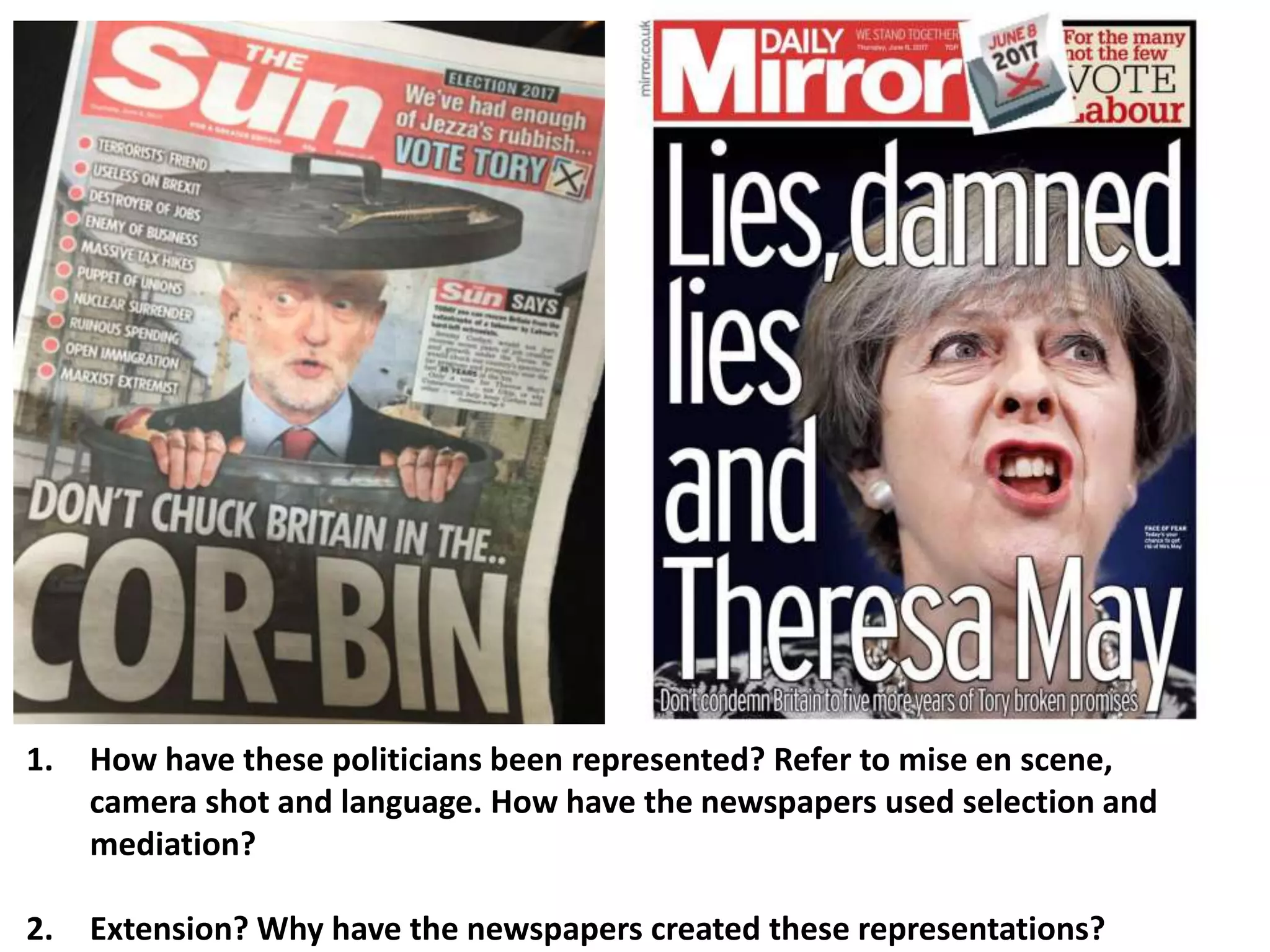
1. How have these politicians been represented? Refer to mise en scene,
camera shot and language. How have the newspapers used selection and
mediation?
2. Extension? Why have the newspapers created these representations?
Analysing representations
• PERSIA
• Point
• Evidence (from the text)
• Reinforce/subvert stereotypes
• Ideology (What are the messages and values behind the text?)
• Audience (what is the effect on the audience?)
Under-represented and misrepresented
groups
Under-represented:
Disability
LGBTQ (until recently)
Middle Eastern Culture
Asian
African/sub Saharan
Elderly
Women (depending on media
texts/genre)
• Misrepresented:
• Muslims (Islamophobia)
• Young, black males
• Youth
• Lower classes
Femininity and Feminism
Femininity is the quality of being female. It is a set of expected behaviours,
roles and attributes usually associated with women and girls. It can be seen as
a SOCIAL CONSTRUCT. It has been normalised by society.
“The female appeared very feminine.” OR
“The female expressed her femininity by wearing red lipstick.”
Feminism is the belief that both sexes are equal.
“A feminist might believe that the text is offensive” OR
A feminist might believe that the text empowers women”
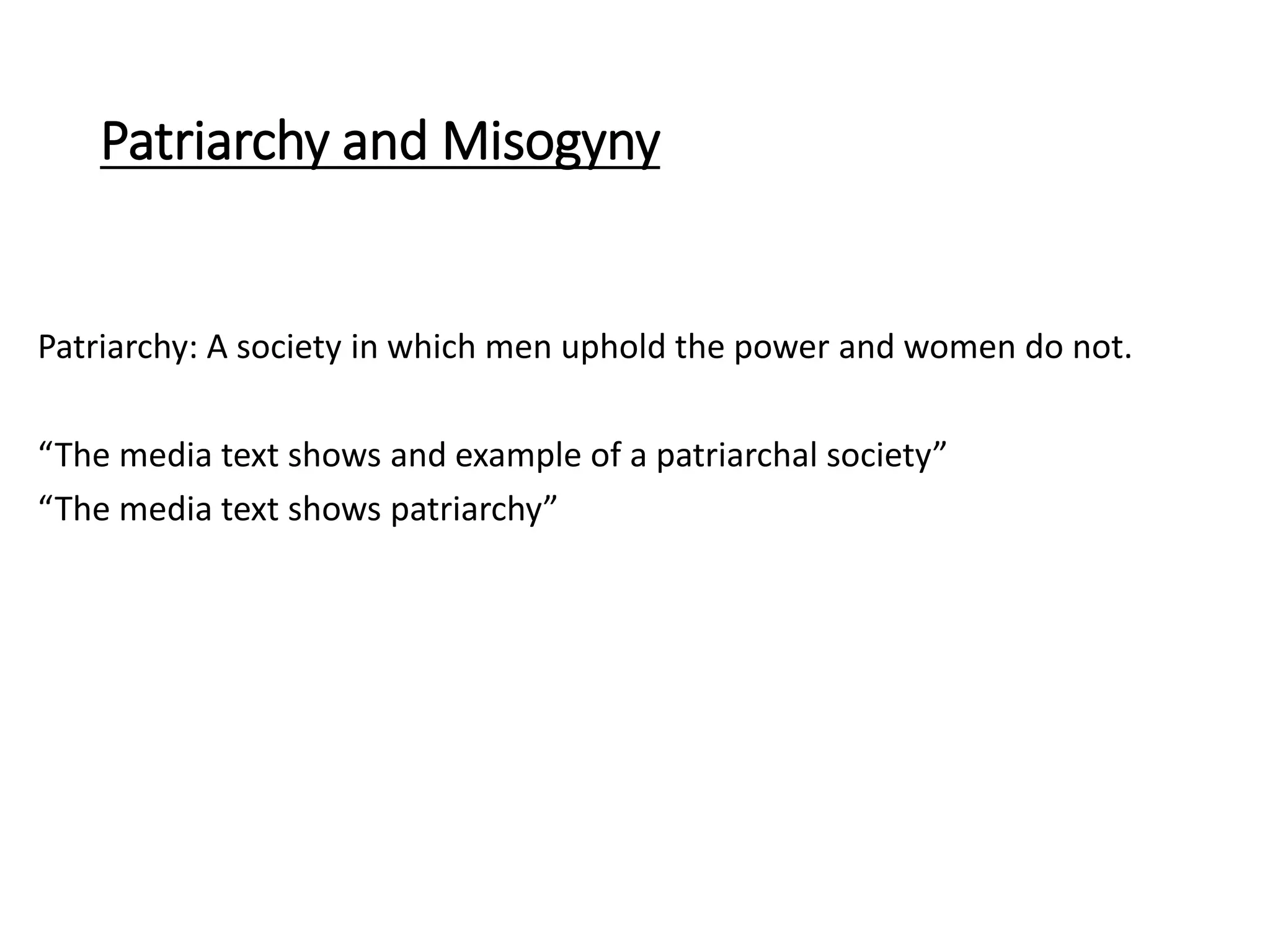
Patriarchy and Misogyny
Patriarchy: A society in which men uphold the power and women do not.
“The media text shows and example of a patriarchal society”
“The media text shows patriarchy”
Misogynistic: A person who hates, prejudices or does not trust women. This
can be shown through;
Discrimination
Social exclusion
Violence towards women
Sexual objectification
Male priviledge
“The male in the text could be seen as misogynistic because…”
Or
“The text could be seen as misogynistic because…”
Some texts have multiple meanings and
representations.
• You might view a text and think it has very positive representations of
gender. However, when you look a little closer there could be multiple
meanings and messages surrounding the representations.
• For example; an empowered feel who appears strong, fights well and is
independent. However, her costume is revealing and sexualised.
• If there are multiple, conflicting representations the text is seen as
POLYSEMIC
• “The text can be seen as polysemic because there are several ways that
women have been represented.”
• If a text can be interpreted/read in a number of ways it is also Polysemic.
Post-feminist perspective
• A post feminist might argue that a woman is celebrating her body
when she is shown in a sexual way.
• A post feminist argues that sexualisation can be a form of female
empowerment!
LAURA MULVEY: THE MALE GAZE
• Feminist Icon and theorist- Laura Mulvey coined the term ‘Male gaze’ to
describe how women are looked at in Cinema (but we can apply this to all
forms of media)
• She argues that women are often overly sexualised in the media. The
audience are encouraged to look (or gaze) at them from a heterosexual,
male’s perspective.
• She noted that media texts often relegate women to objects of sexual
desire. The camera often lingers on sexualised body parts.
• This provides erotic pleasure for a heterosexual male audience and
provides sexual gratification in the form of voyeurism (the pleasure of
looking)
GAMMAN AND MARSHMENT: FEMALE GAZE
• FEMALE GAZE- THE OPPOSITE OF THE MALE GAZE. The idea that men
are also viewed as objects of sexual desire in the media.
STEVE NEALE: GAY GAZE
• Images which show men in passive, submissive, sexualised poses,
lying down, looking up at the camera so that the viewer is dominant
can be described as homoerotic. In this case the male subject will
have hands behind their heads in a pose which could suggest
relaxation but could also be read as submissive and non- aggressive.
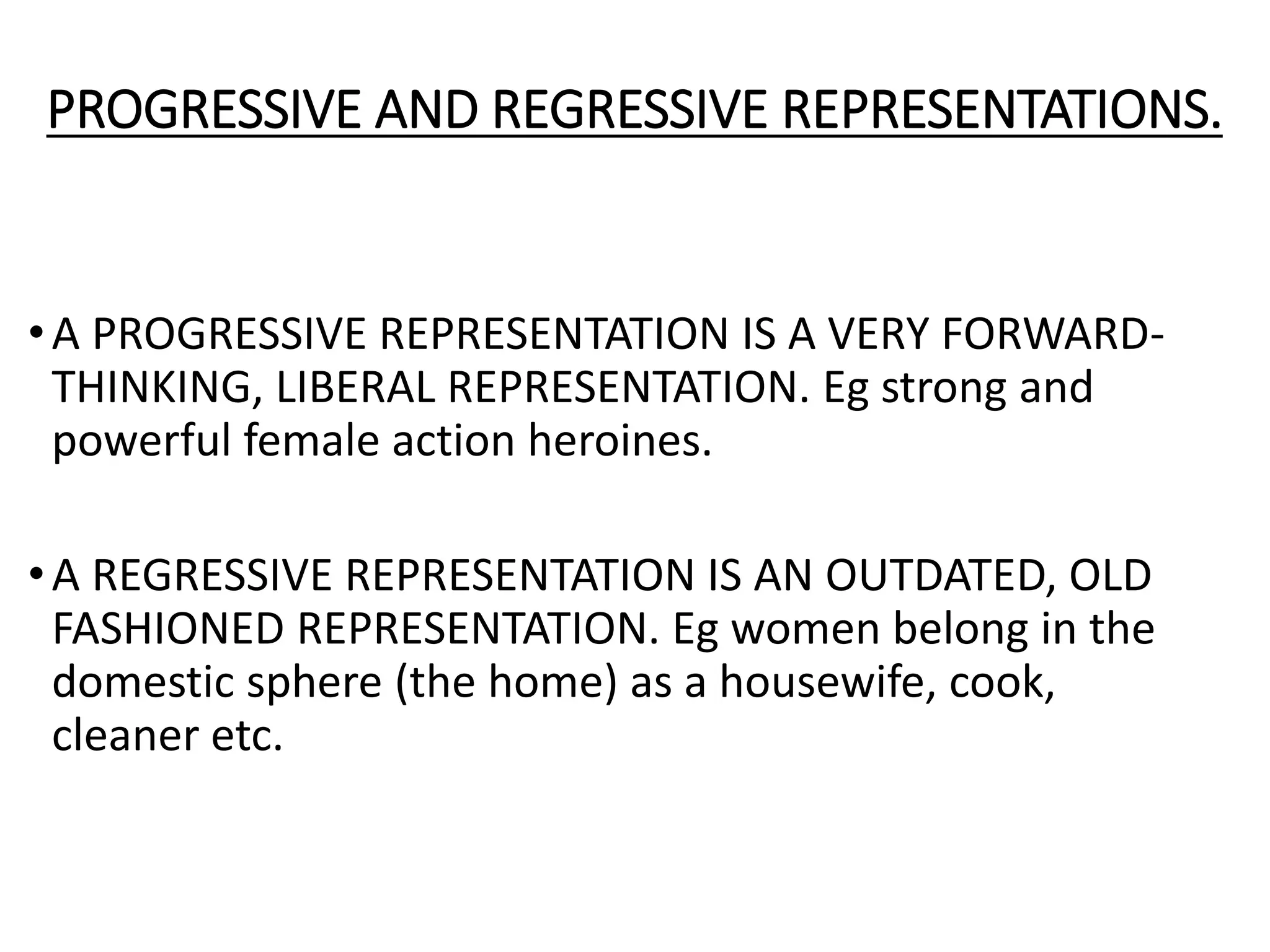
PROGRESSIVE AND REGRESSIVE REPRESENTATIONS.
•A PROGRESSIVE REPRESENTATION IS A VERY FORWARD-
THINKING, LIBERAL REPRESENTATION. Eg strong and
powerful female action heroines.
•A REGRESSIVE REPRESENTATION IS AN OUTDATED, OLD
FASHIONED REPRESENTATION. Eg women belong in the
domestic sphere (the home) as a housewife, cook,
cleaner etc.
STUART HALL: REPRESENTATION
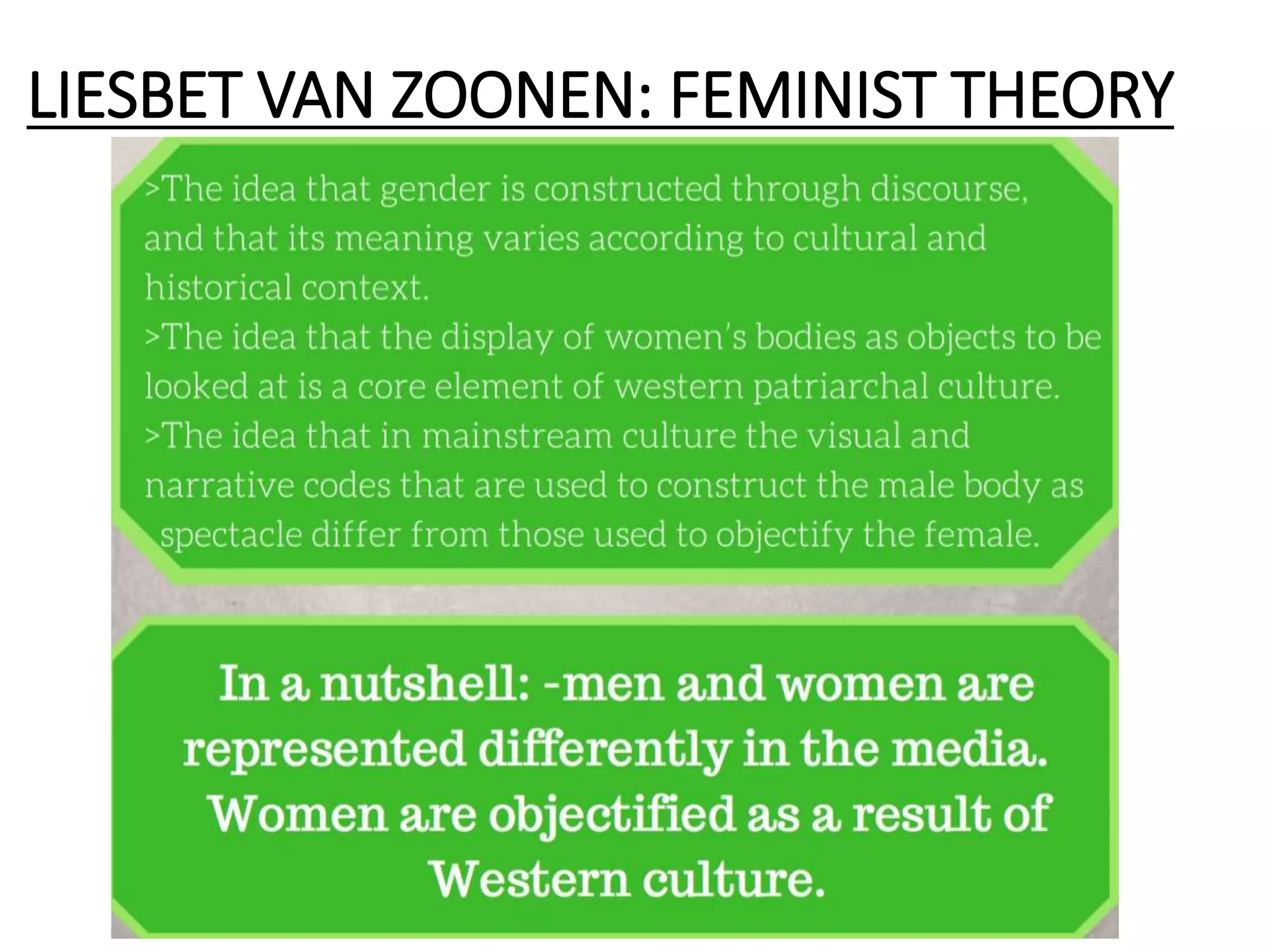
LIESBET VAN ZOONEN: FEMINIST THEORY
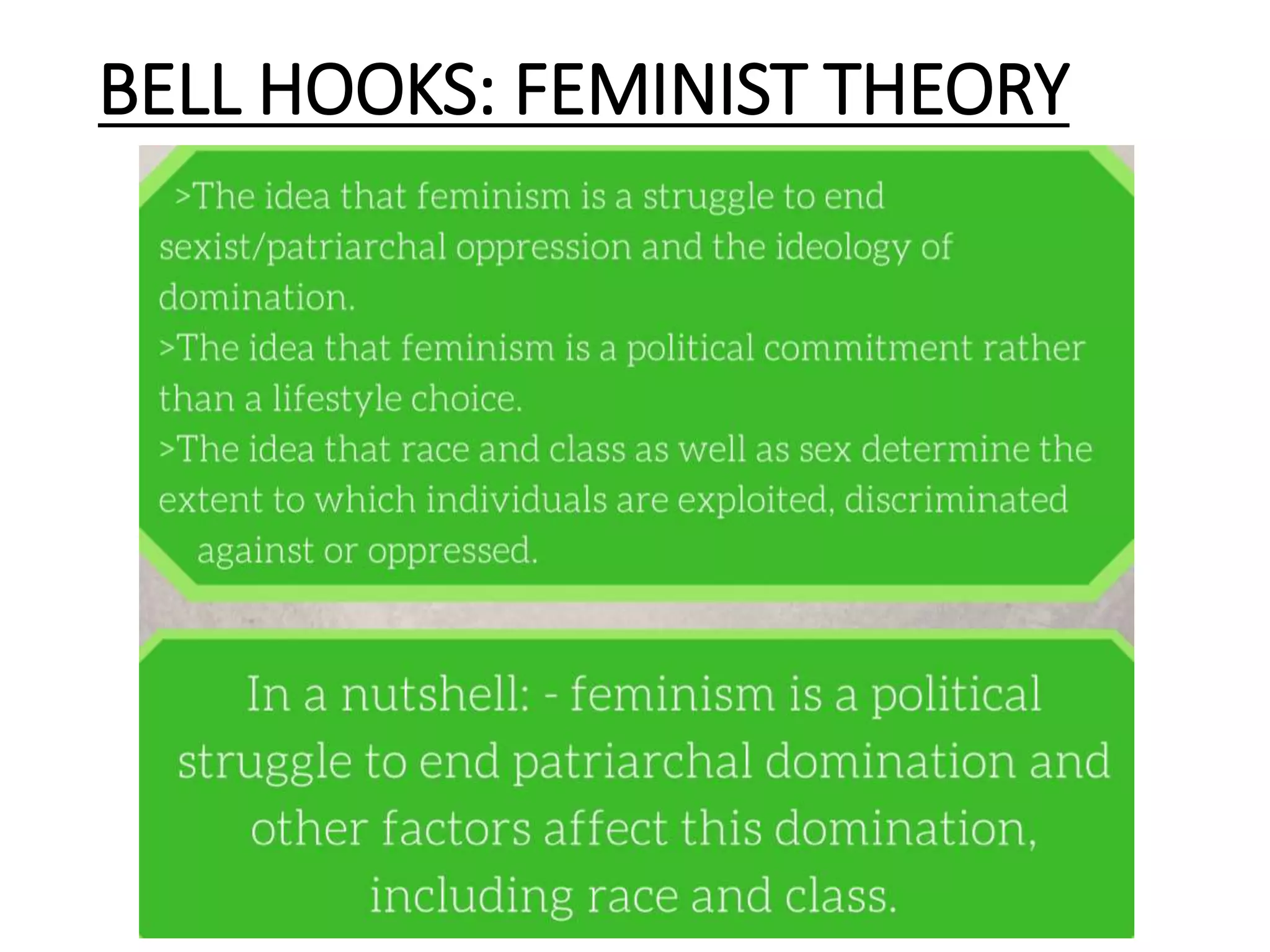
BELL HOOKS: FEMINIST THEORY
JUDITH BUTLER: GENDER PERFORMATIVITY
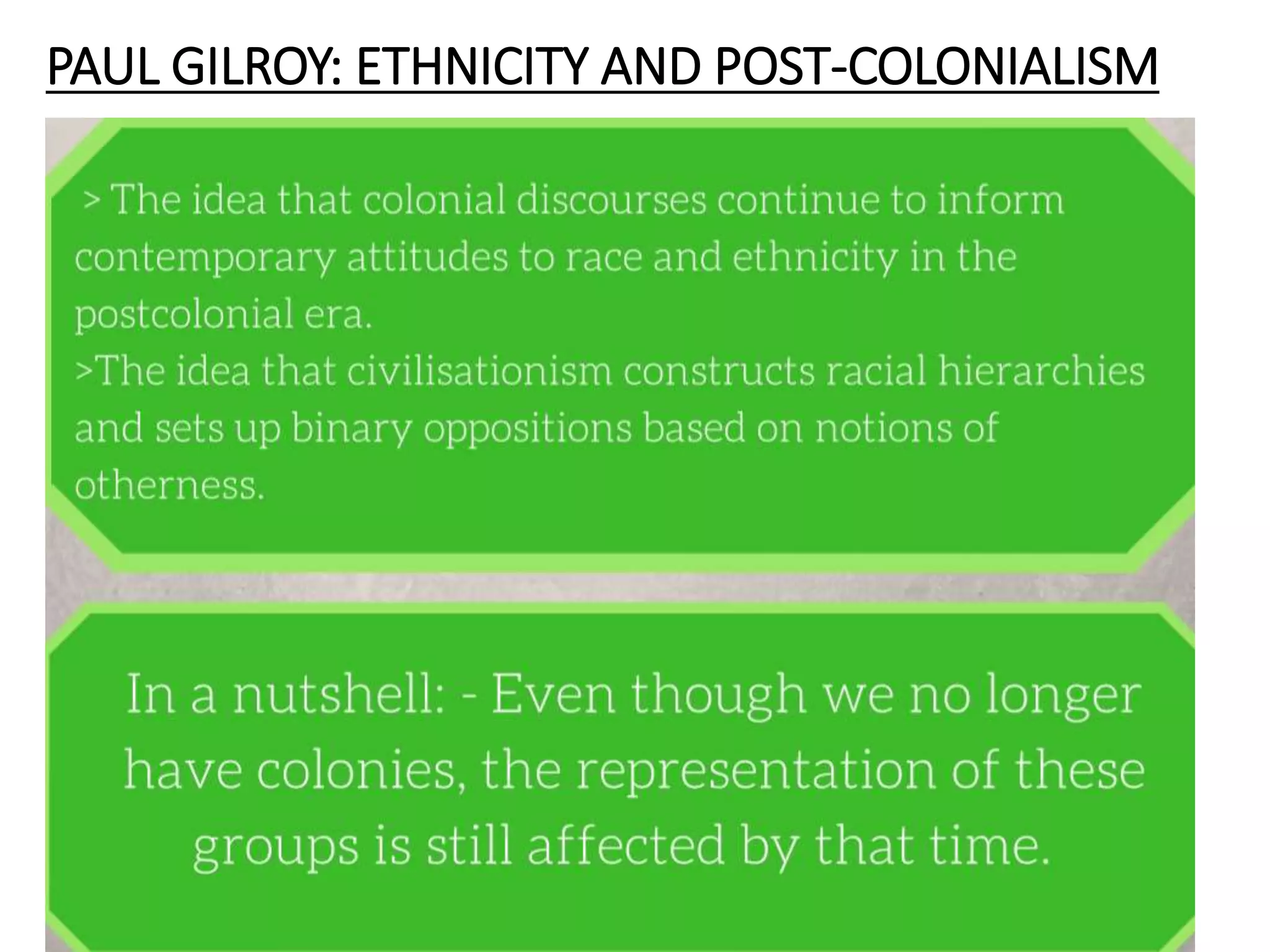
PAUL GILROY: ETHNICITY AND POST-COLONIALISM
David Gauntlett: Representation and
identity
• David Gauntlett argues that in the media today ‘we no longer get singular,
straightforward messages about ideal types of male and female identities.’
• “On the one hand, identity is something unique to each of us that we
assume is more or less consistent over time...our identity is something we
uniquely possess: it is what distinguishes us from other people. Yet on the
other hand, identity also implies a relationship with a broader collective or
social group of some kind”
• “The media do not construct collective identity they merely reflect it”
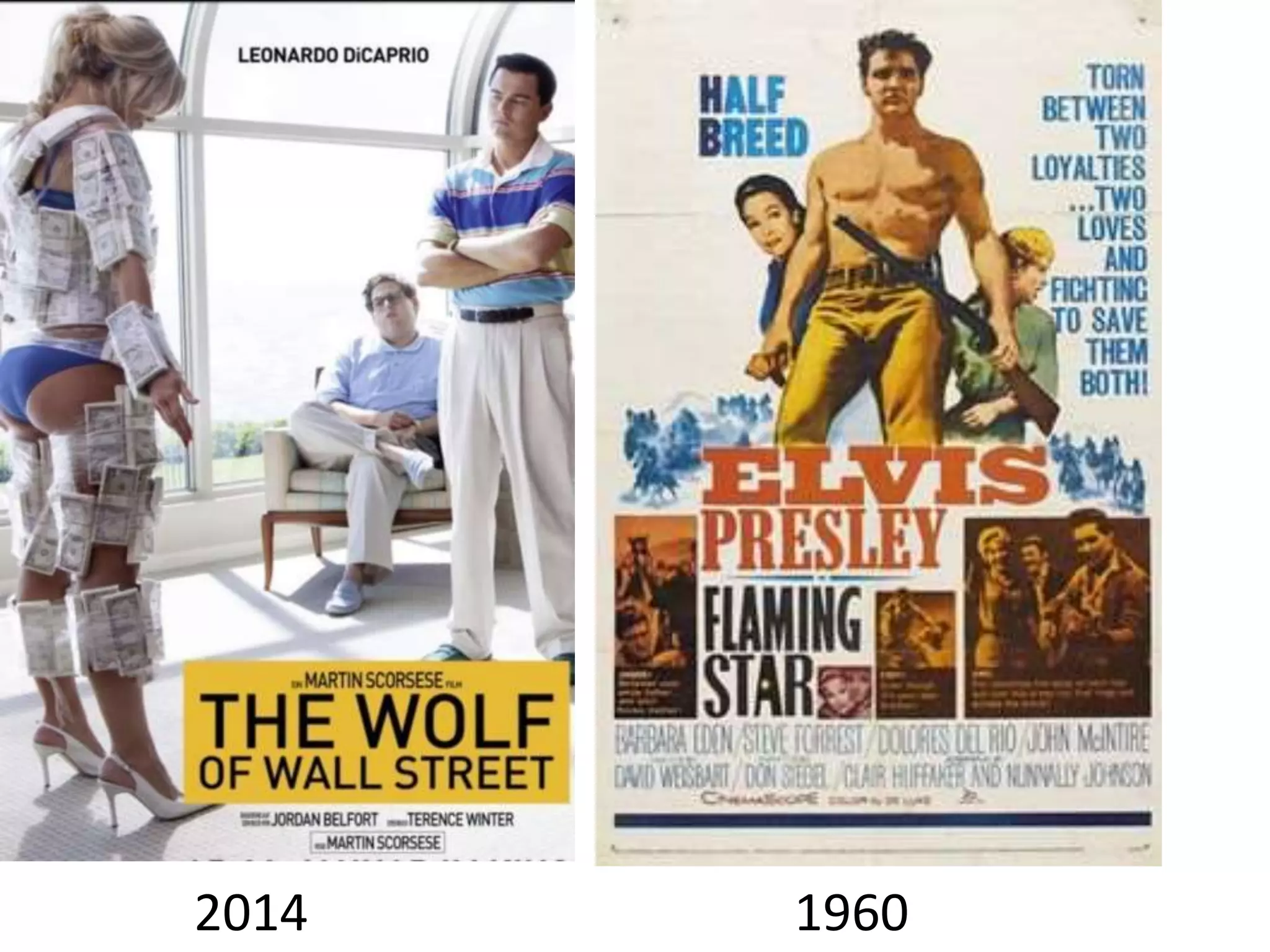
2014 1960
Representation: Advertising and Marketing
Compare representations in the two film posters.
The Wolf of Wall Street & Flaming Star
• Consider representation of gender and ethnicity
• Provide evidence to support your points
• Apply relevant theory
• Use media terminology

2.Media Representation

  • 1.
  • 2.
    Representation: •“The process bywhich the media represent the ‘real world’ (Rayner) • What does this quote mean?
  • 3.
    Key questions weask when analysing representations • Who or what is being represented? • How is the representation created? • Who has created the representation? • Why is the representation created in that way? What is the intention? • What is the effect of the representation?
  • 4.
    Representation can becreated by… • Camera shots • Music • Editing • Photoshop • Text/anchorage text/captions • Mise en scene • Language •The media create representations through a SELECTION AND MEDIATION PROCESS. •They deliberately and carefully select their choice of images and language to CONSTRUCT a representation. They make a conscious decision about which shots to include and which to leave out.
  • 5.
    1. How havethese politicians been represented? Refer to mise en scene, camera shot and language. How have the newspapers used selection and mediation? 2. Extension? Why have the newspapers created these representations?
  • 6.
    Analysing representations • PERSIA •Point • Evidence (from the text) • Reinforce/subvert stereotypes • Ideology (What are the messages and values behind the text?) • Audience (what is the effect on the audience?)
  • 7.
    Under-represented and misrepresented groups Under-represented: Disability LGBTQ(until recently) Middle Eastern Culture Asian African/sub Saharan Elderly Women (depending on media texts/genre) • Misrepresented: • Muslims (Islamophobia) • Young, black males • Youth • Lower classes
  • 8.
    Femininity and Feminism Femininityis the quality of being female. It is a set of expected behaviours, roles and attributes usually associated with women and girls. It can be seen as a SOCIAL CONSTRUCT. It has been normalised by society. “The female appeared very feminine.” OR “The female expressed her femininity by wearing red lipstick.” Feminism is the belief that both sexes are equal. “A feminist might believe that the text is offensive” OR A feminist might believe that the text empowers women”
  • 9.
    Patriarchy and Misogyny Patriarchy:A society in which men uphold the power and women do not. “The media text shows and example of a patriarchal society” “The media text shows patriarchy”
  • 10.
    Misogynistic: A personwho hates, prejudices or does not trust women. This can be shown through; Discrimination Social exclusion Violence towards women Sexual objectification Male priviledge “The male in the text could be seen as misogynistic because…” Or “The text could be seen as misogynistic because…”
  • 11.
    Some texts havemultiple meanings and representations. • You might view a text and think it has very positive representations of gender. However, when you look a little closer there could be multiple meanings and messages surrounding the representations. • For example; an empowered feel who appears strong, fights well and is independent. However, her costume is revealing and sexualised. • If there are multiple, conflicting representations the text is seen as POLYSEMIC • “The text can be seen as polysemic because there are several ways that women have been represented.” • If a text can be interpreted/read in a number of ways it is also Polysemic.
  • 12.
    Post-feminist perspective • Apost feminist might argue that a woman is celebrating her body when she is shown in a sexual way. • A post feminist argues that sexualisation can be a form of female empowerment!
  • 13.
    LAURA MULVEY: THEMALE GAZE • Feminist Icon and theorist- Laura Mulvey coined the term ‘Male gaze’ to describe how women are looked at in Cinema (but we can apply this to all forms of media) • She argues that women are often overly sexualised in the media. The audience are encouraged to look (or gaze) at them from a heterosexual, male’s perspective. • She noted that media texts often relegate women to objects of sexual desire. The camera often lingers on sexualised body parts. • This provides erotic pleasure for a heterosexual male audience and provides sexual gratification in the form of voyeurism (the pleasure of looking)
  • 14.
    GAMMAN AND MARSHMENT:FEMALE GAZE • FEMALE GAZE- THE OPPOSITE OF THE MALE GAZE. The idea that men are also viewed as objects of sexual desire in the media.
  • 15.
    STEVE NEALE: GAYGAZE • Images which show men in passive, submissive, sexualised poses, lying down, looking up at the camera so that the viewer is dominant can be described as homoerotic. In this case the male subject will have hands behind their heads in a pose which could suggest relaxation but could also be read as submissive and non- aggressive.
  • 16.
    PROGRESSIVE AND REGRESSIVEREPRESENTATIONS. •A PROGRESSIVE REPRESENTATION IS A VERY FORWARD- THINKING, LIBERAL REPRESENTATION. Eg strong and powerful female action heroines. •A REGRESSIVE REPRESENTATION IS AN OUTDATED, OLD FASHIONED REPRESENTATION. Eg women belong in the domestic sphere (the home) as a housewife, cook, cleaner etc.
  • 17.
  • 18.
    LIESBET VAN ZOONEN:FEMINIST THEORY
  • 19.
  • 20.
    JUDITH BUTLER: GENDERPERFORMATIVITY
  • 21.
    PAUL GILROY: ETHNICITYAND POST-COLONIALISM
  • 22.
    David Gauntlett: Representationand identity • David Gauntlett argues that in the media today ‘we no longer get singular, straightforward messages about ideal types of male and female identities.’ • “On the one hand, identity is something unique to each of us that we assume is more or less consistent over time...our identity is something we uniquely possess: it is what distinguishes us from other people. Yet on the other hand, identity also implies a relationship with a broader collective or social group of some kind” • “The media do not construct collective identity they merely reflect it”
  • 23.
  • 24.
    Representation: Advertising andMarketing Compare representations in the two film posters. The Wolf of Wall Street & Flaming Star • Consider representation of gender and ethnicity • Provide evidence to support your points • Apply relevant theory • Use media terminology