Analysis of Algorithms
String matching
Andres Mendez-Vazquez
November 24, 2015
1 / 40
Outline
1 String Matching
Introduction
Some Notation
2 Naive Algorithm
Using Brute Force
3 The Rabin-Karp Algorithm
Efficiency After All
Horner’s Rule
Generaiting Possible Matches
The Final Algorithm
Other Methods
4 Exercises
2 / 40
What is string matching?
Given two sequences of characters drawn from a finite alphabet Σ,
T [1..n] and P [1..m]
a b c a b a a b c a b a c a b
a b a a
TEXT T
PATTERN P
s=3
Valid Shift
3 / 40
Where...
A Valid Shift
P occurs with a valid shift s if for some 0 ≤ s ≤ n − m =⇒
T [s + 1..s + m] == P [1..m].
Otherwise
it is an invalid shift.
Thus
The string-matching problem is the problem of of finding all valid shifts
given a patten P on a text T.
4 / 40
Where...
A Valid Shift
P occurs with a valid shift s if for some 0 ≤ s ≤ n − m =⇒
T [s + 1..s + m] == P [1..m].
Otherwise
it is an invalid shift.
Thus
The string-matching problem is the problem of of finding all valid shifts
given a patten P on a text T.
4 / 40
Where...
A Valid Shift
P occurs with a valid shift s if for some 0 ≤ s ≤ n − m =⇒
T [s + 1..s + m] == P [1..m].
Otherwise
it is an invalid shift.
Thus
The string-matching problem is the problem of of finding all valid shifts
given a patten P on a text T.
4 / 40
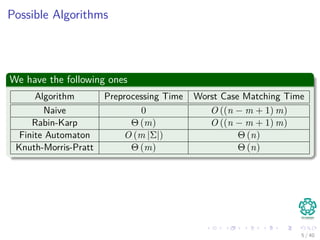
Possible Algorithms
We have the following ones
Algorithm Preprocessing Time Worst Case Matching Time
Naive 0 O ((n − m + 1) m)
Rabin-Karp Θ (m) O ((n − m + 1) m)
Finite Automaton O (m |Σ|) Θ (n)
Knuth-Morris-Pratt Θ (m) Θ (n)
5 / 40
Outline
1 String Matching
Introduction
Some Notation
2 Naive Algorithm
Using Brute Force
3 The Rabin-Karp Algorithm
Efficiency After All
Horner’s Rule
Generaiting Possible Matches
The Final Algorithm
Other Methods
4 Exercises
6 / 40
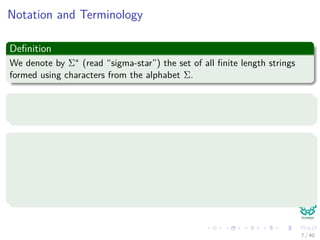
Notation and Terminology
Definition
We denote by Σ∗ (read “sigma-star”) the set of all finite length strings
formed using characters from the alphabet Σ.
Constraint
We assume a finite length strings.
Some basic concepts
The zero empty string, , also belong to Σ∗.
The length of a string x is denoted |x|.
The concatenation of two strings x and y, denoted xy, has length
|x| + |y|
7 / 40
Notation and Terminology
Definition
We denote by Σ∗ (read “sigma-star”) the set of all finite length strings
formed using characters from the alphabet Σ.
Constraint
We assume a finite length strings.
Some basic concepts
The zero empty string, , also belong to Σ∗.
The length of a string x is denoted |x|.
The concatenation of two strings x and y, denoted xy, has length
|x| + |y|
7 / 40
Notation and Terminology
Definition
We denote by Σ∗ (read “sigma-star”) the set of all finite length strings
formed using characters from the alphabet Σ.
Constraint
We assume a finite length strings.
Some basic concepts
The zero empty string, , also belong to Σ∗.
The length of a string x is denoted |x|.
The concatenation of two strings x and y, denoted xy, has length
|x| + |y|
7 / 40
Notation and Terminology
Definition
We denote by Σ∗ (read “sigma-star”) the set of all finite length strings
formed using characters from the alphabet Σ.
Constraint
We assume a finite length strings.
Some basic concepts
The zero empty string, , also belong to Σ∗.
The length of a string x is denoted |x|.
The concatenation of two strings x and y, denoted xy, has length
|x| + |y|
7 / 40
Notation and Terminology
Definition
We denote by Σ∗ (read “sigma-star”) the set of all finite length strings
formed using characters from the alphabet Σ.
Constraint
We assume a finite length strings.
Some basic concepts
The zero empty string, , also belong to Σ∗.
The length of a string x is denoted |x|.
The concatenation of two strings x and y, denoted xy, has length
|x| + |y|
7 / 40
Notation and Terminology
Prefix
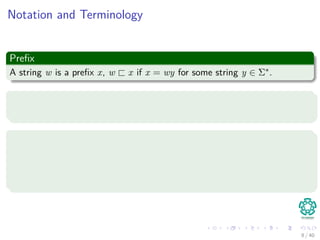
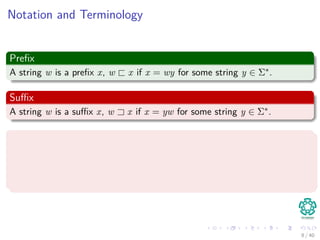
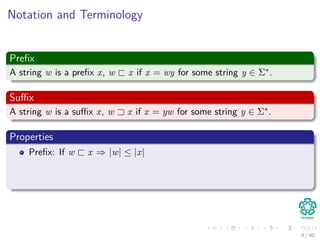
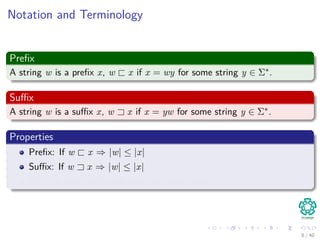
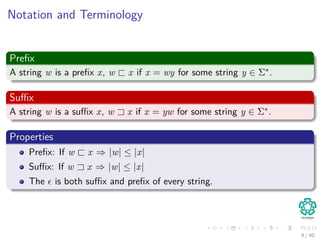
A string w is a prefix x, w x if x = wy for some string y ∈ Σ∗.
Suffix
A string w is a suffix x, w x if x = yw for some string y ∈ Σ∗.
Properties
Prefix: If w x ⇒ |w| ≤ |x|
Suffix: If w x ⇒ |w| ≤ |x|
The is both suffix and prefix of every string.
8 / 40
Notation and Terminology
Prefix
A string w is a prefix x, w x if x = wy for some string y ∈ Σ∗.
Suffix
A string w is a suffix x, w x if x = yw for some string y ∈ Σ∗.
Properties
Prefix: If w x ⇒ |w| ≤ |x|
Suffix: If w x ⇒ |w| ≤ |x|
The is both suffix and prefix of every string.
8 / 40
Notation and Terminology
Prefix
A string w is a prefix x, w x if x = wy for some string y ∈ Σ∗.
Suffix
A string w is a suffix x, w x if x = yw for some string y ∈ Σ∗.
Properties
Prefix: If w x ⇒ |w| ≤ |x|
Suffix: If w x ⇒ |w| ≤ |x|
The is both suffix and prefix of every string.
8 / 40
Notation and Terminology
Prefix
A string w is a prefix x, w x if x = wy for some string y ∈ Σ∗.
Suffix
A string w is a suffix x, w x if x = yw for some string y ∈ Σ∗.
Properties
Prefix: If w x ⇒ |w| ≤ |x|
Suffix: If w x ⇒ |w| ≤ |x|
The is both suffix and prefix of every string.
8 / 40
Notation and Terminology
Prefix
A string w is a prefix x, w x if x = wy for some string y ∈ Σ∗.
Suffix
A string w is a suffix x, w x if x = yw for some string y ∈ Σ∗.
Properties
Prefix: If w x ⇒ |w| ≤ |x|
Suffix: If w x ⇒ |w| ≤ |x|
The is both suffix and prefix of every string.
8 / 40
Notation and Terminology
In addition
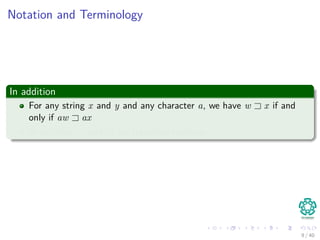
For any string x and y and any character a, we have w x if and
only if aw ax
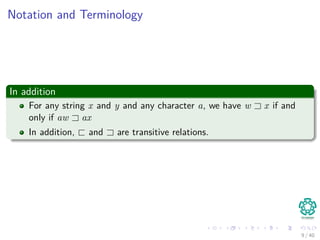
In addition, and are transitive relations.
9 / 40
Notation and Terminology
In addition
For any string x and y and any character a, we have w x if and
only if aw ax
In addition, and are transitive relations.
9 / 40
Outline
1 String Matching
Introduction
Some Notation
2 Naive Algorithm
Using Brute Force
3 The Rabin-Karp Algorithm
Efficiency After All
Horner’s Rule
Generaiting Possible Matches
The Final Algorithm
Other Methods
4 Exercises
10 / 40
The naive string algorithm
Algorithm
NAIVE-STRING-MATCHER(T, P)
1 n = T.length
2 m = P.length
3 for s = 0 to n − m
4 if P [1..m] == T [s + 1..s + m]
5 print “Pattern occurs with shift” s
Complexity
O((n − m + 1)m) or Θ n2 if m = n
2
11 / 40
The naive string algorithm
Algorithm
NAIVE-STRING-MATCHER(T, P)
1 n = T.length
2 m = P.length
3 for s = 0 to n − m
4 if P [1..m] == T [s + 1..s + m]
5 print “Pattern occurs with shift” s
Complexity
O((n − m + 1)m) or Θ n2 if m = n
2
11 / 40
Outline
1 String Matching
Introduction
Some Notation
2 Naive Algorithm
Using Brute Force
3 The Rabin-Karp Algorithm
Efficiency After All
Horner’s Rule
Generaiting Possible Matches
The Final Algorithm
Other Methods
4 Exercises
12 / 40
A more elaborated algorithm
Rabin-Karp algorithm
Lets assume that Σ = {0, 1, ..., 9} then we have the following:
Thus, each string of k consecutive characters is a k-length decimal
number:
c1c2 · · · ck−1ck = 10k−1c1 + 10k−2c2 + . . . + 10ck−1 + ck
Thus
p correspond the decimal number for pattern P [1..m].
ts denote decimal value of m-length substring T [s + 1..s + m] for
s = 0, 1, ..., n − m.
13 / 40
A more elaborated algorithm
Rabin-Karp algorithm
Lets assume that Σ = {0, 1, ..., 9} then we have the following:
Thus, each string of k consecutive characters is a k-length decimal
number:
c1c2 · · · ck−1ck = 10k−1c1 + 10k−2c2 + . . . + 10ck−1 + ck
Thus
p correspond the decimal number for pattern P [1..m].
ts denote decimal value of m-length substring T [s + 1..s + m] for
s = 0, 1, ..., n − m.
13 / 40
A more elaborated algorithm
Rabin-Karp algorithm
Lets assume that Σ = {0, 1, ..., 9} then we have the following:
Thus, each string of k consecutive characters is a k-length decimal
number:
c1c2 · · · ck−1ck = 10k−1c1 + 10k−2c2 + . . . + 10ck−1 + ck
Thus
p correspond the decimal number for pattern P [1..m].
ts denote decimal value of m-length substring T [s + 1..s + m] for
s = 0, 1, ..., n − m.
13 / 40
A more elaborated algorithm
Rabin-Karp algorithm
Lets assume that Σ = {0, 1, ..., 9} then we have the following:
Thus, each string of k consecutive characters is a k-length decimal
number:
c1c2 · · · ck−1ck = 10k−1c1 + 10k−2c2 + . . . + 10ck−1 + ck
Thus
p correspond the decimal number for pattern P [1..m].
ts denote decimal value of m-length substring T [s + 1..s + m] for
s = 0, 1, ..., n − m.
13 / 40
Then
Properties
Clearly ts == p if and only if T [s + 1..s + m] == P [1..m], thus s is a
valid shift.
14 / 40
Now, think about this
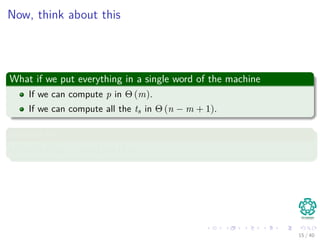
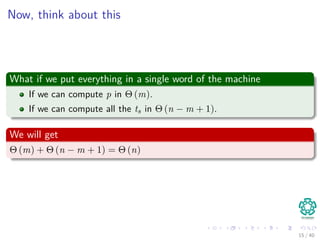
What if we put everything in a single word of the machine
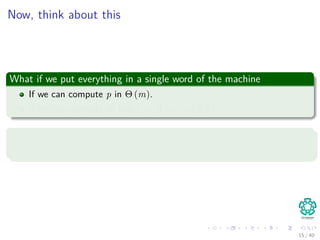
If we can compute p in Θ (m).
If we can compute all the ts in Θ (n − m + 1).
We will get
Θ (m) + Θ (n − m + 1) = Θ (n)
15 / 40
Now, think about this
What if we put everything in a single word of the machine
If we can compute p in Θ (m).
If we can compute all the ts in Θ (n − m + 1).
We will get
Θ (m) + Θ (n − m + 1) = Θ (n)
15 / 40
Now, think about this
What if we put everything in a single word of the machine
If we can compute p in Θ (m).
If we can compute all the ts in Θ (n − m + 1).
We will get
Θ (m) + Θ (n − m + 1) = Θ (n)
15 / 40
Outline
1 String Matching
Introduction
Some Notation
2 Naive Algorithm
Using Brute Force
3 The Rabin-Karp Algorithm
Efficiency After All
Horner’s Rule
Generaiting Possible Matches
The Final Algorithm
Other Methods
4 Exercises
16 / 40
Remember Horner’s Rule
Consider
We can compute, the decimal representation by the Horner’s rule:
p = P[m] + 10(P[m − 1] + 10(P[m − 2] + ... + 10(P[2] + 10P[1])...)) (1)
Thus, we can compute t0 using this rule in
Θ (m) (2)
17 / 40
Remember Horner’s Rule
Consider
We can compute, the decimal representation by the Horner’s rule:
p = P[m] + 10(P[m − 1] + 10(P[m − 2] + ... + 10(P[2] + 10P[1])...)) (1)
Thus, we can compute t0 using this rule in
Θ (m) (2)
17 / 40
Example
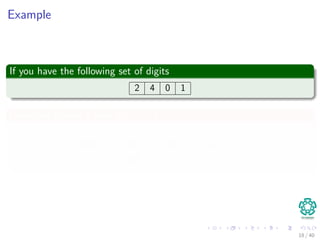
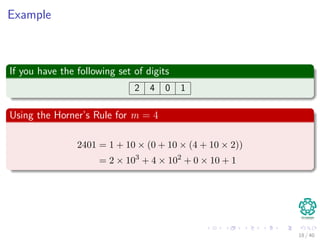
If you have the following set of digits
2 4 0 1
Using the Horner’s Rule for m = 4
2401 = 1 + 10 × (0 + 10 × (4 + 10 × 2))
= 2 × 10³
+ 4 × 10²
+ 0 × 10 + 1
18 / 40
Example
If you have the following set of digits
2 4 0 1
Using the Horner’s Rule for m = 4
2401 = 1 + 10 × (0 + 10 × (4 + 10 × 2))
= 2 × 10³
+ 4 × 10²
+ 0 × 10 + 1
18 / 40
Then
To compute the remaining values, we can use the previous value
ts+1 = 10 ts − 10m−1
T [s + 1] + T [s + m + 1] . (3)
Notice the following
Subtracting from it 10m−1T [s + 1] removes the high-order digit from
ts.
Multiplying the result by 10 shifts the number left by one digit
position.
Adding T [s + m + 1] brings in the appropriate low-order digit.
19 / 40
Then
To compute the remaining values, we can use the previous value
ts+1 = 10 ts − 10m−1
T [s + 1] + T [s + m + 1] . (3)
Notice the following
Subtracting from it 10m−1T [s + 1] removes the high-order digit from
ts.
Multiplying the result by 10 shifts the number left by one digit
position.
Adding T [s + m + 1] brings in the appropriate low-order digit.
19 / 40
Then
To compute the remaining values, we can use the previous value
ts+1 = 10 ts − 10m−1
T [s + 1] + T [s + m + 1] . (3)
Notice the following
Subtracting from it 10m−1T [s + 1] removes the high-order digit from
ts.
Multiplying the result by 10 shifts the number left by one digit
position.
Adding T [s + m + 1] brings in the appropriate low-order digit.
19 / 40
Example
Imagine that you have...
index 1 2 3 4 5 6
digit 1 0 2 4 1 0
1 We have t0 = 1024 then we want to calculate 0241
2 Then we subtract 103 × T [1] == 1000 of 1024
3 We get 0024
4 Multiply by 10, and we get 0240
5 We add T [5] == 1
6 Finally, we get 0241
20 / 40
Example
Imagine that you have...
index 1 2 3 4 5 6
digit 1 0 2 4 1 0
1 We have t0 = 1024 then we want to calculate 0241
2 Then we subtract 103 × T [1] == 1000 of 1024
3 We get 0024
4 Multiply by 10, and we get 0240
5 We add T [5] == 1
6 Finally, we get 0241
20 / 40
Example
Imagine that you have...
index 1 2 3 4 5 6
digit 1 0 2 4 1 0
1 We have t0 = 1024 then we want to calculate 0241
2 Then we subtract 103 × T [1] == 1000 of 1024
3 We get 0024
4 Multiply by 10, and we get 0240
5 We add T [5] == 1
6 Finally, we get 0241
20 / 40
Example
Imagine that you have...
index 1 2 3 4 5 6
digit 1 0 2 4 1 0
1 We have t0 = 1024 then we want to calculate 0241
2 Then we subtract 103 × T [1] == 1000 of 1024
3 We get 0024
4 Multiply by 10, and we get 0240
5 We add T [5] == 1
6 Finally, we get 0241
20 / 40
Example
Imagine that you have...
index 1 2 3 4 5 6
digit 1 0 2 4 1 0
1 We have t0 = 1024 then we want to calculate 0241
2 Then we subtract 103 × T [1] == 1000 of 1024
3 We get 0024
4 Multiply by 10, and we get 0240
5 We add T [5] == 1
6 Finally, we get 0241
20 / 40
Example
Imagine that you have...
index 1 2 3 4 5 6
digit 1 0 2 4 1 0
1 We have t0 = 1024 then we want to calculate 0241
2 Then we subtract 103 × T [1] == 1000 of 1024
3 We get 0024
4 Multiply by 10, and we get 0240
5 We add T [5] == 1
6 Finally, we get 0241
20 / 40
Example
Imagine that you have...
index 1 2 3 4 5 6
digit 1 0 2 4 1 0
1 We have t0 = 1024 then we want to calculate 0241
2 Then we subtract 103 × T [1] == 1000 of 1024
3 We get 0024
4 Multiply by 10, and we get 0240
5 We add T [5] == 1
6 Finally, we get 0241
20 / 40
Remarks
First
We can extend this beyond the decimals to any d digit system!!!
What happens when the numbers are quite large?
We can use the module
Meaning
Compute p and ts values modulo a suitable modulus q.
21 / 40
Remarks
First
We can extend this beyond the decimals to any d digit system!!!
What happens when the numbers are quite large?
We can use the module
Meaning
Compute p and ts values modulo a suitable modulus q.
21 / 40
Remarks
First
We can extend this beyond the decimals to any d digit system!!!
What happens when the numbers are quite large?
We can use the module
Meaning
Compute p and ts values modulo a suitable modulus q.
21 / 40
Outline
1 String Matching
Introduction
Some Notation
2 Naive Algorithm
Using Brute Force
3 The Rabin-Karp Algorithm
Efficiency After All
Horner’s Rule
Generaiting Possible Matches
The Final Algorithm
Other Methods
4 Exercises
22 / 40
Remember Hash Functions
Yes, we are mapping the large numbers into the set
{0, 1, 2, ..., q − 1}
23 / 40
Then, to reduce the possible representation
Use the module of q
It is possible to compute p mod q in Θ (m) time and all the ts mod q in
Θ (n − m + 1) time.
Something Notable
If we choose the modulus q as a prime such that 10q just fits within one
computer word, then we can perform all the necessary computations with
single-precision arithmetic.
24 / 40
Then, to reduce the possible representation
Use the module of q
It is possible to compute p mod q in Θ (m) time and all the ts mod q in
Θ (n − m + 1) time.
Something Notable
If we choose the modulus q as a prime such that 10q just fits within one
computer word, then we can perform all the necessary computations with
single-precision arithmetic.
24 / 40
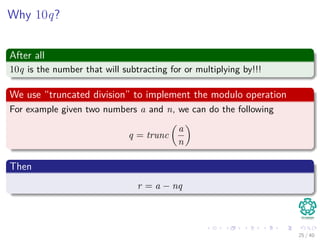
Why 10q?
After all
10q is the number that will subtracting for or multiplying by!!!
We use “truncated division” to implement the modulo operation
For example given two numbers a and n, we can do the following
q = trunc
a
n
Then
r = a − nq
25 / 40
Why 10q?
After all
10q is the number that will subtracting for or multiplying by!!!
We use “truncated division” to implement the modulo operation
For example given two numbers a and n, we can do the following
q = trunc
a
n
Then
r = a − nq
25 / 40
Why 10q?
After all
10q is the number that will subtracting for or multiplying by!!!
We use “truncated division” to implement the modulo operation
For example given two numbers a and n, we can do the following
q = trunc
a
n
Then
r = a − nq
25 / 40
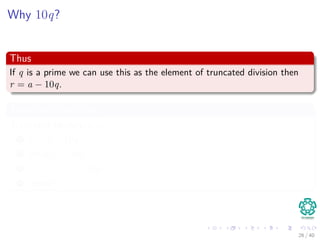
Why 10q?
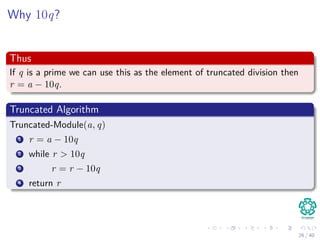
Thus
If q is a prime we can use this as the element of truncated division then
r = a − 10q.
Truncated Algorithm
Truncated-Module(a, q)
1 r = a − 10q
2 while r > 10q
3 r = r − 10q
4 return r
26 / 40
Why 10q?
Thus
If q is a prime we can use this as the element of truncated division then
r = a − 10q.
Truncated Algorithm
Truncated-Module(a, q)
1 r = a − 10q
2 while r > 10q
3 r = r − 10q
4 return r
26 / 40
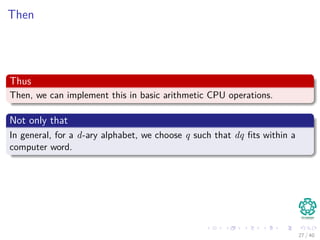
Then
Thus
Then, we can implement this in basic arithmetic CPU operations.
Not only that
In general, for a d-ary alphabet, we choose q such that dq fits within a
computer word.
27 / 40
Then
Thus
Then, we can implement this in basic arithmetic CPU operations.
Not only that
In general, for a d-ary alphabet, we choose q such that dq fits within a
computer word.
27 / 40
In general, we have
The following
ts+1 = (d(ts − T[s + 1]h) + T[s + m + 1]) mod q (4)
where h ≡ dm−1(mod q) is the value of the digit “1” in the high-order
position of an m-digit text window.
Here
We have a small problem!!!
Question?
Can we differentiate between p mod q and ts mod q?
28 / 40
In general, we have
The following
ts+1 = (d(ts − T[s + 1]h) + T[s + m + 1]) mod q (4)
where h ≡ dm−1(mod q) is the value of the digit “1” in the high-order
position of an m-digit text window.
Here
We have a small problem!!!
Question?
Can we differentiate between p mod q and ts mod q?
28 / 40
In general, we have
The following
ts+1 = (d(ts − T[s + 1]h) + T[s + m + 1]) mod q (4)
where h ≡ dm−1(mod q) is the value of the digit “1” in the high-order
position of an m-digit text window.
Here
We have a small problem!!!
Question?
Can we differentiate between p mod q and ts mod q?
28 / 40
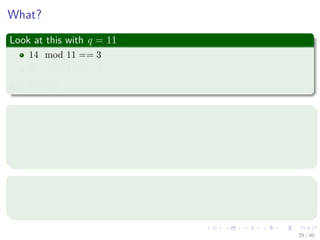
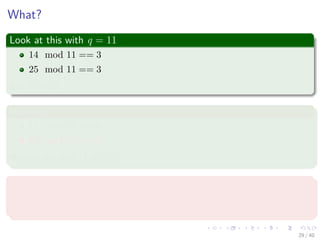
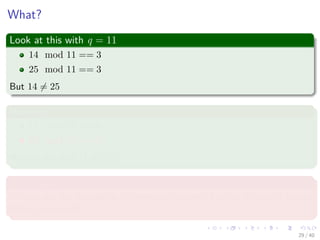
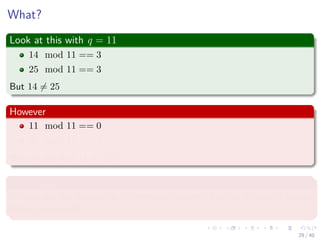
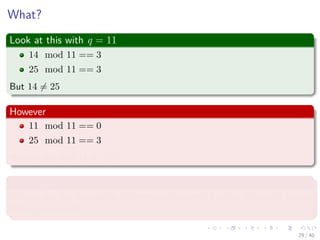
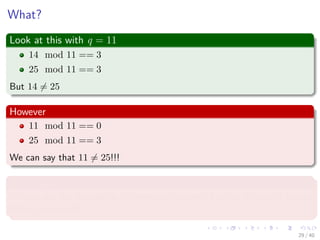
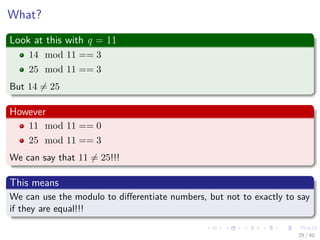
What?
Look at this with q = 11
14 mod 11 == 3
25 mod 11 == 3
But 14 = 25
However
11 mod 11 == 0
25 mod 11 == 3
We can say that 11 = 25!!!
This means
We can use the modulo to differentiate numbers, but not to exactly to say
if they are equal!!!
29 / 40
What?
Look at this with q = 11
14 mod 11 == 3
25 mod 11 == 3
But 14 = 25
However
11 mod 11 == 0
25 mod 11 == 3
We can say that 11 = 25!!!
This means
We can use the modulo to differentiate numbers, but not to exactly to say
if they are equal!!!
29 / 40
What?
Look at this with q = 11
14 mod 11 == 3
25 mod 11 == 3
But 14 = 25
However
11 mod 11 == 0
25 mod 11 == 3
We can say that 11 = 25!!!
This means
We can use the modulo to differentiate numbers, but not to exactly to say
if they are equal!!!
29 / 40
What?
Look at this with q = 11
14 mod 11 == 3
25 mod 11 == 3
But 14 = 25
However
11 mod 11 == 0
25 mod 11 == 3
We can say that 11 = 25!!!
This means
We can use the modulo to differentiate numbers, but not to exactly to say
if they are equal!!!
29 / 40
What?
Look at this with q = 11
14 mod 11 == 3
25 mod 11 == 3
But 14 = 25
However
11 mod 11 == 0
25 mod 11 == 3
We can say that 11 = 25!!!
This means
We can use the modulo to differentiate numbers, but not to exactly to say
if they are equal!!!
29 / 40
What?
Look at this with q = 11
14 mod 11 == 3
25 mod 11 == 3
But 14 = 25
However
11 mod 11 == 0
25 mod 11 == 3
We can say that 11 = 25!!!
This means
We can use the modulo to differentiate numbers, but not to exactly to say
if they are equal!!!
29 / 40
What?
Look at this with q = 11
14 mod 11 == 3
25 mod 11 == 3
But 14 = 25
However
11 mod 11 == 0
25 mod 11 == 3
We can say that 11 = 25!!!
This means
We can use the modulo to differentiate numbers, but not to exactly to say
if they are equal!!!
29 / 40
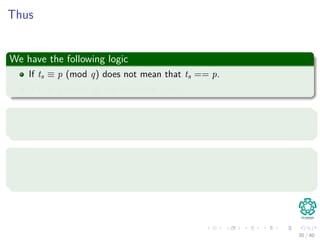
Thus
We have the following logic
If ts ≡ p (mod q) does not mean that ts == p.
If ts ≡ p (mod q), we have that ts = p.
Fixing the problem
To fix this problem we simply test to see if the hit is not spurious.
Note
If q is large enough, then we can hope that spurious hits occur infrequently
enough that the cost of the extra checking is low.
30 / 40
Thus
We have the following logic
If ts ≡ p (mod q) does not mean that ts == p.
If ts ≡ p (mod q), we have that ts = p.
Fixing the problem
To fix this problem we simply test to see if the hit is not spurious.
Note
If q is large enough, then we can hope that spurious hits occur infrequently
enough that the cost of the extra checking is low.
30 / 40
Thus
We have the following logic
If ts ≡ p (mod q) does not mean that ts == p.
If ts ≡ p (mod q), we have that ts = p.
Fixing the problem
To fix this problem we simply test to see if the hit is not spurious.
Note
If q is large enough, then we can hope that spurious hits occur infrequently
enough that the cost of the extra checking is low.
30 / 40
Thus
We have the following logic
If ts ≡ p (mod q) does not mean that ts == p.
If ts ≡ p (mod q), we have that ts = p.
Fixing the problem
To fix this problem we simply test to see if the hit is not spurious.
Note
If q is large enough, then we can hope that spurious hits occur infrequently
enough that the cost of the extra checking is low.
30 / 40
Outline
1 String Matching
Introduction
Some Notation
2 Naive Algorithm
Using Brute Force
3 The Rabin-Karp Algorithm
Efficiency After All
Horner’s Rule
Generaiting Possible Matches
The Final Algorithm
Other Methods
4 Exercises
31 / 40
The Final Algorithm
Rabin-Karp-Matcher(T, P, d, q)
1 n = T.length
2 m = P.length
3 h = dm−1
mod q // Storing the reminder of the highest power
4 p = 0
5 t0 = 0
6 for i = 1 to m // Preprocessing
7 p = (dp + P [i]) mod q
8 t0 = (dp + T [i]) mod q
9 for s = 0 to n − m
10 if p == ts
11 if P [1..m] == T [s + 1..s + m] // Actually a Loop
12 print “Pattern occurs with shift” s
13 if s < n − m
14 ts+1 = (d(ts − T[s + 1]h) + T[s + m + 1]) mod q
32 / 40
The Final Algorithm
Rabin-Karp-Matcher(T, P, d, q)
1 n = T.length
2 m = P.length
3 h = dm−1
mod q // Storing the reminder of the highest power
4 p = 0
5 t0 = 0
6 for i = 1 to m // Preprocessing
7 p = (dp + P [i]) mod q
8 t0 = (dp + T [i]) mod q
9 for s = 0 to n − m
10 if p == ts
11 if P [1..m] == T [s + 1..s + m] // Actually a Loop
12 print “Pattern occurs with shift” s
13 if s < n − m
14 ts+1 = (d(ts − T[s + 1]h) + T[s + m + 1]) mod q
32 / 40
The Final Algorithm
Rabin-Karp-Matcher(T, P, d, q)
1 n = T.length
2 m = P.length
3 h = dm−1
mod q // Storing the reminder of the highest power
4 p = 0
5 t0 = 0
6 for i = 1 to m // Preprocessing
7 p = (dp + P [i]) mod q
8 t0 = (dp + T [i]) mod q
9 for s = 0 to n − m
10 if p == ts
11 if P [1..m] == T [s + 1..s + m] // Actually a Loop
12 print “Pattern occurs with shift” s
13 if s < n − m
14 ts+1 = (d(ts − T[s + 1]h) + T[s + m + 1]) mod q
32 / 40
The Final Algorithm
Rabin-Karp-Matcher(T, P, d, q)
1 n = T.length
2 m = P.length
3 h = dm−1
mod q // Storing the reminder of the highest power
4 p = 0
5 t0 = 0
6 for i = 1 to m // Preprocessing
7 p = (dp + P [i]) mod q
8 t0 = (dp + T [i]) mod q
9 for s = 0 to n − m
10 if p == ts
11 if P [1..m] == T [s + 1..s + m] // Actually a Loop
12 print “Pattern occurs with shift” s
13 if s < n − m
14 ts+1 = (d(ts − T[s + 1]h) + T[s + m + 1]) mod q
32 / 40
Complexity
Preprocessing
1 p mod q is done in Θ(m).
2 tss mod q is done in Θ(n − m + 1).
Then checking P[1..m] == T[s + 1..s + m]
In the worst case, Θ((n − m + 1)m)
33 / 40
Complexity
Preprocessing
1 p mod q is done in Θ(m).
2 tss mod q is done in Θ(n − m + 1).
Then checking P[1..m] == T[s + 1..s + m]
In the worst case, Θ((n − m + 1)m)
33 / 40
Still we can do better!
First
The number of spurious hits is O (n/q).
Because
We can estimate the chance that an arbitrary ts will be equivalent to p
mod q as 1/q.
Properties
Since there are O (n) positions at which the test of line 10 fails (Thus, you
have O (n/q) non valid hits) and we spend O (m) time per hit
34 / 40
Still we can do better!
First
The number of spurious hits is O (n/q).
Because
We can estimate the chance that an arbitrary ts will be equivalent to p
mod q as 1/q.
Properties
Since there are O (n) positions at which the test of line 10 fails (Thus, you
have O (n/q) non valid hits) and we spend O (m) time per hit
34 / 40
Still we can do better!
First
The number of spurious hits is O (n/q).
Because
We can estimate the chance that an arbitrary ts will be equivalent to p
mod q as 1/q.
Properties
Since there are O (n) positions at which the test of line 10 fails (Thus, you
have O (n/q) non valid hits) and we spend O (m) time per hit
34 / 40
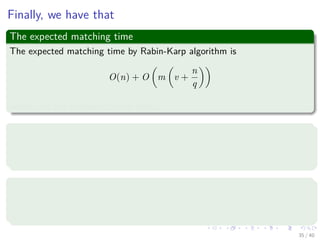
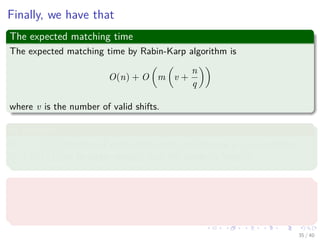
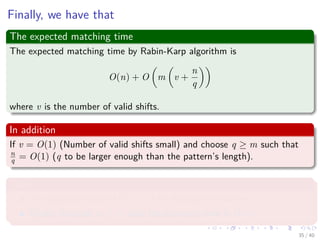
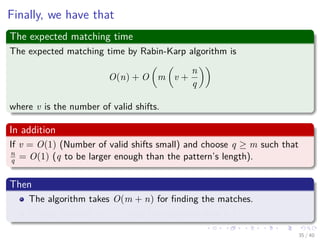
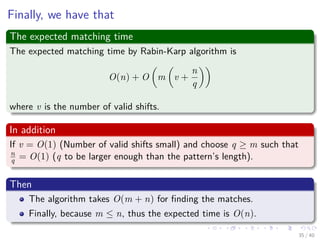
Finally, we have that
The expected matching time
The expected matching time by Rabin-Karp algorithm is
O(n) + O m v +
n
q
where v is the number of valid shifts.
In addition
If v = O(1) (Number of valid shifts small) and choose q ≥ m such that
n
q = O(1) (q to be larger enough than the pattern’s length).
Then
The algorithm takes O(m + n) for finding the matches.
Finally, because m ≤ n, thus the expected time is O(n).
35 / 40
Finally, we have that
The expected matching time
The expected matching time by Rabin-Karp algorithm is
O(n) + O m v +
n
q
where v is the number of valid shifts.
In addition
If v = O(1) (Number of valid shifts small) and choose q ≥ m such that
n
q = O(1) (q to be larger enough than the pattern’s length).
Then
The algorithm takes O(m + n) for finding the matches.
Finally, because m ≤ n, thus the expected time is O(n).
35 / 40
Finally, we have that
The expected matching time
The expected matching time by Rabin-Karp algorithm is
O(n) + O m v +
n
q
where v is the number of valid shifts.
In addition
If v = O(1) (Number of valid shifts small) and choose q ≥ m such that
n
q = O(1) (q to be larger enough than the pattern’s length).
Then
The algorithm takes O(m + n) for finding the matches.
Finally, because m ≤ n, thus the expected time is O(n).
35 / 40
Finally, we have that
The expected matching time
The expected matching time by Rabin-Karp algorithm is
O(n) + O m v +
n
q
where v is the number of valid shifts.
In addition
If v = O(1) (Number of valid shifts small) and choose q ≥ m such that
n
q = O(1) (q to be larger enough than the pattern’s length).
Then
The algorithm takes O(m + n) for finding the matches.
Finally, because m ≤ n, thus the expected time is O(n).
35 / 40
Finally, we have that
The expected matching time
The expected matching time by Rabin-Karp algorithm is
O(n) + O m v +
n
q
where v is the number of valid shifts.
In addition
If v = O(1) (Number of valid shifts small) and choose q ≥ m such that
n
q = O(1) (q to be larger enough than the pattern’s length).
Then
The algorithm takes O(m + n) for finding the matches.
Finally, because m ≤ n, thus the expected time is O(n).
35 / 40
Outline
1 String Matching
Introduction
Some Notation
2 Naive Algorithm
Using Brute Force
3 The Rabin-Karp Algorithm
Efficiency After All
Horner’s Rule
Generaiting Possible Matches
The Final Algorithm
Other Methods
4 Exercises
36 / 40
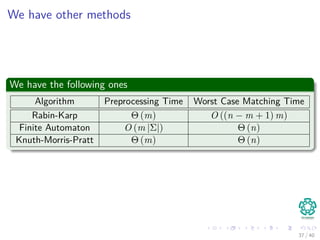
We have other methods
We have the following ones
Algorithm Preprocessing Time Worst Case Matching Time
Rabin-Karp Θ (m) O ((n − m + 1) m)
Finite Automaton O (m |Σ|) Θ (n)
Knuth-Morris-Pratt Θ (m) Θ (n)
37 / 40
Remarks about Knuth-Morris-Pratt
The Algorithm
It is quite an elegant algorithm that improves over the state machine.
How?
It avoid to compute the transition function in the state machine by using
the prefix function π
It encapsulate information how the pattern matches against shifts of
itself
38 / 40
Remarks about Knuth-Morris-Pratt
The Algorithm
It is quite an elegant algorithm that improves over the state machine.
How?
It avoid to compute the transition function in the state machine by using
the prefix function π
It encapsulate information how the pattern matches against shifts of
itself
38 / 40
However, At the same time (Circa 1977)
Boyer–Moore string search algorithm
It was presented at the same time
It is used in the GREP function for pattern matching in UNIX
Actually is the basic algorithm to beat when doing research in this area!!!
Richard Cole (Circa 1991)
He gave a a proof of the algorithm with an upper bound of 3m
comparisons in the worst case!!!
39 / 40
However, At the same time (Circa 1977)
Boyer–Moore string search algorithm
It was presented at the same time
It is used in the GREP function for pattern matching in UNIX
Actually is the basic algorithm to beat when doing research in this area!!!
Richard Cole (Circa 1991)
He gave a a proof of the algorithm with an upper bound of 3m
comparisons in the worst case!!!
39 / 40
However, At the same time (Circa 1977)
Boyer–Moore string search algorithm
It was presented at the same time
It is used in the GREP function for pattern matching in UNIX
Actually is the basic algorithm to beat when doing research in this area!!!
Richard Cole (Circa 1991)
He gave a a proof of the algorithm with an upper bound of 3m
comparisons in the worst case!!!
39 / 40
Exercises
32.1-1
32.1-2
32.1-4
32.2-1
32.2-2
32.2-3
32.2-4
40 / 40

25 String Matching

  • 1.
    Analysis of Algorithms Stringmatching Andres Mendez-Vazquez November 24, 2015 1 / 40
  • 2.
    Outline 1 String Matching Introduction SomeNotation 2 Naive Algorithm Using Brute Force 3 The Rabin-Karp Algorithm Efficiency After All Horner’s Rule Generaiting Possible Matches The Final Algorithm Other Methods 4 Exercises 2 / 40
  • 3.
    What is stringmatching? Given two sequences of characters drawn from a finite alphabet Σ, T [1..n] and P [1..m] a b c a b a a b c a b a c a b a b a a TEXT T PATTERN P s=3 Valid Shift 3 / 40
  • 4.
    Where... A Valid Shift Poccurs with a valid shift s if for some 0 ≤ s ≤ n − m =⇒ T [s + 1..s + m] == P [1..m]. Otherwise it is an invalid shift. Thus The string-matching problem is the problem of of finding all valid shifts given a patten P on a text T. 4 / 40
  • 5.
    Where... A Valid Shift Poccurs with a valid shift s if for some 0 ≤ s ≤ n − m =⇒ T [s + 1..s + m] == P [1..m]. Otherwise it is an invalid shift. Thus The string-matching problem is the problem of of finding all valid shifts given a patten P on a text T. 4 / 40
  • 6.
    Where... A Valid Shift Poccurs with a valid shift s if for some 0 ≤ s ≤ n − m =⇒ T [s + 1..s + m] == P [1..m]. Otherwise it is an invalid shift. Thus The string-matching problem is the problem of of finding all valid shifts given a patten P on a text T. 4 / 40
  • 7.
    Possible Algorithms We havethe following ones Algorithm Preprocessing Time Worst Case Matching Time Naive 0 O ((n − m + 1) m) Rabin-Karp Θ (m) O ((n − m + 1) m) Finite Automaton O (m |Σ|) Θ (n) Knuth-Morris-Pratt Θ (m) Θ (n) 5 / 40
  • 8.
    Outline 1 String Matching Introduction SomeNotation 2 Naive Algorithm Using Brute Force 3 The Rabin-Karp Algorithm Efficiency After All Horner’s Rule Generaiting Possible Matches The Final Algorithm Other Methods 4 Exercises 6 / 40
  • 9.
    Notation and Terminology Definition Wedenote by Σ∗ (read “sigma-star”) the set of all finite length strings formed using characters from the alphabet Σ. Constraint We assume a finite length strings. Some basic concepts The zero empty string, , also belong to Σ∗. The length of a string x is denoted |x|. The concatenation of two strings x and y, denoted xy, has length |x| + |y| 7 / 40
  • 10.
    Notation and Terminology Definition Wedenote by Σ∗ (read “sigma-star”) the set of all finite length strings formed using characters from the alphabet Σ. Constraint We assume a finite length strings. Some basic concepts The zero empty string, , also belong to Σ∗. The length of a string x is denoted |x|. The concatenation of two strings x and y, denoted xy, has length |x| + |y| 7 / 40
  • 11.
    Notation and Terminology Definition Wedenote by Σ∗ (read “sigma-star”) the set of all finite length strings formed using characters from the alphabet Σ. Constraint We assume a finite length strings. Some basic concepts The zero empty string, , also belong to Σ∗. The length of a string x is denoted |x|. The concatenation of two strings x and y, denoted xy, has length |x| + |y| 7 / 40
  • 12.
    Notation and Terminology Definition Wedenote by Σ∗ (read “sigma-star”) the set of all finite length strings formed using characters from the alphabet Σ. Constraint We assume a finite length strings. Some basic concepts The zero empty string, , also belong to Σ∗. The length of a string x is denoted |x|. The concatenation of two strings x and y, denoted xy, has length |x| + |y| 7 / 40
  • 13.
    Notation and Terminology Definition Wedenote by Σ∗ (read “sigma-star”) the set of all finite length strings formed using characters from the alphabet Σ. Constraint We assume a finite length strings. Some basic concepts The zero empty string, , also belong to Σ∗. The length of a string x is denoted |x|. The concatenation of two strings x and y, denoted xy, has length |x| + |y| 7 / 40
  • 14.
    Notation and Terminology Prefix Astring w is a prefix x, w x if x = wy for some string y ∈ Σ∗. Suffix A string w is a suffix x, w x if x = yw for some string y ∈ Σ∗. Properties Prefix: If w x ⇒ |w| ≤ |x| Suffix: If w x ⇒ |w| ≤ |x| The is both suffix and prefix of every string. 8 / 40
  • 15.
    Notation and Terminology Prefix Astring w is a prefix x, w x if x = wy for some string y ∈ Σ∗. Suffix A string w is a suffix x, w x if x = yw for some string y ∈ Σ∗. Properties Prefix: If w x ⇒ |w| ≤ |x| Suffix: If w x ⇒ |w| ≤ |x| The is both suffix and prefix of every string. 8 / 40
  • 16.
    Notation and Terminology Prefix Astring w is a prefix x, w x if x = wy for some string y ∈ Σ∗. Suffix A string w is a suffix x, w x if x = yw for some string y ∈ Σ∗. Properties Prefix: If w x ⇒ |w| ≤ |x| Suffix: If w x ⇒ |w| ≤ |x| The is both suffix and prefix of every string. 8 / 40
  • 17.
    Notation and Terminology Prefix Astring w is a prefix x, w x if x = wy for some string y ∈ Σ∗. Suffix A string w is a suffix x, w x if x = yw for some string y ∈ Σ∗. Properties Prefix: If w x ⇒ |w| ≤ |x| Suffix: If w x ⇒ |w| ≤ |x| The is both suffix and prefix of every string. 8 / 40
  • 18.
    Notation and Terminology Prefix Astring w is a prefix x, w x if x = wy for some string y ∈ Σ∗. Suffix A string w is a suffix x, w x if x = yw for some string y ∈ Σ∗. Properties Prefix: If w x ⇒ |w| ≤ |x| Suffix: If w x ⇒ |w| ≤ |x| The is both suffix and prefix of every string. 8 / 40
  • 19.
    Notation and Terminology Inaddition For any string x and y and any character a, we have w x if and only if aw ax In addition, and are transitive relations. 9 / 40
  • 20.
    Notation and Terminology Inaddition For any string x and y and any character a, we have w x if and only if aw ax In addition, and are transitive relations. 9 / 40
  • 21.
    Outline 1 String Matching Introduction SomeNotation 2 Naive Algorithm Using Brute Force 3 The Rabin-Karp Algorithm Efficiency After All Horner’s Rule Generaiting Possible Matches The Final Algorithm Other Methods 4 Exercises 10 / 40
  • 22.
    The naive stringalgorithm Algorithm NAIVE-STRING-MATCHER(T, P) 1 n = T.length 2 m = P.length 3 for s = 0 to n − m 4 if P [1..m] == T [s + 1..s + m] 5 print “Pattern occurs with shift” s Complexity O((n − m + 1)m) or Θ n2 if m = n 2 11 / 40
  • 23.
    The naive stringalgorithm Algorithm NAIVE-STRING-MATCHER(T, P) 1 n = T.length 2 m = P.length 3 for s = 0 to n − m 4 if P [1..m] == T [s + 1..s + m] 5 print “Pattern occurs with shift” s Complexity O((n − m + 1)m) or Θ n2 if m = n 2 11 / 40
  • 24.
    Outline 1 String Matching Introduction SomeNotation 2 Naive Algorithm Using Brute Force 3 The Rabin-Karp Algorithm Efficiency After All Horner’s Rule Generaiting Possible Matches The Final Algorithm Other Methods 4 Exercises 12 / 40
  • 25.
    A more elaboratedalgorithm Rabin-Karp algorithm Lets assume that Σ = {0, 1, ..., 9} then we have the following: Thus, each string of k consecutive characters is a k-length decimal number: c1c2 · · · ck−1ck = 10k−1c1 + 10k−2c2 + . . . + 10ck−1 + ck Thus p correspond the decimal number for pattern P [1..m]. ts denote decimal value of m-length substring T [s + 1..s + m] for s = 0, 1, ..., n − m. 13 / 40
  • 26.
    A more elaboratedalgorithm Rabin-Karp algorithm Lets assume that Σ = {0, 1, ..., 9} then we have the following: Thus, each string of k consecutive characters is a k-length decimal number: c1c2 · · · ck−1ck = 10k−1c1 + 10k−2c2 + . . . + 10ck−1 + ck Thus p correspond the decimal number for pattern P [1..m]. ts denote decimal value of m-length substring T [s + 1..s + m] for s = 0, 1, ..., n − m. 13 / 40
  • 27.
    A more elaboratedalgorithm Rabin-Karp algorithm Lets assume that Σ = {0, 1, ..., 9} then we have the following: Thus, each string of k consecutive characters is a k-length decimal number: c1c2 · · · ck−1ck = 10k−1c1 + 10k−2c2 + . . . + 10ck−1 + ck Thus p correspond the decimal number for pattern P [1..m]. ts denote decimal value of m-length substring T [s + 1..s + m] for s = 0, 1, ..., n − m. 13 / 40
  • 28.
    A more elaboratedalgorithm Rabin-Karp algorithm Lets assume that Σ = {0, 1, ..., 9} then we have the following: Thus, each string of k consecutive characters is a k-length decimal number: c1c2 · · · ck−1ck = 10k−1c1 + 10k−2c2 + . . . + 10ck−1 + ck Thus p correspond the decimal number for pattern P [1..m]. ts denote decimal value of m-length substring T [s + 1..s + m] for s = 0, 1, ..., n − m. 13 / 40
  • 29.
    Then Properties Clearly ts ==p if and only if T [s + 1..s + m] == P [1..m], thus s is a valid shift. 14 / 40
  • 30.
    Now, think aboutthis What if we put everything in a single word of the machine If we can compute p in Θ (m). If we can compute all the ts in Θ (n − m + 1). We will get Θ (m) + Θ (n − m + 1) = Θ (n) 15 / 40
  • 31.
    Now, think aboutthis What if we put everything in a single word of the machine If we can compute p in Θ (m). If we can compute all the ts in Θ (n − m + 1). We will get Θ (m) + Θ (n − m + 1) = Θ (n) 15 / 40
  • 32.
    Now, think aboutthis What if we put everything in a single word of the machine If we can compute p in Θ (m). If we can compute all the ts in Θ (n − m + 1). We will get Θ (m) + Θ (n − m + 1) = Θ (n) 15 / 40
  • 33.
    Outline 1 String Matching Introduction SomeNotation 2 Naive Algorithm Using Brute Force 3 The Rabin-Karp Algorithm Efficiency After All Horner’s Rule Generaiting Possible Matches The Final Algorithm Other Methods 4 Exercises 16 / 40
  • 34.
    Remember Horner’s Rule Consider Wecan compute, the decimal representation by the Horner’s rule: p = P[m] + 10(P[m − 1] + 10(P[m − 2] + ... + 10(P[2] + 10P[1])...)) (1) Thus, we can compute t0 using this rule in Θ (m) (2) 17 / 40
  • 35.
    Remember Horner’s Rule Consider Wecan compute, the decimal representation by the Horner’s rule: p = P[m] + 10(P[m − 1] + 10(P[m − 2] + ... + 10(P[2] + 10P[1])...)) (1) Thus, we can compute t0 using this rule in Θ (m) (2) 17 / 40
  • 36.
    Example If you havethe following set of digits 2 4 0 1 Using the Horner’s Rule for m = 4 2401 = 1 + 10 × (0 + 10 × (4 + 10 × 2)) = 2 × 10³ + 4 × 10² + 0 × 10 + 1 18 / 40
  • 37.
    Example If you havethe following set of digits 2 4 0 1 Using the Horner’s Rule for m = 4 2401 = 1 + 10 × (0 + 10 × (4 + 10 × 2)) = 2 × 10³ + 4 × 10² + 0 × 10 + 1 18 / 40
  • 38.
    Then To compute theremaining values, we can use the previous value ts+1 = 10 ts − 10m−1 T [s + 1] + T [s + m + 1] . (3) Notice the following Subtracting from it 10m−1T [s + 1] removes the high-order digit from ts. Multiplying the result by 10 shifts the number left by one digit position. Adding T [s + m + 1] brings in the appropriate low-order digit. 19 / 40
  • 39.
    Then To compute theremaining values, we can use the previous value ts+1 = 10 ts − 10m−1 T [s + 1] + T [s + m + 1] . (3) Notice the following Subtracting from it 10m−1T [s + 1] removes the high-order digit from ts. Multiplying the result by 10 shifts the number left by one digit position. Adding T [s + m + 1] brings in the appropriate low-order digit. 19 / 40
  • 40.
    Then To compute theremaining values, we can use the previous value ts+1 = 10 ts − 10m−1 T [s + 1] + T [s + m + 1] . (3) Notice the following Subtracting from it 10m−1T [s + 1] removes the high-order digit from ts. Multiplying the result by 10 shifts the number left by one digit position. Adding T [s + m + 1] brings in the appropriate low-order digit. 19 / 40
  • 41.
    Example Imagine that youhave... index 1 2 3 4 5 6 digit 1 0 2 4 1 0 1 We have t0 = 1024 then we want to calculate 0241 2 Then we subtract 103 × T [1] == 1000 of 1024 3 We get 0024 4 Multiply by 10, and we get 0240 5 We add T [5] == 1 6 Finally, we get 0241 20 / 40
  • 42.
    Example Imagine that youhave... index 1 2 3 4 5 6 digit 1 0 2 4 1 0 1 We have t0 = 1024 then we want to calculate 0241 2 Then we subtract 103 × T [1] == 1000 of 1024 3 We get 0024 4 Multiply by 10, and we get 0240 5 We add T [5] == 1 6 Finally, we get 0241 20 / 40
  • 43.
    Example Imagine that youhave... index 1 2 3 4 5 6 digit 1 0 2 4 1 0 1 We have t0 = 1024 then we want to calculate 0241 2 Then we subtract 103 × T [1] == 1000 of 1024 3 We get 0024 4 Multiply by 10, and we get 0240 5 We add T [5] == 1 6 Finally, we get 0241 20 / 40
  • 44.
    Example Imagine that youhave... index 1 2 3 4 5 6 digit 1 0 2 4 1 0 1 We have t0 = 1024 then we want to calculate 0241 2 Then we subtract 103 × T [1] == 1000 of 1024 3 We get 0024 4 Multiply by 10, and we get 0240 5 We add T [5] == 1 6 Finally, we get 0241 20 / 40
  • 45.
    Example Imagine that youhave... index 1 2 3 4 5 6 digit 1 0 2 4 1 0 1 We have t0 = 1024 then we want to calculate 0241 2 Then we subtract 103 × T [1] == 1000 of 1024 3 We get 0024 4 Multiply by 10, and we get 0240 5 We add T [5] == 1 6 Finally, we get 0241 20 / 40
  • 46.
    Example Imagine that youhave... index 1 2 3 4 5 6 digit 1 0 2 4 1 0 1 We have t0 = 1024 then we want to calculate 0241 2 Then we subtract 103 × T [1] == 1000 of 1024 3 We get 0024 4 Multiply by 10, and we get 0240 5 We add T [5] == 1 6 Finally, we get 0241 20 / 40
  • 47.
    Example Imagine that youhave... index 1 2 3 4 5 6 digit 1 0 2 4 1 0 1 We have t0 = 1024 then we want to calculate 0241 2 Then we subtract 103 × T [1] == 1000 of 1024 3 We get 0024 4 Multiply by 10, and we get 0240 5 We add T [5] == 1 6 Finally, we get 0241 20 / 40
  • 48.
    Remarks First We can extendthis beyond the decimals to any d digit system!!! What happens when the numbers are quite large? We can use the module Meaning Compute p and ts values modulo a suitable modulus q. 21 / 40
  • 49.
    Remarks First We can extendthis beyond the decimals to any d digit system!!! What happens when the numbers are quite large? We can use the module Meaning Compute p and ts values modulo a suitable modulus q. 21 / 40
  • 50.
    Remarks First We can extendthis beyond the decimals to any d digit system!!! What happens when the numbers are quite large? We can use the module Meaning Compute p and ts values modulo a suitable modulus q. 21 / 40
  • 51.
    Outline 1 String Matching Introduction SomeNotation 2 Naive Algorithm Using Brute Force 3 The Rabin-Karp Algorithm Efficiency After All Horner’s Rule Generaiting Possible Matches The Final Algorithm Other Methods 4 Exercises 22 / 40
  • 52.
    Remember Hash Functions Yes,we are mapping the large numbers into the set {0, 1, 2, ..., q − 1} 23 / 40
  • 53.
    Then, to reducethe possible representation Use the module of q It is possible to compute p mod q in Θ (m) time and all the ts mod q in Θ (n − m + 1) time. Something Notable If we choose the modulus q as a prime such that 10q just fits within one computer word, then we can perform all the necessary computations with single-precision arithmetic. 24 / 40
  • 54.
    Then, to reducethe possible representation Use the module of q It is possible to compute p mod q in Θ (m) time and all the ts mod q in Θ (n − m + 1) time. Something Notable If we choose the modulus q as a prime such that 10q just fits within one computer word, then we can perform all the necessary computations with single-precision arithmetic. 24 / 40
  • 55.
    Why 10q? After all 10qis the number that will subtracting for or multiplying by!!! We use “truncated division” to implement the modulo operation For example given two numbers a and n, we can do the following q = trunc a n Then r = a − nq 25 / 40
  • 56.
    Why 10q? After all 10qis the number that will subtracting for or multiplying by!!! We use “truncated division” to implement the modulo operation For example given two numbers a and n, we can do the following q = trunc a n Then r = a − nq 25 / 40
  • 57.
    Why 10q? After all 10qis the number that will subtracting for or multiplying by!!! We use “truncated division” to implement the modulo operation For example given two numbers a and n, we can do the following q = trunc a n Then r = a − nq 25 / 40
  • 58.
    Why 10q? Thus If qis a prime we can use this as the element of truncated division then r = a − 10q. Truncated Algorithm Truncated-Module(a, q) 1 r = a − 10q 2 while r > 10q 3 r = r − 10q 4 return r 26 / 40
  • 59.
    Why 10q? Thus If qis a prime we can use this as the element of truncated division then r = a − 10q. Truncated Algorithm Truncated-Module(a, q) 1 r = a − 10q 2 while r > 10q 3 r = r − 10q 4 return r 26 / 40
  • 60.
    Then Thus Then, we canimplement this in basic arithmetic CPU operations. Not only that In general, for a d-ary alphabet, we choose q such that dq fits within a computer word. 27 / 40
  • 61.
    Then Thus Then, we canimplement this in basic arithmetic CPU operations. Not only that In general, for a d-ary alphabet, we choose q such that dq fits within a computer word. 27 / 40
  • 62.
    In general, wehave The following ts+1 = (d(ts − T[s + 1]h) + T[s + m + 1]) mod q (4) where h ≡ dm−1(mod q) is the value of the digit “1” in the high-order position of an m-digit text window. Here We have a small problem!!! Question? Can we differentiate between p mod q and ts mod q? 28 / 40
  • 63.
    In general, wehave The following ts+1 = (d(ts − T[s + 1]h) + T[s + m + 1]) mod q (4) where h ≡ dm−1(mod q) is the value of the digit “1” in the high-order position of an m-digit text window. Here We have a small problem!!! Question? Can we differentiate between p mod q and ts mod q? 28 / 40
  • 64.
    In general, wehave The following ts+1 = (d(ts − T[s + 1]h) + T[s + m + 1]) mod q (4) where h ≡ dm−1(mod q) is the value of the digit “1” in the high-order position of an m-digit text window. Here We have a small problem!!! Question? Can we differentiate between p mod q and ts mod q? 28 / 40
  • 65.
    What? Look at thiswith q = 11 14 mod 11 == 3 25 mod 11 == 3 But 14 = 25 However 11 mod 11 == 0 25 mod 11 == 3 We can say that 11 = 25!!! This means We can use the modulo to differentiate numbers, but not to exactly to say if they are equal!!! 29 / 40
  • 66.
    What? Look at thiswith q = 11 14 mod 11 == 3 25 mod 11 == 3 But 14 = 25 However 11 mod 11 == 0 25 mod 11 == 3 We can say that 11 = 25!!! This means We can use the modulo to differentiate numbers, but not to exactly to say if they are equal!!! 29 / 40
  • 67.
    What? Look at thiswith q = 11 14 mod 11 == 3 25 mod 11 == 3 But 14 = 25 However 11 mod 11 == 0 25 mod 11 == 3 We can say that 11 = 25!!! This means We can use the modulo to differentiate numbers, but not to exactly to say if they are equal!!! 29 / 40
  • 68.
    What? Look at thiswith q = 11 14 mod 11 == 3 25 mod 11 == 3 But 14 = 25 However 11 mod 11 == 0 25 mod 11 == 3 We can say that 11 = 25!!! This means We can use the modulo to differentiate numbers, but not to exactly to say if they are equal!!! 29 / 40
  • 69.
    What? Look at thiswith q = 11 14 mod 11 == 3 25 mod 11 == 3 But 14 = 25 However 11 mod 11 == 0 25 mod 11 == 3 We can say that 11 = 25!!! This means We can use the modulo to differentiate numbers, but not to exactly to say if they are equal!!! 29 / 40
  • 70.
    What? Look at thiswith q = 11 14 mod 11 == 3 25 mod 11 == 3 But 14 = 25 However 11 mod 11 == 0 25 mod 11 == 3 We can say that 11 = 25!!! This means We can use the modulo to differentiate numbers, but not to exactly to say if they are equal!!! 29 / 40
  • 71.
    What? Look at thiswith q = 11 14 mod 11 == 3 25 mod 11 == 3 But 14 = 25 However 11 mod 11 == 0 25 mod 11 == 3 We can say that 11 = 25!!! This means We can use the modulo to differentiate numbers, but not to exactly to say if they are equal!!! 29 / 40
  • 72.
    Thus We have thefollowing logic If ts ≡ p (mod q) does not mean that ts == p. If ts ≡ p (mod q), we have that ts = p. Fixing the problem To fix this problem we simply test to see if the hit is not spurious. Note If q is large enough, then we can hope that spurious hits occur infrequently enough that the cost of the extra checking is low. 30 / 40
  • 73.
    Thus We have thefollowing logic If ts ≡ p (mod q) does not mean that ts == p. If ts ≡ p (mod q), we have that ts = p. Fixing the problem To fix this problem we simply test to see if the hit is not spurious. Note If q is large enough, then we can hope that spurious hits occur infrequently enough that the cost of the extra checking is low. 30 / 40
  • 74.
    Thus We have thefollowing logic If ts ≡ p (mod q) does not mean that ts == p. If ts ≡ p (mod q), we have that ts = p. Fixing the problem To fix this problem we simply test to see if the hit is not spurious. Note If q is large enough, then we can hope that spurious hits occur infrequently enough that the cost of the extra checking is low. 30 / 40
  • 75.
    Thus We have thefollowing logic If ts ≡ p (mod q) does not mean that ts == p. If ts ≡ p (mod q), we have that ts = p. Fixing the problem To fix this problem we simply test to see if the hit is not spurious. Note If q is large enough, then we can hope that spurious hits occur infrequently enough that the cost of the extra checking is low. 30 / 40
  • 76.
    Outline 1 String Matching Introduction SomeNotation 2 Naive Algorithm Using Brute Force 3 The Rabin-Karp Algorithm Efficiency After All Horner’s Rule Generaiting Possible Matches The Final Algorithm Other Methods 4 Exercises 31 / 40
  • 77.
    The Final Algorithm Rabin-Karp-Matcher(T,P, d, q) 1 n = T.length 2 m = P.length 3 h = dm−1 mod q // Storing the reminder of the highest power 4 p = 0 5 t0 = 0 6 for i = 1 to m // Preprocessing 7 p = (dp + P [i]) mod q 8 t0 = (dp + T [i]) mod q 9 for s = 0 to n − m 10 if p == ts 11 if P [1..m] == T [s + 1..s + m] // Actually a Loop 12 print “Pattern occurs with shift” s 13 if s < n − m 14 ts+1 = (d(ts − T[s + 1]h) + T[s + m + 1]) mod q 32 / 40
  • 78.
    The Final Algorithm Rabin-Karp-Matcher(T,P, d, q) 1 n = T.length 2 m = P.length 3 h = dm−1 mod q // Storing the reminder of the highest power 4 p = 0 5 t0 = 0 6 for i = 1 to m // Preprocessing 7 p = (dp + P [i]) mod q 8 t0 = (dp + T [i]) mod q 9 for s = 0 to n − m 10 if p == ts 11 if P [1..m] == T [s + 1..s + m] // Actually a Loop 12 print “Pattern occurs with shift” s 13 if s < n − m 14 ts+1 = (d(ts − T[s + 1]h) + T[s + m + 1]) mod q 32 / 40
  • 79.
    The Final Algorithm Rabin-Karp-Matcher(T,P, d, q) 1 n = T.length 2 m = P.length 3 h = dm−1 mod q // Storing the reminder of the highest power 4 p = 0 5 t0 = 0 6 for i = 1 to m // Preprocessing 7 p = (dp + P [i]) mod q 8 t0 = (dp + T [i]) mod q 9 for s = 0 to n − m 10 if p == ts 11 if P [1..m] == T [s + 1..s + m] // Actually a Loop 12 print “Pattern occurs with shift” s 13 if s < n − m 14 ts+1 = (d(ts − T[s + 1]h) + T[s + m + 1]) mod q 32 / 40
  • 80.
    The Final Algorithm Rabin-Karp-Matcher(T,P, d, q) 1 n = T.length 2 m = P.length 3 h = dm−1 mod q // Storing the reminder of the highest power 4 p = 0 5 t0 = 0 6 for i = 1 to m // Preprocessing 7 p = (dp + P [i]) mod q 8 t0 = (dp + T [i]) mod q 9 for s = 0 to n − m 10 if p == ts 11 if P [1..m] == T [s + 1..s + m] // Actually a Loop 12 print “Pattern occurs with shift” s 13 if s < n − m 14 ts+1 = (d(ts − T[s + 1]h) + T[s + m + 1]) mod q 32 / 40
  • 81.
    Complexity Preprocessing 1 p modq is done in Θ(m). 2 tss mod q is done in Θ(n − m + 1). Then checking P[1..m] == T[s + 1..s + m] In the worst case, Θ((n − m + 1)m) 33 / 40
  • 82.
    Complexity Preprocessing 1 p modq is done in Θ(m). 2 tss mod q is done in Θ(n − m + 1). Then checking P[1..m] == T[s + 1..s + m] In the worst case, Θ((n − m + 1)m) 33 / 40
  • 83.
    Still we cando better! First The number of spurious hits is O (n/q). Because We can estimate the chance that an arbitrary ts will be equivalent to p mod q as 1/q. Properties Since there are O (n) positions at which the test of line 10 fails (Thus, you have O (n/q) non valid hits) and we spend O (m) time per hit 34 / 40
  • 84.
    Still we cando better! First The number of spurious hits is O (n/q). Because We can estimate the chance that an arbitrary ts will be equivalent to p mod q as 1/q. Properties Since there are O (n) positions at which the test of line 10 fails (Thus, you have O (n/q) non valid hits) and we spend O (m) time per hit 34 / 40
  • 85.
    Still we cando better! First The number of spurious hits is O (n/q). Because We can estimate the chance that an arbitrary ts will be equivalent to p mod q as 1/q. Properties Since there are O (n) positions at which the test of line 10 fails (Thus, you have O (n/q) non valid hits) and we spend O (m) time per hit 34 / 40
  • 86.
    Finally, we havethat The expected matching time The expected matching time by Rabin-Karp algorithm is O(n) + O m v + n q where v is the number of valid shifts. In addition If v = O(1) (Number of valid shifts small) and choose q ≥ m such that n q = O(1) (q to be larger enough than the pattern’s length). Then The algorithm takes O(m + n) for finding the matches. Finally, because m ≤ n, thus the expected time is O(n). 35 / 40
  • 87.
    Finally, we havethat The expected matching time The expected matching time by Rabin-Karp algorithm is O(n) + O m v + n q where v is the number of valid shifts. In addition If v = O(1) (Number of valid shifts small) and choose q ≥ m such that n q = O(1) (q to be larger enough than the pattern’s length). Then The algorithm takes O(m + n) for finding the matches. Finally, because m ≤ n, thus the expected time is O(n). 35 / 40
  • 88.
    Finally, we havethat The expected matching time The expected matching time by Rabin-Karp algorithm is O(n) + O m v + n q where v is the number of valid shifts. In addition If v = O(1) (Number of valid shifts small) and choose q ≥ m such that n q = O(1) (q to be larger enough than the pattern’s length). Then The algorithm takes O(m + n) for finding the matches. Finally, because m ≤ n, thus the expected time is O(n). 35 / 40
  • 89.
    Finally, we havethat The expected matching time The expected matching time by Rabin-Karp algorithm is O(n) + O m v + n q where v is the number of valid shifts. In addition If v = O(1) (Number of valid shifts small) and choose q ≥ m such that n q = O(1) (q to be larger enough than the pattern’s length). Then The algorithm takes O(m + n) for finding the matches. Finally, because m ≤ n, thus the expected time is O(n). 35 / 40
  • 90.
    Finally, we havethat The expected matching time The expected matching time by Rabin-Karp algorithm is O(n) + O m v + n q where v is the number of valid shifts. In addition If v = O(1) (Number of valid shifts small) and choose q ≥ m such that n q = O(1) (q to be larger enough than the pattern’s length). Then The algorithm takes O(m + n) for finding the matches. Finally, because m ≤ n, thus the expected time is O(n). 35 / 40
  • 91.
    Outline 1 String Matching Introduction SomeNotation 2 Naive Algorithm Using Brute Force 3 The Rabin-Karp Algorithm Efficiency After All Horner’s Rule Generaiting Possible Matches The Final Algorithm Other Methods 4 Exercises 36 / 40
  • 92.
    We have othermethods We have the following ones Algorithm Preprocessing Time Worst Case Matching Time Rabin-Karp Θ (m) O ((n − m + 1) m) Finite Automaton O (m |Σ|) Θ (n) Knuth-Morris-Pratt Θ (m) Θ (n) 37 / 40
  • 93.
    Remarks about Knuth-Morris-Pratt TheAlgorithm It is quite an elegant algorithm that improves over the state machine. How? It avoid to compute the transition function in the state machine by using the prefix function π It encapsulate information how the pattern matches against shifts of itself 38 / 40
  • 94.
    Remarks about Knuth-Morris-Pratt TheAlgorithm It is quite an elegant algorithm that improves over the state machine. How? It avoid to compute the transition function in the state machine by using the prefix function π It encapsulate information how the pattern matches against shifts of itself 38 / 40
  • 95.
    However, At thesame time (Circa 1977) Boyer–Moore string search algorithm It was presented at the same time It is used in the GREP function for pattern matching in UNIX Actually is the basic algorithm to beat when doing research in this area!!! Richard Cole (Circa 1991) He gave a a proof of the algorithm with an upper bound of 3m comparisons in the worst case!!! 39 / 40
  • 96.
    However, At thesame time (Circa 1977) Boyer–Moore string search algorithm It was presented at the same time It is used in the GREP function for pattern matching in UNIX Actually is the basic algorithm to beat when doing research in this area!!! Richard Cole (Circa 1991) He gave a a proof of the algorithm with an upper bound of 3m comparisons in the worst case!!! 39 / 40
  • 97.
    However, At thesame time (Circa 1977) Boyer–Moore string search algorithm It was presented at the same time It is used in the GREP function for pattern matching in UNIX Actually is the basic algorithm to beat when doing research in this area!!! Richard Cole (Circa 1991) He gave a a proof of the algorithm with an upper bound of 3m comparisons in the worst case!!! 39 / 40
  • 98.