
IB Environmental Systems and Societies p. 1
Topic 2: Ecosystems and Ecology (25 hours)
2.2 Communities & Ecosystems
Significant Ideas:
➔ The interactions of species with their environment result in energy and nutrient flows.
➔ Photosynthesis and respiration play a significant role in the flow of energy in communities.
➔ The feeding relationships of species in a system can be modeled using food chains, food webs and
ecological pyramids.
Knowledge & Understanding: Use these notes to familiarize yourself with ESS terminology and concepts.
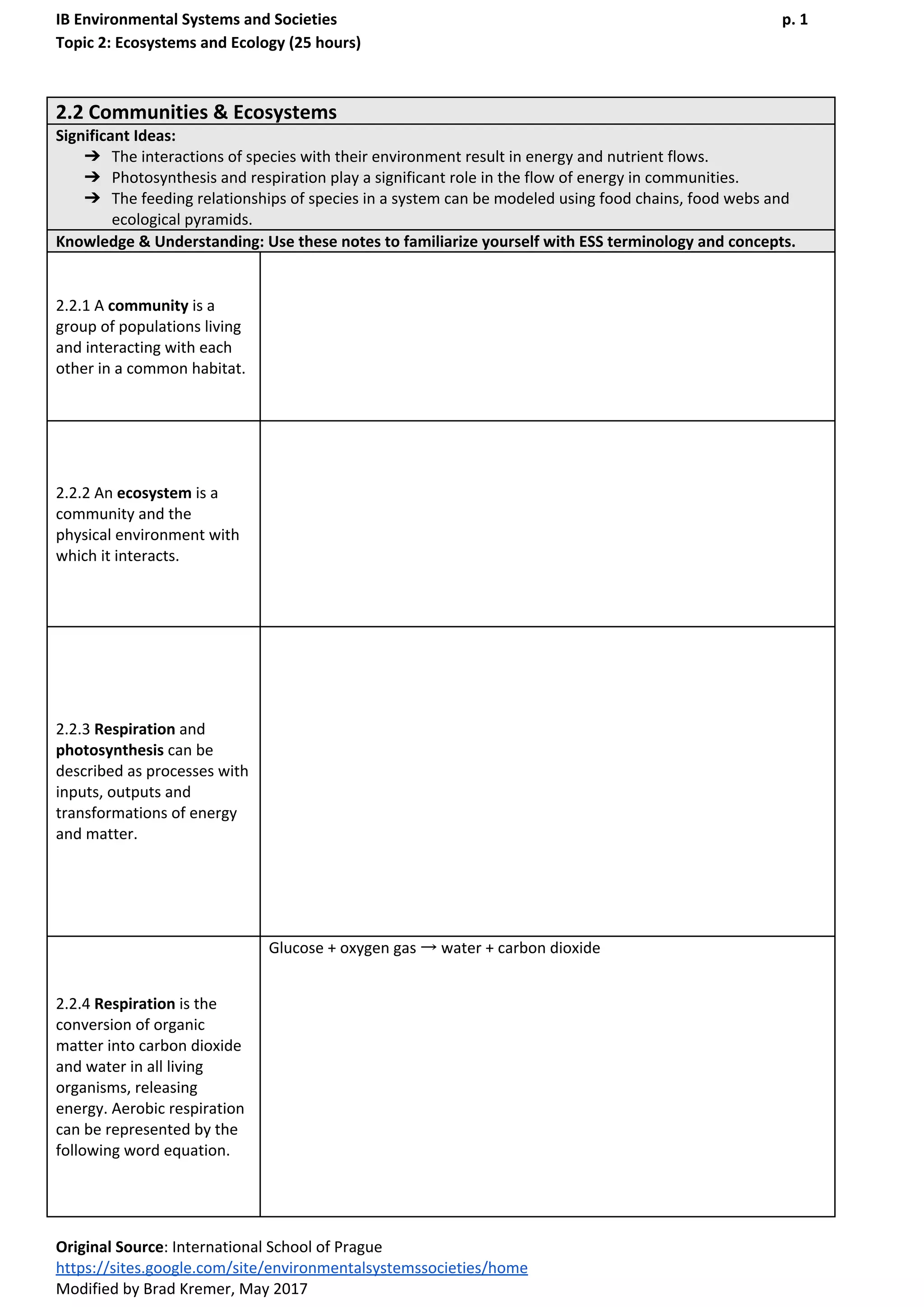
2.2.1 A ​community​ is a
group of populations living
and interacting with each
other in a common habitat.
2.2.2 An ​ecosystem​ is a
community and the
physical environment with
which it interacts.
2.2.3 ​Respiration​ and
photosynthesis​ can be
described as processes with
inputs, outputs and
transformations of energy
and matter.
2.2.4 ​Respiration​ is the
conversion of organic
matter into carbon dioxide
and water in all living
organisms, releasing
energy. Aerobic respiration
can be represented by the
following word equation.
Glucose + oxygen gas → water + carbon dioxide
Original Source​: International School of Prague
https://sites.google.com/site/environmentalsystemssocieties/home
Modified by Brad Kremer, May 2017
IB Environmental Systems and Societies p. 2
Topic 2: Ecosystems and Ecology (25 hours)
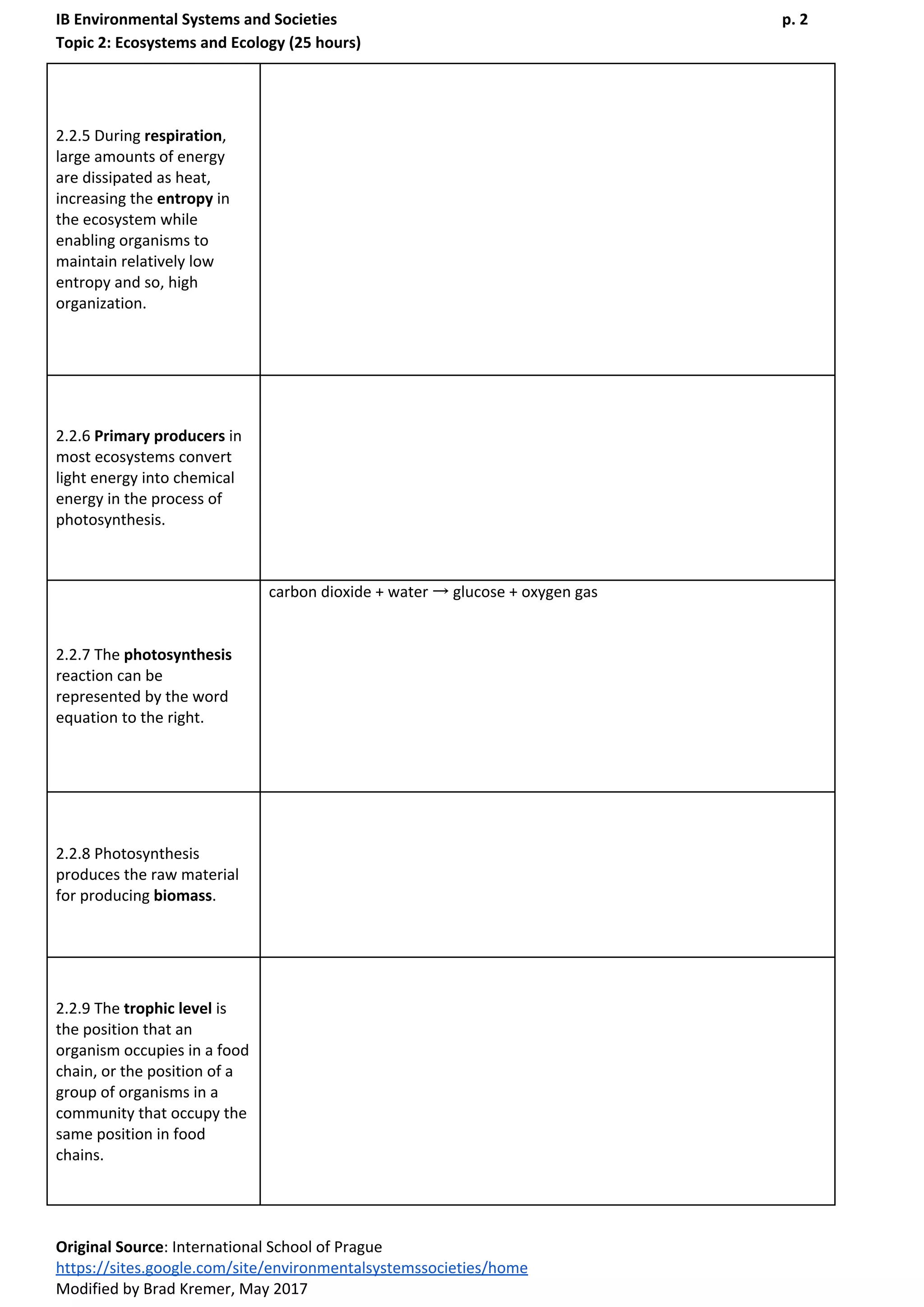
2.2.5 During ​respiration​,
large amounts of energy
are dissipated as heat,
increasing the ​entropy​ in
the ecosystem while
enabling organisms to
maintain relatively low
entropy and so, high
organization.
2.2.6 ​Primary producers​ in
most ecosystems convert
light energy into chemical
energy in the process of
photosynthesis.
2.2.7 The ​photosynthesis
reaction can be
represented by the word
equation to the right.
carbon dioxide + water → glucose + oxygen gas
2.2.8 Photosynthesis
produces the raw material
for producing ​biomass​.
2.2.9 The ​trophic level​ is
the position that an
organism occupies in a food
chain, or the position of a
group of organisms in a
community that occupy the
same position in food
chains.
Original Source​: International School of Prague
https://sites.google.com/site/environmentalsystemssocieties/home
Modified by Brad Kremer, May 2017
IB Environmental Systems and Societies p. 3
Topic 2: Ecosystems and Ecology (25 hours)
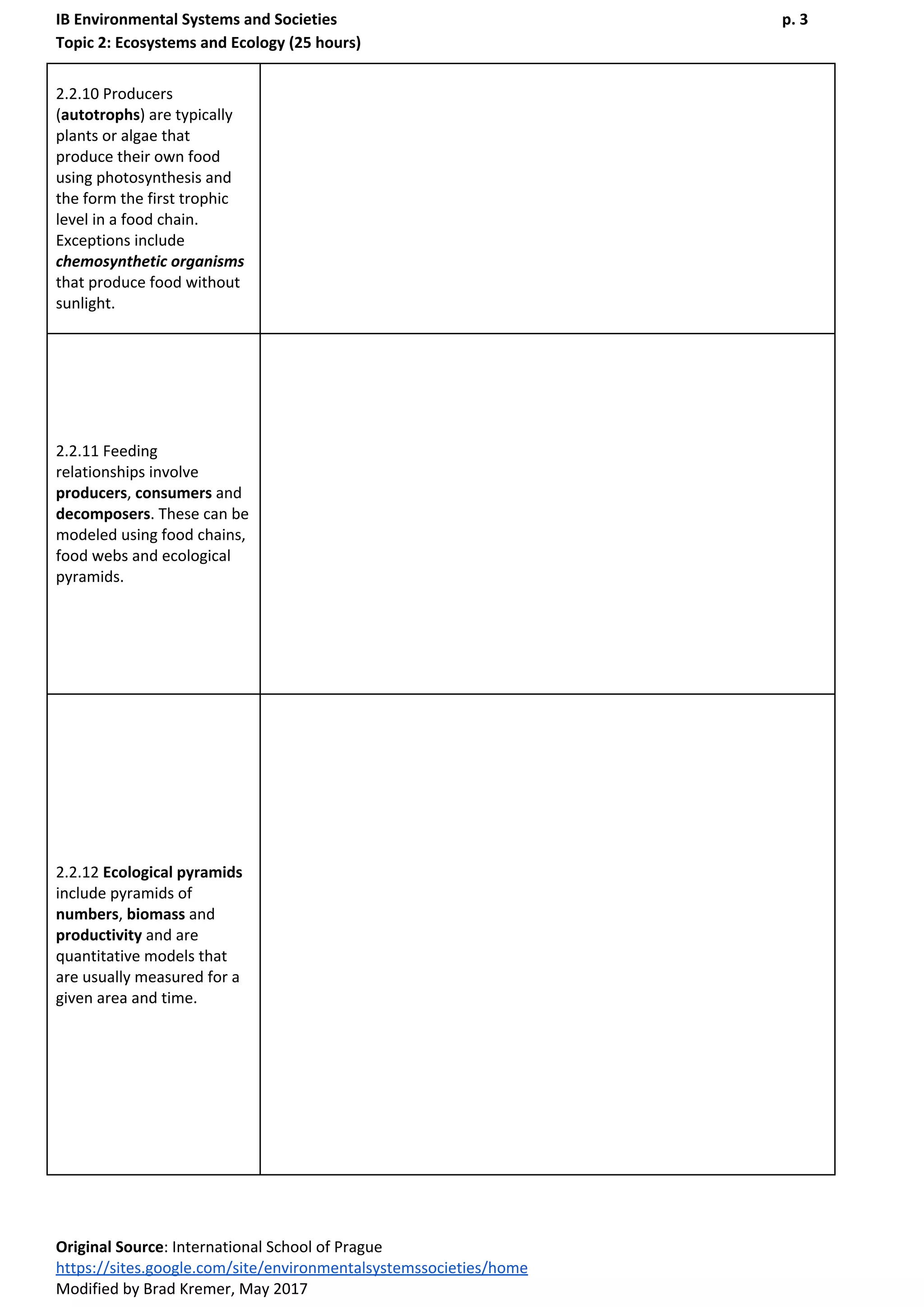
2.2.10 Producers
(​autotrophs​) are typically
plants or algae that
produce their own food
using photosynthesis and
the form the first trophic
level in a food chain.
Exceptions include
chemosynthetic organisms
that produce food without
sunlight.
2.2.11 Feeding
relationships involve
producers​, ​consumers​ and
decomposers​. These can be
modeled using food chains,
food webs and ecological
pyramids.
2.2.12 ​Ecological pyramids
include pyramids of
numbers​, ​biomass​ and
productivity​ and are
quantitative models that
are usually measured for a
given area and time.
Original Source​: International School of Prague
https://sites.google.com/site/environmentalsystemssocieties/home
Modified by Brad Kremer, May 2017
IB Environmental Systems and Societies p. 4
Topic 2: Ecosystems and Ecology (25 hours)
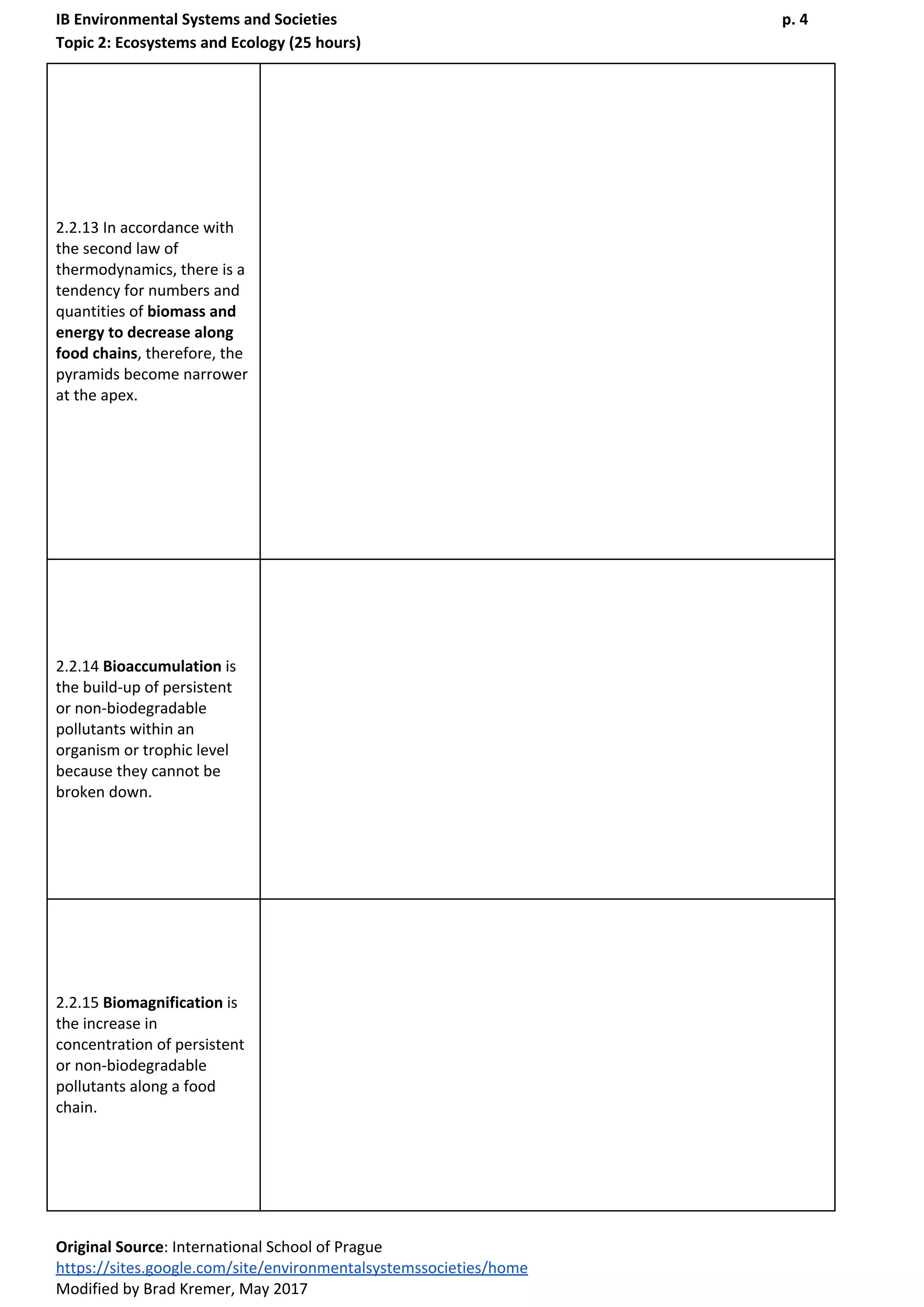
2.2.13 In accordance with
the second law of
thermodynamics, there is a
tendency for numbers and
quantities of ​biomass and
energy to decrease along
food chains​, therefore, the
pyramids become narrower
at the apex.
2.2.14 ​Bioaccumulation​ is
the build-up of persistent
or non-biodegradable
pollutants within an
organism or trophic level
because they cannot be
broken down.
2.2.15 ​Biomagnification​ is
the increase in
concentration of persistent
or non-biodegradable
pollutants along a food
chain.
Original Source​: International School of Prague
https://sites.google.com/site/environmentalsystemssocieties/home
Modified by Brad Kremer, May 2017
IB Environmental Systems and Societies p. 5
Topic 2: Ecosystems and Ecology (25 hours)
2.2.16 Toxins such as ​DDT
and ​mercury​ accumulates
along food chains due to
the decrease of biomass
and energy.
2.2.17 ​Pyramids of
numbers​ can sometimes
display different patterns;
for example, when
numbers of individuals at
lower trophic levels are
relatively large (​inverted
pyramids​).
2.2.18 A ​pyramid of
biomass​ represents the
standing stock or storage of
each trophic level,
measured in units such as
grams of biomass per
square meter (g m​-2​
) or
Joules per square meter (J
m​-2​
) (units of biomass or
energy).
Original Source​: International School of Prague
https://sites.google.com/site/environmentalsystemssocieties/home
Modified by Brad Kremer, May 2017
IB Environmental Systems and Societies p. 6
Topic 2: Ecosystems and Ecology (25 hours)
2.2.19 ​Pyramids of biomass
can show greater quantities
at higher trophic levels
because they represent the
biomass present at a ​fixed
point in time​, although
seasonal variations may be
marked.
2.2.20 ​Pyramids of
productivity​ refer to the
flow of energy through a
trophic level, indicating the
rate at which that stock/
storage is being generated.
2.2.21​ Pyramids of
productivity​ for entire
ecosystems over a year
always show a decrease
along the food chain.
Original Source​: International School of Prague
https://sites.google.com/site/environmentalsystemssocieties/home
Modified by Brad Kremer, May 2017
IB Environmental Systems and Societies p. 7
Topic 2: Ecosystems and Ecology (25 hours)
Applications & Skills: Treat the following prompts as assessment questions on your IB ESS exam. Use the
terminology and concepts from the notes above to respond to each of these prompts.
2.2.AS1 ​Construct​ models of feeding relationships – such as food chains, food webs and ecological pyramids –
from given data.
2.2.AS2 ​Explain​ the transfer and transformation of energy as it flows through an ecosystem.
2.2.AS3 ​Analyze​ the efficiency of energy transfers through a system.
Original Source​: International School of Prague
https://sites.google.com/site/environmentalsystemssocieties/home
Modified by Brad Kremer, May 2017
IB Environmental Systems and Societies p. 8
Topic 2: Ecosystems and Ecology (25 hours)
2.2.AS4 ​Construct​ system diagrams representing photosynthesis and respiration
2.2.AS5 ​Explain​ the relevance of the laws of thermodynamics to the flow of energy through ecosystems.
2.2.AS6 ​Explain​ the impact of a persistent or non-biodegradable pollutant in an ecosystem
Original Source​: International School of Prague
https://sites.google.com/site/environmentalsystemssocieties/home
Modified by Brad Kremer, May 2017
IB Environmental Systems and Societies p. 9
Topic 2: Ecosystems and Ecology (25 hours)
Original Source​: International School of Prague
https://sites.google.com/site/environmentalsystemssocieties/home
Modified by Brad Kremer, May 2017

2.2 communities and ecosystems notes

  • 1.
    IB Environmental Systemsand Societies p. 1 Topic 2: Ecosystems and Ecology (25 hours) 2.2 Communities & Ecosystems Significant Ideas: ➔ The interactions of species with their environment result in energy and nutrient flows. ➔ Photosynthesis and respiration play a significant role in the flow of energy in communities. ➔ The feeding relationships of species in a system can be modeled using food chains, food webs and ecological pyramids. Knowledge & Understanding: Use these notes to familiarize yourself with ESS terminology and concepts. 2.2.1 A ​community​ is a group of populations living and interacting with each other in a common habitat. 2.2.2 An ​ecosystem​ is a community and the physical environment with which it interacts. 2.2.3 ​Respiration​ and photosynthesis​ can be described as processes with inputs, outputs and transformations of energy and matter. 2.2.4 ​Respiration​ is the conversion of organic matter into carbon dioxide and water in all living organisms, releasing energy. Aerobic respiration can be represented by the following word equation. Glucose + oxygen gas → water + carbon dioxide Original Source​: International School of Prague https://sites.google.com/site/environmentalsystemssocieties/home Modified by Brad Kremer, May 2017
  • 2.
    IB Environmental Systemsand Societies p. 2 Topic 2: Ecosystems and Ecology (25 hours) 2.2.5 During ​respiration​, large amounts of energy are dissipated as heat, increasing the ​entropy​ in the ecosystem while enabling organisms to maintain relatively low entropy and so, high organization. 2.2.6 ​Primary producers​ in most ecosystems convert light energy into chemical energy in the process of photosynthesis. 2.2.7 The ​photosynthesis reaction can be represented by the word equation to the right. carbon dioxide + water → glucose + oxygen gas 2.2.8 Photosynthesis produces the raw material for producing ​biomass​. 2.2.9 The ​trophic level​ is the position that an organism occupies in a food chain, or the position of a group of organisms in a community that occupy the same position in food chains. Original Source​: International School of Prague https://sites.google.com/site/environmentalsystemssocieties/home Modified by Brad Kremer, May 2017
  • 3.
    IB Environmental Systemsand Societies p. 3 Topic 2: Ecosystems and Ecology (25 hours) 2.2.10 Producers (​autotrophs​) are typically plants or algae that produce their own food using photosynthesis and the form the first trophic level in a food chain. Exceptions include chemosynthetic organisms that produce food without sunlight. 2.2.11 Feeding relationships involve producers​, ​consumers​ and decomposers​. These can be modeled using food chains, food webs and ecological pyramids. 2.2.12 ​Ecological pyramids include pyramids of numbers​, ​biomass​ and productivity​ and are quantitative models that are usually measured for a given area and time. Original Source​: International School of Prague https://sites.google.com/site/environmentalsystemssocieties/home Modified by Brad Kremer, May 2017
  • 4.
    IB Environmental Systemsand Societies p. 4 Topic 2: Ecosystems and Ecology (25 hours) 2.2.13 In accordance with the second law of thermodynamics, there is a tendency for numbers and quantities of ​biomass and energy to decrease along food chains​, therefore, the pyramids become narrower at the apex. 2.2.14 ​Bioaccumulation​ is the build-up of persistent or non-biodegradable pollutants within an organism or trophic level because they cannot be broken down. 2.2.15 ​Biomagnification​ is the increase in concentration of persistent or non-biodegradable pollutants along a food chain. Original Source​: International School of Prague https://sites.google.com/site/environmentalsystemssocieties/home Modified by Brad Kremer, May 2017
  • 5.
    IB Environmental Systemsand Societies p. 5 Topic 2: Ecosystems and Ecology (25 hours) 2.2.16 Toxins such as ​DDT and ​mercury​ accumulates along food chains due to the decrease of biomass and energy. 2.2.17 ​Pyramids of numbers​ can sometimes display different patterns; for example, when numbers of individuals at lower trophic levels are relatively large (​inverted pyramids​). 2.2.18 A ​pyramid of biomass​ represents the standing stock or storage of each trophic level, measured in units such as grams of biomass per square meter (g m​-2​ ) or Joules per square meter (J m​-2​ ) (units of biomass or energy). Original Source​: International School of Prague https://sites.google.com/site/environmentalsystemssocieties/home Modified by Brad Kremer, May 2017
  • 6.
    IB Environmental Systemsand Societies p. 6 Topic 2: Ecosystems and Ecology (25 hours) 2.2.19 ​Pyramids of biomass can show greater quantities at higher trophic levels because they represent the biomass present at a ​fixed point in time​, although seasonal variations may be marked. 2.2.20 ​Pyramids of productivity​ refer to the flow of energy through a trophic level, indicating the rate at which that stock/ storage is being generated. 2.2.21​ Pyramids of productivity​ for entire ecosystems over a year always show a decrease along the food chain. Original Source​: International School of Prague https://sites.google.com/site/environmentalsystemssocieties/home Modified by Brad Kremer, May 2017
  • 7.
    IB Environmental Systemsand Societies p. 7 Topic 2: Ecosystems and Ecology (25 hours) Applications & Skills: Treat the following prompts as assessment questions on your IB ESS exam. Use the terminology and concepts from the notes above to respond to each of these prompts. 2.2.AS1 ​Construct​ models of feeding relationships – such as food chains, food webs and ecological pyramids – from given data. 2.2.AS2 ​Explain​ the transfer and transformation of energy as it flows through an ecosystem. 2.2.AS3 ​Analyze​ the efficiency of energy transfers through a system. Original Source​: International School of Prague https://sites.google.com/site/environmentalsystemssocieties/home Modified by Brad Kremer, May 2017
  • 8.
    IB Environmental Systemsand Societies p. 8 Topic 2: Ecosystems and Ecology (25 hours) 2.2.AS4 ​Construct​ system diagrams representing photosynthesis and respiration 2.2.AS5 ​Explain​ the relevance of the laws of thermodynamics to the flow of energy through ecosystems. 2.2.AS6 ​Explain​ the impact of a persistent or non-biodegradable pollutant in an ecosystem Original Source​: International School of Prague https://sites.google.com/site/environmentalsystemssocieties/home Modified by Brad Kremer, May 2017
  • 9.
    IB Environmental Systemsand Societies p. 9 Topic 2: Ecosystems and Ecology (25 hours) Original Source​: International School of Prague https://sites.google.com/site/environmentalsystemssocieties/home Modified by Brad Kremer, May 2017