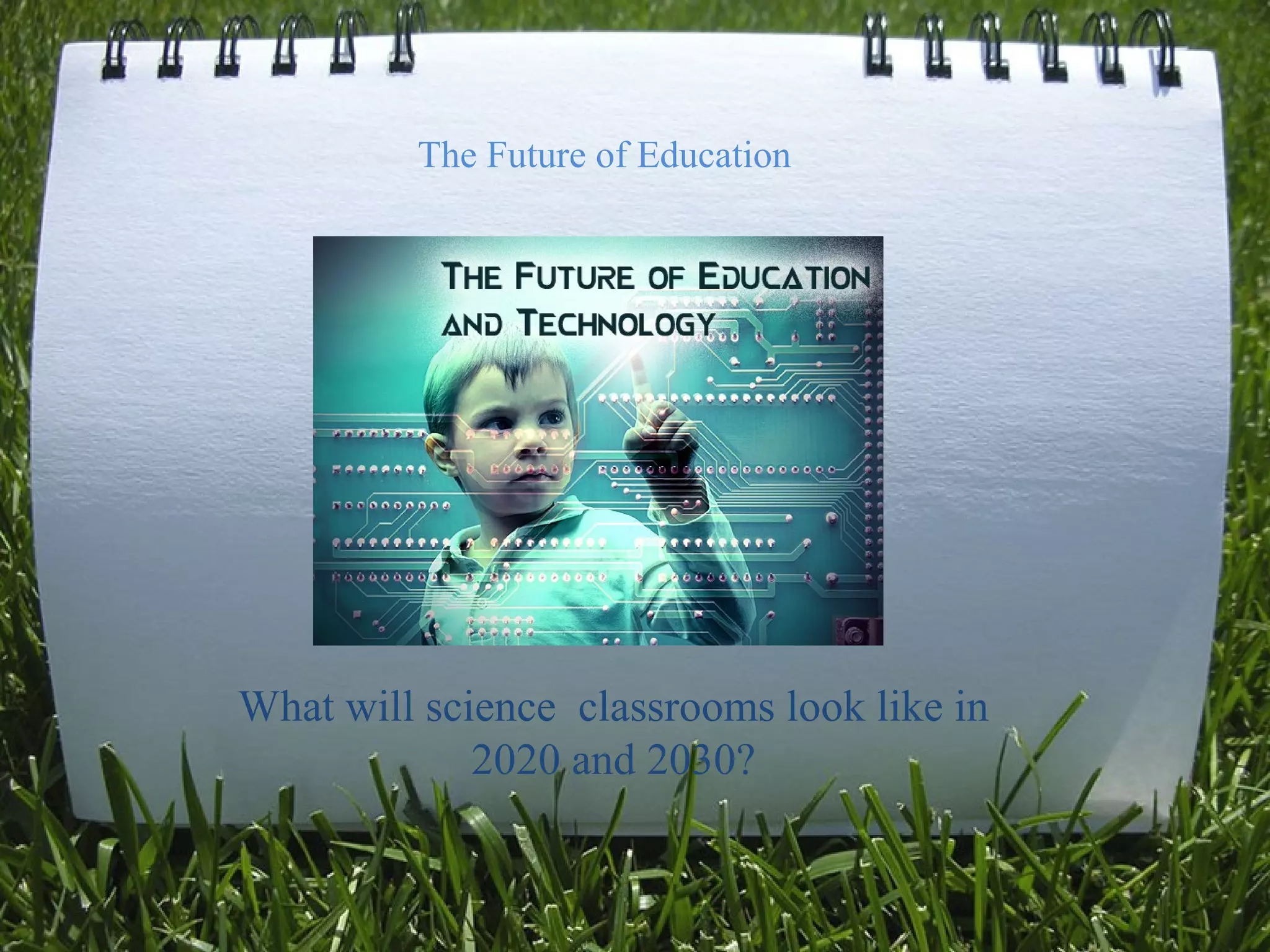
What will science classrooms look like in
2020 and 2030?
The Future of Education
Science Classrooms
in 2020 and 2030
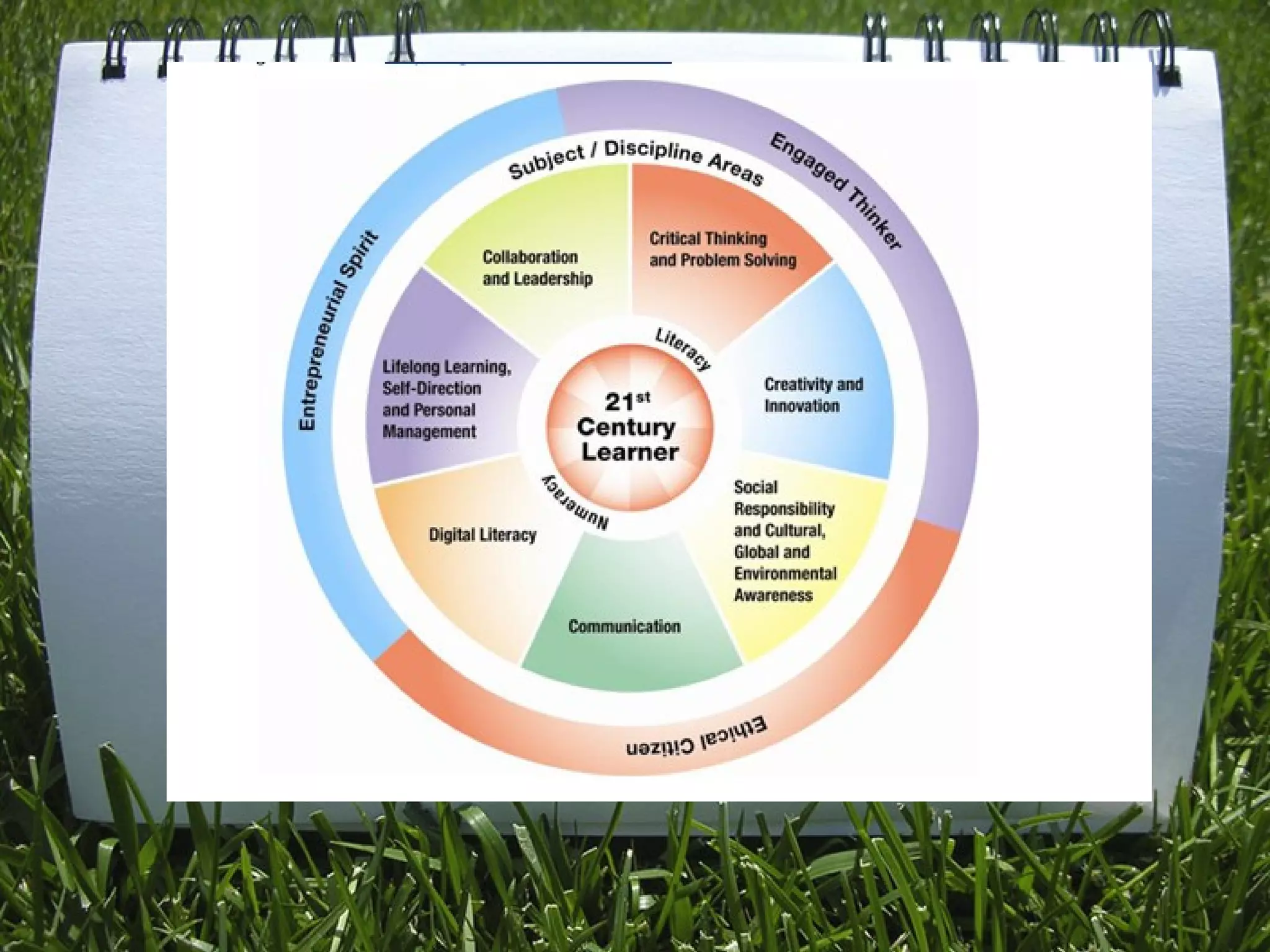
The 21st
Century Learner 
Our Discussion
• A. Predictions to keep us humble
• B. Misconceptions about students.
• C. What will science classrooms look like in 2020 and 2030?
• D. Are students changing?
• E. What teaching strategies should be used?
• F. What changes in technology can we expect?
• G. What can we expect from new learning resources
• H. Conclusions and discussion
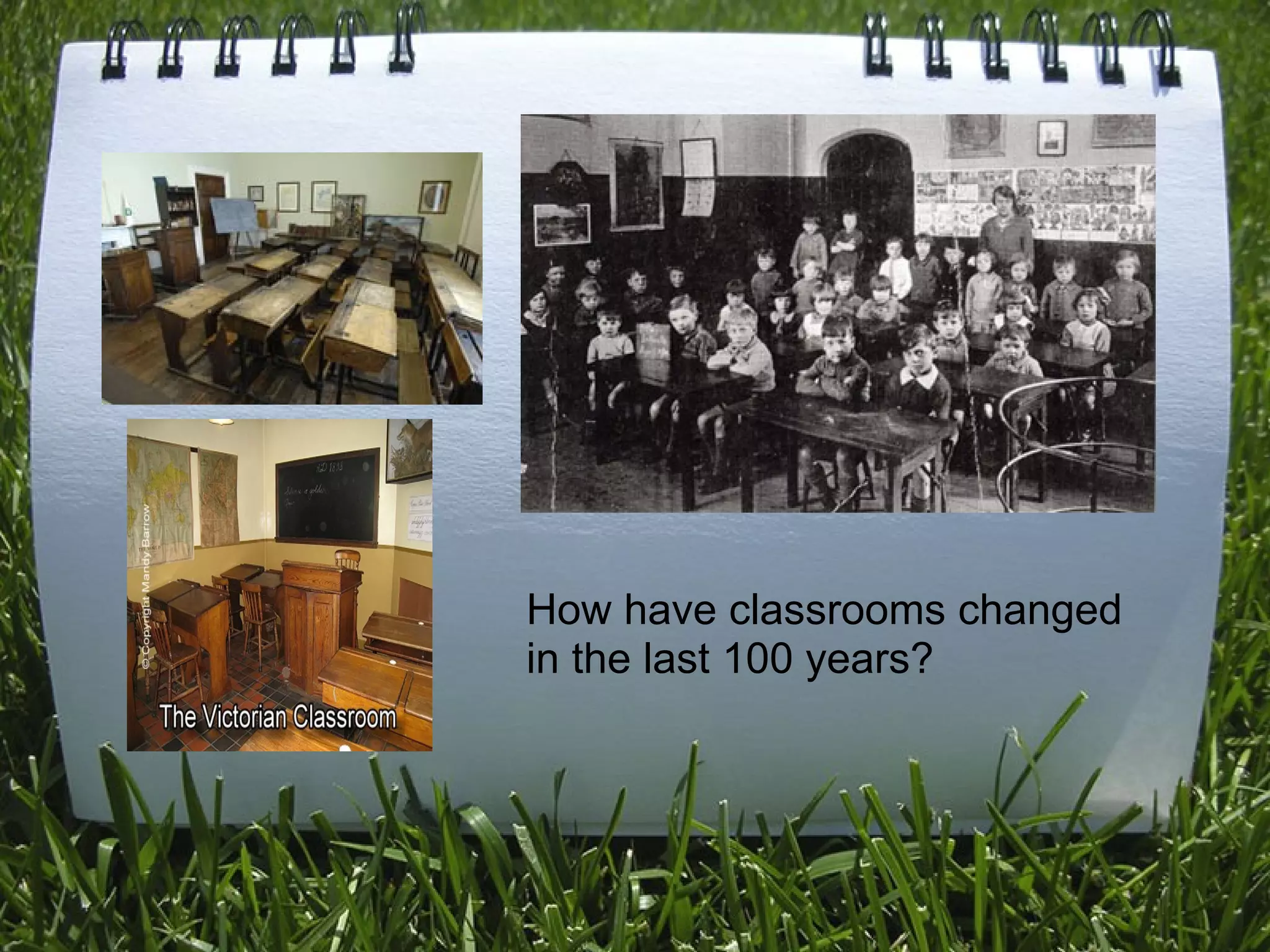
How have classrooms changed
in the last 100 years?
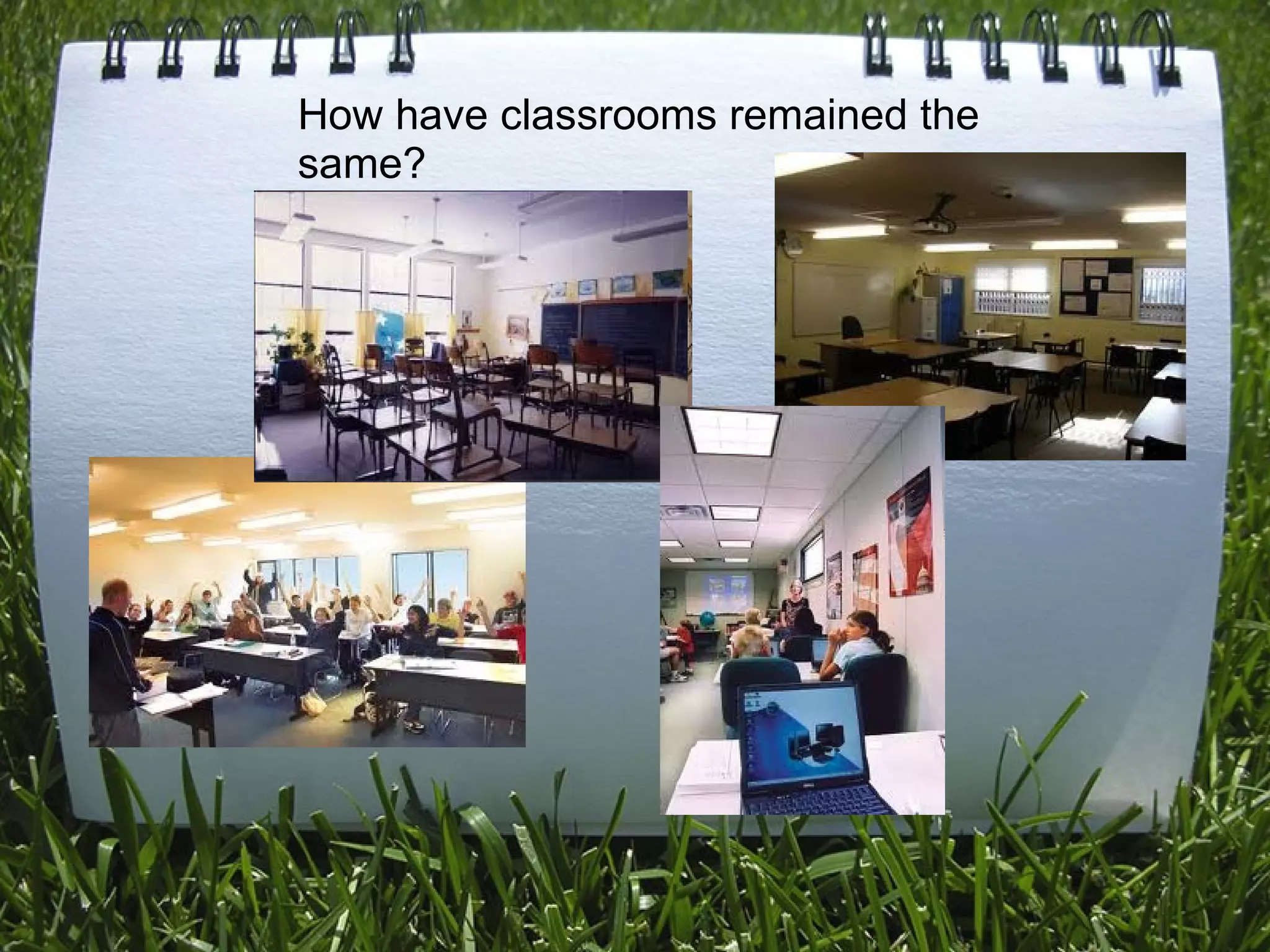
How have classrooms remained the
same?
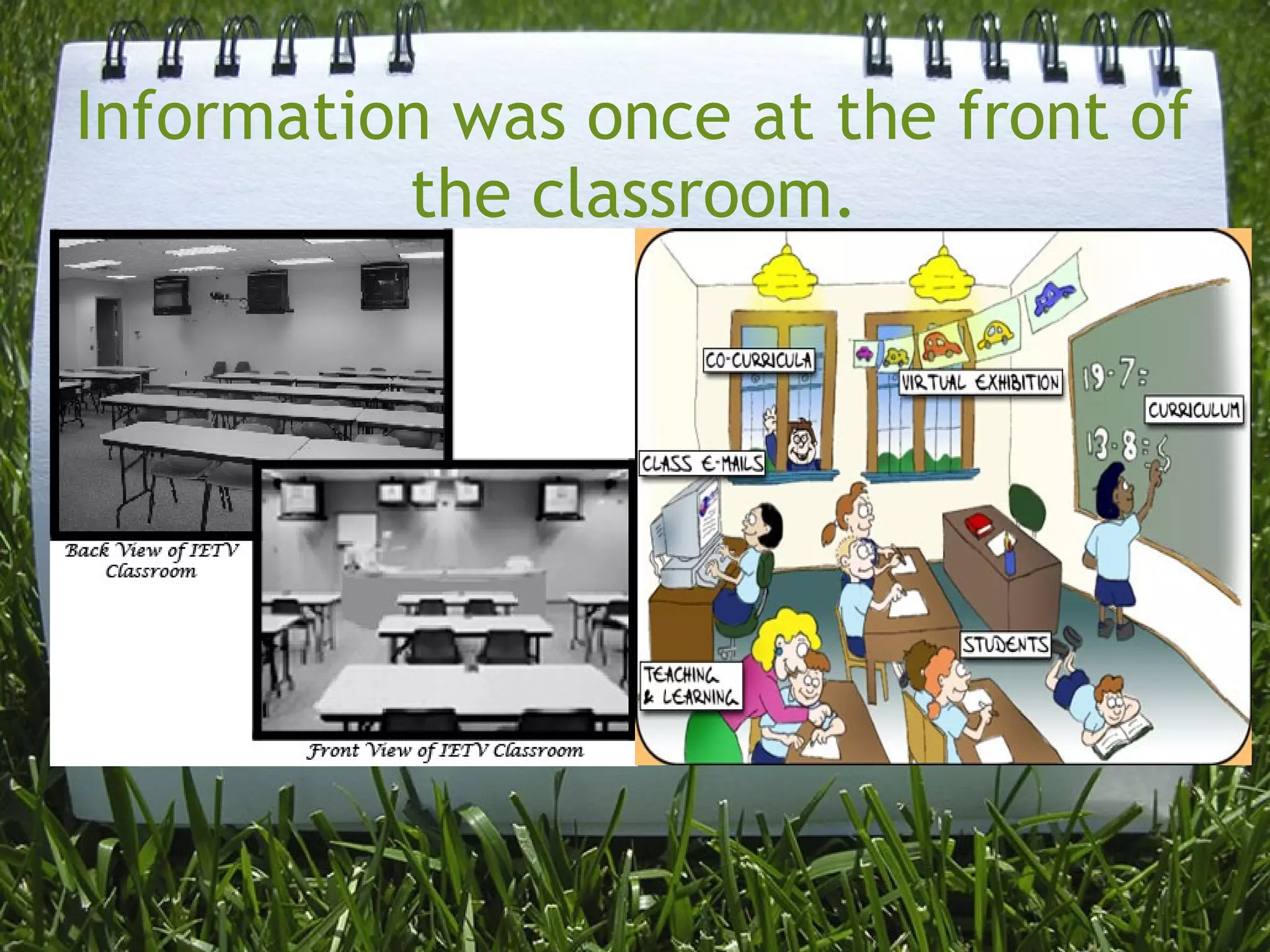
Information was once at the front of
the classroom.
A. The Folly of Predictions 
1970s prediction
Improvements in technology will increase the
amount of leisure time by the 1990s. Few if any
people will work more than a 25-h week.
The biggest challenge to be faced in 20 years will
be what to do with all of our leisure time.
Not everyone is a visionary
“
Everything that can be invented has been invented.»
Charles H. Duell, an official at the US patent office, 1899.
"It will be gone by June"
Variety, passing judgement on rock 'n roll in 1955.
If anything remains more or less unchanged, it will be the
role of women.»
David Riesman, conservative American social scientist,
1967.
Predictions to keep us humble
"I think there is a world market for maybe five computers."-- Thomas
Watson, chairman of IBM, 1943
"We don't like their sound, and guitar music is on the way out."--
Decca Recording Co. rejecting the Beatles, 1962.
"So we went to Atari and said, 'Hey, we've got this amazing thing,
even built with some of your parts, and what do you think about
funding us? Or we'll give it to you. We just want to do it. Pay our
salary, we'll come work for you.' And they said, 'No.' So then we
went to Hewlett-Packard, and they said, 'Hey, we don't need you.
You haven't got through college yet.'"-- Apple Computer Inc. founder
Steve Jobs on attempts to get Atari and HP interested in his and
Steve Wozniak's personal computer.
Signs we live in the 21st Century
You have a list of 15 phone numbers to reach your family of three
You call your son's mobile to let him know it's time to eat. He texts you
back from his bedroom, "What's for dinner?"
You chat several times a day with a stranger from South Africa, but you
haven't spoken with your next door neighbor yet this year.
You hear most of your jokes via Facebook instead of in person
You wake up at 2:00 AM to go to the bathroom and check your
Facebook on your way back to bed.
Your reason for not staying in touch with family is that they are not on
Facebook
You start tilting your head sideways to smile. :)
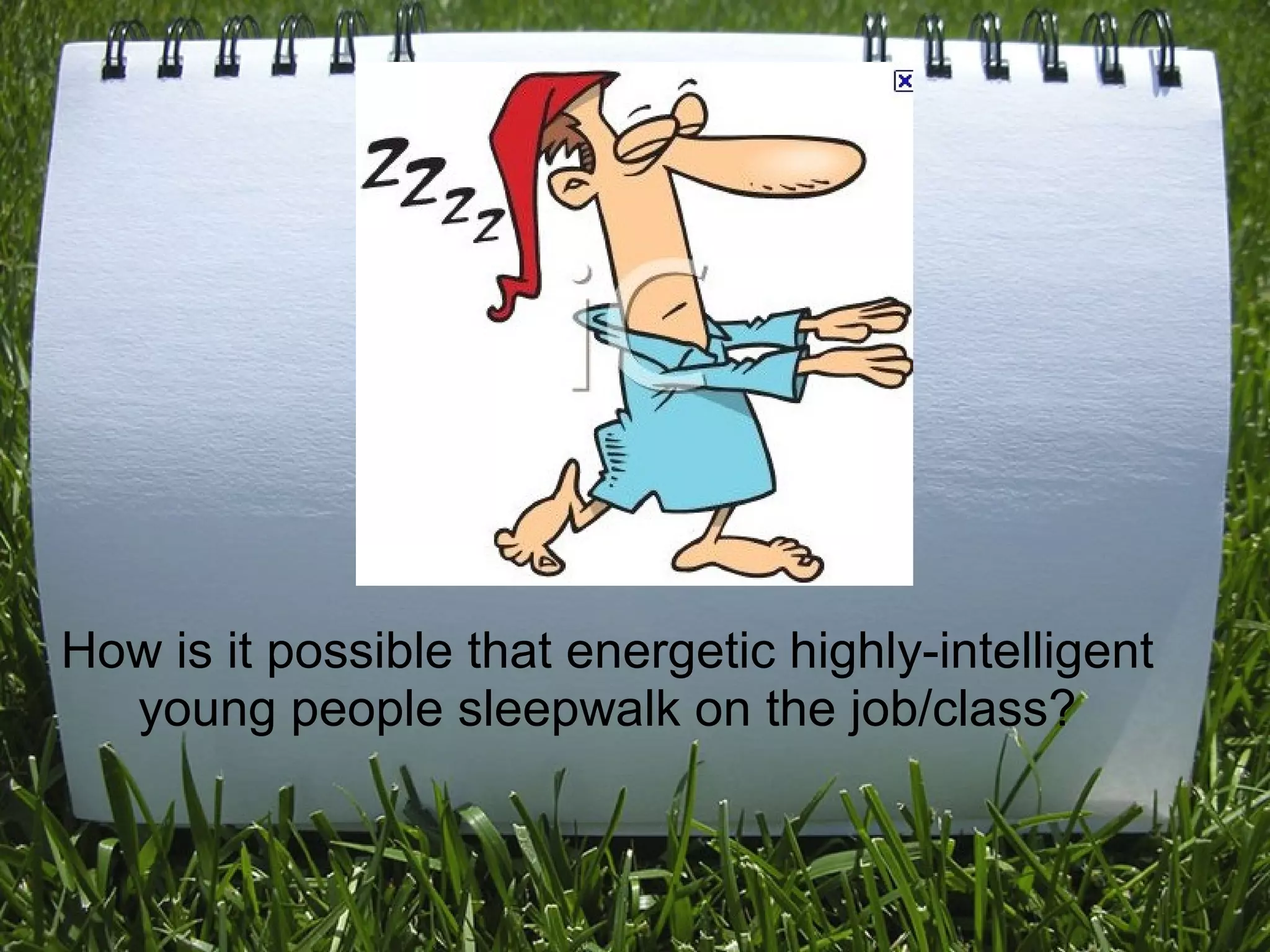
How is it possible that energetic highly-intelligent
young people sleepwalk on the job/class?
B. Are students less able?
•”When I was a student, we were better at spelling,
writing and math.”
•With the possible exception of spelling this is not true.
Curricula is becoming increasing complex.
•Students are not the same and curriculum demands
have increased.
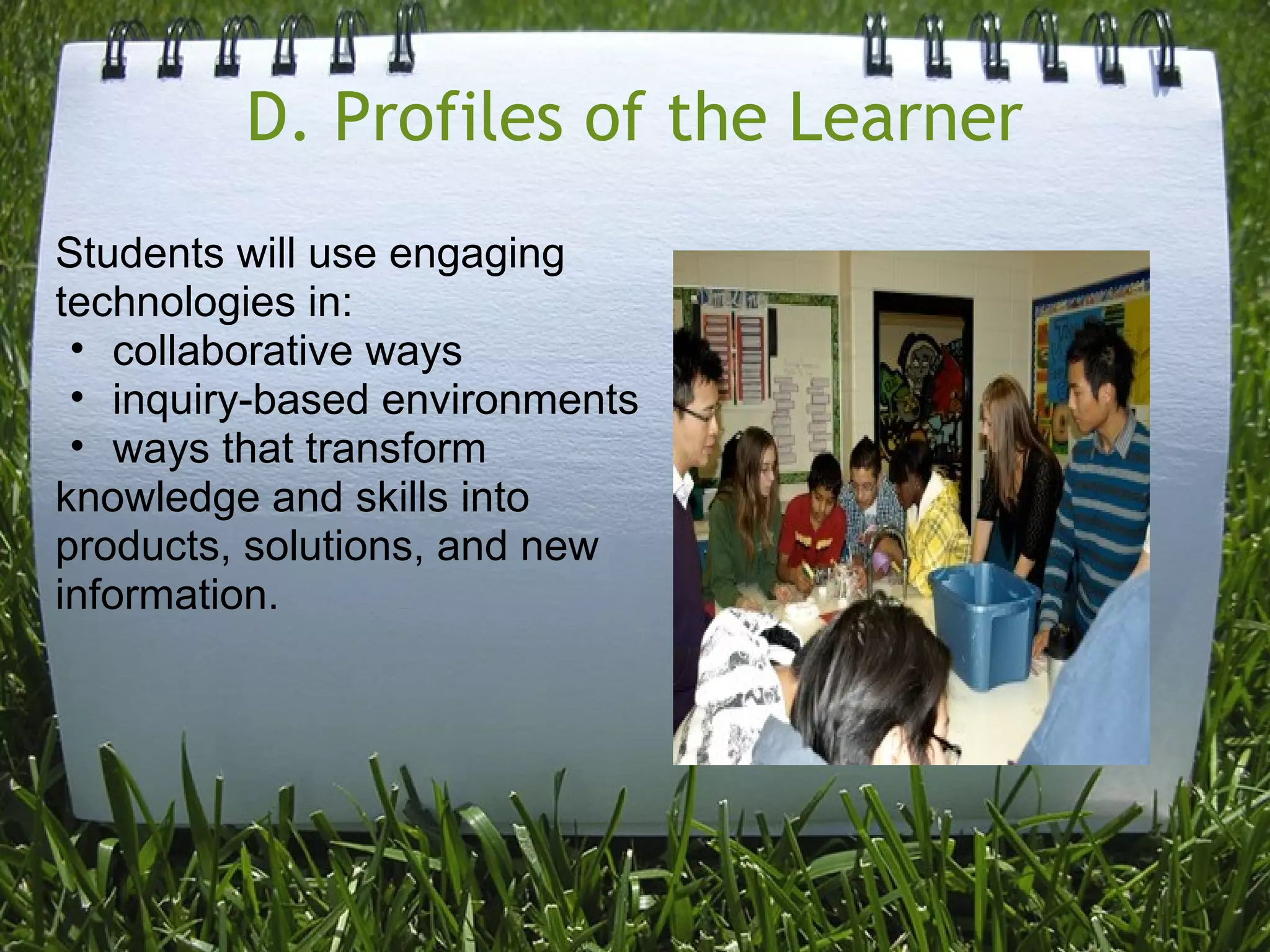
D. Profiles of the Learner
Students will use engaging
technologies in:
• collaborative ways
• inquiry-based environments
• ways that transform
knowledge and skills into
products, solutions, and new
information.
Today's child
"Today's child is bewildered when she enters the
19th century environment that still characterizes
the educational establishment where information is
scarce but ordered and structured by fragmented,
classified patterns, subjects, and schedules."
Marshall McLuhan, 1967
What changes have you seen in schools to make
knowledge less scarce?
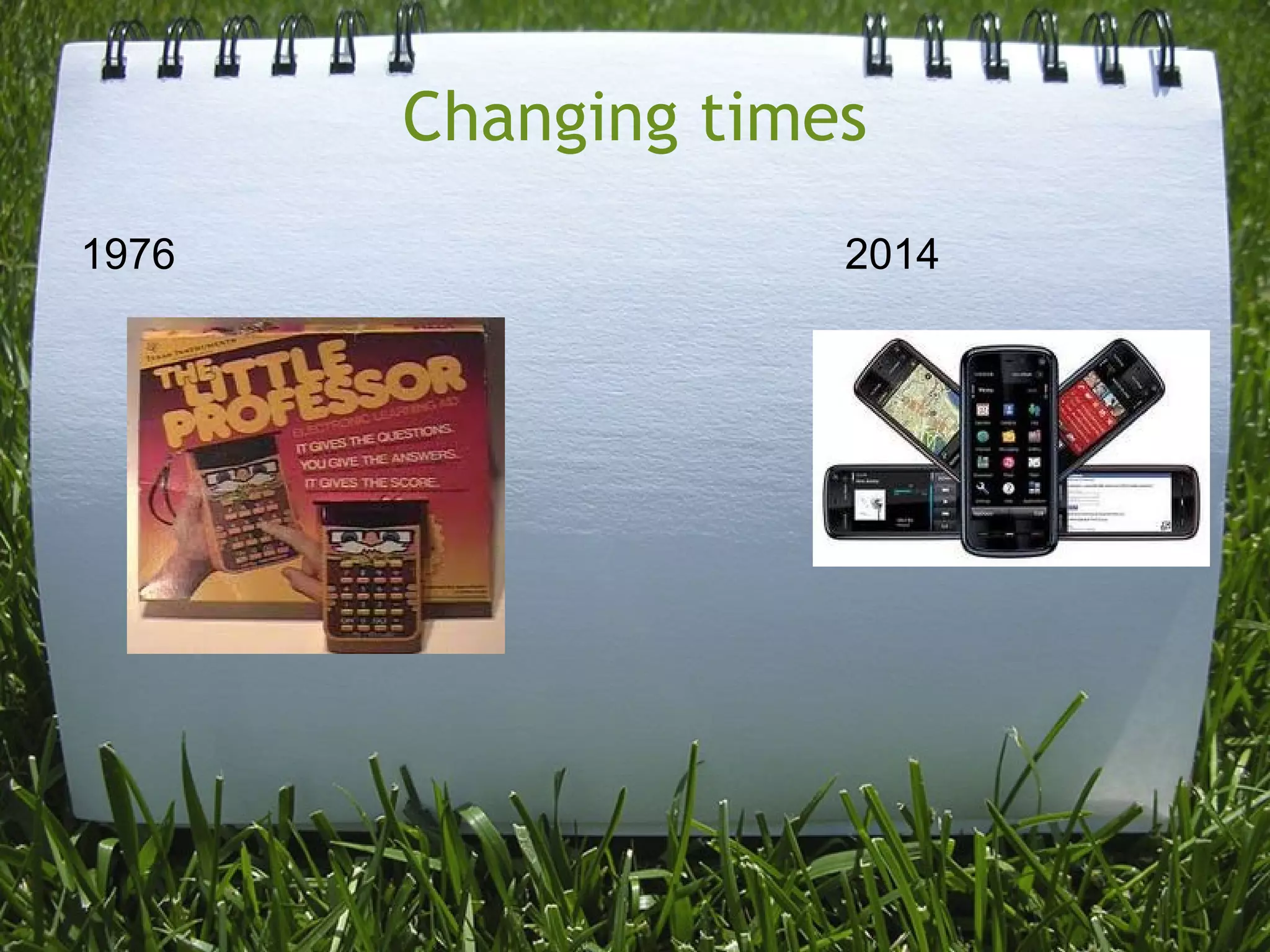
Changing times
1976 2014
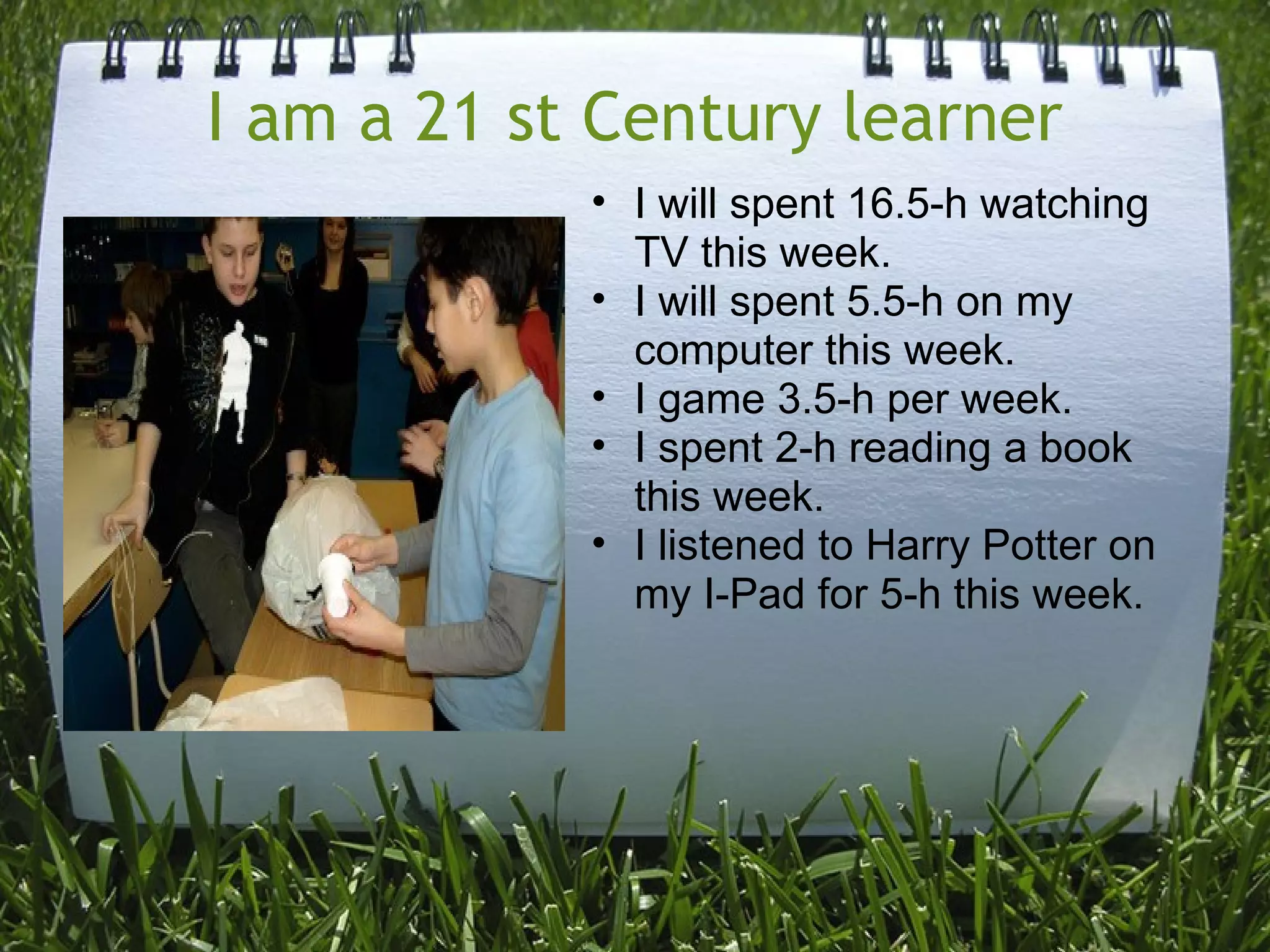
I am a 21 st Century learner
• I will spent 16.5-h watching
TV this week.
• I will spent 5.5-h on my
computer this week.
• I game 3.5-h per week.
• I spent 2-h reading a book
this week.
• I listened to Harry Potter on
my I-Pad for 5-h this week.
I will
• Read 8 books this year.
• Write 42 pages of notes
for classes this semester.
• Spend 5 to 6-h in class
each day.
• Work 2-h day.
• Sleep 2-h less than my
parents did each day.
• Read 2300 webpages,
1281 Facebook profiles
• Write over 500 pages of
email this semester.
• Spend 3.5-h a day online.
• Listen to musics 2.5-h a
day, 2-h on my
cellphone.
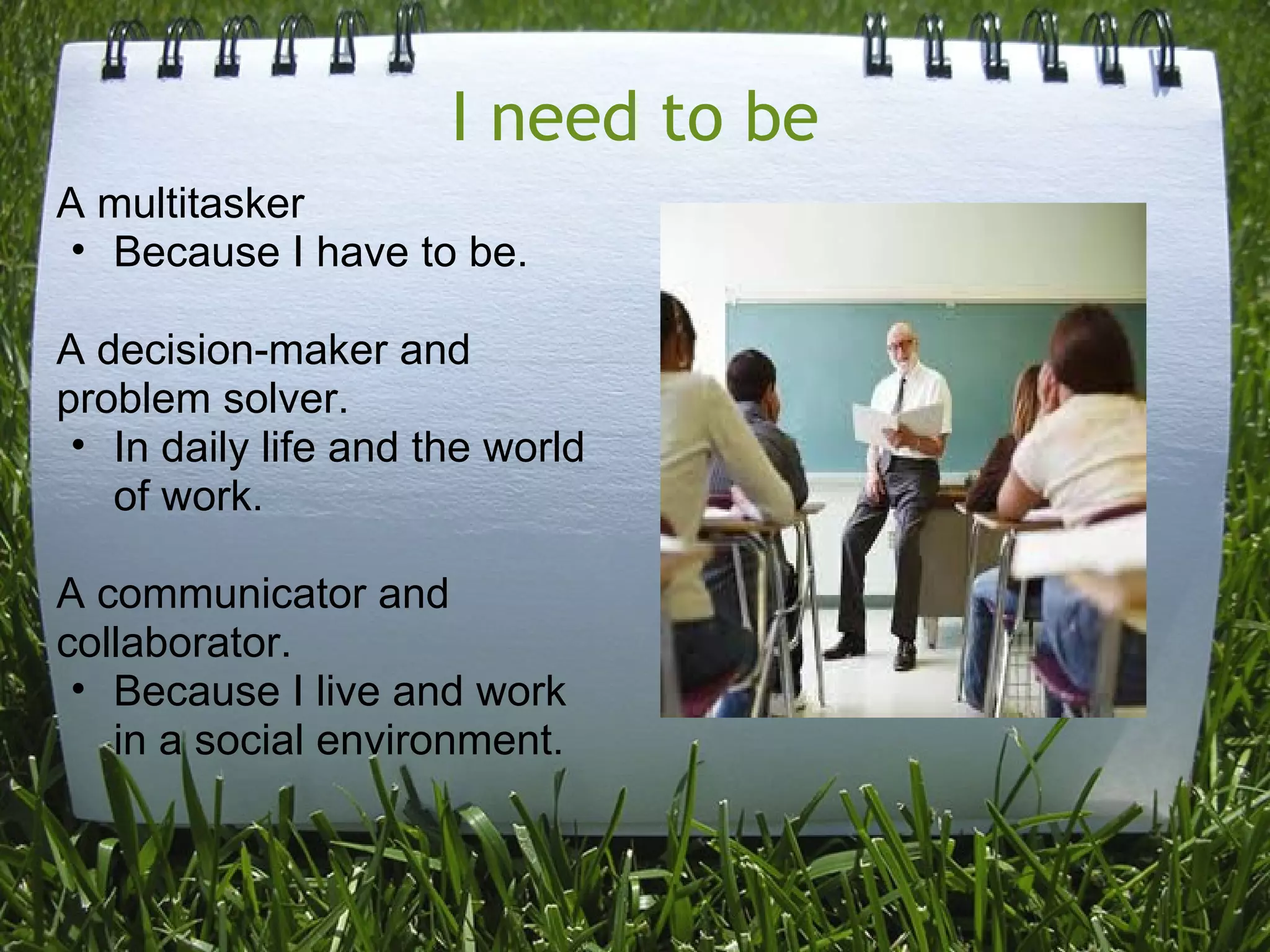
I need to be
A multitasker
• Because I have to be.
A decision-maker and
problem solver.
• In daily life and the world
of work.
A communicator and
collaborator.
• Because I live and work
in a social environment.
My Social Life and School
• My teacher and parents
use email to
communicate.
• 76% of my teachers have
never used WIKIs, blogs
and PODcasts.
• I text my friends.
• I blog
• 14% of the week, I get to
do something with
technology in school.
63% of students don't
use technology weekly.
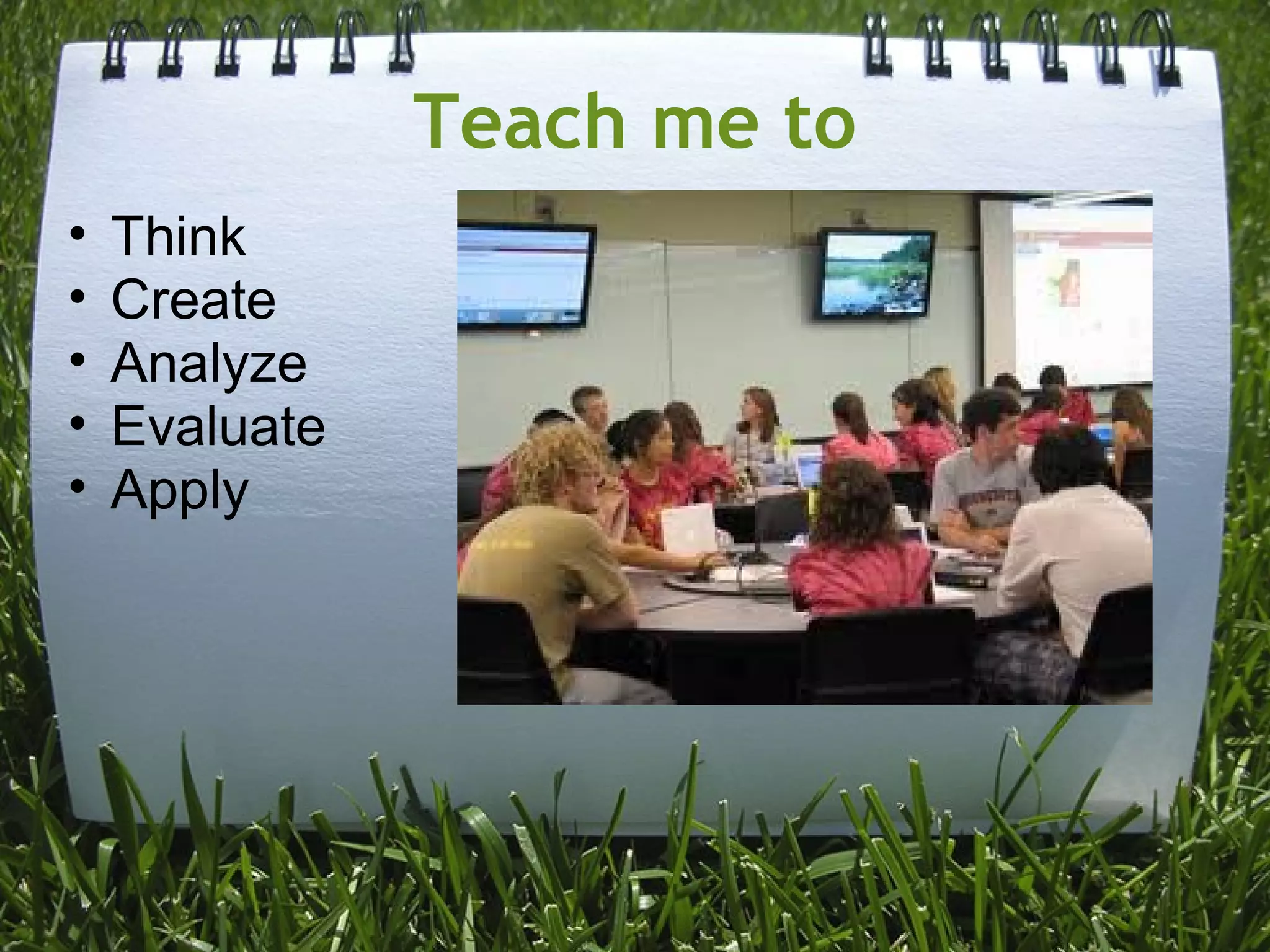
Teach me to
• Think
• Create
• Analyze
• Evaluate
• Apply
A New Paradigm
A shift from information limited, common sources, to
information-rich resources.
A shift from curriculum based on content (outcomes) to one
of skills (competancy).
A shift from learning confined by the classroom to a
community system.
8 Norms of 21st Century Learners
1. They need to be actively engaged. This includes school and
their job.
2. Value collaboration above passive learning.
3. A desire to personalize and customize everything they own.
4. Value choice
5. Demand enjoyment at work and school.
6. More likely to research and critique organizations and
individuals.
7. Speed is normal, with little patience for turn-around time.
8. Will have challenges in developing their professional
identity.
Don Tapscott, 2009. Grown-Up Digital, McGraw Hill, Toronto
E. Teaching Strategies
Student Engagement
• Problem-based learning
• Collaborative work for students and instructors
• Emphasis placed on lifelong Learning
• Inquiry
• Integration of learning and interdisciplinary studies
• Simulations
Student Choice
• Use of technology to present and share students ideas.
• Assistive technologies to support student learning.
• Students involved in their own assessment.
Why does every lesson have to
entertain students with technology?
Students don't need to be entertained, they need
to be engaged!
• Entertainment is passive
• Entertainment is for
enjoyment
• Entertainment is short-
lived
• Entertainment is does
not require relevance.
• Engagement is active
• Engagement is for
learning
• Engagement provides
long-term results
• Engagement requires
relevance and
applicability.
G. Textbooks of the future
Digital textbooks
• Online assessment as part of the textbook. Students
interact with the book.
• Textbook linked with online simulations, videos, podcasts
and laboratory activities.
• Movement away from linear reading - use of pop-ups
provide students with choices.
• Wikis and blogs allow student interaction during the
learning.
Digital Textbook Project In California
Students to use free on-line
textbooks.
Digital textbooks provide
advertising and sponsorship
as a possible source of
revenue.
Advantages
• More up-to-date.
• Lighter school bags.
• Save paper and trees.
• Make learning more
interactive.
• Easier to search.
Math and Science Projects
2010.
$17 B cut from a $52 B
budget.
Much of the motivation is
seen around cost savings.
• Outsourcing of writing.
• Compilation and tagging
of information.
• Linking of information
with activities.
What will be gained and lost
Gain
• More content and more
choices for different types
of learners.
• Potentially many links for
activities. (Labs, WIKIs,
blogs, etc.)
• Resource development
will integrate textbook
with pre-existing visual
resources.
Lost
• No philosophy as an
underpinning for resource
development.
• Eclectic resource
development means no
single format for lab write
up or the presentation of
work.
• Potential for content
bound curriculum.
Choice and Ownership
Teachers will look for resources that allow them greater
participation in the learning of their students. (A push back
against mass uniform delivery and resource models).
Students and parents have a expectation that programs are
tailored to the child's needs and interests.
• Learning any place, any time, and at any pace. (AB Ed
2010-13).
Social networking will find stronger links in completing
assignments, critiquing the work of students and teachers.
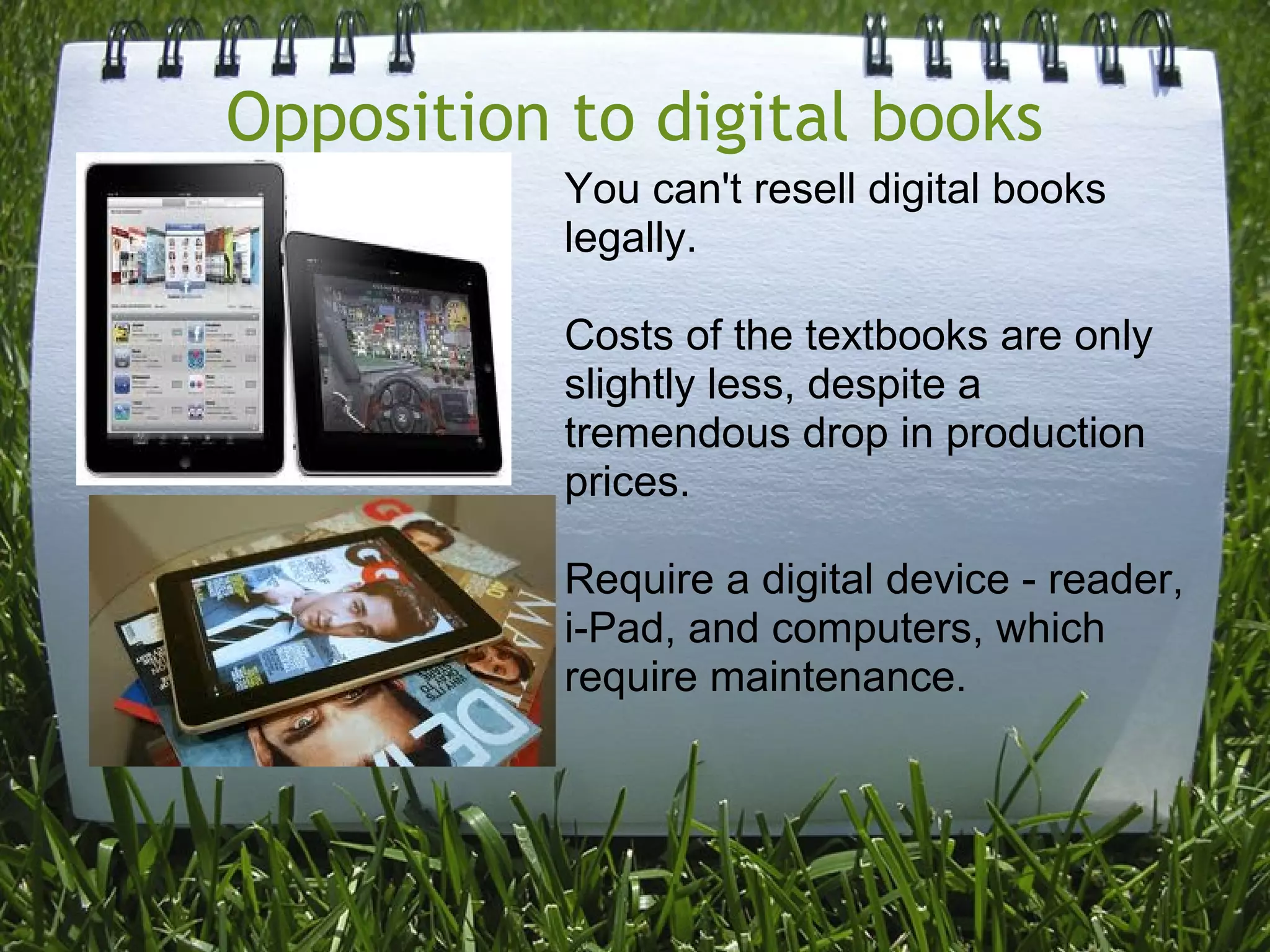
Opposition to digital books
You can't resell digital books
legally.
Costs of the textbooks are only
slightly less, despite a
tremendous drop in production
prices.
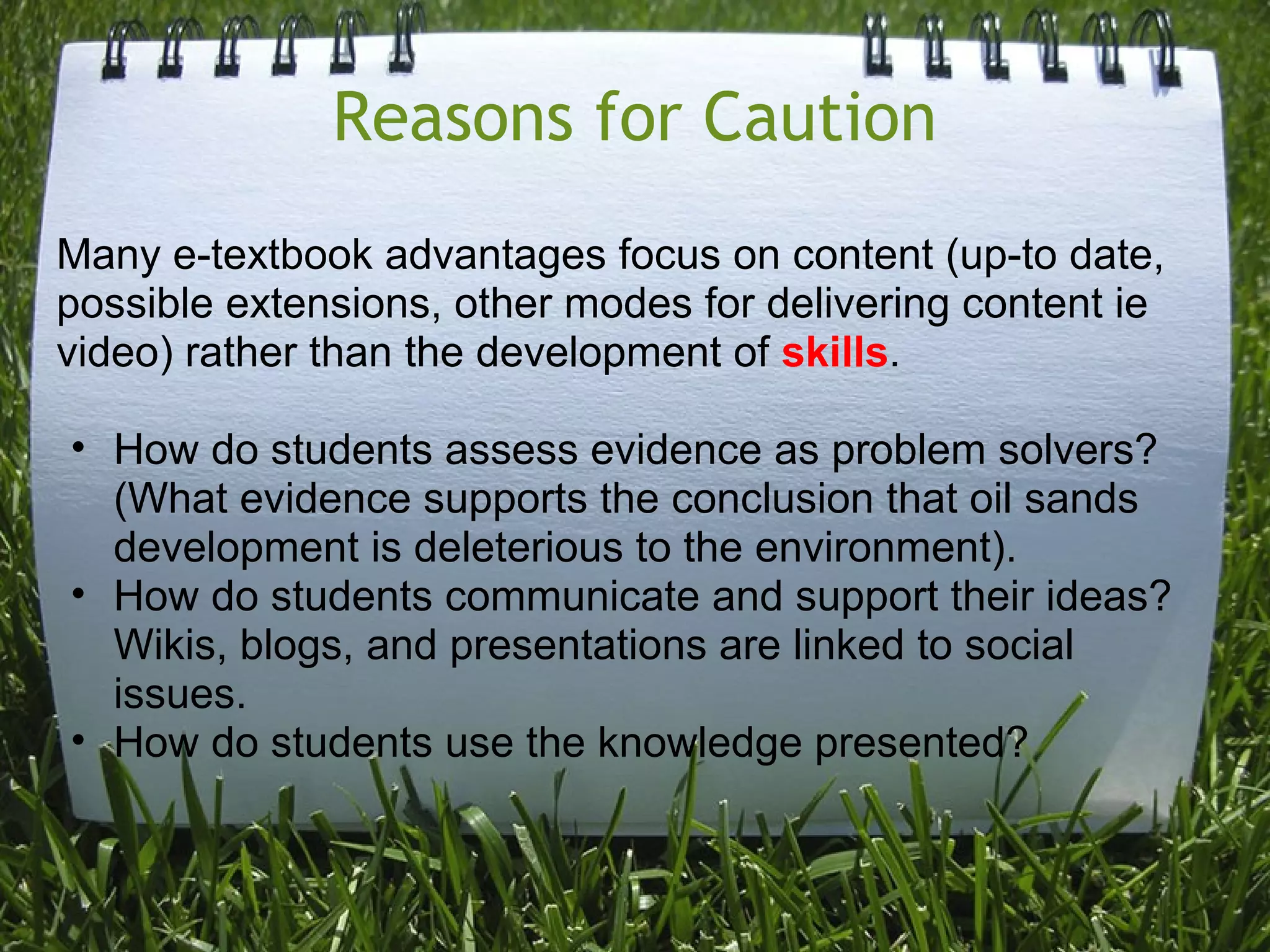
Require a digital device - reader,
i-Pad, and computers, which
require maintenance.
Reasons for Caution
Many e-textbook advantages focus on content (up-to date,
possible extensions, other modes for delivering content ie
video) rather than the development of skills.
• How do students assess evidence as problem solvers?
(What evidence supports the conclusion that oil sands
development is deleterious to the environment).
• How do students communicate and support their ideas?
Wikis, blogs, and presentations are linked to social
issues.
• How do students use the knowledge presented?
Conclusions
Technological tools have an appeal in providing choice and
personalizing learning.
The terms technology and innovation are often used as
synonyms. There is an assumption that teachers who use
more technology are more creative or innovative.
Curriculum must focus on skills and attributes and not
packages of knowledge.

21StCenturyLearner-2

  • 1.
    What will scienceclassrooms look like in 2020 and 2030? The Future of Education
  • 2.
    Science Classrooms in 2020and 2030 The 21st Century Learner 
  • 3.
    Our Discussion • A.Predictions to keep us humble • B. Misconceptions about students. • C. What will science classrooms look like in 2020 and 2030? • D. Are students changing? • E. What teaching strategies should be used? • F. What changes in technology can we expect? • G. What can we expect from new learning resources • H. Conclusions and discussion
  • 4.
    How have classroomschanged in the last 100 years?
  • 5.
    How have classroomsremained the same?
  • 6.
    Information was onceat the front of the classroom.
  • 7.
    A. The Follyof Predictions  1970s prediction Improvements in technology will increase the amount of leisure time by the 1990s. Few if any people will work more than a 25-h week. The biggest challenge to be faced in 20 years will be what to do with all of our leisure time.
  • 8.
    Not everyone isa visionary “ Everything that can be invented has been invented.» Charles H. Duell, an official at the US patent office, 1899. "It will be gone by June" Variety, passing judgement on rock 'n roll in 1955. If anything remains more or less unchanged, it will be the role of women.» David Riesman, conservative American social scientist, 1967.
  • 9.
    Predictions to keepus humble "I think there is a world market for maybe five computers."-- Thomas Watson, chairman of IBM, 1943 "We don't like their sound, and guitar music is on the way out."-- Decca Recording Co. rejecting the Beatles, 1962. "So we went to Atari and said, 'Hey, we've got this amazing thing, even built with some of your parts, and what do you think about funding us? Or we'll give it to you. We just want to do it. Pay our salary, we'll come work for you.' And they said, 'No.' So then we went to Hewlett-Packard, and they said, 'Hey, we don't need you. You haven't got through college yet.'"-- Apple Computer Inc. founder Steve Jobs on attempts to get Atari and HP interested in his and Steve Wozniak's personal computer.
  • 10.
    Signs we livein the 21st Century You have a list of 15 phone numbers to reach your family of three You call your son's mobile to let him know it's time to eat. He texts you back from his bedroom, "What's for dinner?" You chat several times a day with a stranger from South Africa, but you haven't spoken with your next door neighbor yet this year. You hear most of your jokes via Facebook instead of in person You wake up at 2:00 AM to go to the bathroom and check your Facebook on your way back to bed. Your reason for not staying in touch with family is that they are not on Facebook You start tilting your head sideways to smile. :)
  • 11.
    How is itpossible that energetic highly-intelligent young people sleepwalk on the job/class?
  • 12.
    B. Are studentsless able? •”When I was a student, we were better at spelling, writing and math.” •With the possible exception of spelling this is not true. Curricula is becoming increasing complex. •Students are not the same and curriculum demands have increased.
  • 13.
    D. Profiles ofthe Learner Students will use engaging technologies in: • collaborative ways • inquiry-based environments • ways that transform knowledge and skills into products, solutions, and new information.
  • 14.
    Today's child "Today's childis bewildered when she enters the 19th century environment that still characterizes the educational establishment where information is scarce but ordered and structured by fragmented, classified patterns, subjects, and schedules." Marshall McLuhan, 1967 What changes have you seen in schools to make knowledge less scarce?
  • 15.
  • 16.
    I am a21 st Century learner • I will spent 16.5-h watching TV this week. • I will spent 5.5-h on my computer this week. • I game 3.5-h per week. • I spent 2-h reading a book this week. • I listened to Harry Potter on my I-Pad for 5-h this week.
  • 17.
    I will • Read8 books this year. • Write 42 pages of notes for classes this semester. • Spend 5 to 6-h in class each day. • Work 2-h day. • Sleep 2-h less than my parents did each day. • Read 2300 webpages, 1281 Facebook profiles • Write over 500 pages of email this semester. • Spend 3.5-h a day online. • Listen to musics 2.5-h a day, 2-h on my cellphone.
  • 18.
    I need tobe A multitasker • Because I have to be. A decision-maker and problem solver. • In daily life and the world of work. A communicator and collaborator. • Because I live and work in a social environment.
  • 19.
    My Social Lifeand School • My teacher and parents use email to communicate. • 76% of my teachers have never used WIKIs, blogs and PODcasts. • I text my friends. • I blog • 14% of the week, I get to do something with technology in school. 63% of students don't use technology weekly.
  • 20.
    Teach me to •Think • Create • Analyze • Evaluate • Apply
  • 21.
    A New Paradigm Ashift from information limited, common sources, to information-rich resources. A shift from curriculum based on content (outcomes) to one of skills (competancy). A shift from learning confined by the classroom to a community system.
  • 22.
    8 Norms of21st Century Learners 1. They need to be actively engaged. This includes school and their job. 2. Value collaboration above passive learning. 3. A desire to personalize and customize everything they own. 4. Value choice 5. Demand enjoyment at work and school. 6. More likely to research and critique organizations and individuals. 7. Speed is normal, with little patience for turn-around time. 8. Will have challenges in developing their professional identity. Don Tapscott, 2009. Grown-Up Digital, McGraw Hill, Toronto
  • 23.
    E. Teaching Strategies StudentEngagement • Problem-based learning • Collaborative work for students and instructors • Emphasis placed on lifelong Learning • Inquiry • Integration of learning and interdisciplinary studies • Simulations Student Choice • Use of technology to present and share students ideas. • Assistive technologies to support student learning. • Students involved in their own assessment.
  • 24.
    Why does everylesson have to entertain students with technology? Students don't need to be entertained, they need to be engaged! • Entertainment is passive • Entertainment is for enjoyment • Entertainment is short- lived • Entertainment is does not require relevance. • Engagement is active • Engagement is for learning • Engagement provides long-term results • Engagement requires relevance and applicability.
  • 26.
    G. Textbooks ofthe future Digital textbooks • Online assessment as part of the textbook. Students interact with the book. • Textbook linked with online simulations, videos, podcasts and laboratory activities. • Movement away from linear reading - use of pop-ups provide students with choices. • Wikis and blogs allow student interaction during the learning.
  • 27.
    Digital Textbook ProjectIn California Students to use free on-line textbooks. Digital textbooks provide advertising and sponsorship as a possible source of revenue. Advantages • More up-to-date. • Lighter school bags. • Save paper and trees. • Make learning more interactive. • Easier to search. Math and Science Projects 2010. $17 B cut from a $52 B budget. Much of the motivation is seen around cost savings. • Outsourcing of writing. • Compilation and tagging of information. • Linking of information with activities.
  • 28.
    What will begained and lost Gain • More content and more choices for different types of learners. • Potentially many links for activities. (Labs, WIKIs, blogs, etc.) • Resource development will integrate textbook with pre-existing visual resources. Lost • No philosophy as an underpinning for resource development. • Eclectic resource development means no single format for lab write up or the presentation of work. • Potential for content bound curriculum.
  • 29.
    Choice and Ownership Teacherswill look for resources that allow them greater participation in the learning of their students. (A push back against mass uniform delivery and resource models). Students and parents have a expectation that programs are tailored to the child's needs and interests. • Learning any place, any time, and at any pace. (AB Ed 2010-13). Social networking will find stronger links in completing assignments, critiquing the work of students and teachers.
  • 30.
    Opposition to digitalbooks You can't resell digital books legally. Costs of the textbooks are only slightly less, despite a tremendous drop in production prices. Require a digital device - reader, i-Pad, and computers, which require maintenance.
  • 31.
    Reasons for Caution Manye-textbook advantages focus on content (up-to date, possible extensions, other modes for delivering content ie video) rather than the development of skills. • How do students assess evidence as problem solvers? (What evidence supports the conclusion that oil sands development is deleterious to the environment). • How do students communicate and support their ideas? Wikis, blogs, and presentations are linked to social issues. • How do students use the knowledge presented?
  • 32.
    Conclusions Technological tools havean appeal in providing choice and personalizing learning. The terms technology and innovation are often used as synonyms. There is an assumption that teachers who use more technology are more creative or innovative. Curriculum must focus on skills and attributes and not packages of knowledge.

Editor's Notes