Academic Writing Skills
Workshop
Professor Rowena Murray
University of the West of Scotland
rowena.murray@uws.ac.uk
Introduction
 ‘Snack writing’
 Writing goals: setting and monitoring
 Writing to prompts
 Social writing
 Combining generative and structuring
strategies
 Explicit links to university/journal criteria.
Two approaches to academic writing
1. Targeting journals, analysing journals,
dialogue with editors and published
writers, ‘callibrating’ your writing, dealing
with reviewers’ feedback
2. Writing to prompts, freewriting,
generative writing
Developing academic writing: principles
 Using tried and tested strategies
 Discussion: rehearsing arguments
 ‘Pre-peer review’ on writing-in-progress
 Writing/revising time -- increasing
 Analysing published writing
 Developing paper/chapter at meetings
 ‘Binge’ and ‘snack’ writing
Writing to prompts
 What writing for your thesis/writing for
publication have you done, and what would you
like to do [in the long, medium and short term]?
 5 minutes’ writing
 In sentences
 Private writing -- no one will read it
 To be discussed in pairs/groups
Prompts to make the ‘contribution’ explicit
 ‘This research shows/reveals/confirms’
 ‘This is a contribution in the sense that …’
 ‘This is a contribution to the extent that …’
Prompts to match research aim(s) and claim(s)
The aims of this study are > were …
The research questions are > were …
The research objectives are > were …
Prompts for thesis summary
 750 words = 3 pages, double-spaced.
 Use verbs to define purposes of chapters:
Chapter 1 [verb] … Chapter 2 [verb] ….
 Show coherence of thesis argument.
 Show links between chapters.
 Show links between aim(s) and claim(s).
 Insert at end of thesis Introduction.
Prompts to internalise the debate
 ‘Some will argue that …’
 ‘One interpretation could be …’
 ‘However, this could be taken as …’
 ‘This is not to say that …’
 ‘Possible interpretations include …’
Prompts from journals: 1
‘Using earlier research into models of place
branding-management processes, this paper
develops a multi-level conceptual model of … The
model identifies the following components for …
The model identifies the influences and action
processes … This paper proposes an integrative
model that builds on and subsumes …’.
(Hanna & Rowley, 2011: 458
Journal of Marketing Management)
Prompts from journals: 2
‘I explore the role of trust in acquisitions of
entrepreneurial firms … I outline how … I
also find that buyers’ and sellers’ beliefs …
I explore the implications of these findings
for developing a theory of trust asymmetries
and argue that …’.
(Graebner, 2009: 435
Academy of Management Journal)
Prompts from journals: 3
‘This paper investigates the extent to which
the outcomes of the 2008 Research
Assessment Exercise … can be explained
by … The main finding is that … A further
finding is that …There is also evidence of
bias … The results support the use of …’.
(Taylor, 2011: 202)
British Journal of Management)
Match research gap and your
article’s contribution
‘Recent research has been concerned with
whether speech accommodation is an
automatic process or determined by social
factors … This paper investigates … These
biases are, crucially, simultaneously
automatic and social’ (Babel, Language in
Society, 2010).
Adapt published prompts
‘Comparisons of … have become popular over the last
three decades as they permit a systematic investigation of
the impact of … A common result of these studies is that
… Additional results indicate … Finally, we also list some
issues for the future. We demand more efforts on theory of
… We also demand more replications based on updated
data and methods that seek to unify the many differing
results of previous studies’.
Journal of International Health
Active verbs for discussing ideas
Informs, reviews, argues, states, claims,
synthesises, answers, explains, reconsiders,
provides, maintains, outlines, supports, compares,
lists, acknowledges, confirms, analyses, disputes,
concludes, reveals, implies, reminds, suggests,
considers, highlights, refutes, assembles, shows,
adds, clarifies, identifies (Ballenger, 2009)
See also Murray (2014b) article in JADE.
Preparing to write
 Decide on specific writing project.
 Choose a target journal.
 Email the journal editor about your
topic, contribution and appropriateness
of your paper for that journal.
 Collect information about the journal.
 Study sample papers from that journal.
Freewriting
 Write for 5 minutes
 In sentences
 Without stopping
 Private writing -- no one will read it
 What to write about: subject of your paper, your target
journal or its requirements
 Brainstorm in sentences
 Structure and coherence not required
 Explore many angles, do ‘open’ writing
Freewriting & generative writing for
publication
 To get started
 To explore possibilities
 To silence the ‘internal editor’ temporarily
 To develop confidence
 To develop fluency
 To work out a complex argument
 To do rough drafting
 Freewriting to work out what you want to say; generative writing to
work out how to say it.
Pros & cons
 ‘Freewheelers’ like it; ‘structurers’ don’t.
 It’s a good idea to use both types of writing
strategy.
 You need to try it for a while to see whether
there is benefit for your writing process.
 It may be important to ‘write about your
writing’ for some of the time.
References
Freewriting
Elbow, P. (1973) Writing without teachers. Oxford: Oxford
University Press.
Generative writing
Boice, R. (1990) Professors as writers: A self-help guide to
productive writing. Stillwater, OK: New Forums Press.
Writing a ‘page-98 paper’
 My research question is … (50 words)
 Researchers who have looked at this subject are
… (50 words)
 They argue that … (25 words)
 Debate centres on the issue of … (25 words)
 There is work to be done on … (25 words)
 My research is closest to that of X in that … (50
words)
 My contribution will be … (50 words)
Why write a ‘page 98 paper’? And when?
 Early: to establish direction/focus
 Associate & dissociate with literature
 Build on research question/hypothesis
 Focus reading/thinking
 Manageable writing task: 275 words
 To develop thinking and/or for thesis?
 Late: to focus thinking/intro conclusions
Brown’s 8 questions
1. Who are intended readers? (3-5 names)
2. What did you do? (50 words)
3. Why did you do it? (50 words)
4. What happened? (50 words)
5. What do results mean in theory? (50 words)
6. What do results mean in practice? (50 words)
7. What is the key benefit for readers (25 words)
8. What remains unresolved? (no word limit)
Purposes of Brown’s 8 questions
 To draft an abstract
 Not just for experimental work
 Set word limits
 Using generic structure
 Generating text you can work on later
 Write abstract first, revise it as you go
 Construct/see the whole argument
Types of prompt for academic writing
 Warm up prompts: 5 minutes taking stock and
goal-setting.
 Generic prompts, e.g. ‘The purpose of this paper is
to … This suggests that …’
 Journal prompts, e.g. …?
 Questions, e.g. ‘What do I want to write?’
 In outlines, i.e. as well as headings.
 Revision prompts, e.g. ‘Define other approaches’.
Summary
 Use both formal and informal prompts
 Try question and fragment forms of prompt
 Use 1st person (i.e. ‘I’ and ‘we’)
 Use verbs -- make purpose of your writing explicit
 Use prompts to take stock and set new goals
 As a warm up for writing
 To start writing quickly and easily
 To build confidence
 To engage with/solve writing problems
Strategies for the long term
 Writer’s group: can be inter-disciplinary, twice a
month for 90 minutes, someone as timekeeper,
define 90-minute goal, monitor extent to which
goal achieved, micro-groups of 2 or 3 people.
 Writer’s retreat: off-campus, residential, all
working in same room, non-surveillance, without
email/internet, with peer discussions of work-in-
progress, 2 days, 12 hours.
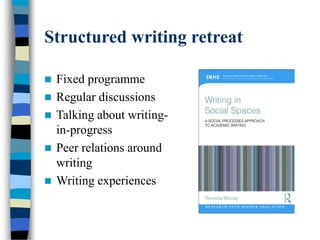
Structured writing retreat
 Fixed programme
 Regular discussions
 Talking about writing-
in-progress
 Peer relations around
writing
 Writing experiences
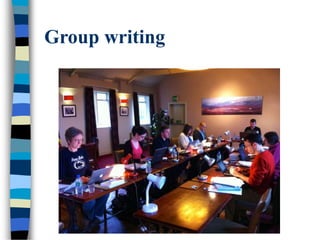
Group writing
See rowenamurray.org
 The retreat programme
 About the retreat venue
 How to sign up
 How to pay
 Evaluations and publications
 Participants’ views (short videos)
 Dates of next retreats
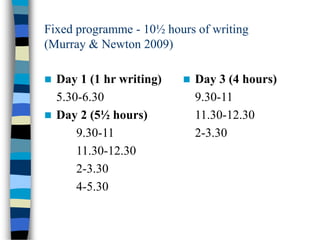
Fixed programme - 10½ hours of writing
(Murray & Newton 2009)
 Day 1 (1 hr writing)
5.30-6.30
 Day 2 (5½ hours)
9.30-11
11.30-12.30
2-3.30
4-5.30
 Day 3 (4 hours)
9.30-11
11.30-12.30
2-3.30
References
Murray, R. (2016) How to Write a Thesis,
4th edition.
Murray, R. (2015) How to Survive your Viva,
3rd edition.
Murray, R. (2013) Writing for Academic
Journals, 3rd edition.
Maidenhead: Open University Press-
McGraw-Hill.
References
Ballenger, B. (2014) The Curious Researcher: A Guide to
Writing Research Papers, 8th edition. New York: Pearson
Longman.
Gilbert, N. Ed. (2006) From Postgraduate to Social Scientist:
A Guide to Key Skills. London: Sage. Chapter 9: ‘Writing
articles, books and presentations’ 149-170.
Murray, R. & Moore, S. (2006) The Handbook of Academic
Writing: A Fresh Approach. Maidenhead: Open University
Press-McGraw-Hill.
Further reading
Morss, K. & Murray, R. (2005) Teaching at University: A
Guide for Postgraduates and Researchers. London: Sage.
Murray, R. (2014a) Doctoral students create new spaces to
write in C Aitchison and Guerin, C (Eds) Writing groups
for doctoral education and beyond: Innovations in theory
and practice. London: Routledge.
Murray, R. (2014b) ‘Snack’ and ‘binge’ writing, Journal of
Academic Development and Education, 2: 5-8.
Murray, R. (2015) Writing in Social Spaces: A Social
Practices Approach to Academic Writing. London: SRHE-
Routledge.

205_Academicwriting.ppt

  • 1.
    Academic Writing Skills Workshop ProfessorRowena Murray University of the West of Scotland rowena.murray@uws.ac.uk
  • 2.
    Introduction  ‘Snack writing’ Writing goals: setting and monitoring  Writing to prompts  Social writing  Combining generative and structuring strategies  Explicit links to university/journal criteria.
  • 3.
    Two approaches toacademic writing 1. Targeting journals, analysing journals, dialogue with editors and published writers, ‘callibrating’ your writing, dealing with reviewers’ feedback 2. Writing to prompts, freewriting, generative writing
  • 4.
    Developing academic writing:principles  Using tried and tested strategies  Discussion: rehearsing arguments  ‘Pre-peer review’ on writing-in-progress  Writing/revising time -- increasing  Analysing published writing  Developing paper/chapter at meetings  ‘Binge’ and ‘snack’ writing
  • 5.
    Writing to prompts What writing for your thesis/writing for publication have you done, and what would you like to do [in the long, medium and short term]?  5 minutes’ writing  In sentences  Private writing -- no one will read it  To be discussed in pairs/groups
  • 6.
    Prompts to makethe ‘contribution’ explicit  ‘This research shows/reveals/confirms’  ‘This is a contribution in the sense that …’  ‘This is a contribution to the extent that …’
  • 7.
    Prompts to matchresearch aim(s) and claim(s) The aims of this study are > were … The research questions are > were … The research objectives are > were …
  • 8.
    Prompts for thesissummary  750 words = 3 pages, double-spaced.  Use verbs to define purposes of chapters: Chapter 1 [verb] … Chapter 2 [verb] ….  Show coherence of thesis argument.  Show links between chapters.  Show links between aim(s) and claim(s).  Insert at end of thesis Introduction.
  • 9.
    Prompts to internalisethe debate  ‘Some will argue that …’  ‘One interpretation could be …’  ‘However, this could be taken as …’  ‘This is not to say that …’  ‘Possible interpretations include …’
  • 10.
    Prompts from journals:1 ‘Using earlier research into models of place branding-management processes, this paper develops a multi-level conceptual model of … The model identifies the following components for … The model identifies the influences and action processes … This paper proposes an integrative model that builds on and subsumes …’. (Hanna & Rowley, 2011: 458 Journal of Marketing Management)
  • 11.
    Prompts from journals:2 ‘I explore the role of trust in acquisitions of entrepreneurial firms … I outline how … I also find that buyers’ and sellers’ beliefs … I explore the implications of these findings for developing a theory of trust asymmetries and argue that …’. (Graebner, 2009: 435 Academy of Management Journal)
  • 12.
    Prompts from journals:3 ‘This paper investigates the extent to which the outcomes of the 2008 Research Assessment Exercise … can be explained by … The main finding is that … A further finding is that …There is also evidence of bias … The results support the use of …’. (Taylor, 2011: 202) British Journal of Management)
  • 13.
    Match research gapand your article’s contribution ‘Recent research has been concerned with whether speech accommodation is an automatic process or determined by social factors … This paper investigates … These biases are, crucially, simultaneously automatic and social’ (Babel, Language in Society, 2010).
  • 14.
    Adapt published prompts ‘Comparisonsof … have become popular over the last three decades as they permit a systematic investigation of the impact of … A common result of these studies is that … Additional results indicate … Finally, we also list some issues for the future. We demand more efforts on theory of … We also demand more replications based on updated data and methods that seek to unify the many differing results of previous studies’. Journal of International Health
  • 15.
    Active verbs fordiscussing ideas Informs, reviews, argues, states, claims, synthesises, answers, explains, reconsiders, provides, maintains, outlines, supports, compares, lists, acknowledges, confirms, analyses, disputes, concludes, reveals, implies, reminds, suggests, considers, highlights, refutes, assembles, shows, adds, clarifies, identifies (Ballenger, 2009) See also Murray (2014b) article in JADE.
  • 16.
    Preparing to write Decide on specific writing project.  Choose a target journal.  Email the journal editor about your topic, contribution and appropriateness of your paper for that journal.  Collect information about the journal.  Study sample papers from that journal.
  • 17.
    Freewriting  Write for5 minutes  In sentences  Without stopping  Private writing -- no one will read it  What to write about: subject of your paper, your target journal or its requirements  Brainstorm in sentences  Structure and coherence not required  Explore many angles, do ‘open’ writing
  • 18.
    Freewriting & generativewriting for publication  To get started  To explore possibilities  To silence the ‘internal editor’ temporarily  To develop confidence  To develop fluency  To work out a complex argument  To do rough drafting  Freewriting to work out what you want to say; generative writing to work out how to say it.
  • 19.
    Pros & cons ‘Freewheelers’ like it; ‘structurers’ don’t.  It’s a good idea to use both types of writing strategy.  You need to try it for a while to see whether there is benefit for your writing process.  It may be important to ‘write about your writing’ for some of the time.
  • 20.
    References Freewriting Elbow, P. (1973)Writing without teachers. Oxford: Oxford University Press. Generative writing Boice, R. (1990) Professors as writers: A self-help guide to productive writing. Stillwater, OK: New Forums Press.
  • 21.
    Writing a ‘page-98paper’  My research question is … (50 words)  Researchers who have looked at this subject are … (50 words)  They argue that … (25 words)  Debate centres on the issue of … (25 words)  There is work to be done on … (25 words)  My research is closest to that of X in that … (50 words)  My contribution will be … (50 words)
  • 22.
    Why write a‘page 98 paper’? And when?  Early: to establish direction/focus  Associate & dissociate with literature  Build on research question/hypothesis  Focus reading/thinking  Manageable writing task: 275 words  To develop thinking and/or for thesis?  Late: to focus thinking/intro conclusions
  • 23.
    Brown’s 8 questions 1.Who are intended readers? (3-5 names) 2. What did you do? (50 words) 3. Why did you do it? (50 words) 4. What happened? (50 words) 5. What do results mean in theory? (50 words) 6. What do results mean in practice? (50 words) 7. What is the key benefit for readers (25 words) 8. What remains unresolved? (no word limit)
  • 24.
    Purposes of Brown’s8 questions  To draft an abstract  Not just for experimental work  Set word limits  Using generic structure  Generating text you can work on later  Write abstract first, revise it as you go  Construct/see the whole argument
  • 26.
    Types of promptfor academic writing  Warm up prompts: 5 minutes taking stock and goal-setting.  Generic prompts, e.g. ‘The purpose of this paper is to … This suggests that …’  Journal prompts, e.g. …?  Questions, e.g. ‘What do I want to write?’  In outlines, i.e. as well as headings.  Revision prompts, e.g. ‘Define other approaches’.
  • 27.
    Summary  Use bothformal and informal prompts  Try question and fragment forms of prompt  Use 1st person (i.e. ‘I’ and ‘we’)  Use verbs -- make purpose of your writing explicit  Use prompts to take stock and set new goals  As a warm up for writing  To start writing quickly and easily  To build confidence  To engage with/solve writing problems
  • 28.
    Strategies for thelong term  Writer’s group: can be inter-disciplinary, twice a month for 90 minutes, someone as timekeeper, define 90-minute goal, monitor extent to which goal achieved, micro-groups of 2 or 3 people.  Writer’s retreat: off-campus, residential, all working in same room, non-surveillance, without email/internet, with peer discussions of work-in- progress, 2 days, 12 hours.
  • 29.
    Structured writing retreat Fixed programme  Regular discussions  Talking about writing- in-progress  Peer relations around writing  Writing experiences
  • 30.
  • 31.
    See rowenamurray.org  Theretreat programme  About the retreat venue  How to sign up  How to pay  Evaluations and publications  Participants’ views (short videos)  Dates of next retreats
  • 32.
    Fixed programme -10½ hours of writing (Murray & Newton 2009)  Day 1 (1 hr writing) 5.30-6.30  Day 2 (5½ hours) 9.30-11 11.30-12.30 2-3.30 4-5.30  Day 3 (4 hours) 9.30-11 11.30-12.30 2-3.30
  • 33.
    References Murray, R. (2016)How to Write a Thesis, 4th edition. Murray, R. (2015) How to Survive your Viva, 3rd edition. Murray, R. (2013) Writing for Academic Journals, 3rd edition. Maidenhead: Open University Press- McGraw-Hill.
  • 34.
    References Ballenger, B. (2014)The Curious Researcher: A Guide to Writing Research Papers, 8th edition. New York: Pearson Longman. Gilbert, N. Ed. (2006) From Postgraduate to Social Scientist: A Guide to Key Skills. London: Sage. Chapter 9: ‘Writing articles, books and presentations’ 149-170. Murray, R. & Moore, S. (2006) The Handbook of Academic Writing: A Fresh Approach. Maidenhead: Open University Press-McGraw-Hill.
  • 35.
    Further reading Morss, K.& Murray, R. (2005) Teaching at University: A Guide for Postgraduates and Researchers. London: Sage. Murray, R. (2014a) Doctoral students create new spaces to write in C Aitchison and Guerin, C (Eds) Writing groups for doctoral education and beyond: Innovations in theory and practice. London: Routledge. Murray, R. (2014b) ‘Snack’ and ‘binge’ writing, Journal of Academic Development and Education, 2: 5-8. Murray, R. (2015) Writing in Social Spaces: A Social Practices Approach to Academic Writing. London: SRHE- Routledge.