By Steve Cole
2017 Spring Fling
Child Abuse: An EMS
Nightmare
Info
 Last Revised 03-01-2017
 For Info contact Steve Cole at:
croaker260@gmail.com
 No disclosures
 No conflicts
“There is no more
fundamental test of a society
than how it treats its
children.”
— Ronald Reagan
Learning Outcomes
 Recognize 4 major categories of
Child Abuse
 Understand reporting requirements
of abuse.
 Understand common presentations
of abuse
 Understand common misidentified
abuse.
 Understand the EMS providers role
in providing treatment to victims of
abuse
WARNING
Centuries of Child
Maltreatment
 1874 - 1st Legal Case
 1900 - Juvenile Justice System
 1962 - “Battered Child
Syndrome
 1963 - 1st Reporting Laws
 1974 - US Child Abuse and
Prevention Act (CAPTA)
 1980’s - Sexual Abuse Laws
Mary Ellen 1
year later
 Mary Ellen's story ended
well.
 She was taken to an
upstate New York farm to
be raised with other
children in a safe and
happy home.
 She later married and had
two children and adopted a
third little girl.
 Two of the children
became schoolteachers
 Mary Ellen lived to be 92.
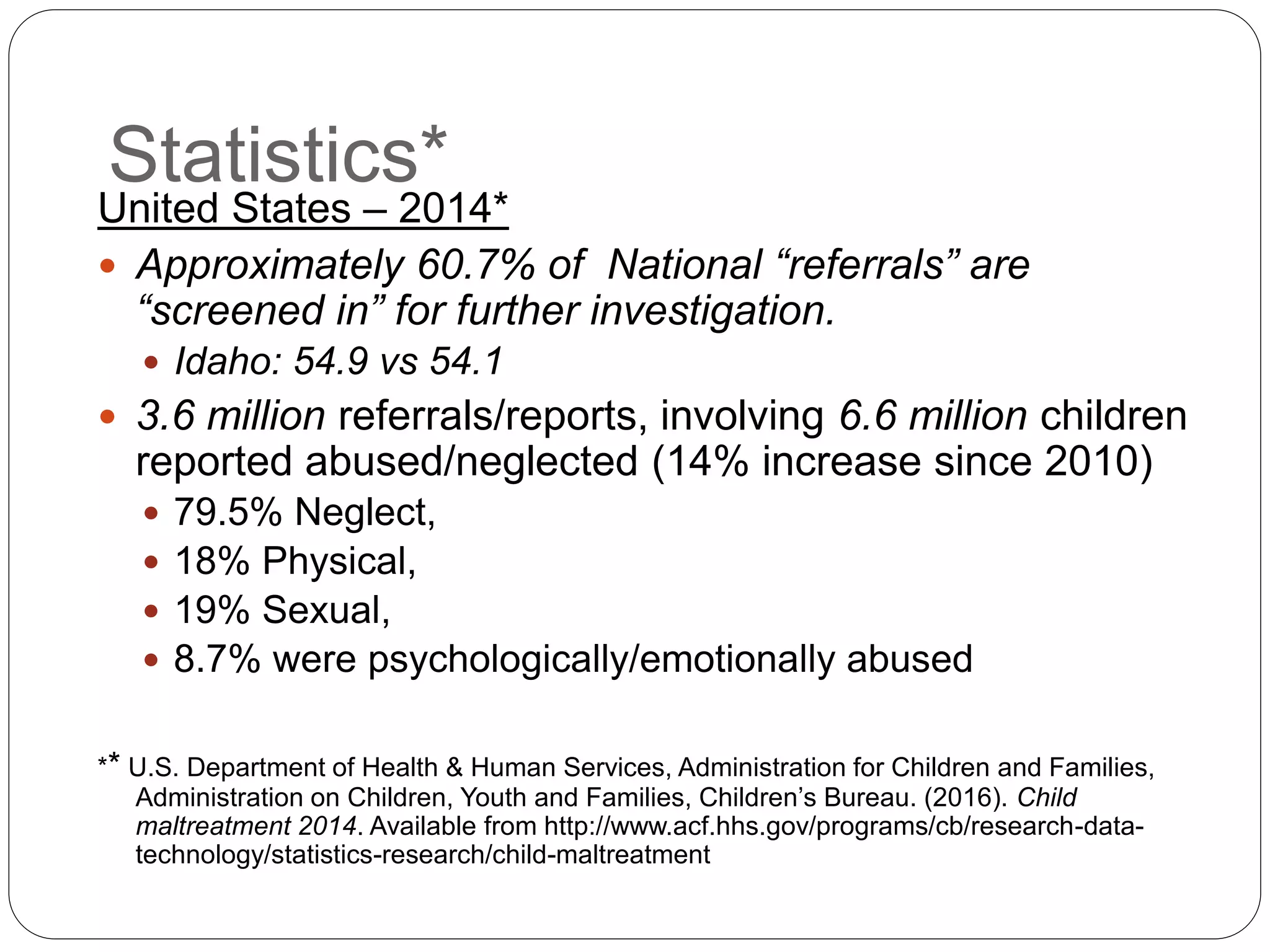
Statistics*
United States – 2014*
 Approximately 60.7% of National “referrals” are
“screened in” for further investigation.
 Idaho: 54.9 vs 54.1
 3.6 million referrals/reports, involving 6.6 million children
reported abused/neglected (14% increase since 2010)
 79.5% Neglect,
 18% Physical,
 19% Sexual,
 8.7% were psychologically/emotionally abused
** U.S. Department of Health & Human Services, Administration for Children and Families,
Administration on Children, Youth and Families, Children’s Bureau. (2016). Child
maltreatment 2014. Available from http://www.acf.hhs.gov/programs/cb/research-data-
technology/statistics-research/child-maltreatment
Statistics*
Idaho – 2014*
 14,364 (14% increase in 5 years) reported
abused/neglected
 1,652 substantiated victims
 5 deaths
 75.5% Neglect, 23.1% Physical, ?
psychological/emotional , 4.9% Sexual
 0.9% Medical Neglect
 1% other
 Only 700 were intentionally false (<5%)
 * U.S. Department of Health & Human Services, Administration for Children and
Families, Administration on Children, Youth and Families, Children’s Bureau. (2016).
Child maltreatment 2014. Available from http://www.acf.hhs.gov/programs/cb/research-
data-technology/statistics-research/child-maltreatment
Other States
Oregon – 2014*
 43,925 reported abused/neglected
 10,661 substantiated
 53.2% Neglect , 9.2% Physical, 2.0
psychological/emotional, 8.1% Sexual
 1.4% medical Neglect
 Washington – 2014*
 53,823 (15% increase in 5 years) reported
abused/neglected
 8,286 substantiated
 81.7% Neglect, 18.9% Physical, 6.2% Sexual, no
data for psychological/emotional.
 * U.S. Department of Health & Human Services, Administration for Children and Families, Administration on
Children, Youth and Families, Children’s Bureau. (2016). Child maltreatment 2014. Available from
http://www.acf.hhs.gov/programs/cb/research-data-technology/statistics-research/child-maltreatment
More Facts  Today, children are eight
to ten times more likely
to be abused in the foster
care system than in their
own homes
 (Toth, 1997; Spencer &
Knudsen, 1992; Pryor,
1991; American Civil
Liberties Union, 1994;
Bolton, et al., 1981)
 Remember , Mary Ellen
was in FOSTER CARE!
The National Center on Child Abuse
and Neglect estimates:
 * For children 1-6 months of
age, abuse is the second
leading cause of death
behind Sudden Infant Death
Syndrome (SIDS).
 For children 1-5 years of
age, abuse is second only to
accidents as the cause of
death.
Childhood Mortality
Homicide is the only leading
cause of childhood death that
has increased in the past 30
years.
It accounts for 5% of all
deaths in children, but only
1% of deaths in adults
Domestic Violence and Child
Maltreatment
(Oregon State University, July 2000 Study):
 Domestic Violence (DV) in the home
occurred in 38% of confirmed cases of child
maltreatment
 DV immediately proceeded child
maltreatment in 78% of the confirmed cases
 Children under age 5 are disproportionately
present in homes with DV (Fantuzzo & Mohr, 1999)
Victims of Maltreatment
Child abuse and neglect affects all
children of all ages.
1999 - 2,974,000 children referred in the US.*
 62% Female
 14%/1000 were age 0-3 yrs.
 25%/1000 were African/American
(*Child Maltreatment 1999: US. National Clearinghouse on Child Abuse and
Neglect)
Contributing Factors -
Victim
 Less than 5 years of
age
 Prematurity/multiple
births
 Chronic health
problems
 Developmentally
delayed
 ADD/ADHD
 Child Irritability
* U.S. Department of Health & Human Services, Administration for Children and Families, Administration
on Children, Youth and Families, Children’s Bureau. (2016). Child maltreatment 2014. Available from
http://www.acf.hhs.gov/programs/cb/research-data-technology/statistics-research/child-maltreatment
Perpetrator
“Someone who
maltreats a child while
in a caretaking
relationship to the
child”
 81% One or both parents
(with or without a sign
nother)
 5% “Other” relatives
 60% Female
Contributing Factors - Perpetrator
 Substance abuse
 Poverty/Unemployment
 Poor coping/parenting skills
 Immaturity
 Poor Education
 History of abuse/domestic
violence
 Behavioral
/Psych/Depression
 Social Isolation
Determining
Maltreatment
 Is the history
consistent with the
injury pattern?
 Is the history
vague or
changing?
 Is the history
consistent with
child’s
developmental
Suspicious Signs
 unexplained
injuries;
 poor hygiene;
 inadequate
nutrition;
 failure to thrive;
 lack of
supervision or
abandonment;
 destructive
behavior;
 sleep or speech
disorders;
 difficulty walking
or sitting;
 pain or bleeding
in the genital
area;
 and venereal
disease.
Types of Abuse
Child Maltreatment
“…the physical or mental injury, sexual
abuse or exploitation, negligence or
maltreatment of a child under the age of
18…by persons responsible for the
child’s welfare.”*
*US Child Abuse Prevention and Treatment Act
Types of Child Abuse
 Neglect - failure to meet basic needs
 Some states also list “Medical Neglect”
 Physical - intentional infliction of physical
injury
 Sexual - sexual contact or exploitation
 Emotional - behaviors resulting in humiliation,
rejection, fear, isolation, etc.
Neglect
“Failure to provide
the basic
necessities of life”
 Food
 Clothing
 Shelter
 Safe Environment
 Medical/Dental
Care
Physical Maltreatment
“Any act committed by an adult or
person in authority over a child that
results in intentional physical injury to
the child”
Common Types of injuries
(not all inclusive)
welts;
burns;
bites;
strangulation;
 broken bones;
 internal injuries;
 cigarette burns;
 immersion
burns;
 and/ or dry
burns
Bruising/Contusions
“Any bruise may be intentional”
“Common” bruising
 Occurs on extensor
skin surfaces
 Occurs over bony,
non-fatty areas
 Usually isolated and
poorly defined
“Suspicious” bruising
 Occurs on fatty areas
or areas covered by
clothing, diapers
 Pattern marks
 Multiple bruises in
various stages of
healing
ABD Injuries
Giardino, Angelo P. "Physical Child Abuse Workup." Physical Child Abuse Workup.
Emedicine.com. Web. 26 Feb. 2015. <http://emedicine.medscape.com/article/915664-
workup#a0720>.
Bite Marks
Other Bazaar Marks
Bizarre marks:
a.Blunt instruments
b.Tattoos
c.Fork mark punctures
d.Circumferential marks (wrists,
ankles) binding
e.Gag marks
Burns
“Any burn may be intentional”
“Common” burns
 Splatter/splash
pattern
 Burns consistent
with history and
child’s
developmental
level
“Suspicious” burns
 Immersion/dunking
patterns
 Contact pattern
 Bilateral burns
 Cigarette burn
Courtesy of David Effron, M.D.
Child abuse – glove pattern injury
Child Abuse – stocking pattern
Coffee
Skeletal Injuries
“Any fracture may be intentional”
“Common”
fractures
 Clavicle
 Wrist
 Forearm
 Lower leg
“Suspicious”
fractures
 Long bones
 Metaphyseal
fractures
 Ribs
 Spiral Fractures
Head Trauma
“Any head injury may be intentional”
“Common” head
injury
 Simple skull
fracture
“Suspicious” head
trauma
 Simple skull fracture
in infant
 Complex skull
fracture
 Subdural/Epidural
hematoma
 Sudden CNS
Shaken Baby Syndrome
“Caused by VIGOROUS shaking of infant or
small child”
 Tearing/shredding of small
cerebral blood vessels and neurons
 Sudden or rapid CNS involvement
 Retinal hemorrhage
Can CPR cause Retinal
hemorrhages?
Retinal hemorrhages are rarely found after chest
compressions in patients with non-traumatic
illnesses, and those retinal hemorrhages that are
found appear to be different from the
hemorrhages found in the shaken baby syndrome.
Prevalence of retinal hemorrhages in pediatric patients after in-hospital
cardiopulmonary resuscitation: a prospective study.
Pediatrics. 1997 Jun;99(6):E3
Munchausen Syndrome by Proxy
 Manufacturing illness or disease by
fabricating symptoms
 Intentionally harming a child in order to
produce injury or symptoms of illness
Consider all sources for the illness or injury.
Nothing is too far-fetched.
Sexual Maltreatment
“Any sexual contact or
exposure to sexual stimuli
to a child, rendered by an
adult or older person.”
Encompasses a broad
spectrum of acts
Image courtesy of "Jones Wilson LLP - Personal Injury Lawyer." Jones
Wilson LLP Sexual Abuse Comments. Web. 26 Feb. 2015.
<http://www.joneswilson.com/las-vegas/sexual-abuse/>.
Sexual Maltreatment
 obscene language;
 pornography;
 exposure;
 fondling;
 molesting;
 oral sex;
 intercourse; and
 sodomy
Emotional/Psychological Maltreatment
“Patterns of behavior by
a person over a child
resulting in degradation,
humiliation, rejection or
terror to that child.”
Ritual Abuse
“A bizarre form of child maltreatment in which
the child may be forced to witness or
participate in various acts of sexual and/or
physical violence”
 Rare
 Community hysteria
 McMartin case
What is your duty to act?
Every Person here is a
mandated reporter
Approximately 12.2% of child fatalites due
to maltreatment had prior contact with
CPS services.
Approximately 50% had recent contact
with medical services.
HIPAA doesn’t affect
reporting
Reporting Child
Maltreatment
Idaho Code 16-1619
“Any physician, resident…intern, nurse, coroner,
school teacher, day care personnel, social
worker, or other person having reason to
believe that a child under the age of eighteen
(18) years has been abused, abandoned or
neglected…shall report report or cause to be
reported within twenty-four (24) hours…to the
proper law enforcement agency or the
department…”
Immunity
Idaho Code 16-1620
“Any person who has reason to believe that a child has
been abused, abandoned or neglected and…makes
a report of abuse, abandonment or neglect as
required in section 16-1619…shall have
immunity…in any judicial proceeding resulting from
such report. Any person who reports in bad faith or
with malice shall not be protected by this section.”
Report To:
Report within 24 hours
Law Enforcement Agency
 Police Department
 Sheriff Department
 Military Police
 School Resource Officer
Department of Health and Welfare
 Division of Children and Family Services
Oregon
 http://www.oregonlaws.org/ors/419B.010
 OR 419B.010
 Any public or private official having reasonable cause to believe that any child with whom the official
comes in contact has suffered abuse or that any person with whom the official comes in contact has
abused a child shall immediately report or cause a report to be made in the manner required in
ORS 419B.015 (Report form and content).
 OR 419B.015
 shall make an oral report by telephone or otherwise to the local office of the Department of Human
Services, to the designee of the department or to a law enforcement agency within the county where
the person making the report is located at the time of the contact.
 The report shall contain, if known, the names and addresses of the child and the parents of the child
or other persons responsible for care of the child, the child's age, the nature and extent of the abuse,
including any evidence of previous abuse, the explanation given for the abuse and any other
information that the person making the report believes might be helpful in establishing the cause of the
abuse and the identity of the perpetrator.
 Other interesting factors:
 Exemption if abuse is “reasonably known” to LE. ( OR 419B.010 section 2)
 Specifically applies to volunteers as well as “paid” professionals. ( OR 419B.010 section 3)
 Mentions duty to report REGARDLESS of internal procedures ( OR 419B.010 section 4)
 Class A Violation if report not made.
 Includes unlawful exposure to “controlled substances” ( OR 419B.005 section 1)
 Specifically mentions “Firefighter or Emergency Medical Services Provider” and various levels of
nursing providers ( OR 419B.005 section 5)
 Good Faith Immunity (OR 419B.025)
Washington
 Mandated Reporters must report suspected child abuse or neglect (or
cause a report to be made) to law enforcement or CPS when they
believe a child has suffered abuse or neglect or may be at risk of
abuse or neglect. RCW 26.44.030 (1)(a)
 “Practitioner”: “ or to provide other health services.” – Probably
includes licensed EMS providers
 The report must be made at the first opportunity, but no later than
forty-eight hours after there is belief that the child has suffered abuse
or neglect. RCW 26.44.030 (1)(f)
 A child is defined as any person under the age of eighteen years.
RCW 26.44.020 (6)
 Great PPT for WA providers here:
https://www.dshs.wa.gov/sites/default/files/CA/csp/documents/Mandat
edReporterTraining.pdf
In 2014:
 62.7% of referrals/reports were
made by professionals like you
 18.1% LE/legal
 17.7 Educational staff
 0.7 Day Care Staff
 9.2% Medical
 5.6 Mental Health
 11% Social Services
 0.5 Foster Care
 Victims reported less than
0.4% of the time.
 “Anonymous sources” 8.1%
Who ya’ gonna call?…
Taking the report
DO’s DONT’S
Do use the child's own
vocabulary.
Do not make promises you
cannot keep, especially that you
will not tell anyone.
Do listen carefully to what the
child is saying.
Do not ask direct questions of the
child - this might compromise the
investigation.
Do tell the child the abuse was
not her/his fault and that s/he is
not bad or to blame.
Do not investigate or push the
child into giving details of the
abuse. Your job is to listen to
what the child wants to tell you.
Do be supportive. Remember
why the child came to you. S/he
needs your help, support, and
guidance. Let the child know that
telling was the right thing to do.
Do not discuss what the child told
you with anyone who is not
directly involved in helping the
child.
Taking the report (cont)
DO’s DONT’S
Do know your limits and what
your role is; this is not a situation
you can or should handle by
yourself.
Do not notify the parents or
anyone (outside of health care
and law enforcement) involved in
the case when a report is made.
The CPS worker will notify them.
Do tell the truth and be specific;
let the child know you will be
making a report to get him/her
help.
Do not have an out-of-control
reaction. Anger and disbelief can
cause the child to take back their
disclosure.
Do immediately make a report to
CPS without further questioning
the child or contacting the family.
Do not delay in making the
report. You could be the last hope
for this child.
Do Document thoroughly,
objectively
Document your reporting of the
suspected abuse.
Don’t document opinions or
speculations
Suspicion that a child under age 18 has
been:
 Abused
 Neglected
 Abandoned
 Details or Who, what , when , why, etc if known.
 You do not need to have all of the above
information when you call to make a report, but
the more accurate information you can provide,
the better equipped the offices will be to assess
the child's safety.
What to Report
Idaho Lines
During business hours, call
the Idaho CareLine:
1-800-926-2588
(TDD 208-332-7205)
If you cant remember: 2-1-1
Washington & Oregon,
 Washington –
 1-866-ENDHARM (1-866-363-4276)
 Oregon –
 1-855-503-SAFE (7233)
 (TTY, hearing impaired) 503-378-6704
(nationwide, during business hours)
Cycle of
Abuse
“The cycle of
violence and
abuse continues
from generation
to generation
until the cycle is
broken.”
We can
break the
Questions???
Special Thanks to:
Marti Monk RN. CEN.
Clinic Coordinator
(Retired)
St. Luke’s CARES
Program
Bonus Material
 What follows is bonus material I took out of the
one hour presentation, but I am keeping here for
the session notes so the student can review them
at their leisure.
Conditions That Mimic Maltreatment
 Cultural Practices
 Elbow Subluxation
 Nursemaids elbow
 Congenital Conditions
 Mongolian spots
Cultural Practices
 There are some cultural customs used as
home remedies to cure or relieve the
symptoms of some ailments such as:
 Backache
 Itchy skin
 Flu Symptoms
 These practices are primarily seen in
Southeast Asian cultures, but some are also
used by Russian immigrants and Mexican-
American families.
 These practices are usually performed by a
trained practitioner.
 From culture to culture, these remedies have
different names and the process differs
slightly.
Coining
Coining
https://www.youtube.com/watch?v=gk3Z5-Hss10
Cupping
https://www.youtube.com/watch?v=fkF_pm637u
Y
Elbow Subluxation
 In children under about 4 years old,
 When the arm is straightened and pulled, the
elbow joint is loose enough to separate for a
moment while a bit of ligament slips between
the bones before they snap back together.
Ouch!
 It is especially common if kids are yanking
their arms against the pull.
 The injury also happens sometimes with falls.
 The main symptom is refusal to use the
affected arm.
 Kids will usually hold the arm close to the
body, with the elbow bent. The hand is
usually turned down or toward the body.
 Kids may scream if you attempt to turn the
hand or move the elbow, but there is unlikely
to be swelling
Mongolian Spots
 Mongolian spots are basically birth marks
commonly seen in those of African American and
Asian descent.
 Mongolian spots are present at birth, and most of
them fade (at least somewhat) by age two. Most
have completely disappeared by age five.
 If Mongolian spots remain at puberty
(uncommon), they are likely to be permanent.
 Tend to have a poorly defined border and an
irregular shape.
 Tend not to be tender.
 Will not have a halo.
 Will not be swollen.
Mongolian Spots
Two Cultural Practices Which Should
be Reported
 Stick Burns and Moxibustion
 Hair Pulling
 If you suspect or are unsure, report!
Mongolian Spots

2017 child maltreatment

  • 1.
    By Steve Cole 2017Spring Fling Child Abuse: An EMS Nightmare
  • 2.
    Info  Last Revised03-01-2017  For Info contact Steve Cole at: croaker260@gmail.com  No disclosures  No conflicts
  • 3.
    “There is nomore fundamental test of a society than how it treats its children.” — Ronald Reagan
  • 4.
    Learning Outcomes  Recognize4 major categories of Child Abuse  Understand reporting requirements of abuse.  Understand common presentations of abuse  Understand common misidentified abuse.  Understand the EMS providers role in providing treatment to victims of abuse
  • 5.
  • 6.
    Centuries of Child Maltreatment 1874 - 1st Legal Case  1900 - Juvenile Justice System  1962 - “Battered Child Syndrome  1963 - 1st Reporting Laws  1974 - US Child Abuse and Prevention Act (CAPTA)  1980’s - Sexual Abuse Laws
  • 8.
    Mary Ellen 1 yearlater  Mary Ellen's story ended well.  She was taken to an upstate New York farm to be raised with other children in a safe and happy home.  She later married and had two children and adopted a third little girl.  Two of the children became schoolteachers  Mary Ellen lived to be 92.
  • 9.
    Statistics* United States –2014*  Approximately 60.7% of National “referrals” are “screened in” for further investigation.  Idaho: 54.9 vs 54.1  3.6 million referrals/reports, involving 6.6 million children reported abused/neglected (14% increase since 2010)  79.5% Neglect,  18% Physical,  19% Sexual,  8.7% were psychologically/emotionally abused ** U.S. Department of Health & Human Services, Administration for Children and Families, Administration on Children, Youth and Families, Children’s Bureau. (2016). Child maltreatment 2014. Available from http://www.acf.hhs.gov/programs/cb/research-data- technology/statistics-research/child-maltreatment
  • 10.
    Statistics* Idaho – 2014* 14,364 (14% increase in 5 years) reported abused/neglected  1,652 substantiated victims  5 deaths  75.5% Neglect, 23.1% Physical, ? psychological/emotional , 4.9% Sexual  0.9% Medical Neglect  1% other  Only 700 were intentionally false (<5%)  * U.S. Department of Health & Human Services, Administration for Children and Families, Administration on Children, Youth and Families, Children’s Bureau. (2016). Child maltreatment 2014. Available from http://www.acf.hhs.gov/programs/cb/research- data-technology/statistics-research/child-maltreatment
  • 11.
    Other States Oregon –2014*  43,925 reported abused/neglected  10,661 substantiated  53.2% Neglect , 9.2% Physical, 2.0 psychological/emotional, 8.1% Sexual  1.4% medical Neglect  Washington – 2014*  53,823 (15% increase in 5 years) reported abused/neglected  8,286 substantiated  81.7% Neglect, 18.9% Physical, 6.2% Sexual, no data for psychological/emotional.  * U.S. Department of Health & Human Services, Administration for Children and Families, Administration on Children, Youth and Families, Children’s Bureau. (2016). Child maltreatment 2014. Available from http://www.acf.hhs.gov/programs/cb/research-data-technology/statistics-research/child-maltreatment
  • 12.
    More Facts Today, children are eight to ten times more likely to be abused in the foster care system than in their own homes  (Toth, 1997; Spencer & Knudsen, 1992; Pryor, 1991; American Civil Liberties Union, 1994; Bolton, et al., 1981)  Remember , Mary Ellen was in FOSTER CARE!
  • 13.
    The National Centeron Child Abuse and Neglect estimates:  * For children 1-6 months of age, abuse is the second leading cause of death behind Sudden Infant Death Syndrome (SIDS).  For children 1-5 years of age, abuse is second only to accidents as the cause of death.
  • 14.
    Childhood Mortality Homicide isthe only leading cause of childhood death that has increased in the past 30 years. It accounts for 5% of all deaths in children, but only 1% of deaths in adults
  • 15.
    Domestic Violence andChild Maltreatment (Oregon State University, July 2000 Study):  Domestic Violence (DV) in the home occurred in 38% of confirmed cases of child maltreatment  DV immediately proceeded child maltreatment in 78% of the confirmed cases  Children under age 5 are disproportionately present in homes with DV (Fantuzzo & Mohr, 1999)
  • 16.
    Victims of Maltreatment Childabuse and neglect affects all children of all ages. 1999 - 2,974,000 children referred in the US.*  62% Female  14%/1000 were age 0-3 yrs.  25%/1000 were African/American (*Child Maltreatment 1999: US. National Clearinghouse on Child Abuse and Neglect)
  • 17.
    Contributing Factors - Victim Less than 5 years of age  Prematurity/multiple births  Chronic health problems  Developmentally delayed  ADD/ADHD  Child Irritability
  • 18.
    * U.S. Departmentof Health & Human Services, Administration for Children and Families, Administration on Children, Youth and Families, Children’s Bureau. (2016). Child maltreatment 2014. Available from http://www.acf.hhs.gov/programs/cb/research-data-technology/statistics-research/child-maltreatment
  • 20.
    Perpetrator “Someone who maltreats achild while in a caretaking relationship to the child”  81% One or both parents (with or without a sign nother)  5% “Other” relatives  60% Female
  • 22.
    Contributing Factors -Perpetrator  Substance abuse  Poverty/Unemployment  Poor coping/parenting skills  Immaturity  Poor Education  History of abuse/domestic violence  Behavioral /Psych/Depression  Social Isolation
  • 23.
    Determining Maltreatment  Is thehistory consistent with the injury pattern?  Is the history vague or changing?  Is the history consistent with child’s developmental
  • 24.
    Suspicious Signs  unexplained injuries; poor hygiene;  inadequate nutrition;  failure to thrive;  lack of supervision or abandonment;  destructive behavior;  sleep or speech disorders;  difficulty walking or sitting;  pain or bleeding in the genital area;  and venereal disease.
  • 25.
  • 26.
    Child Maltreatment “…the physicalor mental injury, sexual abuse or exploitation, negligence or maltreatment of a child under the age of 18…by persons responsible for the child’s welfare.”* *US Child Abuse Prevention and Treatment Act
  • 27.
    Types of ChildAbuse  Neglect - failure to meet basic needs  Some states also list “Medical Neglect”  Physical - intentional infliction of physical injury  Sexual - sexual contact or exploitation  Emotional - behaviors resulting in humiliation, rejection, fear, isolation, etc.
  • 28.
    Neglect “Failure to provide thebasic necessities of life”  Food  Clothing  Shelter  Safe Environment  Medical/Dental Care
  • 30.
    Physical Maltreatment “Any actcommitted by an adult or person in authority over a child that results in intentional physical injury to the child”
  • 31.
    Common Types ofinjuries (not all inclusive) welts; burns; bites; strangulation;  broken bones;  internal injuries;  cigarette burns;  immersion burns;  and/ or dry burns
  • 32.
    Bruising/Contusions “Any bruise maybe intentional” “Common” bruising  Occurs on extensor skin surfaces  Occurs over bony, non-fatty areas  Usually isolated and poorly defined “Suspicious” bruising  Occurs on fatty areas or areas covered by clothing, diapers  Pattern marks  Multiple bruises in various stages of healing
  • 40.
    ABD Injuries Giardino, AngeloP. "Physical Child Abuse Workup." Physical Child Abuse Workup. Emedicine.com. Web. 26 Feb. 2015. <http://emedicine.medscape.com/article/915664- workup#a0720>.
  • 41.
  • 44.
    Other Bazaar Marks Bizarremarks: a.Blunt instruments b.Tattoos c.Fork mark punctures d.Circumferential marks (wrists, ankles) binding e.Gag marks
  • 45.
    Burns “Any burn maybe intentional” “Common” burns  Splatter/splash pattern  Burns consistent with history and child’s developmental level “Suspicious” burns  Immersion/dunking patterns  Contact pattern  Bilateral burns  Cigarette burn
  • 46.
    Courtesy of DavidEffron, M.D.
  • 47.
    Child abuse –glove pattern injury
  • 48.
    Child Abuse –stocking pattern
  • 50.
  • 53.
    Skeletal Injuries “Any fracturemay be intentional” “Common” fractures  Clavicle  Wrist  Forearm  Lower leg “Suspicious” fractures  Long bones  Metaphyseal fractures  Ribs  Spiral Fractures
  • 54.
    Head Trauma “Any headinjury may be intentional” “Common” head injury  Simple skull fracture “Suspicious” head trauma  Simple skull fracture in infant  Complex skull fracture  Subdural/Epidural hematoma  Sudden CNS
  • 55.
    Shaken Baby Syndrome “Causedby VIGOROUS shaking of infant or small child”  Tearing/shredding of small cerebral blood vessels and neurons  Sudden or rapid CNS involvement  Retinal hemorrhage
  • 56.
    Can CPR causeRetinal hemorrhages? Retinal hemorrhages are rarely found after chest compressions in patients with non-traumatic illnesses, and those retinal hemorrhages that are found appear to be different from the hemorrhages found in the shaken baby syndrome. Prevalence of retinal hemorrhages in pediatric patients after in-hospital cardiopulmonary resuscitation: a prospective study. Pediatrics. 1997 Jun;99(6):E3
  • 57.
    Munchausen Syndrome byProxy  Manufacturing illness or disease by fabricating symptoms  Intentionally harming a child in order to produce injury or symptoms of illness Consider all sources for the illness or injury. Nothing is too far-fetched.
  • 58.
    Sexual Maltreatment “Any sexualcontact or exposure to sexual stimuli to a child, rendered by an adult or older person.” Encompasses a broad spectrum of acts Image courtesy of "Jones Wilson LLP - Personal Injury Lawyer." Jones Wilson LLP Sexual Abuse Comments. Web. 26 Feb. 2015. <http://www.joneswilson.com/las-vegas/sexual-abuse/>.
  • 59.
    Sexual Maltreatment  obscenelanguage;  pornography;  exposure;  fondling;  molesting;  oral sex;  intercourse; and  sodomy
  • 60.
    Emotional/Psychological Maltreatment “Patterns ofbehavior by a person over a child resulting in degradation, humiliation, rejection or terror to that child.”
  • 61.
    Ritual Abuse “A bizarreform of child maltreatment in which the child may be forced to witness or participate in various acts of sexual and/or physical violence”  Rare  Community hysteria  McMartin case
  • 62.
    What is yourduty to act?
  • 63.
    Every Person hereis a mandated reporter
  • 65.
    Approximately 12.2% ofchild fatalites due to maltreatment had prior contact with CPS services. Approximately 50% had recent contact with medical services.
  • 66.
  • 67.
    Reporting Child Maltreatment Idaho Code16-1619 “Any physician, resident…intern, nurse, coroner, school teacher, day care personnel, social worker, or other person having reason to believe that a child under the age of eighteen (18) years has been abused, abandoned or neglected…shall report report or cause to be reported within twenty-four (24) hours…to the proper law enforcement agency or the department…”
  • 68.
    Immunity Idaho Code 16-1620 “Anyperson who has reason to believe that a child has been abused, abandoned or neglected and…makes a report of abuse, abandonment or neglect as required in section 16-1619…shall have immunity…in any judicial proceeding resulting from such report. Any person who reports in bad faith or with malice shall not be protected by this section.”
  • 69.
    Report To: Report within24 hours Law Enforcement Agency  Police Department  Sheriff Department  Military Police  School Resource Officer Department of Health and Welfare  Division of Children and Family Services
  • 70.
    Oregon  http://www.oregonlaws.org/ors/419B.010  OR419B.010  Any public or private official having reasonable cause to believe that any child with whom the official comes in contact has suffered abuse or that any person with whom the official comes in contact has abused a child shall immediately report or cause a report to be made in the manner required in ORS 419B.015 (Report form and content).  OR 419B.015  shall make an oral report by telephone or otherwise to the local office of the Department of Human Services, to the designee of the department or to a law enforcement agency within the county where the person making the report is located at the time of the contact.  The report shall contain, if known, the names and addresses of the child and the parents of the child or other persons responsible for care of the child, the child's age, the nature and extent of the abuse, including any evidence of previous abuse, the explanation given for the abuse and any other information that the person making the report believes might be helpful in establishing the cause of the abuse and the identity of the perpetrator.  Other interesting factors:  Exemption if abuse is “reasonably known” to LE. ( OR 419B.010 section 2)  Specifically applies to volunteers as well as “paid” professionals. ( OR 419B.010 section 3)  Mentions duty to report REGARDLESS of internal procedures ( OR 419B.010 section 4)  Class A Violation if report not made.  Includes unlawful exposure to “controlled substances” ( OR 419B.005 section 1)  Specifically mentions “Firefighter or Emergency Medical Services Provider” and various levels of nursing providers ( OR 419B.005 section 5)  Good Faith Immunity (OR 419B.025)
  • 71.
    Washington  Mandated Reportersmust report suspected child abuse or neglect (or cause a report to be made) to law enforcement or CPS when they believe a child has suffered abuse or neglect or may be at risk of abuse or neglect. RCW 26.44.030 (1)(a)  “Practitioner”: “ or to provide other health services.” – Probably includes licensed EMS providers  The report must be made at the first opportunity, but no later than forty-eight hours after there is belief that the child has suffered abuse or neglect. RCW 26.44.030 (1)(f)  A child is defined as any person under the age of eighteen years. RCW 26.44.020 (6)  Great PPT for WA providers here: https://www.dshs.wa.gov/sites/default/files/CA/csp/documents/Mandat edReporterTraining.pdf
  • 72.
    In 2014:  62.7%of referrals/reports were made by professionals like you  18.1% LE/legal  17.7 Educational staff  0.7 Day Care Staff  9.2% Medical  5.6 Mental Health  11% Social Services  0.5 Foster Care  Victims reported less than 0.4% of the time.  “Anonymous sources” 8.1%
  • 73.
  • 75.
    Taking the report DO’sDONT’S Do use the child's own vocabulary. Do not make promises you cannot keep, especially that you will not tell anyone. Do listen carefully to what the child is saying. Do not ask direct questions of the child - this might compromise the investigation. Do tell the child the abuse was not her/his fault and that s/he is not bad or to blame. Do not investigate or push the child into giving details of the abuse. Your job is to listen to what the child wants to tell you. Do be supportive. Remember why the child came to you. S/he needs your help, support, and guidance. Let the child know that telling was the right thing to do. Do not discuss what the child told you with anyone who is not directly involved in helping the child.
  • 76.
    Taking the report(cont) DO’s DONT’S Do know your limits and what your role is; this is not a situation you can or should handle by yourself. Do not notify the parents or anyone (outside of health care and law enforcement) involved in the case when a report is made. The CPS worker will notify them. Do tell the truth and be specific; let the child know you will be making a report to get him/her help. Do not have an out-of-control reaction. Anger and disbelief can cause the child to take back their disclosure. Do immediately make a report to CPS without further questioning the child or contacting the family. Do not delay in making the report. You could be the last hope for this child. Do Document thoroughly, objectively Document your reporting of the suspected abuse. Don’t document opinions or speculations
  • 77.
    Suspicion that achild under age 18 has been:  Abused  Neglected  Abandoned  Details or Who, what , when , why, etc if known.  You do not need to have all of the above information when you call to make a report, but the more accurate information you can provide, the better equipped the offices will be to assess the child's safety. What to Report
  • 78.
    Idaho Lines During businesshours, call the Idaho CareLine: 1-800-926-2588 (TDD 208-332-7205) If you cant remember: 2-1-1
  • 79.
    Washington & Oregon, Washington –  1-866-ENDHARM (1-866-363-4276)  Oregon –  1-855-503-SAFE (7233)  (TTY, hearing impaired) 503-378-6704 (nationwide, during business hours)
  • 80.
    Cycle of Abuse “The cycleof violence and abuse continues from generation to generation until the cycle is broken.” We can break the
  • 81.
  • 82.
    Special Thanks to: MartiMonk RN. CEN. Clinic Coordinator (Retired) St. Luke’s CARES Program
  • 83.
    Bonus Material  Whatfollows is bonus material I took out of the one hour presentation, but I am keeping here for the session notes so the student can review them at their leisure.
  • 84.
    Conditions That MimicMaltreatment  Cultural Practices  Elbow Subluxation  Nursemaids elbow  Congenital Conditions  Mongolian spots
  • 85.
    Cultural Practices  Thereare some cultural customs used as home remedies to cure or relieve the symptoms of some ailments such as:  Backache  Itchy skin  Flu Symptoms  These practices are primarily seen in Southeast Asian cultures, but some are also used by Russian immigrants and Mexican- American families.  These practices are usually performed by a trained practitioner.  From culture to culture, these remedies have different names and the process differs slightly.
  • 86.
  • 87.
  • 88.
  • 89.
  • 91.
  • 92.
    Elbow Subluxation  Inchildren under about 4 years old,  When the arm is straightened and pulled, the elbow joint is loose enough to separate for a moment while a bit of ligament slips between the bones before they snap back together. Ouch!  It is especially common if kids are yanking their arms against the pull.  The injury also happens sometimes with falls.  The main symptom is refusal to use the affected arm.  Kids will usually hold the arm close to the body, with the elbow bent. The hand is usually turned down or toward the body.  Kids may scream if you attempt to turn the hand or move the elbow, but there is unlikely to be swelling
  • 93.
    Mongolian Spots  Mongolianspots are basically birth marks commonly seen in those of African American and Asian descent.  Mongolian spots are present at birth, and most of them fade (at least somewhat) by age two. Most have completely disappeared by age five.  If Mongolian spots remain at puberty (uncommon), they are likely to be permanent.  Tend to have a poorly defined border and an irregular shape.  Tend not to be tender.  Will not have a halo.  Will not be swollen.
  • 94.
  • 95.
    Two Cultural PracticesWhich Should be Reported  Stick Burns and Moxibustion  Hair Pulling  If you suspect or are unsure, report!
  • 96.