Integrative
Learning
Leveraging Bonners’
Leadership Across the
College/University
What We’ll Cover
• Learning Outcomes
• Academic Pathways
• Community Engaged Signature Work
(Capstones)
• Portfolios & Assessment
Learning
Outcomes
Student Learning Outcomes:
Why Integrate?
• Link with institutional mission & plan
• Claim significance to the institution
• Support quality and depth of learning &
experience
How We Got Here
• FIPSE grant to develop minors/certificates
• Collaboration with VALUE Initiative
• Outcome-oriented Training Calendar
• Link with High-Impact Practices
• Leveraging Institutional Experience
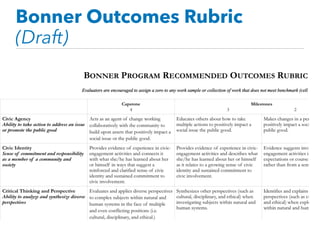
Bonner Outcomes Rubric
(Draft)
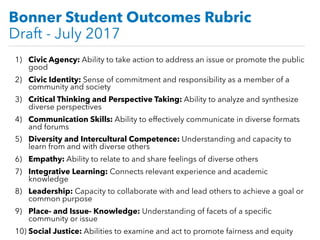
• Civic Agency
• Civic Identity
• Critical Thinking and
Perspective
• Communication Skills
• Diversity and
Intercultural
Competence
• Empathy
• Integrative Learning
• Leadership
• Place- and Issue-
Knowledge
• Social Justice
Bonner Outcomes Rubric
(Draft)
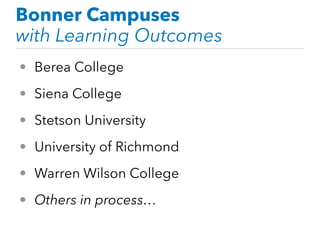
Bonner Campuses
with Learning Outcomes
• Berea College
• Siena College
• Stetson University
• University of Richmond
• Warren Wilson College
• Others in process…
Bonner Wiki Resources
Academic
Pathways
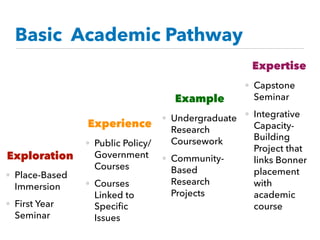
Basic Academic Pathway
Exploration
• Place-Based
Immersion
• First Year
Seminar
Experience
• Public Policy/
Government
Courses
• Courses
Linked to
Specific
Issues
Example
• Undergraduate
Research
Coursework
• Community-
Based
Research
Projects
Expertise
• Capstone
Seminar
• Integrative
Capacity-
Building
Project that
links Bonner
placement
with
academic
course
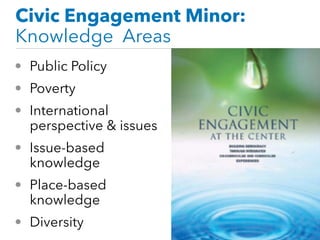
Civic Engagement Minor:
Knowledge Areas
• Public Policy
• Poverty
• International
perspective & issues
• Issue-based
knowledge
• Place-based
knowledge
• Diversity
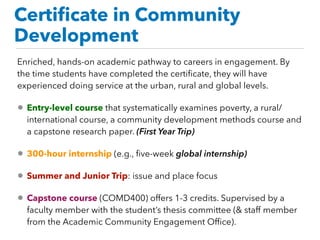
Certificate in Community
Development
Enriched, hands-on academic pathway to careers in engagement. By
the time students have completed the certificate, they will have
experienced doing service at the urban, rural and global levels.  
• Entry-level course that systematically examines poverty, a rural/
international course, a community development methods course and
a capstone research paper. (First Year Trip)
• 300-hour internship (e.g., five-week global internship)
• Summer and Junior Trip: issue and place focus
• Capstone course (COMD400) offers 1-3 credits. Supervised by a
faculty member with the student’s thesis committee (& staff member
from the Academic Community Engagement Office).
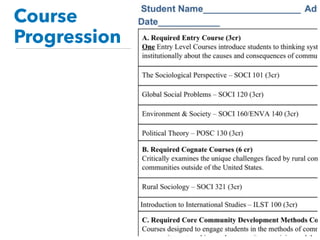
Course
Progression
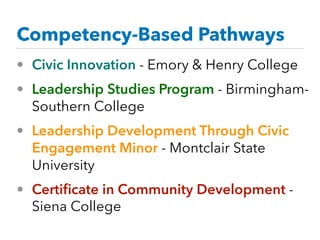
• Civic Innovation - Emory & Henry College
• Leadership Studies Program - Birmingham-
Southern College 
• Leadership Development Through Civic
Engagement Minor - Montclair State
University
• Certificate in Community Development -
Siena College
Competency-Based Pathways
• Poverty and Human Capability Studies -
Washington & Lee University
• Civic Engagement Poverty Studies Minor -
Washburn University
• Certificate in Civic and Global Leadership -
Sewanee: University of the South
‣ Development and Human Capabilities
Track
‣ Community and Global Health Track
Issue-Based Pathways
• Provide guidance if established pathway
not defined in the curriculum
• Identify and acknowledge the “hidden
curriculum”
Academic Advising Option
Community -
Engaged
Signature Work
(Capstones)
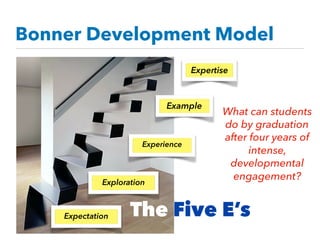
Bonner Development Model
What can students
do by graduation
after four years of
intense,
developmental
engagement?
Expectation
Exploration
Experience
Example
Expertise
The Five E’s
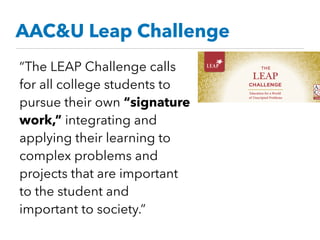
AAC&U Leap Challenge
“The LEAP Challenge calls
for all college students to
pursue their own “signature
work,” integrating and
applying their learning to
complex problems and
projects that are important
to the student and
important to society.”
Community-Engaged Signature Work
• Addressing a community-defined ideally
connected to an academic course.
• A reciprocal and mutually beneficial relationship
between the student and designated community
partner and/or contact that involves ongoing
dialogue and exchange.
• Mentoring and/or advisory relationships for the
students with a faculty and community partner.
Capacity Building Projects…
• Capstone level work (i.e., curriculum development)
• Community-Based Research or Applied research
• Capacity building (web development, GIS mapping)
• Demonstration projects (program development)
• Policy analysis or issue briefs
• Scientific analysis (i.e., water quality analysis)
• Impact assessment or program evaluation
• Business plan development
• Analysis and report on community issue (i.e., poverty)
• Special projects (i.e., computer sci developing app for nonprofit)
• Oral Histories
• Arts and community development projects
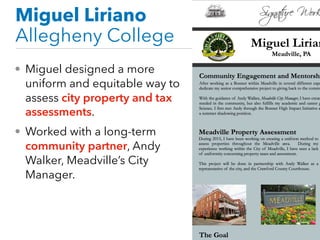
• Miguel designed a more
uniform and equitable way to
assess city property and tax
assessments.
• Worked with a long-term
community partner, Andy
Walker, Meadville’s City
Manager.
Miguel Liriano
Allegheny College
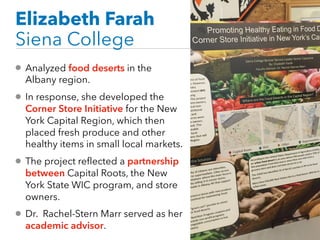
Elizabeth Farah
Siena College
• Analyzed food deserts in the
Albany region.
• In response, she developed the
Corner Store Initiative for the New
York Capital Region, which then
placed fresh produce and other
healthy items in small local markets.
• The project reflected a partnership
between Capital Roots, the New
York State WIC program, and store
owners.
• Dr. Rachel-Stern Marr served as her
academic advisor.
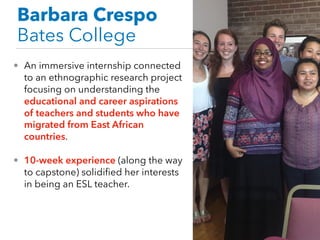
Barbara Crespo
Bates College
• An immersive internship connected
to an ethnographic research project
focusing on understanding the
educational and career aspirations
of teachers and students who have
migrated from East African
countries.
• 10-week experience (along the way
to capstone) solidified her interests
in being an ESL teacher.
• American Cancer Society Capstone: Analyzed social factors in the quality of
healthcare.
• Chronic Geriatric Diseases Capstone: Thematic analysis of diseases such as diabetes,
heart disease, kidney disease, and Alzheimer's Disease among older adults.
• Humanitarian Machine Learning Capstone: Case study (using computer science) of
loan approvals, analyzing them from a humanitarian framework. 
• Meat Consumption and Early Onset Puberty Capstone: Study to analyze the effects
of consuming meat containing antibiotics and its effects on the development of early
onset puberty in females. This research was then shared with the after-school program
to help guide its nutritional programming. 
• Reducing Youth Health Disparities Capstone: Analyzed five health interventions and
their effects on students in a local after-school program.
• School to Prison Pipeline Capstone: Transdisciplinary approach to computers, art,
and social justice through the creation of an interactive data visualization. She
compiled and displayed the data of the year’s annual Charleston County school-based
arrest report to analyze social disparities in student arrests within the local community.
College of Charleston Examples
Bonner Cohort Learning Community:
Community-Engaged Signature Work
The Foundation is doing new program and resource
development in order to support the success of
these aims:
• Partner Focus Groups
• Reading Group and Faculty Change Initiatives
• New Training Modules
• Introductions to CBR and Capstones for
Students
• Recommended Advising Forms
• Worksheets and Links to Bonner CLAs
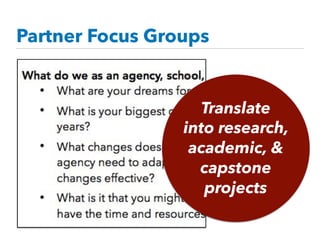
Partner Focus Groups
Translate
into research,
academic, &
capstone
projects
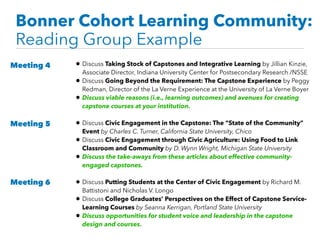
Bonner Cohort Learning Community:
Reading Group Example
• Discuss Taking Stock of Capstones and Integrative Learning by Jillian Kinzie,
Associate Director, Indiana University Center for Postsecondary Research /NSSE
• Discuss Going Beyond the Requirement: The Capstone Experience by Peggy
Redman, Director of the La Verne Experience at the University of La Verne Boyer
• Discuss viable reasons (i.e., learning outcomes) and avenues for creating
capstone courses at your institution.
• Discuss Civic Engagement in the Capstone: The “State of the Community”
Event by Charles C. Turner, California State University, Chico
• Discuss Civic Engagement through Civic Agriculture: Using Food to Link
Classroom and Community by D. Wynn Wright, Michigan State University
• Discuss the take-aways from these articles about effective community-
engaged capstones.
• Discuss Putting Students at the Center of Civic Engagement by Richard M.
Battistoni and Nicholas V. Longo
• Discuss College Graduates’ Perspectives on the Effect of Capstone Service-
Learning Courses by Seanna Kerrigan, Portland State University
• Discuss opportunities for student voice and leadership in the capstone
design and courses.
Meeting 4
Meeting 5
Meeting 6
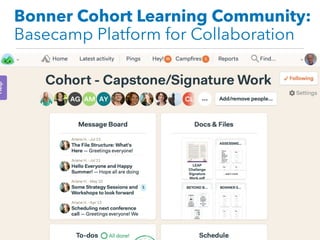
Bonner Cohort Learning Community:
Basecamp Platform for Collaboration
What preparation or
shifts could you
make now to begin
building in
capstones?
Discussion
Portfolios &
Assessment
E-Portfolios
• A mechanism for creating integrative co-
curricular & curricular pathways
• A mechanism for assessing learning
• A tool to show impact
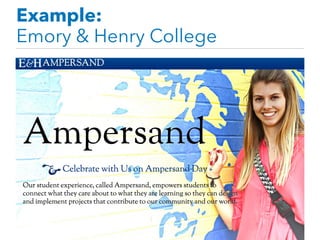
Example:
Emory & Henry College
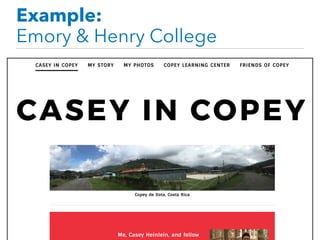
Example:
Emory & Henry College
Bonner Foundation:
Current Assessment Initiatives
• Bonner Student Data Study
‣ small study with six institutions to assess GPA
and graduation rates
‣ report available in September, 2017
• Bonner Student Impact Survey
‣ longitudinal study of freshmen, seniors, and
alumni
‣ pilot to be launched October, 2017
‣ full study to launched September, 2018
Bonner Foundation:
Future Assessment Plans
• Redesign Community Learning
Agreements and other forms to promote
integrative learning
• Integrate e-portfolio module into BWBRS
4.0
• Build on new Student Impact Survey and
carry out a qualitative study to look at
impacts
How do the themes
of this session fit
into current campus
conversations?
Discussion

2017 Bonner Integrative Learning

  • 1.
  • 2.
    What We’ll Cover •Learning Outcomes • Academic Pathways • Community Engaged Signature Work (Capstones) • Portfolios & Assessment
  • 3.
  • 4.
    Student Learning Outcomes: WhyIntegrate? • Link with institutional mission & plan • Claim significance to the institution • Support quality and depth of learning & experience
  • 5.
    How We GotHere • FIPSE grant to develop minors/certificates • Collaboration with VALUE Initiative • Outcome-oriented Training Calendar • Link with High-Impact Practices • Leveraging Institutional Experience
  • 6.
  • 7.
    • Civic Agency •Civic Identity • Critical Thinking and Perspective • Communication Skills • Diversity and Intercultural Competence • Empathy • Integrative Learning • Leadership • Place- and Issue- Knowledge • Social Justice Bonner Outcomes Rubric (Draft)
  • 8.
    Bonner Campuses with LearningOutcomes • Berea College • Siena College • Stetson University • University of Richmond • Warren Wilson College • Others in process…
  • 9.
  • 10.
  • 11.
    Basic Academic Pathway Exploration •Place-Based Immersion • First Year Seminar Experience • Public Policy/ Government Courses • Courses Linked to Specific Issues Example • Undergraduate Research Coursework • Community- Based Research Projects Expertise • Capstone Seminar • Integrative Capacity- Building Project that links Bonner placement with academic course
  • 12.
    Civic Engagement Minor: KnowledgeAreas • Public Policy • Poverty • International perspective & issues • Issue-based knowledge • Place-based knowledge • Diversity
  • 13.
    Certificate in Community Development Enriched,hands-on academic pathway to careers in engagement. By the time students have completed the certificate, they will have experienced doing service at the urban, rural and global levels.   • Entry-level course that systematically examines poverty, a rural/ international course, a community development methods course and a capstone research paper. (First Year Trip) • 300-hour internship (e.g., five-week global internship) • Summer and Junior Trip: issue and place focus • Capstone course (COMD400) offers 1-3 credits. Supervised by a faculty member with the student’s thesis committee (& staff member from the Academic Community Engagement Office).
  • 14.
  • 15.
    • Civic Innovation- Emory & Henry College • Leadership Studies Program - Birmingham- Southern College  • Leadership Development Through Civic Engagement Minor - Montclair State University • Certificate in Community Development - Siena College Competency-Based Pathways
  • 16.
    • Poverty andHuman Capability Studies - Washington & Lee University • Civic Engagement Poverty Studies Minor - Washburn University • Certificate in Civic and Global Leadership - Sewanee: University of the South ‣ Development and Human Capabilities Track ‣ Community and Global Health Track Issue-Based Pathways
  • 17.
    • Provide guidanceif established pathway not defined in the curriculum • Identify and acknowledge the “hidden curriculum” Academic Advising Option
  • 18.
  • 19.
    Bonner Development Model Whatcan students do by graduation after four years of intense, developmental engagement? Expectation Exploration Experience Example Expertise The Five E’s
  • 20.
    AAC&U Leap Challenge “TheLEAP Challenge calls for all college students to pursue their own “signature work,” integrating and applying their learning to complex problems and projects that are important to the student and important to society.”
  • 21.
    Community-Engaged Signature Work •Addressing a community-defined ideally connected to an academic course. • A reciprocal and mutually beneficial relationship between the student and designated community partner and/or contact that involves ongoing dialogue and exchange. • Mentoring and/or advisory relationships for the students with a faculty and community partner.
  • 22.
    Capacity Building Projects… •Capstone level work (i.e., curriculum development) • Community-Based Research or Applied research • Capacity building (web development, GIS mapping) • Demonstration projects (program development) • Policy analysis or issue briefs • Scientific analysis (i.e., water quality analysis) • Impact assessment or program evaluation • Business plan development • Analysis and report on community issue (i.e., poverty) • Special projects (i.e., computer sci developing app for nonprofit) • Oral Histories • Arts and community development projects
  • 23.
    • Miguel designeda more uniform and equitable way to assess city property and tax assessments. • Worked with a long-term community partner, Andy Walker, Meadville’s City Manager. Miguel Liriano Allegheny College
  • 24.
    Elizabeth Farah Siena College •Analyzed food deserts in the Albany region. • In response, she developed the Corner Store Initiative for the New York Capital Region, which then placed fresh produce and other healthy items in small local markets. • The project reflected a partnership between Capital Roots, the New York State WIC program, and store owners. • Dr. Rachel-Stern Marr served as her academic advisor.
  • 25.
    Barbara Crespo Bates College •An immersive internship connected to an ethnographic research project focusing on understanding the educational and career aspirations of teachers and students who have migrated from East African countries. • 10-week experience (along the way to capstone) solidified her interests in being an ESL teacher.
  • 26.
    • American CancerSociety Capstone: Analyzed social factors in the quality of healthcare. • Chronic Geriatric Diseases Capstone: Thematic analysis of diseases such as diabetes, heart disease, kidney disease, and Alzheimer's Disease among older adults. • Humanitarian Machine Learning Capstone: Case study (using computer science) of loan approvals, analyzing them from a humanitarian framework.  • Meat Consumption and Early Onset Puberty Capstone: Study to analyze the effects of consuming meat containing antibiotics and its effects on the development of early onset puberty in females. This research was then shared with the after-school program to help guide its nutritional programming.  • Reducing Youth Health Disparities Capstone: Analyzed five health interventions and their effects on students in a local after-school program. • School to Prison Pipeline Capstone: Transdisciplinary approach to computers, art, and social justice through the creation of an interactive data visualization. She compiled and displayed the data of the year’s annual Charleston County school-based arrest report to analyze social disparities in student arrests within the local community. College of Charleston Examples
  • 27.
    Bonner Cohort LearningCommunity: Community-Engaged Signature Work The Foundation is doing new program and resource development in order to support the success of these aims: • Partner Focus Groups • Reading Group and Faculty Change Initiatives • New Training Modules • Introductions to CBR and Capstones for Students • Recommended Advising Forms • Worksheets and Links to Bonner CLAs
  • 28.
    Partner Focus Groups Translate intoresearch, academic, & capstone projects
  • 29.
    Bonner Cohort LearningCommunity: Reading Group Example • Discuss Taking Stock of Capstones and Integrative Learning by Jillian Kinzie, Associate Director, Indiana University Center for Postsecondary Research /NSSE • Discuss Going Beyond the Requirement: The Capstone Experience by Peggy Redman, Director of the La Verne Experience at the University of La Verne Boyer • Discuss viable reasons (i.e., learning outcomes) and avenues for creating capstone courses at your institution. • Discuss Civic Engagement in the Capstone: The “State of the Community” Event by Charles C. Turner, California State University, Chico • Discuss Civic Engagement through Civic Agriculture: Using Food to Link Classroom and Community by D. Wynn Wright, Michigan State University • Discuss the take-aways from these articles about effective community- engaged capstones. • Discuss Putting Students at the Center of Civic Engagement by Richard M. Battistoni and Nicholas V. Longo • Discuss College Graduates’ Perspectives on the Effect of Capstone Service- Learning Courses by Seanna Kerrigan, Portland State University • Discuss opportunities for student voice and leadership in the capstone design and courses. Meeting 4 Meeting 5 Meeting 6
  • 30.
    Bonner Cohort LearningCommunity: Basecamp Platform for Collaboration
  • 31.
    What preparation or shiftscould you make now to begin building in capstones? Discussion
  • 32.
  • 33.
    E-Portfolios • A mechanismfor creating integrative co- curricular & curricular pathways • A mechanism for assessing learning • A tool to show impact
  • 34.
  • 35.
  • 36.
    Bonner Foundation: Current AssessmentInitiatives • Bonner Student Data Study ‣ small study with six institutions to assess GPA and graduation rates ‣ report available in September, 2017 • Bonner Student Impact Survey ‣ longitudinal study of freshmen, seniors, and alumni ‣ pilot to be launched October, 2017 ‣ full study to launched September, 2018
  • 37.
    Bonner Foundation: Future AssessmentPlans • Redesign Community Learning Agreements and other forms to promote integrative learning • Integrate e-portfolio module into BWBRS 4.0 • Build on new Student Impact Survey and carry out a qualitative study to look at impacts
  • 38.
    How do thethemes of this session fit into current campus conversations? Discussion