


Brain RulesBrain Rules
CirclingCircling
Planning a StoryPlanning a Story
Reading and DiscussingReading and Discussing
a Storya Story
TPRS and GradingTPRS and Grading
Slideshare.net/BlaineraySlideshare.net/Blaineray
Make every
minute
COUNT!!!
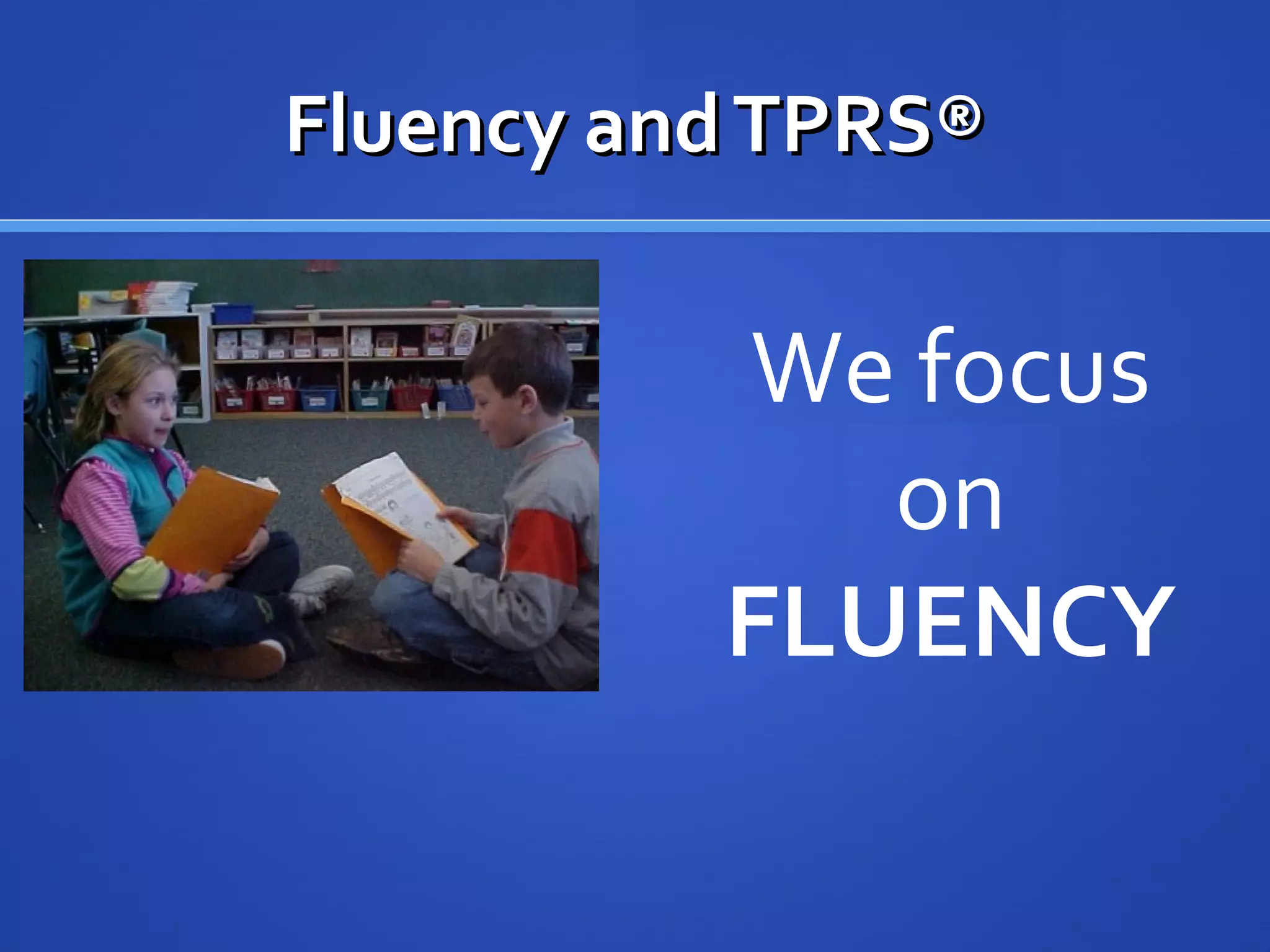
We focus
on
FLUENCY
Fluency andTPRS®Fluency andTPRS®
In order to successfullyIn order to successfully
teachteach fluencyfluency
the teacher must:the teacher must:
 Focus on the details of a storyFocus on the details of a story
 NotNot focus on the languagefocus on the language
TPRS® is a method of second-
language teaching that uses
highly-interactive stories to
provide comprehensible input
and create a feeling of “I am
so getting this.”
What is TPRS®?
We do 4 things inTPRSWe do 4 things inTPRS
We teach language a sentence at aWe teach language a sentence at a
time. If there is breakdown then we :time. If there is breakdown then we :
1.1.Circle (Repetitive questions)Circle (Repetitive questions)
2.2.Add a characterAdd a character
No breakdownNo breakdown
We don’t circle.We don’t circle.
1.We add details to our story.1.We add details to our story.
2.We go back and review.2.We go back and review.
Use words students know
Speak slowly
Key 1: ComprehensibleKey 1: Comprehensible
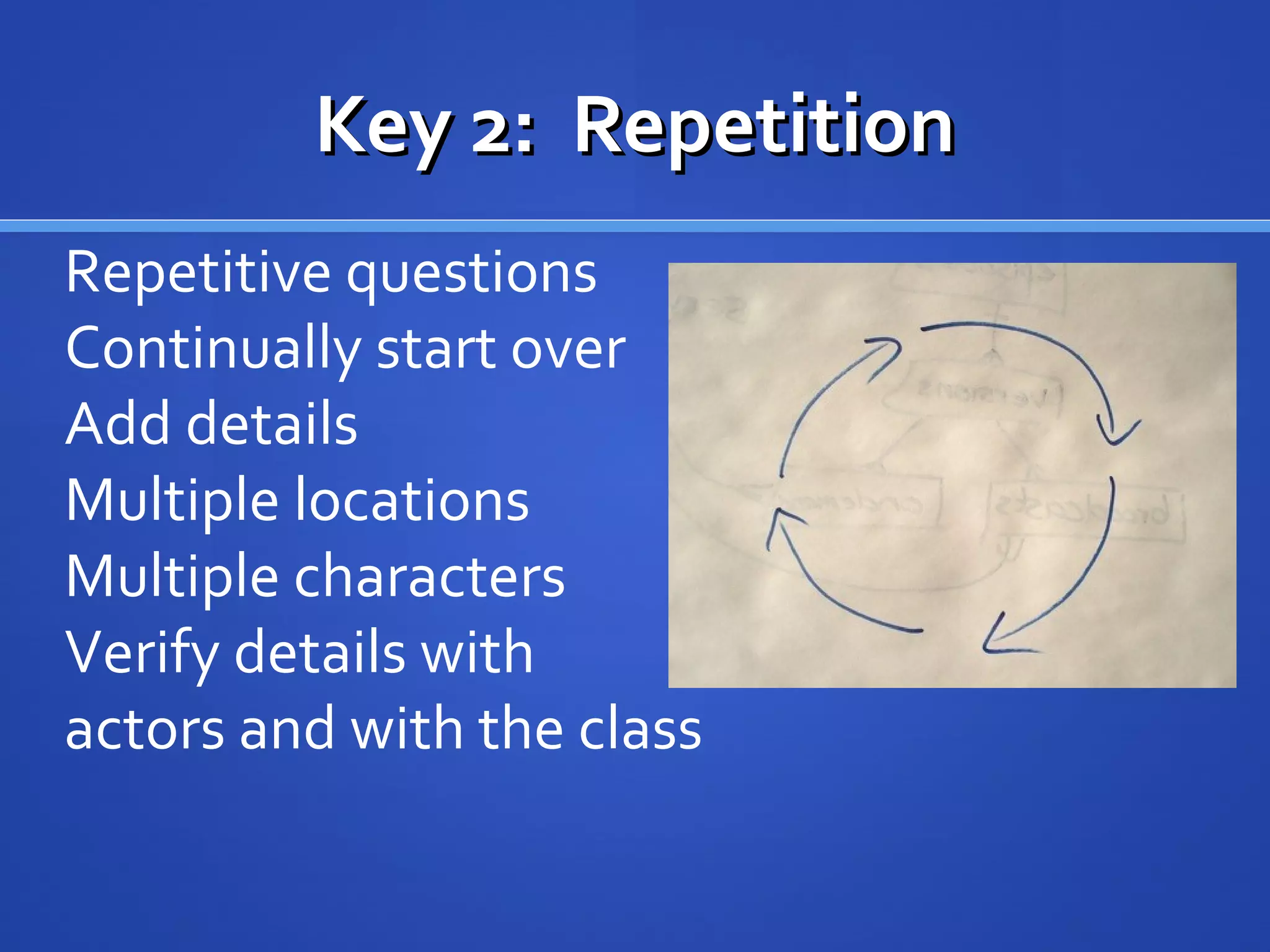
Repetitive questions
Continually start over
Add details
Multiple locations
Multiple characters
Verify details with
actors and with the class
Key 2: RepetitionKey 2: Repetition
BreakdownBreakdown
Students need to answer ourStudents need to answer our
questions with confidence,questions with confidence,
accuracy and no hesitation.Whenaccuracy and no hesitation.When
they don’t, we call thatthey don’t, we call that
breakdown.breakdown.
Recycle the Story
✓ at any point, stop, go back,
and review the story
✓ re-circle the recycled parts
✓ continue story when you get
back to where you left off
Surprise details
“Playing the game”
Personalization
Positive exaggeration
Key 3: InterestKey 3: Interest
Teach to the Eyes!
✓teach STUDENTS not
curriculum
✓look in individual student’s eyes
when teaching
✓hold students accountable
✓always check for understanding
Story Retells
Have students frequently retell the story to
their partners
✓after the story ends
✓have superstar retell story to class
✓Limit the time to two or three minutes
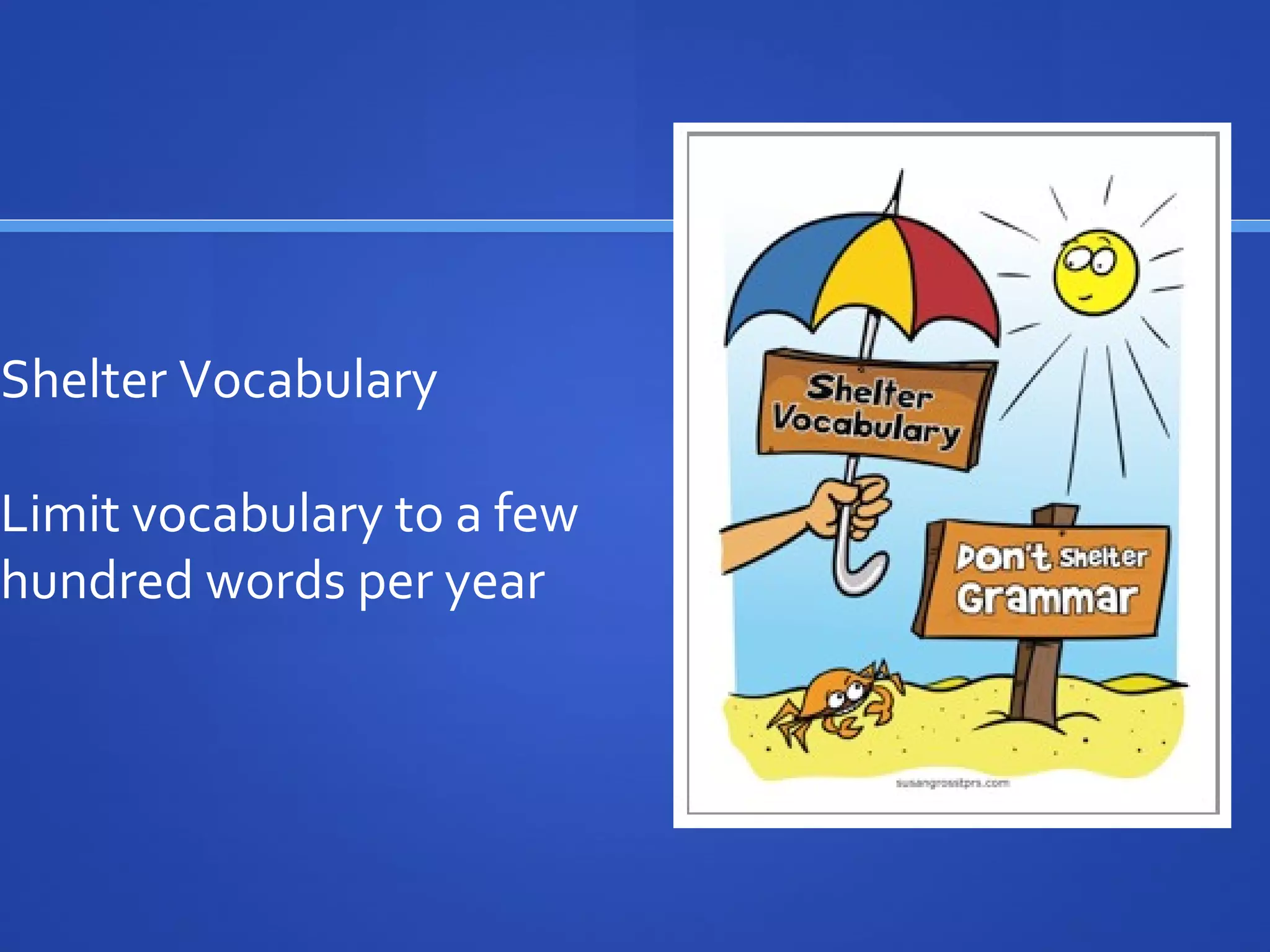
Shelter Vocabulary
Limit vocabulary to a few
hundred words per year
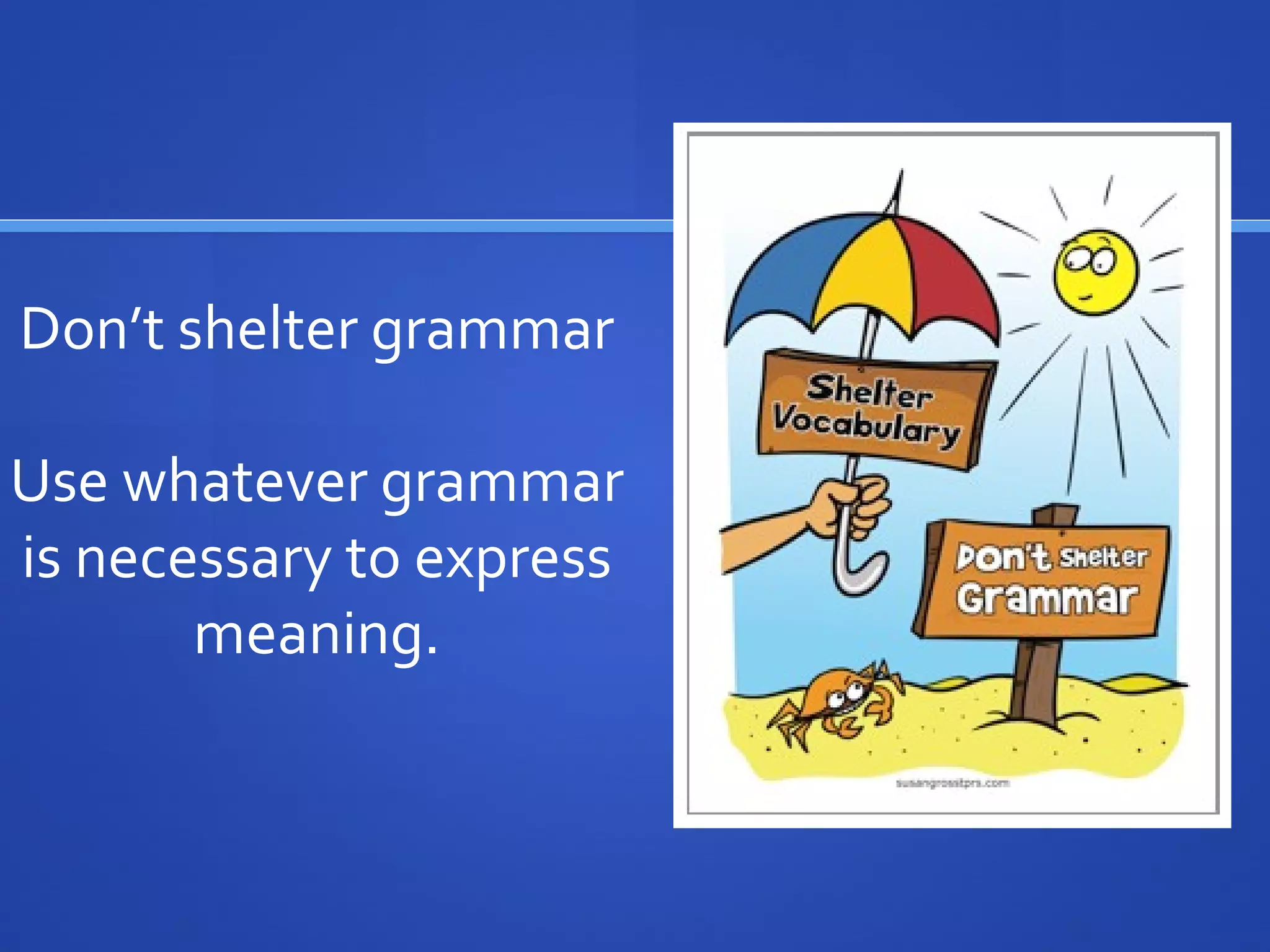
Don’t shelter grammar
Use whatever grammar
is necessary to express
meaning.
Use lessons each dayUse lessons each day
to practice structure.to practice structure.
Structure is the keyStructure is the key
to fluency.to fluency.
Teaching fluency…Teaching fluency…
Data -TeacherData -Teacher
Brain Rules
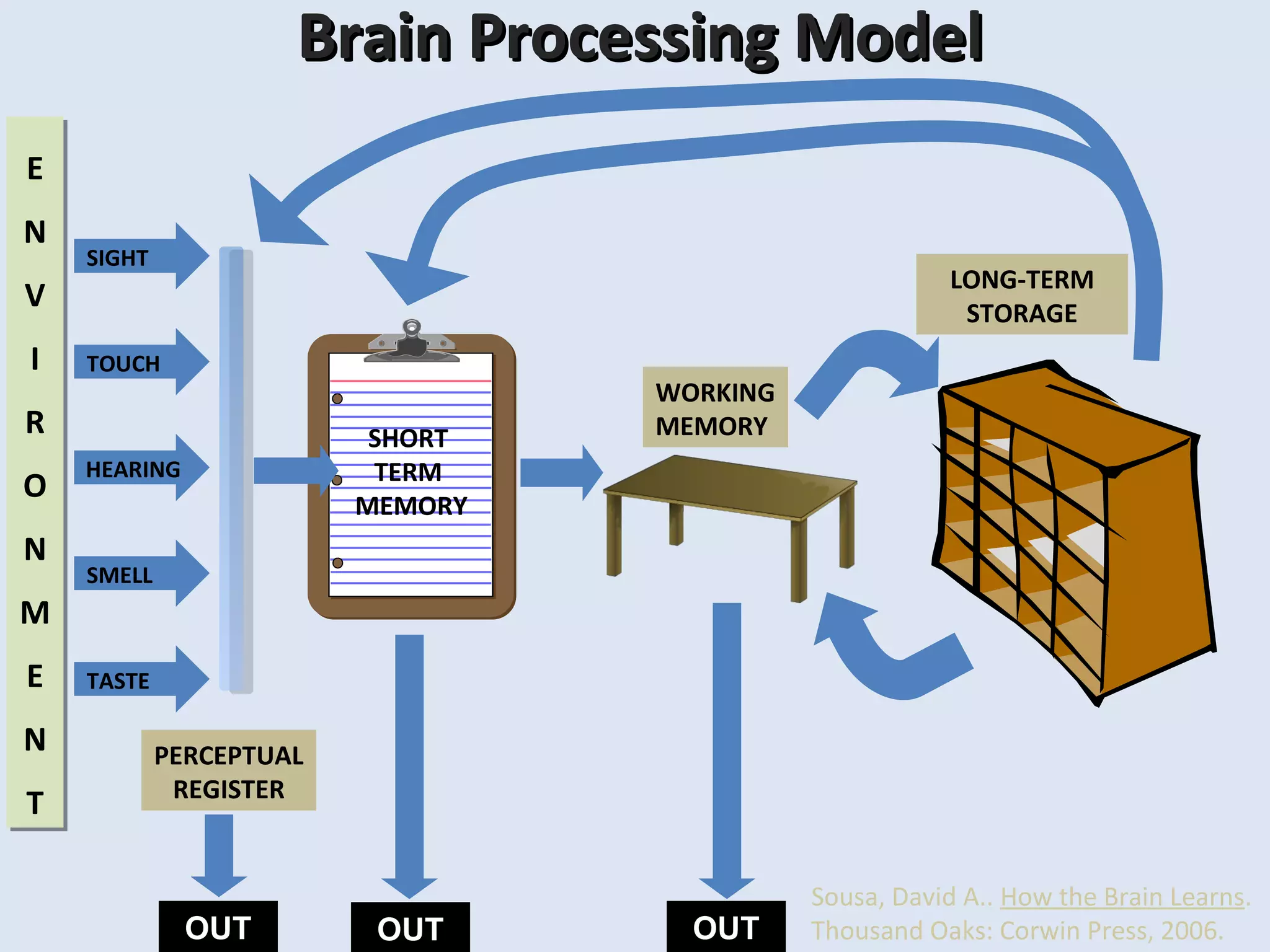
SHORT
TERM
MEMORY
Brain Processing ModelBrain Processing Model
E
N
V
I
R
O
N
M
E
N
T
E
N
V
I
R
O
N
M
E
N
T
HEARING
LONG-TERM
STORAGE
SMELL
SIGHT
TOUCH
TASTE
PERCEPTUAL
REGISTER
OUT OUT OUT
WORKING
MEMORY
Sousa, David A.. How the Brain Learns.
Thousand Oaks: Corwin Press, 2006.
Rule #1:
We don’t pay attention toWe don’t pay attention to
boring thingsboring things..
Rule #2:
We have 30 seconds to repeatWe have 30 seconds to repeat
something before it is forgotten.something before it is forgotten.
Rule #3:
Students must pay attentionStudents must pay attention
in order to learn.in order to learn.
Medina, John. Brain Rules. Seattle: Pear Press, 2008. pp. 76, 79.
How do we get them to pay attention?
•“The novel stimuli – the
unusual, the unpredictable,
or distinctive are powerful
ways to harness attention.”
Emotions get our
attention.
People usually forget 90% of what
they learn in a class within 30 days.
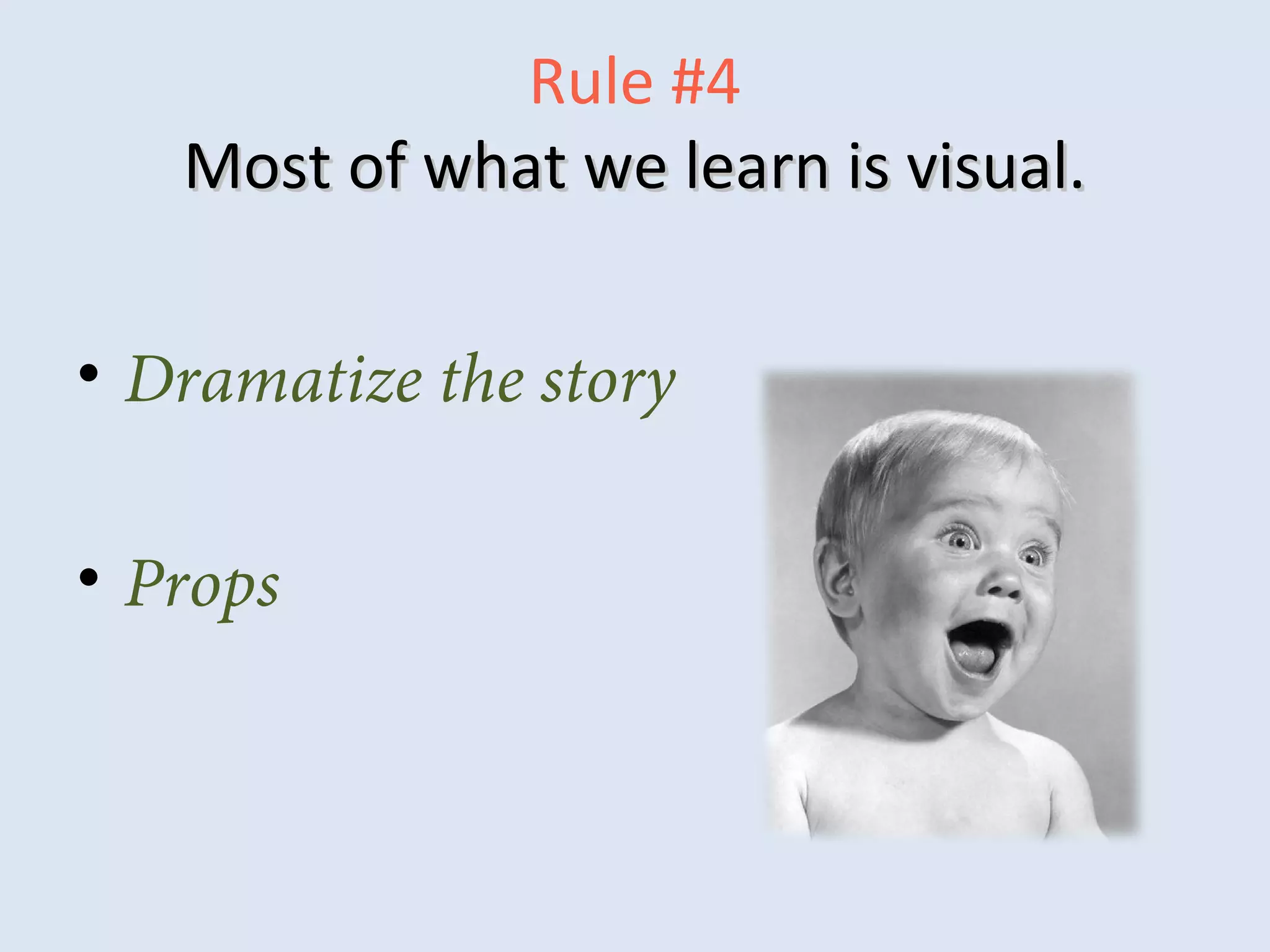
Rule #4
Most of what we learn is visual.Most of what we learn is visual.
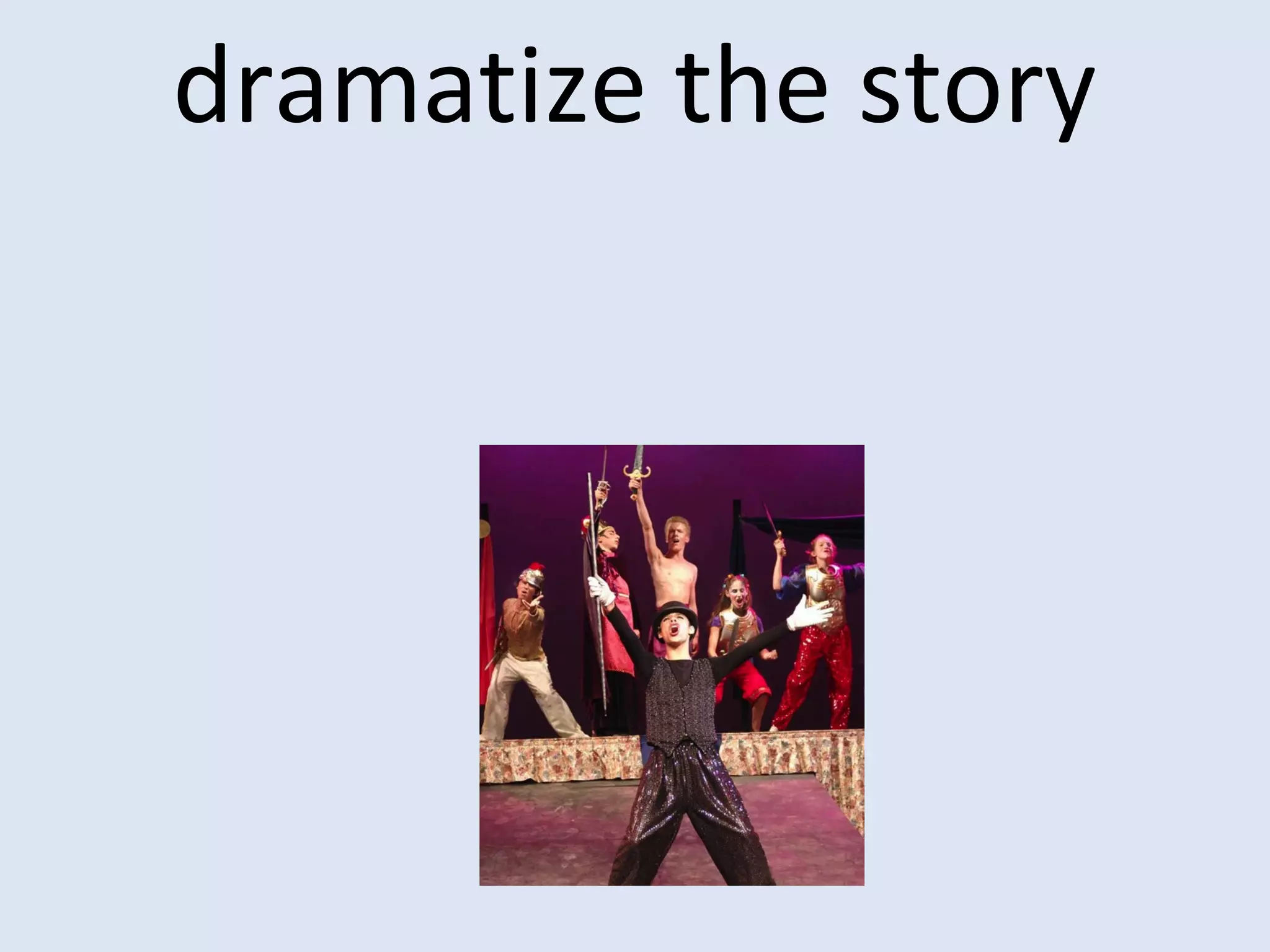
• Dramatize the story
• Props
dramatize the story
✓ wigs & hats
✓ cardboard cutouts
✓ funny noses
✓ funny glasses
✓ stuffed animals
✓ toys
use props
Rule 5:
The initial learning is important.
One could increase the life span of a
memory simply by repeating the
information in timed intervals.
Rule 6:
There are two types of
memories
1. Non-declarative1. Non-declarative
These are things learned by feel such as riding a bike,These are things learned by feel such as riding a bike,
playing the piano, or jumping rope. Theseplaying the piano, or jumping rope. These
memories are not in our conscious awareness.memories are not in our conscious awareness.
2. Declarative memories
“The shirt is blue”
“Jupiter is a planet.”
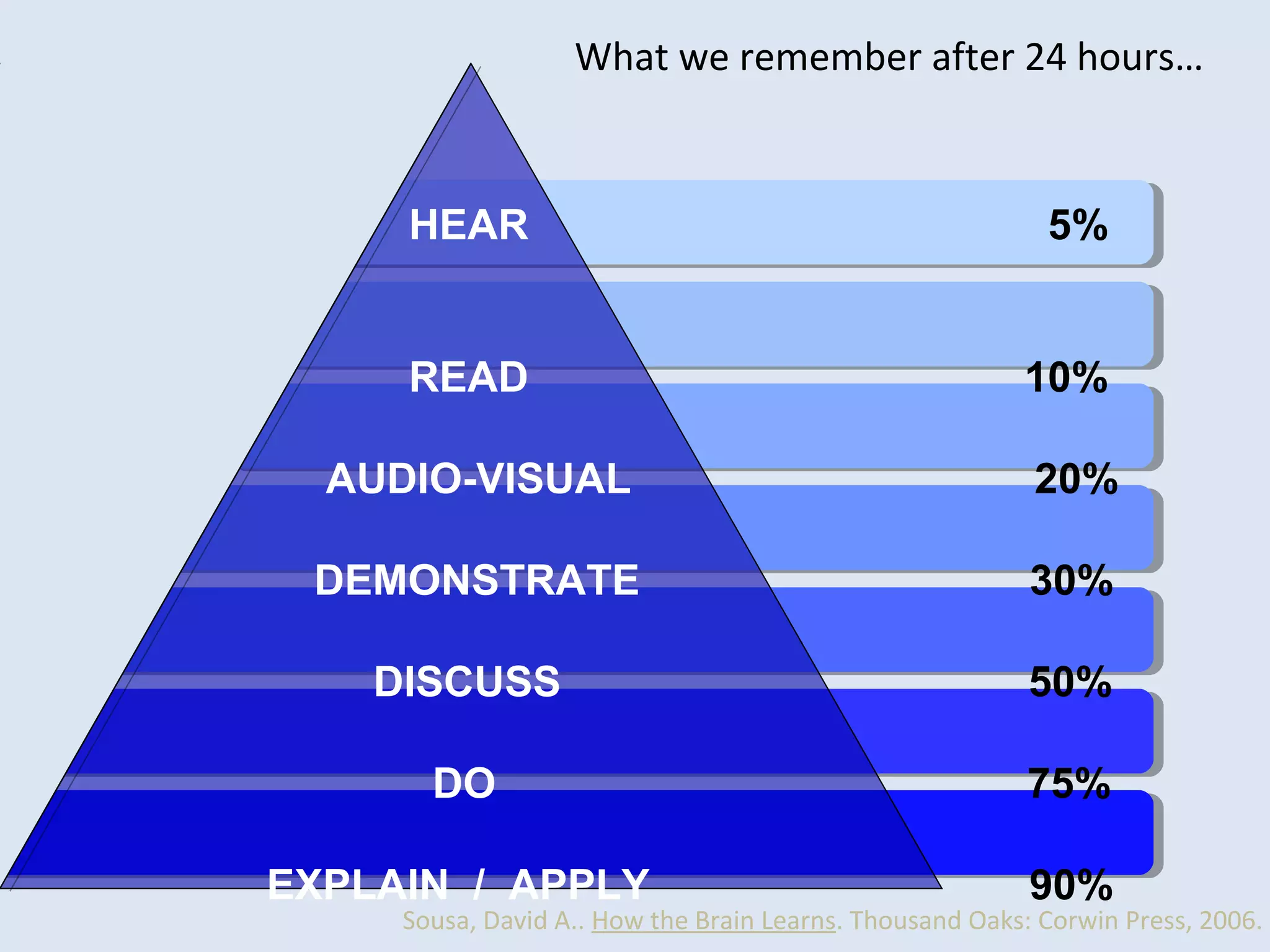
What we remember after 24 hours…
HEAR 5%
READ 10%
AUDIO-VISUAL 20%
DEMONSTRATE 30%
DISCUSS 50%
DO 75%
EXPLAIN / APPLY 90%
Sousa, David A.. How the Brain Learns. Thousand Oaks: Corwin Press, 2006.
Brain RulesBrain Rules
CirclingCircling
Planning a StoryPlanning a Story
Reading and DiscussingReading and Discussing
a Storya Story
TPRS and GradingTPRS and Grading
2 class rules
• No sleeping, phones,
writing or social talking.
(You can ask a question
to the class.)
• You can NEVER say
anything negative about
the class.
3 procedures
1. Whenever I make a statement, you will respond
with an expression of interest. That sounds like
this. “OHHHHHHHH”
2. When I ask you a question, and you know the
answer you have to answer in Spanish because it
is a Spanish story.
3. When I ask you a question and you don’t know
the answer, you will guess. Guess in Spanish.
Make it up. Surprise me. You can guess with
English proper nouns.
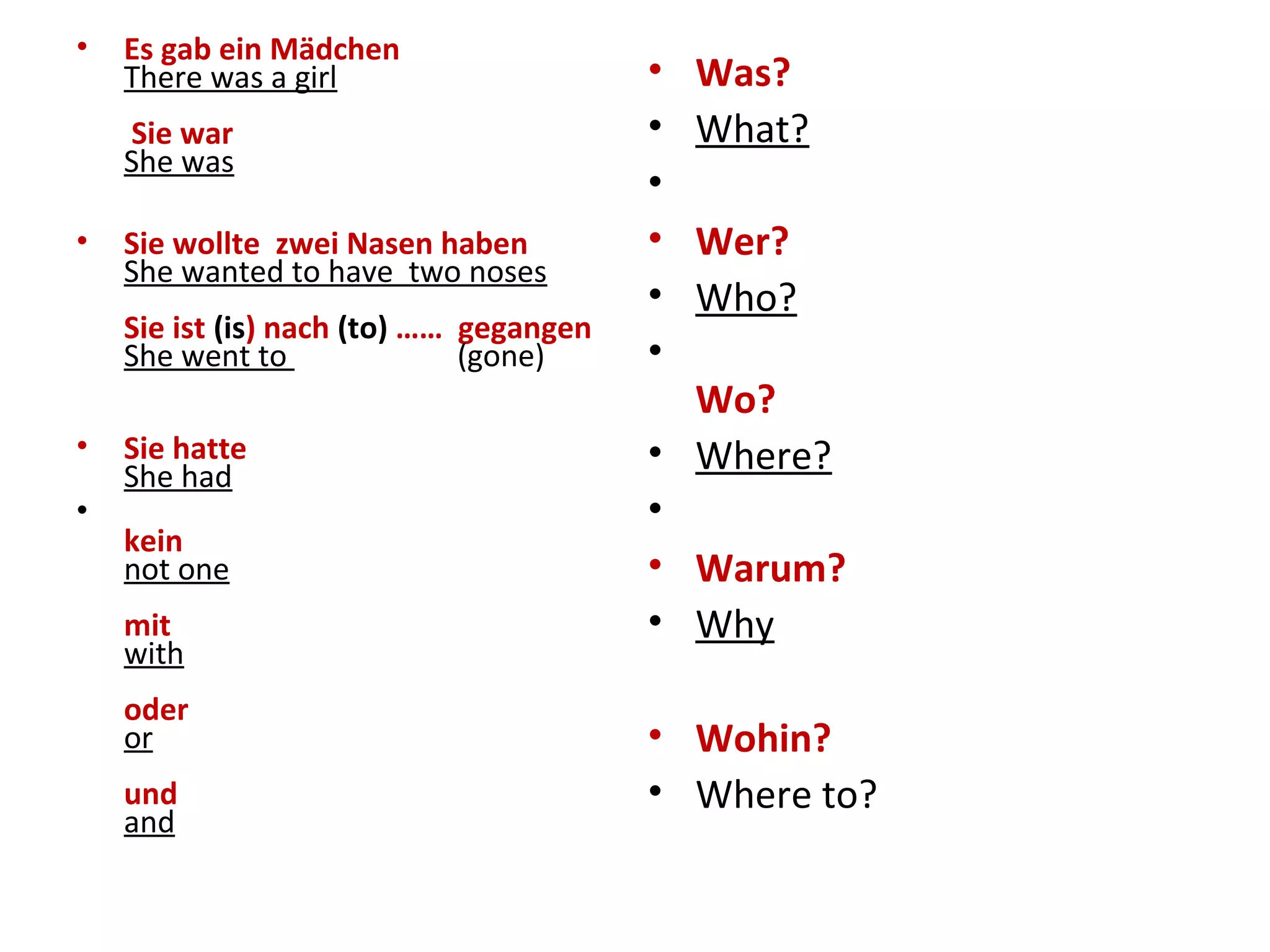
Es (it) gab (gave) ein
Mädchen
There was a girl
Sie war
She was
• Was? What
• Wer? Who
• Wo? Where
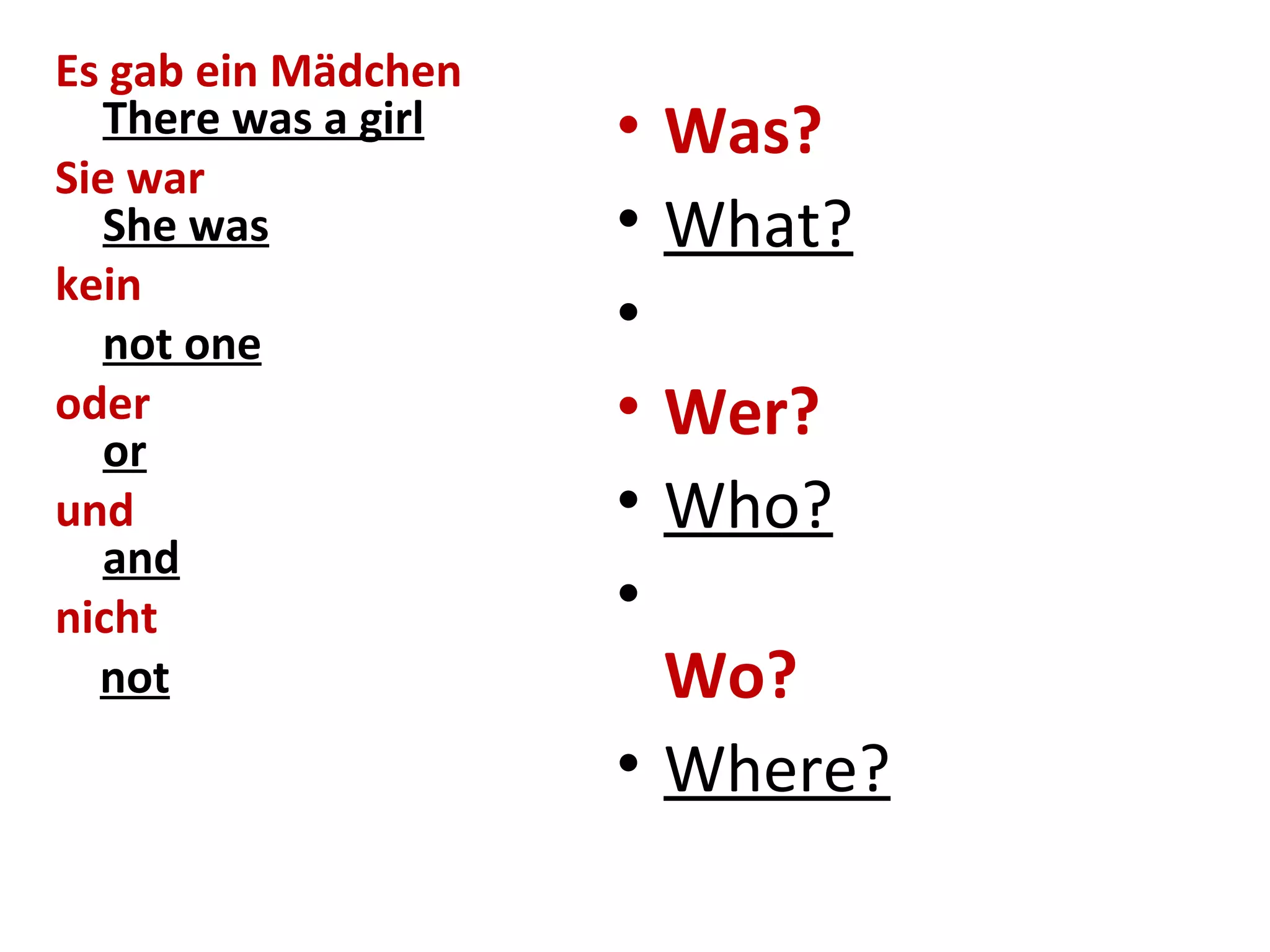
Es gab ein Mädchen
There was a girl
Sie war
She was
kein
not one
oder
or
und
and
nicht
not
• Was?
• What?
•
• Wer?
• Who?
•
Wo?
• Where?
Es gab ein Mädchen
There was a girl
Sie war
She was
Sie hatte
She had
kein
not one
oder
or
und
and
nicht
not
• Was?
• What?
•
• Wer?
• Who?
•
Wo?
• Where?
•
• Warum?
• Why
• Wie?
• How
• Es gab ein Mädchen
There was a girl
Sie war
She was
• Sie wollte zwei Nasen haben
She wanted to have two noses
Sie ist (is) nach (to) …… gegangen
She went to (gone)
• Sie hatte
She had
•
kein
not one
mit
with
oder
or
und
and
• Was?
• What?
•
• Wer?
• Who?
•
Wo?
• Where?
•
• Warum?
• Why
• Wohin?
• Where to?
Circling:
the heart
of
TPRS®
Circling
1. Positive statement
2. ? with a yes answer
3. Either/or questions
4. ? with a no answer
5. Restate the negative and restate the positive
6. Who?
7. What? Where? When? How? Why?
How much?, etc…
8. Positive statement
Rule 1
• Don’t circle in order.
Rule 1
• Don’t circle in order.
Rule 2
• Use the either/or with the different parts of
the sentence.
Rule 3
• Ask negative questions.
Rule 4
• Use the question words.
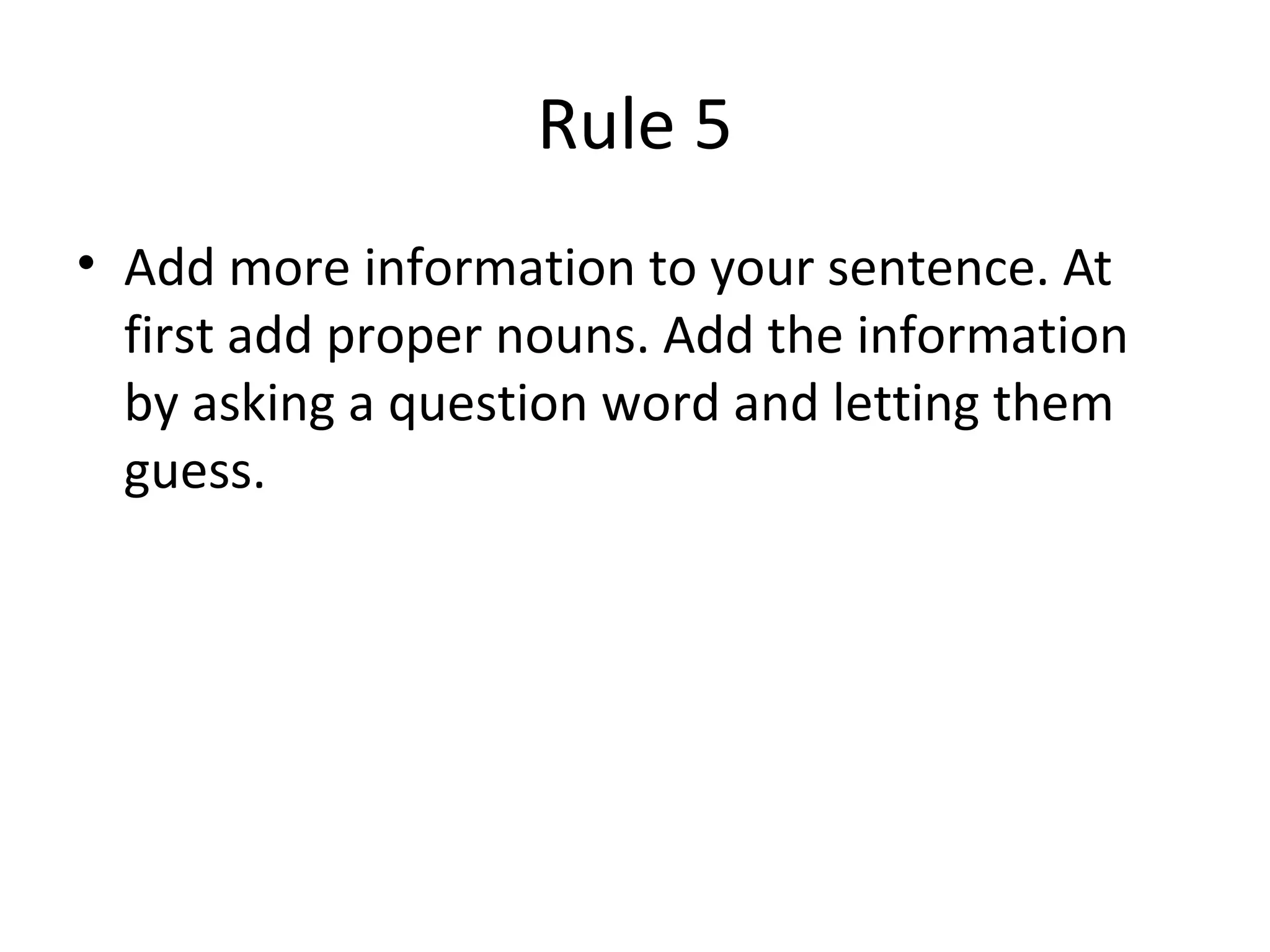
Rule 5
• Add more information to your sentence. At
first add proper nouns. Add the information
by asking a question word and letting them
guess.
Rule 6
• Add other characters.
Rule 7
• Add yourself as a character.
5 steps of teaching a sentence
1. Past tense to the class.
2. Present tense to the student actor.
3. 3. Student answers with a complete
sentence. If s/he can’t answer, he reads the
answer.
4. Verify the answer with the student actor.
5. Verify the answer with the class.
_____ era una chica. Soy – I am
_____ was a girl. Eres – You are
Es - S/he is
_____ estaba en _____ Estoy – I am
_____ was in _____ Estás – You are
Está - s/he is
¿Quién? Who?
¿Qué? What?
¿Dónde? Where?
Step one
Add a sentence
Elena was a girl.
Talk to the class in the past tense.
Ask Elena:
Are you are girl?
Yes, I am a girl.
Yes, you are a girl.
Class, Elena was a girl.
Step two
Add a location
You now have two sentences
Elena was a girl.
She was in Arizona.
Talk to the class in the past.
Talk to your student actor in the
present.
Verify what she says and then talk
to the class.
Step 3
Add a more specific location.
Now you have 3 sentences.
Elena was a girl.
She was in Arizona.
She was in Happy Valley, Arizona.
Step 4
Add another location.
Elena was a girl.
She was in Arizona.
She was in Happy Valley.
She was in Panda Express.
Step 5
Add a parallel character. Compare
and contrast both characters.
Elena was a girl in Happy Valley,
Arizona at Panda Express.
Susie was a girl in Blaine,
Minnesota, at Starbucks.
Compare and contrast the two
characters.
Verify the details with your student
actors.
The girl was ________.
She wanted a cat.
She didn’t have a cat.
She went to _______.
(Dialogue to show there is no cat.
Girl said, Do you have a cat?
Boy said, I don’t have a cat.)
The girl went to _____________.
(Dialogue to show there is a cat.
Girl said, Do you have a cat?
Boy said, Yes, I have a cat.)
The boy gave the girl a cat.
The girl was happy.
Había Hay
There was There is, are
Quería quiero
s/he wanted I want
quieres -
you want
Tenía – had tengo
I have
tienes
you have
Fue a voy
Went to I go
vas
you go
Le dijo Le dio
told him/her gave him
¿Quién? Who? ¿Qué? What? ¿Dónde? Where?
Brain RulesBrain Rules
CirclingCircling
Planning a StoryPlanning a Story
Reading and DiscussingReading and Discussing
a Storya Story
TPRS and GradingTPRS and Grading
Create a TPRS® Lesson Plan
A Story has two parts
Background information
Background information
Often will set up a story and
give information to be used in
the story.
Background information (Monday)
1. Names, and places
2. Multiple characters
3. Doesn’t need to pertain to story
4. Practice any word or structure
5. Use for compare and contrast
6. Verify details with actors
Parallel characters are used
to compare and contrast.
They also make the story
last much longer.
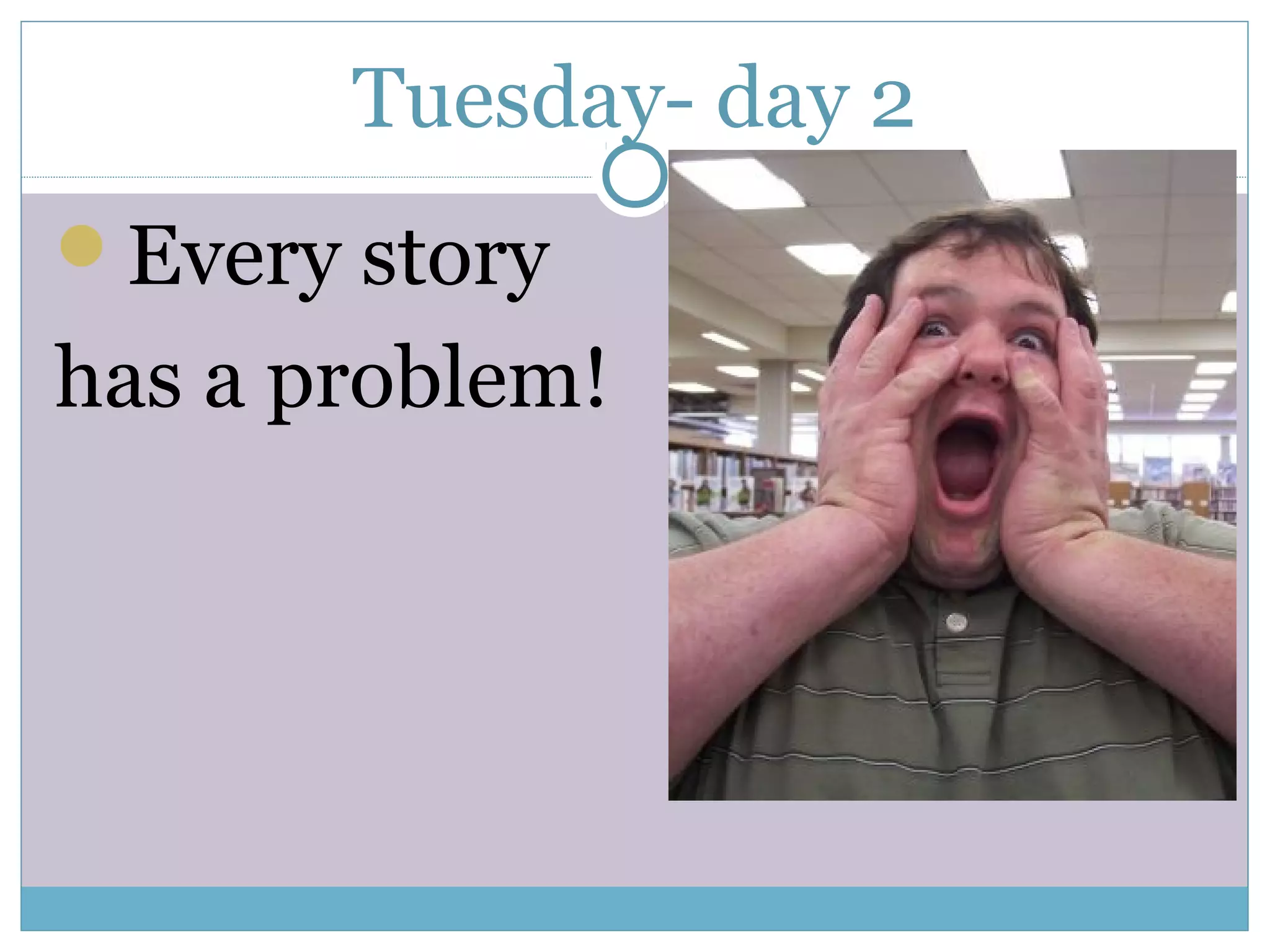
Tuesday- day 2
Every story
has a problem!
Problem has 3 parts
• Introduce the problem by stating
someone wants something.
• Make an unsuccessful attempt to
resolve the problem.
• Resolve the problem.
Variables
Every story has
variables. Use your
variables to create
surprise details.
Surprise details are
what make the stories
interesting.
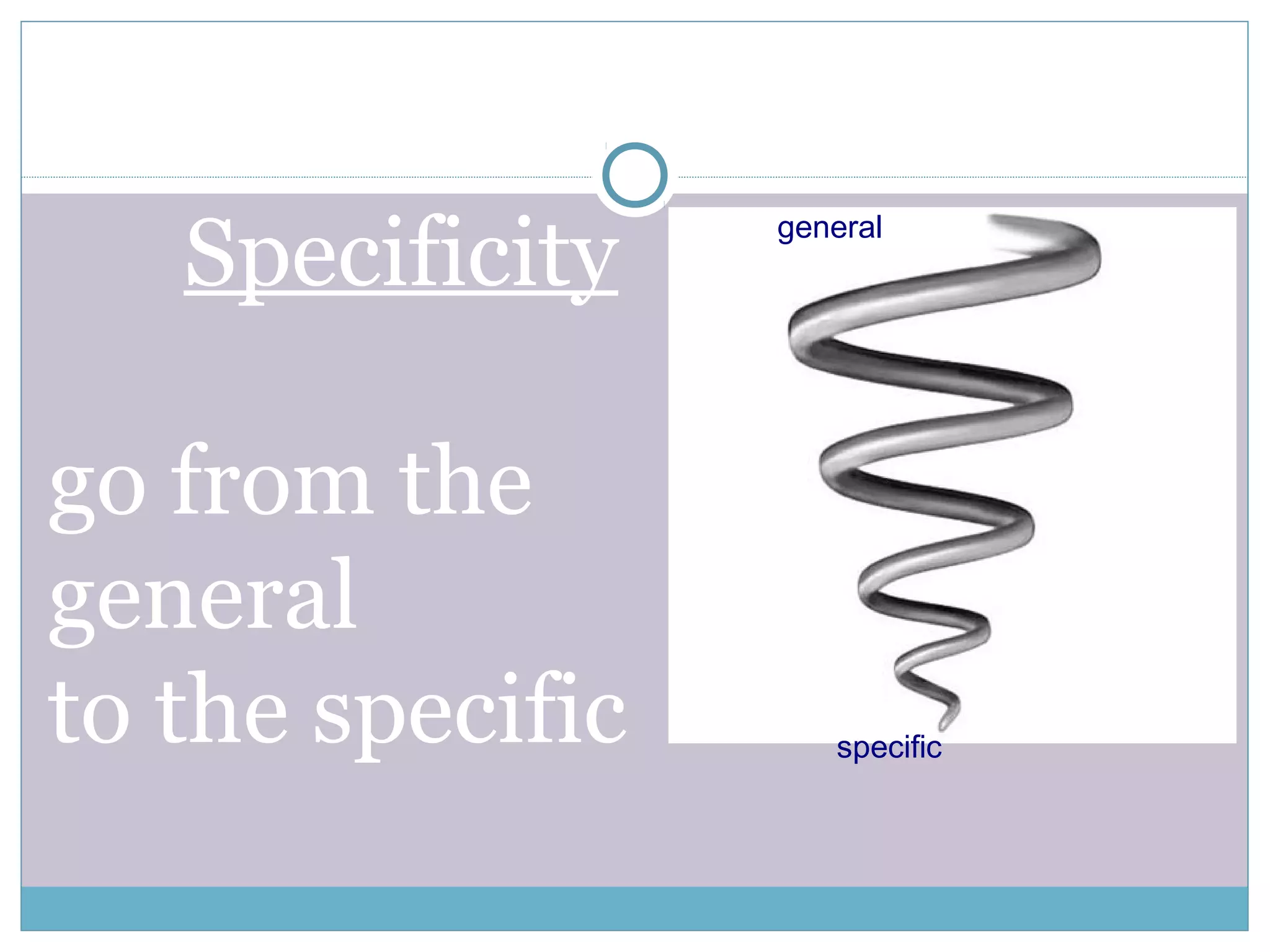
Specificity
go from the
general
to the specific
general
specific
Problem: A boy wanted a cat.
Sentences:
________________________________________
________________________________________
__
In the first line, list a fact of the story, circle the
variable or variables, and list the alternative variables.
________________________________________
________________________________________
________________________________________
________________________________________
________________________________________
________________________________________
______
Lesson PlanLesson Plan
Start with 2 or 3 structuresStart with 2 or 3 structures
 These are the structures you want to
practice.
 Should be basic, high frequency
words.
 Always translate the words of these
structures.
Problem: A boy wanted a cat.
Sentences:
There was a boy.
He was a boy. .
________________________________________
________________________________________
________________________________________
________________________________________
________________________________________
________________________________________
________________________________________
________________________________________
________
Lesson PlanLesson Plan
Read the story
There was a boy. He didn’t have a cat.
He went to Green River, Wyoming.
There was a girl. The girl didn’t have a
cat.
The boy went to Brooklyn. There was a
cat in Brooklyn. The boy picked up the
cat. He was happy because he had a cat.
Lesson PlanLesson Plan
Problem: A boy wanted a cat.
Sentences: The boy didn’t have a cat. He went to Wyoming.
The boy - What don’t we know about him? Name? Where he lives? How
old is he? Favorite music? What is in his bedroom? Who are his friends?
Why does he want a bird?
Information: Where did he live? (Three levels of specificity) Did he have a cat?
Did he have an elephant? What did he have? What did he want? Where did
he go?
Surprise details: Add proper nouns as a surprise. Kmart or Dollar Tree for
locations. Add names and places that are a surprise.
Lesson PlanLesson Plan
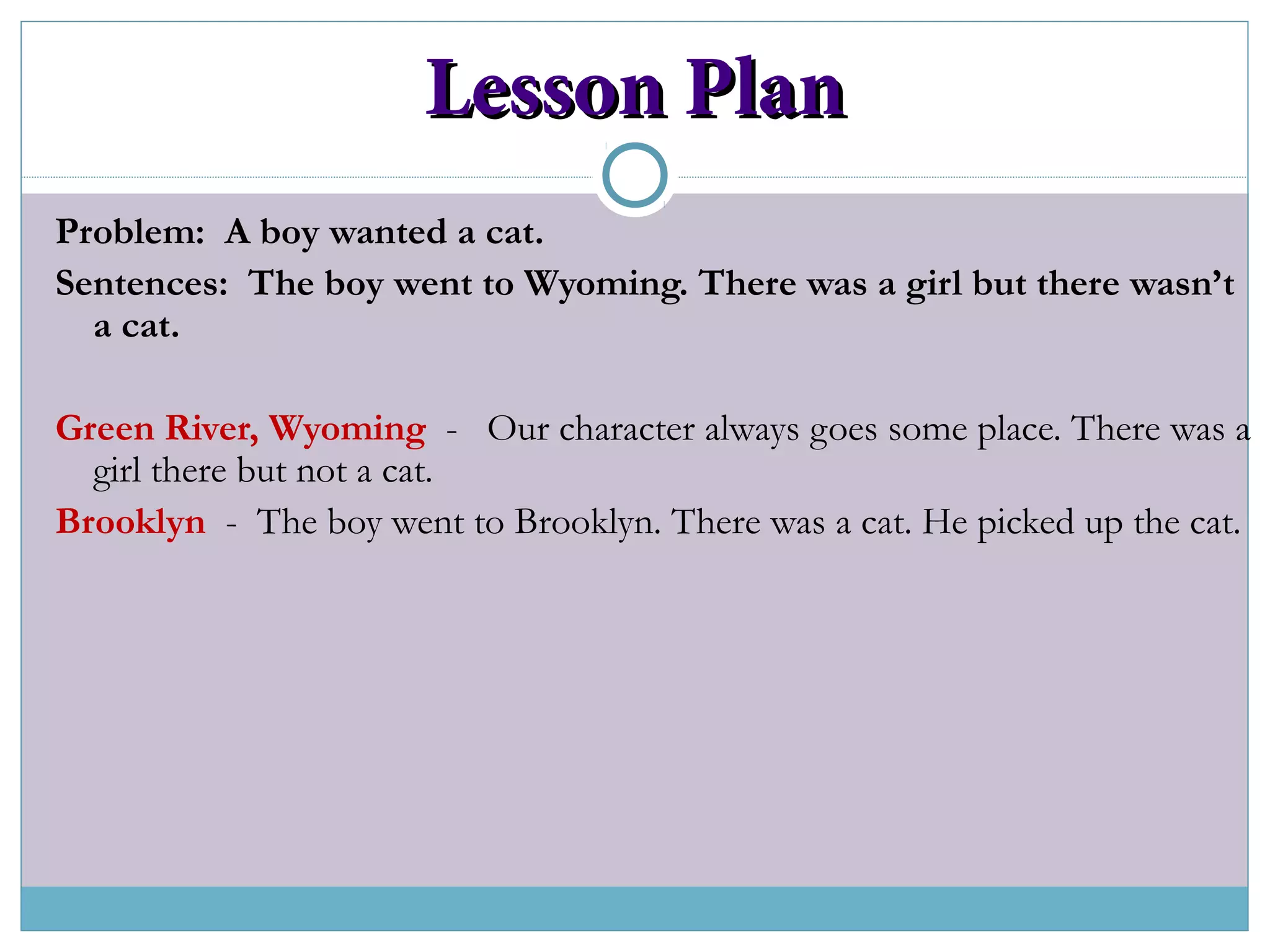
Problem: A boy wanted a cat.
Sentences: The boy went to Wyoming. There was a girl but there wasn’t
a cat.
Green River, Wyoming - Our character always goes some place. There was a
girl there but not a cat.
Brooklyn - The boy went to Brooklyn. There was a cat. He picked up the cat.
Brain RulesBrain Rules
CirclingCircling
Planning a StoryPlanning a Story
Reading and DiscussingReading and Discussing
a Storya Story
TPRS and GradingTPRS and Grading
x. This person will be the most experienced TPRS
person in the group. Announce the three
procedures.
A. Make a statement and have students say,
“Ohhhhhhh”.
B. Ask a question where they know the answer and
have them answer in the target language.
C. Ask them a question where they don’t know the
answer and have them answer
a. in target language (Spanish because it is a Spanish
story
b. Proper nouns
c. surprise me
(If you don’t surprise me, I will surprise you.)
Person number 1– Monday
Background information
 Background information: Introduce the first
character—add details about him/her by asking
questions.
Name, where s/he was (be as specific as possible –
name of state, city, place (proper noun?).
Choose a student actor.
Verify the details with that actor and with the class.
Person number 2– Monday
Background information
Review information about the first character by
asking questions and then add another character.
Add more information about the character. Verify
the details with both characters and with the class.
Tuesday
Introduce a problem
Review the background information by asking
questions.
Your main focus is on character one. You can add
more information about him/her.
Add a problem where the character needs or wants
something.
Verify the details with your student actor and the
class.
Tuesday - Unsuccessful attempt to solve the
problem
Have the character go someplace to make an
unsuccessful attempt to solve the problem.
Use dialogue. Talk to the class and tell the class
what each character says.
Create a reason why the actor doesn’t get what
he/she wants.
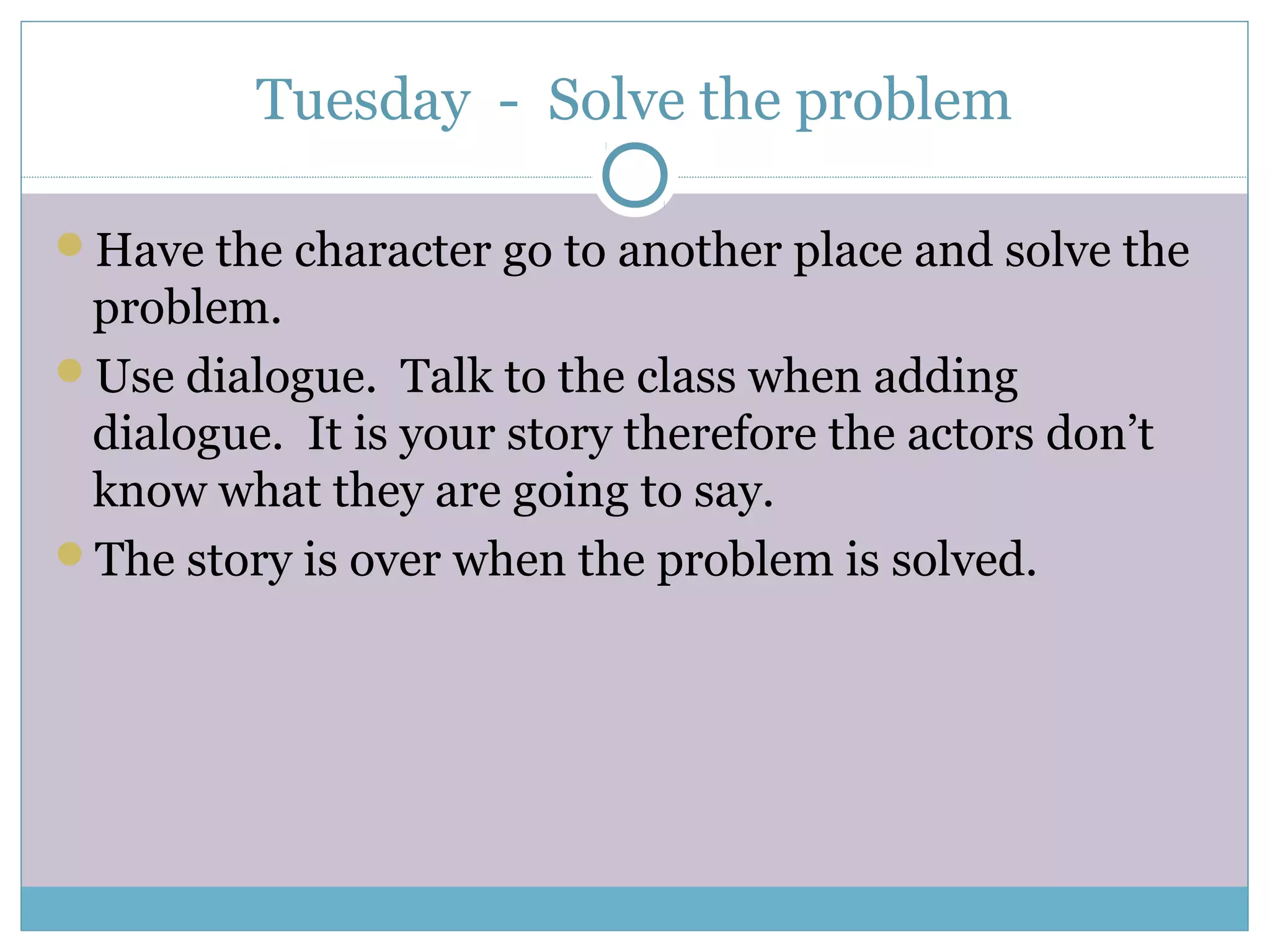
Tuesday - Solve the problem
Have the character go to another place and solve the
problem.
Use dialogue. Talk to the class when adding
dialogue. It is your story therefore the actors don’t
know what they are going to say.
The story is over when the problem is solved.
Brain RulesBrain Rules
CirclingCircling
Planning a StoryPlanning a Story
Reading and DiscussingReading and Discussing
a Storya Story
TPRS and GradingTPRS and Grading
Wednesday Embedded Reading
Start with the first embedded reading.
Translate the first embedded reading.
Students write in the meaning of any new words.
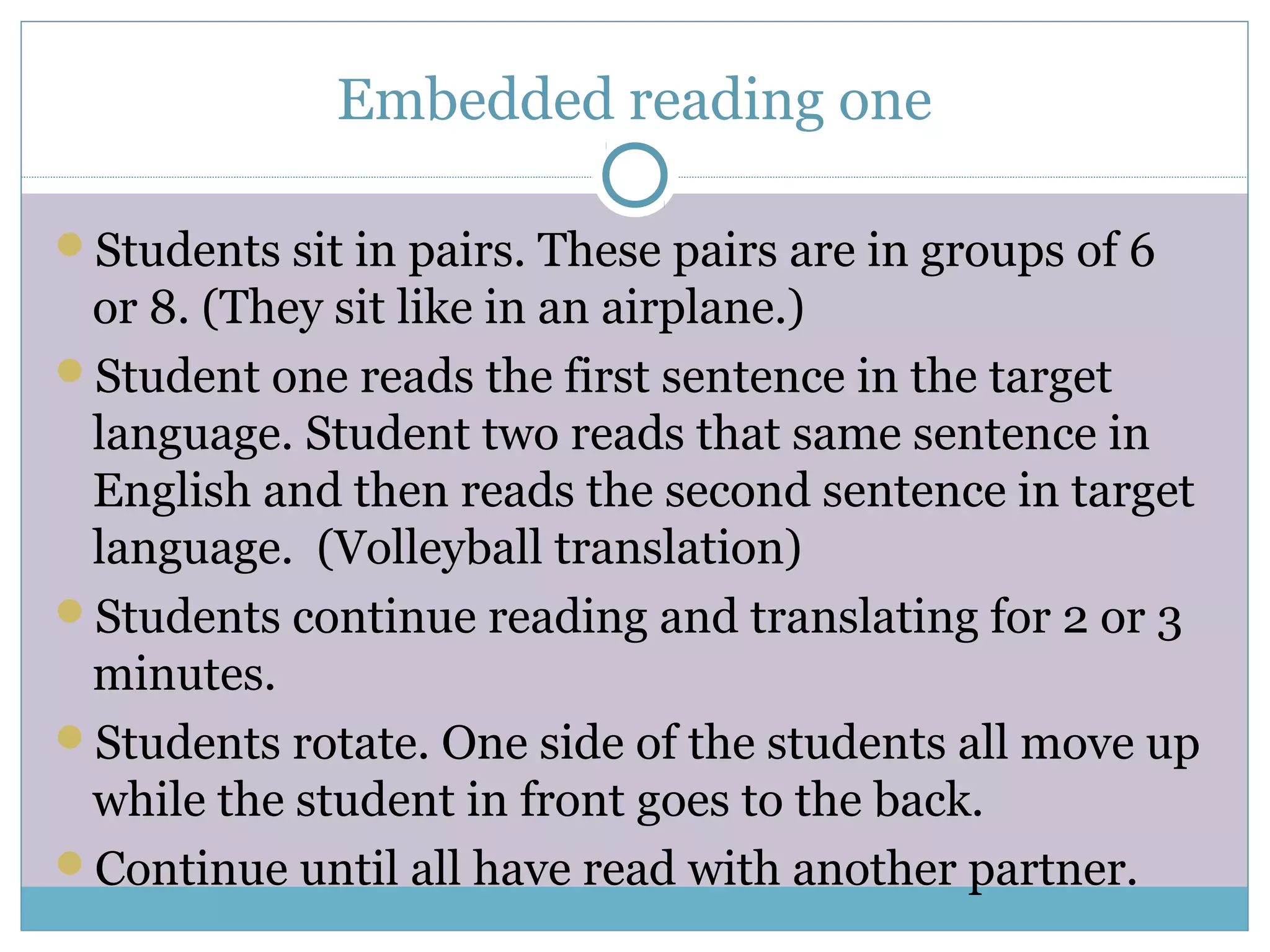
Embedded reading one
Students sit in pairs. These pairs are in groups of 6
or 8. (They sit like in an airplane.)
Student one reads the first sentence in the target
language. Student two reads that same sentence in
English and then reads the second sentence in target
language. (Volleyball translation)
Students continue reading and translating for 2 or 3
minutes.
Students rotate. One side of the students all move up
while the student in front goes to the back.
Continue until all have read with another partner.
Embedded reading 2
Repeat the same process for the second reading.
Students will have a little more time to do the
volleyball translation. Continue until students have
read with either 3 or 4 partners.
Person number 1– Wednesday
Extended reading - Background information
Background information: Introduce the first
character—add details about him/her.
 This person is playing the role of the main character
in the extended reading. Add information about the
character. Add his/her name, where s/he was (be as
specific as possible – name of state, city, place
(proper noun?).
Choose a student actor. Verify the details with that
actor and with the class.
Verify the details with that actor and with the class.
Person number 2 Wednesday
Extended reading - Background information
Add a parallel character. (Usually a student playing
himself)
Compare the new character to the other character.
Add more information about both characters.
Verify the details with both characters and with the
class.
Person 3 – Extended reading
Thursday
 Review the details established in the background
information. Read the first paragraph. Translate
with the class.
Ask facts about the paragraph. Add any surprises to
the story.
Dramatize the extended reading. Add surprises.
Verify the details with your student actors.
Person 5 – Extended reading
Thursday
After you have acted out the extended reading,
students are now ready for volleyball translation of
the extended reading. Have them go through the
entire story now in groups. Give them 3 minutes to
read with each partner. If there is time, also do
volleyball translation with the extended reading in
the past tense.
Brain RulesBrain Rules
CirclingCircling
Planning a StoryPlanning a Story
Reading and DiscussingReading and Discussing
a Storya Story
TPRS and GradingTPRS and Grading
TPRSTPRS®
andand
SchoolSchool
A typical
TPRS®
week
Monday
✓talk about weekend/ PQA
practice with new
structures
✓Establish background
information and add
parallel characters with
surprise details.
Tuesday
✓ Start over and re-
establish the
background information
from yesterday.
✓ Introduce the problem.
✓ Make an unsuccessful
attempt to solve the
problem
✓ Solve the problem
✓ If there is time, solve
the problem with the
parallel character
✓ If there is time, do a
partner retell
Wednesday
✓Embedded readings 1
and 2
✓Add background
information to the
story
✓Add a student as the
parallel character
✓Add background
information about the
student
Thursday
✓Review the details of
the extended reading
✓Add more surprise
details to both
characters
✓Dramatize the rest of
the story
✓Do the embedded
reading with the
extended reading
Friday
✓Timed writing
✓Read a discuss a novel
✓Add surprise details
✓Add one or more
parallel character
✓Read and translate to
the end of the chapter.
✓If time, do partner
student retells.
TestsTests
1. 50% of nine-weeks grade (40% with
reading option)
2. Surprise tests
3. Translation – Target language to English
4. Cumulative throughout the year
5. Test words they know
6. Most students get A’s or B’s on tests
7. If 80% don’t get 80% or higher, retest
Reading Option
1.Make your test grades worth 40% of their nine
weeks grade.
2.Earn 10% of the grade by reading.
3.First and second year students read a novel
every nine weeks.
4.Third year students read a novel a month.
5.Fourth year students read 2000 words of
literature a night.
After 13 days of TPRS one of my 7th
graders asked if he could try a TPRS novel.
For half an hour he read "Berto y sus
buenas ideas" and said that he understood
it and knew most of the words. I've never
had a student read a novel after 13 days of
TPRS in a beginning class. I am blown
away and so excited about the rest of my
classes starting to read when they are
ready. This student is the hook I need in
order to motivate the rest. Last year I had a
7th grader who read 10 novels before I
shared her success with the rest of the
classes. She was the hook for the rest of
the students (over a 100!) who ended up
reading novels in their own time.
Non-Test GradesNon-Test Grades
(quizzes and homework)(quizzes and homework)
1. 25% of nine-weeks grade
2. About a grade or two a week
3. Quizzes
4. Timed writings
5. Homework
a. Retell story to an adult
b. Write out story
c. Draw the story
d. Write a new ending to the story
Timed writingsTimed writings
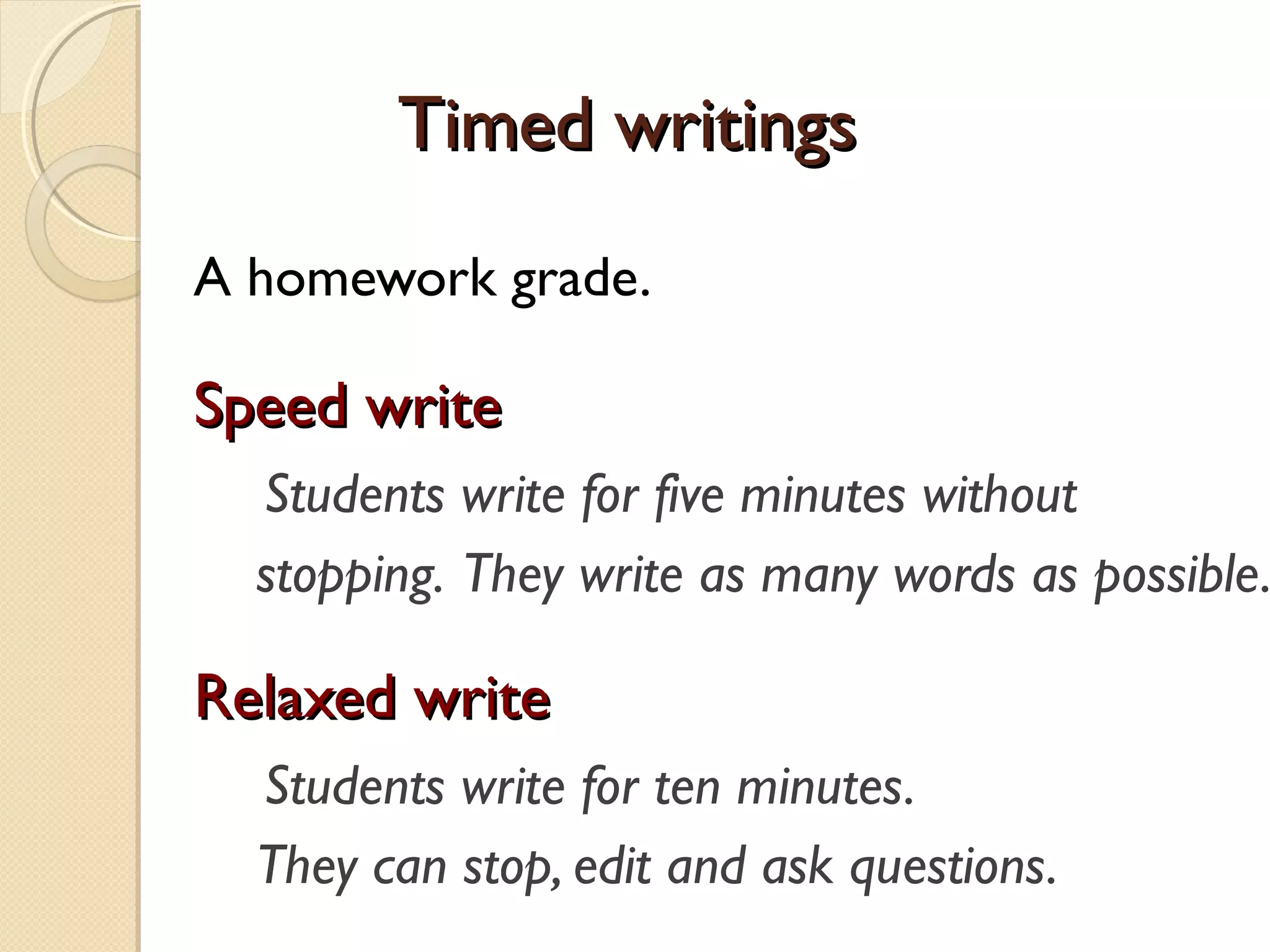
A homework grade.
Speed writeSpeed write
Students write for five minutes without
stopping. They write as many words as possible.
Relaxed writeRelaxed write
Students write for ten minutes.
They can stop, edit and ask questions.
Timed writingsTimed writings
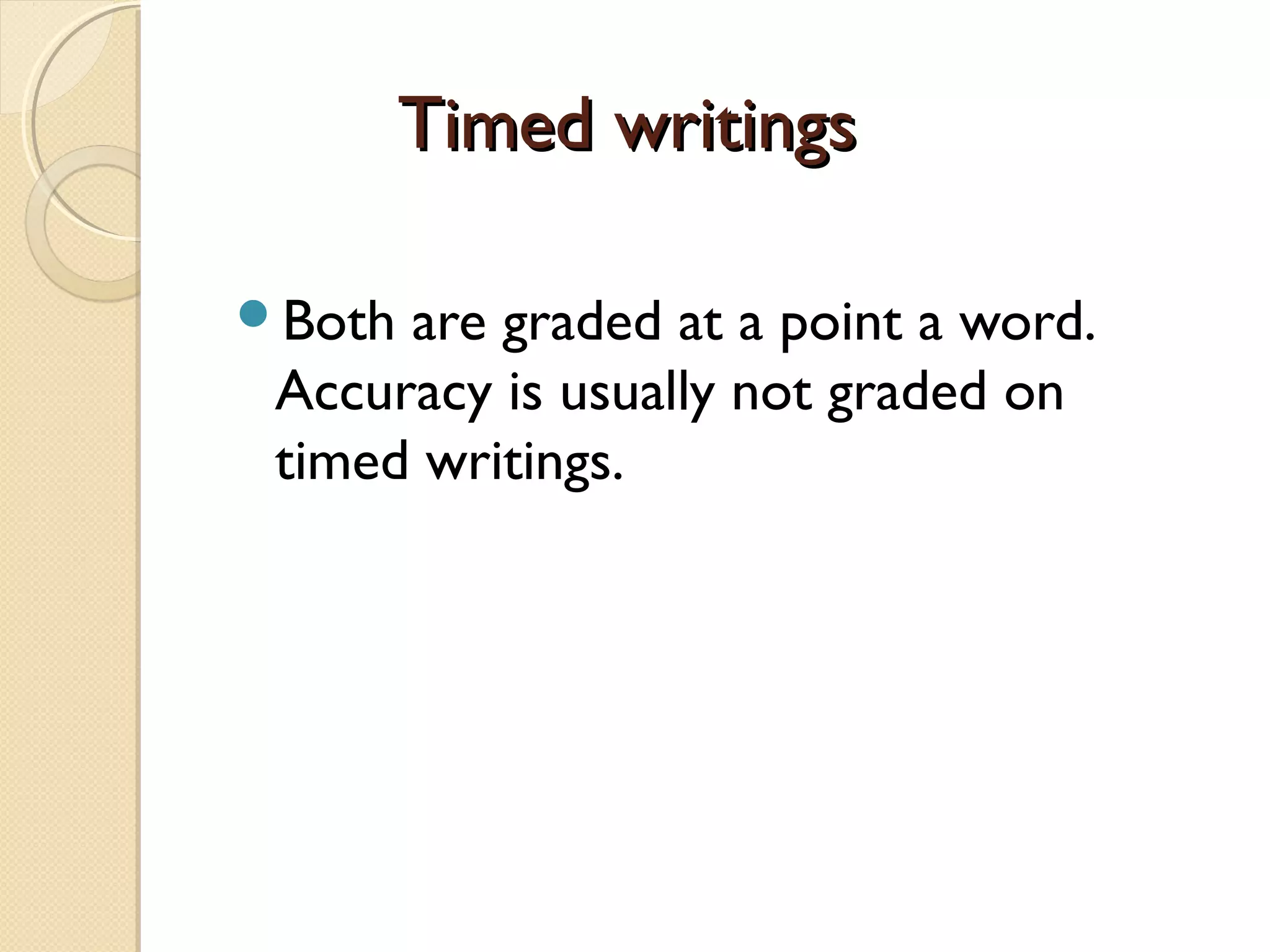
Both are graded at a point a word.
Accuracy is usually not graded on
timed writings.
ParticipationParticipation
1. 25% of nine-weeks grade
2. Each student starts with 100 points.
3. Students are required to look engaged.
4. Looking engaged means: no sleeping,
talking or writing.
5. Each infraction costs the student 5 pts.
6. When there is an infraction, teacher says
the name of the student and “págame”.
Págame MakeupsPágame Makeups
1. Student can make up two págames
(10 pts.) by giving the teacher a
nice card.
2. Student can make up two more
págames by shaking the teacher’s
hand.
Págame MakeupsPágame Makeups
There is a maximum of one card and one
hand shake per nine weeks.
All other págames are made up with 100
word essays in the target language:
a. Essay can be copied but it must be in
the student’s own handwriting.
b. Student can only write two 100-word

2015powerpoint 160110014826

  • 1.
    Brain RulesBrain Rules CirclingCircling Planninga StoryPlanning a Story Reading and DiscussingReading and Discussing a Storya Story TPRS and GradingTPRS and Grading
  • 2.
  • 10.
  • 11.
  • 12.
    In order tosuccessfullyIn order to successfully teachteach fluencyfluency the teacher must:the teacher must:  Focus on the details of a storyFocus on the details of a story  NotNot focus on the languagefocus on the language
  • 13.
    TPRS® is amethod of second- language teaching that uses highly-interactive stories to provide comprehensible input and create a feeling of “I am so getting this.” What is TPRS®?
  • 14.
    We do 4things inTPRSWe do 4 things inTPRS We teach language a sentence at aWe teach language a sentence at a time. If there is breakdown then we :time. If there is breakdown then we : 1.1.Circle (Repetitive questions)Circle (Repetitive questions) 2.2.Add a characterAdd a character
  • 15.
    No breakdownNo breakdown Wedon’t circle.We don’t circle. 1.We add details to our story.1.We add details to our story. 2.We go back and review.2.We go back and review.
  • 16.
    Use words studentsknow Speak slowly Key 1: ComprehensibleKey 1: Comprehensible
  • 17.
    Repetitive questions Continually startover Add details Multiple locations Multiple characters Verify details with actors and with the class Key 2: RepetitionKey 2: Repetition
  • 18.
    BreakdownBreakdown Students need toanswer ourStudents need to answer our questions with confidence,questions with confidence, accuracy and no hesitation.Whenaccuracy and no hesitation.When they don’t, we call thatthey don’t, we call that breakdown.breakdown.
  • 19.
    Recycle the Story ✓at any point, stop, go back, and review the story ✓ re-circle the recycled parts ✓ continue story when you get back to where you left off
  • 20.
    Surprise details “Playing thegame” Personalization Positive exaggeration Key 3: InterestKey 3: Interest
  • 21.
    Teach to theEyes! ✓teach STUDENTS not curriculum ✓look in individual student’s eyes when teaching ✓hold students accountable ✓always check for understanding
  • 22.
    Story Retells Have studentsfrequently retell the story to their partners ✓after the story ends ✓have superstar retell story to class ✓Limit the time to two or three minutes
  • 23.
    Shelter Vocabulary Limit vocabularyto a few hundred words per year
  • 24.
    Don’t shelter grammar Usewhatever grammar is necessary to express meaning.
  • 25.
    Use lessons eachdayUse lessons each day to practice structure.to practice structure. Structure is the keyStructure is the key to fluency.to fluency. Teaching fluency…Teaching fluency…
  • 26.
  • 27.
  • 28.
  • 29.
    SHORT TERM MEMORY Brain Processing ModelBrainProcessing Model E N V I R O N M E N T E N V I R O N M E N T HEARING LONG-TERM STORAGE SMELL SIGHT TOUCH TASTE PERCEPTUAL REGISTER OUT OUT OUT WORKING MEMORY Sousa, David A.. How the Brain Learns. Thousand Oaks: Corwin Press, 2006.
  • 30.
    Rule #1: We don’tpay attention toWe don’t pay attention to boring thingsboring things..
  • 31.
    Rule #2: We have30 seconds to repeatWe have 30 seconds to repeat something before it is forgotten.something before it is forgotten.
  • 32.
    Rule #3: Students mustpay attentionStudents must pay attention in order to learn.in order to learn. Medina, John. Brain Rules. Seattle: Pear Press, 2008. pp. 76, 79.
  • 33.
    How do weget them to pay attention? •“The novel stimuli – the unusual, the unpredictable, or distinctive are powerful ways to harness attention.”
  • 34.
  • 35.
    People usually forget90% of what they learn in a class within 30 days.
  • 36.
    Rule #4 Most ofwhat we learn is visual.Most of what we learn is visual. • Dramatize the story • Props
  • 37.
  • 38.
    ✓ wigs &hats ✓ cardboard cutouts ✓ funny noses ✓ funny glasses ✓ stuffed animals ✓ toys use props
  • 39.
    Rule 5: The initiallearning is important.
  • 40.
    One could increasethe life span of a memory simply by repeating the information in timed intervals.
  • 41.
    Rule 6: There aretwo types of memories
  • 42.
    1. Non-declarative1. Non-declarative Theseare things learned by feel such as riding a bike,These are things learned by feel such as riding a bike, playing the piano, or jumping rope. Theseplaying the piano, or jumping rope. These memories are not in our conscious awareness.memories are not in our conscious awareness. 2. Declarative memories “The shirt is blue” “Jupiter is a planet.”
  • 43.
    What we rememberafter 24 hours… HEAR 5% READ 10% AUDIO-VISUAL 20% DEMONSTRATE 30% DISCUSS 50% DO 75% EXPLAIN / APPLY 90% Sousa, David A.. How the Brain Learns. Thousand Oaks: Corwin Press, 2006.
  • 44.
    Brain RulesBrain Rules CirclingCircling Planninga StoryPlanning a Story Reading and DiscussingReading and Discussing a Storya Story TPRS and GradingTPRS and Grading
  • 45.
    2 class rules •No sleeping, phones, writing or social talking. (You can ask a question to the class.) • You can NEVER say anything negative about the class.
  • 46.
    3 procedures 1. WheneverI make a statement, you will respond with an expression of interest. That sounds like this. “OHHHHHHHH” 2. When I ask you a question, and you know the answer you have to answer in Spanish because it is a Spanish story. 3. When I ask you a question and you don’t know the answer, you will guess. Guess in Spanish. Make it up. Surprise me. You can guess with English proper nouns.
  • 47.
    Es (it) gab(gave) ein Mädchen There was a girl Sie war She was • Was? What • Wer? Who • Wo? Where
  • 48.
    Es gab einMädchen There was a girl Sie war She was kein not one oder or und and nicht not • Was? • What? • • Wer? • Who? • Wo? • Where?
  • 49.
    Es gab einMädchen There was a girl Sie war She was Sie hatte She had kein not one oder or und and nicht not • Was? • What? • • Wer? • Who? • Wo? • Where? • • Warum? • Why • Wie? • How
  • 50.
    • Es gabein Mädchen There was a girl Sie war She was • Sie wollte zwei Nasen haben She wanted to have two noses Sie ist (is) nach (to) …… gegangen She went to (gone) • Sie hatte She had • kein not one mit with oder or und and • Was? • What? • • Wer? • Who? • Wo? • Where? • • Warum? • Why • Wohin? • Where to?
  • 51.
  • 52.
    Circling 1. Positive statement 2.? with a yes answer 3. Either/or questions 4. ? with a no answer 5. Restate the negative and restate the positive 6. Who? 7. What? Where? When? How? Why? How much?, etc… 8. Positive statement
  • 53.
    Rule 1 • Don’tcircle in order.
  • 54.
    Rule 1 • Don’tcircle in order.
  • 55.
    Rule 2 • Usethe either/or with the different parts of the sentence.
  • 56.
    Rule 3 • Asknegative questions.
  • 57.
    Rule 4 • Usethe question words.
  • 58.
    Rule 5 • Addmore information to your sentence. At first add proper nouns. Add the information by asking a question word and letting them guess.
  • 59.
    Rule 6 • Addother characters.
  • 60.
    Rule 7 • Addyourself as a character.
  • 61.
    5 steps ofteaching a sentence 1. Past tense to the class. 2. Present tense to the student actor. 3. 3. Student answers with a complete sentence. If s/he can’t answer, he reads the answer. 4. Verify the answer with the student actor. 5. Verify the answer with the class.
  • 62.
    _____ era unachica. Soy – I am _____ was a girl. Eres – You are Es - S/he is _____ estaba en _____ Estoy – I am _____ was in _____ Estás – You are Está - s/he is ¿Quién? Who? ¿Qué? What? ¿Dónde? Where?
  • 63.
    Step one Add asentence Elena was a girl. Talk to the class in the past tense. Ask Elena: Are you are girl? Yes, I am a girl. Yes, you are a girl. Class, Elena was a girl.
  • 64.
    Step two Add alocation You now have two sentences Elena was a girl. She was in Arizona. Talk to the class in the past. Talk to your student actor in the present. Verify what she says and then talk to the class.
  • 65.
    Step 3 Add amore specific location. Now you have 3 sentences. Elena was a girl. She was in Arizona. She was in Happy Valley, Arizona.
  • 66.
    Step 4 Add anotherlocation. Elena was a girl. She was in Arizona. She was in Happy Valley. She was in Panda Express.
  • 67.
    Step 5 Add aparallel character. Compare and contrast both characters. Elena was a girl in Happy Valley, Arizona at Panda Express. Susie was a girl in Blaine, Minnesota, at Starbucks. Compare and contrast the two characters. Verify the details with your student actors.
  • 68.
    The girl was________. She wanted a cat. She didn’t have a cat. She went to _______. (Dialogue to show there is no cat. Girl said, Do you have a cat? Boy said, I don’t have a cat.) The girl went to _____________. (Dialogue to show there is a cat. Girl said, Do you have a cat? Boy said, Yes, I have a cat.) The boy gave the girl a cat. The girl was happy.
  • 69.
    Había Hay There wasThere is, are Quería quiero s/he wanted I want quieres - you want Tenía – had tengo I have tienes you have Fue a voy Went to I go vas you go Le dijo Le dio told him/her gave him ¿Quién? Who? ¿Qué? What? ¿Dónde? Where?
  • 70.
    Brain RulesBrain Rules CirclingCircling Planninga StoryPlanning a Story Reading and DiscussingReading and Discussing a Storya Story TPRS and GradingTPRS and Grading
  • 71.
    Create a TPRS®Lesson Plan
  • 72.
    A Story hastwo parts Background information
  • 73.
    Background information Often willset up a story and give information to be used in the story.
  • 74.
    Background information (Monday) 1.Names, and places 2. Multiple characters 3. Doesn’t need to pertain to story 4. Practice any word or structure 5. Use for compare and contrast 6. Verify details with actors
  • 75.
    Parallel characters areused to compare and contrast. They also make the story last much longer.
  • 76.
    Tuesday- day 2 Everystory has a problem!
  • 77.
    Problem has 3parts • Introduce the problem by stating someone wants something. • Make an unsuccessful attempt to resolve the problem. • Resolve the problem.
  • 78.
    Variables Every story has variables.Use your variables to create surprise details. Surprise details are what make the stories interesting.
  • 79.
    Specificity go from the general tothe specific general specific
  • 80.
    Problem: A boywanted a cat. Sentences: ________________________________________ ________________________________________ __ In the first line, list a fact of the story, circle the variable or variables, and list the alternative variables. ________________________________________ ________________________________________ ________________________________________ ________________________________________ ________________________________________ ________________________________________ ______ Lesson PlanLesson Plan
  • 81.
    Start with 2or 3 structuresStart with 2 or 3 structures  These are the structures you want to practice.  Should be basic, high frequency words.  Always translate the words of these structures.
  • 82.
    Problem: A boywanted a cat. Sentences: There was a boy. He was a boy. . ________________________________________ ________________________________________ ________________________________________ ________________________________________ ________________________________________ ________________________________________ ________________________________________ ________________________________________ ________ Lesson PlanLesson Plan
  • 83.
    Read the story Therewas a boy. He didn’t have a cat. He went to Green River, Wyoming. There was a girl. The girl didn’t have a cat. The boy went to Brooklyn. There was a cat in Brooklyn. The boy picked up the cat. He was happy because he had a cat.
  • 84.
    Lesson PlanLesson Plan Problem:A boy wanted a cat. Sentences: The boy didn’t have a cat. He went to Wyoming. The boy - What don’t we know about him? Name? Where he lives? How old is he? Favorite music? What is in his bedroom? Who are his friends? Why does he want a bird? Information: Where did he live? (Three levels of specificity) Did he have a cat? Did he have an elephant? What did he have? What did he want? Where did he go? Surprise details: Add proper nouns as a surprise. Kmart or Dollar Tree for locations. Add names and places that are a surprise.
  • 85.
    Lesson PlanLesson Plan Problem:A boy wanted a cat. Sentences: The boy went to Wyoming. There was a girl but there wasn’t a cat. Green River, Wyoming - Our character always goes some place. There was a girl there but not a cat. Brooklyn - The boy went to Brooklyn. There was a cat. He picked up the cat.
  • 86.
    Brain RulesBrain Rules CirclingCircling Planninga StoryPlanning a Story Reading and DiscussingReading and Discussing a Storya Story TPRS and GradingTPRS and Grading
  • 87.
    x. This personwill be the most experienced TPRS person in the group. Announce the three procedures. A. Make a statement and have students say, “Ohhhhhhh”. B. Ask a question where they know the answer and have them answer in the target language. C. Ask them a question where they don’t know the answer and have them answer
  • 88.
    a. in targetlanguage (Spanish because it is a Spanish story b. Proper nouns c. surprise me (If you don’t surprise me, I will surprise you.)
  • 89.
    Person number 1–Monday Background information  Background information: Introduce the first character—add details about him/her by asking questions. Name, where s/he was (be as specific as possible – name of state, city, place (proper noun?). Choose a student actor. Verify the details with that actor and with the class.
  • 90.
    Person number 2–Monday Background information Review information about the first character by asking questions and then add another character. Add more information about the character. Verify the details with both characters and with the class.
  • 91.
    Tuesday Introduce a problem Reviewthe background information by asking questions. Your main focus is on character one. You can add more information about him/her. Add a problem where the character needs or wants something. Verify the details with your student actor and the class.
  • 92.
    Tuesday - Unsuccessfulattempt to solve the problem Have the character go someplace to make an unsuccessful attempt to solve the problem. Use dialogue. Talk to the class and tell the class what each character says. Create a reason why the actor doesn’t get what he/she wants.
  • 93.
    Tuesday - Solvethe problem Have the character go to another place and solve the problem. Use dialogue. Talk to the class when adding dialogue. It is your story therefore the actors don’t know what they are going to say. The story is over when the problem is solved.
  • 94.
    Brain RulesBrain Rules CirclingCircling Planninga StoryPlanning a Story Reading and DiscussingReading and Discussing a Storya Story TPRS and GradingTPRS and Grading
  • 95.
    Wednesday Embedded Reading Startwith the first embedded reading. Translate the first embedded reading. Students write in the meaning of any new words.
  • 96.
    Embedded reading one Studentssit in pairs. These pairs are in groups of 6 or 8. (They sit like in an airplane.) Student one reads the first sentence in the target language. Student two reads that same sentence in English and then reads the second sentence in target language. (Volleyball translation) Students continue reading and translating for 2 or 3 minutes. Students rotate. One side of the students all move up while the student in front goes to the back. Continue until all have read with another partner.
  • 97.
    Embedded reading 2 Repeatthe same process for the second reading. Students will have a little more time to do the volleyball translation. Continue until students have read with either 3 or 4 partners.
  • 98.
    Person number 1–Wednesday Extended reading - Background information Background information: Introduce the first character—add details about him/her.  This person is playing the role of the main character in the extended reading. Add information about the character. Add his/her name, where s/he was (be as specific as possible – name of state, city, place (proper noun?). Choose a student actor. Verify the details with that actor and with the class. Verify the details with that actor and with the class.
  • 99.
    Person number 2Wednesday Extended reading - Background information Add a parallel character. (Usually a student playing himself) Compare the new character to the other character. Add more information about both characters. Verify the details with both characters and with the class.
  • 100.
    Person 3 –Extended reading Thursday  Review the details established in the background information. Read the first paragraph. Translate with the class. Ask facts about the paragraph. Add any surprises to the story. Dramatize the extended reading. Add surprises. Verify the details with your student actors.
  • 101.
    Person 5 –Extended reading Thursday After you have acted out the extended reading, students are now ready for volleyball translation of the extended reading. Have them go through the entire story now in groups. Give them 3 minutes to read with each partner. If there is time, also do volleyball translation with the extended reading in the past tense.
  • 102.
    Brain RulesBrain Rules CirclingCircling Planninga StoryPlanning a Story Reading and DiscussingReading and Discussing a Storya Story TPRS and GradingTPRS and Grading
  • 103.
  • 104.
  • 105.
    Monday ✓talk about weekend/PQA practice with new structures ✓Establish background information and add parallel characters with surprise details.
  • 106.
    Tuesday ✓ Start overand re- establish the background information from yesterday. ✓ Introduce the problem. ✓ Make an unsuccessful attempt to solve the problem ✓ Solve the problem ✓ If there is time, solve the problem with the parallel character ✓ If there is time, do a partner retell
  • 107.
    Wednesday ✓Embedded readings 1 and2 ✓Add background information to the story ✓Add a student as the parallel character ✓Add background information about the student
  • 108.
    Thursday ✓Review the detailsof the extended reading ✓Add more surprise details to both characters ✓Dramatize the rest of the story ✓Do the embedded reading with the extended reading
  • 109.
    Friday ✓Timed writing ✓Read adiscuss a novel ✓Add surprise details ✓Add one or more parallel character ✓Read and translate to the end of the chapter. ✓If time, do partner student retells.
  • 110.
    TestsTests 1. 50% ofnine-weeks grade (40% with reading option) 2. Surprise tests 3. Translation – Target language to English 4. Cumulative throughout the year 5. Test words they know 6. Most students get A’s or B’s on tests 7. If 80% don’t get 80% or higher, retest
  • 111.
    Reading Option 1.Make yourtest grades worth 40% of their nine weeks grade. 2.Earn 10% of the grade by reading. 3.First and second year students read a novel every nine weeks. 4.Third year students read a novel a month. 5.Fourth year students read 2000 words of literature a night.
  • 112.
    After 13 daysof TPRS one of my 7th graders asked if he could try a TPRS novel. For half an hour he read "Berto y sus buenas ideas" and said that he understood it and knew most of the words. I've never had a student read a novel after 13 days of TPRS in a beginning class. I am blown away and so excited about the rest of my classes starting to read when they are ready. This student is the hook I need in order to motivate the rest. Last year I had a 7th grader who read 10 novels before I shared her success with the rest of the classes. She was the hook for the rest of the students (over a 100!) who ended up reading novels in their own time.
  • 113.
    Non-Test GradesNon-Test Grades (quizzesand homework)(quizzes and homework) 1. 25% of nine-weeks grade 2. About a grade or two a week 3. Quizzes 4. Timed writings 5. Homework a. Retell story to an adult b. Write out story c. Draw the story d. Write a new ending to the story
  • 114.
    Timed writingsTimed writings Ahomework grade. Speed writeSpeed write Students write for five minutes without stopping. They write as many words as possible. Relaxed writeRelaxed write Students write for ten minutes. They can stop, edit and ask questions.
  • 115.
    Timed writingsTimed writings Bothare graded at a point a word. Accuracy is usually not graded on timed writings.
  • 116.
    ParticipationParticipation 1. 25% ofnine-weeks grade 2. Each student starts with 100 points. 3. Students are required to look engaged. 4. Looking engaged means: no sleeping, talking or writing. 5. Each infraction costs the student 5 pts. 6. When there is an infraction, teacher says the name of the student and “págame”.
  • 117.
    Págame MakeupsPágame Makeups 1.Student can make up two págames (10 pts.) by giving the teacher a nice card. 2. Student can make up two more págames by shaking the teacher’s hand.
  • 118.
    Págame MakeupsPágame Makeups Thereis a maximum of one card and one hand shake per nine weeks. All other págames are made up with 100 word essays in the target language: a. Essay can be copied but it must be in the student’s own handwriting. b. Student can only write two 100-word