練習1
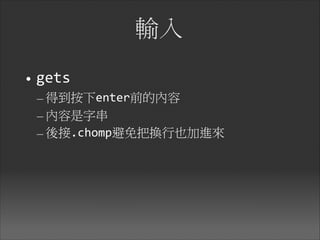
puts 'Hello there,and what's your name?'
name = gets.chomp
puts 'Your name is ' + name + '? What a nice
name!'
puts 'Pleased to meet you, ' + name + '. :)'
CASE
aaa = [1,'abc', 1.3]
p aaa
printf('你要確認哪⼀一個?')
idx = gets.to_i
case aaa[idx]
when String
puts "這是⼀一個字串"
when Integer
puts "這是⼀一個整數"
when Float
puts "這是⼀一個浮點數"
when Numeric
puts '這是⼀一個數字'
else
puts "這是其它類型的物件"
end
47.
三元運算子
EXPRESSION
?
(True
Condition):(False
Condition)
a = 10; b = 100
a > b ? ("#{a} > #{b}"):("#{a} < #{b}") #=> "10 <
100"
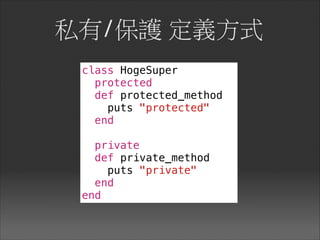
私有/保護 定義方式
class Hoge< HogeSuper
def hoge
protected_method # OK
private_method # OK
a = Hoge.new
a.protected_method # OK
a.private_method # Error
end
end
Hoge.new.hoge
繼承類別
class Vehicle
attr_accessor :tires
end
classCar < Vehicle
def initialize(name)
@tires = []
4.times{@tires << Tire.new}
end
end
class Motorcycle < Vehicle
def initialize(name)
@tires = []
2.times{@tires << Tire.new}
end
end
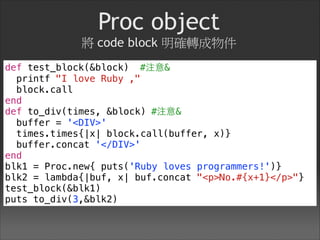
Yield and Method
在函式中使用yield 來執行 code block
def test_block
puts "I love Ruby ,"
yield
end
test_block{ puts 'Ruby loves
programmers!'}
#顯⽰示
I love Ruby ,
Ruby loves programmers!
92.
Yield and Method
在函式中使用yield 來執行 code block
def to_div(times)
buffer = '<DIV>'
times.times{|x| yield(buffer, x)}
buffer.concat '</DIV>'
end
divhtml = to_div(3) do |buf, x|
buf.concat "<p>No.#{x+1}</p>"
end
puts divhtml
#
<DIV><p>No.1</p><p>No.2</p><p>No.3</p></DIV>
Module for Namespace
moduleForum
class Member
#類別全名為 Forum::Member
....
end
class Topic
#Forum::Topic
end
end
101.
Module for Mix-in
多重繼承之實現
moduleShareMod
def subject
...
end
end
class Forum
include ShareMod
end
class SubForum
include ShareMod
end
#Foum和SubForum都會有subject的instance method
define_method
class Movie
def initialize(id,name)
@id = id;@name = name
end
def movie_file(quality)
"/movies/#{quality}/#{@id}.mp4"
end
end
a = Movie.new(123,'阿凡達')
puts a.movie_file(:hd) #/movies/hd/123.mp4
puts a.movie_file(:sd) #/movies/sd/123.mp4
106.
class Movie
QualityNames =[:fullhd, :hd, :sd]
#定義 fullhd_movie_file, hd_movie_file,
sd_movie_file
#三個⽅方法
QualityNames.each do |qt|
define_method "#{qt.to_s}_movie_file".to_sym
do
"/movies/#{qt.to_s}/#{@id}.mp4"
end
end
end
a = Movie.new(123,'阿凡達')
puts a.hd_movie_file #/movies/hd/123.mp4
puts a.sd_movie_file #/movies/sd/123.mp4
107.
Domain-Specific Language
領域特定語言
Class MyApp< Sinatra::Base
get '/books/*.*' do
# matches /books/ruby-guide.html
end
get '/rooms/:id/index.html' do
# matches '/rooms/123/index.html
end
end
108.
Method Missing
class Car
attr_accessor:wheels
def initialize
@wheels = []
4.times{@wheels << Wheel.new(30)}
end
def method_missing(mname, *args)
if mname.to_s =~ /wheel_(d)/
return @wheels[$1.to_i]
end
end
end
my_car = Car.new
p my_car.wheel_1 #<Wheel:0x8f6dea4 @radius=30>











![陣列 Array
[1,2,3,4]
[1,'abc',false,[nil,nil]] #多維陣列
[1,2,3,4].reverse # [4, 3, 2, 1]
[1,'abc',false,[nil,nil]].size # 4
[1,'abc',false,[nil,nil]].flatten # [1,
"abc", false, nil, nil]](https://image.slidesharecdn.com/20140329-140328212158-phpapp02/85/20140329-31-320.jpg)
![索引操作
• [n]
取得第n個
• [n..m]
取得第n至m個
• [n...m]
取得n至m-‐1個
• [n,len]取得n開始的len個](https://image.slidesharecdn.com/20140329-140328212158-phpapp02/85/20140329-32-320.jpg)
![索引操作
arr = [1,2,3,4,5,6,7,8,9]
p arr[2..3] #[3, 4]
p arr[2...4] #[3, 4]
p arr[2,2] #[3, 4]](https://image.slidesharecdn.com/20140329-140328212158-phpapp02/85/20140329-33-320.jpg)
![陣列相加
[1,2,3] + [4,5,6] # [1, 2, 3, 4, 5, 6]
[1,2,3].concat [4,5,6] # [1, 2, 3, 4, 5, 6]](https://image.slidesharecdn.com/20140329-140328212158-phpapp02/85/20140329-34-320.jpg)
![更多陣列函式(1)
ossf=['whoswho','openfoundry','org']
ossf << 'tw'
# ["whoswho", "openfoundry", "org", "tw"]
ossf.push 'www2'
# ["whoswho", "openfoundry", "org", "tw", "www2"]
ossf.unshift 'www2'
# ["www2", "whoswho", "openfoundry", "org", "tw",
"www2"](https://image.slidesharecdn.com/20140329-140328212158-phpapp02/85/20140329-35-320.jpg)
![更多陣列函式
ossf.pop #返回從後⾯面取出的值, 但陣列本⾝身已被改變
#= ["www2", "whoswho", "openfoundry", "org",
"tw"]
ossf.shift ##返回從前⾯面取出的值, 但陣列本⾝身已被改變
#= ["whoswho", "openfoundry", "org", "tw"]](https://image.slidesharecdn.com/20140329-140328212158-phpapp02/85/20140329-36-320.jpg)
![字串陣列共通的方法
• 操作索引
– [n]、[m..m]、[n,len]等
• Enumerable類方法
– each、map等
• 連接、逆轉相關方法
– reverse、concat、delete](https://image.slidesharecdn.com/20140329-140328212158-phpapp02/85/20140329-37-320.jpg)
![取得字串的字元碼
'Abcde123HG'.bytes.to_a
=> [65, 98, 99, 100, 101, 49, 50, 51, 72, 71]](https://image.slidesharecdn.com/20140329-140328212158-phpapp02/85/20140329-38-320.jpg)
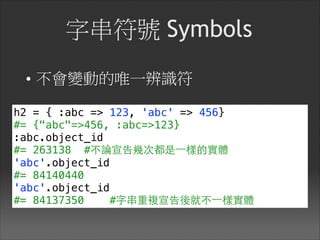
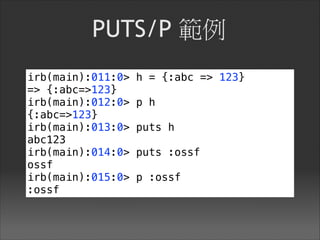
![雜湊 Hash
h = {:abc => 123, 'def' => 456}
#= {"def"=>456, :abc=>123}
h[:abc]
#= 123
h['def']
#= 456](https://image.slidesharecdn.com/20140329-140328212158-phpapp02/85/20140329-39-320.jpg)


![CASE
aaa = [1 ,'abc', 1.3]
p aaa
printf('你要確認哪⼀一個?')
idx = gets.to_i
case aaa[idx]
when String
puts "這是⼀一個字串"
when Integer
puts "這是⼀一個整數"
when Float
puts "這是⼀一個浮點數"
when Numeric
puts '這是⼀一個數字'
else
puts "這是其它類型的物件"
end](https://image.slidesharecdn.com/20140329-140328212158-phpapp02/85/20140329-46-320.jpg)


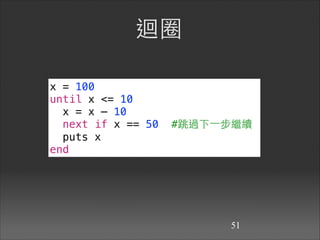
![迴圈
!52
abc = [1,2,3]
loop do
abc.pop
p abc
break if abc.empty? #跳出
end](https://image.slidesharecdn.com/20140329-140328212158-phpapp02/85/20140329-52-320.jpg)



![正規表示式
phone = "002-2882-5252"
if phone =~ /(d+)-(d+)-(d+)/
area = $1
first = $2
second = $3
end
p [area, first, second]](https://image.slidesharecdn.com/20140329-140328212158-phpapp02/85/20140329-57-320.jpg)




![? 與 ! 的慣例
• 函式定義以?結尾者
– 表示回傳值為boolean
• 函式定義以!結尾者
– 表示會改變接收者本身
irb(main):001:0> [1,2,3,4].empty?
=> false
irb(main):002:0> [1,2,3,4,[5,6]].flatten!
=> [1, 2, 3, 4, 5, 6]](https://image.slidesharecdn.com/20140329-140328212158-phpapp02/85/20140329-64-320.jpg)





![繼承類別
class Vehicle
attr_accessor :tires
end
class Car < Vehicle
def initialize(name)
@tires = []
4.times{@tires << Tire.new}
end
end
class Motorcycle < Vehicle
def initialize(name)
@tires = []
2.times{@tires << Tire.new}
end
end](https://image.slidesharecdn.com/20140329-140328212158-phpapp02/85/20140329-75-320.jpg)

![走訪迴圈
langs = ['VB', 'C#', 'C', 'JavaScript']
langs.each do |lang|
puts "我會 #{lang}"
end
輸出:
#我會 VB
#我會 C#
#我會 C
#我會 JavaScript](https://image.slidesharecdn.com/20140329-140328212158-phpapp02/85/20140329-77-320.jpg)


![Code block
10.times{|x| puts x} #輸出0到9
#
(1..9).each{|x| puts x} #1到9
#
(1...9).each{|x| puts x} #1到8
#
['ggg', 123, Time.now].each_with_index
do |x, i|
puts "第#{i+1}個元素的類別
是:#{x.class.to_s}"
end
#第1個元素的類別是:String
#第2個元素的類別是:Fixnum
#第3個元素的類別是:Time](https://image.slidesharecdn.com/20140329-140328212158-phpapp02/85/20140329-80-320.jpg)
![進階Code Block
arr = [1,2,3,4,5,6]
new_arr = arr.map{|a| a+10}
#=> 造出新陣列 [11, 12, 13, 14, 15, 16]](https://image.slidesharecdn.com/20140329-140328212158-phpapp02/85/20140329-81-320.jpg)
![Enumerator
arr = [1,2,3,4,5,6]
arr.select{|a| a > 3}
#=> 只挑選⼤大於3者 [4, 5, 6]](https://image.slidesharecdn.com/20140329-140328212158-phpapp02/85/20140329-82-320.jpg)
![Enumerator
arr = [1,2,3,4,5,6]
arr.reject{|a| a>3}
#=> 和select相反](https://image.slidesharecdn.com/20140329-140328212158-phpapp02/85/20140329-83-320.jpg)
![Enumerator
[4,5,1,2,3].sort{|a, b| a <=> b} #=> 基
本排序](https://image.slidesharecdn.com/20140329-140328212158-phpapp02/85/20140329-84-320.jpg)
![Enumerator
arr1 =
['abc','whoswho.openfoundry.org','OSSF
']
arr1.sort_by{|w| w.size} #⽤用字數排序
arr1.sort{|a,b| a.size <=> b.size } #
和上⾯面相同](https://image.slidesharecdn.com/20140329-140328212158-phpapp02/85/20140329-85-320.jpg)
![Enumerator
arr2 = [5,10,15,20,25]
arr2.inject{|sum, x| sum += x } #計算總
合
=> 75](https://image.slidesharecdn.com/20140329-140328212158-phpapp02/85/20140329-86-320.jpg)


![練習3
[3.33, 4.5, 5.10].inject(0){|sum, x|
sum = sum + x.round } #=> 13](https://image.slidesharecdn.com/20140329-140328212158-phpapp02/85/20140329-89-320.jpg)
![練習
1. 請定義⼀一個Hash像這樣
• wday[:sunday] = '星期⽇日'
• wday[:monday] = ‘星期⼀一'
2. 將這個Hash如下印出
• sunday 是 星期⽇日
• monday 是 星期⼀一](https://image.slidesharecdn.com/20140329-140328212158-phpapp02/85/20140329-90-320.jpg)





![Module for Singleton Class
module HtmlHelper
HTML_ESCAPE = { '&' => '&', '>' =>
'>', '<' => '<', '"' => '"' }
def self.h(s)
s.to_s.gsub(/[&"><]/){ |special|
HTML_ESCAPE[special] }
end
end
puts HtmlHelper.h('<img src="abc.gif"/>我是圖⽚片')
#<img src="abc.gif"/>我是圖⽚片](https://image.slidesharecdn.com/20140329-140328212158-phpapp02/85/20140329-99-320.jpg)


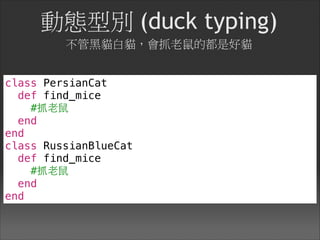
![動態型別 (duck typing)
不論出身正確(參數型別),只論達成目標(方法)
def fetch_and_reverse(arr, idx)
return arr[idx].reverse if arr[idx] &&
arr[idx].respond_to?(:reverse)
end
aa = ['abc', 'RyudoAwaru', 'Linux']
ha = {0 => 'abc', 1 => 'Ubuntu'}
hb = {:first => 'RedHat', :second => 'Suse'}
p fetch_and_reverse(aa, 1) #"urawAoduyR"
p fetch_and_reverse(ha, 0) #"urawAoduyR"
p fetch_and_reverse(hb, :second) #"esuS"](https://image.slidesharecdn.com/20140329-140328212158-phpapp02/85/20140329-103-320.jpg)


![class Movie
QualityNames = [:fullhd, :hd, :sd]
#定義 fullhd_movie_file, hd_movie_file,
sd_movie_file
#三個⽅方法
QualityNames.each do |qt|
define_method "#{qt.to_s}_movie_file".to_sym
do
"/movies/#{qt.to_s}/#{@id}.mp4"
end
end
end
a = Movie.new(123,'阿凡達')
puts a.hd_movie_file #/movies/hd/123.mp4
puts a.sd_movie_file #/movies/sd/123.mp4](https://image.slidesharecdn.com/20140329-140328212158-phpapp02/85/20140329-106-320.jpg)

![Method Missing
class Car
attr_accessor :wheels
def initialize
@wheels = []
4.times{@wheels << Wheel.new(30)}
end
def method_missing(mname, *args)
if mname.to_s =~ /wheel_(d)/
return @wheels[$1.to_i]
end
end
end
my_car = Car.new
p my_car.wheel_1 #<Wheel:0x8f6dea4 @radius=30>](https://image.slidesharecdn.com/20140329-140328212158-phpapp02/85/20140329-108-320.jpg)







![CSV檔案讀取
require 'csv'
arr = []
CSV.parse(File.read('fakedata-dup.csv'),
headers: :first_row).each do |row|
arr << row.to_hash
end](https://image.slidesharecdn.com/20140329-140328212158-phpapp02/85/20140329-120-320.jpg)


