Iola Goulton
 Bathrooms 
 Overheads available www.christianediting.co.nz 
o Sign up for my newsletter 
 Questions 
o Keep for end
Introduction 
What is Christian Fiction? 
Types of Publishing 
Christian Publishers 
Australasian Publishers 
Questions
 Promotes a Christian world view 
o Not a post-modern view 
• God is not dead 
• We are not a product of chance 
• Reason alone will not build a better society 
• There is the hope of eternal life 
• All paths do not lead to God 
o “Anything a Christian writes must reflect the truth of God’s 
account. If as a Christian we don’t write from a biblical worldview, 
we’re not portraying reality as it is.” 
- Ann Tatlock
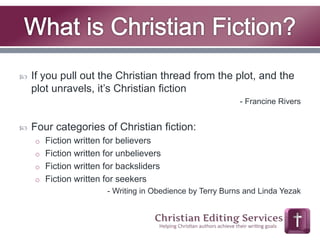
 If you pull out the Christian thread from the plot, and the 
plot unravels, it’s Christian fiction 
- Francine Rivers 
 Four categories of Christian fiction: 
o Fiction written for believers 
o Fiction written for unbelievers 
o Fiction written for backsliders 
o Fiction written for seekers 
- Writing in Obedience by Terry Burns and Linda Yezak
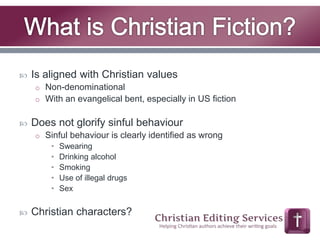
 Is aligned with Christian values 
o Non-denominational 
o With an evangelical bent, especially in US fiction 
 Does not glorify sinful behaviour 
o Sinful behaviour is clearly identified as wrong 
• Swearing 
• Drinking alcohol 
• Smoking 
• Use of illegal drugs 
• Sex 
 Christian characters?
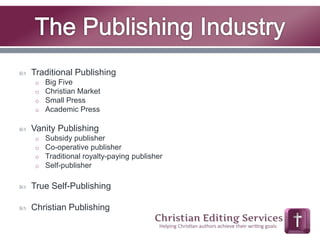
 Traditional Publishing 
o Big Five 
o Christian Market 
o Small Press 
o Academic Press 
 Vanity Publishing 
o Subsidy publisher 
o Co-operative publisher 
o Traditional royalty-paying publisher 
o Self-publisher 
 True Self-Publishing 
 Christian Publishing
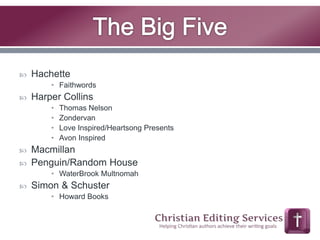
 Hachette 
• Faithwords 
 Harper Collins 
• Thomas Nelson 
• Zondervan 
• Love Inspired/Heartsong Presents 
• Avon Inspired 
 Macmillan 
 Penguin/Random House 
• WaterBrook Multnomah 
 Simon & Schuster 
• Howard Books
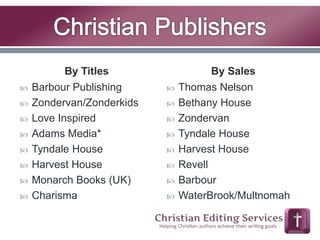
By Titles 
 Barbour Publishing 
 Zondervan/Zonderkids 
 Love Inspired 
 Adams Media* 
 Tyndale House 
 Harvest House 
 Monarch Books (UK) 
 Charisma 
By Sales 
 Thomas Nelson 
 Bethany House 
 Zondervan 
 Tyndale House 
 Harvest House 
 Revell 
 Barbour 
 WaterBrook/Multnomah
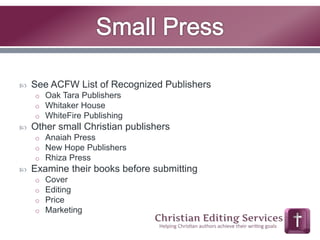
 See ACFW List of Recognized Publishers 
o Oak Tara Publishers 
o Whitaker House 
o WhiteFire Publishing 
 Other small Christian publishers 
o Anaiah Press 
o New Hope Publishers 
o Rhiza Press 
 Examine their books before submitting 
o Cover 
o Editing 
o Price 
o Marketing
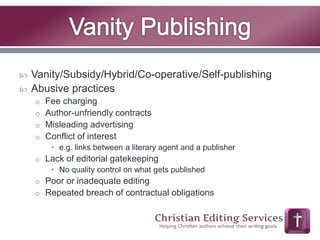
 Vanity/Subsidy/Hybrid/Co-operative/Self-publishing 
 Abusive practices 
o Fee charging 
o Author-unfriendly contracts 
o Misleading advertising 
o Conflict of interest 
• e.g. links between a literary agent and a publisher 
o Lack of editorial gatekeeping 
• No quality control on what gets published 
o Poor or inadequate editing 
o Repeated breach of contractual obligations
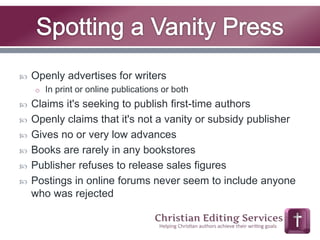
 Openly advertises for writers 
o In print or online publications or both 
 Claims it's seeking to publish first-time authors 
 Openly claims that it's not a vanity or subsidy publisher 
 Gives no or very low advances 
 Books are rarely in any bookstores 
 Publisher refuses to release sales figures 
 Postings in online forums never seem to include anyone 
who was rejected
 Vanity publishers targeting the Christian market 
o America Star Books (previously PublishAmerica) 
o Christian Writers Guild Publishing 
o Deep River Books 
o Lulu (managed by Author Solutions) 
o Tate Publishing 
o WestBow (managed by Author Solutions) 
o Xlibris (An Author Solutions brand) 
o Xulon Press
 Author holds all rights 
 Author organises/undertakes all aspects of publishing 
o Back cover copy 
o Cover design 
o Ebook production 
o Editing 
o Printing 
o Promotion 
o Proofreading 
o Social networking 
o Website 
 Author arranges distribution and distributor takes a 
commission 
o Amazon, iBooks, Smashwords etc
Printing 
 POD 
o CreateSpace 
o Lightning Source 
 Offset 
o Cheaper per copy 
o Up-front investment 
Ebook 
 Amazon 
 iBook store 
 Other stores either 
individually or via 
Smashwords 
 Distribution fee 
o 30% for books $2.99-$9.99
 Acorn Publishing 
 Breath of Fresh Air Press 
 Rhiza Publishing
 Books 
o How to Market A Book by Joanna Penn 
o Let's Get Digital by David Gaughran 
o Let’s Get Visible by David Gaughran 
o The Fine Art of Self-Publishing by Mark Levine 
o Discoverability by Kristine Kathryn Rusch 
o Writing in Obedience by Terry Burns and Linda Yezak 
 Blogs 
o The Passive Voice 
o Newbie’s Guide to Self-Publishing 
o Helping Writers Become Authors 
o Christian Editing Services
Questions
I specialise in adult and young adult Christian fiction, and can be contacted at 
igoulton@christianediting.co.nz. You can also find me at: 
http://www.facebook.com/#!/ChristianReads and http://www.facebook.com/#!/christianediting 
www.christianreads.blogspot.com and www.christianediting.co.nz 
I offer the following services: 
Manuscript Assessment: 
A manuscript assessment is an appraisal and critique of your novel, providing feedback on the 
strengths and weaknesses of your plot, scenes, characters, dialogue, interior monologue, 
narrative, point of view, style, pace, language, Christian themes and overall consistency. This 
will highlight your strengths and provide you with specific areas on which to focus the revision 
of your manuscript. This is most appropriate when you have finished revising the first draft. 
While a manuscript assessment does not include line-by-line copy editing or proofreading, I will 
provide general feedback to help you decide whether your revised novel will need further 
content editing or copy editing before you reach the proofreading stage.
Copy Editing: 
Copy editing includes all aspects of proofreading, plus a line by line edit to look at sentence, 
paragraph and chapter length; identify repetition of words or ideas; ensure consistent plot, 
style, tense and point of view; ensure language and tone are consistent with the location and 
time period of the story; and undertake basic fact checking against reputable internet sites. 
While copy editing does not include rewriting, I do suggest alternatives for words used out of 
context, and revisions for sentences or paragraphs that are overly long. Please note that copy 
editing does not include formatting or coding manuscripts for traditional or electronic 
publication. 
Proofreading: 
Proofreading is the final step in preparing your novel before submission to a publisher or agent. 
This assumes the manuscript has already been extensively revised and edited, and involves 
checking spelling, grammar, punctuation, capitalisation, missing or incorrect words and other 
typographical errors. If my initial read-through shows that the manuscript needs more 
assistance than basic proofreading, I will discuss this with you before I begin work. 
Editing and proofreading are undertaken in Microsoft Word using the Track Changes and 
Comments features.

2014 cwc genre and publishing final

  • 1.
  • 2.
     Bathrooms Overheads available www.christianediting.co.nz o Sign up for my newsletter  Questions o Keep for end
  • 3.
    Introduction What isChristian Fiction? Types of Publishing Christian Publishers Australasian Publishers Questions
  • 4.
     Promotes aChristian world view o Not a post-modern view • God is not dead • We are not a product of chance • Reason alone will not build a better society • There is the hope of eternal life • All paths do not lead to God o “Anything a Christian writes must reflect the truth of God’s account. If as a Christian we don’t write from a biblical worldview, we’re not portraying reality as it is.” - Ann Tatlock
  • 5.
     If youpull out the Christian thread from the plot, and the plot unravels, it’s Christian fiction - Francine Rivers  Four categories of Christian fiction: o Fiction written for believers o Fiction written for unbelievers o Fiction written for backsliders o Fiction written for seekers - Writing in Obedience by Terry Burns and Linda Yezak
  • 6.
     Is alignedwith Christian values o Non-denominational o With an evangelical bent, especially in US fiction  Does not glorify sinful behaviour o Sinful behaviour is clearly identified as wrong • Swearing • Drinking alcohol • Smoking • Use of illegal drugs • Sex  Christian characters?
  • 7.
     Traditional Publishing o Big Five o Christian Market o Small Press o Academic Press  Vanity Publishing o Subsidy publisher o Co-operative publisher o Traditional royalty-paying publisher o Self-publisher  True Self-Publishing  Christian Publishing
  • 8.
     Hachette •Faithwords  Harper Collins • Thomas Nelson • Zondervan • Love Inspired/Heartsong Presents • Avon Inspired  Macmillan  Penguin/Random House • WaterBrook Multnomah  Simon & Schuster • Howard Books
  • 9.
    By Titles Barbour Publishing  Zondervan/Zonderkids  Love Inspired  Adams Media*  Tyndale House  Harvest House  Monarch Books (UK)  Charisma By Sales  Thomas Nelson  Bethany House  Zondervan  Tyndale House  Harvest House  Revell  Barbour  WaterBrook/Multnomah
  • 10.
     See ACFWList of Recognized Publishers o Oak Tara Publishers o Whitaker House o WhiteFire Publishing  Other small Christian publishers o Anaiah Press o New Hope Publishers o Rhiza Press  Examine their books before submitting o Cover o Editing o Price o Marketing
  • 11.
     Vanity/Subsidy/Hybrid/Co-operative/Self-publishing Abusive practices o Fee charging o Author-unfriendly contracts o Misleading advertising o Conflict of interest • e.g. links between a literary agent and a publisher o Lack of editorial gatekeeping • No quality control on what gets published o Poor or inadequate editing o Repeated breach of contractual obligations
  • 12.
     Openly advertisesfor writers o In print or online publications or both  Claims it's seeking to publish first-time authors  Openly claims that it's not a vanity or subsidy publisher  Gives no or very low advances  Books are rarely in any bookstores  Publisher refuses to release sales figures  Postings in online forums never seem to include anyone who was rejected
  • 13.
     Vanity publisherstargeting the Christian market o America Star Books (previously PublishAmerica) o Christian Writers Guild Publishing o Deep River Books o Lulu (managed by Author Solutions) o Tate Publishing o WestBow (managed by Author Solutions) o Xlibris (An Author Solutions brand) o Xulon Press
  • 14.
     Author holdsall rights  Author organises/undertakes all aspects of publishing o Back cover copy o Cover design o Ebook production o Editing o Printing o Promotion o Proofreading o Social networking o Website  Author arranges distribution and distributor takes a commission o Amazon, iBooks, Smashwords etc
  • 15.
    Printing  POD o CreateSpace o Lightning Source  Offset o Cheaper per copy o Up-front investment Ebook  Amazon  iBook store  Other stores either individually or via Smashwords  Distribution fee o 30% for books $2.99-$9.99
  • 16.
     Acorn Publishing  Breath of Fresh Air Press  Rhiza Publishing
  • 17.
     Books oHow to Market A Book by Joanna Penn o Let's Get Digital by David Gaughran o Let’s Get Visible by David Gaughran o The Fine Art of Self-Publishing by Mark Levine o Discoverability by Kristine Kathryn Rusch o Writing in Obedience by Terry Burns and Linda Yezak  Blogs o The Passive Voice o Newbie’s Guide to Self-Publishing o Helping Writers Become Authors o Christian Editing Services
  • 18.
  • 19.
    I specialise inadult and young adult Christian fiction, and can be contacted at igoulton@christianediting.co.nz. You can also find me at: http://www.facebook.com/#!/ChristianReads and http://www.facebook.com/#!/christianediting www.christianreads.blogspot.com and www.christianediting.co.nz I offer the following services: Manuscript Assessment: A manuscript assessment is an appraisal and critique of your novel, providing feedback on the strengths and weaknesses of your plot, scenes, characters, dialogue, interior monologue, narrative, point of view, style, pace, language, Christian themes and overall consistency. This will highlight your strengths and provide you with specific areas on which to focus the revision of your manuscript. This is most appropriate when you have finished revising the first draft. While a manuscript assessment does not include line-by-line copy editing or proofreading, I will provide general feedback to help you decide whether your revised novel will need further content editing or copy editing before you reach the proofreading stage.
  • 20.
    Copy Editing: Copyediting includes all aspects of proofreading, plus a line by line edit to look at sentence, paragraph and chapter length; identify repetition of words or ideas; ensure consistent plot, style, tense and point of view; ensure language and tone are consistent with the location and time period of the story; and undertake basic fact checking against reputable internet sites. While copy editing does not include rewriting, I do suggest alternatives for words used out of context, and revisions for sentences or paragraphs that are overly long. Please note that copy editing does not include formatting or coding manuscripts for traditional or electronic publication. Proofreading: Proofreading is the final step in preparing your novel before submission to a publisher or agent. This assumes the manuscript has already been extensively revised and edited, and involves checking spelling, grammar, punctuation, capitalisation, missing or incorrect words and other typographical errors. If my initial read-through shows that the manuscript needs more assistance than basic proofreading, I will discuss this with you before I begin work. Editing and proofreading are undertaken in Microsoft Word using the Track Changes and Comments features.

Editor's Notes

  • #3 We have a lot to get through, so please try and keep questions to the end.
  • #5 Christian fiction isn’t actually defined anywhere. But organisations like the ECPA and most Christian publishers define it as ‘promoting a Christian world view’. But what does that actually mean? For a good summary of post-modernism, see Writing to a Post-Christian World: Top Ways to Battle Revisionism, Relativism and the Muddled Thinking of Postmodernism with the Written Word by Ann Tatlock (Lighthouse Publishing, 2012). Available at Amazon.com, USD 2.99. Reading this description of post-modernism, it seems to me that post-modern thinking is simply another religion of self.
  • #7 Swearing: Conservatives say absolutely no swearing. Some might permit alternatives (Jannette Oke used ‘dad-blame’ in Love Comes Softly). My Stubborn Heart by Becky Wade caused controversy because of the use of the words ‘boobs’, ‘balls’, ‘pissed’ and ‘crap’ (see http://tinyurl.com/8dmezyt). Thoughts? The surprise here was that the book is from Bethany House – smaller publishers can be a bit more lenient in this area (e.g. ‘crap’ in Even Before novels). The irony is that using the word ‘crap’ will get your post deleted from Amazon. At the other end of the spectrum, there is a discussion on Amazon “Should Christian Authors use the F word?” (http://tinyurl.com/96oouxc). Personally, I think not. Drinking: Most Christian novels shy away from alcohol consumption. It can be done, but, like with swearing, it needs to be done carefully. Smoking: pretty out of fashion in general society, so less of an issue. Drug Use: Some Christian novels (especially in romantic suspense) feature drug dealers or drug users, but I’ve yet to read a scene where characters were shooting up. I think this is best dealt with off-camera. Sex: Well, those historicals are full of children, so we know they did it! But off-camera. We don’t want the details in Christian fiction (but we do want lots of romantic tension). And we want Male/Female, not slash (m/m, m/m/f etc).
  • #8 Exercise on whiteboard: what publishers have they heard of? Divide into (unlabelled) columns Big 5 Other, need an agent No agent but ACFW Recognized Not ACFW Recognised Vanity Self The 'Big Five’ doesn’t necessarily represent the top publishers in each genre
  • #9 Traditional publishing: when they organise editing, covers etc, and they pay you (advance, royalties or both). You NEVER pay them. Hachette: http://www.hachettebookgroup.com. Global Media group, subsidiary of Hachette Livre, who own Time Warner). Publish JK Rowling and Joel Osteen. HarperCollins: http://harpercollins.com/footer/companyProfile.aspx. Subsidiary of News Corporation. Publishes the NIV Bible, Sarah Palin and Terry Pratchett. Macmillan: privately owned by Georg von Holtzbrinck GmbH Publishing Group (Germany). Focus on academic, educational fiction and non-fiction. Penguin: http://www.penguin.com. Owned by Pearson (publishes education materials and the Financial Times) Random House: http://www.randomhouse.com/ Owned by Bertelsmann AG, a global media company. Includes Crown Publishing and Knopf Doubleday. Simon & Schuster:http://www.simonandschuster.com/ Owned by CBS Corporation. Authors include Stephen King, Jodi Picoult, Laura Bush and Al Gore.
  • #10 Note that most of these publishers aren’t owned by Christians, but are publishing titles sold by the CBA. Information from 2012 Christian Writer’s Guide. The ‘Christian Publishers’ is based on the number of titles published each year, whereas bestsellers is based on the number of fiction titles the publisher had on the Christian Top 50 list between May 2009 and April 2010 . Note that Adams Media is a general publisher with some inspirational works, so most of those titles won’t be Christian. Monarch is the biggest UK publisher of ‘books inspired by the Christian faith’. Love Inspired now includes Heartsong Presents, so may have overtaken Zondervan and Barbour
  • #11 ACFW Recognized Publishers List Note that to get on the ACFW list, publishers have to have applied, been publishing for more than a year, and have at least two books which have sold more than $5,000 in copies. Therefore, Rhiza isn’t on the list (yet) although Even Before is (still). The best advice I can give in choosing a publisher is to do your research. Don’t even submit to a publisher if you aren’t 100% confident they are producing the quality of book you would buy yourself.
  • #12 Money flows from the publisher to the author. Not the other way around. May call themselves by any of these names. But true self-publishing is when it is your name on the cover as the publisher. But not all vanity Source: http://accrispin.blogspot.co.nz/2007/02/happy-valentines-day-from-writer-beware.html Unfortunately, you are not going to find out if they breach contractual obligations until they do it to you… unless you do your homework. He who owns the rights pays for the book. If a publisher has asked you to sign a contract giving them the rights to publish your book, you should not be paying them. That would be like expecting McDonalds to pay you to eat their food. I recently read a Tate Publishing book for review. It was, without a doubt, the worst book I’ve ever finished, and showed no signs of being edited. It head-hopped (at one point, it managed three POV’s in four sentences), it used bizarre speaker attributions (“Patrick expressed to her in a sincere manner”), it was repetitive, the characters were bland, it had moving body parts and clumsy sentence structures (“With eyes wandering about, Rylee noticed…” and It was rare that the signal where he was located transported to the use of their cell phones…”), and was tell, not show. I never published the review (I never heard back from the author after I emailed her to say that the review wasn’t going to be glowing, as she had hoped). The author almost certainly paid USD 3995 for Tate to ‘market’ her book. Reading the book, there is no evidence that Tate offered any editorial gatekeeping or editing, and their advertising is misleading: Their website claims they “stay ahead of the curve by making available many options for selling and promoting your work”. I have no idea what you get for $3995, but it could be as little as 20 hours of PR time … which might get you 20 emails; Their website says “Tate Publishing does not charge a fee for publishing and absorbs all the cost of production and distribution of a book. However, there are requirements regarding professional marketing and publicist representation the author is required to provide.”… directly after they say that they will provide authors with a full-time publicist. It appears that TV ads, book trailers and websites are extra (“the option to…”). Tate therefore score 4/7 on the above list – Writer Beware® say that a score of 2 or more indicates a publishing house they are likely to receive complaints about. A further example lack of editorial gatekeeping for a September 2012 Tate release, The Mormon Woman by John J Hart http://www.amazon.com/Mormon-Woman-John-J-Hart/dp/162024117X/ref=sr_1_246?s=books&ie=UTF8&qid=1346230311&sr=1-246 'Joseph Smith was a prophet of God, the Book of Mormon is the inspired word of God, and the Mormon Church is the only true church on the face of the earth. And I say this in the name of Jesus Christ. That's my witness and testimony to you.‘ Is this an appropriate book description for a ‘Christian’ novel?
  • #14 All these publishers have one thing in common: they want your money. If they are begging to publish your book, cold hard truth is that they are a vanity publisher (as Big 5 work exclusively through agents, and small presses can’t afford to publish everything). Some charge you for publishing (WestBow) Some charge you for marketing (Tate – and part of this includes an author website you don’t actually own, which goes against all marketing advice) Some require you to purchase books (Deep River, at an estimated cost of $10,000) Some publish 'free’, but try and sell you additional services (like removing the errors in your manuscript … that weren't in the file you sent but are in the book)
  • #15 This is where things can get messy. Small presses refer to themselves independent, because they are independent of the Big Five. And a lot of self-published authors call themselves Indie. So make sure you understand the difference. You will also see a lot of chatter against self-publishing – usually from literary agents who earn their money selling titles to the Big Five or specialist small presses. Often they are talking about PublishAmerica-style publishing. As we’ve seen, that’s vanity publishing. Self-publishing is, literally, doing it yourself or organising and contracting for someone to do part of it for you. (The irony is that some of these agents have actually self-published themselves, including Rachelle Gardner) A self-publisher can – and should - subcontract some of these services, especially cover design, editing and proofreading, and formatting, because these are things reviewers frequently criticise when reading self-published novels. But the author holds all the rights, and will make all the profit (or loss) on the book.