Switching channels
Global Powers of
Retailing 2012
Retail perspectives
from Deloitte.


The next evolution: Store 3.0™                                       Managing inflation risk in retail
Are retailers ready for the next generation?                         Leveraging advanced analytics to weather the stor


If your phone is equipped to do so, please scan here and see these
and other publications from Deloitte.


© 2012 Deloitte LLP. All rights reserved.

Member of Deloitte Touche Tohmatsu Limited
Contents
                                     Global economic outlook	                                   G4

                                     2012 global retail industry trends	                        G8

                                     Global Powers of Retailing Top 250 highlights	             G10

                                     Global Powers of Retailing geographical analysis	          G20

                                     Global Powers of Retailing product sector analysis	        G25

                                     Top 250 newcomers	                                         G28

                                     Accelerated organic growth, acquisitions fuel Fastest 50 	 G29

                                     Q ratio analysis of the Top 250	                           G32

                                     Study methodology and data sources	                        G34

                                     Consumer Business contacts 	                               G35


www.deloitte.com/consumerbusiness	                                               January 2012    G3
Global economic outlook
The economic situation for retailers
Deloitte Touche Tohmatsu Limited (DTTL), in conjunction with STORES Media, is
pleased to present the 15th annual Global Powers of Retailing. This report identifies
the 250 largest retailers around the world based on publicly available data for fiscal
2010 (encompassing companies’ fiscal years ended through June 2010). The report also
provides an outlook for the global economy, trends for retailers to consider in the
coming months, and an analysis of market capitalization in the retail industry.

The global economy is decelerating, with growth in 2012 likely to be      This is especially true in the United States and China. Hence, for
slower than was experienced in 2011 in many of the world’s leading        retailers targeting upscale consumers, the environment might not be
markets.                                                                  so bad. As for retailers targeting everyone else, the ability to offer low
                                                                          prices to uncertain consumers will be a clear competitive advantage.
In Europe, the crisis of the euro has led to the tightening of credit
markets. In an effort to rebuild investor confidence, governments         The most significant silver lining can be found on the long-term
across the continent are cutting spending and raising taxes, the net      horizon. Even though the economic environment in 2012 will be
effect of which is to weaken economies and, in the process, further       difficult, the long-term outlook for the global economy remains good.
undermine confidence. Meanwhile, the European Central Bank                Global growth in the coming decade is expected to be strong, with
engages in a relatively neutral monetary policy aimed at suppressing      particular strength coming from leading emerging markets other than
inflation. As of this writing, the risk remains that the Eurozone will    China. Of course China will grow, but it faces some headwinds, both
crumble, leading to an even worse economic downturn.                      demographic and structural. Other emerging markets like India, Brazil,
                                                                          Turkey, Indonesia, the Andean region of South America and much of
In the United States there are signs of accelerating economic activity,
                                                                          sub-Saharan Africa offer the possibility of stronger growth and new
yet the failure of the government to agree on a path toward fiscal
                                                                          opportunities for the world’s leading retailers.
rectitude has wreaked havoc with investor confidence, hurting equity
prices and employment creation. While the U.S. economy may                Let us now consider the outlook for the world’s leading retail
accelerate in 2012, it will probably not grow at a pace sufficient to     markets:
significantly reduce unemployment.
                                                                          Western Europe
The world’s second-largest economy, China, is slowing following a         It is difficult to provide a helpful roadmap to a situation that, as of Q4
tightening of monetary policy combined with the negative effects          2011, still seemed to be changing daily. So perhaps it is best to look
of slow growth in Europe and the United States. In addition, the          back at how it came to this.
remaining BRICs face slower growth resulting from the lagged effects
                                                                          The Eurozone project was intended to bind the economic and
of tight monetary policy and weak global growth.
                                                                          political fortunes of Europe’s economies in perpetuity, yet the
Only in Japan is economic growth in 2012 widely expected to exceed        architecture of this union was always lacking. Countries were required
that of 2011. The reason is that 2011 was so awful following the          to maintain fiscal discipline, but there was never a credible vehicle for
devastating earthquake and tsunami, and reconstruction expenditures       ensuring it. The first countries to violate the rules were Germany and
are likely to provide a temporary jolt to the Japanese economy.           France, and it is not surprising that others soon followed. Indeed, the
                                                                          existence of the euro enabled the countries of Southern Europe to
Retailers may find some silver linings in this otherwise cloudy
                                                                          borrow with abandon. Investors were happy to extend credit at low
environment, however. One positive effect of slower global growth
                                                                          interest rates with the expectation that bonds denominated in euros
will be continued dampening of commodity prices. For retailers, this
                                                                          were a safe asset.
means some improvement on the cost side of the ledger. Meanwhile,
a number of countries, including the United States, Japan, several        Still, the absence of fiscal rectitude alone was not the biggest
in Western Europe and many leading emerging markets, are seeing           problem. The biggest problem was that several Mediterranean
higher retail price inflation. Combined with stagnant input prices,       economies lost their competitiveness. Over the past decade, their
this suggests the possibility of improved profit margins, even in the     wages rose far faster than their productivity, with the result that it
context of slow top line growth.                                          became less feasible for them to generate the strong export revenues
                                                                          needed to service their external debts. Normally, a country with a
In many of the slowing markets, a disproportionate share of the
                                                                          competitiveness problem will devalue its currency.
growth of consumer income is accruing to the relatively affluent.

G4      January 2012 	                                                                                         www.deloitte.com/consumerbusiness
However, because these countries no longer have their own                   China’s officials have complained about the rapid expansion of U.S.
currencies, they cannot restore competitiveness unless they                 government debt. This reflects fear that the massive stock of foreign
dramatically accelerate productivity growth and/or cut wages – both         currency reserves held by China’s government could lose value. Less
tall orders.                                                                attention, however, has been paid to the big increase in overall debt
                                                                            in China itself. That is likely to change soon, given the fact that overall
When Greece was unable to roll over its considerable debts and the
                                                                            debt has nearly tripled in the past five years. Notably, a top Chinese
EU bailout was deemed insufficient to correct Europe’s ailments,
                                                                            official recently said that the debt of China’s local governments is “our
investors became fearful. Governments faced difficulty in rolling over
                                                                            version of the U.S. subprime crisis.” The $1.7 trillion in debts issued by
debts, and banks that held such debts faced problems raising funds.
                                                                            local governments to fund infrastructure has been a concern for some
Risk spreads increased, credit market activity declined and Europe
                                                                            time, but officials have downplayed the danger until now. The fear is
faced a new recession. There are three possible scenarios as to what
                                                                            that multiple defaults without a bailout from the central government
might happen next.
                                                                            could damage the health of China’s banks. How did this come about?
In the first, Europe agrees to engage in greater integration in order
                                                                            When the global economic crisis began in 2008 and China’s exports
to avoid disintegration. This could entail using the European Central
                                                                            suddenly dropped, the government implemented a vast stimulus
Bank (ECB) to backstop sovereign debtors and create a fiscal union
                                                                            program to boost domestic demand and offset the decline in
with large transfers of resources from richer to poorer nations within
                                                                            exports. Part of this involved extending credit to provincial and local
the union. This would enable the Eurozone to succeed and ultimately
                                                                            governments to engage in infrastructure development. In the short
prosper. The problem with this scenario is that it requires individual
                                                                            run, this policy was successful in boosting growth and preventing
countries to give up sovereignty and abide by conditions set by the
                                                                            a general recession. The problem, however, is that many such
richer countries in the EU.
                                                                            investments have failed to generate adequate returns. The Chinese
The second scenario is that the Eurozone fails. While this could            government estimates that little more than one-quarter of local
happen, the short-term costs of disintegration would be catastrophic.       government investment has produced a return adequate to service
It can be argued that, in the long run, some of the troubled countries      the debts.
would be better off outside the Eurozone, but much of Europe would
                                                                            Local government borrowing is not the entire problem. During the
suffer grievously during the transition. The Mediterranean countries
                                                                            global crisis, the government injected capital into state-run banks
would face problems in gaining access to global credit markets,
                                                                            so that they could lend to state-run companies. The result was
while the northern economies would see their currencies rise rapidly,
                                                                            an investment boom, but too many of those investments are not
thereby hurting exports.
                                                                            producing an adequate return. As a result, investment in fixed assets
The third scenario, then, seems to be the most likely: Europe               surged, reaching almost 50 percent of GDP last year. Meanwhile,
manages to hold the Eurozone together but fails to take action that         consumer spending declined to about 35 percent of GDP. Now that
would guarantee its success. This could be called the “muddling             the Chinese economy is slowing, the risk exists that China’s debtors
along scenario” and would likely involve a prolonged period of slow         will soon face greater difficulties in servicing their debts.
economic growth, political turmoil and periodic crises.
                                                                            So is China at risk of its own financial crisis? The answer is yes and
What does this scenario mean for retailers? It means continued fiscal       no. There is a danger that a new round of defaults will damage the
contraction across Europe, in part through higher taxes, and tight          solvency of China’s state-run banking system, but it is likely that the
credit market conditions. Consumer spending would grow slowly, if           government would bail out such banks and, thereby, prevent a larger
at all. Consumers would be highly price sensitive and uncertain about       financial crisis.
the future. For retailers, it would mean a severe market share battle. It
                                                                            China does face a risk, however. Specifically, if the government were
would also means that, for retailers that are financially healthy, there
                                                                            compelled to bail out troubled financial institutions, it would probably
would be good reason to accelerate the process of globalization in
                                                                            not support continued lending for the purpose of poorly conceived
order to find growth outside of Europe.
                                                                            investments. Consequently, investment would likely fall considerably.
China                                                                       Given that investment is now close to 50 percent of GDP, such a
China’s economy is decelerating, the result of tighter monetary policy      fall could have serious consequences for GDP, absent an offsetting
in 2011 and declining export growth. In response, China’s central           increase in something else. What could that something else be?
bank has stopped tightening policy. Therefore, although China’s
                                                                            Exports are not likely to take up the slack. Instead, China will
economy will slow in 2012, it will not necessarily slow dramatically.
                                                                            look toward a boost in consumer spending to offset a decline in
On the other hand, it is notable that a senior Chinese official recently
                                                                            investment. Given that consumer spending is now only 35 percent
predicted that growth in 2012 would be below 9 percent -- the first
                                                                            of GDP, it would have to grow very rapidly to make a difference and
year since 2001 that it has done so. Interestingly, there is evidence
                                                                            avoid a significant economic slowdown.
that the economic slowdown is being experienced principally by small
to medium-sized private businesses (especially those that export) and
not by the large state-run enterprises that retain favorable access to
credit.


www.deloitte.com/consumerbusiness	                                                                                              January 2012        G5
There are, however, some positive signs concerning the prospect for            Consumers may feel a bit more confident because the overall
consumer spending. First, wages have been rising, adding to real               economy is showing signs of renewed (albeit modest) strength. In
disposable incomes. This reflects a shortage of labor, as demographic          the first half of 2011, economic growth was so anemic that many
trends limit labor force growth and internal migration slows.                  pundits worried that the United States was heading into a new
In addition, provincial and local governments have been increasing             recession. Today, fears of a double dip have abated somewhat as
their minimum wage.                                                            growth has accelerated. Industrial activity has been rising moderately,
                                                                               with particular focus on production of capital goods. In fact, business
Second, the government intends to have state-run companies pay
                                                                               investment, especially in equipment and software, has been quite
higher dividends to shareholders (mainly the government). This
                                                                               strong during the latter half of 2011.
money could be used to boost overall spending. Third, high inflation
might spur more spending by consumers. Fourth, the currency is                 In addition, exports have been strong. Although export growth has
gradually being allowed to rise in value. This reduces import prices           decelerated somewhat as the global economy has slowed, it remains
and helps to stimulate consumer spending.                                      strong and contributes substantially to overall GDP growth. This
                                                                               reflects the effects of a relatively weak dollar and the impact of a
On the other hand, the biggest negative for consumer spending
                                                                               decade of sizable productivity gains for the manufacturing sector.
is simple demographics. Due to the lagged effect of China’s one
child policy, the labor force is expected to grow much more slowly             Finally, recent growth has been almost entirely due to increased
in the coming decade than it did during the past 10 years. As such,            demand for goods and services. There has been little inventory
the prime consuming age cohort will barely grow while the elderly              accumulation, and inventories remain historically lean. This is good
population will grow rapidly.                                                  news, as it means that the increased output was entirely due to
                                                                               increased demand. It also bodes well for the future, as further
Finally, one side effect of China’s unbalanced economy is a sharp
                                                                               increases in demand will require more production rather than dipping
increase in income inequality. While incomes have increased
                                                                               into existing inventories.
overall, lower income cohorts have not seen significant increases
in purchasing power, especially as home prices have increased                  The impact of economic policy has been mixed. On the one hand,
dramatically.                                                                  monetary policy remains supportive of growth. Although the Federal
                                                                               Reserve is no longer engaged in “quantitative easing,” it is engaged
There are reasons to expect that China’s economy will grow more
                                                                               in a policy designed to reduce long-term interest rates and, therefore,
slowly in the coming decade. Although consumer spending is likely
                                                                               stimulate more credit demand. While it is too early to say whether
to increase as a share of GDP, it is not clear that it will be sufficient to
                                                                               this has been effective, the decline in bank lending has eased and
create a consumer spending boom.
                                                                               consumer willingness to take on new debt has increased. The Fed
United States                                                                  has indicated that it is open to another round of quantitative easing
As of this writing, the U.S. economy is showing signs of modest                should the economy generate disappointing growth.
strength. There is growth, but not the kind that has followed past
                                                                               Fiscal policy is a different story. During 2011, the President and the
recessions, when housing made a sizable contribution to the recovery.
                                                                               Congress failed to reach an agreement on dealing with long-term
Instead, growth has been relatively anemic. The housing market
                                                                               budgetary issues. This resulted in the first-ever downgrade of the
remains troubled. Partly as a consequence of this, credit markets have
                                                                               U.S. government’s credit worthiness. Although the bond market
not been strong and bank lending has been continually declining
                                                                               yawned at this news, it probably had a negative impact on business
since the start of the economic crisis in 2008. Moreover, the troubles
                                                                               confidence, and it certainly had a negative impact on equity prices.
in Europe could have a negative impact on credit activity in the
                                                                               If Congress does absolutely nothing, the budget deficit will decline
United States.
                                                                               considerably. That is because, under current law, taxes are scheduled
Despite these headwinds, American consumers continue to spend.                 to rise considerably at the end of 2012, yielding nearly $3 trillion over
This is a bit surprising given the various negative influences faced by        10 years. In addition, there have already been $2.2 trillion in spending
U.S. consumers. Unemployment is uncomfortably high (above 8.5                  cuts built into future budgets. Thus, the real issue facing Congress is
percent), real disposable incomes have been declining over the past            how to eliminate those tax increases and find offsetting reductions in
year and various measures of consumer confidence have recently                 future budget deficits.
been at near-historic lows. Yet consumer spending has been rising.
                                                                               For retailers, the U.S. economic environment is lukewarm. A
There are various explanations. First, consumers have substantially
                                                                               reasonable expectation for the coming year is that consumer
paid down debt: debt service payments as a share of income are at
                                                                               spending growth will be positive but modest, that inflation will be
the lowest levels since 1993, so consumer cash flow has improved. In
                                                                               low, that consumers will remain relatively price sensitive and that
addition, the increase in spending lately has been at the expense of
                                                                               commodity prices will be soft. It is also a reasonable assumption that,
saving. The saving rate has declined, suggesting a higher degree of
                                                                               to the extent there are income gains, a disproportionate share will
confidence on the part of consumers despite what they tell
                                                                               accrue to upper-income households. Thus, spending growth will be
survey takers.
                                                                               bifurcated.
Finally, it is likely that there is considerable pent-up demand following
a long dry period.


G6       January 2012 	                                                                                            www.deloitte.com/consumerbusiness
Japan                                                                       In addition, India’s financial sector is not highly exposed to the
Japan suffered grievously in 2011 due to the terrible earthquake            troubles in European credit markets. Thus, even a worsening of the
and tsunami. Aside from the unspeakable human cost, there was a             situation in Europe is not likely to have a big negative impact on India.
huge economic cost as well. The sharp drop in electricity production
                                                                            Longer term, India’s prospects are good. The country has a
and the damage to the transport infrastructure led to a big decline
                                                                            youthful population, which bodes well for growth and consumer
in industrial output. Not only did this lead to a drop in Japan’s GDP,
                                                                            spending. Economic policy has been supportive of growth through
it had a global impact as well, as much of the global automotive
                                                                            deregulation. In addition, India’s capital markets have funneled credit
and electronics industry supply chains are dependent on Japan’s
                                                                            to entrepreneurs, contributing to growth. India does have obstacles,
participation.
                                                                            however. These include a high degree of trade protection, continuing
The outlook for 2012, however, is better. Industrial production has         regulation of labor markets and uncertainty regarding the future of
bounced back and, in the third quarter of 2011, the economy grew            policy.
rapidly – especially due to the resumption of exports. In addition,
                                                                            Brazil
the Parliament has allocated the equivalent of $240 billion to
                                                                            As in much of the emerging world, Brazil’s policymakers have quickly
reconstruction, most of which will be spent in the next 18 months.
                                                                            shifted from a focus on excessive inflation toward a focus on growth.
Thus, this should have a positive impact on growth in 2012.
                                                                            In the first half of 2011, Brazil was growing rapidly and experiencing
Still, Japan faces some negative influences. First, it is likely that the   uncomfortably high inflation. The central bank raised interest rates,
reconstruction spending will be financed in part by higher taxes on         which resulted in a sharp rise in the value of the currency and harmed
consumers, and this will probably have a negative impact on retailing.      export competitiveness. Yet by the second half of the year, with
Second, Japan remains highly dependent on exports, yet the value            domestic demand decelerating and exports being harmed by slower
of the yen is at an historic high and is not expected to come down.         global growth, the central bank shifted and cut interest rates.
Moreover, as the global economy slows, export growth is likely to
                                                                            Brazil is likely to have modest growth and declining inflation in
decelerate.
                                                                            2012. Interestingly, consumer spending has held up well despite the
Finally, although Japan’s central bank has engaged in a more                economic slowdown. This was due in part to continuing growth of
aggressive monetary policy, this alone may not be sufficient.               consumer credit. While positive for spending, this credit expansion
The goal of such a policy is to increase inflation, reduce real interest    does pose a risk to the economy and especially to the banking
rates and stimulate more spending and credit market activity. Yet           system.
as of this writing, inflation remains very low, consumer spending is
                                                                            Longer term, the prospects for Brazil’s economy and consumer sector
anemic and credit market activity is poor. Absent a more aggressive
                                                                            are very good. With a youthful population, favorable economic
policy, it is likely that Japan’s economy will grow slowly following the
                                                                            policies and sizable foreign direct investment, growth should
end of reconstruction spending.
                                                                            be strong. In addition, roughly half of Brazil’s exports are now
India                                                                       manufactured goods. This is a big change from the past, when Brazil
Indian retailing briefly made global headlines when the government          was largely a commodity exporter, and it suggests a less volatile
announced it had changed the rules regarding foreign investment             future. Improving income distribution and the rapid rise of the middle
so that multi-brand foreign retailers would be permitted to own up          class also bode well for continued growth of modern retailing.
to 51 percent of an Indian retail enterprise. In the long-term, this
                                                                            Russia
would have a positive impact on economic growth and could lead to
                                                                            Russia’s growth has been moderately strong lately owing to the
a rationalization of the supply chain, greater supply chain efficiency
                                                                            strength of commodity prices. In addition, there are indications of
and greater effective spending power for consumers. It would also
                                                                            greater openness to foreign investment in the commodity sector,
be beneficial to the world’s leading retailers as they continue to seek
                                                                            thereby offering the possibility of increased commodity production.
global opportunities beyond the Chinese market. Facing serious
                                                                            Yet Russia’s continued dependence on commodities makes it
opposition, however, the government backed down and withdrew
                                                                            vulnerable to volatile prices. Russia is also highly dependent on
the planned liberalization. At this writing, it is not clear whether and
                                                                            Western Europe, and a deepening crisis there would have a strong
when this proposal will be offered again.
                                                                            negative impact on Russia.
In the short term, the outlook for India is a bit cloudy. The Indian
                                                                            As long as the economy grows, Russia’s retail industry has good
economy is clearly slowing following a period in which monetary
                                                                            prospects, at least in the largest cities where a disproportionate share
policy was tightened to fight inflation. The problem is that, although
                                                                            of spending power exists. On the other hand, a declining and aging
the monetary tightening resulted in slower economic growth, it
                                                                            population means that longer term prospects are not great. And a
did not bring inflation down. Now policymakers are faced with the
                                                                            failure to diversify away from commodities puts the retail sector at
conundrum of slow growth with persistent inflation.
                                                                            the mercy of forces beyond the control of Russia’s authorities.
That said, because trade is a modest share of GDP, India is relatively
immune to the problems in the global economy.


www.deloitte.com/consumerbusiness	                                                                                             January 2012       G7
2012 global retail industry trends

Away from home                                                            Since customers do not distinguish between channels, retailers will
Globalization is not a new trend for retailers: in fact, it was the       have to support seamless integration among and between each
theme of last year’s Global Powers of Retailing report. In 2012,          of them, including access to assortment, customer information
retailers will continue to look to enter new markets like Asia Pacific,   and order information. Within the next few years, it is likely that
Africa and South America as higher growth in these regions                consumers will expect to use a mobile device to get real-time
continues, and they will look to improve their existing operational       inventory information about the closest stores or to order a product
performance in these markets to achieve sustained growth.                 while in a store and have it delivered to their home. Therefore, in
                                                                          2012 it is likely that retailers will continue to develop and launch
Along the way, retailers have learned that to succeed in emerging         innovative multi-channel solutions.
markets they must significantly customize both their market models
and product offerings to meet local needs and preferences. In             Retailers will need to have a clear understanding of the shopping
addition, expect retailers to more fully empower store and regional       journey and how consumers move across channels, from mobile to
managers when developing marketing and sales plans, given the             social networking, the web and in-store. Understanding how they
managers’ better understanding of local consumer and community            go through the pre-purchase, purchase, and post-purchase process
needs. Finally, real estate will continue to be of great importance       will be key to retailers identifying opportunities that both enhance
when entering new markets, given the difficulties of gaining a            their bottom line and actually make sense to consumers. For
foothold when local operators already own the best locations.             example, most large retailers in developed multi-channel markets
                                                                          like the United States and the U.K. no longer operate in silos but
Retailers will not only be looking for growth in emerging markets;        have become “brand and product showrooms” that drive revenues
they will also look to innovate in multi-channel strategies, mobile       across all channels and are “destinations” for consumers to do more
and data analytics to maintain or grow their market shares in             than just simply browse and transact. To support similar integrated,
developed markets.                                                        seamless and consistent multi-channel experiences, many retailers
                                                                          will need to re-evaluate their business and make fundamental
Across channels                                                           changes across their organizations in all functions
Retailers are entering new markets, both developed and
developing, through various channels. For example, one may open           Mobile
an online store overseas to test the market before committing             With the incredible speed at which the iPhone 4S sold – one million
to a physical presence. Most retailers have a presence across             units in 24 hours,1 four million the weekend it was launched2
multiple channels (e.g., stores, catalogs, online, call centers,          – and smartphones emerging as the most dominant consumer
social networking, digital displays, mobile). Few, however, truly         technology platform, one cannot mention multi-channel without
understand how consumers are using and shopping across each               also discussing mobile. Moreover, since a significant population
of their channels (e.g., using social media sites to get discounts,       of mobile users has not even reached shopping age, one can
going to the store to test the product and then purchasing the            anticipate that mobile, and all the capabilities and opportunities it
product online), and even fewer have a seamless, consistent               offers, will be top of mind among retailers in 2012.
and comprehensive multi-channel strategy. However, having a
comprehensive multi-channel strategy will become more important           Mobile consumers are no longer just early adopters: They represent
than ever.                                                                a broad range of consumer segments and have become part
                                                                          of the mainstream population. For retailers looking to remain
As consumers become savvier, they are increasingly taking charge          relevant in this connected consumer environment, the ability to
of their shopping experience, identifying and leveraging many             leverage mobile to deliver an improved customer experience will
different sources of information and channels to optimize the             be a critical success factor. To be sure, there is a great deal of
different elements of their shopping journey. As of this writing,         activity in launching mobile solutions focused on the pre-shopping
71 percent of respondents to the Deloitte U.S. 2011 Annual Holiday        experience. However, many retailers are diving in without a clear
Survey were planning on shopping multiple channels in some                strategy, and few have launched an integrated multi-channel
manner – viewing or researching products in one channel and               experience. Retailers that can deliver an integrated customer
purchasing in another, for example.                                       experience demonstrating a clear understanding of consumer
                                                                          preferences and behaviors across the purchase process will have an
                                                                          advantage over the competition.

1 Apple press release, October 10, 2011
2 Apple press release, October 17, 2011

G8       January 2012 	                                                                                     www.deloitte.com/consumerbusiness
In the race to put out a “cool” app, retailers must not neglect three      What about the store?
important factors:                                                         While technology is bringing radical changes to how people shop,
                                                                           the bricks-and-mortar store remains the core of retail.
•	Usability and the user experience, including integration points          The physical store, however, is no longer the final shopping
  between mobile and other channels. A poor customer experience            destination; increasingly, it is becoming a piece in a larger, more
  is worse than no app at all.                                             connected customer experience. This transition will require
                                                                           retailers to innovate and re-think their operating models in ways
•	Security and privacy. A mobile-related security or privacy breach        many couldn’t even conceive of five years ago.
  could severely damage a retailer’s reputation and hamper
  adoption of mobile capabilities.

•	Access for employees and business partners. Sales associates
  need access to the same information as the connected “super
  user” consumers who walk through the door. Providing suppliers
  real-time visibility into the location and estimated arrival time of
  shipments can ultimately benefit consumers as well.

From data to personalization
Data analytics and personalization will continue to be critical
success factors in 2012 and beyond. Indeed, personalization has
become the norm for growing numbers of consumers. Given all
the new channels through which retailers are interacting with
consumers, from point-of-sale to mobile to social media sites, the
sheer volume of data that can be collected about consumers and
their shopping behaviors continues to grow. The industry is evolving
quickly in its data analytics capabilities and in its ability to develop
personalized marketing campaigns and customer experiences.
Still, the ongoing challenge for retailers will be how to best analyze
all this rich data and derive from it valuable insights about what
consumers want and need.


www.deloitte.com/consumerbusiness	                                                                                         January 2012      G9
Global Powers of Retailing Top 250 highlights

Deloitte Touche Tohmatsu Limited (DTTL), in conjunction with STORES Media, is
pleased to present the 15th annual Global Powers of Retailing. This report identifies
the 250 largest retailers around the world based on publicly available data for fiscal
2010 (encompassing companies’ fiscal years ended through June 2010). The report also
provides an outlook for the global economy, trends for retailers to consider in the coming
months, and an analysis of market capitalization in the retail industry.

Retail industry rebounds in 2010 as global economy stages                 Stronger profitability also led to an improvement in return on assets.
fragile comeback                                                          Composite ROA increased to 5.8 percent in 2010. While this is up
2010 started off on a positive note, but as it progressed the global      from 4.9 percent in 2009, asset turnover declined slightly to
economy began to face headwinds. In the United States, the end of         1.5 times from 1.6 times the prior year. This suggests that retailers
fiscal stimulus, combined with continuing problems in the housing         may have increased their inventories and invested in new property
and credit markets, caused a deceleration in growth that led to fears     and equipment in 2010 in anticipation of an economic recovery.
of a double-dip recession. Europe saw the start of the Eurozone crisis
when Greece required a massive bailout to avoid default on
its sovereign debts.
                                                                             Top 250 quick stats, 2010
In emerging markets, on the other hand, growth in fiscal 2010 was
unusually strong, resulting in accelerating inflation. Governments           •	$3.94 trillion – aggregate sales of Top 250
in such disparate places as China, India and Brazil responded by
tightening monetary policy. Rising interest rates led to severe              •	$15.763 billion – average size of Top 250 retailers
upward pressure on currency values. Consumer spending in
emerging markets rose at a healthy rate, although the monetary               •	$3.292 billion – minimum sales required to be on Top 250
tightening in some countries caused deceleration.                              list in 2010

Nevertheless, the global retail industry rebounded in 2010.                  •		 .3% – composite year-over-year retail sales growth
                                                                               5
Sales-weighted, currency-adjusted retail sales rose a solid 5.3 percent
for the world’s Top 250 retailers, up from anemic 1.2 percent growth         •	5.7% – 2005-2010 composite compound annual growth
for 2009’s Top 250. As consumers emerged from the doldrums,                    rate in retail sales
more than 80 percent of the Top 250 retailers (205 companies) saw
their 2010 retail sales increase, compared with less than two-thirds         •	3.8% – composite net profit margin
(159 companies) in 2009.
                                                                             •	5.8% – composite return on assets
Profitability continued to improve as well. The Top 250 composite
net profit margin rose to 3.8 percent in 2010, up from 3.1 percent           •	1.5 times – composite asset turnover
in 2009 and 2.4 percent in 2008. Nearly all of the companies that
disclosed their bottom-line results (183 of 195) operated at a profit        •	23.4% – percent of Top 250 retail sales from foreign
in 2010, and more than two-thirds of the reporting companies saw               operations
an improvement in their net profit margin.


G10     January 2012 	                                                                                       www.deloitte.com/consumerbusiness
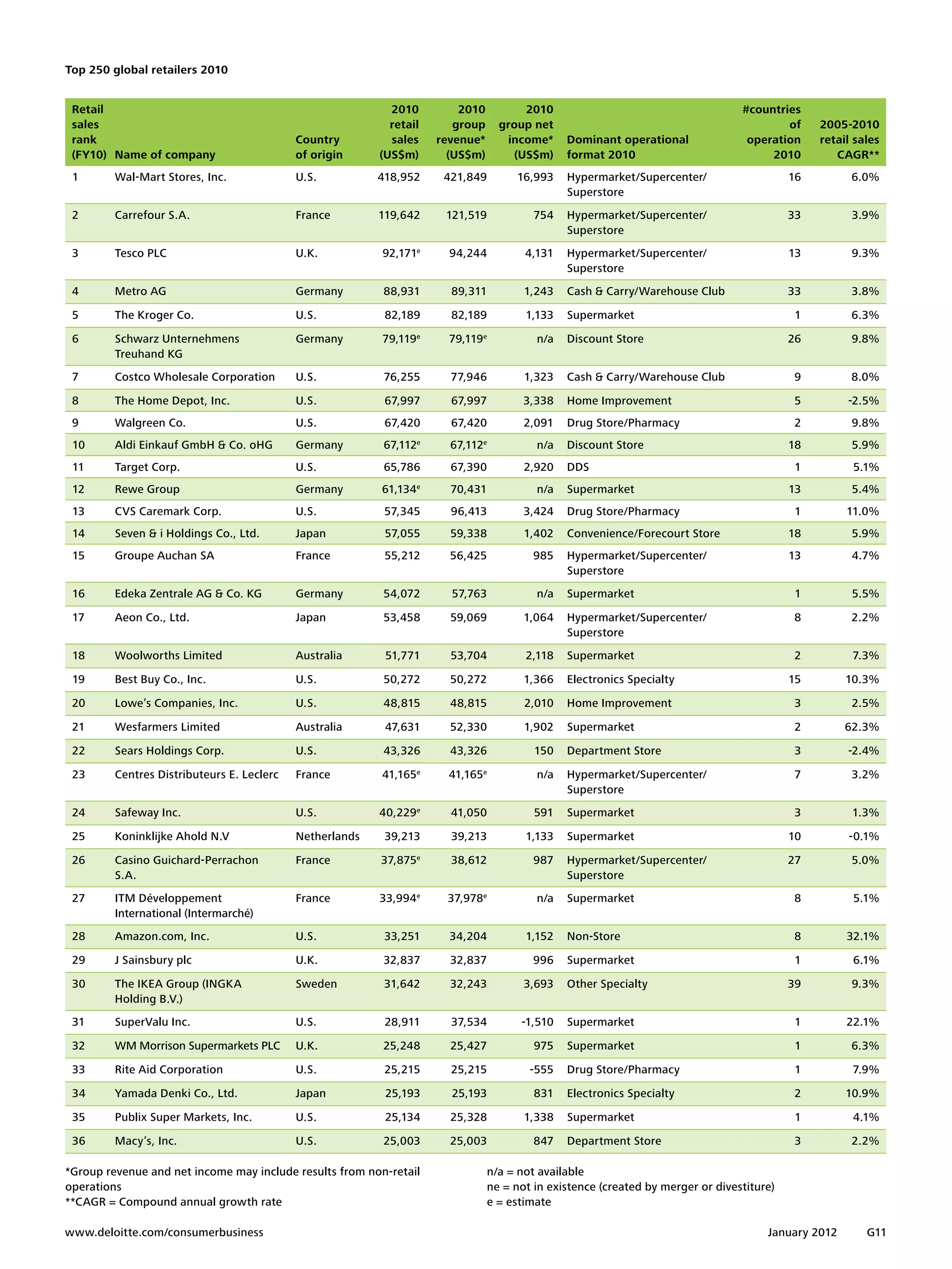
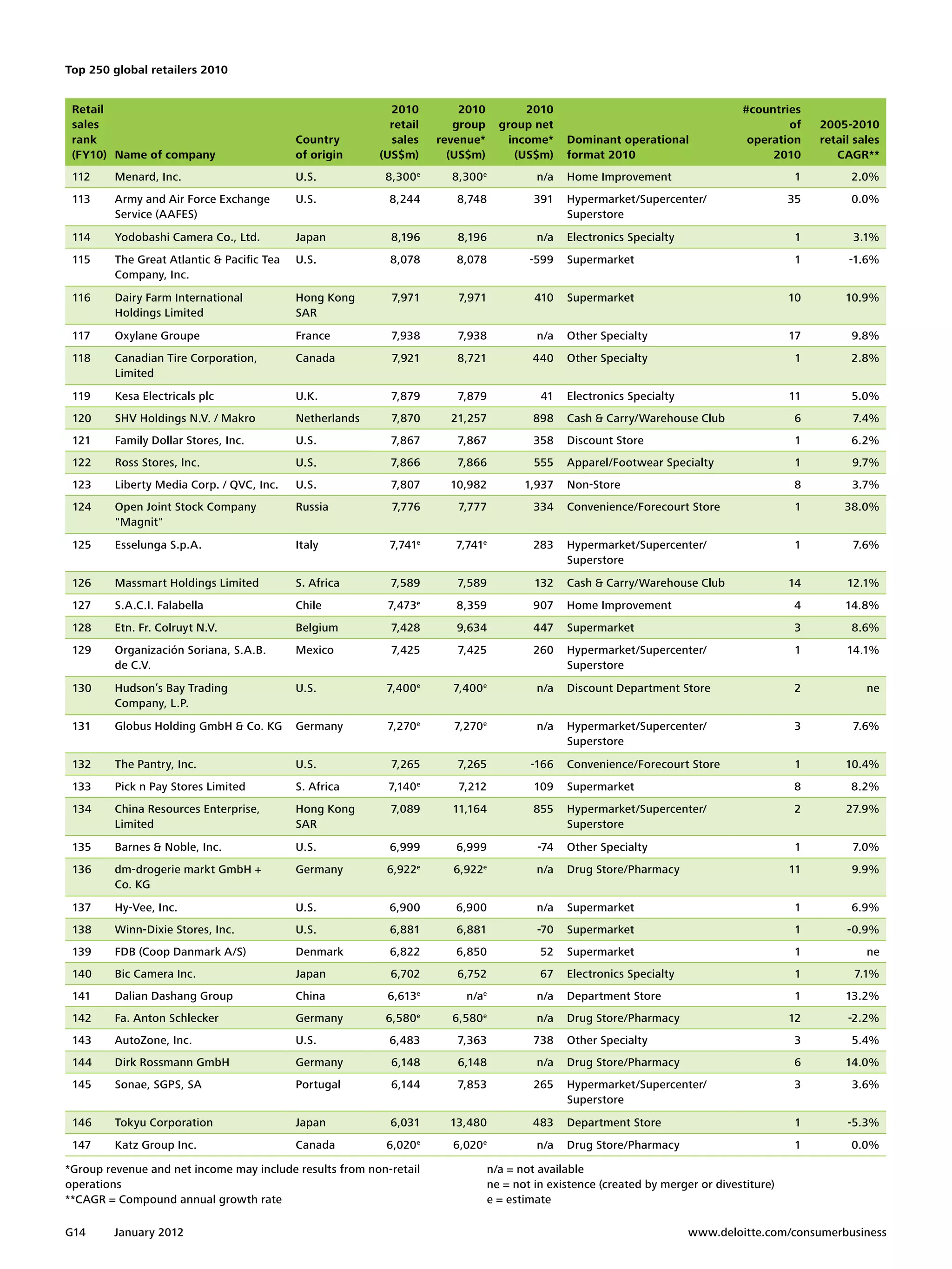
Top 250 global retailers 2010


 Retail                                                     2010           2010             2010                                       #countries
 sales                                                      retail        group         group net                                              of     2005-2010
 rank                                       Country         sales      revenue*          income*     Dominant operational               operation     retail sales
 (FY10) Name of company                     of origin     (US$m)         (US$m)           (US$m)     format 2010                            2010         CAGR**
 1       Wal-Mart Stores, Inc.              U.S.          418,952       421,849            16,993    Hypermarket/Supercenter/                    16         6.0%
                                                                                                     Superstore
 2       Carrefour S.A.                     France        119,642       121,519                754   Hypermarket/Supercenter/                    33         3.9%
                                                                                                     Superstore
 3       Tesco PLC                          U.K.          92,171e        94,244              4,131   Hypermarket/Supercenter/                    13         9.3%
                                                                                                     Superstore
 4       Metro AG                           Germany       88,931         89,311              1,243   Cash & Carry/Warehouse Club                 33         3.8%

 5       The Kroger Co.                     U.S.           82,189        82,189              1,133   Supermarket                                  1         6.3%

 6       Schwarz Unternehmens               Germany       79,119   e
                                                                         79,119   e
                                                                                               n/a   Discount Store                              26         9.8%
         Treuhand KG
 7       Costco Wholesale Corporation       U.S.           76,255        77,946              1,323   Cash & Carry/Warehouse Club                  9         8.0%

 8       The Home Depot, Inc.               U.S.           67,997        67,997              3,338   Home Improvement                             5        -2.5%
 9       Walgreen Co.                       U.S.           67,420        67,420              2,091   Drug Store/Pharmacy                          2         9.8%
 10      Aldi Einkauf GmbH & Co. oHG        Germany       67,112e        67,112e               n/a   Discount Store                              18         5.9%
 11      Target Corp.                       U.S.          65,786         67,390              2,920   DDS                                          1         5.1%
 12      Rewe Group                         Germany       61,134 e       70,431                n/a   Supermarket                                 13         5.4%
 13      CVS Caremark Corp.                 U.S.           57,345        96,413              3,424   Drug Store/Pharmacy                          1        11.0%
 14      Seven & i Holdings Co., Ltd.       Japan          57,055        59,338              1,402   Convenience/Forecourt Store                 18         5.9%
 15      Groupe Auchan SA                   France         55,212        56,425                985   Hypermarket/Supercenter/                    13         4.7%
                                                                                                     Superstore
 16      Edeka Zentrale AG & Co. KG         Germany       54,072         57,763                n/a   Supermarket                                  1         5.5%

 17      Aeon Co., Ltd.                     Japan         53,458         59,069              1,064   Hypermarket/Supercenter/                     8         2.2%
                                                                                                     Superstore
 18      Woolworths Limited                 Australia      51,771        53,704              2,118   Supermarket                                  2         7.3%

 19      Best Buy Co., Inc.                 U.S.          50,272         50,272              1,366   Electronics Specialty                       15        10.3%

 20      Lowe’s Companies, Inc.             U.S.          48,815         48,815              2,010   Home Improvement                             3         2.5%

 21      Wesfarmers Limited                 Australia      47,631        52,330              1,902   Supermarket                                  2        62.3%

 22      Sears Holdings Corp.               U.S.          43,326         43,326                150   Department Store                             3        -2.4%

 23      Centres Distributeurs E. Leclerc   France        41,165e        41,165e               n/a   Hypermarket/Supercenter/                     7         3.2%
                                                                                                     Superstore
 24      Safeway Inc.                       U.S.          40,229e        41,050                591   Supermarket                                  3         1.3%

 25      Koninklijke Ahold N.V              Netherlands    39,213        39,213              1,133   Supermarket                                 10        -0.1%

 26      Casino Guichard-Perrachon          France        37,875e        38,612                987   Hypermarket/Supercenter/                    27         5.0%
         S.A.                                                                                        Superstore
 27      ITM Développement                  France        33,994 e      37,978e                n/a   Supermarket                                  8         5.1%
         International (Intermarché)
 28      Amazon.com, Inc.                   U.S.           33,251        34,204              1,152   Non-Store                                    8        32.1%

 29      J Sainsbury plc                    U.K.          32,837         32,837                996   Supermarket                                  1         6.1%

 30      The IKEA Group (INGKA              Sweden         31,642        32,243              3,693   Other Specialty                             39         9.3%
         Holding B.V.)
 31      SuperValu Inc.                     U.S.           28,911        37,534             -1,510   Supermarket                                  1        22.1%

 32      WM Morrison Supermarkets PLC       U.K.          25,248         25,427                975   Supermarket                                  1         6.3%

 33      Rite Aid Corporation               U.S.           25,215        25,215               -555   Drug Store/Pharmacy                          1         7.9%

 34      Yamada Denki Co., Ltd.             Japan          25,193        25,193                831   Electronics Specialty                        2        10.9%

 35      Publix Super Markets, Inc.         U.S.           25,134        25,328              1,338   Supermarket                                  1         4.1%

 36      Macy’s, Inc.                       U.S.          25,003         25,003                847   Department Store                             3         2.2%

*Group revenue and net income may include results from non-retail                     n/a = not available
operations                                                                            ne = not in existence (created by merger or divestiture)
**CAGR = Compound annual growth rate                                                  e = estimate

www.deloitte.com/consumerbusiness	                                                                                                          January 2012       G11
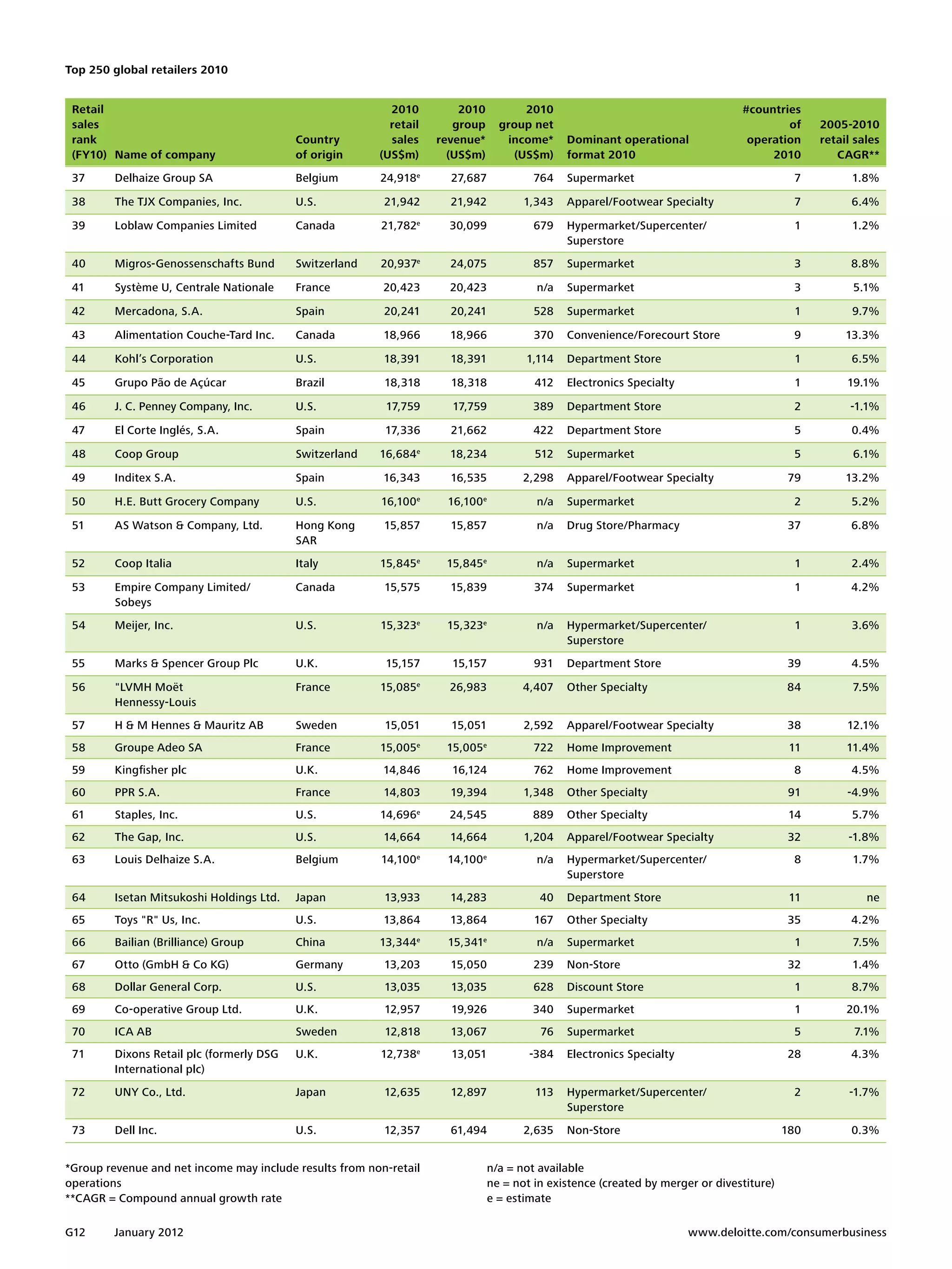
Top 250 global retailers 2010


 Retail                                                    2010           2010          2010                                       #countries
 sales                                                     retail        group      group net                                              of      2005-2010
 rank                                      Country         sales      revenue*       income*     Dominant operational               operation      retail sales
 (FY10) Name of company                    of origin     (US$m)         (US$m)        (US$m)     format 2010                            2010          CAGR**
 37      Delhaize Group SA                 Belgium       24,918e        27,687             764   Supermarket                                  7          1.8%

 38      The TJX Companies, Inc.           U.S.           21,942        21,942           1,343   Apparel/Footwear Specialty                   7          6.4%

 39      Loblaw Companies Limited          Canada        21,782e        30,099             679   Hypermarket/Supercenter/                      1         1.2%
                                                                                                 Superstore
 40      Migros-Genossenschafts Bund       Switzerland   20,937e        24,075             857   Supermarket                                   3         8.8%

 41      Système U, Centrale Nationale     France         20,423        20,423             n/a   Supermarket                                   3         5.1%

 42      Mercadona, S.A.                   Spain          20,241        20,241             528   Supermarket                                   1         9.7%

 43      Alimentation Couche-Tard Inc.     Canada         18,966        18,966             370   Convenience/Forecourt Store                   9        13.3%

 44      Kohl’s Corporation                U.S.           18,391        18,391           1,114   Department Store                              1         6.5%

 45      Grupo Pão de Açúcar               Brazil         18,318        18,318             412   Electronics Specialty                         1        19.1%

 46      J. C. Penney Company, Inc.        U.S.           17,759        17,759             389   Department Store                              2         -1.1%

 47      El Corte Inglés, S.A.             Spain          17,336        21,662             422   Department Store                              5         0.4%

 48      Coop Group                        Switzerland   16,684   e
                                                                        18,234             512   Supermarket                                  5          6.1%

 49      Inditex S.A.                      Spain          16,343        16,535           2,298   Apparel/Footwear Specialty                  79         13.2%

 50      H.E. Butt Grocery Company         U.S.          16,100 e      16,100 e            n/a   Supermarket                                   2         5.2%

 51      AS Watson & Company, Ltd.         Hong Kong      15,857        15,857             n/a   Drug Store/Pharmacy                          37         6.8%
                                           SAR
 52      Coop Italia                       Italy         15,845e       15,845e             n/a   Supermarket                                   1         2.4%

 53      Empire Company Limited/           Canada         15,575        15,839             374   Supermarket                                  1          4.2%
         Sobeys
 54      Meijer, Inc.                      U.S.          15,323e       15,323e             n/a   Hypermarket/Supercenter/                      1         3.6%
                                                                                                 Superstore
 55      Marks & Spencer Group Plc         U.K.           15,157        15,157             931   Department Store                            39          4.5%

 56      "LVMH Moët                        France        15,085e        26,983           4,407   Other Specialty                             84          7.5%
         Hennessy-Louis
 57      H & M Hennes & Mauritz AB         Sweden         15,051        15,051           2,592   Apparel/Footwear Specialty                  38         12.1%
 58      Groupe Adeo SA                    France        15,005e       15,005e             722   Home Improvement                             11        11.4%
 59      Kingfisher plc                    U.K.           14,846        16,124             762   Home Improvement                              8         4.5%
 60      PPR S.A.                          France         14,803        19,394           1,348   Other Specialty                              91        -4.9%
 61      Staples, Inc.                     U.S.          14,696e        24,545            889    Other Specialty                              14         5.7%
 62      The Gap, Inc.                     U.S.           14,664        14,664           1,204   Apparel/Footwear Specialty                   32        -1.8%
 63      Louis Delhaize S.A.               Belgium       14,100 e      14,100e             n/a   Hypermarket/Supercenter/                      8         1.7%
                                                                                                 Superstore
 64      Isetan Mitsukoshi Holdings Ltd.   Japan          13,933        14,283              40   Department Store                             11            ne
 65      Toys "R" Us, Inc.                 U.S.           13,864        13,864             167   Other Specialty                             35          4.2%
 66      Bailian (Brilliance) Group        China         13,344 e      15,341e             n/a   Supermarket                                   1         7.5%
 67      Otto (GmbH & Co KG)               Germany        13,203        15,050             239   Non-Store                                    32         1.4%
 68      Dollar General Corp.              U.S.           13,035        13,035             628   Discount Store                                1         8.7%
 69      Co-operative Group Ltd.           U.K.           12,957        19,926            340    Supermarket                                   1        20.1%
 70      ICA AB                            Sweden         12,818        13,067              76   Supermarket                                   5         7.1%
 71      Dixons Retail plc (formerly DSG   U.K.          12,738e        13,051            -384   Electronics Specialty                       28          4.3%
         International plc)
 72      UNY Co., Ltd.                     Japan          12,635        12,897             113   Hypermarket/Supercenter/                      2        -1.7%
                                                                                                 Superstore
 73      Dell Inc.                         U.S.           12,357        61,494           2,635   Non-Store                                   180         0.3%


*Group revenue and net income may include results from non-retail                 n/a = not available
operations                                                                        ne = not in existence (created by merger or divestiture)
**CAGR = Compound annual growth rate                                              e = estimate

G12      January 2012 	                                                                                                  www.deloitte.com/consumerbusiness
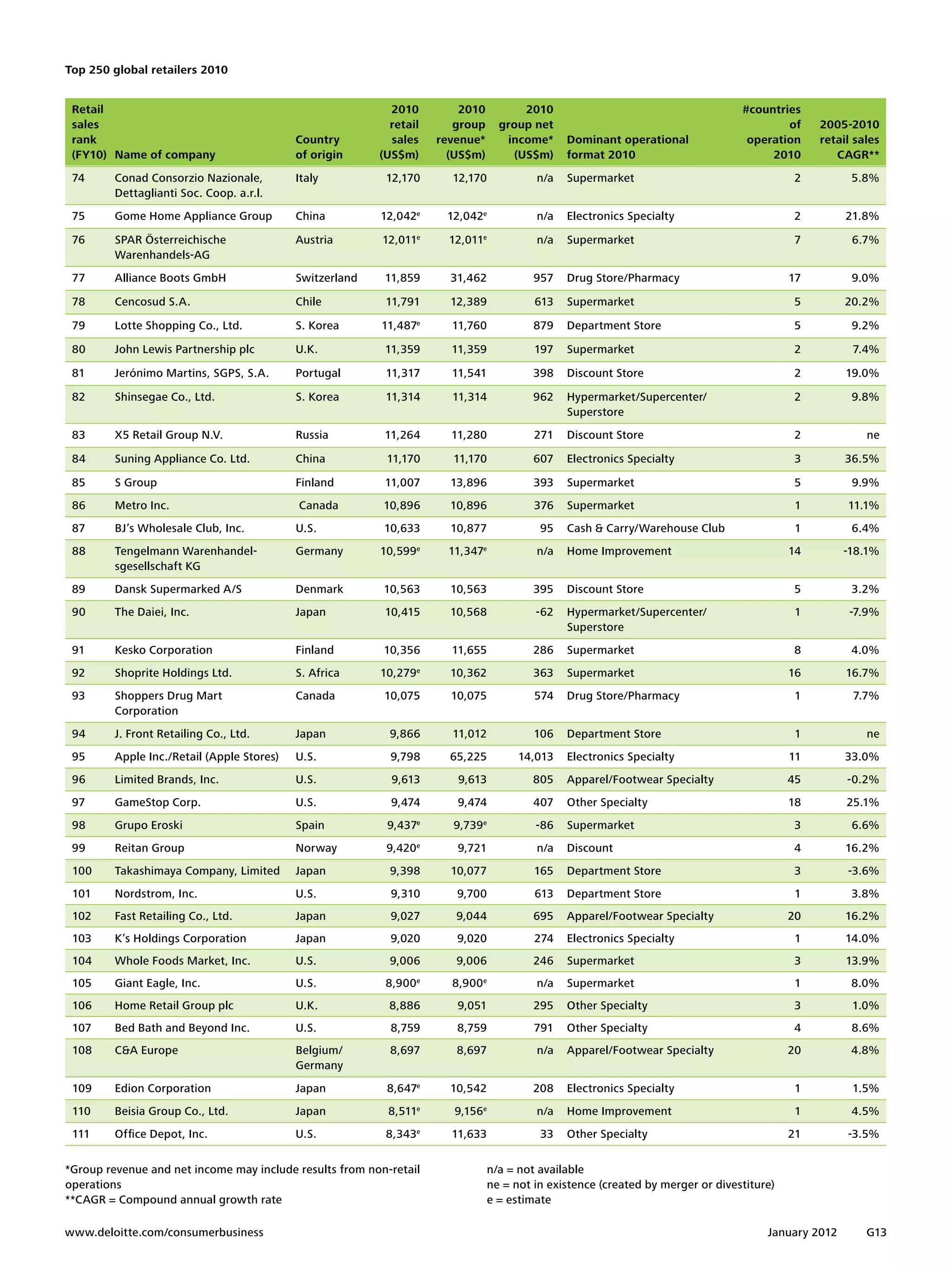
Top 250 global retailers 2010


 Retail                                                     2010         2010            2010                                       #countries
 sales                                                      retail      group        group net                                              of     2005-2010
 rank                                       Country         sales    revenue*         income*     Dominant operational               operation     retail sales
 (FY10) Name of company                     of origin     (US$m)       (US$m)          (US$m)     format 2010                            2010         CAGR**
 74      Conad Consorzio Nazionale,         Italy          12,170      12,170               n/a   Supermarket                                  2         5.8%
         Dettaglianti Soc. Coop. a.r.l.
 75      Gome Home Appliance Group          China         12,042e     12,042e               n/a   Electronics Specialty                        2        21.8%

 76      SPAR Österreichische               Austria       12,011 e
                                                                       12,011  e
                                                                                            n/a   Supermarket                                  7         6.7%
         Warenhandels-AG
 77      Alliance Boots GmbH                Switzerland    11,859      31,462               957   Drug Store/Pharmacy                         17         9.0%

 78      Cencosud S.A.                      Chile          11,791      12,389               613   Supermarket                                  5        20.2%

 79      Lotte Shopping Co., Ltd.           S. Korea      11,487 e
                                                                       11,760               879   Department Store                             5         9.2%

 80      John Lewis Partnership plc         U.K.           11,359      11,359               197   Supermarket                                  2         7.4%

 81      Jerónimo Martins, SGPS, S.A.       Portugal       11,317      11,541               398   Discount Store                               2        19.0%

 82      Shinsegae Co., Ltd.                S. Korea       11,314      11,314               962   Hypermarket/Supercenter/                     2         9.8%
                                                                                                  Superstore
 83      X5 Retail Group N.V.               Russia         11,264      11,280               271   Discount Store                               2            ne

 84      Suning Appliance Co. Ltd.          China          11,170      11,170               607   Electronics Specialty                        3        36.5%

 85      S Group                            Finland        11,007      13,896               393   Supermarket                                  5         9.9%
 86      Metro Inc.                         Canada        10,896       10,896               376   Supermarket                                  1        11.1%
 87      BJ’s Wholesale Club, Inc.          U.S.          10,633       10,877                95   Cash & Carry/Warehouse Club                  1         6.4%
 88      Tengelmann Warenhandel-            Germany       10,599e     11,347e               n/a   Home Improvement                            14        -18.1%
         sgesellschaft KG
 89      Dansk Supermarked A/S              Denmark       10,563       10,563               395   Discount Store                               5         3.2%
 90      The Daiei, Inc.                    Japan          10,415      10,568               -62   Hypermarket/Supercenter/                     1         -7.9%
                                                                                                  Superstore
 91      Kesko Corporation                  Finland       10,356       11,655               286   Supermarket                                  8         4.0%
 92      Shoprite Holdings Ltd.             S. Africa     10,279e      10,362               363   Supermarket                                 16        16.7%
 93      Shoppers Drug Mart                 Canada        10,075       10,075               574   Drug Store/Pharmacy                          1         7.7%
         Corporation
 94      J. Front Retailing Co., Ltd.       Japan           9,866      11,012               106   Department Store                             1            ne
 95      Apple Inc./Retail (Apple Stores)   U.S.            9,798      65,225            14,013   Electronics Specialty                       11        33.0%
 96      Limited Brands, Inc.               U.S.            9,613       9,613               805   Apparel/Footwear Specialty                  45        -0.2%
 97      GameStop Corp.                     U.S.            9,474       9,474               407   Other Specialty                             18        25.1%
 98      Grupo Eroski                       Spain          9,437e      9,739e               -86   Supermarket                                  3         6.6%
 99      Reitan Group                       Norway         9,420 e      9,721               n/a   Discount                                     4        16.2%
 100     Takashimaya Company, Limited       Japan           9,398      10,077               165   Department Store                             3        -3.6%
 101     Nordstrom, Inc.                    U.S.            9,310       9,700               613   Department Store                             1         3.8%
 102     Fast Retailing Co., Ltd.           Japan           9,027       9,044               695   Apparel/Footwear Specialty                  20        16.2%
 103     K’s Holdings Corporation           Japan           9,020       9,020               274   Electronics Specialty                        1        14.0%
 104     Whole Foods Market, Inc.           U.S.            9,006       9,006               246   Supermarket                                  3        13.9%
 105     Giant Eagle, Inc.                  U.S.           8,900e      8,900 e              n/a   Supermarket                                  1         8.0%
 106     Home Retail Group plc              U.K.            8,886       9,051               295   Other Specialty                              3         1.0%
 107     Bed Bath and Beyond Inc.           U.S.            8,759       8,759               791   Other Specialty                              4         8.6%
 108     C&A Europe                         Belgium/        8,697       8,697               n/a   Apparel/Footwear Specialty                  20         4.8%
                                            Germany
 109     Edion Corporation                  Japan          8,647e      10,542               208   Electronics Specialty                        1         1.5%
 110     Beisia Group Co., Ltd.             Japan          8,511 e
                                                                       9,156   e
                                                                                            n/a   Home Improvement                             1         4.5%
 111     Office Depot, Inc.                 U.S.           8,343e      11,633                33   Other Specialty                             21        -3.5%


*Group revenue and net income may include results from non-retail                  n/a = not available
operations                                                                         ne = not in existence (created by merger or divestiture)
**CAGR = Compound annual growth rate                                               e = estimate

www.deloitte.com/consumerbusiness	                                                                                                       January 2012       G13
Top 250 global retailers 2010


 Retail                                                     2010           2010            2010                                       #countries
 sales                                                      retail        group        group net                                              of     2005-2010
 rank                                       Country         sales      revenue*         income*     Dominant operational               operation     retail sales
 (FY10) Name of company                     of origin     (US$m)         (US$m)          (US$m)     format 2010                            2010         CAGR**
 112     Menard, Inc.                       U.S.           8,300e        8,300e               n/a   Home Improvement                             1         2.0%
 113     Army and Air Force Exchange        U.S.            8,244         8,748               391   Hypermarket/Supercenter/                    35         0.0%
         Service (AAFES)                                                                            Superstore
 114     Yodobashi Camera Co., Ltd.         Japan           8,196         8,196               n/a   Electronics Specialty                        1         3.1%
 115     The Great Atlantic & Pacific Tea   U.S.            8,078         8,078              -599   Supermarket                                  1        -1.6%
         Company, Inc.
 116     Dairy Farm International           Hong Kong       7,971         7,971               410   Supermarket                                 10        10.9%
         Holdings Limited                   SAR
 117     Oxylane Groupe                     France          7,938         7,938               n/a   Other Specialty                             17         9.8%
 118     Canadian Tire Corporation,         Canada          7,921         8,721              440    Other Specialty                              1         2.8%
         Limited
 119     Kesa Electricals plc               U.K.            7,879         7,879                41   Electronics Specialty                       11         5.0%
 120     SHV Holdings N.V. / Makro          Netherlands     7,870        21,257               898   Cash & Carry/Warehouse Club                  6         7.4%
 121     Family Dollar Stores, Inc.         U.S.            7,867         7,867               358   Discount Store                               1         6.2%
 122     Ross Stores, Inc.                  U.S.            7,866         7,866               555   Apparel/Footwear Specialty                   1         9.7%
 123     Liberty Media Corp. / QVC, Inc.    U.S.            7,807        10,982             1,937   Non-Store                                    8         3.7%
 124     Open Joint Stock Company           Russia          7,776         7,777               334   Convenience/Forecourt Store                  1       38.0%
         "Magnit"
 125     Esselunga S.p.A.                   Italy           7,741e        7,741e              283   Hypermarket/Supercenter/                     1         7.6%
                                                                                                    Superstore
 126     Massmart Holdings Limited          S. Africa       7,589         7,589               132   Cash & Carry/Warehouse Club                 14        12.1%
 127     S.A.C.I. Falabella                 Chile          7,473e         8,359               907   Home Improvement                             4        14.8%
 128     Etn. Fr. Colruyt N.V.              Belgium         7,428         9,634               447   Supermarket                                  3         8.6%
 129     Organización Soriana, S.A.B.       Mexico          7,425         7,425               260   Hypermarket/Supercenter/                     1        14.1%
         de C.V.                                                                                    Superstore
 130     Hudson’s Bay Trading               U.S.           7,400e        7,400 e              n/a   Discount Department Store                    2            ne
         Company, L.P.
 131     Globus Holding GmbH & Co. KG       Germany        7,270e        7,270e               n/a   Hypermarket/Supercenter/                     3         7.6%
                                                                                                    Superstore
 132     The Pantry, Inc.                   U.S.            7,265         7,265              -166   Convenience/Forecourt Store                  1        10.4%
 133     Pick n Pay Stores Limited          S. Africa      7,140e         7,212               109   Supermarket                                  8         8.2%
 134     China Resources Enterprise,        Hong Kong       7,089        11,164               855   Hypermarket/Supercenter/                     2        27.9%
         Limited                            SAR                                                     Superstore
 135     Barnes & Noble, Inc.               U.S.            6,999         6,999               -74   Other Specialty                              1         7.0%
 136     dm-drogerie markt GmbH +           Germany        6,922   e
                                                                         6,922   e
                                                                                              n/a   Drug Store/Pharmacy                         11         9.9%
         Co. KG
 137     Hy-Vee, Inc.                       U.S.            6,900         6,900               n/a   Supermarket                                  1         6.9%
 138     Winn-Dixie Stores, Inc.            U.S.            6,881         6,881               -70   Supermarket                                  1        -0.9%
 139     FDB (Coop Danmark A/S)             Denmark         6,822         6,850                52   Supermarket                                  1            ne
 140     Bic Camera Inc.                    Japan           6,702         6,752                67   Electronics Specialty                        1         7.1%
 141     Dalian Dashang Group               China          6,613e           n/ae              n/a   Department Store                             1        13.2%
 142     Fa. Anton Schlecker                Germany        6,580   e
                                                                         6,580   e
                                                                                              n/a   Drug Store/Pharmacy                         12        -2.2%
 143     AutoZone, Inc.                     U.S.            6,483         7,363               738   Other Specialty                              3         5.4%
 144     Dirk Rossmann GmbH                 Germany         6,148         6,148               n/a   Drug Store/Pharmacy                          6        14.0%
 145     Sonae, SGPS, SA                    Portugal        6,144         7,853               265   Hypermarket/Supercenter/                     3         3.6%
                                                                                                    Superstore
 146     Tokyu Corporation                  Japan           6,031        13,480              483    Department Store                             1        -5.3%
 147     Katz Group Inc.                    Canada         6,020   e
                                                                         6,020   e
                                                                                              n/a   Drug Store/Pharmacy                          1         0.0%

*Group revenue and net income may include results from non-retail                    n/a = not available
operations                                                                           ne = not in existence (created by merger or divestiture)
**CAGR = Compound annual growth rate                                                 e = estimate

G14      January 2012 	                                                                                                     www.deloitte.com/consumerbusiness
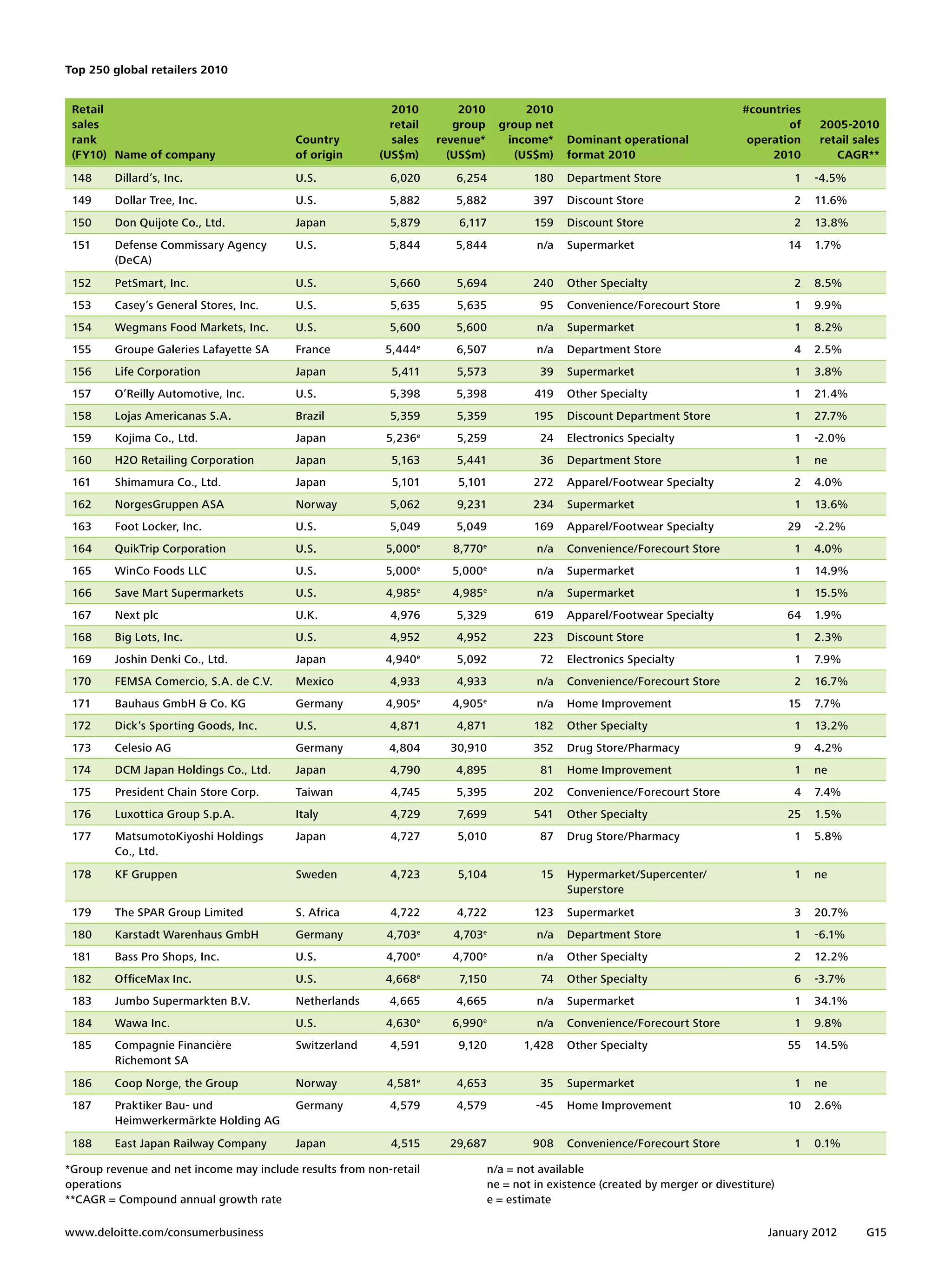
Top 250 global retailers 2010


 Retail                                                    2010           2010          2010                                       #countries
 sales                                                     retail        group      group net                                              of     2005-2010
 rank                                     Country          sales      revenue*       income*     Dominant operational               operation     retail sales
 (FY10) Name of company                   of origin      (US$m)         (US$m)        (US$m)     format 2010                            2010         CAGR**
 148     Dillard’s, Inc.                  U.S.             6,020         6,254             180   Department Store                             1   -4.5%
 149     Dollar Tree, Inc.                U.S.             5,882         5,882             397   Discount Store                               2   11.6%
 150     Don Quijote Co., Ltd.            Japan            5,879         6,117             159   Discount Store                               2   13.8%
 151     Defense Commissary Agency        U.S.             5,844         5,844             n/a   Supermarket                                 14   1.7%
         (DeCA)
 152     PetSmart, Inc.                   U.S.             5,660         5,694             240   Other Specialty                              2   8.5%
 153     Casey’s General Stores, Inc.     U.S.             5,635         5,635              95   Convenience/Forecourt Store                  1   9.9%
 154     Wegmans Food Markets, Inc.       U.S.             5,600         5,600             n/a   Supermarket                                  1   8.2%
 155     Groupe Galeries Lafayette SA     France          5,444e         6,507             n/a   Department Store                             4   2.5%
 156     Life Corporation                 Japan            5,411         5,573              39   Supermarket                                  1   3.8%
 157     O’Reilly Automotive, Inc.        U.S.             5,398         5,398             419   Other Specialty                              1   21.4%
 158     Lojas Americanas S.A.            Brazil           5,359         5,359             195   Discount Department Store                    1   27.7%
 159     Kojima Co., Ltd.                 Japan           5,236e         5,259              24   Electronics Specialty                        1   -2.0%
 160     H2O Retailing Corporation        Japan            5,163         5,441              36   Department Store                             1   ne
 161     Shimamura Co., Ltd.              Japan            5,101         5,101             272   Apparel/Footwear Specialty                   2   4.0%
 162     NorgesGruppen ASA                Norway           5,062         9,231             234   Supermarket                                  1   13.6%
 163     Foot Locker, Inc.                U.S.             5,049         5,049             169   Apparel/Footwear Specialty                  29   -2.2%
 164     QuikTrip Corporation             U.S.            5,000e        8,770 e            n/a   Convenience/Forecourt Store                  1   4.0%
 165     WinCo Foods LLC                  U.S.            5,000   e
                                                                        5,000e             n/a   Supermarket                                  1   14.9%
 166     Save Mart Supermarkets           U.S.            4,985e        4,985e             n/a   Supermarket                                  1   15.5%
 167     Next plc                         U.K.             4,976         5,329             619   Apparel/Footwear Specialty                  64   1.9%
 168     Big Lots, Inc.                   U.S.             4,952         4,952             223   Discount Store                               1   2.3%
 169     Joshin Denki Co., Ltd.           Japan           4,940 e        5,092              72   Electronics Specialty                        1   7.9%
 170     FEMSA Comercio, S.A. de C.V.     Mexico           4,933         4,933             n/a   Convenience/Forecourt Store                  2   16.7%
 171     Bauhaus GmbH & Co. KG            Germany         4,905e        4,905e             n/a   Home Improvement                            15   7.7%
 172     Dick’s Sporting Goods, Inc.      U.S.             4,871         4,871             182   Other Specialty                              1   13.2%
 173     Celesio AG                       Germany          4,804        30,910             352   Drug Store/Pharmacy                          9   4.2%
 174     DCM Japan Holdings Co., Ltd.     Japan            4,790         4,895              81   Home Improvement                             1   ne
 175     President Chain Store Corp.      Taiwan           4,745         5,395             202   Convenience/Forecourt Store                  4   7.4%
 176     Luxottica Group S.p.A.           Italy            4,729         7,699             541   Other Specialty                             25   1.5%
 177     MatsumotoKiyoshi Holdings        Japan            4,727         5,010              87   Drug Store/Pharmacy                          1   5.8%
         Co., Ltd.
 178     KF Gruppen                       Sweden           4,723         5,104              15   Hypermarket/Supercenter/                     1   ne
                                                                                                 Superstore
 179     The SPAR Group Limited           S. Africa        4,722         4,722             123   Supermarket                                  3   20.7%
 180     Karstadt Warenhaus GmbH          Germany         4,703e        4,703e             n/a   Department Store                             1   -6.1%
 181     Bass Pro Shops, Inc.             U.S.            4,700e        4,700 e            n/a   Other Specialty                              2   12.2%
 182     OfficeMax Inc.                   U.S.            4,668   e
                                                                         7,150              74   Other Specialty                              6   -3.7%
 183     Jumbo Supermarkten B.V.          Netherlands      4,665         4,665             n/a   Supermarket                                  1   34.1%
 184     Wawa Inc.                        U.S.            4,630e        6,990 e            n/a   Convenience/Forecourt Store                  1   9.8%
 185     Compagnie Financière             Switzerland      4,591         9,120           1,428   Other Specialty                             55   14.5%
         Richemont SA
 186     Coop Norge, the Group            Norway          4,581e         4,653              35   Supermarket                                  1   ne
 187     Praktiker Bau- und               Germany          4,579         4,579             -45   Home Improvement                            10   2.6%
         Heimwerkermärkte Holding AG
 188     East Japan Railway Company       Japan            4,515        29,687            908    Convenience/Forecourt Store                  1   0.1%

*Group revenue and net income may include results from non-retail                 n/a = not available
operations                                                                        ne = not in existence (created by merger or divestiture)
**CAGR = Compound annual growth rate                                              e = estimate

www.deloitte.com/consumerbusiness	                                                                                                      January 2012       G15
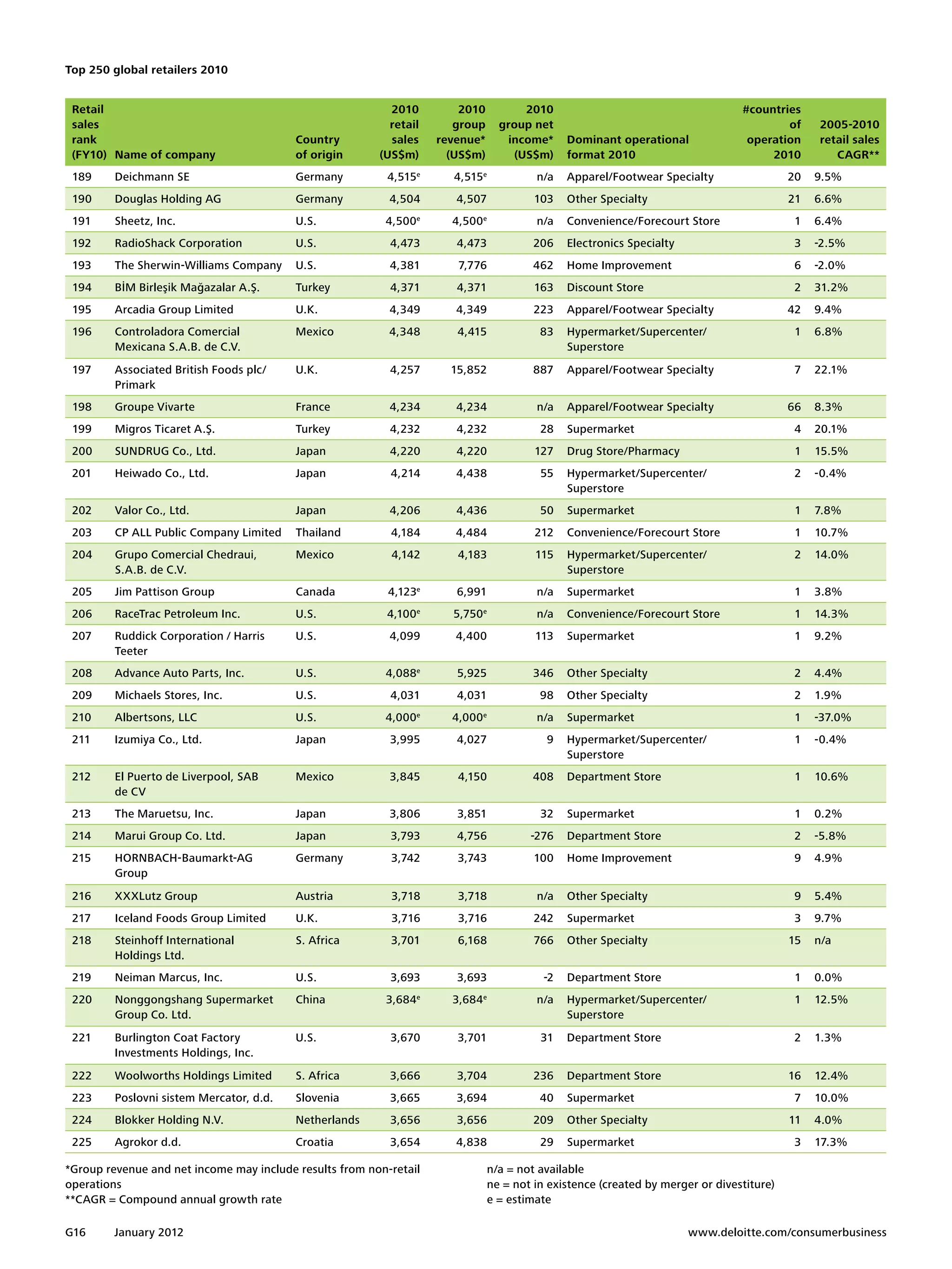
Top 250 global retailers 2010


 Retail                                                    2010         2010          2010                                       #countries
 sales                                                     retail      group      group net                                              of     2005-2010
 rank                                     Country          sales    revenue*       income*      Dominant operational              operation     retail sales
 (FY10) Name of company                   of origin      (US$m)       (US$m)        (US$m)      format 2010                           2010         CAGR**
 189     Deichmann SE                     Germany          4,515e     4,515e             n/a    Apparel/Footwear Specialty                 20   9.5%
 190     Douglas Holding AG               Germany          4,504       4,507             103    Other Specialty                            21   6.6%
 191     Sheetz, Inc.                     U.S.            4,500 e     4,500e             n/a    Convenience/Forecourt Store                 1   6.4%
 192     RadioShack Corporation           U.S.             4,473       4,473             206    Electronics Specialty                       3   -2.5%
 193     The Sherwin-Williams Company     U.S.             4,381       7,776             462    Home Improvement                            6   -2.0%
 194     BİM Birleşik Mağazalar A.Ş.      Turkey           4,371       4,371             163    Discount Store                              2   31.2%
 195     Arcadia Group Limited            U.K.             4,349       4,349             223    Apparel/Footwear Specialty                 42   9.4%
 196     Controladora Comercial           Mexico           4,348       4,415              83    Hypermarket/Supercenter/                    1   6.8%
         Mexicana S.A.B. de C.V.                                                                Superstore
 197     Associated British Foods plc/    U.K.             4,257      15,852             887    Apparel/Footwear Specialty                  7   22.1%
         Primark
 198     Groupe Vivarte                   France           4,234       4,234             n/a    Apparel/Footwear Specialty                 66   8.3%
 199     Migros Ticaret A.Ş.              Turkey           4,232       4,232              28    Supermarket                                 4   20.1%
 200     SUNDRUG Co., Ltd.                Japan            4,220       4,220             127    Drug Store/Pharmacy                         1   15.5%
 201     Heiwado Co., Ltd.                Japan            4,214       4,438              55    Hypermarket/Supercenter/                    2   -0.4%
                                                                                                Superstore
 202     Valor Co., Ltd.                  Japan            4,206       4,436              50    Supermarket                                 1   7.8%
 203     CP ALL Public Company Limited    Thailand         4,184       4,484             212    Convenience/Forecourt Store                 1   10.7%
 204     Grupo Comercial Chedraui,        Mexico           4,142       4,183             115    Hypermarket/Supercenter/                    2   14.0%
         S.A.B. de C.V.                                                                         Superstore
 205     Jim Pattison Group               Canada           4,123e      6,991             n/a    Supermarket                                 1   3.8%
 206     RaceTrac Petroleum Inc.          U.S.            4,100e      5,750 e            n/a    Convenience/Forecourt Store                 1   14.3%
 207     Ruddick Corporation / Harris     U.S.             4,099       4,400             113    Supermarket                                 1   9.2%
         Teeter
 208     Advance Auto Parts, Inc.         U.S.            4,088e       5,925            346     Other Specialty                             2   4.4%
 209     Michaels Stores, Inc.            U.S.             4,031       4,031              98    Other Specialty                             2   1.9%
 210     Albertsons, LLC                  U.S.            4,000e      4,000 e            n/a    Supermarket                                 1   -37.0%
 211     Izumiya Co., Ltd.                Japan            3,995       4,027               9    Hypermarket/Supercenter/                    1   -0.4%
                                                                                                Superstore
 212     El Puerto de Liverpool, SAB      Mexico           3,845       4,150            408     Department Store                            1   10.6%
         de CV
 213     The Maruetsu, Inc.               Japan            3,806       3,851              32    Supermarket                                 1   0.2%
 214     Marui Group Co. Ltd.             Japan            3,793       4,756            -276    Department Store                            2   -5.8%
 215     HORNBACH-Baumarkt-AG             Germany          3,742       3,743             100    Home Improvement                            9   4.9%
         Group
 216     XXXLutz Group                    Austria          3,718       3,718             n/a    Other Specialty                             9   5.4%
 217     Iceland Foods Group Limited      U.K.             3,716       3,716             242    Supermarket                                 3   9.7%
 218     Steinhoff International          S. Africa        3,701       6,168             766    Other Specialty                            15   n/a
         Holdings Ltd.
 219     Neiman Marcus, Inc.              U.S.             3,693       3,693               -2   Department Store                            1   0.0%
 220     Nonggongshang Supermarket        China           3,684e      3,684 e            n/a    Hypermarket/Supercenter/                    1   12.5%
         Group Co. Ltd.                                                                         Superstore
 221     Burlington Coat Factory          U.S.             3,670       3,701              31    Department Store                            2   1.3%
         Investments Holdings, Inc.
 222     Woolworths Holdings Limited      S. Africa        3,666       3,704             236    Department Store                           16   12.4%
 223     Poslovni sistem Mercator, d.d.   Slovenia         3,665       3,694              40    Supermarket                                 7   10.0%
 224     Blokker Holding N.V.             Netherlands      3,656       3,656             209    Other Specialty                            11   4.0%
 225     Agrokor d.d.                     Croatia          3,654       4,838              29    Supermarket                                 3   17.3%

*Group revenue and net income may include results from non-retail               n/a = not available
operations                                                                      ne = not in existence (created by merger or divestiture)
**CAGR = Compound annual growth rate                                            e = estimate

G16     January 2012 	                                                                                                  www.deloitte.com/consumerbusiness
Top 250 global retailers 2010


 Retail                                                    2010            2010            2010                                       #countries
 sales                                                     retail         group        group net                                              of     2005-2010
 rank                                      Country         sales       revenue*         income*     Dominant operational               operation     retail sales
 (FY10) Name of company                    of origin     (US$m)          (US$m)          (US$m)     format 2010                            2010         CAGR**
 226     Tractor Supply Company            U.S.            3,638          3,638               168   Other Specialty                              1   12.0%
 227     Coach, Inc.                       U.S.            3,622          4,159               881   Other Specialty                              6   17.6%
 228     GS Holdings Corp./GS Retail       S. Korea        3,614         36,775             1,304   Convenience/Forecourt Store                  1   7.8%
 229     Roundy’s Supermarkets, Inc.       U.S.            3,610   e
                                                                         3,800   e
                                                                                              n/a   Supermarket                                  1   2.2%
 230     Stater Bros. Holdings Inc.        U.S.            3,607          3,607                25   Supermarket                                  1   2.0%
 231     Nitori Holdings Co., Ltd.         Japan           3,602          3,643               357   Other Specialty                              2   15.1%
 232     Liquor Control Board of           Canada         3,569e          4,478             1,525   Other Specialty                              1   4.4%
         Ontario
 233     Norma Lebensmittelfilialbetrieb   Germany         3,561e        3,561e               n/a   Discount Store                               4   3.7%
         GmbH & Co. KG
 234     TSURUHA Holdings, Inc.            Japan           3,520          3,535                93   Drug Store/Pharmacy                          1   13.8%
 235     RONA Inc.                         Canada          3,519          4,661               144   Home Improvement                             1   4.5%
 236     Belk, Inc.                        U.S.            3,513          3,513               128   Department Store                             1   3.4%
 237     Williams-Sonoma, Inc.             U.S.            3,504          3,504               200   Other Specialty                              5   -0.2%
 238     Sugi Holdings Co., Ltd.           Japan          3,502e          3,532               104   Drug Store/Pharmacy                          1   19.7%
 239     The Golub Corporation/Price       U.S.           3,500e         3,500e               n/a   Supermarket                                  1   3.8%
         Chopper Supermarkets
 240     Arcs Co., Ltd.                    Japan           3,469          3,519                63   Supermarket                                  1   6.4%
 241     Abercrombie & Fitch Co.           U.S.            3,469          3,469               150   Apparel/Footwear Specialty                   9   4.5%
 242     Signet Jewelers Limited           Bermuda         3,437          3,437               200   Other Specialty                              3   1.7%
 243     Axfood AB                         Sweden          3,373          4,770               120   Supermarket                                  1   3.8%
 244     Systembolaget AB                  Sweden          3,357          3,357                42   Other Specialty                              1   5.9%
 245     Lagardère Services SA             France          3,355          4,753               100   Other Specialty                             30   1.3%
 246     Fuji Co. Ltd.                     Japan           3,329          3,329                 9   Hypermarket/Supercenter/                     1   -1.3%
                                                                                                    Superstore
 247     Komeri Co., Ltd.                  Japan           3,320          3,494                67   Home Improvement                             1   4.3%
 248     Debenhams plc                     U.K.            3,319          3,319               152   Department Store                            26   5.7%
 249     Kintetsu Department Store         Japan           3,292          3,428                21   Department Store                             1   -1.7%
         Co., Ltd.
 250     Izumi Co., Ltd.                   Japan          3,292e          5,823               153   Hypermarket/Supercenter/                     1   -0.5%
                                                                                                    Superstore

*Group revenue and net income may include results from non-retail                    n/a = not available
operations                                                                           ne = not in existence (created by merger or divestiture)
**CAGR = Compound annual growth rate                                                 e = estimate


www.deloitte.com/consumerbusiness	                                                                                                         January 2012       G17
Top 250 global retailers 2010 alphabetical listing


Abercrombie & Fitch Co.	          241   Dirk Rossmann GmbH 	             144   Kesa Electricals plc	            119   RONA Inc.	                     235
Advance Auto Parts, Inc.	         208   Dixons Retail plc (formerly DSG        Kesko Corporation	                91   Ross Stores, Inc.	             122
Aeon Co., Ltd.	                    17   International plc)	               71   KF Gruppen	                      178   Roundy’s Supermarkets, Inc.	   229
Agrokor d.d.	                     225   dm-drogerie markt GmbH + Co.           Kingfisher plc	                   59   Ruddick Corporation/
Albertsons, LLC	                  210   KG	136                                 Kintetsu Department Store Co.,         Harris Teeter	                 207
Aldi Einkauf GmbH & Co. oHG	       10   Dollar General Corp.	             68   Ltd.	249                               S Group	                        85
Alimentation Couche-Tard Inc.	     43   Dollar Tree, Inc.	               149   Kohl’s Corporation	               44   S.A.C.I. Falabella 	           127
Alliance Boots GmbH	               77   Don Quijote Co., Ltd.	           150   Kojima Co., Ltd.	                159   Safeway Inc.	                   24
Amazon.com, Inc.	                  28   Douglas Holding AG	              190   Komeri Co., Ltd.	                247   Save Mart Supermarkets	        166
Apple Inc./Retail (Apple Stores)	 95    East Japan Railway Company	      188   Koninklijke Ahold N.V	            25   Schwarz Unternehmens
Arcadia Group Limited	            195   Edeka Zentrale AG & Co. KG	       16   Kroger Co.	                        5   Treuhand KG	                     6
Arcs Co., Ltd.	                   240   Edion Corporation	               109   K’s Holdings Corporation	        103   Sears Holdings Corp.	           22
Army and Air Force Exchange             El Corte Inglés, S.A.	            47   Lagardère Services SA	           245   Seven & i Holdings Co., Ltd.	   14
Service (AAFES)	                  113   El Puerto de Liverpool,                Liberty Media Corp./QVC, Inc.	 123     Sheetz, Inc.	                  191
AS Watson & Company, Ltd.	         51   SAB de CV	                       212   Life Corporation 	               156   Sherwin-Williams Company	      193
Associated British Foods                Empire Company Limited/Sobeys	 53      Limited Brands, Inc.	             96   Shimamura Co., Ltd.	           161
plc/Primark	197                         Esselunga S.p.A. 	               125   Liquor Control Board of Ontario	 232   Shinsegae Co., Ltd.	            82
AutoZone, Inc.	                   143   Etn. Fr. Colruyt N.V.	           128   Loblaw Companies Limited	         39   Shoppers Drug Mart Corporation	 93
Axfood AB	                        243   Fa. Anton Schlecker	             142   Lojas Americanas S.A.	           158   Shoprite Holdings Ltd.	         92
Bailian (Brilliance) Group	        66   Family Dollar Stores, Inc.	      121   Lotte Shopping Co., Ltd.	         79   SHV Holdings N.V./Makro	       120
Barnes & Noble, Inc.	             135   Fast Retailing Co., Ltd.	        102   Louis Delhaize S.A.	              63   Signet Jewelers Limited	       242
Bass Pro Shops, Inc.	             181   FDB (Coop Danmark A/S)	          139   Lowe’s Companies, Inc.	           20   Sonae, SGPS, SA	               145
Bauhaus GmbH & Co. KG	            171   FEMSA Comercio, S.A. de C.V. 	 170     Luxottica Group S.p.A.	          176   SPAR Group Limited	            179
Bed Bath and Beyond Inc.	         107   Foot Locker, Inc.	               163   “LVMH Moët Hennessy-Louis              SPAR Österreichische
Beisia Group Co., Ltd.	           110   Fuji Co. Ltd. 	                  246   Vuitton”	56                            Warenhandels-AG 	               76
Belk, Inc.	                       236   GameStop Corp.	                   97   Macy’s, Inc.	                     36   Staples, Inc.	                  61
Best Buy Co., Inc.	                19   Gap, Inc.	                        62   Marks & Spencer Group Plc	        55   Stater Bros. Holdings Inc.	    230
Bic Camera Inc.	                  140   Giant Eagle, Inc.	               105   Maruetsu, Inc. 	                 213   Steinhoff International
Big Lots, Inc.	                   168   Globus Holding GmbH & Co. KG	 131      Marui Group Co. Ltd.	            214   Holdings Ltd.	                 218
BİM Birleşik Mağazalar A.Ş.	      194   Golub Corporation/Price Chopper        Massmart Holdings Limited	       126   Sugi Holdings Co., Ltd.	       238
BJ’s Wholesale Club, Inc.	         87   Supermarkets	239                       MatsumotoKiyoshi Holdings Co.,         SUNDRUG Co., Ltd.	             200
Blokker Holding N.V.	             224   Gome Home Appliance Group	        75   Ltd.	177                               Suning Appliance Co. Ltd.	      84
Burlington Coat Factory                 Great Atlantic & Pacific Tea           Meijer, Inc.	                     54   SuperValu Inc.	                 31
Investments Holdings, Inc.	       221   Company, Inc.	                   115   Menard, Inc.	                    112   Systembolaget AB	              244
C&A Europe	                       108   Groupe Adeo SA	                   58   Mercadona, S.A.	                  42   Système U, Centrale Nationale	  41
Canadian Tire Corporation,              Groupe Auchan SA	                 15   Metro AG	                          4   Takashimaya Company, Limited	 100
Limited	118                             Groupe Galeries Lafayette SA	    155   Metro Inc.	                       86   Target Corp.	                   11
Carrefour S.A.	                     2   Groupe Vivarte	                  198   Michaels Stores, Inc.	           209   Tengelmann
Casey’s General Stores, Inc.	     153   Grupo Comercial Chedraui,              Migros Ticaret A.Ş.	             199   Warenhandelsgesellschaft KG	    88
Casino Guichard-Perrachon S.A. 	 26     S.A.B. de C.V. 	                 204   Migros-Genossenschafts Bund 	 40       Tesco PLC	                       3
Celesio AG	                       173   Grupo Eroski	                     98   Neiman Marcus, Inc.	             219   TJX Companies, Inc.	            38
Cencosud S.A.	                     78   Grupo Pão de Açúcar	              45   Next plc	                        167   Tokyu Corporation	             146
Centres Distributeurs E. Leclerc	 23    GS Holdings Corp./GS Retail	     228   Nitori Holdings Co., Ltd.	       231   Toys “R” Us, Inc.	              65
China Resources Enterprise,             H & M Hennes & Mauritz AB	        57   Nonggongshang Supermarket              Tractor Supply Company	        226
Limited	134                             H.E. Butt Grocery Company	        50   Group Co. Ltd.	                  220   TSURUHA Holdings, Inc.	        234
Coach, Inc.	                      227   H2O Retailing Corporation	       160   Nordstrom, Inc.	                 101   UNY Co., Ltd.	                  72
Compagnie Financière                    Heiwado Co., Ltd.	               201   NorgesGruppen ASA 	              162   Valor Co., Ltd. 	              202
Richemont SA	                     185   Home Depot, Inc.	                  8   Norma Lebensmittelfilialbetrieb        Walgreen Co.	                    9
Conad Consorzio Nazionale,              Home Retail Group plc	           106   GmbH & Co. KG 	                  233   Wal-Mart Stores, Inc.	           1
Dettaglianti Soc. Coop. a.r.l.	    74   HORNBACH-Baumarkt-AG                   Office Depot, Inc.	              111   Wawa Inc.	                     184
Controladora Comercial                  Group	215                              OfficeMax Inc.	                  182   Wegmans Food Markets, Inc.	    154
Mexicana S.A.B. de C.V.	          196   Hudson’s Bay Trading Company,          Open Joint Stock Company               Wesfarmers Limited	             21
Coop Group 	                       48   L.P.	130                               “Magnit” 	                       124   Whole Foods Market, Inc.	      104
Coop Italia	                       52   Hy-Vee, Inc.	                    137   O’Reilly Automotive, Inc.	       157   Williams-Sonoma, Inc.	         237
Coop Norge, the Group	            186   ICA AB	                           70   Organización Soriana, S.A.B.           WinCo Foods LLC	               165
Co-operative Group Ltd.	           69   Iceland Foods Group Limited	     217   de C.V.	                         129   Winn-Dixie Stores, Inc.	       138
Costco Wholesale Corporation	       7   IKEA Group (INGKA Holding B.V.)	 30    Otto (GmbH & Co KG)	              67   WM Morrison Supermarkets PLC	 32
CP ALL Public Company Limited	 203      Inditex S.A.	                     49   Oxylane Groupe	                  117   Woolworths Holdings Limited	 222
CVS Caremark Corp.	                13   Isetan Mitsukoshi Holdings Ltd.	 64    Pantry, Inc.	                    132   Woolworths Limited	             18
Daiei, Inc.	                       90   ITM Développement                      PetSmart, Inc.	                  152   X5 Retail Group N.V.	           83
Dairy Farm International                International (Intermarché)	      27   Pick n Pay Stores Limited 	      133   XXXLutz Group	                 216
Holdings Limited	                 116   Izumi Co., Ltd. 	                250   Poslovni sistem Mercator, d.d.	 223    Yamada Denki Co., Ltd.	         34
Dalian Dashang Group	             141   Izumiya Co., Ltd. 	              211   PPR S.A.	                         60   Yodobashi Camera Co., Ltd.	    114
Dansk Supermarked A/S	             89   J Sainsbury plc	                  29   Praktiker Bau- und
DCM Japan Holdings Co., Ltd.	     174   J. C. Penney Company, Inc.	       46   Heimwerkermärkte Holding AG	 187
Debenhams plc	                    248   J. Front Retailing Co., Ltd.	     94   President Chain Store Corp.	     175
Defense Commissary Agency               Jerónimo Martins, SGPS, S.A. 	    81   Publix Super Markets, Inc.	       35
(DeCA)	151                              Jim Pattison Group	              205   QuikTrip Corporation	            164
Deichmann SE	                     189   John Lewis Partnership plc	       80   RaceTrac Petroleum Inc.	         206
Delhaize Group SA	                 37   Joshin Denki Co., Ltd.	          169   RadioShack Corporation	          192
Dell Inc.	                         73   Jumbo Supermarkten B.V.	         183   Reitan Group	                     99
Dick’s Sporting Goods, Inc.	      172   Karstadt Warenhaus GmbH	         180   Rewe Group	                       12
Dillard’s, Inc.	                  148   Katz Group Inc.	                 147   Rite Aid Corporation	             33

G18      January 2012 	                                                                                               www.deloitte.com/consumerbusiness
Economic concentration of top 10 retailers, 2010		
	

 Top 250    Name of company            Country of origin                2010        2010 retail            2010           2010        2010 asset
 rank                                                            retail sales     sales growth        net profit      return on         turnover
                                                                   (US $mil)                            margin           assets
 1          Wal-Mart                   U.S.                            418,952           3.4%             4.0%             9.4%              2.3

 2          Carrefour                  France                          119,642           4.8%             0.6%             1.1%              1.7

 3          Tesco                      U.K.                            92,171e           6.7%             4.4%             5.7%              1.3

 4          Metro                      Germany                         88,931            2.8%             1.4%             2.7%              1.9

 5          Kroger                     U.S.                             82,189            7.1%            1.4%             4.8%              3.5

 6          Schwarz                    Germany                         79,119e           9.4%               n/a              n/a             n/a

 7          Costco                     U.S.                             76,255            9.1%            1.7%             5.6%              3.3

 8          The Home Depot             U.S.                             67,997           2.8%             4.9%             8.3%              1.7

 9          Walgreen Co.               U.S.                             67,420           6.4%             3.1%             8.0%              2.6

 10         Aldi                       Germany                         67,112e           5.2%               n/a              n/a             n/a

 Top 10*                                                         $1,159,788              5.0%             3.0%             6.4%              2.1

 Top 250*                                                        $3,940,747              5.3%             3.8%             5.8%              1.5

 Top 10 share of total                                                  29.4%


*Sales-weighted, currency-adjusted composite growth rate
Source: Published company data and Planet Retail


Walgreen joins Top 10 leader board                                          The makeup of the Top 10 changed slightly for the first time since
The share of total Top 250 retail sales accounted for by the                2007. Walgreens continued its steady climb up the Top 250 ranking
Top 10 retailers slipped again in 2010 to 29.4 percent, down from           to become one of the world’s 10 largest retailers in 2010, displacing
30 percent in 2009 and a high of 30.2 percent in fiscal 2008.               Target, which fell to 11th place. A weaker euro against the U.S.
The Top 10’s 5 percent composite year-over-year sales growth, while         dollar had an impact on the European retailers, causing some to
a significant improvement over 2009’s meager 0.2 percent increase,          drop in the dollar-denominated rankings despite solid growth.
lagged the 5.3 percent sales gain for the Top 250 as a whole.
                                                                            Profitability for the world’s Top 10 retailers also underperformed
The leader group’s top-line performance in 2010 was dragged down            the Top 250 group as a whole. The eight Top 10 companies that
by Wal-Mart’s 3.4 percent sales increase. Despite strong growth             disclosed their bottom-line profits generated a composite net profit
in international sales, stagnant sales in the U.S. division, which          margin of 3 percent, compared with 3.8 percent for the Top 250.
accounted for more than 60 percent of Wal-Mart’s total sales, led to        Although Top 10 sales growth and profitability lagged the larger
overall inferior growth.                                                    group, the retail leaders were more productive than the group as
                                                                            a whole, as reflected by the Top 10’s superior return on assets and
All 10 companies on the leader board saw an increase in retail sales        asset turnover ratio.
in 2010, led by Schwarz and Costco. Tesco, Walgreens and Kroger
also outpaced the Top 250’s composite growth rate.


www.deloitte.com/consumerbusiness	                                                                                           January 2012     G19
Global Powers of Retailing geographical analysis


For purposes of geographical analysis, companies are assigned to a region based on
their headquarters location, which may not always coincide with where they derive the
majority of their sales. Although many companies derive sales from outside their region,
100 percent of each company’s sales are accounted for within that company’s region.

Europe, U.S. shares of Top 250 fall                                        Share of Top 250 retailers by region/country, 2010
Composite sales growth for the European retailers outpaced the                                      4.0% 3.2%
Top 250 retailers as a whole in 2010. Nevertheless, for the second
year in a row, the number of European companies among the Top
250 declined, from 92 in 2009 to 88 in 2010. That is partly due                                                         15.2%

to the exchange rate effects of a weaker euro relative to the U.S.
dollar in 2010; it is also the result of several significant divestments                                                         6.0%
                                                                                      32.4%
by European retailers, which resulted in fewer European companies
meeting the 2010 sales threshold for inclusion in the Top 250. Among                                                             5.2%
the “Big 3” European economies, sales growth and profitability of the
German companies lagged their counterparts in France and the U.K.                                                            7.6%

                                                                                          4.0%                           6.0%
Since 2007, the Asia/Pacific region has gained as a share of the
                                                                                                         16.4%
Top 250. In 2010, as in prior years, however, the region’s statistical
gains are mostly the result of the growing strength of the Japanese
yen against the U.S. dollar, allowing more Japanese retailers to move         Africa/Middle East                 U.K.
                                                                              Japan                              Other Europe
into the Top 250. Composite sales growth among the Japanese
                                                                              Other Asia/Pacific                  Latin America
companies was a sluggish 1.5 percent in 2010, far below the
                                                                              France                             U.S.
region’s overall 4.7 percent growth rate and, by far, the lowest of all
                                                                              Germany                            Canada
regions and countries analyzed. Excluding Japan, composite sales for
the 15 other Asia/Pacific retailers grew a robust 10.3 percent, and
this group’s 4.6 percent composite net profit margin was more than
double that of the Japanese retailers.                                     Share of Top 250 sales by region/country, 2010
                                                                                                    2.6% 1.2%
Below-average composite retail sales growth for the North American
retailers led to a decline in the region’s share of Top 250 companies                                             8.8%

and sales in 2010. This was especially true for U.S retailers, as                                                          5.4%
consumer pessimism returned amid continued high unemployment
and growing fears of a double-dip recession. The region’s                                                                        9.5%
profitability was strong, however: With a composite net profit
                                                                                       41.7%
margin of 4.1 percent, North American retailers outperformed the
Top 250 as a whole. Productivity, as measured by return on assets
                                                                                                                                11.1%
and asset turnover, was also well above average.

                                                                                                                          6.5%

                                                                                                           11.6%
                                                                                                  1.8%

                                                                              Africa/Middle East                 U.K.
                                                                              Japan                              Other Europe
                                                                              Other Asia/Pacific                  Latin America
                                                                              France                             U.S.
                                                                              Germany                            Canada


G20     January 2012 	                                                                                                  www.deloitte.com/consumerbusiness
Sales growth and profitability by region/country (%)

20
                                                                                                                                                                                               18.0

                            15.4                                                                                                                                                            14.8
15


10                             9.3
                                                              7.6                                                                                                        7.4
        5.7 5.3                                                                                            5.5 5.6                  5.6                                        5.2                                       5.0 4.7                   4.9 4.7
 5                    3.8                               4.0
                                                                    4.7
                                                                                                                        3.7   4.2                  4.4 4.9                            3.7
                                                                                                                                                                                                                   4.7                       4.1              4.1
                                                                                  3.0   3.5                                                  3.3
                                                                                              1.5 2.1                                                            1.3
 0


                                                                                                                                                                                                                                                       U.S.
                                                                                                                                                                               U.K.


                                                                                                                                                                                                   Latin America
                                                                    Asia/Pacific


                                                                                                                                                                                                                             North America
                                                                                              Japan
            Top 250


                                                                                                                                    France
                                                                                                               Europe


                                                                                                                                                       Germany
                                   Africa/Middle East


       2005-2010 composite retail sales CAGR*                                                         2010 composite retail sales growth                               2010 composite net profit margin

Results reflect Top 250 retailers headquartered in each region/country
*Compound Annual Growth Rate
Source: Published company data and Planet Retail


Strong growth and profitability continued in the Latin America and                                                                       Asset turnover and ROA by region/country		
Africa/Middle East regions. Latin American retailers, in particular,
outperformed their counterparts around the globe. Seven of the                                                                                                                                                            2010                               2010
                                                                                                                                                                                                                    composite                           composite
10 Top 250 Latin American retailers posted double-digit sales increases,
                                                                                                                                                                                                                         asset                           return on
resulting in a composite regional growth rate of 18 percent, and the                                                                                                                                                  turnover                              assets
region’s composite net profit margin of 4.7 percent led the industry.
                                                                                                                                             Top 250                                                                         1.5                                5.8%
Top 250 retailers based in Africa and the Middle East also enjoyed
                                                                                                                                             Africa/Middle East                                                              1.7                                6.8%
robust growth in 2010, and they generated the highest compound
annual growth rate over the 2005-2010 period of all regions.                                                                                 Asia/Pacific                                                                   1.2                                 3.7%

                                                                                                                                             Japan                                                                          1.2                                 2.4%
Top 10 retailers by region                                                                                                                   Europe                                                                         1.3                                 5.0%
Europe’s top 10 retailers in 2010 remained the same as in 2009 except                                                                         France                                                                        1.2                                 3.8%
for two changes in the order. Tesco overtook Metro to once again
                                                                                                                                              Germany                                                                       2.0                                 2.7%
secure second place in the region by virtue of consistently solid sales
                                                                                                                                              U.K.                                                                          1.5                                 5.4%
growth over the past few years. Auchan and Edeka also traded places.
                                                                                                                                             Latin America                                                                   1.0                                4.7%
In North America, Walgreens, which has outperformed Target on the                                                                            North America                                                                   1.9                                    7.6%
top line for several consecutive years, finally moved past the discounter                                                                     U.S.                                                                           1.9                                    7.7%
into fifth place. Home Depot and Lowe’s, both of which fell in the
ranking in 2009 as home improvement sales declined in the United                                                                         Results reflect Top 250 companies headquartered in each region/country
States, maintained their positions in 2010 with modest sales gains.                                                                      Source: Published company data and Planet Retail


The only change to the top 10 Asia/Pacific retailers occurred at the
bottom of the list. Double-digit growth propelled China’s Gome Home
Appliance Group to the number 10 spot, displacing Daiei, as sales
continued to decline for the struggling Japanese retailer.


www.deloitte.com/consumerbusiness	                                                                                                                                                                                                           January 2012            G21
Top 10 retailers by region, 2010		
In Latin America, a region represented by 10 Top 250 companies,
Brazil’s Grupo Pão de Açúcar, the largest retailer, acquired a majority
share in Casas Bahia, the number three retailer in 2009, removing the                  Top                                  Retail
                                                                             Region    250                                   sales         Country
latter from the list as a separate entity. Other changes include Chile’s
                                                                             rank      rank    Company                   (US$ mil)         of origin
Falabella, which surpassed Mexican hypermarket chain Soriana, and
                                                                             Top 10 European Retailers
Mexico’s FEMSA Comercio, operator of the OXXO convenience store
                                                                             1         2       Carrefour                 $119,642             France
chain, which overtook Comercial Mexicana. Falabella and FEMSA both
                                                                             2         3       Tesco                      $92,171e               UK
were propelled up the ranking by strong, double-digit growth.
                                                                             3         4       Metro                      $88,931          Germany
                                                                             4         6       Schwarz                    $79,119e         Germany
The most changes in the regional rankings occurred in Africa/Middle
                                                                             5         10      Aldi                       $67,112e         Germany
East. South Africa’s Pick n Pay was the only retailer in the region to       6         12      Rewe                       $61,134 e        Germany
experience a sales decline in 2010, which dropped it from second             7         15      Auchan                     $55,212             France
place to third. Despite strong growth, Migros fell behind another            8         16      Edeka                      $54,072          Germany
prominent Turkish retailer, BİM, which reported even stronger growth.        9         23      E. Leclerc                 $41,165e            France
SPAR moved from number five to number four on the strength of the            10        25      Ahold                      $39,213        Netherlands
South African rand in addition to solid growth. Metcash, which has           Top 10 North America Retailers
been undergoing a restructuring process to refocus the company’s             1         1       Wal-Mart                  $418,952               U.S.
core business, fell out of the Top 250 in 2010. Joining the Top              2         5       Kroger                     $82,189               U.S.
250 for the first time is another South African company, Steinhoff           3         7       Costco                     $76,255               U.S.
International, a vertically integrated retailer of furniture and household   4         8       Home Depot                 $67,997               U.S.

goods. Shoprite Holdings, Africa’s largest food retailer, remained           5         9       Walgreen                   $67,420               U.S.
                                                                             6         11      Target                     $65,786               U.S.
solidly in first place.
                                                                             7         13      CVS Caremark               $57,345               U.S.
                                                                             8         19      Best Buy                   $50,272               U.S.
                                                                             9         20      Lowe’s                     $48,815               U.S.
                                                                             10        22      Sears Holdings             $43,326               U.S.
                                                                             Top 10 Asia/Pacific Retailers
                                                                             1         14      Seven & i Holdings         $57,055              Japan
                                                                             2         17      Aeon                       $53,458              Japan
                                                                             3         18      Woolworths                 $51,771           Australia
                                                                             4         21      Wesfarmers                 $47,631           Australia
                                                                             5         34      Yamada Denki               $25,193              Japan
                                                                             6         51      AS Watson                  $15,857        Hong Kong
                                                                                                                                               SAR
                                                                             7         64      Isetan Mitsukoshi          $13,933              Japan
                                                                                               Holdings
                                                                             8         66      Bailian                   $13,344e              China
                                                                             9         72      UNY                        $12,635              Japan
                                                                             10        75      Gome Home Appliance        $12,042e             China
                                                                             Top 10 Latin America Retailers
                                                                             1         45      Grupo Pão de Açúcar        $18,318              Brazil
                                                                             2         78      Cencosud                   $11,791               Chile
                                                                             3         127     Falabella                   $7,473e             Chile
                                                                             4         129     Soriana                     $7,425            Mexico
                                                                             5         158     Lojas Americanas            $5,359              Brazil
                                                                             6         170     FEMSA Comercio              $4,933            Mexico
                                                                             7         196     Comercial Mexicana          $4,348            Mexico
                                                                             8         204     Comercial Chedraui          $4,142            Mexico
                                                                             9         212     El Puerto de Liverpool      $3,845            Mexico
                                                                             10        242     Signet Jewelers             $3,437          Bermuda
                                                                             Top Africa/Middle East Retailers
                                                                             1         92      Shoprite Holdings         $10,279e           S. Africa
                                                                             2         126     Massmart                    $7,589           S. Africa
                                                                             3         133     Pick n Pay                  $7,140e          S. Africa
                                                                             4         179     SPAR                        $4,722           S. Africa
                                                                             5         194     BİM                         $4,371             Turkey
                                                                             6         199     Migros Ticaret              $4,232             Turkey
                                                                             7         218     Steinhoff                   $3,701           S. Africa
                                                                             8         222     Woolworths Holdings         $3,666           S. Africa


G22      January 2012 	                                                                                             www.deloitte.com/consumerbusiness
Region/country profiles	


                                      # companies     Average 2010 retail          % retail sales from              Average       % single-country
                                                           sales (US$mil)     foreign operations 2010       # countries 2010       operators 2010
 Top 250*                                      250                 $15,763                      23.4%                    8.2                  40.4%

 Africa/Middle East                               8                 $5,713                      15.0%                    9.8                   0.0%

 Asia/Pacific                                   53                 $10,527                      10.4%                    3.3                  58.5%

 Japan                                          38                  $9,090                       6.7%                    2.6                  68.4%

 Europe                                         88                 $17,296                      38.9%                   14.9                  18.2%

   France                                       13                $28,783                       44.6%                   30.3                  0.0%

   Germany                                      19                $22,969                       42.6%                   13.6                  10.5%

   U.K.                                         15                 $16,980                      24.1%                   16.6                  20.0%

 Latin America                                  10                  $7,107                      19.3%                    2.1                  50.0%

 North America*                                 91                 $19,165                      14.3%                    7.0                  53.8%

   U.S.*                                        81                $20,266                       14.3%                    7.6                  49.4%


Results reflect Top 250 retailers headquartered in each region/country
* Average number of countries excludes Dell (U.S.), whose near-global coverage would skew the average
Source: Published company data and Planet Retail				


France, Germany most globally active; Japan least active                     Within the Asia/Pacific region, Japanese retailers remained quite
The level of globalization among the Global Powers of Retailing, as          insular: they did business in an average of only 2.6 countries, with
measured by foreign operations as a share of total Top 250 retail            just 6.7 percent of sales coming from foreign operations. More than
sales, rebounded to 23.4 percent in 2010 from 22.2 percent in 2009.          two-thirds were single-country operators in 2010. Excluding Japan
                                                                             from the analysis, the other Asia/Pacific retailers were much larger,
European retailers remain, by far, the most globally active. They have       averaging $14.2 billion in 2010 retail sales, and much more likely
reduced their dependence on their home markets, where sales have             to operate internationally. This group operated in an average 4.9
stagnated in recent years, and made expansion into more attractive           countries and derived 16.6 percent of combined retail sales from
foreign markets a priority growth strategy. Nearly 40 percent of             foreign operations. Only one-third had yet to expand beyond their
their 2010 sales were generated by operations outside their home             home country.
countries. For Top 250 retailers based in France and Germany,
foreign operations generated more than 40 percent of overall sales.          All eight of the Top 250 retailers based in Africa or the Middle East
This high level of globalization accounts for the significantly larger       operated outside their home country in 2010, doing business in an
average size of the French and German retailers.                             average of 9.8 countries, but 85 percent of their combined sales still
                                                                             came from domestic operations.
Among all Top 250 retailers, 40 percent were single-country
operators in 2010. By contrast, less than 20 percent of European             Five of the 10 Latin American companies in the Top 250 operated
Top 250 retailers operated exclusively within their national borders.        only within their domestic borders in 2010. While this region had the
All 13 French companies operated internationally, most expanding             smallest global presence, operating in just 2.1 countries, on average,
well beyond their home country as evidenced by an average 30.3               foreign operations accounted for nearly 20 percent of total sales.
countries with retail operations. As a group, the European retailers         This is largely due to rapid expansion within South America by two
averaged 14.9 countries, the most of any region. Their large and             multi-format Chilean retailers: Cencosud and Falabella.
expanding global presence is being driven, in part, by a growing
number of franchised and licensed stores being opened around the
world by top European fashion and luxury goods retailers.                       It should be noted that the average number of countries with
                                                                                retail operations includes the location of franchised, licensed
With a vast domestic market to serve, North American retailers                  and joint venture operations in addition to corporate-owned
remain the largest, with an average size in excess of $19 billion.              channels of distribution. Where information was available,
                                                                                the number of countries reflects non-store sales channels,
In 2010, more than half of the region’s Top 250 retailers continued
                                                                                such as consumer-oriented e-commerce sites, catalogs and
to operate only within their domestic borders; nine of the 10
                                                                                TV shopping programs, as well as store locations. For the
Canadian companies did business only in Canada. Just 14.3 percent
                                                                                Top 250 as a whole, retailers operated in an average of 8.2
of Top 250 North American retail sales came from foreign operations             countries in 2010, up from 7.7 countries in 2009. This does not
in 2010. Still, this was an increase of 1 percentage point from the             include Dell, which is truly global in scope, doing business with
prior year. This trend is expected to continue, especially as more              consumers in 180 countries.
U.S. retailers move into Canada or Mexico.

www.deloitte.com/consumerbusiness	                                                                                             January 2012     G23
Top 250 raise exposure in foreign markets                                                Four methods of market entry were tracked for this analysis:
To get a better picture of the geographic distribution and global                        organic growth, franchising/licensing, joint ventures and acquisitions.
expansion of the Top 250, companies also were assigned to one of                         The predominant method employed in 2010 was franchising,
12 sub-regions based on their headquarters location, and their retail                    licensing or some other form of partnership, which was used for
activity in each sub-region was tracked.                                                 almost half (43 of 88) of the new international market entries
                                                                                         recorded. About one-third of new market activity involved organic
Following a slowdown in international expansion in 2009, the world’s
                                                                                         growth (27 times). Acquisition activity heated up in 2010, with
largest retailers raised their exposure in foreign markets in 2010.
                                                                                         15 of the 88 new market entries resulting from Top 250 companies
Sixty percent (149) of the Top 250 retailers operated in more than
                                                                                         acquiring an existing retailer. Joint ventures were established as the
one country in fiscal 2010, and nearly 80 percent of them (118 of
                                                                                         market entry method on only three occasions.
149) operated in more than one sub-region.
                                                                                         Retailers that entered Western European countries in 2010 did so
                                                                                         mostly through organic growth (nine of 20 times). In Central Europe,
Top 250 new market entries by sub-region, 2010                                           the predominant market entry method was franchising/licensing
                                                                                         (eight of 18 times). For expansion into Middle Eastern (10 of 14)
       Western Europe                  5                            9             5 1
                                                                                         and African (seven of 10) countries, the primary mode of market
        Central Europe                             8          4              6
                                                                                         entry also was franchising/licensing.
        Eastern Europe         3       2
             East Asia 1           3       2                                             These data indicate that in smaller or culturally different markets,
                                           2                                             retailers are more likely to enter with a partner – at least initially.
        Southeast Asia         3
                              1                                                          In some countries, retail businesses cannot be foreign-owned.
              Oceania 1 1
          Central Asia       21 1                                                        Compared with a wholly owned venture, combining capabilities
       Central America         3       2                                                 and resources with a local franchise or joint venture partner can
          & Caribbean                          3
           Middle East                                 10         3 1
                                                                                         substantially reduce risk and time to market given the cultural,
                Africa                         7       2 1
                                                                                         political, economic, legal, regulatory and labor considerations of
                                                                                         doing business in a foreign market.
        North America 1
                         0             5                 10             15          20
                                                                                         As a result, owned expansion is sometimes used as the second
                             Franchising/licensing*               Organic growth         phase of a company’s market entry strategy. Once a retailer has
                             Acquisition                          Joint venture          had time to prove the concept in the new market and gain market
*Includes franchised, licensed, and other partnership or distribution                    knowledge, it may prefer to consolidate its interests and operate the
 arrangements                                                                            business independently. This provides more control, greater flexibility
Excludes companies entering a new country through e-commerce or other
non-store methods
                                                                                         and the ability to ensure a global image in the eyes of its customers
Source: Published company data                                                           around the world.


Forty retailers began operations in a new country in 2010, with
a combined total of 88 new market entries involving 57 countries
located in 11 of the 12 sub-regions. It should be noted that these
numbers reflect new “bricks-and-mortar” retail activity only.

Nearly half the time, in 43 of the 88 international market entries
recorded, the new country was located in Europe, primarily in
Western Europe (20 times – particularly in southern Europe and
Scandinavia) and in Central Europe (18 times – mostly countries on
the Balkan Peninsula or in the Baltic region). A disproportionate share
of new market activity also took place in the Middle East
(14 times – primarily Turkey, the UAE and Syria) and in Africa
(10 times – especially Egypt and other countries in northern Africa).


G24      January 2012 	                                                                                                        www.deloitte.com/consumerbusiness
Global Powers of Retailing product sector analysis


The Global Powers of Retailing analyzes retail performance by primary retail product
sector as well as by geography. Four sectors are used for analysis: Fast-Moving Consumer
Goods, Fashion Goods, Hardlines & Leisure Goods and Diversified. A company is
assigned to one of three specific product sectors if at least half of its sales are derived
from that broadly defined product category. If none of the three specific product sectors
account for at least 50 percent of a company’s sales, it is considered to be diversified.

Specialty retailers advance as global economy emerges                    Fashion Goods retailers saw sales rebound from a dismal 2009 to
from recession                                                           lead the Top 250 in 2010 with composite retail sales growth of
Retailers of Fast-Moving Consumer Goods (FMCG) represent the             7.4 percent. Healthy sales also boosted the ranks of Top 250 fashion
largest product sector, accounting for more than half of all Top         retailers to 38 companies from 35 in 2009, which allowed the sector
250 retailers and two-thirds of Top 250 sales in 2010. This sector       to increase its share of both Top 250 companies and Top 250 sales.
continued to gain ground among the Top 250 in 2008 and 2009,             Profitability remained strong, and the fashion sector enjoyed an
during the height of the global recession. In 2010, however, as          industry-leading 7.7 percent net profit margin. This contributed to
the global economy emerged from recession and began to stage a           the highest return on assets among the four product groups.
sporadic recovery, specialty retailers – both Fashion Goods retailers
and Hardlines & Leisure Goods retailers – outperformed the food,         The Hardlines & Leisure Goods sector also staged a comeback in
drug and mass merchandise sector.                                        2010 following two years of depressed sales. Composite sales
                                                                         growth of 6 percent was almost a return to 2007 pre-recession
Nevertheless, both sales and profits were up for FMCG retailers          levels, when sales increased 6.7 percent. The sector’s net profit
compared with 2009, even as the number of companies                      margin rose more than two percentage points to 5.9 percent from
representing the sector fell to 133 in 2010 from 139 the year            3.8 percent in 2009. The group’s share of Top 250 companies and
before. In addition to fallout from slower sales relative to the         sales were both up slightly from 2009.
specialty retailers, four former FMCG retailers were reassigned to the
Diversified group, as none of the other three primary product sectors
accounted for at least 50 percent of total company sales in 2010.
As a result of both of these factors, the sector’s share of the
Top 250 eroded.

Share of Top 250 retailers by product sector, 2010                       Share of Top 250 sales by product sector, 2010


                         10.0%                                                                    9.8%   8.0%
                                  15.2%


                                                                                      15.6%
          21.6%


                                    53.2%
                                                                                                           66.6%


   Fashion                                                                  Fashion
   FMCG                                                                     FMCG
   Hardlines & leisure                                                      Hardlines & leisure
   Diversified                                                               Diversified


www.deloitte.com/consumerbusiness	                                                                                        January 2012   G25
In 2010, a rising tide lifted all boats. The Diversified group, the                               Product sector profiles
only sector to experience declining sales in 2009, posted a sales
gain of 3.5 percent as well as improved profitability. Nevertheless,                                                Number of        Average    % retail   Average   % single-
                                                                                                                    companies            2010 sales from number of     country
it remained as the poorest performing of the four product sectors.                                                                retail sales   foreign countries   operators
Although diversification can be key to spreading risk and helping                                                                   (US $mil) operations      2010       2010
                                                                                                                                                    2010
to maintain an aggressive growth trajectory, there are dangers                                     Top 250*              250        $15,763     23.4%          8.2     40.4%
associated with excessive diversification. Retailers operating too
                                                                                                   Fashion Goods            38       $8,253      27.7%        19.3      23.7%
many concepts or formats can experience diseconomies of scale
                                                                                                   Fast-Moving              133     $19,737     22.7%          4.7      51.1%
resulting from increased marketing and operational complexity.                                     Consumer
                                                                                                   Goods
                                                                                                   Hardlines &              54      $11,382      25.1%         9.0      29.6%
                                                                                                   Leisure Goods*
Sales growth and profitability by product sector (%)
                                                                                                   Diversified              25      $15,499     21.9%          8.1     32.0%
8                                   7.7
                              7.4
                                                                                                  *  verage number of countries excludes Dell (Hardlines), whose near-global
                                                                                                    A
7
                                          6.4                                                       coverage would skew the average
6     5.7                                                         6.0 5.9                         Source: Published company data and Planet Retail
            5.3                                 5.2
5                                                           4.7
                        4.2
4                 3.8                                                         3.9
                                                                                    3.5
                                                                                                  Fashion retailers bank on global consumer
3                                                     2.8                                 2.8
                                                                                                  Fashion Goods retailers are the most global of the product groups
2
                                                                                                  analyzed. In 2010, more than three-quarters operated outside their
1                                                                                                 home country, engaging consumers in an average of 19.3 countries.
0                                                                                                 Not surprisingly, they derived a larger share of sales from foreign
      Top 250            Fashion          Fast-moving       Hardlines         Diversified
                          Goods            Consumer          Leisure                             operations (27.7 percent) than the other product sectors. Yet, it
                                             Goods           Goods                                might be expected that foreign operations would account for an
        2005-2010 composite retail                      2010 composite retail
                                                                                                  even larger share of the sector’s combined sales given this group’s
        sales CAGR*                                     sales growth                              wide geographic reach. Although retailers of fashion goods see
        2010 composite net profit margin                                                           the opportunity, they are being very deliberate in their approach to
                                                                                                  foreign markets, testing the water with a small number of stores or
*Compound annual growth rate                                                                      a single flagship location.
Source: Published company data and Planet Retail

                                                                                                  On average, retailers of Fast-Moving Consumer Goods remain the
                                                                                                  least global, operating in the fewest countries (4.7). More than half
Asset turnover and ROA by product sector
                                                                                                  were single-country operators. In particular, FMCG retailers based
                                                2010 composite              2010 composite        in North America have not ventured outside their home country.
                                                 asset turnover             return on assets      For many retailers that have ventured globally, however – especially
 Top 250                                                     1.5%                          5.8%   the Western European hypermarket, supermarket and discount store
 Fashion Goods                                               1.1%                          8.4%   retailers – sales from foreign operations have become the lifeblood
 Fast-Moving Consumer Goods                                  1.8%                          4.8%   of their business, accounting for 50 percent or more of total
 Hardlines  Leisure Goods                                   1.4%                          8.0%   company sales.
 Diversified                                                 1.2%                          3.6%
                                                                                                  More retailers in the Hardlines  Leisure Goods sector expanded
Source: Published company data and Planet Retail                                                  beyond their domestic borders in 2010. Among the 54 companies in
                                                                                                  this product sector, only 30 percent did not operate internationally.
                                                                                                  Bucking this trend were the 11 Japanese retailers in this group; only
                                                                                                  two had retail operations outside Japan.

                                                                                                  Diversified retailers were among the least geographically diverse,
                                                                                                  perhaps because their multiple formats allow them to continue to
                                                                                                  find growth at home.


G26         January 2012 	                                                                                                                www.deloitte.com/consumerbusiness
Top 10 retailers by product sector, 2010                                    The top 10 Fast-Moving Consumer Goods retailers remained the
                                                                            same in 2010 as the year before but with a slight change in the
          Top                                      Retail                   order. Kroger pulled ahead of Schwarz strictly on the basis of a
 Sector   250                                       sales      Country of
 rank     rank     Company                      (US$ mil)          origin   weaker euro against the dollar. Better sales performance in addition
                                                                            to a stronger dollar helped Walgreens surpass Aldi.
 Top 10 fast-moving consumer goods retailers
 1        1        Wal-Mart                     $418,952             U.S.   In the Fashion Goods sector, U.S. mid-market department store
 2        2        Carrefour                    $119,642          France    retailers Kohl’s and J.C. Penney traded places as Kohl’s continued
 3        3        Tesco                        $92,171e              UK    to move up the overall Top 250 ranking while Penney continued
 4        5        Kroger                        $82,189             U.S.   to drop. The Gap and Isetan Mitsukoshi Holdings both lost ground
 5        6        Schwarz                      $79,119e        Germany     in 2010, outperformed by LVMH and HM. Double-digit sales
 6        7        Costco                        $76,255             U.S.   growth put Limited Brands in the sector’s top 10 for the first time,
 7        9        Walgreens                     $67,420             U.S.   displacing CA Europe.
 8        10       Aldi                         $67,112   e
                                                                Germany
                                                                            Home Depot, Best Buy, and Lowe’s remained secure in the top
 9        12       Rewe                         $61,134 e       Germany
                                                                            three spots in the Hardlines  Leisure Goods sector due to their
 10       13       CVS Caremark                  $57,345             U.S.
                                                                            sheer size, although 2010 sales growth for all three companies was
 Top 10 fashion goods retailers
                                                                            in the low single digits. Amazon.com jumped seven places to 28th
 1        36       Macy’s                       $25,003              U.S.
                                                                            overall in the Top 250 ranking, taking the number four spot among
 2        38       TJX                           $21,942             U.S.   the sector’s top 10. France’s Groupe Adeo, another up-and-coming
 3        44       Kohl’s                        $18,391             U.S.   retailer, continued to expand its presence around the globe as
 4        46       J. C. Penney                  $17,759             U.S.   a major player in the DIY market, boosting the retailer into 7th
 5        49       Inditex                       $16,343           Spain    position from 10th in 2009. PPR sold a controlling stake in furniture
 6        56       LVMH                         $15,085e          France    chain Conforama to South Africa’s Steinhoff International, dropping
 7        57       HM                           $15,051         Sweden     the French retailer to 9th position.
 8        62       Gap                           $14,664             U.S.
                                                                            Changes among the top 10 Diversified retailers primarily have to do
 9        64       Isetan Mitsukoshi             $13,933           Japan
                   Holdings                                                 with two retailers – Migros of Switzerland and Finland’s S Group
 10       96       Limited Brands                 $9,613             U.S.   – that were reclassified from the FMCG sector to the Diversified
 Top 10 hardlines and leisure goods retailers
                                                                            sector in 2010. The addition of these companies knocked J. Front
                                                                            Retailing of Japan and Hudson’s Bay Trading Company, based in the
 1        8        Home Depot                    $67,997             U.S.
                                                                            United States, off the top 10 Diversified retailer list. Sales soared
 2        19       Best Buy                     $50,272              U.S.
                                                                            18 percent for South Korea’s Lotte Shopping Company in 2010,
 3        20       Lowe’s                       $48,815              U.S.
                                                                            moving it ahead of Finland’s Kesko.
 4        28       Amazon.com                    $33,251             U.S.
 5        30       IKEA                          $31,642         Sweden
 6        34       Yamada Denki                  $25,193           Japan
 7        58       Groupe Adeo                  $15,005   e
                                                                  France
 8        59       Kingfisher                    $14,846              UK
 9        60       PPR                           $14,803          France
 10       61       Staples                      $14,696e             U.S.
 Top 10 diversified retailers
 1        4        Metro                        $88,931         Germany
 2        11       Target                        $65,786             U.S.
 3        22       Sears Holdings               $43,326              U.S.
 4        40       Migros                       $20,937   e
                                                              Switzerland
 5        47       El Corte Inglés               $17,336           Spain
 6        55       Marks  Spencer               $15,157              UK
 7        67       Otto Group                    $13,203        Germany
 8        79       Lotte Shopping               $11,487e         S. Korea
 9        85       S Group                       $11,007          Finland
 10       91       Kesko                         $10,356          Finland


www.deloitte.com/consumerbusiness	                                                                                          January 2012      G27
Top 250 newcomers

Fourteen retailers joined the ranks of the Top 250 in 2010, nine for        Top 250 newcomers, 2010
the first time. Most debuted near the bottom of the list, but there
                                                                             Top     Name of company            Country of     Dominant format
were three notable exceptions. Karstadt Warenhaus (180), the                 250                                origin
German department store retailer, was sold by insolvent Arcandor             rank
to private investor Nicolas Berggruen in April 2010. Ranking 183rd,          180    Karstadt Warenhaus          Germany        Department Store
Netherlands-based Jumbo Supermarkten launched itself into the Top                   GmbH

250 with the December 2009 acquisition of rival Dutch chain Super            183    Jumbo Supermarkten          Netherlands    Supermarket
                                                                                    B.V.
de Boer. British apparel retailer Arcadia Group (195) returned to the
Top 250 following a big jump in fiscal 2010 sales as a result of the         195    Arcadia Group Limited       U.K.           Apparel/Footwear
                                                                                                                               Specialty
integration of Bhs (British Home Stores) in July 2009.
                                                                             200    SUNDRUG Co., Ltd.           Japan          Drug Store/Pharmacy

Perhaps the most striking feature of the 2010 “newcomers” list is            218    Steinhoff International     South Africa   Other Specialty
                                                                                    Holdings Ltd.
that six of the retailers are Japanese. Strong sales lifted most of these
companies, assisted by a favorable exchange rate.                            225    Agrokor d.d.                Croatia        Supermarket

                                                                             228    GS Holdings Corp./GS        South Korea    Convenience/
                                                                                    Retail                                     Forecourt Store
Composite sales for the newcomers grew more than three times
as fast (16.6 percent) as the Top 250 overall in 2010, which                 231    Nitori Holdings Co., Ltd.   Japan          Other Specialty

allowed them to displace slower-growing companies that were                  234    TSURUHA Holdings, Inc.      Japan          Drug Store/Pharmacy
near the bottom of last year’s list. Nevertheless, only five of the          240    Arcs Co., Ltd.              Japan          Supermarket
newcomers were also among the 50 fastest-growing retailers on
                                                                             241    Abercrombie  Fitch Co.     U.S.           Apparel/Footwear
the Top 250 list, which is ranked on the basis of sustained growth                                                             Specialty
over a five-year period.                                                     247    Komeri Co., Ltd.            Japan          Home Improvement

                                                                             248    Debenhams plc               U.K.           Department Store

                                                                             250    Izumi Co., Ltd.             Japan          Hypermarket/
                                                                                                                               Supercenter/
                                                                                                                               Superstore


G28     January 2012 	                                                                                          www.deloitte.com/consumerbusiness
Accelerated organic growth, acquisitions fuel
Fastest 50
Retailers made the most of a fragile and uneven economic recovery                Of the seven retailers that joined the ranks of the Fastest 50 in 2010,
in 2010. Despite the uncertainty, expansion plans accelerated and                five were also new to the Top 250: Jumbo Supermarkten (primarily
acquisitions heated up. Both growth strategies yielded results,                  on the basis of an acquisition); Agrokor, Croatia’s leading retailer
particularly for the 50 fastest-growing retailers. In 2010, composite            (acquisition); SUNDRUG (acquisition) and TSURUHA (acquisition),
retail sales for the group rose 14.6 percent, more than double the               both Japanese drug store retailers; and Nitori Holdings, a Japanese
growth rate for the Fastest 50 in 2009. From 2005 through 2010,                  home furnishings retailer (organic growth). The other two are Swiss
sales increased at a compound annual rate of 20.6 percent.                       luxury goods company Richemont (organic growth and acquisition),
These retailers also stand out for their bottom-line performance:                and RaceTrac Petroleum, a U.S. operator of convenience stores
the composite net profit margin of 6.7 percent beat the Top 250 by               (organic growth).
nearly three percentage points.
                                                                                 Not surprisingly, retailers from fast-growing emerging markets are
                                                                                 well represented, accounting for 19 of the Fastest 50. Included are
                                                                                 five Chinese companies, four from South America, three each from
                                                                                 South Africa and Mexico, two from Turkey and one each from Russia
                                                                                 and Croatia.
50 fastest-growing retailers 2005-2010		

 Growth    Top 250    Name of company                 Country            2010      Operational formats             2005–2010             2010         2010
 rank      rank                                       of origin   retail sales                                     retail sales   retail sales   net profit
                                                                     (US $m)                                           CAGR*         growth        margin
 1         21         Wesfarmers Limited              Australia       47,631      Convenience/Forecourt                 62.3%          5.4%          3.6%
                                                                                  Store, Discount Department
                                                                                  Store, Home Improvement,
                                                                                  Hypermarket/Supercenter/
                                                                                  Superstore, Other Specialty,
                                                                                  Supermarket

 2         124        Open Joint Stock Company        Russia            7,776     Convenience/Forecourt                 38.0%        45.4%           4.3%
                      “Magnit”                                                    Store, Drug Store/Pharmacy,
                                                                                  Hypermarket/Supercenter/
                                                                                  Superstore

 3         84         Suning Appliance Co. Ltd.       China            11,170     Electronics Specialty, Other          36.5%        29.5%           5.4%
                                                                                  Specialty
 4         183        Jumbo Supermarkten B.V.         Nether-          4,665      Hypermarket/Supercenter/              34.1%       123.8%             n/a
                                                      lands                       Superstore, Supermarket
 5         95         Apple Inc./Retail (Apple        U.S.              9,798     Electronics Specialty                 33.0%        47.2%          21.5%
                      Stores)
 6         28         Amazon.com, Inc.                U.S.            33,251      Non-Store                              32.1%       39.4%           3.4%
 7         194        BİM Birleşik Mağazalar A.Ş.     Turkey           4,371      Discount Store                        31.2%        23.5%           3.7%
 8         134        China Resources Enterprise,     Hong              7,089     Convenience/Forecourt Store,          27.9%        51.4%           7.7%
                      Limited                         Kong                        Department Store, Drug Store/
                                                      SAR                         Pharmacy, Hypermarket/
                                                                                  Supercenter/Superstore, Other
                                                                                  Specialty, Supermarket

 9         158        Lojas Americanas S.A.           Brazil           5,359      Discount Department Store,             27.7%       12.6%           3.6%
                                                                                  Non-Store
 10        97         GameStop Corp.                  U.S.              9,474     Other Specialty                        25.1%        4.4%           4.3%
 11        31         SuperValu Inc.                  U.S.            28,911      Discount Store, Supermarket            22.1%        -8.6%         -4.0%
 12        197        Associated British Foods plc/   U.K.             4,257      Apparel/Footwear Specialty             22.1%       18.0%           5.6%
                      Primark
 13        75         Gome Home Appliance             China          12,042e      Electronics Specialty, Other          21.8%        21.5%             n/a
                      Group                                                       Specialty
 14        157        O’Reilly Automotive, Inc.       U.S.             5,398      Other Specialty                       21.4%        11.4%           7.8%


www.deloitte.com/consumerbusiness	                                                                                                  January 2012       G29
Growth     Top 250        Name of company             Country            2010      Operational formats                 2005–2010             2010         2010
rank       rank                                       of origin   retail sales                                         retail sales   retail sales   net profit
                                                                     (US $m)                                               CAGR*         growth        margin
15         179            The SPAR Group Limited      S. Africa         4,722      Convenience/Forecourt Store,             20.7%          9.0%          2.6%
                                                                                   Drug Store/Pharmacy, Home
                                                                                   Improvement, Other Specialty,
                                                                                   Supermarket

16         78             Cencosud S.A.               Chile            11,791      Cash  Carry/Warehouse                   20.2%        18.0%           4.9%
                                                                                   Club, Department Store, Drug
                                                                                   Store/Pharmacy, Electronics
                                                                                   Specialty, Home Improvement,
                                                                                   Hypermarket/Supercenter/
                                                                                   Superstore, Supermarket

17         199            Migros Ticaret A.Ş.         Turkey           4,232       Discount Store, Hypermarket/             20.1%        11.4%           0.7%
                                                                                   Supercenter/Superstore,
                                                                                   Supermarket
18         69             Co-operative Group Ltd.     U.K.            12,957       Convenience/Forecourt                    20.1%          0.4%          1.7%
                                                                                   Store, Drug Store/Pharmacy,
                                                                                   Supermarket
19         238            Sugi Holdings Co., Ltd.     Japan            3,502e      Discount Store, Drug Store/              19.7%          3.7%          3.0%
                                                                                   Pharmacy
20         45             Grupo Pão de Açúcar         Brazil          18,318       Cash  Carry/Warehouse Club,             19.1%        38.0%           2.3%
                                                                                   Convenience/Forecourt Store,
                                                                                   Electronics Specialty, Non-Store,
                                                                                   Hypermarket/Supercenter/
                                                                                   Superstore, Supermarket

21         81             Jerónimo Martins, SGPS,     Portugal         11,317      Cash  Carry/Warehouse Club,             19.0%        19.7%           3.4%
                          S.A.                                                     Discount Store, Drug Store/
                                                                                   Pharmacy, Hypermarket/
                                                                                   Supercenter/Superstore, Other
                                                                                   Specialty, Supermarket

22         227            Coach, Inc.                 U.S.             3,622       Other Specialty                          17.6%        14.8%          21.2%
23         225            Agrokor d.d.                Croatia          3,654       Cash  Carry/Warehouse Club,             17.3%          2.2%          0.6%
                                                                                   Convenience/Forecourt Store,
                                                                                   Hypermarket/Supercenter/
                                                                                   Superstore, Other Specialty,
                                                                                   Supermarket

24         170            FEMSA Comercio, S.A. de     Mexico           4,933       Convenience/Forecourt Store,             16.7%        16.3%             n/a
                          C.V.                                                     Discount Store
25         92             Shoprite Holdings Ltd.      S. Africa      10,279e       Cash  Carry/Warehouse Club,             16.7%          7.3%          3.5%
                                                                                   Convenience/Forecourt Store,
                                                                                   Discount Store, Electronics
                                                                                   Specialty, Hypermarket/
                                                                                   Supercenter/Superstore, Other
                                                                                   Specialty, Supermarket

26         102            Fast Retailing Co., Ltd.    Japan             9,027      Apparel/Footwear Specialty               16.2%        18.7%           7.7%
27         99             Reitan Group                Norway           9,420   e
                                                                                   Convenience/Forecourt Store,             16.2%          2.5%            n/a
                                                                                   Discount Store, Electronics
                                                                                   Specialty
28         200            SUNDRUG Co., Ltd.           Japan            4,220       Drug Store/Pharmacy, Discount            15.5%        27.9%           3.0%
                                                                                   Department Store
29         166            Save Mart Supermarkets      U.S.             4,985e      Supermarket                              15.5%          1.7%            n/a
30         231            Nitori Holdings Co., Ltd.   Japan            3,602       Other Specialty                          15.1%          9.3%          9.8%
31         165            WinCo Foods LLC             U.S.             5,000 e     Supermarket                              14.9%        16.3%             n/a

32         127            S.A.C.I. Falabella          Chile            7,473   e
                                                                                   Department Store, Home                   14.8%        21.2%          10.8%
                                                                                   Improvement, Hypermarket/
                                                                                   Supercenter/Superstore,
                                                                                   Supermarket

33         185            Compagnie Financière        Switzer-         4,591       Apparel/Footwear Specialty,              14.5%        45.5%          15.7%
                          Richemont SA                land                         Non-Store, Other Specialty
34         206            RaceTrac Petroleum Inc.     U.S.             4,100 e     Convenience/Forecourt Store              14.3%        13.9%             n/a


G30      January 2012 	                                                                                                 www.deloitte.com/consumerbusiness
Growth   Top 250     Name of company               Country            2010    Operational formats                2005–2010             2010         2010
 rank     rank                                      of origin   retail sales                                      retail sales   retail sales   net profit
                                                                   (US $m)                                            CAGR*         growth        margin
 35       129        Organización Soriana, S.A.B.   Mexico            7,425    Cash  Carry/Warehouse Club,            14.1%          5.7%          3.5%
                     de C.V.                                                   Convenience/Forecourt Store,
                                                                               Hypermarket/Supercenter/
                                                                               Superstore, Supermarket

 36       103        K’s Holdings Corporation       Japan            9,020     Electronics Specialty, Other            14.0%        18.9%           3.0%
                                                                               Specialty
 37       144        Dirk Rossmann GmbH             Germany           6,148    Drug Store/Pharmacy                     14.0%        12.5%             n/a

 38       204        Grupo Comercial Chedraui,      Mexico            4,142    Hypermarket/Supercenter/                14.0%        10.3%           2.7%
                     S.A.B. de C.V.                                            Superstore, Supermarket
 39       104        Whole Foods Market, Inc.       U.S.             9,006     Supermarket                             13.9%         12.1%          2.7%

 40       150        Don Quijote Co., Ltd.          Japan            5,879     Discount Department Store,              13.8%         3.8%           2.6%
                                                                               Discount Store, Home
                                                                               Improvement, Hypermarket/
                                                                               Supercenter/Superstore,
                                                                               Supermarket

 41       234        TSURUHA Holdings, Inc.         Japan            3,520     Drug Store/Pharmacy                     13.8%          7.2%          2.6%

 42       162        NorgesGruppen ASA              Norway           5,062     Convenience/Forecourt Store,            13.6%         6.4%           2.5%
                                                                               Discount Store, Other Specialty,
                                                                               Supermarket
 43       43         Alimentation Couche-Tard       Canada          18,966     Convenience/Forecourt Store             13.3%        15.4%           2.0%
                     Inc.
 44       172        Dick’s Sporting Goods, Inc.    U.S.             4,871     Other Specialty                         13.2%        10.4%           3.7%

 45       49         Inditex S.A.                   Spain           16,343     Apparel/Footwear Specialty,             13.2%        12.6%          13.9%
                                                                               Other Specialty
 46       141        Dalian Dashang Group           China            6,613e    Department Store, Electronics           13.2%        11.8%             n/a
                                                                               Specialty, Other Specialty,
                                                                               Supermarket
 47       220        Nonggongshang                  China            3,684 e   Convenience/Forecourt Store,            12.5%         6.2%             n/a
                     Supermarket Group Co. Ltd.                                Discount Store, Hypermarket/
                                                                               Supercenter/Superstore,
                                                                               Supermarket

 48       222        Woolworths Holdings            S. Africa        3,666     Apparel/Footwear Specialty,             12.4%          9.4%          6.4%
                     Limited                                                   Convenience/Forecourt Store,
                                                                               Department Store
 49       181        Bass Pro Shops, Inc.           U.S.             4,700 e   Non-Store, Other Specialty              12.2%         5.9%             n/a

 50       57         H  M Hennes  Mauritz AB      Sweden          15,051     Apparel/Footwear Specialty,             12.1%          7.0%         17.2%
                                                                               Other Specialty
 Fastest 50 sales-weighted, currency-adjusted composite                                                                20.6%        14.6%           6.7%


 Top 250 sales-weighted, currency-adjusted composite                                                                    5.7%         5.3%           3.8%


* Compound annual growth rate	
Source: Published company data and Planet Retail		


www.deloitte.com/consumerbusiness	                                                                                                 January 2012       G31
Q ratio analysis of the Top 250

For the last seven years, this report has offered an analysis of the Q         Which companies have high Qs?
ratios of publicly traded retailers from the Top 250 list. The Q ratios        This year we analyzed the financial results of 157 publicly traded
for this year are a bit lower than last year owing to the weakness in          companies on the Top 250 list of retailers. This is up from the 144
the global economy in 2011 and the consequent impact on equity                 analyzed last year. The composite Q ratio for all companies was 1.06.
prices. Once again, the star performers were some of the major                 This was slightly off from 2011 when the composite Q was 1.144
emerging markets where Q ratios tended to be better than those in              yet far better than the very low 0.75 recorded in 2009, a tough year
more affluent markets.                                                         for the global economy and for retailers. Yet this year’s composite Q
                                                                               remains far below the 1.57 recorded in 2008 just before the start of
Before examining the results of our analysis, it is worth taking a             the global economic crisis.
moment to understand what the Q ratio is intended to measure.
                                                                               The company with the highest Q ratio was Coach, the U.S.– based
In the current and anticipated business environment, the world’s               luxury fashion retailer. For the second year in a row the second company
leading retailers will face intense competition, slow growth in major          on the list was BIM, the Turkish hard discount retailer. Number three on
developed markets, rising input prices yet consumer resistance to              the list was Hennes  Mauritz, which has been either first or second
higher retail prices, and excess retail capacity in many developed             on the list in all previous years that this analysis was conducted.
markets. All of this implies that, in order for retailers to succeed, they

will have to find ways to distinguish themselves from competitors.             Top 30 retailers by Q ratio
That means having strong brand identity, offering consumers a
                                                                                Name of Company                                    Country     Q ratio
superior shopping experience, and being clearly differentiated from
                                                                               Coach, Inc.                                              U.S.      7.15
competitors. The latter can entail unique merchandise offerings
including private brands, unique store formats and designs, and                BİM Birleşik Mağazalar A.Ş.                           Turkey       5.81

unusual customer experiences. The goal is to have a sufficiently               H  M Hennes  Mauritz AB                            Sweden        5.67

unique position in the market to generate pricing power and,                   Amazon.com, Inc.                                         U.S.      5.30
consequently, strong profitability. If a publicly traded retailer has          Apple Inc. / Retail (Apple Stores)                       U.S.      4.69
these characteristics, the financial markets are likely to reward such a       CP ALL Public Company Limited                       Thailand       4.50
retailer. That is where the Q ratio comes in.                                  Inditex S.A.                                           Spain       4.15
                                                                               Dollar Tree, Inc.                                        U.S.      4.05
The Q ratio is the ratio of a publicly traded company’s market                 Woolworths Holdings Limited                      South Africa      3.69
capitalization to the value of its tangible assets. If this ratio is greater   Tractor Supply Company                                   U.S.      3.61
than one, it means that financial market participants believe that             Dairy Farm International Holdings Limited     Hong Kong AR         3.35
part of a company’s value comes from its non-tangible assets.                  Ross Stores, Inc.                                        U.S.      3.30
These can include such things as brand equity, differentiation,
                                                                               Shoprite Holdings Ltd.                           South Africa      3.22
innovation, customer experience, market dominance, customer
                                                                               Whole Foods Market, Inc.                                 U.S.      3.00
loyalty, and skillful execution. The higher the Q ratio, the greater
                                                                               The TJX Companies, Inc.                                  U.S.      2.89
share of a company’s value that stems from such non-tangibles.
                                                                               Fast Retailing Co., Ltd.                               Japan       2.85
A Q ratio of less than one, on the other hand, indicates failure to
                                                                               Next plc                                                U.K.       2.69
generate value on the basis of non-tangible assets. It indicates
that the financial markets view a retailer’s strategy as unable to             Bed Bath and Beyond Inc.                                 U.S.      2.65

generate a sufficient return on physical assets. Indeed it suggests an         President Chain Store Corp.                           Taiwan       2.53

arbitrage opportunity. That is, if a company’s Q ratio is less than one,       Open Joint Stock Company Magnit                     Russia       2.42
theoretically a company could be purchased through equity markets              AutoZone, Inc.                                           U.S.      2.41
and the tangible assets could then be sold at a profit.                        Compagnie Financière Richemont SA                Switzerland       2.39
                                                                               The SPAR Group Limited                           South Africa      2.36
                                                                               Family Dollar Stores, Inc.                               U.S.      2.29
                                                                               PetSmart, Inc.                                           U.S.      2.18
                                                                               Limited Brands, Inc.                                     U.S.      2.02
                                                                               O’Reilly Automotive, Inc.                                U.S.      1.98
                                                                               Massmart Holdings Limited                        South Africa      1.93
                                                                               Jerónimo Martins, SGPS, S.A.                        Portugal       1.91
                                                                               Williams-Sonoma, Inc.                                    U.S.      1.86


G32      January 2012 	                                                                                             www.deloitte.com/consumerbusiness
Highlights                                                               Composite Q ratios
As mentioned, emerging market retailers did particularly well for
                                                                          By Format
the year covered in this report. The composite Q ratio for emerging
                                                                          Electronics                        2.86
retailers was 1.22, far lower than last year’s 1.932. The emerging
retailers compared quite favorably to Western European retailers          Apparel                            2.66

(0.85), but fared poorly in comparison to U.S.-based retailers (1.47).    Discount                           1.59
Among countries with two or more retailers on the list, Sweden            Other specialty                    1.45
performed best - its two retailers had a composite Q ratio of 5.21.       Home Improvement                   1.05
The countries with the lowest composite Q ratios were Japan and           Supermarket                        0.84
Germany.
                                                                          Drug                               0.80
                                                                          Hyperstore                         0.77
When measured according to dominant format, the retailers with
                                                                          Department                         0.60
the highest composite Q ratio were electronics stores and apparel
specialty stores, while the lowest were convenience and department        Diversified                        0.53

stores. When measured according to dominant merchandise                   C-store                            0.47
category, the top retailers were those selling hardline and leisure       By Product
goods, while the lowest were those for which there was no                 Hardlines                          1.74
dominant category, diversified retailers.                                 Fashion                            1.62
                                                                          FMCG                               0.76
                                                                          Diversified                        0.57
                                                                          By Country
                                                                          Sweden                             5.21
                                                                          Turkey                             1.54
                                                                          U.S.                               1.47
                                                                          Chile                              1.42
                                                                          South Africa                       1.26
                                                                          Russia                             1.26
                                                                          Australia                          1.11
                                                                          Mexico                             1.04
                                                                          Canada                             0.82
                                                                          Portugal                           0.76
                                                                          Brazil                             0.73
                                                                          U.K.                               0.68
                                                                          France                             0.67
                                                                          Japan                              0.38
                                                                          Germany                            0.32
                                                                          By Region
                                                                          Western Europe                     0.85
                                                                          Latin America                      1.10
                                                                          Emerging                           1.22


www.deloitte.com/consumerbusiness	                                                            January 2012    G33
Study methodology and data sources

Companies are included in the Top 250 Global Powers of Retailing           In order to provide a common base from which to rank companies
list based on their non-auto retail sales for fiscal year 2010             by their Retail Sales results, fiscal year 2010 sales (and profits) for
(encompasses fiscal years ended through June 2011).                        non-U.S. companies were converted to U.S. dollars. Exchange
                                                                           rates, therefore, have an impact on the results. OANDA.com is
A number of sources were consulted to develop the Top 250                  the source for the exchange rates. The average daily exchange
list. The principal data sources for financial and other company           rate corresponding to each company’s fiscal year was used to
information were annual reports, SEC filings and information found         convert that company’s results to U.S. dollars. The 2010 year-over-
in companies’ press releases and fact sheets or on their websites.         year growth rate and the 2005-2010 compound annual growth
If company-issued information was not available, other public-             rate (CAGR) for Retail Sales, however, were calculated in each
domain sources were used, including trade journal estimates,               company’s local currency.
industry analyst reports and various business information databases.
                                                                           Group financial results
Much of the data for non-U.S. food retailers came from Planet              This report uses sales-weighted composites rather than simple
Retail, a leading provider of global intelligence, analysis, news          arithmetic averages as the primary measure for understanding group
and data covering more than 9,000 retail operations across 211             financial results. Therefore, results of larger companies contribute
markets. Planet Retail has offices in London, Frankfurt, Chicago,          more to the composite than do results of smaller companies.
Shizuoka, Japan and Qingdao, China. For more information please            Because the data has been converted to U.S. dollars for ranking
visit www.planetretail.net.                                                purposes and to facilitate comparison among groups, composite
                                                                           growth rates also have been adjusted to correct for currency
Group Revenue reflects the consolidated net revenues of a retailer’s       movement. While these composite results generally
parent company, whether or not that company itself is primarily a          behave in a similar fashion to arithmetic averages, they provide
retailer. Similarly, the income/loss figure also reflects the results of   better representative values for benchmarking purposes.
the parent organization.
                                                                           Group financial results are based only on companies with data.
The Retail Sales figures in this report reflect only the retail portion    Not all data elements were available for all companies.
of the company’s consolidated net sales. As a result, they may
reflect adjustments to reported sales figures to exclude non-retail        It should also be noted that the financial information used for each
operations. Retail Sales exclude separate food service/restaurant          company in a given year is accurate as of the date the financial
operations and wholesale or other business-to-business revenue             report was originally issued. Although a company may have
(except where such sales are made from retail stores) where it was         restated prior-year results to reflect a change in its operations or
possible to break them out.                                                as a result of an accounting change, such restatements are not
                                                                           reflected in this data.
Sales figures do not include the retail banner sales of franchised,
licensed, or independent cooperative member stores; they do include        This study is not an accounting report. It is intended to provide an
royalties and franchising or licensing fees. Group Revenue includes        accurate reflection of market dynamics and their impact on the
wholesale sales to such networked operations – both member stores          structure of the retailing industry over a period of time. As a result
and other supplied stores. Sales figures do not include operations in      of these factors, growth rates for individual companies may not
which the company has only a minority interest.                            correspond to other published results.


G34      January 2012 	                                                                                         www.deloitte.com/consumerbusiness
Consumer Business contacts
For Deloitte Touche Tohmatsu Limited (DTTL) and its member firms


Global Industry Leader               East Africa                  South Africa                 Mexico
Consumer Business                    John Kiarie                  Rodger George                Omar Camacho
Lawrence Hutter                      jkiarie@deloitte.co.ke       rogeorge@deloitte.co.za      ocamacho@deloittemx.com
Deloitte U.K.
lhutter@deloitte.co.uk               Finland                      Spain                        Asia Pacific
                                     Kari Ekholm                  Juan Jose Roque              Asia Pacific Consumer
Marketing                            kari.ekholm@deloitte.fi      jroque@deloitte.es           Business Leader
Karthryn Cordes                                                   	          	                 Yoshio Matsushita
Deloitte Touche Tohmatsu             France                       Sweden                       Deloitte Japan
Limited                              Antoine De Riedmatten        Lars Egenaes                 yomatsushita@tohmatsu.co.jp
kcordes@deloitte.com                 aderiedmatten@deloitte.fr    legenaes@deloitte.se
                                                                  	          	                 Australia
Deloitte Research                    Germany                      Switzerland                  Andrew Griffiths
Ira Kalish                           Peter Thormann               Howard da Silva              andgriffiths@deloitte.com.au
Deloitte Services LP                 pthormann@deloitte.de        hdasilva@deloitte.ch
ikalish@deloitte.com                                                                           China
                                     Greece                       Turkey                       Eric Tang
Retail Leaders                       Dimitris Koutsopoulos        Cem Sezgin                   eritang@deloitte.com.cn
Europe, Middle East                  dkoutsopoulos@deloitte.gr    csezgin@deloitte.com
and Africa
                                                                  	          	                 India
Pieter Peerlings                     Ireland
                                                                  Ukraine                      Shyamak Tata
ppeerlings@deloitte.nl               Kevin Sheehan
                                                                  Andriy Bulakh                shyamaktata@deloitte.com
                                     kesheehan@deloitte.ie
Americas                                                          abulakh@deloitte.ua
Vicky Eng                                                         	          	                 Japan
                                     Israel
Deloitte Consulting LLP                                           United Kingdom               Yoshio Matsushita
                                     Israel Nakel
veng@deloitte.com                                                 Nigel Wixcey                 yomatsushita@deloitte.com
                                     inakel@deloitte.co.il	
                                                                  nigelwixcey@deloitte.co.uk
North America                                                                                  Korea
                                     Italy
Canada                                                            West Africa                  Jae Il Lee
                                     Dario Righetti
Peter Barr                                                        Alain Penanguer              jaeillee@deloitte.com
                                     drighetti@deloitte.it	
pbarr@deloitte.ca                                                 apenanguer@deloitte.fr       	          	
                                     Netherlands                                               Malaysia
United States                        Erik Nanninga                Latin America                Yoon Chong Yee
Alison Paul                          enanninga@deloitte.nl        Latin America Consumer       ycyee@deloitte.com
Deloitte Consulting LLP                                           Business Leader
alpaul@deloitte.com                  Nigeria                      Omar Camacho                 New Zealand
                                     John Robinson                Deloitte Mexico              Lisa Cruickshank
Europe, Middle East and                                           ocamacho@deloittemx.com      lcruickshank@deloitte.co.nz
                                     jerobinson@deloitte.com
Africa (EMEA)
Belgium                                                           Argentina/LATCO              Singapore
                                     Poland
Koen De Staercke                                                  Daniel Varde                 Eugene Ho
                                     Dariusz Kraszewski
kdestaercke@deloitte.com                                          dvarde@deloitte.com          eugeneho@deloitte.com
                                     dkraszewski@deloittece.com
Czech Republic/Eastern                                            Brazil
                                     Portugal                                                  Taiwan
Europe                                                            Reynaldo Saad
                                     Luís Belo                                                 Benjamin Shih
Aaron Martin                                                      rsaad@deloitte.com
                                     lbelo@deloitte.pt                                         benjaminshih@deloitte.com.tw
aamartin@deloittece.com

                                     Russia/CIS                   Chile                        Thailand
Denmark                                                           Cristian Alvarez
                                     Alexander Dorofeyev                                       Montree Panichakul
Mie Vibeke Stryg-Madsen                                           cralvarez@deloitte.com
                                     adorofeyev@deloitte.ru                                    mpanichakul@deloitte.com
stryg-madsen@deloitte.dk

www.deloitte.com/consumerbusiness	                                                                         January 2012       G35
G36   January 2012 	   www.deloitte.com/consumerbusiness
Ten retail markets
poised for growth.


Are they on your radar?


Please scan here to see this and other retail publications
from Deloitte.


© 2012 Deloitte LLP. All rights reserved.

Member of Deloitte Touche Tohmatsu Limited
Deloitte refers to one or more of Deloitte Touche Tohmatsu Limited, a UK private company limited by guarantee, and its network
of member firms, each of which is a legally separate and independent entity. Please see www.deloitte.com/about for a detailed
description of the legal structure of Deloitte Touche Tohmatsu Limited and its member firms.

Deloitte provides audit, tax, consulting, and financial advisory services to public and private clients spanning multiple industries.
With a globally connected network of member firms in more than 150 countries, Deloitte brings world-class capabilities
and deep local expertise to help clients succeed wherever they operate. Deloitte’s approximately 170,000 professionals are
committed to becoming the standard of excellence.

Disclaimer
This publication contains general information only, and none of Deloitte Touche Tohmatsu Limited, its member firms, or their
related entities (collectively, the “Deloitte Network”) is, by means of this publication, rendering professional advice or services.
Before making any decision or taking any action that may affect your finances or your business, you should consult a qualified
professional adviser. No entity in the Deloitte Network shall be responsible for any loss whatsoever sustained by any person who
relies on this publication.

© 2012 Deloitte Global Services Limited

Designed and produced by The Creative Studio at Deloitte, London. 16230A
100193

2012 global powers of retailing deloitte

  • 1.
  • 2.
    Retail perspectives from Deloitte. Thenext evolution: Store 3.0™ Managing inflation risk in retail Are retailers ready for the next generation? Leveraging advanced analytics to weather the stor If your phone is equipped to do so, please scan here and see these and other publications from Deloitte. © 2012 Deloitte LLP. All rights reserved. Member of Deloitte Touche Tohmatsu Limited
  • 3.
    Contents Global economic outlook G4 2012 global retail industry trends G8 Global Powers of Retailing Top 250 highlights G10 Global Powers of Retailing geographical analysis G20 Global Powers of Retailing product sector analysis G25 Top 250 newcomers G28 Accelerated organic growth, acquisitions fuel Fastest 50 G29 Q ratio analysis of the Top 250 G32 Study methodology and data sources G34 Consumer Business contacts G35 www.deloitte.com/consumerbusiness January 2012 G3
  • 4.
    Global economic outlook Theeconomic situation for retailers Deloitte Touche Tohmatsu Limited (DTTL), in conjunction with STORES Media, is pleased to present the 15th annual Global Powers of Retailing. This report identifies the 250 largest retailers around the world based on publicly available data for fiscal 2010 (encompassing companies’ fiscal years ended through June 2010). The report also provides an outlook for the global economy, trends for retailers to consider in the coming months, and an analysis of market capitalization in the retail industry. The global economy is decelerating, with growth in 2012 likely to be This is especially true in the United States and China. Hence, for slower than was experienced in 2011 in many of the world’s leading retailers targeting upscale consumers, the environment might not be markets. so bad. As for retailers targeting everyone else, the ability to offer low prices to uncertain consumers will be a clear competitive advantage. In Europe, the crisis of the euro has led to the tightening of credit markets. In an effort to rebuild investor confidence, governments The most significant silver lining can be found on the long-term across the continent are cutting spending and raising taxes, the net horizon. Even though the economic environment in 2012 will be effect of which is to weaken economies and, in the process, further difficult, the long-term outlook for the global economy remains good. undermine confidence. Meanwhile, the European Central Bank Global growth in the coming decade is expected to be strong, with engages in a relatively neutral monetary policy aimed at suppressing particular strength coming from leading emerging markets other than inflation. As of this writing, the risk remains that the Eurozone will China. Of course China will grow, but it faces some headwinds, both crumble, leading to an even worse economic downturn. demographic and structural. Other emerging markets like India, Brazil, Turkey, Indonesia, the Andean region of South America and much of In the United States there are signs of accelerating economic activity, sub-Saharan Africa offer the possibility of stronger growth and new yet the failure of the government to agree on a path toward fiscal opportunities for the world’s leading retailers. rectitude has wreaked havoc with investor confidence, hurting equity prices and employment creation. While the U.S. economy may Let us now consider the outlook for the world’s leading retail accelerate in 2012, it will probably not grow at a pace sufficient to markets: significantly reduce unemployment. Western Europe The world’s second-largest economy, China, is slowing following a It is difficult to provide a helpful roadmap to a situation that, as of Q4 tightening of monetary policy combined with the negative effects 2011, still seemed to be changing daily. So perhaps it is best to look of slow growth in Europe and the United States. In addition, the back at how it came to this. remaining BRICs face slower growth resulting from the lagged effects The Eurozone project was intended to bind the economic and of tight monetary policy and weak global growth. political fortunes of Europe’s economies in perpetuity, yet the Only in Japan is economic growth in 2012 widely expected to exceed architecture of this union was always lacking. Countries were required that of 2011. The reason is that 2011 was so awful following the to maintain fiscal discipline, but there was never a credible vehicle for devastating earthquake and tsunami, and reconstruction expenditures ensuring it. The first countries to violate the rules were Germany and are likely to provide a temporary jolt to the Japanese economy. France, and it is not surprising that others soon followed. Indeed, the existence of the euro enabled the countries of Southern Europe to Retailers may find some silver linings in this otherwise cloudy borrow with abandon. Investors were happy to extend credit at low environment, however. One positive effect of slower global growth interest rates with the expectation that bonds denominated in euros will be continued dampening of commodity prices. For retailers, this were a safe asset. means some improvement on the cost side of the ledger. Meanwhile, a number of countries, including the United States, Japan, several Still, the absence of fiscal rectitude alone was not the biggest in Western Europe and many leading emerging markets, are seeing problem. The biggest problem was that several Mediterranean higher retail price inflation. Combined with stagnant input prices, economies lost their competitiveness. Over the past decade, their this suggests the possibility of improved profit margins, even in the wages rose far faster than their productivity, with the result that it context of slow top line growth. became less feasible for them to generate the strong export revenues needed to service their external debts. Normally, a country with a In many of the slowing markets, a disproportionate share of the competitiveness problem will devalue its currency. growth of consumer income is accruing to the relatively affluent. G4 January 2012 www.deloitte.com/consumerbusiness
  • 5.
    However, because thesecountries no longer have their own China’s officials have complained about the rapid expansion of U.S. currencies, they cannot restore competitiveness unless they government debt. This reflects fear that the massive stock of foreign dramatically accelerate productivity growth and/or cut wages – both currency reserves held by China’s government could lose value. Less tall orders. attention, however, has been paid to the big increase in overall debt in China itself. That is likely to change soon, given the fact that overall When Greece was unable to roll over its considerable debts and the debt has nearly tripled in the past five years. Notably, a top Chinese EU bailout was deemed insufficient to correct Europe’s ailments, official recently said that the debt of China’s local governments is “our investors became fearful. Governments faced difficulty in rolling over version of the U.S. subprime crisis.” The $1.7 trillion in debts issued by debts, and banks that held such debts faced problems raising funds. local governments to fund infrastructure has been a concern for some Risk spreads increased, credit market activity declined and Europe time, but officials have downplayed the danger until now. The fear is faced a new recession. There are three possible scenarios as to what that multiple defaults without a bailout from the central government might happen next. could damage the health of China’s banks. How did this come about? In the first, Europe agrees to engage in greater integration in order When the global economic crisis began in 2008 and China’s exports to avoid disintegration. This could entail using the European Central suddenly dropped, the government implemented a vast stimulus Bank (ECB) to backstop sovereign debtors and create a fiscal union program to boost domestic demand and offset the decline in with large transfers of resources from richer to poorer nations within exports. Part of this involved extending credit to provincial and local the union. This would enable the Eurozone to succeed and ultimately governments to engage in infrastructure development. In the short prosper. The problem with this scenario is that it requires individual run, this policy was successful in boosting growth and preventing countries to give up sovereignty and abide by conditions set by the a general recession. The problem, however, is that many such richer countries in the EU. investments have failed to generate adequate returns. The Chinese The second scenario is that the Eurozone fails. While this could government estimates that little more than one-quarter of local happen, the short-term costs of disintegration would be catastrophic. government investment has produced a return adequate to service It can be argued that, in the long run, some of the troubled countries the debts. would be better off outside the Eurozone, but much of Europe would Local government borrowing is not the entire problem. During the suffer grievously during the transition. The Mediterranean countries global crisis, the government injected capital into state-run banks would face problems in gaining access to global credit markets, so that they could lend to state-run companies. The result was while the northern economies would see their currencies rise rapidly, an investment boom, but too many of those investments are not thereby hurting exports. producing an adequate return. As a result, investment in fixed assets The third scenario, then, seems to be the most likely: Europe surged, reaching almost 50 percent of GDP last year. Meanwhile, manages to hold the Eurozone together but fails to take action that consumer spending declined to about 35 percent of GDP. Now that would guarantee its success. This could be called the “muddling the Chinese economy is slowing, the risk exists that China’s debtors along scenario” and would likely involve a prolonged period of slow will soon face greater difficulties in servicing their debts. economic growth, political turmoil and periodic crises. So is China at risk of its own financial crisis? The answer is yes and What does this scenario mean for retailers? It means continued fiscal no. There is a danger that a new round of defaults will damage the contraction across Europe, in part through higher taxes, and tight solvency of China’s state-run banking system, but it is likely that the credit market conditions. Consumer spending would grow slowly, if government would bail out such banks and, thereby, prevent a larger at all. Consumers would be highly price sensitive and uncertain about financial crisis. the future. For retailers, it would mean a severe market share battle. It China does face a risk, however. Specifically, if the government were would also means that, for retailers that are financially healthy, there compelled to bail out troubled financial institutions, it would probably would be good reason to accelerate the process of globalization in not support continued lending for the purpose of poorly conceived order to find growth outside of Europe. investments. Consequently, investment would likely fall considerably. China Given that investment is now close to 50 percent of GDP, such a China’s economy is decelerating, the result of tighter monetary policy fall could have serious consequences for GDP, absent an offsetting in 2011 and declining export growth. In response, China’s central increase in something else. What could that something else be? bank has stopped tightening policy. Therefore, although China’s Exports are not likely to take up the slack. Instead, China will economy will slow in 2012, it will not necessarily slow dramatically. look toward a boost in consumer spending to offset a decline in On the other hand, it is notable that a senior Chinese official recently investment. Given that consumer spending is now only 35 percent predicted that growth in 2012 would be below 9 percent -- the first of GDP, it would have to grow very rapidly to make a difference and year since 2001 that it has done so. Interestingly, there is evidence avoid a significant economic slowdown. that the economic slowdown is being experienced principally by small to medium-sized private businesses (especially those that export) and not by the large state-run enterprises that retain favorable access to credit. www.deloitte.com/consumerbusiness January 2012 G5
  • 6.
    There are, however,some positive signs concerning the prospect for Consumers may feel a bit more confident because the overall consumer spending. First, wages have been rising, adding to real economy is showing signs of renewed (albeit modest) strength. In disposable incomes. This reflects a shortage of labor, as demographic the first half of 2011, economic growth was so anemic that many trends limit labor force growth and internal migration slows. pundits worried that the United States was heading into a new In addition, provincial and local governments have been increasing recession. Today, fears of a double dip have abated somewhat as their minimum wage. growth has accelerated. Industrial activity has been rising moderately, with particular focus on production of capital goods. In fact, business Second, the government intends to have state-run companies pay investment, especially in equipment and software, has been quite higher dividends to shareholders (mainly the government). This strong during the latter half of 2011. money could be used to boost overall spending. Third, high inflation might spur more spending by consumers. Fourth, the currency is In addition, exports have been strong. Although export growth has gradually being allowed to rise in value. This reduces import prices decelerated somewhat as the global economy has slowed, it remains and helps to stimulate consumer spending. strong and contributes substantially to overall GDP growth. This reflects the effects of a relatively weak dollar and the impact of a On the other hand, the biggest negative for consumer spending decade of sizable productivity gains for the manufacturing sector. is simple demographics. Due to the lagged effect of China’s one child policy, the labor force is expected to grow much more slowly Finally, recent growth has been almost entirely due to increased in the coming decade than it did during the past 10 years. As such, demand for goods and services. There has been little inventory the prime consuming age cohort will barely grow while the elderly accumulation, and inventories remain historically lean. This is good population will grow rapidly. news, as it means that the increased output was entirely due to increased demand. It also bodes well for the future, as further Finally, one side effect of China’s unbalanced economy is a sharp increases in demand will require more production rather than dipping increase in income inequality. While incomes have increased into existing inventories. overall, lower income cohorts have not seen significant increases in purchasing power, especially as home prices have increased The impact of economic policy has been mixed. On the one hand, dramatically. monetary policy remains supportive of growth. Although the Federal Reserve is no longer engaged in “quantitative easing,” it is engaged There are reasons to expect that China’s economy will grow more in a policy designed to reduce long-term interest rates and, therefore, slowly in the coming decade. Although consumer spending is likely stimulate more credit demand. While it is too early to say whether to increase as a share of GDP, it is not clear that it will be sufficient to this has been effective, the decline in bank lending has eased and create a consumer spending boom. consumer willingness to take on new debt has increased. The Fed United States has indicated that it is open to another round of quantitative easing As of this writing, the U.S. economy is showing signs of modest should the economy generate disappointing growth. strength. There is growth, but not the kind that has followed past Fiscal policy is a different story. During 2011, the President and the recessions, when housing made a sizable contribution to the recovery. Congress failed to reach an agreement on dealing with long-term Instead, growth has been relatively anemic. The housing market budgetary issues. This resulted in the first-ever downgrade of the remains troubled. Partly as a consequence of this, credit markets have U.S. government’s credit worthiness. Although the bond market not been strong and bank lending has been continually declining yawned at this news, it probably had a negative impact on business since the start of the economic crisis in 2008. Moreover, the troubles confidence, and it certainly had a negative impact on equity prices. in Europe could have a negative impact on credit activity in the If Congress does absolutely nothing, the budget deficit will decline United States. considerably. That is because, under current law, taxes are scheduled Despite these headwinds, American consumers continue to spend. to rise considerably at the end of 2012, yielding nearly $3 trillion over This is a bit surprising given the various negative influences faced by 10 years. In addition, there have already been $2.2 trillion in spending U.S. consumers. Unemployment is uncomfortably high (above 8.5 cuts built into future budgets. Thus, the real issue facing Congress is percent), real disposable incomes have been declining over the past how to eliminate those tax increases and find offsetting reductions in year and various measures of consumer confidence have recently future budget deficits. been at near-historic lows. Yet consumer spending has been rising. For retailers, the U.S. economic environment is lukewarm. A There are various explanations. First, consumers have substantially reasonable expectation for the coming year is that consumer paid down debt: debt service payments as a share of income are at spending growth will be positive but modest, that inflation will be the lowest levels since 1993, so consumer cash flow has improved. In low, that consumers will remain relatively price sensitive and that addition, the increase in spending lately has been at the expense of commodity prices will be soft. It is also a reasonable assumption that, saving. The saving rate has declined, suggesting a higher degree of to the extent there are income gains, a disproportionate share will confidence on the part of consumers despite what they tell accrue to upper-income households. Thus, spending growth will be survey takers. bifurcated. Finally, it is likely that there is considerable pent-up demand following a long dry period. G6 January 2012 www.deloitte.com/consumerbusiness
  • 7.
    Japan In addition, India’s financial sector is not highly exposed to the Japan suffered grievously in 2011 due to the terrible earthquake troubles in European credit markets. Thus, even a worsening of the and tsunami. Aside from the unspeakable human cost, there was a situation in Europe is not likely to have a big negative impact on India. huge economic cost as well. The sharp drop in electricity production Longer term, India’s prospects are good. The country has a and the damage to the transport infrastructure led to a big decline youthful population, which bodes well for growth and consumer in industrial output. Not only did this lead to a drop in Japan’s GDP, spending. Economic policy has been supportive of growth through it had a global impact as well, as much of the global automotive deregulation. In addition, India’s capital markets have funneled credit and electronics industry supply chains are dependent on Japan’s to entrepreneurs, contributing to growth. India does have obstacles, participation. however. These include a high degree of trade protection, continuing The outlook for 2012, however, is better. Industrial production has regulation of labor markets and uncertainty regarding the future of bounced back and, in the third quarter of 2011, the economy grew policy. rapidly – especially due to the resumption of exports. In addition, Brazil the Parliament has allocated the equivalent of $240 billion to As in much of the emerging world, Brazil’s policymakers have quickly reconstruction, most of which will be spent in the next 18 months. shifted from a focus on excessive inflation toward a focus on growth. Thus, this should have a positive impact on growth in 2012. In the first half of 2011, Brazil was growing rapidly and experiencing Still, Japan faces some negative influences. First, it is likely that the uncomfortably high inflation. The central bank raised interest rates, reconstruction spending will be financed in part by higher taxes on which resulted in a sharp rise in the value of the currency and harmed consumers, and this will probably have a negative impact on retailing. export competitiveness. Yet by the second half of the year, with Second, Japan remains highly dependent on exports, yet the value domestic demand decelerating and exports being harmed by slower of the yen is at an historic high and is not expected to come down. global growth, the central bank shifted and cut interest rates. Moreover, as the global economy slows, export growth is likely to Brazil is likely to have modest growth and declining inflation in decelerate. 2012. Interestingly, consumer spending has held up well despite the Finally, although Japan’s central bank has engaged in a more economic slowdown. This was due in part to continuing growth of aggressive monetary policy, this alone may not be sufficient. consumer credit. While positive for spending, this credit expansion The goal of such a policy is to increase inflation, reduce real interest does pose a risk to the economy and especially to the banking rates and stimulate more spending and credit market activity. Yet system. as of this writing, inflation remains very low, consumer spending is Longer term, the prospects for Brazil’s economy and consumer sector anemic and credit market activity is poor. Absent a more aggressive are very good. With a youthful population, favorable economic policy, it is likely that Japan’s economy will grow slowly following the policies and sizable foreign direct investment, growth should end of reconstruction spending. be strong. In addition, roughly half of Brazil’s exports are now India manufactured goods. This is a big change from the past, when Brazil Indian retailing briefly made global headlines when the government was largely a commodity exporter, and it suggests a less volatile announced it had changed the rules regarding foreign investment future. Improving income distribution and the rapid rise of the middle so that multi-brand foreign retailers would be permitted to own up class also bode well for continued growth of modern retailing. to 51 percent of an Indian retail enterprise. In the long-term, this Russia would have a positive impact on economic growth and could lead to Russia’s growth has been moderately strong lately owing to the a rationalization of the supply chain, greater supply chain efficiency strength of commodity prices. In addition, there are indications of and greater effective spending power for consumers. It would also greater openness to foreign investment in the commodity sector, be beneficial to the world’s leading retailers as they continue to seek thereby offering the possibility of increased commodity production. global opportunities beyond the Chinese market. Facing serious Yet Russia’s continued dependence on commodities makes it opposition, however, the government backed down and withdrew vulnerable to volatile prices. Russia is also highly dependent on the planned liberalization. At this writing, it is not clear whether and Western Europe, and a deepening crisis there would have a strong when this proposal will be offered again. negative impact on Russia. In the short term, the outlook for India is a bit cloudy. The Indian As long as the economy grows, Russia’s retail industry has good economy is clearly slowing following a period in which monetary prospects, at least in the largest cities where a disproportionate share policy was tightened to fight inflation. The problem is that, although of spending power exists. On the other hand, a declining and aging the monetary tightening resulted in slower economic growth, it population means that longer term prospects are not great. And a did not bring inflation down. Now policymakers are faced with the failure to diversify away from commodities puts the retail sector at conundrum of slow growth with persistent inflation. the mercy of forces beyond the control of Russia’s authorities. That said, because trade is a modest share of GDP, India is relatively immune to the problems in the global economy. www.deloitte.com/consumerbusiness January 2012 G7
  • 8.
    2012 global retailindustry trends Away from home Since customers do not distinguish between channels, retailers will Globalization is not a new trend for retailers: in fact, it was the have to support seamless integration among and between each theme of last year’s Global Powers of Retailing report. In 2012, of them, including access to assortment, customer information retailers will continue to look to enter new markets like Asia Pacific, and order information. Within the next few years, it is likely that Africa and South America as higher growth in these regions consumers will expect to use a mobile device to get real-time continues, and they will look to improve their existing operational inventory information about the closest stores or to order a product performance in these markets to achieve sustained growth. while in a store and have it delivered to their home. Therefore, in 2012 it is likely that retailers will continue to develop and launch Along the way, retailers have learned that to succeed in emerging innovative multi-channel solutions. markets they must significantly customize both their market models and product offerings to meet local needs and preferences. In Retailers will need to have a clear understanding of the shopping addition, expect retailers to more fully empower store and regional journey and how consumers move across channels, from mobile to managers when developing marketing and sales plans, given the social networking, the web and in-store. Understanding how they managers’ better understanding of local consumer and community go through the pre-purchase, purchase, and post-purchase process needs. Finally, real estate will continue to be of great importance will be key to retailers identifying opportunities that both enhance when entering new markets, given the difficulties of gaining a their bottom line and actually make sense to consumers. For foothold when local operators already own the best locations. example, most large retailers in developed multi-channel markets like the United States and the U.K. no longer operate in silos but Retailers will not only be looking for growth in emerging markets; have become “brand and product showrooms” that drive revenues they will also look to innovate in multi-channel strategies, mobile across all channels and are “destinations” for consumers to do more and data analytics to maintain or grow their market shares in than just simply browse and transact. To support similar integrated, developed markets. seamless and consistent multi-channel experiences, many retailers will need to re-evaluate their business and make fundamental Across channels changes across their organizations in all functions Retailers are entering new markets, both developed and developing, through various channels. For example, one may open Mobile an online store overseas to test the market before committing With the incredible speed at which the iPhone 4S sold – one million to a physical presence. Most retailers have a presence across units in 24 hours,1 four million the weekend it was launched2 multiple channels (e.g., stores, catalogs, online, call centers, – and smartphones emerging as the most dominant consumer social networking, digital displays, mobile). Few, however, truly technology platform, one cannot mention multi-channel without understand how consumers are using and shopping across each also discussing mobile. Moreover, since a significant population of their channels (e.g., using social media sites to get discounts, of mobile users has not even reached shopping age, one can going to the store to test the product and then purchasing the anticipate that mobile, and all the capabilities and opportunities it product online), and even fewer have a seamless, consistent offers, will be top of mind among retailers in 2012. and comprehensive multi-channel strategy. However, having a comprehensive multi-channel strategy will become more important Mobile consumers are no longer just early adopters: They represent than ever. a broad range of consumer segments and have become part of the mainstream population. For retailers looking to remain As consumers become savvier, they are increasingly taking charge relevant in this connected consumer environment, the ability to of their shopping experience, identifying and leveraging many leverage mobile to deliver an improved customer experience will different sources of information and channels to optimize the be a critical success factor. To be sure, there is a great deal of different elements of their shopping journey. As of this writing, activity in launching mobile solutions focused on the pre-shopping 71 percent of respondents to the Deloitte U.S. 2011 Annual Holiday experience. However, many retailers are diving in without a clear Survey were planning on shopping multiple channels in some strategy, and few have launched an integrated multi-channel manner – viewing or researching products in one channel and experience. Retailers that can deliver an integrated customer purchasing in another, for example. experience demonstrating a clear understanding of consumer preferences and behaviors across the purchase process will have an advantage over the competition. 1 Apple press release, October 10, 2011 2 Apple press release, October 17, 2011 G8 January 2012 www.deloitte.com/consumerbusiness
  • 9.
    In the raceto put out a “cool” app, retailers must not neglect three What about the store? important factors: While technology is bringing radical changes to how people shop, the bricks-and-mortar store remains the core of retail. • Usability and the user experience, including integration points The physical store, however, is no longer the final shopping between mobile and other channels. A poor customer experience destination; increasingly, it is becoming a piece in a larger, more is worse than no app at all. connected customer experience. This transition will require retailers to innovate and re-think their operating models in ways • Security and privacy. A mobile-related security or privacy breach many couldn’t even conceive of five years ago. could severely damage a retailer’s reputation and hamper adoption of mobile capabilities. • Access for employees and business partners. Sales associates need access to the same information as the connected “super user” consumers who walk through the door. Providing suppliers real-time visibility into the location and estimated arrival time of shipments can ultimately benefit consumers as well. From data to personalization Data analytics and personalization will continue to be critical success factors in 2012 and beyond. Indeed, personalization has become the norm for growing numbers of consumers. Given all the new channels through which retailers are interacting with consumers, from point-of-sale to mobile to social media sites, the sheer volume of data that can be collected about consumers and their shopping behaviors continues to grow. The industry is evolving quickly in its data analytics capabilities and in its ability to develop personalized marketing campaigns and customer experiences. Still, the ongoing challenge for retailers will be how to best analyze all this rich data and derive from it valuable insights about what consumers want and need. www.deloitte.com/consumerbusiness January 2012 G9
  • 10.
    Global Powers ofRetailing Top 250 highlights Deloitte Touche Tohmatsu Limited (DTTL), in conjunction with STORES Media, is pleased to present the 15th annual Global Powers of Retailing. This report identifies the 250 largest retailers around the world based on publicly available data for fiscal 2010 (encompassing companies’ fiscal years ended through June 2010). The report also provides an outlook for the global economy, trends for retailers to consider in the coming months, and an analysis of market capitalization in the retail industry. Retail industry rebounds in 2010 as global economy stages Stronger profitability also led to an improvement in return on assets. fragile comeback Composite ROA increased to 5.8 percent in 2010. While this is up 2010 started off on a positive note, but as it progressed the global from 4.9 percent in 2009, asset turnover declined slightly to economy began to face headwinds. In the United States, the end of 1.5 times from 1.6 times the prior year. This suggests that retailers fiscal stimulus, combined with continuing problems in the housing may have increased their inventories and invested in new property and credit markets, caused a deceleration in growth that led to fears and equipment in 2010 in anticipation of an economic recovery. of a double-dip recession. Europe saw the start of the Eurozone crisis when Greece required a massive bailout to avoid default on its sovereign debts. Top 250 quick stats, 2010 In emerging markets, on the other hand, growth in fiscal 2010 was unusually strong, resulting in accelerating inflation. Governments • $3.94 trillion – aggregate sales of Top 250 in such disparate places as China, India and Brazil responded by tightening monetary policy. Rising interest rates led to severe • $15.763 billion – average size of Top 250 retailers upward pressure on currency values. Consumer spending in emerging markets rose at a healthy rate, although the monetary • $3.292 billion – minimum sales required to be on Top 250 tightening in some countries caused deceleration. list in 2010 Nevertheless, the global retail industry rebounded in 2010. • .3% – composite year-over-year retail sales growth 5 Sales-weighted, currency-adjusted retail sales rose a solid 5.3 percent for the world’s Top 250 retailers, up from anemic 1.2 percent growth • 5.7% – 2005-2010 composite compound annual growth for 2009’s Top 250. As consumers emerged from the doldrums, rate in retail sales more than 80 percent of the Top 250 retailers (205 companies) saw their 2010 retail sales increase, compared with less than two-thirds • 3.8% – composite net profit margin (159 companies) in 2009. • 5.8% – composite return on assets Profitability continued to improve as well. The Top 250 composite net profit margin rose to 3.8 percent in 2010, up from 3.1 percent • 1.5 times – composite asset turnover in 2009 and 2.4 percent in 2008. Nearly all of the companies that disclosed their bottom-line results (183 of 195) operated at a profit • 23.4% – percent of Top 250 retail sales from foreign in 2010, and more than two-thirds of the reporting companies saw operations an improvement in their net profit margin. G10 January 2012 www.deloitte.com/consumerbusiness
  • 11.
    Top 250 globalretailers 2010 Retail 2010 2010 2010 #countries sales retail group group net of 2005-2010 rank Country sales revenue* income* Dominant operational operation retail sales (FY10) Name of company of origin (US$m) (US$m) (US$m) format 2010 2010 CAGR** 1 Wal-Mart Stores, Inc. U.S. 418,952 421,849 16,993 Hypermarket/Supercenter/ 16 6.0% Superstore 2 Carrefour S.A. France 119,642 121,519 754 Hypermarket/Supercenter/ 33 3.9% Superstore 3 Tesco PLC U.K. 92,171e 94,244 4,131 Hypermarket/Supercenter/ 13 9.3% Superstore 4 Metro AG Germany 88,931 89,311 1,243 Cash & Carry/Warehouse Club 33 3.8% 5 The Kroger Co. U.S. 82,189 82,189 1,133 Supermarket 1 6.3% 6 Schwarz Unternehmens Germany 79,119 e 79,119 e n/a Discount Store 26 9.8% Treuhand KG 7 Costco Wholesale Corporation U.S. 76,255 77,946 1,323 Cash & Carry/Warehouse Club 9 8.0% 8 The Home Depot, Inc. U.S. 67,997 67,997 3,338 Home Improvement 5 -2.5% 9 Walgreen Co. U.S. 67,420 67,420 2,091 Drug Store/Pharmacy 2 9.8% 10 Aldi Einkauf GmbH & Co. oHG Germany 67,112e 67,112e n/a Discount Store 18 5.9% 11 Target Corp. U.S. 65,786 67,390 2,920 DDS 1 5.1% 12 Rewe Group Germany 61,134 e 70,431 n/a Supermarket 13 5.4% 13 CVS Caremark Corp. U.S. 57,345 96,413 3,424 Drug Store/Pharmacy 1 11.0% 14 Seven & i Holdings Co., Ltd. Japan 57,055 59,338 1,402 Convenience/Forecourt Store 18 5.9% 15 Groupe Auchan SA France 55,212 56,425 985 Hypermarket/Supercenter/ 13 4.7% Superstore 16 Edeka Zentrale AG & Co. KG Germany 54,072 57,763 n/a Supermarket 1 5.5% 17 Aeon Co., Ltd. Japan 53,458 59,069 1,064 Hypermarket/Supercenter/ 8 2.2% Superstore 18 Woolworths Limited Australia 51,771 53,704 2,118 Supermarket 2 7.3% 19 Best Buy Co., Inc. U.S. 50,272 50,272 1,366 Electronics Specialty 15 10.3% 20 Lowe’s Companies, Inc. U.S. 48,815 48,815 2,010 Home Improvement 3 2.5% 21 Wesfarmers Limited Australia 47,631 52,330 1,902 Supermarket 2 62.3% 22 Sears Holdings Corp. U.S. 43,326 43,326 150 Department Store 3 -2.4% 23 Centres Distributeurs E. Leclerc France 41,165e 41,165e n/a Hypermarket/Supercenter/ 7 3.2% Superstore 24 Safeway Inc. U.S. 40,229e 41,050 591 Supermarket 3 1.3% 25 Koninklijke Ahold N.V Netherlands 39,213 39,213 1,133 Supermarket 10 -0.1% 26 Casino Guichard-Perrachon France 37,875e 38,612 987 Hypermarket/Supercenter/ 27 5.0% S.A. Superstore 27 ITM Développement France 33,994 e 37,978e n/a Supermarket 8 5.1% International (Intermarché) 28 Amazon.com, Inc. U.S. 33,251 34,204 1,152 Non-Store 8 32.1% 29 J Sainsbury plc U.K. 32,837 32,837 996 Supermarket 1 6.1% 30 The IKEA Group (INGKA Sweden 31,642 32,243 3,693 Other Specialty 39 9.3% Holding B.V.) 31 SuperValu Inc. U.S. 28,911 37,534 -1,510 Supermarket 1 22.1% 32 WM Morrison Supermarkets PLC U.K. 25,248 25,427 975 Supermarket 1 6.3% 33 Rite Aid Corporation U.S. 25,215 25,215 -555 Drug Store/Pharmacy 1 7.9% 34 Yamada Denki Co., Ltd. Japan 25,193 25,193 831 Electronics Specialty 2 10.9% 35 Publix Super Markets, Inc. U.S. 25,134 25,328 1,338 Supermarket 1 4.1% 36 Macy’s, Inc. U.S. 25,003 25,003 847 Department Store 3 2.2% *Group revenue and net income may include results from non-retail n/a = not available operations ne = not in existence (created by merger or divestiture) **CAGR = Compound annual growth rate e = estimate www.deloitte.com/consumerbusiness January 2012 G11
  • 12.
    Top 250 globalretailers 2010 Retail 2010 2010 2010 #countries sales retail group group net of 2005-2010 rank Country sales revenue* income* Dominant operational operation retail sales (FY10) Name of company of origin (US$m) (US$m) (US$m) format 2010 2010 CAGR** 37 Delhaize Group SA Belgium 24,918e 27,687 764 Supermarket 7 1.8% 38 The TJX Companies, Inc. U.S. 21,942 21,942 1,343 Apparel/Footwear Specialty 7 6.4% 39 Loblaw Companies Limited Canada 21,782e 30,099 679 Hypermarket/Supercenter/ 1 1.2% Superstore 40 Migros-Genossenschafts Bund Switzerland 20,937e 24,075 857 Supermarket 3 8.8% 41 Système U, Centrale Nationale France 20,423 20,423 n/a Supermarket 3 5.1% 42 Mercadona, S.A. Spain 20,241 20,241 528 Supermarket 1 9.7% 43 Alimentation Couche-Tard Inc. Canada 18,966 18,966 370 Convenience/Forecourt Store 9 13.3% 44 Kohl’s Corporation U.S. 18,391 18,391 1,114 Department Store 1 6.5% 45 Grupo Pão de Açúcar Brazil 18,318 18,318 412 Electronics Specialty 1 19.1% 46 J. C. Penney Company, Inc. U.S. 17,759 17,759 389 Department Store 2 -1.1% 47 El Corte Inglés, S.A. Spain 17,336 21,662 422 Department Store 5 0.4% 48 Coop Group Switzerland 16,684 e 18,234 512 Supermarket 5 6.1% 49 Inditex S.A. Spain 16,343 16,535 2,298 Apparel/Footwear Specialty 79 13.2% 50 H.E. Butt Grocery Company U.S. 16,100 e 16,100 e n/a Supermarket 2 5.2% 51 AS Watson & Company, Ltd. Hong Kong 15,857 15,857 n/a Drug Store/Pharmacy 37 6.8% SAR 52 Coop Italia Italy 15,845e 15,845e n/a Supermarket 1 2.4% 53 Empire Company Limited/ Canada 15,575 15,839 374 Supermarket 1 4.2% Sobeys 54 Meijer, Inc. U.S. 15,323e 15,323e n/a Hypermarket/Supercenter/ 1 3.6% Superstore 55 Marks & Spencer Group Plc U.K. 15,157 15,157 931 Department Store 39 4.5% 56 "LVMH Moët France 15,085e 26,983 4,407 Other Specialty 84 7.5% Hennessy-Louis 57 H & M Hennes & Mauritz AB Sweden 15,051 15,051 2,592 Apparel/Footwear Specialty 38 12.1% 58 Groupe Adeo SA France 15,005e 15,005e 722 Home Improvement 11 11.4% 59 Kingfisher plc U.K. 14,846 16,124 762 Home Improvement 8 4.5% 60 PPR S.A. France 14,803 19,394 1,348 Other Specialty 91 -4.9% 61 Staples, Inc. U.S. 14,696e 24,545 889 Other Specialty 14 5.7% 62 The Gap, Inc. U.S. 14,664 14,664 1,204 Apparel/Footwear Specialty 32 -1.8% 63 Louis Delhaize S.A. Belgium 14,100 e 14,100e n/a Hypermarket/Supercenter/ 8 1.7% Superstore 64 Isetan Mitsukoshi Holdings Ltd. Japan 13,933 14,283 40 Department Store 11 ne 65 Toys "R" Us, Inc. U.S. 13,864 13,864 167 Other Specialty 35 4.2% 66 Bailian (Brilliance) Group China 13,344 e 15,341e n/a Supermarket 1 7.5% 67 Otto (GmbH & Co KG) Germany 13,203 15,050 239 Non-Store 32 1.4% 68 Dollar General Corp. U.S. 13,035 13,035 628 Discount Store 1 8.7% 69 Co-operative Group Ltd. U.K. 12,957 19,926 340 Supermarket 1 20.1% 70 ICA AB Sweden 12,818 13,067 76 Supermarket 5 7.1% 71 Dixons Retail plc (formerly DSG U.K. 12,738e 13,051 -384 Electronics Specialty 28 4.3% International plc) 72 UNY Co., Ltd. Japan 12,635 12,897 113 Hypermarket/Supercenter/ 2 -1.7% Superstore 73 Dell Inc. U.S. 12,357 61,494 2,635 Non-Store 180 0.3% *Group revenue and net income may include results from non-retail n/a = not available operations ne = not in existence (created by merger or divestiture) **CAGR = Compound annual growth rate e = estimate G12 January 2012 www.deloitte.com/consumerbusiness
  • 13.
    Top 250 globalretailers 2010 Retail 2010 2010 2010 #countries sales retail group group net of 2005-2010 rank Country sales revenue* income* Dominant operational operation retail sales (FY10) Name of company of origin (US$m) (US$m) (US$m) format 2010 2010 CAGR** 74 Conad Consorzio Nazionale, Italy 12,170 12,170 n/a Supermarket 2 5.8% Dettaglianti Soc. Coop. a.r.l. 75 Gome Home Appliance Group China 12,042e 12,042e n/a Electronics Specialty 2 21.8% 76 SPAR Österreichische Austria 12,011 e 12,011 e n/a Supermarket 7 6.7% Warenhandels-AG 77 Alliance Boots GmbH Switzerland 11,859 31,462 957 Drug Store/Pharmacy 17 9.0% 78 Cencosud S.A. Chile 11,791 12,389 613 Supermarket 5 20.2% 79 Lotte Shopping Co., Ltd. S. Korea 11,487 e 11,760 879 Department Store 5 9.2% 80 John Lewis Partnership plc U.K. 11,359 11,359 197 Supermarket 2 7.4% 81 Jerónimo Martins, SGPS, S.A. Portugal 11,317 11,541 398 Discount Store 2 19.0% 82 Shinsegae Co., Ltd. S. Korea 11,314 11,314 962 Hypermarket/Supercenter/ 2 9.8% Superstore 83 X5 Retail Group N.V. Russia 11,264 11,280 271 Discount Store 2 ne 84 Suning Appliance Co. Ltd. China 11,170 11,170 607 Electronics Specialty 3 36.5% 85 S Group Finland 11,007 13,896 393 Supermarket 5 9.9% 86 Metro Inc. Canada 10,896 10,896 376 Supermarket 1 11.1% 87 BJ’s Wholesale Club, Inc. U.S. 10,633 10,877 95 Cash & Carry/Warehouse Club 1 6.4% 88 Tengelmann Warenhandel- Germany 10,599e 11,347e n/a Home Improvement 14 -18.1% sgesellschaft KG 89 Dansk Supermarked A/S Denmark 10,563 10,563 395 Discount Store 5 3.2% 90 The Daiei, Inc. Japan 10,415 10,568 -62 Hypermarket/Supercenter/ 1 -7.9% Superstore 91 Kesko Corporation Finland 10,356 11,655 286 Supermarket 8 4.0% 92 Shoprite Holdings Ltd. S. Africa 10,279e 10,362 363 Supermarket 16 16.7% 93 Shoppers Drug Mart Canada 10,075 10,075 574 Drug Store/Pharmacy 1 7.7% Corporation 94 J. Front Retailing Co., Ltd. Japan 9,866 11,012 106 Department Store 1 ne 95 Apple Inc./Retail (Apple Stores) U.S. 9,798 65,225 14,013 Electronics Specialty 11 33.0% 96 Limited Brands, Inc. U.S. 9,613 9,613 805 Apparel/Footwear Specialty 45 -0.2% 97 GameStop Corp. U.S. 9,474 9,474 407 Other Specialty 18 25.1% 98 Grupo Eroski Spain 9,437e 9,739e -86 Supermarket 3 6.6% 99 Reitan Group Norway 9,420 e 9,721 n/a Discount 4 16.2% 100 Takashimaya Company, Limited Japan 9,398 10,077 165 Department Store 3 -3.6% 101 Nordstrom, Inc. U.S. 9,310 9,700 613 Department Store 1 3.8% 102 Fast Retailing Co., Ltd. Japan 9,027 9,044 695 Apparel/Footwear Specialty 20 16.2% 103 K’s Holdings Corporation Japan 9,020 9,020 274 Electronics Specialty 1 14.0% 104 Whole Foods Market, Inc. U.S. 9,006 9,006 246 Supermarket 3 13.9% 105 Giant Eagle, Inc. U.S. 8,900e 8,900 e n/a Supermarket 1 8.0% 106 Home Retail Group plc U.K. 8,886 9,051 295 Other Specialty 3 1.0% 107 Bed Bath and Beyond Inc. U.S. 8,759 8,759 791 Other Specialty 4 8.6% 108 C&A Europe Belgium/ 8,697 8,697 n/a Apparel/Footwear Specialty 20 4.8% Germany 109 Edion Corporation Japan 8,647e 10,542 208 Electronics Specialty 1 1.5% 110 Beisia Group Co., Ltd. Japan 8,511 e 9,156 e n/a Home Improvement 1 4.5% 111 Office Depot, Inc. U.S. 8,343e 11,633 33 Other Specialty 21 -3.5% *Group revenue and net income may include results from non-retail n/a = not available operations ne = not in existence (created by merger or divestiture) **CAGR = Compound annual growth rate e = estimate www.deloitte.com/consumerbusiness January 2012 G13
  • 14.
    Top 250 globalretailers 2010 Retail 2010 2010 2010 #countries sales retail group group net of 2005-2010 rank Country sales revenue* income* Dominant operational operation retail sales (FY10) Name of company of origin (US$m) (US$m) (US$m) format 2010 2010 CAGR** 112 Menard, Inc. U.S. 8,300e 8,300e n/a Home Improvement 1 2.0% 113 Army and Air Force Exchange U.S. 8,244 8,748 391 Hypermarket/Supercenter/ 35 0.0% Service (AAFES) Superstore 114 Yodobashi Camera Co., Ltd. Japan 8,196 8,196 n/a Electronics Specialty 1 3.1% 115 The Great Atlantic & Pacific Tea U.S. 8,078 8,078 -599 Supermarket 1 -1.6% Company, Inc. 116 Dairy Farm International Hong Kong 7,971 7,971 410 Supermarket 10 10.9% Holdings Limited SAR 117 Oxylane Groupe France 7,938 7,938 n/a Other Specialty 17 9.8% 118 Canadian Tire Corporation, Canada 7,921 8,721 440 Other Specialty 1 2.8% Limited 119 Kesa Electricals plc U.K. 7,879 7,879 41 Electronics Specialty 11 5.0% 120 SHV Holdings N.V. / Makro Netherlands 7,870 21,257 898 Cash & Carry/Warehouse Club 6 7.4% 121 Family Dollar Stores, Inc. U.S. 7,867 7,867 358 Discount Store 1 6.2% 122 Ross Stores, Inc. U.S. 7,866 7,866 555 Apparel/Footwear Specialty 1 9.7% 123 Liberty Media Corp. / QVC, Inc. U.S. 7,807 10,982 1,937 Non-Store 8 3.7% 124 Open Joint Stock Company Russia 7,776 7,777 334 Convenience/Forecourt Store 1 38.0% "Magnit" 125 Esselunga S.p.A. Italy 7,741e 7,741e 283 Hypermarket/Supercenter/ 1 7.6% Superstore 126 Massmart Holdings Limited S. Africa 7,589 7,589 132 Cash & Carry/Warehouse Club 14 12.1% 127 S.A.C.I. Falabella Chile 7,473e 8,359 907 Home Improvement 4 14.8% 128 Etn. Fr. Colruyt N.V. Belgium 7,428 9,634 447 Supermarket 3 8.6% 129 Organización Soriana, S.A.B. Mexico 7,425 7,425 260 Hypermarket/Supercenter/ 1 14.1% de C.V. Superstore 130 Hudson’s Bay Trading U.S. 7,400e 7,400 e n/a Discount Department Store 2 ne Company, L.P. 131 Globus Holding GmbH & Co. KG Germany 7,270e 7,270e n/a Hypermarket/Supercenter/ 3 7.6% Superstore 132 The Pantry, Inc. U.S. 7,265 7,265 -166 Convenience/Forecourt Store 1 10.4% 133 Pick n Pay Stores Limited S. Africa 7,140e 7,212 109 Supermarket 8 8.2% 134 China Resources Enterprise, Hong Kong 7,089 11,164 855 Hypermarket/Supercenter/ 2 27.9% Limited SAR Superstore 135 Barnes & Noble, Inc. U.S. 6,999 6,999 -74 Other Specialty 1 7.0% 136 dm-drogerie markt GmbH + Germany 6,922 e 6,922 e n/a Drug Store/Pharmacy 11 9.9% Co. KG 137 Hy-Vee, Inc. U.S. 6,900 6,900 n/a Supermarket 1 6.9% 138 Winn-Dixie Stores, Inc. U.S. 6,881 6,881 -70 Supermarket 1 -0.9% 139 FDB (Coop Danmark A/S) Denmark 6,822 6,850 52 Supermarket 1 ne 140 Bic Camera Inc. Japan 6,702 6,752 67 Electronics Specialty 1 7.1% 141 Dalian Dashang Group China 6,613e n/ae n/a Department Store 1 13.2% 142 Fa. Anton Schlecker Germany 6,580 e 6,580 e n/a Drug Store/Pharmacy 12 -2.2% 143 AutoZone, Inc. U.S. 6,483 7,363 738 Other Specialty 3 5.4% 144 Dirk Rossmann GmbH Germany 6,148 6,148 n/a Drug Store/Pharmacy 6 14.0% 145 Sonae, SGPS, SA Portugal 6,144 7,853 265 Hypermarket/Supercenter/ 3 3.6% Superstore 146 Tokyu Corporation Japan 6,031 13,480 483 Department Store 1 -5.3% 147 Katz Group Inc. Canada 6,020 e 6,020 e n/a Drug Store/Pharmacy 1 0.0% *Group revenue and net income may include results from non-retail n/a = not available operations ne = not in existence (created by merger or divestiture) **CAGR = Compound annual growth rate e = estimate G14 January 2012 www.deloitte.com/consumerbusiness
  • 15.
    Top 250 globalretailers 2010 Retail 2010 2010 2010 #countries sales retail group group net of 2005-2010 rank Country sales revenue* income* Dominant operational operation retail sales (FY10) Name of company of origin (US$m) (US$m) (US$m) format 2010 2010 CAGR** 148 Dillard’s, Inc. U.S. 6,020 6,254 180 Department Store 1 -4.5% 149 Dollar Tree, Inc. U.S. 5,882 5,882 397 Discount Store 2 11.6% 150 Don Quijote Co., Ltd. Japan 5,879 6,117 159 Discount Store 2 13.8% 151 Defense Commissary Agency U.S. 5,844 5,844 n/a Supermarket 14 1.7% (DeCA) 152 PetSmart, Inc. U.S. 5,660 5,694 240 Other Specialty 2 8.5% 153 Casey’s General Stores, Inc. U.S. 5,635 5,635 95 Convenience/Forecourt Store 1 9.9% 154 Wegmans Food Markets, Inc. U.S. 5,600 5,600 n/a Supermarket 1 8.2% 155 Groupe Galeries Lafayette SA France 5,444e 6,507 n/a Department Store 4 2.5% 156 Life Corporation Japan 5,411 5,573 39 Supermarket 1 3.8% 157 O’Reilly Automotive, Inc. U.S. 5,398 5,398 419 Other Specialty 1 21.4% 158 Lojas Americanas S.A. Brazil 5,359 5,359 195 Discount Department Store 1 27.7% 159 Kojima Co., Ltd. Japan 5,236e 5,259 24 Electronics Specialty 1 -2.0% 160 H2O Retailing Corporation Japan 5,163 5,441 36 Department Store 1 ne 161 Shimamura Co., Ltd. Japan 5,101 5,101 272 Apparel/Footwear Specialty 2 4.0% 162 NorgesGruppen ASA Norway 5,062 9,231 234 Supermarket 1 13.6% 163 Foot Locker, Inc. U.S. 5,049 5,049 169 Apparel/Footwear Specialty 29 -2.2% 164 QuikTrip Corporation U.S. 5,000e 8,770 e n/a Convenience/Forecourt Store 1 4.0% 165 WinCo Foods LLC U.S. 5,000 e 5,000e n/a Supermarket 1 14.9% 166 Save Mart Supermarkets U.S. 4,985e 4,985e n/a Supermarket 1 15.5% 167 Next plc U.K. 4,976 5,329 619 Apparel/Footwear Specialty 64 1.9% 168 Big Lots, Inc. U.S. 4,952 4,952 223 Discount Store 1 2.3% 169 Joshin Denki Co., Ltd. Japan 4,940 e 5,092 72 Electronics Specialty 1 7.9% 170 FEMSA Comercio, S.A. de C.V. Mexico 4,933 4,933 n/a Convenience/Forecourt Store 2 16.7% 171 Bauhaus GmbH & Co. KG Germany 4,905e 4,905e n/a Home Improvement 15 7.7% 172 Dick’s Sporting Goods, Inc. U.S. 4,871 4,871 182 Other Specialty 1 13.2% 173 Celesio AG Germany 4,804 30,910 352 Drug Store/Pharmacy 9 4.2% 174 DCM Japan Holdings Co., Ltd. Japan 4,790 4,895 81 Home Improvement 1 ne 175 President Chain Store Corp. Taiwan 4,745 5,395 202 Convenience/Forecourt Store 4 7.4% 176 Luxottica Group S.p.A. Italy 4,729 7,699 541 Other Specialty 25 1.5% 177 MatsumotoKiyoshi Holdings Japan 4,727 5,010 87 Drug Store/Pharmacy 1 5.8% Co., Ltd. 178 KF Gruppen Sweden 4,723 5,104 15 Hypermarket/Supercenter/ 1 ne Superstore 179 The SPAR Group Limited S. Africa 4,722 4,722 123 Supermarket 3 20.7% 180 Karstadt Warenhaus GmbH Germany 4,703e 4,703e n/a Department Store 1 -6.1% 181 Bass Pro Shops, Inc. U.S. 4,700e 4,700 e n/a Other Specialty 2 12.2% 182 OfficeMax Inc. U.S. 4,668 e 7,150 74 Other Specialty 6 -3.7% 183 Jumbo Supermarkten B.V. Netherlands 4,665 4,665 n/a Supermarket 1 34.1% 184 Wawa Inc. U.S. 4,630e 6,990 e n/a Convenience/Forecourt Store 1 9.8% 185 Compagnie Financière Switzerland 4,591 9,120 1,428 Other Specialty 55 14.5% Richemont SA 186 Coop Norge, the Group Norway 4,581e 4,653 35 Supermarket 1 ne 187 Praktiker Bau- und Germany 4,579 4,579 -45 Home Improvement 10 2.6% Heimwerkermärkte Holding AG 188 East Japan Railway Company Japan 4,515 29,687 908 Convenience/Forecourt Store 1 0.1% *Group revenue and net income may include results from non-retail n/a = not available operations ne = not in existence (created by merger or divestiture) **CAGR = Compound annual growth rate e = estimate www.deloitte.com/consumerbusiness January 2012 G15
  • 16.
    Top 250 globalretailers 2010 Retail 2010 2010 2010 #countries sales retail group group net of 2005-2010 rank Country sales revenue* income* Dominant operational operation retail sales (FY10) Name of company of origin (US$m) (US$m) (US$m) format 2010 2010 CAGR** 189 Deichmann SE Germany 4,515e 4,515e n/a Apparel/Footwear Specialty 20 9.5% 190 Douglas Holding AG Germany 4,504 4,507 103 Other Specialty 21 6.6% 191 Sheetz, Inc. U.S. 4,500 e 4,500e n/a Convenience/Forecourt Store 1 6.4% 192 RadioShack Corporation U.S. 4,473 4,473 206 Electronics Specialty 3 -2.5% 193 The Sherwin-Williams Company U.S. 4,381 7,776 462 Home Improvement 6 -2.0% 194 BİM Birleşik Mağazalar A.Ş. Turkey 4,371 4,371 163 Discount Store 2 31.2% 195 Arcadia Group Limited U.K. 4,349 4,349 223 Apparel/Footwear Specialty 42 9.4% 196 Controladora Comercial Mexico 4,348 4,415 83 Hypermarket/Supercenter/ 1 6.8% Mexicana S.A.B. de C.V. Superstore 197 Associated British Foods plc/ U.K. 4,257 15,852 887 Apparel/Footwear Specialty 7 22.1% Primark 198 Groupe Vivarte France 4,234 4,234 n/a Apparel/Footwear Specialty 66 8.3% 199 Migros Ticaret A.Ş. Turkey 4,232 4,232 28 Supermarket 4 20.1% 200 SUNDRUG Co., Ltd. Japan 4,220 4,220 127 Drug Store/Pharmacy 1 15.5% 201 Heiwado Co., Ltd. Japan 4,214 4,438 55 Hypermarket/Supercenter/ 2 -0.4% Superstore 202 Valor Co., Ltd. Japan 4,206 4,436 50 Supermarket 1 7.8% 203 CP ALL Public Company Limited Thailand 4,184 4,484 212 Convenience/Forecourt Store 1 10.7% 204 Grupo Comercial Chedraui, Mexico 4,142 4,183 115 Hypermarket/Supercenter/ 2 14.0% S.A.B. de C.V. Superstore 205 Jim Pattison Group Canada 4,123e 6,991 n/a Supermarket 1 3.8% 206 RaceTrac Petroleum Inc. U.S. 4,100e 5,750 e n/a Convenience/Forecourt Store 1 14.3% 207 Ruddick Corporation / Harris U.S. 4,099 4,400 113 Supermarket 1 9.2% Teeter 208 Advance Auto Parts, Inc. U.S. 4,088e 5,925 346 Other Specialty 2 4.4% 209 Michaels Stores, Inc. U.S. 4,031 4,031 98 Other Specialty 2 1.9% 210 Albertsons, LLC U.S. 4,000e 4,000 e n/a Supermarket 1 -37.0% 211 Izumiya Co., Ltd. Japan 3,995 4,027 9 Hypermarket/Supercenter/ 1 -0.4% Superstore 212 El Puerto de Liverpool, SAB Mexico 3,845 4,150 408 Department Store 1 10.6% de CV 213 The Maruetsu, Inc. Japan 3,806 3,851 32 Supermarket 1 0.2% 214 Marui Group Co. Ltd. Japan 3,793 4,756 -276 Department Store 2 -5.8% 215 HORNBACH-Baumarkt-AG Germany 3,742 3,743 100 Home Improvement 9 4.9% Group 216 XXXLutz Group Austria 3,718 3,718 n/a Other Specialty 9 5.4% 217 Iceland Foods Group Limited U.K. 3,716 3,716 242 Supermarket 3 9.7% 218 Steinhoff International S. Africa 3,701 6,168 766 Other Specialty 15 n/a Holdings Ltd. 219 Neiman Marcus, Inc. U.S. 3,693 3,693 -2 Department Store 1 0.0% 220 Nonggongshang Supermarket China 3,684e 3,684 e n/a Hypermarket/Supercenter/ 1 12.5% Group Co. Ltd. Superstore 221 Burlington Coat Factory U.S. 3,670 3,701 31 Department Store 2 1.3% Investments Holdings, Inc. 222 Woolworths Holdings Limited S. Africa 3,666 3,704 236 Department Store 16 12.4% 223 Poslovni sistem Mercator, d.d. Slovenia 3,665 3,694 40 Supermarket 7 10.0% 224 Blokker Holding N.V. Netherlands 3,656 3,656 209 Other Specialty 11 4.0% 225 Agrokor d.d. Croatia 3,654 4,838 29 Supermarket 3 17.3% *Group revenue and net income may include results from non-retail n/a = not available operations ne = not in existence (created by merger or divestiture) **CAGR = Compound annual growth rate e = estimate G16 January 2012 www.deloitte.com/consumerbusiness
  • 17.
    Top 250 globalretailers 2010 Retail 2010 2010 2010 #countries sales retail group group net of 2005-2010 rank Country sales revenue* income* Dominant operational operation retail sales (FY10) Name of company of origin (US$m) (US$m) (US$m) format 2010 2010 CAGR** 226 Tractor Supply Company U.S. 3,638 3,638 168 Other Specialty 1 12.0% 227 Coach, Inc. U.S. 3,622 4,159 881 Other Specialty 6 17.6% 228 GS Holdings Corp./GS Retail S. Korea 3,614 36,775 1,304 Convenience/Forecourt Store 1 7.8% 229 Roundy’s Supermarkets, Inc. U.S. 3,610 e 3,800 e n/a Supermarket 1 2.2% 230 Stater Bros. Holdings Inc. U.S. 3,607 3,607 25 Supermarket 1 2.0% 231 Nitori Holdings Co., Ltd. Japan 3,602 3,643 357 Other Specialty 2 15.1% 232 Liquor Control Board of Canada 3,569e 4,478 1,525 Other Specialty 1 4.4% Ontario 233 Norma Lebensmittelfilialbetrieb Germany 3,561e 3,561e n/a Discount Store 4 3.7% GmbH & Co. KG 234 TSURUHA Holdings, Inc. Japan 3,520 3,535 93 Drug Store/Pharmacy 1 13.8% 235 RONA Inc. Canada 3,519 4,661 144 Home Improvement 1 4.5% 236 Belk, Inc. U.S. 3,513 3,513 128 Department Store 1 3.4% 237 Williams-Sonoma, Inc. U.S. 3,504 3,504 200 Other Specialty 5 -0.2% 238 Sugi Holdings Co., Ltd. Japan 3,502e 3,532 104 Drug Store/Pharmacy 1 19.7% 239 The Golub Corporation/Price U.S. 3,500e 3,500e n/a Supermarket 1 3.8% Chopper Supermarkets 240 Arcs Co., Ltd. Japan 3,469 3,519 63 Supermarket 1 6.4% 241 Abercrombie & Fitch Co. U.S. 3,469 3,469 150 Apparel/Footwear Specialty 9 4.5% 242 Signet Jewelers Limited Bermuda 3,437 3,437 200 Other Specialty 3 1.7% 243 Axfood AB Sweden 3,373 4,770 120 Supermarket 1 3.8% 244 Systembolaget AB Sweden 3,357 3,357 42 Other Specialty 1 5.9% 245 Lagardère Services SA France 3,355 4,753 100 Other Specialty 30 1.3% 246 Fuji Co. Ltd. Japan 3,329 3,329 9 Hypermarket/Supercenter/ 1 -1.3% Superstore 247 Komeri Co., Ltd. Japan 3,320 3,494 67 Home Improvement 1 4.3% 248 Debenhams plc U.K. 3,319 3,319 152 Department Store 26 5.7% 249 Kintetsu Department Store Japan 3,292 3,428 21 Department Store 1 -1.7% Co., Ltd. 250 Izumi Co., Ltd. Japan 3,292e 5,823 153 Hypermarket/Supercenter/ 1 -0.5% Superstore *Group revenue and net income may include results from non-retail n/a = not available operations ne = not in existence (created by merger or divestiture) **CAGR = Compound annual growth rate e = estimate www.deloitte.com/consumerbusiness January 2012 G17
  • 18.
    Top 250 globalretailers 2010 alphabetical listing Abercrombie & Fitch Co. 241 Dirk Rossmann GmbH 144 Kesa Electricals plc 119 RONA Inc. 235 Advance Auto Parts, Inc. 208 Dixons Retail plc (formerly DSG Kesko Corporation 91 Ross Stores, Inc. 122 Aeon Co., Ltd. 17 International plc) 71 KF Gruppen 178 Roundy’s Supermarkets, Inc. 229 Agrokor d.d. 225 dm-drogerie markt GmbH + Co. Kingfisher plc 59 Ruddick Corporation/ Albertsons, LLC 210 KG 136 Kintetsu Department Store Co., Harris Teeter 207 Aldi Einkauf GmbH & Co. oHG 10 Dollar General Corp. 68 Ltd. 249 S Group 85 Alimentation Couche-Tard Inc. 43 Dollar Tree, Inc. 149 Kohl’s Corporation 44 S.A.C.I. Falabella 127 Alliance Boots GmbH 77 Don Quijote Co., Ltd. 150 Kojima Co., Ltd. 159 Safeway Inc. 24 Amazon.com, Inc. 28 Douglas Holding AG 190 Komeri Co., Ltd. 247 Save Mart Supermarkets 166 Apple Inc./Retail (Apple Stores) 95 East Japan Railway Company 188 Koninklijke Ahold N.V 25 Schwarz Unternehmens Arcadia Group Limited 195 Edeka Zentrale AG & Co. KG 16 Kroger Co. 5 Treuhand KG 6 Arcs Co., Ltd. 240 Edion Corporation 109 K’s Holdings Corporation 103 Sears Holdings Corp. 22 Army and Air Force Exchange El Corte Inglés, S.A. 47 Lagardère Services SA 245 Seven & i Holdings Co., Ltd. 14 Service (AAFES) 113 El Puerto de Liverpool, Liberty Media Corp./QVC, Inc. 123 Sheetz, Inc. 191 AS Watson & Company, Ltd. 51 SAB de CV 212 Life Corporation 156 Sherwin-Williams Company 193 Associated British Foods Empire Company Limited/Sobeys 53 Limited Brands, Inc. 96 Shimamura Co., Ltd. 161 plc/Primark 197 Esselunga S.p.A. 125 Liquor Control Board of Ontario 232 Shinsegae Co., Ltd. 82 AutoZone, Inc. 143 Etn. Fr. Colruyt N.V. 128 Loblaw Companies Limited 39 Shoppers Drug Mart Corporation 93 Axfood AB 243 Fa. Anton Schlecker 142 Lojas Americanas S.A. 158 Shoprite Holdings Ltd. 92 Bailian (Brilliance) Group 66 Family Dollar Stores, Inc. 121 Lotte Shopping Co., Ltd. 79 SHV Holdings N.V./Makro 120 Barnes & Noble, Inc. 135 Fast Retailing Co., Ltd. 102 Louis Delhaize S.A. 63 Signet Jewelers Limited 242 Bass Pro Shops, Inc. 181 FDB (Coop Danmark A/S) 139 Lowe’s Companies, Inc. 20 Sonae, SGPS, SA 145 Bauhaus GmbH & Co. KG 171 FEMSA Comercio, S.A. de C.V. 170 Luxottica Group S.p.A. 176 SPAR Group Limited 179 Bed Bath and Beyond Inc. 107 Foot Locker, Inc. 163 “LVMH Moët Hennessy-Louis SPAR Österreichische Beisia Group Co., Ltd. 110 Fuji Co. Ltd. 246 Vuitton” 56 Warenhandels-AG 76 Belk, Inc. 236 GameStop Corp. 97 Macy’s, Inc. 36 Staples, Inc. 61 Best Buy Co., Inc. 19 Gap, Inc. 62 Marks & Spencer Group Plc 55 Stater Bros. Holdings Inc. 230 Bic Camera Inc. 140 Giant Eagle, Inc. 105 Maruetsu, Inc. 213 Steinhoff International Big Lots, Inc. 168 Globus Holding GmbH & Co. KG 131 Marui Group Co. Ltd. 214 Holdings Ltd. 218 BİM Birleşik Mağazalar A.Ş. 194 Golub Corporation/Price Chopper Massmart Holdings Limited 126 Sugi Holdings Co., Ltd. 238 BJ’s Wholesale Club, Inc. 87 Supermarkets 239 MatsumotoKiyoshi Holdings Co., SUNDRUG Co., Ltd. 200 Blokker Holding N.V. 224 Gome Home Appliance Group 75 Ltd. 177 Suning Appliance Co. Ltd. 84 Burlington Coat Factory Great Atlantic & Pacific Tea Meijer, Inc. 54 SuperValu Inc. 31 Investments Holdings, Inc. 221 Company, Inc. 115 Menard, Inc. 112 Systembolaget AB 244 C&A Europe 108 Groupe Adeo SA 58 Mercadona, S.A. 42 Système U, Centrale Nationale 41 Canadian Tire Corporation, Groupe Auchan SA 15 Metro AG 4 Takashimaya Company, Limited 100 Limited 118 Groupe Galeries Lafayette SA 155 Metro Inc. 86 Target Corp. 11 Carrefour S.A. 2 Groupe Vivarte 198 Michaels Stores, Inc. 209 Tengelmann Casey’s General Stores, Inc. 153 Grupo Comercial Chedraui, Migros Ticaret A.Ş. 199 Warenhandelsgesellschaft KG 88 Casino Guichard-Perrachon S.A. 26 S.A.B. de C.V. 204 Migros-Genossenschafts Bund 40 Tesco PLC 3 Celesio AG 173 Grupo Eroski 98 Neiman Marcus, Inc. 219 TJX Companies, Inc. 38 Cencosud S.A. 78 Grupo Pão de Açúcar 45 Next plc 167 Tokyu Corporation 146 Centres Distributeurs E. Leclerc 23 GS Holdings Corp./GS Retail 228 Nitori Holdings Co., Ltd. 231 Toys “R” Us, Inc. 65 China Resources Enterprise, H & M Hennes & Mauritz AB 57 Nonggongshang Supermarket Tractor Supply Company 226 Limited 134 H.E. Butt Grocery Company 50 Group Co. Ltd. 220 TSURUHA Holdings, Inc. 234 Coach, Inc. 227 H2O Retailing Corporation 160 Nordstrom, Inc. 101 UNY Co., Ltd. 72 Compagnie Financière Heiwado Co., Ltd. 201 NorgesGruppen ASA 162 Valor Co., Ltd. 202 Richemont SA 185 Home Depot, Inc. 8 Norma Lebensmittelfilialbetrieb Walgreen Co. 9 Conad Consorzio Nazionale, Home Retail Group plc 106 GmbH & Co. KG 233 Wal-Mart Stores, Inc. 1 Dettaglianti Soc. Coop. a.r.l. 74 HORNBACH-Baumarkt-AG Office Depot, Inc. 111 Wawa Inc. 184 Controladora Comercial Group 215 OfficeMax Inc. 182 Wegmans Food Markets, Inc. 154 Mexicana S.A.B. de C.V. 196 Hudson’s Bay Trading Company, Open Joint Stock Company Wesfarmers Limited 21 Coop Group 48 L.P. 130 “Magnit” 124 Whole Foods Market, Inc. 104 Coop Italia 52 Hy-Vee, Inc. 137 O’Reilly Automotive, Inc. 157 Williams-Sonoma, Inc. 237 Coop Norge, the Group 186 ICA AB 70 Organización Soriana, S.A.B. WinCo Foods LLC 165 Co-operative Group Ltd. 69 Iceland Foods Group Limited 217 de C.V. 129 Winn-Dixie Stores, Inc. 138 Costco Wholesale Corporation 7 IKEA Group (INGKA Holding B.V.) 30 Otto (GmbH & Co KG) 67 WM Morrison Supermarkets PLC 32 CP ALL Public Company Limited 203 Inditex S.A. 49 Oxylane Groupe 117 Woolworths Holdings Limited 222 CVS Caremark Corp. 13 Isetan Mitsukoshi Holdings Ltd. 64 Pantry, Inc. 132 Woolworths Limited 18 Daiei, Inc. 90 ITM Développement PetSmart, Inc. 152 X5 Retail Group N.V. 83 Dairy Farm International International (Intermarché) 27 Pick n Pay Stores Limited 133 XXXLutz Group 216 Holdings Limited 116 Izumi Co., Ltd. 250 Poslovni sistem Mercator, d.d. 223 Yamada Denki Co., Ltd. 34 Dalian Dashang Group 141 Izumiya Co., Ltd. 211 PPR S.A. 60 Yodobashi Camera Co., Ltd. 114 Dansk Supermarked A/S 89 J Sainsbury plc 29 Praktiker Bau- und DCM Japan Holdings Co., Ltd. 174 J. C. Penney Company, Inc. 46 Heimwerkermärkte Holding AG 187 Debenhams plc 248 J. Front Retailing Co., Ltd. 94 President Chain Store Corp. 175 Defense Commissary Agency Jerónimo Martins, SGPS, S.A. 81 Publix Super Markets, Inc. 35 (DeCA) 151 Jim Pattison Group 205 QuikTrip Corporation 164 Deichmann SE 189 John Lewis Partnership plc 80 RaceTrac Petroleum Inc. 206 Delhaize Group SA 37 Joshin Denki Co., Ltd. 169 RadioShack Corporation 192 Dell Inc. 73 Jumbo Supermarkten B.V. 183 Reitan Group 99 Dick’s Sporting Goods, Inc. 172 Karstadt Warenhaus GmbH 180 Rewe Group 12 Dillard’s, Inc. 148 Katz Group Inc. 147 Rite Aid Corporation 33 G18 January 2012 www.deloitte.com/consumerbusiness
  • 19.
    Economic concentration oftop 10 retailers, 2010 Top 250 Name of company Country of origin 2010 2010 retail 2010 2010 2010 asset rank retail sales sales growth net profit return on turnover (US $mil) margin assets 1 Wal-Mart U.S. 418,952 3.4% 4.0% 9.4% 2.3 2 Carrefour France 119,642 4.8% 0.6% 1.1% 1.7 3 Tesco U.K. 92,171e 6.7% 4.4% 5.7% 1.3 4 Metro Germany 88,931 2.8% 1.4% 2.7% 1.9 5 Kroger U.S. 82,189 7.1% 1.4% 4.8% 3.5 6 Schwarz Germany 79,119e 9.4% n/a n/a n/a 7 Costco U.S. 76,255 9.1% 1.7% 5.6% 3.3 8 The Home Depot U.S. 67,997 2.8% 4.9% 8.3% 1.7 9 Walgreen Co. U.S. 67,420 6.4% 3.1% 8.0% 2.6 10 Aldi Germany 67,112e 5.2% n/a n/a n/a Top 10* $1,159,788 5.0% 3.0% 6.4% 2.1 Top 250* $3,940,747 5.3% 3.8% 5.8% 1.5 Top 10 share of total 29.4% *Sales-weighted, currency-adjusted composite growth rate Source: Published company data and Planet Retail Walgreen joins Top 10 leader board The makeup of the Top 10 changed slightly for the first time since The share of total Top 250 retail sales accounted for by the 2007. Walgreens continued its steady climb up the Top 250 ranking Top 10 retailers slipped again in 2010 to 29.4 percent, down from to become one of the world’s 10 largest retailers in 2010, displacing 30 percent in 2009 and a high of 30.2 percent in fiscal 2008. Target, which fell to 11th place. A weaker euro against the U.S. The Top 10’s 5 percent composite year-over-year sales growth, while dollar had an impact on the European retailers, causing some to a significant improvement over 2009’s meager 0.2 percent increase, drop in the dollar-denominated rankings despite solid growth. lagged the 5.3 percent sales gain for the Top 250 as a whole. Profitability for the world’s Top 10 retailers also underperformed The leader group’s top-line performance in 2010 was dragged down the Top 250 group as a whole. The eight Top 10 companies that by Wal-Mart’s 3.4 percent sales increase. Despite strong growth disclosed their bottom-line profits generated a composite net profit in international sales, stagnant sales in the U.S. division, which margin of 3 percent, compared with 3.8 percent for the Top 250. accounted for more than 60 percent of Wal-Mart’s total sales, led to Although Top 10 sales growth and profitability lagged the larger overall inferior growth. group, the retail leaders were more productive than the group as a whole, as reflected by the Top 10’s superior return on assets and All 10 companies on the leader board saw an increase in retail sales asset turnover ratio. in 2010, led by Schwarz and Costco. Tesco, Walgreens and Kroger also outpaced the Top 250’s composite growth rate. www.deloitte.com/consumerbusiness January 2012 G19
  • 20.
    Global Powers ofRetailing geographical analysis For purposes of geographical analysis, companies are assigned to a region based on their headquarters location, which may not always coincide with where they derive the majority of their sales. Although many companies derive sales from outside their region, 100 percent of each company’s sales are accounted for within that company’s region. Europe, U.S. shares of Top 250 fall Share of Top 250 retailers by region/country, 2010 Composite sales growth for the European retailers outpaced the 4.0% 3.2% Top 250 retailers as a whole in 2010. Nevertheless, for the second year in a row, the number of European companies among the Top 250 declined, from 92 in 2009 to 88 in 2010. That is partly due 15.2% to the exchange rate effects of a weaker euro relative to the U.S. dollar in 2010; it is also the result of several significant divestments 6.0% 32.4% by European retailers, which resulted in fewer European companies meeting the 2010 sales threshold for inclusion in the Top 250. Among 5.2% the “Big 3” European economies, sales growth and profitability of the German companies lagged their counterparts in France and the U.K. 7.6% 4.0% 6.0% Since 2007, the Asia/Pacific region has gained as a share of the 16.4% Top 250. In 2010, as in prior years, however, the region’s statistical gains are mostly the result of the growing strength of the Japanese yen against the U.S. dollar, allowing more Japanese retailers to move Africa/Middle East U.K. Japan Other Europe into the Top 250. Composite sales growth among the Japanese Other Asia/Pacific Latin America companies was a sluggish 1.5 percent in 2010, far below the France U.S. region’s overall 4.7 percent growth rate and, by far, the lowest of all Germany Canada regions and countries analyzed. Excluding Japan, composite sales for the 15 other Asia/Pacific retailers grew a robust 10.3 percent, and this group’s 4.6 percent composite net profit margin was more than double that of the Japanese retailers. Share of Top 250 sales by region/country, 2010 2.6% 1.2% Below-average composite retail sales growth for the North American retailers led to a decline in the region’s share of Top 250 companies 8.8% and sales in 2010. This was especially true for U.S retailers, as 5.4% consumer pessimism returned amid continued high unemployment and growing fears of a double-dip recession. The region’s 9.5% profitability was strong, however: With a composite net profit 41.7% margin of 4.1 percent, North American retailers outperformed the Top 250 as a whole. Productivity, as measured by return on assets 11.1% and asset turnover, was also well above average. 6.5% 11.6% 1.8% Africa/Middle East U.K. Japan Other Europe Other Asia/Pacific Latin America France U.S. Germany Canada G20 January 2012 www.deloitte.com/consumerbusiness
  • 21.
    Sales growth andprofitability by region/country (%) 20 18.0 15.4 14.8 15 10 9.3 7.6 7.4 5.7 5.3 5.5 5.6 5.6 5.2 5.0 4.7 4.9 4.7 5 3.8 4.0 4.7 3.7 4.2 4.4 4.9 3.7 4.7 4.1 4.1 3.0 3.5 3.3 1.5 2.1 1.3 0 U.S. U.K. Latin America Asia/Pacific North America Japan Top 250 France Europe Germany Africa/Middle East 2005-2010 composite retail sales CAGR* 2010 composite retail sales growth 2010 composite net profit margin Results reflect Top 250 retailers headquartered in each region/country *Compound Annual Growth Rate Source: Published company data and Planet Retail Strong growth and profitability continued in the Latin America and Asset turnover and ROA by region/country Africa/Middle East regions. Latin American retailers, in particular, outperformed their counterparts around the globe. Seven of the 2010 2010 composite composite 10 Top 250 Latin American retailers posted double-digit sales increases, asset return on resulting in a composite regional growth rate of 18 percent, and the turnover assets region’s composite net profit margin of 4.7 percent led the industry. Top 250 1.5 5.8% Top 250 retailers based in Africa and the Middle East also enjoyed Africa/Middle East 1.7 6.8% robust growth in 2010, and they generated the highest compound annual growth rate over the 2005-2010 period of all regions. Asia/Pacific 1.2 3.7% Japan 1.2 2.4% Top 10 retailers by region Europe 1.3 5.0% Europe’s top 10 retailers in 2010 remained the same as in 2009 except France 1.2 3.8% for two changes in the order. Tesco overtook Metro to once again Germany 2.0 2.7% secure second place in the region by virtue of consistently solid sales U.K. 1.5 5.4% growth over the past few years. Auchan and Edeka also traded places. Latin America 1.0 4.7% In North America, Walgreens, which has outperformed Target on the North America 1.9 7.6% top line for several consecutive years, finally moved past the discounter U.S. 1.9 7.7% into fifth place. Home Depot and Lowe’s, both of which fell in the ranking in 2009 as home improvement sales declined in the United Results reflect Top 250 companies headquartered in each region/country States, maintained their positions in 2010 with modest sales gains. Source: Published company data and Planet Retail The only change to the top 10 Asia/Pacific retailers occurred at the bottom of the list. Double-digit growth propelled China’s Gome Home Appliance Group to the number 10 spot, displacing Daiei, as sales continued to decline for the struggling Japanese retailer. www.deloitte.com/consumerbusiness January 2012 G21
  • 22.
    Top 10 retailersby region, 2010 In Latin America, a region represented by 10 Top 250 companies, Brazil’s Grupo Pão de Açúcar, the largest retailer, acquired a majority share in Casas Bahia, the number three retailer in 2009, removing the Top Retail Region 250 sales Country latter from the list as a separate entity. Other changes include Chile’s rank rank Company (US$ mil) of origin Falabella, which surpassed Mexican hypermarket chain Soriana, and Top 10 European Retailers Mexico’s FEMSA Comercio, operator of the OXXO convenience store 1 2 Carrefour $119,642 France chain, which overtook Comercial Mexicana. Falabella and FEMSA both 2 3 Tesco $92,171e UK were propelled up the ranking by strong, double-digit growth. 3 4 Metro $88,931 Germany 4 6 Schwarz $79,119e Germany The most changes in the regional rankings occurred in Africa/Middle 5 10 Aldi $67,112e Germany East. South Africa’s Pick n Pay was the only retailer in the region to 6 12 Rewe $61,134 e Germany experience a sales decline in 2010, which dropped it from second 7 15 Auchan $55,212 France place to third. Despite strong growth, Migros fell behind another 8 16 Edeka $54,072 Germany prominent Turkish retailer, BİM, which reported even stronger growth. 9 23 E. Leclerc $41,165e France SPAR moved from number five to number four on the strength of the 10 25 Ahold $39,213 Netherlands South African rand in addition to solid growth. Metcash, which has Top 10 North America Retailers been undergoing a restructuring process to refocus the company’s 1 1 Wal-Mart $418,952 U.S. core business, fell out of the Top 250 in 2010. Joining the Top 2 5 Kroger $82,189 U.S. 250 for the first time is another South African company, Steinhoff 3 7 Costco $76,255 U.S. International, a vertically integrated retailer of furniture and household 4 8 Home Depot $67,997 U.S. goods. Shoprite Holdings, Africa’s largest food retailer, remained 5 9 Walgreen $67,420 U.S. 6 11 Target $65,786 U.S. solidly in first place. 7 13 CVS Caremark $57,345 U.S. 8 19 Best Buy $50,272 U.S. 9 20 Lowe’s $48,815 U.S. 10 22 Sears Holdings $43,326 U.S. Top 10 Asia/Pacific Retailers 1 14 Seven & i Holdings $57,055 Japan 2 17 Aeon $53,458 Japan 3 18 Woolworths $51,771 Australia 4 21 Wesfarmers $47,631 Australia 5 34 Yamada Denki $25,193 Japan 6 51 AS Watson $15,857 Hong Kong SAR 7 64 Isetan Mitsukoshi $13,933 Japan Holdings 8 66 Bailian $13,344e China 9 72 UNY $12,635 Japan 10 75 Gome Home Appliance $12,042e China Top 10 Latin America Retailers 1 45 Grupo Pão de Açúcar $18,318 Brazil 2 78 Cencosud $11,791 Chile 3 127 Falabella $7,473e Chile 4 129 Soriana $7,425 Mexico 5 158 Lojas Americanas $5,359 Brazil 6 170 FEMSA Comercio $4,933 Mexico 7 196 Comercial Mexicana $4,348 Mexico 8 204 Comercial Chedraui $4,142 Mexico 9 212 El Puerto de Liverpool $3,845 Mexico 10 242 Signet Jewelers $3,437 Bermuda Top Africa/Middle East Retailers 1 92 Shoprite Holdings $10,279e S. Africa 2 126 Massmart $7,589 S. Africa 3 133 Pick n Pay $7,140e S. Africa 4 179 SPAR $4,722 S. Africa 5 194 BİM $4,371 Turkey 6 199 Migros Ticaret $4,232 Turkey 7 218 Steinhoff $3,701 S. Africa 8 222 Woolworths Holdings $3,666 S. Africa G22 January 2012 www.deloitte.com/consumerbusiness
  • 23.
    Region/country profiles # companies Average 2010 retail % retail sales from Average % single-country sales (US$mil) foreign operations 2010 # countries 2010 operators 2010 Top 250* 250 $15,763 23.4% 8.2 40.4% Africa/Middle East 8 $5,713 15.0% 9.8 0.0% Asia/Pacific 53 $10,527 10.4% 3.3 58.5% Japan 38 $9,090 6.7% 2.6 68.4% Europe 88 $17,296 38.9% 14.9 18.2% France 13 $28,783 44.6% 30.3 0.0% Germany 19 $22,969 42.6% 13.6 10.5% U.K. 15 $16,980 24.1% 16.6 20.0% Latin America 10 $7,107 19.3% 2.1 50.0% North America* 91 $19,165 14.3% 7.0 53.8% U.S.* 81 $20,266 14.3% 7.6 49.4% Results reflect Top 250 retailers headquartered in each region/country * Average number of countries excludes Dell (U.S.), whose near-global coverage would skew the average Source: Published company data and Planet Retail France, Germany most globally active; Japan least active Within the Asia/Pacific region, Japanese retailers remained quite The level of globalization among the Global Powers of Retailing, as insular: they did business in an average of only 2.6 countries, with measured by foreign operations as a share of total Top 250 retail just 6.7 percent of sales coming from foreign operations. More than sales, rebounded to 23.4 percent in 2010 from 22.2 percent in 2009. two-thirds were single-country operators in 2010. Excluding Japan from the analysis, the other Asia/Pacific retailers were much larger, European retailers remain, by far, the most globally active. They have averaging $14.2 billion in 2010 retail sales, and much more likely reduced their dependence on their home markets, where sales have to operate internationally. This group operated in an average 4.9 stagnated in recent years, and made expansion into more attractive countries and derived 16.6 percent of combined retail sales from foreign markets a priority growth strategy. Nearly 40 percent of foreign operations. Only one-third had yet to expand beyond their their 2010 sales were generated by operations outside their home home country. countries. For Top 250 retailers based in France and Germany, foreign operations generated more than 40 percent of overall sales. All eight of the Top 250 retailers based in Africa or the Middle East This high level of globalization accounts for the significantly larger operated outside their home country in 2010, doing business in an average size of the French and German retailers. average of 9.8 countries, but 85 percent of their combined sales still came from domestic operations. Among all Top 250 retailers, 40 percent were single-country operators in 2010. By contrast, less than 20 percent of European Five of the 10 Latin American companies in the Top 250 operated Top 250 retailers operated exclusively within their national borders. only within their domestic borders in 2010. While this region had the All 13 French companies operated internationally, most expanding smallest global presence, operating in just 2.1 countries, on average, well beyond their home country as evidenced by an average 30.3 foreign operations accounted for nearly 20 percent of total sales. countries with retail operations. As a group, the European retailers This is largely due to rapid expansion within South America by two averaged 14.9 countries, the most of any region. Their large and multi-format Chilean retailers: Cencosud and Falabella. expanding global presence is being driven, in part, by a growing number of franchised and licensed stores being opened around the world by top European fashion and luxury goods retailers. It should be noted that the average number of countries with retail operations includes the location of franchised, licensed With a vast domestic market to serve, North American retailers and joint venture operations in addition to corporate-owned remain the largest, with an average size in excess of $19 billion. channels of distribution. Where information was available, the number of countries reflects non-store sales channels, In 2010, more than half of the region’s Top 250 retailers continued such as consumer-oriented e-commerce sites, catalogs and to operate only within their domestic borders; nine of the 10 TV shopping programs, as well as store locations. For the Canadian companies did business only in Canada. Just 14.3 percent Top 250 as a whole, retailers operated in an average of 8.2 of Top 250 North American retail sales came from foreign operations countries in 2010, up from 7.7 countries in 2009. This does not in 2010. Still, this was an increase of 1 percentage point from the include Dell, which is truly global in scope, doing business with prior year. This trend is expected to continue, especially as more consumers in 180 countries. U.S. retailers move into Canada or Mexico. www.deloitte.com/consumerbusiness January 2012 G23
  • 24.
    Top 250 raiseexposure in foreign markets Four methods of market entry were tracked for this analysis: To get a better picture of the geographic distribution and global organic growth, franchising/licensing, joint ventures and acquisitions. expansion of the Top 250, companies also were assigned to one of The predominant method employed in 2010 was franchising, 12 sub-regions based on their headquarters location, and their retail licensing or some other form of partnership, which was used for activity in each sub-region was tracked. almost half (43 of 88) of the new international market entries recorded. About one-third of new market activity involved organic Following a slowdown in international expansion in 2009, the world’s growth (27 times). Acquisition activity heated up in 2010, with largest retailers raised their exposure in foreign markets in 2010. 15 of the 88 new market entries resulting from Top 250 companies Sixty percent (149) of the Top 250 retailers operated in more than acquiring an existing retailer. Joint ventures were established as the one country in fiscal 2010, and nearly 80 percent of them (118 of market entry method on only three occasions. 149) operated in more than one sub-region. Retailers that entered Western European countries in 2010 did so mostly through organic growth (nine of 20 times). In Central Europe, Top 250 new market entries by sub-region, 2010 the predominant market entry method was franchising/licensing (eight of 18 times). For expansion into Middle Eastern (10 of 14) Western Europe 5 9 5 1 and African (seven of 10) countries, the primary mode of market Central Europe 8 4 6 entry also was franchising/licensing. Eastern Europe 3 2 East Asia 1 3 2 These data indicate that in smaller or culturally different markets, 2 retailers are more likely to enter with a partner – at least initially. Southeast Asia 3 1 In some countries, retail businesses cannot be foreign-owned. Oceania 1 1 Central Asia 21 1 Compared with a wholly owned venture, combining capabilities Central America 3 2 and resources with a local franchise or joint venture partner can & Caribbean 3 Middle East 10 3 1 substantially reduce risk and time to market given the cultural, Africa 7 2 1 political, economic, legal, regulatory and labor considerations of doing business in a foreign market. North America 1 0 5 10 15 20 As a result, owned expansion is sometimes used as the second Franchising/licensing* Organic growth phase of a company’s market entry strategy. Once a retailer has Acquisition Joint venture had time to prove the concept in the new market and gain market *Includes franchised, licensed, and other partnership or distribution knowledge, it may prefer to consolidate its interests and operate the arrangements business independently. This provides more control, greater flexibility Excludes companies entering a new country through e-commerce or other non-store methods and the ability to ensure a global image in the eyes of its customers Source: Published company data around the world. Forty retailers began operations in a new country in 2010, with a combined total of 88 new market entries involving 57 countries located in 11 of the 12 sub-regions. It should be noted that these numbers reflect new “bricks-and-mortar” retail activity only. Nearly half the time, in 43 of the 88 international market entries recorded, the new country was located in Europe, primarily in Western Europe (20 times – particularly in southern Europe and Scandinavia) and in Central Europe (18 times – mostly countries on the Balkan Peninsula or in the Baltic region). A disproportionate share of new market activity also took place in the Middle East (14 times – primarily Turkey, the UAE and Syria) and in Africa (10 times – especially Egypt and other countries in northern Africa). G24 January 2012 www.deloitte.com/consumerbusiness
  • 25.
    Global Powers ofRetailing product sector analysis The Global Powers of Retailing analyzes retail performance by primary retail product sector as well as by geography. Four sectors are used for analysis: Fast-Moving Consumer Goods, Fashion Goods, Hardlines & Leisure Goods and Diversified. A company is assigned to one of three specific product sectors if at least half of its sales are derived from that broadly defined product category. If none of the three specific product sectors account for at least 50 percent of a company’s sales, it is considered to be diversified. Specialty retailers advance as global economy emerges Fashion Goods retailers saw sales rebound from a dismal 2009 to from recession lead the Top 250 in 2010 with composite retail sales growth of Retailers of Fast-Moving Consumer Goods (FMCG) represent the 7.4 percent. Healthy sales also boosted the ranks of Top 250 fashion largest product sector, accounting for more than half of all Top retailers to 38 companies from 35 in 2009, which allowed the sector 250 retailers and two-thirds of Top 250 sales in 2010. This sector to increase its share of both Top 250 companies and Top 250 sales. continued to gain ground among the Top 250 in 2008 and 2009, Profitability remained strong, and the fashion sector enjoyed an during the height of the global recession. In 2010, however, as industry-leading 7.7 percent net profit margin. This contributed to the global economy emerged from recession and began to stage a the highest return on assets among the four product groups. sporadic recovery, specialty retailers – both Fashion Goods retailers and Hardlines & Leisure Goods retailers – outperformed the food, The Hardlines & Leisure Goods sector also staged a comeback in drug and mass merchandise sector. 2010 following two years of depressed sales. Composite sales growth of 6 percent was almost a return to 2007 pre-recession Nevertheless, both sales and profits were up for FMCG retailers levels, when sales increased 6.7 percent. The sector’s net profit compared with 2009, even as the number of companies margin rose more than two percentage points to 5.9 percent from representing the sector fell to 133 in 2010 from 139 the year 3.8 percent in 2009. The group’s share of Top 250 companies and before. In addition to fallout from slower sales relative to the sales were both up slightly from 2009. specialty retailers, four former FMCG retailers were reassigned to the Diversified group, as none of the other three primary product sectors accounted for at least 50 percent of total company sales in 2010. As a result of both of these factors, the sector’s share of the Top 250 eroded. Share of Top 250 retailers by product sector, 2010 Share of Top 250 sales by product sector, 2010 10.0% 9.8% 8.0% 15.2% 15.6% 21.6% 53.2% 66.6% Fashion Fashion FMCG FMCG Hardlines & leisure Hardlines & leisure Diversified Diversified www.deloitte.com/consumerbusiness January 2012 G25
  • 26.
    In 2010, arising tide lifted all boats. The Diversified group, the Product sector profiles only sector to experience declining sales in 2009, posted a sales gain of 3.5 percent as well as improved profitability. Nevertheless, Number of Average % retail Average % single- companies 2010 sales from number of country it remained as the poorest performing of the four product sectors. retail sales foreign countries operators Although diversification can be key to spreading risk and helping (US $mil) operations 2010 2010 2010 to maintain an aggressive growth trajectory, there are dangers Top 250* 250 $15,763 23.4% 8.2 40.4% associated with excessive diversification. Retailers operating too Fashion Goods 38 $8,253 27.7% 19.3 23.7% many concepts or formats can experience diseconomies of scale Fast-Moving 133 $19,737 22.7% 4.7 51.1% resulting from increased marketing and operational complexity. Consumer Goods Hardlines & 54 $11,382 25.1% 9.0 29.6% Leisure Goods* Sales growth and profitability by product sector (%) Diversified 25 $15,499 21.9% 8.1 32.0% 8 7.7 7.4 * verage number of countries excludes Dell (Hardlines), whose near-global A 7 6.4 coverage would skew the average 6 5.7 6.0 5.9 Source: Published company data and Planet Retail 5.3 5.2 5 4.7 4.2 4 3.8 3.9 3.5 Fashion retailers bank on global consumer 3 2.8 2.8 Fashion Goods retailers are the most global of the product groups 2 analyzed. In 2010, more than three-quarters operated outside their 1 home country, engaging consumers in an average of 19.3 countries. 0 Not surprisingly, they derived a larger share of sales from foreign Top 250 Fashion Fast-moving Hardlines Diversified Goods Consumer Leisure operations (27.7 percent) than the other product sectors. Yet, it Goods Goods might be expected that foreign operations would account for an 2005-2010 composite retail 2010 composite retail even larger share of the sector’s combined sales given this group’s sales CAGR* sales growth wide geographic reach. Although retailers of fashion goods see 2010 composite net profit margin the opportunity, they are being very deliberate in their approach to foreign markets, testing the water with a small number of stores or *Compound annual growth rate a single flagship location. Source: Published company data and Planet Retail On average, retailers of Fast-Moving Consumer Goods remain the least global, operating in the fewest countries (4.7). More than half Asset turnover and ROA by product sector were single-country operators. In particular, FMCG retailers based 2010 composite 2010 composite in North America have not ventured outside their home country. asset turnover return on assets For many retailers that have ventured globally, however – especially Top 250 1.5% 5.8% the Western European hypermarket, supermarket and discount store Fashion Goods 1.1% 8.4% retailers – sales from foreign operations have become the lifeblood Fast-Moving Consumer Goods 1.8% 4.8% of their business, accounting for 50 percent or more of total Hardlines Leisure Goods 1.4% 8.0% company sales. Diversified 1.2% 3.6% More retailers in the Hardlines Leisure Goods sector expanded Source: Published company data and Planet Retail beyond their domestic borders in 2010. Among the 54 companies in this product sector, only 30 percent did not operate internationally. Bucking this trend were the 11 Japanese retailers in this group; only two had retail operations outside Japan. Diversified retailers were among the least geographically diverse, perhaps because their multiple formats allow them to continue to find growth at home. G26 January 2012 www.deloitte.com/consumerbusiness
  • 27.
    Top 10 retailersby product sector, 2010 The top 10 Fast-Moving Consumer Goods retailers remained the same in 2010 as the year before but with a slight change in the Top Retail order. Kroger pulled ahead of Schwarz strictly on the basis of a Sector 250 sales Country of rank rank Company (US$ mil) origin weaker euro against the dollar. Better sales performance in addition to a stronger dollar helped Walgreens surpass Aldi. Top 10 fast-moving consumer goods retailers 1 1 Wal-Mart $418,952 U.S. In the Fashion Goods sector, U.S. mid-market department store 2 2 Carrefour $119,642 France retailers Kohl’s and J.C. Penney traded places as Kohl’s continued 3 3 Tesco $92,171e UK to move up the overall Top 250 ranking while Penney continued 4 5 Kroger $82,189 U.S. to drop. The Gap and Isetan Mitsukoshi Holdings both lost ground 5 6 Schwarz $79,119e Germany in 2010, outperformed by LVMH and HM. Double-digit sales 6 7 Costco $76,255 U.S. growth put Limited Brands in the sector’s top 10 for the first time, 7 9 Walgreens $67,420 U.S. displacing CA Europe. 8 10 Aldi $67,112 e Germany Home Depot, Best Buy, and Lowe’s remained secure in the top 9 12 Rewe $61,134 e Germany three spots in the Hardlines Leisure Goods sector due to their 10 13 CVS Caremark $57,345 U.S. sheer size, although 2010 sales growth for all three companies was Top 10 fashion goods retailers in the low single digits. Amazon.com jumped seven places to 28th 1 36 Macy’s $25,003 U.S. overall in the Top 250 ranking, taking the number four spot among 2 38 TJX $21,942 U.S. the sector’s top 10. France’s Groupe Adeo, another up-and-coming 3 44 Kohl’s $18,391 U.S. retailer, continued to expand its presence around the globe as 4 46 J. C. Penney $17,759 U.S. a major player in the DIY market, boosting the retailer into 7th 5 49 Inditex $16,343 Spain position from 10th in 2009. PPR sold a controlling stake in furniture 6 56 LVMH $15,085e France chain Conforama to South Africa’s Steinhoff International, dropping 7 57 HM $15,051 Sweden the French retailer to 9th position. 8 62 Gap $14,664 U.S. Changes among the top 10 Diversified retailers primarily have to do 9 64 Isetan Mitsukoshi $13,933 Japan Holdings with two retailers – Migros of Switzerland and Finland’s S Group 10 96 Limited Brands $9,613 U.S. – that were reclassified from the FMCG sector to the Diversified Top 10 hardlines and leisure goods retailers sector in 2010. The addition of these companies knocked J. Front Retailing of Japan and Hudson’s Bay Trading Company, based in the 1 8 Home Depot $67,997 U.S. United States, off the top 10 Diversified retailer list. Sales soared 2 19 Best Buy $50,272 U.S. 18 percent for South Korea’s Lotte Shopping Company in 2010, 3 20 Lowe’s $48,815 U.S. moving it ahead of Finland’s Kesko. 4 28 Amazon.com $33,251 U.S. 5 30 IKEA $31,642 Sweden 6 34 Yamada Denki $25,193 Japan 7 58 Groupe Adeo $15,005 e France 8 59 Kingfisher $14,846 UK 9 60 PPR $14,803 France 10 61 Staples $14,696e U.S. Top 10 diversified retailers 1 4 Metro $88,931 Germany 2 11 Target $65,786 U.S. 3 22 Sears Holdings $43,326 U.S. 4 40 Migros $20,937 e Switzerland 5 47 El Corte Inglés $17,336 Spain 6 55 Marks Spencer $15,157 UK 7 67 Otto Group $13,203 Germany 8 79 Lotte Shopping $11,487e S. Korea 9 85 S Group $11,007 Finland 10 91 Kesko $10,356 Finland www.deloitte.com/consumerbusiness January 2012 G27
  • 28.
    Top 250 newcomers Fourteenretailers joined the ranks of the Top 250 in 2010, nine for Top 250 newcomers, 2010 the first time. Most debuted near the bottom of the list, but there Top Name of company Country of Dominant format were three notable exceptions. Karstadt Warenhaus (180), the 250 origin German department store retailer, was sold by insolvent Arcandor rank to private investor Nicolas Berggruen in April 2010. Ranking 183rd, 180 Karstadt Warenhaus Germany Department Store Netherlands-based Jumbo Supermarkten launched itself into the Top GmbH 250 with the December 2009 acquisition of rival Dutch chain Super 183 Jumbo Supermarkten Netherlands Supermarket B.V. de Boer. British apparel retailer Arcadia Group (195) returned to the Top 250 following a big jump in fiscal 2010 sales as a result of the 195 Arcadia Group Limited U.K. Apparel/Footwear Specialty integration of Bhs (British Home Stores) in July 2009. 200 SUNDRUG Co., Ltd. Japan Drug Store/Pharmacy Perhaps the most striking feature of the 2010 “newcomers” list is 218 Steinhoff International South Africa Other Specialty Holdings Ltd. that six of the retailers are Japanese. Strong sales lifted most of these companies, assisted by a favorable exchange rate. 225 Agrokor d.d. Croatia Supermarket 228 GS Holdings Corp./GS South Korea Convenience/ Retail Forecourt Store Composite sales for the newcomers grew more than three times as fast (16.6 percent) as the Top 250 overall in 2010, which 231 Nitori Holdings Co., Ltd. Japan Other Specialty allowed them to displace slower-growing companies that were 234 TSURUHA Holdings, Inc. Japan Drug Store/Pharmacy near the bottom of last year’s list. Nevertheless, only five of the 240 Arcs Co., Ltd. Japan Supermarket newcomers were also among the 50 fastest-growing retailers on 241 Abercrombie Fitch Co. U.S. Apparel/Footwear the Top 250 list, which is ranked on the basis of sustained growth Specialty over a five-year period. 247 Komeri Co., Ltd. Japan Home Improvement 248 Debenhams plc U.K. Department Store 250 Izumi Co., Ltd. Japan Hypermarket/ Supercenter/ Superstore G28 January 2012 www.deloitte.com/consumerbusiness
  • 29.
    Accelerated organic growth,acquisitions fuel Fastest 50 Retailers made the most of a fragile and uneven economic recovery Of the seven retailers that joined the ranks of the Fastest 50 in 2010, in 2010. Despite the uncertainty, expansion plans accelerated and five were also new to the Top 250: Jumbo Supermarkten (primarily acquisitions heated up. Both growth strategies yielded results, on the basis of an acquisition); Agrokor, Croatia’s leading retailer particularly for the 50 fastest-growing retailers. In 2010, composite (acquisition); SUNDRUG (acquisition) and TSURUHA (acquisition), retail sales for the group rose 14.6 percent, more than double the both Japanese drug store retailers; and Nitori Holdings, a Japanese growth rate for the Fastest 50 in 2009. From 2005 through 2010, home furnishings retailer (organic growth). The other two are Swiss sales increased at a compound annual rate of 20.6 percent. luxury goods company Richemont (organic growth and acquisition), These retailers also stand out for their bottom-line performance: and RaceTrac Petroleum, a U.S. operator of convenience stores the composite net profit margin of 6.7 percent beat the Top 250 by (organic growth). nearly three percentage points. Not surprisingly, retailers from fast-growing emerging markets are well represented, accounting for 19 of the Fastest 50. Included are five Chinese companies, four from South America, three each from South Africa and Mexico, two from Turkey and one each from Russia and Croatia. 50 fastest-growing retailers 2005-2010 Growth Top 250 Name of company Country 2010 Operational formats 2005–2010 2010 2010 rank rank of origin retail sales retail sales retail sales net profit (US $m) CAGR* growth margin 1 21 Wesfarmers Limited Australia 47,631 Convenience/Forecourt 62.3% 5.4% 3.6% Store, Discount Department Store, Home Improvement, Hypermarket/Supercenter/ Superstore, Other Specialty, Supermarket 2 124 Open Joint Stock Company Russia 7,776 Convenience/Forecourt 38.0% 45.4% 4.3% “Magnit” Store, Drug Store/Pharmacy, Hypermarket/Supercenter/ Superstore 3 84 Suning Appliance Co. Ltd. China 11,170 Electronics Specialty, Other 36.5% 29.5% 5.4% Specialty 4 183 Jumbo Supermarkten B.V. Nether- 4,665 Hypermarket/Supercenter/ 34.1% 123.8% n/a lands Superstore, Supermarket 5 95 Apple Inc./Retail (Apple U.S. 9,798 Electronics Specialty 33.0% 47.2% 21.5% Stores) 6 28 Amazon.com, Inc. U.S. 33,251 Non-Store 32.1% 39.4% 3.4% 7 194 BİM Birleşik Mağazalar A.Ş. Turkey 4,371 Discount Store 31.2% 23.5% 3.7% 8 134 China Resources Enterprise, Hong 7,089 Convenience/Forecourt Store, 27.9% 51.4% 7.7% Limited Kong Department Store, Drug Store/ SAR Pharmacy, Hypermarket/ Supercenter/Superstore, Other Specialty, Supermarket 9 158 Lojas Americanas S.A. Brazil 5,359 Discount Department Store, 27.7% 12.6% 3.6% Non-Store 10 97 GameStop Corp. U.S. 9,474 Other Specialty 25.1% 4.4% 4.3% 11 31 SuperValu Inc. U.S. 28,911 Discount Store, Supermarket 22.1% -8.6% -4.0% 12 197 Associated British Foods plc/ U.K. 4,257 Apparel/Footwear Specialty 22.1% 18.0% 5.6% Primark 13 75 Gome Home Appliance China 12,042e Electronics Specialty, Other 21.8% 21.5% n/a Group Specialty 14 157 O’Reilly Automotive, Inc. U.S. 5,398 Other Specialty 21.4% 11.4% 7.8% www.deloitte.com/consumerbusiness January 2012 G29
  • 30.
    Growth Top 250 Name of company Country 2010 Operational formats 2005–2010 2010 2010 rank rank of origin retail sales retail sales retail sales net profit (US $m) CAGR* growth margin 15 179 The SPAR Group Limited S. Africa 4,722 Convenience/Forecourt Store, 20.7% 9.0% 2.6% Drug Store/Pharmacy, Home Improvement, Other Specialty, Supermarket 16 78 Cencosud S.A. Chile 11,791 Cash Carry/Warehouse 20.2% 18.0% 4.9% Club, Department Store, Drug Store/Pharmacy, Electronics Specialty, Home Improvement, Hypermarket/Supercenter/ Superstore, Supermarket 17 199 Migros Ticaret A.Ş. Turkey 4,232 Discount Store, Hypermarket/ 20.1% 11.4% 0.7% Supercenter/Superstore, Supermarket 18 69 Co-operative Group Ltd. U.K. 12,957 Convenience/Forecourt 20.1% 0.4% 1.7% Store, Drug Store/Pharmacy, Supermarket 19 238 Sugi Holdings Co., Ltd. Japan 3,502e Discount Store, Drug Store/ 19.7% 3.7% 3.0% Pharmacy 20 45 Grupo Pão de Açúcar Brazil 18,318 Cash Carry/Warehouse Club, 19.1% 38.0% 2.3% Convenience/Forecourt Store, Electronics Specialty, Non-Store, Hypermarket/Supercenter/ Superstore, Supermarket 21 81 Jerónimo Martins, SGPS, Portugal 11,317 Cash Carry/Warehouse Club, 19.0% 19.7% 3.4% S.A. Discount Store, Drug Store/ Pharmacy, Hypermarket/ Supercenter/Superstore, Other Specialty, Supermarket 22 227 Coach, Inc. U.S. 3,622 Other Specialty 17.6% 14.8% 21.2% 23 225 Agrokor d.d. Croatia 3,654 Cash Carry/Warehouse Club, 17.3% 2.2% 0.6% Convenience/Forecourt Store, Hypermarket/Supercenter/ Superstore, Other Specialty, Supermarket 24 170 FEMSA Comercio, S.A. de Mexico 4,933 Convenience/Forecourt Store, 16.7% 16.3% n/a C.V. Discount Store 25 92 Shoprite Holdings Ltd. S. Africa 10,279e Cash Carry/Warehouse Club, 16.7% 7.3% 3.5% Convenience/Forecourt Store, Discount Store, Electronics Specialty, Hypermarket/ Supercenter/Superstore, Other Specialty, Supermarket 26 102 Fast Retailing Co., Ltd. Japan 9,027 Apparel/Footwear Specialty 16.2% 18.7% 7.7% 27 99 Reitan Group Norway 9,420 e Convenience/Forecourt Store, 16.2% 2.5% n/a Discount Store, Electronics Specialty 28 200 SUNDRUG Co., Ltd. Japan 4,220 Drug Store/Pharmacy, Discount 15.5% 27.9% 3.0% Department Store 29 166 Save Mart Supermarkets U.S. 4,985e Supermarket 15.5% 1.7% n/a 30 231 Nitori Holdings Co., Ltd. Japan 3,602 Other Specialty 15.1% 9.3% 9.8% 31 165 WinCo Foods LLC U.S. 5,000 e Supermarket 14.9% 16.3% n/a 32 127 S.A.C.I. Falabella Chile 7,473 e Department Store, Home 14.8% 21.2% 10.8% Improvement, Hypermarket/ Supercenter/Superstore, Supermarket 33 185 Compagnie Financière Switzer- 4,591 Apparel/Footwear Specialty, 14.5% 45.5% 15.7% Richemont SA land Non-Store, Other Specialty 34 206 RaceTrac Petroleum Inc. U.S. 4,100 e Convenience/Forecourt Store 14.3% 13.9% n/a G30 January 2012 www.deloitte.com/consumerbusiness
  • 31.
    Growth Top 250 Name of company Country 2010 Operational formats 2005–2010 2010 2010 rank rank of origin retail sales retail sales retail sales net profit (US $m) CAGR* growth margin 35 129 Organización Soriana, S.A.B. Mexico 7,425 Cash Carry/Warehouse Club, 14.1% 5.7% 3.5% de C.V. Convenience/Forecourt Store, Hypermarket/Supercenter/ Superstore, Supermarket 36 103 K’s Holdings Corporation Japan 9,020 Electronics Specialty, Other 14.0% 18.9% 3.0% Specialty 37 144 Dirk Rossmann GmbH Germany 6,148 Drug Store/Pharmacy 14.0% 12.5% n/a 38 204 Grupo Comercial Chedraui, Mexico 4,142 Hypermarket/Supercenter/ 14.0% 10.3% 2.7% S.A.B. de C.V. Superstore, Supermarket 39 104 Whole Foods Market, Inc. U.S. 9,006 Supermarket 13.9% 12.1% 2.7% 40 150 Don Quijote Co., Ltd. Japan 5,879 Discount Department Store, 13.8% 3.8% 2.6% Discount Store, Home Improvement, Hypermarket/ Supercenter/Superstore, Supermarket 41 234 TSURUHA Holdings, Inc. Japan 3,520 Drug Store/Pharmacy 13.8% 7.2% 2.6% 42 162 NorgesGruppen ASA Norway 5,062 Convenience/Forecourt Store, 13.6% 6.4% 2.5% Discount Store, Other Specialty, Supermarket 43 43 Alimentation Couche-Tard Canada 18,966 Convenience/Forecourt Store 13.3% 15.4% 2.0% Inc. 44 172 Dick’s Sporting Goods, Inc. U.S. 4,871 Other Specialty 13.2% 10.4% 3.7% 45 49 Inditex S.A. Spain 16,343 Apparel/Footwear Specialty, 13.2% 12.6% 13.9% Other Specialty 46 141 Dalian Dashang Group China 6,613e Department Store, Electronics 13.2% 11.8% n/a Specialty, Other Specialty, Supermarket 47 220 Nonggongshang China 3,684 e Convenience/Forecourt Store, 12.5% 6.2% n/a Supermarket Group Co. Ltd. Discount Store, Hypermarket/ Supercenter/Superstore, Supermarket 48 222 Woolworths Holdings S. Africa 3,666 Apparel/Footwear Specialty, 12.4% 9.4% 6.4% Limited Convenience/Forecourt Store, Department Store 49 181 Bass Pro Shops, Inc. U.S. 4,700 e Non-Store, Other Specialty 12.2% 5.9% n/a 50 57 H M Hennes Mauritz AB Sweden 15,051 Apparel/Footwear Specialty, 12.1% 7.0% 17.2% Other Specialty Fastest 50 sales-weighted, currency-adjusted composite 20.6% 14.6% 6.7% Top 250 sales-weighted, currency-adjusted composite 5.7% 5.3% 3.8% * Compound annual growth rate Source: Published company data and Planet Retail www.deloitte.com/consumerbusiness January 2012 G31
  • 32.
    Q ratio analysisof the Top 250 For the last seven years, this report has offered an analysis of the Q Which companies have high Qs? ratios of publicly traded retailers from the Top 250 list. The Q ratios This year we analyzed the financial results of 157 publicly traded for this year are a bit lower than last year owing to the weakness in companies on the Top 250 list of retailers. This is up from the 144 the global economy in 2011 and the consequent impact on equity analyzed last year. The composite Q ratio for all companies was 1.06. prices. Once again, the star performers were some of the major This was slightly off from 2011 when the composite Q was 1.144 emerging markets where Q ratios tended to be better than those in yet far better than the very low 0.75 recorded in 2009, a tough year more affluent markets. for the global economy and for retailers. Yet this year’s composite Q remains far below the 1.57 recorded in 2008 just before the start of Before examining the results of our analysis, it is worth taking a the global economic crisis. moment to understand what the Q ratio is intended to measure. The company with the highest Q ratio was Coach, the U.S.– based In the current and anticipated business environment, the world’s luxury fashion retailer. For the second year in a row the second company leading retailers will face intense competition, slow growth in major on the list was BIM, the Turkish hard discount retailer. Number three on developed markets, rising input prices yet consumer resistance to the list was Hennes Mauritz, which has been either first or second higher retail prices, and excess retail capacity in many developed on the list in all previous years that this analysis was conducted. markets. All of this implies that, in order for retailers to succeed, they will have to find ways to distinguish themselves from competitors. Top 30 retailers by Q ratio That means having strong brand identity, offering consumers a Name of Company Country Q ratio superior shopping experience, and being clearly differentiated from Coach, Inc. U.S. 7.15 competitors. The latter can entail unique merchandise offerings including private brands, unique store formats and designs, and BİM Birleşik Mağazalar A.Ş. Turkey 5.81 unusual customer experiences. The goal is to have a sufficiently H M Hennes Mauritz AB Sweden 5.67 unique position in the market to generate pricing power and, Amazon.com, Inc. U.S. 5.30 consequently, strong profitability. If a publicly traded retailer has Apple Inc. / Retail (Apple Stores) U.S. 4.69 these characteristics, the financial markets are likely to reward such a CP ALL Public Company Limited Thailand 4.50 retailer. That is where the Q ratio comes in. Inditex S.A. Spain 4.15 Dollar Tree, Inc. U.S. 4.05 The Q ratio is the ratio of a publicly traded company’s market Woolworths Holdings Limited South Africa 3.69 capitalization to the value of its tangible assets. If this ratio is greater Tractor Supply Company U.S. 3.61 than one, it means that financial market participants believe that Dairy Farm International Holdings Limited Hong Kong AR 3.35 part of a company’s value comes from its non-tangible assets. Ross Stores, Inc. U.S. 3.30 These can include such things as brand equity, differentiation, Shoprite Holdings Ltd. South Africa 3.22 innovation, customer experience, market dominance, customer Whole Foods Market, Inc. U.S. 3.00 loyalty, and skillful execution. The higher the Q ratio, the greater The TJX Companies, Inc. U.S. 2.89 share of a company’s value that stems from such non-tangibles. Fast Retailing Co., Ltd. Japan 2.85 A Q ratio of less than one, on the other hand, indicates failure to Next plc U.K. 2.69 generate value on the basis of non-tangible assets. It indicates that the financial markets view a retailer’s strategy as unable to Bed Bath and Beyond Inc. U.S. 2.65 generate a sufficient return on physical assets. Indeed it suggests an President Chain Store Corp. Taiwan 2.53 arbitrage opportunity. That is, if a company’s Q ratio is less than one, Open Joint Stock Company Magnit Russia 2.42 theoretically a company could be purchased through equity markets AutoZone, Inc. U.S. 2.41 and the tangible assets could then be sold at a profit. Compagnie Financière Richemont SA Switzerland 2.39 The SPAR Group Limited South Africa 2.36 Family Dollar Stores, Inc. U.S. 2.29 PetSmart, Inc. U.S. 2.18 Limited Brands, Inc. U.S. 2.02 O’Reilly Automotive, Inc. U.S. 1.98 Massmart Holdings Limited South Africa 1.93 Jerónimo Martins, SGPS, S.A. Portugal 1.91 Williams-Sonoma, Inc. U.S. 1.86 G32 January 2012 www.deloitte.com/consumerbusiness
  • 33.
    Highlights Composite Q ratios As mentioned, emerging market retailers did particularly well for By Format the year covered in this report. The composite Q ratio for emerging Electronics 2.86 retailers was 1.22, far lower than last year’s 1.932. The emerging retailers compared quite favorably to Western European retailers Apparel 2.66 (0.85), but fared poorly in comparison to U.S.-based retailers (1.47). Discount 1.59 Among countries with two or more retailers on the list, Sweden Other specialty 1.45 performed best - its two retailers had a composite Q ratio of 5.21. Home Improvement 1.05 The countries with the lowest composite Q ratios were Japan and Supermarket 0.84 Germany. Drug 0.80 Hyperstore 0.77 When measured according to dominant format, the retailers with Department 0.60 the highest composite Q ratio were electronics stores and apparel specialty stores, while the lowest were convenience and department Diversified 0.53 stores. When measured according to dominant merchandise C-store 0.47 category, the top retailers were those selling hardline and leisure By Product goods, while the lowest were those for which there was no Hardlines 1.74 dominant category, diversified retailers. Fashion 1.62 FMCG 0.76 Diversified 0.57 By Country Sweden 5.21 Turkey 1.54 U.S. 1.47 Chile 1.42 South Africa 1.26 Russia 1.26 Australia 1.11 Mexico 1.04 Canada 0.82 Portugal 0.76 Brazil 0.73 U.K. 0.68 France 0.67 Japan 0.38 Germany 0.32 By Region Western Europe 0.85 Latin America 1.10 Emerging 1.22 www.deloitte.com/consumerbusiness January 2012 G33
  • 34.
    Study methodology anddata sources Companies are included in the Top 250 Global Powers of Retailing In order to provide a common base from which to rank companies list based on their non-auto retail sales for fiscal year 2010 by their Retail Sales results, fiscal year 2010 sales (and profits) for (encompasses fiscal years ended through June 2011). non-U.S. companies were converted to U.S. dollars. Exchange rates, therefore, have an impact on the results. OANDA.com is A number of sources were consulted to develop the Top 250 the source for the exchange rates. The average daily exchange list. The principal data sources for financial and other company rate corresponding to each company’s fiscal year was used to information were annual reports, SEC filings and information found convert that company’s results to U.S. dollars. The 2010 year-over- in companies’ press releases and fact sheets or on their websites. year growth rate and the 2005-2010 compound annual growth If company-issued information was not available, other public- rate (CAGR) for Retail Sales, however, were calculated in each domain sources were used, including trade journal estimates, company’s local currency. industry analyst reports and various business information databases. Group financial results Much of the data for non-U.S. food retailers came from Planet This report uses sales-weighted composites rather than simple Retail, a leading provider of global intelligence, analysis, news arithmetic averages as the primary measure for understanding group and data covering more than 9,000 retail operations across 211 financial results. Therefore, results of larger companies contribute markets. Planet Retail has offices in London, Frankfurt, Chicago, more to the composite than do results of smaller companies. Shizuoka, Japan and Qingdao, China. For more information please Because the data has been converted to U.S. dollars for ranking visit www.planetretail.net. purposes and to facilitate comparison among groups, composite growth rates also have been adjusted to correct for currency Group Revenue reflects the consolidated net revenues of a retailer’s movement. While these composite results generally parent company, whether or not that company itself is primarily a behave in a similar fashion to arithmetic averages, they provide retailer. Similarly, the income/loss figure also reflects the results of better representative values for benchmarking purposes. the parent organization. Group financial results are based only on companies with data. The Retail Sales figures in this report reflect only the retail portion Not all data elements were available for all companies. of the company’s consolidated net sales. As a result, they may reflect adjustments to reported sales figures to exclude non-retail It should also be noted that the financial information used for each operations. Retail Sales exclude separate food service/restaurant company in a given year is accurate as of the date the financial operations and wholesale or other business-to-business revenue report was originally issued. Although a company may have (except where such sales are made from retail stores) where it was restated prior-year results to reflect a change in its operations or possible to break them out. as a result of an accounting change, such restatements are not reflected in this data. Sales figures do not include the retail banner sales of franchised, licensed, or independent cooperative member stores; they do include This study is not an accounting report. It is intended to provide an royalties and franchising or licensing fees. Group Revenue includes accurate reflection of market dynamics and their impact on the wholesale sales to such networked operations – both member stores structure of the retailing industry over a period of time. As a result and other supplied stores. Sales figures do not include operations in of these factors, growth rates for individual companies may not which the company has only a minority interest. correspond to other published results. G34 January 2012 www.deloitte.com/consumerbusiness
  • 35.
    Consumer Business contacts ForDeloitte Touche Tohmatsu Limited (DTTL) and its member firms Global Industry Leader East Africa South Africa Mexico Consumer Business John Kiarie Rodger George Omar Camacho Lawrence Hutter jkiarie@deloitte.co.ke rogeorge@deloitte.co.za ocamacho@deloittemx.com Deloitte U.K. lhutter@deloitte.co.uk Finland Spain Asia Pacific Kari Ekholm Juan Jose Roque Asia Pacific Consumer Marketing kari.ekholm@deloitte.fi jroque@deloitte.es Business Leader Karthryn Cordes Yoshio Matsushita Deloitte Touche Tohmatsu France Sweden Deloitte Japan Limited Antoine De Riedmatten Lars Egenaes yomatsushita@tohmatsu.co.jp kcordes@deloitte.com aderiedmatten@deloitte.fr legenaes@deloitte.se Australia Deloitte Research Germany Switzerland Andrew Griffiths Ira Kalish Peter Thormann Howard da Silva andgriffiths@deloitte.com.au Deloitte Services LP pthormann@deloitte.de hdasilva@deloitte.ch ikalish@deloitte.com China Greece Turkey Eric Tang Retail Leaders Dimitris Koutsopoulos Cem Sezgin eritang@deloitte.com.cn Europe, Middle East dkoutsopoulos@deloitte.gr csezgin@deloitte.com and Africa India Pieter Peerlings Ireland Ukraine Shyamak Tata ppeerlings@deloitte.nl Kevin Sheehan Andriy Bulakh shyamaktata@deloitte.com kesheehan@deloitte.ie Americas abulakh@deloitte.ua Vicky Eng Japan Israel Deloitte Consulting LLP United Kingdom Yoshio Matsushita Israel Nakel veng@deloitte.com Nigel Wixcey yomatsushita@deloitte.com inakel@deloitte.co.il nigelwixcey@deloitte.co.uk North America Korea Italy Canada West Africa Jae Il Lee Dario Righetti Peter Barr Alain Penanguer jaeillee@deloitte.com drighetti@deloitte.it pbarr@deloitte.ca apenanguer@deloitte.fr Netherlands Malaysia United States Erik Nanninga Latin America Yoon Chong Yee Alison Paul enanninga@deloitte.nl Latin America Consumer ycyee@deloitte.com Deloitte Consulting LLP Business Leader alpaul@deloitte.com Nigeria Omar Camacho New Zealand John Robinson Deloitte Mexico Lisa Cruickshank Europe, Middle East and ocamacho@deloittemx.com lcruickshank@deloitte.co.nz jerobinson@deloitte.com Africa (EMEA) Belgium Argentina/LATCO Singapore Poland Koen De Staercke Daniel Varde Eugene Ho Dariusz Kraszewski kdestaercke@deloitte.com dvarde@deloitte.com eugeneho@deloitte.com dkraszewski@deloittece.com Czech Republic/Eastern Brazil Portugal Taiwan Europe Reynaldo Saad Luís Belo Benjamin Shih Aaron Martin rsaad@deloitte.com lbelo@deloitte.pt benjaminshih@deloitte.com.tw aamartin@deloittece.com Russia/CIS Chile Thailand Denmark Cristian Alvarez Alexander Dorofeyev Montree Panichakul Mie Vibeke Stryg-Madsen cralvarez@deloitte.com adorofeyev@deloitte.ru mpanichakul@deloitte.com stryg-madsen@deloitte.dk www.deloitte.com/consumerbusiness January 2012 G35
  • 36.
    G36 January 2012 www.deloitte.com/consumerbusiness
  • 37.
    Ten retail markets poisedfor growth. Are they on your radar? Please scan here to see this and other retail publications from Deloitte. © 2012 Deloitte LLP. All rights reserved. Member of Deloitte Touche Tohmatsu Limited
  • 38.
    Deloitte refers toone or more of Deloitte Touche Tohmatsu Limited, a UK private company limited by guarantee, and its network of member firms, each of which is a legally separate and independent entity. Please see www.deloitte.com/about for a detailed description of the legal structure of Deloitte Touche Tohmatsu Limited and its member firms. Deloitte provides audit, tax, consulting, and financial advisory services to public and private clients spanning multiple industries. With a globally connected network of member firms in more than 150 countries, Deloitte brings world-class capabilities and deep local expertise to help clients succeed wherever they operate. Deloitte’s approximately 170,000 professionals are committed to becoming the standard of excellence. Disclaimer This publication contains general information only, and none of Deloitte Touche Tohmatsu Limited, its member firms, or their related entities (collectively, the “Deloitte Network”) is, by means of this publication, rendering professional advice or services. Before making any decision or taking any action that may affect your finances or your business, you should consult a qualified professional adviser. No entity in the Deloitte Network shall be responsible for any loss whatsoever sustained by any person who relies on this publication. © 2012 Deloitte Global Services Limited Designed and produced by The Creative Studio at Deloitte, London. 16230A 100193