Open Data Solutions              
Managing the Risk & Economic Development


              Lou Milrad
           Legal Counsel & Senior
                  Advisor
             Milrad Law Office
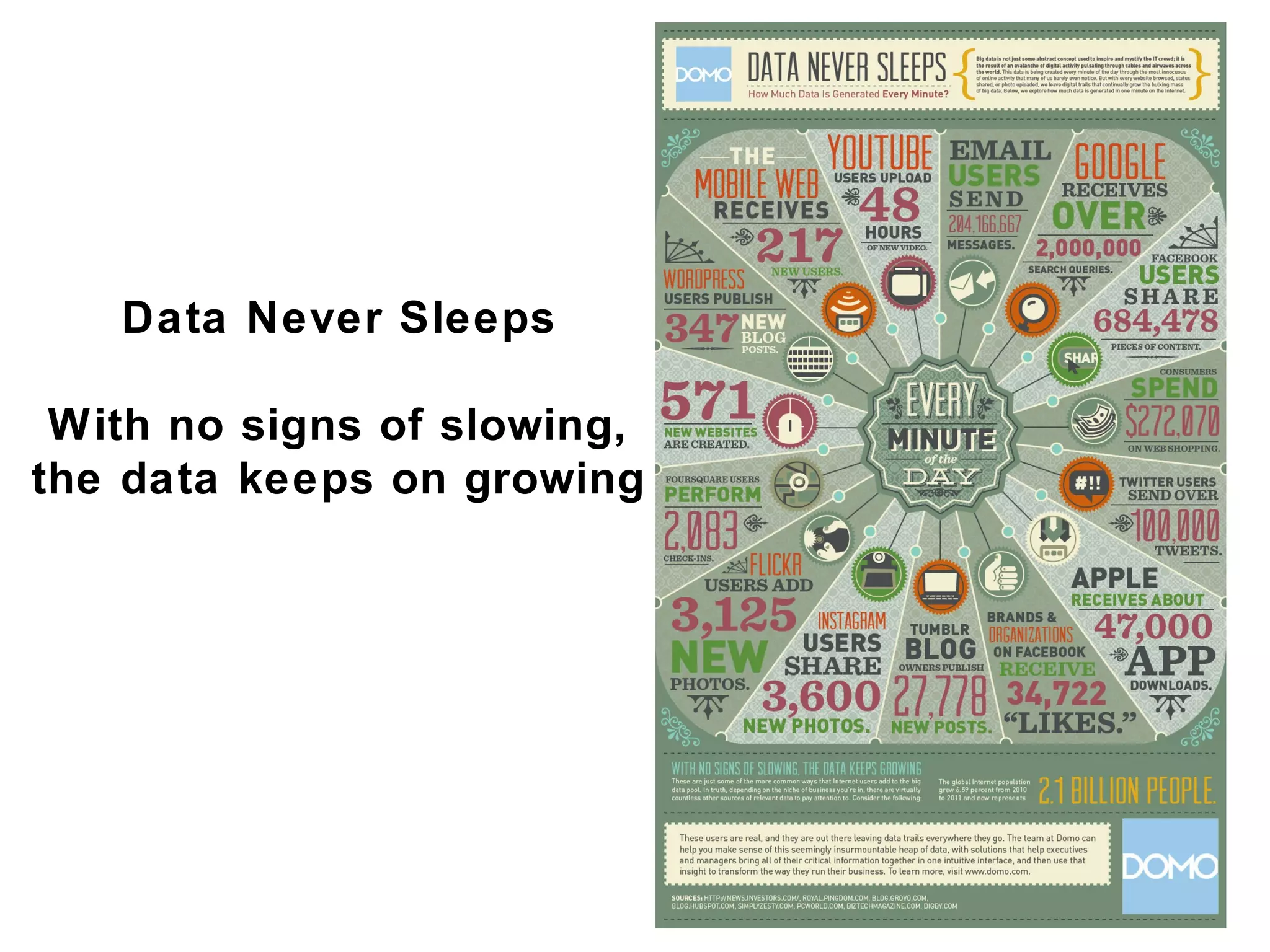
Data Never Sleeps

 With no signs of slowing,
the data keeps on growing
Defining Open Data
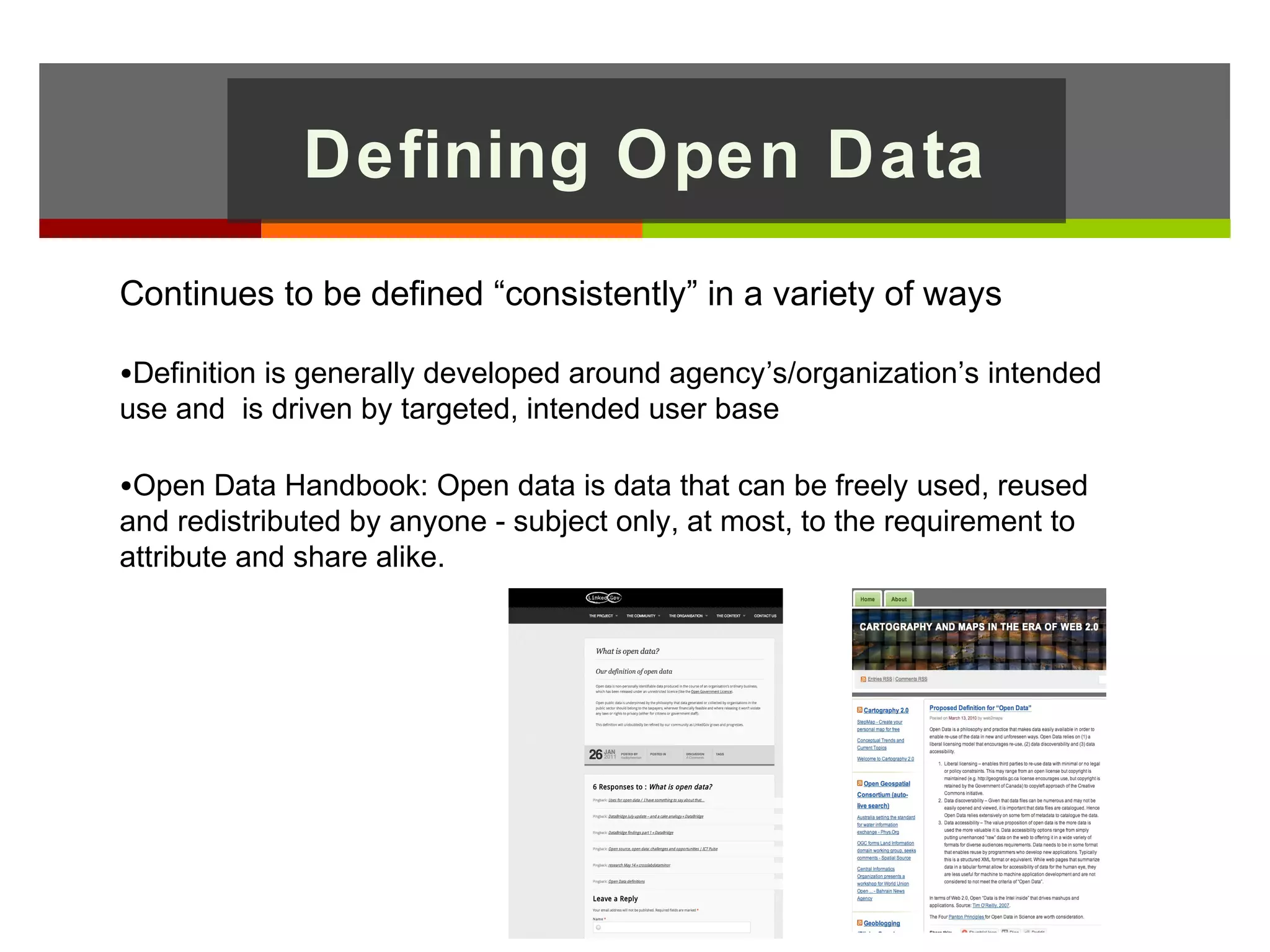
Continues to be defined “consistently” in a variety of ways

•Definition is generally developed around agency’s/organization’s intended
use and is driven by targeted, intended user base

•Open Data Handbook: Open data is data that can be freely used, reused
and redistributed by anyone - subject only, at most, to the requirement to
attribute and share alike.
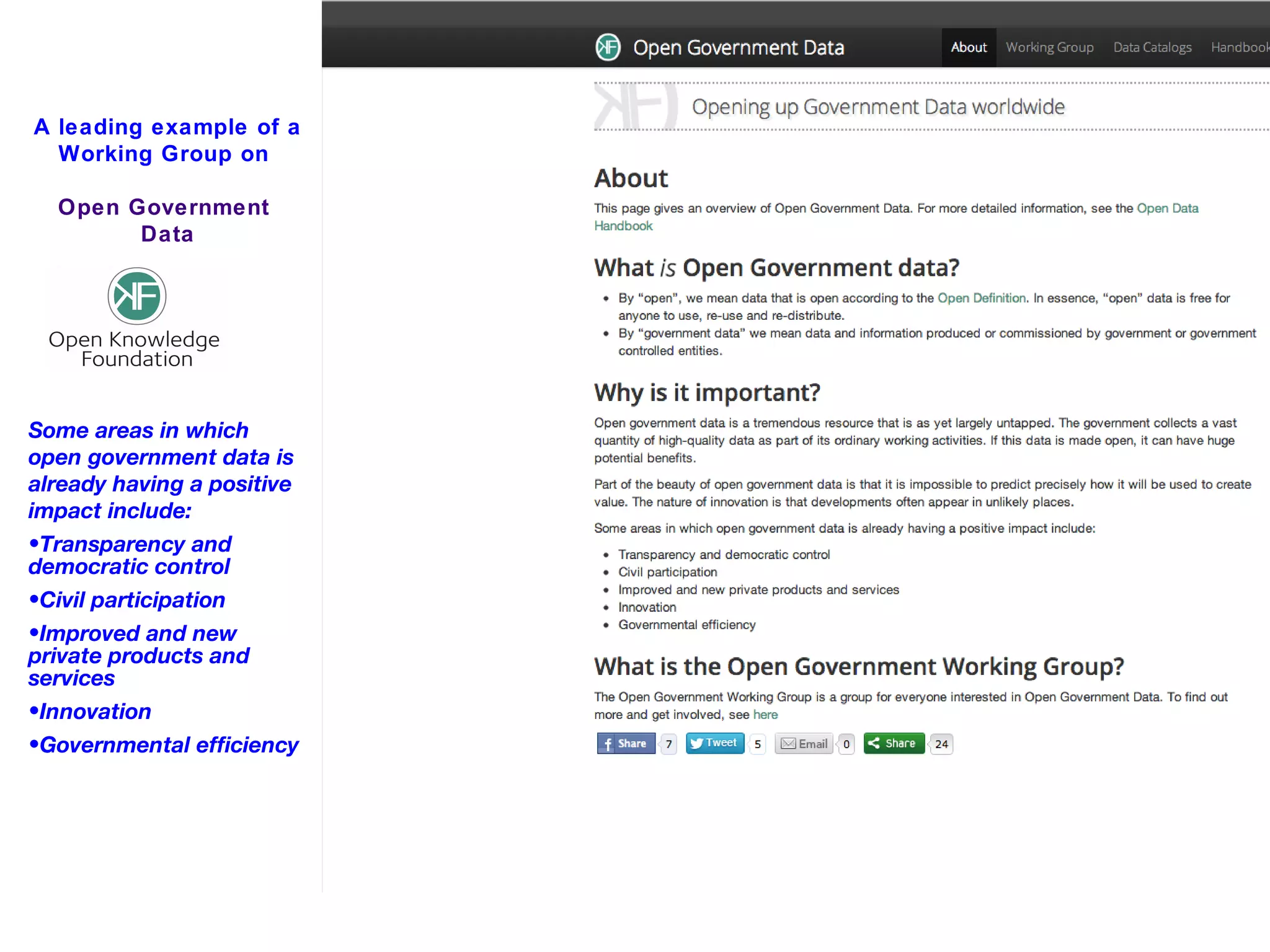
A leading example of a
  Working Group on

  Open Government
        Data


Some areas in which
open government data is
already having a positive
impact include:
•Transparency and
democratic control
•Civil participation
•Improved and new
private products and
services
•Innovation
•Governmental efficiency
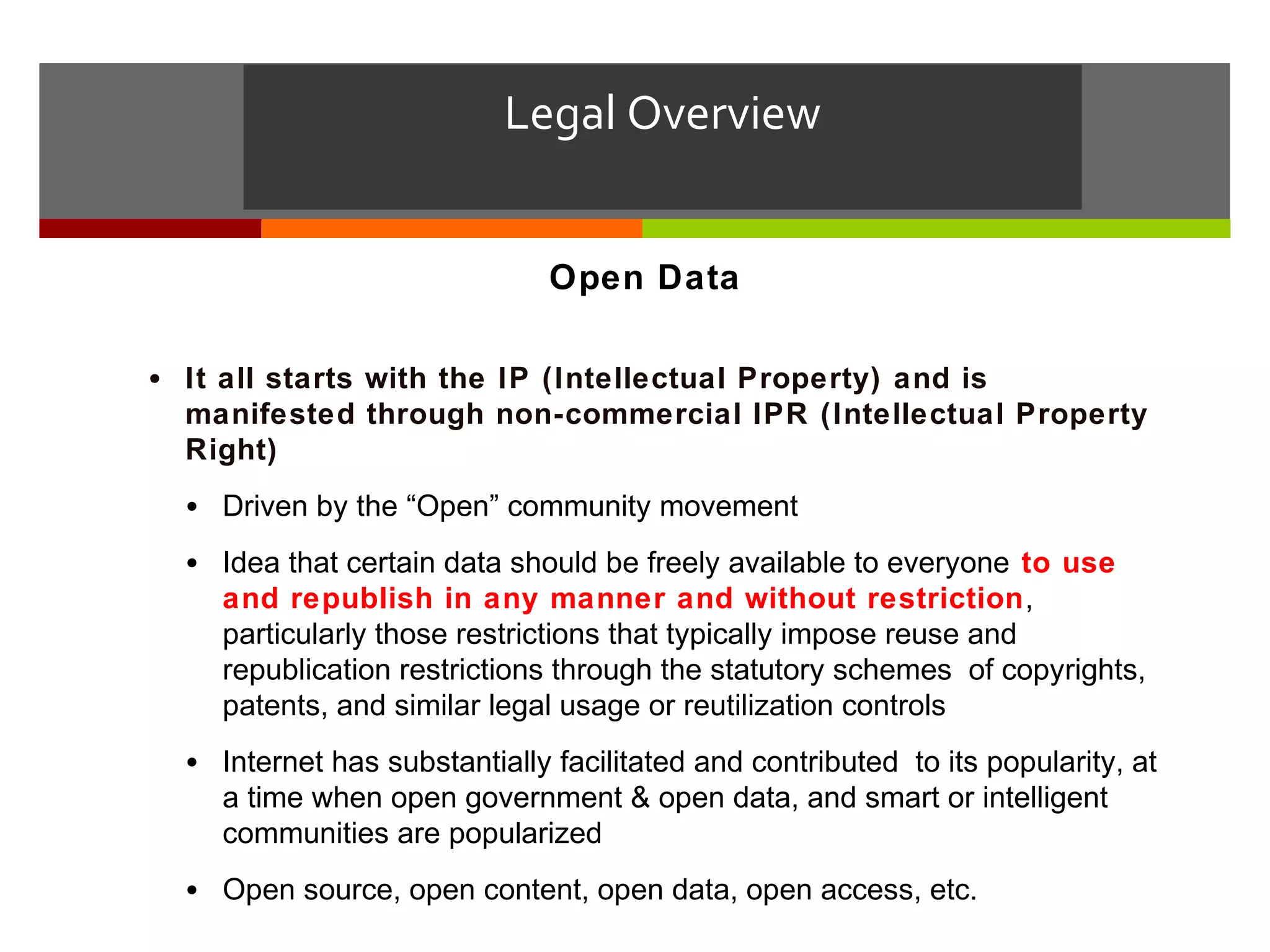
Legal Overview


                               Open Data

• It all starts with the IP (Intellectual Property) and is
  manifested through non-commercial IPR (Intellectual Property
  Right)
  • Driven by the “Open” community movement
  • Idea that certain data should be freely available to everyone to use
    and republish in any manner and without restriction,
    particularly those restrictions that typically impose reuse and
    republication restrictions through the statutory schemes of copyrights,
    patents, and similar legal usage or reutilization controls
  • Internet has substantially facilitated and contributed to its popularity, at
    a time when open government & open data, and smart or intelligent
    communities are popularized
  • Open source, open content, open data, open access, etc.
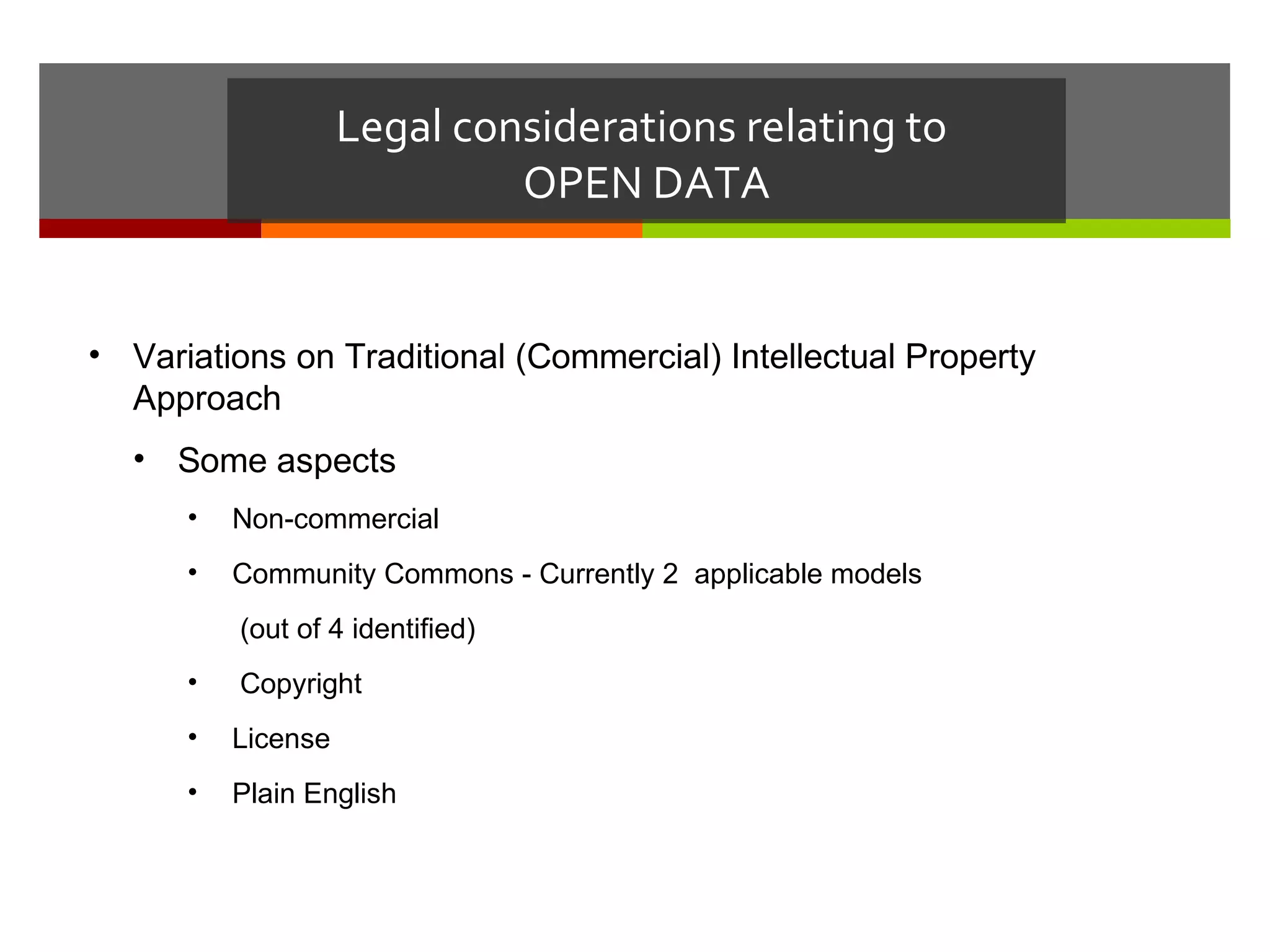
Legal considerations relating to
                             OPEN DATA


• Variations on Traditional (Commercial) Intellectual Property
  Approach
  • Some aspects
      •   Non-commercial
      •   Community Commons - Currently 2 applicable models
          (out of 4 identified)
      •   Copyright
      •   License
      •   Plain English
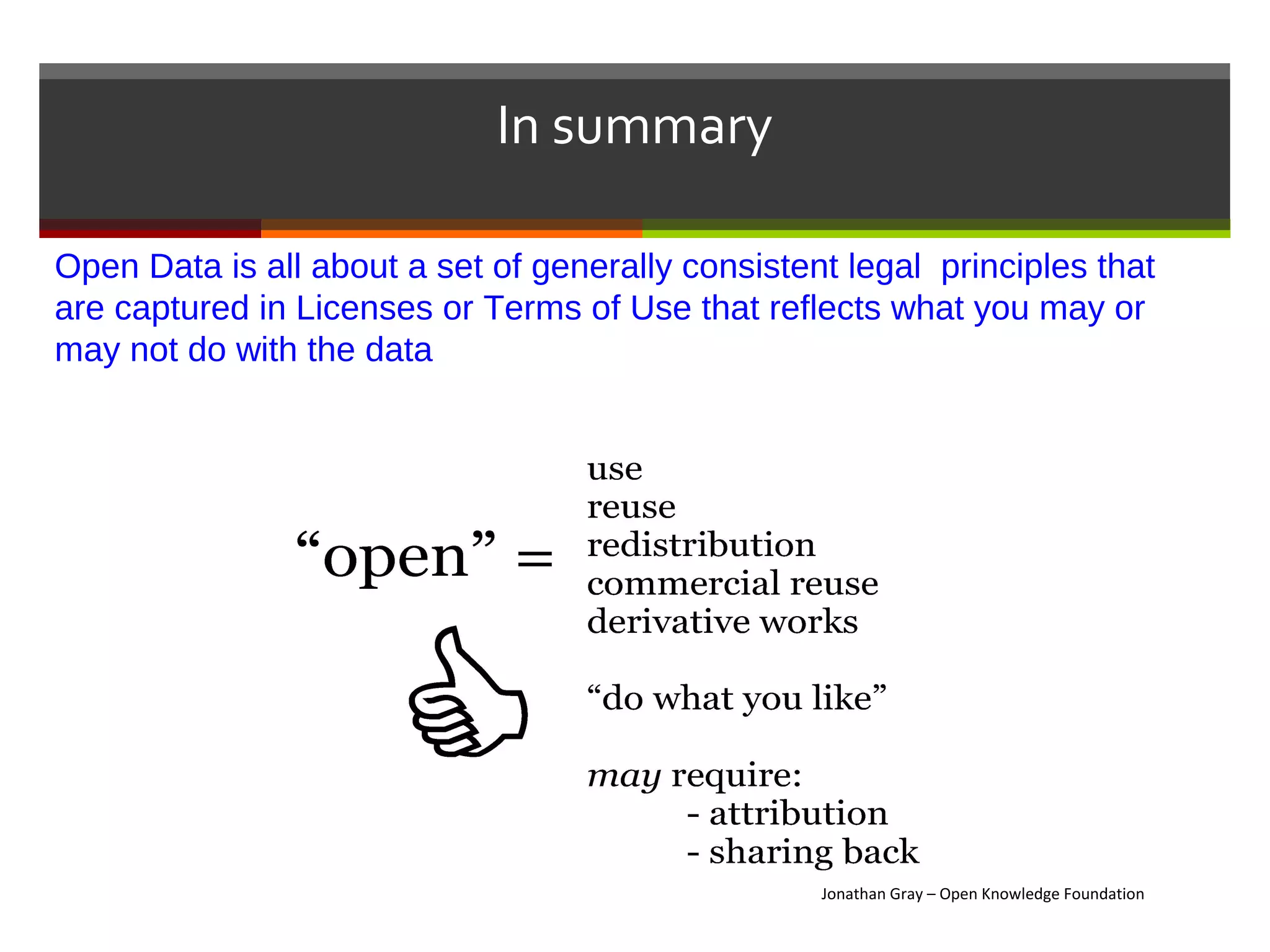
In summary

Open Data is all about a set of generally consistent legal principles that
are captured in Licenses or Terms of Use that reflects what you may or
may not do with the data


                                                   Jonathan Gray – Open Knowledge Foundation
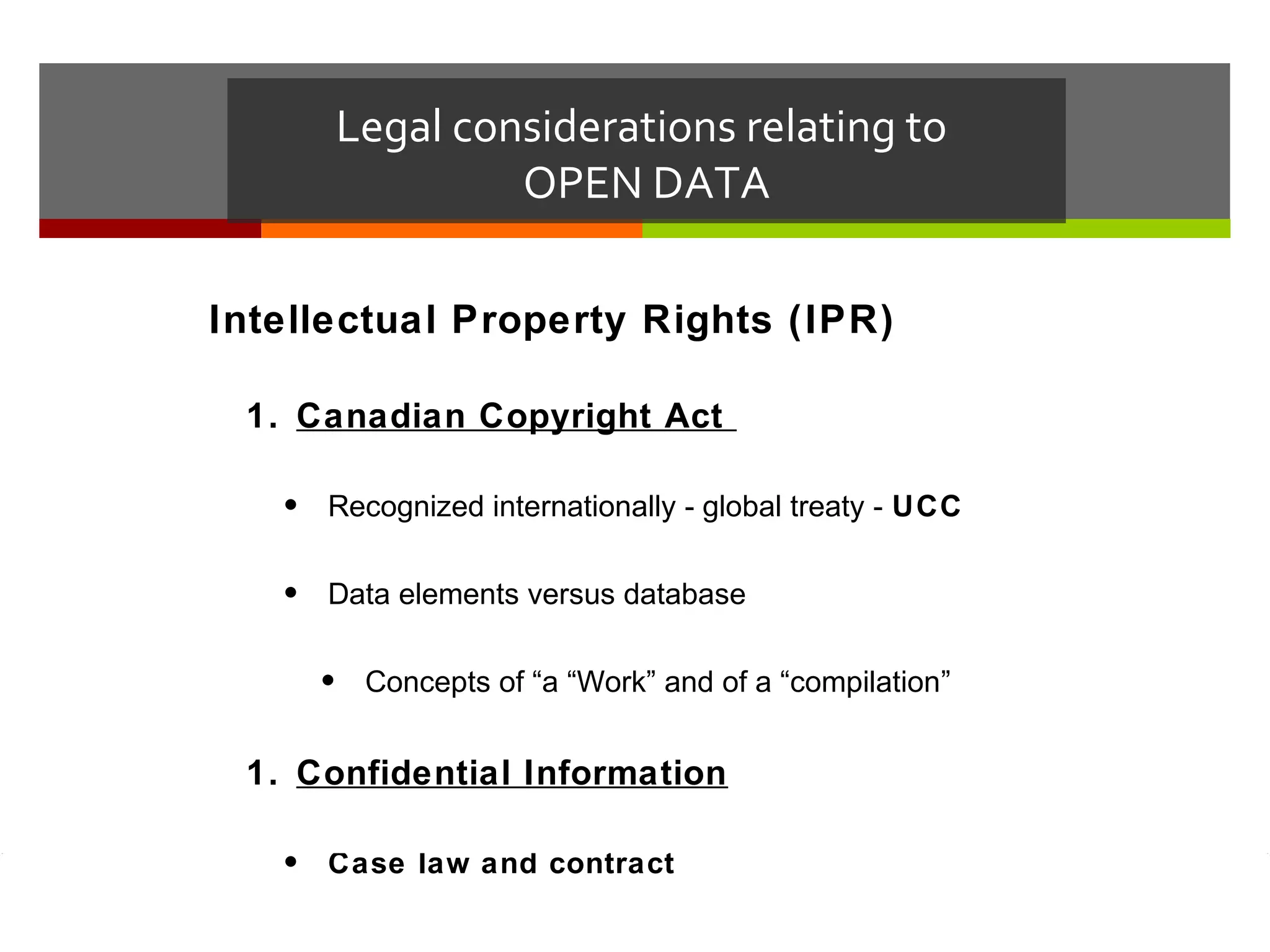
Legal considerations relating to
                  OPEN DATA

Intellectual Property Rights (IPR)

 1. Canadian Copyright Act

   • Recognized internationally - global treaty - UCC

   • Data elements versus database

     •    Concepts of “a “Work” and of a “compilation”


 1. Confidential Information

   • Case law and contract
Legal considerations relating to
                     OPEN DATA
                Associated Legal Considerations


• Data Protection
 •Privacy & Access to Information
      • Personal Information – MFIPPA
      • Breach of Confidence – Confidential Information
      • Confidential Information – IPR
         • Commercially sensitive information such as financial terms of
           submitted tenders and proposals
Legal considerations relating to
                      OPEN DATA


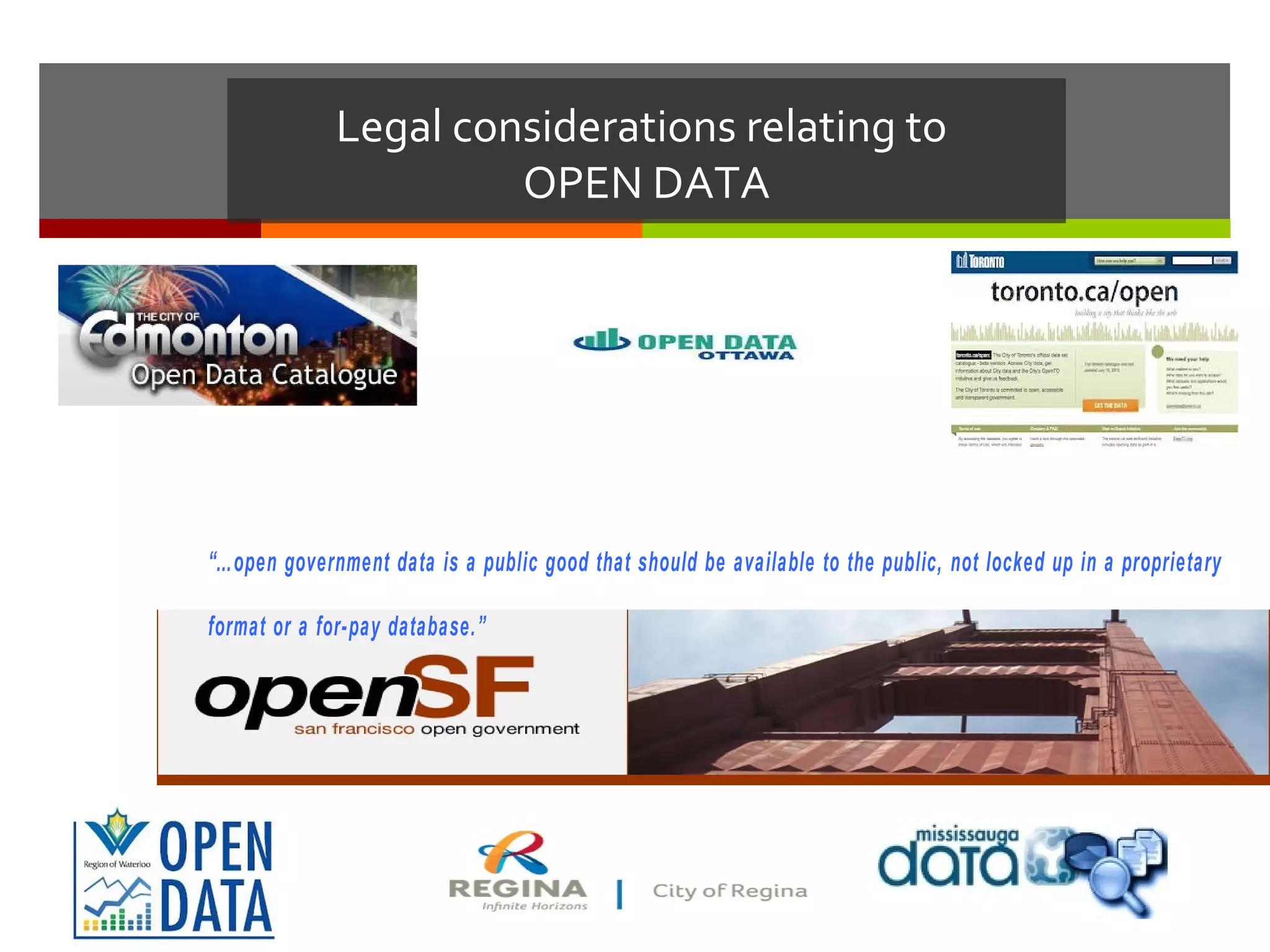
“…open government data is a public good that should be available to the public, not locked up in a proprietary

format or a for-pay database.”
Legal considerations relating to
              OPEN DATA


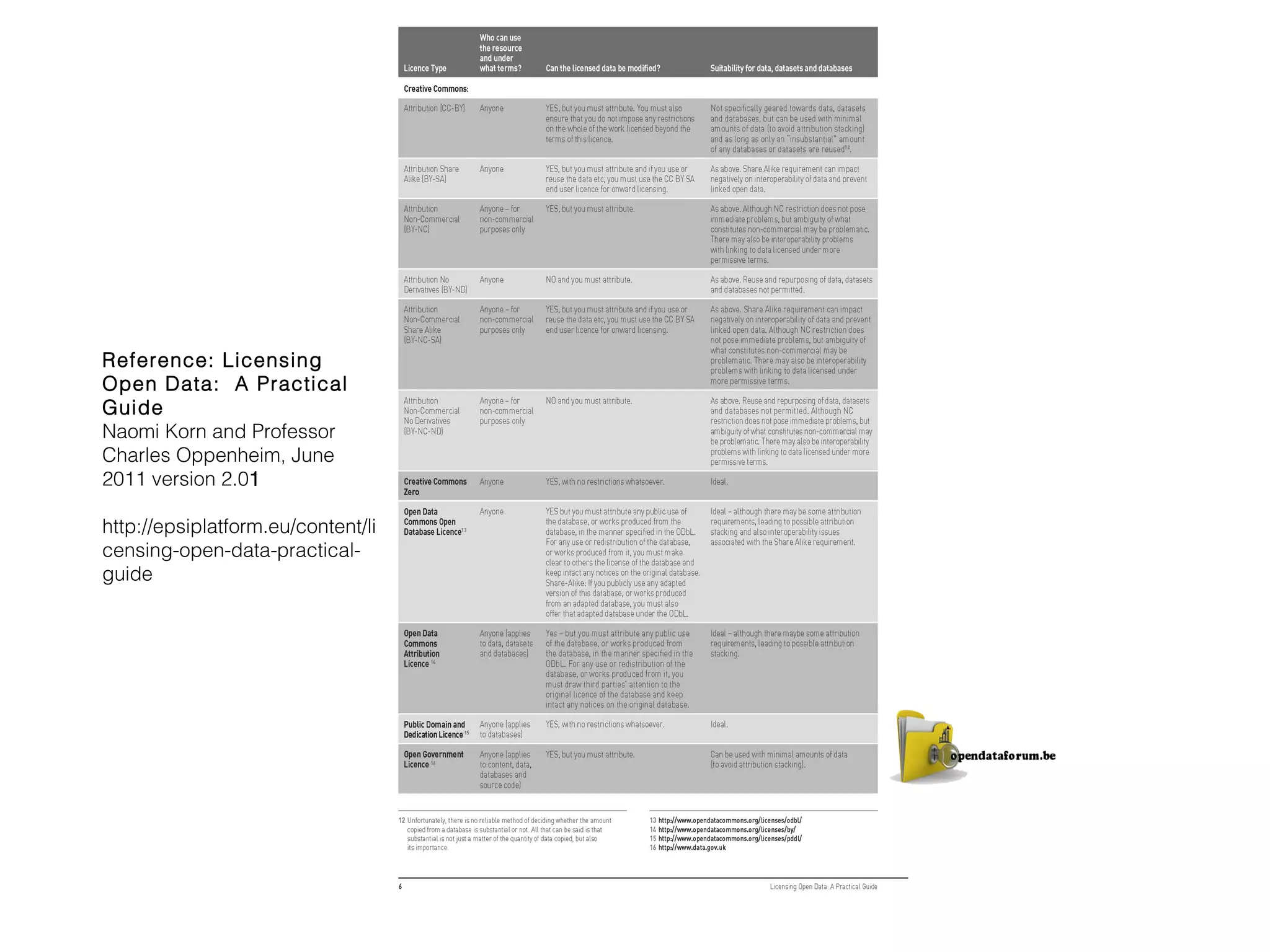
• Contracting through model License/Terms of Use
 • Non-traditional
 • Differentiating factors,
   • Brevity
   • Towards plain English
   • Unlike “typical” commercial approach
   • Copyright preservation as stated, with extended authority
   • Share and share-alike
   • Attribution not necessarily required
Reference: Licensing
Open Data: A Practical
Guide
Naomi Korn and Professor
Charles Oppenheim, June
2011 version 2.01

http://epsiplatform.eu/content/li
censing-open-data-practical-
guide
Legal considerations relating to
                  OPEN DATA

• Intellectual Property – Summary
  • Ownership

    • Of original datasets needs to be by Municipality

      • Springboard for innovation

      • Conforms to principles that Open Data “is a public good that
        should be available to the public, not locked up in a proprietary
        format or a for-pay database.”

    • Rights, if any, of private sector cleansing of data?

    • Data Catalogues and Datasets – website portal

    • What are the Applicable policies around ownership
OPEN DATA &
              ECONOMIC DEVELOPMENT
A brief introduction into the potential of Open Data as
an investment attraction tool

•Municipalities are bastions of a wealth of land related (cadastral) data in both digital and
hardcopy format


• Examples include


   •   Legal Descriptions


   •   Assessment & property/business tax information


   •   Official plans, zoning& planning and building information,


   •    Subdivision and other land related plans (including building plans),, plans of survey,
       etc.
OPEN DATA &
            ECONOMIC DEVELOPMENT

A brief introduction (continued)
•all capable of being digitized, cleansed and available as open data as a set
of economic development tool ((subject to certain restrictions)

•capable of being pooled and shared with colleague municipalities, senior
levels of government, and LIO as well as the private sector

•Goal is to provide a pooled resource to enable site selectors, and potential
businesses to create and compare digital models of potential local
investment and FTI opportunities

•Would require a public-private approach to design, build, maintain and
enhance
OPEN DATA &
              ECONOMIC DEVELOPMENT

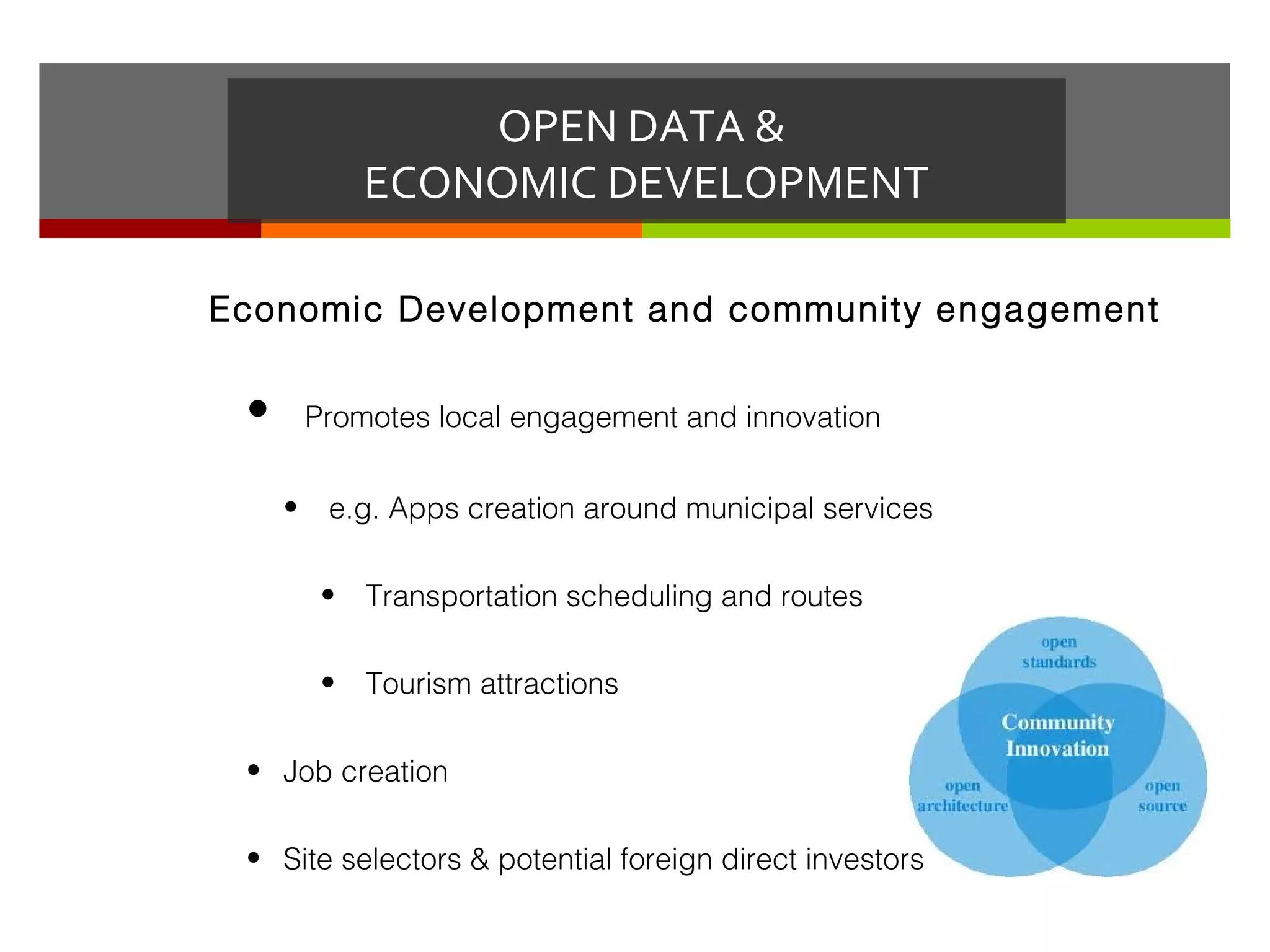
Economic Development and community engagement


 •       Promotes local engagement and innovation


     •    e.g. Apps creation around municipal services

          •   Transportation scheduling and routes

          •   Tourism attractions

 • Job creation

 • Site selectors & potential foreign direct investors
Open Data Solutions
Managing the Risk & Economic Development


                Lou Milrad
    Legal Counsel & Senior Advisor
          Milrad Law Office


            lou@milrad.ca 
            647.982.7890 | 
           www.milradlaw.ca

Open Data Solutions - Managing the Risk & Economic Development - 2012 AMCTO Open Data Forum October 29, 2012

  • 1.
    Open Data Solutions  Managing the Risk & Economic Development Lou Milrad Legal Counsel & Senior Advisor Milrad Law Office
  • 2.
    Data Never Sleeps With no signs of slowing, the data keeps on growing
  • 3.
    Defining Open Data Continuesto be defined “consistently” in a variety of ways •Definition is generally developed around agency’s/organization’s intended use and is driven by targeted, intended user base •Open Data Handbook: Open data is data that can be freely used, reused and redistributed by anyone - subject only, at most, to the requirement to attribute and share alike.
  • 4.
    A leading exampleof a Working Group on Open Government Data Some areas in which open government data is already having a positive impact include: •Transparency and democratic control •Civil participation •Improved and new private products and services •Innovation •Governmental efficiency
  • 5.
    Legal Overview Open Data • It all starts with the IP (Intellectual Property) and is manifested through non-commercial IPR (Intellectual Property Right) • Driven by the “Open” community movement • Idea that certain data should be freely available to everyone to use and republish in any manner and without restriction, particularly those restrictions that typically impose reuse and republication restrictions through the statutory schemes of copyrights, patents, and similar legal usage or reutilization controls • Internet has substantially facilitated and contributed to its popularity, at a time when open government & open data, and smart or intelligent communities are popularized • Open source, open content, open data, open access, etc.
  • 6.
    Legal considerations relatingto OPEN DATA • Variations on Traditional (Commercial) Intellectual Property Approach • Some aspects • Non-commercial • Community Commons - Currently 2 applicable models (out of 4 identified) • Copyright • License • Plain English
  • 7.
    In summary Open Datais all about a set of generally consistent legal principles that are captured in Licenses or Terms of Use that reflects what you may or may not do with the data Jonathan Gray – Open Knowledge Foundation
  • 8.
    Legal considerations relatingto OPEN DATA Intellectual Property Rights (IPR) 1. Canadian Copyright Act • Recognized internationally - global treaty - UCC • Data elements versus database • Concepts of “a “Work” and of a “compilation” 1. Confidential Information • Case law and contract
  • 9.
    Legal considerations relatingto OPEN DATA Associated Legal Considerations • Data Protection •Privacy & Access to Information • Personal Information – MFIPPA • Breach of Confidence – Confidential Information • Confidential Information – IPR • Commercially sensitive information such as financial terms of submitted tenders and proposals
  • 10.
    Legal considerations relatingto OPEN DATA “…open government data is a public good that should be available to the public, not locked up in a proprietary format or a for-pay database.”
  • 11.
    Legal considerations relatingto OPEN DATA • Contracting through model License/Terms of Use • Non-traditional • Differentiating factors, • Brevity • Towards plain English • Unlike “typical” commercial approach • Copyright preservation as stated, with extended authority • Share and share-alike • Attribution not necessarily required
  • 12.
    Reference: Licensing Open Data:A Practical Guide Naomi Korn and Professor Charles Oppenheim, June 2011 version 2.01 http://epsiplatform.eu/content/li censing-open-data-practical- guide
  • 13.
    Legal considerations relatingto OPEN DATA • Intellectual Property – Summary • Ownership • Of original datasets needs to be by Municipality • Springboard for innovation • Conforms to principles that Open Data “is a public good that should be available to the public, not locked up in a proprietary format or a for-pay database.” • Rights, if any, of private sector cleansing of data? • Data Catalogues and Datasets – website portal • What are the Applicable policies around ownership
  • 14.
    OPEN DATA & ECONOMIC DEVELOPMENT A brief introduction into the potential of Open Data as an investment attraction tool •Municipalities are bastions of a wealth of land related (cadastral) data in both digital and hardcopy format • Examples include • Legal Descriptions • Assessment & property/business tax information • Official plans, zoning& planning and building information, • Subdivision and other land related plans (including building plans),, plans of survey, etc.
  • 15.
    OPEN DATA & ECONOMIC DEVELOPMENT A brief introduction (continued) •all capable of being digitized, cleansed and available as open data as a set of economic development tool ((subject to certain restrictions) •capable of being pooled and shared with colleague municipalities, senior levels of government, and LIO as well as the private sector •Goal is to provide a pooled resource to enable site selectors, and potential businesses to create and compare digital models of potential local investment and FTI opportunities •Would require a public-private approach to design, build, maintain and enhance
  • 16.
    OPEN DATA & ECONOMIC DEVELOPMENT Economic Development and community engagement • Promotes local engagement and innovation • e.g. Apps creation around municipal services • Transportation scheduling and routes • Tourism attractions • Job creation • Site selectors & potential foreign direct investors
  • 17.
    Open Data Solutions Managingthe Risk & Economic Development Lou Milrad Legal Counsel & Senior Advisor Milrad Law Office lou@milrad.ca  647.982.7890 |  www.milradlaw.ca