




Do I have to Be Creative  to be A Successful  Virtual Assistant?
Do I have to Be Creative  to be A Successful  Virtual Assistant? Only if you  want to be paid well and be successful!
Robert Alan Black,  Ph.D,CSP. A l a n Welcome-Hallo-Good Day
Do I have to Be Creative  to be A Successful  Virtual Assistant?
YES! YES! YES! YES! YES! YES!
To be paid well  & be successful!
What does it  Mean to be Creative? Am I creative? How can I become More creative?
Creative? New ,  Novel ,  Unique New combination of old ,  existing ideas
Creative? New ,  Novel ,  Unique
 
Creative? New ,  Novel ,  Unique New combination of old ,  existing ideas
Creative? New combination of old ,  existing ideas
 
Am I  Creative
 
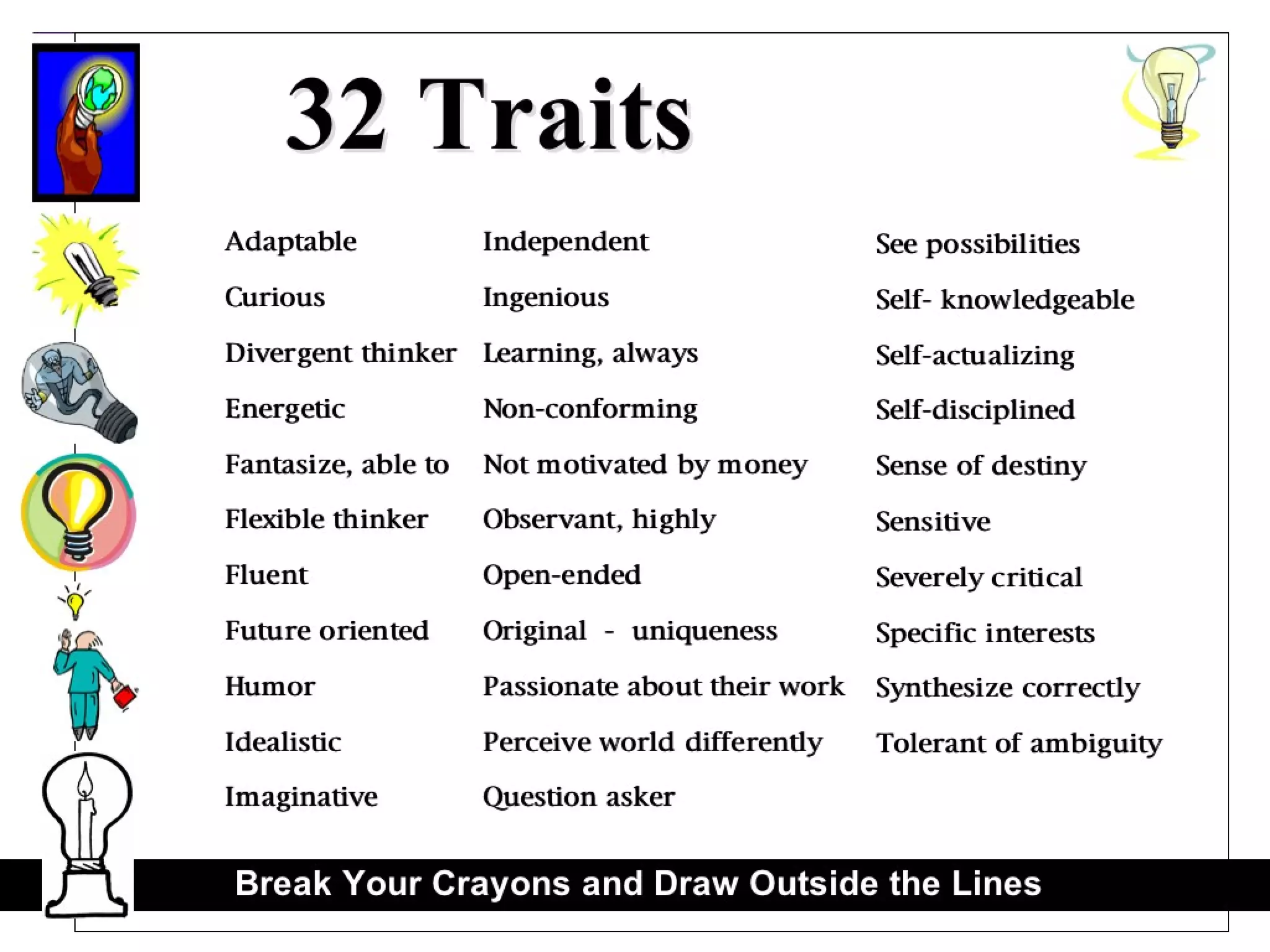
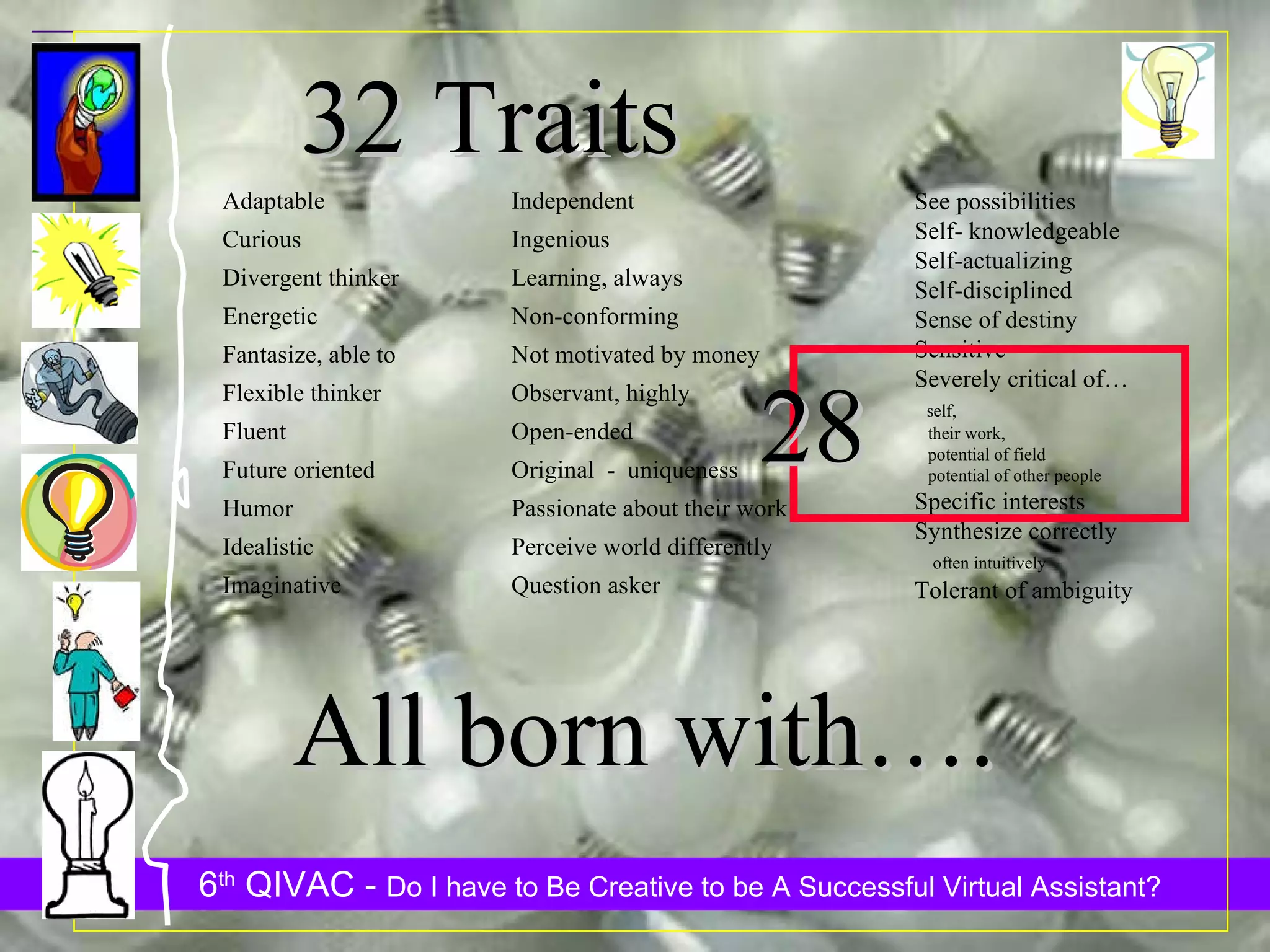
32 Traits See possibilities Self- knowledgeable Self-actualizing Self-disciplined Sense of destiny Sensitive Severely critical of… self,  their work,  potential of field  potential of other people Specific interests Synthesize correctly  often intuitively Tolerant of ambiguity Adaptable Curious Divergent thinker Energetic Fantasize, able to Flexible thinker Fluent Future oriented Humor Idealistic Imaginative Independent Ingenious Learning, always Non-conforming Not motivated by money Observant, highly Open-ended Original  -  uniqueness Passionate about their work Perceive world differently Question asker 28 All born with….
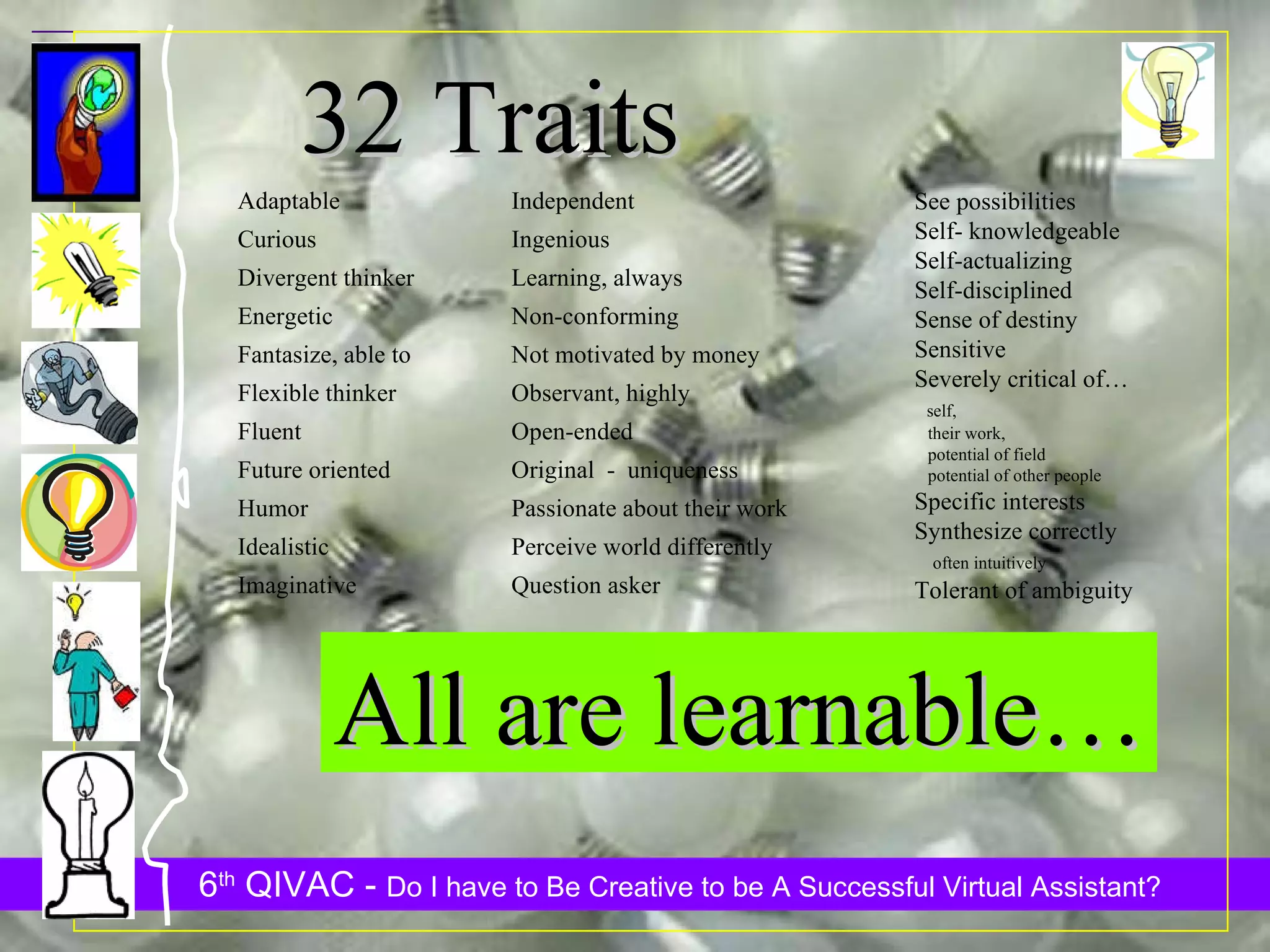
32 Traits See possibilities Self- knowledgeable Self-actualizing Self-disciplined Sense of destiny Sensitive Severely critical of… self,  their work,  potential of field  potential of other people Specific interests Synthesize correctly  often intuitively Tolerant of ambiguity Adaptable Curious Divergent thinker Energetic Fantasize, able to Flexible thinker Fluent Future oriented Humor Idealistic Imaginative Independent Ingenious Learning, always Non-conforming Not motivated by money Observant, highly Open-ended Original  -  uniqueness Passionate about their work Perceive world differently Question asker All are learnable…
Each of us  are born  R a i n b o w s & turned into B&W pens/pencils
By continually Looking for Generating & Combining Ideas We become more C r e a t i v e
How?
C r e a t i v e  Think ing   Inside, Outside,  Along side, Under, Over, with a New or No Box at All…
Let’s Begin !
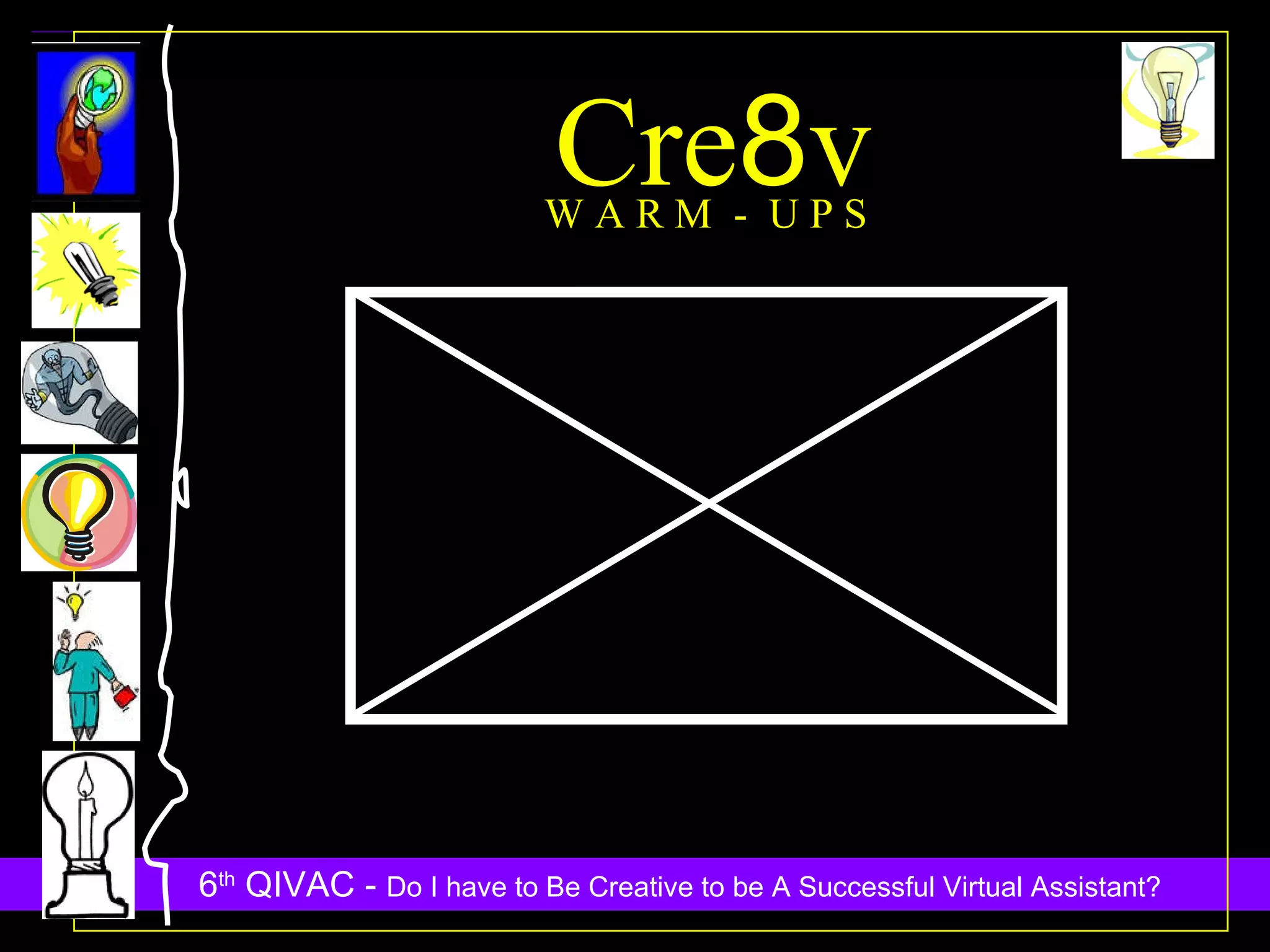
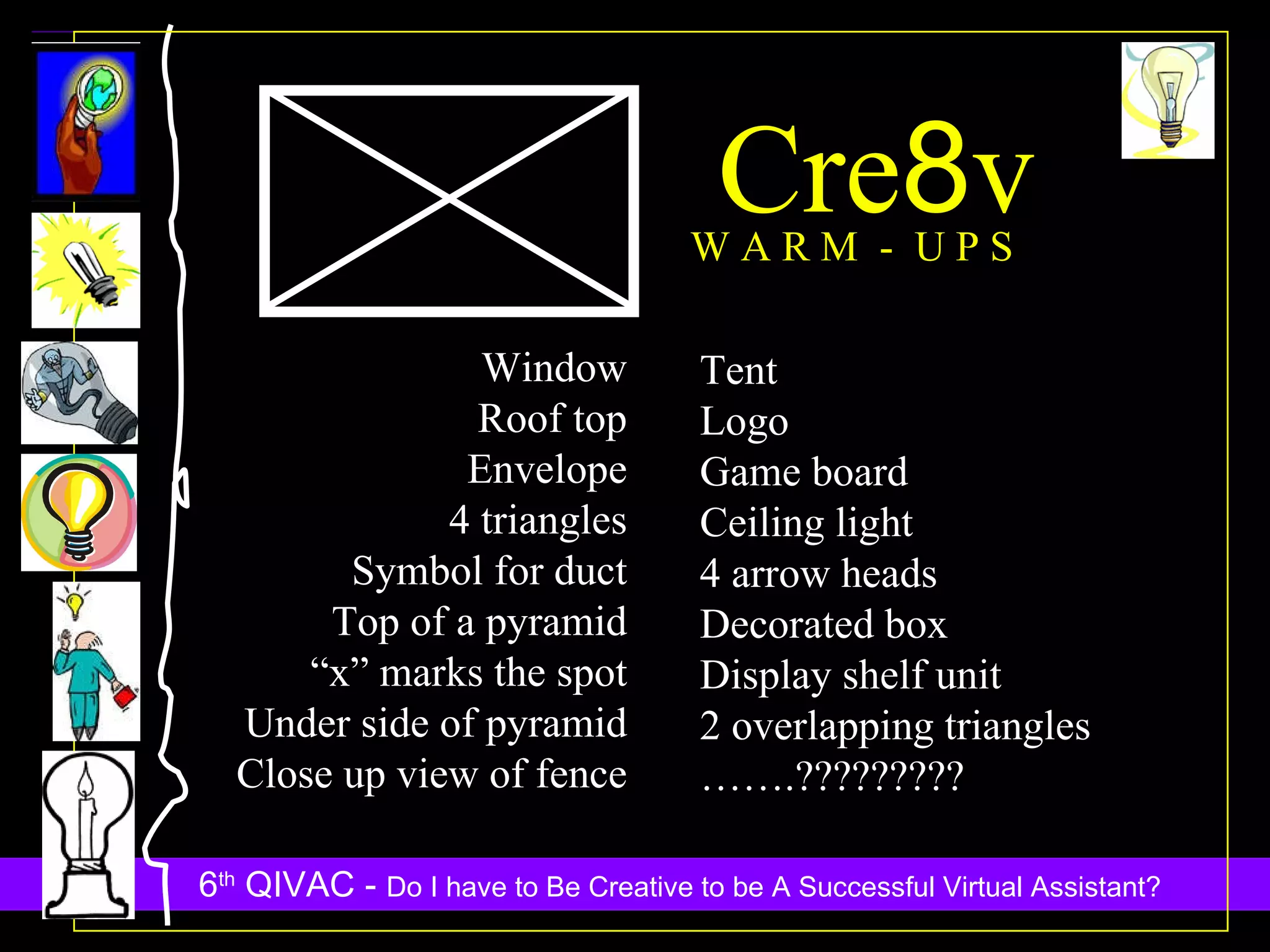
Cre 8 v W A R M  -  U P S
Cre 8 v W A R M  -  U P S Window Roof top Envelope 4 triangles Symbol for duct Top of a pyramid “ x” marks the spot Under side of pyramid Close up view of fence Tent Logo Game board Ceiling light 4 arrow heads Decorated box Display shelf unit 2 overlapping triangles …… .?????????
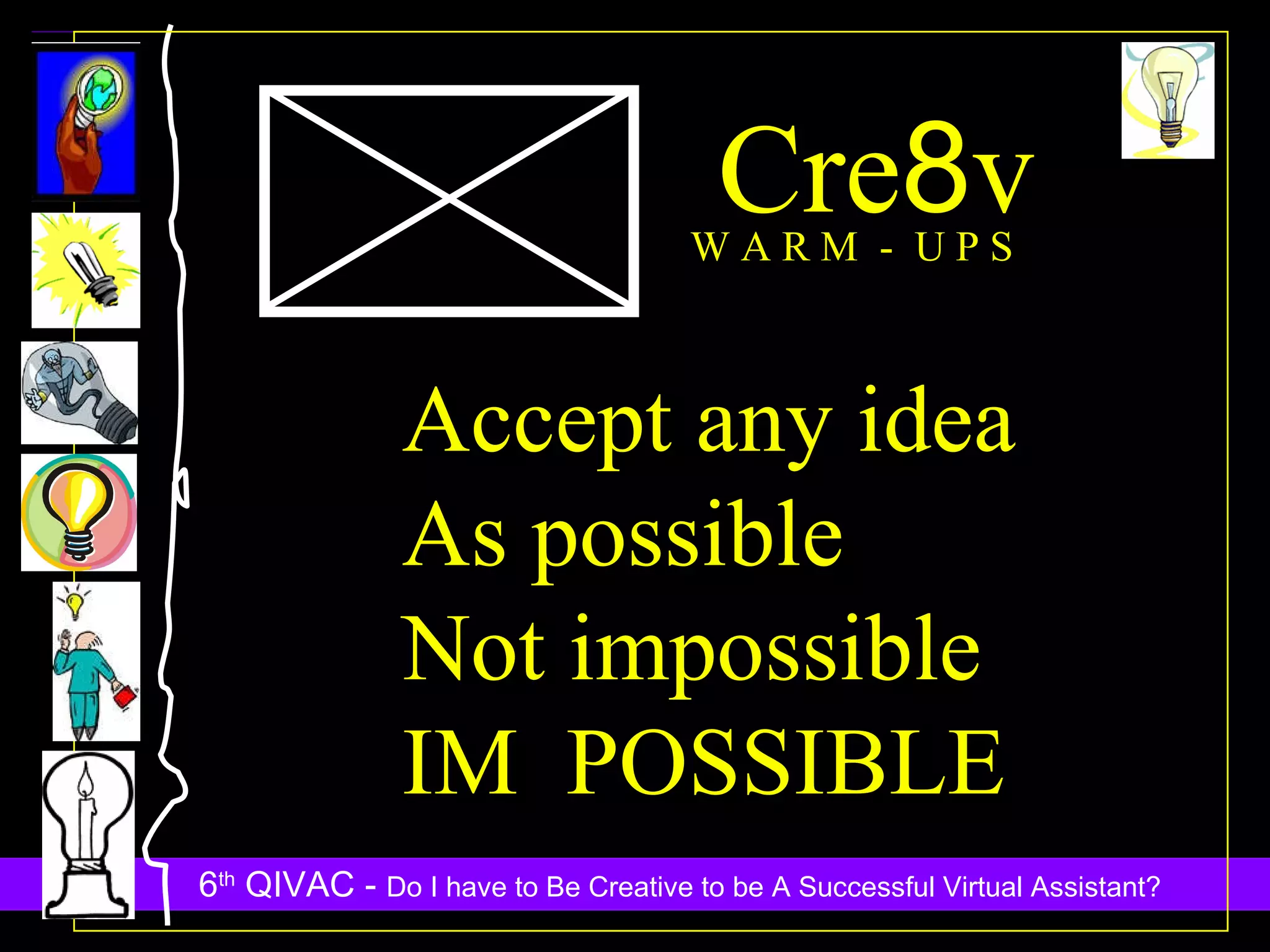
Cre 8 v W A R M  -  U P S Accept any idea As possible Not impossible IM  POSSIBLE
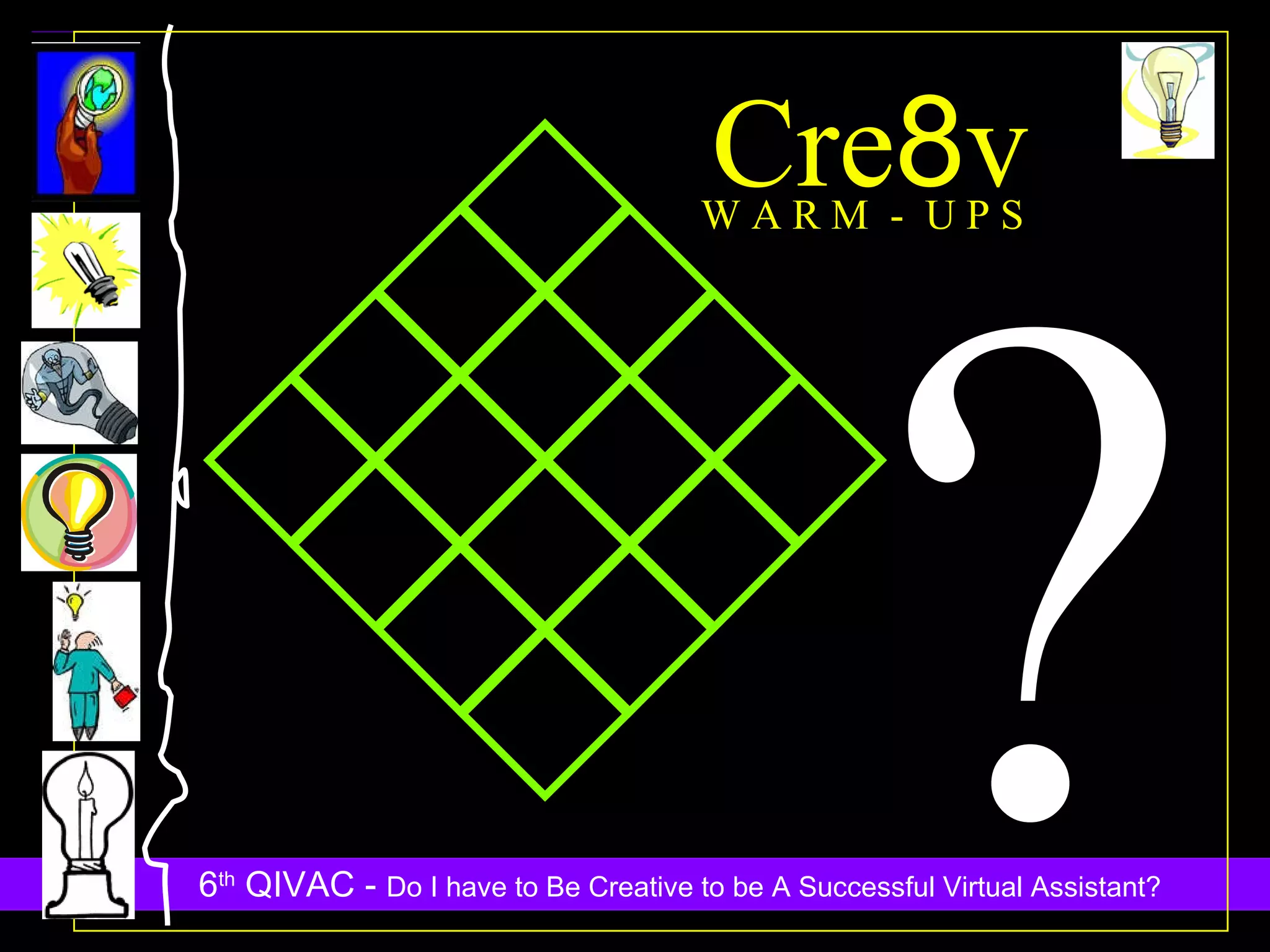
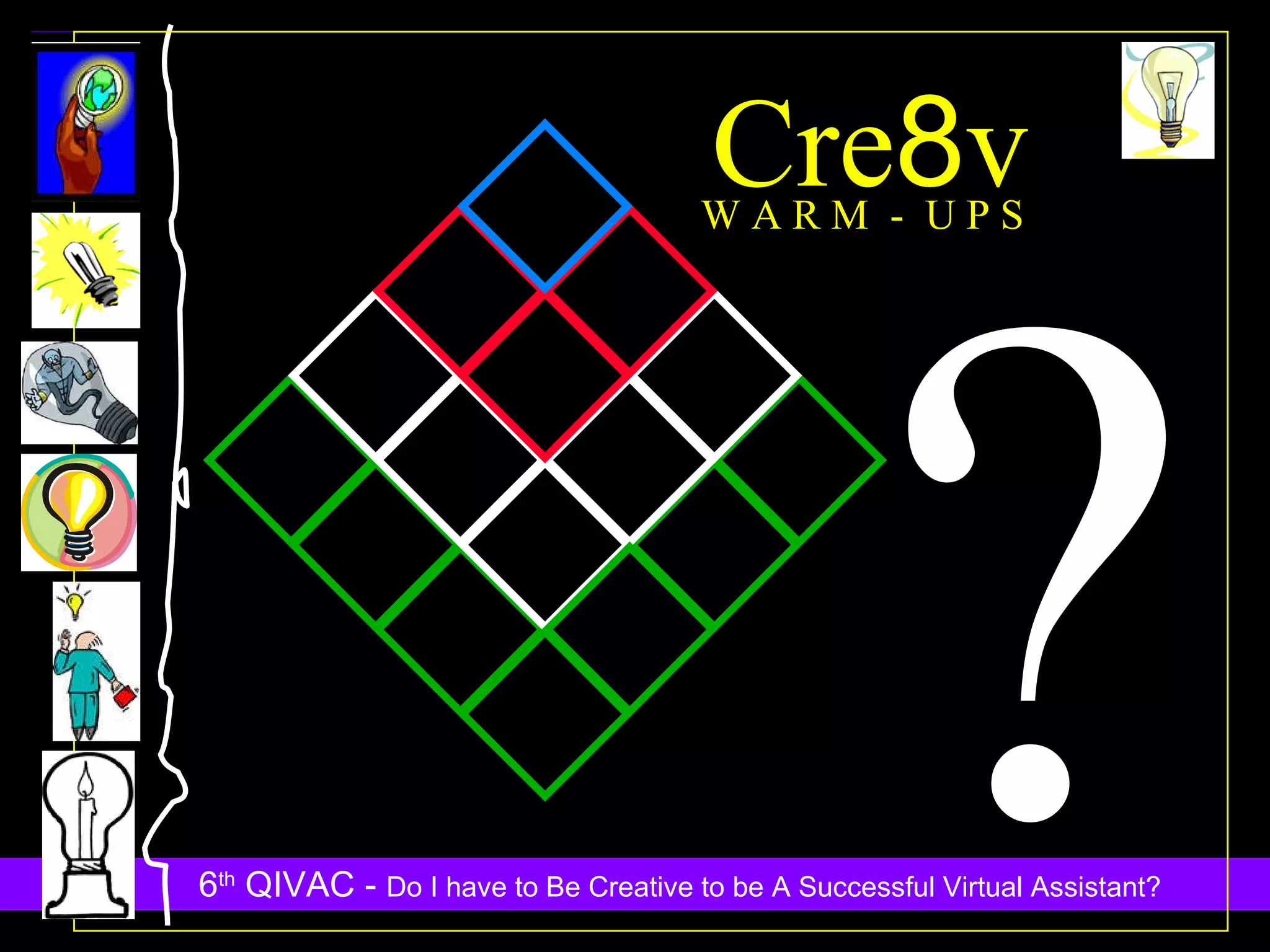
Cre 8 v W A R M  -  U P S ?
many perspectives What you see What your client sees
 
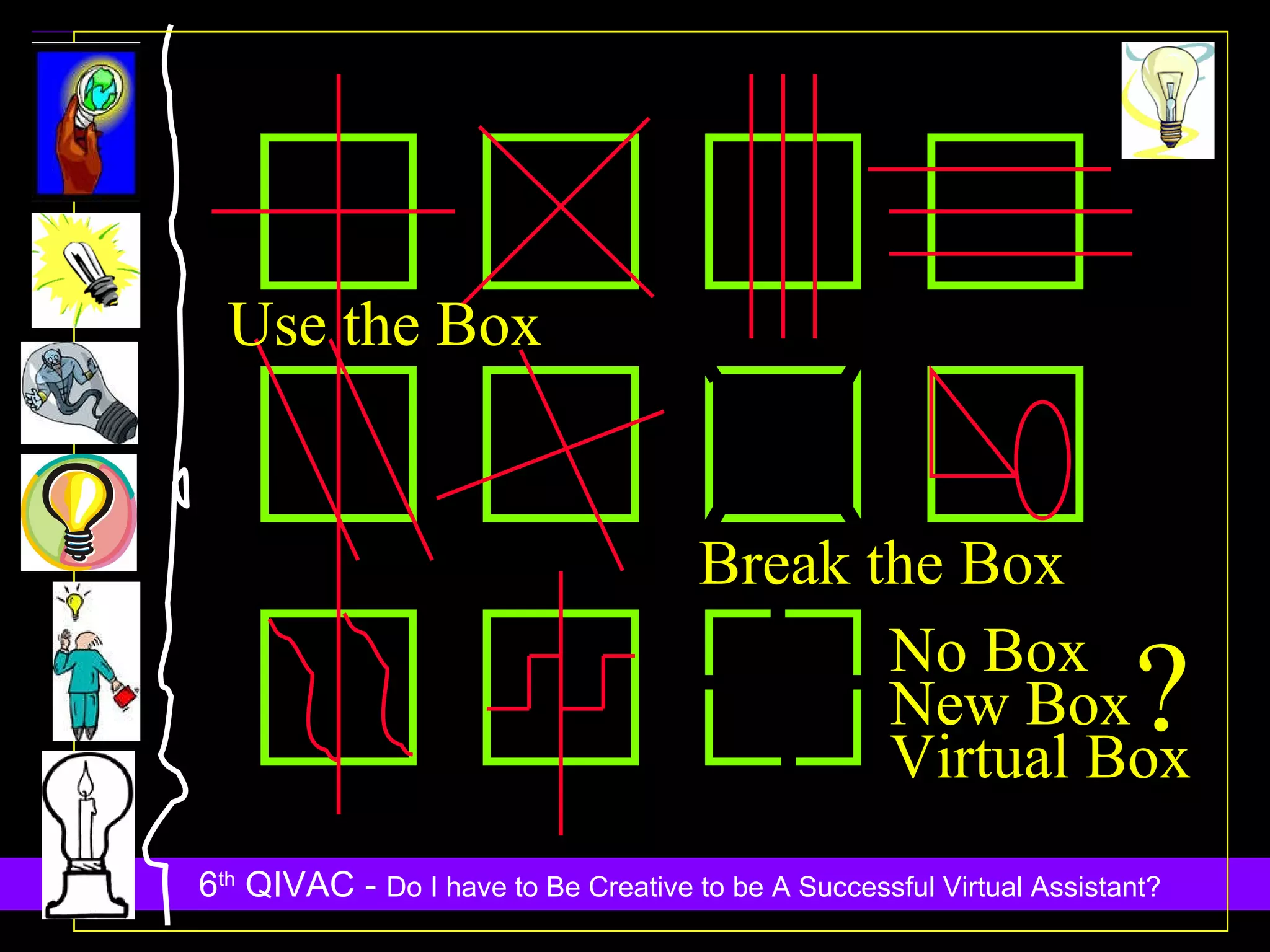
? Break the Box Use the Box No Box New Box Virtual Box
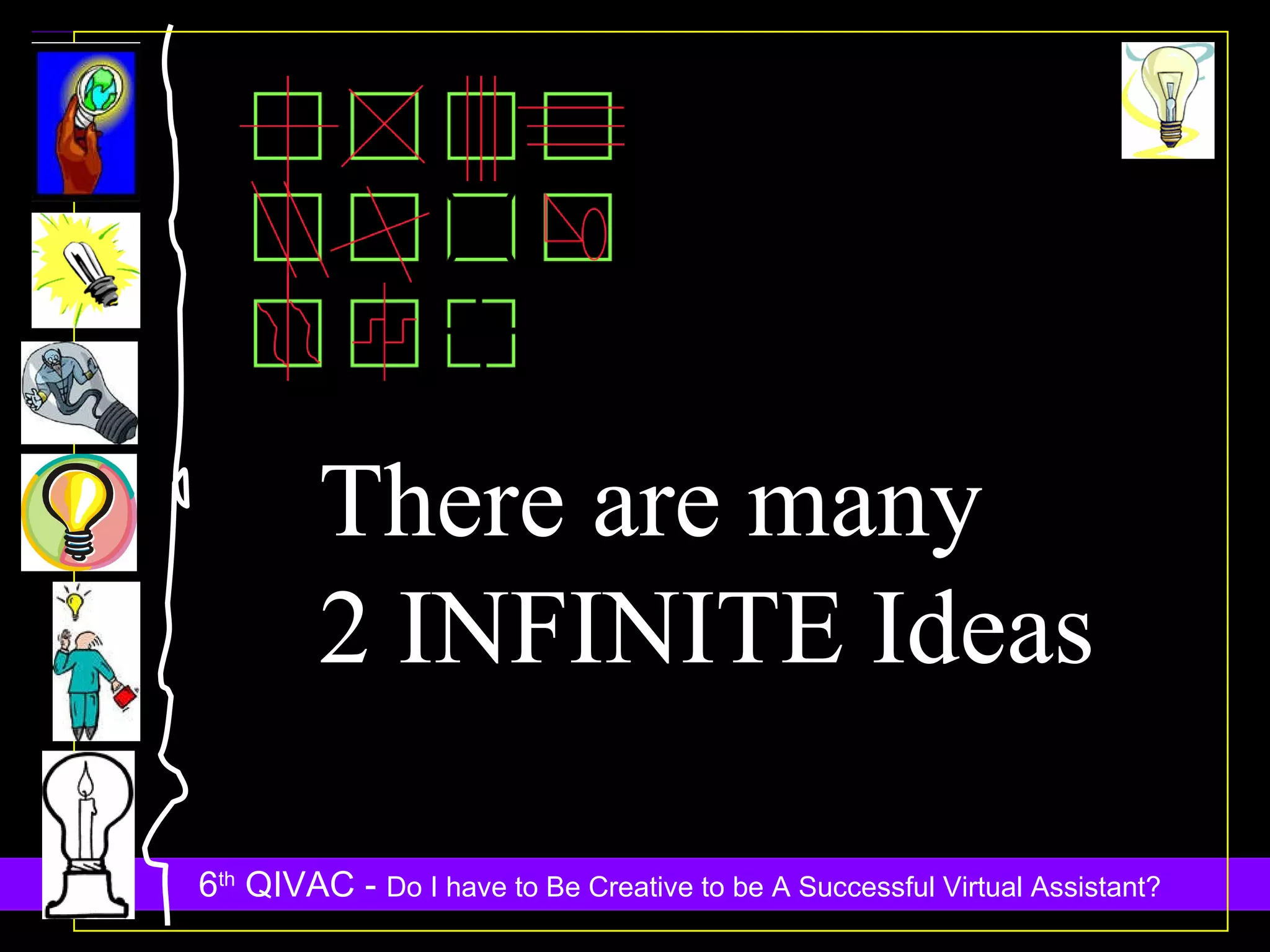
There are many 2 INFINITE Ideas
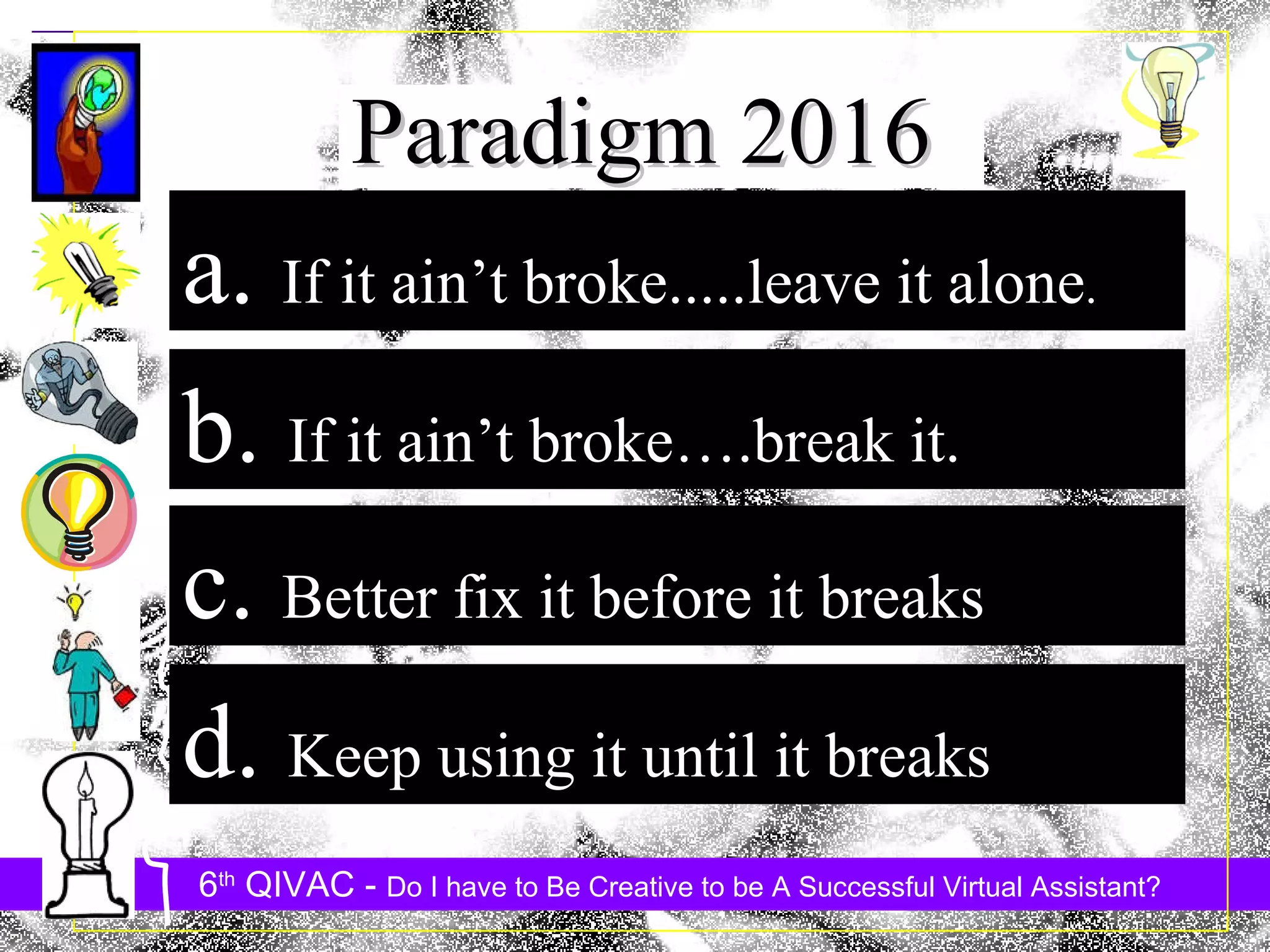
Paradigm 2016 a.  If it ain’t broke.....leave it alone . b.  If it ain’t broke….break it.  c.  Better fix it before it breaks d.  Keep using it until it breaks
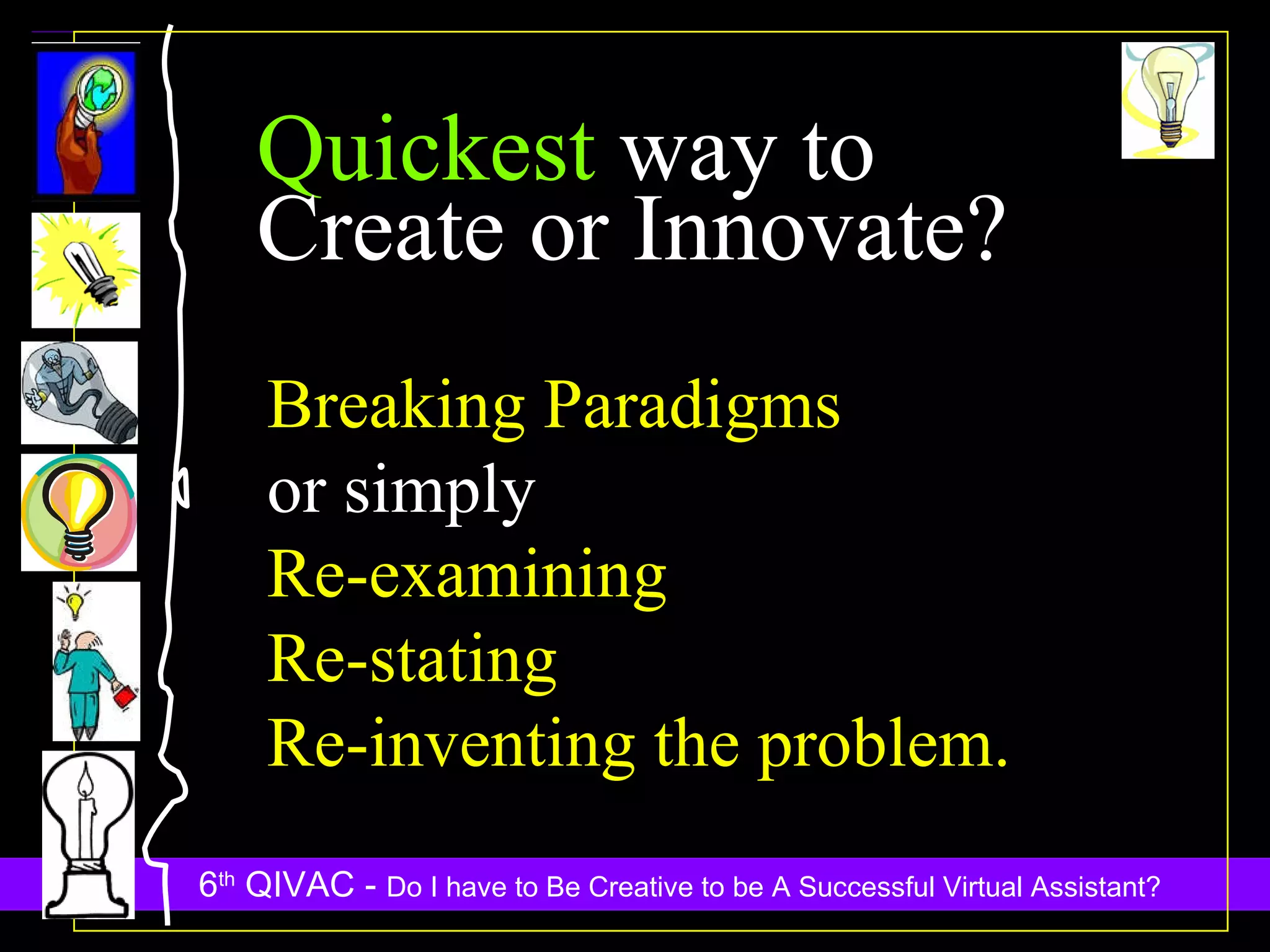
Breaking Paradigms or simply  Re-examining Re-stating Re-inventing the problem. Quickest  way to Create or Innovate?
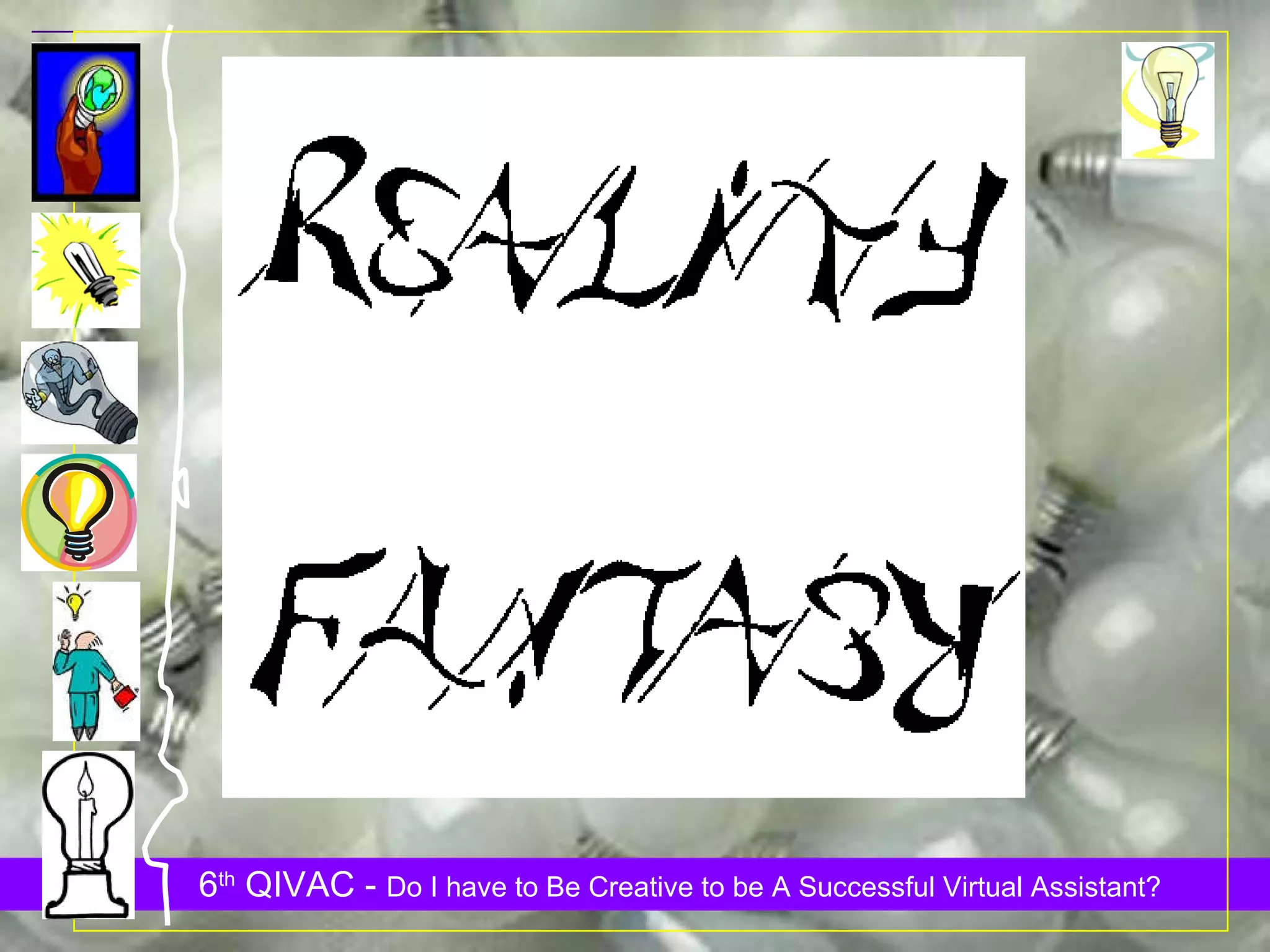
What Might It Be?
 
 
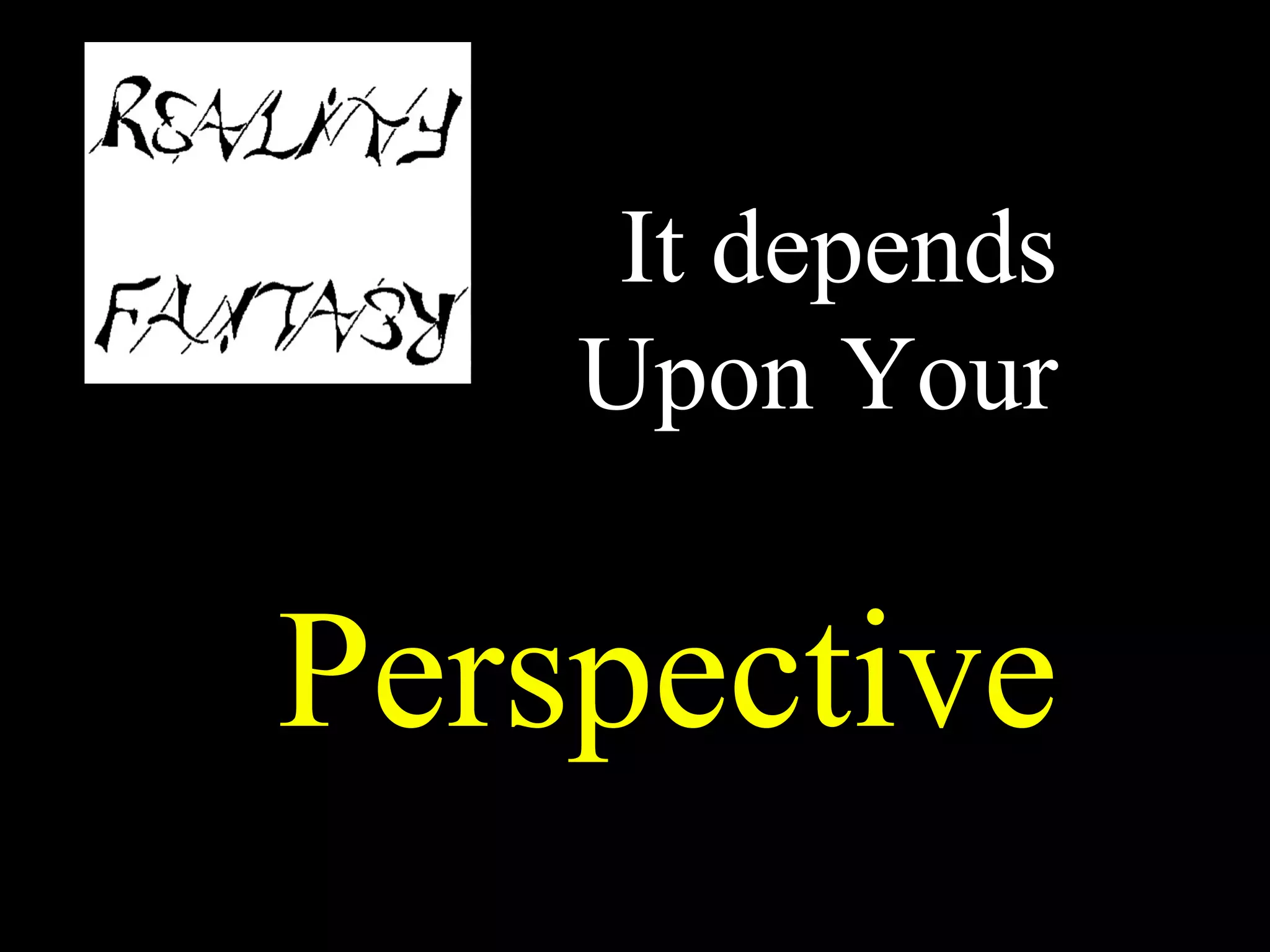
It depends Upon Your Perspective
How Are You C r e a t i v e
S t y l e s Cre8ng ™
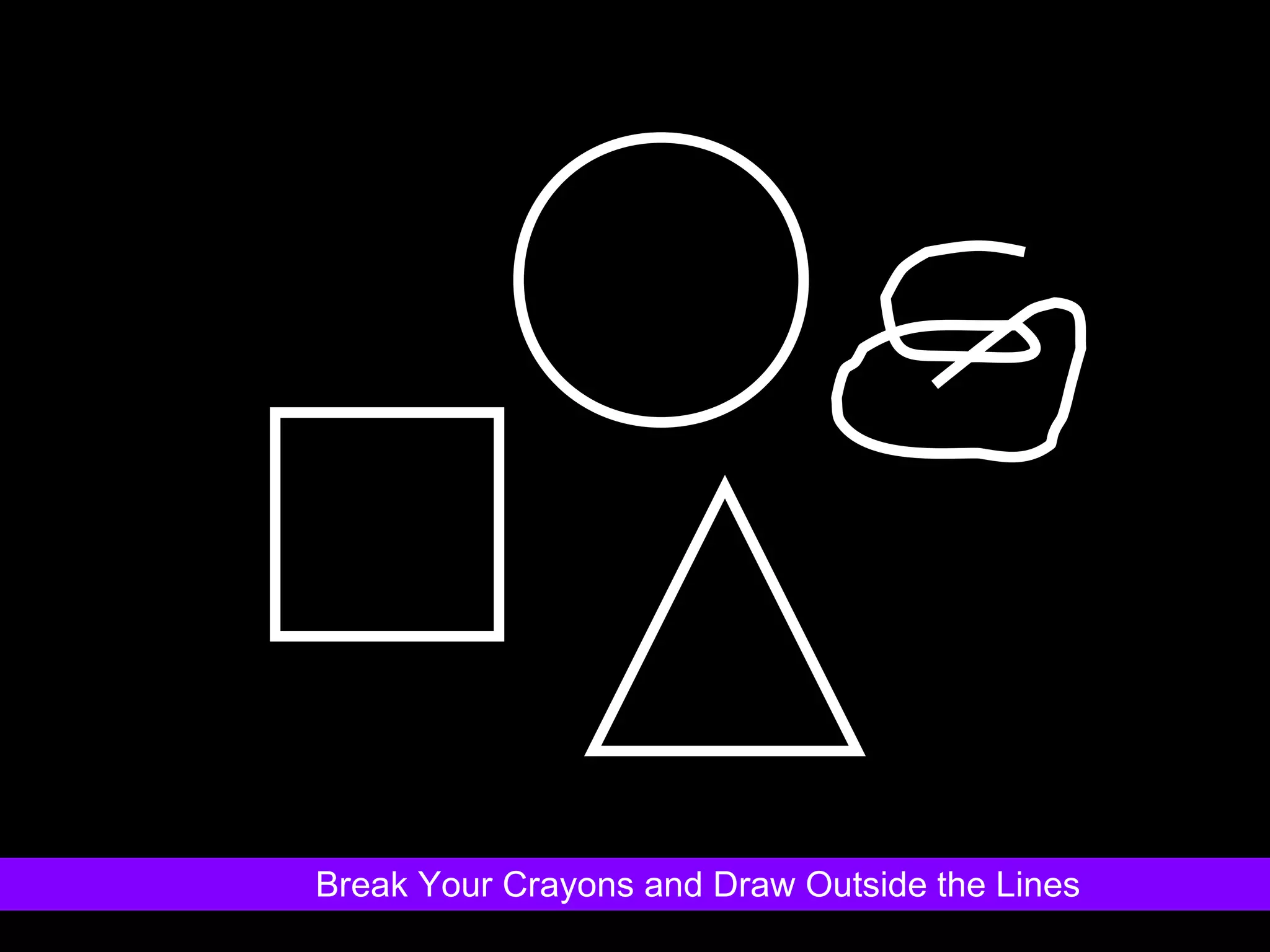
Break Your Crayons and Draw Outside the Lines
Think Learn Communicate Solve Problems C R E A T E !
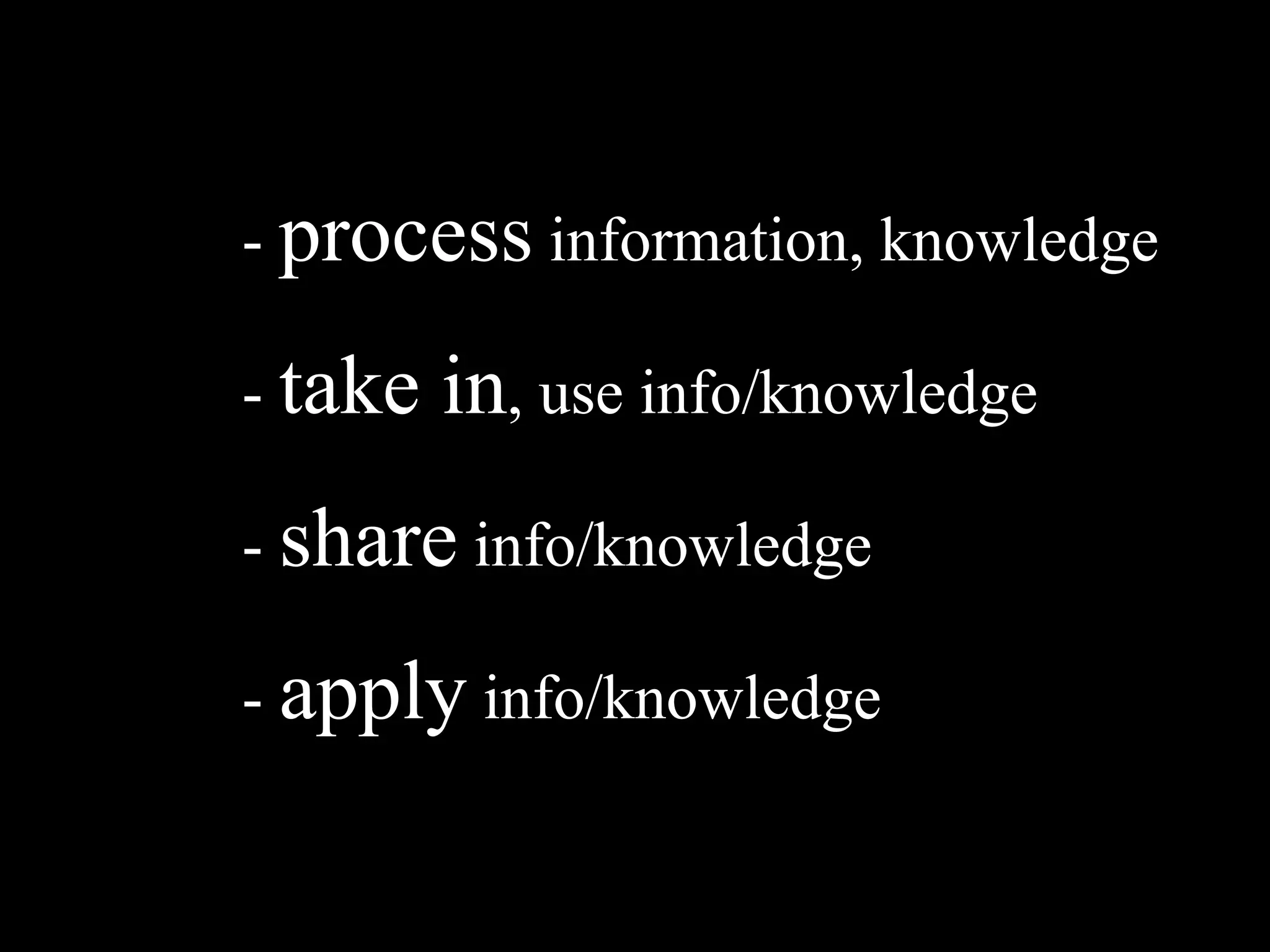
-  process  information, knowledge -  take in , use info/knowledge -  share  info/knowledge -  apply  info/knowledge
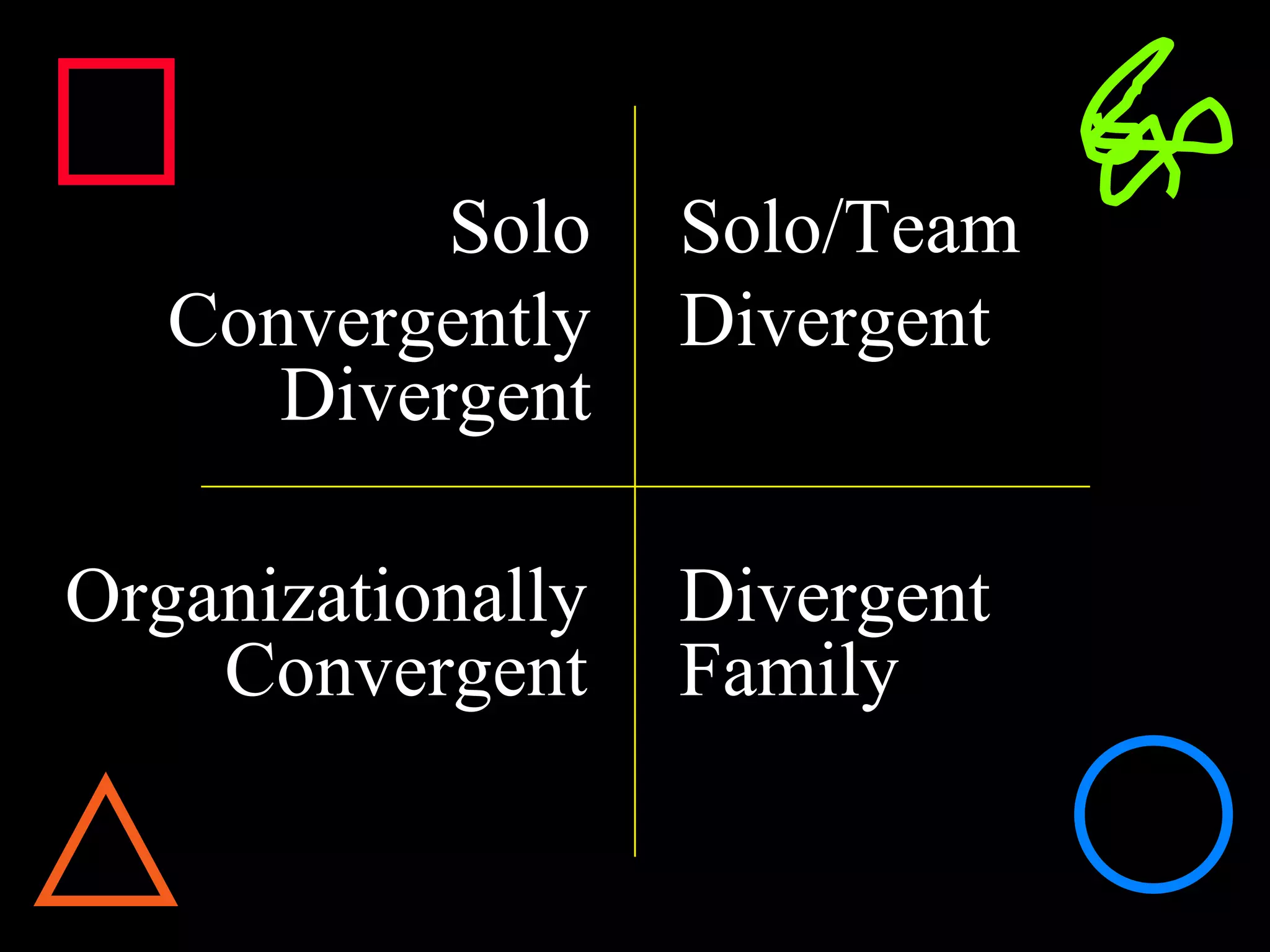
Solo Convergently Divergent Organizationally Convergent Divergent Family Solo/Team Divergent
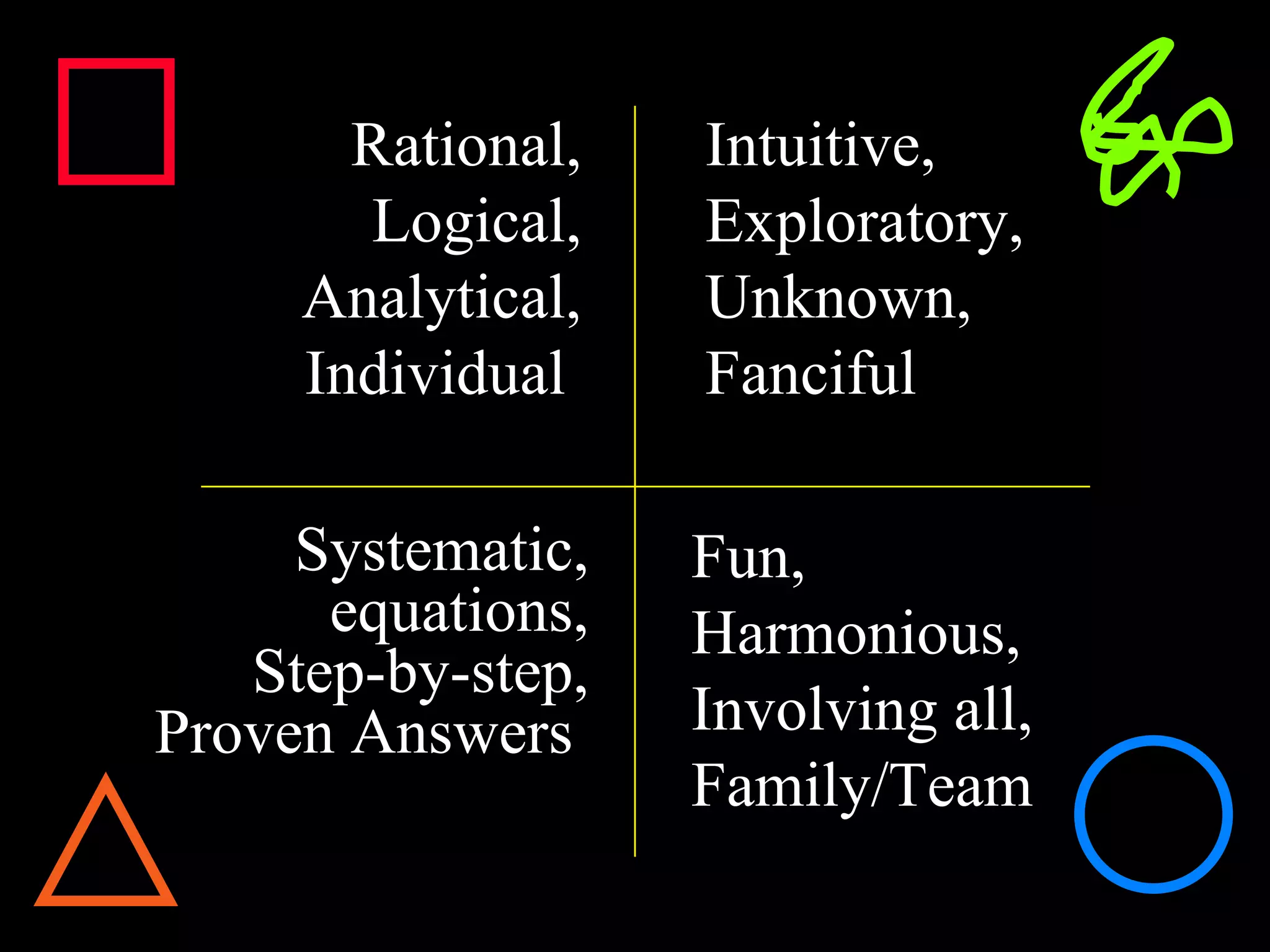
Rational, Logical, Analytical, Individual  Systematic, equations, Step-by-step, Proven Answers  Intuitive, Exploratory, Unknown, Fanciful Fun, Harmonious, Involving all,  Family/Team
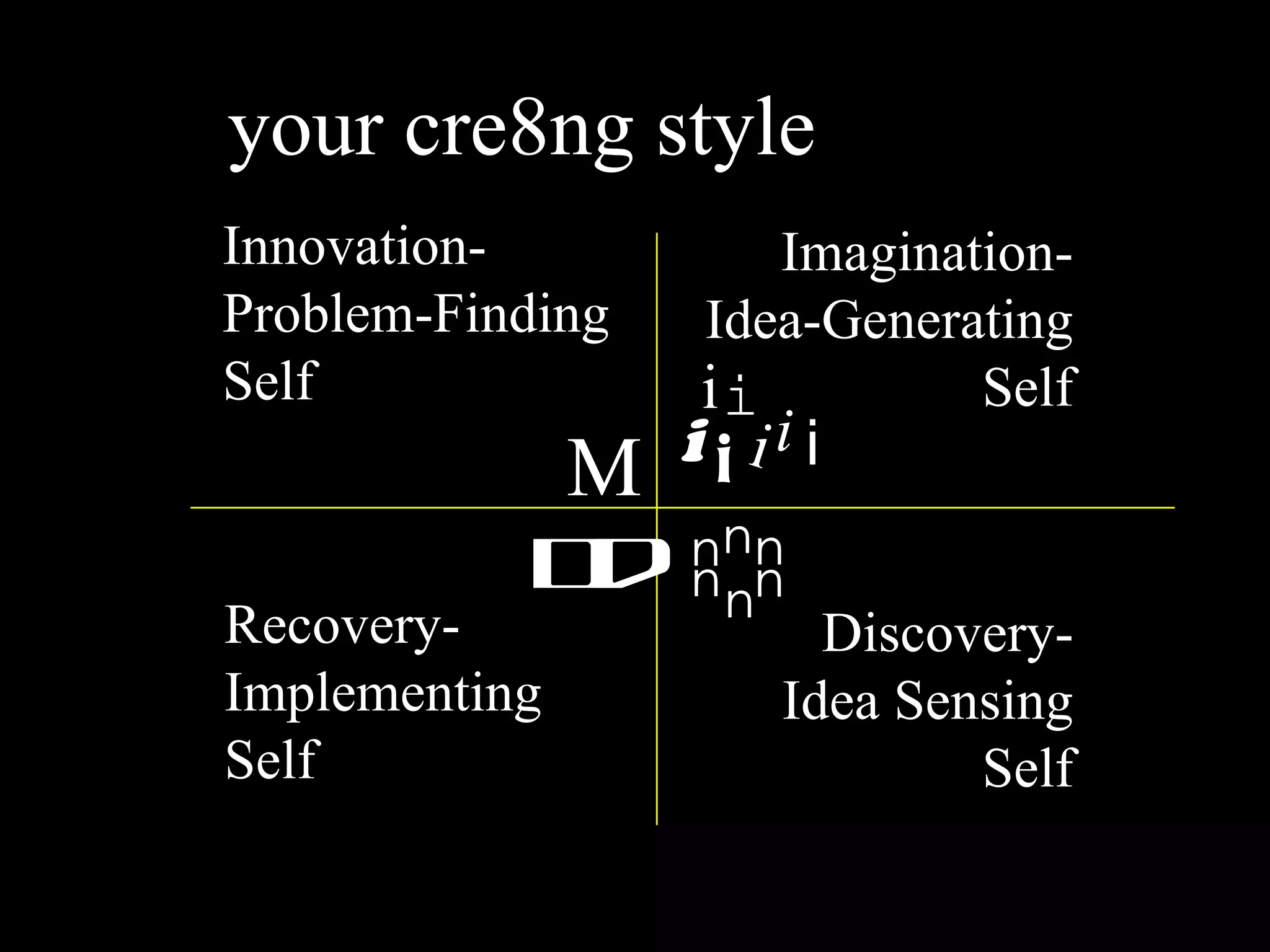
Innovation- Problem-Finding Self Recovery- Implementing Self Imagination- Idea-Generating Self Discovery- Idea Sensing Self M Dd n i i i i i i your cre8ng style n n n n n i
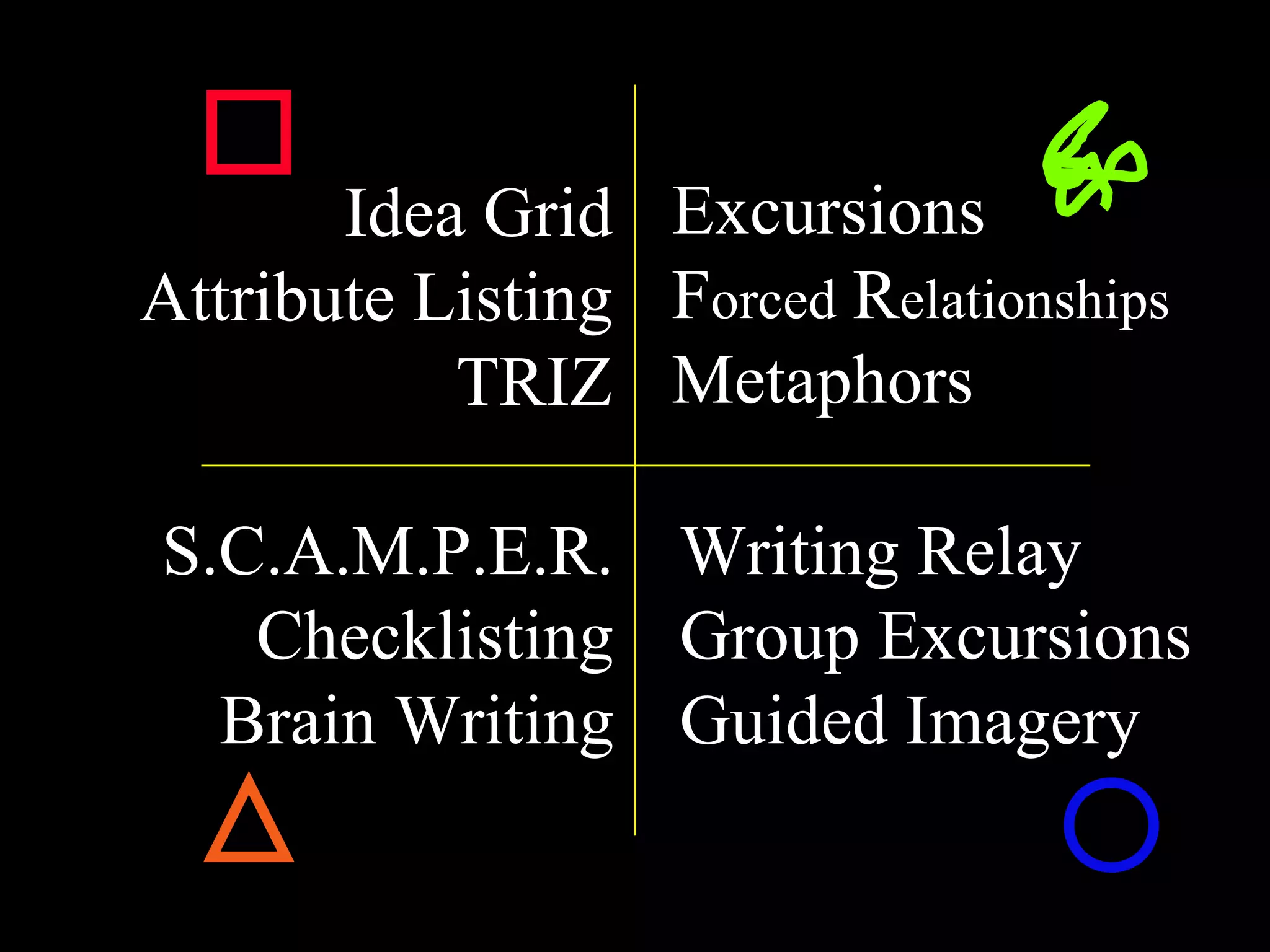
Idea Grid Attribute Listing TRIZ S.C.A.M.P.E.R. Checklisting Brain Writing Excursions   F orced   R elationships Metaphors Writing Relay Group Excursions Guided Imagery
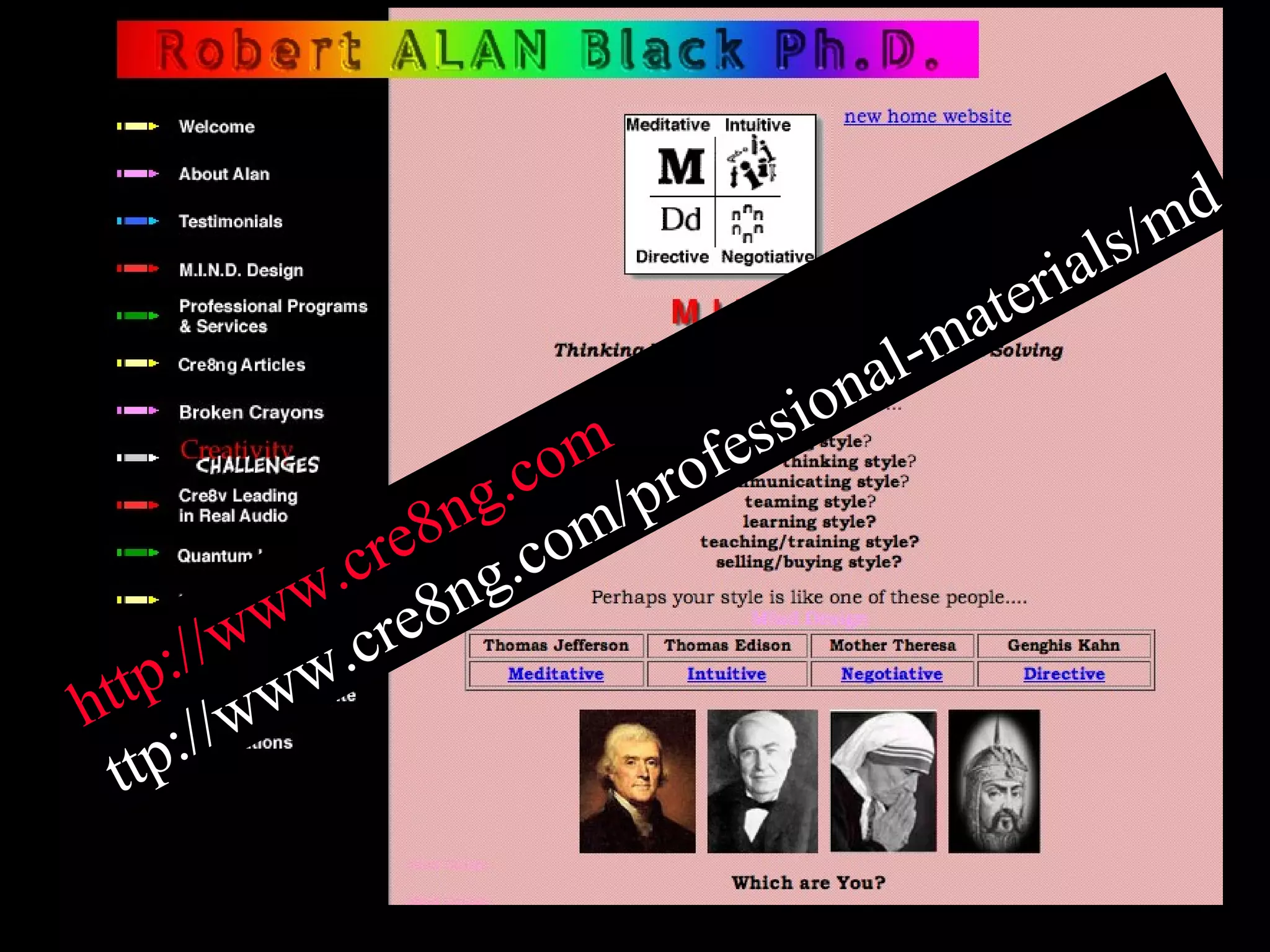
http://www.cre8ng.com ttp://www.cre8ng.com/professional-materials/md
Keep a notebook
Thinking Tools Divergent & Convergent Creative
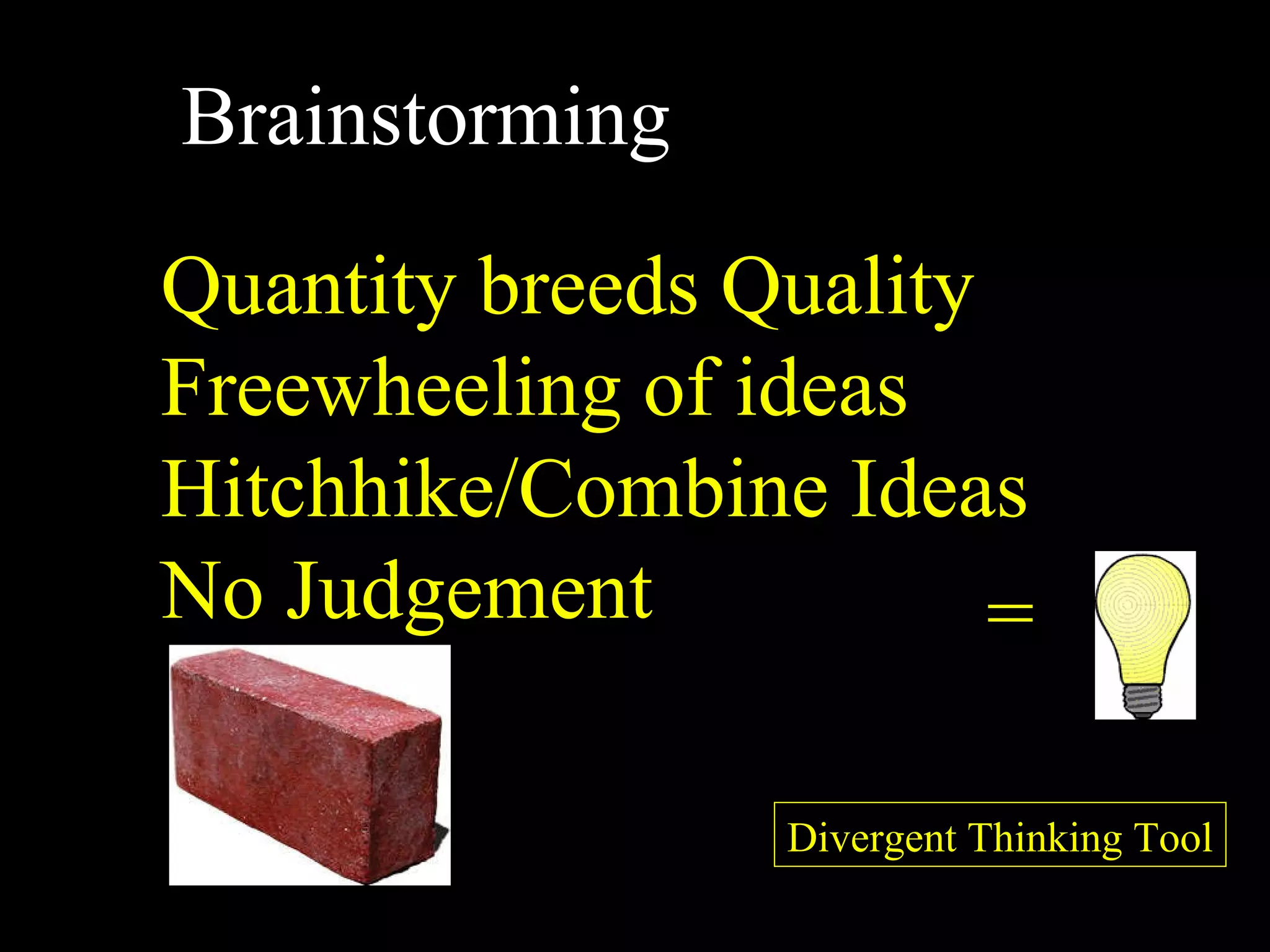
= Divergent Thinking Tool Brainstorming Quantity breeds Quality Freewheeling of ideas Hitchhike/Combine Ideas No Judgement
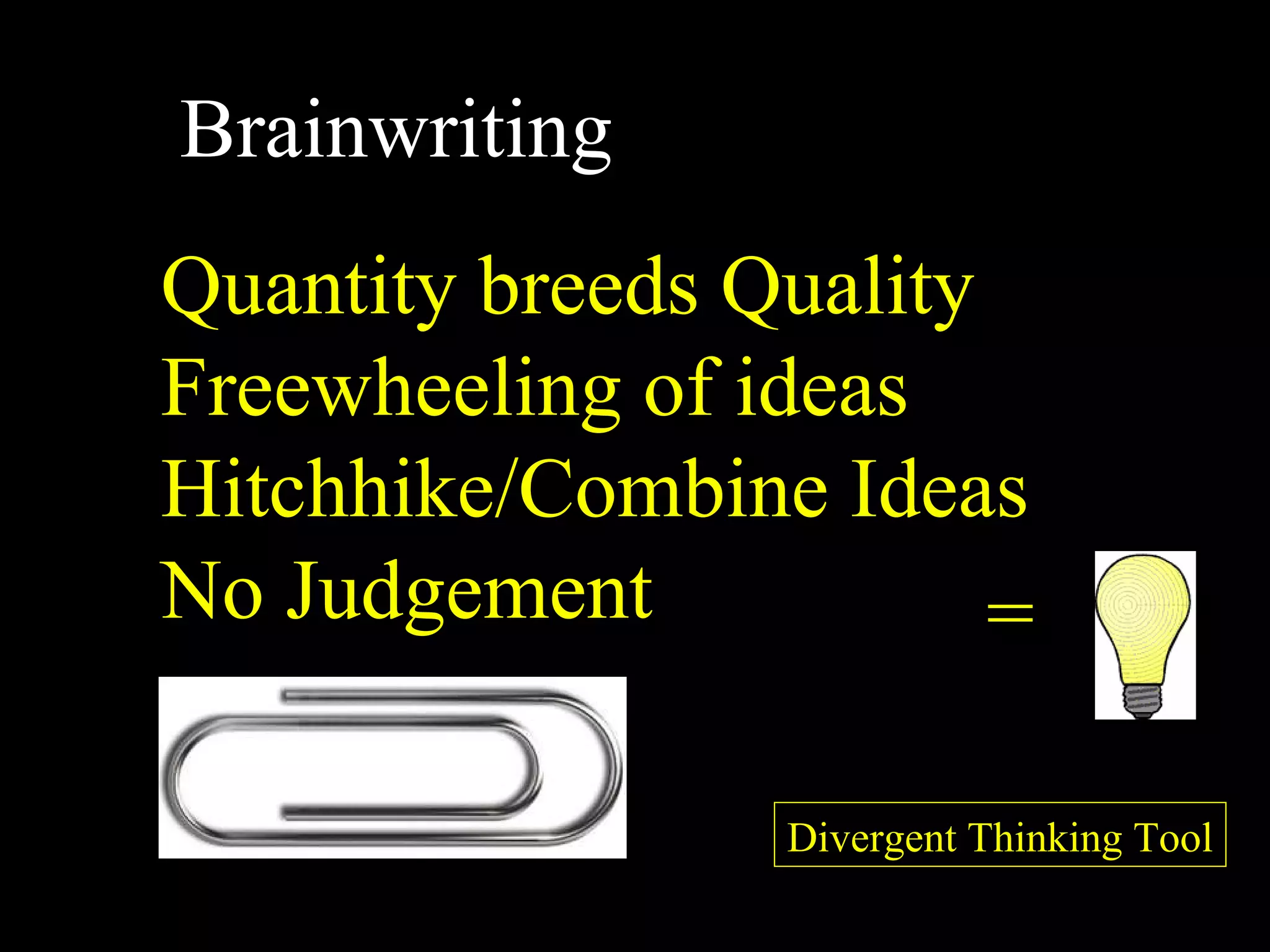
= Divergent Thinking Tool Brainwriting Quantity breeds Quality Freewheeling of ideas Hitchhike/Combine Ideas No Judgement
= Divergent Thinking Tool Alphabetizing A B C D E F G H I J K L M N O P Q R S T U V W X Y Z
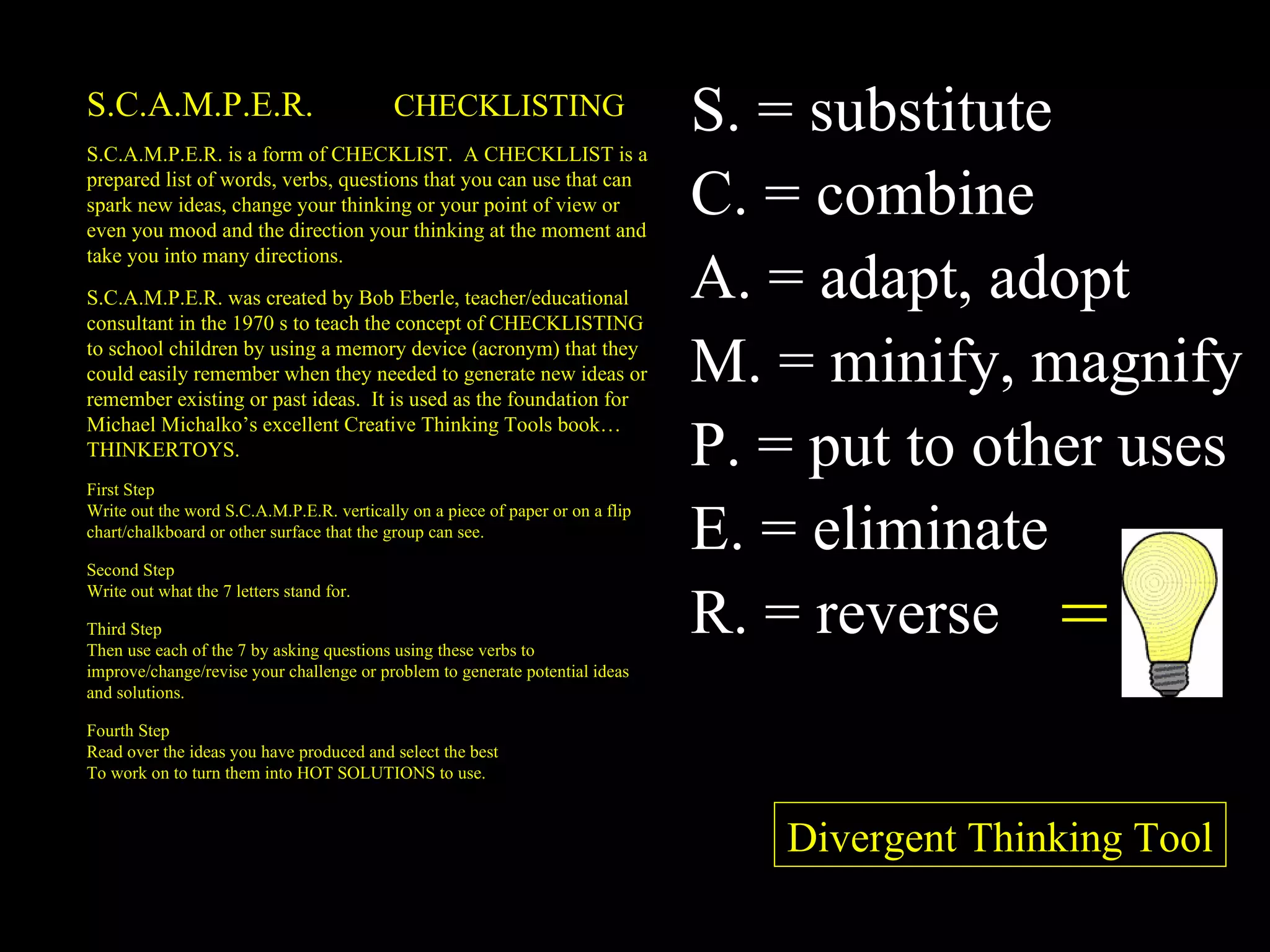
S.C.A.M.P.E.R.  CHECKLISTING S.C.A.M.P.E.R. is a form of CHECKLIST.  A CHECKLLIST is a prepared list of words, verbs, questions that you can use that can spark new ideas, change your thinking or your point of view or even you mood and the direction your thinking at the moment and take you into many directions. S.C.A.M.P.E.R. was created by Bob Eberle, teacher/educational consultant in the 1970 s to teach the concept of CHECKLISTING to school children by using a memory device (acronym) that they could easily remember when they needed to generate new ideas or remember existing or past ideas.  It is used as the foundation for Michael Michalko’s excellent Creative Thinking Tools book…THINKERTOYS. First Step Write out the word S.C.A.M.P.E.R. vertically on a piece of paper or on a flip chart/chalkboard or other surface that the group can see. Second Step Write out what the 7 letters stand for. Third Step Then use each of the 7 by asking questions using these verbs to improve/change/revise your challenge or problem to generate potential ideas and solutions. Fourth Step Read over the ideas you have produced and select the best To work on to turn them into HOT SOLUTIONS to use. = S. = substitute C. = combine A. = adapt, adopt M. = minify, magnify P. = put to other uses E. = eliminate R. = reverse Divergent Thinking Tool
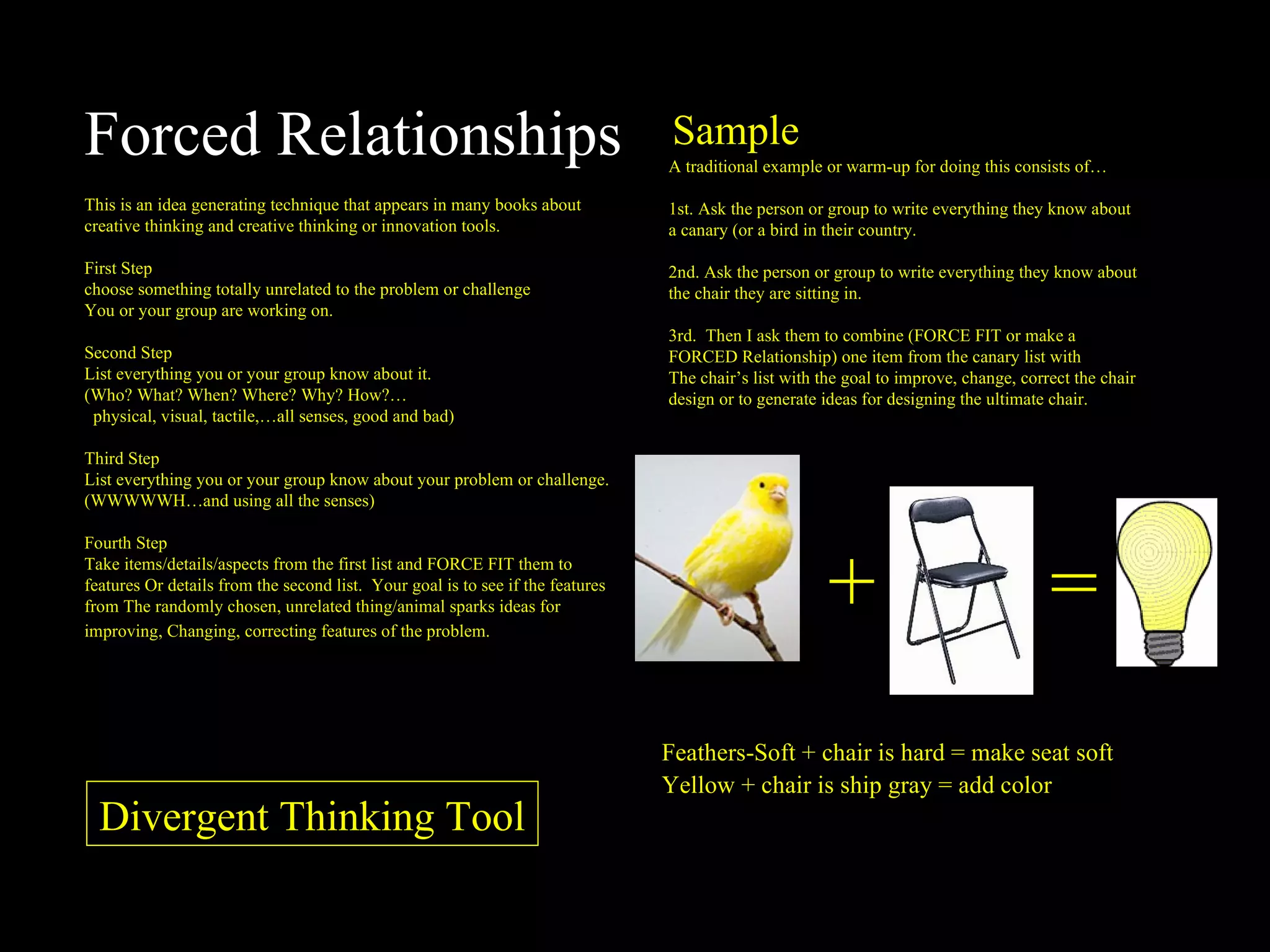
Forced Relationships This is an idea generating technique that appears in many books about creative thinking and creative thinking or innovation tools. First Step choose something totally unrelated to the problem or challenge You or your group are working on. Second Step List everything you or your group know about it. (Who? What? When? Where? Why? How?… physical, visual, tactile,…all senses, good and bad) Third Step List everything you or your group know about your problem or challenge. (WWWWWH…and using all the senses) Fourth Step Take items/details/aspects from the first list and FORCE FIT them to features Or details from the second list.  Your goal is to see if the features from The randomly chosen, unrelated thing/animal sparks ideas for improving, Changing, correcting features of the problem.   A traditional example or warm-up for doing this consists of… 1st. Ask the person or group to write everything they know about a canary (or a bird in their country. 2nd. Ask the person or group to write everything they know about the chair they are sitting in. 3rd.  Then I ask them to combine (FORCE FIT or make a FORCED Relationship) one item from the canary list with  The chair’s list with the goal to improve, change, correct the chair design or to generate ideas for designing the ultimate chair. Sample + = Feathers-Soft + chair is hard = make seat soft Yellow + chair is ship gray = add color Divergent Thinking Tool
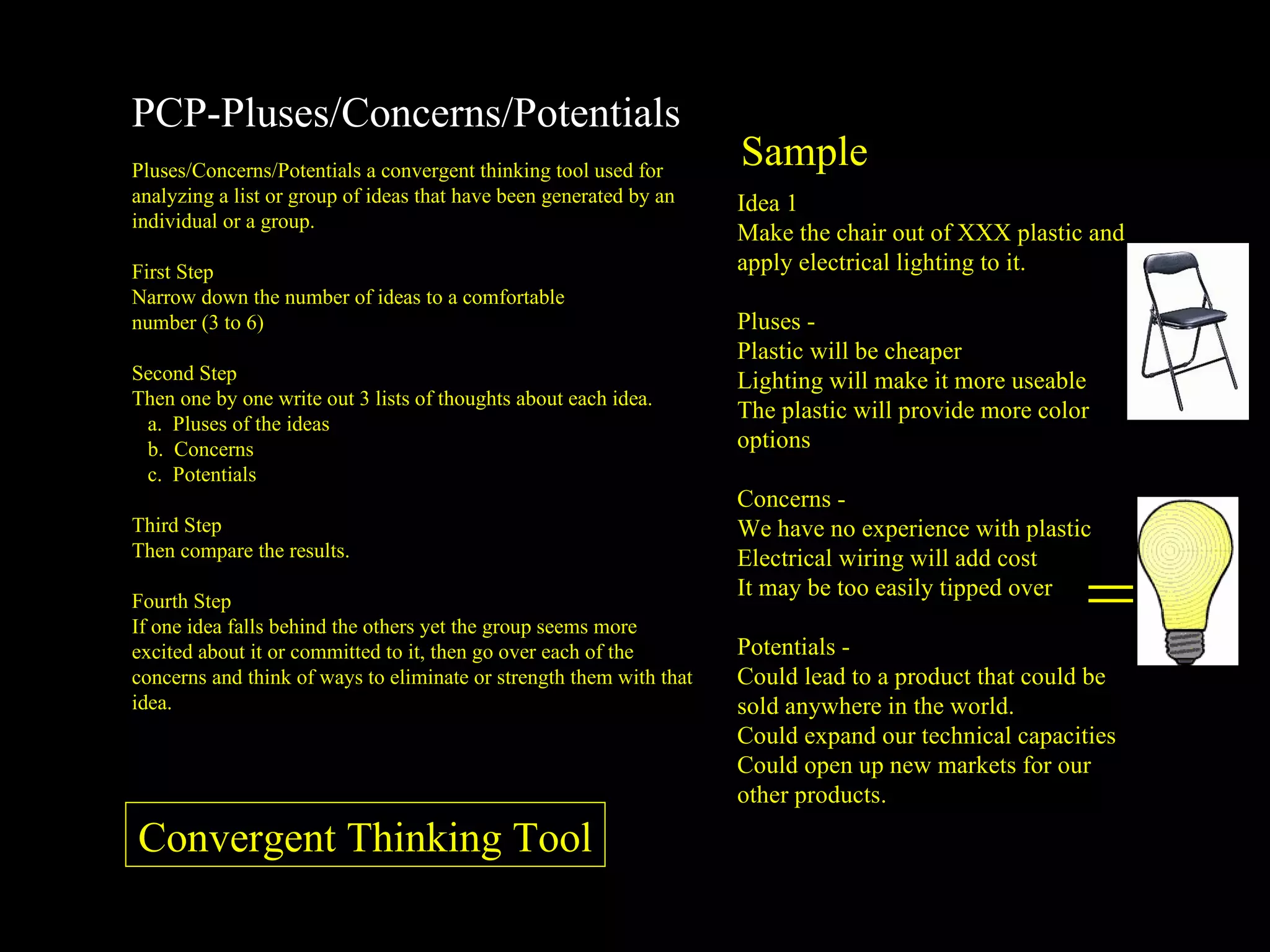
PCP-Pluses/Concerns/Potentials Pluses/Concerns/Potentials a convergent thinking tool used for analyzing a list or group of ideas that have been generated by an individual or a group. First Step Narrow down the number of ideas to a comfortable  number (3 to 6) Second Step Then one by one write out 3 lists of thoughts about each idea. Pluses of the ideas Concerns Potentials Third Step Then compare the results. Fourth Step If one idea falls behind the others yet the group seems more excited about it or committed to it, then go over each of the concerns and think of ways to eliminate or strength them with that idea. Sample = Idea 1 Make the chair out of XXX plastic and apply electrical lighting to it. Pluses -  Plastic will be cheaper Lighting will make it more useable The plastic will provide more color options  Concerns -  We have no experience with plastic Electrical wiring will add cost It may be too easily tipped over  Potentials -  Could lead to a product that could be sold anywhere in the world. Could expand our technical capacities Could open up new markets for our other products. Convergent Thinking Tool
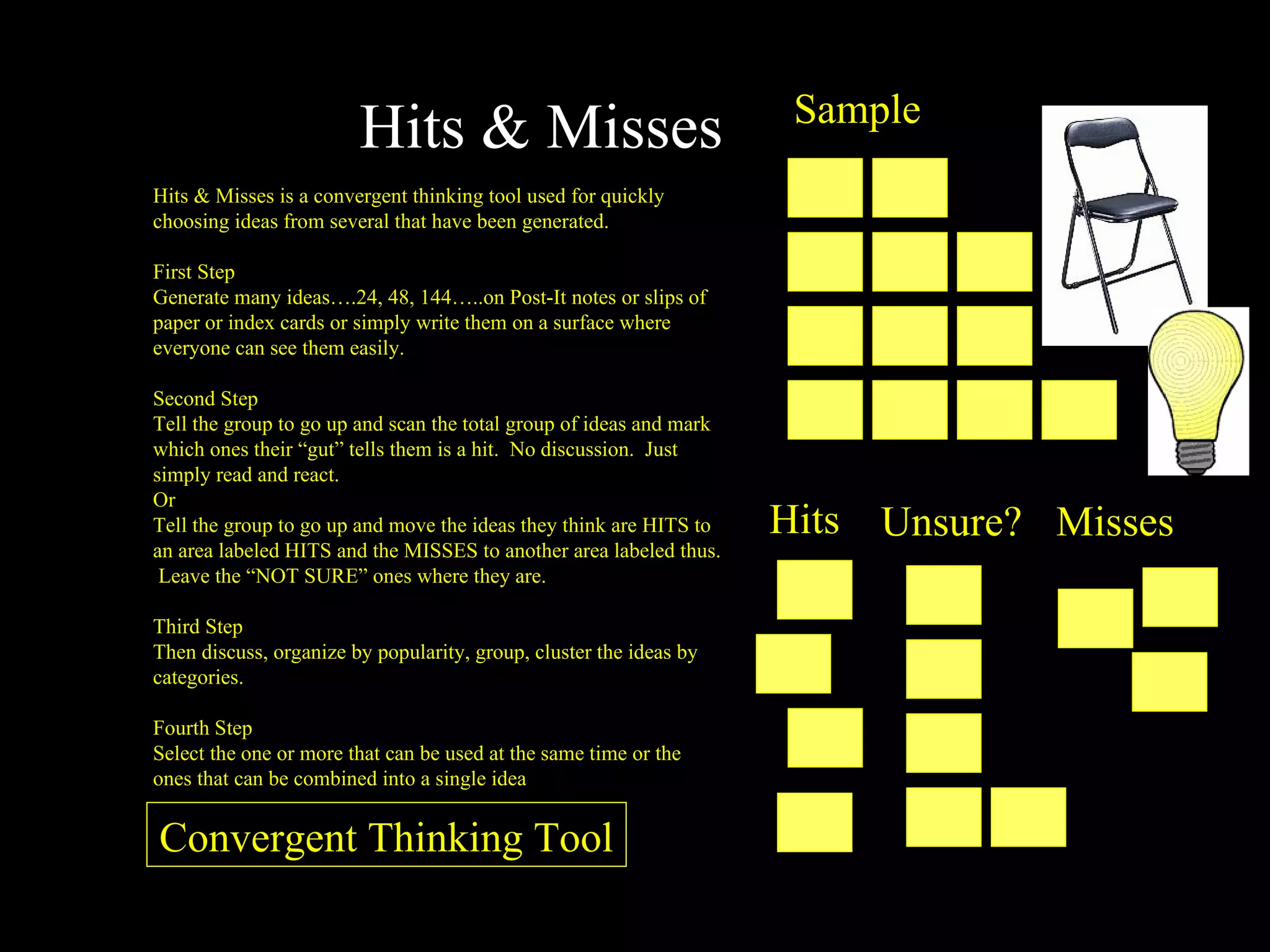
Hits & Misses Hits & Misses is a convergent thinking tool used for quickly choosing ideas from several that have been generated. First Step Generate many ideas….24, 48, 144…..on Post-It notes or slips of paper or index cards or simply write them on a surface where everyone can see them easily. Second Step Tell the group to go up and scan the total group of ideas and mark which ones their “gut” tells them is a hit.  No discussion.  Just simply read and react. Or Tell the group to go up and move the ideas they think are HITS to an area labeled HITS and the MISSES to another area labeled thus.  Leave the “NOT SURE” ones where they are. Third Step Then discuss, organize by popularity, group, cluster the ideas by categories. Fourth Step Select the one or more that can be used at the same time or the ones that can be combined into a single idea Sample Hits Unsure? Misses Convergent Thinking Tool
Resources & Opportunities


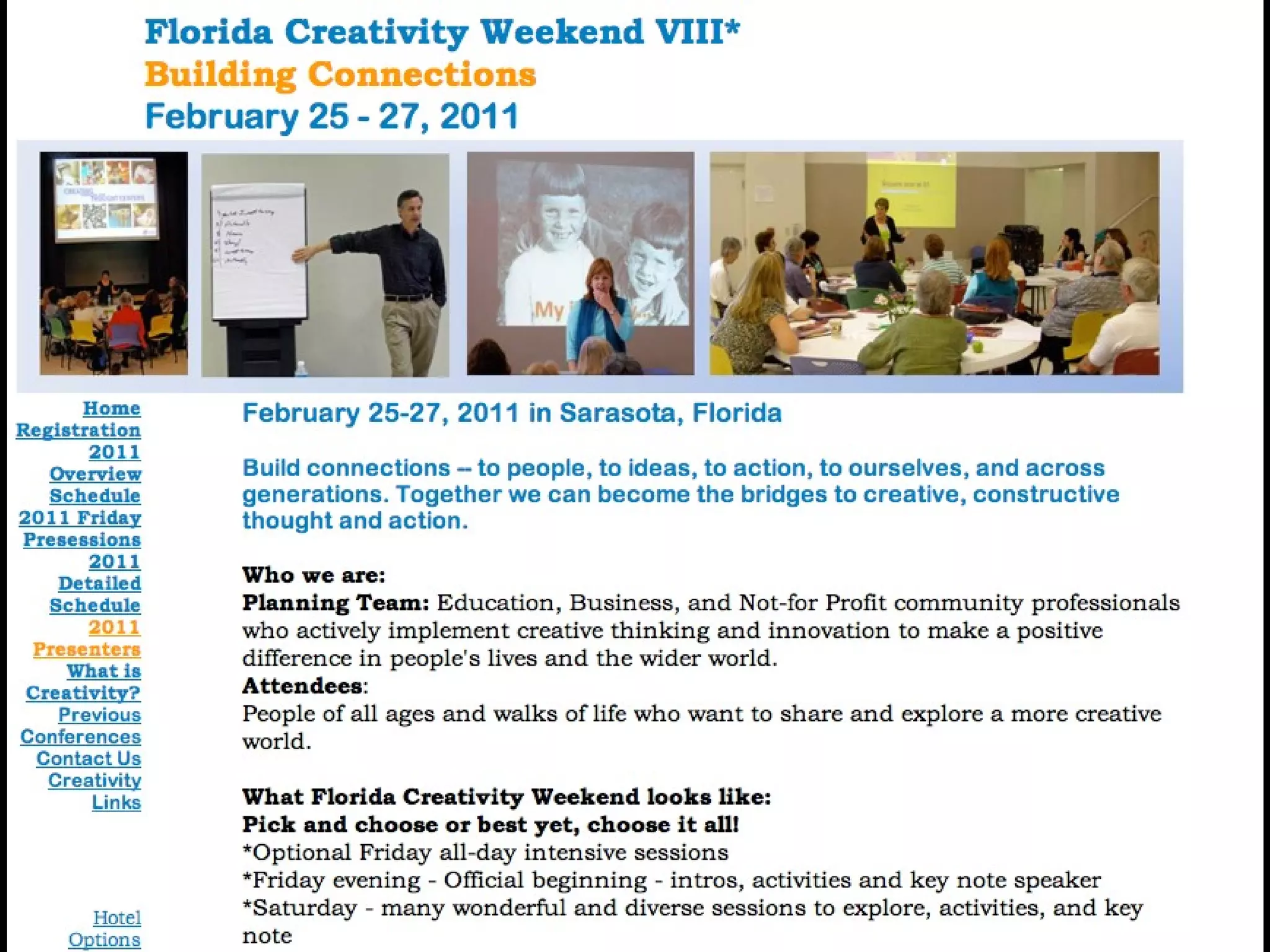
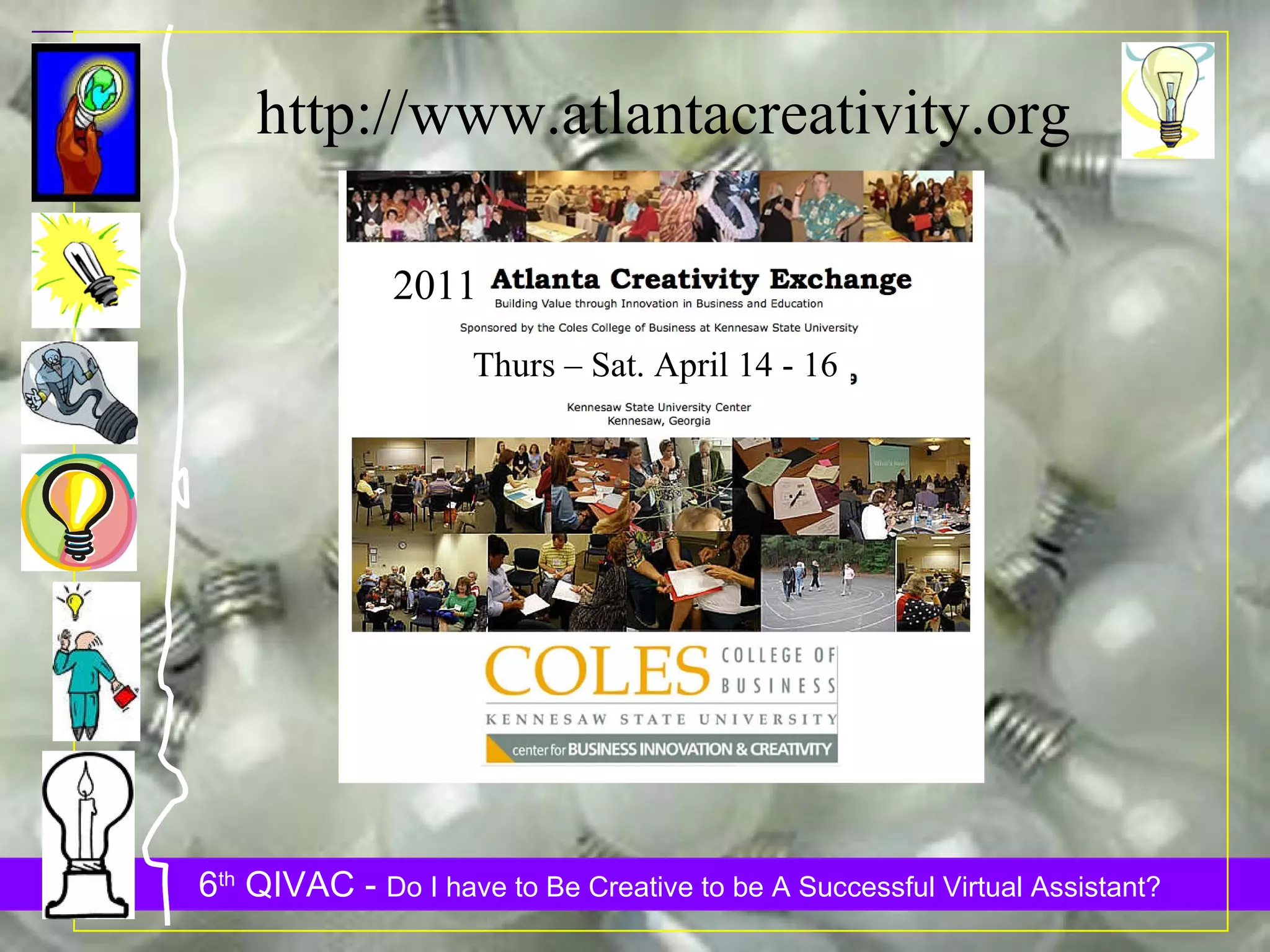
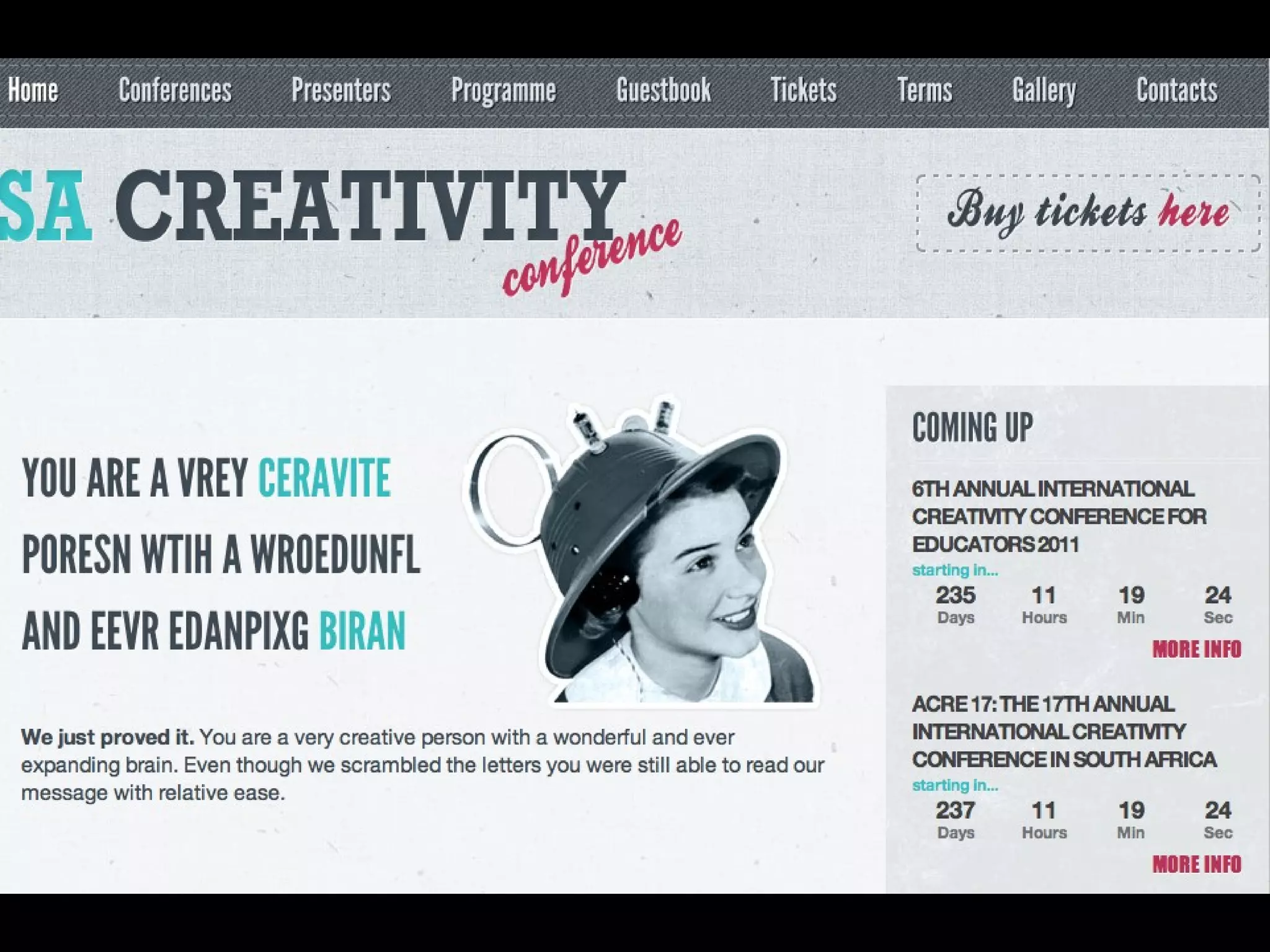
http://www.atlantacreativity.org 2011 Thurs – Sat. April 14 - 16


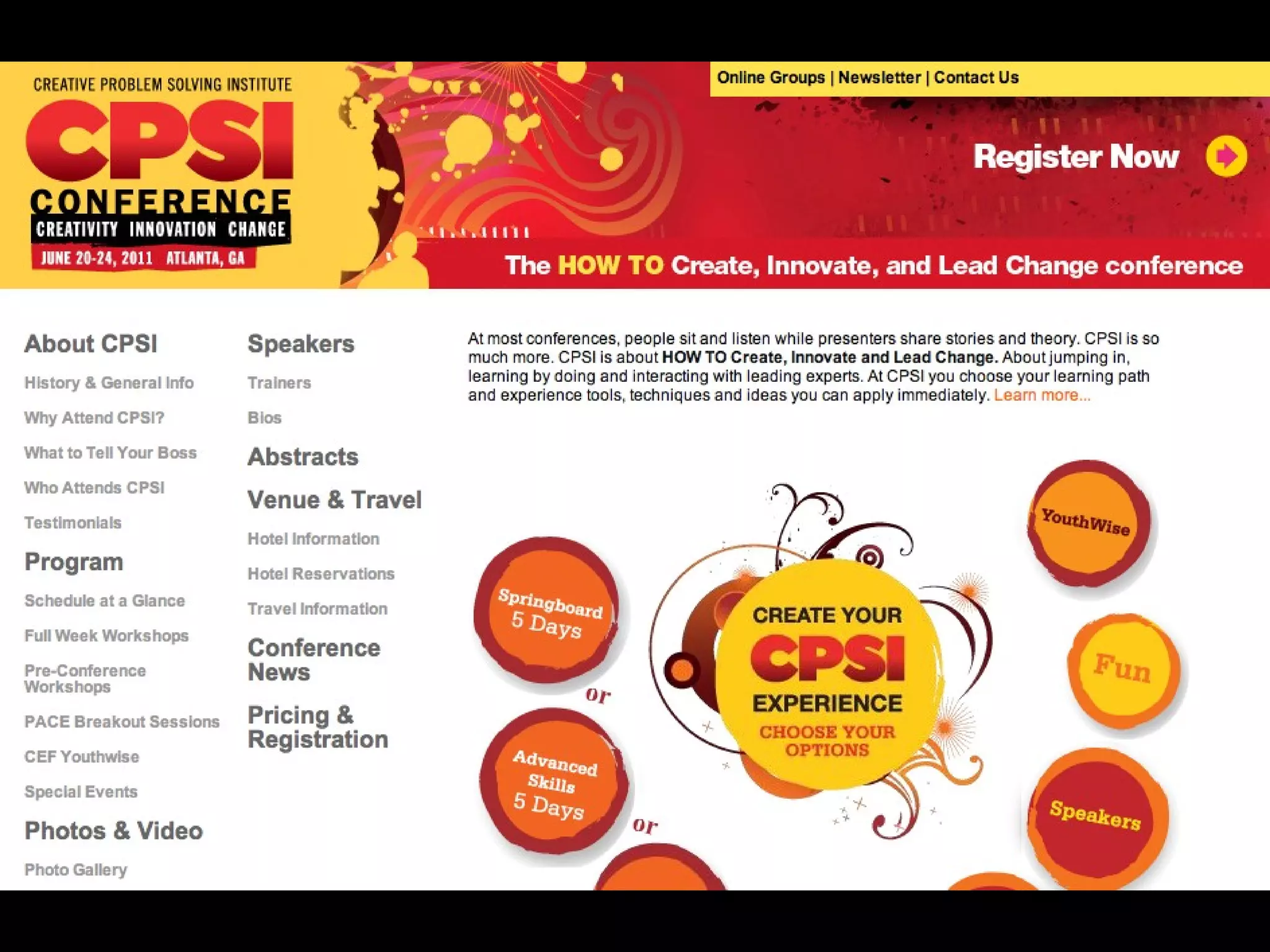
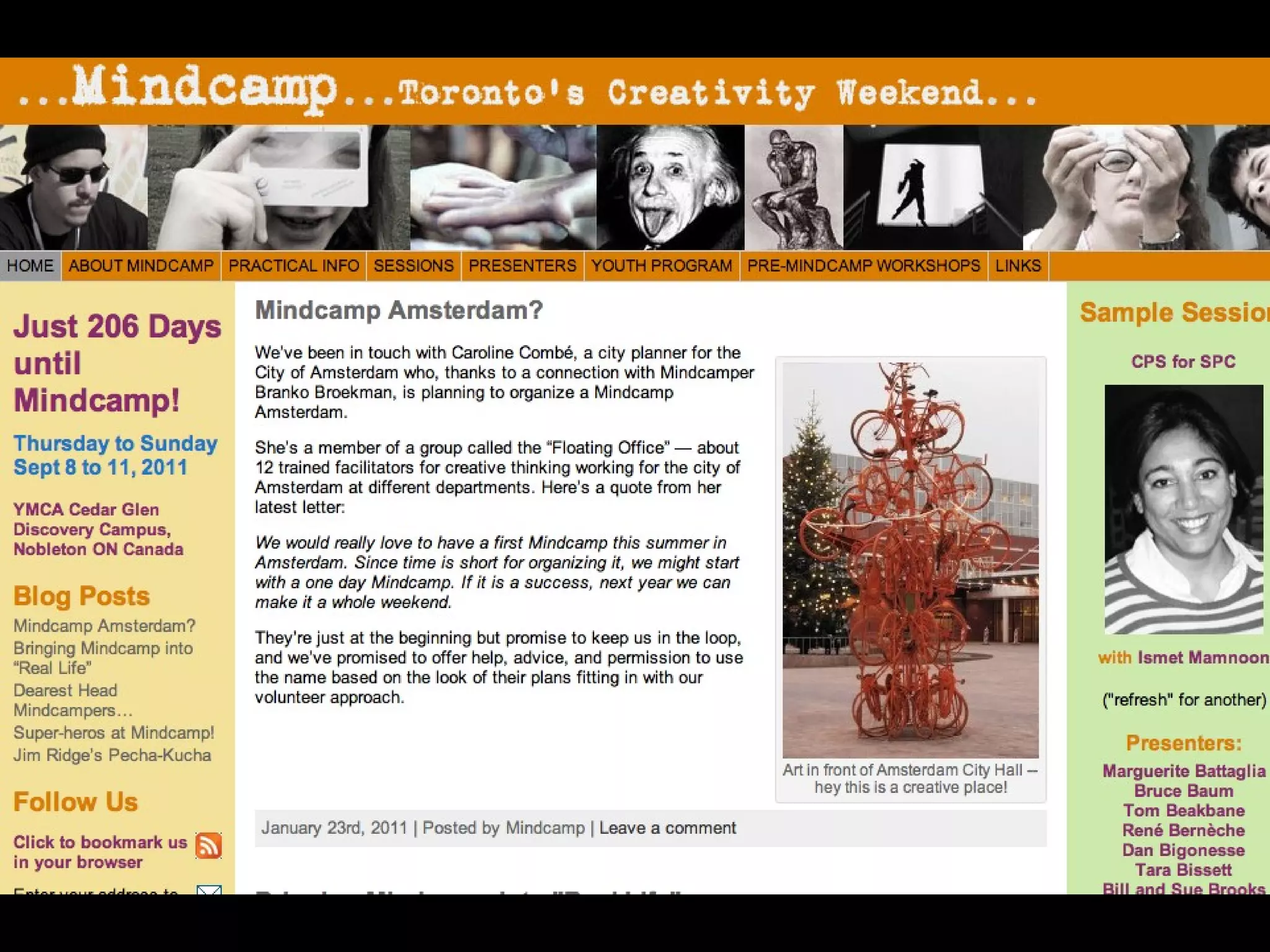
http://www.ifoco.org for conferences near you.
Being creative is a choice… a daily choice! Individuals, leaders, entire organizations can make the choice.
May you all… As future successful VA’s choose to be... C r e a t i v e
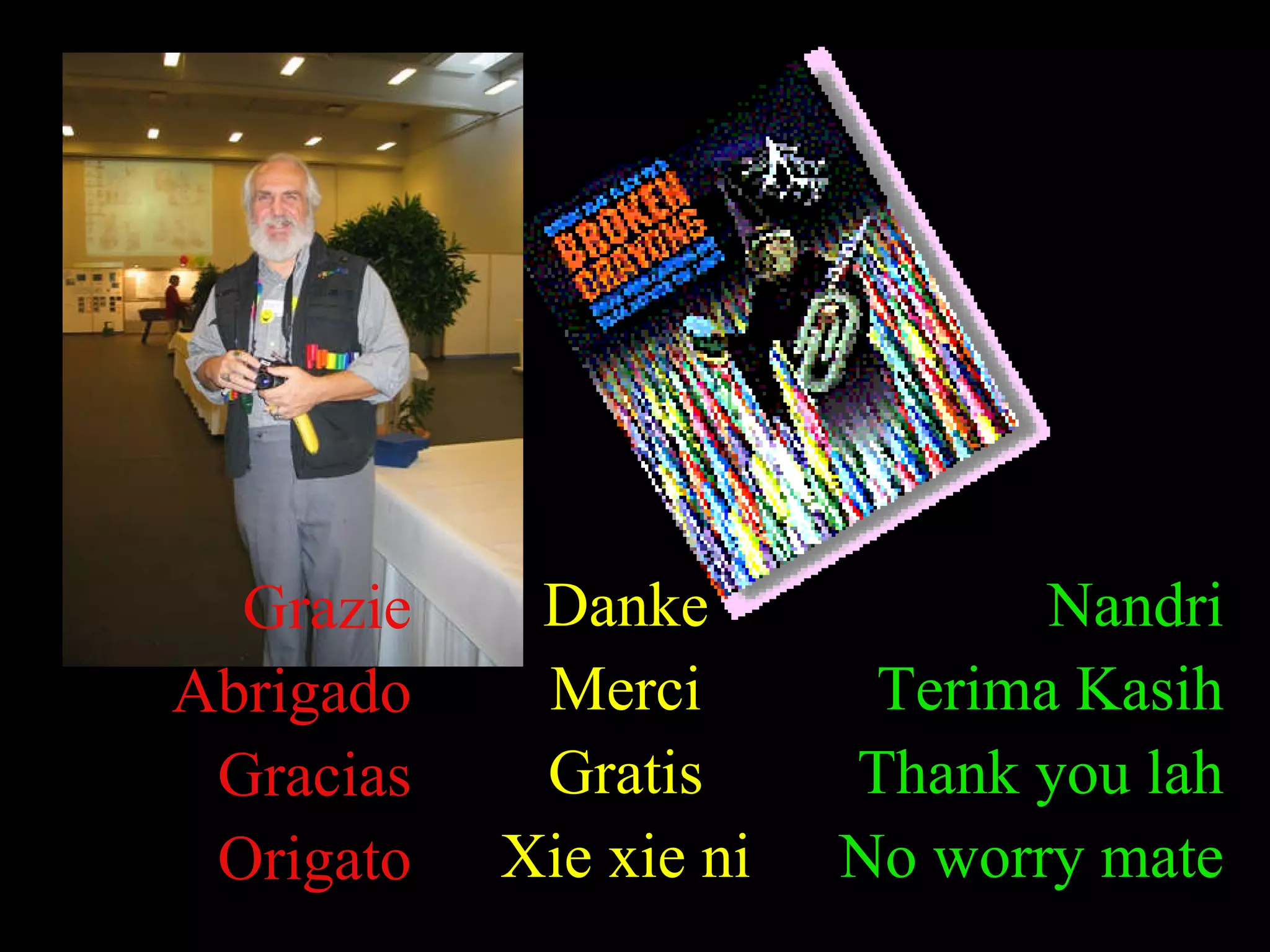
Nandri Terima Kasih Thank you lah No worry mate Grazie Abrigado Gracias Origato Danke Merci Gratis Xie xie ni
Contact information Robert Alan Black, Ph.D., CSP Cre8ng People, Places & Possibilities P. O. Box 5805 Athens, Georgia 30604 [email_address] http://www.cre8ng.com
 

2011 OIVAC ppt presentation

  • 1.
  • 2.
  • 3.
    Do I haveto Be Creative to be A Successful Virtual Assistant?
  • 4.
    Do I haveto Be Creative to be A Successful Virtual Assistant? Only if you want to be paid well and be successful!
  • 5.
    Robert Alan Black, Ph.D,CSP. A l a n Welcome-Hallo-Good Day
  • 6.
    Do I haveto Be Creative to be A Successful Virtual Assistant?
  • 7.
    YES! YES! YES!YES! YES! YES!
  • 8.
    To be paidwell & be successful!
  • 9.
    What does it Mean to be Creative? Am I creative? How can I become More creative?
  • 10.
    Creative? New , Novel , Unique New combination of old , existing ideas
  • 11.
    Creative? New , Novel , Unique
  • 12.
  • 13.
    Creative? New , Novel , Unique New combination of old , existing ideas
  • 14.
    Creative? New combinationof old , existing ideas
  • 15.
  • 16.
    Am I Creative
  • 17.
  • 18.
    32 Traits Seepossibilities Self- knowledgeable Self-actualizing Self-disciplined Sense of destiny Sensitive Severely critical of… self, their work, potential of field potential of other people Specific interests Synthesize correctly often intuitively Tolerant of ambiguity Adaptable Curious Divergent thinker Energetic Fantasize, able to Flexible thinker Fluent Future oriented Humor Idealistic Imaginative Independent Ingenious Learning, always Non-conforming Not motivated by money Observant, highly Open-ended Original - uniqueness Passionate about their work Perceive world differently Question asker 28 All born with….
  • 19.
    32 Traits Seepossibilities Self- knowledgeable Self-actualizing Self-disciplined Sense of destiny Sensitive Severely critical of… self, their work, potential of field potential of other people Specific interests Synthesize correctly often intuitively Tolerant of ambiguity Adaptable Curious Divergent thinker Energetic Fantasize, able to Flexible thinker Fluent Future oriented Humor Idealistic Imaginative Independent Ingenious Learning, always Non-conforming Not motivated by money Observant, highly Open-ended Original - uniqueness Passionate about their work Perceive world differently Question asker All are learnable…
  • 20.
    Each of us are born R a i n b o w s & turned into B&W pens/pencils
  • 21.
    By continually Lookingfor Generating & Combining Ideas We become more C r e a t i v e
  • 22.
  • 23.
    C r ea t i v e Think ing Inside, Outside, Along side, Under, Over, with a New or No Box at All…
  • 24.
  • 25.
    Cre 8 vW A R M - U P S
  • 26.
    Cre 8 vW A R M - U P S Window Roof top Envelope 4 triangles Symbol for duct Top of a pyramid “ x” marks the spot Under side of pyramid Close up view of fence Tent Logo Game board Ceiling light 4 arrow heads Decorated box Display shelf unit 2 overlapping triangles …… .?????????
  • 27.
    Cre 8 vW A R M - U P S Accept any idea As possible Not impossible IM POSSIBLE
  • 28.
    Cre 8 vW A R M - U P S ?
  • 29.
    Cre 8 vW A R M - U P S ?
  • 30.
    many perspectives Whatyou see What your client sees
  • 31.
  • 32.
    ? Break theBox Use the Box No Box New Box Virtual Box
  • 33.
    There are many2 INFINITE Ideas
  • 34.
    Paradigm 2016 a. If it ain’t broke.....leave it alone . b. If it ain’t broke….break it. c. Better fix it before it breaks d. Keep using it until it breaks
  • 35.
    Breaking Paradigms orsimply Re-examining Re-stating Re-inventing the problem. Quickest way to Create or Innovate?
  • 36.
  • 37.
  • 38.
  • 39.
    It depends UponYour Perspective
  • 40.
    How Are YouC r e a t i v e
  • 41.
    S t yl e s Cre8ng ™
  • 42.
    Break Your Crayonsand Draw Outside the Lines
  • 43.
    Think Learn CommunicateSolve Problems C R E A T E !
  • 44.
    - process information, knowledge - take in , use info/knowledge - share info/knowledge - apply info/knowledge
  • 45.
    Solo Convergently DivergentOrganizationally Convergent Divergent Family Solo/Team Divergent
  • 46.
    Rational, Logical, Analytical,Individual Systematic, equations, Step-by-step, Proven Answers Intuitive, Exploratory, Unknown, Fanciful Fun, Harmonious, Involving all, Family/Team
  • 47.
    Innovation- Problem-Finding SelfRecovery- Implementing Self Imagination- Idea-Generating Self Discovery- Idea Sensing Self M Dd n i i i i i i your cre8ng style n n n n n i
  • 48.
    Idea Grid AttributeListing TRIZ S.C.A.M.P.E.R. Checklisting Brain Writing Excursions F orced R elationships Metaphors Writing Relay Group Excursions Guided Imagery
  • 49.
  • 50.
  • 51.
    Thinking Tools Divergent& Convergent Creative
  • 52.
    = Divergent ThinkingTool Brainstorming Quantity breeds Quality Freewheeling of ideas Hitchhike/Combine Ideas No Judgement
  • 53.
    = Divergent ThinkingTool Brainwriting Quantity breeds Quality Freewheeling of ideas Hitchhike/Combine Ideas No Judgement
  • 54.
    = Divergent ThinkingTool Alphabetizing A B C D E F G H I J K L M N O P Q R S T U V W X Y Z
  • 55.
    S.C.A.M.P.E.R. CHECKLISTINGS.C.A.M.P.E.R. is a form of CHECKLIST. A CHECKLLIST is a prepared list of words, verbs, questions that you can use that can spark new ideas, change your thinking or your point of view or even you mood and the direction your thinking at the moment and take you into many directions. S.C.A.M.P.E.R. was created by Bob Eberle, teacher/educational consultant in the 1970 s to teach the concept of CHECKLISTING to school children by using a memory device (acronym) that they could easily remember when they needed to generate new ideas or remember existing or past ideas. It is used as the foundation for Michael Michalko’s excellent Creative Thinking Tools book…THINKERTOYS. First Step Write out the word S.C.A.M.P.E.R. vertically on a piece of paper or on a flip chart/chalkboard or other surface that the group can see. Second Step Write out what the 7 letters stand for. Third Step Then use each of the 7 by asking questions using these verbs to improve/change/revise your challenge or problem to generate potential ideas and solutions. Fourth Step Read over the ideas you have produced and select the best To work on to turn them into HOT SOLUTIONS to use. = S. = substitute C. = combine A. = adapt, adopt M. = minify, magnify P. = put to other uses E. = eliminate R. = reverse Divergent Thinking Tool
  • 56.
    Forced Relationships Thisis an idea generating technique that appears in many books about creative thinking and creative thinking or innovation tools. First Step choose something totally unrelated to the problem or challenge You or your group are working on. Second Step List everything you or your group know about it. (Who? What? When? Where? Why? How?… physical, visual, tactile,…all senses, good and bad) Third Step List everything you or your group know about your problem or challenge. (WWWWWH…and using all the senses) Fourth Step Take items/details/aspects from the first list and FORCE FIT them to features Or details from the second list. Your goal is to see if the features from The randomly chosen, unrelated thing/animal sparks ideas for improving, Changing, correcting features of the problem. A traditional example or warm-up for doing this consists of… 1st. Ask the person or group to write everything they know about a canary (or a bird in their country. 2nd. Ask the person or group to write everything they know about the chair they are sitting in. 3rd. Then I ask them to combine (FORCE FIT or make a FORCED Relationship) one item from the canary list with The chair’s list with the goal to improve, change, correct the chair design or to generate ideas for designing the ultimate chair. Sample + = Feathers-Soft + chair is hard = make seat soft Yellow + chair is ship gray = add color Divergent Thinking Tool
  • 57.
    PCP-Pluses/Concerns/Potentials Pluses/Concerns/Potentials aconvergent thinking tool used for analyzing a list or group of ideas that have been generated by an individual or a group. First Step Narrow down the number of ideas to a comfortable number (3 to 6) Second Step Then one by one write out 3 lists of thoughts about each idea. Pluses of the ideas Concerns Potentials Third Step Then compare the results. Fourth Step If one idea falls behind the others yet the group seems more excited about it or committed to it, then go over each of the concerns and think of ways to eliminate or strength them with that idea. Sample = Idea 1 Make the chair out of XXX plastic and apply electrical lighting to it. Pluses - Plastic will be cheaper Lighting will make it more useable The plastic will provide more color options Concerns - We have no experience with plastic Electrical wiring will add cost It may be too easily tipped over Potentials - Could lead to a product that could be sold anywhere in the world. Could expand our technical capacities Could open up new markets for our other products. Convergent Thinking Tool
  • 58.
    Hits & MissesHits & Misses is a convergent thinking tool used for quickly choosing ideas from several that have been generated. First Step Generate many ideas….24, 48, 144…..on Post-It notes or slips of paper or index cards or simply write them on a surface where everyone can see them easily. Second Step Tell the group to go up and scan the total group of ideas and mark which ones their “gut” tells them is a hit. No discussion. Just simply read and react. Or Tell the group to go up and move the ideas they think are HITS to an area labeled HITS and the MISSES to another area labeled thus. Leave the “NOT SURE” ones where they are. Third Step Then discuss, organize by popularity, group, cluster the ideas by categories. Fourth Step Select the one or more that can be used at the same time or the ones that can be combined into a single idea Sample Hits Unsure? Misses Convergent Thinking Tool
  • 59.
  • 60.
  • 61.
  • 62.
  • 63.
  • 64.
  • 65.
  • 66.
  • 67.
  • 68.
    Being creative isa choice… a daily choice! Individuals, leaders, entire organizations can make the choice.
  • 69.
    May you all…As future successful VA’s choose to be... C r e a t i v e
  • 70.
    Nandri Terima KasihThank you lah No worry mate Grazie Abrigado Gracias Origato Danke Merci Gratis Xie xie ni
  • 71.
    Contact information RobertAlan Black, Ph.D., CSP Cre8ng People, Places & Possibilities P. O. Box 5805 Athens, Georgia 30604 [email_address] http://www.cre8ng.com
  • 72.