RULE CHANGES for 2009


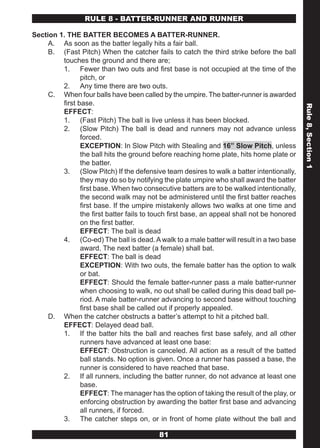
RULE-SECTION                       TOPIC                      PAGES

1 Definitions   Change to the definition of Charged              26
                Conference

2-1 Table       Change to the maximum fence distance in          32
                Modified Pitch

3-1A[1]         Clarifies requirements on Approved bats          39

3-1F            Indentifies additional bat deficiencies          39

3-1K            Expands the elements of bat construction         41

3-3B            Specifies Mandated SP ball color beginning       42
                in 2010

3-6G EFFECT     Adds a penalty to illegal equipment after a      47
                warning

4-2I            Allows use of Courtesy Runners for               50
                ADA players

4-6C[1-9]       Removes disqualification penalty to an         52-53
                unreported Substitute

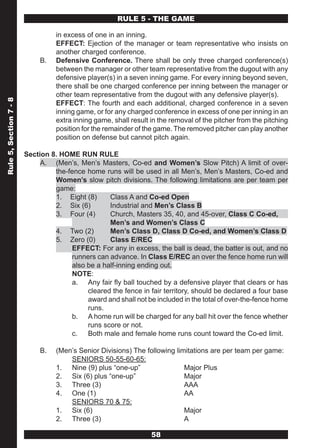
5-8A            Establishes Home Run limits in Women’s           58
                Slow Pitch

5-8A[1]         Increases Home Run limits in Co-ed Open          58

5-8A[2]         Increases Home Run limits in Men’s B             58
                Slow Pitch

5-8A[3]         Increases Home Run limits in Men’s C             58
                and Co-ed C Slow Pitch


                                  20
RULE CHANGES for 2009


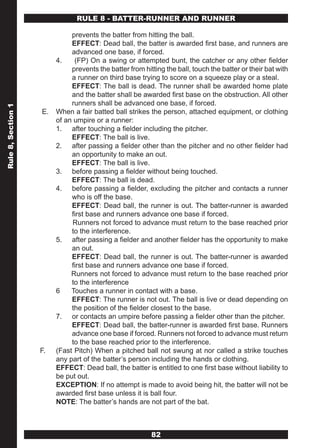
RULE-SECTION      TOPIC                                               PAGES

5-8A[5]           Increases Home Run limits in Men’s D and               58
                  Co-ed D Slow Pitch

5-8A[6]           Adds Class E/REC to Men’s Slow Pitch                   58

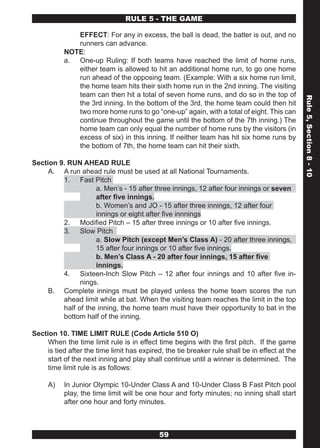
5-9A[1]           Changes the Run Ahead Rule Men’s                       59
                  Fast Pitch

5-9A[4]           Creates a new Run Ahead Rule for Men’s A               59
                  Slow Pitch

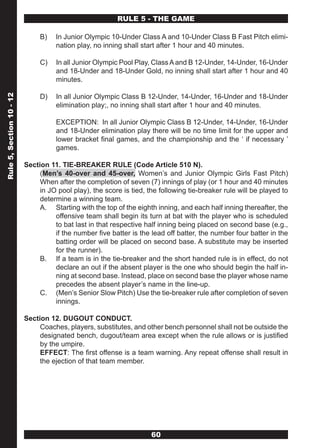
5-11              Adds 40-0 and 45-0 Fast Pitch to the Tie-Breaker       60
                  Rule

6-1A FP / MP      Clarification on the pitching rule                   61/65

6-3O FP/6-3N MP   Adds and EFFECT                                      62/66

6-6A FP           Permits an approved drying agent for                 62-63
                  the pitcher

7-3               Mandates starting count in Adult Slow Pitch            76
                  with the Exception of Masters and Seniors

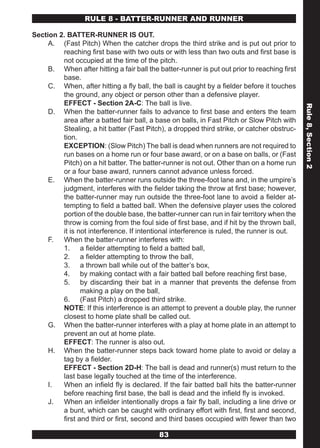
8-1C[2]           Clarifies in 16” Slow Pitch the ball remains live      81

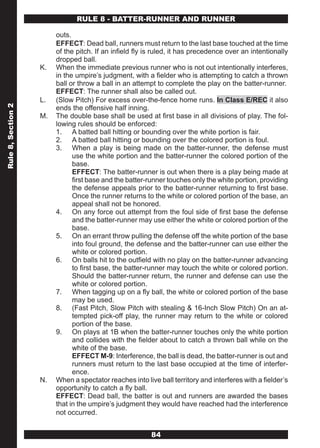
8-3I EXCEPTION    Add Masters Slow Pitch to base running                 85
                  exception

8-5I              Change in rule from a HR/4 Base Award to a             89
                  2 Base Award

8-7I[2]           Clarifies that any defensive player may make a         91
                  live ball appeal

8-10              Allows all Fast Pitch to use the Courtesy              96
                  Runner Rule

                                 21
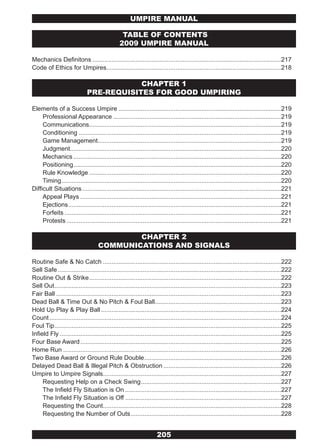
2009 PLAYING RULES

                           PLAYING RULES
                         TABLE OF CONTENTS
Rule 1-Definitions ..........................................................................24
Rule 2-The Playing Field ...............................................................32
Rule 3-Equipment ..........................................................................39
Rule 4-Players and Substitutes .....................................................48
Rule 5-The Game ..........................................................................56
Rule 6-Pitching Regulations (Fast Pitch) .......................................61
Rule 6-Pitching Regulations (Modified Pitch) ................................65
Rule 6-Pitching Regulations (Slow Pitch) ......................................69
Rule 6-Pitching Regulations (16-Inch Slow Pitch) .........................72
Rule 7-Batting ................................................................................75
Rule 8-Batter-Runner and Runner.................................................81
Rule 9-Protests ..............................................................................98
Rule 10-Umpires..........................................................................100
Rule 11-Scoring ...........................................................................102
Rule 12-Use of ASA playing Rules ..............................................106
Rules Supplement .......................................................................107
Playing Rules Index .....................................................................135


                                              22
OFFICIAL SOFTBALL PLAYING RULES

Copyright by the Amateur Softball Association of America REVISED 2009 “Permission
    to reprint THE OFFICIAL PLAYING RULES has been granted by THE AMATEUR
    SOFTBALL ASSOCIATION OF AMERICA.”

Where (Fast Pitch) is shown, Modified Pitch rules are followed the same as fast pitch
    with the exception of the pitching rule. Where (Slow Pitch) is shown, 16” slow pitch
    rules are followed the same as slow pitch with the exception of the pitching rule.

The words “Junior Olympic” or the initials “JO” refer to youth softball.

New rules and/or changes are in bold letters in each shaded section. Housekeep-
    ing changes are shaded, but not bold.

Read the “Points of Emphasis” at the end of the rules to clarify various selected
    rules.

PREAMBLE TO THE RULES.
WARNING, DISCLOSURE AND DISCLAIMER

     One of the primary purposes of ASA’s official playing rules (including its equipment
     standards) and ASA’s Code is to promote competitive balance and to preserve
     the integrity of the sport of amateur softball. ASA’s official playing rules and Code
     should not be considered a guarantee that participants, spectators or others will
     be safe or free from injury or harm. There are risks and dangers incidental to
     the game of softball, including specifically (but not limited to) the danger of being
     injured by thrown bats, thrown balls, batted balls or other objects. Softball poses
     a risk to its participants, spectators and other persons at or near ASA events or
     practices. Softball is a vigorous team sport at times involving severe cardiovascular
     stress and violent physical contact. Softball involves certain risk, including but not
     limited to death, serious neck and spinal injuries resulting in complete or partial
     paralysis, brain damage and serious injury to virtually all bones, joints, muscles
     and internal organs, and equipment provided for the protection of the participants
     may be inadequate to prevent serious injury. It is further disclosed that softball
     involves a particularly high risk of ankle, knee, head, and neck injury. In addition,
     participation in ASA events may involve activities incidental thereto, including but
     not limited to, travel to and from the site activity, participation at sites that may
     be remote from available medical assistance, and possible reckless conduct of
     other participants. Participants engaging in softball and activities incidental to
     softball do so with knowledge of the danger involved and agree to accept any and
     all inherent risks of property damage, personal injury, or death. Parents, family,
     guests, participants and spectators assume all risk and danger of personal injury,
     losses, damages to person or property and all hazards arising from, incidental to
     or related in any way to the game of softball.

     DISCLAIMER: The Amateur Softball Association of America, Inc. (“ASA”), its
     officials, agents, EMPLOYEES, SPONSORS, VOLUNTEERS, contractors, LO-

                                           23
OFFICIAL SOFTBALL PLAYING RULES

                                 CAL ASSOCIATIONS AND AFFILIATES are not responsible for ANY INJURY
                                 (INCLUDING DEATH) OR LOSS OF PROPERTY TO ANY PERSON SUFFERED
                                 WHILE WATCHING, PLAYING, PRACTICING, OR IN ANY OTHER WAY AT OR
                                 INVOLVED IN THE GAME OF SOFTBALL FOR ANY REASON WHATSOEVER,
                                 INCLUDING ORDINARY NEGLIGENCE ON THE PART OF ASA OR ITS AGENTS,
                                 EMPLOYEES, SPONSORS VOLUNTEERS, THE OWNERS AND LESSORS
                                 OF THE PREMISES AND ALL OTHERS WHO ARE INVOLVED AND INCLUD-
                                 ING THE RECKLESS CONDUCT OF OTHER PARTICIPANTS. ASA expressly
Rule 1, Definitions A - B


                                 disclaims any and all liability for any injury or property loss related in any way to
                                 the game of softball. This warning, disclosure and disclaimer is intended to be as
                                 broad and inclusive as permitted for applicable laws. If any portion is held invalid
                                 the remainder of the warning, disclosure and disclaimer will continue in full legal
                                 force and effect.


                                                         RULE 1 - DEFINITIONS

                            ALTERED BAT: When the physical structure of a legal softball bat has been
                               changed.

                            APPEAL PLAY: A play on a rule violation on which an umpire may not make a deci-
                               sion until requested by a manager, coach or player.

                            BALL COMPRESSION: The load force, in pounds, required to compress a softball 0.250
                               inches when measured in accordance with the ASTM test method for measuring
                               compression-displacement of softballs.

                            BALL COR: The coefficient of restitution of a softball when measured in accordance
                               with the ASTM test method for measuring coefficient of restitution of softballs.

                            BASE ON BALLS: Permits a batter to gain first base when four pitches are judged to
                               be out of the strike zone.

                            BASE LINE: An imaginary line directly between bases.

                            BASE PATH: A line directly between a base and the runner’s position at the time a
                               defensive player is attempting to tag that runner.

                            BATTED BALL: Any pitched ball that hits the bat or is hit by the bat and lands either
                               in fair territory or foul territory.

                            BATTER’S BOX: The area to which the batter is restricted when batting.

                            BATTER-RUNNER: A player who has completed a turn at bat but has not yet been
                               put out or reached first base.
                                                                       24
OFFICIAL SOFTBALL PLAYING RULES
                        RULE 1 - THE DEFINITIONS

BATTING ORDER:The official listing of offensive players in the order in which they
   bat.

BLOCKED BALL: A batted, pitched or thrown ball that is touched, stopped or handled
   by a person not engaged in the game, or which touches loose equipment or any
   object that is not part of the official equipment or official playing area.

BLOOD RULE: Refers to a player, coach or umpire who is bleeding or who has blood


                                                                                             Rule 1, Definitions B - C
   on their uniform and treatment is required.

BUNT: A pitched ball that is intentionally tapped with the bat, slowly, within the in-
   field.

CATCH/NO CATCH:
   A. A catch is a legally caught ball, which occurs when the fielder catches a
       batted, pitched or thrown ball with the hand(s) or glove/mitt.
       1. To establish a valid catch, the fielder shall hold the ball long enough to
             prove control of it and/or that the release of the ball is voluntary.
       2. If the ball is merely held in the fielder’s arm(s) or prevented from dropping
             to the ground by some part of the fielder’s body, equipment or clothing,
             the catch is not completed until the ball is in the grasp of the fielder’s
             hand(s) or glove.
       3. The fielder’s feet must be within the field of play, touching the “out of
             play” line or in the air after leaving live ball territory in order to have a
             valid catch. A player who is “out of play” and returns must have both
             feet touching live ball territory or one foot touching and the other in the
             air, for the catch to be legal.
   B. It is not a catch:
       1. If a fielder, while gaining control, collides with another player, umpire
             or a fence, or falls to the ground and drops the ball as a result of the
             collision or falling to the ground.
       2. If a ball strikes anything other than a defensive player while it is in flight
             is the same as if it struck the ground.
       3. When a fielder catches a batted or thrown ball with anything other than
             the hand(s) or glove in its proper place.

CATCH AND CARRY: A legal catch followed by a defensive player carrying the ball
   into dead ball territory.

CATCHER’S BOX: The area to which the catcher is restricted while catching. The
   catcher must remain in the box until:
   A. (Fast Pitch) The pitch is released.
   B. (Slow Pitch) The pitched ball is:
        1. Batted.
        2. Touches the ground, plate, or batter.
        3. Reaches the catcher’s box.

                                           25
RULE 1 - THE DEFINITIONS

                            CHAMPIONSHIP PLAY: When used in the ASA Softball Playing Rules, the term
                               “Championship Play” shall have the same meaning as is assigned to such term
                               by the ASA Code.

                            CHARGED CONFERENCE: When a team representative requests a suspension of
                               play or delays the game for the purpose of delivering a message to another
                               team member, unless the pitcher is removed for the pitching position.
Rule 1, Definitions C - D


                            CHOPPED BALL: (Slow Pitch) Occurs when the batter strikes downward with a chop-
                               ping motion of the bat.

                            COACH: A person who occupies the coach’s box and / or assists in the direction of
                               their team representatives on the field.

                            COACH’S BOX: The area in which the base coach is restricted to prior to the release
                               of the pitch.

                            COURTESY RUNNER: Any player who runs for a runner without a charged
                               substitution.

                            CROW HOP: (Fast Pitch) The act of a pitcher who steps, hops or drags off the front
                               of the pitcher’s plate, replants the pivot foot, thereby establishing a second im-
                               petus, or starting point, pushes off from the newly established starting point and
                               completes the delivery.

                            DEAD BALL.: A ball that is not in play.

                            DEFENSIVE TEAM: The team in the field.

                            DESIGNATED PLAYER (DP): (Fast Pitch) The player who is initially on the line-up
                                card in the team’s batting order but not in the defensive line-up.

                            DISLODGED BASE: A base displaced from its proper position.

                            DISQUALIFIED PLAYER: A player removed from the game for a rule violation.

                            DOUBLE PLAY: A play in which two offensive players are legally put out as a result
                               of continuous action.

                            DUGOUT/ TEAM AREA: An out-of-play area designated for players and team rep-
                               resentatives.

                            EJECTED PARTICIPANT: A team representative removed from the game by the
                                umpire, usually for an unsportsmanlike act or conduct.

                            EXTRA PLAYER (EP): (Slow Pitch) An optional player(s) in slow pitch.

                                                                      26
RULE 1 - THE DEFINITIONS

FAIR BALL: A legally batted ball that:
        A. Settles or is touched on or over fair territory between home and first
            base or between home and third base.
        B. Bounds over or past first or third base, which is in fair territory, regard-
            less of where the ball hits after going over the base.
        C. While on or over fair territory, touches the person, attached equipment
            or clothing of a player or an umpire.
        D. While over fair territory, an offensive player interferes with a defensive


                                                                                            Rule 1, Definitions D - F
            player attempting to field a batted ball.
        E. Touches first, second or third base.
        F. First falls or is first touched on or over fair territory beyond first, second
            or third base.
        G. While over fair territory, leaves the playing field beyond the outfield
            fence.
        H. Hits the foul pole.

FAIR TERRITORY: That part of the playing field within, and including, the first and
    third base foul lines from home plate to the bottom of the playing field fence and
    perpendicularly upwards.

FAKE TAG: A form of obstruction by a fielder who attempts to tag a runner without the
   ball and thereby impedes a runner advancing or returning to a base.

FIELDER: Any player of the team in the field.

FLEX: The player who is initially listed in the tenth spot on the line-up card, and may
    play any defensive position, and may enter the game on offense only in the Des-
    ignated Player’s (DP) batting position.

FLY BALL: A batted ball, fair or foul, that rises into the air.

FORCE OUT: An out which may be made only when a runner loses the right to the
   base that the runner is occupying because the batter becomes a batter-runner,
   and before the batter-runner or a trailing runner has been put out.

FOUL BALL: A batted ball that:
   A. Settles or is touched (not caught) on or over foul territory between home and
       first base or between home and third base.
   B. Bounds or rolls past first or third base on or over foul territory.
   C. While over foul territory, touches the person, attached or detached equip-
       ment or clothing of a player or an umpire, or any object foreign to the natural
       ground.
   D. While over foul territory, an offensive player interferes with a defensive player
       attempting to field a batted ball.
   E. First hits the ground over foul territory beyond first or third base.
   F. Touches the batter or the bat in the batter’s hand(s) a second time while the

                                            27
RULE 1 - THE DEFINITIONS

                                      batter is within the batter’s box.
                                 G.   Goes directly from the bat to any part of the catcher’s body or equipment
                                      and is caught by another fielder.
                                 H.   Hits the pitcher’s plate and rolls untouched to foul territory before reaching
                                      first or third base.

                            FOUL TIP: A batted ball that goes sharply and directly from the bat to the catcher’s
                               hand(s) or glove/mitt and is legally caught by the catcher.
Rule 1, Definitions F - I


                            HOME TEAM: The team that starts the game on defense.

                            ILLEGAL BAT: A bat that does not meet the requirements of an official bat or warm-
                                up bat.

                            ILLEGALLY BATTED BALL: Occurs when the batter hits the ball fair or foul and:
                                    A. At the time the bat makes contact with the ball, the entire foot is com-
                                        pletely outside the lines of the batter’s box and on the ground.
                                    B. At the time the bat makes contact with the ball, any part of the foot is
                                        touching home plate.
                                    C. An illegal, altered or non-approved bat is used.
                                    D. At the time the bat makes contact with the ball, the batter’s entire foot
                                        has contacted the ground out of the batter’s box and returned to hit the
                                        ball while inside the box.

                            ILLEGAL PLAYER: A player who takes a position in the line-up, either on offense or
                                defense, who does not have a legal right to that position.

                            IN FLIGHT: The term used for any batted, thrown or pitched ball which has not yet
                                touched the ground or some object or person other than a fielder.

                            IN JEOPARDY: A term indicating that the ball is in play and an offensive player may
                                 be put out.

                            INELIGIBLE PLAYER: A player who does not meet the requirements of the ASA
                                Code.

                            INFIELD: That portion of the field in fair territory that includes areas normally covered
                                 by infielders.

                            INFIELDER: A fielder who defends the area of the field around first, second, third or
                                 shortstop areas.

                            INFIELD FLY: A fair fly ball, not including a line drive or an attempted bunt which can be
                                 caught by an infielder, pitcher or catcher with ordinary effort when first and second
                                 or first, second and third bases are occupied with less than two outs.


                                                                       28
RULE 1 - THE DEFINITIONS

INNING: That portion of a game within which the teams alternate on offense and defense
    and in which there are three outs for each team. A new inning begins immediately
    after the final out of the previous inning. EXCEPTION: Men’s Class E Slow Pitch
    when an over the fence home run is hit the half inning is over.

INTERFERENCE: The act of an offensive player or team member, umpire or spectator
    that impedes, hinders, or confuses a defensive player attempting to execute a
    play. Contact is not necessary.


                                                                                         Rule 1, Definitions I - O
JUNIOR OLYMPIC PLAYER: Any player eligible to participate in the Junior Olympic
    program. If Junior Olympic players play on an adult team, it is considered playing
    in an adult league and adult rules will be in effect.

LEAPING: (Fast Pitch) An act by the pitcher when both feet become airborne on the
   initial move and push from the pitcher’s plate.

LINE DRIVE: A batted ball that travels parallel or near the ground through most of
    its flight.

LINE–UP CARD: The official document listing starting players and substitutes of a
    given team.

MANAGER: The team representative that must have control of their team at all times
   on and off the field.

NON-APPROVED BAT: A bat that does not meet ASA specifications and is on the
   current non-approved bat list.

OBSTRUCTION: The act of a defensive team member:
   A. Who hinders or impedes a batter from striking at or hitting a pitched ball.
   B. Who impedes the progress of a runner or batter-runner who is legally running
      the bases unless the fielder is:
      1. in possession of the ball.
      2. in the act of fielding a batted ball.
   NOTE: Contact is not necessary to impede the progress of the batter-runner or
      a runner.

OFFENSIVE TEAM: The team at bat.

ON-DECK BATTER: The offensive player who is scheduled to bat next.

ON-DECK CIRCLE: The area nearest the offensive team’s dugout in which the next
    batter is restricted to before the release of the pitch.

OUTFIELD: That portion of the field in fair territory which is normally covered by
   outfielders.

                                         29
RULE 1 - THE DEFINITIONS

                            OUTFIELDER: A fielder who defends the area of the field that the left, left-center, right-
                               center, and right fielders normally play.

                            OVER SLIDE: The act of an offensive player when, as a runner, slides beyond or loses
                               contact with a base the player is attempting to reach.

                            OVERTHROW: A thrown ball from a fielder goes
                               A. beyond the boundary lines of the playing field (dead ball territory), or
Rule 1, Definitions O - S


                               B. becomes a blocked ball.

                            PARTICIPANT: A starting player, substitute, manager, coach or other team representa-
                               tive located in the dugout, team area or playing field.

                            PASSED BALL: A legally delivered pitch that should have been held or controlled by
                               the catcher with ordinary effort.

                            PIVOT FOOT: (Fast Pitch) The foot which must remain in contact with the pitcher’s
                                plate prior to pushing off. (Slow Pitch) The pivot foot is the foot that the pitcher
                                must keep in contact with the pitcher’s plate until the ball is released.

                            PLAY: An attempt by a defensive player to retire an offensive player. A pitch is not
                                considered a play except as it relates to an appeal.

                            PLAY BALL: The term used by the plate umpire to indicate that play shall start.

                            PROTEST: A formal request to review the decision of an umpire’s rule interpretation.

                            QUICK PITCH: A pitch made with the obvious attempt to catch the batter off bal-
                                ance.

                            RUNNER: An offensive player who has reached first base and has not yet been put
                               out or scored.

                            SACRIFICE FLY: Scored when, with fewer than two outs, the batter scores a runner
                               with a fly ball or line drive that is:
                               A. Caught.
                               B. Dropped by any fielder and, in the scorer’s judgment, the runner could have
                                    scored after the catch had the fly ball or line drive been caught.

                            STARTING PLAYER: A player listed on the line-up card that is inspected and approved
                               by the plate umpire.

                            STEALING: The act of a runner attempting to advance during a pitch:
                               A. (Slow Pitch with stealing) Runners can advance once the pitched ball reaches
                                   the front edge of home plate.


                                                                       30
RULE 1 - THE DEFINITIONS

     B.   (Fast Pitch) Runners can advance once the pitched ball leaves the pitcher’s
          hand.

STRIKE MAT: A Mat 24 inches long with a V shaped cut out with the edges 12 inches
    long to fit tight with the point of home plate.

STRIKE ZONE: That space over any part of home plate, when a batter assumes a


                                                                                          Rule 1, Definitions S - w
    natural batting stance adjacent to home plate, between the batter’s,
    A. (Fast Pitch) Arm pits and the top of the knees.
    B. (Slow Pitch) Back shoulder and the front knee.
    C. (Seniors Slow Pitch): A rectangle 17” x 32.5” which includes the plate and
         the plate extension (mat). Any legally pitch ball not struck at that lands on
         any part of the plate or mat will be ruled a strike. The shoulder to the knee
         strike zone has been eliminated.

SUBSTITUTE: Any member of a team’s roster who is not listed as a starting player, or
   a player who leaves and re-enters the game.

TAG: A legal tag is the act of a defensive player:
    A. touching a base with any part of the body while holding the ball securely and
          firmly in the hand or glove or;
    B. touching the runner or batter-runner with the ball while securely held in the
          hand or glove.

TIME: The term used by the umpire to suspend play.

TRIPLE PLAY: A play by the defense in which three offensive players are legally put
    out as a result of continuous action.

TURN AT BAT: When a player first enters the batter’s box and continues until the player
   is substituted for, put out, or becomes a batter-runner while at bat.

WILD PITCH: A legally delivered pitch that the catcher cannot catch or stop and control
    with ordinary effort.


                                         31
RULE 2 - THE PLAYING FIELD

                    Section 1.The playing field is the area within which the ball may be legally played and
                         fielded. There shall be a clear and unobstructed area between the foul lines and
                         within the radius of the prescribed fence distances from home plate.

                    OFFICIAL DISTANCE TABLE

                    Adult      Division      Bases             Pitching          Min. Fence        Max. Fence
                    Fast       Women          60’                 43’               200’             250’
                    Pitch       Men           60’                 46’               225’             275’
Rule 2, Section 1


                    Mod.       Women           60’               40’                 200’            275’
                    Pitch       Men            60’               46’                 265’            325’

                    Slow       Women           65’               50’                  265’            275’
                    Pitch       Men            65’               50’                  300’            315’
                               Co-ed           65’               50’                  275’            300’
                                                     Church or Industrial is 65’ bases

                    16-In.     Women           55’               38’                 200’             250’
                    Pitch       Men            60’               38’                 250’             300’

                    Youth      Division      Bases             Pitching          Min. Fence        Max. Fence

                    Fast     G10-U-A/B         60’               35’                 175’             225’
                    Pitch    G12-U-A/B         60’               40’                 200’             225’
                             G14-U-A/B         60’               40’                 200’             225’
                             G16-U-A/B         60’               40’                 200’             225’
                              G18-U-A          60’               43’                 200’             225’
                              G18-U-B          60’               40’                 200’             225’
                             G18-U Gold        60’               43’                 200’             225’
                              B10-U-B          60’               35’                 175’             225’
                              B12-U-B          60’               40’                 200’             225’
                              B14-U-B          60’               46’                 200’             225’
                              B16-U-B          60’               46’                 200’             225’
                              B18-U-B          60’               46’                 225’             250’

                    Slow       G10-U-A         60’               40’                 175’             200’
                    Pitch      G12-U-A         60’               46’                 175’             200’
                               G14-U-A         65’               50’                 225’             250’
                               G16-U-A         65’               50’                 225’             250’
                               G18-U-A         65’               50’                 225’             250’
                               B10-U-A         60’               40’                 200’             225’
                               B12-U-A         60’               46’                 225’             250’
                               B14-U-A         65’               50’                 275’             300’
                               B16-U-A         65’               50’                 275’             300’
                               B18-U-A         65’               50’                 275’             300’

                            If the base distances or the pitching distance is found to be at the wrong dimensions
                            during the course of the game, correct the error, with no penalty, and continue
                            playing the game. Every effort should be made by the umpire to obtain the correct
                            dimensions.
                                                                  32
RULE 2 - THE PLAYING FIELD

Section 2. Ground or special rules establishing the limits of the playing field may be
     established by tournament officials. Any obstruction on fair ground less than the
     prescribed fence distances from home plate should be clearly marked for the
     umpire’s information. If using a baseball field, the mound should be removed
     and the backstop distances must meet those prescribed (minimum of 25 feet or
     a maximum of 30 feet from home plate).

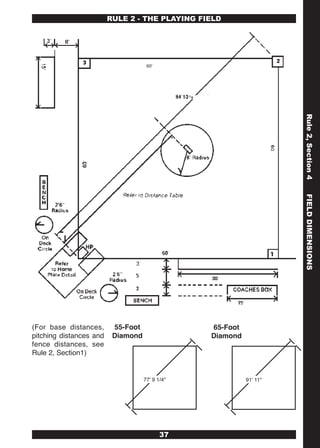
Section 3. For the layout of the diamond, refer to the drawing showing the official


                                                                                                 Rule 2, Section 2 - 3
     dimensions for a softball diamond. This section serves as an example for laying
     out a diamond with 60-foot bases and a 46-foot pitching distance. To determine
     the position of home plate, draw a line in the direction desired to lay the diamond.
     Drive a stake at the corner of home plate nearest the catcher. Fasten a cord to
     this stake and tie knots, or otherwise mark the cord, at 46 feet, 60 feet, 84 feet 10
     1/4 inches, and at 120 feet. Place the cord (without stretching) along the direction
     line and place a stake at the 46-foot marker. This will be the front line at the middle
     of the pitcher’s plate. Along the same line, drive a stake at the 84-foot 10 1/4-inch
     marker. This will be the center of second base. Place the 120-foot marker at the
     center of second base and, taking hold of the cord at the 60-foot marker, walk to
     the right of the direction line until the cord is taut and drive a stake at the 60-foot
     marker. This will be the outside corner of first base and the cord will now form
     the lines to first and second bases. Again, holding the cord at the 60-foot marker,
     walk across the field and, in a like manner, mark the outside corner of third base.
     Home plate, first base, and third base are wholly inside the diamond. To check
     the diamond, place the home plate end of the cord at the first base stake and
     the 120-foot marker at third base. The 60-foot marker should now check at home
     plate and the middle of second base.
     In the layout of a 65-foot base path diamond, follow the same procedure with the
     following substitute dimensions: 65 foot, 130 foot, and 91 feet 11 inches. Check
     all distances with a steel tape whenever possible.
     A. The three-foot line is drawn in foul territory parallel to and three feet from the
           baseline, starting at a point halfway between home plate and first base.
     B. The batter’s on-deck circle is a five-foot circle (2 1/2-foot radius) placed
           adjacent to the end of the player’s bench or dugout area closest to home
           plate.
     C. There shall be batter’s boxes, one on each side of home plate. The front
           line of the box will be drawn from the center of home plate. The inside lines
           of the batter’s box shall be six inches from home plate.
           Batter’s Box Table:
           Fast. Modified & Slow Pitch:                  3’W x 7’L
           16” Slow Pitch                                4’W x 8’L

     D.    The catcher’s box shall be as wide as the two batter’s boxes from outside
           line to outside line, 8’5” for Fast Pitch and Slow Pitch and 10’5” feet wide for
           16” Slow Pitch and 10’ long.
     E.    Each coach’s box is behind a line 15 feet long drawn outside the diamond.
           The line is parallel to and eight feet from the first and third base line, extended

                                             33
RULE 2 - THE PLAYING FIELD

                         from the bases toward home plate.
                    F.   The pitcher’s plate shall be of rubber or wood, 24 inches long and six inches
                         wide. The top of the plate shall be level with the ground. The front of the
                         pitcher’s plate shall be the prescribed pitching distances from the back point
                         of home plate. It shall be permanently attached to the ground at distances
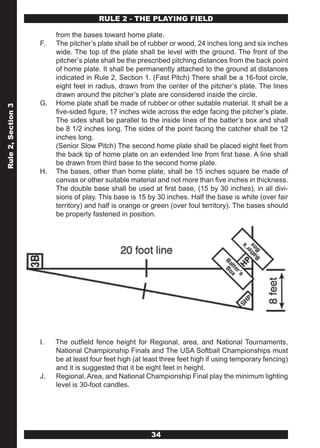
                         indicated in Rule 2, Section 1. (Fast Pitch) There shall be a 16-foot circle,
                         eight feet in radius, drawn from the center of the pitcher’s plate. The lines
                         drawn around the pitcher’s plate are considered inside the circle.
                    G.   Home plate shall be made of rubber or other suitable material. It shall be a
Rule 2, Section 3


                         five-sided figure, 17 inches wide across the edge facing the pitcher’s plate.
                         The sides shall be parallel to the inside lines of the batter’s box and shall
                         be 8 1/2 inches long. The sides of the point facing the catcher shall be 12
                         inches long.
                         (Senior Slow Pitch) The second home plate shall be placed eight feet from
                         the back tip of home plate on an extended line from first base. A line shall
                         be drawn from third base to the second home plate.
                    H.   The bases, other than home plate, shall be 15 inches square be made of
                         canvas or other suitable material and not more than five inches in thickness.
                         The double base shall be used at first base, (15 by 30 inches), in all divi-
                         sions of play. This base is 15 by 30 inches. Half the base is white (over fair
                         territory) and half is orange or green (over foul territory). The bases should
                         be properly fastened in position.


                    I.   The outfield fence height for Regional, area, and National Tournaments,
                         National Championship Finals and The USA Softball Championships must
                         be at least four feet high (at least three feet high if using temporary fencing)
                         and it is suggested that it be eight feet in height.
                    J.   Regional, Area, and National Championship Final play the minimum lighting
                         level is 30-foot candles.


                                                         34
RULE 2 - THE PLAYING FIELD

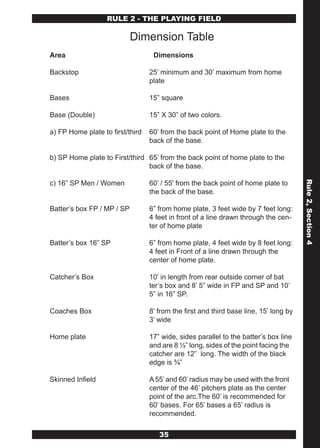
                            Dimension Table
Area                               Dimensions

Backstop                          25’ minimum and 30’ maximum from home
                                  plate

Bases                             15” square

Base (Double)                     15” X 30” of two colors.
a) FP Home plate to first/third   60’ from the back point of Home plate to the
                                  back of the base.

b) SP Home plate to First/third 65’ from the back point of home plate to the
                                back of the base.

c) 16” SP Men / Women             60’ / 55' from the back point of home plate to


                                                                                       Rule 2, Section 4
                                  the back of the base.

Batter’s box FP / MP / SP         6” from home plate, 3 feet wide by 7 feet long:
                                  4 feet in front of a line drawn through the cen-
                                  ter of home plate

Batter’s box 16” SP               6” from home plate, 4 feet wide by 8 feet long:
                                  4 feet in Front of a line drawn through the
                                  center of home plate.

Catcher’s Box                     10’ in length from rear outside corner of bat
                                  ter’s box and 8’ 5” wide in FP and SP and 10’
                                  5” in 16” SP.

Coaches Box                       8’ from the first and third base line, 15’ long by
                                  3’ wide

Home plate                        17” wide, sides parallel to the batter’s box line
                                  and are 8 ½” long, sides of the point facing the
                                  catcher are 12” long. The width of the black
                                  edge is ¾”

Skinned Infield                   A 55’ and 60’ radius may be used with the front
                                  center of the 46’ pitchers plate as the center
                                  point of the arc.The 60’ is recommended for
                                  60’ bases. For 65’ bases a 65’ radius is
                                  recommended.

                                     35
RULE 2 - THE PLAYING FIELD


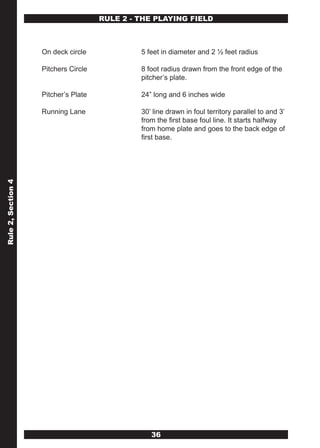
                    On deck circle             5 feet in diameter and 2 ½ feet radius

                    Pitchers Circle            8 foot radius drawn from the front edge of the
                                               pitcher’s plate.

                    Pitcher’s Plate            24” long and 6 inches wide

                    Running Lane               30’ line drawn in foul territory parallel to and 3’
                                               from the first base foul line. It starts halfway
                                               from home plate and goes to the back edge of
                                               first base.
Rule 2, Section 4


                                                  36
RULE 2 - THE PLAYING FIELD


                                     60'


                                                                     Rule 2, Section 4
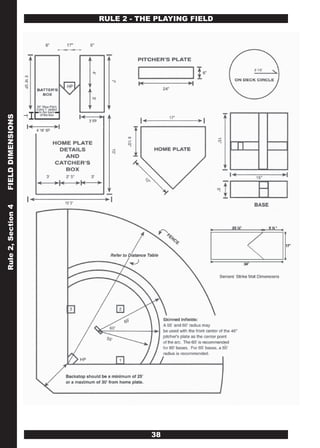
                                                                     FIELD DIMENSIONS


(For base distances,      55-Foot                65-Foot
pitching distances and    Diamond                Diamond
fence distances, see
Rule 2, Section1)


                                    77' 9 1/4"             91' 11"


                                           37
Rule 2, Section 4   FIELD DIMENSIONS


38
                                            RULE 2 - THE PLAYING FIELD
RULE 3 - EQUIPMENT

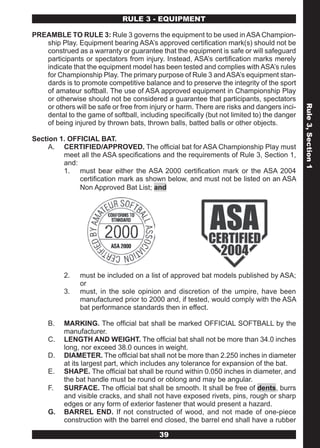
PREAMBLE TO RULE 3: Rule 3 governs the equipment to be used in ASA Champion-
   ship Play. Equipment bearing ASA’s approved certification mark(s) should not be
   construed as a warranty or guarantee that the equipment is safe or will safeguard
   participants or spectators from injury. Instead, ASA’s certification marks merely
   indicate that the equipment model has been tested and complies with ASA’s rules
   for Championship Play. The primary purpose of Rule 3 and ASA’s equipment stan-
   dards is to promote competitive balance and to preserve the integrity of the sport
   of amateur softball. The use of ASA approved equipment in Championship Play
   or otherwise should not be considered a guarantee that participants, spectators
   or others will be safe or free from injury or harm. There are risks and dangers inci-


                                                                                            Rule 3, Section 1
   dental to the game of softball, including specifically (but not limited to) the danger
   of being injured by thrown bats, thrown balls, batted balls or other objects.

Section 1. OFFICIAL BAT.
     A. CERTIFIED/APPROVED. The official bat for ASA Championship Play must
         meet all the ASA specifications and the requirements of Rule 3, Section 1,
         and:
         1. must bear either the ASA 2000 certification mark or the ASA 2004
              certification mark as shown below, and must not be listed on an ASA
              Non Approved Bat List; and


          2.    must be included on a list of approved bat models published by ASA;
                or
          3.    must, in the sole opinion and discretion of the umpire, have been
                manufactured prior to 2000 and, if tested, would comply with the ASA
                bat performance standards then in effect.

     B.   MARKING. The official bat shall be marked OFFICIAL SOFTBALL by the
          manufacturer.
     C.   LENGTH AND WEIGHT. The official bat shall not be more than 34.0 inches
          long, nor exceed 38.0 ounces in weight.
     D.   DIAMETER. The official bat shall not be more than 2.250 inches in diameter
          at its largest part, which includes any tolerance for expansion of the bat.
     E.   SHAPE. The official bat shall be round within 0.050 inches in diameter, and
          the bat handle must be round or oblong and may be angular.
     F.   SURFACE. The official bat shall be smooth. It shall be free of dents, burrs
          and visible cracks, and shall not have exposed rivets, pins, rough or sharp
          edges or any form of exterior fastener that would present a hazard.
     G.   BARREL END. If not constructed of wood, and not made of one-piece
          construction with the barrel end closed, the barrel end shall have a rubber

                                          39
RULE 3 - EQUIPMENT

                         or vinyl plastic or other approved material insert, or end cap at the large end
                         of the bat. The insert of end cap shall be firmly secured and permanently
                         affixed so that it can not be removed by anyone other than the manufacturer
                         without damaging or destroying the end cap or barrel. The bat barrel shall
                         be free of audible rattles when shaken. The bat barrel shall not have signs
                         of excessive wear.
                    H.   SAFETY GRIP. The official bat shall have a safety grip of cork, tape (no
                         smooth plastic tape) or composition material. The Safety Grip shall not be
                         less than 10.0 inches long, and shall not extend more than 15.0 inches from
                         the small/knob end of the bat. The Safety Grip may be a molded finger-formed
Rule 3, Section 1


                         grip as long as it is permanently attached to the bat or attached to the bat
                         with safety tape. Resin, pine tar or spray substances are permissible on the
                         Safety Grip only. Any tape applied to the Safety Grip must be continuously
                         spiral, but does not have to be a solid layer of tape. The Safety Grip may
                         not exceed two layers of tape. A bat having a “flare” or “cone” grip attached
                         will be considered an Altered Bat. EFFECT: Rule 7 Section 6B
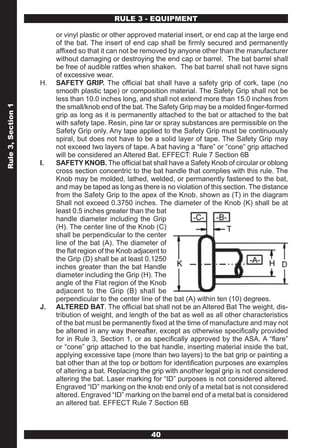
                    I.   SAFETY KNOB. The official bat shall have a Safety Knob of circular or oblong
                         cross section concentric to the bat handle that complies with this rule. The
                         Knob may be molded, lathed, welded, or permanently fastened to the bat,
                         and may be taped as long as there is no violation of this section. The distance
                         from the Safety Grip to the apex of the Knob, shown as (T) in the diagram
                         Shall not exceed 0.3750 inches. The diameter of the Knob (K) shall be at
                         least 0.5 inches greater than the bat
                         handle diameter including the Grip
                         (H). The center line of the Knob (C)
                         shall be perpendicular to the center
                         line of the bat (A). The diameter of
                         the flat region of the Knob adjacent to
                         the Grip (D) shall be at least 0.1250
                         inches greater than the bat Handle
                         diameter including the Grip (H). The
                         angle of the Flat region of the Knob
                         adjacent to the Grip (B) shall be
                         perpendicular to the center line of the bat (A) within ten (10) degrees.
                    J.   ALTERED BAT. The official bat shall not be an Altered Bat The weight, dis-
                         tribution of weight, and length of the bat as well as all other characteristics
                         of the bat must be permanently fixed at the time of manufacture and may not
                         be altered in any way thereafter, except as otherwise specifically provided
                         for in Rule 3, Section 1, or as specifically approved by the ASA. A “flare”
                         or “cone” grip attached to the bat handle, inserting material inside the bat,
                         applying excessive tape (more than two layers) to the bat grip or painting a
                         bat other than at the top or bottom for identification purposes are examples
                         of altering a bat. Replacing the grip with another legal grip is not considered
                         altering the bat. Laser marking for “ID” purposes is not considered altered.
                         Engraved “ID” marking on the knob end only of a metal bat is not considered
                         altered. Engraved “ID” marking on the barrel end of a metal bat is considered
                         an altered bat. EFFECT Rule 7 Section 6B


                                                         40
RULE 3 - EQUIPMENT

     K.    CONSTRUCTION. The official bat shall be of one piece construction,
           multi-piece permanently assembled or two-piece interchangable con-
           struction. If the bat is designed with interchangable components it must
           meet the following additional criteria:
           1. Mating components must have a unique locking key to prevent
           uncertified equipment combinations in the field.
           2. All component combinations must meet the one-piece bat rules.
           3. Manufacturer must demonstrate that the interchangable bat fails


                                                                                                 Rule 3, Section 2 - 3
               in a safe manner (i.e. visible damage before locking feature(s)
               fail(s).
           4. Bat components must be designed in a way to prevent uncertified
               equipment alterations.

Section 2. WARM-UP BAT.
     The warm-up bat shall meet the following requirements to be approved:
     A. Stamped with 1/4 inch letters WB on either end of the bat or marked in one-
         inch letters the words WARM-UP BAT only on the barrel end of the bat.
     B. The warm-up bat shall comply with the safety grip and the safety knob require-
         ments of the official bat.
     C. Be of one-piece construction or a one-piece permanently assembled bat that
         clearly distinguishes itself as a warm-up bat and is approved by the ASA.
     D. Shall have a safety knob of a minimum of 1/4 inch protruding at a 90 degree angle
         from the handle. It may be molded, lathed, welded or permanently fastened.
     E. Only approved attachments included in the list published by the ASA can be
         used on bats used to warm up bats.

Section 3. OFFICIAL SOFTBALL.
     A. CERTIFIED/APPROVED. Only softballs which bear an ASA approved certi-
         fication mark signifying compliance with the Ball COR and Ball Compression
         limitations then in effect, and which satisfy all other applicable provisions in Rule
         3, Section 3, will be allowed for use in ASA Championship Play. The ASA has
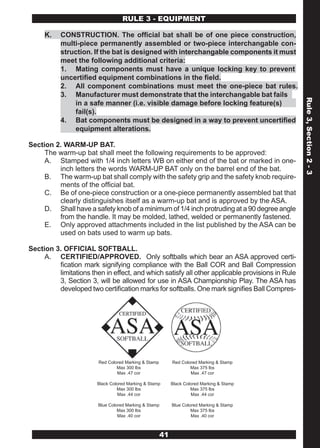
         developed two certification marks for softballs. One mark signifies Ball Compres-


                        Red Colored Marking & Stamp        Red Colored Marking & Stamp
                                Max 300 lbs                        Max 375 lbs
                                Max .47 cor                        Max .47 cor

                        Black Colored Marking & Stamp      Black Colored Marking & Stamp
                                 Max 300 lbs                        Max 375 lbs
                                 Max .44 cor                        Max .44 cor

                        Blue Colored Marking & Stamp       Blue Colored Marking & Stamp
                                 Max 300 lbs                        Max 375 lbs
                                 Max .40 cor                        Max .40 cor


                                                      41
RULE 3 - EQUIPMENT

                          sion 300 lbs or less. The other signifies Ball Compression of more than 300 lbs,
                          but less than 375 lbs.
                          The markings are also distinguishable by color, where red represents a Ball COR
                          of .470 or under, black represents a Ball COR of .440 or under, and blue repre-
                          sents a Ball COR of .400 or under. One of the following must be appropriately
                          and indelibly stamped on each softball allowed for use in ASA Championship
                          Play:
                    B.    COVER. The official softball shall have a cover of leather or synthetic material.
                          The ball shall be regular, smooth-seamed, and smooth-surfaced. Beginning
Rule 3, Section 3


                          January 1, 2010 the optic yellow ball shall be used in all Slow Pitch,
                          including Co-ed, Masters and Seniors.
                    C.    THE 16-INCH BALL. The official 16-inch softball shall be at least 16.0 inches
                          in circumference when measured across two seams, and shall weigh at least
                          9.0 ounces. The 16-inch ball shall have a white cover, white stitches, a Ball
                          COR of .470 or under, and a Ball Compression of 375.0 lbs or under. The
                          16-inch ball shall be used in the following ASA play: all men’s 16-inch slow
                          pitch.
                    D.    THE 14-INCH BALL. The official 14-inch softball shall be at least 14.0 inches
                          in circumference when measured across two seams, and shall weight at least
                          8.0 ounces.
                    E.    THE 12-INCH BALL. The official 12-inch softball shall be at least 12.0 inches
                          in circumference when measured across two seams, and shall weigh at
                          least 6.750 ounces. The 12-inch ball shall have no fewer than 88 stitches in
                          each cover, sewn by the two needle method, or with an authentic facsimile
                          of stitching as approved by the ASA.
                          1. The 12-Inch Fast Pitch Ball. The white cover or yellow optic cover,
                                 red-stitch 12-inch ball (all men’s and boys play may have white cover,
                                 white stitches) with a Ball COR of .470 or under and a Ball Compression
                                 of 375.0 lbs or under shall be used in the following ASA play: men’s and
                                 women’s fast pitch, men’s and women’s master fast pitch, men’s senior
                                 fast pitch, and boys and girls 12, 14, 16 and 18-under fast pitch.
                          2. The 12-inch Modified Pitch Ball. The white cover, red-stitch or yellow
                                 optic cover, red-stitch 12-inch ball with a Ball COR of .470 or under, and
                                 a Ball Compression of 375.0 lbs or under, shall be used in the following
                                 ASA play: all modified pitch.
                          3. The 12-inch Slow Pitch Ball. The white cover, red-stitch or yellow optic
                                 cover, red-stitch 12-inch ball with a Ball COR or .440 or under, and a
                                 Ball Compression of 375.0 lbs or under, shall be used in the following
                                 ASA play: men’s slow pitch, men’s major, co-ed slow pitch (male batters
                                 only), men’s master’s, men’s senior’s, and boys 14, 16, and 18-under
                                 slow pitch. Beginning January 1, 2010 the optic yellow ball shall
                                 be used in all Slow Pitch, including Co-ed, Masters and Seniors.
                    F.   THE 11-INCH BALL. The official 11-inch softball shall be at least 11.0 inches
                          in circumference. It shall weigh at least 6.0 ounces. The smooth-seamed
                          style shall not have fewer than 80 stitches in each cover, sewn by the two-
                          needle method, or with an authentic facsimile of stitching as approved by
                          the ASA.
                          1. The 11-inch Fast Pitch Ball. The white cover, white stitch or yellow
                                 optic cover, red-stitch 11-inch ball (it may be white-stitch for boys fast
                                                           42
RULE 3 - EQUIPMENT

                 pitch), with a Ball COR of .470 or under and a Ball Compression of
                 375.0 lbs or under and shall be used in the following ASA play: boys
                 and girls 10-under fast pitch.
            2. The 11-inch Slow Pitch Ball. The white cover, red-stitch or yellow optic
                 cover, red-stitch 11-inch ball with a Ball COR of .440 or under, and a
                 Ball Compression of 375.0 lbs or under, shall be used in the following
                 ASA play: women’s slow pitch, co-ed slow pitch (women batter’s only),
                 women’s masters, women’s senior’s, boys 10-under and 12-under slow
                 pitch and girls 10, 12, 14, 16, and 18-under slow pitch. Beginning Janu-


                                                                                                    Rule 3, Section 3
                 ary 1, 2010 the optic yellow ball shall be used in all Slow Pitch,
                 including Co-ed, Masters and Seniors.
     G.     The 10-inch Ball. The official 10-inch softball shall be at least 10.0 inches in
            circumference when measured across two seams, and shall weigh at least
            5.50 ounces.

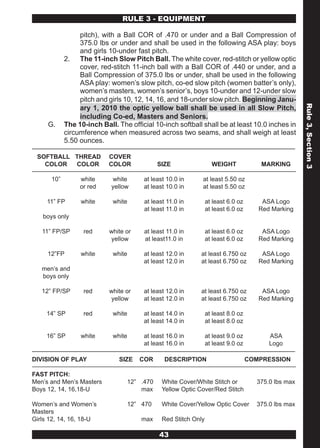
 SOFTBALL THREAD           COVER
   COLOR  COLOR            COLOR            SIZE                  WEIGHT              MARKING

      10”        white      white      at least 10.0 in     at least 5.50 oz
                 or red     yellow     at least 10.0 in     at least 5.50 oz

     11” FP      white      white      at least 11.0 in         at least 6.0 oz       ASA Logo
                                       at least 11.0 in         at least 6.0 oz      Red Marking
   boys only

   11” FP/SP      red      white or    at least 11.0 in         at least 6.0 oz       ASA Logo
                            yellow     at least11.0 in          at least 6.0 oz      Red Marking

     12”FP       white      white      at least 12.0 in     at least 6.750 oz         ASA Logo
                                       at least 12.0 in     at least 6.750 oz        Red Marking
   men’s and
   boys only

   12” FP/SP      red      white or    at least 12.0 in     at least 6.750 oz         ASA Logo
                            yellow     at least 12.0 in     at least 6.750 oz        Red Marking

    14” SP        red       white      at least 14.0 in         at least 8.0 oz
                                       at least 14.0 in         at least 8.0 oz

    16” SP       white      white      at least 16.0 in         at least 9.0 oz         ASA
                                       at least 16.0 in         at least 9.0 oz         Logo

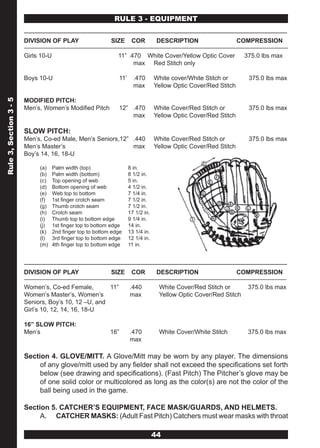
DIVISION OF PLAY               SIZE   COR      DESCRIPTION                        COMPRESSION

FAST PITCH:
Men’s and Men’s Masters          12” .470     White Cover/White Stitch or           375.0 lbs max
Boys 12, 14, 16,18-U                 max      Yellow Optic Cover/Red Stitch

Women’s and Women’s              12” 470      White Cover/Yellow Optic Cover        375.0 lbs max
Masters
Girls 12, 14, 16, 18-U                max     Red Stitch Only

                                             43
RULE 3 - EQUIPMENT


                        DIVISION OF PLAY                     SIZE      COR          DESCRIPTION                    COMPRESSION

                        Girls 10-U                              11” .470 White Cover/Yellow Optic Cover             375.0 lbs max
                                                                      max Red Stitch only

                        Boys 10-U                               11’     .470       White cover/White Stitch or       375.0 lbs max
                                                                        max        Yellow Optic Cover/Red Stitch

                        MODIFIED PITCH:
Rule 3, Section 3 - 5


                        Men’s, Women’s Modified Pitch           12” .470           White Cover/Red Stitch or         375.0 lbs max
                                                                    max            Yellow Optic Cover/Red Stitch

                        SLOW PITCH:
                        Men’s, Co-ed Male, Men’s Seniors,12” .440                  White Cover/Red Stitch or         375.0 lbs max
                        Men’s Master’s                       max                   Yellow Optic Cover/Red Stitch
                        Boy’s 14, 16, 18-U

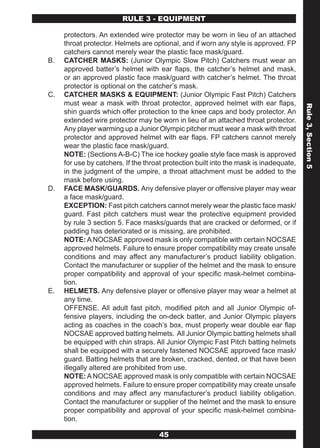
                             (a)     Palm width (top)                 8 in.
                             (b)     Palm width (bottom)              8 1/2 in.
                             (c)     Top opening of web               5 in.
                             (d)     Bottom opening of web            4 1/2 in.
                             (e)     Web top to bottom                7 1/4 in.
                             (f)     1st finger crotch seam           7 1/2 in.
                             (g)     Thumb crotch seam                7 1/2 in.
                             (h)     Crotch seam                      17 1/2 in.
                             (i)     Thumb top to bottom edge         9 1/4 in.
                             (j)     1st finger top to bottom edge    14 in.
                             (k)     2nd finger top to bottom edge    13 1/4 in.
                             (l)     3rd finger top to bottom edge    12 1/4 in.
                             (m)     4th finger top to bottom edge    11 in.


                        DIVISION OF PLAY                     SIZE      COR          DESCRIPTION                    COMPRESSION

                        Women’s, Co-ed Female,        11”             .440          White Cover/Red Stitch or        375.0 lbs max
                        Women’s Master’s, Women’s                     max           Yellow Optic Cover/Red Stitch
                        Seniors, Boy’s 10, 12 –U, and
                        Girl’s 10, 12, 14, 16, 18-U

                        16” SLOW PITCH:
                        Men’s                                16”      .470          White Cover/White Stitch         375.0 lbs max
                                                                      max

                        Section 4. GLOVE/MITT. A Glove/Mitt may be worn by any player. The dimensions
                             of any glove/mitt used by any fielder shall not exceed the specifications set forth
                             below (see drawing and specifications). (Fast Pitch) The Pitcher’s glove may be
                             of one solid color or multicolored as long as the color(s) are not the color of the
                             ball being used in the game.

                        Section 5. CATCHER’S EQUIPMENT, FACE MASK/GUARDS, AND HELMETS.
                             A. CATCHER MASKS: (Adult Fast Pitch) Catchers must wear masks with throat

                                                                                   44
RULE 3 - EQUIPMENT

     protectors. An extended wire protector may be worn in lieu of an attached
     throat protector. Helmets are optional, and if worn any style is approved. FP
     catchers cannot merely wear the plastic face mask/guard.
B.   CATCHER MASKS: (Junior Olympic Slow Pitch) Catchers must wear an
     approved batter’s helmet with ear flaps, the catcher’s helmet and mask,
     or an approved plastic face mask/guard with catcher’s helmet. The throat
     protector is optional on the catcher’s mask.
C.   CATCHER MASKS & EQUIPMENT: (Junior Olympic Fast Pitch) Catchers
     must wear a mask with throat protector, approved helmet with ear flaps,


                                                                                        Rule 3, Section 5
     shin guards which offer protection to the knee caps and body protector. An
     extended wire protector may be worn in lieu of an attached throat protector.
     Any player warming up a Junior Olympic pitcher must wear a mask with throat
     protector and approved helmet with ear flaps. FP catchers cannot merely
     wear the plastic face mask/guard.
     NOTE: (Sections A-B-C) The ice hockey goalie style face mask is approved
     for use by catchers. If the throat protection built into the mask is inadequate,
     in the judgment of the umpire, a throat attachment must be added to the
     mask before using.
D.   FACE MASK/GUARDS. Any defensive player or offensive player may wear
     a face mask/guard.
     EXCEPTION: Fast pitch catchers cannot merely wear the plastic face mask/
     guard. Fast pitch catchers must wear the protective equipment provided
     by rule 3 section 5. Face masks/guards that are cracked or deformed, or if
     padding has deteriorated or is missing, are prohibited.
     NOTE: A NOCSAE approved mask is only compatible with certain NOCSAE
     approved helmets. Failure to ensure proper compatibility may create unsafe
     conditions and may affect any manufacturer’s product liability obligation.
     Contact the manufacturer or supplier of the helmet and the mask to ensure
     proper compatibility and approval of your specific mask-helmet combina-
     tion.
E.   HELMETS. Any defensive player or offensive player may wear a helmet at
     any time.
     OFFENSE. All adult fast pitch, modified pitch and all Junior Olympic of-
     fensive players, including the on-deck batter, and Junior Olympic players
     acting as coaches in the coach’s box, must properly wear double ear flap
     NOCSAE approved batting helmets. All Junior Olympic batting helmets shall
     be equipped with chin straps. All Junior Olympic Fast Pitch batting helmets
     shall be equipped with a securely fastened NOCSAE approved face mask/
     guard. Batting helmets that are broken, cracked, dented, or that have been
     illegally altered are prohibited from use.
     NOTE: A NOCSAE approved mask is only compatible with certain NOCSAE
     approved helmets. Failure to ensure proper compatibility may create unsafe
     conditions and may affect any manufacturer’s product liability obligation.
     Contact the manufacturer or supplier of the helmet and the mask to ensure
     proper compatibility and approval of your specific mask-helmet combina-
     tion.

                                     45
RULE 3 - EQUIPMENT

                                  EFFECT: Failure to wear the batting helmet when ordered to do so by the
                                  umpire shall cause the player to be removed from the game. Wearing the
                                  helmet improperly or removing the helmet during a live ball play and judged
                                  by the umpire to be a deliberate act shall cause the violator to be declared
                                  out immediately. The ball remains live. Calling a runner out for removing a
                                  helmet does not remove force play situations. Umpires should use discretion
                                  as to the intent of the rule concerning player safety.
                                  DEFENSE. Any defensive player may wear a helmet, with or without ear
Rule 3, Section 5 - 6


                                  flaps, of similar color as the team caps. It must have a bill.
                                  EXCEPTION: Hockey style face mask.
                             F.   PROTECTIVE EQUIPMENT
                                  Unless more stringent equipment is required by these rules any offensive
                                  or defensive player may wear any protective equipment. As specifically set
                                  forth in these Rules, helmets may be required to be worn in certain situations
                                  during certain play, however, regardless of whether helmets are mandated
                                  by rule, any player shall have a right to wear a helmet at any time and during
                                  any part of the game, if that player so desires. Helmets shall have a bill.
                                  WARNING: The game of softball involves certain risk, including but not
                                  limited to death, serious neck and spinal injuries resulting in complete or
                                  partial paralysis, brain damage and serious injury to virtually all bones, joints,
                                  muscles and internal organs. Equipment used may be inadequate to prevent
                                  serious injury. However, in certain situations, the player’s use of a helmet
                                  may prevent or lessen certain injuries. Players choosing to not wear helmets
                                  do so with knowledge of the danger involved and agree to accept any and all
                                  liability for any injury or property loss related in any way to a player’s decision
                                  not to wear a helmet.

                        Section 6. UNIFORM.
                             All players on a team shall properly wear uniforms that are like in color and style.
                             Sleeves or straps of the uniform top may be adjusted, with or without tie-ups, to
                             the comfort of the players, provided uniform numbers remain visible. If because
                             of the blood rule a change is required and the uniform part does not match, the
                             player will not be penalized. All protective equipment should be worn properly. If a
                             player is requested by the umpire to remove jewelry, illegal shoes or illegal parts
                             of the uniform and they refuse, the player will not be allowed to play.
                             Coaches, players and team representative shall not display the names and/or
                             logos of any other softball association on their uniforms.
                             A. HEADWEAR.
                                   1. (Fast Pitch Male) Ball caps are mandatory, must be alike, and worn
                                         properly.
                                   2. (Female Fast Pitch and all Slow Pitch) Ball caps, visors and headbands
                                         are optional for players. If worn, they may be mixed, but must be worn
                                         properly. If one type or more than one type is worn, they all must be of
                                         the same color. Handkerchiefs do not qualify as headbands and cannot
                                         be worn around the head or neck. Plastic visors are not allowed.
                             B. PANTS/SLIDING PANTS. All players’ pants may be long, short, or mixed in

                                                                    46
RULE 3 - EQUIPMENT

           style, as long as they are like in color. Players may wear a solid-colored pair
           of sliding pants. It is not mandatory that all players wear sliding pants, but if
           more than one player wears them, they must be like in color and style. No
           player may wear ragged, frayed or slit legs on exposed sliding pants.
     C. UNDERSHIRTS. Players may wear a solid-colored undershirt. It is not
           mandatory that all players wear an undershirt, but if more than one player
           wears one, they must be like in color and style. No player may wear ragged,
           frayed or slit sleeves on exposed undershirts.


                                                                                               Rule 3, Section 6 - 7
     D. NUMBERS. An Arabic whole number (0-99) of contrasting color, or outlined
           in contrasting color, at least six inches high must be worn and visible on the
           back of all uniform shirts. No players on the same team may wear identical
           numbers. Players without numbers will not be permitted to play. There is no
           penalty for a player wearing a wrong number or a duplicate number. Correct
           the number in the score book or have the player(s) change jerseys in case
           of duplication, and continue play.
     E. CASTS/PROSTHESES. All casts and splints must be padded. Prostheses
           may be worn. Braces with exposed hard surfaces must be padded. Any of
           this equipment judged by the umpire to be potentially dangerous is illegal.
           Any decision by the umpire should be based on whether or not a device worn
           or used by an individual with a disability changes the fundamental nature of
           the game or poses a significant risk to the safety of other players.
     F. JEWELRY. Exposed jewelry, which is judged by the umpire to be danger-
           ous, must be removed and may not be worn during the game. Medical alert
           bracelets or necklaces are not considered jewelry. If worn, they must be
           taped to the body so the medical alert information remains visible.
     G. SHOES. Must be worn by all participants. A shoe shall be considered official
           if it is made with either canvas or leather uppers or similar material(s). The
           soles may be either smooth or have soft or hard rubber cleats. Ordinary metal
           sole or heel plates may be used if the cleats on the plates do not extend
           more than 3/4 of an inch from the sole or heel of the shoe. Shoes with round
           metal spikes are illegal. Shoes with detachable cleats that screw on are not
           permitted however; shoes with detachable cleats that screw INTO the shoe
           are permitted.
           EXCEPTION: All Junior Olympic Fast and Slow Pitch, Co-ed Slow Pitch, and
           Senior Slow Pitch Play: No metal spikes nor hard plastic or polyurethane
           spikes similar to metal sole and heel plates are allowed.
           EFFECT: Players wearing metal cleats after being warned by the umpire,
           shall be EJECTED.
Section 7. ALL EQUIPMENT.
     Notwithstanding the foregoing, the ASA reserves the right to withhold or withdraw
     approval of any equipment which, in the ASA’s sole determination, significantly
     changes the character of the game, affects the safety of participants or specta-
     tors, or renders a player’s performance more a product of the player’s equipment
     rather than the player’s individual skill.
     NOTE: The characteristics of any approved equipment cannot be changed. Ex-
     amples would be icing, cooling, heating equipment.

                                            47
RULE 4 - PLAYERS, COACHES, SUBSTITUTES

                    Section 1. PLAYERS.
                         A. A team must have the required number of players present in the dugout or
                             team area to start or continue a game.
                             1. Line-up cards are to be completed and submitted to the official scorer
                                   and umpire at the start of each game. A starting player shall be official
                                   when the line-up is inspected and approved by the plate umpire and
                                   team manager at the pre-game meeting. The line-up shall contain the
                                   first and last name, defensive position and uniform number of each
                                   player. If a wrong number is on the line-up, correct it and continue
Rule 4, Section 1


                                   playing with no penalty. All available substitutes should be listed in the
                                   designated place by their last name, first name and uniform number.
                             2. Eligible roster members may be added to the available substitute list
                                   at any time during the game.
                         B. Male rosters shall include only male players and female rosters shall include
                             only female players.
                         C. A team shall consist of players in the following positions:
                             1. Fast Pitch.
                                   a. Fast Pitch with Nine players: pitcher (F1), catcher (F2), first base-
                                         man (F3), second baseman (F4), third baseman (F5), shortstop
                                         (F6), left fielder (F7), center fielder (F8) and right fielder (F9).
                                   b. Fast Pitch with Designated Player (DP) and Flex: Ten Players with
                                         nine batting
                             2.          Modified Pitch:
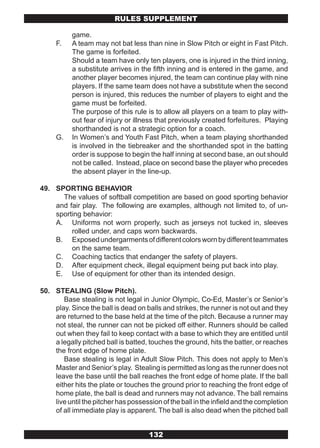
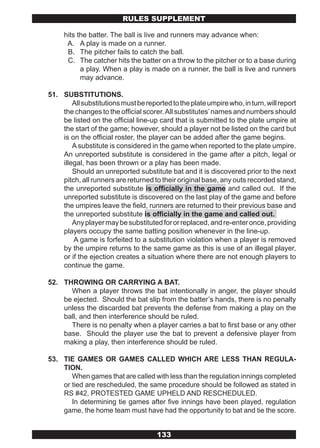
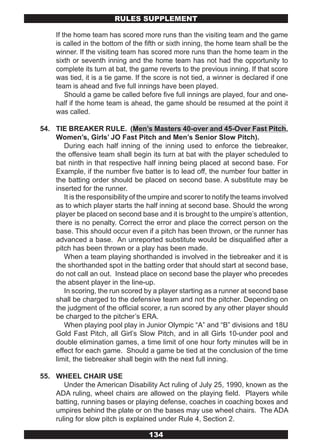
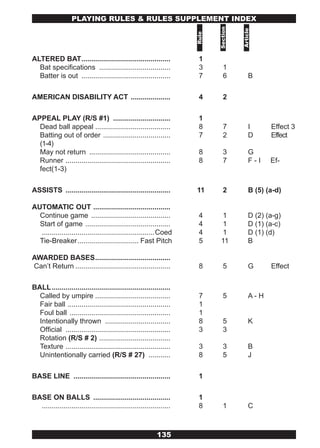
                                   a. Nine man as follows; pitcher (F1), catcher (F2), first baseman
                                         (F3), second baseman (F4), third baseman (F5), shortstop (F6),
                                         left fielder (F7), center fielder (F8) and right fielder (F9).
                                   b. Nine Player with Designated Player (DP) and Flex: Ten Players
                                         with nine batting.
                                   c. Ten Player Modified as follows; pitcher (F1), catcher (F2), first base-
                                         man (F3), second baseman (F4), third baseman (F5), shortstop
                                         (F6), left fielder (F7), left center fielder (F8), right center fielder
                                         (F9) and right fielder (F10).
                                   d. Ten Player Modified with Designated Player (DP) and Flex 11
                                         players with 10 batting.
                             3. Slow Pitch.
                                   a. Ten players as follows: pitcher (F1), catcher (F2), first baseman
                                         (F3), second baseman (F4), third baseman (F5), shortstop (F6),
                                         left fielder (F7), left center fielder (F8), right center fielder (F9) and
                                         right fielder (F10).
                                   b. Ten Players with Extra Player (EP) 11 players with only 10 playing
                                         defense.
                                   c. Senior Slow Pitch (50-55-60) Ten defensive players and 1 or 2
                                         Extra players (EP) or has the option of having all their players in
                                         the batting order. NOTE: The shorthanded rule allows the game
                                         to continue with one less than is in the batting order.


                                                                 48
RULE 4 - PLAYERS, COACHES, SUBSTITUTES

          d.   Senior Slow Pitch (65-70-75) 11 defensive players will bat (F11)
               and 1 or 2 Extra Players (EP) or have the option of having all
               their players bat. NOTE: The shorthanded rule allows the game
               to continue game can continue with one less than is in the batting
               order.
          e.   Co-ed 10 players five male and five females, pitcher (F1), catcher
               (F2), first baseman (F3), second baseman (F4), third baseman
               (F5), shortstop (F6), left fielder (F7), left center fielder (F8), right
               center fielder (F9) and right fielder (F10). They must have two


                                                                                          Rule 4, Section 1
               males and two females in both the infield and the outfield and one
               male and one female as pitcher and catcher.
          f.   Co-ed with Extra Player (EP) Twelve players: six male and six
               females as in Ten players with 2 Extra Players (EPs).

D.   SHORTHANDED RULE.
     1. To start a game:
        a. A game may begin or finish with one less than required to start.
        b. The vacant position must be listed last in the batting order.
        c. An out will be recorded when the vacant position in the batting
              order is scheduled to bat.
        d. (Co-ed Slow Pitch) If a team plays shorthanded with either three
              players in the infield or outfield, at least one must be male and at
              least one must be a female.
     2. To continue a game once started with a full team listed on the line-up
        card:
        a. If a team begins play with the required number of players as listed,
              that team may continue a game with one less player than is cur-
              rently in the batting order whenever a player leaves the game for
              any reason other than ejection. Under no circumstances shall a
              team be permitted to bat less than nine (slow pitch) or eight (fast
              pitch).
        b. If playing shorthanded, and a substitute arrives, the substitute
              must be inserted immediately into the vacant spot. If the substitute
              refuses to enter for any reason that player becomes ineligible for
              the remainder of the game.
        c. Co-ed If another player of the correct sex arrives, that player
              must be inserted into the line-up in the vacant spot by alternating
              sexes.
        d. If the player leaving the game is a runner or batter, the runner or
              batter shall be declared out.
        e. When the player who has left the game is scheduled to bat, an
              out shall be declared for each turn at bat. An inning or the game
              can end with an automatic out.
        f.    The player who has left the game cannot return to the line-up.
        g. Co-ed The batting order must still alternate and the defensive
              positioning remains as required.

                                     49
RULE 4 - PLAYERS, COACHES, SUBSTITUTES


                                             EXCEPTION: A player who has left the game under the blood rule
                                             may return even after missing a turn at bat.
                                             EFFECT - Failure to have the required number of eligible players
                                             to start or continue a game will result in a forfeit.

                        Section 2. AMERICAN DISABILITY ACT RULE
                             A. This rule may be used for a player that has been determined by the American
Rule 4, Section 2 - 3


                                 Disabilities Act of July 25, 1990, to be physically challenged. As a result of
                                 the player’s disability, the player can play either offense or defense.
                             B. Teams using a physically challenged player on offense or defense must have
                                 11 players. If the physically challenged player can play both, 10 players are
                                 needed.
                             C. When a physically challenged person plays offense only, the team will follow
                                 the EP rule as written. There would be 11 hitters including the ADA player,
                                 and only 10 who play defense.
                             D. When a physically challenged player plays defense only, they will be listed
                                 as the FLEX and placed last in the line-up. The team has the option to bat 10
                                 or 11 players (if the EP is also used). When using a FLEX, it must be made
                                 known prior to the start of the game.
                             E. If a team starts the game with the FLEX option, the FLEX player can never
                                 play offense. If this person for any reason cannot continue to play and the
                                 team has no other physically challenged player for a substitute, the EP can
                                 now play defense.
                             F. The FLEX position has the same re-entry status as any other starting posi-
                                 tion as long as the person substituted is also determined to be physically
                                 challenged under the ADA program. The original FLEX player may re-enter
                                 only in the same spot in the batting order.
                             G. (Co-ed) When a FLEX or two FLEX players, one male and/or one female,
                                 are used, the name(s) must be inserted at the end of the line-up. The EP or
                                 two EP’s can be listed anywhere in the first 10 positions.
                             NOTE: This special rule has been adopted to accommodate the athlete who is
                                 physically challenged. The intent is not to change the game and/or not to
                                 deprive any player from playing who would normally play, therefore, when
                                 using the EP, the normal EP rules will be followed including substitutions
                                 and re-entry. If the EP is used in addition to the FLEX, the FLEX must play
                                 defense and any of the other 11 players will be eligible to play defense. Only
                                 11 are allowed to bat.
                             H. The DP/FLEX rule in fast pitch accommodates the ADA rule.
                             I.  Any eligible player on the official line-up including available substitutes
                                 may be used as a courtesy runner for an ADA player. Unlimited courtesy
                                 runners are allowed each inning.

                        Section 3. DESIGNATED PLAYER (Fast Pitch)
                             A. A designated player (DP) may be used for any player provided it is made
                                 known prior to the start of the game and the player’s name is indicated in

                                                                 50
RULE 4 - PLAYERS, COACHES, SUBSTITUTES

          the line-up as one of the nine in the batting order.
     B.   The name of the player for whom the DP is batting (FLEX) will be placed in
          the 10th position in the line-up.
     C.   The starting player listed as the DP must remain in the same position in the
          batting order for the entire game. The DP and the DP’s substitute, or the
          substitute’s replacement, may never play offense at the same time.
     D.   The DP may be substituted for at any time, by a pinch-hitter, pinch-runner
          or the FLEX. If the starting DP is replaced on offense by the FLEX, the DP


                                                                                           Rule 4, Section 3 - 4
          will leave the game. If replaced by a substitute the DP position remains in
          the line-up. A starting DP may re-enter one time, as long as the DP returns
          to the original position in the batting order.
          1. If replaced by the FLEX, this reduces the number of players from 10 to
                 nine. If the DP does not re-enter, the game may legally end with nine
                 players.
          2. If the DP re-enters and the FLEX was batting in the DP’s position, the
                 FLEX can return to the 10th position and play defense only or leave
                 the game.
     E.   The DP may play any defensive position. Should the DP play defense for
          a player other than the one for whom the DP is batting (FLEX), that player
          will continue to bat but not play defense, and is not considered to have left
          the game. If the DP plays defense for the FLEX, the FLEX is considered to
          have left the game. This reduces the number of players from 10 to nine. The
          FLEX can re-enter the game.
     F.   The person being batted for (FLEX) may be substituted for at any time, by a
          legal substitute or the DP for whom the FLEX is playing defense. The FLEX
          may re-enter the game one time, in the 10th position or in the DP’s position
          in the batting order.
     G.   If returning to the 10th position, the FLEX will again play defense only but
          may play any defensive position.
     H.   If the FLEX returns to the DP’s position, the FLEX will play offense and
          defense; there will be only nine players in the batting order.
     I.   Placing the defensive only player (FLEX) into one of the first nine positions
          for someone other than the original DP is considered an illegal player. The
          illegal player shall be disqualified. Rule 4 Section 6F[2]. The FLEX replacing
          the DP is not considered a substitution for the FLEX. The DP, who has left
          the game, can re-enter the game.

Section 4. EXTRA PLAYER (Slow Pitch).
     A. An extra player (EP) is optional, but if used, it must be made known prior to
         the start of the game and be listed in the line-up card in the regular batting
         order. If the EP is used, the EP must be used the entire game. If an EP is
         used and not listed on the line-up card the following occurs:
         EFFECT
         1. If the illegal player is discovered while at bat, the legal batter enters
              and assumes the count, or
         2. If discovered while the illegal player is on base and before a pitch has

                                          51
RULE 4 - PLAYERS, COACHES, SUBSTITUTES

                                         been thrown to the next batter, treat as batting out of order. The person
                                         who should have batted is out, and all play as a result of the improper
                                         batter is nullified, and the person not listed in line-up is disqualified from
                                         the game, or
                                   3. If discovered while the illegal player is on base and a pitch has been
                                         thrown to the next batter, remove the illegal player from the base, or
                                         if the player has scored, nullify the run, and disqualify the player from
                                         the game.
Rule 4, Section 4 - 6


                             B.    The EP must remain in the same position in the batting order for the entire
                                   game.
                             C.    When an EP is used, all 11 on the starting line-up must bat and any 10 of
                                   those 11 may play defense.
                             D.    The EP may be substituted for at any time. The substitute must be a player
                                   who has not yet been in the game. The starting EP may re-enter.
                             E.    If the EP’s are used in co-ed, all 12 must bat and any 10, (five male and five
                                   female), may play defense. Defensive positions may be changed as long as
                                   the co-ed positioning is followed. The batting order must remain the same
                                   throughout the game.
                             F.    (Senior). One or two extra players may be designated at any place in the
                                   batting order. The EP(s) may enter the game on defense at any time, but
                                   the batting order must remain the same throughout the game.

                        Section 5. RE-ENTRY.
                             A. Any player may be substituted for or replaced and re-entered once, provided
                                 the players occupy their same batting position in the batting order.
                             B. The starting player and their substitute may not be in the line-up at the same
                                 time.
                             C. If a player re-enters the game a second time or a player re-enters the game
                                 in a position in the batting order other than their original starting or substitute
                                 position, this is considered an illegal re-entry.
                                 EFFECT - Section 5 A-C: Violation of the re-entry rule is considered an illegal
                                 player. The illegal player shall be disqualified. Rule 4, Section 6F[4].

                        Section 6. SUBSTITUTES/ILLEGAL PLAYER.
                             A substitute may take the place of a player whose name is in their team’s batting
                             order. The following regulations govern player substitutions:
                             A. The manager or team representative of the team making the substitution shall
                                  notify the plate umpire at the time the substitute enters. The plate umpire
                                  shall then report the change to the scorer.
                             B. A substitute shall be considered officially in the game when reported to the
                                  plate umpire. The player does not violate the unreported substituted rule until
                                  a pitch, legal or illegal, or a play has been made. The use of an unreported
                                  substitute is handled as a protest by the offended team while the player is
                                  in the game.
                                  EFFECT: Upon being properly protested, the player will now be officially in
                                  the game, and subject to penalties as appropriate and listed in 4-6C (1-9).

                                                                     52
RULE 4 - PLAYERS, COACHES, SUBSTITUTES

C.   A substitute who enters the game without reporting is considered an unre-
     ported substitute:
     1. After a pitch, legal or illegal, or a play made.
          EFFECT: Player is officially in the game and all action stand.
     2. Before the offending team informs the umpire prior to a protest by the
          offended team.
          EFFECT: No Violation regardless of how long the player or players
          were in the game. All action stands.
     3. When they bat and reach first base safely and are discovered:


                                                                                   Rule 4, Section 6
                   a. BEFORE the next pitch, legal or illegal
                   b. Before the defense has left the field of play
                   c. Before the umpires have left the field of play
          EFFECT: All runners will return to the last base occupied prior to
          the batted ball. The unreported substitute is officially in the game
          and called out. All other outs that occur on this play stand.
     4. When discovered after completing their turn at bat and:
                 a. AFTER the next pitch, legal or illegal,
                 b. Before the defense has left the field
                 c. Before the umpires have left the field of play
          EFFECT: The unreported substitute is officially in the game. Any
          advance of runner(s) as a result of the play is legal.
     5. When a runner and that runner is brought to the attention of the umpire
          BEFORE a pitch, legal or illegal, or a play made;
          EFFECT: No penalty. Replace the unreported substitute with the correct
          player or enter them as a legal substitute.
     6. When a runner and that runner is protested AFTER a pitch, legal or
          illegal, or a play made;
          EFFECT: The runner is officially in the game. Any advance of the
          runner(s) is legal.
     7. When on defense is protested by the offense BEFORE a pitch, legal
          or illegal:
          EFFECT: No penalty. Replace with the correct player or enter them as
          a legal substitute.
     8. When on defense MAKES A PLAY and is protested:
                 a. BEFORE the next pitch, legal or illegal,
                 b. before the defense has left the field, and
                 c. before the umpires have left the field of play;
          EFFECT: The unreported substitute is officially in the game and
          the offensive team has the option to:
                 a.Take the result of the play.
                 b.Have the last batter return to bat and assume the ball and
          strike count. All runners return to the last base occupied prior to
          the play.
     9. When on defense is protested AFTER a pitch, legal or illegal, to the
          next batter;
          EFFECT: The unreported substitute is officially in the game and
          all play stands.
                                   53
RULE 4 - PLAYERS, COACHES, SUBSTITUTES

                                       NOTE: If the substitute is an illegal player for any reason, the
                                       substitute will be subject to the penalty for that violation.
                                        NOTE: C 1-9 In 16 inch SP an appeal must be made before a pitch
                                       legal or illegal, or a hesitation.
                             D. If an injury to a batter-runner or runner prevents them from proceeding to an
                                 awarded base, and the ball is dead, a substitute for the batter-runner may be
                                 made. The substitute will be allowed to proceed to any awarded base(s). The
                                 substitute must legally touch any awarded or missed base(s) not previously
                                 touched. This is not a courtesy runner, but a legal substitute.
Rule 4, Section 6 - 7


                             E.   A player will not violate the illegal player rule until a pitch, legal or illegal,
                                 or a play made. The use of an illegal player is handled as a protest by the
                                 offended team while the player is in the game.
                                 EFFECT: Once the umpire has been informed the illegal player shall be
                                 disqualified, and can be legally replaced either by a substitute or a starter
                                 who re-enters the game.
                             F. Illegal Players Include:
                                 1. ILLEGAL PITCHER. A player who returns to pitch after being removed
                                       from the pitching position by the umpire,
                                       EFFECT: Once discovered, the illegal pitcher shall be disqualified and
                                       all play stands.
                                 2. ILLEGAL BATTER. (Fast Pitch) Placing the “FLEX” player in one of
                                       the first nine positions in the batting order for someone other than the
                                       original DP.
                                 3. ILLEGAL RUNNER. Occurs when:
                                       a. An offensive player is placed in the line-up as a runner for another
                                             offensive player.
                                             EXCEPTION: Senior Slow Pitch, Men’s Masters 40-OSP/45-OSP,
                                             Senior or Master Fast Pitch (pitcher and catcher only), and in the
                                             tie-breaker rule (Rule 5 Section 11)
                                       b. (Fast Pitch) The FLEX is placed n the line-up as a runner for
                                             someone other than the starting DP.
                                       c. (Boys and Girls JO Fast Pitch) A player does not report as a
                                             courtesy runner or an illegal courtesy runner is used.
                                 4. ILLEGAL RE-ENTRY. Occurs when:
                                       a. A starting player returns to the game a second time after being
                                             substituted for twice.
                                       b. A starting player returns to the game, but is not in their original
                                             position in the batting order.
                                       c. A substitute returns to the game after being replaced twice.
                                             EFFECT: Section F [2-4] The Illegal Player is disqualified and re
                                             placed with a legal substitute. All other provisions of Rule 4 sec
                                             tion 6 A-C [1-9] apply.
                        Section 7. COACH.
                             A. A coach is responsible for the team’s actions on the field and will represent
                                 the team in communications with the umpire and opposing team. A player
                                 may be designated as a coach in the event the coach is absent or that player
                                 is acting as a player/coach.
                             B. Coaches must be neatly attired or dressed in the team uniform. If a coach
                                 wears a hat/cap, it must be approved head wear.

                                                                    54
RULE 4 - PLAYERS, COACHES, SUBSTITUTES

           EFFECT: The coach(s) cannot be on the playing field to coach their team.
     C.    A base coach is an eligible team member or coach of the team at bat who
           occupies the coach’s box at first or third, to direct the offensive players.
           1. When in the coach’s box a base coach may have a score book (electronic
                 or paper), pen, pencil, or electronic marker and an indicator all of which
                 shall be used for scorekeeping or record keeping purposes only.
           2. A base coach shall stay within the confines of these boxes with both
                 feet.
                 a. A coach may leave the coach’s box to signal the runner to slide,


                                                                                               Rule 4, Section 7 - 10
                       advance or return to a base or move out of a fielder’s way as long
                       as the coach does not intentionally interfere with the play.
                 b. A coach may not leave the coach’s box to give verbal communica-
                       tions or signals to the batter.
                       EFFECT: After a warning, an offensive conference will be
                       charged.
           3. Base coaches may not use language that will reflect negatively upon
                 players, umpires or spectators.
           4. A base coach may address only their team members.
           5. No communication equipment, to include cell phones, pagers, etc., are
                 allowed to be worn or carried on the playing field.
           EFFECT: Disqualification or ejection from the game after a warning.
Section 8. DISQUALIFIED OR EJECTED PARTICIPANT.
     A. A disqualified player is prohibited from playing but can remain in the team area
           or serve as a coach/manager.
           EFFECT: If found playing, the game is forfeited.
     B. An ejected participant must leave the grounds and have no contact with the
           umpires or participants in the game.
           EFFECT: The Game is forfeited.
     C. Any arguing on the judgment of balls and strikes will result in a team warn-
           ing.
           EFFECT: Any repeat offense shall result in the ejection of that team mem-
           ber.
     D. If a player is disqualified a team can play shorthanded, however if a player is
           ejected and the team does not have enough players, play can not continue.
           EFFECT: The game is forfeited.
Section 9. BLOOD RULE.
     A game participant or umpire who is bleeding or who has blood on their uniform
     shall be prohibited from participating further in the game until appropriate treatment
     can be administered. If medical care or treatment is administered in a reasonable
     length of time, the individual will not have to leave the game. The length of time that
     is considered reasonable is left to the umpire’s judgment. Uniform rule violations
     will not be enforced if a uniform change is required. The umpire shall:
     A. Stop the game and immediately, call a coach, trainer or other authorized person
           to the injured player and allow treatment.
     B. Apply the rules of the game regarding substitution, short-handed rule and re-
           entry if necessary.
Section 10. INJURED PLAYER.
     During a live ball situation, when a player becomes injured, and in the umpire’s
     judgment requires immediate attention, the umpire shall call “DEAD BALL”.
     EFFECT: Award any bases that would have been reached.
                                            55
RULE 5 - THE GAME

                        Section 1. HOME TEAM.
                             The team designated as home team shall bat last in the inning.

                        Section 2. FITNESS OF THE GROUNDS.
                             The fitness of the grounds for a game shall be decided solely by the plate um-
                             pire.

                        Section 3. REGULATION GAME.
Rule 5, Section 1 - 4


                             A. A regulation game shall consist of seven innings. A full seven innings need
                                 not be played if the team second at bat scores more runs in six and one-half
                                 innings and/or before the third out in the last of the seventh inning, or the
                                 run-ahead rule is applied.
                             B. A game that is tied at the end of seven innings shall be continued by playing
                                 additional innings until one side has scored more runs than the other at the
                                 end of a complete inning, or until the team second at bat has scored more
                                 runs in their half of the inning before the third out is made.
                             C. A game called by the umpire shall be regulation if five or more complete
                                 innings have been played, or if the team second at bat has scored more
                                 runs in four or more innings than the other team has scored in five or more
                                 innings. The umpire is empowered to call a game at any time because of
                                 darkness, rain, fire, panic or any other cause that places the patrons or play-
                                 ers in peril.
                             D. Games that are not considered regulation shall be resumed at the exact
                                 point where they were stopped.
                             E. A regulation tie game shall be declared if the score is equal when the game
                                 is called at the end of five or more complete innings, or if the team second at
                                 bat has equaled the score of the first team at bat in the incomplete inning.
                             F. Games that are regulation tie games shall be resumed at the exact point
                                 where they were stopped.

                        Section 4. FORFEITED GAMES.
                             A forfeited game shall be declared by the umpire in favor of the team not at fault
                             in the following cases:
                             A. If an umpire is physically attacked by any team member and/or spectator.
                             B. If a team fails to appear on the field, or being on the field, refuses to begin
                                   a game for which it is scheduled or assigned within a time set for forfeitures
                                   by the organization that the team represents.
                             C. If one side refuses to continue to play after the game has begun, unless the
                                   game has been suspended or terminated by the umpire.
                             D. If, after play has been suspended by the umpire, one side fails to resume play-
                                   ing within two minutes after “play ball” has been declared by the umpire.
                             E. If a team employs tactics noticeably designed to delay or to hasten the
                                   game.
                             F. If, after a warning by the umpire, any rules of the game are willfully vio-
                                   lated.


                                                                  56
RULE 5 - THE GAME

     G.   If the order for the ejection of a game participant is not obeyed within one
          minute.
     H.   If the ejection of a player or players from the game results in fewer than the
          required number of players to continue the game.
     I.   If an ejected participant is discovered participating, or has contact with the
          umpires or other participants in the game.
     J.   If a team is playing one player short and another player becomes injured or
          ill, leaving the team with two less players than the required number.


                                                                                           Rule 5, Section 4 - 7
     K.   Once a game has been forfeited, the forfeit cannot be changed.

Section 5. SCORING OF RUNS.
     A. One run shall be scored each time a runner:
         1. Touches first, second, third bases and home plate.
         2. When using the tie breaker rule, a runner starting at second base, touches
         third base and home plate.
     EXCEPTION: All Adult Slow pitch (except Master’s and Senior’s). Any fair ball
         hit over the fence for a home run or a four base award, the batter and all
         runners are credited with a run. The batter and the runner are not required
         to run the bases.
     B. No run shall be scored if the third out of the inning is the result of:
         1. A batter-runner being called out prior to reaching first base or any other
               runner forced out due to the batter becoming a batter-runner. On an
               appeal play, the force out is determined when the appeal is made, not
               when the infraction occurred.
         2. A runner being put out by a tag or live ball appeal play prior to the lead
               runner touching home plate.
         3. A preceding runner is declared out on an appeal play.
     C. No run shall be scored if a “fourth out” is the result of an appeal of a base
         missed or left to soon on a runner who has scored.

Section 6. GAME WINNER.
     The winner of the game shall be the team that scores more runs in a regulation
     game.
     A. The score of a called regulation game shall be the score at the end of the
         last complete inning, unless the team second at bat has scored an equal
         number or more runs than the first team at bat in the incomplete inning. In
         this case the score shall be that of the incomplete inning.
     B. The score of a regulation tie game shall be the tie score when the game was
         terminated.
     C. The score of a forfeited game shall be seven to zero in favor of the team not
         at fault.

Section 7. CONFERENCES.
     A. Offensive Conference. There shall be only one charged conference between
         a team representative(s) and the batter, another team representative, and/
         or runner(s) in an inning. The umpire shall not permit any such conferences

                                          57
RULE 5 - THE GAME

                                  in excess of one in an inning.
                                  EFFECT: Ejection of the manager or team representative who insists on
                                  another charged conference.
                             B.   Defensive Conference. There shall be only three charged conference(s)
                                  between the manager or other team representative from the dugout with any
                                  defensive player(s) in a seven inning game. For every inning beyond seven,
                                  there shall be one charged conference per inning between the manager or
                                  other team representative from the dugout with any defensive player(s).
Rule 5, Section 7 - 8


                                  EFFECT: The fourth and each additional, charged conference in a seven
                                  inning game, or for any charged conference in excess of one per inning in an
                                  extra inning game, shall result in the removal of the pitcher from the pitching
                                  position for the remainder of the game. The removed pitcher can play another
                                  position on defense but cannot pitch again.

                        Section 8. HOME RUN RULE
                             A. (Men’s, Men’s Masters, Co-ed and Women’s Slow Pitch) A limit of over-
                                 the-fence home runs will be used in all Men’s, Men’s Masters, Co-ed and
                                 Women’s slow pitch divisions. The following limitations are per team per
                                 game:
                                 1. Eight (8)     Class A and Co-ed Open
                                 2. Six (6)       Industrial and Men’s Class B
                                 3. Four (4)      Church, Masters 35, 40, and 45-over, Class C Co-ed,
                                                  Men’s and Women’s Class C
                                 4. Two (2)       Men’s Class D, Class D Co-ed, and Women’s Class D
                                 5. Zero (0)      Class E/REC
                                      EFFECT: For any in excess, the ball is dead, the batter is out, and no
                                      runners can advance. In Class E/REC an over the fence home run will
                                      also be a half-inning ending out.
                                      NOTE:
                                      a. Any fair fly ball touched by a defensive player that clears or has
                                           cleared the fence in fair territory, should be declared a four base
                                           award and shall not be included in the total of over-the-fence home
                                           runs.
                                      b. A home run will be charged for any ball hit over the fence whether
                                           runs score or not.
                                      c. Both male and female home runs count toward the Co-ed limit.

                             B.   (Men’s Senior Divisions) The following limitations are per team per game:
                                      SENIORS 50-55-60-65:
                                  1. Nine (9) plus “one-up”                 Major Plus
                                  2. Six (6) plus “one-up”                  Major
                                  3. Three (3)                              AAA
                                  4. One (1)                                AA
                                      SENIORS 70 & 75:
                                  1. Six (6)                                Major
                                  2. Three (3)                              A

                                                                  58
RULE 5 - THE GAME

              EFFECT: For any in excess, the ball is dead, the batter is out, and no
              runners can advance.
           NOTE:
           a. One-up Ruling: If both teams have reached the limit of home runs,
              either team is allowed to hit an additional home run, to go one home
              run ahead of the opposing team. (Example: With a six home run limit,
              the home team hits their sixth home run in the 2nd inning. The visiting
              team can then hit a total of seven home runs, and do so in the top of


                                                                                                Rule 5, Section 8 - 10
              the 3rd inning. In the bottom of the 3rd, the home team could then hit
              two more home runs to go “one-up” again, with a total of eight. This can
              continue throughout the game until the bottom of the 7th inning.) The
              home team can only equal the number of home runs by the visitors (in
              excess of six) in this inning. If neither team has hit six home runs by
              the bottom of 7th, the home team can hit their sixth.

Section 9. RUN AHEAD RULE
     A. A run ahead rule must be used at all National Tournaments.
         1. Fast Pitch
                    a. Men’s - 15 after three innings, 12 after four innings or seven
                    after five innings.
                    b. Women’s and JO - 15 after three innings, 12 after four
                    innings or eight after five innnings
         2. Modified Pitch – 15 after three innings or 10 after five innings.
         3. Slow Pitch
                    a. Slow Pitch (except Men’s Class A) - 20 after three innings,
                    15 after four innings or 10 after five innings.
                    b. Men’s Class A - 20 after four innings, 15 after five
                    innings.
         4. Sixteen-Inch Slow Pitch – 12 after four innings and 10 after five in-
               nings.
     B. Complete innings must be played unless the home team scores the run
         ahead limit while at bat. When the visiting team reaches the limit in the top
         half of the inning, the home team must have their opportunity to bat in the
         bottom half of the inning.

Section 10. TIME LIMIT RULE (Code Article 510 O)
     When the time limit rule is in effect time begins with the first pitch. If the game
     is tied after the time limit has expired, the tie breaker rule shall be in effect at the
     start of the next inning and play shall continue until a winner is determined. The
     time limit rule is as follows:

     A)    In Junior Olympic 10-Under Class A and 10-Under Class B Fast Pitch pool
           play, the time limit will be one hour and forty minutes; no inning shall start
           after one hour and forty minutes.


                                            59
RULE 5 - THE GAME

                               B)   In Junior Olympic 10-Under Class A and 10-Under Class B Fast Pitch elimi-
                                    nation play, no inning shall start after 1 hour and 40 minutes.

                               C)   In all Junior Olympic Pool Play, Class A and B 12-Under, 14-Under, 16-Under
                                    and 18-Under and 18-Under Gold, no inning shall start after 1 hour and 40
                                    minutes.

                               D)   In all Junior Olympic Class B 12-Under, 14-Under, 16-Under and 18-Under
Rule 5, Section 10 - 12


                                    elimination play;, no inning shall start after 1 hour and 40 minutes.

                                    EXCEPTION: In all Junior Olympic Class B 12-Under, 14-Under, 16-Under
                                    and 18-Under elimination play there will be no time limit for the upper and
                                    lower bracket final games, and the championship and the ‘ if necessary ’
                                    games.

                          Section 11. TIE-BREAKER RULE (Code Article 510 N).
                               (Men’s 40-over and 45-over, Women’s and Junior Olympic Girls Fast Pitch)
                               When after the completion of seven (7) innings of play (or 1 hour and 40 minutes
                               in JO pool play), the score is tied, the following tie-breaker rule will be played to
                               determine a winning team.
                               A. Starting with the top of the eighth inning, and each half inning thereafter, the
                                    offensive team shall begin its turn at bat with the player who is scheduled
                                    to bat last in that respective half inning being placed on second base (e.g.,
                                    if the number five batter is the lead off batter, the number four batter in the
                                    batting order will be placed on second base. A substitute may be inserted
                                    for the runner).
                               B. If a team is in the tie-breaker and the short handed rule is in effect, do not
                                    declare an out if the absent player is the one who should begin the half in-
                                    ning at second base. Instead, place on second base the player whose name
                                    precedes the absent player’s name in the line-up.
                               C. (Men’s Senior Slow Pitch) Use the tie-breaker rule after completion of seven
                                    innings.

                          Section 12. DUGOUT CONDUCT.
                               Coaches, players, substitutes, and other bench personnel shall not be outside the
                               designated bench, dugout/team area except when the rule allows or is justified
                               by the umpire.
                               EFFECT: The first offense is a team warning. Any repeat offense shall result in
                               the ejection of that team member.


                                                                     60
RULE 6 - PITCHING REGULATIONS (FAST PITCH)

Section 1. PRELIMINARIES.
     Before starting the delivery (pitch), the pitcher shall comply with the following:
     A. The pitcher must take the pitching position on the pitcher’s plate with
          hands separated and the ball in the glove or the pitcher’s hand.
     B. The pitcher shall not be considered in the pitching position unless the catcher
          is in position to receive the pitch.


                                                                                              Rule 6 Fast Pitch, Section 1 - 3
     C. Both feet must be on the ground within the 24-inch length of the pitcher’s
          plate. The shoulders shall be in line with first and third bases.
          1. (Male) The pitcher shall take a position with their pivot foot in contact
                with the pitcher’s plate and their non-pivot foot in contact with or behind
                the pitcher’s plate.
          2. (Female) The pitcher shall take a position with both feet in contact with
                the pitcher’s plate.
     D. While on the pitcher’s plate, the pitcher shall take the signal or appear to
          take a signal with the hands separated. The ball must remain in either the
          glove or pitching hand.
     E. The pitcher shall bring the hands together for not less than one second and
          not more than 10 seconds before releasing it,
          1. (Male) A backward step may be taken before, simultaneous with or after
                the hands are brought together. The pivot foot must remain in contact
                with the pitcher’s plate at all times prior to the forward step.
          2. (Female) Both feet must remain in contact with the pitcher’s plate at all
                times prior to the forward step.

Section 2. STARTING THE PITCH.
     The pitch starts when one hand is taken off the ball after the hands have been
     placed together.

Section 3. LEGAL DELIVERY.
     A. The pitcher must not make any motion to pitch without immediately delivering
         the ball to the batter.
     B. The pitcher must not use a pitching motion in which, after bringing the hands
         together, the pitcher removes one hand from the ball, and returns the ball to
         both hands.
     C. The pitcher must not make a stop or reversal of the forward motion after
         separating the hands.
     D. The pitcher must not make two revolutions of the arm on the windmill pitch.
         A pitcher may drop the arm to the side and to the rear before starting the
         windmill motion.
     E. The delivery must be an underhand motion with the hand below the hip and
         the wrist not farther from the body than the elbow.
     F. The pitch shall be delivered on the throwing arm side of the body and not
         behind the back or through the legs.
     G. The release of the ball and follow through of the hand and wrist must be
         forward and past the straight line of the body.


                                           61
RULE 6 - PITCHING REGULATIONS (FAST PITCH)

                                        H.    (Men’s Fast Pitch) In the act of delivering the ball, the pitcher must take one
                                              step with the non-pivot foot simultaneous with the release of the ball. The
                                              step must be forward toward the batter. It is not a step if the pitcher slides
                                              the pivot foot across the pitcher’s plate toward the batter, or if the pivot foot
                                              turns or slides in order to push off the pitcher’s plate, provided contact is
                                              maintained with the plate. Raising the foot off the pitching plate and returning
Rule 6 Fast Pitch, Section 3 - 6


                                              it to the plate creates a rocking motion and is an illegal act.
                                        I.    (Women’s and all JO play) In the act of delivering the ball, the pitcher must
                                              take one step with the non-pivot foot simultaneous with the release of the
                                              ball. The step must be forward and toward the batter within the 24-inch length
                                              of the pitcher’s plate. It is not a step if the pitcher slides the pivot foot across
                                              the pitcher’s plate toward the batter, or if the pivot foot turns or slides in order
                                              to push off the pitcher’s plate, provided contact is maintained with the plate.
                                              Raising the foot off the pitching plate and returning it to the plate creates a
                                              rocking motion and is an illegal act
                                        J.    Pushing off with the pivot foot from a place other than the pitcher’s plate is
                                              illegal.
                                        K.    (Women’s and all JO Play) Pushing off and dragging the pivot foot in contact
                                              with the ground is required. If a hole has been created, the pivot foot may
                                              drag no higher than the level plane of the ground.
                                        L.    (Men’s) Pushing off and dragging the pivot foot in contact with the ground,
                                              or if both feet are in the air, having the toes of the pivot foot in the downward
                                              direction is required.
                                        M.    The pitcher must not make another revolution after releasing the ball.
                                        N.    The pitcher shall not deliberately drop, roll or bounce the ball in order to
                                              prevent the batter from hitting it.
                                        O.    The pitcher has 20 seconds to release the next pitch after receiving the ball
                                              or after the umpire indicates “play ball.”
                                              EFFECT: A ball on the batter.

                                   Section 4. INTENTIONAL WALK.
                                        If the pitcher desires to walk a batter intentionally all pitches must be legally de-
                                        livered to the batter.

                                   Section 5. DEFENSIVE POSITIONING.
                                        A. The pitcher shall not deliver a pitch unless all available defensive players are
                                            positioned in fair territory, except the catcher who must be in the catcher’s
                                            box.
                                        B. A fielder shall not take a position in the batter’s line of vision or, with deliberate
                                            unsportsmanlike intent, act in a manner to distract the batter. A pitch does
                                            not have to be released.
                                            EFFECT: The offending player shall be ejected from the game.

                                   Section 6. FOREIGN SUBSTANCE/PROTECTIVE WRAPS.
                                        A. A defensive player shall not at any time during the game be allowed to use
                                            any foreign substance upon the ball. Under the supervision and control of

                                                                                62
RULE 6 - PITCHING REGULATIONS (FAST PITCH)

         the umpire, powder resin and/or an approved manufactured drying agent
         may be used by the pitcher that is included on the list published by the
         ASA. The resin must be left on the ground and the approved drying
         agent in the pitcher’s pocket. A pitcher who licks their fingers must wipe
         the fingers off before bringing them in contact with the ball.
         EFFECT: An illegal pitch shall be called on the first offense. If any defensive


                                                                                               Rule 6 Fast Pitch, Section 6 - 9
         player continues to place a foreign substance on the ball, the player should
         be ejected from the game. If any other substance is found in the pitcher’s
         pocket, the pitcher shall be ejected.
     B. A pitcher shall not wear any item on the pitching hand, wrist, forearm, elbow
         or thighs, which may, in the umpire’s judgment, be distracting to the batter.
         Batting gloves may not be worn on the pitching hand.

Section 7. CATCHER.
     A. The catcher must remain within the lines of the catcher’s box until the pitch
         is released.
     B. The catcher shall return the ball directly to the pitcher after each pitch, except
         after a strikeout, a put out or an attempted put out made by the catcher.
         EFFECT: A ball on the batter.
         EXCEPTION: Does not apply with a runner(s) on base or the batter becoming
         a batter-runner.

Section 8. THROWING TO A BASE.
     The pitcher shall not throw to a base during a live ball while either foot is in con-
     tact with the pitcher’s plate after the pitcher has taken the pitching position. If the
     throw from the pitcher’s plate occurs during a live ball appeal play, the appeal
     is canceled. The pitcher may move back from the pitching position by stepping
     back off the pitcher’s plate prior to separating their hands. Stepping forward or
     sideways at any time constitutes an illegal pitch.
     EFFECT - Sections 1,2,3A-N,4,5,7A and 8:
     A. Any infraction of Sections 1,2,3A-N,4,5,7A and 8 is an illegal pitch.
     B. If the batter hits the ball and reaches first base safely, and if all other run-
           ners have advanced at least one base on the batted ball, the illegal pitch is
           nullified. All action as a result of the batted ball stands. No option is given.
           When a runner passes a base, the runner is considered to have touched a
           base.
     C. Otherwise the manager has the option to take the result of the play, or the
           illegal pitch is enforced by awarding a ball to the batter and advancing all
           runners one base.
     D. If an illegal pitch hits the batter out of the strike zone, the batter is awarded
           first base and all runners are awarded one base.

Section 9. WARM-UP PITCHES.
     At the beginning of each half inning, or when a pitcher relieves another, not more
     than one minute may be used to deliver not more than five pitches. Play shall be


                                            63
RULE 6 - PITCHING REGULATIONS (FAST PITCH)

                                         suspended during this time. For excessive warm-up pitches, a pitcher shall be
                                         penalized by awarding a ball to the batter for each pitch in excess of five. This
                                         does not apply if the umpire delays the start of play due to substitution, confer-
                                         ence, injuries, or other umpire responsibilities. A pitcher returning to pitch in the
                                         same half inning will not receive warm-up pitches. There is no limitation as to the
                                         number of times a player can return to the pitching position as long as the player
Rule 6 Fast Pitch, Section 9 - 11


                                         is legally in the game.

                                    Section 10. NO PITCH.
                                         No pitch shall be declared when:
                                         A. The pitcher pitches during the suspension of play.
                                         B. The pitcher attempts a quick return of the ball before the batter has taken a
                                              position in the batter’s box or when the batter is off balance.
                                         C. A runner is called out for leaving a base prior to the pitcher releasing the
                                              ball.
                                         D. If a pitch is delivered before a runner has retouched their base after being
                                              legitimately off that base.
                                         E. No player, manager or coach shall call time, employ any other word or phrase,
                                              or commit any act while the ball is live for the obvious purpose of trying to
                                              make the pitcher commit an illegal pitch. A warning shall be issued to the
                                              offending team, and a repeat of this type act by any member of the team
                                              warned shall result in the offender being ejected from the game.
                                              EFFECT - Section 10 A-E: The ball is dead, all subsequent action on that
                                              pitch is canceled.

                                    Section 11. DROPPED BALL.
                                         If the ball slips from the pitcher’s hand during the delivery, a ball is declared on the
                                         batter, the ball will remain live and the runner(s) may advance at their own risk.


                                                                                64
RULE 6 - PITCHING REGULATIONS (MODIFIED PITCH)

Section 1. PRELIMINARIES.
     Before starting the delivery (pitch), the pitcher shall comply with the following:
     A. The pitcher must take the pitching position on the pitcher’s plate with
          hands separated and the ball in the glove or the pitcher’s hand.
     B. The pitcher shall not be considered in the pitching position unless the catcher


                                                                                              Rule 6 Modified Pitch, Section 1 - 3
          is in position to receive the pitch.
     C. The pitcher shall take a position with both feet in contact with the pitcher’s
          plate. Both feet must be on the ground within the 24-inch length of the pitcher’s
          plate. The shoulders shall be in line with first and third bases.
     D. While on the pitcher’s plate, the pitcher shall take the signal or appear to
          take a signal with the hands separated. The ball must remain in either the
          glove or pitching hand.
     E. The pitcher shall hold the ball in both hands for not less than one second and
          not more than 10 seconds before releasing it, and both feet must remain in
          contact with the pitching plate at all times prior to the forward step.

Section 2. STARTING THE PITCH.
     The pitch starts when one hand is taken off the ball after the hands have been
     placed together.

Section 3. LEGAL DELIVERY.
     A. The pitcher must not make any motion to pitch without immediately delivering
         the ball to the batter.
     B. The pitcher must not use a pitching motion in which, after bringing the hands
         together in the pitching position, the pitcher removes one hand from the ball
         and returns the ball to both hands.
     C. The pitcher shall not make a stop or reversal of the forward motion after
         separating the hands.
     D. The pitcher may take the ball behind the back on the back swing.
     E. The pitcher must not use a windmill or slingshot-type pitch or make a complete
         revolution in the delivery.
     F. Position of the ball:
         1. (9 Player Major/A) No restriction on the back swing or on the downward
              motion and during the complete delivery.
         2. (10-Player) The ball must not be outside the pitcher’s wrist on the back
              swing, at the top of the back swing, on the downward motion, or during
              the complete delivery.
     G. The delivery must be an underhand motion with the hand below the hip and
         the pitcher’s palm may be pointing downward.
     H. The pitch shall be delivered on the throwing arm side of the body and not
         behind the back or through the legs.
      I. Arm, shoulder, hip:
         1. (9 Player Major/A) No restrictions on the arm. The shoulders and driving
              hip must be squared to home plate when the ball is released.
         2. (10-Player) On the forward swing of the pitching arm, the elbow must be


                                           65
RULE 6 - PITCHING REGULATIONS (MODIFIED PITCH)

                                                        locked at the point of release, and the shoulders and driving hip must
                                                        be squared to home plate when the ball is released.
                                            J.    The release of the ball must be on the first forward swing of the pitching arm
                                                  past the hip. The release must have a complete, smooth follow-through with
                                                  no abrupt stop of the arm near the hip.
Rule 6 Modified Pitch, Section 3 - 6


                                            K.    In the act of delivering the ball, the pitcher must take one step simultaneous
                                                  with the release of the ball. The step must be forward and toward the batter
                                                  within the 24-inch length of the pitcher’s plate.
                                                  1. (9 Player Major) The pivot foot must drag and not lose
                                                        contact with the ground. Raising the foot off the pitching
                                                        plate and returning it to the plate creates a rocking mo-
                                                        tion and is an illegal act.
                                                  2. (9 Player A / 10Player) The stepping foot must be
                                                        pointed toward home plate and must not touch the
                                                        ground in front of, or cross over a straight line between
                                                        the pivot foot and home plate. It is not a step if the
                                                        pitcher slides the pivot foot across the pitcher’s plate,
                                                        provided contact is maintained with the plate. Raising
                                                        the foot off the pitching plate and returning it to the plate
                                                        creates a rocking motion and is an illegal act.
                                            L.    Pushing off with the pivot foot from a place other than the pitcher’s plate is
                                                  illegal.
                                            M.    The pitcher shall not deliberately drop, roll or bounce the ball in order to
                                                  prevent the batter from hitting it.
                                            N.    The pitcher has 20 seconds to release the next pitch after receiving the ball
                                                  or after the umpire indicates “play ball”.
                                                  EFFECT: A ball on the batter.

                                       Section 4. INTENTIONAL WALK.
                                            If the pitcher desires to walk a batter intentionally all pitches must be legally de-
                                            livered to the batter.

                                       Section 5. DEFENSIVE POSITIONING.
                                            A. The pitcher shall not deliver a pitch unless all available defensive players are
                                                positioned in fair territory, except the catcher who must be in the catcher’s
                                                box.
                                            B. A fielder shall not take a position in the batter’s line of vision or, with deliberate
                                                unsportsmanlike intent, act in a manner to distract the batter. A pitch does
                                                not have to be released.
                                                 EFFECT: The offending player shall be ejected from the game.

                                       Section 6. FOREIGN SUBSTANCE.
                                            A. A defensive player shall not, at any time during the game, be allowed to use
                                                any foreign substance upon the ball. Under the supervision and control of the
                                                umpire, powdered resin may be used to dry the hands. Applying resin in the


                                                                                    66
RULE 6 - PITCHING REGULATIONS (MODIFIED PITCH)

          glove and then placing the ball in the glove is an illegal act. Resin must be
          kept on the ground behind the pitcher’s plate. A pitcher who licks their fingers,
          must wipe them off before bringing them in contact with the ball.
          EFFECT: An illegal pitch shall be called on the first offense. If any defensive
          player continues to place a foreign substance on the ball, the player should


                                                                                               Rule 6 Modified Pitch, Section 6 - 9
          be ejected from the ball game.
     B. The pitcher shall not wear any item on the pitching hand, wrist, forearm, elbow
          or thighs, which may, in the umpire’s judgment, be distracting to the batter.
          Batting gloves may not be worn on the pitching hand.

Section 7. CATCHER.
     A. The catcher must remain within the lines of the catcher’s box until the pitch
         is released.
     B. The catcher shall return the ball directly to the pitcher after each pitch, except
         after a strikeout, put out or an attempted put out made by the catcher.
         EFFECT: A ball on the batter.
         EXCEPTION: Does not apply with a runner(s) on base or the batter becoming
         a batter-runner.

Section 8. THROWING TO A BASE.
     The pitcher shall not throw to a base during a live ball while either foot is in con-
     tact with the pitcher’s plate after the pitcher has taken the pitching position. If the
     throw from the pitcher’s plate occurs during a live ball appeal play, the appeal
     is canceled. The pitcher may move back from the pitching position by stepping
     backwards off the pitcher’s plate prior to separating hands. Stepping forward or
     sideways at any time constitutes an illegal pitch.
     EFFECT - Sections 1,2,3A-M,4,5, 7A and 8:
     A. Any infractions of Sections 1,2,3A-M,4,5, 7A and 8 is an illegal pitch.
     B. If the batter hits the ball and reaches first base safely, and if all other run-
           ners have advanced at least one base on the batted ball, the illegal pitch is
           nullified. All action as a result of the batted ball stands. No option is given.
           When a runner passes a base, the runner is considered to have touched the
           base.
     C. Otherwise the manager has the option to take the result of the play, or the
           illegal pitch is enforced by awarding a ball to the batter (if ball four award
           first base) and advancing all runners one base.
     D. If an illegal pitch hits the batter out of the strike zone, the batter is awarded
           first base and all runner(s) are awarded one base.

Section 9. WARM-UP PITCHES.
     At the beginning of each half inning, or when a pitcher relieves another, not more
     than one minute may be used to deliver not more than three pitches. Play shall
     be suspended during this time. For excessive warm-up pitches, a pitcher shall be
     penalized by awarding a ball to the batter for each pitch in excess of three. This
     does not apply if the umpire delays the start of play due to substitution, confer-


                                            67
RULE 6 - PITCHING REGULATIONS (MODIFIED PITCH)

                                              ence, injuries, and other umpire responsibilities. A pitcher returning to pitch in the
                                              same half inning will not receive warm-up pitches. There is no limitation as to the
                                              number of times a player can return to the pitching position as long as the player
                                              is legally in the game.
Rule 6 Modified Pitch, Section 10 - 11


                                         Section 10. NO PITCH.
                                              No pitch shall be declared when:
                                              A. The pitcher pitches during the suspension of play.
                                              B. The pitcher attempts a quick return of the ball before the batter has taken a
                                                   position in the batter’s box or when the batter is off balance.
                                              C. A runner is called out for leaving a base prior to the pitcher releasing the
                                                   pitch.
                                              D. A pitch is delivered before a runner has returned to the base after being
                                                   legitimately off that base.
                                              E. No player, manager or coach shall call time, employ any other word or phrase,
                                                   or commit any act while the ball is alive for the purpose of trying to make the
                                                   pitcher commit an illegal pitch. A warning shall be issued to the offending
                                                   team, and a repeat of this type act by any member of the team warned shall
                                                   result in the offender being ejected from the game.
                                                   EFFECT - Section 10A-E: The ball is dead, and all subsequent action on
                                                   that pitch is canceled.

                                         Section 11. DROPPED BALL.
                                              If the ball slips from the pitcher’s hand during the delivery, a ball is declared on the
                                              batter, the ball will remain live and the runners may advance at their own risk.


                                                                                     68
RULE 6 - PITCHING REGULATIONS (SLOw PITCH)

Section 1. PRELIMINARIES.
     A. The pitcher must take a position with both feet firmly on the ground and with
         one or both feet in contact with the pitcher’s plate.
         EFFECT: Delayed Dead Ball, Illegal Pitch
     B. (Seniors) The pitcher may take a position from the front edge of the pitcher’s
         plate to six feet behind the pitcher’s within the 24 inch width of the pitcher’s


                                                                                            Rule 6 Slow Pitch, Section 1 - 3
         plate with both feet firmly on the ground.
         EFFECT: Delayed Dead Ball, Illegal Pitch
     C. The pitcher must come to a full and complete stop with the ball in front of
         the body. The front of the body must face the batter. This position must be
         maintained at least one second before starting the delivery.
         EFFECT: Delayed Dead Ball, Illegal Pitch
     D. The pitcher shall not be considered in the pitching position unless the catcher
         is in position to receive the pitch.
         EFFECT: Delayed Dead Ball, Illegal Pitch
     E. The pitcher must not simulate a legal pitch while not in contact with the
         pitchers plate.
         EFFECT: A dead ball should be called, an illegal pitch ruled, a warning is
         issued, and repeated action would result in the pitcher ruled illegal, and
         removed from the pitching position.

Section 2. STARTING THE PITCH.
     The pitch starts when the pitcher makes any motion with the ball after the required
     stop. While on the pitching plate prior to the required stop, any motion may be
     used.

Section 3. LEGAL DELIVERY.
     A. The pitcher must not make any motion to pitch without immediately delivering
         the ball to the batter.
     B. The delivery is a continuous motion.
     C. The pitcher must not use a delivery in which there is a stop or reversal of
         the pitching motion.
     D. The pitcher must deliver the ball toward home plate on the first forward swing
         of the pitching arm past the hip with an underhand motion. The palm of the
         hand may be over or under the ball.
     E. The pivot foot must remain in contact with the pitcher’s plate until the pitched
         ball leaves the hand. If a step is taken, it may be forward, backward, or to
         the side, provided the pivot foot is in contact with the pitcher’s plate and the
         step is simultaneous with the release of the ball.
     F. The pitcher must not pitch the ball behind the back or through the legs.
     G. The pitch shall be released at a moderate speed. The speed is left entirely
         up to the judgment of the umpire. The umpire shall warn the pitcher who
         delivers a pitch with excessive speed. If the pitcher repeats such an act after
         being warned, the pitcher shall be removed from the pitcher’s position for
         the remainder of the game.
     H. The ball must be delivered with perceptible arc and reach a height of at least

                                          69
RULE 6 - PITCHING REGULATIONS (SLOw PITCH)

                                              six feet from the ground, while not exceeding a maximum height of 12 feet
                                              from the ground.
                                        I.    The pitcher must not continue any pitching motion after the ball is re-
                                              leased.
                                        J.    The pitcher has 10 seconds to release the next pitch after receiving the ball,
                                              or after the umpire indicates “play ball”.
Rule 6 Slow Pitch, Section 4 - 7


                                        K.    The pitcher shall not deliver a pitch from the glove.

                                   Section 4. DEFENSIVE POSITIONING.
                                        A. The pitcher shall not deliver a pitch unless all available players are positioned
                                            in fair territory, except the catcher who must be in the catcher’s box.
                                        B. A fielder shall not take a position in the batter’s line of vision or, with deliberate
                                            unsportsmanlike intent, act in a manner to distract the batter. A pitch does
                                            not have to be released.
                                            EFFECT: The offending player shall be ejected from the game.

                                   Section 5. FOREIGN SUBSTANCE.
                                        A defensive player shall not, at any time during the game, be allowed to use any
                                        foreign substance upon the ball, the pitching hand or the fingers. Under the super-
                                        vision and control of the umpire, powdered resin may be used to dry the hands.
                                        The pitcher may wear tape on the fingers or a sweatband on the wrist or forearm
                                        of the pitching arm. Batting gloves may not be worn on the pitching hand.
                                        EFFECT: An illegal pitch shall be called on the first offense. If any defensive player
                                        continues to place a foreign substance on the ball, the player should be ejected
                                        from the ball game.

                                   Section 6. CATCHER.
                                        A. The catcher must remain within the lines of the catcher’s box until the pitched
                                            ball is batted, touches the ground, plate, batter, or reaches the catcher’s
                                            box.
                                        B. The catcher shall return the ball directly to the pitcher after each pitch, except
                                            after a strikeout.
                                            EFFECT 6-B: A ball on the batter.
                                            EXCEPTION: Does not apply with a runner(s) on base or the batter becom-
                                                  ing a batter-runner.

                                   Section 7. QUICK PITCH.
                                        The pitcher shall not attempt a quick return of the ball before the batter has taken
                                        a position in the batter’s box or when the batter is off balance.

                                        EFFECT -Sections 2-4, 7:
                                        A. Any infraction of Sections 2-4, 7 is an illegal pitch.
                                        B. If a batter swings at or contacts any illegal pitch, it is nullified and all play
                                            stands.
                                        C. If the batter does not swing, a ball shall be called on the batter.


                                                                                70
RULE 6 - PITCHING REGULATIONS (SLOw PITCH)

Section 8. WARM-UP PITCHES.
     At the beginning of each half inning, or when a pitcher relieves another, not more
     than one minute may be used to deliver not more than three warm-up pitches. Play
     shall be suspended during this time. For excessive warm-up pitches, a pitcher shall
     be penalized by awarding a ball to the batter for each pitch. This does not apply
     if the umpire delays the start of play due to substitution, conference, injuries, and


                                                                                             Rule 6 Slow Pitch, Section 8 - 9
     other umpire responsibilities. A pitcher returning to pitch in the same half inning
     will not receive warm-up pitches. There is no limitation as to the number of times
     a player can return to the pitching position as long as the player is legally in the
     game.

Section 9. NO PITCH.
     No pitch shall be declared when:
     A. The pitcher pitches during the suspension of play.
     B. A runner is called out for leaving a base before the pitched ball reaches home
          plate, is batted, or touches the ground before reaching home plate.
     C. A pitch is delivered before a runner has retouched their base after being
          legitimately off that base.
     D. The ball slips from the pitcher’s hand during the delivery or during the back
          swing.
     E. No player, manager or coach shall call time, employ any other word or phrase,
          or commit any act while the ball is live for the obvious purpose of trying to
          make the pitcher commit an illegal pitch. A warning shall be issued to the
          offending team, and a repeat of this type act by any member of the team
          warned shall result in the offender being ejected from the game.
          EFFECT Section 9A-E: The ball is dead, and all subsequent action on that
          pitch is canceled.


                                           71
RULE 6 - PITCHING REGULATIONS (16” SLOw PITCH)

                                       Section 1. PRELIMINARIES.
                                            A. The pitcher must take a position with both feet firmly on the ground and with
                                                one or both feet in contact with the pitcher’s plate. The pitcher’s pivot foot
                                                must be in contact with the pitcher’s plate throughout the delivery.
                                            B. The pitcher must come to a complete stop with the ball in front of the body.
Rule 6 16” Slow Pitch, Section 1 - 3


                                                The front of the body must face the batter. This position must be maintained
                                                at least one second before starting the delivery.
                                            C. The pitcher shall not be considered in the pitching position unless the catcher
                                                is in position to receive the pitch.
                                            D. The pitcher must not make any motion to pitch while not in contact with the
                                                pitcher’s plate.
                                                EFFECT: A dead ball should be called, an illegal pitch ruled, a warning issued,
                                                and repeated action would result in the pitcher ruled illegal, and removed
                                                from the pitching position.
                                            E. While the pitcher is in the pitching position, in the motion for the delivery,
                                                or in the act of faking a delivery prior to a hesitation, the pivot foot must be
                                                in contact with the pitcher’s plate. After a hesitation, the foot may leave the
                                                pitcher’s plate during an attempted pickoff or a fake throw. When the pitching
                                                motion is restarted, the restriction takes effect again.
                                            F. The pitcher may not take the pitching position on or near the pitcher’s plate
                                                without possession of the ball.

                                       Section 2. STARTING THE PITCH.
                                            The pitch starts when the pitcher makes any motion with the ball that is part of the
                                            delivery after the required stop. While on the pitcher’s plate, prior to the required
                                            stop, any motion may be used.

                                       Section 3. LEGAL DELIVERY.
                                            A. The pivot foot must remain in contact with the pitcher’s plate until the pitched
                                                ball leaves the hand. If a step is taken, it can be forward, back, or to the side,
                                                provided the pivot foot is in contact with the pitcher’s plate and the step is
                                                simultaneous with a hesitation or with the release of the ball.
                                            B. The pitcher must not pitch the ball behind the back or through the legs.
                                            C. The pitch shall be released at a moderate speed. The speed is left entirely
                                                up to the judgment of the umpire.
                                                EFFECT: The umpire shall warn the pitcher who delivers a pitch with ex-
                                                cessive speed. If the pitcher repeats such an act after being warned, the
                                                pitcher shall be removed from the pitcher’s position for the remainder of the
                                                game.
                                            D. The ball must be delivered with a perceptible arc and reach a height of at
                                                least six feet from the ground, while not exceeding a maximum height of 12
                                                feet from the ground.
                                            E. The pitcher must not continue their motion after releasing the ball.
                                            F. The pitcher shall not attempt a pick off after the second hesitation.
                                                EFFECT: Illegal pitch and the ball is dead.
                                            G. The pitcher must not commit a third hesitation before the mandatory delivery

                                                                                  72
RULE 6 - PITCHING REGULATIONS (16” SLOw PITCH)

          of a pitch, legal or illegal. A pickoff attempt by the pitcher is a hesitation.
     Hesitations are defined as:
          1. Making any motion to pitch without immediately delivering the ball to
                the batter.
          2. Using a delivery that is not a continuous motion.


                                                                                                 Rule 6 16” Slow Pitch, Section 3 - 5
          3. Using a delivery in which there is a stop or reversal of the pitching mo-
                tion.
          4. Not delivering the ball toward home plate on the first forward swing of
                the pitching arm past the hip.
                a. After a hesitation of the pitching motion, and before a restart of
                      the motion, the pitcher may attempt or fake a throw for a pick off
                      with his pivot foot in contact with the pitcher’s plate.
                b. Runners may be off the bases without penalty during the delivery
                      or fake delivery.
                c. During the pick off attempt by the pitcher, or the catcher following
                      a pitch, each runner must return to the base occupied at the start
                      of the pitch, and before the runner is touched with the ball.
                d. If the ball is overthrown, runners may not advance.
                e. If the thrown ball remains in live ball territory, the runners are in
                      jeopardy until they return to their original bases.
          H. The pitcher has 10 seconds to release the next pitch after receiving the
                ball, or after the umpire indicates “play ball.”
          I.    The pitcher shall not deliver a pitch from the glove.

Section 4. DEFENSIVE POSITIONING.
     A. The pitcher shall not deliver a pitch unless all available defensive players are
         positioned in fair territory, except the catcher who must be in the catcher’s
         box.
     B. A fielder shall not take a position in the batter’s line of vision or, with deliberate
         unsportsmanlike intent, act in a manner to distract the batter. A pitch does
         not have to be released.
         EFFECT: The offending player shall be ejected from the game.

Section 5. FOREIGN SUBSTANCE.
     Any defensive player shall not, at any time during the game, be allowed to use
     any foreign substance upon the ball, the pitching hand or the fingers. Under the
     supervision and control of the umpire, powdered resin may be used to dry the
     hands. The pitcher may wear tape on the fingers or a sweatband on the wrist
     or forearm of the pitching arm. Batting gloves may not be worn on the pitching
     hand.
     EFFECT: An illegal pitch shall be called on the first offense. If any defensive player
     continues to place a foreign substance on the ball, the player should be ejected
     from the ball game.


                                             73
RULE 6 - PITCHING REGULATIONS (16” SLOw PITCH)

                                       Section 6. CATCHER.
                                            A. The catcher must remain within the lines of the catcher’s box until the pitched
                                                ball is batted, touches the ground or plate, or reaches the catcher’s box.
                                            B. The catcher shall return the ball directly to the pitcher after each pitch, except
                                                after a strikeout.
Rule 6 16” Slow Pitch, Section 6 - 9


                                                EFFECT: A ball on the batter.
                                                EXCEPTION: Does not apply when the batter becomes a batter-runner or
                                                there are runners on base.

                                       Section 7. QUICK PITCH.
                                            The pitcher shall not attempt a quick return of the ball before the batter has taken
                                            a position in the batter’s box or when the batter is off balance.

                                            EFFECT - Sections 1-4, 6A and 7:
                                            A. Any infraction of Sections 1-4, 6A and 7 is an illegal pitch.
                                            B. If a batter swings at or contacts any illegal pitch, the illegal pitch is nullified
                                                and all play stands.
                                            C. If the batter does not swing, a ball shall be called on the batter. Runners are
                                                not advanced.

                                       Section 8. WARM-UP PITCHES.
                                            At the beginning of each half inning, or when a pitcher relieves another, not more
                                            than one minute may be used to deliver not more than three warm-up pitches. Play
                                            shall be suspended during this time. For excessive warm-up pitches, a pitcher shall
                                            be penalized by awarding a ball to the batter for each pitch. This does not apply
                                            if the umpire delays the start of play due to substitution, conference, injuries, and
                                            other umpire responsibilities. A pitcher returning to pitch in the same half inning
                                            will not receive warm-up pitches. There is no limitation as to the number of times
                                            a player can return to the pitching position as long as the player is legally in the
                                            game.

                                       Section 9. NO PITCH.
                                            No pitch shall be declared when:
                                            A. The pitcher pitches during the suspension of play.
                                            B. The ball slips from the pitcher’s hand during the delivery or during the back
                                                 swing.
                                            C. No player, manager or coach shall call time, employ any other word or phrase,
                                                 or commit any act while the ball is live for the obvious purpose of trying to
                                                 make the pitcher commit an illegal pitch. A warning shall be issued to the
                                                 offending team, and a repeat of this type act by any member of the team
                                                 warned shall result in the offender being ejected from the game.
                                                 EFFECT - Section 9A-C: The ball is dead, and all subsequent action on that
                                                 pitch is canceled.


                                                                                  74
RULE 7 - BATTING

Section 1. ON-DECK BATTER.
     A. The on-deck batter shall take a position within the lines of the on-deck circle
         nearest the offensive team area.
     B. The on-deck batter may loosen up with no more than two official softball
         bats, an approved warm-up bat, or a combination not to exceed two. Any
         attachment placed on the bat must be approved by the ASA
     C. The on-deck batter may leave the on-deck circle:
              1. When they become the batter.


                                                                                               Rule 7, Section 1 - 2
              2. When directing runners advancing from third to home plate.
     D. The on-deck batter may not interfere with a defensive player’s opportunity
         to make an out.
       EFFECT:
              1. If it involves a runner, the runner closest to home plate at the time of
              the interference shall be declared out.
              2. If it is with the defensive fielder fielding a fly ball, the batter is out.

Section 2. BATTING ORDER.
     A. The batting order shall show the names, first and last, in the order in which
         the players are scheduled to bat.
     B. The batting order delivered to the umpire must be followed throughout the
         game, unless a player is replaced by:
                1. a substitute who must take the place of the removed player in the
                      batting order, or
                2. (Fast Pitch) when the FLEX batting for the DP and remaining in the
                      batting order until returning to the 10th position in the line-up.
     C. The first batter in each inning shall be the batter whose name follows the
         last player who completed a turn at bat in the previous inning.
         EFFECT - Section 2B-C: Batting out of order is an appeal play that may be
         made by the defensive team only. The Appeal must be made before the next
         pitch, legal or illegal, is made to the following batter, or before the pitcher
         and all infielders have vacated their normal fielding positions and have left
         fair territory on their way to the team area.
     D.   If batting out of order is discovered:
         1. While the incorrect batter is at bat:
                EFFECT: The correct batter must take the batter’s position and assume
                the balls and strikes count. Any runner advanced and runs scored
                while the incorrect batter was at bat shall be legal. There is no penalty
                whether discovered by the offense or defense while the incorrect batter
                is at bat.
         2. After the incorrect batter has completed a turn at bat and:
                a. BEFORE a legal or illegal pitch to the following batter
                b. or before the pitcher and all infielders have vacated their normal
                      fielding positions and have left fair territory:
                EFFECT:
                a. The player who should have batted is out.


                                            75
RULE 7 - BATTING

                                       b. Any advance of runners and any run scored shall be nullified. All
                                              outs made stand.
                                       c. The next batter is the player whose name follows that of the player
                                              called out for failing to bat.
                                       d. If the batter declared out is the third out, the correct batter to lead
                                              off the next inning shall be the player who would have come to
                                              bat had the player been put out by ordinary play.
                                        EXCEPTION: If the incorrect batter is called out as a result of their time
Rule 7, Section 2 - 3


                                              at bat, and is scheduled to be the proper batter, skip that player
                                              and the next person in the line-up will be the batter.
                                  3. After a legal or illegal pitch to the NEXT BATTER, or after the pitcher
                                       and all infielders have vacated their normal fielding positions and have
                                       left fair territory:
                                       EFFECT:
                                       a. The turn at bat of the incorrect batter is legal.
                                       b. All runs scored and runners advanced, and outs made are legal
                                       c. The next batter shall be that player whose name follows that of the
                                              incorrect batter.
                                        d. No out is called for failure to bat.
                                       e. Players who have not batted and who have not been called out have
                                              lost their turn at bat until their spot in the batting order is reached
                                              again in the regular order.
                                  4. Runners shall not be removed from the base occupied, except the
                                       batter-runner who has been removed from a base by the umpire as in
                                       (2) above to bat in the proper position. The correct batter misses the
                                       turn at bat with no penalty. The batter following the correct batter in the
                                       batting order becomes the legal batter.
                                       NOTE: D 1-4 In 16 inch SP an appeal must be made prior to a pitch,
                                       legal or illegal, or a hesitation.
                             E.   The batting order for Co-ed shall alternate the sexes. Co-ed play will use
                                  an 11-inch red-stitch ball for female batters and an 12-inch red stitch ball for
                                  male batters.
                                  EFFECT: When the wrong ball is used, the manager of the offensive team
                                  has the option of taking the result of the play or having the last batter bat
                                  again assuming the ball and strike count prior to the wrong ball being dis-
                                  covered.
                             F.   When the third out in an inning is made before the batter has completed their
                                  turn at bat, the player shall be the first batter in the next inning.

                        Section 3. BATTING POSITION.
                             A. Prior to the pitch, the batter must have both feet completely within the lines
                                 of the batter’s box. The batter may touch the lines, but no part of the foot
                                 may be outside the lines prior to the pitch.
                             B. (Adult Slow Pitch ONLY. Except Masters and Seniors.) The batter shall
                                 assume a one-ball, one-strike count upon entering the batter’s box.


                                                                    76
RULE 7 - BATTING

     C.   The batter must take the batter’s position in the batter’s box within 10 seconds
          after being directed to do so by the umpire.
          EFFECT: The umpire will call a strike. No pitch has to be thrown and the ball
          is dead.
     D.   (Junior Olympic, Modified Pitch) After entering the batter’s box, the batter
          must remain in the box with at least one foot between pitches and while
          taking signals and practice swings.
          EXCEPTIONS: The batter can leave the box:


                                                                                             Rule 7, Section 3 - 4
                1. when the ball is batted fair or foul.
                2. on a swing, slap or check swing.
                3. when forced out of the box by a pitch.
                4. on a wild pitch or passed ball.
                5. when a play is attempted.
                6. when time has been called.
                7. when the pitcher leaves the eight-foot circle or the catcher leaves
                     the catcher’s box.
                8. on a three ball count pitch that is a strike that the batter thinks is
                     a ball.
                     EFFECT: If the batter leaves the batter’s box and delays play, for
                     any other reason the umpire may warn the batter or call a strike.
                     Any number of warnings and called strikes can be made with each
                     batter. No pitch has to be thrown and the ball is dead.
     E.   The batter shall not step directly in front of the catcher to the other batter’s
          box while the pitcher (FP) is taking the signal or (SP) is in position to pitch,
          or anytime thereafter prior to the release of the pitch.
          EFFECT: The ball is dead, the batter is out and runners may not advance.
     F.   After the ball is live, the batter may not step out of the batter’s box to stop
          play unless time has been granted by the umpire.
          EFFECT:
          1. All play shall continue.
          2. The pitch will be judged a ball or strike by the umpire.

Section 4. A STRIKE IS CALLED BY THE UMPIRE.
     A. (Fast Pitch/Slow Pitch with stealing) For each legally pitched ball entering
         the strike zone.
         EFFECT: The ball is live and runners may advance with liability to be put
         out.
     B. (Slow Pitch) For each legally pitched ball passing through the strike zone
         before touching the ground and the batter does not swing. Any pitched ball
         that hits the ground or plate cannot be legally swung at by the batter. If the
         batter swings and misses prior to the ball hitting the ground or plate, it is a
         strike.
         EFFECT: The ball is dead.
     C. (Seniors) When the pitch touches home plate or the strike mat.


                                          77
RULE 7 - BATTING

                             D.   For each legally pitched ball swung at and missed by the batter.
                                  FAST PITCH/Slow Pitch with stealing
                                  EFFECT: The ball is live and runners may advance with liability to be put
                                  out.
                                  SLOW PITCH without stealing
                                  EFFECT: The ball is dead.
                             E.   For each foul tip.
                                  EFFECT: (Fast Pitch/Slow pitch with stealing) The ball is live and runners may
Rule 7, Section 4 - 5


                                  advance with liability to be put out. The batter is out if it is the third strike.
                                  1. (Slow Pitch without stealing) The ball is dead and the batter is out if it
                                        is the third strike.
                                  2. (16-Inch Slow Pitch) The ball remains live; runners cannot advance.
                             F.   (Fast Pitch) For each foul ball when the batter has fewer than two strikes.
                             G.   (Slow Pitch) For each foul ball, including the third strike.
                                  NOTE: E-F: If a pitched ball is swung at, missed, and then hit on the follow
                                  through, it is a strike and a dead ball.
                             H.   For each pitched ball swung at and missed which touches any part of the
                                  batter.
                             I.   When any part of the batter’s person or clothing is hit with a batted ball while
                                  the batter is in the batter’s box and (FP) has fewer than two strikes.
                             J.   When a legally pitched ball hits the batter while the ball is in the strike
                                  zone.
                             K.   If the batter does not take their position in the batter’s box within 10 seconds
                                  after being directed by the umpire.
                             L.   (Junior Olympic and Adult Modified Pitch) When, between pitches, the batter
                                  leaves the batter’s box illegally or does not return to the box after a warn-
                                  ing.
                                  EFFECT: Section 4F-L: The ball is dead and each runner must return to
                                  their base without liability to be put out.
                             M.   When a pitched ball is prevented from entering the strike zone by any actions
                                  of the batter other than hitting the ball.
                                  EFFECT: The ball is dead and a strike is called.

                        Section 5. A BALL IS CALLED BY THE UMPIRE.
                             A. (Fast Pitch) For each legally pitched ball that does not enter the strike zone,
                                 touches the ground before reaching home plate, or touches home plate, and
                                 the batter does not swing.
                                 EFFECT: The ball is live and runners are entitled to advance with liability to
                                 be put out.
                             B. (Slow Pitch) For each legally pitched ball that does not enter the strike zone,
                                 touches the ground before reaching home plate, or touches home plate,
                                 and the batter does not swing. Any pitched ball that hits the ground or plate
                                 cannot be legally swung at by the batter. If the batter swings at a pitch after
                                 the ball hits the ground or plate, it is a ball.
                                 EFFECT: The ball is dead and runners may not advance.
                                 EXCEPTION: (16-Inch Slow Pitch): The ball remains live; however, runners

                                                                   78
RULE 7 - BATTING

          cannot advance. If the batter swings at the ball, it would be batter interfer-
          ence.
     C.   (Seniors) A legally pitched ball that does not touch home plate or the strike
          mat.
     D.   (Fast Pitch) For each illegally pitched ball not swung at or swung at and
          missed.
          EFFECT: The ball is dead and runners are entitled to advance one base
          without liability to be put out.


                                                                                           Rule 7, Section 5 - 6
     E.   (Slow Pitch) For each illegally pitched ball not swung at.
          EFFECT: The ball is dead and runners may not advance.
          EXCEPTION: Slow Pitch with stealing unless the ball hits the ground before
          reaching home plate or hits the plate.
     F.   (Slow Pitch with Stealing) When a pitched ball hits the batter outside the
          strike zone.
     G.   When the catcher fails to return the ball directly to the pitcher as required.
     H.   For each excessive warm-up pitch.
          EFFECT: Section 5F-H: The ball is dead and runners may not advance.

Section 6. THE BATTER IS OUT.
     A. When the third strike is:
         1. swung at and the pitched ball touches any part of the batter’s person,
               or
         2. is not swung at, and the pitched ball hits the batter while the pitch is in
               the strike zone.
         3. when the pitched ball, in the umpire’s judgment, is prevented from
               entering the strike zone by actions of the batter other than hitting the
               ball.
     B. When a batter enters the batter’s box with or is discovered using an altered
         or non-approved bat.
         EFFECT: The batter shall be ejected from the game, and if in a tournament,
         shall be ejected for the remainder of the tournament.
     C. When the batter enters the batter’s box with or is discovered using an illegal
         bat.
         EFFECT: The batter is called out.
         Note: B-C If a previous batter has used the same altered or illegal bat and
         a pitch has been made, the current batter only is out.
     D. When an entire foot is touching the ground completely outside the lines of
         the batter’s box at the time the ball makes contact with the bat.
     E. When any part of a foot is touching home plate at the time the ball makes
         contact with the bat.
     F. When a batter leaves the batter’s box and returns to the box and makes
         contact with the ball.
     G. (Fast Pitch) When the batter bunts foul after the second strike. If the ball is
         caught before touching the ground, it remains live.
     H. (Slow Pitch) When the batter bunts or chops the ball.
     I.  When members of the team at bat, including those in the team area, other

                                          79
RULE 7 - BATTING

                         than runners interfere with a player attempting to field a fair or foul fly ball.
                    J.   (16” Slow Pitch) When a batter intentionally hits a pitched ball that first strikes
                         the ground or home plate, to prevent the catcher from executing a pick-off
                         attempt.
                    K.   When the batter hits a fair ball with the bat a second time in fair territory.
                         EFFECT: D –K The ball is dead and runner(s) must return to the base oc-
                         cupied at the time of the pitch.

                         EXCEPTION:
Rule 7, Section 6


                         1. When the batter is in the batter’s box and contact is made while the bat
                               is in the batter’s hands.
                                EFFECT: Foul ball, even if the ball is hit a second time over fair ter-
                               ritory.
                         2. When the batter drops the bat and the ball rolls against the bat in fair
                               territory, and, in the umpire’s judgment, there was no intent to interfere
                               with the ball.
                               EFFECT: The ball is live.
                         3. When contact is made on the follow through after missing the pitch on
                               the initial swing.
                               EFFECT: The ball is dead, and a strike is called.
                    L.   Slow Pitch) After a third strike, including a foul ball that is hit after two
                         strikes.
                    M.   (Fast Pitch) When a called or swinging third strike is caught by the catch-
                         er.
                    N.   (Fast Pitch) When the batter has three strikes and/or if there are fewer than
                         two outs and first base is occupied at the time of the pitch.
                    O.   Whenever the batter due up has left the game under the Short-handed
                         Rule.
                    P.   When hindering the catcher from catching or throwing the ball by stepping
                         out of the batter’s box.
                    Q.   When actively hindering the catcher while in the batter’s box.
                    R.   When intentionally interfering with a thrown ball, in or out of the batter’s
                         box.
                    S.   When interfering with a play at home plate.
                         EFFECT: P-S The ball is dead, the batter is out and each runner must return
                         to the last base that, in the umpire’s judgment, was touched at the time of
                         the interference.
                         EXCEPTION: If no play is being made and the batter accidentally makes
                         contact with the catcher’s return throw to the pitcher, the ball is dead and
                         any advancement of runner(s) shall be nullified.


                                                           80
RULE 8 - BATTER-RUNNER AND RUNNER

Section 1. THE BATTER BECOMES A BATTER-RUNNER.
     A. As soon as the batter legally hits a fair ball.
     B. (Fast Pitch) When the catcher fails to catch the third strike before the ball
         touches the ground and there are;
         1. Fewer than two outs and first base is not occupied at the time of the
                pitch, or
         2. Any time there are two outs.
     C. When four balls have been called by the umpire. The batter-runner is awarded
         first base.


                                                                                             Rule 8, Section 1
         EFFECT:
         1. (Fast Pitch) The ball is live unless it has been blocked.
         2. (Slow Pitch) The ball is dead and runners may not advance unless
                forced.
                EXCEPTION: In Slow Pitch with Stealing and 16” Slow Pitch, unless
                the ball hits the ground before reaching home plate, hits home plate or
                the batter.
         3. (Slow Pitch) If the defensive team desires to walk a batter intentionally,
                they may do so by notifying the plate umpire who shall award the batter
                first base. When two consecutive batters are to be walked intentionally,
                the second walk may not be administered until the first batter reaches
                first base. If the umpire mistakenly allows two walks at one time and
                the first batter fails to touch first base, an appeal shall not be honored
                on the first batter.
                EFFECT: The ball is dead
         4. (Co-ed) The ball is dead. A walk to a male batter will result in a two base
                award. The next batter (a female) shall bat.
                EFFECT: The ball is dead
                EXCEPTION: With two outs, the female batter has the option to walk
                or bat.
                EFFECT: Should the female batter-runner pass a male batter-runner
                when choosing to walk, no out shall be called during this dead ball pe-
                riod. A male batter-runner advancing to second base without touching
                first base shall be called out if properly appealed.
     D. When the catcher obstructs a batter’s attempt to hit a pitched ball.
         EFFECT: Delayed dead ball.
         1. If the batter hits the ball and reaches first base safely, and all other
                runners have advanced at least one base:
                EFFECT: Obstruction is canceled. All action as a result of the batted
                ball stands. No option is given. Once a runner has passed a base, the
                runner is considered to have reached that base.
         2. If all runners, including the batter runner, do not advance at least one
                base.
                EFFECT: The manager has the option of taking the result of the play, or
                enforcing obstruction by awarding the batter first base and advancing
                all runners, if forced.
         3. The catcher steps on, or in front of home plate without the ball and

                                           81
RULE 8 - BATTER-RUNNER AND RUNNER

                              prevents the batter from hitting the ball.
                              EFFECT: Dead ball, the batter is awarded first base, and runners are
                              advanced one base, if forced.
                         4.    (FP) On a swing or attempted bunt, the catcher or any other fielder
                              prevents the batter from hitting the ball, touch the batter or their bat with
                              a runner on third base trying to score on a squeeze play or a steal.
                              EFFECT: The ball is dead. The runner shall be awarded home plate
                              and the batter shall be awarded first base on the obstruction. All other
                              runners shall be advanced one base, if forced.
Rule 8, Section 1


                    E.   When a fair batted ball strikes the person, attached equipment, or clothing
                         of an umpire or a runner:
                         1. after touching a fielder including the pitcher.
                              EFFECT: The ball is live.
                         2. after passing a fielder other than the pitcher and no other fielder had
                              an opportunity to make an out.
                              EFFECT: The ball is live.
                         3. before passing a fielder without being touched.
                              EFFECT: The ball is dead.
                         4. before passing a fielder, excluding the pitcher and contacts a runner
                              who is off the base.
                              EFFECT: Dead ball, the runner is out. The batter-runner is awarded
                              first base and runners advance one base if forced.
                              Runners not forced to advance must return to the base reached prior
                              to the interference.
                         5. after passing a fielder and another fielder has the opportunity to make
                              an out.
                              EFFECT: Dead ball, the runner is out. The batter-runner is awarded
                              first base and runners advance one base if forced.
                              Runners not forced to advance must return to the base reached prior
                              to the interference
                         6    Touches a runner in contact with a base.
                              EFFECT: The runner is not out. The ball is live or dead depending on
                              the position of the fielder closest to the base.
                         7. or contacts an umpire before passing a fielder other than the pitcher.
                              EFFECT: Dead ball, the batter-runner is awarded first base. Runners
                              advance one base if forced. Runners not forced to advance must return
                              to the base reached prior to the interference.
                    F.   (Fast Pitch) When a pitched ball not swung at nor called a strike touches
                         any part of the batter’s person including the hands or clothing.
                         EFFECT: Dead ball, the batter is entitled to one first base without liability to
                         be put out.
                         EXCEPTION: If no attempt is made to avoid being hit, the batter will not be
                         awarded first base unless it is ball four.
                         NOTE: The batter’s hands are not part of the bat.


                                                          82
RULE 8 - BATTER-RUNNER AND RUNNER

Section 2. BATTER-RUNNER IS OUT.
     A. (Fast Pitch) When the catcher drops the third strike and is put out prior to
         reaching first base with two outs or with less than two outs and first base is
         not occupied at the time of the pitch.
     B. When after hitting a fair ball the batter-runner is put out prior to reaching first
         base.
     C. When, after hitting a fly ball, the ball is caught by a fielder before it touches
         the ground, any object or person other than a defensive player.
         EFFECT - Section 2A-C: The ball is live.


                                                                                              Rule 8, Section 2
     D. When the batter-runner fails to advance to first base and enters the team
         area after a batted fair ball, a base on balls, in Fast Pitch or Slow Pitch with
         Stealing, a hit batter (Fast Pitch), a dropped third strike, or catcher obstruc-
         tion.
         EXCEPTION: (Slow Pitch) The ball is dead when runners are not required to
         run bases on a home run or four base award, or on a base on balls, or (Fast
         Pitch) on a hit batter. The batter-runner is not out. Other than on a home run
         or a four base award, runners cannot advance unless forced.
     E. When the batter-runner runs outside the three-foot lane and, in the umpire’s
         judgment, interferes with the fielder taking the throw at first base; however,
         the batter-runner may run outside the three-foot lane to avoid a fielder at-
         tempting to field a batted ball. When the defensive player uses the colored
         portion of the double base, the batter-runner can run in fair territory when the
         throw is coming from the foul side of first base, and if hit by the thrown ball,
         it is not interference. If intentional interference is ruled, the runner is out.
     F. When the batter-runner interferes with:
         1. a fielder attempting to field a batted ball,
         2. a fielder attempting to throw the ball,
         3. a thrown ball while out of the batter’s box,
         4. by making contact with a fair batted ball before reaching first base,
         5. by discarding their bat in a manner that prevents the defense from
                making a play on the ball,
         6. (Fast Pitch) a dropped third strike.
         NOTE: If this interference is an attempt to prevent a double play, the runner
         closest to home plate shall be called out.
     G. When the batter-runner interferes with a play at home plate in an attempt to
         prevent an out at home plate.
         EFFECT: The runner is also out.
     H. When the batter-runner steps back toward home plate to avoid or delay a
         tag by a fielder.
         EFFECT - Section 2D-H: The ball is dead and runner(s) must return to the
         last base legally touched at the time of the interference.
     I.  When an infield fly is declared. If the fair batted ball hits the batter-runner
         before reaching first base, the ball is dead and the infield fly is invoked.
     J. When an infielder intentionally drops a fair fly ball, including a line drive or
         a bunt, which can be caught with ordinary effort with first, first and second,
         first and third or first, second and third bases occupied with fewer than two

                                           83
RULE 8 - BATTER-RUNNER AND RUNNER

                         outs.
                         EFFECT: Dead ball, runners must return to the last base touched at the time
                         of the pitch. If an infield fly is ruled, it has precedence over an intentionally
                         dropped ball.
                    K.   When the immediate previous runner who is not out intentionally interferes,
                         in the umpire’s judgment, with a fielder who is attempting to catch a thrown
                         ball or throw a ball in an attempt to complete the play on the batter-runner.
                         EFFECT: The runner shall also be called out.
                    L.   (Slow Pitch) For excess over-the-fence home runs. In Class E/REC it also
Rule 8, Section 2


                         ends the offensive half inning.
                    M.   The double base shall be used at first base in all divisions of play. The fol-
                         lowing rules should be enforced:
                         1. A batted ball hitting or bounding over the white portion is fair.
                         2. A batted ball hitting or bounding over the colored portion is foul.
                         3. When a play is being made on the batter-runner, the defense must
                               use the white portion and the batter-runner the colored portion of the
                               base.
                               EFFECT: The batter-runner is out when there is a play being made at
                               first base and the batter-runner touches only the white portion, providing
                               the defense appeals prior to the batter-runner returning to first base.
                               Once the runner returns to the white or colored portion of the base, an
                               appeal shall not be honored.
                         4. On any force out attempt from the foul side of first base the defense
                               and the batter-runner may use either the white or colored portion of the
                               base.
                         5. On an errant throw pulling the defense off the white portion of the base
                               into foul ground, the defense and the batter-runner can use either the
                               white or colored portion.
                         6. On balls hit to the outfield with no play on the batter-runner advancing
                               to first base, the batter-runner may touch the white or colored portion.
                               Should the batter-runner return, the runner and defense can use the
                               white or colored portion.
                         7. When tagging up on a fly ball, the white or colored portion of the base
                               may be used.
                         8. (Fast Pitch, Slow Pitch with stealing & 16-Inch Slow Pitch) On an at-
                               tempted pick-off play, the runner may return to the white or colored
                               portion of the base.
                         9. On plays at 1B when the batter-runner touches only the white portion
                               and collides with the fielder about to catch a thrown ball while on the
                               white of the base.
                               EFFECT M-9: Interference, the ball is dead, the batter-runner is out and
                               runners must return to the last base occupied at the time of interfer-
                               ence.
                    N.   When a spectator reaches into live ball territory and interferes with a fielder’s
                         opportunity to catch a fly ball.
                         EFFECT: Dead ball, the batter is out and runners are awarded the bases
                         that in the umpire’s judgment they would have reached had the interference
                         not occurred.


                                                          84
RULE 8 - BATTER-RUNNER AND RUNNER

Section 3. TOUCHING BASES IN LEGAL ORDER.
     A. When a runner must return to a base while the ball is live or dead, the bases
         must be touched in reverse order.
         EFFECT: The runner is out, if properly appealed.
         EXCEPTION: On a foul ball.
     B. When a runner or batter-runner acquires the right to a base by touching it
         before being put out, the runner or batter-runner is entitled to hold that base
         until legally touching the next consecutive base or is forced to vacate it for


                                                                                              Rule 8, Section 3 - 4
         a trailing runner. When a runner passes a base, the runner is considered to
         have touched that base. This also applies to awarded bases.
     C. When a runner dislodges a base from its proper position, that runner and
         trailing runner(s) in the same series of plays are not compelled to follow a
         base out of position.
         EFFECT - Section 3 B-C: The ball is live and runners may advance or return
         with liability to be put out.
     D. A runner shall not run bases in reverse order to confuse the fielders nor to
         make a travesty of the game.
         EFFECT: The ball is dead and the runner is out.
     E. Two runners may not occupy the same base at the same time..
         EFFECT: The runner who first legally occupied the base is entitled to that
         base, unless forced to advance. The other runner may be put out by being
         tagged with the ball.
     F. Failure of a previous runner to touch a base or to legally tag up on a caught
         fly ball, and who is declared out, does not affect the status of a trailing runner
         who touches bases in proper order. If the failure to touch a base in regular
         order or to legally tag up on a caught fly ball is the third out of the inning, no
         trailing runner may score a run.
     G. No runner may return to touch a base missed or one left too soon after a
         trailing runner has scored or once they leave live ball territory.
     H. Bases left too soon on a caught fly ball must be retouched prior to advancing
         to awarded bases.
     I.  Awarded bases must be touched in legal order.
         EXCEPTION: All Adult Slow Pitch. (This does not apply to Seniors’ Play.)
         On any fair batted ball hit over the fence for a home run or on a four base
         award, the batter and all runners are credited with a run. The batter and any
         runners on base are not required to run the bases. This eliminates any the
         appeal play on runners.

     Section 4. RUNNERS ARE ENTITLED TO ADVANCE WITH LIABILITY TO BE
     PUT OUT.
     A. (Fast Pitch) When the ball leaves the pitcher’s hand on the delivery.
     B. On a thrown ball or a fair batted ball that is not blocked.
     C. On a thrown ball that hits an umpire.
     D. When a legally caught fly ball is first touched by a defensive player.
     E. If a fair ball
          1. Contacts an umpire or a runner after having passed a fielder other than

                                           85
RULE 8 - BATTER-RUNNER AND RUNNER

                                      the pitcher, and provided no other fielder had a chance to make an out,
                                      or
                                  2. When a fair batted ball has been touched by a fielder, including the
                                      pitcher, and the runner did not intentionally interfere with the batted ball
                                      or the fielder attempting to field the batted ball.
                                  EFFECT - Section 4A-E: The ball is live.
                             F.   (Men’s Slow Pitch & Women’s Slow Pitch). This does not apply to Master’s and
                                  Senior’s Play, Co-ed Slow Pitch or Junior Olympic). Runners may advance
Rule 8, Section 4 - 5


                                  when the ball reaches home plate, or
                                  1. When a pitched ball is batted.
                                  2. Until the pitcher has possession of the ball in the infield and all immedi-
                                      ate play has apparently been completed.
                                  3. Slow Pitch with stealing, runners may advance when a pitched ball, legal
                                      or illegal, reaches the front edge of home plate.
                                  4. When a pitched ball that hits behind home plate and strikes the umpire,
                                      or a thrown ball by the catcher that strikes the umpire.

                              G. When a live ball becomes lodged in a defensive player’s uniform or equip-
                                 ment.
                              H. While the ball is live or on awarded bases, the runner fails to touch a base
                                 before attempting to make the next base.
                              I. After overrunning first base, the runner attempts to continue to second
                                 base.
                              J. After dislodging a base, a runner attempts to continue to the next base.
                              K. (16-Inch Slow Pitch) A runner may lead off any base with the risk of being
                                 picked off by a throw from the pitcher or catcher. If a throw results in an
                                 overthrow or blocked ball, no runners may advance. Any runner advancing
                                 on a pitch not batted is in jeopardy to be put out if tagged before returning to
                                 their original base.
                             L. When an infield fly is declared and caught, runners may tag up and advance.
                                 If the ball is not caught, runners may advance at their own risk.

                        Section 5. RUNNERS ARE ENTITLED TO ADVANCE WITHOUT LIABILITY TO BE
                             PUT OUT.
                             A. When forced to vacate a base because the batter was awarded a base on
                                 balls.
                                 EFFECT: (Fast Pitch) The ball remains live unless it is blocked. Any runner
                                 affected is entitled to one base and may advance farther with liability to be
                                 put out if the ball is live. (Slow Pitch) The ball is dead.
                                 EXCEPTION: In 16” Slow Pitch and all divisions with stealing, the ball remains
                                 live.
                             B. When a fielder not in possession of the ball or not in the act of fielding a batted
                                 ball, obstructs the progress of a runner or batter-runner.
                                 EFFECT: When obstruction occurs a delayed dead ball is ruled.
                                 NOTE 1:Obstructed runners are required to touch all bases in proper order.
                                 EFFECT: Delayed dead ball, the runner is called out if properly appealed

                                                                    86
RULE 8 - BATTER-RUNNER AND RUNNER

     NOTE 2: Should an act of interference occur following any obstruction,
     enforcement of the interference penalty has precedence.

     1.   An obstructed runner may not be called out between the two bases
          where obstructed
          Exceptions:
                 a. when an obstructed runner, after the obstruction, safely obtains
                 the base they would have been awarded, in the umpire’s judgment,
                 had there been no obstruction and there is a subsequent play on


                                                                                       Rule 8, Section 5
                 a different runner,
                 b.         an act of interference, or
                 c.         if passing another runner.
                 EFFECT a-c: The obstructed runner is no longer protected between
                 the bases where obstructed and may be put out
                 d.         missing a base
                 e.         leaving a base before a fly ball was first touched
                 EFFECT d/e: The obstructed runner is out if properly appealed.
     2.   If the obstructed runner is put out prior to reaching the base which would
          have been reached had there not been obstruction,
          EFFECT: A dead ball is called and the obstructed runner and all other
          runners shall be awarded the base or bases which would have been
          reached, in the umpire’s judgment, had there not been obstruction.
     3.   If the obstructed runner is put out after passing the base which would
          have been reached had there been no obstruction or advanced beyond
          the two bases where the obstruction occurred,
          EFFECT: The obstructed runner will be called out. The ball remains
          live.
     4.   When a runner, while advancing or returning to a base
          a. Is obstructed by a fielder who neither has the ball or
          b. Is attempting to field a batted or thrown ball, or
          c. When a fielder fakes a tag without the ball
          EFFECT: The obstructed runner and all other runners shall always be
          awarded the base or bases which would have been reached, in the
          umpire’s judgment, had there been no obstruction.
          NOTE: If the umpire feels there is justification, a defensive player mak-
          ing a fake tag could be ejected from the game.

C.   (Fast Pitch and Slow Pitch with stealing) When a pitched ball that remains
     live becomes blocked or goes out of live ball territory.
     EFFECT: The ball is dead and runners are awarded one base only. The
     batter is awarded first base only on the fourth ball.
D.   When forced to vacate a base because the batter was awarded first base.
E.   (Fast Pitch) When a pitcher makes an illegal pitch, providing the offensive
     coach does not take the result of the play.
F.   When a fielder intentionally contacts or catches a fair batted, a thrown, or a
     pitched ball with any part of the uniform or equipment that is detached from

                                     87
RULE 8 - BATTER-RUNNER AND RUNNER

                        its proper place.
                        EFFECT: Delayed Dead Ball and the batter and runners are entitled to:
                       1. three bases from the time of the pitch on a batted ball,
                       2. two bases from the time of the throw on a thrown ball,
                       3. one base from the time of the pitch on a pitched ball
                              a. In all games with stealing runners may advance farther with liability
                                    to be put out.
                              b. A batter is awarded one base only on the third strike in Fast Pitch
                                    and Modified
Rule 8, Section 5


                         4. If the illegal catch or touch is made on a fair batted ball which, in the
                              umpire’s judgment would have cleared the outfield fence in flight, the
                              batter-runner shall receive a four base award.
                         5. On a pitched ball that eludes the catcher and is retrieved with detached
                              equipment, there is no penalty if:
                              a. the runner(s) are not advancing,
                              b. no apparent play is possible, or
                              c. no advantage is gained.
                    G. When the ball is live and is overthrown or is blocked:
                        EFFECT: All runners shall be awarded two bases. The award shall be governed
                        by the position of the runners when the ball left the fielder’s hand. Runners must
                        return to touch a base missed or a base left too soon. When two runners are
                        between the same two bases, the award is based on the position of the lead
                        runner. Once a base runner advances to the next awarded base, the runner
                        may no longer return to touch any base missed or any base left too soon.
                        EXCEPTION:
                        1. When a fielder loses possession of the ball, and the ball leaves live ball
                              territory or becomes blocked.
                              EFFECT: Each runner is awarded one base from the last base touched
                              at the time the ball entered the dead ball area or became blocked.
                        2. When the ball becomes dead, runners must return to touch a base missed
                              or bases left too soon if they have advanced, touched, and are a base
                              beyond the base missed or the base left too soon. Runners must be given
                              the opportunity to complete their base running responsibilities. A runner
                              shall not be declared out if a fielder deliberately carries or throws the ball
                              into dead ball territory to prevent that runner from returning to a base
                              missed or a base left too soon. Once a runner leaves live ball territory,
                              they cannot return to touch a missed base or one left too soon.
                        3. If the ball becomes blocked due to offensive equipment not involved in
                              the game.
                              EFFECT: The ball is dead and runners are returned to the last base
                              touched at the time of the blocked ball. If the blocked ball prevented the
                              defense from making an out, the runner being played on is out.
                        4. If a base is awarded in error, after a legal or illegal pitch the error cannot
                              be corrected.
                    H. When a fair batted fly ball strikes the foul pole above the fence level or leaves
                        the playing field in fair territory without touching the ground or going through

                                                            88
RULE 8 - BATTER-RUNNER AND RUNNER

          the fence.
          EFFECT: The batter-runner shall be entitled to a home run, unless it passes
          out of the grounds at a distance less than the prescribed fence distances
          from home plate, in which case the batter-runner is entitled to two bases.
     I.   When a fair batted ball:
          1. Bounces over, rolls under or through a fence or any designated boundary
          of the playing field.
          2. Deflects off the defensive player and goes out of play in foul territory.


                                                                                               Rule 8, Section 5 - 6
          3. Hits the fence and then deflects off of the defensive player and goes
          over the home run fence.
          4. Deflects off a runner or umpire and goes out of play in foul territory, after
          passing an infielder, excluding the pitcher and provided no other fielder had
          a chance to make an out.
          EFFECT: The ball is dead, and all runners are awarded two bases from the
          time of the pitch.
     J.   When a live ball is unintentionally carried by a fielder from live ball territory.
          A fielder carrying a live ball into the team area to tag a player is considered
          to have unintentionally carried it there.
          EFFECT: The ball is dead and runners are awarded one base from the last
          base touched at the time the fielder left live ball territory.
     K.   When in the judgment of the umpire, a fielder intentionally carries, kicks,
          pushes or throws a live ball from live ball territory.
          EFFECT: The ball is dead. All runners are awarded two bases from the last
          base touched at the time the fielder left or the ball was kicked, pushed or
          thrown from the live ball territory.
     L.   When there is spectator interference with any thrown or fair batted ball.
          EFFECT: The ball is dead at the moment of interference.
     M.   When a ball gets lodged in
          1. umpire’s gear or clothing or
          2. in an offensive player’s clothing.
          EFFECT: The ball is dead and the umpire should award runners the bases
          the runners would have reached.

Section 6. A RUNNER MUST RETURN TO THEIR BASE.
     A. When a batted ball is foul.
     B. When an illegally batted ball is declared by the umpire.
     C. When a batter, batter-runner or runner is called out for interference. All
         other runners shall return to the last base touched at the time of the interfer-
         ence.
     D. (Fast Pitch) When any part of the batter’s person or clothing is touched by
         a pitched ball that is swung at and missed.
     E. (Fast Pitch) When the batter is hit by a pitched ball, unless forced.
         EFFECT - Section 6A-E:
         1. The ball is dead.
         2. All runners must return to their base without liability to be put out, except
               when forced to advance to the next base because the batter became

                                           89
RULE 8 - BATTER-RUNNER AND RUNNER
                                        a batter-runner.
                                  3.    Runners are not required to touch the intervening bases while returning
                                        to a base.
                             F.   (Fast Pitch, Slow Pitch with stealing or 16” Slow Pitch) When the plate umpire
                                  interferes with the catcher’s attempt to throw out a runner who is stealing, or
                                  an attempted pick off play.
                                  EFFECT:
                                  1. Delayed dead ball at the time of the interference. If the runner is ruled
                                        out, the ball remains live.
Rule 8, Section 6 - 7


                                  2. If the runner is not out, the ball becomes dead. The runner(s) shall be
                                        returned to the base occupied at the start of the pitch.
                                        NOTE: It is not umpire interference if, on a passed ball or wild pitch,
                                        the umpire gets hit by a thrown ball from the catcher. The ball is live.
                             G.   (Slow Pitch) When base stealing is not allowed.
                                  EFFECT: Runners must return to their base after each pitch.
                                  EXCEPTION: (Slow Pitch with stealing) Runners may advance after the ball
                                  reaches the front edge of home plate.
                             H.   When an intentionally dropped ball is ruled.

                        Section 7. THE RUNNER IS OUT.
                             A. When running to any base in regular or reverse order and the runner runs
                                 more than three feet from the base path to avoid being touched by the ball
                                 in the hand(s) of a fielder.
                             B. When the ball is live and while the runner is not in contact with a base, the
                                 runner is legally touched with the ball in the hand(s) of a fielder.
                             C. When, on a force play, a fielder contacts the base while holding the ball, or
                                 tags the runner before the runner reaches the base. If the forced runner,
                                 after touching the next base, retreats for any reason towards the base first
                                 occupied, the force play is reinstated and the runner may again be put out
                                 if the defense tags the runner or the base to which the runner is forced.
                                 EFFECT: Section A-C :The ball is live
                             D. When a runner physically passes a preceding runner before that runner has
                                 been called out. If this was the third out of the inning, any runs scored prior
                                 to the out for passing a preceding runner count.
                                 EFFECT: The ball is live. The runner who passes the preceding runner is
                                 out.
                             E. When any offensive team member, other than another runner, physically
                                 assists a runner while the ball is live.
                                 EFFECT: The ball is live. The runner being assisted is out
                                 EXCEPTION – Section E: After a runner has scored and missed home
                                 plate and then is physically assisted back to home plate, the ball is dead,
                                 the runner is out and the run is nullified.
                             F. When the runner leaves a base to advance to another base before a caught
                                 fly ball has touched a fielder, providing the ball is returned to the infield and
                                 properly appealed.
                             G. When the runner fails to touch a base or bases in regular or reverse order

                                                                   90
RULE 8 - BATTER-RUNNER AND RUNNER

     and the ball is returned to the infield and properly appealed. If the runner put
     out is the batter-runner at first base, or any other runner forced to advance
     because the batter became a batter-runner, this is a force out.
H.   When the batter-runner legally overruns first base, attempts to run to second
     base and is legally touched with the ball while not in contact with the base.
I.   When running or sliding for any base and the runner fails to touch it, provided
     the defense properly appeals.
     EFFECT - Section 7F-I:
     1. These are appeal plays. The defensive team loses the opportunity of


                                                                                          Rule 8, Section 7
           having the runner called out if any of the following occur:
           a) The appeal is not made before the next legal or illegal pitch, (16
                  inch SP or hesitation.)
           b) The pitcher and all infielders have vacated their normal fielding
                  positions and have left fair territory on their way to the team area,
                  or
           c) On the last play of the game the umpires have left live ball terri-
                  tory.
     2. (Live Ball Appeal) If properly appealed by any defensive player during
           a live ball, the runner is out.
     3. (Dead Ball Appeal) Once the ball has been returned to the infield and
           time is called, any infielder with or without possession of the ball, may
           make a verbal appeal on a runner missing a base or leaving a base
           too soon on a caught fly ball. No runner may leave a base during this
           period as the ball remains dead until the next pitch.
           a) If the ball leaves live ball territory, a dead ball appeal cannot be
                  made until completion of all legal advancement by base run-
                  ners.
           b) If the pitcher has possession of the ball and is in contact with the
                  pitchers plate when making a verbal appeal, no illegal pitch is
                  called.
           c) If “play ball” has been declared by the umpire and the pitcher then
                  requests an appeal, the umpire shall call “time” and allow the ap-
                  peal process.
J.   When a runner interferes:
     1. With a fielder attempting to field a batted fair ball or a foul fly ball, or
     2. With a fielder attempting to throw the ball, or
     3) With a thrown ball.
     EFFECT: If this interference, in the umpire’s judgment is an attempt to prevent
           a double play and occurs before the runner is put out, the immediate
           trailing runner shall also be called out.
     4. Intentionally with any defensive player having the opportunity to make
           an out with the deflected batted ball.
     EFFECT: The ball is dead and the runner is out. All other runners must return
           to the last base touched at the time of the interference.
K.   When a runner is struck with a fair untouched batted ball while not in contact
     with a base and before it passes another infielder excluding the pitcher, or

                                      91
RULE 8 - BATTER-RUNNER AND RUNNER

                         if it passes an infielder and another fielder has an opportunity to make an
                         out.
                         EFFECT: The ball is dead and the runner is out. All other runners must return
                         to the last base legally touched at the time of the interference.
                    L.   When a runner intentionally kicks a fair ball that an infielder missed.
                         EFFECT: The ball is dead. All other runners must return to the last base
                         legally touched at the time of the interference.
                         NOTE: Section 7J-L: When runners are called out for interference, the
                         batter-runner is awarded first base.
Rule 8, Section 7


                         EXCEPTION: If the interference prevents the fielder from catching a routine
                         fly ball, fair or foul, with ordinary effort, the batter is also out.
                    M.   When the coach near third base runs in the direction of home plate on or
                         near the baseline while a fielder is attempting to make a play on a batted or
                         thrown ball and thereby draws a throw to home plate.
                         EFFECT: The ball is dead. The runner closest to home is out. Runners not
                         out must return to the last base touched at the time of the interference.
                    N.   When member(s) of the offensive team stand or collect around a base to
                         which a runner is advancing, confusing the fielders and adding to the difficulty
                         of making the play.
                         EFFECT: The ball is dead. The runner closest to home is out. Runners not
                         out must return to the last base touched at the time of the interference.
                    O.   When a coach intentionally interferes with a batted or thrown ball, or interferes
                         with the defensive team’s opportunity to make a play on another runner. A
                         batted or thrown ball that unintentionally hits a base coach is not considered
                         interference.
                         EFFECT: The ball is dead. The runner closest to home is out. Runners not out
                         must return to the last base legally touched at the time of the interference.
                    P.   When, after being declared out or after scoring, an offensive player interferes
                         with a defensive player’s opportunity to make a play on another runner.
                         EFFECT: The ball is dead. The runner closest to home plate at the time of the
                         interference is out. All runners not out must return to the last base touched
                         at the time of the interference.
                         NOTE: A runner continuing to run and drawing a throw may be considered
                         a form of interference. This does not apply to the batter-runner running on
                         the dropped third strike rule.
                    Q.   When a defensive player has the ball and the runner remains upright and
                         crashes into the defensive player.
                         EFFECT: The ball is dead. The runner is out. All runners must return to the
                         last base touched. If the act is determined to be flagrant, the offender shall
                         be ejected.
                    R.   (Slow Pitch) When the runner fails to keep contact with the base to which
                         they are entitled until a pitched ball is batted, touches the ground, or reaches
                         home plate.
                         EXCEPTION: (16-Inch Slow Pitch) A runner may leave a base as soon as
                         the ball is put in play.
                    S.   (Fast Pitch) When the runner fails to keep contact with the base to which the

                                                          92
RULE 8 - BATTER-RUNNER AND RUNNER

     runner is entitled until the ball leaves the pitcher’s hand.
     EFFECT - Sections 8 R-S: The ball is dead, “no pitch” is declared when
     applicable, and the runner is out.
T.   (Fast Pitch) LOOK BACK RULE.
     The “Look Back” rule shall be in effect for all runners when the ball is live,
     the batter-runner has touched first base or has been declared out, and the
     pitcher has possession and control of the ball within the pitcher’s circle. The
     pitcher is considered to be in the pitcher’s circle when both feet are on or
     within the lines.


                                                                                          Rule 8, Section 7
          1. When a runner is legitimately off a base after a pitch or as a result
                of a batter completing a turn at bat, and while the pitcher has control
                of the ball within the eight foot radius of the pitcher’s plate, the
                runner may stop once, but then must immediately return to the
                base or attempt to advance to the next base.
          2. Once the runner stops at a base for any reason, the runner will
                be declared out if leaving the base.
          3. Responsibilities of the batter-runner after touching first base, and
                while the pitcher has control of the ball within the eight foot radius
                of the pitcher’s plate. This includes a base on balls or a dropped
                third strike.
                a. A batter-runner who rounds first base toward second base
                      may stop once, but then must immediately non-stop return to
                      first base or attempt to advance non-stop to second base.
                b.     A batter-runner who over-runs first base toward right field,
                      turns left and immediately stops, must then return non-stop to
                      first base or attempt to advance non-stop to second base.
                c.     A batter-runner who over-runs first base toward right field,
                      turns left and moves directly toward second base and stops
                      is committed to second base and must attempt to advance
                      non-stop to second base.
                d.     A batter-runner who over-runs first base toward right field,
                      turns left and moves back toward the infield in any direction
                      except directly toward second base is committed to first base
                      and must return non-stop to first base.
                e. A batter-runner who over-runs first base toward right field,
                      and turns right, is committed to first base and must return
                      non-stop to first base.
                      EFFECT - Section 7-T [1-3]: The ball is dead. “No pitch” is
                      declared when applicable, and the runner is out. When more
                      than one runner is off base, if one is called out, the ball is
                      dead and other runners are returned to the last base touched.
                      One runner only may be called out.
               EXCEPTION: The runner will not be declared out if
          1. A play is made on any runner. A fake throw is considered a play,
          2. The pitcher no longer has possession of the ball within the eight
                foot radius, or

                                      93
RULE 8 - BATTER-RUNNER AND RUNNER

                                        3. The pitcher releases the ball on a pitch to the batter.
                             U.   When a runner abandons a base and enters the team area or leaves live
                                  ball territory.
                             V.   When a runner is positioned behind and not in contact with a base to get a
                                  running start on any fly ball.
                                  EFFECT: The ball remains live.
                             W.   Whenever a runner on base leaves the game under the shorthanded rule.
                                  (Rule 4, Section 1D)
Rule 8, Section 7 - 8


                             X.   Prior to a legal or illegal pitch to the next batter, if the runner was discovered
                                  having used an illegal, altered or non-approved bat
                                  EFFECT: The runner shall be called out. If the bat was altered, the runner
                                  shall also be ejected. In either case, if the altered/illegal bat is discovered
                                  prior to the next pitch, any runners put out prior to the discovery shall remain
                                  out.
                             Y.   When base runners switch positions on the bases they occupied following
                                  any conference.
                                  EFFECT: Each runner on an improper base shall be declared out. In addition,
                                  the head coach shall be ejected for
                                      unsportsmanlike conduct.

                        Section 8. RUNNER IS NOT OUT.
                             A. When a runner runs behind or in front of the fielder and outside the base path
                                 in order to avoid interfering with a fielder attempting to field a batted ball.
                             B. When a runner does not run in a direct line to a base, provided the fielder in
                                 the direct line does not have the ball in their possession.
                             C. When more than one fielder attempts to field a batted ball and the runner
                                 comes into contact with the one who, in the umpire’s judgment could not
                                 have made an out.
                             D. When a runner is hit with a fair, untouched batted ball that has passed an
                                 infielder, excluding the pitcher, and, in the umpire’s judgment no other fielder
                                 had an opportunity to make an out.
                             E. When a runner is hit with a fair untouched batted ball over foul territory that,
                                 in the umpire’s judgment no fielder had an opportunity to make an out.
                             F. When a runner is hit by a fair batted ball after it touches, or is touched by,
                                 any fielder, including the pitcher, and the runner could not avoid contact with
                                 the ball.
                             G. When a runner off a base:
                                 1. is touched with a ball not securely held by a fielder.
                                 2. is touched with a hand or glove of a defensive player and the ball is in
                                       the other hand.
                             H. When the defensive team does not appeal:
                                 1. until after the next legal or illegal pitch, or
                                 2. until after the pitcher and all infielders have clearly vacated their normal
                                       fielding positions and have left fair territory on their way to the team
                                       area, or
                                 3. on the last play of the game, until the umpires have left live ball terri-

                                                                   94
RULE 8 - BATTER-RUNNER AND RUNNER

                tory.
     I.   When a batter-runner overruns first base after touching it and returns directly
          to the base.
     J.   When the runner is not given sufficient time to return to a base.
          EFFECT: The runner will not be called out for being off a base before the
          pitcher releases the ball. “No pitch” will be called by the umpire.
     K.   When the runner has legally started to advance.
          EFFECT: The runner may not be stopped by the pitcher receiving the ball


                                                                                            Rule 8, Section 8 - 9
          while on the pitcher’s plate, or by the pitcher stepping on the pitcher’s plate
          with the ball in their possession.
     L.   When the runner stays on the base until a fly ball is touched by a fielder and
          then attempts to advance.
     M.   When hit by a batted ball while in contact with a base, unless the runner
          intentionally interferes with the ball or a fielder making a play.
     N.   When the runner slides into a base and dislodges it from its proper position.
          The base is considered to have followed the runner.
     O.   When a fielder makes a play on a batter, batter-runner or runner while using
          an illegal glove/mitt, and it is discovered by the umpire before:
          1. the next legal or illegal pitch or
          2. the pitcher and all infielders have vacated their normal defensive posi-
                tions and have left fair territory or
          3. On the last play of the game, the umpires have left live ball territory,
                EFFECT: The manager of the offended team is given two options:
                a. Have the entire play nullified with each runner returning to their
                      original base and the batter batting again, assuming the ball and
                      strike count prior to the pitch that was hit or on a steal attempt.
                b. Take the result of the play.
     P.   When a runner legally returns to a base left too soon or missed prior to an
          appeal being made, or is returning to a base during a dead ball.

Section 9. RUNNING (MASTERS AND SENIORS)
     A. (Masters and Seniors Fast Pitch).
          1. Courtesy Runners may be used only for the pitcher and the catcher.
          2. The pitcher and catcher are identified as the last players who physically
               played that position on defense. In the top of the first inning only, the
               pitcher and catcher are identified as those players listed on the line-up
               card as pitcher and catcher.
          3. Any eligible player on the official line-up including available substitutes
               may be used as a courtesy runner. One courtesy runner only may be
               used per inning.
     B. Masters Slow Pitch, Seniors Slow Pitch and Women’s Slow Pitch
          1. (Senior Men and Senior Women) Unlimited courtesy runners are allowed
               each inning.
          2. (Women’s Master 35-OSP, Men’s Master 40-OSP and 45-OSP) Any
               eligible player on the official line-up including available substitutes


                                          95
RULE 8 - BATTER-RUNNER AND RUNNER

                                      may be used as a courtesy runner. One courtesy runner only may be
                                      used per inning.
                             C. Courtesy Runners
                                 1. A courtesy runner is in the game when announced by the offensive
                                      team representative.
                                 2. A courtesy runner whose turn at bat comes while on base:
                                      EFFECT: Will be called out. The courtesy runner will be removed from
                                      the base and take their turn at bat. A second courtesy runner is not
Rule 8, Section 9 - 10


                                      permitted at this time.
                                 3. A player may be a courtesy runner only once an inning.
                                      EFFECT: If a courtesy runner is used more than once they will be called
                                      out and removed from the base.
                                 4. A courtesy runner may not run for an existing courtesy runner except
                                      for an injury.
                                      EFFECT: Violations result in an out and the runner is removed from the
                                      base.
                                 5. A runner who is replaced with a courtesy runner may not be used as a
                                      courtesy runner for the remainder of the inning.
                                      EFFECT: Violations result in an out and the runner is removed from the
                                      base.

                             D.   Senior Slow Pitch
                                  1. Defensive players can touch only the original home plate and runners
                                      can touch only the second home plate.
                                  2. Runners must touch the second home plate located adjacent to the
                                      right-handed batter’s box in order to be safe at home.
                                  3. Runners tagged by a defensive player will not be out.
                                  4. Should a defensive player touch the second home plate and still touch
                                      the original home plate before the runner reaches the second home
                                      plate, the runner is out.
                                  5. If the runner touches the original home plate, the runner is out and the
                                      ball remains live.
                                  6. Once a runner passes the commitment line, 20 foot marking from a
                                      second home plate, the runner cannot return to third base.
                                      EFFECT: The runner is called out if the runner returns, and the ball
                                      remains live.
                                  7. If the runner has passed the commitment line, 20 foot marking, and
                                      continues running on the original foul line, and interferes with the fielder
                                      taking a throw at or in contact with the original home plate:
                                      EFFECT: A dead ball shall be declared and the runner is out.

                         Section 10. COURTESY RUNNERS (Fast Pitch)
                              A. The team at bat may use a courtesy runner:
                                  1. For the pitcher and/or the catcher at any time.
                                  2. Neither the pitcher nor the catcher will be required to leave the game
                                       under such circumstances.

                                                                  96
RULE 8 - BATTER-RUNNER AND RUNNER

     3.    The same courtesy runner may not run for both the pitcher and the
           catcher at any time during the game.
B.   In the top of the first inning only, the pitcher and catcher are identified as
     those players listed on the line-up as the pitcher and catcher. Thereafter, the
     pitcher and catcher are identified as the last players who physically played
     that position on defense. If a substitute enters in the following half inning
     and gets on base, should the pitcher or catcher re-enter no courtesy runner
     can be utilized for the pitcher or catcher during that half inning
C.   Players who are currently in the game or have participated in the game in


                                                                                       Rule 8, Section 10
     any playing capacity are not eligible to serve as courtesy runners.
D.   A player may not be a substitute for any player in the half inning that they
     participated as a courtesy runner.
     EXCEPTION: Should an injury or disqualification occur and no substitutes
     are available the courtesy runner must be used as a substitute and take the
     place of the injured player. Should the courtesy runner be on base and is
     entered as a substitute, the pitcher or catcher for whom the courtesy runner
     is running must run in their place.
E.   The courtesy runner is not permitted to run as a courtesy runner for the
     Designated Player (DP) if the DP is batting for the pitcher or the catcher.
F.   Once the courtesy runner is designated for that half-inning, the pitcher or
     catcher for whom they are running may not return to run while that courtesy
     runner is on base. A courtesy runner cannot run for a courtesy runner.
     EXCEPTION: Should an injury or disqualification occur to any offensive player,
     and no substitutes are is available, the courtesy runner must take the place
     of the injured player. In this case, the courtesy runner enters as a substitute
     and the pitcher or catcher for whom the courtesy runner is running must run
     in their place.
G.   A courtesy runner must be reported to the plate umpire.
     EFFECT A-G: If a courtesy runner fails to report or violates the courtesy
     runner rule they are considered an illegal runner and shall be disqualified.


                                     97
RULE 9 - PROTESTS

                        Section 1. PROTESTS. There are three types of protests:
                             A. Misinterpretation of a playing rule - must be made:
                                 1. before the next pitch legal or illegal,
                                 2. before the next play
                                 3. before all infielders have left fair territory,
                                 4. on the last play of the game, before the umpires leave live ball terri-
                                       tory
                             B. Illegal player - must be made while the player in question is in the game and
Rule 9, Section 1 - 5


                                 before the umpires leave the playing field.
                                 NOTE: A-B An umpire cannot reverse a decision after a pitch, legal or il-
                                 legal.
                             C. Ineligible player - can be made any time. Eligibility is the decision of the
                                 protest committee.

                        Section 2. Protests will not be considered if based solely on a decision involving the
                             accuracy of judgment on the part of an umpire.
                             A. Examples of protests which will not be considered are:
                                  1. Whether a batted ball was fair or foul.
                                  2. Whether a runner was safe or out.
                                  3. Whether a pitched ball was a ball or a strike.
                                  4. Whether there is a legal or illegal pitch.
                                  5. Whether a runner did or did not touch a base.
                                  6. Whether a runner did or did not leave a base too soon on a caught fly
                                       ball.
                                  7. Whether a fly ball was or was not caught legally.
                                  8. Whether a batted ball was or was not an infield fly.
                                  9. Whether there was or was not interference or obstruction.
                                  10. Whether the field is or is not fit to continue or resume play.
                                  11. Whether there is or is not sufficient light to continue play.
                                  12. Whether a player or live ball did or did not leave the live ball territory or
                                       touch some object or person in a dead ball area.
                                  13. Whether a batted ball did or did not clear the fence in flight.
                                  14. Whether a batted ball was or was not touched by a fielder before clear-
                                       ing the fence in flight.
                             B. Any other matter involving only the accuracy of the umpire’s judgment.

                        Section 3. Protests may only involve the interpretation of a rule.

                        Section 4. The manager, acting manager or captain of the protesting team shall im-
                             mediately notify the plate umpire that the game is being played under protest. The
                             plate umpire shall in turn notify the opposing manager and official scorekeeper. To
                             aid in the correct determination of the issue, all interested parties shall take notice
                             of the information, details and conditions surrounding the decision to protest.

                        Section 5. Protest of eligibility can be made or appealed at any time. Eligibility protests
                             can not be waived by the Local Association.

                                                                    98
RULE 9 - PROTESTS

Section 6. The written protest should contain the following information:
     A. The date, time and place of the game.
     B. The names of the umpires and scorers.
     C. The rule and section of the official rules or local rules under which the protest
         is made.
     D. The information, details and conditions relevant to the decision to protest.
     E. All essential facts concerning the matter protested.


                                                                                            Rule 9, Section 6 - 7
Section 7. The decision rendered on a protested game must result in one of the fol-
     lowing:
     A. The protest is considered to be invalid and the game score stands as
          played.
     B. When a protest is determined to be valid because of the misinterpretation of
          a playing rule, the decision will be corrected and the game shall be replayed
          from the point at which the incorrect decision was made. If the protesting
          team wins the game the protest then becomes meaningless.
     C. When a protest for ineligibility is determined to be valid, the offending team
          shall forfeit the game being played or the game last played to the offended
          team.

     Failure of umpires to adhere to Rule 10 shall not be grounds for protest. These
     are guidelines for umpires.


                                          99
RULE 10 - UMPIRES

                       Section 1. POWER AND DUTIES.
                            The umpires are the representative of the league or organization by which they
                            have been assigned to a particular game and, as such, are authorized and required
                            to enforce each section of these rules. They have the power to order a player,
                            coach, captain or manager to carry out or to omit any act which, in their judgment
                            is necessary to give force and effect to one or all of these rules, and to impose
                            penalties as herein prescribed, The plate umpire shall have the authority to make
                            decisions on any situations not specifically covered in these rules. The following
Rule 10, Section 1-4


                            is the general information for umpires.

                       Section 2. CHANGE OF UMPIRES.
                            Teams may not request a change of umpires during a game
                            A. No umpire may be replaced during a game unless incapacitated by injury or
                                illness.

                       Section 3. UMPIRE’S JUDGMENT.
                            A. There will be no protest on any decision involving accuracy of judgment. No
                                decision rendered by any umpire will be reversed except when the umpire is
                                convinced it is in violation of one of these rules. In case the manager, acting
                                manager or captain of either team does seek reversal of a decision based
                                solely on a point of rules, the umpire whose decision is in question will, if in
                                doubt, confer with the other umpire(s) before taking any action; but under
                                no circumstances will any player or person, other than the manager, acting
                                manager or captain of either team, have any right to protest any decision
                                and seek its reversal on a claim that it is in conflict with these rules.
                            B. Under no circumstances will any umpire seek to reverse a decision made
                                by an associate, nor will any umpire criticize or interfere with the duties of
                                their associate(s) unless asked to do so.
                            C. The plate umpire may rectify any situation in which the reversal of an umpire’s
                                decision or a delayed call by an umpire places a batter-runner, a runner or
                                the defensive team in jeopardy. This correction is not possible after one pitch
                                legal or illegal or after the pitcher and all infielders have clearly vacated their
                                normal fielding positions and have left fair territory on their way to the bench
                                or dugout area, or after the last play of the game, the umpires have left the
                                field of play.

                       Section 4. SUSPENSION OF PLAY.
                            A. Umpires may suspend play when, in their judgment, conditions justify such
                                action.
                            B.   An umpire shall call time to perform other duties..
                            C. The umpire will suspend play whenever a batter or pitcher steps out of posi-
                                tion for a legitimate reason.
                            D. An umpire will suspend play if a fair batted ball hits the umpire prior to pass-
                                ing an infielder.
                                EFFECT: The batter-runner is awarded a base hit. No runners are advanced
                                unless forced to advance.

                                                                  100
RULE 10 - UMPIRES

     E.   An umpire will not call time while any play is in progress, including when a
          thrown ball hits an umpire.
          EXCEPTION: During a live ball situations, when a player becomes injured
          and requires immediate attention, an umpire shall call time.
     F.   An umpire will not call time if requested by the offensive team after the pitcher
          has started the delivery.
     G.   During a live ball situations, when a player becomes injured and in the um-
          pire’s judgment requires immediate attention, the


                                                                                              Rule 10, Section 4 - 5
                    umpire shall call “TIME”. Award any bases that would have been
          reached.
     H.   Umpires will not suspend play at the request of players, coaches or managers
          until all action in progress has been completed.
     I.   (Slow Pitch) When, in the judgment of an umpire, all immediate play is ap-
          parently completed, the umpire should call time.

Section 5 UNIFORM:
     The male and female umpire shall wear:
     1. A powder blue or navy blue, short-sleeve polo shirt. ASA letters are worn on
         the left chest of the polo shirt.
     2. Navy blue or heather gray slacks and navy or black socks.
     3. The approved navy cap with white ASA letters, trimmed with light blue on the
         front and the US Flag positioned on the left side, with the stars forward.
     4. The approved navy blue ball bag with ASA letters to be worn with either navy
         or heather gray slacks,
     5. The approved navy jacket with white ASA letters on the left chest,
     6. Black shoes and belt.
     7. A t-shirt is optional to wear under the powder blue or navy blue polo shirt; If
         a t-shirt is worn, it must be a white t-shirt under the powder blue polo shirt
         and navy t-shirt under the navy blue polo shirt.
     8. The plate umpire in fast pitch MUST wear a black mask, with black or tan
         padding and a black throat protector. (An extended wire protector may be
         worn in lieu of a throat protector on the mask.)


                                          101
RULE 11 - SCORING

                         Failure of official scorer to adhere to Rule 11 shall not be grounds for protest. These
                              are guidelines for the official scorer.

                         Section 1. THE OFFICIAL SCORER SHALL KEEP RECORDS OF EACH GAME AS
                              OUTLINED IN THE FOLLOWING RULES.
                              The official scorer shall have sole authority to make all decisions involving judg-
                              ment in relation to scorekeeping. For example, it is the scorer’s responsibility to
                              determine whether a batter-runner’s advance to first base is the result of a hit
Rule 11, Section 1 - 2


                              or an error; however, a scorer shall not make a decision which conflicts with the
                              official playing rules or with an umpire’s decision.

                         Section 2. THE BOX SCORE.
                              A. Each player’s name and the position or positions played shall be listed in the
                                  order in which the player batted or would have batted had the player not been
                                  removed or had the game not ended before the player’s turn at bat.
                                  1. (Fast Pitch) The designated player (DP) is optional, but if one is used
                                       it must be made known prior to the start of the game and listed on the
                                       score sheet in the regular batting order. Ten names will be listed, with the
                                       10th name being the FLEX player, playing defense only This 10th player
                                       may bat only if they move into the DP position in the batting order.
                                  2. (Slow Pitch) The extra player (EP) is optional, but if one is used it must
                                       be made known prior to the start of the game and be listed on the score
                                       sheet in the regular batting order. There will be 11 names for men’s and
                                       women’s slow pitch and 12 names for co-ed slow pitch on the official
                                       batting order and all will bat.
                                  3. (ADA Slow Pitch) If the physically challenged player is playing defense
                                       only (FLEX), they will be listed last on the score sheet.
                              B. Each player’s batting and fielding record must be tabulated.
                                  1. The first column will show the number of times at bat by each player,
                                       but a time at bat will not be charged against the player when:
                                       a. The player hits a sacrifice fly that scores a runner.
                                       b. The player is awarded a base on balls.
                                       c.    (Fast Pitch) The player hits a sacrifice bunt.
                                       d. (Fast Pitch) The player is hit by a pitched ball.
                                       e. (Fast Pitch) The player hits a sacrifice slap hit.
                                             NOTE: A slap hit is defined as a fake bunt followed by a controlled
                                             swing and resulting in the runner(s) advancing, as in the case of a
                                             sacrifice bunt.
                                       f.    The third out occurs and the batter is not entitled to run to first
                                             base
                                             EXCEPTION: Third strike foul rule in slow pitch.
                                  2. The second column will show the number of runs scored by each
                                       player.
                                  3. The third column will show the number of base hits made by each player.
                                       A base hit is a batted ball that permits the batter to reach base safely:
                                       a. On a fair ball which settles on the ground, clears the fence or strikes
                                             the fence before being touched by a fielder.

                                                                   102
RULE 11 - SCORING

     b.   On a fair ball which is hit with such force or such slowness or which
          takes such an unnatural bounce that it is impossible to field with
          ordinary effort in time to make an out.
     c.   When a fair ball which has not been touched by a fielder becomes
          dead because of touching the person or clothing of the umpire.
     d. When a fielder unsuccessfully attempts to retire a previous runner
          and in the scorer’s judgment, the batter-runner would not have
          been retired at first base by perfect fielding.
4.   The fourth column will show the number of opponents put out by each


                                                                                       Rule 11, Section 2
     player.
     a. A put out is credited to a fielder each time they:
          1. Catch a fly ball or line drive.
          2. Catch a thrown ball that retires a batter-runner or runner.
          3. Touch a runner with the ball when the runner is off the base
                 to which the runner is entitled.
          4. Is nearest the ball when a runner is declared out for being
                 struck by a fair batted ball or for interference with a fielder, or
                 when a runner is called out for being in violation of Rule 8,
                 Sections 8E, J, S or T.
          5. Is the nearest fielder to an unreported substitute who is de-
                 clared out in accordance with Rule 4, Section 6B OFFENSE
                 1(b).
     b. A put out is credited to the catcher:
          1. When a third strike is called.
          2. (Slow Pitch) When the batter bunts or chops the ball.
          3. When the batter fails to bat in correct order.
          4. When the batter interferes with the catcher.
          5. (Slow Pitch) When the batter hits a third strike foul ball.
          6. (Slow Pitch) When a batter hits a home run in excess of the
                 limit.
5.   The fifth column shall show the number of assists made by each player.
     An assist shall be credited:
     a. To each player who handles the ball in any series of plays which
          results in the put out of a runner or batter-runner. One assist only
          shall be given to any player who handles the ball on any put out.
          The player who makes the put out in a rundown or similar type play
          shall be credited with both an assist and a put out.
     b. To each player who handles or throws the ball in such a manner that
          a put out would have resulted except for an error of a teammate.
     c.   To each player who, by deflecting a batted ball, aids in a put out.
     d. To each player who handles the ball on a play which results in a
          runner or batter-runner being called out for interference or for run-
          ning out of the base path.
6.   The sixth column will show the number of errors made by each player.
     Errors are recorded:
     a. For each player who commits a misplay which prolongs the turn at
          bat of the batter or extends the existence runner.

                                 103
RULE 11 - SCORING

                                         b.    For the fielder who fails to touch a base after receiving a thrown
                                               ball to retire a runner on a force out, or when a runner is compelled
                                               to return to a base, and provided the thrown ball could be caught
                                               by the fielder with ordinary effort.
                                         c.    For the catcher if a batter is awarded first base because of catcher
                                               obstruction.
                                         d.    For the fielder who fails to complete a double play because of a
                                               dropped ball.
Rule 11, Section 2 - 5


                                         e.    For a fielder if a runner advances a base because of that fielder’s
                                               failure to catch, stop or try to stop a ball accurately thrown to a base,
                                               provided there was occasion for the throw. When more than one
                                               player could receive the throw, the scorer must determine which
                                               player should receive the error.

                         Section 3. A BASE HIT shall not be scored:
                              A. When a runner is forced out on a batted ball or would have been forced out
                                   except for a fielding error.
                              B. When a player fielding a batted ball retires a preceding runner with ordinary
                                   effort.
                              C. When a fielder fails in an attempt to retire a preceding runner and, in the
                                   scorer’s judgment, the batter-runner could have been retired at first base.
                              D. When a batter reaches first base safely as a result of a preceding runner be-
                                   ing called out for interfering with a batted or thrown ball, or with a defensive
                                   player.

                         Section 4. A RUN BATTED IN is a run scored because of:
                              A. A safe hit.
                              B. A sacrifice bunt (Fast Pitch), a sacrifice slap hit (Fast Pitch) or a sacrifice fly
                                   (Fast Pitch and Slow Pitch).
                              C. An infield put out or fielder’s choice.
                              D. A runner forced home because of obstruction, a hit batter or a base on
                                   balls.
                              E. A home run and all runs scored as a result.
                              F.   Subject to the provisions of Rule 11, Section 4G, when the batter ends a game
                                   with a safe hit which drives in as many runs as are necessary to put a team
                                   in the lead, the batter shall be credited with only as many bases on the hit as
                                   are advanced by the runner who scores the winning run, and then only if the
                                   batter runs out the hit for as many bases as are advanced by the runner who
                                   scores the winning run.
                              G. When the batter ends a game with a home run hit out of the playing field, all
                                   runners on base are entitled to score.

                         Section 5. A PITCHER SHALL BE CREDITED WITH A WIN.
                              A. When a starting pitcher has pitched at least four innings and the pitcher’s
                                   team is not only in the lead when the pitcher is replaced but remains in the
                                   lead for the remainder of the game.
                              B. When a starting pitcher has pitched at least three innings and the pitcher’s

                                                                     104
RULE 11 - SCORING

           team scores more runs than the opposing team in a game that is terminated
           after five innings of play, or in a game that is terminated after the pitcher’s
           team has scored more runs in four or more innings than the opposing team
           has scored in five or more innings and provided that the pitcher’s team is not
           only in the lead if the pitcher is replaced after three innings of pitching but
           remains in the lead for the remainder of the game.

Section 6. A PITCHER WILL BE CREDITED WITH A LOSS. Regardless of the number


                                                                                              Rule 11, Section 5 - 10
     of innings the pitcher has pitched, a pitcher shall be charged with a loss if replaced
     when the pitcher’s team is behind in the score and fails to tie the score or gain
     the lead thereafter.

Section 7. THE SUMMARY shall list the following items in this order:
     A. The score by innings and the final score.
     B. The runs batted in and by whom.
     C. Two-base hits and by whom.
     D. Three-base hits and by whom.
     E. Home runs and by whom.
     F.   Sacrifice flies and by whom.
     G. Double plays and players participating in them.
     H. Triple plays and players participating in them.
     I.   Number of bases on balls charged to each pitcher.
     J.   Number of strike outs by each pitcher.
     K. Number of hits and runs allowed by each pitcher.
     L. The name of the winning pitcher.
     M. The name of the losing pitcher.
     N. The time of the game.
     O. The names of the umpires and scorers.
     P. (Fast Pitch Only) Stolen bases and by whom. This includes a batter advancing
          to second base on an awarded base on balls.
     Q. (Fast Pitch Only) Sacrifice bunts and by whom.
     R. (Fast Pitch Only) The names of batters hit by a pitched ball and the names
          of the pitchers who hit them.
     S. (Fast Pitch Only) The number of wild pitches charged to each pitcher.
     T.   (Fast Pitch Only) The number of passed balls charged to each catcher.

Section 8. STOLEN BASE. (Fast Pitch) A stolen base is credited to a runner whenever
     they advance one base unaided by a hit, put out, force out, fielder’s choice, passed
     ball, wild pitch, an error, illegal pitch or obstruction.

Section 9. FORFEITED GAME. All records of a forfeited game will be included in the
     official records except that of a pitcher’s won-lost record.

Section 10. TIE BREAKER RULE. In scoring, the run scored by the player starting as a
     runner at second base shall be charged to the defensive team and not the pitcher.
     Depending on the judgment of the official scorekeeper, a run scored by any other
     player will be charged to the pitcher’s ERA.

                                           105
RULE 12 - USE OF ASA PLAYING RULES

               The ASA Softball Playing Rules shall only apply to ASA Championship Play.
               Provided, however, in accordance with Article 520(B&D) of the ASA Code, ASA
               Local Associations as well as other organizations may adopt or use all or any
               part of the ASA Softball Playing Rules as they deem appropriate for use in Non-
               Championship Play. The use of all or any part of such rules is strictly a local matter
               and such rules may be altered as league officials deem appropriate or necessary
               to conduct Non-Championship Play.

          B. Non-Championship Local League. The ASA, as national governing body for
              softball in the United States understands that local city or county leagues may
              adopt and use ASA’s official playing rules. The use of any or all of ASA’s playing
Rule 12


              rules is strictly a local matter and the rules may be altered as league officials
              deem necessary to conduct their own league play. ASA expressly disclaims any
              and all liability associated with the use of its official playing rules or any modifica-
              tion of its official playing rules, including its equipment standards, is to promote
              competitive balance and to preserve the integrity of the sport of amateur softball.
              ASA’s official playing rules, or any modification thereof, should not be considered
              a guarantee that participants, spectators or others will be safe of free from injury
              or ham. As stated in the preamble to the ASA Code, there are many risks and
              dangers incidental to the game of softball and ASA disclaims any and all liability
              associated with the game of softball or the use of its rules or Code. ASA does
              not review, sanction or approve of any modifications to its official playing rules.
              To the extent ASA’s official playing rules are modified by local leagues; such
              modification may increase the potential or likelihood of injury, death or property
              loss, including the dangers associated with increased batted ball speeds. ASA
              shall not be responsible for any injury (including death) or property loss to any
              person in connection with any modification of ASA’s official playing rules or the
              use of ASA’s rules or any modified rules at any game or event.

          D. Use of ASA Official Playing Rules. ASA’s official playing rules are designed to
              be used at ASA championship events and implemented by ASA officials and
              volunteers. ASA shall not be responsible for any injury (including death) or
              property loss to any person in connection with the use and implementation of
              ASA’s official playing rules at any event, whether or not the event is recognized
              or sanctioned by ASA.


                                                     106
RULES SUPPLEMENT

1.   APPEALS
     A. Types.
        1. Missing a base, forward or backward, or touching the white por-
              tion only of the double base when a play is being made on the
              batter-runner at first base.
              EXCEPTION: A play from foul territory, or an errant or missed
              throw pulling the defensive player into foul territory.
        2. Leaving a base on a caught fly ball before the ball is first
              touched.
        3. Attempting to advance to second base after making a turn at first
              base.
        4. Batting out of order.
     B. Live. In all games an appeal may be made during a live ball by any
        fielder in possession of the ball touching the base missed or left too
        soon on a caught fly ball, or by tagging the runner committing the
        violation if they are still on the playing field.
     C. Dead. The dead ball appeal may be made:
        1. Once all runners have completed their advancement and time has
              been called. Runners must be given ample opportunity, in the
              umpire’s judgment, to complete their base running responsibili-
              ties. Any infielder, with or without the ball, may make a verbal
              appeal on a runner missing a base or leaving a base too soon
              on a caught fly ball. The pitcher and the catcher are considered
              infielders for the appeal process. The appropriate umpire should
              then make a decision on the play.
        2. When a ball goes out of play, runners must be given the opportunity
              to complete their base running responsibilities before the dead
              ball appeal can be made.
     D. May Not Return. A runner may not return to touch a base missed or
        one left too soon on a caught fly ball if:
        1. They have left the field of play.
        2. A following runner has scored.
        3. Once a runner advances to and passes the next base awarded.
        NOTE: A “dead ball” should be called and runners given the opportunity
              to complete their base running responsibilities. Returning to touch
              a base missed or one left too soon must occur prior to an award;
              therefore, on an overthrow the umpire should hesitate in making
              the award while watching what the runner does. If the runner
              shows no intention of returning to touch a base missed or re-tag
              a base left too soon, then the umpire should make the award.
              Once the umpire awards bases, and if a runner reaches the first
              base of the award, and then for any reason retreats to a previous
              base missed or left too soon, this is an illegal act. The defense
              may appeal and the umpire should rule the runner out.


                                      107
RULES SUPPLEMENT

E.   When. Appeals must be made:
     1. Before the next pitch, legal or illegal.
     2. At the end of an inning, before the pitcher and all infielders have
            left fair territory on their way to the bench or dugout area.
     3. On the last play of the game, an appeal can be made until the
            umpires leave the field of play.
F.   Advance. Runners may advance during a live ball appeal. When the
     ball is live in fast pitch, each runner may leave their base when:
     1. The pitcher no longer has possession of the ball within the pitcher’s
            circle.
     2. The pitcher makes a play on any runner; a fake throwing motion
            is considered a play. If time out is requested for an appeal, the
            umpire should grant time in fast pitch or slow pitch and runners
            may not advance until the next pitch.
G.   More Than One Appeal. More than one appeal play may be made,
     but guessing should not be allowed.
     EXAMPLE: The runner misses second base by a step, but just touches
     the corner of third base. Even though an appeal is made at third base
     and the umpire called the runner safe, an appeal may be made at
     second base on the same runner.
H.   Awards. An appeal should be honored even if the base missed was
     before or after an award.
I.   Plate and Tag Missed. If a runner misses home plate and the catcher
     misses the tag, the umpire should hesitate. If no tag is made, the umpire
     should call the runner safe. If an appeal play is made by tagging the
     runner or home plate, the umpire should then render a decision.
J.   Force Out. When an appeal is the third out and a force out, no runs
     shall score. The force is reinstated when a forced runner retreats toward
     the base first occupied and they may be put out if the defense tags the
     runner or the base to which they are forced. When the batter-runner
     is put out prior to reaching first base, all force outs are eliminated. On
     an appeal play, the force out is determined when the appeal is made,
     not when the infraction occurred.
K.   Tag-Ups. When a runner leaves a base too soon on a caught fly ball
     and returns in an attempt to retouch, this is considered a time play and
     not a force out. When the appeal is the third out, all runs scored in
     advance of the appealed runner and prior to the legal appeal count.
L.   Missing First Base Before the Throw Arrives. When a runner passes
     first base before the throw arrives, they are considered to have touched
     the base unless properly appealed. On appeals involving the double
     base, when the batter-runner touches the white rather than the colored
     portion and a play is made, the same procedure applies. When an
     appeal is made in both situations, it must be made prior to the runner
     returning to first base while the ball is live.
     EXCEPTION: If a play is being made from first base foul territory, or
     an errant or missed throw pulls the defensive player into foul territory,

                               108
RULES SUPPLEMENT

          the runner may touch the white or colored portion of the base. This is
          not considered missing the base.
     M.   Fourth-Out Appeal. An appeal may be made after the third out of an
          inning as long as it is made properly. The appeal must be made on
          a runner who has scored but missed a base or left a base too soon.
          EXAMPLE: One out with runners on first and third base. The batter
          hits a fly ball that is caught. Both runners leave their base before the
          caught ball is touched. An appeal is made at first base for the third out.
          The defense then makes an appeal at third base before all infielders
          leave the infield. The runner on third base should be called out, and
          the run does not count.
     N.   End of Game. When a situation arises that could lead to an appeal
          by the defense on the last play of the game, umpires should wait until
          all infielders have crossed the foul line on their way to the dugout
          before leaving the infield. If teams line up for “high-fives” there is little
          chance for an appeal even if the infielders have not crossed the foul
          line. Umpires should leave the field at this time. No appeal can be
          made once the umpires leave the field.

2.   BALL ROTATION PROCEDURE.
         Many local associations now use the same ball rotation procedure that
     is used in championship play. The procedure is as follows:
         A. The pitcher has a choice of which ball to use at the start of each half
     inning. However, if both balls do not get into play in the first half of the
     first inning, the pitcher in the bottom half of the first inning MUST throw the
     unused ball. No choice is offered.
         B. The current game ball should be used until it goes out of play or be-
     comes unplayable. When the ball goes out of play, the umpire should put
     another ball in play. The pitcher now MUST pitch with that ball unless the
     ball is deemed unplayable by the umpire.
         C. If the pitcher requests another ball because it is unplayable, give them
     another ball and remove the unplayable ball from the game. Do NOT give
     the pitcher a choice of balls when nothing is wrong with the ball.
         D. After an inning is completed, the ball should be returned to the vicinity
     of the pitcher’s plate by the team leaving the field. The pitcher taking the
     field now has a ball with which to start the next half inning. The pitcher may
     request another ball from the plate umpire, and the umpire should give them
     another ball after receiving the ball from the pitcher. The pitcher has now
     made their choice and must pitch that ball.

3.   BAT WITH DENTS, RATTLES, EXCESSIVE WEAR OR DELAMINA-
     TIONS.
     When bats with dents,excessive wear or an audible rattle are found, that bat
     shall be removed and held until the Championship is over. When noticeable
     delamination appears on the Easton style bats designed to show delamina-
     tion on the barrel area more than an inch in any direction, remove that bat

                                        109
RULES SUPPLEMENT

     and hold it until the end of the Championship.

4.   BATTING WITH AN ILLEGAL BAT:
        When a batter uses an illegal or altered bat and reaches base safely, and
     the next batter steps into the batter’s box with the same bat, the following
     penalty is in effect:
        A. If noticed before a pitch is thrown to the next batter, the umpire should
     call out the batter who used the bat and is now on base.
         B. If the bat is altered, the player is ejected from the game and the
     tournament. The bat is removed from the game, runners put out prior to
     discovering this infraction remain out, and runners not put out return to the
     base they occupied at the time of the batted ball.
        C. After a pitch to the current batter, that batter is called out and there is
     no penalty to the previous batter for using the illegal or altered bat.

5.   BATTER REMAINS IN BATTER’S BOX. (Junior Olympic Fast and Slow
     Pitch and Adult Modified Pitch Only)
        This rule is not intended to penalize the player, but is used to speed up
     the game. The batter can still get a signal with one foot in the box and take
     practice swings.
        If the batter leaves the box illegally, a warning should be given. Any
     number of warnings on the same batter may be given. A strike should not
     be called without a warning. One, two or three strikes may be called on the
     same batter under this ruling.

6.   BATTING ORDER IS OFFICIAL.
       The batting order is considered official when it is reviewed by the man-
     ager and the plate umpire at the pre-game meeting. Once the manager
     approves the line-up and returns it to the umpire, any changes thereafter
     are considered a substitution.

7.   BATTING OUT OF THE BATTER’S BOX.
        To call a batter out for batting out of the batter’s box, one foot or both feet
     must be on the ground completely outside the lines of the batter’s box when
     contact is made with the ball. The lines of the batter’s box are considered
     inside the batter’s box.
        A batter should be called out immediately for hitting a pitched ball while
     out of the batter’s box, or for re-entering the batter’s box and making contact
     with the ball. The ball is dead, and the batter is out whether the ball is fair or
     foul. When there are no batter’s box lines, good judgment should be used
     and the benefit of doubt should go to the batter. If contact is not made with
     the ball, there is no penalty.

8.   CATCHER’S BOX.
       The catcher’s box is described in Rule 2, Section 3 D.
       (Slow Pitch) The catcher may not have any part of their body or equip-

                                     110
RULES SUPPLEMENT

     ment touching the ground outside the lines of the catcher’s box until the
     ball is batted, touches the ground or plate, hits the batter, or reaches the
     catcher’s box. It is an illegal pitch if the catcher touches the ground outside
     the lines of the catcher’s box. The catcher, even when within the catcher’s
     box, may still obstruct the batter.
        (Fast Pitch) Catchers must remain in the catcher’s box until the pitch is
     released. The catcher may move closer to the plate without penalty when
     the batter is positioned in the front portion of the batter’s box during a pitch.
     However, the catcher must, at all times, still avoid catcher’s obstruction as
     the batter has the right to the entire batter’s box.
        Obstruction does not require contact between the catcher and the bat or
     the batter. The umpire’s request for the catcher to move farther away from
     the batter to avoid injury or obstruction should be obeyed. (See catcher
     obstruction under RS #36.)

9.   CHARGED CONFERENCES.
     A. Defensive. A defensive charged conference occurs when the defense
        requests a suspension of play for any reason, and a representative enters
        the playing field to communicate with any defensive player. Should a
        defensive player approach the dugout and receive instructions, this is
        considered a defensive conference. The umpire should advise a team
        representative when a defensive conference has been charged. A TEAM
        IS ALLOWED THREE CONFERENCES PER SEVEN INNINGS. It is
        not a charged conference if the pitcher is removed. They may use all
        three conferences in one inning or spread them out over a seven inning
        game. Once the three conferences have been used, the pitcher must be
        removed for each additional charged conference. In extra inning games,
        there will be one charged conference allowed in each extra inning. On
        the second conference in an extra inning of a game, the pitcher must
        be removed. If the pitcher returns to the pitching position after being
        removed and one pitch is thrown, the pitcher is disqualified.

     B.   Offensive. An offensive charged conference occurs when the offensive
          team requests a suspension of play and is granted time by an umpire
          to permit a team representative to confer with a batter, a runner(s), or
          another team representative. Only one such conference is allowed per
          inning. The umpires should refuse to grant the second conference.
          EFFECT: If the offensive team insists on holding a second conference
          in an inning after being informed by the umpire that it is not permitted,
          the umpire should eject the team representative from the game.
          It is not an offensive conference when a team representative confers
          with a batter and / or runner(s) during a defensive charged conference
          as long as they are ready to play when the defense is ready, or when
          the pitcher is putting on a warm-up jacket.

     C.   Umpires. A conference should not be charged to either team when

                                        111
RULES SUPPLEMENT

           time-out is called by the umpire for a legitimate reason. FOR EXAMPLE:
           An injured player, blood rule, scorekeeper problems, field maintenance
           repairs, etc. A coach may confer with a pitcher, batter, or a runner
           during an umpire’s time-out without penalty, as long as they are ready
           to continue once the problem is resolved.

10. CHECK SWING / BUNT STRIKE.
       Normally, there are four areas which constitute whether or not a batter
    swung at the pitched ball or checked their swing.
    A. Did the batter roll their wrists?
    B. Did the batter swing through the ball and bring back the bat, unless
          the batter draws the bat back before the pitch arrives?
    C. Was the bat out in front of the body?
    D. Did the batter make an attempt to hit the pitch?
       On a bunt attempt where the batter puts the bat across the plate and
    the pitched ball is out of the strike zone, a ball should be called unless the
    batter moves the bat toward the ball.
       In each of the above situations, the umpire should think in terms of priori-
    ties. First, was the pitch in the strike zone? If so, it is simply a strike. Second,
    did the batter swing at the pitched ball, or, in the case of a bunt attempt,
    did the batter move the bat toward the pitched ball? In either case, it is the
    plate umpire’s call. If in doubt, or if blocked out, the umpire should call the
    pitch a ball. If the umpire calls the pitch a ball and the catcher requests the
    umpire to go for help, the plate umpire should ONLY ask for help if there
    is doubt in their mind as to whether or not the batter swung at the pitched
    ball. On a missed bunt attempt with two strikes, the dropped third strike rule
    applies. (Rule 8, Section 1 B)

11. COMMUNICATION DEVICES.
       Communication devices are not allowed on the playing field or in the dug-
    outs. Head phones and ear phones have been used by coaches to commu-
    nicate from one coaches’ box to the other, to communicate between coaches
    and the dugout, and from the stands to the dugout. Signs and signals have
    been stolen while outside the field of play, stands or the outfield area and
    communicated to coaches or players. Therefore, umpires must prohibit any
    use of such equipment. Electronic scorebooks, however, are not considered
    a communication device and are legal for use by base coaches.

12. COURTESY RUNNER.
      The “courtesy runner” is a part of all Fast Pitch, Masters and Senior
    Slow Pitch divisions of play.
    A. In Adult Fast Pitch and J.O. play, only players who have not been
        used in the game can be used as a “courtesy runner”, but only for the
        pitcher and catcher.
    B. In Master and Seniors Fast Pitch, “courtesy runners” may be ANY player on


                                      112
RULES SUPPLEMENT

          the line-up card and may be used once per inning, but only for the pitcher
          and catcher.
     C. In Masters Men and Women’s Slow Pitch “courtesy runners” may be
          ANY player on the line-up card and may be used once per inning.
     D. In Senior Men and Women’s Slow Pitch, unlimited “courtesy runners”
          may be used and can be ANY player on the line-up card.
     E. Any ADA Player, Fast or Slow Pitch may use a courtesy runner once
          they reach base. Any player may be used for the ADA player.
     A “courtesy runner” not reported is disqualified when brought to the umpire’s
          attention by the offended team. See Rule 8, Sections 9 and 10 for
          other guidelines to follow.

13. CRASHING INTO A FIELDER WITH THE BALL. (INTERFERENCE)
       In an effort to prevent injury and protect a defensive player attempting
    to make a play on a runner, a runner must be called out when they remain
    on their feet and crash into a defensive player who is holding the ball and
    waiting to apply a tag. To prevent the out ruling, the runner may slide, jump
    over the defender holding the ball, go around the defender or return to the
    previous base touched. If the act is determined to be flagrant, the offender
    is ejected. A runner may slide into the fielder.
    A. When a runner is called out for crashing into a fielder holding the
          ball, the ball becomes dead. Each runner must return to the last base
          touched at the time of the crash as this constitutes interference.
    B. When, as in A above, the runner crashes into a fielder holding the ball
          before being put out and, in the judgment of the umpire, it was an at-
          tempt to break up an obvious double play, the immediate succeeding
          runner is also called out. Rule 8, Section 7 J.
    C. When a crash occurs after the runner is called out, the runner closest
          to home plate is also out. Rule 8, Section 7 P.
    D. When an obstructed runner crashes into a fielder holding the ball, the
          obstruction is ignored and the runner is out. (Rule 8, Section 7 Q) This
          type of award, Rule 8, Section 5 B [2 & 3], does not give the runner
          the right to violate Rule 8, Section 7 Q.
    E. When a runner runs outside the three-foot lane to avoid a crash with a
          defender holding the ball and waiting to apply a tag, the runner should
          be called out.
    F. When a defensive player is fielding a thrown ball and the flight of the
          ball carries or draws them into the path of the base runner, it is not a
          crash.
    G. When the ball, runner and the defensive player arrive at the same time
          and place, and contact is made, the umpire should not invoke the crash
          rule, interference, or obstruction. This is merely incidental contact, or
          what some persons commonly call, “a wreck.”
          NOTE: If the ball does not enter dead ball territory in either E or F, the
          ball remains live.


                                       113
RULES SUPPLEMENT

14. DELAYED DEAD BALL.
       There are five situations in which a violation of a rule occurs, the umpire
    recognizes the violation, but the ball remains live until the conclusion of
    play. These situations are:
    A. An illegal pitch. (Rule 6, Section 1-8 Fast Pitch and Modified Pitch)
          (Rule 6, Section 1-7 Slow Pitch and 16-Inch Slow Pitch)
    B. Catcher’s obstruction. (Rule 8, Section 1 D)
    C. Plate umpire interference. (Rule 8, Section 6 F)
    D. Obstruction. (Rule 8, Section 5 B)
    E. Batted or thrown ball contacts detached equipment. (Rule 8, Section 5 F)
          In each situation, once the play is completed, the proper enforcement
          should be made.

15. DESIGNATED PLAYER OR DP (Fast Pitch).
       The designated player may be listed in any of the nine batting positions in
    the batting order. The player listed tenth in the batting order plays defense
    for the DP, but may also play offense for the DP, and is called the FLEX.
    A. A designated player (DP) may be used for any defensive player provided
          it is made known to the plate umpire prior to the start of the game. The
          DP must be indicated on the line-up card as one of the nine hitters in
          the batting order.
    B. The name of the player for whom the DP is batting, FLEX, must be
          placed in the tenth position in the batting order.
    C. The DP and any substitutes for the DP must remain in the same position
          in the batting order throughout the game. The FLEX and all substitutes
          for the FLEX must enter the game in the tenth position in the line-up
          card.
    D. The DP may be substituted for at any time by a pinch hitter or pinch
          runner. The substitute becomes the DP and has all the options of the
          DP position. The starting DP and a substitute for the DP may not be
          in the game at the same time.
    E. The FLEX may be substituted for at any time. The substitute becomes
          the FLEX and has all the options of the FLEX position. The starting
          FLEX and a substitute for the FLEX may not be in the game at the
          same time.
    F. The starting DP and their substitute may be replaced by the FLEX as a
          hitter or as a runner. This reduces the number of players in the game
          from ten to nine. The DP and the FLEX may not be on offense at the
          same time.
    G. The FLEX may be replaced on defense by the DP. This reduces the
          number of players in the game from ten to nine. The DP and the FLEX
          may be on defense at the same time.
    H. The starting DP may re-enter the game one time, but only in the original
          DP position in the batting order. If the DP re-enters and the FLEX is
          batting in the DP position, the FLEX must:
          1. Return to the number ten position in the line-up and play defense

                                    114
RULES SUPPLEMENT

                only. This is not considered to have left the game. Or,
          2. Leave the game.
     I.   The starting FLEX may re-enter the game one time and must:
          1. Return to the original FLEX position, tenth in the line-up card,
                or
          2. Take the place of the starting DP in the batting order. If the FLEX
                re-enters and the DP is playing defense in the FLEX position, the
                DP must continue to bat in the DP position in the batting order,
                play offense only or play defense for another player. This is not
                considered to have left the game.
     J.   The DP may play defense for any player and at any position. Should
          the DP play defense for a player other than the FLEX, that position
          player continues to bat and does not play defense. That player is not
          considered to have left the game.
     K.   The role of the DP / FLEX is never terminated. A team may go from
          ten to nine players and back to ten players any number of times during
          the game. The game may end with ten or nine players.
     L.   If the DP replaces the FLEX, or the FLEX replaces the DP, the change
          must be reported to the umpire. If not reported, the change is treated
          the same as an unreported substitute.

16. DUGOUT CONDUCT.
       This rule reflects on all game participants. Once the game begins, only
    players involved in the game may be outside the dugout, except when the
    rule allows or the reason is justified by an umpire. A manager walking on
    the field for a conference is an example of a rule allowing a coach or player
    on the field. An example of umpire justification is when a game participant
    must leave the dugout to go to the restroom. Except for the on-deck batter,
    players may not be out of the dugout between innings standing near the
    batter’s box observing the pitcher warming up, nor should game participants
    be allowed to step outside the dugout to observe the game from behind the
    backstop. Participants may not smoke or use alcoholic beverages inside
    or outside the dugout.

17. EQUIPMENT ON THE PLAYING FIELD.
       Loose equipment, miscellaneous items or a detached part of a player’s
    uniform, other than that being legally used in the game at the time, should
    not be within live ball territory. Official equipment which may be in live ball
    territory with no penalty includes the batter’s bat, the catcher’s mask, umpire
    paraphernalia, a helmet which has inadvertently fallen off an offensive or
    defensive player during play or any equipment belonging to a person as-
    signed to the game. Loose equipment, miscellaneous items or detached
    uniform parts which are in live ball territory and are not being legally used
    in the game at the time could cause a blocked ball or interference.
    A. Thrown Ball.
          1. When a thrown ball hits loose equipment belonging to the team

                                    115
RULES SUPPLEMENT

               at bat, the ball is dead immediately. If such action interferes with
               a play, interference should be ruled. The runner being played on
               at the time of the interference is called out, and each runner must
               return to the last base touched prior to the interference. If a play
               is not apparent, a blocked ball should be ruled, no one is called
               out, and all runners must return to the last base touched at the
               time of the dead ball.
          2. When the loose equipment belongs to the team in the field, it
               becomes a blocked ball and the overthrow rule applies.
     B.   Batted Ball.
          1. A batted foul ball touching loose equipment is a foul ball.
          2. A batted fair ball touching loose equipment belonging to:
               a. The offense, it is a dead ball and runners return, unless they
                     are forced to advance when the batter-runner is awarded
                     first base on a base hit, or
               b. The defense, it is a dead ball and all runners, including the
                     batter-runner, are awarded two bases from their position at
                     the time of the pitch.

18. EXTRA PLAYER OR EP (Slow Pitch).
       If a team uses the EP, it must be indicated on the line-up card at the start
    of the game. The team must end the game with 11 players or play using
    the shorthanded rule.
       All 11 players bat, but only ten play defense. Defensive changes may be
    made at any time; however, the batting order may not change. EXAMPLE:
    The EP may sit on the bench one inning, play third base one inning, play the
    outfield one inning, sit on the bench again and then play first base. All these
    defensive changes are legal as long as the EP remains in the same position
    in the batting order. This applies to all of the starting 11 players.
       Any of the 11 starting players may leave the game once and re-enter.
    A starting player and their substitute may not be in the game at the same
    time. If this occurs, the player listed in the wrong position in the batting
    order is disqualified.

19. FAKE TAG.
       A fake tag occurs when a fielder without the ball deceives the runner by
    impeding their progress; for example, causing a runner to slide, slow down
    or stop running.
    1. Obstruction is called when a fake tag is made as mentioned above. The
          umpire should signal delayed dead ball and let the play continue to its
          completion. The obstructed runner, and each runner affected by the
          obstruction, should always be awarded the base or bases they would
          have reached had the obstruction not occurred. Again, each runner
          is awarded only the base or bases that in the judgment of the umpire
          they would have reached had there not been obstruction.
    2. The umpire should rule obstruction on all fake tags. Continued fake

                                    116
RULES SUPPLEMENT

          tags should result in ejections. In flagrant cases where the sliding player
          gets hurt, the offending player should be ejected without warning.
     3.   When a fielder fakes a tag but the runner continues on to the next
          base without sliding or breaking stride, there is no rule violation since
          the runner’s progress was not impeded. However, a warning should
          be given.

20. FALLING OVER THE FENCE ON A CATCH.
       The fence is an extension of the playing field, which makes it legal for
    a player to climb the fence and make the catch. When a player catches a
    ball in the air and their momentum carries them through or over the fence,
    the catch is legal, the batter-runner is out, the ball is dead, and with fewer
    than two outs all runners are advanced one base without liability to be put
    out. Guidelines are as follows:
    1. When a player catches the ball before they touch the ground outside
          the playing area, the catch is legal, or
    2. When a player catches the ball after they touch the ground outside the
          playing area, it is not a catch. When a collapsible, portable fence is
          used and a defensive player is standing on the fence when the catch
          is made, it is a legal catch. A defensive player may climb a fence to
          make a legal catch; therefore a defensive player may also stand on a
          fence that has fallen or is falling to the ground. As long as the defen-
          sive player has not stepped outside the playing area, the other side of
          fence, the catch is legal.

21. FORCE OUT.
       A force out can be made by tagging a runner who is forced to advance to
    a base as the result of the batter becoming a batter-runner, or by touching
    the base to which they are being forced. It is not possible to have a force
    out on a caught fly ball as the batter-runner is no longer a runner. On an
    appeal play, the force out is determined at the time the appeal is made, not
    when the infraction occurred.

22. FOUL BALL / FOUL TIP
      The reference of the “height of the batter’s head” as it relates to a Foul
    Ball and Foul Tip no longer applies. This change, instituted in 2006, allows
    more opportunity for the catcher to obtain “outs” by catching foul batted
    balls the same as any other fielder who is playing closer to home plate.
    Umpires only need to judge whether the ball moves from the bat “sharply”
    and “directly” versus a ball that has a perceptible arc and / or if the catcher
    moves their glove / mitt to catch the ball after contact with the bat.

        The definition of a foul ball has not changed. However, a foul tip is now
     defined as a batted ball that goes sharply and directly from the bat to the
     catcher’s glove / mitt or hand and is legally caught by the catcher. It is not
     a foul tip unless caught and any foul tip that is caught is a strike, and the

                                    117
RULES SUPPLEMENT

      ball remains live in Fast Pitch and Slow Pitch with stealing. It is not a catch
      if the ball rebounds off the catcher, unless the ball has first touched the
      catcher’s glove / mitt or hand. Again, a foul tip can only be caught by the
      catcher. Examples of foul ball and foul tip follow:
          A.   A foul ball with “perceptible” arc goes toward the catcher’s left and
               the catcher moves their glove / mitt to catch the ball. In this situa-
               tion, the batter is out and the ball remains live just as it would when
               any other fielder catches a foul fly ball.
          B.   The foul ball rebounds from the bat with a “perceptible arc” shoulder
               high and the catcher moves upward with the glove / mitt to make
               the catch. In this situation, the batter is out and the ball remains
               live just as it would when any other fielder catches a foul fly ball.
          C.   The pitcher throws a rise ball and the catcher is moving up as the
               pitch is on the way to home plate. The batter squares to bunt the
               ball above their head and the ball goes in a straight line from the bat
               to the glove / mitt and the catcher catches the ball. In this situation,
               it is a foul tip. It does not matter that the ball is above the batter’s
               head. The only thing that matters when determining whether it is
               a foul tip is the fact that the ball goes directly from the bat to the
               catcher’s glove / mitt or hand and then is caught by the catcher.

         Umpires must be alert to the fact that runners need to tag-up on a batted
      foul ball that is caught. This increases the opportunity for more “outs”, not
      only with the catcher catching the ball but the opportunity for more appeal
      plays with a runner leaving a base too soon on a caught fly ball. Remember,
      the runner must wait until “first touch” before breaking contact with a base on
      a caught fly ball, fair or foul. Runners may leave when the pitch is released
      in Fast Pitch and when the pitch reaches the front edge of home plate in
      Slow Pitch with stealing, if the ball is judged to be a foul tip.


23.   GLOVE / MITT (Using an illegal glove / mitt).
      A. If discovered or brought to the umpire’s attention, it should be corrected
         immediately. If a player refuses to correct the use of an illegal glove /
         mitt, they may not play.

24. HITTING THE BALL A SECOND TIME.
      When considering the act of a batter hitting the pitched ball a second time,
    umpires should place the act into one of three categories.
    A. If the bat is in the hands of the batter when the ball comes in contact
        with bat, and the batter is in the batter’s box, it is a foul ball. If, when
        the bat contacts the ball a batter’s entire foot is completely outside the
        batter’s box, the batter is out. When in doubt, don’t guess the batter
        out. Call a foul ball.
    B. If the bat is out of the batter’s hands, dropped or thrown, and it hits the
        ball a second time in fair territory, the ball is dead and the batter-runner

                                      118
RULES SUPPLEMENT

          is out. However, if the BALL hits the bat on the ground, the batter is
          not out and the umpire must then determine whether the ball is fair or
          foul based on the fair / foul rule. If the ball rolls against the bat in fair
          territory, the ball remains live. If the ball stops or is touched in fair ter-
          ritory, it is a fair ball. If the ball touches the bat in fair territory and then
          rolls to foul ground and stops, it is a foul ball. If the ball rolls against
          the bat in foul territory, it is a foul ball.
     C.   If a batter swings at and misses the pitched ball but:
          1. Accidentally hits it on the follow-through, or
          2. Intentionally hits it on the second swing, or
          3. Hits the ball after it bounces off the catcher or mitt / glove.
                The ball is dead, and all runners must return to the base they
                occupied prior to the pitch. (FP, SP with Stealing and 16” SP) In
                (2) and (3), if the act is intentional with runners on base, the batter
                is called out for interference. If this occurs on strike three in fast
                pitch, Rule 8, Section 2F has precedence.

25. HOME RUNS (SLOW PITCH) AND RUNNING BASES.
       This rule applies only to games involving Adult Slow Pitch except Masters
    or Seniors. When an over-the-fence home run is hit, the batter and all base
    runners may go directly to the dugout. Appeals for runners missing a base
    are not allowed. This speeds up the game as batters and runners do not
    have to run the bases.

26. HOME RUNS / FOUR BASE AWARDS / GROUND RULE DOUBLES.
        When a ball does not hit the ground and leaves the playing field in fair ter-
    ritory, it is a home run. In Slow Pitch, any fair fly ball touched by a defensive
    player on either side of the fence that clears or has cleared the fence in fair
    territory, should be declared a four-base award and shall not be included
    in the total of over-the-fence home runs.
    A. A batted ball hitting a foul pole above the fence is a home run.
    B. A batted ball hitting the top of the fence and bouncing over in fair ter-
          ritory is a home run.
    C. A batted ball going over the fence in fair territory at a distance shorter
          than the recommended minimum distance is a two base award.
    D. A batted ball hitting a defensive player in fair territory, but going over
          the fence in foul territory is a two base award.
    E. A batted ball that leaves the park in fair territory and first touches the
          ground in foul territory is a home run.
    F. A batted ball that touches the fence, then touches a player and
          goes over the fence in fair territory is a two base award.

27. IMAGINARY LINE OR DEAD BALL AREA.
       When a fielder carries a live ball into a dead ball area, the ball becomes
    dead and a base or bases are awarded to all runners. If the act is unin-
    tentional, the award is one base. If the act is intentional, the award is two

                                      119
RULES SUPPLEMENT

      bases. The base award is governed from the last base legally touched at
      the time the ball became dead.
         When a chalk line is used to determine an out-of-play area, the line is
      in play. If a fielder is touching the line, the fielder is in the field of play and
      may make a legal catch or throw. If a foot is on the ground completely in
      dead ball territory, not touching the line, the ball becomes dead and a play
      may not be made.
         When a player has one foot inside the line or touching the line, and
      another foot in the air at the time the catch is made, the catch is legal and
      the batter is out. If the fielder then steps into a dead ball area, foot on the
      ground, the ball becomes dead and all runners are awarded one base from
      the last base touched when the ball became dead.
         Defensive players cannot take advantage and intentionally throw or step
      into a dead ball area in order to prevent a runner who has missed a base or
      left a base too soon from returning to the base. If it is ruled that the defensive
      player intentionally threw the ball or stepped into the dead ball area, allow
      the runner to return to the base.

28. INFIELDER
       An infielder, pitcher, or catcher for purposes of an appeal play or the
    infield fly rule is any player who defends the area of the field around first,
    second, third or shortstop areas. This also assists in placing fielders in the
    COED slow pitch game, which requires four players in the outfield and four
    in the infield.

29.     INJURED PLAYER
         During any live ball, when a player becomes injured and, in the umpire’s
      judgment, requires immediate attention, the umpire should call time and
      allow first aid treatment. If runners are on base when time out is called,
      those runners should be awarded the bases that the umpire judges they
      would have reached if time out not been called.

30. INTENTIONALLY DROPPED BALL.
       The ball cannot be intentionally dropped unless the fielder has actually
    caught it, and then drops it. Merely guiding the ball to the ground is not an
    intentionally dropped ball.

31. INTENTIONAL WALK (Fast Pitch).
        The ball is live during an intentional walk in fast pitch. All defensive players
    must be in fair territory until the pitch is released, except the catcher who
    must remain in the catcher’s box and the pitcher who must be in a legal
    pitching position at the start of each pitch. If the defensive players do not
    position themselves in fair territory, an illegal pitch should be called each
    time a pitch is made while a member of the defense is standing in foul ter-
    ritory. All four pitches must be thrown to the catcher.


                                       120
RULES SUPPLEMENT

32. INTENTIONAL WALK (Slow Pitch).
       An intentional walk is permissible and occurs during a dead ball. A pitch
    is not required and the intentional walk starts by the defensive team notify-
    ing the plate umpire of their intent. The umpire should call time out and
    award the batter first base without liability to be put out. A possible appeal
    on a previous play is nullified. When two successive batters are walked
    intentionally, the second walk may not be administered until the first batter
    reaches first base.

33. INTERFERENCE.
       Interference is the act of an offensive player or team member that im-
    pedes, hinders or confuses a defensive player attempting to execute a play.
    Interference may be in the form of physical contact, verbal distraction, visual
    distraction, or any type of distraction that hinders a fielder in the execution
    of a play. Defensive players must be given the opportunity to field the ball
    anywhere on the playing field or throw the ball without being hindered.
    A. Runner interference includes:
          1. A runner or batter-runner who interferes with a fielder executing
               a play, including the batter-runner touching the white portion of
               the double base at first base and colliding with the fielder trying
               to catch a thrown ball from a fielder,
               a) When a runner interferes with a fielder, the umpire must de-
                     termine if the interference occurred before or after the runner
                     who interfered was put out and then apply the appropriate
                     rule.
               b) When a runner is hit by a fair batted ball, it is interference
                     if it occurred before the ball passed an infielder, excluding
                     the pitcher, and provided the runner was not in contact with
                     the base. It is interference if the batted ball deflects off one
                     defensive player and the runner intentionally interferes with
                     any defensive player who has an opportunity to make an
                     out.
               c) A runner could be standing on a base and a defensive player
                     bumps the runner while watching the flight of the ball. If the
                     defensive player fails to make a catch on a ball that could
                     have been caught, it is the umpire’s judgment whether or
                     not interference should be called. The rule provides that a
                     runner must vacate any space needed by a fielder to make
                     a play on a batted ball, unless the runner has contact with
                     a legally occupied base when the hindrance occurs. In this
                     case, the runner should not be called out unless the hindrance
                     is intentional.
               d) If interference occurs by the runner on a foul fly ball not caught
                     but, in the umpire’s judgment, could have been caught with
                     ordinary effort had interference not occurred, the runner is out


                                     121
RULES SUPPLEMENT

                 and the batter is also out. If, in the judgment of the umpire,
                 the foul fly ball could have not be caught with ordinary effort,
                 a strike is called, the ball is dead, and the batter remains at
                 bat. (Slow Pitch) If on the third strike, the batter is out.
           e) For crash interference, refer to RS #14.
     2. A runner or batter-runner who is hit by a fair touched or untouched
           batted ball, or
     3. Interfering with a thrown ball.
B.   Batter interference occurs while the batter is at bat and before the
     ball is batted. It occurs in fast pitch when the batter interferes with the
     catcher’s throw on an attempted steal or when the batter interferes with
     the catcher on a play at the plate. The batter’s box is not a sanctuary
     for the batter when a play is being made at the plate. Interference could
     also occur when a batter releases the bat in a manner that it hits the
     catcher and prevents them from making a play. If the batter merely
     drops the bat and the catcher trips over it, there is no interference.
     Batter interference is also discussed in RS #24B.
C.   Offensive players in the dugout may be charged with interference if
     they interfere with a fielders’ opportunity to make an out on a fly ball.
D.   On-deck batters may be charged with interference if they interfere with
     a throw, a possible tag on a runner, or a fielder’s opportunity to make
     an out on a fly ball.
E.   Coach’s interference occurs when a base coach runs toward home
     and draws a throw or when they interfere with a fielder attempting to
     catch or throw a ball. The coach’s box is not a sanctuary.
F.   Spectator interference occurs when a spectator:
     1. Enters the field and interferes with a play.
           EFFECT: The batter and runner(s) should be placed at the bases
           that they would have reached had spectator interference not oc-
           curred. The field belongs to the fielder and the stands belong to
           the spectator. Or
     2. Reaches onto the field from the stands and prevents a fielder
           from catching a fly ball in the field of play.
           EFFECT: A dead ball is ruled and the batter is out. All runners
           should be placed at the bases they would have reached had
           the interference not occurred. It is not interference if the fielder
           reaches into the stands.
G.   Umpire interference occurs:
     1. When an umpire is hit by a fair, untouched batted ball before it
           passes an infielder, excluding the pitcher. The batter-runner is
           awarded first base. This is an exception to the statement that
           someone must be called out on interference.
     2. (Fast Pitch & Slow Pitch with Stealing) When an umpire interferes
           with a catcher’s attempt to put out a runner stealing, or an attempted
           pick-off from the catcher to any base. It is interference only if the
           runner is not put out; in which case runners are returned to the

                                122
RULES SUPPLEMENT

                base they occupied at the time of the pitch. Umpire interference
                may not be called in any other case.
           When batter, batter-runner, runner, on-deck batter or coach interfer-
          ence occurs, the ball is dead, someone must be called out, and each
          other runner must return to the last base touched at the time of the
          interference.
     H.   Offensive team interference occurs when a thrown ball strikes loose
          equipment left in live ball territory; but only when play is actually af-
          fected (RS #18).
     I.   Batter-Runner interference occurs when the batter-runner steps back
          while running to first base to avoid a tag by a defensive player, or when
          running to first base, runs outside the three foot lane over fair or foul
          territory and interferes with a thrown ball to first base.

34. LOOK-BACK RULE (Fast Pitch) (Rule 8 Section 7 T).
       When a runner is legitimately off base after a pitch, or as a result of a
    batter completing their turn at bat, and is stationary when the pitcher has
    the ball in the circle, the runner MUST immediately attempt to advance to
    the next base or immediately return to the base left.
       The responsibility is entirely on the runner. There is no obligation on the
    pitcher to look, fake or throw.
    A. The “look back” rule does not go into effect for any runner until the
         batter-runner touches first base or is called out, and the pitcher has
         control of the ball within the eight foot radius circle.
    B. Failure to immediately proceed to the next base or return to their original
         base after the pitcher has the ball within the circle results in the runner
         being called out.
    C. Once the runner returns or stops at any base for any reason, the runner
         is out if they leave that base.
         EXCEPTION B-C: A runner will not be declared out when:
         1. A play is made on another runner, or
         2. The pitcher leaves the circle or drops the ball, or
         3. The pitcher releases the ball to the batter, or
         4. The pitcher places the ball under their arm or between their legs
                to free both hands to fix their uniform, hair, etc. The ball is not
                controlled unless it is held in the glove or hand. Once the pitcher
                controls the ball again in the glove or hand, the “Look Back” rule
                is again in effect.
    D. If multiple runners are off base and more than one umpire calls a run-
         ner out, the umpires must determine which runner was called out first
         and return the other runner(s) to the base they left. When a runner is
         declared out in this situation, the ball is dead. It is impossible to call
         two outs on the “look back” rule.
    E. A pitcher fielding a ball in the circle is an infielder and runners can leave
         their base. If runners leave their base, the same rule applies while the
         pitcher holds the ball in the circle: once the runner stops, they must

                                    123
RULES SUPPLEMENT

          decide which way to continue or be called out.
     F.   A base on balls or a dropped third strike is treated as a batted ball if
          the batter-runner continues past first base without stopping or stops
          only once and then immediately moves one way or the other. However,
          if the runner stops at first base and then steps off the base after the
          pitcher has the ball in the circle, the runner is out.
     G.   Batter-runners overrunning first base can not start back to the base,
          and before reaching first advance to second base. If a batter-runner
          commits to first base, moving toward first base, the runner must return
          to that base. The batter-runner may not change their mind and ad-
          vance to second base once they have started moving directly to first
          base following the overrun. If they do so, the runner is out. Umpire’s
          judgment determines what is committing toward a base.
     H.   If a runner is moving toward a base, other than first base, when the
          pitcher receives the ball in the circle, that runner may stop once then
          immediately advance to the next base or return to the previous base.
          A runner failing to advance to the next base or return to the previous
          base should be called out. Making an attempt or fake justifies the run-
          ner being called out. If, after the pitcher has the ball in the circle, the
          runner starts back to their original base or forward to another base and
          then stops or reverses direction, the runner is out unless the pitcher
          makes a play on them or another runner. When a play is made on any
          runner, other runners may also stop or reverse their direction.
     I.   A runner is out when standing off the base and they do not immedi-
          ately attempt to advance or return after the pitcher has the ball in the
          circle.
     J.   While in the circle and in possession of the ball, any act by the pitcher
          that, in the umpire’s judgment, causes the runner to react is considered
          making a play.
     K.   The pitcher must have control of the ball while in the circle. Placing
          the ball on the ground, holding the ball between their legs or under
          their arm is not considered having control of the ball.
     L.   Being in the eight-foot circle is defined as both feet within or partially
          within the lines. The pitcher is not considered in the circle if either foot
          is completely outside the lines.

35. MEDIA COVERAGE.
       Media authorized by the tournament committee can be on the playing
    field. All media personnel must be able to move to avoid being hit by an
    errant throw or by a batted ball. Should the media accidentally be hit, the
    ball remains live. All photographic equipment must be carried or on the
    photographer. No equipment can be left on the ground, including tripods.
    Should an errant throw or batted ball become lodged in the photographer’s
    equipment, the overthrow or out of play rule applies.


                                     124
RULES SUPPLEMENT

36. OBSTRUCTION.
    Obstruction is the act of a fielder:
    A. Not in possession of the ball, or
    B. Not in the act of fielding a batted ball,
        which impedes the progress of a batter-runner or runner who is legally
        running the bases.
               If a defensive player is blocking the base or base path without the
        ball, they are impeding the progress of the runner and this is obstruc-
        tion. In past years, coaches taught their players to block the base,
        catch the ball and make the tag. Now defensive players must catch
        the ball, block the base and then make the tag.
               Whenever obstruction occurs, whether or not a play is being
        made on a runner, the umpire should declare obstruction and signal a
        delayed dead ball. The ball remains live. If the obstructed runner is put
        out prior to reaching the base they would have reached had obstruction
        not occurred, a dead ball is called and the obstructed runner, and all
        other runners affected by the obstruction, shall be awarded the base(s)
        they would have reached, in the umpire’s judgment, had obstruction
        not occurred. An obstructed runner may be called out between the two
        bases the runner was obstructed if the runner is properly appealed for
        missing a base or leaving a base before a fly ball is first touched. If the
        runner committed an act of interference after the obstruction or passed
        another runner, this also would overrule the obstruction.
               When an obstructed runner is awarded a base that they would
        have reached had obstruction not occurred and a preceding runner is
        on that base, the obstructed runner shall be awarded that base and
        the runner occupying it is entitled to the next base without liability to
        be put out.
               When an obstructed runner safely obtains the base they would
        have been awarded, in the umpire’s judgment, had obstruction not
        occurred and there is a subsequent play on a different runner, the
        obstructed runner is no longer protected between the two bases where
        they were obstructed. That runner may now be put out anywhere on
        the base paths.
               It should also be clear that the statement “a runner cannot be called
        out between the two bases the runner was obstructed” does not apply
        when the runner committed another violation and that violation is being
        played upon. EXAMPLE: A runner leaving second base too soon on
        a fly ball is returning after the ball is caught and is obstructed between
        second base and third base. If the runner would not have made it back
        to second base prior to the throw arriving, the runner remains out.
        Should the obstructed runner be put out after passing the base they would
        have reached had obstruction not occurred, the runner is advancing at
        their own risk and, if tagged, should be called out. The ball remains live
        and other plays may be made.
               When the runner is obstructed during a rundown, a delayed dead

                                    125
RULES SUPPLEMENT

            ball is declared and signaled. If the runner is tagged out after being
            obstructed, a dead ball is called and the runner is awarded the base
            they would have made had obstruction not occurred. Should the ball be
            overthrown after the obstruction, the runner may advance. The runner may
            not be called out between the two bases where they were obstructed.
         Catcher obstruction is a delayed dead ball call. Should catcher obstruc-
     tion be called when the batter hits the ball, but the batter-runner reaches first
     base safely and all other runners advance at least one base, the obstruction
     is canceled. All action as a result of the batted ball stands. Should the bat-
     ter not reach first base, or if one of the other runners does not advance at
     least one base, the manager of the offensive team has the option of taking
     the result of the play or taking the award. The award is, place the batter at
     first base and runners are advanced ONLY if forced because of the award
     to the batter.
          NOTE: The batter must be given the opportunity to hit the ball. Should
     the batter delay their swing, and clearly the attempt is no longer to hit the ball
     but rather to interfere with the catcher’s throw on a steal attempt, interference
     should be called on the batter. (Also see RS #8 - Catcher’s Box)
         (Fast Pitch and Slow Pitch with stealing allowed) Should a catcher reach
     forward, over or in front of home plate, in an attempt to catch the pitched
     ball, catcher’s obstruction may be ruled.

37. OVER-RUNNING FIRST BASE.
       After over-running first base, the batter-runner may legally turn to their
    left or right when returning to the base. If any attempt is made to advance
    to second base, regardless of whether the runner is in fair or foul territory,
    they are liable for an appeal out if tagged with the ball by a defensive player
    while off the base. Overrunning first base on the look back rule is covered
    under RS # 34.
       When using the double base, the batter-runner may use the white portion
    any time a play is not being made at first base. If a play is made at first base,
    but the ball is overthrown or the fielder is pulled off the base by an errant or
    missed throw, the batter runner is now allowed to use the white portion of
    the base. Should the batter-runner overrun first base and return to either
    portion of the base before an appeal, an appeal is not allowed.

38. OVERTHROWS.
       Runners are always awarded two bases on balls that are overthrown or
    become blocked as a result of hitting loose equipment that belongs to the
    defensive team and should not be on the field (RS #18). Regardless of who
    made the throw, two bases are awarded from the last base touched at the
    time the thrown ball was released.
       The runner’s direction of movement has no effect on the award. When an
    overthrow is made on a runner returning to a base, the runner is awarded
    two bases from that base.
       EXCEPTION: When the runner is returning to first base and the throw is

                                     126
RULES SUPPLEMENT

      from the outfield, it leaves the outfielder’s hand while the runner is between
      2B and 3B, but the runner is between 1B and 2B when the ball goes out of
      play, the runner is awarded home plate.
         When two runners are between the same bases at the time of the award,
      the award is determined by the position of the front runner. Two runners
      between first base and second base will be awarded second base and third
      base; however, if two runners are between second base and third base, both
      will be awarded home plate. Should the umpire err in the award of bases,
      after one pitch, legal or illegal, the umpire may not change the award.
         When a fielder loses possession of the ball on an attempted tag and
      the ball then enters dead ball territory or becomes blocked, all runners are
      awarded one base from the base last touched at the time the ball entered
      dead ball territory, or became blocked.
         (Fast Pitch and Slow Pitch with Stealing) On pitched balls that go out of
      play, runners are awarded one base from the last base touched at the time
      of the pitch. Should a batter receive a base on balls and the fourth ball gets
      away from the catcher and goes out of play, the award is first base only.

39.     PASSING A RUNNER.
         Passing a runner may occur while runners are advancing or returning to
      a base. Normally it occurs when a lead runner stops to see if a ball will be
      caught and the trail runner, also watching the ball, does not see the lead
      runner stopped. The trail runner, the runner doing the passing, is called
      out and the ball remains live. To pass a runner, the trail runner must pass
      the entire body of the lead runner, not just an arm or leg ahead of the trail
      runner.

40. PITCHING (Fast Pitch).
      There are six basic features in the pitching rule. These are:
    A. Contact with the Pitcher’s Plate. The pitcher must have both feet on
        the ground within the 24-inch length of the plate. The shoulders shall
        be in line with first and third base, with the hands separated, and
        the ball in the glove or pitching hand.
        The male pitcher shall take a position with the pivot foot in contact with
        the pitcher’s plate and the non-pivot foot on or behind the pitcher’s
        plate.
        The female pitcher shall take a position with both feet in contact with
        the pitcher’s plate.
    B. Signal. A pitcher must take a signal or simulate taking a signal from
        the catcher while in contact with the pitcher’s plate as described in (A)
        above. The ball must be held in the hand or the glove / mitt while taking
        the signal. The ball held in one hand may be in front of or behind the
        body. Taking or simulating taking a signal prevents the pitcher from
        walking onto the pitcher’s plate and putting the batter at a disadvantage
        by throwing a quick pitch. The actual signal may be taken from the
        catcher, the dugout or any other location.

                                     127
RULES SUPPLEMENT

C.   Preliminary to Delivery. MALE pitchers shall have one or both feet in
     contact with the pitcher’s plate. FEMALE pitchers must keep both feet
     in contact with the pitcher’s plate during the entire preliminary process.
     After taking or simulating taking the signal, bringing the hands together
     and keeping them together a minimum of one second and not more
     than 10 seconds; the pitcher may begin their pitching motion. FEMALE,
     during this entire period the pivot foot must remain in contact with the
     pitcher’s plate. MALE, if the pitcher wants to step back with the non-
     pivot foot they may do so prior to separating the hands. No rocking
     movement which pulls the pivot foot off the pitcher’s plate is allowed.
     If the pivot foot turns or slides in order to push off the pitcher’s plate,
     it is acceptable as long as contact is maintained. It is not considered
     a step when the pitcher slides their foot across the pitcher’s plate.
D.   Start of Pitch. The pitch starts when the pitcher takes one hand off the
     ball after bringing the hands together.
E.   Delivery. The delivery may not be two full revolutions. The pitcher’s
     hand may go past the hip twice as long as two full revolutions are not
     completed. The wrist may not be any farther from the hip than the
     elbow. The delivery may not have a stop or reversal of the forward
     motion, and must be made on the throwing arm side of the body. The
     pitch may not be delivered behind the back or between the legs.
F.   Step or Release. A step, only one, must be taken and it must be for-
     ward, toward the batter and within the 24-inch length of the pitcher’s
     plate; however, beginning in 2007 MALE ADULT pitchers no longer
     are required to step forward within the 24-inch length of the pitcher’s
     plate. Dragging or pushing off with the pivot foot from the pitcher’s
     plate is required. Pushing off from a spot other than the pitcher’s plate
     is considered a crow hop and is illegal. The ADULT MALE may push off
     with the pivot foot and drag the foot in the dirt, or may be airborne with
     both feet as long as the pivot foot toe is pointing downward toward the
     ground. Should the pivot foot toe not be pointed downward, an illegal
     pitch should be called. The release of the ball must be simultaneous
     with the step.

          Much attention and discussion has been given to recognizing
     the differences between the crow hop and the leap on the pitching
     delivery:
     1. A CROW HOP is defined as a replant of the pivot foot prior to
          delivering the pitch. This can be done by (1) sliding the foot in
          front, but not in contact with, the pitcher’s plate; (2) lifting the pivot
          foot and stepping forward; or (3) jumping forward from the pitcher’s
          plate with the pivot foot prior to starting the pitch. Umpires should
          look at the location of the pivot foot when the hands separate, the
          start of the pitch. If the pivot foot is off and in front of the pitcher’s
          plate before the hands separate, this would be a crow hop and
          an illegal pitch should be called.

                                 128
RULES SUPPLEMENT

          2.   A LEAP occurs when both of the pitcher’s feet become airborne
               on the initial move as the pitcher pushes from the pitcher’s plate.
               In the WOMEN’S and YOUTH Fast Pitch divisions the pivot foot
               must stay in contact with the ground following the push off from the
               pitcher’s plate. ADULT MALE pitchers are allowed to have both
               feet airborne as long as the pivot foot toe is pointed downward
               toward the ground. If the pivot foot toe is not pointed downward,
               an illegal pitch should be called. ADULT MALE pitchers can also
               legally push and drag the pivot foot on the ground during the
               step.
     G.   Pitcher returning to pitch. A pitcher returning to pitch in the same half
          inning shall not receive warm-up pitches. There is no limit as to the
          number of times a player can return to the pitching position as long
          as the player has not left the batting order, or has not been removed
          from the pitcher’s position by rule.
     H.   Under the supervision and control of the umpire, powder resin
          and/or an approved manufactured drying agent may be used by
          the pitcher that is included on the list published by the ASA. The
          resin must be left on the ground and the approved drying agent
          in the pitcher’s pocket.

41. PITCHER’S UNIFORM.
             A pitcher should be dressed identically to the other players on the
    team. A long-sleeve sweatshirt of any color is acceptable under the jersey.
    If worn, the sweatshirt sleeves may not extend past the wrist so a clear
    gap can be seen between the ball and the end of the shirt. If two or more
    players, including the pitcher, wear sweatshirts, they must be identical in
    color and style. No player may wear ragged, frayed or slit sleeves on an
    exposed undershirt.
          A pitcher may wear a batting glove and / or wristband on the glove hand
    and wrist. A pitcher may wear the pitcher’s toe plate on their shoe.
           In Fast Pitch, the pitching rule allows a pitcher to wear a band-aid on
    the finger, or an arm wrap on the arm, as long as the umpire feels neither
    is distracting to the batter. If a band-aid on the finger or a wrap on the arm
    is flesh colored, they should be allowed, even if a sweatshirt is not worn.
    If a design or writing is on the wrap, and the umpire feels it is distracting,
    the pitcher should be asked to remove the wrap. The pitcher’s glove / mitt
    may be of one solid color or multi-colored as long as the glove / mitt does
    not contain colors that are the same as the color of the ball being used in
    the game.
            In Slow Pitch, a pitcher may wear a wristband on the pitching arm,
    may have tape on the pitching fingers and wear any color fielder’s glove. A
    batting glove may not be worn on the pitching hand.

42. PROTESTED GAME UPHELD AND RESCHEDULED.
       When the protest of a game is upheld, the game shall be rescheduled

                                   129
RULES SUPPLEMENT

      from the point at which it was protested. Although the same line-ups must
      be used when the game is resumed, there is no penalty for substitutions
      legally placed into the line-ups. Even if a player was not at the protested
      game, they are legal for substitution purposes when the game is rescheduled
      as long as they are on the roster at the time of the rescheduled game. If a
      player was ejected or disqualified in the original game after the protest was
      filed, that player may legally play in the rescheduled game because they
      were legally in the game at the time of the protest, unless the ejection also
      drew suspension for unsportsmanlike conduct.

43. RUN SCORING ON THE THIRD OUT OF AN INNING.
       A run can not score when the third out of an inning is a putout of the
    batter-runner at first base, or at another base if a preceding runner is forced
    because of the batter becoming a batter-runner.
       Bases missed could result in a force out. FOR EXAMPLE, should the
    runner from first base miss second base on a base hit and, when properly
    appealed, that is the third out of the inning, any runs scored do not count.
    Remember, on an appeal play the force out is determined when the appeal
    is made, not when the infraction occurred.
       An appeal play on a runner leaving a base too soon on a caught fly ball
    is a time play, not a force. When the appeal results in the third out of an
    inning, any run scored prior the appeal counts..

44. RUNNER HIT BY A FAIR BATTED BALL.
    A. While in Contact With the Base. A runner who is hit by a fair batted
       ball while in contact with the base should not be called out unless the
       act is intentional. The ball remains live, or becomes immediately dead,
       depending on the closest defensive player. When the closest defensive
       player is in front of the base that the runner is in contact with, the ball
       remains live. However, when the closest defensive player is behind the
       base, the ball is dead. Should the ball be ruled dead and the batter
       awarded a base hit, only runners forced to advance because the batter
       was placed on first base shall advance one base.
    B. While Not in Contact With the Base. A runner who is hit by a fair batted
       ball while not in contact with a base should be called out or ruled safe,
       depending on the interference rule. (Rule 8, Section 7 J & K or Rule 8,
       Section 8 D-F)

45.      RUNNERS SWITCHING POSITIONS ON THE BASE PATH.
          Following a “Time Out”, should two or more base runners change posi-
      tions on the base they originally held, the runners involved shall be called
      out and the manager of the offending team ejected.

46. SHOES.
       Metal cleats are legal in Adult Fast Pitch and Slow Pitch. They are not
    legal in Adult COED Slow Pitch, seniors, or any level of Youth Fast Pitch

                                    130
RULES SUPPLEMENT

     and Slow Pitch. Polyurethane or plastic cleats shaped to look like a metal
     triangle, toe or heel plate are illegal in youth, seniors, and COED play. If
     there are nubbins or round plastic cleats in addition to the triangle plate, the
     shoe is legal. Cleats that screw onto a post are illegal, but cleats that screw
     into the shoe are legal. Players wearing metal cleats after being warned
     by the umpire that they are not to do so shall be ejected.

47. SHORTHANDED TEAMS (STARTING THE GAME).
       All divisions of play may begin the game one player short, that is Slow
    Pitch and COED may start with nine players and Fast Pitch may begin with
    eight players. When a team plays one short, an out must be recorded in
    the last position in the batting order. In COED, the out is in the 9th or tenth
    position, depending on which sex is missing from the alternate batting
    order. If a player arrives after the game begins, that player must be placed
    in the last position in the batting order. If the player brings the team to a
    full batting order, and a player leaves for any reason other than an ejection
    or disqualification, it is permissible to return to one less and continue play
    shorthanded.
       In Slow Pitch, should a team begin the game with nine players, they are
    not allowed to use the “shorthanded rule” and play with eight.
       In Fast Pitch, should a team begin the game with eight players, they are
    not allowed to use the “shorthanded rule” and play with seven.

48. SHORTHANDED TEAMS (CONTINUING AFTER STARTING WITH FULL
    TEAM).
       After beginning the game with a full team, a team may continue a game
    with one player less than it uses to begin a game as long as the player
    vacancy is not created by an ejection. This rule is designed to avoid forfeits
    whenever possible. In all divisions of play, when a team starts with the
    required number of players, and a player leaves the game for any reason
    other than an ejection, the following guidelines apply:
     A. When a team is short one player due to a player being disqualified, the
          game continues using the shorthanded rule. If the team is already playing
          shorthanded and the disqualification occurs, the game is forfeited.
     B. When a player leaving the game is a runner, the runner is called out
          even if the runner reached base safely.
     C. Each time the absent player is due to bat, an out is recorded. This is
          the same in COED play; therefore, two males or two females may not
          follow each other in the batting order without an out.
    D. When a team plays shorthanded because a player leaves the game,
          the player may not return to the line-up.
          EXCEPTION: A player being treated under the blood rule may return.
          (Rule 4, Section 8)
    E. If there is an eligible substitute at the game, or if an eligible substitute
          arrives before the game is over, the substitute MUST enter the game.
          Refusal to do so makes the player ineligible for the remainder of the

                                     131
RULES SUPPLEMENT

           game.
     F.    A team may not bat less than nine in Slow Pitch or eight in Fast Pitch.
           The game is forfeited.
           Should a team have only ten players, one is injured in the third inning,
           a substitute arrives in the fifth inning and is entered in the game, and
           another player becomes injured, the team can continue play with nine
           players. If the same team does not have a substitute when the second
           person is injured, this reduces the number of players to eight and the
           game must be forfeited.
           The purpose of this rule is to allow all players on a team to play with-
           out fear of injury or illness that previously created forfeitures. Playing
           shorthanded is not a strategic option for a coach.
     G.    In Women’s and Youth Fast Pitch, when a team playing shorthanded
           is involved in the tiebreaker and the shorthanded spot in the batting
           order is suppose to begin the half inning at second base, an out should
           not be called. Instead, place on second base the player who precedes
           the absent player in the line-up.

49. SPORTING BEHAVIOR
      The values of softball competition are based on good sporting behavior
    and fair play. The following are examples, although not limited to, of un-
    sporting behavior:
    A. Uniforms not worn properly, such as jerseys not tucked in, sleeves
         rolled under, and caps worn backwards.
    B. Exposed undergarments of different colors worn by different teammates
         on the same team.
    C. Coaching tactics that endanger the safety of players.
    D. After equipment check, illegal equipment being put back into play.
    E. Use of equipment for other than its intended design.

50. STEALING (Slow Pitch).
       Base stealing is not legal in Junior Olympic, Co-Ed, Master’s or Senior’s
    play. Since the ball is dead on balls and strikes, the runner is not out and they
    are returned to the base held at the time of the pitch. Because a runner may
    not steal, the runner can not be picked off either. Runners should be called
    out when they fail to keep contact with a base to which they are entitled until
    a legally pitched ball is batted, touches the ground, hits the batter, or reaches
    the front edge of home plate.
       Base stealing is legal in Adult Slow Pitch. This does not apply to Men’s
    Master and Senior’s play. Stealing is permitted as long as the runner does not
    leave the base until the ball reaches the front edge of home plate. If the ball
    either hits the plate or touches the ground prior to reaching the front edge of
    home plate, the ball is dead and runners may not advance. The ball remains
    live until the pitcher has possession of the ball in the infield and the completion
    of all immediate play is apparent. The ball is also dead when the pitched ball


                                      132
RULES SUPPLEMENT

     hits the batter. The ball is live and runners may advance when:
      A. A play is made on a runner.
      B. The pitcher fails to catch the ball.
      C. The catcher hits the batter on a throw to the pitcher or to a base during
           a play. When a play is made on a runner, the ball is live and runners
           may advance.

51. SUBSTITUTIONS.
        All substitutions must be reported to the plate umpire who, in turn, will report
    the changes to the official scorer. All substitutes’ names and numbers should
    be listed on the official line-up card that is submitted to the plate umpire at
    the start of the game; however, should a player not be listed on the card but
    is on the official roster, the player can be added after the game begins.
        A substitute is considered in the game when reported to the plate umpire.
    An unreported substitute is considered in the game after a pitch, legal or
    illegal, has been thrown or a play has been made.
        Should an unreported substitute bat and it is discovered prior to the next
    pitch, all runners are returned to their original base, any outs recorded stand,
    the unreported substitute is officially in the game and called out. If the
    unreported substitute is discovered on the last play of the game and before
    the umpires leave the field, runners are returned to their previous base and
    the unreported substitute is officially in the game and called out.
        Any player may be substituted for or replaced, and re-enter once, providing
    players occupy the same batting position whenever in the line-up.
        A game is forfeited to a substitution violation when a player is removed
    by the umpire returns to the same game as this is use of an illegal player,
    or if the ejection creates a situation where there are not enough players to
    continue the game.

52. THROWING OR CARRYING A BAT.
      When a player throws the bat intentionally in anger, the player should
    be ejected. Should the bat slip from the batter’s hands, there is no penalty
    unless the discarded bat prevents the defense from making a play on the
    ball, and then interference should be ruled.
      There is no penalty when a player carries a bat to first base or any other
    base. Should the player use the bat to prevent a defensive player from
    making a play, then interference should be ruled.

53. TIE GAMES OR GAMES CALLED WHICH ARE LESS THAN REGULA-
    TION.
       When games that are called with less than the regulation innings completed
    or tied are rescheduled, the same procedure should be followed as stated in
    RS #42, PROTESTED GAME UPHELD AND RESCHEDULED.
       In determining tie games after five innings have been played, regulation
    game, the home team must have had the opportunity to bat and tie the score.


                                      133
RULES SUPPLEMENT

     If the home team has scored more runs than the visiting team and the game
     is called in the bottom of the fifth or sixth inning, the home team shall be the
     winner. If the visiting team has scored more runs than the home team in the
     sixth or seventh inning and the home team has not had the opportunity to
     complete its turn at bat, the game reverts to the previous inning. If that score
     was tied, it is a tie game. If the score is not tied, a winner is declared if one
     team is ahead and five full innings have been played.
         Should a game be called before five full innings are played, four and one-
     half if the home team is ahead, the game should be resumed at the point it
     was called.

54. TIE BREAKER RULE. (Men’s Masters 40-over and 45-Over Fast Pitch,
    Women’s, Girls’ JO Fast Pitch and Men’s Senior Slow Pitch).
       During each half inning of the inning used to enforce the tiebreaker,
    the offensive team shall begin its turn at bat with the player scheduled to
    bat ninth in that respective half inning being placed at second base. For
    Example, if the number five batter is to lead off, the number four batter in
    the batting order should be placed on second base. A substitute may be
    inserted for the runner.
       It is the responsibility of the umpire and scorer to notify the teams involved
    as to which player starts the half inning at second base. Should the wrong
    player be placed on second base and it is brought to the umpire’s attention,
    there is no penalty. Correct the error and place the correct person on the
    base. This should occur even if a pitch has been thrown, or the runner has
    advanced a base. An unreported substitute would be disqualified after a
    pitch has been thrown or a play has been made.
       When a team playing shorthanded is involved in the tiebreaker and it is
    the shorthanded spot in the batting order that should start at second base,
    do not call an out. Instead place on second base the player who precedes
    the absent player in the line-up.
       In scoring, the run scored by a player starting as a runner at second base
    shall be charged to the defensive team and not the pitcher. Depending on
    the judgment of the official scorer, a run scored by any other player should
    be charged to the pitcher’s ERA.
       When playing pool play in Junior Olympic “A” and “B” divisions and 18U
    Gold Fast Pitch, all Girl’s Slow Pitch, and in all Girls 10-under pool and
    double elimination games, a time limit of one hour forty minutes will be in
    effect for each game. Should a game be tied at the conclusion of the time
    limit, the tiebreaker shall begin with the next full inning.

55. WHEEL CHAIR USE
       Under the American Disability Act ruling of July 25, 1990, known as the
    ADA ruling, wheel chairs are allowed on the playing field. Players while
    batting, running bases or playing defense, coaches in coaching boxes and
    umpires behind the plate or on the bases may use wheel chairs. The ADA
    ruling for slow pitch is explained under Rule 4, Section 2.

                                     134
PLAYING RULES & RULES SUPPLEMENT INDEx


                                                                             Section


                                                                                       Article
                                                                      Rule
ALTERED BAT .............................................              1
  Bat specifications ....................................              3        1
  Batter is out .............................................          7        6           B

AMERICAN DISABILITY ACT ....................                           4        2

APPEAL PLAY (R/S #1) .............................                     1
  Dead ball appeal ......................................              8        7           I      Effect 3
  Batting out of order ..................................              7        2           D      Effect
  (1-4)
  May not return .........................................             8        3           G
  Runner .....................................................         8        7           F-I    Ef-
  fect(1-3)

ASSISTS .....................................................         11        2           B (5) (a-d)

AUTOMATIC OUT .......................................
  Continue game ........................................               4       1            D (2) (a-g)
  Start of game ...........................................            4      1             D (1) (a-c)
  .........................................................Coed        4      1             D (1) (d)
  Tie-Breaker ............................... Fast Pitch               5      11            B

AWARDED BASES ......................................
Can’t Return ................................................          8        5           G      Effect

BALL ............................................................
  Called by umpire ......................................              7        5           A-H
  Fair ball ....................................................       1
  Foul ball ...................................................        1
  Intentionally thrown .................................               8        5           K
  Official .....................................................       3        3
  Rotation (R/S # 2) ....................................
  Texture .....................................................        3        3           B
  Unintentionally carried (R/S # 27) ...........                       8        5           J

BASE LINE .................................................            1

BASE ON BALLS .......................................                  1
  .................................................................    8        1           C


                                                            135
PLAYING RULES & RULES SUPPLEMENT INDEx


                                                                              Section


                                                                                        Article
                                                                       Rule
BASE PATH ................................................              1
  Runner out ...............................................            8        7           A
  Runner not out .........................................              8        8           A,B

BASES ........................................................          2        3           H
  Dimensions ..............................................             2        3           H
  Double base ............................................              2        3           H

BAT ..............................................................      3        1
  Carrying bat on bases (R/S # 52) ............
  Illegal ........................................................      3        1           B-I
  Throwing bat (R/S #52) ............................

   Warm-up ...................................................          3        2
   With dents (R/S # 3) .................................               3        1           F

BATTED BALL.............................................                1

BATTER .......................................................
  Automatic out ...........................................             4        1           D (1C)(2E)
  Becomes a batter-runner ..........................                    8        1           A-G
  Check swing (R/S # 10) ............................
  Chopping down on ball, penalty ...........SP                          1
   .................................................................    7        6          H
  Continue game .........................................               4        1          D (2)
  Enters batter’s box with altered bat ..........                       7        6          B
  Feet in the batter’s box .............................                7        3          A
  Hindering the catcher ...............................                 7        6          P-S
  Hit by pitch ................................................         7        4          H-J
   ...................................................... FP/MP         8        1          F,G
  Hitting a fair ball with the bat a second .....
   time (R/S # 24) ........................................             7       6           K
  Hitting with an illegal bat (R/S # 4) ...........                     7       6           C
  Intentional walk .........................................            8       1           C (3)(4)
  Not taking position in 10 seconds .............                       7       3           C
   .................................................................    7       4           K
  On-deck hitter ...........................................            7       1           A-D
  Out ............................................................      7       6           A-S
  Start of game ............................................            4       1           D (1)
   .........................................................Coed        4       1           D (1) d
  Starting Count in Adult Slow Pitch ............                       7       3           B
  Stepping across home plate while pitcher
  is in pitching position ................................              7       3           E

                                                            136
PLAYING RULES & RULES SUPPLEMENT INDEx


                                                                                Section


                                                                                          Article
                                                                         Rule
    Stepping out of batter’s box (R/S # 7) ......                         7        6           D–F     Effect
    When third out is made while at bat .........                         7        2           F

BATTER’S BOX ...........................................                  1
  Dimensions ...............................................              2        3           C
  Violation (JO & Modified Only) (R/S # 5) ..                             7        3           D

BATTER-RUNNER.......................................                      1
   .................................................................      8        1           A-G
  Accident prevents running to
  awarded base ...........................................                4        6           D
  Batter-runner is out ...................................                8        2           A-N
  Going directly to first base ........................                   8        2           D
  Home run does not have to run
  (All Adult Slow Pitch except Seniors) .......                           8        3           I
  Moving back to home ...............................                     8        2           H
  Overrunning first base (R/S #37) ..............                         8        7           H
   ...................................................... FP/MP           8        7           T(3)
  Running outside three-foot line ................                        8        2           E

BATTER’S ON-DECK CIRCLE....................                               1
......................................................................    2        3           B

BATTING ORDER ........................................                    1
  Extra player ..............................................             1
  .................................................................       4        4
  For designated player .................... FP/MP                        1
  .................................................................       4        3
  Out of order ..............................................             7        2           A-F

BLOCKED BALL .........................................                    1
  Offensive equipment on field ....................                       8        5           G (3)

BLOOD RULE ..............................................                 1
  .................................................................       4        9

BOX SCORE ................................................               11        2           A, B

BUNT (R/S # 10) .........................................                 1
  With two strikes on the batter ........ FP/MP                           7        6           G

                                                               137
PLAYING RULES & RULES SUPPLEMENT INDEx


                                                                                Section


                                                                                          Article
                                                                         Rule
  .............................................................SP        7       6          H
CAPS............................................................
  For coaches ..............................................             4       7          B
  For players ...............................................            3       6          A


CASTS .........................................................          3       6          E

CATCH .........................................................
  Legally caught ball ....................................               1

CATCH AND CARRY ...................................                      1
  Intentionally carried out play .....................                   8      5           K
  Unintentionally carried out of play ............                       8      5           J

CATCHER’S BOX (R/S # 8).........................                         1
  ...................................................... FP/MP           6      7           A
  ...................................................... SP/16”          6      6           A
  ...............................................Dimensions              2      3           D

CATCHER’S OBSTRUCTION .....................                              8      1           D (1-4)

CHARGED CONFERENCES (R/S # 9) ......
  Defensive .................................................            1
  .................................................................      5      7           B
  Offensive ..................................................           1
  .................................................................      5      7           A

CHANGE OF UMPIRES...............................                         10     2

CHOPPED BALL .........................................                   1
  .............................................................SP        7      6           H

CLEATS .......................................................           3      6           G EFFECT

COACH ........................................................           1
......................................................................   4      7
    Assists runner ...........................................           8      7           E
    Communications Equipment (Use of)…….                                 4      7           C (5)
    Interferes with throw .................................              8      7           M

                                                               138
PLAYING RULES & RULES SUPPLEMENT INDEx


                                                                              Section


                                                                                        Article
                                                                       Rule
   .................................................................    8        7           O
   Leave the coach’s box ..............................                 4        7           C (2)
   Removal from the game ...........................                    5        7           A
   .................................................................   10        1
   Scorebooks in coach’s box .......................                   4         7           C (1)
   Uniform………………………………………                                              4         7           B

COACH’S BOX ............................................                1
  Dimensions ...............................................            2        3           E

CODE (Rules from ASA Code)...................
  Divisions of play ......................................
  Softball (Approved) ..................................                3      3
  Regulation Games ...................................                  5      3
  Tie-Breaker ..............................................            5     11
  Time Limit ...............................................            5     10

COED RULES ..............................................
  Ball ...........................................................      3        3
  Base distances .........................................              2        1
  Batting order .............................................           7        2           E
  Defensive positioning ...............................                 4        1           C (3E)
  Extra player ( EP ) ....................................              2
  .................................................................     4        1           C (3F)
  .................................................................     4        4           E
  Male base on balls ...................................                8        1           C (4)
  Outfield distance .......................................             2        1
  Pitching distance ......................................              2        1
  Shoes .......................................................         3        6           G
  Shorthanded .............................................             4        1           D (1) (d) (2) (c)
  Starting game ...........................................             4        1           D (2) (c)
  Uniforms ...................................................          3        6
  Use of the wrong ball ................................                7        2           E        Effect

CONDITION OF FIELD ................................                     5        2

CONFERENCES (Offense/Defense)(R/S #9)                                   5        7


                                                            139
PLAYING RULES & RULES SUPPLEMENT INDEx


                                                                                Section


                                                                                          Article
                                                                         Rule
COURTESY RUNNER (R/S # 12) ................                              1
  All Fast Pitch ............................................            8      10          A-G     Effect
  Master’s & Senior’s .............................FP                    8       9          A-C
  Senior 55-Over ....................................SP                  8      9           B-D

CROW HOP (R/S # 40) ............................FP                       1
......................................................................   6       3          H

DEAD BALL .................................................              1

DEFENSIVE TEAM ......................................                    1
  Defensive player distracts batter ... FP/MP                            6       5          B
  ...................................................... SP/16”          6       4          B

DEFINITIONS ...............................................              1

DELAYED DEAD BALL (R/S # 14)..............
  Illegal pitch .................................... FP/MP               6      1-8
   ...................................................... SP/16”         6      1-7
  Catcher obstruction ..................................                 8       1          D
  Detached equipment hitting ball ...............                        8       5          F
  Obstruction ...............................................            8       5          B
  Plate umpire interference .........................                    8       6          F


DESIGNATED PLAYER (DP) (R/S # 15) .....                                   1
..................................................................FP      4     3           A-I
    Scoring .....................................................        11     2           A (1)

DETACHED EQUIPMENT ...........................                           8      5           F

DIAMOND DIMENSIONS.............................                          2      1

DELIBERATE CRASH (Runner) (R/S # 13)                                     8      7           Q

DISABLED PLAYER OR COACH (ADA) ...                                       4      2

DISLODGED BASE .....................................                     1
  Following a base ......................................                8      3           C
  Not out if off dislodged base .....................                    8      8           N
  Runner attempts to continue ....................                       8      4           I

                                                               140
PLAYING RULES & RULES SUPPLEMENT INDEx


                                                                              Section


                                                                                        Article
                                                                       Rule
DISQUALIFIED PLAYER .............................                      1
   .................................................................   4        8           A
  Altered bat ................................................         7        6           B
  Batter ........................................................      4        6           C (1-4)
  Pitcher ......................................................       4        6           C (7-8)
  Re-entry ....................................................        4        5
  Runner ......................................................        4        6           C (5-6)
  Substitute .................................................         4        6           C

DOUBLE BASE ...........................................                2        3           H
  Batter-runner interference ........................                  8        2           M
  Batter-runner touching white portion during
  play ...........................................................     8        2           M
  Errant or missed throw .............................                 8        2           M (5)

DOUBLE PLAY ............................................               1

DROPPED BALL DURING WINDUP FP/MP                                       6      11
  .............................................................SP      6      9             D
  ............................................................ 16”     6      9             B

DROPPED THIRD STRIKE......................FP                           8        1           B

DUGOUT ......................................................          1
  Conduct (R/S # 16) ...................................               5      12

EJECTED PLAYER ......................................                  1

EJECTION FROM GAME ............................                         5       4           G-I
  Crash .......................................................         8       7           Q
  Second offense after warning ...................                      4       8           C
  Second offensive conference (Coach) .....                             5       7           A         EFFECT
  Violation of the rules .................................             10       1

EQUIPMENT ................................................             3      1-7
  Left on field (R/S # 17) .............................               8       5            G (3)

ERROR.........................................................         11       2           B (6) (a-e)


                                                             141
PLAYING RULES & RULES SUPPLEMENT INDEx


                                                                             Section


                                                                                       Article
                                                                      Rule
EXTRA PLAYER ( EP ) (R/S # 18) ...............                         1
  .............................................................SP      4       4          A-F
  Minimum number of players .....................                      4       1          C (3) (b,f)
  Penalty .....................................................        4       4          A
  .................................................................    4       5          A
  Scoring .....................................................       11       2          A (2)
  Two ( Senior SP ) .....................................             4        4          F

FAIR BALL ...................................................         1

FAIR TERRITORY ........................................               1

FAKE TAG (R/S # 19) ..................................                1

FIELDER ......................................................        1

FITNESS OF GROUND ...............................                     5        2

FLEX PLAYER (R/S #15) .............................                   1
  .................................................................   4       3           A-I

FLY BALL.....................................................         1
  Carried into dead ball area .......................                 8       5           J-K

FORCE OUT (R/S # 21) ..............................                   1
  .................................................................   8       7           G

FOREIGN SUBSTANCE ON
PITCHING HAND .............................. FP/MP                    6       6
   ...................................................... SP/16”      6       5

FORFEITED GAME .....................................                   5      4           A-K
  Records ....................................................        11      9
  Score of ....................................................        5      6           C

FOUL BALL .................................................           1

FOUL TIP .....................................................        1
  .................................................................   7       4           E

FOUR BASE AWARDS…(R/S #26) .............                              5       8           A(1-6) Note

                                                            142
PLAYING RULES & RULES SUPPLEMENT INDEx


                                                                            Section


                                                                                      Article
                                                                     Rule
GAME CALLED ...........................................              5       3           C

GAME STARTS............................................              5      10

GLOVES.......................................................        3       4
  Illegal glove usage (R/S #23) ...................                  8       8           O
  Softball glove specifications .....................                3       4

GROUND RULE DOUBLE...........................                        8       5           I (1-4)

GROUND RULES ........................................                2       2

HEADBANDS...............................................             3       6           A (2)

HEADWEAR ................................................            3       6           A
  Mixed headwear .......................................             3       6           A (2)

HEIGHT OF PITCH ..................................SP                 6       3           H
  ............................................................ 16”   6       3           D

HELMET .......................................................
  Cracked, broken, altered ..........................                3       5           E
  Defensive .................................................        3       5           E
  Usage .......................................................      3       5           E

HESITATION PITCH ...............................16”                  6       3           F

HIT BATTER AFTER SWING ......................                        7       6           A
  In the strike zone ......................................          7       6           A

HOME PLATE ..............................................
  Dimensions ...............................................         2       3           G
  Second home plate ( Senior SP ) .............                      2       3           G

HOME RUN (R/S #26)..................................                 8       5           H
  Home run rule .......................................SP            5       8
  Running bases (all Adult Slow Pitch)
  (R/S # 25).. ...............................................       8       3           I         Exception


                                                           143
PLAYING RULES & RULES SUPPLEMENT INDEx


                                                                              Section


                                                                                        Article
                                                                       Rule
HOME TEAM................................................              1

ILLEGAL BAT ..............................................             1
  Legal bat ...................................................        3       1

ILLEGAL BATTER .......................................                 4       6          F (2)

ILLEGAL PITCH ............................... FP/MP                    6      1-8         Effect
   ...................................................... SP/16”       6      1-7         Effect

ILLEGAL PITCHER .....................................                  4       6          F (1)
  Excessive speed ..................................SP                 6       3          G
  Motion before stepping on plate ...........SP                        6       1          D
  Removed from position ............................                   4       6          F (1)    Effect

ILLEGAL PLAYER .......................................                 1
   .................................................................   4       6          F

ILLEGAL RE-ENTRY ...................................                   4      6           F (4)

ILLEGAL RUNNER ......................................                  4      6           F (4)

ILLEGALLY BATTED BALL ........................                         1
  Batter must return .....................................             8      6           B
  Batter is out ..............................................         7      6           D-F
  Batter is not out ........................................           7      6           K-F      Exception

ILLEGALLY CAUGHT BALL .......................
  Detached equipment ................................                  8      5           F
  Illegal glove/mitt ........................................          8      8           O

INCOMPLETE GAME ..................................                     5      3           D, F

INELIGIBLE PLAYER ..................................                   1

INFIELD........................................................        1

INFIELD FLY ................................................           1
   .................................................................   8      2           I

                                                              144
PLAYING RULES & RULES SUPPLEMENT INDEx


                                                                              Section


                                                                                        Article
                                                                       Rule
INFIELDER R/S #28) ...................................                  1

IN FLIGHT ....................................................          1

IN JEOPARDY .............................................               1

INJURED PLAYER (R/S #29) ......................                         4      10

INJURED RUNNER ....................................                     4      6             E
  Blood rule .................................................          4      10

INNINGS.......................................................          1
  Regulation games ....................................                 5     3
  New inning starts……………………………                                          5     10

INSULTING REMARKS TOWARD PLAYERS
OR UMPIRES ...............................................              4        7           C (3)

INTENTIONALLY CARRIED/THROWN ......                                     8        5           K
BALL (R/S #27)

INTENTIONALLY DROPPED
FLY BALL (R/S # 30) ...................................                 8        2           J

INTENTIONAL WALK (R/S # 31 & 32) ........
..................................................................SP    8        1           C (3)

INTERFERENCE (R/S #33) .........................                        1
  Aiding a runner .........................................             8        7           E
  At home plate ...........................................             8        6           F
  Ball hitting umpire .....................................             8        1           E (7)
  By base coach ..........................................              8        7           M, O
  By batter ...................................................         7        3           D
  By batter-runner .......................................              8        2           E-G
   .................................................................    7        6           P
  By on-deck batter .....................................               7        1           D
  By plate umpire ........................FP/MP/SP                      8        6           F
  By runner ..................................................          8        7           J, K, L, P, Q
  Crash by runner (R/S # 13) ......................                     8        7           Q
  Offensive equipment on field ....................                     8        5           G (3)
                                                            145
PLAYING RULES & RULES SUPPLEMENT INDEx


                                                                              Section


                                                                                        Article
                                                                       Rule
   Runners return .........................................            8      6           C
   .................................................................   8      7           J-Q       Effect
   Spectator ..................................................        8      2           N
   .................................................................   8      5           L
   While fielding foul ball ..............................             7      6           I
   With a bat .................................................        7      6           K

JEWELRY ....................................................           3      6           F
  Medical alert bracelets / necklaces ..........                       3      6           F         Note

JUNIOR OLYMPIC .......................................
  Base distances .........................................             2       1
  Batter’s box violation ................................              7       3          D
  Catchers ..............................................FP            3       5          C
  Catchers ...............................................SP           3       5          B
  Coaching ..................................................          3      5           E
  Courtesy runner (Girls/Boys FP Only) (R/S #12)                       8      10
  Field dimensions ......................................              2      1
  FP pitching................................................          6      3           I
  Helmets ....................................................         3      5           E
  Helmets (Defensive) .................................                3      5           E
  Metal spikes .............................................           3      6           G
  On-deck batters ........................................             3      5           E
  Pitching distances ....................................              2      1
  Strike called by umpire .............................                7      4           J
   .................................................................   8      1           B (2) Excep-
  tion
  Tie breaker (Girls FP Only) .......................                  5      11
  Warm-Up ..................................................           3       5          C

JUNIOR OLYMPIC PLAYER........................                          1
  Ball ...........................................................     3      3           J, K, M
  Bases ......................................................         2      1


LEAPING (R/S #40) .................................FP                  1

LEAVE GAME ( Re-entry ) ..........................                     4      5


                                                              146
PLAYING RULES & RULES SUPPLEMENT INDEx


                                                                                Section


                                                                                          Article
                                                                         Rule
    Substitutes ................................................         4        6

LEGAL DELIVERY OR PITCH ......... FP/MP                                  6        3           A-J
   ............................................................SP        6        3           A-M
  ............................................................ 16”       6        3           A-J

LEGALLY CAUGHT BALL ( CATCH ) ........                                   1

LEGAL TAG .................................................              1

LINE DRIVE .................................................             1

LINE-UP .......................................................          4        1           A (1)
......................................................................   7        2           A-F

LOOK BACK RULE (R/S # 34)......... FP/MP                                 8        7           T

LOSS, CREDITED TO PITCHER.................                               11       6

MASKS AND THROAT PROTECTORS ......                                       3        5
 Catchers ...............................................FP              3        5           C       Note
 Face masks ..............................................               3        5           E


MAXIMUM/MINIMUM ARC ......................SP                             6        3           H
  ............................................................ 16”       6        3           D

MEDIA COVERAGE (R/S # 35) ...................

MITTS ...........................................................        3        4
  Illegal glove penalty ..................................               8        8           O

MODIFIED PITCHING RULES................ MP                               6      1-11
 Ball ...................................................... MP          3       3            L
 Legal delivery ...................................... MP                3       3            A-M
 Major delivery ...................................... MP                6       3            F (1) J(1)
 Class A delivery ................................... MP                 6       3            F (2) J(2)
 10 Man delivery ................................... MP                  6       3            F (3) J(2)

MULTI-COLORED GLOVES....................FP                               3        4

                                                               147
PLAYING RULES & RULES SUPPLEMENT INDEx


                                                                                Section


                                                                                          Article
                                                                         Rule
NO PITCH ......................................... FP/MP                 6      10          A-E
  .............................................................SP        6      9           A-E
  ............................................................ 16”       6      9           A-C

NUMBERS ...................................................              3       6          D

OBSTRUCTION (R/S # 36) ..........................                        1
  .................................................................      8       5          B
 Catcher obstruction ..................................                  8       1          D
 Catcher with batter on attempted squeeze
 play ................................................ FP/MP             8       1          D (3,4)

OFFENSIVE TEAM ......................................                    1

OFFENSIVE TEAM CONFERENCE (R/S #9)                                       5       7          A

OFFICIAL BALL – 10”, 11”, 12” & 16” .......                              3      3

OFFICIAL SCOREKEEPER ........................                            11     1

ON-DECK BATTER .....................................                     1
  .................................................................      7      1           A-D

ON-DECK CIRCLE .....................................
 Dimensions ...............................................              2      3           B
 Violation ....................................................          7      1           D

OUTFIELD....................................................             1

OVERRUN FIRST BASE (R/S # 37) ............                               8      8           I
......................................................................   8      7           T (3)

OVERSLIDE .................................................              1
  Runner is out ............................................             8      7           B

OVERTHROW (R/S # 38) ............................                        1
  .................................................................      8      5           G Except. 1-4
  From pitching plate ...............................FP                  8      5           C


                                                                148
PLAYING RULES & RULES SUPPLEMENT INDEx


                                                                            Section


                                                                                      Article
                                                                     Rule
PASSED BALL ............................................             1

PICK OFF ................................................16”         6       3           F,G (4)

PINE TAR .....................................................       3       1           H

PITCH (FP AND MODIFIED PITCH) ............
  Delivered with catcher out of
  catcher’s box ............................................         6       5           A
  Illegal ........................................................   6      1-8          Effect
  No pitch declared .....................................            6      10           A-E
  Quick return pitch .....................................           6      10           B
  Returned by catcher .................................              6       7           B
  Slips from pitcher’s hand ..........................               6      11
  Warm-up pitches allowed .........................                  6       9
  Wind up ....................................................       6       3           A-O

PITCH (SLOW PITCH)
  Delivered with catcher out of
  catcher’s box ............................................         6       4           A
  Height of pitch) .........................................         6       3           H
  Illegal ........................................................   6      1-7
  No pitch declared .....................................            6       9           A-F
  Quick return pitch .....................................           6       7
  Returned by catcher .................................              6       6           B
  Slips from pitcher’s hand ..........................               6       9           D
  Warm-up pitches ......................................             6       8
  Wind up ....................................................       6       3           A-K

PITCH (16-INCH) .........................................
  Delivered with catcher out of
  catcher’s box ............................................         6       4           A
  Height of pitch ..........................................         6       3           D
  Illegal ........................................................   6      1-7
  No pitch declared .....................................            6       9           A-C
  Quick return pitch .....................................           6       7
  Returned by catcher .................................              6       6           B
  Slips from pitcher’s hand ..........................               6       9           B
  Warm-up pitches ......................................             6       8
  Wind up ....................................................       6       3           A-H

PITCH BEGINS (R/S # 40)................ FP/MP                        6       2

                                                            149
PLAYING RULES & RULES SUPPLEMENT INDEx


                                                                              Section


                                                                                        Article
                                                                       Rule
    ...................................................... SP/16”      6       2

PITCHER ( FAST PITCH ) ...........................
  Alloted time ...............................................          6      3          M
  Batting glove on pitching hand .................                      6      6          B
  Credited with loss .....................................             11      6
  Credited with win ......................................             11      5          A, B
  Defensive conference ...............................                 1
   .................................................................   5       7          B
  Deliberately dropped or rolled ball ............                     6       3          L
  Substance on ball .....................................              6       6          A
  Illegal pitch penalty ...................................            6      1-8         Effect
   .................................................................   7       5          D
  Legal delivery ...........................................           6       3          A-L
  Playing runners back to base from
  eight-foot circle .........................................          8      7           T
  Position of feet ................................. Male)             6      1           C (1) & E (1)
   .................................................... Female)        6      1           C (2) & E (2)
  Re-enter ...................................................         4      5
  Removal after conference with manager ..                             5      7           B
  Starting pitcher .........................................           1
  Step during delivery ..................................              6      3           G
  Tape on finger ...........................................           6      6
  Uniform (R/S # 41) ...................................               3      6
  Warm-up pitches allowed between innings                              6      9
  Wristbands................................................           6      6           B

PITCHER ( MODIFIED PITCH ) ...................
  Allotted time ..............................................          6     3           M
  Batting glove on pitching hand .................                      6     6           B
  Credited with loss .....................................             11     6
  Credited with win ......................................             11     5           A, B
  Defensive conference ...............................                 1
  Deliberately dropped or rolled ball ............                     6       3          L
  Foreign substance on ball ........................                   6       6
  Illegal pitch penalty ...................................            6      1-8         Effect
   .................................................................   7       5          D
  Legal delivery ...........................................           6       3          A-M
  Nine Player ...............................................          6       3          F & J (1)
  Ten Player ................................................          6       3          F & J (2)
  Playing runners back to base from
  eight-foot circle .........................................          8      7           T

                                                              150
PLAYING RULES & RULES SUPPLEMENT INDEx


                                                                              Section


                                                                                        Article
                                                                       Rule
   Position of feet ..........................................          6        1           C
   Re-enter ...................................................         4        5
   Removal after conference with manager ..                             5        7           B
   Starting pitcher .........................................           1
   Step during delivery ..................................              6        3           J
   Tape on fingers .........................................            6        6
   Uniform (R/S # 41) ...................................               3        6
   Warm-up pitches allowed between innings                              6        9
   Wristbands................................................           6        6           B

PITCHER (SLOW PITCH) ............................
  Allotted time ..............................................          6        3           J
  Batting glove on pitching hand .................                      6        5
  Credited with loss .....................................             11        6
  Credited with win ......................................             11        5           A, B
  Defensive conference ...............................                 1
  Foreign substance on ball ........................                   6       5
  Illegal pitch penalty ...................................            6      1-7            Effect
   .................................................................   7       5             D
  Legal delivery ...........................................           6       3             A-K
  Position of feet ..........................................          6       3             E
  Re-enter ...................................................         4       5
  Removal after conference with manager ..                             5       7             B
  Starting pitcher .........................................           1
  Tape on fingers .........................................            6         5
  Uniforms (R/S # 41) ..................................               3         6
  Warm-up pitches allowed between innings                              6         8
  Wristbands................................................           6         5

PITCHER ( 16”SP) ......................................
  Allotted time ..............................................          6        3           H
  Batting glove on pitching hand .................                      6        5
  Credited with loss .....................................             11        6
  Credited with win ......................................             11        5           A, B
  Defensive conference ...............................                 1
  Foreign substance on ball ........................                   6       5
  Hesitation throws ......................................             6       3             G-H (1-4)
  Illegal pitch ...............................................        6      1-7            Effect
  Legal delivery ...........................................           6       3             A-J
  Penalty for illegal pitch .............................              6      1-7            Effect
   .................................................................   7       5             D
  Pick-off attempts .......................................            6       3             G (4C)
  Position of feet ..........................................          6       3             A

                                                             151
PLAYING RULES & RULES SUPPLEMENT INDEx


                                                                             Section


                                                                                       Article
                                                                      Rule
   Re-enter ...................................................       4        5
   Removal after conference with manager ..                           5        7           B
   Starting pitcher .........................................         1
   Tape on fingers .........................................          6        5
   Uniform (R/S #41) ....................................             3        6
   Warm-up pitches allowed between innings                            6        8
   Wristbands................................................         6        5

PITCHER’S PLATE ......................................                2        3          F
  Contact at delivery ....................................            6        3          E, G, J
  Eight-foot circle .........................................         2        3          F
  Pitcher throws while in contact with ......FP                       6        8
   ............................................................ MP    6        8
   ............................................................ 16”   6        1          E

PITCHER’S SIGNALS ...................... FP/MP                        6        1          D

PITCHING DISTANCES ...............................                    2        1

PITCHING POSITION ....................... FP/MP                       6        1          A-E
   .............................................................SP    6        1          A-D
   ............................................................ 16”   6        1          A-F

PIVOT FOOT ................................................           1


PLAY BALL ..................................................          1
  Fail to resume play in two minutes ...........                      5        4          D

PLAY MADE BY UNANNOUNCED
SUBSTITUTE ...............................................            4       6           C (7-9)

PLAYERS .....................................................         4       1           A-D
  Disabled ( ADA Rule ) ...............................               4       2
  Minimum number to play ..........................                   4       1           C
  Officially entering the game ......................                 4       6           A, B
  Positions ...................................................       4       1           C (1–3)
  Short-handed rule .....................................             4       1           D

PLAYING FIELD ..........................................              2      1-3
  Fitness for play .........................................          5       2

                                                            152
PLAYING RULES & RULES SUPPLEMENT INDEx


                                                                              Section


                                                                                        Article
                                                                       Rule
PROSTHESIS USAGE.................................                      3        6           E

PROTESTS (R/S #42) ..................................                  1
   .................................................................   9      1-7
  Correcting errors ......................................             9       2            A
  Decisions ..................................................         9       7            A-C
  Examples .................................................           9       1
  Information needed ..................................                9       6
  Notification of intent ..................................            9       4
  Time limit .................................................         9       5
  Types ........................................................       9       2            A-C

QUICK RETURN PITCH ..............................                      1
  ...................................................... FP/MP         6      10            B
  ...................................................... SP/16”        6      7

RE-ENTER GAME .......................................                  4        5

RE-ENTRY, PENALTY FOR ILLEGAL ........                                 4        5           A-C
  .................................................................    4        4           E (4)

REFUSING TO PLAY ...................................                   5        4           B-D

REGULATION GAME ..................................                     5        3

REMOVAL FROM GAME ............................                         5        4           G, H
  Batter using altered bat ............................                7        6           B
  Manager or coach ....................................                5        7           A       Effect
  Re-entry ....................................................        4        5           A-C
  Substitute not announced .........................                   4        6           C


RESIN................................................ FP/MP            6        6           A
  ...................................................... SP/16”        6        5

RETURN OF PITCH TO PITCHER ... FP/MP                                   6        7           B
  ...................................................... SP/16”        6        6           B

REVERSAL OF UMPIRE’S DECISION .......                                  10       3           B,C

                                                             153
PLAYING RULES & RULES SUPPLEMENT INDEx


                                                                              Section


                                                                                        Article
                                                                       Rule
ROSTERS ( Male and Female ) ..................                         4      1          B

RUNNER ......................................................          1
  Abandons base ........................................               8      7          U
  Aiding a runner who misses home plate…                               8      7          E        Exception
  Assisted by anyone ..................................                8      7          E
  Award of bases on overthrow of ball out
  of play .......................................................      8      5          G
  Base stealing ............................................           8      4          A
   .............................................................SP     8      4          F (3)
  Bases touched in legal order ....................                    8      3
  Coach draws throw at home .....................                      8      7          M
  Comes into contact with fielder attempting
  to field ball ................................................       8      7          J
  Comes into contact with fielder not
   entitled to field ball ...................................          8       8         C
  Correcting errors on awards .....................                    8       5         G (4)
   .................................................................   9       2         A
  Courtesy runner…………(Senior SP Only)                                  8       9         B, C
   ..................... (Master & Seniors FP Only)                    8       9         A-C
   ......................... (J.O. Girls/Boys FP Only)                 8      10         A-G

   Deliberate contact with a fielder
   with the ball ..............................................        8      7          Q
   Enters team area ......................................             8      7          U
   Entitled to advance with liability to be put
   out ............................................................    8      4          A-K
   Entitled to advance without liability to be
   put out ......................................................      8      5          A-M
   Fails to keep contact with base until
   pitched ball reaches home plate ...........SP                       8      7          R
   Fails to keep contact with base until the
   ball leaves the pitcher’s hand ...............FP                    8      7          S
   Fails to return to base or proceed to next
   base when ball is in the eight-foot circle ...
    .............................................................FP    8      7          T
   Hit by batted ball (R/S #44) ......................                 8      8          D-F
   Homerun does not have to run ( all
   Men’s Class “A” ...................................SP               8      3          I
   Illegal bat ..................................................      8      7          X
   Illegal pitch .................................... FP/MP            8      5          E
   Illegal runner .............................................        4      6          F(3)


                                                             154
PLAYING RULES & RULES SUPPLEMENT INDEx


                                                                               Section


                                                                                         Article
                                                                        Rule
   Intentionally kicking ball ............................              8        7           L
   Interferes with play after being declared out                        8        7           P
   Interferes with play before being
   declared out ..............................................          8        7           J
   Leading off ............................................FP           8        7           S       Effect
    .............................................................SP     8        7           R       Effect
    ............................................................ 16”    8        4           K
   Leaving base after returning .................FP                     8        7           T (2)
   Leaving base on an appeal ......................                     8        7           F-I     Effect
   Leaving base too soon .............................                  8        3           H
    .................................................................   8        8           L
   Misses home plate ...................................                8        7           I
   Must return to his base .............................                8        6           A-H
   Not out ......................................................       8        8           A-P
   Obstructed ................................................          8        5           B
   Offensive team collecting to confuse the
   defense .....................................................        8        7           N
   Out ............................................................     8        7           A-Y
   Overruns first base and attempts to go to
   second ......................................................        8        7           H
   Passes another runner (R/S # 39) ............                        8        7           D
   Return after thrown ball goes out-of-play..                          8        5           G (2)
   Running the bases in reverse order .........                         8        3           D
   Running out of baseline ............................                 8        7           A
   Running start ............................................           8        7           V
   Struck by fair ball while off base ...............                   8        7           K
   Struck by fair ball while on base ...............                    8        8           M
   Switching positions on base after a time out.                        8        7           Y
   (R/S # 45)
   Two occupying a base at the same time ..                             8        3           E

RUN AHEAD RULE .....................................                    5        9           1-3

RUNS BATTED IN .......................................                  11       4           A-G

RUNS NOT SCORED ..................................                      5        5           B-C
  .................................................................     8        3           F
  Force out ..................................................          5        5           B (1)

RUNS SCORED ON THIRD OUT (R/S # 43)                                     5        5           B

SACRIFICE FLY ...........................................               1

                                                            155
PLAYING RULES & RULES SUPPLEMENT INDEx


                                                                              Section


                                                                                        Article
                                                                      Rule
SCOREKEEPER’S SUMMARY ...................                             11         7           A-T

SCORING .....................................................         11     1 -10
  Excessive home runs ...............................                 11       2             B (4) (b) (6)
  Forfeited game records ............................                 11       9
  Base hit ....................................................       11       3             A-C
  Runs .........................................................       5       5
  Tie-breaker ...............................................          5      11
  ………………………………………………                                                  11      10

SENIOR SLOW PITCH RULES ...................
  Ball ...........................................................     3         3                    Chart
  Commitment Line .....................................                8         9          D (6)
  Courtesy runner ....................................SP               8         9          B,C
  Courtesy runner out ..................................               8         9          C
  Double first base ..................................SP               2         3          H
  Double home plate ................... Senior SP                      2         3          G
  .................................................................    8         9          D
  Extra player .........................................SP             4         4          F
  Home run rule .......................................SP              5         8
  Metal spikes .........................................SP             3         6          G
  No return line ........................................SP            8         9          D
  Second courtesy runner ...........................                   8         9          C (4)

SHOES (R/S # 46)........................................               3         6          G

SHORT-HANDED TEAMS (PR/S #47-48) ...                                   4        1           D
  Continuing a game…………………………                                          4        1           D (2)
  Forfeit .......................................................      5        4           J
  In tie breaker ............................................          5       11           A
  Starting less that ten .............................SP               4       1            D (1)
   .........................................................Coed       4       1            D 1 (d)

   Starting less than nine ..........................FP                4         1          D (1)
   Continuing a game ...................................               4         1          D (2)

SIXTEEN-INCH SLOW PITCH RULES
  Ball ...........................................................     3        3
  Base distance ...........................................            2        1
  Foul tip ......................................................      7        4           E
  Lead off.....................................................        8        4           K
  Pick off ......................................................      6        3           F,G (4) (c)


                                                           156
PLAYING RULES & RULES SUPPLEMENT INDEx


                                                                             Section


                                                                                       Article
                                                                      Rule
   Pitching .....................................................      6     1-9
   Pitching distance ......................................            2      1
   Pitching hesitation ....................................            6      3             G (1-4)
   Outfield distance .......................................           2      1
   Runner is not out ......................................            8      7             R         Exception


SOFTBALL – 10”, 11”,12”, & 16” ...............                         3        3

SPECTATORS, ABUSIVE LANGUAGE ......
Attacking umpire ........................................              5        4           A

SPEED OF PITCH....................................SP                   6        3           G
  ............................................................ 16”     6        3           C

SPIKES ........................................................        3        6           G
  Youth, Seniors & Coed ............................                   3        6           G         Exception


STARTING LINEUP .....................................                  4        1           A
  Number of players ....................................               4        1           C
  Positions ...................................................        4        1           C
  Re-enter ...................................................         4        5

STARTING PLAYER ....................................                   1

STEALING (R/S # 50) ..................................                 1
  .............................................................SP     8         6           F, G
  Base runner out ....................................FP              8         7           T (2)
  Leaving bases after returning ........ FP/MP                        8         7           S
  Scoring .................................................FP         11        8
  Not allowed ...........................................SP           8         6           G
  When ball leaves pitcher’s hand.... FP/MP                           8         4           A


STEP TAKEN BY PITCHER ....................FP                           6        3           G
  ............................................................ MP      6        3           J
  .............................................................SP      6        3           E
  ............................................................ 16”     6        3           A

STEPPING OUT OF BATTER’S BOX .........                                 7        6           D
  .................................................................    7        3           E

                                                            157
PLAYING RULES & RULES SUPPLEMENT INDEx


                                                                             Section


                                                                                       Article
                                                                      Rule
STRIKE ........................................................       7        4           A-M
  Ball hitting batter on third strike ................                7        4           H, I
  Dropped third strike ..................................             8        1           B

STRIKE ZONE .........................................FP               1
  .............................................................SP     1
  ..................................................... Seniors       1

SUBSTITUTIONS (R/S # 51) ......................                       1
  Courtesy runner (J.O. Girls/Boys FP Only)                           8      10           A-G
  Courtesy runner .. (Masters & Seniors FP)                           8       9           A-B
  Courtesy runner ................... (Seniors SP)                    8       9           B,C
  No substitute available .............................               5       4           H
  .................................................................   4      1            D
  Notify umpire ............................................          4      6            A
  Officially in game ......................................           4      6            B
  Re-enter ...................................................        4      5
  Unreported ..............................................           4      6            C

SUBSTITUTE RUNNER...............................
  Automatic out ...........................................           4        1          D
  Injury to runner .........................................          4        6          D

SUSPENSION OF PLAY ..............................                      5       4          D
  .................................................................    7       3          E
  .................................................................   10       8          A-I

TAPE ON PITCHING HAND ............. FP/MP                             6        6
  ...................................................... SP/16”       6        5

TEAM ...........................................................      4       1
  Delay or hasten game ..............................                 5       4           E
  Home team ...............................................           5       1

   Refusing to play ........................................          5       4           B-D
   To continue playing ...................................            4       1           D(2)
   To start a game .........................................          4       1           A,D (1)

THIRD STRIKE RULE ...................... FP/MP                        8       1           B
  .................................................................   7       6           M

                                                            158
PLAYING RULES & RULES SUPPLEMENT INDEx


                                                                               Section


                                                                                         Article
                                                                        Rule
    .............................................................SP     7        6           L
    ..................................FP, SP with stealing              7        4           E
    ...........................................................SP .     7        4           G
    .................................................................   8        1           B (2) Exception

THREE-FOOT LINE ....................................
  Dimensions ...............................................            2        3           A
  Violation ....................................................        8        2           E

THROAT PROTECTORS (Masks) ..............                                3        5           A-C


THROWING BAT (R/S # 52) ........................

THROWING GLOVE AT BALL ....................                             8        5           F

THROWING TO A BASE WHILE FOOT IS IN
CONTACT WITH THE PlTCHER’S
PLATE ............................................... FP/MP             6        8
  ............................................................ 16”      6        3           G(4) (a)

TIE GAMES (R/S # 53) ................................                    5      3            B, E, F
  Regulation tie ...........................................             5      3            B, E, F
  Tie breaker (R/S # 54) ..............................                  5     11
TIME .............................................................       1
  By umpire .................................................           10      4            A-I
  Player, manager, coach ................. FP/MP                        6      10            E
   .............................................................SP      6      9             E
   ............................................................ 16”     6      9             C

TIME LIMIT RULE ........................................                5      10

TRIPLE PLAY...............................................              1

TURN AT BAT ..............................................              1

UMPIRES .....................................................           10     1-4
 Hit by thrown ball ......................................              10      4            E
 Interference ..............................................             8      1            E (1-7)
  .................................................................     10      4            D


                                                             159
PLAYING RULES & RULES SUPPLEMENT INDEx


                                                                             Section


                                                                                       Article
                                                                      Rule
   Interference (plate umpire) ...................FP                   8       6           F
   Judgment ..................................................        10       3
   Reversal of decision .................................             10       3          B


UNIFORMS ..................................................
  For players ...............................................         3        6
  Logos from other organizations…………..                                3        6
  Mixed long/short pants .........................SP                  3        6          B
  Numbers on uniform .................................                3        6          D
  Straps on uniform tops……………………..                                    3        6

WALK (Base on Balls) ................................                 1
  .................................................................   8        1          C

WARM-UP BATS .........................................                3        2

WHEEL CHAIR USAGE (R/S # 55) (ADA). .                                 4        2

WILD PITCH.................................................           1
  Goes out of play ............................ FP/MP                 8        5          C

WIN CREDITED TO PITCHER ....................                          11       5          A, B

WINNING TEAM ..........................................               5       6


                                                            160
TRADEMARk AND SERvICE MARk NOTICE

   Each of the following is a trademark, trade name, service mark and/or collective membership
mark of the Amateur Softball Association of America (the "ASA"):

    Mark                                                                         U.S. Registration or Serial Number
    1. Balls & Strikes (Stylized) .....................................................................................570,786
    2. The Amateur Softball Association of America......................................................833,489
       (with softball and diamond logo)
    3. A.S.A. ..............................................................................................................1,102,423
    4. ASA...................................................................................................................1,417,048
    5. Amateur Softball Association of America ..........................................................1,442,234
    6. ASA...................................................................................................................1,443,350
    7. The Amateur Softball Association of America...................................................1,443,351
       (with softball and diamond logo)
    8. The Amateur Softball Association of America...................................................1,443,629
       (with softball and diamond logo)
    9. Amateur Softball Association of America ..........................................................1,443,630
    10. A.S.A. US (and shield logo) ............................................................................1,446,894
    11. ASA Umpire (and diamond logo) ....................................................................1,446,895
    12. USA Softball ...................................................................................................1,858,966
    13. USA Softball ...................................................................................................2,319,625
    14. USA Softball (with flag design) .......................................................................2,319,626
    15. Certified by Amateur Softball Association conforms to Standard 200 ASA 2000 ......2,341,661
    16. ASA.................................................................................................................2,457,961
    17. Certified ASA Softball and Ball Design ...........................................................2,640,413
    18. Certified ASA Softball and Diamond Design...................................................2,643,763
    19. SOFTBALL...THE GAME AMERICA PLAYS! ...............................................78/211,044
    20. ASA CERTIFIED...........................................................................................78/270,834
    21. ASA SOFTBALL (word mark) .......................................................................78/317,659
    22. ASA and Design ...........................................................................................78/317,621
    23. Road to Oklahoma City ................................................................................78/421,346

     Use of any trademarks, trade names or service marks belonging to the ASA, including, without
limitation, the above-listed marks, is strictly prohibited without the written consent of the ASA. Permis-
sion to use any of the ASA's marks may be requested by contacting the National Headquarters.

    The ASA diligently polices the use of its marks and will take any necessary action, including
legal recourse against unauthorized users, to protect its marks. All unauthorized uses of the marks
and any infringing, counterfeit or imitation of any of these marks should be reported promptly to
the ASA National Headquarters.


                                                            161
SAFETY AwARENESS GUIDE


SAFETY AWARENESS GUIDE


               162
SAFETY AwARENESS GUIDE

PREAMBLE
Use of the techniques in this Softball Safety Awareness Guide should not be con-
sidered a guarantee that participants, spectators or others will be safe or free from
injury or harm while participating in the contact sport of amateur softball. Please
read the entire document, including the Warning, Disclosure and Disclaimer at page
204.


Introduction
Anyone who has played softball, or any other contact sport, knows that there
are inherent risks. Many of these risks are listed in the Warning Disclosure and
Disclaimer found in this Guide. While no contact sport can ever be free from risk,
many times risks can be minimized. The participants in contact sports must take
ownership of these issues and make it their personal responsibility to be aware of
their surroundings and take steps to minimize these risks.

This guide, and our dedicated on-line library of documents contained in this guide,
are formulated to assist you in educating yourself to minimize risks and prevent
unnecessary injuries.

Over the years, ASA has educated its participants in the area of safety awareness.
The ASA web site, www.asasoftball.com, and ASA’s insurance agent’s web site,
www.BollingerASA.com, have made these documents available. With this Safety
Awareness Guide, ASA is launching an aggressive campaign designed to educate
its members.

This guide is designed to help you minimize and/or prevent injuries and accidents.
We hope you find the information useful.

Also, please keep in mind that it is always best to be insured in the event that some-
thing does happen. If your ASA team or league is not already insured, the ASA
has made both accident and liability insurance easy, affordable and available to
you. The accident insurance will help pay the cost of medical bills, while the liability
insurance will protect you if you are ever sued in your capacity as an ASA coach,
player or volunteer. For information on how to insure your team, please contact
your local ASA JO or Adult Commissioner.


                                         163
SAFETY AwARENESS GUIDE

Topics addressed in this Guide include:

• Softball Safety Recommendations
      ◊ Equipment
      ◊ First Aid
      ◊ Youth-Specific Considerations
      ◊ Adult-Specific Considerations
      ◊ Field Condition Issues
• Lightning Safety Guidelines
• Physical and Sexual Abuse Information and Prevention
• Recommended Travel Policy
• Medical Condition Issues
• Crisis Management Plan

Never hesitate to contact us if you think we can help with an issue.

Your friends at the ASA!

               ASA/USA Softball
               2801 N.E. 50th Street
               Oklahoma City, OK 73111
               405-424-5266
               www.asasoftball.com


                                164
SAFETY AwARENESS GUIDE

ASA and the History of its Rule Making Responsibilities.

ASA was founded in 1933. In 2008, ASA celebrated its 75th year as on organization
promoting the sport of softball.

ASA’s longstanding support and promotion of amateur softball was one of the primary
reasons that the copyright to the Official Rules of Softball were assigned by the
International Joint Rules Committee on Softball to ASA on May 31, 1980. Those
Official Playing Rules were adopted by ASA’s Council on October 10, 1980, and be-
came effective January 1, 1981. The Official Rules have been revised almost every
year since. Amendments to the Rules are proposed, voted upon and enacted at an
annual legislative session of ASA’s Council, a legislative body consisting of over two
hundred ASA volunteers and staff from across the United States.

ASA’s Official Rules include certain equipment standards and mandatory equip-
ment requirements for ASA Championship Play. ASA’s rule making authority and
official playing rules govern only ASA’s championship play. Participants playing in
non-championship play are not governed by ASA’s Official Playing Rules and, as
explained below, are free to modify ASA’s Official Playing Rules as appropriate.

The Official Playing Rules set forth mandatory equipment requirements, such as
batting helmet requirements in ASA’s youth program. This section explains the type
of mandatory equipment and for which events the equipment is required to be used
under ASA’s official playing rules. This section also sets forth various ‘recommended’
types of protective equipment. Please note that ASA’s official playing rules generally
describe mandatory equipment and prohibited equipment. ASA’s official rules do not
contain references to ‘recommended’ protective equipment. Therefore, the below
‘recommendations’ are not the official playing rules of ASA or official ASA policy.
Instead, these recommendations are merely provided in this Guide for the reader’s
consideration. The recommendations are also not exhaustive. Participants are en-
couraged to use all available protective equipment. Please note that ASA does have
an official policy and rule that promotes and gives each player the right to the use
additional protective equipment beyond that which is required under its official playing
rules. Rule 3, Section 5(F) of ASA’s Official Playing Rules states that any defensive
or offensive player has the right to wear any non-mandated additional protective
equipment he/she desires.

ASA’s official playing rules are designed to be used at ASA championship events and
implemented by ASA officials and volunteers. ASA is aware that its Official Play-
ing Rules, or modifications of its Official Playing Rules, are used by leagues and
organizations participating in non-championship play. Please be aware that because
ASA’s official playing rules (including its mandatory equipment) are designed for ASA
championship play, the Official Playing Rules have built-in assumptions concerning
the competition. For instance, there is a heightened risk of injury where games are
played among players with a wide disparity in skill levels (i.e. 12 year old team play-
ing against and 18 year old team or co-ed teams with highly skilled and lesser skilled

                                        165
SAFETY AwARENESS GUIDE

players). To attempt to address the disparity among participants in ASA champion-
ship play, ASA has implemented a classification system that classifies teams or
players according to their respective age or skill level. For instance, youth players
are classified by ASA by age, such as 18-U (18 and under), 16-U (16 and under),
14-U (14 and under) and 12-U (12 and under) for ASA championship play. Adult
players are classified for ASA championship play under Class A, Class B, Class C
or some other designation. ASA maintains rules concerning eligibility and move-
ment between classification levels. All ASA championship play is governed by this
classification system. ASA’s classification system for ASA championship play mini-
mizes players participating against each other with a wide disparity in skill levels.

To the extent a local league uses ASA’s official playing rules for non-championship
play and does not maintain a classification system, that local league may want to
implement more restrictive equipment standards and/or require certain additional
protective equipment than is already contained in ASA’s official playing rules.

One of the primary purposes of ASA is to promote the sport of softball. One of
the purposes of ASA’s official playing rules, including its equipment standards and
classification system, is to promote softball, promote competitive balance and to
preserve the integrity of the sport. ASA recognizes that every year, at varying
levels, all different types of softball games are played, including youth, co-ed, rec-
reational, league, tournament and national championships. Please recognize that
ASA’s official playing rules are not designed to fit every situation. No set of rules
can effectively address such a wide array of situations. ASA recognizes that the im-
position of mandates requiring the use of cutting-edge, expensive or over-extensive
equipment during play will not promote the game of amateur softball but instead
hinder it. An exhaustive list of mandatory equipment in its rules to fit all players
and all situations would be counterproductive to the sport. Such rules would also
likely hinder the widespread participation in amateur softball. Therefore, although
not mandatory, players are encouraged to consider and wear additional protective
equipment. No protective equipment can make the game entirely safe or free from
injury, but additional equipment can lessen the risks of injury.

Use of ASA’s Official Rules Outside Their Intended Purpose

The ASA, as national governing body for softball in the United States understands
that local, recreational, city or county leagues may adopt and use ASA’s official
playing rules. The use of any or all of ASA’s playing rules is strictly a local matter
and the rules may be altered as league officials deem necessary to conduct their
own non-championship league play. ASA’s official playing rules, or any modifica-
tion thereof, should not be considered a guarantee that participants, spectators or
others will be safe or free from injury or harm. To the extent ASA’s official playing
rules are modified by local leagues; such modification may increase the potential or
likelihood of injury, death or property loss, including the dangers associated with in-
creased batted ball speeds. ASA expressly disclaims any and all liability associated
with the use of its official playing rules or any modification of its official playing rules.

                                            166
SAFETY AwARENESS GUIDE

Basic Softball Equipment Information and Recommendations

Proper fitting softball equipment is just as important to your team’s success as
learning proper softball fundamentals and skills. To see if your equipment is legal for
ASA Championship Play look in the equipment section of the latest ASA Participant
Manual/Rule Book or on the ASA website at www.asasoftball.com under “Approved
Equipment.” The following provides a general outline of ASA’s official playing
rules concerning mandatory equipment to be used in ASA championship play. As
explained above, this section also contains some recommendations concerning
equipment.

Balls: Softballs generally come in two sizes 11” and 12” and are used in both Fast
Pitch and Slow Pitch depending on the age group. To give you a better idea of
just how big that is—a baseball is nine inches. Keep in mind that the word softball
doesn’t mean that the balls are “soft.” In fact, they are similar to a baseball in overall
hardness. So whether you are coaching a group of inexperienced kids or whether
you are participating in a co-ed adult game with players possessing a wide disparity
of softball skills you should consider using a softer ball, safety ball or a lower
COR/compression softball available from many of the ball manufacturers. All balls
that meet ASA’s certifications for championship play can be found by visiting the
certified equipment section of asasoftball.com.

Bats: The ASA publishes a list of bats that are not certified by ASA for champion-
ship play because they exceed the allowable batted ball speed adjusted by ASA’s
council as recorded by the testing lab. This non approved list can be found by
visiting the certified equipment link at www.asasoftball.com. The non approved list
is not exhaustive. Other bats may also not be approved by ASA. Approved bats
are manufactured with ASA’s certification logo. We encourage all coaches, parents,
players and league directors to check for ASA’s certification logo and to check the
non approved list often as it changes on a reoccurring basis. If skill disparity among
the players or local conditions warrant, the ASA has provided bat descriptions allow-
ing league directors and tournament directors to specify certain specifications.

Note: Sections 1 and 3 of Rule 3 of ASA’s official rules discusses ASA’s certifica-
tion of balls and bats for use in ASA Championship Play. The preamble to Rule
3 states: Rule 3 governs the equipment to be used in ASA Championship Play.
Equipment bearing ASA’s approved certification mark(s) should not be construed
as a warranty or guarantee that the equipment is safe or will safeguard participants
or spectators from injury. Instead, ASA’s certification marks merely indicate that the
equipment model has been tested and complies with ASA’s rules for Championship
Play. The primary purpose of Rule 3 and ASA’s equipment standards is to promote
competitive balance and to preserve the integrity of the sport of amateur softball.
The use of ASA approved equipment in Championship Play or otherwise should not
be considered a guarantee that participants, spectators or others will be safe or free
from injury or harm. There are risks and dangers incidental to the game of softball,
including specifically (but not limited to) the danger of being injured by thrown bats,
thrown balls, batted balls or other objects.
                                          167
SAFETY AwARENESS GUIDE

Catcher’s Mask: Catcher’s masks protect the catcher’s face. Catcher’s masks are
mandated by ASA’s Official Playing Rules in all games except for Adult Women’s
slow pitch and Adult Men slow pitch. The masks come in different weights depend-
ing upon the thickness of the material. One important part of the catcher’s mask is
the throat protector. It can be either a large piece of plastic connected to the mask
by two strips of leather, or a metal extension at the bottom of the mask. The throat
protector is as important to the catcher’s safety as the mask itself, we recommend
you make sure your catcher’s mask includes one. Make sure your catcher’s face
mask fits properly. Adjustable straps on the back of the mask allow the mask to
be adjusted for a proper fit. Also, if your catcher is using the adjustable throat
protector, make sure that it fits properly (it should completely cover the throat). It
should dangle just enough to be flexible, but it should not be too loose or too low.
Catcher’s Masks are required for all fast pitch (i.e. youth and adult fast pitch) and
for youth slow pitch. Throat protectors are required for all fast pitch (i.e. youth and
adult fast pitch) and are recommended for all catchers.

CATCHER MASKS AND THROAT PROTECTORS FOR ADULT FAST PITCH:
Catchers must wear masks with throat protectors. An extended wire protector may
be worn in lieu of an attached throat protector. Helmets are optional by fast pitch
catchers, and if worn any style is approved. In adult fast pitch, a plastic face mask/
guard by itself is not an acceptable substitute for a catcher’s mask.

CATCHER MASKS AND THROAT PROTECTORS FOR JUNIOR OLYMPIC
FAST PITCH: Catchers must wear an approved batter’s helmet with ear flaps, the
catcher’s helmet and mask, or an approved plastic face mask/guard with catcher’s
helmet. A throat protector for Junior Olympic Fast Pitch catchers is mandatory.

CATCHER MASKS FOR JUNIOR OLYMPIC SLOW PITCH: Catchers must wear
an approved batter’s helmet with ear flaps, the catcher’s helmet and mask, or an
approved plastic face mask/guard with catcher’s helmet. A throat protector for
Junior Olympic Slow Pitch catchers is not mandatory but recommended.

Catcher’s Chest Protector: The chest protector protects the catcher’s chest. It
has adjustable straps on the back. Chest protectors come in different sizes, so your
catcher should have one that covers the chest without being too bulky to prevent
quick movement. This is required only for fast pitch youth catchers, but is recom-
mended for all catchers (adult and youth, fast pitch and slow pitch).

Catcher’s Shin Guards: Shin guards protect the catcher’s legs from foul balls
and from runners sliding into home plate. They fit over the front portion of the
catcher’s legs with small extensions going over the top of the foot and knee. Shin
guards have adjustable straps in the back to make them fit snugly. Make sure your
catcher selects a set of shin guards that are the same length as his or her legs.
They come in youth and adult sizes so be aware of this when buying shin guards for
your catcher. Shin Guards are required for J.O./Youth Fast Pitch catchers but are
recommended for all catchers.

                                         168
SAFETY AwARENESS GUIDE

Fielder’s Glove: A glove has individual fingers and can be worn by all defensive
players. Gloves come in adult and youth sizes, and in outfield and infield lengths.
The outfielder’s glove is longer than an infielder’s glove, but either type may be
worn by infielders and outfielders. Do not think that the more expensive the glove,
the better it is. When choosing a glove, the player should be able to control it (not
too big), and it should be comfortable.

The ASA glove rule now allows any player to wear a mitt or glove at any position.
We only regulate the glove’s size and colors. The ASA glove rule is as follows:

A Glove/Mitt may be worn by any player. The dimensions of any glove/mitt used
by any fielder shall not exceed the specifications set forth below (see drawing and
specifications [in Rule 3, Section 4]). (Fast Pitch) The Pitcher’s glove may be of one
solid color or multicolored as long as the color(s) are not the color of the ball being
used in the game.

Helmets: All batters in fast pitch softball must wear batting helmets. Not just while
they are batting, but also while they are base runners. All Junior Olympic players
acting as coaches in the coach’s box must properly wear double ear flap helmets.
Please note: chin straps are mandatory on all youth batting helmets. Please
note: A NOCSAE-approved face guard is mandatory on all fast pitch youth
batting helmets.

Helmets also come in different sizes, usually Small, Medium and Large, so make
sure you have enough helmets in the different sizes for everyone on your team.
Helmets must be NOCSAE approved in order to be legal and safe. Don’t buy
helmets without the NOCSAE seal. Helmets must also be equipped with a securely
fastened NOCSAE certified mask or guard. The mask must bear the NOCSAE seal
on it also. If the mask and helmet are molded as one piece only one NOCSAE seal
is required.

In addition, any defensive player may wear a helmet of similar color as the team
caps. It is recommended that offensive players (not batting) wear a helmet even
though it may not be mandatory under ASA’s rules. For instance, base runners
often have their backs to the fielders so their heads may be more vulnerable to
thrown balls than defensive players. It is recommended that all coaches and other
persons on the playing field wearing helmets.

Home Plate: There is only one home plate on each softball field, and its shape is
totally different from the other three bases. It gets its unusual shape because the
two foul lines (first base and third base) come together at the point of home plate.
Home plate is in fair territory, with the point facing away from the pitcher.

Double First Base: A base is normally 15” x 15” in size. A double first base is
either two separate bases or one base 15” x 30” in size, half inside and half outside
the foul line. The inside base is white and the outside base is orange or green. A
double first base is mandatory in all levels of ASA championship play.
                                         169
SAFETY AwARENESS GUIDE

  Bases: There are three bases on a softball field (first, second and third). When
  running the bases, there are various risks of injury. These risks include injuries from
  sliding, being hit by a thrown ball and/or collision with other players. Certain injuries
  from sliding may be heightened or mitigated by the type of bases used. There are a
  variety of different types of bases (i.e. hard or soft, moveable or permanent). When
  participating in softball, make yourself aware of the type of bases used during each
  game so that you can employ base running techniques the minimize risk of injury to
  your hands, wrists, arms, feet, ankles, legs or other areas.

  Summary of ASA-Mandated Protective Equipment For ASA Championship
  Play:

  The below chart, dated as of October 1, 2008, details which ASA Championship
  Play games require which mandatory protective equipment. The last column indi-
  cates that, although not required in all situations, protective equipment is permitted
  to be worn by any player in any game at any time under Rule 3 of ASA’s Official
  Playing Rules.

                              JO/Youth    JO/Youth
                                                                                                           Permitted to
                             Slow Pitch   Fast pitch      Adult                    Adult
                                                                    Adult Men                 Adult Men     Be Worn If
      EQUIPMENT:              Program     Program       Women
                                                                    Slow Pitch
                                                                                  Women
                                                                                              Fast pitch   Participant
                               (Male &     (Male &     Slow Pitch                Fast pitch
                                                                                                           So Desires
                               Female)     Female)
Double First Base                X            X            X            X            X            X             X

Catcher’s Mask                   X            X                                      X            X             X

Catcher’s Throat Protector                    X                                      X            X             X

Catcher’s Chest Protector                     X                                                                 X

Catcher’s Shin Guards                         X                                                                 X

Batting Helmet                   X            X                                      X            X             X

Chin Strap for Batting
                                 X            X                                                                 X
Helmet
Face Mask (usually for
                                                                                                                X
pitchers)
Other Protective Equipment                                                                                      X


  The above rules are shown as of the date this chart was prepared. Please consult
  the latest version of the rules for any updated requirements. Grey shading indicates
  fast pitch.
  * In addition, all offensive youth players acting as coaches or otherwise must wear a
  helmet when standing anywhere outside the dugouts. Examples include but are not
  limited to coaching, bat girl/boy, etc.


                                                       170
SAFETY AwARENESS GUIDE

Softball and Youth Safety Awareness

Safety is and has always been a concern of the ASA, and the organization has
implemented many safety initiatives over the years. Safety issues are thoughtfully
considered along with other factors such as competitive balance and preserving the
integrity of the sport of softball. The ASA was the first association to require all of its
youth batters and base runners to wear helmets; to require catchers to wear a mask
with a throat protector and an approved helmet with ear flaps; to allow the use of
a double-base system at first base; and to recommend the use of safety balls and
bats for players at the 10-under levels. ASA created a nationwide coaching educa-
tion program to assist volunteer coaches in better educating, training and preparing
young players to participate in the sport.

The ASA JO program is dedicated to building healthy, productive, confident chil-
dren. Sometimes adults fail to realize just how difficult the skills of softball can be
for youngsters. Therefore, we encourage coaches and parents to allow children to
learn at their own rate, and to praise players as they progress in their development.

Everyone wants to be a winner. The ASA’s purpose is to create a team of winners -
winners not only on the softball field, but in life.

Foremost, the ASA Junior Olympic Youth program is about children - it’s about
creating a positive environment where they can grow and develop, and learn a sport
they can enjoy for a lifetime. Most importantly, it’s about making sure they come
away from their softball experience feeling confident about themselves and who
they are.

Softball and Adult Safety

As adults, we play softball for many of the same reasons that children do. We like
to compete, have fun, and continue to share the excitement of playing a sport we
love with friends. However, just as youth players play against others in their own
age group to achieve a relatively fair and safe playing field, adults have to make
certain considerations regarding fair and safe play. While it is common sense that
an “A” player should not bat against a novice pitcher, some leagues form in ways
that could produce just such a situation. Co-ed leagues often bring together a wide
range of skill levels. And while it is nice to try to accommodate everyone, it is wise
to keep players of widely different ability levels from playing against each other in
the same game or league. There is a greater likelihood of injury in games where
players having a wide disparity of skill levels are playing in the same game.

As a general rule, adults are going to hit the ball faster and harder and therefore
there is often a greater risk of injury. The game of softball is played with bats and
balls. Although termed a ‘softball’, a softball is a hard object that can cause serious
injury or even death. As such, at all levels of the game, especially adults, horseplay
with bats and balls should never be tolerated.

                                           171
SAFETY AwARENESS GUIDE

Adults should also ensure that they do not participate in softball while under the
influence of alcohol, drugs or medication, as doing so creates a greater risk of
injury to the person under the influence and those around him/her. Playing under
the influence of alcohol or any other substance that causes reaction times to slow
down is very dangerous. Most people are keenly aware of the dangers of driving
while intoxicated. Driving while intoxicated is dangerous, in part, because of slowed
reaction times. For these same reasons, participating in softball while intoxicated is
likewise dangerous and should never be undertaken.

Coaches
While players have a responsibility for their own safety, a coach also must be aware
of safety issues and use common sense and safety practices. This includes a con-
cern for the mental as well as physical well-being of the participants.

Overlooking a safe environment can seriously affect how your players learn softball
skills and fundamentals. How many of your players pull their heads on ground balls,
catch fly balls off to one side, or jump out of the way as soon as the pitcher pitches
the ball? These are the results of an unsafe learning experience, or to put it in
coachspeak, “fear of the ball.”

Keep in mind that what might be safe to you is not necessarily safe to your players.
To a child who is just learning to play softball and who knows that he or she cannot
throw or field a ball, the last thing they want to do is stand in front of or underneath
a hard hit ball. They fear they cannot catch it, and they know that if they miss they
are liable to get hurt. Although this may not be good thinking for a ballplayer, it is a
perfectly logical train of thought. Would you want to do something that you know will
cause you great pain?

How do you “make it all safe?” Instead of using regular softballs, use a softer, safety
ball. You will be pleasantly surprised at the tremendous amount of improvement you
see in your players in a short period of time. Once your players realize that the ball
will not hurt them, they will get down in front of the ground ball and correctly position
themselves underneath the fly ball.

Using a safety ball is not “sissy,” or just for little children. It is an important tool to
your softball success if it helps your players improve and learn in a safe environ-
ment.

First Aid
During a typical softball season, in spite of the very best injury prevention plan,
some injuries will occur. Most of these will be during practice, and you or another
competent adult must provide care as best you can. You want to know as much as
you can about treating injuries to keep the damage from an injury to a minimum.
Consider enrolling in a first aid class and taking a CPR course. You should have
a first aid kit at your practices and games (suggested contents below), and know
the telephone numbers of emergency personnel. Do you know where the nearest

                                             172
SAFETY AwARENESS GUIDE

phone is? But more importantly since you will be staying with an injured athlete
on the field, do your players know where the nearest phone is, and how to tell
emergency personnel how to get where you are? Do you have change if it is a pay
phone? Do you have medical release forms? As a coach, you should make every
effort to expand your knowledge of first aid so that you can minimize the damage
from injuries received in practices and games.

AIDS and Injuries: You should not let a fear of acquired immune deficiency syn-
drome (AIDS) from stopping you from helping a player. If you are aiding an injured
player, you are at risk if you allow contaminated blood to come in contact with an
open wound. That is why you should always have a pair of rubber gloves with you.
The rubber gloves will protect you from AIDS should one of your players carry this
disease. Check with your league director or a medical professional for more infor-
mation on how to protect yourself from AIDS.

                          Suggested First Aid Kit Supplies
 Ice or Impact Ice Bags           Splint Material            Plastic Bags
         Scissors                    Band Aids               Sun Screen
      Athletic Tape                    Gauze                Antibiotic Tape
  Q-Tips/Cotton Swabs           Antibiotic Ointment            Sting Kill
       Safety Pins                   Tweezers                 Bug Spray
       Cell Phone            4 Pairs of Rubber Gloves    Medical Release Form
                                       Towel

R.I.C.E. Principles
You may have heard of the R.I.C.E. Principles for injuries. Below is an overview of
the R.I.C.E. Principles for treating injuries:

R-est
Activity should be discontinued as soon as the pain or injury is noticed. Continued
exercise may further aggravate the injury. The concept of “no pain, no gain” is
replaced with “train, don’t strain; if stressed, get rest.” The rest should continue until
symptoms of pain and injury subside.

I-ce
An ice pack should be applied immediately to a new injury. Ice decompresses swell-
ing and blood flow and reduces pain. Where there is swelling, application should
be continued intermittently for 72 hours. Ice should never be applied directly to the
skin and the maximum time for each pack application is 20 minutes. Using ice at
bedtime is not necessary unless the pain interferes with sleeping.

C-ompression
Initially, a wet wrap can be applied to give compression. Start distal (i.e. farthest
from a point of reference) to the injury and wrap toward the heart. Later, an elastic
bandage can be used. It should be wrapped firmly, but not tightly enough to cut off
circulation around the injured area. During the early stages when swelling is severe,

                                          173
SAFETY AwARENESS GUIDE

the wrap should be loosened every half hour, then reapplied. Compression reduces
swelling and blood pooling. Compression at bedtime is not necessary unless the
pain interferes with sleeping.

E-levation
Elevate the injured part so that it is higher than the heart at all times initially (includ-
ing during sleep) and whenever possible until swelling has subsided. In this way,
gravity prevents pooling of blood and other fluids.
See a physician immediately following any major injury.

Heat Related Injuries
When playing summer outdoor sports such as softball, precautions should be taken
to avoid heat injuries. Heat exhaustion and heat stroke are two summer afflictions
to be aware of. Be aware that athletes are sensitive to the heat. Every player will
have a different tolerance level so one person may be fine and the others may
require attention even in the same conditions.

Heat Exhaustion
Heat related injuries like heat exhaustion and heat stroke are very serious and can
be life-threatening. Softball is played outside during the heat of the summer and
heat related injuries are always possible. Be alert to this.

Signs and Symptoms of Heat Exhaustion:
*** Moist and clammy skin
*** Pale skin color
*** Normal body temperature
*** Profuse sweating
*** Dizziness, nausea, weakness and fainting

Do:
***    Get the athlete out of the heat into a cool, shady area
***    Loosen or remove clothing and take off helmet and/or hat
***    Lie the athlete down and elevate feet
***    Cool down the athlete with wet towels, ice water, air-conditioning
***    Transport athlete to emergency room if athlete does not recover after a short
rest

Do Not:
*** Give athlete any more fluids if they vomit
*** Allow athlete to become chilled
*** Allow athlete back into the game or practice
*** Take this problem lightly; call for help immediately if you are unsure

Heat Stroke
Heat stroke is life-threatening! The athlete’s entire system is shutting down be-
cause of extreme heat, and death is possible if immediate action is not taken.

                                           174
SAFETY AwARENESS GUIDE

Signs and Symptoms of Heat Stroke:
   • Hot, dry skin and body temperature is very high (104-105F)
   • Rapid pulse and breathing
   • Behavior may be irrational
   • Athlete may lose consciousness
   • Eye pupils are constricted (very small)
   • Weak, loose muscles

Do:
      •   Cool athlete immediately and as fast as possible
      •   Call emergency help immediately
      •   Remove athlete from heat
      •   Put athlete in cold water, if possible

Do Not:
   • Give the athletes fluids
   • Leave the athlete
   • Allow athlete back in the game or practice

Do not underestimate the dangers associated with heat and/or humidity. These
dangers are recognizable and preventable. Be aware that each of your athletes has
different heat tolerance levels, and be sensitive to these differences.

The Most Important Nutrient - Water
Water loss for an athlete can be critical and, in severe cases, can lead to death. Main-
taining an adequate level of water in the body can be easy if the athlete understands
the importance of water.

The body cools itself much like the cooling system of an automobile. As muscles
produce the energy needed for training and competition, they generate heat. This
heat, in turn, causes body temperature to rise. Blood picks up heat from the muscles
and carries it to the skin’s surface where it is lost as sweat evaporates. Sweat is the
body’s main method of cooling itself.

As you sweat, you lose water - water which must be replaced if you want to perform at
your best. Losing as little as two or three percent of your weight via sweat can cause
a decrease in concentration, coordination, strength and stamina. More importantly, if
lost water is not replaced, your body begins to conserve water by slowing the sweating
and thus, the cooling process. You must replace lost water.

Do not give your athletes salt tablets. Water will be pulled from the body to dilute the
salt. If the team physician or trainer feels that additional salt is needed, it should be
added to foods at meals or eaten in salty foods such as ham, chips or other snack
foods.


                                           175
SAFETY AwARENESS GUIDE

                   ALWAYS BE AWARE OF FIELD CONDITIONS

All participants in softball should be aware of their surroundings at all times. This
includes both on and off the playing field. Prior to participating, each individual
should review the playing field and surrounding area to be sure he/she is aware
of hazards or dangers so he/she can avoid them. For instance, each participant
should follow these general principles:
1. Make yourself aware of any holes, depressions, raised sprinkler heads and
     other hazards.
2. Clear the infield of stones, pieces of glass, foreign objects and debris.
3. Check the field for equipment from other sports – football tackling sleds, por-
     table soccer goals, little league baseball pegs, etc.
4. Position backstop to be sure it is the proper distance from home plate. Ensure
     that screening is secure with no sharp protruding edges.
5. Be sure all fences are in good repair and free of protruding hazards or sharp
     edges.
6. Be sure dugout areas are properly positioned and set back from the field of
     play.
7. Be aware of your property. If you park your car near a field, be aware of the
     risks of a foul ball or home run possibly doing damage to your car.

While events such as ASA National Championships are mostly played on well-
manicured fields, recreational players often do not have such privileges. Therefore,
you should always be aware that there will likely be various hazards present at local
parks or playing fields. To prevent injury, make yourself aware of these hazards
from the outset so you can avoid them. You should also make other participants
aware of any hazards you observe.

ASA Guidelines for Lightning Safety

All individuals participating in or observing an outdoor softball event are responsible
for their own safety and should monitor threatening weather conditions. Umpires
are responsible for monitoring weather conditions with respect to games and will
make the call to stop play, remove individuals from the field, and announce a warn-
ing to the spectators.

The umpire should keep an eye on weather conditions, including observing weather
conditions. Storm watches or warnings known to the umpire should be heeded.
When the weather becomes dangerous, the umpire will announce that all play
activities are suspended and all individuals, including players and spectators,
should seek appropriate shelter. In instances where there is more than one umpire,
any umpire may suspend a game when weather becomes dangerous. No place is
absolutely safe from lightning threat; however, some places are safer than others.
Large, enclosed structures (substantially constructed buildings) tend to be safer
than smaller structures or open structures. In general, a fully enclosed vehicle with
the windows rolled up tends to be safer than being outside so long as contact with
metal surfaces inside and outside the vehicle is avoided.
                                         176
SAFETY AwARENESS GUIDE

The following areas are not appropriate shelter and should be avoided: Any area of
higher elevation; wide-open areas such as sports fields, tall isolated objects such as
flag poles, light poles, or trees; metal fences and metal bleachers, unprotected open
buildings like dugouts, picnic pavilions, rain shelters and bus stops.

When determining whether or not to suspend play, the umpire should use his/her
common sense and good judgment. If a thunderstorm appears imminent before
or during an activity or contest (regardless of whether lightning is seen or thunder
heard), postpone or suspend the activity until the hazard has passed. Signs of
imminent thunderstorm activity are darkening clouds, high winds and thunder or
lightning. Even storms that are many miles away can pose a lightning danger. This
may mean the appropriate decision is to suspend activities even before the first
sight of lightning or sound of thunder.

All individuals should have the right to leave an athletic site or activity in order to
seek a safer structure or location if they feel they are in danger from impending
lighting activity. Lightning Safety is the number one consideration. The activity, the
completion of the game or the outcome of the game are all secondary.

If activity has been suspended due to lightning, the umpire should wait at least 30
minutes after the last lightning flash or sound of thunder prior to resuming activity.
Each time additional lightning is observed or thunder is heard, the minimum 30-min-
ute waiting period should be reset. A clear sky or lack of rainfall are not adequate
indicators for resuming play. The minimum 30-minute return-to-play waiting period
should not be shortened. Play should not be resumed even after the 30 minute wait-
ing period if any signs of thunderstorm activity remain in the area or if the weather
forecast indicates the threat is not over.

NO LIGHTNING SAFETY GUIDELINES CAN GUARANTEE ABSOLUTE SAFETY.
THE NATIONAL WEATHER SERVICE STATES THAT EACH YEAR MORE THAN
400 PEOPLE ARE STRUCK BY LIGHTNING AND, ON AVERAGE, SEVENTY
PEOPLE ARE KILLED EACH YEAR BY LIGHTNING. IT IS THE RESPONSIBIL-
ITY OF EVERY PERSON TO BE AWARE OF WEATHER CONDITIONS AND TAKE
APPROPRIATE ACTION TO PREVENT OR MITIGATE THE RISKS OF WEATHER
RELATED INJURIES. PLEASE USE COMMON SENSE AND GOOD JUDGMENT.
PLAN AHEAD AND REMAIN AWARE OF YOUR SURROUNDINGS.


                                         177
SAFETY AwARENESS GUIDE

Lightning Safety At-A-Glance:

• Lightning safety is the number one consideration; the activity can be made up
  later.

• The umpire(s) should monitor weather conditions and determine whether or not
  to suspend play.

• Signs of imminent thunderstorm activity are darkening clouds, high winds and
  thunder or lightning. Even storms that are many miles away can pose a lightning
  danger.

• When determining whether or not to suspend play, the umpire should use his/her
  common sense and good judgment.

• If a thunderstorm appears imminent before or during an activity or contest (re-
  gardless of whether lightning is seen or thunder heard), postpone or suspend the
  activity until the hazard has passed.

• No place is absolutely safe from lightning threat; however, some places are safer
  than others. Large, enclosed structures (substantially constructed buildings) tend
  to be safer than smaller structures or open structures.

• If activity has been suspended due to lightning, the umpire should wait at least
  30 minutes after the last lightning flash or sound of thunder prior to resuming ac-
  tivity. Each time additional lightning is observed or thunder is heard, the minimum
  30-minute waiting period should be reset. A clear sky or lack of rainfall are not
  adequate indicators for resuming play.

• The minimum 30-minute return-to-play waiting period should not be shortened.

Depending on the particular area in which you are located, there may be other
weather related risks such as tornado, earthquake, hurricane, flooding or other con-
ditions. For more information about severe weather threats and tips, see publica-
tions available from the NOAA National Weather Service website (www.nws.noaa.
gov/om) or visit the National Severe Storm Laboratory website (http://www.nssl.
noaa.gov).


                                        178
SAFETY AwARENESS GUIDE

SEXUAL AND PHYSICAL ABUSE

The sexual and physical abuse of children remains a societal problem that requires
attention. While not specific to the sport of amateur softball, the threat of abuse in
sports programs does exist. ASA/USA Softball is committed to creating and uphold-
ing traditions of excellence in softball by building and maintaining a supportive and
nurturing environment in which children and youth may grow, develop, and prosper.
To ensure such an environment, the ASA seeks to attract the most qualified and
enthusiastic staff and volunteers to assist in ASA programs. Whether the children
involved in ASA programs are our own, or the children of others, each of us has a
responsibility to protect them. It is the policy of ASA that there shall be no abuse,
either physical, mental, emotional or sexual, of any participant involved in any of
ASA’s programs. ASA will not tolerate any abuse.

There is no such thing as a so-called “’consensual’ sexual relationship with a mi-
nor.” Neither applicable law nor ASA recognize such relationships as ‘consensual’
relationships. All such relations with a minor constitute sexual abuse under the law
and, therefore, will be treated by ASA and law enforcement authorities as sexual
abuse. If you are aware of a ‘consensual’ sexual relationship between a minor and
an adult, you should report it immediately to your local Child Protective Services
(CPS) office.

ASA takes all allegations of abuse very seriously, and ASA refers all allegations to
the local or state law enforcement authorities for investigation in which ASA will fully
cooperate.

Reporting

Local law enforcement authorities and other state agencies, including those re-
sponsible for Child Protective Services (CPS), have the primary responsibility in the
field of child protection. Child Protective Services (CPS) is a program mandated
by individual states for the protection of children who are alleged to be abused or
neglected. The function of this program is to screen and investigate allegations,
perform assessments of the children’s safety and risk of harm, and evaluate the
conditions that support or refute the allegations and need for intervention.

ASA is an amateur softball organization. ASA does not possess the expertise,
power, authority or resources to investigate claims of abuse. Child Protective
Services and local law enforcement are best suited and trained to investigate and
pursue claims of abuse.

Those who believe they have identified an instance of child abuse or neglect shall
report it to their local Child Protective Services (CPS) office, which will investigate
the matter. A list of states with toll-free (800, 866, 877 or 888) phone numbers for
reporting child abuse or neglect is available at www.childwelfare.gov. You may also
report abuse and contact local authorities by calling the 24-hour Childhelp® USA

                                         179
SAFETY AwARENESS GUIDE

National Child Abuse Hotline at 1-800-4-A-CHILD (1-800-422-4453). Urgent or life
threatening situations shall be reported immediately by calling “911.”

Additionally, persons known or believed to be a threat to ASA participants or youth
should be reported to ASA so ASA can determine whether such persons should
continue to be eligible to participate in ASA on a going forward basis. Please refer
to the ASA Code, available at http://www.asasoftball.com, for the procedure by
which such a complaint may be reported. Filing a complaint pursuant to the ASA
Code is not a substitute for notifying local authorities of an instance of child abuse
or neglect. Those persons who believe they have identified an instance of child
abuse or neglect should immediately report it to their local Child Protective Service
(CPS) office or to local law enforcement authorities.


Resources

At http://www.nsopr.gov/, the U.S. Department of Justice maintains the Dru Sjodin
National Sex Offender Public Website in which the public can search various sex
offender registries.

Please note that the regular use of background checks is not a guarantee of a
child’s safety or that children will be free from harm. For instance, a background
check will not detect a first time offender or a person using a false identity. Back-
ground checks may also not detect persons who have prior convictions in jurisdic-
tions that do not maintain searchable databases or whose records contain typo-
graphical or other errors. As a result, background checks can not replace the need
for all persons to be diligent, to be attentive, to take all abuse allegations seriously
and/or to refer all allegations of abuse to law enforcement authorities.

The best source of information on the registered sex offenders in your community is
quite often your local law enforcement authorities.


Zero Tolerance Policy Against Abuse

We are committed to providing a safe environment for our members and partici-
pants, and to prevent abusive conduct in any form. Every member of this organi-
zation is responsible for protecting our participants and ensuring their safety and
well-being while involved in sponsored activities.

To this end, we have established the following guidelines of behavior and proce-
dures for our staff, volunteers and participants. All members of this organization, as
well as parents, spectators and other invitees are expected to observe and adhere
to these guidelines.


                                          180
SAFETY AwARENESS GUIDE

1.   Abuse of any kind is not permitted within our organization. This means we do
     not tolerate physical, sexual, emotional or verbal abuse or misconduct from our
     players, coaches, officials, volunteers, parents or spectators.

2.   Physical and sexual abuse, including, but not limited to, striking, hitting, kicking,
     biting, indecent or wanton gesturing, lewd remarks, indecent exposure, un-
     wanted physical contact, any form of sexual contact or inappropriate touching,
     are strictly prohibited within our organization.

3.   Emotional abuse or verbal abuse is also prohibited. These include, but are not
     limited to such forms of abuse as: yelling, insulting, threatening, mocking, de-
     meaning behavior, or making abusive statements in regard to a person’s race,
     gender, religion, nationality/ethnicity, sex or age.

4.   Every member of this organization is responsible for reporting any cases of
     questionable conduct or alleged mistreatment toward our members by any
     coach, official, volunteer, player, parent, sibling or spectator.

5.   Buddy System for Players: We recommend that every activity sponsored by our
     program put a Buddy System in place. Each youth participant should be as-
     signed a buddy during sponsored activities. No child should go anywhere – to
     the bathrooms, locker rooms, or other location – without his or her buddy.

6.   Buddy System for Adults: To further protect our youth participants, as well as
     our coaches, officials and volunteers, two adults should always be present at
     every activity. In particular, we recommend that.

           • No adult person should allow him/herself to be alone with a child
           • Do not drive alone with a child participant in the car
           • Do not take a child alone to the locker room, bathrooms or any other
             private room
           • Provide one-on-one training or individual coaching only with the assis-
             tance of another adult
           • If you must have a private conversation with a youth participant, do it
             within view of others, in the gym or on the field, not in a private office
           • Coaches and other adult members of this organization should not
             socialize individually with participants outside of sponsored activities


7.   Supervision/Chaperone ratio: We recommend that for any sponsored activity,
     the ratio of adults to youth participants be 1:8 – one (or more) adults for every
     eight children, with a minimum of two adults for every activity.

8.   When traveling overnight with youth participants, children should be paired up
     with other children of same gender and similar age group, with chaperones in
     separate but nearby rooms.

                                           181
SAFETY AwARENESS GUIDE

9.   We encourage parents to become as active as possible in sponsored activities,
     games, practices and other events. The more the parents are involved, the less
     likely it is for abusive situations to develop.

10. Empower our children to trust their feelings and let them know that their con-
    cerns, fears and hopes are important by listening to them. Open communica-
    tion between children and parents, or between children and other adults in the
    organization may help early warning signs of abuse to surface.

11. We will respond quickly to any and all allegations of abuse within this organiza-
    tion. This information will be communicated to the authorities for investigation
    and will be reviewed by the organization. The alleged offender will be notified of
    such allegations promptly.

12. Any person accused of sexual or physical abuse may be asked to resign
    voluntarily or will be suspended on an interim basis until the matter is resolved.
    In each case, the person accused will have an opportunity to be heard before
    a final decision concerning eligibility to participate is made by the organiza-
    tion. Regardless of criminal or civil guilt in the alleged abuse, the continued
    presence of the person could be detrimental to the reputation of the organiza-
    tion and could be harmful to the participants. A person who is accused but
    later cleared of charges, may apply to be reinstated within the organization.
    Reinstatement is not a right, and no guarantee is made that he or she will be
    reinstated to his/her former position.

13. We promote good sportsmanship throughout the organization and encourage
    qualities of mutual respect, courtesy and tolerance in all participants, coaches,
    officials and volunteers. We advocate building a strong self-image among the
    youth participants. Children with a strong self-image may be less likely targets
    for abuse; similarly, they may be less likely to abuse or bully others around
    them.

Traveling teams present an opportunity for abuse or an opportunity for a credible
accusation of abuse to be made. We recommend local associations, leagues and
teams adopt and follow the Recommended Softball Team Travel and Conduct
Policy in this Guide. The Travel and Conduct Policy is designed to ensure the
protection of adults and children and to clearly outline the conduct expected of
participants.


                                         182
SAFETY AwARENESS GUIDE

The following general information may also be helpful to you:

Signs and Symptoms of Possible Child Abuse

Physical Abuse
  • Unexplained bruises
  • Unexplained cuts or scrapes
  • Unexplained stomach injuries
  • Fear of adults
  • Withdrawn behavior
  • Fear of parents
  • Fear of going home

Physical Neglect
  • Underfed or constant hunger
  • Unattended medical needs
  • Constantly tired
  • Constantly unclean

Sexual Abuse
  • Difficulty walking or sitting
  • Poor peer relationships
  • Stomachaches
  • Sudden onset of behavior problems

Emotional/psychological Abuse
  • Speech problems
  • Antisocial behavior
  • Habit of sucking, biting or rocking
  • Loss of appetite
  • Learning difficulties

Sex Offender Facts

• Sex offenders come from all walks of life, and from all socio-economic groups.
  They can be male or female, rich or poor, employed or unemployed, religious or
  non-religious, highly educated or uneducated or from any race.
• Usually non-violent and have few problems with the law (pedophiles are frequent-
  ly respected community members).
• The suspect is known to the victim in over 80% of sex crimes. In other words,
  the suspect is a parent, relative, caregiver, neighbor, co-worker, or significant
  other.
• May seek employment or volunteer with programs involving children of the age of
  their preference.
• Strangers can be “good guys” or “bad guys” (this includes females). Persons
  known to you or your children can be “good guys” or “bad guys” (again, this
  includes females).
                                          183
SAFETY AwARENESS GUIDE

• Sex offenders have great social skills. This is what enables them to gain the
  confidence and trust of not only the children but the parent.
• Sex crimes flourish in secrecy. Sex offenders have secretive lifestyles, and many
  of their sexual assaults are so well planned that they appear to occur without
  forethought. Many sex offenders are otherwise highly functioning people who
  use their social skills to commit their crimes.
• Many pedophiles seek out mothers or single parent families for the purpose of
  victimizing their children. They offer food, money and baby-sitting services –
  anything to be helpful and put them in a position to gain confidence and trust.
• Most sex offenders “groom” their victims prior to any sexual abuse. They play
  games with the children, take them to fun restaurants, to get ice cream, etc.
  They do whatever the child wants in order to gain confidence and trust.
• The single most effective means of protecting your child is communicating with
  your child. They have to feel comfortable discussing sensitive matters with you.
  If they don’t feel they can talk with you about their true feelings or that they will be
  “put down” for it, then you can’t expect they will tell you when they are put in an
  uncomfortable situation by a child molester.
• Teach your child that they should not be asked to touch anyone in the bathing
  suit areas of their body, or allow anyone to touch them in those areas. Teach
  them types of situations to avoid. It’s not good enough to tell a child to avoid
  strangers.
• Most child molestations are committed by someone known to or related to the
  child.


                                          184
SAFETY AwARENESS GUIDE

Recommended Softball Team Travel and Conduct Policy

This policy has been established to ensure that each player benefits from the over-
night trips organized by ASA teams and leagues. No player should be permitted to
complete his/her reservation until he/she and his/her parent or guardian have read
together the following policies and have signed that the player will comply with the
policies.

Policies: (You may add to and/or modify this as you deem appropriate.)

1. Players must respect hotel property. The player is responsible for any damage
   or misappropriation of hotel property. The player and/or the player’s family are
   responsible for restitution should any damage or should any loss of property
   occur. The player and/or the player’s family must reimburse the hotel before the
   group leaves the premises.

2. Players must be considerate and respectful of the rights of other hotel guests.
   Unnecessary and loud noises, such as slamming doors, running in the hallways,
   and loud music, are strictly forbidden.

3. Players are responsible for respecting the property of the transportation service.
   The player and/or the player’s family are responsible for any damage or misap-
   propriation of the property of the Transportation service. The player and/or the
   player’s family are responsible for restitution should any damage or loss of
   property occurs.

4. Players will not enter any vehicle except the ones that are provided by the tour.
   Players will not engage in any activity with persons unfamiliar to the Trip Super-
   visor and Chaperones without their consent.

5. The players shall represent [INSERT NAME OF TEAM or LEAGUE] at all times
   and must never conduct themselves in a way that is detrimental to the reputa-
   tion or identity of the club. It is understood and agreed that if a player willfully
   disregards the established rules of the team or of this policy, the Trip Supervi-
   sor and/or Chaperone will notify his/her parents and he/she may face serious
   consequences including suspension and expulsion. Law enforcement agencies
   will be notified of and involved in situations as deemed appropriate by the trip
   supervisor or as required by law.

6. The players are subject to the authority of the Trip Supervisor and Chaperones
   at all times. If a player has any concern about the behavior of fellow players,
   they should bring these concerns to the Trip Supervisor and/or Chaperone. The
   Trip Supervisor will determine the course of action to follow and shall be autho-
   rized to act “loco parentis,” that is, to proceed in the place of the parent. The
   Trip Supervisor, Coaches and/or Chaperones shall not assume liability, either


                                         185
SAFETY AwARENESS GUIDE

   expressed or implied, for any action taken in good faith and with regard for the
   well-being of an individual player or the players as a whole.

7. In the event of an illness or injury, absent specific written directives provided by
   the parent in advance, the advice of local medical professionals will be followed.
   Parents agree to assume any medical expenses not covered by their own family
   medical insurance policies and that of the ASA accident policy.

8. Any medication that must be administered during an overnight field trip, either
   over the counter or prescribed requires a physician’s written order and a parent/
   guardian authorization. Required medication should be in a properly labeled
   container. The player may carry and self-administer the medication during the
   overnight field trip.

9. The team’s zero-tolerance substance use policies will be adhered to regardless
   of the laws or customs of other countries.

10. The nightly curfew will be_____P.M. Players are expected to be in their own
    rooms with the lights out at this time. Bed checks will be made. Players may not
    leave their hotel room for any reason once bed checks are made. The hotel staff
    has been advised to notify the Trip Supervisor if there is any infraction of this
    rule.

11. Players are not permitted to have members of the opposite sex in their room at
    any time, nor is it permissible for a player to share a room with an adult Chaper-
    one or Coach unless it is their own parent or guardian.

12. Players are not permitted to change assigned hotel rooms.

13. Players must be on time for all scheduled activities and meals on the trip. Each
    player will fully participate in each day’s program of activities. Players will not
    deviate from the schedule, program, or directions of the Coaches and Chaper-
    ones without their consent.

14. Players are limited to one piece of luggage and one carry on piece. Luggage
    must have identification clearly visible. Players are responsible for the contents
    of their luggage and are asked not to bring any personal property of value.


                                         186
SAFETY AwARENESS GUIDE

The signature of either parent to this policy statement shall constitute full permission
for: the player, the player named below to participate in the trip. It is likewise under-
stood that ASA disclaims all legal responsibility on any matter whatsoever.

We have read together the foregoing and agree to the conditions as outlined above.

_____________________________ _______________________________
  Parent’s Name—Please Print    Player’s Name—Please Print

_____________________________ ______________________________
   Parent’s Name—Please Sign     Player’s Name—Please Sign

Date__________________________________

Revised 7/08


                                          187
SAFETY AwARENESS GUIDE

Memorandum

TO:       ASA Local Associations

FROM:     Ron Radigonda, Executive Director

DATE:     December 1, 2007

RE:       ASA’s Minimum Criteria for Known Offenses

All background check results should be evaluated on a case-by-case basis. An
ASA committee has evaluated certain background check issues and advised ASA’s
Board of Directors’ of the committee’s conclusions. Recently, ASA’s Board of
Directors adopted a policy that states, at a minimum, any person who is known to
have been convicted of any of the offenses described on the attached sheet war-
rants exclusion from any ASA youth program activities. This would include any par-
ticipation as a coach, manager, official, umpire or participation in any other capacity
with respect to J.O. league or other youth program activities.

The attached sheet lists various offenses. Different states adopt different laws and
categorize different offenses. The attached list of offenses is not intended to be an
exhaustive list. Your organization should exclude any person from ASA youth pro-
gram activities for any other offense you deem appropriately relates to these issues.

All persons involved with any J.O. programs should remain diligent in safeguarding
the welfare of the participants. Merely conducting background screenings is not
a guarantee that your program will be problem-free. For instance, a background
screening will not reveal a first time offender. A background screening may also fail
to reveal conviction information on an individual using a false name or date of birth
to conceal a criminal history.

Any person observing any criminal conduct should immediately report the conduct
to the police.


                                         188
SAFETY AwARENESS GUIDE

                           ASA Background Check Policy

                                   Screening Policy

ASA and/or ASA state/metro associations reserve the right to screen any volunteer
and/or employee who has access to children in ASA programs. The screening may
consist of (1) a Staff and Volunteer Application Form, (2) an interview, (3) consent
to reference and fingerprint background checks, and (4) approval by staff and/or
committee members.

If a background check is performed and the following convictions are revealed, ASA
and/or its state/metro associations should refuse to permit individuals who desire to
participate in youth programs when those persons have been convicted of one or
more of the following listed offenses:

      1.    Registered sex offender
      2.    Murder
      3.    Manslaughter
      4.    Robbery
      5.    Kidnapping
      6.    Aggravated Assault
      7.    Burglary
      8.    Arson
      9.    Reckless Homicide
      10.   Aggravated Domestic violence
      11.   DUI- 3 or more in less than 7 years
      12.   Contributing to Delinquency of minor
      13.   Child seduction
      14.   Criminal Deviate Seduction
      15.   Sexual Misconduct of Minor
      16.   Child molesting
      17.   Child Solicitation
      18.   Rape
      19.   Felony and Class A/B Drug offences
      20.   Sexual Assault
      21.   Embezzlement
      22.   Felony Theft
      23.   Injury to a Child
      24.   Child Pornography

The above list of criminal offenses is not intended to be exhaustive. Other convic-
tions, accusations, charges or facts should be considered on a case by case basis
and a decision concerning eligibility to participate in youth programs should be
made. The person whose eligibility to participate is at issue should be permitted an
opportunity to present his/her side of the story prior to the imposition of a final deci-
sion on suspension or ineligibility.

                                          189
SAFETY AwARENESS GUIDE

CARDIOPULMONARY RESCUSITATION (CPR)

CPR is a specialized skill to endeavor to revive victims of cardiac arrest (no breath-
ing, no pulse). CPR training is regularly available by certified instructors trained
by the American Red Cross, American Heart Association and other organizations.
Traditionally, CPR includes clearing the air passage, mouth-to-mouth breathing and
chest-compressions.

Recent studies and advisories suggest that untrained bystander-rescuers should
be encouraged to provide compression-only CPR (a/k/a hands-only CPR) if they
are unable or unwilling to provide mouth-to-mouth breathing, although the best
method of CPR is still compressions coordinated with mouth-to-mouth breathing.

Being trained in CPR is an invaluable skill not only in connection with softball but
also in connection with your workplace environment, your family, and your everyday
life. ASA has no particular expertise in this area but everyone is encouraged to
become familiar with these issues and/or certified in CPR. For more information:
   • Please visit www.americanheart.org/handsonlycpr to learn more about Hands-
     Only CPR.
   • Please visit: www.americanheart.org/cpr to learn more about conventional CPR
     or to find a CPR class near you.


  1
    Source: Sayre, M.R., et al. "Hands-Only (Compression-Only) Cardiopulmonary Resusci-
  tation: A Call to Action for Bystander Response to Adults Who Experience Out-of-Hospital
  Sudden Cardiac Arrest. A Science Advisory for the Public From the American Heart Associa-
  tion Emergency Cardiovascular, March 31, 2008 © 2008 American Heart Association, Inc.
  http://circ.ahajournals.org/cgi/content/full/117/16/2162


                                          190
SAFETY AwARENESS GUIDE

A Guide to Crisis Management for the Amateur Softball Association

The headlines seem to come with increasing frequency. Child severely injured
sliding into home plate …... lightning strikes player in the outfield ... fight breaks out
after game. As a youth-serving professional, would you and your staff know what to
do if something terrible were to happen? How would you and your staff react to an
unexpected life-threatening, chaotic and emotionally charged situation?

While it is impossible to anticipate every event, you can develop a framework for
responding to crises that may increase the likelihood of a good outcome.

The purpose of this section is to provide you with the tools and critical thinking skills
which you can use to help you make the best decisions when you are challenged by
circumstances beyond your immediate control.

If you already have a crisis plan in place, use this guide to refine or reaffirm what
you have developed. If you don’t have a plan, we hope that you will use this outline
as a starting point. In either instance, share your plan and crisis management infor-
mation with your coaches. Educate them. Practice.

Just don’t wait for a crisis to happen before you begin ¬figuring out what to do.

What is a crisis?
When asked to define “crisis,” most people would respond by describing a cataclys-
mic event, like a tornado, hurricane, medical emergency or an emotionally trying
situation. Because the experience of a crisis is highly individualized, what repre-
sents a crisis for one person may not be experienced as a crisis by someone else.

When a crisis has occurred, we are faced with incomprehensible uncertainty. We
don’t know what lies ahead. The aftermath might include serious injury, loss of life,
damage to property and reputation, or litigation.

No two people will define “crisis” in the same way. It may help, however, to keep the
following in mind:
   • A crisis is an unstable or crucial time or state of affairs, an emotionally signifi-
     cant event, a radical change in the status of a person’s life due to bodily injury
     or death, or a serious endangerment to property in which a decisive change for
     better or worse is impending.
   • In crisis situations, it is obvious or highly likely that a third party (such as the
     police, medical personnel, or an insurance company) will be involved in some
     way.

Before the Crisis
Preparation is the key to effective crisis management. The best time to think about
how to handle a potential situation is well before it happens. Setting aside “Think
Time” now to outline a crisis management plan may increase the likelihood of a

                                          191
SAFETY AwARENESS GUIDE

positive outcome and minimize “Response Time” after a crisis has occurred.
We urge you to put together a kit that contains these guidelines and other materials
you may need in a crisis.

Call your local emergency management agency (EMA) to identify potential natural
and man-made disasters that may affect your area. Once you have identified poten-
tial exposures, arrange a meeting with your EMA for additional suggestions that will
help make your crisis management responses more specific to the disasters that
may occur in your area.

Remember, in addition to preserving life and health, your crisis management plan
should also protect your organizational structure and operations, personnel, and
services you provide. Consider storing duplicate business records in a secured,
offsite location. Review your plan at least once a year with your coaches and volun-
teers, so it is practiced and current.

Responding to a Crisis
As you develop your crisis management plan, design your communications strat-
egy. You may need to communicate while the crisis is happening. For example, you
have just become aware of an allegation of molestation in the locker room. Devel-
oping a code word or signal ahead of time and using it when a crisis occurs will let
your coaches know it’s time to implement the crisis management plan.

Immediately following the event, the steps you take should be responsive in nature.
Planned, practiced actions can help you avoid chaos and lower the risk of additional
negative consequences.

During the first few minutes, concentrate on gathering accurate, concise informa-
tion. This information will help you respond immediately and eliminate confusion
later.

Realize that things are likely to happen rapidly and often simultaneously. Stay
focused, but flexible when carrying out the first steps of your plan. You may need to
change the order of the following actions.


Action Steps

1. Find Out
   Find out and record exactly what happened; which individuals were involved;
   and their current location, present condition, and immediate needs. Note any
   actions that have been taken so far. Ascertain who was in charge or supervising
   when the incident occurred, and determine who is in charge now. Assess which
   resources you now have available, which outside resources may be called in,
   and how such assistance will be delivered.

                                        192
SAFETY AwARENESS GUIDE

   Document the facts as you learn them. Keep a notebook and pen or pencil in
   your crisis response kit.

Essential facts checklist
  • What happened?
  • Who was involved?
  • Where are they now?
  • What is their present condition?
  • What action has been taken so far?
  • Who was supervising/coaching?
  • Who is in charge?
  • What internal resources are available?
  • What outside resources are needed?
  • How will assistance be delivered?
  • When did the incident occur?

   As you get the facts about what happened or is still happening, it’s important to
   determine if the crisis is life threatening or not. If you are faced with an encroach-
   ment of a life-threatening situation, you may need to take immediate action
   before you contact emergency services.

2. Call Emergency Services
   Equipped with facts, call 911 or the appropriate emergency services. Telephone
   numbers to emergency services should be prominently maintained in your
   coaching manuals, and kept in cell phones so that they can be accessed quickly
   and easily. Always carry directions to the ball field where you are playing. In
   a crisis, it may be difficult to provide precise directions to emergency person-
   nel. Consider adding a fully-charged cellular telephone, with telephone number
   clearly posted on it, to your crisis response kit (see page 8). This way, if no
   telephone services are available, you may still be able to communicate.

   Calls made at this time should be kept to an absolute minimum. Limit your calls
   to the following:

Emergency Medical Services:
  Describe the situation accurately and quickly. The facts you have gathered will
  help you to respond to the dispatcher’s questions and increase the likelihood
  of a prompt and proper response. Remember to ask relevant questions. For
  example, if children or adults have been injured, find out what actions should be
  taken before the emergency medical personnel arrive.

   We recommend having one or more coaches certified in CPR and First Aid on
   the premises at all times.


                                         193
SAFETY AwARENESS GUIDE

Fire Department:
   You may need to alert the fire department, even if there is no evidence of fire.
   There may be unknown hazards present—gas leaks, hazardous chemical spills,
   for example—that the fire department can identify and remedy.

Police Department:
  If a crime has occurred, notify the police immediately. The police can also be
  helpful in securing and controlling access to the area.

   Special circumstances may require calls to other authorities or agencies. For
   instance, call the Poison Control Center if you suspect that a child or adult has
   ingested a harmful substance. If you suspect that a child is missing, immediately
   call the National Center for Missing and Exploited Children. The Center can
   mobilize resources and coordinate a search with the FBI and local authorities.
   Keep in mind that the first minutes and hours after a child is suspected missing
   are often the most important in obtaining a successful recovery.

3. Stabilize the Situation
   With help on the way, your attention can be directed to stabilizing the situation.
   You can accomplish this by accounting for those involved, assessing their condi-
   tion, removing everyone from further harm, and controlling the activity at the
   scene.

   When you develop your plan, identify individuals who can act as “greeters.”
   Greeters help monitor the flow of traffic, keep unauthorized individuals out of
   the crisis area, and direct press inquiries to a designated spokes¬person. The in-
   dividuals you select for this role should be diplomatic but authoritative, articulate,
   and level-headed.

   Greeters also need to be well versed on your crisis management plan. Provide
   them with brief, bullet points of information about how the media can contact the
   designated spokesperson, as well as how, when, and where parents can retrieve
   their children.

   As soon as possible, disperse these greeters to strategic areas (entrances, ex-
   its) with appropriate instructions. When something terrible happens, people who
   want to help, onlookers, media and less well-intentioned people often flock to the
   site.

   Account for all individuals involved. In the confusion of the moment, it may be
   difficult to remember everyone’s name. A current roster and list of players and
   volunteers should be placed in your crisis response kit. Consider making a du-
   plicate of your sign in sheet, and periodically placing the duplicate in your crisis
   response kit.


                                          194
SAFETY AwARENESS GUIDE

Checklist for Stabilization
  • Deal with hazards in the area.
  • Disperse greeters.
  • Account for individuals; gather in a central location.
  • Attend to the needs of the injured.
  • Look for additional injuries.
  • Attend to the needs of the non-injured.
  • Assign a coach or trusted parent volunteer to care for the uninjured children.
  • Preserve everything involved in the incident.

   Immediately attend to the needs of those people who are obviously injured, and
   search for others who may have been injured. Administer care following the
   instructions you receive from Emergency Services. After injured individuals have
   been cared for or placed in the care of a qualified person such as an EMT, turn
   your attention to the non-injured individuals who may have witnessed the event.

   If possible, gather the non-injured individuals in a centralized location. This area
   should be free from hazards and access should be restricted. Use barriers if they
   are available, and station a greeter at the entrance and exit to the area.

   Assign an adequate number of staff members to care for the uninjured children.
   It is important to maintain a balance between the demands of the crisis and the
   need for continuity of everyday activities. Children should be closely observed.
   Some children may seem to be okay, even though they may be hurt or deeply af-
   fected by the incident. Sometimes the crisis will elicit memories of earlier trauma.
   Watch for these “silent sufferers,” and make sure that they receive appropriate
   care and attention.

   In your crisis planning, consider using a, child care center, school, church or syn-
   agogue as a possible evacuation site. Make arrangements to use these facilities
   in advance, and store emergency supplies at these locations. If necessary, plan
   ahead for the safe transportation of the children in your care to these alternative
   emergency facilities.

   Finally, preserve the integrity of the scene to the best of your ability. Some items
   can provide important forensic ¬evidence for police, medical personnel, insur-
   ance companies and others. Restrict as much of the affected area and objects
   as circumstances allow.

4. Establish Crisis Headquarters
   Once the immediate pressure of the crisis has abated and the situation has been
   stabilized, organize crisis headquarters. Look for an area that is reasonably quiet
   and secluded. A calm atmosphere will allow for clear thinking and an opportunity
   to make phone calls without distraction. Scout possible locations in advance,
   and find at least one alternative that fits the bill.


                                         195
SAFETY AwARENESS GUIDE

   Store emergency equipment and supplies in a pre-designated area or backpack
   so that they can be easily and rapidly moved into crisis headquarters. When
   headquarters is functional, take some time to think about a protocol for the
   phone calls you will make. A telephone protocol is a statement or script that you
   and designated staff can use to impart information about the crisis accurately
   and consistently. This procedure can help reduce speculation and contain the
   “emotional temperature.”

   Set up a log for incoming and outgoing telephone calls. It’s extremely important
   that you maintain a record of what has been communicated, with whom you
   spoke and when the conversation occurred. This log should be maintained until
   the crisis is completely resolved.

5. Contact Parents/Guardians of Children Involved
   Your first communication with the parents and guard¬ians of children involved
   in the incident can be a very difficult task. At this point, take some time to think
   about what you want to communicate. Put yourself in a parent’s place. How
   would you want someone to deliver this kind of news? What would you want to
   know? How might you react?

   For now, focus on informing the parents and guardians of the children who have
   been directly involved — injured, harmed or adversely affected — in the crisis.
   Carefully compose a script for these conversations that provides the facts of the
   situation, and reflects your concern for the well-being of parents, guardians, and
   children.

   Offer to make arrangements for parents or guardians to travel to the hospital,
   your facility or emergency location. Coordinate their arrival and arrange for suit-
   able accommodations once they have arrived.

6. Mobilize the Crisis Team
   Your professional and business advisors, as well as community leaders and
   agencies, may be able to offer you assistance in responding to the aftermath of
   a crisis. Activate these resources now.

   In assessing the range of care and supervision needed, consider the crisis’
   impact on each of the following groups:

        1) Individuals directly involved in the incident;
        2) those closely affected by the incident; and
        3) your community — other children, parents, guardians, volunteers, and
            others with whom you regularly interact.

   Once you have an understanding of the kind of care you need, begin to plan the
   level of intervention that the situation requires. There are three levels of interven-
   tion to consider: the team’s crisis response team; local community resources;

                                          196
SAFETY AwARENESS GUIDE

  and outside resources. Identify the areas in which you will need assistance.
  Seek clergy and mental health providers who have experience in responding to
  crises.
  Each member of your team should have a clearly defined role. During implemen-
  tation, coordinate the flow of information between team members.

  Realize that children, other coaches and volunteers may show ¬secondary ef-
  fects of involvement in or having witnessed an incident. Keep track of everyone
  involved in the event, even if they withdraw from your program. Unexpressed
  anger, for example, can lead to an accumulation of resentment. Follow up with
  those involved and find out how they are doing.

7. Call Emergency Resources
   Contact the appropriate emergency resources to help with cleanup, repair, and
   continued management of the ¬crisis. Your crisis response kit should con-
   tain a list of these resources, contact names and their office and emergency
   phone numbers. For your convenience, we have prepared a list of emergency
   resources and have supplied phone numbers for national resources such as the
   American Red Cross, the Center for Disease Control, and the Federal Emer-


                                      197
SAFETY AwARENESS GUIDE

  gency Management Agency.
Suggested Emergency Resources:

         National:                   Community:                 Facility Specific:
   American Red Cross
                                Animal Control Agency               Electrician
    1-800-REDCROSS
  Centers for Disease
        Control
                                  Hospitals, local and          Equipment Rental
    800-CDC-INFO
                                       regional                     Services
 Emergency Hotline #770-
       488-7100
  Environmental Protec-
       tion Agency
                                   Gas and Electric          Fire Equipment Service
    National Response
                                     Company                        Company
          Center
     1-800-424-8802.
  Child Protective Ser-
 vices/ Childhelp® USA
                                 Health Departments,
  National Child Abuse                                        Food Service Vendors
                                   local and state
   Hotline at 800-4-A-
 CHILD (1-800-422-4453)
  Poison Control Center
         Hotline                 Telephone Company                   Plumber
      800-222-1222
  FEMA/Department of
   Homeland Security
 1-800-621-FEMA (3362).            Water Company             Transportation Services
  DHS Citizen Line: 202-
        282-8000
                                  Family or Women’s
                                                               Tree Care Specialist
                                       Shelter

8. Call Support Resources
   Establish relationships with advisors and community resources well in advance
   of a crisis so that they can be quickly mobilized if a crisis occurs. Identify people
   who have had specific experience in crisis response. When you solicit the as-
   sistance of these individuals, ask whether there will be a fee associated with
   their participation. Note this in your crisis response files, along with the day and
   after-hours telephone numbers for your contacts.

     Suggested support resources:
     • Insurance agent/company
     • Appropriate ASA Officials
                                          198
SAFETY AwARENESS GUIDE

     •   Business partners/Board of Directors
     •   Attorney/law firm
     •   Neighboring schools, child care centers, camps
     •   Clergy
     •   Mental health professionals
     •   Physicians
     •   Professional associations
     •   Public relations advisors

9. Contact Other Parents/Guardians
   Contact the parents and guardians of those who were not directly involved in the
   incident, and tell them what has occurred. You can do this by telephone or letter,
   depending on the level of urgency required by the ¬situation.

   Begin your message by acknowledging that an incident has occurred. Assure
   parents that their child was not involved in the incident. Provide basic facts about
   the incident, but do not discuss details or identify individuals who were involved
   in the incident. Inform parents about the level of support that was or will be pro-
   vided to their child.

   Close by thanking the parents for their patience and understanding, and encour-
   age them to contact you if they have any questions or concerns.

   We suggest having your attorney review the notice prior to its release. Whether
   you communicate by phone or mail, keep a log of all telephone calls and cor-
   respondence received in response to your message. Maintain the log until the
   issue has been fully resolved.

10. Manage the Media
   Crises which involve children seem to attract a large amount of media attention.
   If your program experiences a ¬crisis, you should expect that the media will
   become involved. How you handle the media can have a significant impact on
   your personal, your team and your organization’s reputation.

   Fortunately, there are steps you can take that may alleviate “bad press.” Con-
   sider notifying media contacts after a crisis has occurred — before they contact
   you. Review all of the information that you plan to provide the media with your
   attorney before releasing it. Consider asking your attorney to be present when
   you speak with media ¬representatives.

   Make arrangements to meet with the press in one place, at one time. During
   this meeting, try to place the incident in a historical perspective. Describe your
   program, your overall safety record and business practices. Ask the media for
   balanced, not sensational, reporting of the incident. Provide them with the basic
   facts of the incident, avoid speculation and assigning blame. Do not release the
   names or any other personal information about the people involved in the event.

                                         199
SAFETY AwARENESS GUIDE

  Also, keep in mind that when meeting with the media, nothing is “off the record.”
Post Incident Follow-Up

11. Post Incident Actions
   In the weeks and months following the incident, carry out status checks with
   those persons involved, their families and others affected by the incident. Simi-
   larly, contact members of your crisis response team. Ask them to help evalu-
   ate your response. Focus on what you could do better, and update your crisis
   response plan accordingly. Periodically check your crisis response supplies and
   kit, so that they are complete and up-to-date.

     Crisis Response Kit
     • Notebooks, pencils, pens
     • A cell phone/charged/extra battery/with number posted on phone
     • Emergency services telephone numbers
     • Current roster with medications & special needs
     • Child profile kits
     • List of coaches and volunteers
     • List of emergency contact numbers for children & coaches
     • List of emergency resources and telephone numbers
     • List of support resources and telephone numbers
     • List of media contacts
     • Copy of crisis response plan
     • Flashlight
     • National Oceanograhic & Atmospheric Administration weather radio (battery-
       operated)
     • Blankets
     • First aid kit
     • Batteries
     • Bottled water—at least a 24-hour supply
     • Snacks
     • Permission to treat/health forms
     • Disposable camera with flash
     • Current phone book
     • Change for pay phones
     • Whistles

12. Organize Files and Prepare Reports
   During the course of the crisis, you will have compiled a great deal of informa-
   tion. Shortly afterward, you should organize the data you have collected. Make
   copies of your incident notes, telephone logs, prepared statements, etc., so that
   you can use this material in compiling reports you write or file.

   Reports should be prepared and preserved in consultation with your attorney
   and insurance agent. These reports should be factual in content and should
   contain a description of everything that happened and how you and others re-

                                        200
SAFETY AwARENESS GUIDE

   sponded. Do not release reports to anyone who is not specifically authorized by
   your attorney or others representing your interests. If you can, arrange face-to-
   face meetings with investigators or confirm their identity with a third party.

   Be sure to file all claims and incident reports with the appropriate authorities in
   a timely manner. These include medical, property, liability and workers’ compen-
   sation insurance claims, reports to child welfare authorities, OSHA and other
   state/local regulatory agencies. Cooperate fully with any ongoing investigations
   conducted by the authorities.

      File and reports checklist
      • Incident notes
      • Telephone logs
      • Scripts and statements
      • Correspondence
      • Insurance claims
             ◊ Accident Medical Insurance
             ◊ Worker’s Compensation
             ◊ Liability
             ◊ Property
      • Reports —
             ◊ child welfare agencies
             ◊ OSHA
             ◊ Health Department
             ◊ State and local agencies
      • Press clippings and videos of television coverage

The Importance of “Plan B”
     • You awaken in the morning and discover that a power outage during the
       night has reset your alarm clock, causing you to oversleep.
     • You’re driving to a meeting and find yourself hopelessly stuck in traffic.
     • Your plane arrives in Denver as planned, but your baggage is sent to At-
       lanta. It’s midnight and you have a 10 am meeting with an important client.

What do you do?
When confronted with obstacles or “what ifs,” we’re often challenged to come up
with “Plan Bs.”

In dealing with crisis, “Plan Bs” take on additional importance. People may not be
able to perform the tasks they’ve been assigned; services expected may not be
available; the situation may have aspects that were unanticipated.

When you review your crisis response plan, take time to develop and document
“Plan Bs.” Help your coaches and parent volunteers understand the multiple tasks


                                         201
SAFETY AwARENESS GUIDE

or duties they may be asked to perform.
Take Care of Yourself
Throughout this process you have been attending to the needs of everyone. Do not
neglect your own care. There are sources of support for you “inside” and “outside”
your facility. Spend time with your staff and children in your care. Reconnect with
your core beliefs (why and how you started coaching).

Take time for physical exercise and relaxation. Give yourself permission to partici-
pate in and enjoy everyday ¬routines, as well as special events. Treat yourself with
kindness. Be aware of, appreciate, and generate humor. Maintain involvement in
professional and community activities.

Remember, none of us is alone. Avoid isolation. Spend time with friends. Don’t
hesitate to develop a relationship with a mental health professional who can help
you work through this difficult experience.


                                        202
SAFETY AwARENESS GUIDE

                     Issues Concerning Softball Participation
                  With Medical Conditions, Including Pregnancy

Participants who have certain medical conditions, including pregnancy, may have
heightened risks or may be susceptible to additional risks of injury from softball
activities.

ASA has no particular medical expertise and therefore cannot advise participants
as to the risks associated with their participation in softball with a particular medical
condition or while pregnant.

Before deciding to proceed with participation in softball, (if the participant has not
already done so), the participant should consult with a qualified medical profes-
sional concerning whether it is safe for him/her (and/or her unborn child) to continue
participating in softball while pregnant or with said medical condition and, if so, the
participant should consult with their doctor concerning how he/she should continue
to participate and/or how long he/she should continue to participate.

Please be aware that there are risks and dangers associated with participation in
softball while having a medical condition or while you are pregnant. Continued
participation in softball during pregnancy poses risks to your health and well being
and the health and well being of your unborn child. This Guide contains a copy of
the Warning, Disclosure and Disclaimer contained in our organization’s governing
documentation. As a result of your medical condition or pregnancy, there may be
additional risks and dangers associated with your participation in softball activities
and/or the existing risks and dangers may be heightened while your medical condi-
tion exists. For those who are pregnant, the existing, heightened and/or additional
risks and dangers will apply not only to you but also to your unborn child.

Depending on the circumstances, you may be required to present a signed au-
thorization from a qualified medical professional before being able to continue to
participate.

To the extent you choose to take a temporary leave of absence from participation
while you are pregnant or have a medical condition, upon your return, you will not
be penalized in any manner by ASA as a result of your temporary leave of absence.

Please consider the above information and consult with your medical professionals
concerning your continued participation in softball activities.


                                          203
SAFETY AwARENESS GUIDE

WARNING, DISCLOSURE AND DISCLAIMER

Use of the techniques in this Softball Safety Awareness Guide should not be con-
sidered a guarantee that participants, spectators or others will be safe or free from
injury or harm while participating in the sport of amateur softball. There are risks
and dangers incidental to the game of softball, including specifically (but not limited
to) the danger of being injured by thrown bats, thrown balls, batted balls or other
objects Softball poses a risk to its participants, spectators and other persons at or
near ASA events or practices. Softball is a vigorous team sport at times involving
severe cardiovascular stress and violent physical contact. Softball involves certain
risk, including but not limited to death, heat-stroke, serious neck and spinal injuries
resulting in complete or partial paralysis, brain damage and serious injury to virtually
all bones, joints, muscles and internal organs, and equipment provided for the pro-
tection of the participants may be inadequate to prevent serious injury. It is further
disclosed that softball involves a particularly high risk of ankle, knee, head, and
neck injury. In addition, participation in ASA events may involve activities incidental
thereto, including but not limited to, travel to and from the site activity, participation
at sites that may be remote from available medical assistance, and possible reck-
less conduct of other participants. Participants engaging in softball and activities
incidental to softball do so with knowledge of the danger involved and agree to
accept any and all inherent risks of property damage, personal injury, or death.
Parents, family, guests, participants and spectators assume all risk and danger of
personal injury, losses, damages to person or property and all hazards arising from,
incidental to or related in any way to the game of softball.

DISCLAIMER: THE AMATEUR SOFTBALL ASSOCIATION OF AMERICA, INC.
(“ASA”), ITS OFFICIALS, AGENTS, EMPLOYEES, SPONSORS, VOLUNTEERS,
CONTRACTORS, LOCAL ASSOCIATIONS AND AFFILLIATES ARE NOT RE-
SPONSIBLE FOR ANY INJURY (INCLUDING DEATH) OR LOSS OF PROPERTY
TO ANY PERSON SUFFERED WHILE WATCHING, PLAYING, PRACTICING, OR
IN ANY OTHER WAY AT OR INVOLVED IN THE GAME OF SOFTBALL FOR ANY
REASON WHATSOEVER, INCLUDING ORDINARY NEGLIGENCE ON THE PART
OF ASA OR ITS AGENTS, EMPLOYEES, SPONSORS, VOLUNTEERS, THE
OWNERS AND LESSORS OF THE PREMISES AND ALL OTHERS WHO ARE
INVOLVED AND INCLUDING THE RECKLESS CONDUCT OF OTHER PARTICI-
PANTS. ASA EXPRESSLY DISCLAIMS ANY AND ALL LIABILITY FOR ANY INJU-
RY OR PROPERTY LOSS RELATED IN ANY WAY TO THE GAME OF SOFTBALL.
THE INFORMATION PROVIDED HEREIN IS PROVIDED “AS-IS” AND WITHOUT
WARRANTY OF ANY KIND. ASA MAKES NO WARRANTY THAT THE INFORMA-
TION IN THIS GUIDE WILL PREVENT INJURIES OR ELIMINATE THE RISK OF
INJURIES. THE INFORMATION IN THIS GUIDE IS BELIEVED TO BE ACCURATE
BUT IS NOT WARRANTED TO BE ACCURATE. This warning, disclosure and
disclaimer is intended to be as broad and inclusive as permitted by applicable laws.
If any portion is held invalid the remainder of the warning, disclosure and disclaimer
will continue in full legal force and effect.


                                          204
UMPIRE MANUAL

                                                 TABLE OF CONTENTS
                                                2009 UMPIRE MANUAL

Mechanics Definitons .............................................................................................................217
Code of Ethics for Umpires.....................................................................................................218

                                          CHAPTER 1
                              PRE-REQUISITES FOR GOOD UMPIRING

Elements of a Success Umpire ..............................................................................................219
     Professional Appearance .................................................................................................219
     Communications...............................................................................................................219
     Conditioning .....................................................................................................................219
     Game Management..........................................................................................................219
     Judgment..........................................................................................................................220
     Mechanics ........................................................................................................................220
     Positioning ........................................................................................................................220
     Rule Knowledge ...............................................................................................................220
     Timing ...............................................................................................................................220
Difficult Situations ...................................................................................................................221
     Appeal Plays ....................................................................................................................221
     Ejections ...........................................................................................................................221
     Forfeits .............................................................................................................................221
     Protests ............................................................................................................................221

                                            CHAPTER 2
                                    COMMUNICATIONS AND SIGNALS

Routine Safe & No Catch .......................................................................................................222
Sell Safe .................................................................................................................................222
Routine Out & Strike ...............................................................................................................222
Sell Out ...................................................................................................................................223
Fair Ball ..................................................................................................................................223
Dead Ball & Time Out & No Pitch & Foul Ball.........................................................................223
Hold Up Play & Play Ball ........................................................................................................224
Count ......................................................................................................................................224
Foul Tip ...................................................................................................................................225
Infield Fly ................................................................................................................................225
Four Base Award ....................................................................................................................225
Home Run ..............................................................................................................................226
Two Base Award or Ground Rule Double ...............................................................................226
Delayed Dead Ball & Illegal Pitch & Obstruction ....................................................................226
Umpire to Umpire Signals.......................................................................................................227
     Requesting Help on a Check Swing .................................................................................227
     The Infield Fly Situation is On ..........................................................................................227
     The Infield Fly Situation is Off ..........................................................................................227
     Requesting the Count.......................................................................................................228
     Requesting the Number of Outs .......................................................................................228


                                                                    205
UMPIRE MANUAL

                                            CHAPTER 3
                                 Pre and Post Game Responsibilities

Pre-Game with Partners .........................................................................................................229
Umpire Crew Entering the Field .............................................................................................230
Pre-Game Conference with Coaches .....................................................................................230
End of the Game Procedure ...................................................................................................231
Post Game with Partners........................................................................................................231

                                                        CHAPTER 4
                                                      Plate Mechanics

Calling the Pitch in Slow Pitch ................................................................................................232
     Stance ..............................................................................................................................232
Set Position ............................................................................................................................233
     The Pitch ..........................................................................................................................233
Calling the Pitch in Fast Pitch .................................................................................................234
     Stance ..............................................................................................................................234
     Set Position ......................................................................................................................235
     The Pitch ..........................................................................................................................235
Movement from the Plate in Slow Pitch and Fast Pitch ..........................................................236
     Movement.........................................................................................................................236
     Movement to Third Base ..................................................................................................237
     Plays at Home Plate .........................................................................................................238
Difficult Situations ...................................................................................................................238
     Slow Pitch.........................................................................................................................238
     Fast Pitch .........................................................................................................................239
General Responsibilities Both Slow Pitch and Fast Pitch.......................................................241

                                                        CHAPTER 5
                                                      Base Mechanics

General Responsibilities .........................................................................................................244
   Starting Positions .............................................................................................................244
Preparation Prior to the Pitch .................................................................................................244
   General Techniques on the Bases ...................................................................................244
   Points Governing Decisions on the Bases .......................................................................245
   Watching the Ball..............................................................................................................245
Base Calls ..............................................................................................................................246
   Force Plays/Plays at First Base/Tag Plays .......................................................................246
   Swipe Tag/Pulled Foot......................................................................................................247
   Inside/Outside ..................................................................................................................247
   Fly Ball Coverage .............................................................................................................248
   Difficult Situations .............................................................................................................249


                                                                   206
UMPIRE MANUAL

                                                       CHAPTER 6
                                                      Umpire Systems
The One Umpire System ........................................................................................................250
   Fly Ball Situations .............................................................................................................251
   No Runners on Base ........................................................................................................251
   Between Inning Mechanics ..............................................................................................252
The Two Umpire System ........................................................................................................252
   Fly Ball Tag-up Responsibilities........................................................................................253
   Positioning and Coverage – General ...............................................................................254
   Fast Pitch – No Runners on Base ....................................................................................254
   Fast Pitch - Runner on First Base ...................................................................................255
   Fast Pitch – Runner on Second Base ..............................................................................255
   Fast Pitch - Runner on Third Base ..................................................................................256
   Fast Pitch - Runners on First and Second Base .............................................................256
   Fast Pitch – Runners on Second and Third Base ............................................................257
   Fast Pitch – Runners on First and Third Base .................................................................258
   Fast Pitch - Bases Loaded ..............................................................................................258
   Slow Pitch - Two Umpire System .....................................................................................259
The Three Umpire System .....................................................................................................260
   No Runners on Base ........................................................................................................261
   Runner on First Base .......................................................................................................262
   Runner on Second Base ..................................................................................................262
   Runner on Third Base ......................................................................................................263
   Runner on First and Second Base ...................................................................................263
   Runner on First and Third Base .......................................................................................264
   Runner on Second and Third Base ..................................................................................264
   Bases Loaded ..................................................................................................................265
Two and Three Umpire System Between Umpire Mechanics ................................................266
Tag-up Responsibilities – Three Umpire System....................................................................267
2008 New Members – National Indicator Fraternity ..............................................................268
2008 New Members – Medals Program .................................................................................269
2008 New Members - Elite Umpires .....................................................................................272


                                                                207
UMPIRE MANUAL

                LETTER FROM THE ExECUTIvE DIRECTOR
                          RON RADIGONDA


   The ASA Umpire Manual is one of the many publications that the Amateur Softball
Association (ASA) produces on an annual basis to ensure its umpires are the best
trained in the world.

   We have made a committment to our umpire program and sincerely feel that we
have one of the most outstanding officiating programs in the country. It's because the
people who join the ASA umpire program strive to be the best. They accomplish this
through their dedication and training and the time and effort they put into developing
their umpiring skills.

  We are certainly proud of the thousands of umpires who officiate our tournaments
and games each summer. We realize that you are a very important piece of this
softball puzzle.

   In your preparations for the upcoming season, we encourage all ASA umpires
to use this manual as well as the other umpiring publications offered by the ASA to
better yourselves.

  My best to all of you throughout the 2009 season. May this be your best season yet
and it is my hope that you accomplish each goal you have set for the year.


  Yours in softball,


  Ron Radigonda
  Executive Director


                                        208
UMPIRE MANUAL

               LETTER FROM THE DIRECTOR OF UMPIRES
                           CRAIG CRESS


   My fellow ASA Umpires,

    It is an honor and privilege to address each of you as the ASA Director of Member-
ship Services. The ASA Umpire Manual, originally written by the best softball minds in
the country, is used to help in developing more than 32,000 registered ASA umpires
into the nation’s best.

   This past season the ASA National Umpire Staff worked diligently to make the ASA
Umpire Manual even better. The 2009 Umpire Manual combines the rules with the
Rules Supplement to help clarify the intent of the rules for all to understand better.
You will also notice a new layout to the umpire manual, hopefully making easier to
read and follow.

   These rules and mechanics are used by softball associations throughout the world
to assist in the development of their umpires. At the international level, umpires are
required to know and understand the same mechanics even though they may not
understand the language of their partners on the field.

   I strongly urge you to study every aspect of this book and use its information to
help you become a better umpire. In addition, participating in a national umpire school
and your location association clinics will provide helpful tips and practice to further
your skills. All of these tools will help you advance quickly in your umpiring career and
possibly provide you with the opportunity to work at an ASA National Championship.

   The National Umpire Staff and I look forward to working with each of you as we
continue to improve the ASA Umpiring Program. I hope your umpiring experience this
year will be enhanced and made more enjoyable by the information in the Umpire
Manual.

   If I or the National Umpire Staff can help you in any way, please let us know.

   Best Regards,


   Craig Cress
   Director of Membership Services


                                          209
UMPIRE MANUAL

                LETTER FROM THE SUPERvISOR OF UMPIRES
                             kEvIN RYAN


   It is my privilege to be a part of the greatest umpire program in the United States,
the ASA Umpire Program. You, our umpires, are what make the program what it is
today. It is because of you that we are all allowed to have the fun, make the friends
and develop the relationships we so cherish in being an ASA umpire.

    You will find this year a few changes to the umpire manual portion of our rule book.
A committee of dedicated people have come up with a new layout so that essential
portions of the manual are easier to find and understand. We hope you find the same
thing once you are able to review it and use it.

   These mechanics are copied by many associations around the world. The develop-
ment of these mechanics come from years of knowledge, review and application in our
great game of softball. I urge you to review them not just at the start of the year, but
throughout the year. The more you review and study our mechanics, the more they
become part of your regular movement during the games you are umpiring. These
tools in this mechanic section will help you be a better umpire for what ever game
you may choose.

    Last but not least, I invite all of you to introduce our umpiring program to a friend.
When a friend says they have thought about being an umpire but do not know where
to start, invite them to the first meeting of your Local Association. When they say they
could use some extra spending money, introduce them to umpiring. Once they see
our mechanics and our organization and the friendships we have developed, they will
always want to be an ASA umpire.

    On behalf of the National Umpire Staff, I hope all of you have a great season and
that this mechanic manual helps you continue to grow and develop as an ASA um-
pire. I hope your experience as an umpire is a positive one and made better by the
information in our umpire manual.


   Sincerely,


   Kevin Ryan
   ASA Supervisor of Umpires


                                          210
UMPIRE MANUAL

             2009 NATIONAL UMPIRE STAFF


DIRECTOR OF MEMBERSHIP SERvICES
Craig Cress

2801 NE 50th Street
Oklahoma City, OK 73111-7203
Bus: (405) 425-3441
Fax: (405) 424-3855
ccress@softball.org


SUPERvISOR OF UMPIRES
kevin Ryan

7540 Turnberry Ln
Stanley, NC 28164
Bus: (704) 822-9170
Fax: (704) 827-1475
kryan@softball.org


                           211
UMPIRE MANUAL

               2009 DEPUTY UMPIRE STAFF

DEPUTY SUPERvISOR
julie johnson
1333 W. Monroe St.
Alexandria, IN 46001
Res: (765) 724-2347
Cell: (765) 623-5462
Email: jjohnson1333@aol.com
DEPUTY SUPERvISOR
Larry Montgomery
2658 Cla - Wood Place
Tupelo, MS 38801
Bus: (662) 841-6516
Res: (662) 844-4756
Fax: (662) 841-6410
Email: region6uic@comcast.net
http://www.missasa.com

DEPUTY SUPERvISOR
jim Craig
PO Box 742
Amherst NY 14226-0742
Res: (716) 834-6092
Cell: (716) 316-0147
Email: buffump1@aol.com
DEPUTY SUPERvISOR
Malcolm Boyles
23 218th Place SW
Bothell, WA. 98021
Res: (425) 481-0546
Cell: (425) 273-6252
Email: amaskedman@msn.com

                          212
UMPIRE MANUAL

               2009 NATIONAL UMPIRE STAFF
NEw ENGLAND (01)
Norman C. Davis
PO Box 1115
Auburn, ME 04211-1115
Bus: (207) 783-3440
Res: (207) 783-3440
Fax: (207) 783-3440
Email:reg1uic@gwi.net

MID ATLANTIC (02)
Bob Mauger (jill)
176 Gravel Hole Road
Cape May Court House
New Jersey 08210
(H) 609-861-5450
(O) 609-861-5450
Email: remauger@aol.com

CENTRAL ATLANTIC (03)
Mark S. Ingrao
2993 Aspen Lane
Falls Church, VA 22042
(H) 703/536-9692
(O) 703/518-6141 x106
Email: Mark@naahq.org

SOUTH ATLANTIC (04)
Dick Gayler
4695 Lock Ridge Ct
Kennesaw, GA 30152-5715
Bus: (770) 423-6099
Res: (770) 427-5450
Fax : (770) 427-5450
Email: gaylers@mindspring.com
                           213
UMPIRE MANUAL

                2009 NATIONAL UMPIRE STAFF
SOUTHERN (05)
Max wilkes
2413 Beacon St
Phenix City, AL 36867
Res: (334) 298-0907
Fax: (334) 298-0907
Email: maxwilkes@aol.com


SOUTHwESTERN (06)
Gene Harrison
212 W 40th Pl
Sand Springs, OK 74063
Bus: (918) 241-8677
Res: (918 245-9765
Fax: (918) 241-8677
Email: geneh52@hotmail.com

TExAS (07)
walter Sparks
5607 Cary Grant
San Antonio, TX 78240
Res: (210) 523-6208
Fax: (210) 523-6208
Email: wsparkssa@aol.com

GREAT LAkES (08)
Mike De Leo
1049 S 10th St.
Au Gres, MI 48703
Res: (989) 876-6130
Email: region8uic@centurytel.net


                             214
UMPIRE MANUAL

               2009 NATIONAL UMPIRE STAFF
EAST CENTRAL (09)
Bernie Profato (kathy)
126 Millcreek Rd
Niles, OH 44446
H- 330-652-5283
W-330-797-2556
Fax: 330-797-2559
Email: bernie@umpire.com

MID wEST (10)
jerry Fick
3016 Ambler Dr.
Cincinnati, OH 45241-3100
Res: (513) 563-2755
Fax: (513) 563-0701
Email: asauic@fuse.net

NORTHERN (11)
walt Stack
105 Country Club Dr.
Bismarck, ND 58501
Res: (701) 223-9748
Email: stackwalt@aol.com
Cell: (206) 963-3346

MID AMERICA (12)
Dave Epperson
3816 SW Atwood
Topeka, KS 66610
Cell: (785) 554-1351
Email: depperson8@cox.net


                            215
UMPIRE MANUAL

                2009 NATIONAL UMPIRE STAFF
ROCkY MOUNTAIN (13)
joe Robinson (Barbara)
7471 East Nicaragua Dr.
Tucson, AZ 85730-3327
Res: (520) 790-3253
Cell: (520) 991-3494
Fax: (520) 748-7405
Email: azasaump1@aol.com

PACIFIC COAST (14)
Dave Maudsley (joan)
6455 Hillspire Ct.
Citrus Heights, CA 95621-1843
Res: (916) 722-4475
Cell: (916) 947-2492
Email: dmaudsley@surewest.net

NORTHwEST (15)
Bill Silves
13254 Parkhurst Ln.
Mt. Vernon, WA 98273
Res: (360) 856-4179
Cell: (206) 963-3346
Email: wildbillsilves@msn.com


                            216
UMPIRE MANUAL

                           SECTION 1         DEFINITIONS

BUTTONHOOK: The movement of a Base Umpire from outside the infield to a
   position inside the diamond. This is accomplished by planting the right foot
   and using a pivoting motion toward the runner.

CHECK SWING: An intentional attempt by the batter to stop the completion of their
   swing.

COUNTER ROTATED: When the First Base umpire’s starting position is off the foul
   line in the Three-Umpire System.

DIAMOND: The area of the infield inside the baseline.

FLAT PITCH (SP): A term used to describe a pitch that does not reach the required
    six foot minimum height.

FORTY FIVE DEGREE ANGLE: The position at a base which the umpire should
   strive to gain prior to their movement to the final calling position.

GOOD PELVIC ALLIGNMENT (GPA): The alignment of the Plate Umpire’s pelvic
   with the outside front corner of home plate.

HEEL/TOE STANCE: The position of the Plate Umpire’s feet when the heel of the
   foot closest to the batter is in a straight line with the toe of the foot closest to
   the catcher.

HIGH PITCH (SP): A term used to describe a pitch that exceeds the 12 foot maxi-
    mum arc.

HOLDING ZONE: An area outside the diamond, adjacent to the third base foul line,
   where the plate umpire should go to read a play in certain situations.

INSIDE/OUTSIDE THEORY: The theory that governs the movement of the Base
    Umpire, as determined by a batted or thrown ball, inside or outside the infield.

NINETY DEGREE ANGLE: The primary position of observation by an umpire for
    viewing the required four elements to make a call.

SECONDARY POSITION: The movement away from the primary position to an area
   an umpire should attain to observe any subsequent play.

SLOT: The position the Plate Umpire assumes behind the catcher slightly inside the
   inside corner of the plate and outside the perimeter of the strike zone prior to
   the set position.

TAG PLAY: A situation in which a defensive player in possession of the ball touches
    a runner or batter-runner who is not in contact with a base.

TRACKING THE BALL: The act of watching the ball from the pitcher’s hand into the
   catcher’s glove/mitt using a slight movement of the head guided by the nose.

TRAILING THE BATTER- RUNNER: The movement of the Plate umpire toward
    First Base near the line in fair territory to observe possible violations by the
    batter-runner and to assist the Base Umpire with unusual situations.
                                          217
UMPIRE MANUAL


WALKING THE LINE: The mechanic in which the Base Umpire(s) starts on the foul
   line and moves toward home plate as the pitch is delivered.


                      CODE OF ETHICS FOR UMPIRES

  1.  Honor all contracts regardless of possible inconvenience or financial basis.
  2.  Study the rules of the game diligently, observe the work of other good officials,
      and attempt to improve at all times.
  3. Remember that while your work as an umpire is important, you must conduct
      yourself in such a way that spectator attention is directed to the players during
      the game and not at you.
  4. Dress and maintain your appearance in a manner befitting the dignity and
      importance of the umpire.
  5. Be fair and unbiased in your decisions, rendering them without regard to the
      score or the quality of the play on the field.
  6. Cooperate and be professional in your associations with your fellow umpires
      and do nothing to cause them public embarrassment.
  7. Be firm but not overbearing; positive but never rude; dignified but never ‘cocky.’
      Remember the good umpire doesn’t have to have the last word.
  8. Be prepared both physically and mentally to administer the game.
  9. Do not smoke on or in the vicinity of the playing field, nor drink any alcoholic
      beverages before the game you are to work.
  10. Do not give information which might be used by a team’s future opponent.
  11. Keep in mind that the game is more important than the wishes of any individual
      player or coach or the ambitions of any individual umpire.


                                        218
UMPIRE MANUAL

                              CHAPTER 1
                  PRE-REQUISITES FOR GOOD UMPIRING

Successful umpires posses certain common qualities. They include:

    •   A thorough knowledge of the rules
    •   Effective communication skills: both verbal and listening
    •   Effective game management, self control, and a current knowledge of ASA
        mechanics.

In short, there is no substitute for game experience. The quality of judgment is only
achieved through lessons learned in game situations.

The game of softball demands hustle at all times by every umpire. Athletes who play
the game of softball work hard on conditioning to perform at a peak level. Umpires
should too! Successful umpires have to achieve physical fitness prior to the start of
the season to be able to move at the player’s speed. Rules study and experience
won’t cover up for an umpire that is out of position because they are not fit enough to
match the movement of the players.

  ELEMENTS OF A SUCCESSFUL UMPIRE:

    •   Professional Appearance - a clean, pressed ASA uniform with shoes
        shined, Official ASA cap, ball bag, indicator, plate brush and appropriate
        protective equipment for the game being played. A professional appearance
        should be a habit you never break.

    •   Communications:
           ◊ Always be business-like and professional when communicating with
              anyone about the game.
           ◊ Support your crew throughout the entire game. If an information
              request comes from your partner stick to the facts and give only the
              information requested.
           ◊ When having a discussion with a manager or coach demonstrate good
              listening skills and answer the question directly using the language
              from the rulebook.
           ◊ Verbalize loud enough for your partners to hear you when rotating to
              cover plays. Communication only works when it is acknowledged,
              therefore, respond to your partner so that they know that they have
              been heard.

    •   Conditioning: Maintaining a good level of fitness not only helps an um-
        pire’s movement, but also improves their ability to maintain focus through-
        out the game.

    •   Game management: Comes from leading by example. If you want players

                                         219
UMPIRE MANUAL

    to hustle on and off of the field then you should hustle to your next position
    at the end of the inning. Use preventive umpiring techniques to handle little
    problems such as equipment left on the field or ball players bantering. “Nip
    it” early and avoid problems later.

•   Judgment: Can be best described in the saying “umpiring judgment is
    mainly experience, salted with cool headed common sense.” It takes
    years to develop good judgment. Umpires earn the respect of the play-
    ers by the way we render decisions. Umpires should keep a tight reign on
    their temperament and remember that no provocation, not even a physical
    attack, should cause an umpire to lose sight of their primary responsibil-
    ity – keeping the game under control. The players will relax and trust the
    good judgment of the umpire if the call makes sense. Calls that don’t make
    sense put players on edge and are cause for question. To develop good
    judgment umpires should take time to learn the common sense application
    of the rules during game situations.

•   Mechanics: They are the backbone of umpiring. The ASA National Umpire
    Staff spends a large amount of time developing effective mechanics de-
    signed to give every umpire the best opportunity to judge each play. Plate
    mechanics begin with calling balls and strikes and end with the required
    movement by an umpire to complete their other duties. This includes the
    elements of stance, the set position, calling the pitch and movement from
    the plate when required. Base mechanics begin with the fundamentals of
    positioning, followed by timing, judgment, signals and a verbal call. Um-
    pires should work on improving their mechanics during every game.

•   Positioning: Equals credibility. Every umpire must be a “student of the
    game” to prepare for every situation that may occur during a game. Suc-
    cessful umpiring requires complete concentration, full energies and undi-
    vided attention from the first pitch to the last out of each game. A current
    knowledge of ASA mechanics will place you in the proper position to umpire
    each play successfully.

•   Rule Knowledge: Is essential for successful umpiring. To develop a
    complete knowledge of the rules each umpire should study their rulebook
    regularly and attend Local and Regional Rules Clinics as well as a National
    Umpire School. Umpires who are committed to becoming the very best
    should attend the Advanced Camps offered in both Slow Pitch and Fast
    Pitch.

•   Timing: Is the essential for believable umpiring. A call made before the
    umpire has seen the “whole play” can be a mistake. A call made after an
    extended delay is often viewed as a lack of confidence in the call by the um-
    pire. Calls made too quick or too late have the same effect on ball players...
    NOT BELIEVABLE! Good timing is equally important on the bases and at

                                       220
UMPIRE MANUAL

      the plate. A successful umpire will allow themselves to see the whole pitch
      or the whole play, then after a slight hesitation, make the call.
DIFFICULT SITUATIONS
    • Appeal plays require a thorough knowledge of the rule. An appeal play is
      a unique part of the game initiated by the offended team.

           Appeals include:
           1. Batting out of order
           2. A runner missing a base or touching the wrong portion of the double
              base if a play is being made
           3. Attempting to advance to 2B after overrunning 1B
           4. A base runner leaving too soon on a caught fly ball

           Appeals may be made:
           A. During a live ball or dead ball
           B. Prior to the next pitch
           C. Before the defense has left the field
           D. Before the umpires leave the field at the end of the game.

    •   Ejections happen when an umpire removes a participant from the game.
        The ejected person must leave the field and have no contact with other
        participants or umpires. The plate umpire will not restart the game until the
        ejected participant has been removed. Explain the time frame to the manag-
        er and let them handle the situation.

        The ejected participant should be allowed to return for the next game unless
        they physically attacked an umpire. When working with a partner, remem-
        ber that the ejecting umpire’s duties are finished when the ejection occurs.
        It is now time for the partner to step in and remove the ejected participant
        from the field and out of the park.

    •   Forfeits are a “no win” situation. If working with a partner(s) always consult
        the crew before declaring a forfeit. All umpires can declare a forfeit, but be
        sure to exhaust every option before arriving at the decision. Although the
        rule book allows the umpire to rule a forfeit if the ejected participant is not
        removed in one minute, use good judgment. Pulling a watch only antago-
        nizes all concerned.

    •   Protests happen when a team member doesn’t understand the ruling the
        umpire just made. An umpires top priority is to get the call right. Once a
        protest is filed, notification must be given to the opposing coach prior to
        the next pitch. In Championship play a Protest Committee will convene to
        render a decision before the next pitch. If the protest is upheld the game will
        resume from the point the protest was filed.


                                         221
UMPIRE MANUAL

                                   CHAPTER 2
                     COMMUNICATIONS & SIGNALS
Approved ASA signals are designed to emphasize an umpire’s ruling on a play
as well as communicating with fellow umpires, coaches, players, spectators
and scorekeepers. Proper use of ASA approved signals reinforce the profe
sional appearance and demeanor expected of an ASA umpire.

                                    ROUTINE SAFE & NO CATCH
                                    1) Stand up-right with the feet shoulder-width
                                    apart, facing square to the play and eyes on
                                    the ball
                                    2) Bring both hands to the chest about shoul-
                                    der high and say “safe”.
                                    3) Extend the arms, parallel to the ground,
                                    with the palms of the hands down.


                                    SELL SAFE
                                    1) Use the same mechanic as the routine
                                    safe signal and add emphasis by stepping
                                    toward the play and leading with your left foot
                                    as your make the verbal call and safe signal.
                                    2) Finish square to the play by bringing the
                                    right foot forward into line with the left foot.


                                    ROUTINE OUT & STRIKE
                                    1) Stand up-right with feet shoulder-width
                                    apart, facing square to the play and eyes on
                                    the ball
                                    2) Bring your left hand up belt high
                                    3) Bring your right hand and arm out to the
                                    side of the body and up to a 90 degree angle
                                    with the closed fist facing your head.
                                    4) The right arm should be parallel to the
                                    ground and forward enough to see your elbow
                                    with peripheral vision as you verbalize the out
                                    call.
                                    NOTE: Strike calls should be verbalized in the
                                    down position before the signal is given.

                                      222
UMPIRE MANUAL

   SELL OUT
   1) Start up-right facing square to the play with
   the feet shoulder-width apart and eyes on the
   ball.
   2) Take a step toward the play with your left
   foot.
   3) Bring your right foot up behind the left foot
   and shift your weight onto the right foot.
   4) Take a second step toward the play with
   your left foot as you make an over-hand
   throwing motion and verbalize the word “out”.
   5) Bring your right foot in line with your left
   foot as you complete the throwing motion.


   FAIR BALL
   1) Start up-right facing square to the play with
   the feet shoulder-width apart and eyes on the
   ball.
   2) Point toward fair ground by raising your
   hand and arm no higher than your shoulder
   and parallel to the ground.
   3) If further emphasis is needed point a sec-
   ond time toward fair ground.
   4) DO NOT verbalize a fair ball call


   DEAD BALL & TIME OUT & NO PITCH &
   FOUL BALL
   1) Stand up-right facing square to the play
   with the feet shoulder-width apart and eyes
   on the ball
   2) Raise both hands high above the head
   with palms facing out as you verbalize “Dead
   Ball”, “Time Out”, “No Pitch” OR “Foul Ball”


     223
UMPIRE MANUAL

  HOLD UP PLAY
  1) Stand up-right with feet shoulder-width
  apart and facing the pitcher
  2) Indicate that play should NOT begin by
  holding up the hand opposite the batter with
  the palm facing the pitcher.


  PLAY BALL
  1) Indicate that play ball should begin by
  pointing to the pitcher and say “Play” or
  “Play Ball.”


  COUNT:
  1) Raise both arms above the head indicat-
  ing number of balls with consecutive fingers
  on the left hand and strikes with consecutive
  fingers on the right hand.
  2) Give both the number of balls and strikes
  verbally each time the count is given.
  3) Rotate your hands, not your body, so
  everyone can see the count.


      224
UMPIRE MANUAL

   FOUL TIP:
   1) Rise and raise both hands and brush the
   fingers of the right hand over the left hand,
   chest high in front of the body.
   2) Follow with the strike signal and no verbal
   strike call.


   INFIELD FLY:
   1) Stand up-right facing square to the play
   with feet shoulder-width apart and with eyes
   on the ball.
   2) When the ball reaches its highest point
   extend your right arm above your head with
   fist closed and verbalize “Infield Fly” or if near
   a foul line, “Infield Fly, if fair.”


   FOUR BASE AWARD:
   1) (SP) Raise the right arm above the head,
   hand open with four fingers shown and ver-
   bally call “4 bases.”


     225
UMPIRE MANUAL


   HOME RUN:
   1) Raise the right arm above the head, fist
   closed and rotate the fist.


   TWO BASE AWARD OR GROUND RULE
   DOUBLE:
   1) Raise the right arm above the head, hand
   open with two consecutive fingers extended
   and verbally call “two bases”.


   DELAYED DEAD BALL & ILLEGAL PITCH &
   OBSTRUCTION
   1) Stand up-right with feet shoulder width
   apart and eyes on the ball.
   2) Raise the left arm shoulder high and paral-
   lel to the ground with the fist closed.
   3) Verbalize “illegal pitch”, or “obstruction” as
   needed to describe the action observed.


     226
UMPIRE MANUAL


      UMPIRE TO UMPIRE SIGNALS
   REQUESTING HELP ON A CHECK SWING
   1. The Plate Umpire should step out from
   behind the catcher and, in Fast Pitch, remove
   their mask with their left hand and point to the
   base umpire and say “Did they go”
   2.. The base umpire should respond(s) by
   saying “yes” and give a routine out signal, or
   “no” and give a routine safe signal.
   3. The Plate umpire places their mask back
   on and gives the count to reflect the end
   result of the decision.


   THE INFIELD FLY SITUATION IS ON:
   1. The plate umpire should put their right hand
   over their chest and make eye contact with
   their partner
   2. The Base Umpire(s) will return the same
   signal to the Plate Umpire


   THE INFIELD FLY SITUATION IS OFF:
   1. The Plate umpire will tap their left forearm
   with their right hand and make eye contact
   with their partner.
   2. The Base Umpire(s) will return the same
   signal to the Plate Umpire.


     227
UMPIRE MANUAL


REQUESTING THE COUNT:
1. Plate Umpire removes their mask, if necessary, and verbally asks their partner
“what is the count”.
2. The base umpire will verbally give the count back to the Plate Umpire.

REQUESTING THE NUMBER OF OUTS:
1.    (use the same procedure as above for the count).

NOTE:
1.When the Base Umpire is missing the count or number of outs they should use the
same process.


                                      228
UMPIRE MANUAL

                            CHAPTER 3
                PRE AND POST GAME RESPONSIBILITIES

The Pre-game preparation should begin when you receive your assignment. Record
the assignment in your date book and then make sure to contact your partner or
partners well in advance of the scheduled game.

Arrive at the complex at least 60 minutes prior to the scheduled starting time and
inform the appropriate administrators that you have arrived. (i.e. Coaches, Tourna-
ment Director, UIC. Etc.).

Review the ground rules with the appropriate game administrators, then establish the
location of the game balls and where the scorekeepers will be located.

PRE-GAME WITH PARTNERS
The purpose of this meeting is to get the umpire crew on the “same page” for the game.
The Plate umpire should conduct this conference and encourage other crew members
to participate. Do not use this conference to deviate from mechanics in this Manual.
         The pre-game conference should include the following topics:
         A. New Rules
         B. Fly Ball Coverage
         C. Tag Up Responsibilities
         D. Umpire to Umpire signals
         E. Requesting help from your partner.
             1. Check Swing
             2. Appeal to wrong umpire
             3. Request for information
NOTE. The umpire responsible for the call asks their partner for information and an-
nounces the decision after the conference is concluded.
         F. Special Rules
             1. Time Limit
             2. Run - Ahead Rule
             3. Tiebreaker procedure (Fast Pitch only)
         G. Managing Umpire to Coach/Manager discussions and Ejections
             1. Partners should insure discussion is “one-on-one”.
             2. Partners take control of removing ejected players.
         H. Special situations or team specific tendencies including:
             1. Team Speed
             2. Bunting and Slapping
             3. Is it a rivalry game?
             4. Is there ‘bad blood’ between these two teams?
         I. Entering and exiting the field.
             1. Always enter together
             2. Exit together on side of ‘least resistance’


                                        229
UMPIRE MANUAL

UMPIRE CREW ENTERING THE FIELD
The umpire crew should perform these specific duties upon entering the field of play
and prior to the pre-game coaches’ conference.
        A. Inspect the field/walk the perimeter of the field
            1. Look for any holes in the fence or specific problems
                in general.
            2. Check for any hazards that may create a dead ball situation.
            3. Insure the field is properly marked and the bases and pitching plate
                are set at the proper distance.
        B. Inspecting Equipment
            1. Inspect all equipment together.
            2. Communicate how illegal or removed equipment will be handled.

PRE-GAME CONFERENCE WITH COACHES
Keep the Pre-Game Coaches’ conference short, but informative. Have a definite
agenda prepared as this is not a rules clinic. Consult your ASA “Pre-Game/Signal
Card for additional comments for your coaches’ conference. Otherwise, use the fol-
lowing outline:
        A. Umpires should take proper positions as follows: the plate umpire stands
        behind homeplate facing the pitcher’s plate. In the two umpire system, the
        base umpire faces homeplate and the plate umpire. In the three umpire
        system, the first base umpire faces the plate umpire on the first base side
        and the third base umpire faces the plate umpire on the third base side.
        Both should have their backs facing the pitcher.
        B. Plate umpire conducts meeting
        C. Plate umpire should introduce themselves and other umpires. Then have
           the coaches introduce themselves.
        D. Plate umpire receives line-up cards from each coach.
                1. Inspects for proper number of players in the starting line-up
                2. Inspects for proper information, by rule
                3. Returns line-up card to respective coach for final check
                4. Accepts as “official’ when cards are returned to plate umpire
        E. Review Ground Rules
                1. Keep ball in play as much as possible
                2. Designate out of play areas
                3. When out of play lines are not visible, use “permanent objects” to
                   determine whether a ball is in or out of play.
       F. Review Special Rules
                1. Time limit
                2. Run Ahead
                3. Tiebreakers (Fast Pitch Only)
                4. Home Run Limit for this classification (Slow Pitch Only)
        G. Coin Toss, if needed to determine home team.
        H. WHEN THE CONFERENCE IS OVER, THE UMPIRES SHOULD
        HUSTLE TO THEIR RESPECTIVE POSITIONS TO START THE GAME!

                                        230
UMPIRE MANUAL

END OF THE GAME PROCEDURE
   A. Leave the field together as a team and on the side of least resistance while
      giving the defensive team reasonable time for an appeal. Appeals are not
      permitted after the umpires leave the field.
   B. Go directly to your staging area, but don’t run. Avoid conversations with
      players or fans.
   C.The Plate umpire should return game balls to the administrator if present.
   D.Know your departure route before the game ends and where you want to
      end up.
   E. Have no conversation with fans or participants. If confronted, be polite and
      excuse yourself to get ready for your next assignment.

POST GAME WITH PARTNERS
   A. Find a secluded place.
   B Plate umpire initiates open discussion over unusual situations that occurred
      in that game. Every umpire is encouraged to participate.
   C.Discuss pertinent Rule and Mechanic situations that happened in the game.
      Could anything have been done differently?
   D.Self evaluate!
   E. Be honest giving and receiving constructive advice.

ALWAYS REMEMBER, AN UMPIRE IS EXPECTED TO BE PERFECT THEIR FIRST
GAME AND IMPROVE EACH GAME THEREAFTER!!!


                                      231
UMPIRE MANUAL

                                   CHAPTER 4
                                PLATE MECHANICS

Plate mechanics begin with calling balls and strikes and end with any required move-
ment by the umpire to complete other duties. This includes the elements of the stance,
the set position, the pitch, and movement from the plate when required.

A plate umpire who keeps these elements in perspective has a better chance of hav-
ing a solid game behind the plate. These elements are similar n both Slow Pitch and
Fast Pitch. Attention to detail in these areas will make you a better plate umpire. Let’s
examine these elements one by one.

A.    CALLING THE PITCH IN SLOW PITCH
      Stance: The stance is the foundation of good plate mechanics. The elements
      of a good stance are as follows:
     • First, the umpire must set their feet with the heel of the foot closest to the
        batter in a straight line with the toe of the foot closest to the catcher. Do this
        by setting your foot behind the catcher first and squaring your shoulders
        to the plate. Then bring in your foot behind the batter so your feet are in
        a heel toe alignment. Both feet should be turned slightly outward so your
        knees are over your toes. On a right handed batter set your right foot first,
        then your left foot. On a left handed batter, set your left foot first, then your
        right foot. This will provide the same stance on both a left handed batter
        and a right handed batter. Your feet should be at least shoulder width apart
        or wider, if comfortable, keeping in mind that you will have to move when
        needed.
     • Second, make sure you are not too close or too far from the catcher. Re-
        member this rule of thumb; you must see the complete plate and then the
        ball from the pitcher’s hand to the catcher’s glove or the ground as it passes
        through or out of the strike zone.
     • Third, rotating your head and eyes toward the pitcher will assist you in see-
        ing the ball from the pitcher’s hand to the catcher’s glove or the ground.
     • Fourth, be sure to bend at the knees, not at the waist. This allows your back
        to be as straight as possible with a slight tilt forward to bring your head into
        the proper position. This will reduce the pressure on your lower back and
        the top of your legs.
     • Remember in Slow Pitch or Fast Pitch the stance is the same with only a
        slight difference in the height of the set position.


                                          232
UMPIRE MANUAL

                             Set Position: The plate umpire assumes the set
                             position to call balls and strikes. To be in a good
                             set position the plate umpire should follow these
                             guidelines:

                              •          The umpire must start in the slot. The slot
                              is defined as the position the umpire assumes prior
                              to going set in which they are behind the catcher,
                              slightly inside the inside corner of the plate and
                              outside the perimeter of the strike zone.
                              •          You must have Good Pelvic Alignment,
                              referred to as GPA. This position is achieved when
                              the umpire has their pelvis aligned with the outside
                              front corner of the plate. This allows you to look
                              down and through the strike zone.
                              •          In both Slow Pitch and Fast Pitch, set no
    lower than the top of the strike zone in relationship to the batter. Your body
    should be locked in a stationary position to see the ball released from the
    pitcher’s hand and travel all the way to the catcher’s glove or the ground.
    Your hands should be placed in a comfortable position in front of your body.
•   Go set at the start of the pitch. In Slow Pitch this is when the pitcher makes
    any motion with the ball after the required stop. Each pitcher is different and
    the time you go set can vary accordingly.

 The Pitch: Calling the pitch is where a plate umpire puts the stance and set
 position to work. To call the pitch, the plate umpire should follow these guide-
 lines:
• To start the game or any time after the umpire has prevented a pitch from
    being delivered, the umpire should direct the pitcher to play ball. When
    holding up play, simply hold up the hand opposite the batter with your palm
    facing the pitcher. When you are ready for the pitch, point at the pitcher and
    say “play” or “play ball.” At this point, it is imperative that the umpire pick up
    the ball with their eyes while the ball is in the pitcher’s hand.
• The umpire then tracks the ball from the pitcher’s hand to the catcher’s
    glove or to the ground. Tracking the ball is the act of watching the ball from
    the pitcher’s hand into the catcher’s glove using a slight movement of the
    head guided by the nose. Tracking is not an exaggerated head movement
    or just an eye movement. It is a movement of the nose which simultane-
    ously brings the head with the pitch as the eyes are locked on the ball.
• Good timing is crucial when calling the pitch. After the ball is in the glove or
    hits the ground in slow pitch, make sure you pause, and then call the pitch
• The verbal call should always be made in the down position and the strike
    signal in the up position.
• From the down position, the strike call should be elongated and made
    briskly and loudly. The umpire should then rise to an upright position without


                                      233
UMPIRE MANUAL

          moving their feet and bring the right arm up to a 90 degree angle so the
          elbow can be seen with the umpire’s peripheral vision. The fist should be
          closed with the palm facing the umpire’s ear. A strong hammer adds cer-
          tainty to your call. Any swinging strike should be a signal only.
     •    In Slow Pitch on a called third strike, a 90 degree hammer is used with a
          louder verbal call. For further emphasis, verbalize the words “strike three.”
     •    Ball calls should be short and crisp and made in the down position. Use
          volume to indicate closeness of the pitch.
     •    In Slow Pitch with stealing and the ball hits in front of the plate, hits the
          plate, or hits the batter the proper mechanic is a dead ball signal followed
          by a verbal ball or if swung at a strike signal.
     •    There are times when the count should be given by the plate umpire.
          Signaling the count is done by raising both arms above the head indicating
          balls with consecutive fingers on the left hand and strikes with consecutive
          fingers on the right hand. Give both the number of balls and strikes every
          time the count is given. Rotate your hands, not your body, so everyone can
          see the count.
     •    After each pitch step out, relax, reset and restart the process. This allows
          the umpire the time to refocus and reset for the next pitch.


B.       CALLING THE PITCH IN FAST PITCH:
      Stance: The stance is the foundation of good plate mechanics. The elements
      of a good stance are as follows:
     • First, the umpire must set their feet with the heel of the foot closest to the
        batter in a straight line with the toe of the foot closest to the catcher. Do this
        by setting your foot behind the catcher first and squaring your shoulders
        to the plate. Then bring in your foot behind the batter so your feet are in
        a heel toe alignment. Both feet should be turned slightly outward so your
        knees are over your toes. On a right handed batter set your right foot first,
        then your left foot. On a left handed batter, set your left foot first, then your
        right foot. This will provide the same stance on both a left handed batter
        and a right handed batter. Your feet should be at least shoulder width apart
        or wider, if comfortable, keeping in mind that you will have to move when
        needed.
     • Second, make sure you are not too close or too far from the catcher. Re-
        member this rule of thumb; you must see the complete plate and then the
        ball from the pitcher’s hand to the catcher’s glove or the ground as it passes
        through or out of the strike zone
     • Third, rotating your head and eyes toward the pitcher will assist you in see-
        ing the ball from the pitcher’s hand to the catcher’s glove or the ground
     • Fourth, be sure to bend at the knees, not at the waist. This allows your back
        to be as straight as possible with a slight tilt forward to bring your head into
        the proper position. This will reduce the pressure on your lower back and
        the top of your legs.
     • Remember in Slow Pitch or Fast Pitch the stance is the same with only a
                                          234
UMPIRE MANUAL
   slight difference in the height of the set position.

 Set Position: The plate umpire assumes the set position to call balls and
                                                     strikes. To be in a good set
                                                     position the plate umpire
                                                     should follow these guide-
                                                     lines:
                                                     •      The umpire must start
                                                     in the slot. The slot is defined
                                                     as the position the umpire
                                                     assumes prior to going set
                                                     in which they are behind the
                                                     catcher, slightly inside the
                                                     inside corner of the plate and
                                                     outside the perimeter of the
                                                     strike zone.
                                                     •      You must have Good
                                                     Pelvic Alignment, referred to
  as GPA. This position is achieved when the umpire has their pelvis aligned
  with the outside front corner of the plate. This allows you to look down and
  through the strike zone.
• In both slow pitch and fast pitch, set no lower than the top of the strike zone
  in relationship to the batter. Your body should be locked in a stationary
  position to see the ball released from the pitcher’s hand and travel all the
  way to the catcher’s glove or the ground. Your hands should be placed in a
  comfortable position in front of your body.
• Go set at the start of the pitch. In Fast Pitch this is when one hand is taken
  off the ball after the hands have been placed together. Each pitcher is differ-
  ent and the time you go set can vary accordingly.

The Pitch: Calling the pitch is where a plate umpire puts the stance and set
  position to work. To call the pitch, the plate umpire should follow these
  guidelines:
• To start the game or any time after the umpire has prevented a pitch from
  being delivered, the umpire should direct the pitcher to play ball. When
  holding up play, simply hold up the hand opposite the batter with your palm
  facing the pitcher. When you are ready for the pitch, point at the pitcher and
  say “play” or “play ball.” At this point, it is imperative that the umpire pick up
  the ball with their eyes while the ball is in the pitcher’s hand.
• The umpire then tracks the ball from the pitcher’s hand to the catcher’s
  glove or to the ground. Tracking the ball is the act of watching the ball from
  the pitcher’s hand into the catcher’s glove using a slight movement of the
  head guided by the nose. Tracking is not an exaggerated head movement
  or just an eye movement. It is a movement of the nose which simultane-
  ously brings the head with the pitch as the eyes are locked on the ball.
• Good timing is crucial when calling the pitch. After the ball is in the glove or

                                     235
UMPIRE MANUAL

          hits the ground in slow pitch, make sure you pause, and then call the pitch.
     •    The verbal call should always be made in the down position and the strike
          signal in the up position.
     •    From the down position, the strike call should be elongated and made
          briskly and loudly. The umpire should then rise to an upright position with
          out moving their feet and bring the right arm up to a 90 degree angle so
          the elbow can be seen with the umpire’s peripheral vision. The fist should
          be closed with the palm facing the umpire’s ear. A strong hammer adds
          certainty to your call. Any swinging strike should be a signal only.
     •    In Fast Pitch on a called third strike, both a strong verbal call and signal
          should be given. For further emphasis, verbalize the words “strike three.”
     •    Ball calls should be short and crisp and made in the down position. Use
          volume to indicate closeness of the pitch.
     •    On a foul tip the umpire should rise and brush the fingers of the right hand
          over the left hand, chest high in front of the body followed by the strike
          signal.
     •    There are times when the count should be given by the plate umpire.
          Signaling the count is done by raising both arms above the head indicating
          ball with consecutive fingers on the left hand and strikes with consecutive
          fingers on the right hand. Give both the number of balls and strikes every
          time the count is given. Rotate your hands, not your body, so everyone can
          see the count.
     •    After each pitch step out, relax, reset and restart the process. This allows
          the umpire the time to refocus and reset for the next pitch.

C.       MOVEMENT FROM THE PLATE IN SLOW PITCH AND FAST PITCH

      Movement: A good plate umpire realizes that they are not only required to
      call balls and strikes, but must be able to move to cover other responsibili-
      ties. The plate umpire must be ready and able to move during the game. Let’s
      examine the reasons for movement from the plate:
     • First, the plate umpire should be ready to clear the catcher for any of three
         reasons; a passed ball, a foul fly ball behind the catcher or a dropped third
         strike in Fast Pitch. The umpire dictates their movement by reading the
         shoulders of the catcher. On a right handed or left handed batter, pivot
         and drop step to allow the catcher to take you to the ball. Once you have
         cleared the catcher, you must remember your other responsibilities, such
         as a possible catch of the foul fly ball, help on a throw to 1B on the batter-
         runner or a play at the plate
     • Second, on a batted ball, the plate umpire should always exit to the left
         of the catcher to trail the batter-runner. Trail the batter-runner when there
         are no runners on or a single runner on 1st base, unless the play takes
         you elsewhere. Trail the batter-runner slightly inside the foul line approxi-
         mately one-third of the way to First Base to help the First Base umpire with
         a pulled foot, swiped tag or a bobbled ball. After trailing the batter-runner
         to First Base you may need to move to third base or to the holding zone.
                                          236
UMPIRE MANUAL

    When moving to third base move directly across the diamond in front of the
    pitcher’s plate to a location 90 degrees to the path of the runner, just short
    of the base they are trying to reach and about 10-12 feet from the base.
    When moving to the holding zone, move directly to an area in foul ground
    about half way to 3rd base and read the play.
•   Third, the plate umpire has fair/foul responsibility on ground balls near the
    foul line. Position yourself on the foul line, and if the ball is foul signal by
    raising the hands over the head and give a verbal call of “foul or foul ball.” If
    the ball is fair, point toward fair territory with the arm closest to fair ground.
•   Fourth, on fly balls to the outfield not near the foul line, move to obtain a
    good angle to the catch versus straight at the fielder catching the ball. If the
    ball is caught give an out signal and a verbal “out” call.
•   Fifth, on a fly ball to the outfield near the foul line, when your partner does
    not turn their back, the plate umpire has fair/foul and catch/no catch respon-
    sibilities. When the ball is near the foul line with no runner at third base,
    move up that foul line to a position where you can see the ball land. If the
    ball is foul, give the dead ball signal followed by a verbal call of “foul or foul
    ball.” If the ball is fair, give the fair ball signal. No verbal call is given. When
    the ball is close to the foul line and is touched, whether caught or not, the
    umpire must first give the ball status by pointing fair or foul. When the ball
    is first touched over fair territory point fair and if the ball is not caught the
    point is followed by a strong “fair ball” signal. If the ball is caught, give an
    out signal. When the ball is first touched over foul territory, point foul and if
    the ball is not caught, give a strong dead ball signal and strong verbal call of
    “foul” or “foul ball.” If the ball is caught, give an out signal.
•   Sixth, when the ball is hit over the fence in fair territory, give a Home Run
    signal by raising the right arm above the head, fist closed and rotate the
    fist. In Slow Pitch when a fair batted ball is touched in flight and goes over
    the fence in fair territory, give the four base award signal by raising the right
    arm above the head, hand open with four fingers shown and verbally call
    “four bases.” If the ball hits the ground before clearing the fence and then
    bounces over the fence, give the two base award signal by raising the right
    arm above the head, hand open with two consecutive fingers extended and
    verbally call “two bases.”

 Movement to Third Base: Once the umpire has exited to the catcher’s left,
 there are several situations where the umpire should move to third base:
• First, after going to the holding zone and a play develops at third base,
   move inside the diamond about two-thirds of the way to third base, approxi-
   mately 10 – 12 feet from the base, obtaining a 90 degree angle. Stop, read
   the play, then make the call
• Second, when exiting the catcher with a play immediately at third base,
   move up the foul line in fair territory to approximately 10 -12 feet from the
   base, obtaining a 90 degree angle. Stop, read the play, then make the call.
• Third, in Slow Pitch, the plate umpire has the responsibility for a runner at-
   tempting to steal third base. Move toward third base in foul ground, or in fair

                                       237
UMPIRE MANUAL

        territory, staying out of the throwing lane and let the ball take you to the play
        as you obtain the best angle and distance.

      Plays at the Home Plate: There are specific mechanics used by the plate
      umpire when making calls at home plate:
     • On throws from the outfield or the infield assume a position in foul ground,
        90 degrees to the path of the runner, to approximately 10 -12 feet from
        home plate in line with the outside deepest corner of the right handed bat-
        ter’s box. Adjust as needed to obtain an unobstructed view of the play. If
        the ball gets away from the catcher and goes behind you, move as the play
        dictates to get an unobstructed view. Avoid going inside the diamond except
        as a last resort.
     • When returning to home plate from a play at third base and the ball is in foul
        ground, remain inside the diamond and move parallel to the base line, to
        approximately 10 – 12 feet from home plate, obtaining a 90 degree angle to
        the path of the runner.
     • On a timing play when the runner touches the plate prior to the last out of
        the inning and the run will count, point to the plate emphatically and say
        “run counts” or “run scores”.
     • On a timing play where the runner does not touch the plate before the last
        out of the inning is made and the run will not count, give an emphatic safe
        signal and say “run does not count” or “no run”.


D.    DIFFICULT SITUATIONS

     1. Slow Pitch
        Illegal Pitches: A Slow Pitch plate umpire will normally make more illegal-
        pitch calls than a Fast Pitch plate umpire due to the differences in thepitch-
        ing rule. An illegal pitch must be called when it becomes illegal by the plate
        or base umpire. To signal an illegal pitch raise your left arm horizontal with
        the fist closed and verbally say “illegal or illegal pitch” loud enough for the
        closest defensive player to hear you. In Slow Pitch, if the batter does not
        swing at the illegal pitch, it is ruled a ball. If the batter swings at the pitch,
        the illegal pitch is ignored and the result of the swing stands.

       Stealing Mechanics: Some divisions of Slow Pitch allow runners to ad-
       vance when the ball reaches the front edge of home plate. Umpires must be
       ready to react to a player attempting to advance.
       On a pickoff play move from your starting position to the best possible posi-
       tion to see the four elements of the play come together. Stop, see the play
       and make the call.
          On a steal attempt from First Base to Second Base the base umpire must
       read the steal attempt and move parallel to the baseline to a 90 degree
       angle to the base that the runner is attempting to advance. This will be a tag


                                          238
UMPIRE MANUAL

  play. The umpire must be in position before the four elements of the play
  come together. Stop, see the play and make the call.
      On a steal attempt from Second Base to third base the plate umpire must
  recognize the steal attempt and react by finding the ball while moving toward
  third base, keeping in mind that the ball may become blocked or go out of
  play. Let the throw turn your head toward third base as you move into posi-
  tion to see the four elements of the play come together. Stop as close to 90
  degrees to the tag play as possible, see the play and make the call.

  Home Run Procedure: Home Run procedure is the same in both Slow
  Pitch and Fast Pitch. A fly ball that clears the fence in fair territory without
  being touched is declared a home run. Raise your hand high above the
  head and make a circle motion with a closed fist.

2. Fast Pitch
   Illegal Pitches/Catcher’s Obstruction: When catcher’s obstruction or an
   illegal pitch is called, the umpire should give the delayed dead ball signal.
   Give the signal by extending the left arm straight out to the side of the body
   with the fist closed while verbalizing “obstruction” or “illegal pitch.”
       The illegal pitch can be called by either umpire. The Plate Umpire calls
   the timing elements, stepping outside the twenty-four inch width of the
   pitcher’s plate (Women’s and JO only). The Base Umpire is responsible for
   infractions involving the feet being in front or behind the pitcher’s plate, crow
   hop, or leap. The batter may swing at or hit an illegal pitch after it’s been
   called. If the batter reaches First Base safely and all runners advance at
   least one base the illegal pitch is ignored and no option is given. If not, the
   manager of the offended team is given the option of taking the result of the
   play, or having a ball awarded to the batter and all runners advanced one
   base. If an illegal pitch hits a batter, the batter is awarded First Base and all
   runners are advanced one base.
       Catcher’s obstruction is the act of a catcher that hinders or prevents the
   batter from striking at or hitting a pitched ball. If the batter reaches First
   Base safely and all runners advance at least one base the obstruction is
   cancelled. All action as a result of the batted ball stands. No option is given.
   Once a runner has passed a base the runner is considered to have reached
   that base. If all runners, including the batter runner do not advance at least
   one base, the manager has the option of taking the result of the play, or
   enforcing obstruction by awarding the batter First Base and advancing all
   runners if forced.
       If the catcher steps on, or in front of home plate without the ball and
   prevents the batter from hitting the ball, the umpire will call “Dead Ball”.
   The batter is awarded First Base and all runners are advanced one base, if
   forced.
       On a swing or attempted bunt, the catcher or any other fielder prevents
   the batter from hitting the ball, touches the batter or their bat with a runner
   on third base trying to score on a squeeze play or a steal, the ball is dead.

                                     239
UMPIRE MANUAL

The runner shall be awarded home plate and the batter shall be awarded
First Base on the obstruction. All other runners shall advance if forced.

Hit by Pitch: Kill the play as soon as the batter is hit, with a strong “Dead
Ball” verbal call. Now review the action that just happened. Did the batter
make a motion to turn away from the pitch, or was the batter in the strike
zone making no attempt to avoid being hit by the pitch? If the batter was
avoiding the pitch, award them First Base. If they made no attempt to get out
of the way, there is no award. If the ball was in the strike zone, it should be
called a strike, with a strong verbal call.

Hitting the ball a second time: When the ball hits the bat a second time
or hits the batter, a dead ball is declared using the dead ball signal and a
strong verbal call. While making the dead ball call, review in your mind what
you just saw. Then, ask yourself the question, did the second hit occur in
fair or foul territory? If the answer is foul territory, the ball is foul and a strike
is called on the batter. If the ball is fair, the next question you need to ask is
whether the batter was in or out of the batter’s box. If they were in the box,
it s a foul ball and a strike is called on the batter. If the second hit occurred
out of the batter’s box, the batter is out. In each case give a strong dead
ball call and point to where the second hit took place. Then announce to all
the result of the action, “foul ball, strike on the batter”, or “the batter is out”.
    The base umpire should assist the plate umpire by making a dead ball
signal and a strong verbal call immediately, indicating only that there was a
second hit.

Remember, as a Plate Umpire take charge of this call and SELL it.

Check Swing: When asking for help on a check swing, the umpire should
step out from behind the plate, remove the mask, point to their partner and
ask “did they swing” or “did they go?”

Batted Ball off of a batters foot:
       1. When the batter is in the batters box;
             a. Raise both hands above the head and call “dead ball” to stop
                the action.
             b. Verbalize “foul ball”.
       2. When the batter is out of the batter’s box:
             a. Raise both hands above the head and call “dead ball” to stop
                the action
             b. Point to the play, give an out signal and verbalize “batter is
                out”.

Three Foot Running Lane: A three foot running lane violation is an ex-
ample of an interference call. The plate umpire should:
   • Give the dead ball signal while giving a strong verbal “dead ball” call .

                                    240
UMPIRE MANUAL

            •   Point in the direction of where the interference occurred.
            •   Take charge and sell the call.

E.    GENERAL RESPONSIBILITIES BOTH SLOW PITCH AND
      FAST PITCH
     Infield Fly Situation: When an umpire signals to their partner that the infield
     fly rule is in effect, do so prior to the pitch.

     The signal is made by placing the right hand and arm across the chest with
     the hand over the heart.

     It is the Plate umpire’s responsibility to call the Infield Fly.

     When an Infield Fly is judged by the umpire:
          1. The umpire should judge the Infield Fly when the ball reaches it’s
             highest point.
          2. Give the infield fly signal by raising your right arm above your head
             with fist closed and verbalize “infield fly”, or if near a line verbalize
             “infield fly if fair”.

     When the infield fly is no longer in effect simply tap your left forearm with you
     right hand to signal to your partner the infield fly has been removed.

     Passed Balls: On a passed ball, first clear the catcher and then read the
     play. Move as the play dictates to the best position possible. Avoid going
     inside the diamond except as a last resort.

     Hold Up Play: To hold up play on a right handed batter raise your right arm
     above your head with the palm open and facing the pitcher. On a left handed
     batter raise your left arm above your head with your palm open and facing the
     pitcher.

     Time out – Suspension of Play: To suspend play raise both arms high
     above your head with your palms facing the pitcher while moving out from
     behind the atter and catcher. If the Pitcher has started the pitch, TIME OUT
     should NOT be granted. The pitch should be called a “strike” or a “ball” de
     pending on it’s location.

     Cleaning Home Plate or the Pitcher’s Plate: If time has not been declared,
     call “time”. Move to a position facing the backstop with your back to field of
     play. Use your brush to clean the plate using short, crisp strokes.

     Conferences: The two types of conferences: Offensive and Defensive.
     It is the plate umpire’s responsibility to document conferences:

                                            241
UMPIRE MANUAL


Offensive Conferences;
• An umpire should only allow one Offensive Conference per half inning.
• At the end of the conference, the umpire should notify the team participant
   that “the conference was the last one for that inning”.
• A participant that attempts to have a second Offensive Conference during
   the same inning should be removed from the game.

Defensive Conferences;
• Each team is permitted three Defensive Conferences during a seven inning
  game.
• All of the Defensive Conferences can take place during the same inning
  without removing the pitcher from the pitching position.
• Umpires should not penalize an offensive team for having a conference
  while the defensive team is having a Defensive Conference provided the
  offensive team is ready to play when the Defensive charged Conference
  is over. The same is true if the defensive team has a conference while the
  offensive team is having a charged conference.
• Once the umpire instructs the team that is charged with the conference to
  play ball, both teams must immediately play ball or be in jeopardy of a con-
  ference being charged to them and enforcement of the appropriate penalty.

Ball Rotation: According to ASA procedure the current game ball is in play
until such time as it goes out of play. However, if both game balls do not get
into play during the first half of the first inning, the pitcher in the bottom half of
the first inning must throw the unused ball.
• If both game balls have been used, the pitcher has a choice of which ball to
    use during that half of the inning.
• The pitcher cannot have both game balls for the purpose of making a
    choice.
• The pitcher may request another ball prior to the start of warm-up pitches.
• The umpire should require the pitcher to relinquish possession of the ball
    and then put a replacement ball into the game.
• The umpire has sole authority to determine if a ball is playable or not.

Line-up Card Management: In order to prevent problems during the game,
the Plate Umpire should keep an accurate line-up card throughout the game.

Here are some suggestions to help properly manage your line-up card:
• Use a line-up card holder to protect each individual line-up.
• At the pre-game conference with the coaches, inspect each card:
      1. To see that the first name, last name, number and positions are listed.
      2. To see that all substitutes have first name, last name and numbers
          listed.
      3. Count the players in the starting line-up to make sure they have the


                                      242
UMPIRE MANUAL

            proper number of players. (i.e. FP – 9 or 10 if the DP/Flex is used,
            SP – 10 or 11 if the EP is used).
        4. In Fast Pitch, identify the DP’s position to indicate that this is the only
            place in the batting order to which the Flex may enter.
        5. Return the card to the respective coaches for their final review.
        6. Accept them as “official” when they are returned to you.
•   During the game, you should record the following information on your line-
    up card:
        1. Substitutions
        2. Re-Entry’s
        3. Movement of the DP and Flex in and out of the line-up.
        4. Defensive Conferences
        5. Offensive Conferences
        6. Courtesy Runners
•   In order to properly manage the line-up card you should understand the
    principles of re-entry and substitutions as well as the Shorthanded rule.
    Also, when can a player get added to the line-up card and what to do about
    an incorrect number or position on the line-up card.
•   Managing your line-up card is an integral part of overall game management.


                                      243
UMPIRE MANUAL

                                    CHAPTER 5
                                  Base Mechanics

Base Mechanics begin with the fundamentals of positioning, followed by timing, judg-
ment, signals, and a verbal call.

A.    GENERAL RESPONSIBILITIES
     1. Starting Positions
        A Slow Pitch base umpire will take a starting position on the First Base
        side and off and behind of the Second Baseman with no runners on base or a
        runner at third base only. This position will allow the umpire to move to their
        primary position when the ball is put into play. With multiple runners on base,
        the base umpire will take a position on the Second Base side of the Second
        Baseman. The umpire should make every effort not to take a position that
        puts them in the line of sight of a defender and a pitched ball to the batter.

       In Fast Pitch with no runners on base, start on the foul line 18 – 21 feet
       behind First Base and walk the line. Walk the line by taking one or two steps
       toward home plate, pushing off with your left foot to move off the foul line
       when the ball is batted.

     2. Preparation Prior to the Pitch
        When starting off the line or starting on the line with runners on base, the
        base umpire will take the “ready position or stance” prior to a pitch being
        delivered to the batter. Do this by:
              A) Placing your feet at least shoulder width apart or wider to create a firm
                 foundation as you will have to move when the ball is put into play.
              B) Stand upright in a comfortable position and lean forward as the ball
                 is delivered to the batter. This will transfer your body weight from the
                 heels to the balls of your feet for better balance.
              C) Keep your hands in a comfortable position in front of the body between
                 your upper legs and your belt buckle.
              D) The “Ready Position/Stance allows the umpire to react to a batted
                 ball in the same manner as a defensive player.

     3. General Techniques on the Bases:
        Umpires must be “Students of the Game” in preparation for handling deci-
        sions on the bases. The game situation will include the presence of runners
        on base(s), the number of outs and the count on the batter. These factors
        will dictate the base umpire’s primary responsibility as a play develops. Your
        complete concentration, full energies and undivided attention is required
        from the first pitch to the last out.

       Work for the best angle on all plays and do not let the players or coach
       make the call for you. On a close play, sell the call; but on an obvious play
       use only a routine signal.
                                          244
UMPIRE MANUAL

  Whenever possible, stop to allow yourself time to see the entire play before
  making your decision. See the play to its completion and give a strong
  verbal call, followed by a visual signal. This will help your timing and reduce
  the possibility of the dreaded “out/safe” call.

  On a ball that is hit to the outfield that could possibly be trapped, go out
  on it, even with runners on base. Remember to communicate with your
  partner(s). On home runs hit out of the park, know where and when the ball
  left the playing field.

4. Points governing decisions on the Bases:
   Base umpire decisions are governed by the game situation and the actions
   of offensive and defensive participants. The four elements of a play consist
   of:
          1) Ball
          2) Base
          3) Offense
          4) Defense
   The base umpire must hustle to get into the correct position to see these
   elements come together before making a call.

  Umpires should say “SAFE” and give the safe signal when a runner beats
  the ball to a base on a force out attempt and likewise say “OUT” and give
  an out signal when the ball beats the runner to the base. A good verbal call
  and strong signal should be given simultaneously. The volume of the voice
  should reflect the closeness of the play.

  If you think that you were blocked out of seeing the entire play and are
  asked to “go for help” then go to your partner for information to get the
  call correct. ALWAYS MAKE THE CALL AND THEN GO FOR HELP, IF
  NEEDED.

5. Watching the ball:
   Watching the ball aids a base umpire in reading where the play is likely to
   develop. The umpire must watch the ball as it is fielded on the infield while
   moving to the proper position for their primary call. Let the ball turn your
   head into the play as the four elements of the play come together; stop,
   watch the play and make the call.

  On batted balls to the outfield, the base umpire is required to “buttonhook”
  into the infield. When you have performed the buttonhook locate the ball
  with your eyes. Watch the ball and glance at the runner. As the runner gets
  close to the base change your focus to glancing at the ball and watching the
  runner to see the runner touch the base.

  Know where the ball is at all times, no live ball play can be made on a batter,

                                    245
UMPIRE MANUAL

  batter-runner or runner without the ball.

B. BASE CALLS
   1. Force Plays/Plays at 1B/Tag Plays: Tag plays, force plays and plays
      at First Base require movement to the proper position to see the entire
      play.
       • In Slow Pitch on a play at First Base, with no runner on base, and
          a ground ball to the infield, move parallel to the base line without
          taking your eyes off the ball to the position you would have reached
          had you started on the foul line. Move no further than a 45 degree
          angle from the foul line and no closer than 18 feet from the base.
          This keeps the four elements, the base, the ball, the offense, and the
          defense in front of you as the play develops. Stop; let the ball take
          you to the play, then make the call.
       • On a routine out call, keep your feet at least shoulder width apart
          and bring your body to an upright position. Raise your right arm to
          a 90 degree angle with the fist closed, so the elbow can be seen
          with your peripheral vision. On a routine safe call, keep your feet at
          least shoulder width apart and bring your body to an upright position
          while bringing your hands chest high with palms down. With forearms
          parallel to the ground, extend your arms straight out keeping palms
          down.
       • In Fast Pitch on a play at First Base, with no runner on base and a
          ground ball to the infield, without taking your eyes off the ball, move
          inside the foul line to no further than a 45 degree angle from the foul
          line and no closer than 18 feet from the base. When the runner is
          out on a very close play use the sell out signal. This signal is nothing
          more than simulating a throw by a fielder. Move your feet as if you
          were fielding a ground ball and give the signal followed by a strong
          “out” call. When the runner is safe on a very close play use the “sell
          safe” signal. This signal is made by stepping toward the play, giving
          an emphatic “safe” signal and a strong “safe” call. Finish the call by
          bringing your rear foot forward and squaring up to the play.
       • In Fast Pitch and Slow Pitch with a runner at First Base and a ground
          ball to the infield for a possible double play, make two movements
          from the starting position. When the play goes to Second Base, take
          one or two parallel steps toward Second Base to watch the play and
          push off with the right foot and make the call while moving parallel to
          the baseline toward First Base. Without taking your eyes off the play,
          let the ball turn your head to the play at First Base. Stop; see the
          play, then make the call.
       • On a tag play, take a position 90 degrees to the path of the runner


                                    246
UMPIRE MANUAL

       just short of the base they are trying to reach at a depth of 10 – 12
       feet from the play. All four elements will be in front of you. As the play
       develops, move to get an unobstructed view, read the play, hesitate
       slightly, and then make the call.


2. Swipe Tag / Pulled Foot
   Adjustment from Primary position: Once you have obtained the best
   angle to see the play, further actions may dictate the need to move.
   Sometimes movement from the primary position will help the umpire get
   an unobstructed view of the play.
     • After obtaining 90 degrees to the path of the runner on a tag play, you
        should adjust as necessary.
     • After obtaining your angle on the play at First Base and the throw
        takes the defense off the base for a possible swipe tag, move with
        the play to keep an unobstructed view. A slight adjustment will put
        you in a position to see the possible tag. Once you see the tag, point
        with the left hand say, “TAG,” followed by an “out” call and signal.
     • After obtaining your angle on the play at First Base and there is a
        possible pulled foot, move with the play to keep an unobstructed view.
        A slight adjustment can put you in a better position to see the foot off
        the base. If the fielder pulls their foot, point with your left hand and say
        “OFF THE BASE” and give a strong “safe” signal and a clear “SAFE”
        call.

3. Inside / Outside Theory
   The Inside / Outside Theory is simple:
      • If the ball is hit inside the diamond stay outside the diamond.
      • If the ball is hit outside the infield move inside the infield.
   This allows the four elements to be in front of you; the ball, the base, the
   offense and the defense.


                                   247
UMPIRE MANUAL

  •   For the purpose of the Inside / Outside Theory, the umpire will consider
      the diamond as the area of the infield inside the baselines forming a
      diamond shape. The infield is defined as that portion of the field that
      is normally covered by the infielders.
   • The key to the Inside / Outside Theory is movement and the key to
      movement to inside the diamond is the button-hook. When moving
      from the starting position toward the infield, concentrate on your run-
      ner responsibility. Alternate between watching the ball and glancing
      at the runner. Once inside the diamond 10 – 12 feet, plant your right
      foot and pivot into the play watching the runner touch the base. Move
      parallel with the runner to the next base or return to the previous base
      obtaining your 90 degree angle for a possible tag play.
   • When the ball stays inside the diamond, the umpire should stay outside
      the diamond.
This allows the umpire to keep the four elements in view while gaining
the proper angle and distance to make a call.


                                            4. Fly Ball Coverage
                                             There are times a base umpire
                                            needs to go to the outfield for fly
                                            ballcoverage. When going out on
                                            a fly ball, the angle you obtain is
                                            very important.
                                            •            When going to the out-
                                            field, the umpire should verbally
                                            communicate with your partner,
                                            using phrases such as “one man”,
                                            “two man” or “going”.
                                            •            When going to the out-
                                            field, move for an angle parallel
      to the flight of the ball as opposed to running directly at the fielder
      attempting to make the catch. This allows a better view of the catch
      or no catch. Read the fielder so that you are stopped and set to see
      the play and make the call by signaling either “out” for a catch or
      “safe” for no catch. Once the call is made, let the ball turn you back
      to the infield to observe additional plays. Stay in the outfield and do
      not come back to the infield until all play has ceased.
  •   When going out on fly balls near the foul line stay near the foul line.
      You are responsible for “Fair” or “Foul” and “Catch” or “No Catch.”
      Position yourself near the foul line, and if foul, signal by raising the
      hands over the head and give a verbal call of “Foul” or “Foul ball.” If
      the ball is fair, point toward fair territory with the arm closest to fair
      ground.
  •   When the ball is close to the foul line and is touched, whether caught
      or not, the umpire must first give the ball status by pointing fair or foul.

                                248
UMPIRE MANUAL

                When the ball is first touched over fair territory, point fair and if the
                ball is not caught the point is followed by a strong fair ball signal. If
                the ball is caught, an out signal is given. When the ball is first touched
                over foul territory, point foul and if the ball is not caught give a strong
                dead ball signal and strong verbal call of “foul” or “foul ball.” If the
                ball is caught give an “out” signal.

5. Difficult Situations
     A. Live Ball running violations:
            There are violations by runners that require a signal and a verbal call
            when they occur, while allowing the ball to remain live.
              1) Running out of the base path to avoid a tag
                     a. Point at the runner with your left hand and verbalize “out of
                        the base path…out”.
                     b. Let the play continue
              2) Passing a runner
                     a. Point at the runner who passed their teammate and verbalize
                        “out”.
                     b. Let the play continue

    B. Run Downs:
       When a player is caught in a rundown it is important that the umpire(s
       responsible for the coverage move(s) to get the best perspective of both
       ends of the play. Most rundowns are covered by only one umpire.
             1) Stay approximately 12 - 15 feet from the rundown and move
                parallel to the baseline.
             2) Know where the ball is at all times.
             3) Move quickly toward and around the play to achieve the best angle
                as the tag is applied.
             4) Be alert for obstruction or interference.
       When covering rundowns with two umpires, each umpire should take a
       position at their end of the rundown. This is referred to as “bracketing”.
       When bracketing, one umpire should be outside the diamond and the other
       umpire should remain inside the diamond.

        In all cases, communication is a must. When two umpires are covering
        a rundown the umpire with a clear unobstructed view of the tag should
        make the call. To prevent both umpires from making a call, eye contact is
        essential prior to the call being made.

    C. Interference:.
       To indicate that interference has occurred the umpire should:
             1) Step forward while giving a strong “Dead Ball” signal while emphati-
                cally calling “Dead Ball”.
             2) Point to the interference then give a strong “Out” signal and a verbal
                “Out” call.

                                         249
UMPIRE MANUAL

    D. Obstruction:
       The base umpire should immediately:
            1) Give the “Delayed Dead Ball” signal and verbally say “obstruction”.
               The signal need not be held throughout the play, but just long enough
               for it to be seen.
            2) When the play becomes dead, make the proper obstruction award.
               Be prepared to explain your ruling.
            3) If the obstructed runner is put out prior to reaching the base(s) they
               would have reached had there been no obstruction, the umpire shall
               call “time” and award the obstructed runner and all other runners, the
               base(s) they would have reached had there been no obstruction.
            4) When Catcher’s Obstruction occurs, the plate umpire shall give the
               “Delayed Dead Ball” signal and verbalize
               “Catcher’s Obstruction”.
            5) Be prepared to apply the appropriate enforcement.

    E. Collision
       Contact between defensive and offensive players does not necessarily
       mean that Obstruction or Interference occurred. The field is laid out in such
       a manner that it puts the defensive and offensive players on a collision
       course.
       Consider the following:
             1) Did the Offensive player alter their direction in a way to draw con-
                tact with the Defensive player in an attempt to draw an Obstruction
                call?
             2) Did the Defensive player alter their attempt to field the ball to draw
                an Interference call?
             3) Could the Defensive player actually make a play?
             4) Did the Defensive player have possession of the ball?
       Thorough knowledge of Interference and Obstruction rules and their ap-
       plication will assist in making a prompt and accurate decision.

                                 CHAPTER 6
                                Umpire Systems


                                    ONE UMPIRE
The One Umpire System is being used in many areas of the nation today, mostly in
slow pitch. It is not recommended and should be used only when necessity demands.
Most softball authorities believe that when only one umpire is assigned to a game, the
best location for the umpire prior to each pitch is behind home plate.

Single umpiring is a difficult job that takes a tremendous amount of hustle, alertness
and keen anticipation.


                                        250
UMPIRE MANUAL

The umpires starting position for each pitch should be from behind home plate. This
is the best position for calling balls and strikes, and fair and foul balls. It also enables
the umpire to have a clear view of the complete playing field.

On each batted ball or play that develops, the umpire must move from behind the plate
and into the infield to obtain the best position possible for any play that develops. A
key to help anticipate the play is to watch the feet of the outfielder making a throw, as
fielders will step in the direction the throw will be made.

It’s important to keep your eye on the ball, this is especially important when umpiring
alone. In some situations, this is almost impossible. The umpire must make the call
and still see if the runner coming home touched the plate before the out was made.
When this happens there is the possibility of the ball being dropped or bobbled on the
tag. As soon as it is determined whether the runner scored or not, turn back to the tag
play to be sure the ball was retained by the fielder.

Try to position yourself as close as possible on all play situations, especially tag plays.
With no other runners on base, make sure all calls are made from inside the diamond.
If there is a play at home plate, position yourself near the back of the right hand batter’s
box at a 90 degree angle to the runner. Then adjust your position to allow a follow up
secondary position. It is important to get close to the play to obtain the best angle and
be able to see the ball, base and runner. Not only is this important to make the calls,
but also to watch runners tag the bases.

On situations where a call is made at a base and a subsequent play develops at another
base, make sure you watch the ball so as not to be hit with a thrown ball.

Movement to cover the other bases is based on judgment. HUSTLE to the best posi-
tion possible to make a call. If the ball is live when a runner is on base, such as after
a base hit, the umpire should call TIME when the ball is held by a player in the infield
area and in the umpire’s opinion, all play has ceased.

There is no excuse for calling a play from behind or just in front of the plate.
In the following diagrams, the umpire is designated as “P’’:

            Position:                 Situation:
     A.     Ground ball               No runners on

     B.     Ground ball               Runner on First Base or
                                      runners on first and Second Base

     C.     Ground ball               Bases loaded
            hit to the infield


                                           251
UMPIRE MANUAL

Fly Ball Situation
     A. No runners—fly ball to the infield or outfield and not near the foul line.
     B. Runners on First Base.
     C. Runners on first and second or second only, move to a possible call at third
         or to foul territory ahead of the lead runner for a possible play at home if
         necessary after the catch.
     D. Runner on second and third or first and third.

NOTE: On all fly ball situations where the ball is near the foul line, the umpire must
stay on the foul line to determine whether the ball is fair or foul—then move into the
infield to pick up runners and plays.

     No Runner on Base Situation
     A. No runners—single.
     B. No runners—double.
     C. No runners—triple.
     D. No runners—home run.

NOTE: On all base hit situations, umpire must watch runner tag bases and be aware
of position of the ball.

Between Inning Mechanics
The plate umpire shall take a position at the 1B baseline extended facing the 1B dugout
when the team is coming to bat and the 3B baseline extended facing the 3B dugout
when that team is coming to bat.

                               TWO-UMPIRE SYSTEM
The Two-Umpire System is now standard for most leagues. With its use, ninety percent
of the situations that will ordinarily arise may be adequately covered. Two umpires,
working as a team for any period of time, can cover their plays with ease, be in the
right place at the right time, and perform mechanics so smoothly that players and
spectators are unconscious of their presence until the play has been made.

The PLATE UMPIRE should be prepared to take a share of the base plays. The lead
runner, if there is more than one on the bases, is the plate umpire’s responsibility. To
do the job properly, the plate umpire must go to a holding zone in foul territory between
home and third base, then immediately pick up the lead runner, and prepare to make
the call on the runner, whether it is at third base or the plate. If there are two runners
on base and the next batter hits for extra bases which will score the lead runner without
a play, the plate umpire pays little attention other than noting that the runner touched
third base and the plate. Attention then is directed to the second runner and the play
that may be made. The BASE UMPIRE meanwhile ascertains that all runners touch
second and First Bases and takes whatever plays are made on the batter-runner. If
the batter-runner advances as far as third on the hit, and a play is made, it is the base
umpire’s call. If this is the third out of the inning, the base umpire quickly and vocifer-
                                           252
UMPIRE MANUAL

ously makes the call, so that the plate umpire may announce whether a runner scoring
on the same play has touched home before the third out is made.

The proper position for the BASE UMPIRE to assume at the start of the game in Fast
Pitch is down the right field foul line in foul territory about 18-21 feet beyond First Base
and at least a step back of where the First Baseman is positioned. One step, because
this clears the umpire of any quick lunge by the First Baseman for a drive down the
foul line. If the umpire stands in line with the fielder, the fielder may have to slow his
charge to prevent colliding with the umpire. In the game of Slow Pitch the base umpire
should take a position to the First Base side of the Second Baseman. Their location
should be as such that he can obtain a position at 1B they would have reached had
they started on the line. Movement to the infield and proper positioning are covered
under SECTION 4—The Base Umpire. The base umpire is responsible for making the
Fair / Foul, Catch / No-Catch call when going out on fly balls, and the plate umpire will
pick up all runners - both tagging up and touching bases.

There are four times a base umpire will make a call at third base:
    1. On the batter-runner on a triple with no runners on base.
    2. On the last runner into third base.
    3. On a lone runner on fly ball advancement.
    4. On any return throw from the plate area or a cut-off by a player.

Each umpire has equal authority to call leaving a base too soon on the pitch. Be in
position to make the call. The BASE UMPIRE should observe the pitcher (Fast Pitch)
and home plate (Slow Pitch) out of the corner of his eye as they watch the runner.
Use common sense and think the game. In fast pitch, if more than one runner is on
base, which runner is logical to make a steal attempt? Observe that runner closer
than the other runner(s). Do not guess a runner out. Be sure the runner actually left
the base too soon.


FLY BALL TAG-UP RESPONSIBILITIES
  Fast Pitch and Slow Pitch

     THE PLATE UMPIRE has tag responsibilities under the following situations:
     1. All runners at third base.
     2. The runner at Second Base with runners at first and Second Base.

     THE BASE UMPIRE has tag responsibilities under the following situations:
     1. All runners at First Base.
     2. The runner at Second Base with runners at second and third bases or Sec-
        ond Base only.
     3. Runners at first and Second Base when the bases are full.


                                           253
UMPIRE MANUAL

NOTE: These tag-up procedures should be followed at all times, UNLESS there is
COMMUNICATION between both umpires. These responsibilities are covered in the
duties listed on the following pages.

Positioning and Coverage - General
Initial positioning with runners on base is described on the following pages. When
mechanics dealing with each situation differ, they will be covered individually, however,
there are several basic responsibilities which will not be duplicated.

The PLATE UMPIRE will call all balls hit fair and/or foul. The plate umpire will move
out and up the foul line to make these calls, remembering not to make the call too
quickly.

The PLATE UMPIRE should always be alert and move to a position to help your
partner in case of a run down.

If the BASE UMPIRE goes to the outfield for catch / no catch situations, or goes out
on a ball hit close to the foul line, once the base umpire’s back is turned, the calls will
be the BASE UMPIRE’S. The PLATE UMPIRE must move into the infield and revert
to the one umpire system, covering all bases.

On routine fly balls to the outfield, the BASE UMPIRE will move inside the diamond,
watching the assigned runner tag-ups listed above. The BASE UMPIRE follows the
Inside-Outside Theory on all batted balls. This was described under the Base Umpire
section of the manual.

In fast pitch and slow pitch with stealing, the BASE UMPIRE must be alert for snap
throws and a possible pick-off of each base-runner.

BOTH UMPIRES must 1) hustle at all times, 2) keep their eyes on the ball and 3) be
in the correct position on all calls. The following responsibilities deal with the individual
situation.

  REMEMBER, ANY TIME YOU ARE FORCED TO DEVIATE , COMMUNICATE.

  Key to Diagrams: P—Plate Umpire; B—Base Umpire; R—Runner or Runners.

                             No Runners on Base - Fast Pitch

  PLATE UMPIRE:
    1. On ground balls hit close to the foul line, stay at home plate on the line and
       make the call.
    2. On infield hits, move up the First Base line observing the play, and be pre-
       pared to help your partner.
    3. Refer to the PLATE UMPIRE SECTION.


                                           254
UMPIRE MANUAL

BASE UMPIRE:
 1. Basic position is 18 to 21 feet beyond First Base in foul territory.
 2. Responsible for the batter-runner all the way to third base.
 3. Refer to BASE UMPIRE SECTION.

                      Runner on First Base Only - Fast Pitch

PLATE UMPIRE:
  1. On batted balls to the infield leave to the left of the catcher moving up the
     First Base line to observe the play, then move toward third base to cover
     the advancing runner.
  2. On steals where there is a wild throw at Second Base, pick up the runner
     advancing to third base, and be prepared to take the runner home.
  3. Refer to the PLATE UMPIRE SECTION.

BASE UMPIRE:
 1. Take a position about halfway between first and Second Base and outside
    the base line. This position will normally place the umpire two or three steps
    behind and to the First Base side of the Second Baseman.
 2. If the runner attempts to steal second, move toward the base staying behind
    the fielder. Should the throw be wild, move inside the base path.
 3. On base hits to the outfield, immediately come inside the diamond, button
    hook and take the batter-runner all the way to third base.
 4. On a double play, take one or two steps toward Second Base, follow the
    flight of the ball and move toward First Base as the ball takes you into the
    play.
 5. Has tag-up responsibility for runner at First Base, and takes single runner
    all the way to third base after the catch.
 6. Refer to the BASE UMPIRE SECTION.

                     Runner on Second Base Only - Fast Pitch

PLATE UMPIRE:
  1. On hits, move toward third base. Be ready and in position to make a call
     by going down the left field foul line in foul ground. When you are about
     one third of the way from third base, quickly move into the infield for a good
     position to make the call.
  2. If the first play is at First Base, and there is a throw to third, the plate umpire
     has the call at third.
  3. Refer to the PLATE UMPIRE SECTION.

BASE UMPIRE:
 1. Take a position about two steps behind and to the Second Base side of the
    shortstop. Be cautious not to interfere with any outfielder’s view of the batter
    or a play by the infielders.
 2. On any ball hit to the infield, take the first throw unless it is to home plate. If

                                        255
UMPIRE MANUAL

       the first throw is to First Base, Second Base, or third base, any subsequent
       throw to third base is covered by the plate umpire.
  3.   On all balls hit through the infield or to the outfield that you do not go out on,
       immediately come inside the diamond, button hook and take the batter-
       runner all the way to third base.
  4.   On routine fly balls to the outfield, move into the infield to a position
       between the pitcher’s plate and the base line. You are responsible for the
       tag-up of the runner, and after the ball is caught, take the runner into third
       base.
  5.   Take the batter-runner to third base, watching that they touch all bases.
       When the ball is in the outfield, take a position deep enough in the infield to
       allow movement for a play at either base.
  6.   On an attempted steal of third, move toward third base and be prepared for
       a call. Movement should be parallel to the baseline between second and
       third base.
  7.   Refer to the BASE UMPIRE SECTION.

                       Runner on Third Base Only - Fast Pitch

PLATE UMPIRE:
  1. If a fly ball is hit, move from behind home plate and line up the runner on
     third base and watch the tag-up.
  2. On base hits move toward third base watching the runner. If the runner
     goes home, drift back toward home and watch the runner touch home plate.
  3. Refer to the PLATE UMPIRE SECTION.

BASE UMPIRE:
 1. Take a position about two steps behind and to the third base side of the
    shortstop. Be cautious so as not to interfere with any outfielder’s view of the
    batter or a play by the infielders.
 2. If a ball is hit to the infield, wait until the fielder commits, then move quickly
    toward that base. Don’t take your eyes off the ball.
 3. Call all plays made on the first throw by an infielder unless it is to home
    plate. Take the batter-runner into third base and see that all bases are
    touched.
 4. Refer to BASE UMPIRE SECTION.

                   Runners on First and Second Base - Fast Pitch

PLATE UMPIRE:
  1. On base hits take the lead runner into third base and home. On steals
     where there is a wild throw at Second Base pick up the runner coming into
     third base.
  2. Be ready and in position to make a call at third base by going down the third
     base line in foul ground. When you are about one third of the way from third
     base quickly move into the infield for a good position on the tag play.

                                         256
UMPIRE MANUAL

  3. On hits move toward third base. If the lead runner comes home and there is
     no play made, drift toward third but watch the runner touch home plate.
  4. Responsible for tag-up at Second Base.
  5. Refer to PLATE UMPIRE SECTION.

BASE UMPIRE:
 1. Take a position about two steps behind and to the Second Base side of the
    shortstop. Be cautious so as not to interfere with any outfielder’s view of the
    batter or a play by the infielders.
 2. On any ball hit to the infield, take the first throw unless it is to home plate. If
    the first throw is to first, second, or third base, any subsequent throw to third
    base is covered by the plate umpire.
 3. If the runner attempts to steal third, move toward the base to make the call.
    Movement should be parallel to the baseline between second and third
    base.
 4. On routine fly balls to outfield, move into the infield to a position between
    the pitcher’s plate and the base line. You are responsible for the tag-up of
    the runner on first.
 5. See that the runner and batter touch second and First Base. When the ball
    is in the outfield, take a position deep enough in the infield to allow you to
    move for a play at either base.
 6. Refer to BASE UMPIRE SECTION.

                 Runners on Second and Third Base - Fast Pitch

PLATE UMPIRE:
  1. If a fly ball is hit, line up the runner on third base and watch the tag-up.
  2. On base hits move toward third base. If the lead runner comes home and
     there is no play, drift toward third but watch the runner touch home plate. If
     there is a play at home, move back to a position in the rear and left side of
     the right-handed batter’s box.
  3. If the play is at First Base, watch the lead runner touch home plate, and
     then go to third for a possible play on the second runner.
  4. Refer to PLATE UMPIRE SECTION.

BASE UMPIRE:
 1. Take a position about two steps behind and to the third base side of the
    shortstop. Be careful not to interfere with any outfielder’s view of the batter
    or a play by the infielders.
 2. On a ball hit to the infield, take the first throw unless it is to home. If the
    first throw is to first, second, or third base, any subsequent throw to third is
    covered by the plate umpire.
 3. On fly balls, move inside the diamond quickly, button hook and line up the
    runner on Second Base and take the runner to third base after the catch.
 4. On all balls hit through the infield or to the outfield that you do not go out on,
    immediately come inside the diamond, button hook and take the batter-

                                       257
UMPIRE MANUAL

     runner all the way to third base.
  5. Refer to BASE UMPIRE SECTION.

                   Runners on First and Third Base - Fast Pitch

PLATE UMPIRE:
  1. If a fly ball is hit, move from behind home plate and line up the runner on
     third base and watch the tag-up.
  2. On base hits move toward third base. If the lead runner comes home and
     there is no play, drift toward third but watch the runner touch home plate. If
     there is a play at home, move back to a position in the rear and left side of
     the right-hand batter’s box.
  3. If the play is at First Base, watch the lead runner touch home plate, and
     then go to third for a possible play on the second runner.
  4. Refer to the PLATE UMPIRE SECTION.

BASE UMPIRE:
 1. Take a position about two steps behind and to the third base side of the
    shortstop. Be careful not to interfere with any outfielder’s view of the batter
    or a play by the infielders.
 2. On any ball hit to the infield, take the first throw unless it is to home plate. If
    the first throw is to first, second, or third base, any subsequent throw to third
    base is covered by the plate umpire.
 3. If a ball is hit to the infield wait until the fielder commits then move quickly
    toward that base. Keep your eyes on the ball.
 4. On a base hit move inside the diamond quickly and watch the runner on first
    touch Second Base and be alert for a play at that base, take the batter-
    runner as far as third base and watch that each base is touched.
 5. On fly balls, get inside the diamond quickly, button hook and line up the
    runner on First Base. After checking the runner tag-up at First Base, be
    prepared to take the runner into Second Base and/or third base.
 6. Refer to BASE UMPIRE SECTION.

                             Bases Loaded - Fast Pitch

PLATE UMPIRE:
  1. If a fly ball is hit, move from behind home plate, line up the runner on third
     base and watch the tag-up.
  2. On base hits move toward third base in foul territory. If the lead runner
     comes home and there is no play , drift toward third and watch the runner
     touch home plate. If there is a play at home plate, move back to a position
     at the rear and left side of the right-hand batter’s box.
  3. If the play is at First Base, watch the lead runner touch home plate, and
     then go to third for a possible play on the second runner.
  4. Refer to PLATE UMPIRE SECTION.


                                       258
UMPIRE MANUAL

  BASE UMPIRE:
   1. Take a position about two steps behind and to the third base side of the
      shortstop. Be careful not to interfere with any outfielder’s view of the batter
      or a play by the infielders.
   2. On any ball hit to the infield, take the first throw unless it is to home plate. If
      the first throw is to first, second, or third base, any subsequent throw to third
      base is covered by the plate umpire.
   3. If a ball is hit to the infield wait until the fielder commits, then move quickly
      toward that base. Keep your eyes on the ball.
   4. On any ball hit to the outfield move inside the diamond quickly, button hook
      and be prepared to make a call at first, second or third base.
   5. On fly balls, move inside the diamond quickly, to take tag-ups of runners on
      first and Second Base, and be prepared for any play into Second Base.
   6. Refer to BASE UMPIRE SECTION.


                    TWO UMPIRE SYSTEM-SLOW PITCH
PLATE UMPIRE:
The plate umpire has the same responsibilities as Fast Pitch with the following excep-
tions. In Slow Pitch the plate umpire is responsible:
     A. For all calls on a pitched ball once it leaves the pitcher’s hand.
     B. For all fair and foul balls.
     C. For batter-runner infractions.
     D. For coverage at third base on a steal or pick-off.
     E. For all calls at third base and home plate with the following exceptions:
         1. The base umpire is responsible for the batter-runner or the last runner to
            third base.
         2. The base umpire is responsible for a lone runner on a tag-up to third
            base.
         3. When there is a play at home plate and a subsequent play at third base
            or a cut off throw, the base umpire is responsible for the subsequent play
            in the infield regardless of where the play is made.

BASE UMPIRE:
The base umpire is responsible for the following situations:
    A. If the base umpire does not go out on a fly ball, they are responsible for all
       calls at First and Second Base.
    B. For the batter-runner or the last runner to third base.
    C. For a lone runner on a tag-up and advancement on a fly ball to third base.
    D. When there is a play at home plate and the throw to home plate is cut off or
       a subsequent play anywhere in the infield.
    E. With a runner on base, the base umpire will normally take a position off of
       the Second Baseman, and shading the lead runner. Under no circumstance
       shall the base umpire take a position inside the base line or on the short-
       stop side of Second Base.
                                         259
UMPIRE MANUAL

     F. Positioning: The base umpire will take a position between First and Second
        Base depending on the defensive alignment.

        1. No runners on base. The base umpire should be to the First Base side
           and off of the Second Baseman, if possible. On all ground balls hit to the
           infield that turn into a play at First Base, the umpire should move parallel
           with the baseline toward First Base. The base umpire should reach the
           same position they would have reached had they started in foul territory.

        2. Runner on First Base only, Third Base only, and First Base and
           Third Base only. The base umpire should normally take a position off of
           and to the First Base side of the Second Baseman.

        3. Runner on Second Base only, First Base and Second Base only,
           Second Base and Third Base only or bases loaded. The base umpire
           should take a position normally off of and to the Second Base side of the
           Second Baseman.

Situation 1: In some divisions of play, the infielders play very deep making it difficult
for the base umpire to button-hook inside ahead of the runner. Should the base umpire
be positioned off of the Second Baseman when the Second Baseman and Shortstop
are playing very deep, the base umpire should find a position on an imaginary line
directly between the two defenders toward Second Base. When the ball stays in the
infield and there is a play at First Base, it is imperative that the umpire move parallel
to the baseline to make the call. (DIAGRAM)

Situation 2: In some divisions of play, teams are bringing an outfielder closer to the
infield to play behind Second Base, referred to as the fifth infielder. If this occurs and
all infielders are playing very deep, the imaginary line should be from the Second
Baseman to the defensive player positioned behind Second Base. (DIAGRAM)

                           THREE-UMPIRE SYSTEM
                         FAST PITCH AND SLOW PITCH
The Three-Umpire system, when executed properly, is not only the most enjoyable
system of umpiring, but also assures a complete coverage of everything that may occur
on the ball field. Because it entails a 50 percent addition to the two umpire officiating
expense, it may never replace the two-umpire system.

The two-umpire system provides adequate coverage for all but a small proportion of
the situations that may arise, but the three umpire system, when properly executed,
insures the undivided attention of one umpire on every play and at each base.

At the start of the play, the BASE UMPIRES assume positions outside the base lines
about 18 to 21 feet behind first and third base. The PLATE UMPIRE judges batted

                                          260
UMPIRE MANUAL

balls, foul / fair as per the section on this mechanic. The BASE UMPIRES should only
help the plate umpire on these decisions when they turn their back to the infield and
go out on a ball hit near the fence or on a sinking line drive.

There are four basic rules governing the coverage of the three-umpire system:
    1. Rotation for the three-umpire system is always clockwise.
    2. When a BASE UMPIRE turns their back to the infield to go to the outfield on
       a play, the umpire should remain outside until the play has been completed.
    3. When an umpire goes to the outfield, the crew reverts to the two-umpire
       system.
    4. When the umpires start the basic position from a counter rotated position,
       there will be no rotation.

The counter rotated position is the basic position prior to any pitch when the third base
umpire is down the line at third base and the First Base umpire assumes a position
behind the Second Baseman.

Throughout this section we have stated the desired positions for base umpires. These
are guides, not rigid rules. Situations arise whereby your position will have to vary from
play to play. Each umpire should select the position that permits the best coverage of
play, yet does not interfere with the play.

NOTE: Fly ball coverage will be the same for fast pitch and slow pitch.

                                   No Runners on Base

  Fly Ball Coverage
    P: Trail batter-runner toward First Base. If the First Base umpire goes out, as-
         sist in watching the batter-runner touch First Base. Return to home in foul
         ground for any possible play at home plate.
    1st: Go out on all fly balls hit between center field and right field in fast pitch
         and right-center field and right field in slow pitch. If the third base umpire
         goes out on a fly ball, move inside the diamond, button-hook and take the
         runner to third base.
    3rd: Go out on all fly balls between center field and left field in fast pitch and
         left-center field and left field in slow pitch. If the First Base umpire goes out
         on a fly ball, move inside the diamond and take the runner to third base.

  Base Hit to Outfield
   P: Trail the batter-runner toward First Base. Release toward third base for a
        possible call. Look toward home plate to make sure the First Base umpire
        is there for the play.
   1st: Move inside the diamond, button-hook and glance to second to make sure
        the third base umpire is there. Release, move into foul territory and go to
        home plate for any play at home. Be positioned on the right hand batter’s
        box side of home plate.

                                          261
UMPIRE MANUAL

 3rd. Move inside the diamond toward Second Base for any play. Glance to third
      to make sure the plate umpire is there for the play.

                             Runner on First Base Only

Fly Ball Coverage
  P: Trail the batter-runner toward First Base. Be prepared to take the lead run-
       ner to third if ball is dropped. Take all plays at home plate. Responsible for
       fly balls to left field, when LF is going toward the foul line.
  1st: Move inside the diamond and take tag-up at First Base. Be positioned for
       calls at First Base and Second Base. Take the last runner to third base.
       Responsible for fly balls to right field when RF is going toward the foul line.
  3rd: Be positioned at Second Base. Take all fly balls between right field and
       left field, UNLESS EITHER outfielder is going toward the foul line. When
       First Base umpire takes fly ball, move inside the diamond for tag-up at
       First Base.

Base Hit to Outfield
 P: Trail the batter-runner toward First Base, release and go to third base to
      get positioned for any calls at third base.
 1st: Move inside the diamond, watch the batter-runner touch First Base,
      release to foul ground, and rotate to home for any calls at home plate. Be
      positioned on the right hand batter’s box side of home plate.
 3rd: Be positioned at Second Base. Move inside the diamond for any play at
      Second Base. Be alert for any possible plays at First Base.

                           Runner on Second Base Only

Fly Ball Coverage
  P: Hustle toward third base in foul ground. Be prepared to take the plays into
       third base and home plate. Responsible for fly balls hit to right field, when
       RF is going toward the foul line.
  1st: Be positioned at Second Base shading the runner. Take all fly balls to right
       field and left field, UNLESS EITHER outfielder is going toward the foul
       line. When the PLATE umpire or the THIRD base umpire takes the fly ball,
       move inside the diamond and take the tag-up at Second Base. Take the
       last runner to third base.
  3rd: Hustle into the diamond for the tag-up at Second Base. Be prepared for
       plays at Second Base. Take the last runner to third base. Responsible for
       fly balls to left field when LF is going toward the foul line.

Balls Hit to Outfield
 (No rotation when First Base umpire positioned at Second Base.)
 P: Move from behind home plate and get in position for any play at home
      plate.
 1st: Be positioned at Second Base shading the runner. Move inside the dia-

                                       262
UMPIRE MANUAL

      mond and be prepared to take any plays at First Base or Second Base.
 3rd: Move inside the diamond and take plays at third base.

                             Runner on Third Base Only

Fly Ball Coverage
  P: Move from behind home plate in foul ground. Take the tag-up at third base.
       Be alert for any possible plays at third base or home plate.
  1st: Take all fly balls between center field and the right field line. If the third
       base umpire goes out, move inside and take the batter-runner to third
       base.
  3rd: Take all fly balls between center field and the left field line. If the First Base
       umpire goes out, hustle into the diamond to watch the batter-runner touch
       First Base. Be alert for any possible plays at Second Base or First Base.
       Take the batter-runner into third base.

Base Hit to Outfield
 P: Move from behind home plate in foul ground. After watching the runner
      from third touch home plate, release and go to third base to get a position
      inside the diamond for any possible calls at third base. Look to home plate
      to make sure First Base umpire has moved to home plate.
 1st: Move inside the diamond and watch the batter-runner touch First Base.
      Release to foul ground after checking to see that third base umpire is at
      Second Base. Hustle to home for any plays at home plate. Be positioned
      on the right hand batter’s box side of home plate.
 3rd: Move inside the diamond for any possible play at Second Base. Look to
      third base to see that the plate umpire has moved there.

                         Runners on First and Second Base

Fly Ball Coverage
  P: Hustle toward third base in foul ground, hold and take the tag-p at Second
       Base. Be prepared to take plays at third base and home plate. Respon-
       sible for fly balls to right field, when RF is going toward the foul line.
  1st: Be positioned at Second Base shading the lead runner. Take all fly balls
       between right field and left field, UNLESS EITHER outfielder is going
       toward the foul line. When the PLATE umpire or THIRD base umpire takes
       the fly ball, move inside the diamond and take the tag- up at First Base.
       Take the last runner to third base.
  3rd: Hustle into the diamond for the tag-up at First Base. Take calls at First
       Base or Second Base and the last runner to third base. Responsible for
       fly balls to left field when LF is going toward the foul line or the tag- up at
       Second Base if the Plate umpire has fly ball coverage to right field.


                                        263
UMPIRE MANUAL

Base Hit to Outfield
 (No rotation when First Base umpire is counter rotated)
 P: Move from behind home plate and get ready for any play at home plate.
 1st: Be positioned at Second Base shading the lead runner. Move inside the
      diamond and be prepared to take plays at Second Base or First Base.
 3rd: Move inside the diamond for any play at third base.

                         Runners on First and Third Base

Fly Ball Coverage
  P: Hustle toward third base in foul ground and take the tag-up at third base.
       when the First Base or the Third Base umpire goes out on a fly ball. Be
       prepared for any play at home plate. Release toward third base after the
       runner touches home plate, if the batter-runner becomes a runner. Re-
       sponsible for fly balls to right field, when RF is going toward the foul line.
       Be alert for a possible play at home plate.
  1st: Be positioned at Second Base shading the runner at First Base. Take all fly
       balls between right field and left field, UNLESS EITHER outfielder is going
       toward the foul line. When the third base umpire takes the fly ball, move
       inside the diamond for the tag up at First Base. Take the last runner to
       third base.
  3rd: Hustle into the diamond and take the tag-up at First Base. If the First Base
       umpire goes out on a fly ball, take calls at First Base or Second Base and
       the last runner to third base. Responsible for fly balls to left field when LF
       is going toward the foul line.

Base Hit to Outfield
 (No rotation when the First Base umpire is counter rotated)
 P: Move from behind home plate and be positioned for any play at home.
 1st: Be positioned at Second Base shading the runner at First Base. Move
      inside the diamond and be prepared to take plays at First Base or Second
      Base.
 3rd: Move inside the diamond for any play at third base.

                       Runners on Second and Third Base

Fly Ball Coverage
  P: Hustle toward third base in foul ground, hold and take the tag-up at third
       base. Be prepared to take the play at home plate and any possible play at
       third base if the batter-runner becomes a runner. Responsible for fly balls
       to right field when RF is going toward the foul line.
  1st: Be positioned at Second Base shading the runner a Second Base. Take
       all fly balls between right field and left field, UNLESS EITHER outfielder is
       going toward the foul line. When the PLATE umpire or THIRD base umpire
       takes the fly ball, move inside the diamond and take the tag-up at Second


                                      264
UMPIRE MANUAL

      Base. Take the last runner into third base.
 3rd: Hustle into the diamond for the tag-up at Second Base. Watch the batter-
      runner touch First Base. Be prepared for plays at Second Base or First
      Base. Take the last runner into third base. Responsible for fly balls to left
      field when LF is going toward the foul line.

Base Hit to Outfield
 (No rotation when the First Base umpire is counter rotated)
 P: Move from behind home plate and get ready for any play at home plate.
 1st: Be positioned at Second Base shading the runner at Second Base. Move
      inside the diamond and be prepared to take plays at Second Base or First
      Base.
 3rd: Move inside the diamond for any play at third base.

                                    Bases Loaded

Fly Ball Coverage
  P: Hustle toward third base in foul ground, and take the tag-up at third base.
       Be prepared for any play at home plate. Watch the runner touch home
       plate and release for any play at third base. Responsible for fly balls to
       right field, when RF is going toward the foul line.
  1st: Be positioned at Second Base shading the runner at Second Base. Take
       all fly balls to right field and left field, UNLESS EITHER outfielder is going
       toward the foul line. When the Plate umpire or the Third base umpire take
       the fly ball, move inside the diamond and take the tag-ups at First Base
       and Second Base. Take the last runner to third base.
  3rd: Hustle into the diamond for the tag-up at Second Base and First Base.
       Be prepared to take any calls at First Base or Second Base, and take the
       last runner into third base. Responsible for fly balls to left field when LF is
       going toward the foul line or the tag-up at third base if the Plate umpire has
       fly ball coverage.

Base Hit to Outfield
 (No rotation when the First Base umpire is counter rotated)
 P: Move from behind home plate and be positioned for any play at home
      plate.
 1st: Be positioned at Second Base shading the runner at Second Base. Move
      inside the diamond and be prepared to take plays at Second Base or First
      Base.
 3rd: Move inside the diamond for any play at third base.


                                       265
UMPIRE MANUAL

                      TWO OR THREE-UMPIRE SYSTEM
                       BETWEEN INNING MECHANICS
  PLATE UMPIRE:
The plate umpire shall take a position at the 1B baseline extended facing the 1B dugout
when that team is coming to bat and the 3B baseline extended facing the 3B dugout
when that team is coming to bat.

   BASE UMPIRE:
Assume a position approximately 15 feet in the outfield. Stand in fair territory and face
the infield. Be alert to hustle players on and off the field. In a two-umpire system, the
base umpire is responsible for brushing the pitcher’s plate after the conclusion of the
previous inning.

  THESE ARE THE PREFERRED POSITIONS, IF YOU NEED TO MOVE TO AN-
OTHER AREA, DO SO.


                                          266
UMPIRE MANUAL

               TAG-UP RESPONSIBILITES – THREE UMPIRE-SYSTEM

When neither base umpire goes out on a fly ball:

Runner at 1B only:                                           First Base Umpire
Runner at 2B only:                                           First Base Umpire
Runners at 1B/2B:               Runner at 1B                 First Base Umpire
                                Runner at 2B                 Third base Umpire
Runners at 2B/3B                Runner at 2B                 First Base Umpire
                                Runner at 3B                 Third base Umpire
Runners at 1B/3B                Runner at 1B                 First Base Umpire
                                Runner at 3B                 Third base Umpire
Bases Loaded                    Runners at 1B & 2B           First Base Umpire
                                Runner at 3B                 Third base Umpire

Note:    If either base umpire goes out to judge a fly ball, tag-up responsibilities will
be the same for the plate and base umpire as they are in the Two-Umpire system.

           LEAVING A BASE TOO SOON ON A PITCH RESPONSIBILITIES
                          THREE-UMPIRE SYSTEM

Runner at 1B only                                             First Base umpire
Runner at 2B only                                             First Base umpire
Runner at 3B only                                             Third base umpire
Runners at 1B/2B                Runner at 1B                  Third base umpire
                                Runner at 2B                  First Base umpire
Runners at 2B/3B                Runner at 2B                  First Base umpire
                                Runner at 3B                  Third base umpire
Runners at 1B/3B                Runner at 1B                  First Base umpire
                                Runner at 3B                  Third base umpire
Bases Loaded                    Runners at 1B & 3B            Third base umpire
                                Runner at 2B                  First Base umpire


                                          267

2009 Asa Official Rules

  • 1.
    RULE CHANGES for2009 RULE-SECTION TOPIC PAGES 1 Definitions Change to the definition of Charged 26 Conference 2-1 Table Change to the maximum fence distance in 32 Modified Pitch 3-1A[1] Clarifies requirements on Approved bats 39 3-1F Indentifies additional bat deficiencies 39 3-1K Expands the elements of bat construction 41 3-3B Specifies Mandated SP ball color beginning 42 in 2010 3-6G EFFECT Adds a penalty to illegal equipment after a 47 warning 4-2I Allows use of Courtesy Runners for 50 ADA players 4-6C[1-9] Removes disqualification penalty to an 52-53 unreported Substitute 5-8A Establishes Home Run limits in Women’s 58 Slow Pitch 5-8A[1] Increases Home Run limits in Co-ed Open 58 5-8A[2] Increases Home Run limits in Men’s B 58 Slow Pitch 5-8A[3] Increases Home Run limits in Men’s C 58 and Co-ed C Slow Pitch 20
  • 2.
    RULE CHANGES for2009 RULE-SECTION TOPIC PAGES 5-8A[5] Increases Home Run limits in Men’s D and 58 Co-ed D Slow Pitch 5-8A[6] Adds Class E/REC to Men’s Slow Pitch 58 5-9A[1] Changes the Run Ahead Rule Men’s 59 Fast Pitch 5-9A[4] Creates a new Run Ahead Rule for Men’s A 59 Slow Pitch 5-11 Adds 40-0 and 45-0 Fast Pitch to the Tie-Breaker 60 Rule 6-1A FP / MP Clarification on the pitching rule 61/65 6-3O FP/6-3N MP Adds and EFFECT 62/66 6-6A FP Permits an approved drying agent for 62-63 the pitcher 7-3 Mandates starting count in Adult Slow Pitch 76 with the Exception of Masters and Seniors 8-1C[2] Clarifies in 16” Slow Pitch the ball remains live 81 8-3I EXCEPTION Add Masters Slow Pitch to base running 85 exception 8-5I Change in rule from a HR/4 Base Award to a 89 2 Base Award 8-7I[2] Clarifies that any defensive player may make a 91 live ball appeal 8-10 Allows all Fast Pitch to use the Courtesy 96 Runner Rule 21
  • 3.
    2009 PLAYING RULES PLAYING RULES TABLE OF CONTENTS Rule 1-Definitions ..........................................................................24 Rule 2-The Playing Field ...............................................................32 Rule 3-Equipment ..........................................................................39 Rule 4-Players and Substitutes .....................................................48 Rule 5-The Game ..........................................................................56 Rule 6-Pitching Regulations (Fast Pitch) .......................................61 Rule 6-Pitching Regulations (Modified Pitch) ................................65 Rule 6-Pitching Regulations (Slow Pitch) ......................................69 Rule 6-Pitching Regulations (16-Inch Slow Pitch) .........................72 Rule 7-Batting ................................................................................75 Rule 8-Batter-Runner and Runner.................................................81 Rule 9-Protests ..............................................................................98 Rule 10-Umpires..........................................................................100 Rule 11-Scoring ...........................................................................102 Rule 12-Use of ASA playing Rules ..............................................106 Rules Supplement .......................................................................107 Playing Rules Index .....................................................................135 22
  • 4.
    OFFICIAL SOFTBALL PLAYINGRULES Copyright by the Amateur Softball Association of America REVISED 2009 “Permission to reprint THE OFFICIAL PLAYING RULES has been granted by THE AMATEUR SOFTBALL ASSOCIATION OF AMERICA.” Where (Fast Pitch) is shown, Modified Pitch rules are followed the same as fast pitch with the exception of the pitching rule. Where (Slow Pitch) is shown, 16” slow pitch rules are followed the same as slow pitch with the exception of the pitching rule. The words “Junior Olympic” or the initials “JO” refer to youth softball. New rules and/or changes are in bold letters in each shaded section. Housekeep- ing changes are shaded, but not bold. Read the “Points of Emphasis” at the end of the rules to clarify various selected rules. PREAMBLE TO THE RULES. WARNING, DISCLOSURE AND DISCLAIMER One of the primary purposes of ASA’s official playing rules (including its equipment standards) and ASA’s Code is to promote competitive balance and to preserve the integrity of the sport of amateur softball. ASA’s official playing rules and Code should not be considered a guarantee that participants, spectators or others will be safe or free from injury or harm. There are risks and dangers incidental to the game of softball, including specifically (but not limited to) the danger of being injured by thrown bats, thrown balls, batted balls or other objects. Softball poses a risk to its participants, spectators and other persons at or near ASA events or practices. Softball is a vigorous team sport at times involving severe cardiovascular stress and violent physical contact. Softball involves certain risk, including but not limited to death, serious neck and spinal injuries resulting in complete or partial paralysis, brain damage and serious injury to virtually all bones, joints, muscles and internal organs, and equipment provided for the protection of the participants may be inadequate to prevent serious injury. It is further disclosed that softball involves a particularly high risk of ankle, knee, head, and neck injury. In addition, participation in ASA events may involve activities incidental thereto, including but not limited to, travel to and from the site activity, participation at sites that may be remote from available medical assistance, and possible reckless conduct of other participants. Participants engaging in softball and activities incidental to softball do so with knowledge of the danger involved and agree to accept any and all inherent risks of property damage, personal injury, or death. Parents, family, guests, participants and spectators assume all risk and danger of personal injury, losses, damages to person or property and all hazards arising from, incidental to or related in any way to the game of softball. DISCLAIMER: The Amateur Softball Association of America, Inc. (“ASA”), its officials, agents, EMPLOYEES, SPONSORS, VOLUNTEERS, contractors, LO- 23
  • 5.
    OFFICIAL SOFTBALL PLAYINGRULES CAL ASSOCIATIONS AND AFFILIATES are not responsible for ANY INJURY (INCLUDING DEATH) OR LOSS OF PROPERTY TO ANY PERSON SUFFERED WHILE WATCHING, PLAYING, PRACTICING, OR IN ANY OTHER WAY AT OR INVOLVED IN THE GAME OF SOFTBALL FOR ANY REASON WHATSOEVER, INCLUDING ORDINARY NEGLIGENCE ON THE PART OF ASA OR ITS AGENTS, EMPLOYEES, SPONSORS VOLUNTEERS, THE OWNERS AND LESSORS OF THE PREMISES AND ALL OTHERS WHO ARE INVOLVED AND INCLUD- ING THE RECKLESS CONDUCT OF OTHER PARTICIPANTS. ASA expressly Rule 1, Definitions A - B disclaims any and all liability for any injury or property loss related in any way to the game of softball. This warning, disclosure and disclaimer is intended to be as broad and inclusive as permitted for applicable laws. If any portion is held invalid the remainder of the warning, disclosure and disclaimer will continue in full legal force and effect. RULE 1 - DEFINITIONS ALTERED BAT: When the physical structure of a legal softball bat has been changed. APPEAL PLAY: A play on a rule violation on which an umpire may not make a deci- sion until requested by a manager, coach or player. BALL COMPRESSION: The load force, in pounds, required to compress a softball 0.250 inches when measured in accordance with the ASTM test method for measuring compression-displacement of softballs. BALL COR: The coefficient of restitution of a softball when measured in accordance with the ASTM test method for measuring coefficient of restitution of softballs. BASE ON BALLS: Permits a batter to gain first base when four pitches are judged to be out of the strike zone. BASE LINE: An imaginary line directly between bases. BASE PATH: A line directly between a base and the runner’s position at the time a defensive player is attempting to tag that runner. BATTED BALL: Any pitched ball that hits the bat or is hit by the bat and lands either in fair territory or foul territory. BATTER’S BOX: The area to which the batter is restricted when batting. BATTER-RUNNER: A player who has completed a turn at bat but has not yet been put out or reached first base. 24
  • 6.
    OFFICIAL SOFTBALL PLAYINGRULES RULE 1 - THE DEFINITIONS BATTING ORDER:The official listing of offensive players in the order in which they bat. BLOCKED BALL: A batted, pitched or thrown ball that is touched, stopped or handled by a person not engaged in the game, or which touches loose equipment or any object that is not part of the official equipment or official playing area. BLOOD RULE: Refers to a player, coach or umpire who is bleeding or who has blood Rule 1, Definitions B - C on their uniform and treatment is required. BUNT: A pitched ball that is intentionally tapped with the bat, slowly, within the in- field. CATCH/NO CATCH: A. A catch is a legally caught ball, which occurs when the fielder catches a batted, pitched or thrown ball with the hand(s) or glove/mitt. 1. To establish a valid catch, the fielder shall hold the ball long enough to prove control of it and/or that the release of the ball is voluntary. 2. If the ball is merely held in the fielder’s arm(s) or prevented from dropping to the ground by some part of the fielder’s body, equipment or clothing, the catch is not completed until the ball is in the grasp of the fielder’s hand(s) or glove. 3. The fielder’s feet must be within the field of play, touching the “out of play” line or in the air after leaving live ball territory in order to have a valid catch. A player who is “out of play” and returns must have both feet touching live ball territory or one foot touching and the other in the air, for the catch to be legal. B. It is not a catch: 1. If a fielder, while gaining control, collides with another player, umpire or a fence, or falls to the ground and drops the ball as a result of the collision or falling to the ground. 2. If a ball strikes anything other than a defensive player while it is in flight is the same as if it struck the ground. 3. When a fielder catches a batted or thrown ball with anything other than the hand(s) or glove in its proper place. CATCH AND CARRY: A legal catch followed by a defensive player carrying the ball into dead ball territory. CATCHER’S BOX: The area to which the catcher is restricted while catching. The catcher must remain in the box until: A. (Fast Pitch) The pitch is released. B. (Slow Pitch) The pitched ball is: 1. Batted. 2. Touches the ground, plate, or batter. 3. Reaches the catcher’s box. 25
  • 7.
    RULE 1 -THE DEFINITIONS CHAMPIONSHIP PLAY: When used in the ASA Softball Playing Rules, the term “Championship Play” shall have the same meaning as is assigned to such term by the ASA Code. CHARGED CONFERENCE: When a team representative requests a suspension of play or delays the game for the purpose of delivering a message to another team member, unless the pitcher is removed for the pitching position. Rule 1, Definitions C - D CHOPPED BALL: (Slow Pitch) Occurs when the batter strikes downward with a chop- ping motion of the bat. COACH: A person who occupies the coach’s box and / or assists in the direction of their team representatives on the field. COACH’S BOX: The area in which the base coach is restricted to prior to the release of the pitch. COURTESY RUNNER: Any player who runs for a runner without a charged substitution. CROW HOP: (Fast Pitch) The act of a pitcher who steps, hops or drags off the front of the pitcher’s plate, replants the pivot foot, thereby establishing a second im- petus, or starting point, pushes off from the newly established starting point and completes the delivery. DEAD BALL.: A ball that is not in play. DEFENSIVE TEAM: The team in the field. DESIGNATED PLAYER (DP): (Fast Pitch) The player who is initially on the line-up card in the team’s batting order but not in the defensive line-up. DISLODGED BASE: A base displaced from its proper position. DISQUALIFIED PLAYER: A player removed from the game for a rule violation. DOUBLE PLAY: A play in which two offensive players are legally put out as a result of continuous action. DUGOUT/ TEAM AREA: An out-of-play area designated for players and team rep- resentatives. EJECTED PARTICIPANT: A team representative removed from the game by the umpire, usually for an unsportsmanlike act or conduct. EXTRA PLAYER (EP): (Slow Pitch) An optional player(s) in slow pitch. 26
  • 8.
    RULE 1 -THE DEFINITIONS FAIR BALL: A legally batted ball that: A. Settles or is touched on or over fair territory between home and first base or between home and third base. B. Bounds over or past first or third base, which is in fair territory, regard- less of where the ball hits after going over the base. C. While on or over fair territory, touches the person, attached equipment or clothing of a player or an umpire. D. While over fair territory, an offensive player interferes with a defensive Rule 1, Definitions D - F player attempting to field a batted ball. E. Touches first, second or third base. F. First falls or is first touched on or over fair territory beyond first, second or third base. G. While over fair territory, leaves the playing field beyond the outfield fence. H. Hits the foul pole. FAIR TERRITORY: That part of the playing field within, and including, the first and third base foul lines from home plate to the bottom of the playing field fence and perpendicularly upwards. FAKE TAG: A form of obstruction by a fielder who attempts to tag a runner without the ball and thereby impedes a runner advancing or returning to a base. FIELDER: Any player of the team in the field. FLEX: The player who is initially listed in the tenth spot on the line-up card, and may play any defensive position, and may enter the game on offense only in the Des- ignated Player’s (DP) batting position. FLY BALL: A batted ball, fair or foul, that rises into the air. FORCE OUT: An out which may be made only when a runner loses the right to the base that the runner is occupying because the batter becomes a batter-runner, and before the batter-runner or a trailing runner has been put out. FOUL BALL: A batted ball that: A. Settles or is touched (not caught) on or over foul territory between home and first base or between home and third base. B. Bounds or rolls past first or third base on or over foul territory. C. While over foul territory, touches the person, attached or detached equip- ment or clothing of a player or an umpire, or any object foreign to the natural ground. D. While over foul territory, an offensive player interferes with a defensive player attempting to field a batted ball. E. First hits the ground over foul territory beyond first or third base. F. Touches the batter or the bat in the batter’s hand(s) a second time while the 27
  • 9.
    RULE 1 -THE DEFINITIONS batter is within the batter’s box. G. Goes directly from the bat to any part of the catcher’s body or equipment and is caught by another fielder. H. Hits the pitcher’s plate and rolls untouched to foul territory before reaching first or third base. FOUL TIP: A batted ball that goes sharply and directly from the bat to the catcher’s hand(s) or glove/mitt and is legally caught by the catcher. Rule 1, Definitions F - I HOME TEAM: The team that starts the game on defense. ILLEGAL BAT: A bat that does not meet the requirements of an official bat or warm- up bat. ILLEGALLY BATTED BALL: Occurs when the batter hits the ball fair or foul and: A. At the time the bat makes contact with the ball, the entire foot is com- pletely outside the lines of the batter’s box and on the ground. B. At the time the bat makes contact with the ball, any part of the foot is touching home plate. C. An illegal, altered or non-approved bat is used. D. At the time the bat makes contact with the ball, the batter’s entire foot has contacted the ground out of the batter’s box and returned to hit the ball while inside the box. ILLEGAL PLAYER: A player who takes a position in the line-up, either on offense or defense, who does not have a legal right to that position. IN FLIGHT: The term used for any batted, thrown or pitched ball which has not yet touched the ground or some object or person other than a fielder. IN JEOPARDY: A term indicating that the ball is in play and an offensive player may be put out. INELIGIBLE PLAYER: A player who does not meet the requirements of the ASA Code. INFIELD: That portion of the field in fair territory that includes areas normally covered by infielders. INFIELDER: A fielder who defends the area of the field around first, second, third or shortstop areas. INFIELD FLY: A fair fly ball, not including a line drive or an attempted bunt which can be caught by an infielder, pitcher or catcher with ordinary effort when first and second or first, second and third bases are occupied with less than two outs. 28
  • 10.
    RULE 1 -THE DEFINITIONS INNING: That portion of a game within which the teams alternate on offense and defense and in which there are three outs for each team. A new inning begins immediately after the final out of the previous inning. EXCEPTION: Men’s Class E Slow Pitch when an over the fence home run is hit the half inning is over. INTERFERENCE: The act of an offensive player or team member, umpire or spectator that impedes, hinders, or confuses a defensive player attempting to execute a play. Contact is not necessary. Rule 1, Definitions I - O JUNIOR OLYMPIC PLAYER: Any player eligible to participate in the Junior Olympic program. If Junior Olympic players play on an adult team, it is considered playing in an adult league and adult rules will be in effect. LEAPING: (Fast Pitch) An act by the pitcher when both feet become airborne on the initial move and push from the pitcher’s plate. LINE DRIVE: A batted ball that travels parallel or near the ground through most of its flight. LINE–UP CARD: The official document listing starting players and substitutes of a given team. MANAGER: The team representative that must have control of their team at all times on and off the field. NON-APPROVED BAT: A bat that does not meet ASA specifications and is on the current non-approved bat list. OBSTRUCTION: The act of a defensive team member: A. Who hinders or impedes a batter from striking at or hitting a pitched ball. B. Who impedes the progress of a runner or batter-runner who is legally running the bases unless the fielder is: 1. in possession of the ball. 2. in the act of fielding a batted ball. NOTE: Contact is not necessary to impede the progress of the batter-runner or a runner. OFFENSIVE TEAM: The team at bat. ON-DECK BATTER: The offensive player who is scheduled to bat next. ON-DECK CIRCLE: The area nearest the offensive team’s dugout in which the next batter is restricted to before the release of the pitch. OUTFIELD: That portion of the field in fair territory which is normally covered by outfielders. 29
  • 11.
    RULE 1 -THE DEFINITIONS OUTFIELDER: A fielder who defends the area of the field that the left, left-center, right- center, and right fielders normally play. OVER SLIDE: The act of an offensive player when, as a runner, slides beyond or loses contact with a base the player is attempting to reach. OVERTHROW: A thrown ball from a fielder goes A. beyond the boundary lines of the playing field (dead ball territory), or Rule 1, Definitions O - S B. becomes a blocked ball. PARTICIPANT: A starting player, substitute, manager, coach or other team representa- tive located in the dugout, team area or playing field. PASSED BALL: A legally delivered pitch that should have been held or controlled by the catcher with ordinary effort. PIVOT FOOT: (Fast Pitch) The foot which must remain in contact with the pitcher’s plate prior to pushing off. (Slow Pitch) The pivot foot is the foot that the pitcher must keep in contact with the pitcher’s plate until the ball is released. PLAY: An attempt by a defensive player to retire an offensive player. A pitch is not considered a play except as it relates to an appeal. PLAY BALL: The term used by the plate umpire to indicate that play shall start. PROTEST: A formal request to review the decision of an umpire’s rule interpretation. QUICK PITCH: A pitch made with the obvious attempt to catch the batter off bal- ance. RUNNER: An offensive player who has reached first base and has not yet been put out or scored. SACRIFICE FLY: Scored when, with fewer than two outs, the batter scores a runner with a fly ball or line drive that is: A. Caught. B. Dropped by any fielder and, in the scorer’s judgment, the runner could have scored after the catch had the fly ball or line drive been caught. STARTING PLAYER: A player listed on the line-up card that is inspected and approved by the plate umpire. STEALING: The act of a runner attempting to advance during a pitch: A. (Slow Pitch with stealing) Runners can advance once the pitched ball reaches the front edge of home plate. 30
  • 12.
    RULE 1 -THE DEFINITIONS B. (Fast Pitch) Runners can advance once the pitched ball leaves the pitcher’s hand. STRIKE MAT: A Mat 24 inches long with a V shaped cut out with the edges 12 inches long to fit tight with the point of home plate. STRIKE ZONE: That space over any part of home plate, when a batter assumes a Rule 1, Definitions S - w natural batting stance adjacent to home plate, between the batter’s, A. (Fast Pitch) Arm pits and the top of the knees. B. (Slow Pitch) Back shoulder and the front knee. C. (Seniors Slow Pitch): A rectangle 17” x 32.5” which includes the plate and the plate extension (mat). Any legally pitch ball not struck at that lands on any part of the plate or mat will be ruled a strike. The shoulder to the knee strike zone has been eliminated. SUBSTITUTE: Any member of a team’s roster who is not listed as a starting player, or a player who leaves and re-enters the game. TAG: A legal tag is the act of a defensive player: A. touching a base with any part of the body while holding the ball securely and firmly in the hand or glove or; B. touching the runner or batter-runner with the ball while securely held in the hand or glove. TIME: The term used by the umpire to suspend play. TRIPLE PLAY: A play by the defense in which three offensive players are legally put out as a result of continuous action. TURN AT BAT: When a player first enters the batter’s box and continues until the player is substituted for, put out, or becomes a batter-runner while at bat. WILD PITCH: A legally delivered pitch that the catcher cannot catch or stop and control with ordinary effort. 31
  • 13.
    RULE 2 -THE PLAYING FIELD Section 1.The playing field is the area within which the ball may be legally played and fielded. There shall be a clear and unobstructed area between the foul lines and within the radius of the prescribed fence distances from home plate. OFFICIAL DISTANCE TABLE Adult Division Bases Pitching Min. Fence Max. Fence Fast Women 60’ 43’ 200’ 250’ Pitch Men 60’ 46’ 225’ 275’ Rule 2, Section 1 Mod. Women 60’ 40’ 200’ 275’ Pitch Men 60’ 46’ 265’ 325’ Slow Women 65’ 50’ 265’ 275’ Pitch Men 65’ 50’ 300’ 315’ Co-ed 65’ 50’ 275’ 300’ Church or Industrial is 65’ bases 16-In. Women 55’ 38’ 200’ 250’ Pitch Men 60’ 38’ 250’ 300’ Youth Division Bases Pitching Min. Fence Max. Fence Fast G10-U-A/B 60’ 35’ 175’ 225’ Pitch G12-U-A/B 60’ 40’ 200’ 225’ G14-U-A/B 60’ 40’ 200’ 225’ G16-U-A/B 60’ 40’ 200’ 225’ G18-U-A 60’ 43’ 200’ 225’ G18-U-B 60’ 40’ 200’ 225’ G18-U Gold 60’ 43’ 200’ 225’ B10-U-B 60’ 35’ 175’ 225’ B12-U-B 60’ 40’ 200’ 225’ B14-U-B 60’ 46’ 200’ 225’ B16-U-B 60’ 46’ 200’ 225’ B18-U-B 60’ 46’ 225’ 250’ Slow G10-U-A 60’ 40’ 175’ 200’ Pitch G12-U-A 60’ 46’ 175’ 200’ G14-U-A 65’ 50’ 225’ 250’ G16-U-A 65’ 50’ 225’ 250’ G18-U-A 65’ 50’ 225’ 250’ B10-U-A 60’ 40’ 200’ 225’ B12-U-A 60’ 46’ 225’ 250’ B14-U-A 65’ 50’ 275’ 300’ B16-U-A 65’ 50’ 275’ 300’ B18-U-A 65’ 50’ 275’ 300’ If the base distances or the pitching distance is found to be at the wrong dimensions during the course of the game, correct the error, with no penalty, and continue playing the game. Every effort should be made by the umpire to obtain the correct dimensions. 32
  • 14.
    RULE 2 -THE PLAYING FIELD Section 2. Ground or special rules establishing the limits of the playing field may be established by tournament officials. Any obstruction on fair ground less than the prescribed fence distances from home plate should be clearly marked for the umpire’s information. If using a baseball field, the mound should be removed and the backstop distances must meet those prescribed (minimum of 25 feet or a maximum of 30 feet from home plate). Section 3. For the layout of the diamond, refer to the drawing showing the official Rule 2, Section 2 - 3 dimensions for a softball diamond. This section serves as an example for laying out a diamond with 60-foot bases and a 46-foot pitching distance. To determine the position of home plate, draw a line in the direction desired to lay the diamond. Drive a stake at the corner of home plate nearest the catcher. Fasten a cord to this stake and tie knots, or otherwise mark the cord, at 46 feet, 60 feet, 84 feet 10 1/4 inches, and at 120 feet. Place the cord (without stretching) along the direction line and place a stake at the 46-foot marker. This will be the front line at the middle of the pitcher’s plate. Along the same line, drive a stake at the 84-foot 10 1/4-inch marker. This will be the center of second base. Place the 120-foot marker at the center of second base and, taking hold of the cord at the 60-foot marker, walk to the right of the direction line until the cord is taut and drive a stake at the 60-foot marker. This will be the outside corner of first base and the cord will now form the lines to first and second bases. Again, holding the cord at the 60-foot marker, walk across the field and, in a like manner, mark the outside corner of third base. Home plate, first base, and third base are wholly inside the diamond. To check the diamond, place the home plate end of the cord at the first base stake and the 120-foot marker at third base. The 60-foot marker should now check at home plate and the middle of second base. In the layout of a 65-foot base path diamond, follow the same procedure with the following substitute dimensions: 65 foot, 130 foot, and 91 feet 11 inches. Check all distances with a steel tape whenever possible. A. The three-foot line is drawn in foul territory parallel to and three feet from the baseline, starting at a point halfway between home plate and first base. B. The batter’s on-deck circle is a five-foot circle (2 1/2-foot radius) placed adjacent to the end of the player’s bench or dugout area closest to home plate. C. There shall be batter’s boxes, one on each side of home plate. The front line of the box will be drawn from the center of home plate. The inside lines of the batter’s box shall be six inches from home plate. Batter’s Box Table: Fast. Modified & Slow Pitch: 3’W x 7’L 16” Slow Pitch 4’W x 8’L D. The catcher’s box shall be as wide as the two batter’s boxes from outside line to outside line, 8’5” for Fast Pitch and Slow Pitch and 10’5” feet wide for 16” Slow Pitch and 10’ long. E. Each coach’s box is behind a line 15 feet long drawn outside the diamond. The line is parallel to and eight feet from the first and third base line, extended 33
  • 15.
    RULE 2 -THE PLAYING FIELD from the bases toward home plate. F. The pitcher’s plate shall be of rubber or wood, 24 inches long and six inches wide. The top of the plate shall be level with the ground. The front of the pitcher’s plate shall be the prescribed pitching distances from the back point of home plate. It shall be permanently attached to the ground at distances indicated in Rule 2, Section 1. (Fast Pitch) There shall be a 16-foot circle, eight feet in radius, drawn from the center of the pitcher’s plate. The lines drawn around the pitcher’s plate are considered inside the circle. G. Home plate shall be made of rubber or other suitable material. It shall be a Rule 2, Section 3 five-sided figure, 17 inches wide across the edge facing the pitcher’s plate. The sides shall be parallel to the inside lines of the batter’s box and shall be 8 1/2 inches long. The sides of the point facing the catcher shall be 12 inches long. (Senior Slow Pitch) The second home plate shall be placed eight feet from the back tip of home plate on an extended line from first base. A line shall be drawn from third base to the second home plate. H. The bases, other than home plate, shall be 15 inches square be made of canvas or other suitable material and not more than five inches in thickness. The double base shall be used at first base, (15 by 30 inches), in all divi- sions of play. This base is 15 by 30 inches. Half the base is white (over fair territory) and half is orange or green (over foul territory). The bases should be properly fastened in position. I. The outfield fence height for Regional, area, and National Tournaments, National Championship Finals and The USA Softball Championships must be at least four feet high (at least three feet high if using temporary fencing) and it is suggested that it be eight feet in height. J. Regional, Area, and National Championship Final play the minimum lighting level is 30-foot candles. 34
  • 16.
    RULE 2 -THE PLAYING FIELD Dimension Table Area Dimensions Backstop 25’ minimum and 30’ maximum from home plate Bases 15” square Base (Double) 15” X 30” of two colors. a) FP Home plate to first/third 60’ from the back point of Home plate to the back of the base. b) SP Home plate to First/third 65’ from the back point of home plate to the back of the base. c) 16” SP Men / Women 60’ / 55' from the back point of home plate to Rule 2, Section 4 the back of the base. Batter’s box FP / MP / SP 6” from home plate, 3 feet wide by 7 feet long: 4 feet in front of a line drawn through the cen- ter of home plate Batter’s box 16” SP 6” from home plate, 4 feet wide by 8 feet long: 4 feet in Front of a line drawn through the center of home plate. Catcher’s Box 10’ in length from rear outside corner of bat ter’s box and 8’ 5” wide in FP and SP and 10’ 5” in 16” SP. Coaches Box 8’ from the first and third base line, 15’ long by 3’ wide Home plate 17” wide, sides parallel to the batter’s box line and are 8 ½” long, sides of the point facing the catcher are 12” long. The width of the black edge is ¾” Skinned Infield A 55’ and 60’ radius may be used with the front center of the 46’ pitchers plate as the center point of the arc.The 60’ is recommended for 60’ bases. For 65’ bases a 65’ radius is recommended. 35
  • 17.
    RULE 2 -THE PLAYING FIELD On deck circle 5 feet in diameter and 2 ½ feet radius Pitchers Circle 8 foot radius drawn from the front edge of the pitcher’s plate. Pitcher’s Plate 24” long and 6 inches wide Running Lane 30’ line drawn in foul territory parallel to and 3’ from the first base foul line. It starts halfway from home plate and goes to the back edge of first base. Rule 2, Section 4 36
  • 18.
    RULE 2 -THE PLAYING FIELD 60' Rule 2, Section 4 FIELD DIMENSIONS (For base distances, 55-Foot 65-Foot pitching distances and Diamond Diamond fence distances, see Rule 2, Section1) 77' 9 1/4" 91' 11" 37
  • 19.
    Rule 2, Section4 FIELD DIMENSIONS 38 RULE 2 - THE PLAYING FIELD
  • 20.
    RULE 3 -EQUIPMENT PREAMBLE TO RULE 3: Rule 3 governs the equipment to be used in ASA Champion- ship Play. Equipment bearing ASA’s approved certification mark(s) should not be construed as a warranty or guarantee that the equipment is safe or will safeguard participants or spectators from injury. Instead, ASA’s certification marks merely indicate that the equipment model has been tested and complies with ASA’s rules for Championship Play. The primary purpose of Rule 3 and ASA’s equipment stan- dards is to promote competitive balance and to preserve the integrity of the sport of amateur softball. The use of ASA approved equipment in Championship Play or otherwise should not be considered a guarantee that participants, spectators or others will be safe or free from injury or harm. There are risks and dangers inci- Rule 3, Section 1 dental to the game of softball, including specifically (but not limited to) the danger of being injured by thrown bats, thrown balls, batted balls or other objects. Section 1. OFFICIAL BAT. A. CERTIFIED/APPROVED. The official bat for ASA Championship Play must meet all the ASA specifications and the requirements of Rule 3, Section 1, and: 1. must bear either the ASA 2000 certification mark or the ASA 2004 certification mark as shown below, and must not be listed on an ASA Non Approved Bat List; and 2. must be included on a list of approved bat models published by ASA; or 3. must, in the sole opinion and discretion of the umpire, have been manufactured prior to 2000 and, if tested, would comply with the ASA bat performance standards then in effect. B. MARKING. The official bat shall be marked OFFICIAL SOFTBALL by the manufacturer. C. LENGTH AND WEIGHT. The official bat shall not be more than 34.0 inches long, nor exceed 38.0 ounces in weight. D. DIAMETER. The official bat shall not be more than 2.250 inches in diameter at its largest part, which includes any tolerance for expansion of the bat. E. SHAPE. The official bat shall be round within 0.050 inches in diameter, and the bat handle must be round or oblong and may be angular. F. SURFACE. The official bat shall be smooth. It shall be free of dents, burrs and visible cracks, and shall not have exposed rivets, pins, rough or sharp edges or any form of exterior fastener that would present a hazard. G. BARREL END. If not constructed of wood, and not made of one-piece construction with the barrel end closed, the barrel end shall have a rubber 39
  • 21.
    RULE 3 -EQUIPMENT or vinyl plastic or other approved material insert, or end cap at the large end of the bat. The insert of end cap shall be firmly secured and permanently affixed so that it can not be removed by anyone other than the manufacturer without damaging or destroying the end cap or barrel. The bat barrel shall be free of audible rattles when shaken. The bat barrel shall not have signs of excessive wear. H. SAFETY GRIP. The official bat shall have a safety grip of cork, tape (no smooth plastic tape) or composition material. The Safety Grip shall not be less than 10.0 inches long, and shall not extend more than 15.0 inches from the small/knob end of the bat. The Safety Grip may be a molded finger-formed Rule 3, Section 1 grip as long as it is permanently attached to the bat or attached to the bat with safety tape. Resin, pine tar or spray substances are permissible on the Safety Grip only. Any tape applied to the Safety Grip must be continuously spiral, but does not have to be a solid layer of tape. The Safety Grip may not exceed two layers of tape. A bat having a “flare” or “cone” grip attached will be considered an Altered Bat. EFFECT: Rule 7 Section 6B I. SAFETY KNOB. The official bat shall have a Safety Knob of circular or oblong cross section concentric to the bat handle that complies with this rule. The Knob may be molded, lathed, welded, or permanently fastened to the bat, and may be taped as long as there is no violation of this section. The distance from the Safety Grip to the apex of the Knob, shown as (T) in the diagram Shall not exceed 0.3750 inches. The diameter of the Knob (K) shall be at least 0.5 inches greater than the bat handle diameter including the Grip (H). The center line of the Knob (C) shall be perpendicular to the center line of the bat (A). The diameter of the flat region of the Knob adjacent to the Grip (D) shall be at least 0.1250 inches greater than the bat Handle diameter including the Grip (H). The angle of the Flat region of the Knob adjacent to the Grip (B) shall be perpendicular to the center line of the bat (A) within ten (10) degrees. J. ALTERED BAT. The official bat shall not be an Altered Bat The weight, dis- tribution of weight, and length of the bat as well as all other characteristics of the bat must be permanently fixed at the time of manufacture and may not be altered in any way thereafter, except as otherwise specifically provided for in Rule 3, Section 1, or as specifically approved by the ASA. A “flare” or “cone” grip attached to the bat handle, inserting material inside the bat, applying excessive tape (more than two layers) to the bat grip or painting a bat other than at the top or bottom for identification purposes are examples of altering a bat. Replacing the grip with another legal grip is not considered altering the bat. Laser marking for “ID” purposes is not considered altered. Engraved “ID” marking on the knob end only of a metal bat is not considered altered. Engraved “ID” marking on the barrel end of a metal bat is considered an altered bat. EFFECT Rule 7 Section 6B 40
  • 22.
    RULE 3 -EQUIPMENT K. CONSTRUCTION. The official bat shall be of one piece construction, multi-piece permanently assembled or two-piece interchangable con- struction. If the bat is designed with interchangable components it must meet the following additional criteria: 1. Mating components must have a unique locking key to prevent uncertified equipment combinations in the field. 2. All component combinations must meet the one-piece bat rules. 3. Manufacturer must demonstrate that the interchangable bat fails Rule 3, Section 2 - 3 in a safe manner (i.e. visible damage before locking feature(s) fail(s). 4. Bat components must be designed in a way to prevent uncertified equipment alterations. Section 2. WARM-UP BAT. The warm-up bat shall meet the following requirements to be approved: A. Stamped with 1/4 inch letters WB on either end of the bat or marked in one- inch letters the words WARM-UP BAT only on the barrel end of the bat. B. The warm-up bat shall comply with the safety grip and the safety knob require- ments of the official bat. C. Be of one-piece construction or a one-piece permanently assembled bat that clearly distinguishes itself as a warm-up bat and is approved by the ASA. D. Shall have a safety knob of a minimum of 1/4 inch protruding at a 90 degree angle from the handle. It may be molded, lathed, welded or permanently fastened. E. Only approved attachments included in the list published by the ASA can be used on bats used to warm up bats. Section 3. OFFICIAL SOFTBALL. A. CERTIFIED/APPROVED. Only softballs which bear an ASA approved certi- fication mark signifying compliance with the Ball COR and Ball Compression limitations then in effect, and which satisfy all other applicable provisions in Rule 3, Section 3, will be allowed for use in ASA Championship Play. The ASA has developed two certification marks for softballs. One mark signifies Ball Compres- Red Colored Marking & Stamp Red Colored Marking & Stamp Max 300 lbs Max 375 lbs Max .47 cor Max .47 cor Black Colored Marking & Stamp Black Colored Marking & Stamp Max 300 lbs Max 375 lbs Max .44 cor Max .44 cor Blue Colored Marking & Stamp Blue Colored Marking & Stamp Max 300 lbs Max 375 lbs Max .40 cor Max .40 cor 41
  • 23.
    RULE 3 -EQUIPMENT sion 300 lbs or less. The other signifies Ball Compression of more than 300 lbs, but less than 375 lbs. The markings are also distinguishable by color, where red represents a Ball COR of .470 or under, black represents a Ball COR of .440 or under, and blue repre- sents a Ball COR of .400 or under. One of the following must be appropriately and indelibly stamped on each softball allowed for use in ASA Championship Play: B. COVER. The official softball shall have a cover of leather or synthetic material. The ball shall be regular, smooth-seamed, and smooth-surfaced. Beginning Rule 3, Section 3 January 1, 2010 the optic yellow ball shall be used in all Slow Pitch, including Co-ed, Masters and Seniors. C. THE 16-INCH BALL. The official 16-inch softball shall be at least 16.0 inches in circumference when measured across two seams, and shall weigh at least 9.0 ounces. The 16-inch ball shall have a white cover, white stitches, a Ball COR of .470 or under, and a Ball Compression of 375.0 lbs or under. The 16-inch ball shall be used in the following ASA play: all men’s 16-inch slow pitch. D. THE 14-INCH BALL. The official 14-inch softball shall be at least 14.0 inches in circumference when measured across two seams, and shall weight at least 8.0 ounces. E. THE 12-INCH BALL. The official 12-inch softball shall be at least 12.0 inches in circumference when measured across two seams, and shall weigh at least 6.750 ounces. The 12-inch ball shall have no fewer than 88 stitches in each cover, sewn by the two needle method, or with an authentic facsimile of stitching as approved by the ASA. 1. The 12-Inch Fast Pitch Ball. The white cover or yellow optic cover, red-stitch 12-inch ball (all men’s and boys play may have white cover, white stitches) with a Ball COR of .470 or under and a Ball Compression of 375.0 lbs or under shall be used in the following ASA play: men’s and women’s fast pitch, men’s and women’s master fast pitch, men’s senior fast pitch, and boys and girls 12, 14, 16 and 18-under fast pitch. 2. The 12-inch Modified Pitch Ball. The white cover, red-stitch or yellow optic cover, red-stitch 12-inch ball with a Ball COR of .470 or under, and a Ball Compression of 375.0 lbs or under, shall be used in the following ASA play: all modified pitch. 3. The 12-inch Slow Pitch Ball. The white cover, red-stitch or yellow optic cover, red-stitch 12-inch ball with a Ball COR or .440 or under, and a Ball Compression of 375.0 lbs or under, shall be used in the following ASA play: men’s slow pitch, men’s major, co-ed slow pitch (male batters only), men’s master’s, men’s senior’s, and boys 14, 16, and 18-under slow pitch. Beginning January 1, 2010 the optic yellow ball shall be used in all Slow Pitch, including Co-ed, Masters and Seniors. F. THE 11-INCH BALL. The official 11-inch softball shall be at least 11.0 inches in circumference. It shall weigh at least 6.0 ounces. The smooth-seamed style shall not have fewer than 80 stitches in each cover, sewn by the two- needle method, or with an authentic facsimile of stitching as approved by the ASA. 1. The 11-inch Fast Pitch Ball. The white cover, white stitch or yellow optic cover, red-stitch 11-inch ball (it may be white-stitch for boys fast 42
  • 24.
    RULE 3 -EQUIPMENT pitch), with a Ball COR of .470 or under and a Ball Compression of 375.0 lbs or under and shall be used in the following ASA play: boys and girls 10-under fast pitch. 2. The 11-inch Slow Pitch Ball. The white cover, red-stitch or yellow optic cover, red-stitch 11-inch ball with a Ball COR of .440 or under, and a Ball Compression of 375.0 lbs or under, shall be used in the following ASA play: women’s slow pitch, co-ed slow pitch (women batter’s only), women’s masters, women’s senior’s, boys 10-under and 12-under slow pitch and girls 10, 12, 14, 16, and 18-under slow pitch. Beginning Janu- Rule 3, Section 3 ary 1, 2010 the optic yellow ball shall be used in all Slow Pitch, including Co-ed, Masters and Seniors. G. The 10-inch Ball. The official 10-inch softball shall be at least 10.0 inches in circumference when measured across two seams, and shall weigh at least 5.50 ounces. SOFTBALL THREAD COVER COLOR COLOR COLOR SIZE WEIGHT MARKING 10” white white at least 10.0 in at least 5.50 oz or red yellow at least 10.0 in at least 5.50 oz 11” FP white white at least 11.0 in at least 6.0 oz ASA Logo at least 11.0 in at least 6.0 oz Red Marking boys only 11” FP/SP red white or at least 11.0 in at least 6.0 oz ASA Logo yellow at least11.0 in at least 6.0 oz Red Marking 12”FP white white at least 12.0 in at least 6.750 oz ASA Logo at least 12.0 in at least 6.750 oz Red Marking men’s and boys only 12” FP/SP red white or at least 12.0 in at least 6.750 oz ASA Logo yellow at least 12.0 in at least 6.750 oz Red Marking 14” SP red white at least 14.0 in at least 8.0 oz at least 14.0 in at least 8.0 oz 16” SP white white at least 16.0 in at least 9.0 oz ASA at least 16.0 in at least 9.0 oz Logo DIVISION OF PLAY SIZE COR DESCRIPTION COMPRESSION FAST PITCH: Men’s and Men’s Masters 12” .470 White Cover/White Stitch or 375.0 lbs max Boys 12, 14, 16,18-U max Yellow Optic Cover/Red Stitch Women’s and Women’s 12” 470 White Cover/Yellow Optic Cover 375.0 lbs max Masters Girls 12, 14, 16, 18-U max Red Stitch Only 43
  • 25.
    RULE 3 -EQUIPMENT DIVISION OF PLAY SIZE COR DESCRIPTION COMPRESSION Girls 10-U 11” .470 White Cover/Yellow Optic Cover 375.0 lbs max max Red Stitch only Boys 10-U 11’ .470 White cover/White Stitch or 375.0 lbs max max Yellow Optic Cover/Red Stitch MODIFIED PITCH: Rule 3, Section 3 - 5 Men’s, Women’s Modified Pitch 12” .470 White Cover/Red Stitch or 375.0 lbs max max Yellow Optic Cover/Red Stitch SLOW PITCH: Men’s, Co-ed Male, Men’s Seniors,12” .440 White Cover/Red Stitch or 375.0 lbs max Men’s Master’s max Yellow Optic Cover/Red Stitch Boy’s 14, 16, 18-U (a) Palm width (top) 8 in. (b) Palm width (bottom) 8 1/2 in. (c) Top opening of web 5 in. (d) Bottom opening of web 4 1/2 in. (e) Web top to bottom 7 1/4 in. (f) 1st finger crotch seam 7 1/2 in. (g) Thumb crotch seam 7 1/2 in. (h) Crotch seam 17 1/2 in. (i) Thumb top to bottom edge 9 1/4 in. (j) 1st finger top to bottom edge 14 in. (k) 2nd finger top to bottom edge 13 1/4 in. (l) 3rd finger top to bottom edge 12 1/4 in. (m) 4th finger top to bottom edge 11 in. DIVISION OF PLAY SIZE COR DESCRIPTION COMPRESSION Women’s, Co-ed Female, 11” .440 White Cover/Red Stitch or 375.0 lbs max Women’s Master’s, Women’s max Yellow Optic Cover/Red Stitch Seniors, Boy’s 10, 12 –U, and Girl’s 10, 12, 14, 16, 18-U 16” SLOW PITCH: Men’s 16” .470 White Cover/White Stitch 375.0 lbs max max Section 4. GLOVE/MITT. A Glove/Mitt may be worn by any player. The dimensions of any glove/mitt used by any fielder shall not exceed the specifications set forth below (see drawing and specifications). (Fast Pitch) The Pitcher’s glove may be of one solid color or multicolored as long as the color(s) are not the color of the ball being used in the game. Section 5. CATCHER’S EQUIPMENT, FACE MASK/GUARDS, AND HELMETS. A. CATCHER MASKS: (Adult Fast Pitch) Catchers must wear masks with throat 44
  • 26.
    RULE 3 -EQUIPMENT protectors. An extended wire protector may be worn in lieu of an attached throat protector. Helmets are optional, and if worn any style is approved. FP catchers cannot merely wear the plastic face mask/guard. B. CATCHER MASKS: (Junior Olympic Slow Pitch) Catchers must wear an approved batter’s helmet with ear flaps, the catcher’s helmet and mask, or an approved plastic face mask/guard with catcher’s helmet. The throat protector is optional on the catcher’s mask. C. CATCHER MASKS & EQUIPMENT: (Junior Olympic Fast Pitch) Catchers must wear a mask with throat protector, approved helmet with ear flaps, Rule 3, Section 5 shin guards which offer protection to the knee caps and body protector. An extended wire protector may be worn in lieu of an attached throat protector. Any player warming up a Junior Olympic pitcher must wear a mask with throat protector and approved helmet with ear flaps. FP catchers cannot merely wear the plastic face mask/guard. NOTE: (Sections A-B-C) The ice hockey goalie style face mask is approved for use by catchers. If the throat protection built into the mask is inadequate, in the judgment of the umpire, a throat attachment must be added to the mask before using. D. FACE MASK/GUARDS. Any defensive player or offensive player may wear a face mask/guard. EXCEPTION: Fast pitch catchers cannot merely wear the plastic face mask/ guard. Fast pitch catchers must wear the protective equipment provided by rule 3 section 5. Face masks/guards that are cracked or deformed, or if padding has deteriorated or is missing, are prohibited. NOTE: A NOCSAE approved mask is only compatible with certain NOCSAE approved helmets. Failure to ensure proper compatibility may create unsafe conditions and may affect any manufacturer’s product liability obligation. Contact the manufacturer or supplier of the helmet and the mask to ensure proper compatibility and approval of your specific mask-helmet combina- tion. E. HELMETS. Any defensive player or offensive player may wear a helmet at any time. OFFENSE. All adult fast pitch, modified pitch and all Junior Olympic of- fensive players, including the on-deck batter, and Junior Olympic players acting as coaches in the coach’s box, must properly wear double ear flap NOCSAE approved batting helmets. All Junior Olympic batting helmets shall be equipped with chin straps. All Junior Olympic Fast Pitch batting helmets shall be equipped with a securely fastened NOCSAE approved face mask/ guard. Batting helmets that are broken, cracked, dented, or that have been illegally altered are prohibited from use. NOTE: A NOCSAE approved mask is only compatible with certain NOCSAE approved helmets. Failure to ensure proper compatibility may create unsafe conditions and may affect any manufacturer’s product liability obligation. Contact the manufacturer or supplier of the helmet and the mask to ensure proper compatibility and approval of your specific mask-helmet combina- tion. 45
  • 27.
    RULE 3 -EQUIPMENT EFFECT: Failure to wear the batting helmet when ordered to do so by the umpire shall cause the player to be removed from the game. Wearing the helmet improperly or removing the helmet during a live ball play and judged by the umpire to be a deliberate act shall cause the violator to be declared out immediately. The ball remains live. Calling a runner out for removing a helmet does not remove force play situations. Umpires should use discretion as to the intent of the rule concerning player safety. DEFENSE. Any defensive player may wear a helmet, with or without ear Rule 3, Section 5 - 6 flaps, of similar color as the team caps. It must have a bill. EXCEPTION: Hockey style face mask. F. PROTECTIVE EQUIPMENT Unless more stringent equipment is required by these rules any offensive or defensive player may wear any protective equipment. As specifically set forth in these Rules, helmets may be required to be worn in certain situations during certain play, however, regardless of whether helmets are mandated by rule, any player shall have a right to wear a helmet at any time and during any part of the game, if that player so desires. Helmets shall have a bill. WARNING: The game of softball involves certain risk, including but not limited to death, serious neck and spinal injuries resulting in complete or partial paralysis, brain damage and serious injury to virtually all bones, joints, muscles and internal organs. Equipment used may be inadequate to prevent serious injury. However, in certain situations, the player’s use of a helmet may prevent or lessen certain injuries. Players choosing to not wear helmets do so with knowledge of the danger involved and agree to accept any and all liability for any injury or property loss related in any way to a player’s decision not to wear a helmet. Section 6. UNIFORM. All players on a team shall properly wear uniforms that are like in color and style. Sleeves or straps of the uniform top may be adjusted, with or without tie-ups, to the comfort of the players, provided uniform numbers remain visible. If because of the blood rule a change is required and the uniform part does not match, the player will not be penalized. All protective equipment should be worn properly. If a player is requested by the umpire to remove jewelry, illegal shoes or illegal parts of the uniform and they refuse, the player will not be allowed to play. Coaches, players and team representative shall not display the names and/or logos of any other softball association on their uniforms. A. HEADWEAR. 1. (Fast Pitch Male) Ball caps are mandatory, must be alike, and worn properly. 2. (Female Fast Pitch and all Slow Pitch) Ball caps, visors and headbands are optional for players. If worn, they may be mixed, but must be worn properly. If one type or more than one type is worn, they all must be of the same color. Handkerchiefs do not qualify as headbands and cannot be worn around the head or neck. Plastic visors are not allowed. B. PANTS/SLIDING PANTS. All players’ pants may be long, short, or mixed in 46
  • 28.
    RULE 3 -EQUIPMENT style, as long as they are like in color. Players may wear a solid-colored pair of sliding pants. It is not mandatory that all players wear sliding pants, but if more than one player wears them, they must be like in color and style. No player may wear ragged, frayed or slit legs on exposed sliding pants. C. UNDERSHIRTS. Players may wear a solid-colored undershirt. It is not mandatory that all players wear an undershirt, but if more than one player wears one, they must be like in color and style. No player may wear ragged, frayed or slit sleeves on exposed undershirts. Rule 3, Section 6 - 7 D. NUMBERS. An Arabic whole number (0-99) of contrasting color, or outlined in contrasting color, at least six inches high must be worn and visible on the back of all uniform shirts. No players on the same team may wear identical numbers. Players without numbers will not be permitted to play. There is no penalty for a player wearing a wrong number or a duplicate number. Correct the number in the score book or have the player(s) change jerseys in case of duplication, and continue play. E. CASTS/PROSTHESES. All casts and splints must be padded. Prostheses may be worn. Braces with exposed hard surfaces must be padded. Any of this equipment judged by the umpire to be potentially dangerous is illegal. Any decision by the umpire should be based on whether or not a device worn or used by an individual with a disability changes the fundamental nature of the game or poses a significant risk to the safety of other players. F. JEWELRY. Exposed jewelry, which is judged by the umpire to be danger- ous, must be removed and may not be worn during the game. Medical alert bracelets or necklaces are not considered jewelry. If worn, they must be taped to the body so the medical alert information remains visible. G. SHOES. Must be worn by all participants. A shoe shall be considered official if it is made with either canvas or leather uppers or similar material(s). The soles may be either smooth or have soft or hard rubber cleats. Ordinary metal sole or heel plates may be used if the cleats on the plates do not extend more than 3/4 of an inch from the sole or heel of the shoe. Shoes with round metal spikes are illegal. Shoes with detachable cleats that screw on are not permitted however; shoes with detachable cleats that screw INTO the shoe are permitted. EXCEPTION: All Junior Olympic Fast and Slow Pitch, Co-ed Slow Pitch, and Senior Slow Pitch Play: No metal spikes nor hard plastic or polyurethane spikes similar to metal sole and heel plates are allowed. EFFECT: Players wearing metal cleats after being warned by the umpire, shall be EJECTED. Section 7. ALL EQUIPMENT. Notwithstanding the foregoing, the ASA reserves the right to withhold or withdraw approval of any equipment which, in the ASA’s sole determination, significantly changes the character of the game, affects the safety of participants or specta- tors, or renders a player’s performance more a product of the player’s equipment rather than the player’s individual skill. NOTE: The characteristics of any approved equipment cannot be changed. Ex- amples would be icing, cooling, heating equipment. 47
  • 29.
    RULE 4 -PLAYERS, COACHES, SUBSTITUTES Section 1. PLAYERS. A. A team must have the required number of players present in the dugout or team area to start or continue a game. 1. Line-up cards are to be completed and submitted to the official scorer and umpire at the start of each game. A starting player shall be official when the line-up is inspected and approved by the plate umpire and team manager at the pre-game meeting. The line-up shall contain the first and last name, defensive position and uniform number of each player. If a wrong number is on the line-up, correct it and continue Rule 4, Section 1 playing with no penalty. All available substitutes should be listed in the designated place by their last name, first name and uniform number. 2. Eligible roster members may be added to the available substitute list at any time during the game. B. Male rosters shall include only male players and female rosters shall include only female players. C. A team shall consist of players in the following positions: 1. Fast Pitch. a. Fast Pitch with Nine players: pitcher (F1), catcher (F2), first base- man (F3), second baseman (F4), third baseman (F5), shortstop (F6), left fielder (F7), center fielder (F8) and right fielder (F9). b. Fast Pitch with Designated Player (DP) and Flex: Ten Players with nine batting 2. Modified Pitch: a. Nine man as follows; pitcher (F1), catcher (F2), first baseman (F3), second baseman (F4), third baseman (F5), shortstop (F6), left fielder (F7), center fielder (F8) and right fielder (F9). b. Nine Player with Designated Player (DP) and Flex: Ten Players with nine batting. c. Ten Player Modified as follows; pitcher (F1), catcher (F2), first base- man (F3), second baseman (F4), third baseman (F5), shortstop (F6), left fielder (F7), left center fielder (F8), right center fielder (F9) and right fielder (F10). d. Ten Player Modified with Designated Player (DP) and Flex 11 players with 10 batting. 3. Slow Pitch. a. Ten players as follows: pitcher (F1), catcher (F2), first baseman (F3), second baseman (F4), third baseman (F5), shortstop (F6), left fielder (F7), left center fielder (F8), right center fielder (F9) and right fielder (F10). b. Ten Players with Extra Player (EP) 11 players with only 10 playing defense. c. Senior Slow Pitch (50-55-60) Ten defensive players and 1 or 2 Extra players (EP) or has the option of having all their players in the batting order. NOTE: The shorthanded rule allows the game to continue with one less than is in the batting order. 48
  • 30.
    RULE 4 -PLAYERS, COACHES, SUBSTITUTES d. Senior Slow Pitch (65-70-75) 11 defensive players will bat (F11) and 1 or 2 Extra Players (EP) or have the option of having all their players bat. NOTE: The shorthanded rule allows the game to continue game can continue with one less than is in the batting order. e. Co-ed 10 players five male and five females, pitcher (F1), catcher (F2), first baseman (F3), second baseman (F4), third baseman (F5), shortstop (F6), left fielder (F7), left center fielder (F8), right center fielder (F9) and right fielder (F10). They must have two Rule 4, Section 1 males and two females in both the infield and the outfield and one male and one female as pitcher and catcher. f. Co-ed with Extra Player (EP) Twelve players: six male and six females as in Ten players with 2 Extra Players (EPs). D. SHORTHANDED RULE. 1. To start a game: a. A game may begin or finish with one less than required to start. b. The vacant position must be listed last in the batting order. c. An out will be recorded when the vacant position in the batting order is scheduled to bat. d. (Co-ed Slow Pitch) If a team plays shorthanded with either three players in the infield or outfield, at least one must be male and at least one must be a female. 2. To continue a game once started with a full team listed on the line-up card: a. If a team begins play with the required number of players as listed, that team may continue a game with one less player than is cur- rently in the batting order whenever a player leaves the game for any reason other than ejection. Under no circumstances shall a team be permitted to bat less than nine (slow pitch) or eight (fast pitch). b. If playing shorthanded, and a substitute arrives, the substitute must be inserted immediately into the vacant spot. If the substitute refuses to enter for any reason that player becomes ineligible for the remainder of the game. c. Co-ed If another player of the correct sex arrives, that player must be inserted into the line-up in the vacant spot by alternating sexes. d. If the player leaving the game is a runner or batter, the runner or batter shall be declared out. e. When the player who has left the game is scheduled to bat, an out shall be declared for each turn at bat. An inning or the game can end with an automatic out. f. The player who has left the game cannot return to the line-up. g. Co-ed The batting order must still alternate and the defensive positioning remains as required. 49
  • 31.
    RULE 4 -PLAYERS, COACHES, SUBSTITUTES EXCEPTION: A player who has left the game under the blood rule may return even after missing a turn at bat. EFFECT - Failure to have the required number of eligible players to start or continue a game will result in a forfeit. Section 2. AMERICAN DISABILITY ACT RULE A. This rule may be used for a player that has been determined by the American Rule 4, Section 2 - 3 Disabilities Act of July 25, 1990, to be physically challenged. As a result of the player’s disability, the player can play either offense or defense. B. Teams using a physically challenged player on offense or defense must have 11 players. If the physically challenged player can play both, 10 players are needed. C. When a physically challenged person plays offense only, the team will follow the EP rule as written. There would be 11 hitters including the ADA player, and only 10 who play defense. D. When a physically challenged player plays defense only, they will be listed as the FLEX and placed last in the line-up. The team has the option to bat 10 or 11 players (if the EP is also used). When using a FLEX, it must be made known prior to the start of the game. E. If a team starts the game with the FLEX option, the FLEX player can never play offense. If this person for any reason cannot continue to play and the team has no other physically challenged player for a substitute, the EP can now play defense. F. The FLEX position has the same re-entry status as any other starting posi- tion as long as the person substituted is also determined to be physically challenged under the ADA program. The original FLEX player may re-enter only in the same spot in the batting order. G. (Co-ed) When a FLEX or two FLEX players, one male and/or one female, are used, the name(s) must be inserted at the end of the line-up. The EP or two EP’s can be listed anywhere in the first 10 positions. NOTE: This special rule has been adopted to accommodate the athlete who is physically challenged. The intent is not to change the game and/or not to deprive any player from playing who would normally play, therefore, when using the EP, the normal EP rules will be followed including substitutions and re-entry. If the EP is used in addition to the FLEX, the FLEX must play defense and any of the other 11 players will be eligible to play defense. Only 11 are allowed to bat. H. The DP/FLEX rule in fast pitch accommodates the ADA rule. I. Any eligible player on the official line-up including available substitutes may be used as a courtesy runner for an ADA player. Unlimited courtesy runners are allowed each inning. Section 3. DESIGNATED PLAYER (Fast Pitch) A. A designated player (DP) may be used for any player provided it is made known prior to the start of the game and the player’s name is indicated in 50
  • 32.
    RULE 4 -PLAYERS, COACHES, SUBSTITUTES the line-up as one of the nine in the batting order. B. The name of the player for whom the DP is batting (FLEX) will be placed in the 10th position in the line-up. C. The starting player listed as the DP must remain in the same position in the batting order for the entire game. The DP and the DP’s substitute, or the substitute’s replacement, may never play offense at the same time. D. The DP may be substituted for at any time, by a pinch-hitter, pinch-runner or the FLEX. If the starting DP is replaced on offense by the FLEX, the DP Rule 4, Section 3 - 4 will leave the game. If replaced by a substitute the DP position remains in the line-up. A starting DP may re-enter one time, as long as the DP returns to the original position in the batting order. 1. If replaced by the FLEX, this reduces the number of players from 10 to nine. If the DP does not re-enter, the game may legally end with nine players. 2. If the DP re-enters and the FLEX was batting in the DP’s position, the FLEX can return to the 10th position and play defense only or leave the game. E. The DP may play any defensive position. Should the DP play defense for a player other than the one for whom the DP is batting (FLEX), that player will continue to bat but not play defense, and is not considered to have left the game. If the DP plays defense for the FLEX, the FLEX is considered to have left the game. This reduces the number of players from 10 to nine. The FLEX can re-enter the game. F. The person being batted for (FLEX) may be substituted for at any time, by a legal substitute or the DP for whom the FLEX is playing defense. The FLEX may re-enter the game one time, in the 10th position or in the DP’s position in the batting order. G. If returning to the 10th position, the FLEX will again play defense only but may play any defensive position. H. If the FLEX returns to the DP’s position, the FLEX will play offense and defense; there will be only nine players in the batting order. I. Placing the defensive only player (FLEX) into one of the first nine positions for someone other than the original DP is considered an illegal player. The illegal player shall be disqualified. Rule 4 Section 6F[2]. The FLEX replacing the DP is not considered a substitution for the FLEX. The DP, who has left the game, can re-enter the game. Section 4. EXTRA PLAYER (Slow Pitch). A. An extra player (EP) is optional, but if used, it must be made known prior to the start of the game and be listed in the line-up card in the regular batting order. If the EP is used, the EP must be used the entire game. If an EP is used and not listed on the line-up card the following occurs: EFFECT 1. If the illegal player is discovered while at bat, the legal batter enters and assumes the count, or 2. If discovered while the illegal player is on base and before a pitch has 51
  • 33.
    RULE 4 -PLAYERS, COACHES, SUBSTITUTES been thrown to the next batter, treat as batting out of order. The person who should have batted is out, and all play as a result of the improper batter is nullified, and the person not listed in line-up is disqualified from the game, or 3. If discovered while the illegal player is on base and a pitch has been thrown to the next batter, remove the illegal player from the base, or if the player has scored, nullify the run, and disqualify the player from the game. Rule 4, Section 4 - 6 B. The EP must remain in the same position in the batting order for the entire game. C. When an EP is used, all 11 on the starting line-up must bat and any 10 of those 11 may play defense. D. The EP may be substituted for at any time. The substitute must be a player who has not yet been in the game. The starting EP may re-enter. E. If the EP’s are used in co-ed, all 12 must bat and any 10, (five male and five female), may play defense. Defensive positions may be changed as long as the co-ed positioning is followed. The batting order must remain the same throughout the game. F. (Senior). One or two extra players may be designated at any place in the batting order. The EP(s) may enter the game on defense at any time, but the batting order must remain the same throughout the game. Section 5. RE-ENTRY. A. Any player may be substituted for or replaced and re-entered once, provided the players occupy their same batting position in the batting order. B. The starting player and their substitute may not be in the line-up at the same time. C. If a player re-enters the game a second time or a player re-enters the game in a position in the batting order other than their original starting or substitute position, this is considered an illegal re-entry. EFFECT - Section 5 A-C: Violation of the re-entry rule is considered an illegal player. The illegal player shall be disqualified. Rule 4, Section 6F[4]. Section 6. SUBSTITUTES/ILLEGAL PLAYER. A substitute may take the place of a player whose name is in their team’s batting order. The following regulations govern player substitutions: A. The manager or team representative of the team making the substitution shall notify the plate umpire at the time the substitute enters. The plate umpire shall then report the change to the scorer. B. A substitute shall be considered officially in the game when reported to the plate umpire. The player does not violate the unreported substituted rule until a pitch, legal or illegal, or a play has been made. The use of an unreported substitute is handled as a protest by the offended team while the player is in the game. EFFECT: Upon being properly protested, the player will now be officially in the game, and subject to penalties as appropriate and listed in 4-6C (1-9). 52
  • 34.
    RULE 4 -PLAYERS, COACHES, SUBSTITUTES C. A substitute who enters the game without reporting is considered an unre- ported substitute: 1. After a pitch, legal or illegal, or a play made. EFFECT: Player is officially in the game and all action stand. 2. Before the offending team informs the umpire prior to a protest by the offended team. EFFECT: No Violation regardless of how long the player or players were in the game. All action stands. 3. When they bat and reach first base safely and are discovered: Rule 4, Section 6 a. BEFORE the next pitch, legal or illegal b. Before the defense has left the field of play c. Before the umpires have left the field of play EFFECT: All runners will return to the last base occupied prior to the batted ball. The unreported substitute is officially in the game and called out. All other outs that occur on this play stand. 4. When discovered after completing their turn at bat and: a. AFTER the next pitch, legal or illegal, b. Before the defense has left the field c. Before the umpires have left the field of play EFFECT: The unreported substitute is officially in the game. Any advance of runner(s) as a result of the play is legal. 5. When a runner and that runner is brought to the attention of the umpire BEFORE a pitch, legal or illegal, or a play made; EFFECT: No penalty. Replace the unreported substitute with the correct player or enter them as a legal substitute. 6. When a runner and that runner is protested AFTER a pitch, legal or illegal, or a play made; EFFECT: The runner is officially in the game. Any advance of the runner(s) is legal. 7. When on defense is protested by the offense BEFORE a pitch, legal or illegal: EFFECT: No penalty. Replace with the correct player or enter them as a legal substitute. 8. When on defense MAKES A PLAY and is protested: a. BEFORE the next pitch, legal or illegal, b. before the defense has left the field, and c. before the umpires have left the field of play; EFFECT: The unreported substitute is officially in the game and the offensive team has the option to: a.Take the result of the play. b.Have the last batter return to bat and assume the ball and strike count. All runners return to the last base occupied prior to the play. 9. When on defense is protested AFTER a pitch, legal or illegal, to the next batter; EFFECT: The unreported substitute is officially in the game and all play stands. 53
  • 35.
    RULE 4 -PLAYERS, COACHES, SUBSTITUTES NOTE: If the substitute is an illegal player for any reason, the substitute will be subject to the penalty for that violation. NOTE: C 1-9 In 16 inch SP an appeal must be made before a pitch legal or illegal, or a hesitation. D. If an injury to a batter-runner or runner prevents them from proceeding to an awarded base, and the ball is dead, a substitute for the batter-runner may be made. The substitute will be allowed to proceed to any awarded base(s). The substitute must legally touch any awarded or missed base(s) not previously touched. This is not a courtesy runner, but a legal substitute. Rule 4, Section 6 - 7 E. A player will not violate the illegal player rule until a pitch, legal or illegal, or a play made. The use of an illegal player is handled as a protest by the offended team while the player is in the game. EFFECT: Once the umpire has been informed the illegal player shall be disqualified, and can be legally replaced either by a substitute or a starter who re-enters the game. F. Illegal Players Include: 1. ILLEGAL PITCHER. A player who returns to pitch after being removed from the pitching position by the umpire, EFFECT: Once discovered, the illegal pitcher shall be disqualified and all play stands. 2. ILLEGAL BATTER. (Fast Pitch) Placing the “FLEX” player in one of the first nine positions in the batting order for someone other than the original DP. 3. ILLEGAL RUNNER. Occurs when: a. An offensive player is placed in the line-up as a runner for another offensive player. EXCEPTION: Senior Slow Pitch, Men’s Masters 40-OSP/45-OSP, Senior or Master Fast Pitch (pitcher and catcher only), and in the tie-breaker rule (Rule 5 Section 11) b. (Fast Pitch) The FLEX is placed n the line-up as a runner for someone other than the starting DP. c. (Boys and Girls JO Fast Pitch) A player does not report as a courtesy runner or an illegal courtesy runner is used. 4. ILLEGAL RE-ENTRY. Occurs when: a. A starting player returns to the game a second time after being substituted for twice. b. A starting player returns to the game, but is not in their original position in the batting order. c. A substitute returns to the game after being replaced twice. EFFECT: Section F [2-4] The Illegal Player is disqualified and re placed with a legal substitute. All other provisions of Rule 4 sec tion 6 A-C [1-9] apply. Section 7. COACH. A. A coach is responsible for the team’s actions on the field and will represent the team in communications with the umpire and opposing team. A player may be designated as a coach in the event the coach is absent or that player is acting as a player/coach. B. Coaches must be neatly attired or dressed in the team uniform. If a coach wears a hat/cap, it must be approved head wear. 54
  • 36.
    RULE 4 -PLAYERS, COACHES, SUBSTITUTES EFFECT: The coach(s) cannot be on the playing field to coach their team. C. A base coach is an eligible team member or coach of the team at bat who occupies the coach’s box at first or third, to direct the offensive players. 1. When in the coach’s box a base coach may have a score book (electronic or paper), pen, pencil, or electronic marker and an indicator all of which shall be used for scorekeeping or record keeping purposes only. 2. A base coach shall stay within the confines of these boxes with both feet. a. A coach may leave the coach’s box to signal the runner to slide, Rule 4, Section 7 - 10 advance or return to a base or move out of a fielder’s way as long as the coach does not intentionally interfere with the play. b. A coach may not leave the coach’s box to give verbal communica- tions or signals to the batter. EFFECT: After a warning, an offensive conference will be charged. 3. Base coaches may not use language that will reflect negatively upon players, umpires or spectators. 4. A base coach may address only their team members. 5. No communication equipment, to include cell phones, pagers, etc., are allowed to be worn or carried on the playing field. EFFECT: Disqualification or ejection from the game after a warning. Section 8. DISQUALIFIED OR EJECTED PARTICIPANT. A. A disqualified player is prohibited from playing but can remain in the team area or serve as a coach/manager. EFFECT: If found playing, the game is forfeited. B. An ejected participant must leave the grounds and have no contact with the umpires or participants in the game. EFFECT: The Game is forfeited. C. Any arguing on the judgment of balls and strikes will result in a team warn- ing. EFFECT: Any repeat offense shall result in the ejection of that team mem- ber. D. If a player is disqualified a team can play shorthanded, however if a player is ejected and the team does not have enough players, play can not continue. EFFECT: The game is forfeited. Section 9. BLOOD RULE. A game participant or umpire who is bleeding or who has blood on their uniform shall be prohibited from participating further in the game until appropriate treatment can be administered. If medical care or treatment is administered in a reasonable length of time, the individual will not have to leave the game. The length of time that is considered reasonable is left to the umpire’s judgment. Uniform rule violations will not be enforced if a uniform change is required. The umpire shall: A. Stop the game and immediately, call a coach, trainer or other authorized person to the injured player and allow treatment. B. Apply the rules of the game regarding substitution, short-handed rule and re- entry if necessary. Section 10. INJURED PLAYER. During a live ball situation, when a player becomes injured, and in the umpire’s judgment requires immediate attention, the umpire shall call “DEAD BALL”. EFFECT: Award any bases that would have been reached. 55
  • 37.
    RULE 5 -THE GAME Section 1. HOME TEAM. The team designated as home team shall bat last in the inning. Section 2. FITNESS OF THE GROUNDS. The fitness of the grounds for a game shall be decided solely by the plate um- pire. Section 3. REGULATION GAME. Rule 5, Section 1 - 4 A. A regulation game shall consist of seven innings. A full seven innings need not be played if the team second at bat scores more runs in six and one-half innings and/or before the third out in the last of the seventh inning, or the run-ahead rule is applied. B. A game that is tied at the end of seven innings shall be continued by playing additional innings until one side has scored more runs than the other at the end of a complete inning, or until the team second at bat has scored more runs in their half of the inning before the third out is made. C. A game called by the umpire shall be regulation if five or more complete innings have been played, or if the team second at bat has scored more runs in four or more innings than the other team has scored in five or more innings. The umpire is empowered to call a game at any time because of darkness, rain, fire, panic or any other cause that places the patrons or play- ers in peril. D. Games that are not considered regulation shall be resumed at the exact point where they were stopped. E. A regulation tie game shall be declared if the score is equal when the game is called at the end of five or more complete innings, or if the team second at bat has equaled the score of the first team at bat in the incomplete inning. F. Games that are regulation tie games shall be resumed at the exact point where they were stopped. Section 4. FORFEITED GAMES. A forfeited game shall be declared by the umpire in favor of the team not at fault in the following cases: A. If an umpire is physically attacked by any team member and/or spectator. B. If a team fails to appear on the field, or being on the field, refuses to begin a game for which it is scheduled or assigned within a time set for forfeitures by the organization that the team represents. C. If one side refuses to continue to play after the game has begun, unless the game has been suspended or terminated by the umpire. D. If, after play has been suspended by the umpire, one side fails to resume play- ing within two minutes after “play ball” has been declared by the umpire. E. If a team employs tactics noticeably designed to delay or to hasten the game. F. If, after a warning by the umpire, any rules of the game are willfully vio- lated. 56
  • 38.
    RULE 5 -THE GAME G. If the order for the ejection of a game participant is not obeyed within one minute. H. If the ejection of a player or players from the game results in fewer than the required number of players to continue the game. I. If an ejected participant is discovered participating, or has contact with the umpires or other participants in the game. J. If a team is playing one player short and another player becomes injured or ill, leaving the team with two less players than the required number. Rule 5, Section 4 - 7 K. Once a game has been forfeited, the forfeit cannot be changed. Section 5. SCORING OF RUNS. A. One run shall be scored each time a runner: 1. Touches first, second, third bases and home plate. 2. When using the tie breaker rule, a runner starting at second base, touches third base and home plate. EXCEPTION: All Adult Slow pitch (except Master’s and Senior’s). Any fair ball hit over the fence for a home run or a four base award, the batter and all runners are credited with a run. The batter and the runner are not required to run the bases. B. No run shall be scored if the third out of the inning is the result of: 1. A batter-runner being called out prior to reaching first base or any other runner forced out due to the batter becoming a batter-runner. On an appeal play, the force out is determined when the appeal is made, not when the infraction occurred. 2. A runner being put out by a tag or live ball appeal play prior to the lead runner touching home plate. 3. A preceding runner is declared out on an appeal play. C. No run shall be scored if a “fourth out” is the result of an appeal of a base missed or left to soon on a runner who has scored. Section 6. GAME WINNER. The winner of the game shall be the team that scores more runs in a regulation game. A. The score of a called regulation game shall be the score at the end of the last complete inning, unless the team second at bat has scored an equal number or more runs than the first team at bat in the incomplete inning. In this case the score shall be that of the incomplete inning. B. The score of a regulation tie game shall be the tie score when the game was terminated. C. The score of a forfeited game shall be seven to zero in favor of the team not at fault. Section 7. CONFERENCES. A. Offensive Conference. There shall be only one charged conference between a team representative(s) and the batter, another team representative, and/ or runner(s) in an inning. The umpire shall not permit any such conferences 57
  • 39.
    RULE 5 -THE GAME in excess of one in an inning. EFFECT: Ejection of the manager or team representative who insists on another charged conference. B. Defensive Conference. There shall be only three charged conference(s) between the manager or other team representative from the dugout with any defensive player(s) in a seven inning game. For every inning beyond seven, there shall be one charged conference per inning between the manager or other team representative from the dugout with any defensive player(s). Rule 5, Section 7 - 8 EFFECT: The fourth and each additional, charged conference in a seven inning game, or for any charged conference in excess of one per inning in an extra inning game, shall result in the removal of the pitcher from the pitching position for the remainder of the game. The removed pitcher can play another position on defense but cannot pitch again. Section 8. HOME RUN RULE A. (Men’s, Men’s Masters, Co-ed and Women’s Slow Pitch) A limit of over- the-fence home runs will be used in all Men’s, Men’s Masters, Co-ed and Women’s slow pitch divisions. The following limitations are per team per game: 1. Eight (8) Class A and Co-ed Open 2. Six (6) Industrial and Men’s Class B 3. Four (4) Church, Masters 35, 40, and 45-over, Class C Co-ed, Men’s and Women’s Class C 4. Two (2) Men’s Class D, Class D Co-ed, and Women’s Class D 5. Zero (0) Class E/REC EFFECT: For any in excess, the ball is dead, the batter is out, and no runners can advance. In Class E/REC an over the fence home run will also be a half-inning ending out. NOTE: a. Any fair fly ball touched by a defensive player that clears or has cleared the fence in fair territory, should be declared a four base award and shall not be included in the total of over-the-fence home runs. b. A home run will be charged for any ball hit over the fence whether runs score or not. c. Both male and female home runs count toward the Co-ed limit. B. (Men’s Senior Divisions) The following limitations are per team per game: SENIORS 50-55-60-65: 1. Nine (9) plus “one-up” Major Plus 2. Six (6) plus “one-up” Major 3. Three (3) AAA 4. One (1) AA SENIORS 70 & 75: 1. Six (6) Major 2. Three (3) A 58
  • 40.
    RULE 5 -THE GAME EFFECT: For any in excess, the ball is dead, the batter is out, and no runners can advance. NOTE: a. One-up Ruling: If both teams have reached the limit of home runs, either team is allowed to hit an additional home run, to go one home run ahead of the opposing team. (Example: With a six home run limit, the home team hits their sixth home run in the 2nd inning. The visiting team can then hit a total of seven home runs, and do so in the top of Rule 5, Section 8 - 10 the 3rd inning. In the bottom of the 3rd, the home team could then hit two more home runs to go “one-up” again, with a total of eight. This can continue throughout the game until the bottom of the 7th inning.) The home team can only equal the number of home runs by the visitors (in excess of six) in this inning. If neither team has hit six home runs by the bottom of 7th, the home team can hit their sixth. Section 9. RUN AHEAD RULE A. A run ahead rule must be used at all National Tournaments. 1. Fast Pitch a. Men’s - 15 after three innings, 12 after four innings or seven after five innings. b. Women’s and JO - 15 after three innings, 12 after four innings or eight after five innnings 2. Modified Pitch – 15 after three innings or 10 after five innings. 3. Slow Pitch a. Slow Pitch (except Men’s Class A) - 20 after three innings, 15 after four innings or 10 after five innings. b. Men’s Class A - 20 after four innings, 15 after five innings. 4. Sixteen-Inch Slow Pitch – 12 after four innings and 10 after five in- nings. B. Complete innings must be played unless the home team scores the run ahead limit while at bat. When the visiting team reaches the limit in the top half of the inning, the home team must have their opportunity to bat in the bottom half of the inning. Section 10. TIME LIMIT RULE (Code Article 510 O) When the time limit rule is in effect time begins with the first pitch. If the game is tied after the time limit has expired, the tie breaker rule shall be in effect at the start of the next inning and play shall continue until a winner is determined. The time limit rule is as follows: A) In Junior Olympic 10-Under Class A and 10-Under Class B Fast Pitch pool play, the time limit will be one hour and forty minutes; no inning shall start after one hour and forty minutes. 59
  • 41.
    RULE 5 -THE GAME B) In Junior Olympic 10-Under Class A and 10-Under Class B Fast Pitch elimi- nation play, no inning shall start after 1 hour and 40 minutes. C) In all Junior Olympic Pool Play, Class A and B 12-Under, 14-Under, 16-Under and 18-Under and 18-Under Gold, no inning shall start after 1 hour and 40 minutes. D) In all Junior Olympic Class B 12-Under, 14-Under, 16-Under and 18-Under Rule 5, Section 10 - 12 elimination play;, no inning shall start after 1 hour and 40 minutes. EXCEPTION: In all Junior Olympic Class B 12-Under, 14-Under, 16-Under and 18-Under elimination play there will be no time limit for the upper and lower bracket final games, and the championship and the ‘ if necessary ’ games. Section 11. TIE-BREAKER RULE (Code Article 510 N). (Men’s 40-over and 45-over, Women’s and Junior Olympic Girls Fast Pitch) When after the completion of seven (7) innings of play (or 1 hour and 40 minutes in JO pool play), the score is tied, the following tie-breaker rule will be played to determine a winning team. A. Starting with the top of the eighth inning, and each half inning thereafter, the offensive team shall begin its turn at bat with the player who is scheduled to bat last in that respective half inning being placed on second base (e.g., if the number five batter is the lead off batter, the number four batter in the batting order will be placed on second base. A substitute may be inserted for the runner). B. If a team is in the tie-breaker and the short handed rule is in effect, do not declare an out if the absent player is the one who should begin the half in- ning at second base. Instead, place on second base the player whose name precedes the absent player’s name in the line-up. C. (Men’s Senior Slow Pitch) Use the tie-breaker rule after completion of seven innings. Section 12. DUGOUT CONDUCT. Coaches, players, substitutes, and other bench personnel shall not be outside the designated bench, dugout/team area except when the rule allows or is justified by the umpire. EFFECT: The first offense is a team warning. Any repeat offense shall result in the ejection of that team member. 60
  • 42.
    RULE 6 -PITCHING REGULATIONS (FAST PITCH) Section 1. PRELIMINARIES. Before starting the delivery (pitch), the pitcher shall comply with the following: A. The pitcher must take the pitching position on the pitcher’s plate with hands separated and the ball in the glove or the pitcher’s hand. B. The pitcher shall not be considered in the pitching position unless the catcher is in position to receive the pitch. Rule 6 Fast Pitch, Section 1 - 3 C. Both feet must be on the ground within the 24-inch length of the pitcher’s plate. The shoulders shall be in line with first and third bases. 1. (Male) The pitcher shall take a position with their pivot foot in contact with the pitcher’s plate and their non-pivot foot in contact with or behind the pitcher’s plate. 2. (Female) The pitcher shall take a position with both feet in contact with the pitcher’s plate. D. While on the pitcher’s plate, the pitcher shall take the signal or appear to take a signal with the hands separated. The ball must remain in either the glove or pitching hand. E. The pitcher shall bring the hands together for not less than one second and not more than 10 seconds before releasing it, 1. (Male) A backward step may be taken before, simultaneous with or after the hands are brought together. The pivot foot must remain in contact with the pitcher’s plate at all times prior to the forward step. 2. (Female) Both feet must remain in contact with the pitcher’s plate at all times prior to the forward step. Section 2. STARTING THE PITCH. The pitch starts when one hand is taken off the ball after the hands have been placed together. Section 3. LEGAL DELIVERY. A. The pitcher must not make any motion to pitch without immediately delivering the ball to the batter. B. The pitcher must not use a pitching motion in which, after bringing the hands together, the pitcher removes one hand from the ball, and returns the ball to both hands. C. The pitcher must not make a stop or reversal of the forward motion after separating the hands. D. The pitcher must not make two revolutions of the arm on the windmill pitch. A pitcher may drop the arm to the side and to the rear before starting the windmill motion. E. The delivery must be an underhand motion with the hand below the hip and the wrist not farther from the body than the elbow. F. The pitch shall be delivered on the throwing arm side of the body and not behind the back or through the legs. G. The release of the ball and follow through of the hand and wrist must be forward and past the straight line of the body. 61
  • 43.
    RULE 6 -PITCHING REGULATIONS (FAST PITCH) H. (Men’s Fast Pitch) In the act of delivering the ball, the pitcher must take one step with the non-pivot foot simultaneous with the release of the ball. The step must be forward toward the batter. It is not a step if the pitcher slides the pivot foot across the pitcher’s plate toward the batter, or if the pivot foot turns or slides in order to push off the pitcher’s plate, provided contact is maintained with the plate. Raising the foot off the pitching plate and returning Rule 6 Fast Pitch, Section 3 - 6 it to the plate creates a rocking motion and is an illegal act. I. (Women’s and all JO play) In the act of delivering the ball, the pitcher must take one step with the non-pivot foot simultaneous with the release of the ball. The step must be forward and toward the batter within the 24-inch length of the pitcher’s plate. It is not a step if the pitcher slides the pivot foot across the pitcher’s plate toward the batter, or if the pivot foot turns or slides in order to push off the pitcher’s plate, provided contact is maintained with the plate. Raising the foot off the pitching plate and returning it to the plate creates a rocking motion and is an illegal act J. Pushing off with the pivot foot from a place other than the pitcher’s plate is illegal. K. (Women’s and all JO Play) Pushing off and dragging the pivot foot in contact with the ground is required. If a hole has been created, the pivot foot may drag no higher than the level plane of the ground. L. (Men’s) Pushing off and dragging the pivot foot in contact with the ground, or if both feet are in the air, having the toes of the pivot foot in the downward direction is required. M. The pitcher must not make another revolution after releasing the ball. N. The pitcher shall not deliberately drop, roll or bounce the ball in order to prevent the batter from hitting it. O. The pitcher has 20 seconds to release the next pitch after receiving the ball or after the umpire indicates “play ball.” EFFECT: A ball on the batter. Section 4. INTENTIONAL WALK. If the pitcher desires to walk a batter intentionally all pitches must be legally de- livered to the batter. Section 5. DEFENSIVE POSITIONING. A. The pitcher shall not deliver a pitch unless all available defensive players are positioned in fair territory, except the catcher who must be in the catcher’s box. B. A fielder shall not take a position in the batter’s line of vision or, with deliberate unsportsmanlike intent, act in a manner to distract the batter. A pitch does not have to be released. EFFECT: The offending player shall be ejected from the game. Section 6. FOREIGN SUBSTANCE/PROTECTIVE WRAPS. A. A defensive player shall not at any time during the game be allowed to use any foreign substance upon the ball. Under the supervision and control of 62
  • 44.
    RULE 6 -PITCHING REGULATIONS (FAST PITCH) the umpire, powder resin and/or an approved manufactured drying agent may be used by the pitcher that is included on the list published by the ASA. The resin must be left on the ground and the approved drying agent in the pitcher’s pocket. A pitcher who licks their fingers must wipe the fingers off before bringing them in contact with the ball. EFFECT: An illegal pitch shall be called on the first offense. If any defensive Rule 6 Fast Pitch, Section 6 - 9 player continues to place a foreign substance on the ball, the player should be ejected from the game. If any other substance is found in the pitcher’s pocket, the pitcher shall be ejected. B. A pitcher shall not wear any item on the pitching hand, wrist, forearm, elbow or thighs, which may, in the umpire’s judgment, be distracting to the batter. Batting gloves may not be worn on the pitching hand. Section 7. CATCHER. A. The catcher must remain within the lines of the catcher’s box until the pitch is released. B. The catcher shall return the ball directly to the pitcher after each pitch, except after a strikeout, a put out or an attempted put out made by the catcher. EFFECT: A ball on the batter. EXCEPTION: Does not apply with a runner(s) on base or the batter becoming a batter-runner. Section 8. THROWING TO A BASE. The pitcher shall not throw to a base during a live ball while either foot is in con- tact with the pitcher’s plate after the pitcher has taken the pitching position. If the throw from the pitcher’s plate occurs during a live ball appeal play, the appeal is canceled. The pitcher may move back from the pitching position by stepping back off the pitcher’s plate prior to separating their hands. Stepping forward or sideways at any time constitutes an illegal pitch. EFFECT - Sections 1,2,3A-N,4,5,7A and 8: A. Any infraction of Sections 1,2,3A-N,4,5,7A and 8 is an illegal pitch. B. If the batter hits the ball and reaches first base safely, and if all other run- ners have advanced at least one base on the batted ball, the illegal pitch is nullified. All action as a result of the batted ball stands. No option is given. When a runner passes a base, the runner is considered to have touched a base. C. Otherwise the manager has the option to take the result of the play, or the illegal pitch is enforced by awarding a ball to the batter and advancing all runners one base. D. If an illegal pitch hits the batter out of the strike zone, the batter is awarded first base and all runners are awarded one base. Section 9. WARM-UP PITCHES. At the beginning of each half inning, or when a pitcher relieves another, not more than one minute may be used to deliver not more than five pitches. Play shall be 63
  • 45.
    RULE 6 -PITCHING REGULATIONS (FAST PITCH) suspended during this time. For excessive warm-up pitches, a pitcher shall be penalized by awarding a ball to the batter for each pitch in excess of five. This does not apply if the umpire delays the start of play due to substitution, confer- ence, injuries, or other umpire responsibilities. A pitcher returning to pitch in the same half inning will not receive warm-up pitches. There is no limitation as to the number of times a player can return to the pitching position as long as the player Rule 6 Fast Pitch, Section 9 - 11 is legally in the game. Section 10. NO PITCH. No pitch shall be declared when: A. The pitcher pitches during the suspension of play. B. The pitcher attempts a quick return of the ball before the batter has taken a position in the batter’s box or when the batter is off balance. C. A runner is called out for leaving a base prior to the pitcher releasing the ball. D. If a pitch is delivered before a runner has retouched their base after being legitimately off that base. E. No player, manager or coach shall call time, employ any other word or phrase, or commit any act while the ball is live for the obvious purpose of trying to make the pitcher commit an illegal pitch. A warning shall be issued to the offending team, and a repeat of this type act by any member of the team warned shall result in the offender being ejected from the game. EFFECT - Section 10 A-E: The ball is dead, all subsequent action on that pitch is canceled. Section 11. DROPPED BALL. If the ball slips from the pitcher’s hand during the delivery, a ball is declared on the batter, the ball will remain live and the runner(s) may advance at their own risk. 64
  • 46.
    RULE 6 -PITCHING REGULATIONS (MODIFIED PITCH) Section 1. PRELIMINARIES. Before starting the delivery (pitch), the pitcher shall comply with the following: A. The pitcher must take the pitching position on the pitcher’s plate with hands separated and the ball in the glove or the pitcher’s hand. B. The pitcher shall not be considered in the pitching position unless the catcher Rule 6 Modified Pitch, Section 1 - 3 is in position to receive the pitch. C. The pitcher shall take a position with both feet in contact with the pitcher’s plate. Both feet must be on the ground within the 24-inch length of the pitcher’s plate. The shoulders shall be in line with first and third bases. D. While on the pitcher’s plate, the pitcher shall take the signal or appear to take a signal with the hands separated. The ball must remain in either the glove or pitching hand. E. The pitcher shall hold the ball in both hands for not less than one second and not more than 10 seconds before releasing it, and both feet must remain in contact with the pitching plate at all times prior to the forward step. Section 2. STARTING THE PITCH. The pitch starts when one hand is taken off the ball after the hands have been placed together. Section 3. LEGAL DELIVERY. A. The pitcher must not make any motion to pitch without immediately delivering the ball to the batter. B. The pitcher must not use a pitching motion in which, after bringing the hands together in the pitching position, the pitcher removes one hand from the ball and returns the ball to both hands. C. The pitcher shall not make a stop or reversal of the forward motion after separating the hands. D. The pitcher may take the ball behind the back on the back swing. E. The pitcher must not use a windmill or slingshot-type pitch or make a complete revolution in the delivery. F. Position of the ball: 1. (9 Player Major/A) No restriction on the back swing or on the downward motion and during the complete delivery. 2. (10-Player) The ball must not be outside the pitcher’s wrist on the back swing, at the top of the back swing, on the downward motion, or during the complete delivery. G. The delivery must be an underhand motion with the hand below the hip and the pitcher’s palm may be pointing downward. H. The pitch shall be delivered on the throwing arm side of the body and not behind the back or through the legs. I. Arm, shoulder, hip: 1. (9 Player Major/A) No restrictions on the arm. The shoulders and driving hip must be squared to home plate when the ball is released. 2. (10-Player) On the forward swing of the pitching arm, the elbow must be 65
  • 47.
    RULE 6 -PITCHING REGULATIONS (MODIFIED PITCH) locked at the point of release, and the shoulders and driving hip must be squared to home plate when the ball is released. J. The release of the ball must be on the first forward swing of the pitching arm past the hip. The release must have a complete, smooth follow-through with no abrupt stop of the arm near the hip. Rule 6 Modified Pitch, Section 3 - 6 K. In the act of delivering the ball, the pitcher must take one step simultaneous with the release of the ball. The step must be forward and toward the batter within the 24-inch length of the pitcher’s plate. 1. (9 Player Major) The pivot foot must drag and not lose contact with the ground. Raising the foot off the pitching plate and returning it to the plate creates a rocking mo- tion and is an illegal act. 2. (9 Player A / 10Player) The stepping foot must be pointed toward home plate and must not touch the ground in front of, or cross over a straight line between the pivot foot and home plate. It is not a step if the pitcher slides the pivot foot across the pitcher’s plate, provided contact is maintained with the plate. Raising the foot off the pitching plate and returning it to the plate creates a rocking motion and is an illegal act. L. Pushing off with the pivot foot from a place other than the pitcher’s plate is illegal. M. The pitcher shall not deliberately drop, roll or bounce the ball in order to prevent the batter from hitting it. N. The pitcher has 20 seconds to release the next pitch after receiving the ball or after the umpire indicates “play ball”. EFFECT: A ball on the batter. Section 4. INTENTIONAL WALK. If the pitcher desires to walk a batter intentionally all pitches must be legally de- livered to the batter. Section 5. DEFENSIVE POSITIONING. A. The pitcher shall not deliver a pitch unless all available defensive players are positioned in fair territory, except the catcher who must be in the catcher’s box. B. A fielder shall not take a position in the batter’s line of vision or, with deliberate unsportsmanlike intent, act in a manner to distract the batter. A pitch does not have to be released. EFFECT: The offending player shall be ejected from the game. Section 6. FOREIGN SUBSTANCE. A. A defensive player shall not, at any time during the game, be allowed to use any foreign substance upon the ball. Under the supervision and control of the umpire, powdered resin may be used to dry the hands. Applying resin in the 66
  • 48.
    RULE 6 -PITCHING REGULATIONS (MODIFIED PITCH) glove and then placing the ball in the glove is an illegal act. Resin must be kept on the ground behind the pitcher’s plate. A pitcher who licks their fingers, must wipe them off before bringing them in contact with the ball. EFFECT: An illegal pitch shall be called on the first offense. If any defensive player continues to place a foreign substance on the ball, the player should Rule 6 Modified Pitch, Section 6 - 9 be ejected from the ball game. B. The pitcher shall not wear any item on the pitching hand, wrist, forearm, elbow or thighs, which may, in the umpire’s judgment, be distracting to the batter. Batting gloves may not be worn on the pitching hand. Section 7. CATCHER. A. The catcher must remain within the lines of the catcher’s box until the pitch is released. B. The catcher shall return the ball directly to the pitcher after each pitch, except after a strikeout, put out or an attempted put out made by the catcher. EFFECT: A ball on the batter. EXCEPTION: Does not apply with a runner(s) on base or the batter becoming a batter-runner. Section 8. THROWING TO A BASE. The pitcher shall not throw to a base during a live ball while either foot is in con- tact with the pitcher’s plate after the pitcher has taken the pitching position. If the throw from the pitcher’s plate occurs during a live ball appeal play, the appeal is canceled. The pitcher may move back from the pitching position by stepping backwards off the pitcher’s plate prior to separating hands. Stepping forward or sideways at any time constitutes an illegal pitch. EFFECT - Sections 1,2,3A-M,4,5, 7A and 8: A. Any infractions of Sections 1,2,3A-M,4,5, 7A and 8 is an illegal pitch. B. If the batter hits the ball and reaches first base safely, and if all other run- ners have advanced at least one base on the batted ball, the illegal pitch is nullified. All action as a result of the batted ball stands. No option is given. When a runner passes a base, the runner is considered to have touched the base. C. Otherwise the manager has the option to take the result of the play, or the illegal pitch is enforced by awarding a ball to the batter (if ball four award first base) and advancing all runners one base. D. If an illegal pitch hits the batter out of the strike zone, the batter is awarded first base and all runner(s) are awarded one base. Section 9. WARM-UP PITCHES. At the beginning of each half inning, or when a pitcher relieves another, not more than one minute may be used to deliver not more than three pitches. Play shall be suspended during this time. For excessive warm-up pitches, a pitcher shall be penalized by awarding a ball to the batter for each pitch in excess of three. This does not apply if the umpire delays the start of play due to substitution, confer- 67
  • 49.
    RULE 6 -PITCHING REGULATIONS (MODIFIED PITCH) ence, injuries, and other umpire responsibilities. A pitcher returning to pitch in the same half inning will not receive warm-up pitches. There is no limitation as to the number of times a player can return to the pitching position as long as the player is legally in the game. Rule 6 Modified Pitch, Section 10 - 11 Section 10. NO PITCH. No pitch shall be declared when: A. The pitcher pitches during the suspension of play. B. The pitcher attempts a quick return of the ball before the batter has taken a position in the batter’s box or when the batter is off balance. C. A runner is called out for leaving a base prior to the pitcher releasing the pitch. D. A pitch is delivered before a runner has returned to the base after being legitimately off that base. E. No player, manager or coach shall call time, employ any other word or phrase, or commit any act while the ball is alive for the purpose of trying to make the pitcher commit an illegal pitch. A warning shall be issued to the offending team, and a repeat of this type act by any member of the team warned shall result in the offender being ejected from the game. EFFECT - Section 10A-E: The ball is dead, and all subsequent action on that pitch is canceled. Section 11. DROPPED BALL. If the ball slips from the pitcher’s hand during the delivery, a ball is declared on the batter, the ball will remain live and the runners may advance at their own risk. 68
  • 50.
    RULE 6 -PITCHING REGULATIONS (SLOw PITCH) Section 1. PRELIMINARIES. A. The pitcher must take a position with both feet firmly on the ground and with one or both feet in contact with the pitcher’s plate. EFFECT: Delayed Dead Ball, Illegal Pitch B. (Seniors) The pitcher may take a position from the front edge of the pitcher’s plate to six feet behind the pitcher’s within the 24 inch width of the pitcher’s Rule 6 Slow Pitch, Section 1 - 3 plate with both feet firmly on the ground. EFFECT: Delayed Dead Ball, Illegal Pitch C. The pitcher must come to a full and complete stop with the ball in front of the body. The front of the body must face the batter. This position must be maintained at least one second before starting the delivery. EFFECT: Delayed Dead Ball, Illegal Pitch D. The pitcher shall not be considered in the pitching position unless the catcher is in position to receive the pitch. EFFECT: Delayed Dead Ball, Illegal Pitch E. The pitcher must not simulate a legal pitch while not in contact with the pitchers plate. EFFECT: A dead ball should be called, an illegal pitch ruled, a warning is issued, and repeated action would result in the pitcher ruled illegal, and removed from the pitching position. Section 2. STARTING THE PITCH. The pitch starts when the pitcher makes any motion with the ball after the required stop. While on the pitching plate prior to the required stop, any motion may be used. Section 3. LEGAL DELIVERY. A. The pitcher must not make any motion to pitch without immediately delivering the ball to the batter. B. The delivery is a continuous motion. C. The pitcher must not use a delivery in which there is a stop or reversal of the pitching motion. D. The pitcher must deliver the ball toward home plate on the first forward swing of the pitching arm past the hip with an underhand motion. The palm of the hand may be over or under the ball. E. The pivot foot must remain in contact with the pitcher’s plate until the pitched ball leaves the hand. If a step is taken, it may be forward, backward, or to the side, provided the pivot foot is in contact with the pitcher’s plate and the step is simultaneous with the release of the ball. F. The pitcher must not pitch the ball behind the back or through the legs. G. The pitch shall be released at a moderate speed. The speed is left entirely up to the judgment of the umpire. The umpire shall warn the pitcher who delivers a pitch with excessive speed. If the pitcher repeats such an act after being warned, the pitcher shall be removed from the pitcher’s position for the remainder of the game. H. The ball must be delivered with perceptible arc and reach a height of at least 69
  • 51.
    RULE 6 -PITCHING REGULATIONS (SLOw PITCH) six feet from the ground, while not exceeding a maximum height of 12 feet from the ground. I. The pitcher must not continue any pitching motion after the ball is re- leased. J. The pitcher has 10 seconds to release the next pitch after receiving the ball, or after the umpire indicates “play ball”. Rule 6 Slow Pitch, Section 4 - 7 K. The pitcher shall not deliver a pitch from the glove. Section 4. DEFENSIVE POSITIONING. A. The pitcher shall not deliver a pitch unless all available players are positioned in fair territory, except the catcher who must be in the catcher’s box. B. A fielder shall not take a position in the batter’s line of vision or, with deliberate unsportsmanlike intent, act in a manner to distract the batter. A pitch does not have to be released. EFFECT: The offending player shall be ejected from the game. Section 5. FOREIGN SUBSTANCE. A defensive player shall not, at any time during the game, be allowed to use any foreign substance upon the ball, the pitching hand or the fingers. Under the super- vision and control of the umpire, powdered resin may be used to dry the hands. The pitcher may wear tape on the fingers or a sweatband on the wrist or forearm of the pitching arm. Batting gloves may not be worn on the pitching hand. EFFECT: An illegal pitch shall be called on the first offense. If any defensive player continues to place a foreign substance on the ball, the player should be ejected from the ball game. Section 6. CATCHER. A. The catcher must remain within the lines of the catcher’s box until the pitched ball is batted, touches the ground, plate, batter, or reaches the catcher’s box. B. The catcher shall return the ball directly to the pitcher after each pitch, except after a strikeout. EFFECT 6-B: A ball on the batter. EXCEPTION: Does not apply with a runner(s) on base or the batter becom- ing a batter-runner. Section 7. QUICK PITCH. The pitcher shall not attempt a quick return of the ball before the batter has taken a position in the batter’s box or when the batter is off balance. EFFECT -Sections 2-4, 7: A. Any infraction of Sections 2-4, 7 is an illegal pitch. B. If a batter swings at or contacts any illegal pitch, it is nullified and all play stands. C. If the batter does not swing, a ball shall be called on the batter. 70
  • 52.
    RULE 6 -PITCHING REGULATIONS (SLOw PITCH) Section 8. WARM-UP PITCHES. At the beginning of each half inning, or when a pitcher relieves another, not more than one minute may be used to deliver not more than three warm-up pitches. Play shall be suspended during this time. For excessive warm-up pitches, a pitcher shall be penalized by awarding a ball to the batter for each pitch. This does not apply if the umpire delays the start of play due to substitution, conference, injuries, and Rule 6 Slow Pitch, Section 8 - 9 other umpire responsibilities. A pitcher returning to pitch in the same half inning will not receive warm-up pitches. There is no limitation as to the number of times a player can return to the pitching position as long as the player is legally in the game. Section 9. NO PITCH. No pitch shall be declared when: A. The pitcher pitches during the suspension of play. B. A runner is called out for leaving a base before the pitched ball reaches home plate, is batted, or touches the ground before reaching home plate. C. A pitch is delivered before a runner has retouched their base after being legitimately off that base. D. The ball slips from the pitcher’s hand during the delivery or during the back swing. E. No player, manager or coach shall call time, employ any other word or phrase, or commit any act while the ball is live for the obvious purpose of trying to make the pitcher commit an illegal pitch. A warning shall be issued to the offending team, and a repeat of this type act by any member of the team warned shall result in the offender being ejected from the game. EFFECT Section 9A-E: The ball is dead, and all subsequent action on that pitch is canceled. 71
  • 53.
    RULE 6 -PITCHING REGULATIONS (16” SLOw PITCH) Section 1. PRELIMINARIES. A. The pitcher must take a position with both feet firmly on the ground and with one or both feet in contact with the pitcher’s plate. The pitcher’s pivot foot must be in contact with the pitcher’s plate throughout the delivery. B. The pitcher must come to a complete stop with the ball in front of the body. Rule 6 16” Slow Pitch, Section 1 - 3 The front of the body must face the batter. This position must be maintained at least one second before starting the delivery. C. The pitcher shall not be considered in the pitching position unless the catcher is in position to receive the pitch. D. The pitcher must not make any motion to pitch while not in contact with the pitcher’s plate. EFFECT: A dead ball should be called, an illegal pitch ruled, a warning issued, and repeated action would result in the pitcher ruled illegal, and removed from the pitching position. E. While the pitcher is in the pitching position, in the motion for the delivery, or in the act of faking a delivery prior to a hesitation, the pivot foot must be in contact with the pitcher’s plate. After a hesitation, the foot may leave the pitcher’s plate during an attempted pickoff or a fake throw. When the pitching motion is restarted, the restriction takes effect again. F. The pitcher may not take the pitching position on or near the pitcher’s plate without possession of the ball. Section 2. STARTING THE PITCH. The pitch starts when the pitcher makes any motion with the ball that is part of the delivery after the required stop. While on the pitcher’s plate, prior to the required stop, any motion may be used. Section 3. LEGAL DELIVERY. A. The pivot foot must remain in contact with the pitcher’s plate until the pitched ball leaves the hand. If a step is taken, it can be forward, back, or to the side, provided the pivot foot is in contact with the pitcher’s plate and the step is simultaneous with a hesitation or with the release of the ball. B. The pitcher must not pitch the ball behind the back or through the legs. C. The pitch shall be released at a moderate speed. The speed is left entirely up to the judgment of the umpire. EFFECT: The umpire shall warn the pitcher who delivers a pitch with ex- cessive speed. If the pitcher repeats such an act after being warned, the pitcher shall be removed from the pitcher’s position for the remainder of the game. D. The ball must be delivered with a perceptible arc and reach a height of at least six feet from the ground, while not exceeding a maximum height of 12 feet from the ground. E. The pitcher must not continue their motion after releasing the ball. F. The pitcher shall not attempt a pick off after the second hesitation. EFFECT: Illegal pitch and the ball is dead. G. The pitcher must not commit a third hesitation before the mandatory delivery 72
  • 54.
    RULE 6 -PITCHING REGULATIONS (16” SLOw PITCH) of a pitch, legal or illegal. A pickoff attempt by the pitcher is a hesitation. Hesitations are defined as: 1. Making any motion to pitch without immediately delivering the ball to the batter. 2. Using a delivery that is not a continuous motion. Rule 6 16” Slow Pitch, Section 3 - 5 3. Using a delivery in which there is a stop or reversal of the pitching mo- tion. 4. Not delivering the ball toward home plate on the first forward swing of the pitching arm past the hip. a. After a hesitation of the pitching motion, and before a restart of the motion, the pitcher may attempt or fake a throw for a pick off with his pivot foot in contact with the pitcher’s plate. b. Runners may be off the bases without penalty during the delivery or fake delivery. c. During the pick off attempt by the pitcher, or the catcher following a pitch, each runner must return to the base occupied at the start of the pitch, and before the runner is touched with the ball. d. If the ball is overthrown, runners may not advance. e. If the thrown ball remains in live ball territory, the runners are in jeopardy until they return to their original bases. H. The pitcher has 10 seconds to release the next pitch after receiving the ball, or after the umpire indicates “play ball.” I. The pitcher shall not deliver a pitch from the glove. Section 4. DEFENSIVE POSITIONING. A. The pitcher shall not deliver a pitch unless all available defensive players are positioned in fair territory, except the catcher who must be in the catcher’s box. B. A fielder shall not take a position in the batter’s line of vision or, with deliberate unsportsmanlike intent, act in a manner to distract the batter. A pitch does not have to be released. EFFECT: The offending player shall be ejected from the game. Section 5. FOREIGN SUBSTANCE. Any defensive player shall not, at any time during the game, be allowed to use any foreign substance upon the ball, the pitching hand or the fingers. Under the supervision and control of the umpire, powdered resin may be used to dry the hands. The pitcher may wear tape on the fingers or a sweatband on the wrist or forearm of the pitching arm. Batting gloves may not be worn on the pitching hand. EFFECT: An illegal pitch shall be called on the first offense. If any defensive player continues to place a foreign substance on the ball, the player should be ejected from the ball game. 73
  • 55.
    RULE 6 -PITCHING REGULATIONS (16” SLOw PITCH) Section 6. CATCHER. A. The catcher must remain within the lines of the catcher’s box until the pitched ball is batted, touches the ground or plate, or reaches the catcher’s box. B. The catcher shall return the ball directly to the pitcher after each pitch, except after a strikeout. Rule 6 16” Slow Pitch, Section 6 - 9 EFFECT: A ball on the batter. EXCEPTION: Does not apply when the batter becomes a batter-runner or there are runners on base. Section 7. QUICK PITCH. The pitcher shall not attempt a quick return of the ball before the batter has taken a position in the batter’s box or when the batter is off balance. EFFECT - Sections 1-4, 6A and 7: A. Any infraction of Sections 1-4, 6A and 7 is an illegal pitch. B. If a batter swings at or contacts any illegal pitch, the illegal pitch is nullified and all play stands. C. If the batter does not swing, a ball shall be called on the batter. Runners are not advanced. Section 8. WARM-UP PITCHES. At the beginning of each half inning, or when a pitcher relieves another, not more than one minute may be used to deliver not more than three warm-up pitches. Play shall be suspended during this time. For excessive warm-up pitches, a pitcher shall be penalized by awarding a ball to the batter for each pitch. This does not apply if the umpire delays the start of play due to substitution, conference, injuries, and other umpire responsibilities. A pitcher returning to pitch in the same half inning will not receive warm-up pitches. There is no limitation as to the number of times a player can return to the pitching position as long as the player is legally in the game. Section 9. NO PITCH. No pitch shall be declared when: A. The pitcher pitches during the suspension of play. B. The ball slips from the pitcher’s hand during the delivery or during the back swing. C. No player, manager or coach shall call time, employ any other word or phrase, or commit any act while the ball is live for the obvious purpose of trying to make the pitcher commit an illegal pitch. A warning shall be issued to the offending team, and a repeat of this type act by any member of the team warned shall result in the offender being ejected from the game. EFFECT - Section 9A-C: The ball is dead, and all subsequent action on that pitch is canceled. 74
  • 56.
    RULE 7 -BATTING Section 1. ON-DECK BATTER. A. The on-deck batter shall take a position within the lines of the on-deck circle nearest the offensive team area. B. The on-deck batter may loosen up with no more than two official softball bats, an approved warm-up bat, or a combination not to exceed two. Any attachment placed on the bat must be approved by the ASA C. The on-deck batter may leave the on-deck circle: 1. When they become the batter. Rule 7, Section 1 - 2 2. When directing runners advancing from third to home plate. D. The on-deck batter may not interfere with a defensive player’s opportunity to make an out. EFFECT: 1. If it involves a runner, the runner closest to home plate at the time of the interference shall be declared out. 2. If it is with the defensive fielder fielding a fly ball, the batter is out. Section 2. BATTING ORDER. A. The batting order shall show the names, first and last, in the order in which the players are scheduled to bat. B. The batting order delivered to the umpire must be followed throughout the game, unless a player is replaced by: 1. a substitute who must take the place of the removed player in the batting order, or 2. (Fast Pitch) when the FLEX batting for the DP and remaining in the batting order until returning to the 10th position in the line-up. C. The first batter in each inning shall be the batter whose name follows the last player who completed a turn at bat in the previous inning. EFFECT - Section 2B-C: Batting out of order is an appeal play that may be made by the defensive team only. The Appeal must be made before the next pitch, legal or illegal, is made to the following batter, or before the pitcher and all infielders have vacated their normal fielding positions and have left fair territory on their way to the team area. D. If batting out of order is discovered: 1. While the incorrect batter is at bat: EFFECT: The correct batter must take the batter’s position and assume the balls and strikes count. Any runner advanced and runs scored while the incorrect batter was at bat shall be legal. There is no penalty whether discovered by the offense or defense while the incorrect batter is at bat. 2. After the incorrect batter has completed a turn at bat and: a. BEFORE a legal or illegal pitch to the following batter b. or before the pitcher and all infielders have vacated their normal fielding positions and have left fair territory: EFFECT: a. The player who should have batted is out. 75
  • 57.
    RULE 7 -BATTING b. Any advance of runners and any run scored shall be nullified. All outs made stand. c. The next batter is the player whose name follows that of the player called out for failing to bat. d. If the batter declared out is the third out, the correct batter to lead off the next inning shall be the player who would have come to bat had the player been put out by ordinary play. EXCEPTION: If the incorrect batter is called out as a result of their time Rule 7, Section 2 - 3 at bat, and is scheduled to be the proper batter, skip that player and the next person in the line-up will be the batter. 3. After a legal or illegal pitch to the NEXT BATTER, or after the pitcher and all infielders have vacated their normal fielding positions and have left fair territory: EFFECT: a. The turn at bat of the incorrect batter is legal. b. All runs scored and runners advanced, and outs made are legal c. The next batter shall be that player whose name follows that of the incorrect batter. d. No out is called for failure to bat. e. Players who have not batted and who have not been called out have lost their turn at bat until their spot in the batting order is reached again in the regular order. 4. Runners shall not be removed from the base occupied, except the batter-runner who has been removed from a base by the umpire as in (2) above to bat in the proper position. The correct batter misses the turn at bat with no penalty. The batter following the correct batter in the batting order becomes the legal batter. NOTE: D 1-4 In 16 inch SP an appeal must be made prior to a pitch, legal or illegal, or a hesitation. E. The batting order for Co-ed shall alternate the sexes. Co-ed play will use an 11-inch red-stitch ball for female batters and an 12-inch red stitch ball for male batters. EFFECT: When the wrong ball is used, the manager of the offensive team has the option of taking the result of the play or having the last batter bat again assuming the ball and strike count prior to the wrong ball being dis- covered. F. When the third out in an inning is made before the batter has completed their turn at bat, the player shall be the first batter in the next inning. Section 3. BATTING POSITION. A. Prior to the pitch, the batter must have both feet completely within the lines of the batter’s box. The batter may touch the lines, but no part of the foot may be outside the lines prior to the pitch. B. (Adult Slow Pitch ONLY. Except Masters and Seniors.) The batter shall assume a one-ball, one-strike count upon entering the batter’s box. 76
  • 58.
    RULE 7 -BATTING C. The batter must take the batter’s position in the batter’s box within 10 seconds after being directed to do so by the umpire. EFFECT: The umpire will call a strike. No pitch has to be thrown and the ball is dead. D. (Junior Olympic, Modified Pitch) After entering the batter’s box, the batter must remain in the box with at least one foot between pitches and while taking signals and practice swings. EXCEPTIONS: The batter can leave the box: Rule 7, Section 3 - 4 1. when the ball is batted fair or foul. 2. on a swing, slap or check swing. 3. when forced out of the box by a pitch. 4. on a wild pitch or passed ball. 5. when a play is attempted. 6. when time has been called. 7. when the pitcher leaves the eight-foot circle or the catcher leaves the catcher’s box. 8. on a three ball count pitch that is a strike that the batter thinks is a ball. EFFECT: If the batter leaves the batter’s box and delays play, for any other reason the umpire may warn the batter or call a strike. Any number of warnings and called strikes can be made with each batter. No pitch has to be thrown and the ball is dead. E. The batter shall not step directly in front of the catcher to the other batter’s box while the pitcher (FP) is taking the signal or (SP) is in position to pitch, or anytime thereafter prior to the release of the pitch. EFFECT: The ball is dead, the batter is out and runners may not advance. F. After the ball is live, the batter may not step out of the batter’s box to stop play unless time has been granted by the umpire. EFFECT: 1. All play shall continue. 2. The pitch will be judged a ball or strike by the umpire. Section 4. A STRIKE IS CALLED BY THE UMPIRE. A. (Fast Pitch/Slow Pitch with stealing) For each legally pitched ball entering the strike zone. EFFECT: The ball is live and runners may advance with liability to be put out. B. (Slow Pitch) For each legally pitched ball passing through the strike zone before touching the ground and the batter does not swing. Any pitched ball that hits the ground or plate cannot be legally swung at by the batter. If the batter swings and misses prior to the ball hitting the ground or plate, it is a strike. EFFECT: The ball is dead. C. (Seniors) When the pitch touches home plate or the strike mat. 77
  • 59.
    RULE 7 -BATTING D. For each legally pitched ball swung at and missed by the batter. FAST PITCH/Slow Pitch with stealing EFFECT: The ball is live and runners may advance with liability to be put out. SLOW PITCH without stealing EFFECT: The ball is dead. E. For each foul tip. EFFECT: (Fast Pitch/Slow pitch with stealing) The ball is live and runners may Rule 7, Section 4 - 5 advance with liability to be put out. The batter is out if it is the third strike. 1. (Slow Pitch without stealing) The ball is dead and the batter is out if it is the third strike. 2. (16-Inch Slow Pitch) The ball remains live; runners cannot advance. F. (Fast Pitch) For each foul ball when the batter has fewer than two strikes. G. (Slow Pitch) For each foul ball, including the third strike. NOTE: E-F: If a pitched ball is swung at, missed, and then hit on the follow through, it is a strike and a dead ball. H. For each pitched ball swung at and missed which touches any part of the batter. I. When any part of the batter’s person or clothing is hit with a batted ball while the batter is in the batter’s box and (FP) has fewer than two strikes. J. When a legally pitched ball hits the batter while the ball is in the strike zone. K. If the batter does not take their position in the batter’s box within 10 seconds after being directed by the umpire. L. (Junior Olympic and Adult Modified Pitch) When, between pitches, the batter leaves the batter’s box illegally or does not return to the box after a warn- ing. EFFECT: Section 4F-L: The ball is dead and each runner must return to their base without liability to be put out. M. When a pitched ball is prevented from entering the strike zone by any actions of the batter other than hitting the ball. EFFECT: The ball is dead and a strike is called. Section 5. A BALL IS CALLED BY THE UMPIRE. A. (Fast Pitch) For each legally pitched ball that does not enter the strike zone, touches the ground before reaching home plate, or touches home plate, and the batter does not swing. EFFECT: The ball is live and runners are entitled to advance with liability to be put out. B. (Slow Pitch) For each legally pitched ball that does not enter the strike zone, touches the ground before reaching home plate, or touches home plate, and the batter does not swing. Any pitched ball that hits the ground or plate cannot be legally swung at by the batter. If the batter swings at a pitch after the ball hits the ground or plate, it is a ball. EFFECT: The ball is dead and runners may not advance. EXCEPTION: (16-Inch Slow Pitch): The ball remains live; however, runners 78
  • 60.
    RULE 7 -BATTING cannot advance. If the batter swings at the ball, it would be batter interfer- ence. C. (Seniors) A legally pitched ball that does not touch home plate or the strike mat. D. (Fast Pitch) For each illegally pitched ball not swung at or swung at and missed. EFFECT: The ball is dead and runners are entitled to advance one base without liability to be put out. Rule 7, Section 5 - 6 E. (Slow Pitch) For each illegally pitched ball not swung at. EFFECT: The ball is dead and runners may not advance. EXCEPTION: Slow Pitch with stealing unless the ball hits the ground before reaching home plate or hits the plate. F. (Slow Pitch with Stealing) When a pitched ball hits the batter outside the strike zone. G. When the catcher fails to return the ball directly to the pitcher as required. H. For each excessive warm-up pitch. EFFECT: Section 5F-H: The ball is dead and runners may not advance. Section 6. THE BATTER IS OUT. A. When the third strike is: 1. swung at and the pitched ball touches any part of the batter’s person, or 2. is not swung at, and the pitched ball hits the batter while the pitch is in the strike zone. 3. when the pitched ball, in the umpire’s judgment, is prevented from entering the strike zone by actions of the batter other than hitting the ball. B. When a batter enters the batter’s box with or is discovered using an altered or non-approved bat. EFFECT: The batter shall be ejected from the game, and if in a tournament, shall be ejected for the remainder of the tournament. C. When the batter enters the batter’s box with or is discovered using an illegal bat. EFFECT: The batter is called out. Note: B-C If a previous batter has used the same altered or illegal bat and a pitch has been made, the current batter only is out. D. When an entire foot is touching the ground completely outside the lines of the batter’s box at the time the ball makes contact with the bat. E. When any part of a foot is touching home plate at the time the ball makes contact with the bat. F. When a batter leaves the batter’s box and returns to the box and makes contact with the ball. G. (Fast Pitch) When the batter bunts foul after the second strike. If the ball is caught before touching the ground, it remains live. H. (Slow Pitch) When the batter bunts or chops the ball. I. When members of the team at bat, including those in the team area, other 79
  • 61.
    RULE 7 -BATTING than runners interfere with a player attempting to field a fair or foul fly ball. J. (16” Slow Pitch) When a batter intentionally hits a pitched ball that first strikes the ground or home plate, to prevent the catcher from executing a pick-off attempt. K. When the batter hits a fair ball with the bat a second time in fair territory. EFFECT: D –K The ball is dead and runner(s) must return to the base oc- cupied at the time of the pitch. EXCEPTION: Rule 7, Section 6 1. When the batter is in the batter’s box and contact is made while the bat is in the batter’s hands. EFFECT: Foul ball, even if the ball is hit a second time over fair ter- ritory. 2. When the batter drops the bat and the ball rolls against the bat in fair territory, and, in the umpire’s judgment, there was no intent to interfere with the ball. EFFECT: The ball is live. 3. When contact is made on the follow through after missing the pitch on the initial swing. EFFECT: The ball is dead, and a strike is called. L. Slow Pitch) After a third strike, including a foul ball that is hit after two strikes. M. (Fast Pitch) When a called or swinging third strike is caught by the catch- er. N. (Fast Pitch) When the batter has three strikes and/or if there are fewer than two outs and first base is occupied at the time of the pitch. O. Whenever the batter due up has left the game under the Short-handed Rule. P. When hindering the catcher from catching or throwing the ball by stepping out of the batter’s box. Q. When actively hindering the catcher while in the batter’s box. R. When intentionally interfering with a thrown ball, in or out of the batter’s box. S. When interfering with a play at home plate. EFFECT: P-S The ball is dead, the batter is out and each runner must return to the last base that, in the umpire’s judgment, was touched at the time of the interference. EXCEPTION: If no play is being made and the batter accidentally makes contact with the catcher’s return throw to the pitcher, the ball is dead and any advancement of runner(s) shall be nullified. 80
  • 62.
    RULE 8 -BATTER-RUNNER AND RUNNER Section 1. THE BATTER BECOMES A BATTER-RUNNER. A. As soon as the batter legally hits a fair ball. B. (Fast Pitch) When the catcher fails to catch the third strike before the ball touches the ground and there are; 1. Fewer than two outs and first base is not occupied at the time of the pitch, or 2. Any time there are two outs. C. When four balls have been called by the umpire. The batter-runner is awarded first base. Rule 8, Section 1 EFFECT: 1. (Fast Pitch) The ball is live unless it has been blocked. 2. (Slow Pitch) The ball is dead and runners may not advance unless forced. EXCEPTION: In Slow Pitch with Stealing and 16” Slow Pitch, unless the ball hits the ground before reaching home plate, hits home plate or the batter. 3. (Slow Pitch) If the defensive team desires to walk a batter intentionally, they may do so by notifying the plate umpire who shall award the batter first base. When two consecutive batters are to be walked intentionally, the second walk may not be administered until the first batter reaches first base. If the umpire mistakenly allows two walks at one time and the first batter fails to touch first base, an appeal shall not be honored on the first batter. EFFECT: The ball is dead 4. (Co-ed) The ball is dead. A walk to a male batter will result in a two base award. The next batter (a female) shall bat. EFFECT: The ball is dead EXCEPTION: With two outs, the female batter has the option to walk or bat. EFFECT: Should the female batter-runner pass a male batter-runner when choosing to walk, no out shall be called during this dead ball pe- riod. A male batter-runner advancing to second base without touching first base shall be called out if properly appealed. D. When the catcher obstructs a batter’s attempt to hit a pitched ball. EFFECT: Delayed dead ball. 1. If the batter hits the ball and reaches first base safely, and all other runners have advanced at least one base: EFFECT: Obstruction is canceled. All action as a result of the batted ball stands. No option is given. Once a runner has passed a base, the runner is considered to have reached that base. 2. If all runners, including the batter runner, do not advance at least one base. EFFECT: The manager has the option of taking the result of the play, or enforcing obstruction by awarding the batter first base and advancing all runners, if forced. 3. The catcher steps on, or in front of home plate without the ball and 81
  • 63.
    RULE 8 -BATTER-RUNNER AND RUNNER prevents the batter from hitting the ball. EFFECT: Dead ball, the batter is awarded first base, and runners are advanced one base, if forced. 4. (FP) On a swing or attempted bunt, the catcher or any other fielder prevents the batter from hitting the ball, touch the batter or their bat with a runner on third base trying to score on a squeeze play or a steal. EFFECT: The ball is dead. The runner shall be awarded home plate and the batter shall be awarded first base on the obstruction. All other runners shall be advanced one base, if forced. Rule 8, Section 1 E. When a fair batted ball strikes the person, attached equipment, or clothing of an umpire or a runner: 1. after touching a fielder including the pitcher. EFFECT: The ball is live. 2. after passing a fielder other than the pitcher and no other fielder had an opportunity to make an out. EFFECT: The ball is live. 3. before passing a fielder without being touched. EFFECT: The ball is dead. 4. before passing a fielder, excluding the pitcher and contacts a runner who is off the base. EFFECT: Dead ball, the runner is out. The batter-runner is awarded first base and runners advance one base if forced. Runners not forced to advance must return to the base reached prior to the interference. 5. after passing a fielder and another fielder has the opportunity to make an out. EFFECT: Dead ball, the runner is out. The batter-runner is awarded first base and runners advance one base if forced. Runners not forced to advance must return to the base reached prior to the interference 6 Touches a runner in contact with a base. EFFECT: The runner is not out. The ball is live or dead depending on the position of the fielder closest to the base. 7. or contacts an umpire before passing a fielder other than the pitcher. EFFECT: Dead ball, the batter-runner is awarded first base. Runners advance one base if forced. Runners not forced to advance must return to the base reached prior to the interference. F. (Fast Pitch) When a pitched ball not swung at nor called a strike touches any part of the batter’s person including the hands or clothing. EFFECT: Dead ball, the batter is entitled to one first base without liability to be put out. EXCEPTION: If no attempt is made to avoid being hit, the batter will not be awarded first base unless it is ball four. NOTE: The batter’s hands are not part of the bat. 82
  • 64.
    RULE 8 -BATTER-RUNNER AND RUNNER Section 2. BATTER-RUNNER IS OUT. A. (Fast Pitch) When the catcher drops the third strike and is put out prior to reaching first base with two outs or with less than two outs and first base is not occupied at the time of the pitch. B. When after hitting a fair ball the batter-runner is put out prior to reaching first base. C. When, after hitting a fly ball, the ball is caught by a fielder before it touches the ground, any object or person other than a defensive player. EFFECT - Section 2A-C: The ball is live. Rule 8, Section 2 D. When the batter-runner fails to advance to first base and enters the team area after a batted fair ball, a base on balls, in Fast Pitch or Slow Pitch with Stealing, a hit batter (Fast Pitch), a dropped third strike, or catcher obstruc- tion. EXCEPTION: (Slow Pitch) The ball is dead when runners are not required to run bases on a home run or four base award, or on a base on balls, or (Fast Pitch) on a hit batter. The batter-runner is not out. Other than on a home run or a four base award, runners cannot advance unless forced. E. When the batter-runner runs outside the three-foot lane and, in the umpire’s judgment, interferes with the fielder taking the throw at first base; however, the batter-runner may run outside the three-foot lane to avoid a fielder at- tempting to field a batted ball. When the defensive player uses the colored portion of the double base, the batter-runner can run in fair territory when the throw is coming from the foul side of first base, and if hit by the thrown ball, it is not interference. If intentional interference is ruled, the runner is out. F. When the batter-runner interferes with: 1. a fielder attempting to field a batted ball, 2. a fielder attempting to throw the ball, 3. a thrown ball while out of the batter’s box, 4. by making contact with a fair batted ball before reaching first base, 5. by discarding their bat in a manner that prevents the defense from making a play on the ball, 6. (Fast Pitch) a dropped third strike. NOTE: If this interference is an attempt to prevent a double play, the runner closest to home plate shall be called out. G. When the batter-runner interferes with a play at home plate in an attempt to prevent an out at home plate. EFFECT: The runner is also out. H. When the batter-runner steps back toward home plate to avoid or delay a tag by a fielder. EFFECT - Section 2D-H: The ball is dead and runner(s) must return to the last base legally touched at the time of the interference. I. When an infield fly is declared. If the fair batted ball hits the batter-runner before reaching first base, the ball is dead and the infield fly is invoked. J. When an infielder intentionally drops a fair fly ball, including a line drive or a bunt, which can be caught with ordinary effort with first, first and second, first and third or first, second and third bases occupied with fewer than two 83
  • 65.
    RULE 8 -BATTER-RUNNER AND RUNNER outs. EFFECT: Dead ball, runners must return to the last base touched at the time of the pitch. If an infield fly is ruled, it has precedence over an intentionally dropped ball. K. When the immediate previous runner who is not out intentionally interferes, in the umpire’s judgment, with a fielder who is attempting to catch a thrown ball or throw a ball in an attempt to complete the play on the batter-runner. EFFECT: The runner shall also be called out. L. (Slow Pitch) For excess over-the-fence home runs. In Class E/REC it also Rule 8, Section 2 ends the offensive half inning. M. The double base shall be used at first base in all divisions of play. The fol- lowing rules should be enforced: 1. A batted ball hitting or bounding over the white portion is fair. 2. A batted ball hitting or bounding over the colored portion is foul. 3. When a play is being made on the batter-runner, the defense must use the white portion and the batter-runner the colored portion of the base. EFFECT: The batter-runner is out when there is a play being made at first base and the batter-runner touches only the white portion, providing the defense appeals prior to the batter-runner returning to first base. Once the runner returns to the white or colored portion of the base, an appeal shall not be honored. 4. On any force out attempt from the foul side of first base the defense and the batter-runner may use either the white or colored portion of the base. 5. On an errant throw pulling the defense off the white portion of the base into foul ground, the defense and the batter-runner can use either the white or colored portion. 6. On balls hit to the outfield with no play on the batter-runner advancing to first base, the batter-runner may touch the white or colored portion. Should the batter-runner return, the runner and defense can use the white or colored portion. 7. When tagging up on a fly ball, the white or colored portion of the base may be used. 8. (Fast Pitch, Slow Pitch with stealing & 16-Inch Slow Pitch) On an at- tempted pick-off play, the runner may return to the white or colored portion of the base. 9. On plays at 1B when the batter-runner touches only the white portion and collides with the fielder about to catch a thrown ball while on the white of the base. EFFECT M-9: Interference, the ball is dead, the batter-runner is out and runners must return to the last base occupied at the time of interfer- ence. N. When a spectator reaches into live ball territory and interferes with a fielder’s opportunity to catch a fly ball. EFFECT: Dead ball, the batter is out and runners are awarded the bases that in the umpire’s judgment they would have reached had the interference not occurred. 84
  • 66.
    RULE 8 -BATTER-RUNNER AND RUNNER Section 3. TOUCHING BASES IN LEGAL ORDER. A. When a runner must return to a base while the ball is live or dead, the bases must be touched in reverse order. EFFECT: The runner is out, if properly appealed. EXCEPTION: On a foul ball. B. When a runner or batter-runner acquires the right to a base by touching it before being put out, the runner or batter-runner is entitled to hold that base until legally touching the next consecutive base or is forced to vacate it for Rule 8, Section 3 - 4 a trailing runner. When a runner passes a base, the runner is considered to have touched that base. This also applies to awarded bases. C. When a runner dislodges a base from its proper position, that runner and trailing runner(s) in the same series of plays are not compelled to follow a base out of position. EFFECT - Section 3 B-C: The ball is live and runners may advance or return with liability to be put out. D. A runner shall not run bases in reverse order to confuse the fielders nor to make a travesty of the game. EFFECT: The ball is dead and the runner is out. E. Two runners may not occupy the same base at the same time.. EFFECT: The runner who first legally occupied the base is entitled to that base, unless forced to advance. The other runner may be put out by being tagged with the ball. F. Failure of a previous runner to touch a base or to legally tag up on a caught fly ball, and who is declared out, does not affect the status of a trailing runner who touches bases in proper order. If the failure to touch a base in regular order or to legally tag up on a caught fly ball is the third out of the inning, no trailing runner may score a run. G. No runner may return to touch a base missed or one left too soon after a trailing runner has scored or once they leave live ball territory. H. Bases left too soon on a caught fly ball must be retouched prior to advancing to awarded bases. I. Awarded bases must be touched in legal order. EXCEPTION: All Adult Slow Pitch. (This does not apply to Seniors’ Play.) On any fair batted ball hit over the fence for a home run or on a four base award, the batter and all runners are credited with a run. The batter and any runners on base are not required to run the bases. This eliminates any the appeal play on runners. Section 4. RUNNERS ARE ENTITLED TO ADVANCE WITH LIABILITY TO BE PUT OUT. A. (Fast Pitch) When the ball leaves the pitcher’s hand on the delivery. B. On a thrown ball or a fair batted ball that is not blocked. C. On a thrown ball that hits an umpire. D. When a legally caught fly ball is first touched by a defensive player. E. If a fair ball 1. Contacts an umpire or a runner after having passed a fielder other than 85
  • 67.
    RULE 8 -BATTER-RUNNER AND RUNNER the pitcher, and provided no other fielder had a chance to make an out, or 2. When a fair batted ball has been touched by a fielder, including the pitcher, and the runner did not intentionally interfere with the batted ball or the fielder attempting to field the batted ball. EFFECT - Section 4A-E: The ball is live. F. (Men’s Slow Pitch & Women’s Slow Pitch). This does not apply to Master’s and Senior’s Play, Co-ed Slow Pitch or Junior Olympic). Runners may advance Rule 8, Section 4 - 5 when the ball reaches home plate, or 1. When a pitched ball is batted. 2. Until the pitcher has possession of the ball in the infield and all immedi- ate play has apparently been completed. 3. Slow Pitch with stealing, runners may advance when a pitched ball, legal or illegal, reaches the front edge of home plate. 4. When a pitched ball that hits behind home plate and strikes the umpire, or a thrown ball by the catcher that strikes the umpire. G. When a live ball becomes lodged in a defensive player’s uniform or equip- ment. H. While the ball is live or on awarded bases, the runner fails to touch a base before attempting to make the next base. I. After overrunning first base, the runner attempts to continue to second base. J. After dislodging a base, a runner attempts to continue to the next base. K. (16-Inch Slow Pitch) A runner may lead off any base with the risk of being picked off by a throw from the pitcher or catcher. If a throw results in an overthrow or blocked ball, no runners may advance. Any runner advancing on a pitch not batted is in jeopardy to be put out if tagged before returning to their original base. L. When an infield fly is declared and caught, runners may tag up and advance. If the ball is not caught, runners may advance at their own risk. Section 5. RUNNERS ARE ENTITLED TO ADVANCE WITHOUT LIABILITY TO BE PUT OUT. A. When forced to vacate a base because the batter was awarded a base on balls. EFFECT: (Fast Pitch) The ball remains live unless it is blocked. Any runner affected is entitled to one base and may advance farther with liability to be put out if the ball is live. (Slow Pitch) The ball is dead. EXCEPTION: In 16” Slow Pitch and all divisions with stealing, the ball remains live. B. When a fielder not in possession of the ball or not in the act of fielding a batted ball, obstructs the progress of a runner or batter-runner. EFFECT: When obstruction occurs a delayed dead ball is ruled. NOTE 1:Obstructed runners are required to touch all bases in proper order. EFFECT: Delayed dead ball, the runner is called out if properly appealed 86
  • 68.
    RULE 8 -BATTER-RUNNER AND RUNNER NOTE 2: Should an act of interference occur following any obstruction, enforcement of the interference penalty has precedence. 1. An obstructed runner may not be called out between the two bases where obstructed Exceptions: a. when an obstructed runner, after the obstruction, safely obtains the base they would have been awarded, in the umpire’s judgment, had there been no obstruction and there is a subsequent play on Rule 8, Section 5 a different runner, b. an act of interference, or c. if passing another runner. EFFECT a-c: The obstructed runner is no longer protected between the bases where obstructed and may be put out d. missing a base e. leaving a base before a fly ball was first touched EFFECT d/e: The obstructed runner is out if properly appealed. 2. If the obstructed runner is put out prior to reaching the base which would have been reached had there not been obstruction, EFFECT: A dead ball is called and the obstructed runner and all other runners shall be awarded the base or bases which would have been reached, in the umpire’s judgment, had there not been obstruction. 3. If the obstructed runner is put out after passing the base which would have been reached had there been no obstruction or advanced beyond the two bases where the obstruction occurred, EFFECT: The obstructed runner will be called out. The ball remains live. 4. When a runner, while advancing or returning to a base a. Is obstructed by a fielder who neither has the ball or b. Is attempting to field a batted or thrown ball, or c. When a fielder fakes a tag without the ball EFFECT: The obstructed runner and all other runners shall always be awarded the base or bases which would have been reached, in the umpire’s judgment, had there been no obstruction. NOTE: If the umpire feels there is justification, a defensive player mak- ing a fake tag could be ejected from the game. C. (Fast Pitch and Slow Pitch with stealing) When a pitched ball that remains live becomes blocked or goes out of live ball territory. EFFECT: The ball is dead and runners are awarded one base only. The batter is awarded first base only on the fourth ball. D. When forced to vacate a base because the batter was awarded first base. E. (Fast Pitch) When a pitcher makes an illegal pitch, providing the offensive coach does not take the result of the play. F. When a fielder intentionally contacts or catches a fair batted, a thrown, or a pitched ball with any part of the uniform or equipment that is detached from 87
  • 69.
    RULE 8 -BATTER-RUNNER AND RUNNER its proper place. EFFECT: Delayed Dead Ball and the batter and runners are entitled to: 1. three bases from the time of the pitch on a batted ball, 2. two bases from the time of the throw on a thrown ball, 3. one base from the time of the pitch on a pitched ball a. In all games with stealing runners may advance farther with liability to be put out. b. A batter is awarded one base only on the third strike in Fast Pitch and Modified Rule 8, Section 5 4. If the illegal catch or touch is made on a fair batted ball which, in the umpire’s judgment would have cleared the outfield fence in flight, the batter-runner shall receive a four base award. 5. On a pitched ball that eludes the catcher and is retrieved with detached equipment, there is no penalty if: a. the runner(s) are not advancing, b. no apparent play is possible, or c. no advantage is gained. G. When the ball is live and is overthrown or is blocked: EFFECT: All runners shall be awarded two bases. The award shall be governed by the position of the runners when the ball left the fielder’s hand. Runners must return to touch a base missed or a base left too soon. When two runners are between the same two bases, the award is based on the position of the lead runner. Once a base runner advances to the next awarded base, the runner may no longer return to touch any base missed or any base left too soon. EXCEPTION: 1. When a fielder loses possession of the ball, and the ball leaves live ball territory or becomes blocked. EFFECT: Each runner is awarded one base from the last base touched at the time the ball entered the dead ball area or became blocked. 2. When the ball becomes dead, runners must return to touch a base missed or bases left too soon if they have advanced, touched, and are a base beyond the base missed or the base left too soon. Runners must be given the opportunity to complete their base running responsibilities. A runner shall not be declared out if a fielder deliberately carries or throws the ball into dead ball territory to prevent that runner from returning to a base missed or a base left too soon. Once a runner leaves live ball territory, they cannot return to touch a missed base or one left too soon. 3. If the ball becomes blocked due to offensive equipment not involved in the game. EFFECT: The ball is dead and runners are returned to the last base touched at the time of the blocked ball. If the blocked ball prevented the defense from making an out, the runner being played on is out. 4. If a base is awarded in error, after a legal or illegal pitch the error cannot be corrected. H. When a fair batted fly ball strikes the foul pole above the fence level or leaves the playing field in fair territory without touching the ground or going through 88
  • 70.
    RULE 8 -BATTER-RUNNER AND RUNNER the fence. EFFECT: The batter-runner shall be entitled to a home run, unless it passes out of the grounds at a distance less than the prescribed fence distances from home plate, in which case the batter-runner is entitled to two bases. I. When a fair batted ball: 1. Bounces over, rolls under or through a fence or any designated boundary of the playing field. 2. Deflects off the defensive player and goes out of play in foul territory. Rule 8, Section 5 - 6 3. Hits the fence and then deflects off of the defensive player and goes over the home run fence. 4. Deflects off a runner or umpire and goes out of play in foul territory, after passing an infielder, excluding the pitcher and provided no other fielder had a chance to make an out. EFFECT: The ball is dead, and all runners are awarded two bases from the time of the pitch. J. When a live ball is unintentionally carried by a fielder from live ball territory. A fielder carrying a live ball into the team area to tag a player is considered to have unintentionally carried it there. EFFECT: The ball is dead and runners are awarded one base from the last base touched at the time the fielder left live ball territory. K. When in the judgment of the umpire, a fielder intentionally carries, kicks, pushes or throws a live ball from live ball territory. EFFECT: The ball is dead. All runners are awarded two bases from the last base touched at the time the fielder left or the ball was kicked, pushed or thrown from the live ball territory. L. When there is spectator interference with any thrown or fair batted ball. EFFECT: The ball is dead at the moment of interference. M. When a ball gets lodged in 1. umpire’s gear or clothing or 2. in an offensive player’s clothing. EFFECT: The ball is dead and the umpire should award runners the bases the runners would have reached. Section 6. A RUNNER MUST RETURN TO THEIR BASE. A. When a batted ball is foul. B. When an illegally batted ball is declared by the umpire. C. When a batter, batter-runner or runner is called out for interference. All other runners shall return to the last base touched at the time of the interfer- ence. D. (Fast Pitch) When any part of the batter’s person or clothing is touched by a pitched ball that is swung at and missed. E. (Fast Pitch) When the batter is hit by a pitched ball, unless forced. EFFECT - Section 6A-E: 1. The ball is dead. 2. All runners must return to their base without liability to be put out, except when forced to advance to the next base because the batter became 89
  • 71.
    RULE 8 -BATTER-RUNNER AND RUNNER a batter-runner. 3. Runners are not required to touch the intervening bases while returning to a base. F. (Fast Pitch, Slow Pitch with stealing or 16” Slow Pitch) When the plate umpire interferes with the catcher’s attempt to throw out a runner who is stealing, or an attempted pick off play. EFFECT: 1. Delayed dead ball at the time of the interference. If the runner is ruled out, the ball remains live. Rule 8, Section 6 - 7 2. If the runner is not out, the ball becomes dead. The runner(s) shall be returned to the base occupied at the start of the pitch. NOTE: It is not umpire interference if, on a passed ball or wild pitch, the umpire gets hit by a thrown ball from the catcher. The ball is live. G. (Slow Pitch) When base stealing is not allowed. EFFECT: Runners must return to their base after each pitch. EXCEPTION: (Slow Pitch with stealing) Runners may advance after the ball reaches the front edge of home plate. H. When an intentionally dropped ball is ruled. Section 7. THE RUNNER IS OUT. A. When running to any base in regular or reverse order and the runner runs more than three feet from the base path to avoid being touched by the ball in the hand(s) of a fielder. B. When the ball is live and while the runner is not in contact with a base, the runner is legally touched with the ball in the hand(s) of a fielder. C. When, on a force play, a fielder contacts the base while holding the ball, or tags the runner before the runner reaches the base. If the forced runner, after touching the next base, retreats for any reason towards the base first occupied, the force play is reinstated and the runner may again be put out if the defense tags the runner or the base to which the runner is forced. EFFECT: Section A-C :The ball is live D. When a runner physically passes a preceding runner before that runner has been called out. If this was the third out of the inning, any runs scored prior to the out for passing a preceding runner count. EFFECT: The ball is live. The runner who passes the preceding runner is out. E. When any offensive team member, other than another runner, physically assists a runner while the ball is live. EFFECT: The ball is live. The runner being assisted is out EXCEPTION – Section E: After a runner has scored and missed home plate and then is physically assisted back to home plate, the ball is dead, the runner is out and the run is nullified. F. When the runner leaves a base to advance to another base before a caught fly ball has touched a fielder, providing the ball is returned to the infield and properly appealed. G. When the runner fails to touch a base or bases in regular or reverse order 90
  • 72.
    RULE 8 -BATTER-RUNNER AND RUNNER and the ball is returned to the infield and properly appealed. If the runner put out is the batter-runner at first base, or any other runner forced to advance because the batter became a batter-runner, this is a force out. H. When the batter-runner legally overruns first base, attempts to run to second base and is legally touched with the ball while not in contact with the base. I. When running or sliding for any base and the runner fails to touch it, provided the defense properly appeals. EFFECT - Section 7F-I: 1. These are appeal plays. The defensive team loses the opportunity of Rule 8, Section 7 having the runner called out if any of the following occur: a) The appeal is not made before the next legal or illegal pitch, (16 inch SP or hesitation.) b) The pitcher and all infielders have vacated their normal fielding positions and have left fair territory on their way to the team area, or c) On the last play of the game the umpires have left live ball terri- tory. 2. (Live Ball Appeal) If properly appealed by any defensive player during a live ball, the runner is out. 3. (Dead Ball Appeal) Once the ball has been returned to the infield and time is called, any infielder with or without possession of the ball, may make a verbal appeal on a runner missing a base or leaving a base too soon on a caught fly ball. No runner may leave a base during this period as the ball remains dead until the next pitch. a) If the ball leaves live ball territory, a dead ball appeal cannot be made until completion of all legal advancement by base run- ners. b) If the pitcher has possession of the ball and is in contact with the pitchers plate when making a verbal appeal, no illegal pitch is called. c) If “play ball” has been declared by the umpire and the pitcher then requests an appeal, the umpire shall call “time” and allow the ap- peal process. J. When a runner interferes: 1. With a fielder attempting to field a batted fair ball or a foul fly ball, or 2. With a fielder attempting to throw the ball, or 3) With a thrown ball. EFFECT: If this interference, in the umpire’s judgment is an attempt to prevent a double play and occurs before the runner is put out, the immediate trailing runner shall also be called out. 4. Intentionally with any defensive player having the opportunity to make an out with the deflected batted ball. EFFECT: The ball is dead and the runner is out. All other runners must return to the last base touched at the time of the interference. K. When a runner is struck with a fair untouched batted ball while not in contact with a base and before it passes another infielder excluding the pitcher, or 91
  • 73.
    RULE 8 -BATTER-RUNNER AND RUNNER if it passes an infielder and another fielder has an opportunity to make an out. EFFECT: The ball is dead and the runner is out. All other runners must return to the last base legally touched at the time of the interference. L. When a runner intentionally kicks a fair ball that an infielder missed. EFFECT: The ball is dead. All other runners must return to the last base legally touched at the time of the interference. NOTE: Section 7J-L: When runners are called out for interference, the batter-runner is awarded first base. Rule 8, Section 7 EXCEPTION: If the interference prevents the fielder from catching a routine fly ball, fair or foul, with ordinary effort, the batter is also out. M. When the coach near third base runs in the direction of home plate on or near the baseline while a fielder is attempting to make a play on a batted or thrown ball and thereby draws a throw to home plate. EFFECT: The ball is dead. The runner closest to home is out. Runners not out must return to the last base touched at the time of the interference. N. When member(s) of the offensive team stand or collect around a base to which a runner is advancing, confusing the fielders and adding to the difficulty of making the play. EFFECT: The ball is dead. The runner closest to home is out. Runners not out must return to the last base touched at the time of the interference. O. When a coach intentionally interferes with a batted or thrown ball, or interferes with the defensive team’s opportunity to make a play on another runner. A batted or thrown ball that unintentionally hits a base coach is not considered interference. EFFECT: The ball is dead. The runner closest to home is out. Runners not out must return to the last base legally touched at the time of the interference. P. When, after being declared out or after scoring, an offensive player interferes with a defensive player’s opportunity to make a play on another runner. EFFECT: The ball is dead. The runner closest to home plate at the time of the interference is out. All runners not out must return to the last base touched at the time of the interference. NOTE: A runner continuing to run and drawing a throw may be considered a form of interference. This does not apply to the batter-runner running on the dropped third strike rule. Q. When a defensive player has the ball and the runner remains upright and crashes into the defensive player. EFFECT: The ball is dead. The runner is out. All runners must return to the last base touched. If the act is determined to be flagrant, the offender shall be ejected. R. (Slow Pitch) When the runner fails to keep contact with the base to which they are entitled until a pitched ball is batted, touches the ground, or reaches home plate. EXCEPTION: (16-Inch Slow Pitch) A runner may leave a base as soon as the ball is put in play. S. (Fast Pitch) When the runner fails to keep contact with the base to which the 92
  • 74.
    RULE 8 -BATTER-RUNNER AND RUNNER runner is entitled until the ball leaves the pitcher’s hand. EFFECT - Sections 8 R-S: The ball is dead, “no pitch” is declared when applicable, and the runner is out. T. (Fast Pitch) LOOK BACK RULE. The “Look Back” rule shall be in effect for all runners when the ball is live, the batter-runner has touched first base or has been declared out, and the pitcher has possession and control of the ball within the pitcher’s circle. The pitcher is considered to be in the pitcher’s circle when both feet are on or within the lines. Rule 8, Section 7 1. When a runner is legitimately off a base after a pitch or as a result of a batter completing a turn at bat, and while the pitcher has control of the ball within the eight foot radius of the pitcher’s plate, the runner may stop once, but then must immediately return to the base or attempt to advance to the next base. 2. Once the runner stops at a base for any reason, the runner will be declared out if leaving the base. 3. Responsibilities of the batter-runner after touching first base, and while the pitcher has control of the ball within the eight foot radius of the pitcher’s plate. This includes a base on balls or a dropped third strike. a. A batter-runner who rounds first base toward second base may stop once, but then must immediately non-stop return to first base or attempt to advance non-stop to second base. b. A batter-runner who over-runs first base toward right field, turns left and immediately stops, must then return non-stop to first base or attempt to advance non-stop to second base. c. A batter-runner who over-runs first base toward right field, turns left and moves directly toward second base and stops is committed to second base and must attempt to advance non-stop to second base. d. A batter-runner who over-runs first base toward right field, turns left and moves back toward the infield in any direction except directly toward second base is committed to first base and must return non-stop to first base. e. A batter-runner who over-runs first base toward right field, and turns right, is committed to first base and must return non-stop to first base. EFFECT - Section 7-T [1-3]: The ball is dead. “No pitch” is declared when applicable, and the runner is out. When more than one runner is off base, if one is called out, the ball is dead and other runners are returned to the last base touched. One runner only may be called out. EXCEPTION: The runner will not be declared out if 1. A play is made on any runner. A fake throw is considered a play, 2. The pitcher no longer has possession of the ball within the eight foot radius, or 93
  • 75.
    RULE 8 -BATTER-RUNNER AND RUNNER 3. The pitcher releases the ball on a pitch to the batter. U. When a runner abandons a base and enters the team area or leaves live ball territory. V. When a runner is positioned behind and not in contact with a base to get a running start on any fly ball. EFFECT: The ball remains live. W. Whenever a runner on base leaves the game under the shorthanded rule. (Rule 4, Section 1D) Rule 8, Section 7 - 8 X. Prior to a legal or illegal pitch to the next batter, if the runner was discovered having used an illegal, altered or non-approved bat EFFECT: The runner shall be called out. If the bat was altered, the runner shall also be ejected. In either case, if the altered/illegal bat is discovered prior to the next pitch, any runners put out prior to the discovery shall remain out. Y. When base runners switch positions on the bases they occupied following any conference. EFFECT: Each runner on an improper base shall be declared out. In addition, the head coach shall be ejected for unsportsmanlike conduct. Section 8. RUNNER IS NOT OUT. A. When a runner runs behind or in front of the fielder and outside the base path in order to avoid interfering with a fielder attempting to field a batted ball. B. When a runner does not run in a direct line to a base, provided the fielder in the direct line does not have the ball in their possession. C. When more than one fielder attempts to field a batted ball and the runner comes into contact with the one who, in the umpire’s judgment could not have made an out. D. When a runner is hit with a fair, untouched batted ball that has passed an infielder, excluding the pitcher, and, in the umpire’s judgment no other fielder had an opportunity to make an out. E. When a runner is hit with a fair untouched batted ball over foul territory that, in the umpire’s judgment no fielder had an opportunity to make an out. F. When a runner is hit by a fair batted ball after it touches, or is touched by, any fielder, including the pitcher, and the runner could not avoid contact with the ball. G. When a runner off a base: 1. is touched with a ball not securely held by a fielder. 2. is touched with a hand or glove of a defensive player and the ball is in the other hand. H. When the defensive team does not appeal: 1. until after the next legal or illegal pitch, or 2. until after the pitcher and all infielders have clearly vacated their normal fielding positions and have left fair territory on their way to the team area, or 3. on the last play of the game, until the umpires have left live ball terri- 94
  • 76.
    RULE 8 -BATTER-RUNNER AND RUNNER tory. I. When a batter-runner overruns first base after touching it and returns directly to the base. J. When the runner is not given sufficient time to return to a base. EFFECT: The runner will not be called out for being off a base before the pitcher releases the ball. “No pitch” will be called by the umpire. K. When the runner has legally started to advance. EFFECT: The runner may not be stopped by the pitcher receiving the ball Rule 8, Section 8 - 9 while on the pitcher’s plate, or by the pitcher stepping on the pitcher’s plate with the ball in their possession. L. When the runner stays on the base until a fly ball is touched by a fielder and then attempts to advance. M. When hit by a batted ball while in contact with a base, unless the runner intentionally interferes with the ball or a fielder making a play. N. When the runner slides into a base and dislodges it from its proper position. The base is considered to have followed the runner. O. When a fielder makes a play on a batter, batter-runner or runner while using an illegal glove/mitt, and it is discovered by the umpire before: 1. the next legal or illegal pitch or 2. the pitcher and all infielders have vacated their normal defensive posi- tions and have left fair territory or 3. On the last play of the game, the umpires have left live ball territory, EFFECT: The manager of the offended team is given two options: a. Have the entire play nullified with each runner returning to their original base and the batter batting again, assuming the ball and strike count prior to the pitch that was hit or on a steal attempt. b. Take the result of the play. P. When a runner legally returns to a base left too soon or missed prior to an appeal being made, or is returning to a base during a dead ball. Section 9. RUNNING (MASTERS AND SENIORS) A. (Masters and Seniors Fast Pitch). 1. Courtesy Runners may be used only for the pitcher and the catcher. 2. The pitcher and catcher are identified as the last players who physically played that position on defense. In the top of the first inning only, the pitcher and catcher are identified as those players listed on the line-up card as pitcher and catcher. 3. Any eligible player on the official line-up including available substitutes may be used as a courtesy runner. One courtesy runner only may be used per inning. B. Masters Slow Pitch, Seniors Slow Pitch and Women’s Slow Pitch 1. (Senior Men and Senior Women) Unlimited courtesy runners are allowed each inning. 2. (Women’s Master 35-OSP, Men’s Master 40-OSP and 45-OSP) Any eligible player on the official line-up including available substitutes 95
  • 77.
    RULE 8 -BATTER-RUNNER AND RUNNER may be used as a courtesy runner. One courtesy runner only may be used per inning. C. Courtesy Runners 1. A courtesy runner is in the game when announced by the offensive team representative. 2. A courtesy runner whose turn at bat comes while on base: EFFECT: Will be called out. The courtesy runner will be removed from the base and take their turn at bat. A second courtesy runner is not Rule 8, Section 9 - 10 permitted at this time. 3. A player may be a courtesy runner only once an inning. EFFECT: If a courtesy runner is used more than once they will be called out and removed from the base. 4. A courtesy runner may not run for an existing courtesy runner except for an injury. EFFECT: Violations result in an out and the runner is removed from the base. 5. A runner who is replaced with a courtesy runner may not be used as a courtesy runner for the remainder of the inning. EFFECT: Violations result in an out and the runner is removed from the base. D. Senior Slow Pitch 1. Defensive players can touch only the original home plate and runners can touch only the second home plate. 2. Runners must touch the second home plate located adjacent to the right-handed batter’s box in order to be safe at home. 3. Runners tagged by a defensive player will not be out. 4. Should a defensive player touch the second home plate and still touch the original home plate before the runner reaches the second home plate, the runner is out. 5. If the runner touches the original home plate, the runner is out and the ball remains live. 6. Once a runner passes the commitment line, 20 foot marking from a second home plate, the runner cannot return to third base. EFFECT: The runner is called out if the runner returns, and the ball remains live. 7. If the runner has passed the commitment line, 20 foot marking, and continues running on the original foul line, and interferes with the fielder taking a throw at or in contact with the original home plate: EFFECT: A dead ball shall be declared and the runner is out. Section 10. COURTESY RUNNERS (Fast Pitch) A. The team at bat may use a courtesy runner: 1. For the pitcher and/or the catcher at any time. 2. Neither the pitcher nor the catcher will be required to leave the game under such circumstances. 96
  • 78.
    RULE 8 -BATTER-RUNNER AND RUNNER 3. The same courtesy runner may not run for both the pitcher and the catcher at any time during the game. B. In the top of the first inning only, the pitcher and catcher are identified as those players listed on the line-up as the pitcher and catcher. Thereafter, the pitcher and catcher are identified as the last players who physically played that position on defense. If a substitute enters in the following half inning and gets on base, should the pitcher or catcher re-enter no courtesy runner can be utilized for the pitcher or catcher during that half inning C. Players who are currently in the game or have participated in the game in Rule 8, Section 10 any playing capacity are not eligible to serve as courtesy runners. D. A player may not be a substitute for any player in the half inning that they participated as a courtesy runner. EXCEPTION: Should an injury or disqualification occur and no substitutes are available the courtesy runner must be used as a substitute and take the place of the injured player. Should the courtesy runner be on base and is entered as a substitute, the pitcher or catcher for whom the courtesy runner is running must run in their place. E. The courtesy runner is not permitted to run as a courtesy runner for the Designated Player (DP) if the DP is batting for the pitcher or the catcher. F. Once the courtesy runner is designated for that half-inning, the pitcher or catcher for whom they are running may not return to run while that courtesy runner is on base. A courtesy runner cannot run for a courtesy runner. EXCEPTION: Should an injury or disqualification occur to any offensive player, and no substitutes are is available, the courtesy runner must take the place of the injured player. In this case, the courtesy runner enters as a substitute and the pitcher or catcher for whom the courtesy runner is running must run in their place. G. A courtesy runner must be reported to the plate umpire. EFFECT A-G: If a courtesy runner fails to report or violates the courtesy runner rule they are considered an illegal runner and shall be disqualified. 97
  • 79.
    RULE 9 -PROTESTS Section 1. PROTESTS. There are three types of protests: A. Misinterpretation of a playing rule - must be made: 1. before the next pitch legal or illegal, 2. before the next play 3. before all infielders have left fair territory, 4. on the last play of the game, before the umpires leave live ball terri- tory B. Illegal player - must be made while the player in question is in the game and Rule 9, Section 1 - 5 before the umpires leave the playing field. NOTE: A-B An umpire cannot reverse a decision after a pitch, legal or il- legal. C. Ineligible player - can be made any time. Eligibility is the decision of the protest committee. Section 2. Protests will not be considered if based solely on a decision involving the accuracy of judgment on the part of an umpire. A. Examples of protests which will not be considered are: 1. Whether a batted ball was fair or foul. 2. Whether a runner was safe or out. 3. Whether a pitched ball was a ball or a strike. 4. Whether there is a legal or illegal pitch. 5. Whether a runner did or did not touch a base. 6. Whether a runner did or did not leave a base too soon on a caught fly ball. 7. Whether a fly ball was or was not caught legally. 8. Whether a batted ball was or was not an infield fly. 9. Whether there was or was not interference or obstruction. 10. Whether the field is or is not fit to continue or resume play. 11. Whether there is or is not sufficient light to continue play. 12. Whether a player or live ball did or did not leave the live ball territory or touch some object or person in a dead ball area. 13. Whether a batted ball did or did not clear the fence in flight. 14. Whether a batted ball was or was not touched by a fielder before clear- ing the fence in flight. B. Any other matter involving only the accuracy of the umpire’s judgment. Section 3. Protests may only involve the interpretation of a rule. Section 4. The manager, acting manager or captain of the protesting team shall im- mediately notify the plate umpire that the game is being played under protest. The plate umpire shall in turn notify the opposing manager and official scorekeeper. To aid in the correct determination of the issue, all interested parties shall take notice of the information, details and conditions surrounding the decision to protest. Section 5. Protest of eligibility can be made or appealed at any time. Eligibility protests can not be waived by the Local Association. 98
  • 80.
    RULE 9 -PROTESTS Section 6. The written protest should contain the following information: A. The date, time and place of the game. B. The names of the umpires and scorers. C. The rule and section of the official rules or local rules under which the protest is made. D. The information, details and conditions relevant to the decision to protest. E. All essential facts concerning the matter protested. Rule 9, Section 6 - 7 Section 7. The decision rendered on a protested game must result in one of the fol- lowing: A. The protest is considered to be invalid and the game score stands as played. B. When a protest is determined to be valid because of the misinterpretation of a playing rule, the decision will be corrected and the game shall be replayed from the point at which the incorrect decision was made. If the protesting team wins the game the protest then becomes meaningless. C. When a protest for ineligibility is determined to be valid, the offending team shall forfeit the game being played or the game last played to the offended team. Failure of umpires to adhere to Rule 10 shall not be grounds for protest. These are guidelines for umpires. 99
  • 81.
    RULE 10 -UMPIRES Section 1. POWER AND DUTIES. The umpires are the representative of the league or organization by which they have been assigned to a particular game and, as such, are authorized and required to enforce each section of these rules. They have the power to order a player, coach, captain or manager to carry out or to omit any act which, in their judgment is necessary to give force and effect to one or all of these rules, and to impose penalties as herein prescribed, The plate umpire shall have the authority to make decisions on any situations not specifically covered in these rules. The following Rule 10, Section 1-4 is the general information for umpires. Section 2. CHANGE OF UMPIRES. Teams may not request a change of umpires during a game A. No umpire may be replaced during a game unless incapacitated by injury or illness. Section 3. UMPIRE’S JUDGMENT. A. There will be no protest on any decision involving accuracy of judgment. No decision rendered by any umpire will be reversed except when the umpire is convinced it is in violation of one of these rules. In case the manager, acting manager or captain of either team does seek reversal of a decision based solely on a point of rules, the umpire whose decision is in question will, if in doubt, confer with the other umpire(s) before taking any action; but under no circumstances will any player or person, other than the manager, acting manager or captain of either team, have any right to protest any decision and seek its reversal on a claim that it is in conflict with these rules. B. Under no circumstances will any umpire seek to reverse a decision made by an associate, nor will any umpire criticize or interfere with the duties of their associate(s) unless asked to do so. C. The plate umpire may rectify any situation in which the reversal of an umpire’s decision or a delayed call by an umpire places a batter-runner, a runner or the defensive team in jeopardy. This correction is not possible after one pitch legal or illegal or after the pitcher and all infielders have clearly vacated their normal fielding positions and have left fair territory on their way to the bench or dugout area, or after the last play of the game, the umpires have left the field of play. Section 4. SUSPENSION OF PLAY. A. Umpires may suspend play when, in their judgment, conditions justify such action. B. An umpire shall call time to perform other duties.. C. The umpire will suspend play whenever a batter or pitcher steps out of posi- tion for a legitimate reason. D. An umpire will suspend play if a fair batted ball hits the umpire prior to pass- ing an infielder. EFFECT: The batter-runner is awarded a base hit. No runners are advanced unless forced to advance. 100
  • 82.
    RULE 10 -UMPIRES E. An umpire will not call time while any play is in progress, including when a thrown ball hits an umpire. EXCEPTION: During a live ball situations, when a player becomes injured and requires immediate attention, an umpire shall call time. F. An umpire will not call time if requested by the offensive team after the pitcher has started the delivery. G. During a live ball situations, when a player becomes injured and in the um- pire’s judgment requires immediate attention, the Rule 10, Section 4 - 5 umpire shall call “TIME”. Award any bases that would have been reached. H. Umpires will not suspend play at the request of players, coaches or managers until all action in progress has been completed. I. (Slow Pitch) When, in the judgment of an umpire, all immediate play is ap- parently completed, the umpire should call time. Section 5 UNIFORM: The male and female umpire shall wear: 1. A powder blue or navy blue, short-sleeve polo shirt. ASA letters are worn on the left chest of the polo shirt. 2. Navy blue or heather gray slacks and navy or black socks. 3. The approved navy cap with white ASA letters, trimmed with light blue on the front and the US Flag positioned on the left side, with the stars forward. 4. The approved navy blue ball bag with ASA letters to be worn with either navy or heather gray slacks, 5. The approved navy jacket with white ASA letters on the left chest, 6. Black shoes and belt. 7. A t-shirt is optional to wear under the powder blue or navy blue polo shirt; If a t-shirt is worn, it must be a white t-shirt under the powder blue polo shirt and navy t-shirt under the navy blue polo shirt. 8. The plate umpire in fast pitch MUST wear a black mask, with black or tan padding and a black throat protector. (An extended wire protector may be worn in lieu of a throat protector on the mask.) 101
  • 83.
    RULE 11 -SCORING Failure of official scorer to adhere to Rule 11 shall not be grounds for protest. These are guidelines for the official scorer. Section 1. THE OFFICIAL SCORER SHALL KEEP RECORDS OF EACH GAME AS OUTLINED IN THE FOLLOWING RULES. The official scorer shall have sole authority to make all decisions involving judg- ment in relation to scorekeeping. For example, it is the scorer’s responsibility to determine whether a batter-runner’s advance to first base is the result of a hit Rule 11, Section 1 - 2 or an error; however, a scorer shall not make a decision which conflicts with the official playing rules or with an umpire’s decision. Section 2. THE BOX SCORE. A. Each player’s name and the position or positions played shall be listed in the order in which the player batted or would have batted had the player not been removed or had the game not ended before the player’s turn at bat. 1. (Fast Pitch) The designated player (DP) is optional, but if one is used it must be made known prior to the start of the game and listed on the score sheet in the regular batting order. Ten names will be listed, with the 10th name being the FLEX player, playing defense only This 10th player may bat only if they move into the DP position in the batting order. 2. (Slow Pitch) The extra player (EP) is optional, but if one is used it must be made known prior to the start of the game and be listed on the score sheet in the regular batting order. There will be 11 names for men’s and women’s slow pitch and 12 names for co-ed slow pitch on the official batting order and all will bat. 3. (ADA Slow Pitch) If the physically challenged player is playing defense only (FLEX), they will be listed last on the score sheet. B. Each player’s batting and fielding record must be tabulated. 1. The first column will show the number of times at bat by each player, but a time at bat will not be charged against the player when: a. The player hits a sacrifice fly that scores a runner. b. The player is awarded a base on balls. c. (Fast Pitch) The player hits a sacrifice bunt. d. (Fast Pitch) The player is hit by a pitched ball. e. (Fast Pitch) The player hits a sacrifice slap hit. NOTE: A slap hit is defined as a fake bunt followed by a controlled swing and resulting in the runner(s) advancing, as in the case of a sacrifice bunt. f. The third out occurs and the batter is not entitled to run to first base EXCEPTION: Third strike foul rule in slow pitch. 2. The second column will show the number of runs scored by each player. 3. The third column will show the number of base hits made by each player. A base hit is a batted ball that permits the batter to reach base safely: a. On a fair ball which settles on the ground, clears the fence or strikes the fence before being touched by a fielder. 102
  • 84.
    RULE 11 -SCORING b. On a fair ball which is hit with such force or such slowness or which takes such an unnatural bounce that it is impossible to field with ordinary effort in time to make an out. c. When a fair ball which has not been touched by a fielder becomes dead because of touching the person or clothing of the umpire. d. When a fielder unsuccessfully attempts to retire a previous runner and in the scorer’s judgment, the batter-runner would not have been retired at first base by perfect fielding. 4. The fourth column will show the number of opponents put out by each Rule 11, Section 2 player. a. A put out is credited to a fielder each time they: 1. Catch a fly ball or line drive. 2. Catch a thrown ball that retires a batter-runner or runner. 3. Touch a runner with the ball when the runner is off the base to which the runner is entitled. 4. Is nearest the ball when a runner is declared out for being struck by a fair batted ball or for interference with a fielder, or when a runner is called out for being in violation of Rule 8, Sections 8E, J, S or T. 5. Is the nearest fielder to an unreported substitute who is de- clared out in accordance with Rule 4, Section 6B OFFENSE 1(b). b. A put out is credited to the catcher: 1. When a third strike is called. 2. (Slow Pitch) When the batter bunts or chops the ball. 3. When the batter fails to bat in correct order. 4. When the batter interferes with the catcher. 5. (Slow Pitch) When the batter hits a third strike foul ball. 6. (Slow Pitch) When a batter hits a home run in excess of the limit. 5. The fifth column shall show the number of assists made by each player. An assist shall be credited: a. To each player who handles the ball in any series of plays which results in the put out of a runner or batter-runner. One assist only shall be given to any player who handles the ball on any put out. The player who makes the put out in a rundown or similar type play shall be credited with both an assist and a put out. b. To each player who handles or throws the ball in such a manner that a put out would have resulted except for an error of a teammate. c. To each player who, by deflecting a batted ball, aids in a put out. d. To each player who handles the ball on a play which results in a runner or batter-runner being called out for interference or for run- ning out of the base path. 6. The sixth column will show the number of errors made by each player. Errors are recorded: a. For each player who commits a misplay which prolongs the turn at bat of the batter or extends the existence runner. 103
  • 85.
    RULE 11 -SCORING b. For the fielder who fails to touch a base after receiving a thrown ball to retire a runner on a force out, or when a runner is compelled to return to a base, and provided the thrown ball could be caught by the fielder with ordinary effort. c. For the catcher if a batter is awarded first base because of catcher obstruction. d. For the fielder who fails to complete a double play because of a dropped ball. Rule 11, Section 2 - 5 e. For a fielder if a runner advances a base because of that fielder’s failure to catch, stop or try to stop a ball accurately thrown to a base, provided there was occasion for the throw. When more than one player could receive the throw, the scorer must determine which player should receive the error. Section 3. A BASE HIT shall not be scored: A. When a runner is forced out on a batted ball or would have been forced out except for a fielding error. B. When a player fielding a batted ball retires a preceding runner with ordinary effort. C. When a fielder fails in an attempt to retire a preceding runner and, in the scorer’s judgment, the batter-runner could have been retired at first base. D. When a batter reaches first base safely as a result of a preceding runner be- ing called out for interfering with a batted or thrown ball, or with a defensive player. Section 4. A RUN BATTED IN is a run scored because of: A. A safe hit. B. A sacrifice bunt (Fast Pitch), a sacrifice slap hit (Fast Pitch) or a sacrifice fly (Fast Pitch and Slow Pitch). C. An infield put out or fielder’s choice. D. A runner forced home because of obstruction, a hit batter or a base on balls. E. A home run and all runs scored as a result. F. Subject to the provisions of Rule 11, Section 4G, when the batter ends a game with a safe hit which drives in as many runs as are necessary to put a team in the lead, the batter shall be credited with only as many bases on the hit as are advanced by the runner who scores the winning run, and then only if the batter runs out the hit for as many bases as are advanced by the runner who scores the winning run. G. When the batter ends a game with a home run hit out of the playing field, all runners on base are entitled to score. Section 5. A PITCHER SHALL BE CREDITED WITH A WIN. A. When a starting pitcher has pitched at least four innings and the pitcher’s team is not only in the lead when the pitcher is replaced but remains in the lead for the remainder of the game. B. When a starting pitcher has pitched at least three innings and the pitcher’s 104
  • 86.
    RULE 11 -SCORING team scores more runs than the opposing team in a game that is terminated after five innings of play, or in a game that is terminated after the pitcher’s team has scored more runs in four or more innings than the opposing team has scored in five or more innings and provided that the pitcher’s team is not only in the lead if the pitcher is replaced after three innings of pitching but remains in the lead for the remainder of the game. Section 6. A PITCHER WILL BE CREDITED WITH A LOSS. Regardless of the number Rule 11, Section 5 - 10 of innings the pitcher has pitched, a pitcher shall be charged with a loss if replaced when the pitcher’s team is behind in the score and fails to tie the score or gain the lead thereafter. Section 7. THE SUMMARY shall list the following items in this order: A. The score by innings and the final score. B. The runs batted in and by whom. C. Two-base hits and by whom. D. Three-base hits and by whom. E. Home runs and by whom. F. Sacrifice flies and by whom. G. Double plays and players participating in them. H. Triple plays and players participating in them. I. Number of bases on balls charged to each pitcher. J. Number of strike outs by each pitcher. K. Number of hits and runs allowed by each pitcher. L. The name of the winning pitcher. M. The name of the losing pitcher. N. The time of the game. O. The names of the umpires and scorers. P. (Fast Pitch Only) Stolen bases and by whom. This includes a batter advancing to second base on an awarded base on balls. Q. (Fast Pitch Only) Sacrifice bunts and by whom. R. (Fast Pitch Only) The names of batters hit by a pitched ball and the names of the pitchers who hit them. S. (Fast Pitch Only) The number of wild pitches charged to each pitcher. T. (Fast Pitch Only) The number of passed balls charged to each catcher. Section 8. STOLEN BASE. (Fast Pitch) A stolen base is credited to a runner whenever they advance one base unaided by a hit, put out, force out, fielder’s choice, passed ball, wild pitch, an error, illegal pitch or obstruction. Section 9. FORFEITED GAME. All records of a forfeited game will be included in the official records except that of a pitcher’s won-lost record. Section 10. TIE BREAKER RULE. In scoring, the run scored by the player starting as a runner at second base shall be charged to the defensive team and not the pitcher. Depending on the judgment of the official scorekeeper, a run scored by any other player will be charged to the pitcher’s ERA. 105
  • 87.
    RULE 12 -USE OF ASA PLAYING RULES The ASA Softball Playing Rules shall only apply to ASA Championship Play. Provided, however, in accordance with Article 520(B&D) of the ASA Code, ASA Local Associations as well as other organizations may adopt or use all or any part of the ASA Softball Playing Rules as they deem appropriate for use in Non- Championship Play. The use of all or any part of such rules is strictly a local matter and such rules may be altered as league officials deem appropriate or necessary to conduct Non-Championship Play. B. Non-Championship Local League. The ASA, as national governing body for softball in the United States understands that local city or county leagues may adopt and use ASA’s official playing rules. The use of any or all of ASA’s playing Rule 12 rules is strictly a local matter and the rules may be altered as league officials deem necessary to conduct their own league play. ASA expressly disclaims any and all liability associated with the use of its official playing rules or any modifica- tion of its official playing rules, including its equipment standards, is to promote competitive balance and to preserve the integrity of the sport of amateur softball. ASA’s official playing rules, or any modification thereof, should not be considered a guarantee that participants, spectators or others will be safe of free from injury or ham. As stated in the preamble to the ASA Code, there are many risks and dangers incidental to the game of softball and ASA disclaims any and all liability associated with the game of softball or the use of its rules or Code. ASA does not review, sanction or approve of any modifications to its official playing rules. To the extent ASA’s official playing rules are modified by local leagues; such modification may increase the potential or likelihood of injury, death or property loss, including the dangers associated with increased batted ball speeds. ASA shall not be responsible for any injury (including death) or property loss to any person in connection with any modification of ASA’s official playing rules or the use of ASA’s rules or any modified rules at any game or event. D. Use of ASA Official Playing Rules. ASA’s official playing rules are designed to be used at ASA championship events and implemented by ASA officials and volunteers. ASA shall not be responsible for any injury (including death) or property loss to any person in connection with the use and implementation of ASA’s official playing rules at any event, whether or not the event is recognized or sanctioned by ASA. 106
  • 88.
    RULES SUPPLEMENT 1. APPEALS A. Types. 1. Missing a base, forward or backward, or touching the white por- tion only of the double base when a play is being made on the batter-runner at first base. EXCEPTION: A play from foul territory, or an errant or missed throw pulling the defensive player into foul territory. 2. Leaving a base on a caught fly ball before the ball is first touched. 3. Attempting to advance to second base after making a turn at first base. 4. Batting out of order. B. Live. In all games an appeal may be made during a live ball by any fielder in possession of the ball touching the base missed or left too soon on a caught fly ball, or by tagging the runner committing the violation if they are still on the playing field. C. Dead. The dead ball appeal may be made: 1. Once all runners have completed their advancement and time has been called. Runners must be given ample opportunity, in the umpire’s judgment, to complete their base running responsibili- ties. Any infielder, with or without the ball, may make a verbal appeal on a runner missing a base or leaving a base too soon on a caught fly ball. The pitcher and the catcher are considered infielders for the appeal process. The appropriate umpire should then make a decision on the play. 2. When a ball goes out of play, runners must be given the opportunity to complete their base running responsibilities before the dead ball appeal can be made. D. May Not Return. A runner may not return to touch a base missed or one left too soon on a caught fly ball if: 1. They have left the field of play. 2. A following runner has scored. 3. Once a runner advances to and passes the next base awarded. NOTE: A “dead ball” should be called and runners given the opportunity to complete their base running responsibilities. Returning to touch a base missed or one left too soon must occur prior to an award; therefore, on an overthrow the umpire should hesitate in making the award while watching what the runner does. If the runner shows no intention of returning to touch a base missed or re-tag a base left too soon, then the umpire should make the award. Once the umpire awards bases, and if a runner reaches the first base of the award, and then for any reason retreats to a previous base missed or left too soon, this is an illegal act. The defense may appeal and the umpire should rule the runner out. 107
  • 89.
    RULES SUPPLEMENT E. When. Appeals must be made: 1. Before the next pitch, legal or illegal. 2. At the end of an inning, before the pitcher and all infielders have left fair territory on their way to the bench or dugout area. 3. On the last play of the game, an appeal can be made until the umpires leave the field of play. F. Advance. Runners may advance during a live ball appeal. When the ball is live in fast pitch, each runner may leave their base when: 1. The pitcher no longer has possession of the ball within the pitcher’s circle. 2. The pitcher makes a play on any runner; a fake throwing motion is considered a play. If time out is requested for an appeal, the umpire should grant time in fast pitch or slow pitch and runners may not advance until the next pitch. G. More Than One Appeal. More than one appeal play may be made, but guessing should not be allowed. EXAMPLE: The runner misses second base by a step, but just touches the corner of third base. Even though an appeal is made at third base and the umpire called the runner safe, an appeal may be made at second base on the same runner. H. Awards. An appeal should be honored even if the base missed was before or after an award. I. Plate and Tag Missed. If a runner misses home plate and the catcher misses the tag, the umpire should hesitate. If no tag is made, the umpire should call the runner safe. If an appeal play is made by tagging the runner or home plate, the umpire should then render a decision. J. Force Out. When an appeal is the third out and a force out, no runs shall score. The force is reinstated when a forced runner retreats toward the base first occupied and they may be put out if the defense tags the runner or the base to which they are forced. When the batter-runner is put out prior to reaching first base, all force outs are eliminated. On an appeal play, the force out is determined when the appeal is made, not when the infraction occurred. K. Tag-Ups. When a runner leaves a base too soon on a caught fly ball and returns in an attempt to retouch, this is considered a time play and not a force out. When the appeal is the third out, all runs scored in advance of the appealed runner and prior to the legal appeal count. L. Missing First Base Before the Throw Arrives. When a runner passes first base before the throw arrives, they are considered to have touched the base unless properly appealed. On appeals involving the double base, when the batter-runner touches the white rather than the colored portion and a play is made, the same procedure applies. When an appeal is made in both situations, it must be made prior to the runner returning to first base while the ball is live. EXCEPTION: If a play is being made from first base foul territory, or an errant or missed throw pulls the defensive player into foul territory, 108
  • 90.
    RULES SUPPLEMENT the runner may touch the white or colored portion of the base. This is not considered missing the base. M. Fourth-Out Appeal. An appeal may be made after the third out of an inning as long as it is made properly. The appeal must be made on a runner who has scored but missed a base or left a base too soon. EXAMPLE: One out with runners on first and third base. The batter hits a fly ball that is caught. Both runners leave their base before the caught ball is touched. An appeal is made at first base for the third out. The defense then makes an appeal at third base before all infielders leave the infield. The runner on third base should be called out, and the run does not count. N. End of Game. When a situation arises that could lead to an appeal by the defense on the last play of the game, umpires should wait until all infielders have crossed the foul line on their way to the dugout before leaving the infield. If teams line up for “high-fives” there is little chance for an appeal even if the infielders have not crossed the foul line. Umpires should leave the field at this time. No appeal can be made once the umpires leave the field. 2. BALL ROTATION PROCEDURE. Many local associations now use the same ball rotation procedure that is used in championship play. The procedure is as follows: A. The pitcher has a choice of which ball to use at the start of each half inning. However, if both balls do not get into play in the first half of the first inning, the pitcher in the bottom half of the first inning MUST throw the unused ball. No choice is offered. B. The current game ball should be used until it goes out of play or be- comes unplayable. When the ball goes out of play, the umpire should put another ball in play. The pitcher now MUST pitch with that ball unless the ball is deemed unplayable by the umpire. C. If the pitcher requests another ball because it is unplayable, give them another ball and remove the unplayable ball from the game. Do NOT give the pitcher a choice of balls when nothing is wrong with the ball. D. After an inning is completed, the ball should be returned to the vicinity of the pitcher’s plate by the team leaving the field. The pitcher taking the field now has a ball with which to start the next half inning. The pitcher may request another ball from the plate umpire, and the umpire should give them another ball after receiving the ball from the pitcher. The pitcher has now made their choice and must pitch that ball. 3. BAT WITH DENTS, RATTLES, EXCESSIVE WEAR OR DELAMINA- TIONS. When bats with dents,excessive wear or an audible rattle are found, that bat shall be removed and held until the Championship is over. When noticeable delamination appears on the Easton style bats designed to show delamina- tion on the barrel area more than an inch in any direction, remove that bat 109
  • 91.
    RULES SUPPLEMENT and hold it until the end of the Championship. 4. BATTING WITH AN ILLEGAL BAT: When a batter uses an illegal or altered bat and reaches base safely, and the next batter steps into the batter’s box with the same bat, the following penalty is in effect: A. If noticed before a pitch is thrown to the next batter, the umpire should call out the batter who used the bat and is now on base. B. If the bat is altered, the player is ejected from the game and the tournament. The bat is removed from the game, runners put out prior to discovering this infraction remain out, and runners not put out return to the base they occupied at the time of the batted ball. C. After a pitch to the current batter, that batter is called out and there is no penalty to the previous batter for using the illegal or altered bat. 5. BATTER REMAINS IN BATTER’S BOX. (Junior Olympic Fast and Slow Pitch and Adult Modified Pitch Only) This rule is not intended to penalize the player, but is used to speed up the game. The batter can still get a signal with one foot in the box and take practice swings. If the batter leaves the box illegally, a warning should be given. Any number of warnings on the same batter may be given. A strike should not be called without a warning. One, two or three strikes may be called on the same batter under this ruling. 6. BATTING ORDER IS OFFICIAL. The batting order is considered official when it is reviewed by the man- ager and the plate umpire at the pre-game meeting. Once the manager approves the line-up and returns it to the umpire, any changes thereafter are considered a substitution. 7. BATTING OUT OF THE BATTER’S BOX. To call a batter out for batting out of the batter’s box, one foot or both feet must be on the ground completely outside the lines of the batter’s box when contact is made with the ball. The lines of the batter’s box are considered inside the batter’s box. A batter should be called out immediately for hitting a pitched ball while out of the batter’s box, or for re-entering the batter’s box and making contact with the ball. The ball is dead, and the batter is out whether the ball is fair or foul. When there are no batter’s box lines, good judgment should be used and the benefit of doubt should go to the batter. If contact is not made with the ball, there is no penalty. 8. CATCHER’S BOX. The catcher’s box is described in Rule 2, Section 3 D. (Slow Pitch) The catcher may not have any part of their body or equip- 110
  • 92.
    RULES SUPPLEMENT ment touching the ground outside the lines of the catcher’s box until the ball is batted, touches the ground or plate, hits the batter, or reaches the catcher’s box. It is an illegal pitch if the catcher touches the ground outside the lines of the catcher’s box. The catcher, even when within the catcher’s box, may still obstruct the batter. (Fast Pitch) Catchers must remain in the catcher’s box until the pitch is released. The catcher may move closer to the plate without penalty when the batter is positioned in the front portion of the batter’s box during a pitch. However, the catcher must, at all times, still avoid catcher’s obstruction as the batter has the right to the entire batter’s box. Obstruction does not require contact between the catcher and the bat or the batter. The umpire’s request for the catcher to move farther away from the batter to avoid injury or obstruction should be obeyed. (See catcher obstruction under RS #36.) 9. CHARGED CONFERENCES. A. Defensive. A defensive charged conference occurs when the defense requests a suspension of play for any reason, and a representative enters the playing field to communicate with any defensive player. Should a defensive player approach the dugout and receive instructions, this is considered a defensive conference. The umpire should advise a team representative when a defensive conference has been charged. A TEAM IS ALLOWED THREE CONFERENCES PER SEVEN INNINGS. It is not a charged conference if the pitcher is removed. They may use all three conferences in one inning or spread them out over a seven inning game. Once the three conferences have been used, the pitcher must be removed for each additional charged conference. In extra inning games, there will be one charged conference allowed in each extra inning. On the second conference in an extra inning of a game, the pitcher must be removed. If the pitcher returns to the pitching position after being removed and one pitch is thrown, the pitcher is disqualified. B. Offensive. An offensive charged conference occurs when the offensive team requests a suspension of play and is granted time by an umpire to permit a team representative to confer with a batter, a runner(s), or another team representative. Only one such conference is allowed per inning. The umpires should refuse to grant the second conference. EFFECT: If the offensive team insists on holding a second conference in an inning after being informed by the umpire that it is not permitted, the umpire should eject the team representative from the game. It is not an offensive conference when a team representative confers with a batter and / or runner(s) during a defensive charged conference as long as they are ready to play when the defense is ready, or when the pitcher is putting on a warm-up jacket. C. Umpires. A conference should not be charged to either team when 111
  • 93.
    RULES SUPPLEMENT time-out is called by the umpire for a legitimate reason. FOR EXAMPLE: An injured player, blood rule, scorekeeper problems, field maintenance repairs, etc. A coach may confer with a pitcher, batter, or a runner during an umpire’s time-out without penalty, as long as they are ready to continue once the problem is resolved. 10. CHECK SWING / BUNT STRIKE. Normally, there are four areas which constitute whether or not a batter swung at the pitched ball or checked their swing. A. Did the batter roll their wrists? B. Did the batter swing through the ball and bring back the bat, unless the batter draws the bat back before the pitch arrives? C. Was the bat out in front of the body? D. Did the batter make an attempt to hit the pitch? On a bunt attempt where the batter puts the bat across the plate and the pitched ball is out of the strike zone, a ball should be called unless the batter moves the bat toward the ball. In each of the above situations, the umpire should think in terms of priori- ties. First, was the pitch in the strike zone? If so, it is simply a strike. Second, did the batter swing at the pitched ball, or, in the case of a bunt attempt, did the batter move the bat toward the pitched ball? In either case, it is the plate umpire’s call. If in doubt, or if blocked out, the umpire should call the pitch a ball. If the umpire calls the pitch a ball and the catcher requests the umpire to go for help, the plate umpire should ONLY ask for help if there is doubt in their mind as to whether or not the batter swung at the pitched ball. On a missed bunt attempt with two strikes, the dropped third strike rule applies. (Rule 8, Section 1 B) 11. COMMUNICATION DEVICES. Communication devices are not allowed on the playing field or in the dug- outs. Head phones and ear phones have been used by coaches to commu- nicate from one coaches’ box to the other, to communicate between coaches and the dugout, and from the stands to the dugout. Signs and signals have been stolen while outside the field of play, stands or the outfield area and communicated to coaches or players. Therefore, umpires must prohibit any use of such equipment. Electronic scorebooks, however, are not considered a communication device and are legal for use by base coaches. 12. COURTESY RUNNER. The “courtesy runner” is a part of all Fast Pitch, Masters and Senior Slow Pitch divisions of play. A. In Adult Fast Pitch and J.O. play, only players who have not been used in the game can be used as a “courtesy runner”, but only for the pitcher and catcher. B. In Master and Seniors Fast Pitch, “courtesy runners” may be ANY player on 112
  • 94.
    RULES SUPPLEMENT the line-up card and may be used once per inning, but only for the pitcher and catcher. C. In Masters Men and Women’s Slow Pitch “courtesy runners” may be ANY player on the line-up card and may be used once per inning. D. In Senior Men and Women’s Slow Pitch, unlimited “courtesy runners” may be used and can be ANY player on the line-up card. E. Any ADA Player, Fast or Slow Pitch may use a courtesy runner once they reach base. Any player may be used for the ADA player. A “courtesy runner” not reported is disqualified when brought to the umpire’s attention by the offended team. See Rule 8, Sections 9 and 10 for other guidelines to follow. 13. CRASHING INTO A FIELDER WITH THE BALL. (INTERFERENCE) In an effort to prevent injury and protect a defensive player attempting to make a play on a runner, a runner must be called out when they remain on their feet and crash into a defensive player who is holding the ball and waiting to apply a tag. To prevent the out ruling, the runner may slide, jump over the defender holding the ball, go around the defender or return to the previous base touched. If the act is determined to be flagrant, the offender is ejected. A runner may slide into the fielder. A. When a runner is called out for crashing into a fielder holding the ball, the ball becomes dead. Each runner must return to the last base touched at the time of the crash as this constitutes interference. B. When, as in A above, the runner crashes into a fielder holding the ball before being put out and, in the judgment of the umpire, it was an at- tempt to break up an obvious double play, the immediate succeeding runner is also called out. Rule 8, Section 7 J. C. When a crash occurs after the runner is called out, the runner closest to home plate is also out. Rule 8, Section 7 P. D. When an obstructed runner crashes into a fielder holding the ball, the obstruction is ignored and the runner is out. (Rule 8, Section 7 Q) This type of award, Rule 8, Section 5 B [2 & 3], does not give the runner the right to violate Rule 8, Section 7 Q. E. When a runner runs outside the three-foot lane to avoid a crash with a defender holding the ball and waiting to apply a tag, the runner should be called out. F. When a defensive player is fielding a thrown ball and the flight of the ball carries or draws them into the path of the base runner, it is not a crash. G. When the ball, runner and the defensive player arrive at the same time and place, and contact is made, the umpire should not invoke the crash rule, interference, or obstruction. This is merely incidental contact, or what some persons commonly call, “a wreck.” NOTE: If the ball does not enter dead ball territory in either E or F, the ball remains live. 113
  • 95.
    RULES SUPPLEMENT 14. DELAYEDDEAD BALL. There are five situations in which a violation of a rule occurs, the umpire recognizes the violation, but the ball remains live until the conclusion of play. These situations are: A. An illegal pitch. (Rule 6, Section 1-8 Fast Pitch and Modified Pitch) (Rule 6, Section 1-7 Slow Pitch and 16-Inch Slow Pitch) B. Catcher’s obstruction. (Rule 8, Section 1 D) C. Plate umpire interference. (Rule 8, Section 6 F) D. Obstruction. (Rule 8, Section 5 B) E. Batted or thrown ball contacts detached equipment. (Rule 8, Section 5 F) In each situation, once the play is completed, the proper enforcement should be made. 15. DESIGNATED PLAYER OR DP (Fast Pitch). The designated player may be listed in any of the nine batting positions in the batting order. The player listed tenth in the batting order plays defense for the DP, but may also play offense for the DP, and is called the FLEX. A. A designated player (DP) may be used for any defensive player provided it is made known to the plate umpire prior to the start of the game. The DP must be indicated on the line-up card as one of the nine hitters in the batting order. B. The name of the player for whom the DP is batting, FLEX, must be placed in the tenth position in the batting order. C. The DP and any substitutes for the DP must remain in the same position in the batting order throughout the game. The FLEX and all substitutes for the FLEX must enter the game in the tenth position in the line-up card. D. The DP may be substituted for at any time by a pinch hitter or pinch runner. The substitute becomes the DP and has all the options of the DP position. The starting DP and a substitute for the DP may not be in the game at the same time. E. The FLEX may be substituted for at any time. The substitute becomes the FLEX and has all the options of the FLEX position. The starting FLEX and a substitute for the FLEX may not be in the game at the same time. F. The starting DP and their substitute may be replaced by the FLEX as a hitter or as a runner. This reduces the number of players in the game from ten to nine. The DP and the FLEX may not be on offense at the same time. G. The FLEX may be replaced on defense by the DP. This reduces the number of players in the game from ten to nine. The DP and the FLEX may be on defense at the same time. H. The starting DP may re-enter the game one time, but only in the original DP position in the batting order. If the DP re-enters and the FLEX is batting in the DP position, the FLEX must: 1. Return to the number ten position in the line-up and play defense 114
  • 96.
    RULES SUPPLEMENT only. This is not considered to have left the game. Or, 2. Leave the game. I. The starting FLEX may re-enter the game one time and must: 1. Return to the original FLEX position, tenth in the line-up card, or 2. Take the place of the starting DP in the batting order. If the FLEX re-enters and the DP is playing defense in the FLEX position, the DP must continue to bat in the DP position in the batting order, play offense only or play defense for another player. This is not considered to have left the game. J. The DP may play defense for any player and at any position. Should the DP play defense for a player other than the FLEX, that position player continues to bat and does not play defense. That player is not considered to have left the game. K. The role of the DP / FLEX is never terminated. A team may go from ten to nine players and back to ten players any number of times during the game. The game may end with ten or nine players. L. If the DP replaces the FLEX, or the FLEX replaces the DP, the change must be reported to the umpire. If not reported, the change is treated the same as an unreported substitute. 16. DUGOUT CONDUCT. This rule reflects on all game participants. Once the game begins, only players involved in the game may be outside the dugout, except when the rule allows or the reason is justified by an umpire. A manager walking on the field for a conference is an example of a rule allowing a coach or player on the field. An example of umpire justification is when a game participant must leave the dugout to go to the restroom. Except for the on-deck batter, players may not be out of the dugout between innings standing near the batter’s box observing the pitcher warming up, nor should game participants be allowed to step outside the dugout to observe the game from behind the backstop. Participants may not smoke or use alcoholic beverages inside or outside the dugout. 17. EQUIPMENT ON THE PLAYING FIELD. Loose equipment, miscellaneous items or a detached part of a player’s uniform, other than that being legally used in the game at the time, should not be within live ball territory. Official equipment which may be in live ball territory with no penalty includes the batter’s bat, the catcher’s mask, umpire paraphernalia, a helmet which has inadvertently fallen off an offensive or defensive player during play or any equipment belonging to a person as- signed to the game. Loose equipment, miscellaneous items or detached uniform parts which are in live ball territory and are not being legally used in the game at the time could cause a blocked ball or interference. A. Thrown Ball. 1. When a thrown ball hits loose equipment belonging to the team 115
  • 97.
    RULES SUPPLEMENT at bat, the ball is dead immediately. If such action interferes with a play, interference should be ruled. The runner being played on at the time of the interference is called out, and each runner must return to the last base touched prior to the interference. If a play is not apparent, a blocked ball should be ruled, no one is called out, and all runners must return to the last base touched at the time of the dead ball. 2. When the loose equipment belongs to the team in the field, it becomes a blocked ball and the overthrow rule applies. B. Batted Ball. 1. A batted foul ball touching loose equipment is a foul ball. 2. A batted fair ball touching loose equipment belonging to: a. The offense, it is a dead ball and runners return, unless they are forced to advance when the batter-runner is awarded first base on a base hit, or b. The defense, it is a dead ball and all runners, including the batter-runner, are awarded two bases from their position at the time of the pitch. 18. EXTRA PLAYER OR EP (Slow Pitch). If a team uses the EP, it must be indicated on the line-up card at the start of the game. The team must end the game with 11 players or play using the shorthanded rule. All 11 players bat, but only ten play defense. Defensive changes may be made at any time; however, the batting order may not change. EXAMPLE: The EP may sit on the bench one inning, play third base one inning, play the outfield one inning, sit on the bench again and then play first base. All these defensive changes are legal as long as the EP remains in the same position in the batting order. This applies to all of the starting 11 players. Any of the 11 starting players may leave the game once and re-enter. A starting player and their substitute may not be in the game at the same time. If this occurs, the player listed in the wrong position in the batting order is disqualified. 19. FAKE TAG. A fake tag occurs when a fielder without the ball deceives the runner by impeding their progress; for example, causing a runner to slide, slow down or stop running. 1. Obstruction is called when a fake tag is made as mentioned above. The umpire should signal delayed dead ball and let the play continue to its completion. The obstructed runner, and each runner affected by the obstruction, should always be awarded the base or bases they would have reached had the obstruction not occurred. Again, each runner is awarded only the base or bases that in the judgment of the umpire they would have reached had there not been obstruction. 2. The umpire should rule obstruction on all fake tags. Continued fake 116
  • 98.
    RULES SUPPLEMENT tags should result in ejections. In flagrant cases where the sliding player gets hurt, the offending player should be ejected without warning. 3. When a fielder fakes a tag but the runner continues on to the next base without sliding or breaking stride, there is no rule violation since the runner’s progress was not impeded. However, a warning should be given. 20. FALLING OVER THE FENCE ON A CATCH. The fence is an extension of the playing field, which makes it legal for a player to climb the fence and make the catch. When a player catches a ball in the air and their momentum carries them through or over the fence, the catch is legal, the batter-runner is out, the ball is dead, and with fewer than two outs all runners are advanced one base without liability to be put out. Guidelines are as follows: 1. When a player catches the ball before they touch the ground outside the playing area, the catch is legal, or 2. When a player catches the ball after they touch the ground outside the playing area, it is not a catch. When a collapsible, portable fence is used and a defensive player is standing on the fence when the catch is made, it is a legal catch. A defensive player may climb a fence to make a legal catch; therefore a defensive player may also stand on a fence that has fallen or is falling to the ground. As long as the defen- sive player has not stepped outside the playing area, the other side of fence, the catch is legal. 21. FORCE OUT. A force out can be made by tagging a runner who is forced to advance to a base as the result of the batter becoming a batter-runner, or by touching the base to which they are being forced. It is not possible to have a force out on a caught fly ball as the batter-runner is no longer a runner. On an appeal play, the force out is determined at the time the appeal is made, not when the infraction occurred. 22. FOUL BALL / FOUL TIP The reference of the “height of the batter’s head” as it relates to a Foul Ball and Foul Tip no longer applies. This change, instituted in 2006, allows more opportunity for the catcher to obtain “outs” by catching foul batted balls the same as any other fielder who is playing closer to home plate. Umpires only need to judge whether the ball moves from the bat “sharply” and “directly” versus a ball that has a perceptible arc and / or if the catcher moves their glove / mitt to catch the ball after contact with the bat. The definition of a foul ball has not changed. However, a foul tip is now defined as a batted ball that goes sharply and directly from the bat to the catcher’s glove / mitt or hand and is legally caught by the catcher. It is not a foul tip unless caught and any foul tip that is caught is a strike, and the 117
  • 99.
    RULES SUPPLEMENT ball remains live in Fast Pitch and Slow Pitch with stealing. It is not a catch if the ball rebounds off the catcher, unless the ball has first touched the catcher’s glove / mitt or hand. Again, a foul tip can only be caught by the catcher. Examples of foul ball and foul tip follow: A. A foul ball with “perceptible” arc goes toward the catcher’s left and the catcher moves their glove / mitt to catch the ball. In this situa- tion, the batter is out and the ball remains live just as it would when any other fielder catches a foul fly ball. B. The foul ball rebounds from the bat with a “perceptible arc” shoulder high and the catcher moves upward with the glove / mitt to make the catch. In this situation, the batter is out and the ball remains live just as it would when any other fielder catches a foul fly ball. C. The pitcher throws a rise ball and the catcher is moving up as the pitch is on the way to home plate. The batter squares to bunt the ball above their head and the ball goes in a straight line from the bat to the glove / mitt and the catcher catches the ball. In this situation, it is a foul tip. It does not matter that the ball is above the batter’s head. The only thing that matters when determining whether it is a foul tip is the fact that the ball goes directly from the bat to the catcher’s glove / mitt or hand and then is caught by the catcher. Umpires must be alert to the fact that runners need to tag-up on a batted foul ball that is caught. This increases the opportunity for more “outs”, not only with the catcher catching the ball but the opportunity for more appeal plays with a runner leaving a base too soon on a caught fly ball. Remember, the runner must wait until “first touch” before breaking contact with a base on a caught fly ball, fair or foul. Runners may leave when the pitch is released in Fast Pitch and when the pitch reaches the front edge of home plate in Slow Pitch with stealing, if the ball is judged to be a foul tip. 23. GLOVE / MITT (Using an illegal glove / mitt). A. If discovered or brought to the umpire’s attention, it should be corrected immediately. If a player refuses to correct the use of an illegal glove / mitt, they may not play. 24. HITTING THE BALL A SECOND TIME. When considering the act of a batter hitting the pitched ball a second time, umpires should place the act into one of three categories. A. If the bat is in the hands of the batter when the ball comes in contact with bat, and the batter is in the batter’s box, it is a foul ball. If, when the bat contacts the ball a batter’s entire foot is completely outside the batter’s box, the batter is out. When in doubt, don’t guess the batter out. Call a foul ball. B. If the bat is out of the batter’s hands, dropped or thrown, and it hits the ball a second time in fair territory, the ball is dead and the batter-runner 118
  • 100.
    RULES SUPPLEMENT is out. However, if the BALL hits the bat on the ground, the batter is not out and the umpire must then determine whether the ball is fair or foul based on the fair / foul rule. If the ball rolls against the bat in fair territory, the ball remains live. If the ball stops or is touched in fair ter- ritory, it is a fair ball. If the ball touches the bat in fair territory and then rolls to foul ground and stops, it is a foul ball. If the ball rolls against the bat in foul territory, it is a foul ball. C. If a batter swings at and misses the pitched ball but: 1. Accidentally hits it on the follow-through, or 2. Intentionally hits it on the second swing, or 3. Hits the ball after it bounces off the catcher or mitt / glove. The ball is dead, and all runners must return to the base they occupied prior to the pitch. (FP, SP with Stealing and 16” SP) In (2) and (3), if the act is intentional with runners on base, the batter is called out for interference. If this occurs on strike three in fast pitch, Rule 8, Section 2F has precedence. 25. HOME RUNS (SLOW PITCH) AND RUNNING BASES. This rule applies only to games involving Adult Slow Pitch except Masters or Seniors. When an over-the-fence home run is hit, the batter and all base runners may go directly to the dugout. Appeals for runners missing a base are not allowed. This speeds up the game as batters and runners do not have to run the bases. 26. HOME RUNS / FOUR BASE AWARDS / GROUND RULE DOUBLES. When a ball does not hit the ground and leaves the playing field in fair ter- ritory, it is a home run. In Slow Pitch, any fair fly ball touched by a defensive player on either side of the fence that clears or has cleared the fence in fair territory, should be declared a four-base award and shall not be included in the total of over-the-fence home runs. A. A batted ball hitting a foul pole above the fence is a home run. B. A batted ball hitting the top of the fence and bouncing over in fair ter- ritory is a home run. C. A batted ball going over the fence in fair territory at a distance shorter than the recommended minimum distance is a two base award. D. A batted ball hitting a defensive player in fair territory, but going over the fence in foul territory is a two base award. E. A batted ball that leaves the park in fair territory and first touches the ground in foul territory is a home run. F. A batted ball that touches the fence, then touches a player and goes over the fence in fair territory is a two base award. 27. IMAGINARY LINE OR DEAD BALL AREA. When a fielder carries a live ball into a dead ball area, the ball becomes dead and a base or bases are awarded to all runners. If the act is unin- tentional, the award is one base. If the act is intentional, the award is two 119
  • 101.
    RULES SUPPLEMENT bases. The base award is governed from the last base legally touched at the time the ball became dead. When a chalk line is used to determine an out-of-play area, the line is in play. If a fielder is touching the line, the fielder is in the field of play and may make a legal catch or throw. If a foot is on the ground completely in dead ball territory, not touching the line, the ball becomes dead and a play may not be made. When a player has one foot inside the line or touching the line, and another foot in the air at the time the catch is made, the catch is legal and the batter is out. If the fielder then steps into a dead ball area, foot on the ground, the ball becomes dead and all runners are awarded one base from the last base touched when the ball became dead. Defensive players cannot take advantage and intentionally throw or step into a dead ball area in order to prevent a runner who has missed a base or left a base too soon from returning to the base. If it is ruled that the defensive player intentionally threw the ball or stepped into the dead ball area, allow the runner to return to the base. 28. INFIELDER An infielder, pitcher, or catcher for purposes of an appeal play or the infield fly rule is any player who defends the area of the field around first, second, third or shortstop areas. This also assists in placing fielders in the COED slow pitch game, which requires four players in the outfield and four in the infield. 29. INJURED PLAYER During any live ball, when a player becomes injured and, in the umpire’s judgment, requires immediate attention, the umpire should call time and allow first aid treatment. If runners are on base when time out is called, those runners should be awarded the bases that the umpire judges they would have reached if time out not been called. 30. INTENTIONALLY DROPPED BALL. The ball cannot be intentionally dropped unless the fielder has actually caught it, and then drops it. Merely guiding the ball to the ground is not an intentionally dropped ball. 31. INTENTIONAL WALK (Fast Pitch). The ball is live during an intentional walk in fast pitch. All defensive players must be in fair territory until the pitch is released, except the catcher who must remain in the catcher’s box and the pitcher who must be in a legal pitching position at the start of each pitch. If the defensive players do not position themselves in fair territory, an illegal pitch should be called each time a pitch is made while a member of the defense is standing in foul ter- ritory. All four pitches must be thrown to the catcher. 120
  • 102.
    RULES SUPPLEMENT 32. INTENTIONALWALK (Slow Pitch). An intentional walk is permissible and occurs during a dead ball. A pitch is not required and the intentional walk starts by the defensive team notify- ing the plate umpire of their intent. The umpire should call time out and award the batter first base without liability to be put out. A possible appeal on a previous play is nullified. When two successive batters are walked intentionally, the second walk may not be administered until the first batter reaches first base. 33. INTERFERENCE. Interference is the act of an offensive player or team member that im- pedes, hinders or confuses a defensive player attempting to execute a play. Interference may be in the form of physical contact, verbal distraction, visual distraction, or any type of distraction that hinders a fielder in the execution of a play. Defensive players must be given the opportunity to field the ball anywhere on the playing field or throw the ball without being hindered. A. Runner interference includes: 1. A runner or batter-runner who interferes with a fielder executing a play, including the batter-runner touching the white portion of the double base at first base and colliding with the fielder trying to catch a thrown ball from a fielder, a) When a runner interferes with a fielder, the umpire must de- termine if the interference occurred before or after the runner who interfered was put out and then apply the appropriate rule. b) When a runner is hit by a fair batted ball, it is interference if it occurred before the ball passed an infielder, excluding the pitcher, and provided the runner was not in contact with the base. It is interference if the batted ball deflects off one defensive player and the runner intentionally interferes with any defensive player who has an opportunity to make an out. c) A runner could be standing on a base and a defensive player bumps the runner while watching the flight of the ball. If the defensive player fails to make a catch on a ball that could have been caught, it is the umpire’s judgment whether or not interference should be called. The rule provides that a runner must vacate any space needed by a fielder to make a play on a batted ball, unless the runner has contact with a legally occupied base when the hindrance occurs. In this case, the runner should not be called out unless the hindrance is intentional. d) If interference occurs by the runner on a foul fly ball not caught but, in the umpire’s judgment, could have been caught with ordinary effort had interference not occurred, the runner is out 121
  • 103.
    RULES SUPPLEMENT and the batter is also out. If, in the judgment of the umpire, the foul fly ball could have not be caught with ordinary effort, a strike is called, the ball is dead, and the batter remains at bat. (Slow Pitch) If on the third strike, the batter is out. e) For crash interference, refer to RS #14. 2. A runner or batter-runner who is hit by a fair touched or untouched batted ball, or 3. Interfering with a thrown ball. B. Batter interference occurs while the batter is at bat and before the ball is batted. It occurs in fast pitch when the batter interferes with the catcher’s throw on an attempted steal or when the batter interferes with the catcher on a play at the plate. The batter’s box is not a sanctuary for the batter when a play is being made at the plate. Interference could also occur when a batter releases the bat in a manner that it hits the catcher and prevents them from making a play. If the batter merely drops the bat and the catcher trips over it, there is no interference. Batter interference is also discussed in RS #24B. C. Offensive players in the dugout may be charged with interference if they interfere with a fielders’ opportunity to make an out on a fly ball. D. On-deck batters may be charged with interference if they interfere with a throw, a possible tag on a runner, or a fielder’s opportunity to make an out on a fly ball. E. Coach’s interference occurs when a base coach runs toward home and draws a throw or when they interfere with a fielder attempting to catch or throw a ball. The coach’s box is not a sanctuary. F. Spectator interference occurs when a spectator: 1. Enters the field and interferes with a play. EFFECT: The batter and runner(s) should be placed at the bases that they would have reached had spectator interference not oc- curred. The field belongs to the fielder and the stands belong to the spectator. Or 2. Reaches onto the field from the stands and prevents a fielder from catching a fly ball in the field of play. EFFECT: A dead ball is ruled and the batter is out. All runners should be placed at the bases they would have reached had the interference not occurred. It is not interference if the fielder reaches into the stands. G. Umpire interference occurs: 1. When an umpire is hit by a fair, untouched batted ball before it passes an infielder, excluding the pitcher. The batter-runner is awarded first base. This is an exception to the statement that someone must be called out on interference. 2. (Fast Pitch & Slow Pitch with Stealing) When an umpire interferes with a catcher’s attempt to put out a runner stealing, or an attempted pick-off from the catcher to any base. It is interference only if the runner is not put out; in which case runners are returned to the 122
  • 104.
    RULES SUPPLEMENT base they occupied at the time of the pitch. Umpire interference may not be called in any other case. When batter, batter-runner, runner, on-deck batter or coach interfer- ence occurs, the ball is dead, someone must be called out, and each other runner must return to the last base touched at the time of the interference. H. Offensive team interference occurs when a thrown ball strikes loose equipment left in live ball territory; but only when play is actually af- fected (RS #18). I. Batter-Runner interference occurs when the batter-runner steps back while running to first base to avoid a tag by a defensive player, or when running to first base, runs outside the three foot lane over fair or foul territory and interferes with a thrown ball to first base. 34. LOOK-BACK RULE (Fast Pitch) (Rule 8 Section 7 T). When a runner is legitimately off base after a pitch, or as a result of a batter completing their turn at bat, and is stationary when the pitcher has the ball in the circle, the runner MUST immediately attempt to advance to the next base or immediately return to the base left. The responsibility is entirely on the runner. There is no obligation on the pitcher to look, fake or throw. A. The “look back” rule does not go into effect for any runner until the batter-runner touches first base or is called out, and the pitcher has control of the ball within the eight foot radius circle. B. Failure to immediately proceed to the next base or return to their original base after the pitcher has the ball within the circle results in the runner being called out. C. Once the runner returns or stops at any base for any reason, the runner is out if they leave that base. EXCEPTION B-C: A runner will not be declared out when: 1. A play is made on another runner, or 2. The pitcher leaves the circle or drops the ball, or 3. The pitcher releases the ball to the batter, or 4. The pitcher places the ball under their arm or between their legs to free both hands to fix their uniform, hair, etc. The ball is not controlled unless it is held in the glove or hand. Once the pitcher controls the ball again in the glove or hand, the “Look Back” rule is again in effect. D. If multiple runners are off base and more than one umpire calls a run- ner out, the umpires must determine which runner was called out first and return the other runner(s) to the base they left. When a runner is declared out in this situation, the ball is dead. It is impossible to call two outs on the “look back” rule. E. A pitcher fielding a ball in the circle is an infielder and runners can leave their base. If runners leave their base, the same rule applies while the pitcher holds the ball in the circle: once the runner stops, they must 123
  • 105.
    RULES SUPPLEMENT decide which way to continue or be called out. F. A base on balls or a dropped third strike is treated as a batted ball if the batter-runner continues past first base without stopping or stops only once and then immediately moves one way or the other. However, if the runner stops at first base and then steps off the base after the pitcher has the ball in the circle, the runner is out. G. Batter-runners overrunning first base can not start back to the base, and before reaching first advance to second base. If a batter-runner commits to first base, moving toward first base, the runner must return to that base. The batter-runner may not change their mind and ad- vance to second base once they have started moving directly to first base following the overrun. If they do so, the runner is out. Umpire’s judgment determines what is committing toward a base. H. If a runner is moving toward a base, other than first base, when the pitcher receives the ball in the circle, that runner may stop once then immediately advance to the next base or return to the previous base. A runner failing to advance to the next base or return to the previous base should be called out. Making an attempt or fake justifies the run- ner being called out. If, after the pitcher has the ball in the circle, the runner starts back to their original base or forward to another base and then stops or reverses direction, the runner is out unless the pitcher makes a play on them or another runner. When a play is made on any runner, other runners may also stop or reverse their direction. I. A runner is out when standing off the base and they do not immedi- ately attempt to advance or return after the pitcher has the ball in the circle. J. While in the circle and in possession of the ball, any act by the pitcher that, in the umpire’s judgment, causes the runner to react is considered making a play. K. The pitcher must have control of the ball while in the circle. Placing the ball on the ground, holding the ball between their legs or under their arm is not considered having control of the ball. L. Being in the eight-foot circle is defined as both feet within or partially within the lines. The pitcher is not considered in the circle if either foot is completely outside the lines. 35. MEDIA COVERAGE. Media authorized by the tournament committee can be on the playing field. All media personnel must be able to move to avoid being hit by an errant throw or by a batted ball. Should the media accidentally be hit, the ball remains live. All photographic equipment must be carried or on the photographer. No equipment can be left on the ground, including tripods. Should an errant throw or batted ball become lodged in the photographer’s equipment, the overthrow or out of play rule applies. 124
  • 106.
    RULES SUPPLEMENT 36. OBSTRUCTION. Obstruction is the act of a fielder: A. Not in possession of the ball, or B. Not in the act of fielding a batted ball, which impedes the progress of a batter-runner or runner who is legally running the bases. If a defensive player is blocking the base or base path without the ball, they are impeding the progress of the runner and this is obstruc- tion. In past years, coaches taught their players to block the base, catch the ball and make the tag. Now defensive players must catch the ball, block the base and then make the tag. Whenever obstruction occurs, whether or not a play is being made on a runner, the umpire should declare obstruction and signal a delayed dead ball. The ball remains live. If the obstructed runner is put out prior to reaching the base they would have reached had obstruction not occurred, a dead ball is called and the obstructed runner, and all other runners affected by the obstruction, shall be awarded the base(s) they would have reached, in the umpire’s judgment, had obstruction not occurred. An obstructed runner may be called out between the two bases the runner was obstructed if the runner is properly appealed for missing a base or leaving a base before a fly ball is first touched. If the runner committed an act of interference after the obstruction or passed another runner, this also would overrule the obstruction. When an obstructed runner is awarded a base that they would have reached had obstruction not occurred and a preceding runner is on that base, the obstructed runner shall be awarded that base and the runner occupying it is entitled to the next base without liability to be put out. When an obstructed runner safely obtains the base they would have been awarded, in the umpire’s judgment, had obstruction not occurred and there is a subsequent play on a different runner, the obstructed runner is no longer protected between the two bases where they were obstructed. That runner may now be put out anywhere on the base paths. It should also be clear that the statement “a runner cannot be called out between the two bases the runner was obstructed” does not apply when the runner committed another violation and that violation is being played upon. EXAMPLE: A runner leaving second base too soon on a fly ball is returning after the ball is caught and is obstructed between second base and third base. If the runner would not have made it back to second base prior to the throw arriving, the runner remains out. Should the obstructed runner be put out after passing the base they would have reached had obstruction not occurred, the runner is advancing at their own risk and, if tagged, should be called out. The ball remains live and other plays may be made. When the runner is obstructed during a rundown, a delayed dead 125
  • 107.
    RULES SUPPLEMENT ball is declared and signaled. If the runner is tagged out after being obstructed, a dead ball is called and the runner is awarded the base they would have made had obstruction not occurred. Should the ball be overthrown after the obstruction, the runner may advance. The runner may not be called out between the two bases where they were obstructed. Catcher obstruction is a delayed dead ball call. Should catcher obstruc- tion be called when the batter hits the ball, but the batter-runner reaches first base safely and all other runners advance at least one base, the obstruction is canceled. All action as a result of the batted ball stands. Should the bat- ter not reach first base, or if one of the other runners does not advance at least one base, the manager of the offensive team has the option of taking the result of the play or taking the award. The award is, place the batter at first base and runners are advanced ONLY if forced because of the award to the batter. NOTE: The batter must be given the opportunity to hit the ball. Should the batter delay their swing, and clearly the attempt is no longer to hit the ball but rather to interfere with the catcher’s throw on a steal attempt, interference should be called on the batter. (Also see RS #8 - Catcher’s Box) (Fast Pitch and Slow Pitch with stealing allowed) Should a catcher reach forward, over or in front of home plate, in an attempt to catch the pitched ball, catcher’s obstruction may be ruled. 37. OVER-RUNNING FIRST BASE. After over-running first base, the batter-runner may legally turn to their left or right when returning to the base. If any attempt is made to advance to second base, regardless of whether the runner is in fair or foul territory, they are liable for an appeal out if tagged with the ball by a defensive player while off the base. Overrunning first base on the look back rule is covered under RS # 34. When using the double base, the batter-runner may use the white portion any time a play is not being made at first base. If a play is made at first base, but the ball is overthrown or the fielder is pulled off the base by an errant or missed throw, the batter runner is now allowed to use the white portion of the base. Should the batter-runner overrun first base and return to either portion of the base before an appeal, an appeal is not allowed. 38. OVERTHROWS. Runners are always awarded two bases on balls that are overthrown or become blocked as a result of hitting loose equipment that belongs to the defensive team and should not be on the field (RS #18). Regardless of who made the throw, two bases are awarded from the last base touched at the time the thrown ball was released. The runner’s direction of movement has no effect on the award. When an overthrow is made on a runner returning to a base, the runner is awarded two bases from that base. EXCEPTION: When the runner is returning to first base and the throw is 126
  • 108.
    RULES SUPPLEMENT from the outfield, it leaves the outfielder’s hand while the runner is between 2B and 3B, but the runner is between 1B and 2B when the ball goes out of play, the runner is awarded home plate. When two runners are between the same bases at the time of the award, the award is determined by the position of the front runner. Two runners between first base and second base will be awarded second base and third base; however, if two runners are between second base and third base, both will be awarded home plate. Should the umpire err in the award of bases, after one pitch, legal or illegal, the umpire may not change the award. When a fielder loses possession of the ball on an attempted tag and the ball then enters dead ball territory or becomes blocked, all runners are awarded one base from the base last touched at the time the ball entered dead ball territory, or became blocked. (Fast Pitch and Slow Pitch with Stealing) On pitched balls that go out of play, runners are awarded one base from the last base touched at the time of the pitch. Should a batter receive a base on balls and the fourth ball gets away from the catcher and goes out of play, the award is first base only. 39. PASSING A RUNNER. Passing a runner may occur while runners are advancing or returning to a base. Normally it occurs when a lead runner stops to see if a ball will be caught and the trail runner, also watching the ball, does not see the lead runner stopped. The trail runner, the runner doing the passing, is called out and the ball remains live. To pass a runner, the trail runner must pass the entire body of the lead runner, not just an arm or leg ahead of the trail runner. 40. PITCHING (Fast Pitch). There are six basic features in the pitching rule. These are: A. Contact with the Pitcher’s Plate. The pitcher must have both feet on the ground within the 24-inch length of the plate. The shoulders shall be in line with first and third base, with the hands separated, and the ball in the glove or pitching hand. The male pitcher shall take a position with the pivot foot in contact with the pitcher’s plate and the non-pivot foot on or behind the pitcher’s plate. The female pitcher shall take a position with both feet in contact with the pitcher’s plate. B. Signal. A pitcher must take a signal or simulate taking a signal from the catcher while in contact with the pitcher’s plate as described in (A) above. The ball must be held in the hand or the glove / mitt while taking the signal. The ball held in one hand may be in front of or behind the body. Taking or simulating taking a signal prevents the pitcher from walking onto the pitcher’s plate and putting the batter at a disadvantage by throwing a quick pitch. The actual signal may be taken from the catcher, the dugout or any other location. 127
  • 109.
    RULES SUPPLEMENT C. Preliminary to Delivery. MALE pitchers shall have one or both feet in contact with the pitcher’s plate. FEMALE pitchers must keep both feet in contact with the pitcher’s plate during the entire preliminary process. After taking or simulating taking the signal, bringing the hands together and keeping them together a minimum of one second and not more than 10 seconds; the pitcher may begin their pitching motion. FEMALE, during this entire period the pivot foot must remain in contact with the pitcher’s plate. MALE, if the pitcher wants to step back with the non- pivot foot they may do so prior to separating the hands. No rocking movement which pulls the pivot foot off the pitcher’s plate is allowed. If the pivot foot turns or slides in order to push off the pitcher’s plate, it is acceptable as long as contact is maintained. It is not considered a step when the pitcher slides their foot across the pitcher’s plate. D. Start of Pitch. The pitch starts when the pitcher takes one hand off the ball after bringing the hands together. E. Delivery. The delivery may not be two full revolutions. The pitcher’s hand may go past the hip twice as long as two full revolutions are not completed. The wrist may not be any farther from the hip than the elbow. The delivery may not have a stop or reversal of the forward motion, and must be made on the throwing arm side of the body. The pitch may not be delivered behind the back or between the legs. F. Step or Release. A step, only one, must be taken and it must be for- ward, toward the batter and within the 24-inch length of the pitcher’s plate; however, beginning in 2007 MALE ADULT pitchers no longer are required to step forward within the 24-inch length of the pitcher’s plate. Dragging or pushing off with the pivot foot from the pitcher’s plate is required. Pushing off from a spot other than the pitcher’s plate is considered a crow hop and is illegal. The ADULT MALE may push off with the pivot foot and drag the foot in the dirt, or may be airborne with both feet as long as the pivot foot toe is pointing downward toward the ground. Should the pivot foot toe not be pointed downward, an illegal pitch should be called. The release of the ball must be simultaneous with the step. Much attention and discussion has been given to recognizing the differences between the crow hop and the leap on the pitching delivery: 1. A CROW HOP is defined as a replant of the pivot foot prior to delivering the pitch. This can be done by (1) sliding the foot in front, but not in contact with, the pitcher’s plate; (2) lifting the pivot foot and stepping forward; or (3) jumping forward from the pitcher’s plate with the pivot foot prior to starting the pitch. Umpires should look at the location of the pivot foot when the hands separate, the start of the pitch. If the pivot foot is off and in front of the pitcher’s plate before the hands separate, this would be a crow hop and an illegal pitch should be called. 128
  • 110.
    RULES SUPPLEMENT 2. A LEAP occurs when both of the pitcher’s feet become airborne on the initial move as the pitcher pushes from the pitcher’s plate. In the WOMEN’S and YOUTH Fast Pitch divisions the pivot foot must stay in contact with the ground following the push off from the pitcher’s plate. ADULT MALE pitchers are allowed to have both feet airborne as long as the pivot foot toe is pointed downward toward the ground. If the pivot foot toe is not pointed downward, an illegal pitch should be called. ADULT MALE pitchers can also legally push and drag the pivot foot on the ground during the step. G. Pitcher returning to pitch. A pitcher returning to pitch in the same half inning shall not receive warm-up pitches. There is no limit as to the number of times a player can return to the pitching position as long as the player has not left the batting order, or has not been removed from the pitcher’s position by rule. H. Under the supervision and control of the umpire, powder resin and/or an approved manufactured drying agent may be used by the pitcher that is included on the list published by the ASA. The resin must be left on the ground and the approved drying agent in the pitcher’s pocket. 41. PITCHER’S UNIFORM. A pitcher should be dressed identically to the other players on the team. A long-sleeve sweatshirt of any color is acceptable under the jersey. If worn, the sweatshirt sleeves may not extend past the wrist so a clear gap can be seen between the ball and the end of the shirt. If two or more players, including the pitcher, wear sweatshirts, they must be identical in color and style. No player may wear ragged, frayed or slit sleeves on an exposed undershirt. A pitcher may wear a batting glove and / or wristband on the glove hand and wrist. A pitcher may wear the pitcher’s toe plate on their shoe. In Fast Pitch, the pitching rule allows a pitcher to wear a band-aid on the finger, or an arm wrap on the arm, as long as the umpire feels neither is distracting to the batter. If a band-aid on the finger or a wrap on the arm is flesh colored, they should be allowed, even if a sweatshirt is not worn. If a design or writing is on the wrap, and the umpire feels it is distracting, the pitcher should be asked to remove the wrap. The pitcher’s glove / mitt may be of one solid color or multi-colored as long as the glove / mitt does not contain colors that are the same as the color of the ball being used in the game. In Slow Pitch, a pitcher may wear a wristband on the pitching arm, may have tape on the pitching fingers and wear any color fielder’s glove. A batting glove may not be worn on the pitching hand. 42. PROTESTED GAME UPHELD AND RESCHEDULED. When the protest of a game is upheld, the game shall be rescheduled 129
  • 111.
    RULES SUPPLEMENT from the point at which it was protested. Although the same line-ups must be used when the game is resumed, there is no penalty for substitutions legally placed into the line-ups. Even if a player was not at the protested game, they are legal for substitution purposes when the game is rescheduled as long as they are on the roster at the time of the rescheduled game. If a player was ejected or disqualified in the original game after the protest was filed, that player may legally play in the rescheduled game because they were legally in the game at the time of the protest, unless the ejection also drew suspension for unsportsmanlike conduct. 43. RUN SCORING ON THE THIRD OUT OF AN INNING. A run can not score when the third out of an inning is a putout of the batter-runner at first base, or at another base if a preceding runner is forced because of the batter becoming a batter-runner. Bases missed could result in a force out. FOR EXAMPLE, should the runner from first base miss second base on a base hit and, when properly appealed, that is the third out of the inning, any runs scored do not count. Remember, on an appeal play the force out is determined when the appeal is made, not when the infraction occurred. An appeal play on a runner leaving a base too soon on a caught fly ball is a time play, not a force. When the appeal results in the third out of an inning, any run scored prior the appeal counts.. 44. RUNNER HIT BY A FAIR BATTED BALL. A. While in Contact With the Base. A runner who is hit by a fair batted ball while in contact with the base should not be called out unless the act is intentional. The ball remains live, or becomes immediately dead, depending on the closest defensive player. When the closest defensive player is in front of the base that the runner is in contact with, the ball remains live. However, when the closest defensive player is behind the base, the ball is dead. Should the ball be ruled dead and the batter awarded a base hit, only runners forced to advance because the batter was placed on first base shall advance one base. B. While Not in Contact With the Base. A runner who is hit by a fair batted ball while not in contact with a base should be called out or ruled safe, depending on the interference rule. (Rule 8, Section 7 J & K or Rule 8, Section 8 D-F) 45. RUNNERS SWITCHING POSITIONS ON THE BASE PATH. Following a “Time Out”, should two or more base runners change posi- tions on the base they originally held, the runners involved shall be called out and the manager of the offending team ejected. 46. SHOES. Metal cleats are legal in Adult Fast Pitch and Slow Pitch. They are not legal in Adult COED Slow Pitch, seniors, or any level of Youth Fast Pitch 130
  • 112.
    RULES SUPPLEMENT and Slow Pitch. Polyurethane or plastic cleats shaped to look like a metal triangle, toe or heel plate are illegal in youth, seniors, and COED play. If there are nubbins or round plastic cleats in addition to the triangle plate, the shoe is legal. Cleats that screw onto a post are illegal, but cleats that screw into the shoe are legal. Players wearing metal cleats after being warned by the umpire that they are not to do so shall be ejected. 47. SHORTHANDED TEAMS (STARTING THE GAME). All divisions of play may begin the game one player short, that is Slow Pitch and COED may start with nine players and Fast Pitch may begin with eight players. When a team plays one short, an out must be recorded in the last position in the batting order. In COED, the out is in the 9th or tenth position, depending on which sex is missing from the alternate batting order. If a player arrives after the game begins, that player must be placed in the last position in the batting order. If the player brings the team to a full batting order, and a player leaves for any reason other than an ejection or disqualification, it is permissible to return to one less and continue play shorthanded. In Slow Pitch, should a team begin the game with nine players, they are not allowed to use the “shorthanded rule” and play with eight. In Fast Pitch, should a team begin the game with eight players, they are not allowed to use the “shorthanded rule” and play with seven. 48. SHORTHANDED TEAMS (CONTINUING AFTER STARTING WITH FULL TEAM). After beginning the game with a full team, a team may continue a game with one player less than it uses to begin a game as long as the player vacancy is not created by an ejection. This rule is designed to avoid forfeits whenever possible. In all divisions of play, when a team starts with the required number of players, and a player leaves the game for any reason other than an ejection, the following guidelines apply: A. When a team is short one player due to a player being disqualified, the game continues using the shorthanded rule. If the team is already playing shorthanded and the disqualification occurs, the game is forfeited. B. When a player leaving the game is a runner, the runner is called out even if the runner reached base safely. C. Each time the absent player is due to bat, an out is recorded. This is the same in COED play; therefore, two males or two females may not follow each other in the batting order without an out. D. When a team plays shorthanded because a player leaves the game, the player may not return to the line-up. EXCEPTION: A player being treated under the blood rule may return. (Rule 4, Section 8) E. If there is an eligible substitute at the game, or if an eligible substitute arrives before the game is over, the substitute MUST enter the game. Refusal to do so makes the player ineligible for the remainder of the 131
  • 113.
    RULES SUPPLEMENT game. F. A team may not bat less than nine in Slow Pitch or eight in Fast Pitch. The game is forfeited. Should a team have only ten players, one is injured in the third inning, a substitute arrives in the fifth inning and is entered in the game, and another player becomes injured, the team can continue play with nine players. If the same team does not have a substitute when the second person is injured, this reduces the number of players to eight and the game must be forfeited. The purpose of this rule is to allow all players on a team to play with- out fear of injury or illness that previously created forfeitures. Playing shorthanded is not a strategic option for a coach. G. In Women’s and Youth Fast Pitch, when a team playing shorthanded is involved in the tiebreaker and the shorthanded spot in the batting order is suppose to begin the half inning at second base, an out should not be called. Instead, place on second base the player who precedes the absent player in the line-up. 49. SPORTING BEHAVIOR The values of softball competition are based on good sporting behavior and fair play. The following are examples, although not limited to, of un- sporting behavior: A. Uniforms not worn properly, such as jerseys not tucked in, sleeves rolled under, and caps worn backwards. B. Exposed undergarments of different colors worn by different teammates on the same team. C. Coaching tactics that endanger the safety of players. D. After equipment check, illegal equipment being put back into play. E. Use of equipment for other than its intended design. 50. STEALING (Slow Pitch). Base stealing is not legal in Junior Olympic, Co-Ed, Master’s or Senior’s play. Since the ball is dead on balls and strikes, the runner is not out and they are returned to the base held at the time of the pitch. Because a runner may not steal, the runner can not be picked off either. Runners should be called out when they fail to keep contact with a base to which they are entitled until a legally pitched ball is batted, touches the ground, hits the batter, or reaches the front edge of home plate. Base stealing is legal in Adult Slow Pitch. This does not apply to Men’s Master and Senior’s play. Stealing is permitted as long as the runner does not leave the base until the ball reaches the front edge of home plate. If the ball either hits the plate or touches the ground prior to reaching the front edge of home plate, the ball is dead and runners may not advance. The ball remains live until the pitcher has possession of the ball in the infield and the completion of all immediate play is apparent. The ball is also dead when the pitched ball 132
  • 114.
    RULES SUPPLEMENT hits the batter. The ball is live and runners may advance when: A. A play is made on a runner. B. The pitcher fails to catch the ball. C. The catcher hits the batter on a throw to the pitcher or to a base during a play. When a play is made on a runner, the ball is live and runners may advance. 51. SUBSTITUTIONS. All substitutions must be reported to the plate umpire who, in turn, will report the changes to the official scorer. All substitutes’ names and numbers should be listed on the official line-up card that is submitted to the plate umpire at the start of the game; however, should a player not be listed on the card but is on the official roster, the player can be added after the game begins. A substitute is considered in the game when reported to the plate umpire. An unreported substitute is considered in the game after a pitch, legal or illegal, has been thrown or a play has been made. Should an unreported substitute bat and it is discovered prior to the next pitch, all runners are returned to their original base, any outs recorded stand, the unreported substitute is officially in the game and called out. If the unreported substitute is discovered on the last play of the game and before the umpires leave the field, runners are returned to their previous base and the unreported substitute is officially in the game and called out. Any player may be substituted for or replaced, and re-enter once, providing players occupy the same batting position whenever in the line-up. A game is forfeited to a substitution violation when a player is removed by the umpire returns to the same game as this is use of an illegal player, or if the ejection creates a situation where there are not enough players to continue the game. 52. THROWING OR CARRYING A BAT. When a player throws the bat intentionally in anger, the player should be ejected. Should the bat slip from the batter’s hands, there is no penalty unless the discarded bat prevents the defense from making a play on the ball, and then interference should be ruled. There is no penalty when a player carries a bat to first base or any other base. Should the player use the bat to prevent a defensive player from making a play, then interference should be ruled. 53. TIE GAMES OR GAMES CALLED WHICH ARE LESS THAN REGULA- TION. When games that are called with less than the regulation innings completed or tied are rescheduled, the same procedure should be followed as stated in RS #42, PROTESTED GAME UPHELD AND RESCHEDULED. In determining tie games after five innings have been played, regulation game, the home team must have had the opportunity to bat and tie the score. 133
  • 115.
    RULES SUPPLEMENT If the home team has scored more runs than the visiting team and the game is called in the bottom of the fifth or sixth inning, the home team shall be the winner. If the visiting team has scored more runs than the home team in the sixth or seventh inning and the home team has not had the opportunity to complete its turn at bat, the game reverts to the previous inning. If that score was tied, it is a tie game. If the score is not tied, a winner is declared if one team is ahead and five full innings have been played. Should a game be called before five full innings are played, four and one- half if the home team is ahead, the game should be resumed at the point it was called. 54. TIE BREAKER RULE. (Men’s Masters 40-over and 45-Over Fast Pitch, Women’s, Girls’ JO Fast Pitch and Men’s Senior Slow Pitch). During each half inning of the inning used to enforce the tiebreaker, the offensive team shall begin its turn at bat with the player scheduled to bat ninth in that respective half inning being placed at second base. For Example, if the number five batter is to lead off, the number four batter in the batting order should be placed on second base. A substitute may be inserted for the runner. It is the responsibility of the umpire and scorer to notify the teams involved as to which player starts the half inning at second base. Should the wrong player be placed on second base and it is brought to the umpire’s attention, there is no penalty. Correct the error and place the correct person on the base. This should occur even if a pitch has been thrown, or the runner has advanced a base. An unreported substitute would be disqualified after a pitch has been thrown or a play has been made. When a team playing shorthanded is involved in the tiebreaker and it is the shorthanded spot in the batting order that should start at second base, do not call an out. Instead place on second base the player who precedes the absent player in the line-up. In scoring, the run scored by a player starting as a runner at second base shall be charged to the defensive team and not the pitcher. Depending on the judgment of the official scorer, a run scored by any other player should be charged to the pitcher’s ERA. When playing pool play in Junior Olympic “A” and “B” divisions and 18U Gold Fast Pitch, all Girl’s Slow Pitch, and in all Girls 10-under pool and double elimination games, a time limit of one hour forty minutes will be in effect for each game. Should a game be tied at the conclusion of the time limit, the tiebreaker shall begin with the next full inning. 55. WHEEL CHAIR USE Under the American Disability Act ruling of July 25, 1990, known as the ADA ruling, wheel chairs are allowed on the playing field. Players while batting, running bases or playing defense, coaches in coaching boxes and umpires behind the plate or on the bases may use wheel chairs. The ADA ruling for slow pitch is explained under Rule 4, Section 2. 134
  • 116.
    PLAYING RULES &RULES SUPPLEMENT INDEx Section Article Rule ALTERED BAT ............................................. 1 Bat specifications .................................... 3 1 Batter is out ............................................. 7 6 B AMERICAN DISABILITY ACT .................... 4 2 APPEAL PLAY (R/S #1) ............................. 1 Dead ball appeal ...................................... 8 7 I Effect 3 Batting out of order .................................. 7 2 D Effect (1-4) May not return ......................................... 8 3 G Runner ..................................................... 8 7 F-I Ef- fect(1-3) ASSISTS ..................................................... 11 2 B (5) (a-d) AUTOMATIC OUT ....................................... Continue game ........................................ 4 1 D (2) (a-g) Start of game ........................................... 4 1 D (1) (a-c) .........................................................Coed 4 1 D (1) (d) Tie-Breaker ............................... Fast Pitch 5 11 B AWARDED BASES ...................................... Can’t Return ................................................ 8 5 G Effect BALL ............................................................ Called by umpire ...................................... 7 5 A-H Fair ball .................................................... 1 Foul ball ................................................... 1 Intentionally thrown ................................. 8 5 K Official ..................................................... 3 3 Rotation (R/S # 2) .................................... Texture ..................................................... 3 3 B Unintentionally carried (R/S # 27) ........... 8 5 J BASE LINE ................................................. 1 BASE ON BALLS ....................................... 1 ................................................................. 8 1 C 135
  • 117.
    PLAYING RULES &RULES SUPPLEMENT INDEx Section Article Rule BASE PATH ................................................ 1 Runner out ............................................... 8 7 A Runner not out ......................................... 8 8 A,B BASES ........................................................ 2 3 H Dimensions .............................................. 2 3 H Double base ............................................ 2 3 H BAT .............................................................. 3 1 Carrying bat on bases (R/S # 52) ............ Illegal ........................................................ 3 1 B-I Throwing bat (R/S #52) ............................ Warm-up ................................................... 3 2 With dents (R/S # 3) ................................. 3 1 F BATTED BALL............................................. 1 BATTER ....................................................... Automatic out ........................................... 4 1 D (1C)(2E) Becomes a batter-runner .......................... 8 1 A-G Check swing (R/S # 10) ............................ Chopping down on ball, penalty ...........SP 1 ................................................................. 7 6 H Continue game ......................................... 4 1 D (2) Enters batter’s box with altered bat .......... 7 6 B Feet in the batter’s box ............................. 7 3 A Hindering the catcher ............................... 7 6 P-S Hit by pitch ................................................ 7 4 H-J ...................................................... FP/MP 8 1 F,G Hitting a fair ball with the bat a second ..... time (R/S # 24) ........................................ 7 6 K Hitting with an illegal bat (R/S # 4) ........... 7 6 C Intentional walk ......................................... 8 1 C (3)(4) Not taking position in 10 seconds ............. 7 3 C ................................................................. 7 4 K On-deck hitter ........................................... 7 1 A-D Out ............................................................ 7 6 A-S Start of game ............................................ 4 1 D (1) .........................................................Coed 4 1 D (1) d Starting Count in Adult Slow Pitch ............ 7 3 B Stepping across home plate while pitcher is in pitching position ................................ 7 3 E 136
  • 118.
    PLAYING RULES &RULES SUPPLEMENT INDEx Section Article Rule Stepping out of batter’s box (R/S # 7) ...... 7 6 D–F Effect When third out is made while at bat ......... 7 2 F BATTER’S BOX ........................................... 1 Dimensions ............................................... 2 3 C Violation (JO & Modified Only) (R/S # 5) .. 7 3 D BATTER-RUNNER....................................... 1 ................................................................. 8 1 A-G Accident prevents running to awarded base ........................................... 4 6 D Batter-runner is out ................................... 8 2 A-N Going directly to first base ........................ 8 2 D Home run does not have to run (All Adult Slow Pitch except Seniors) ....... 8 3 I Moving back to home ............................... 8 2 H Overrunning first base (R/S #37) .............. 8 7 H ...................................................... FP/MP 8 7 T(3) Running outside three-foot line ................ 8 2 E BATTER’S ON-DECK CIRCLE.................... 1 ...................................................................... 2 3 B BATTING ORDER ........................................ 1 Extra player .............................................. 1 ................................................................. 4 4 For designated player .................... FP/MP 1 ................................................................. 4 3 Out of order .............................................. 7 2 A-F BLOCKED BALL ......................................... 1 Offensive equipment on field .................... 8 5 G (3) BLOOD RULE .............................................. 1 ................................................................. 4 9 BOX SCORE ................................................ 11 2 A, B BUNT (R/S # 10) ......................................... 1 With two strikes on the batter ........ FP/MP 7 6 G 137
  • 119.
    PLAYING RULES &RULES SUPPLEMENT INDEx Section Article Rule .............................................................SP 7 6 H CAPS............................................................ For coaches .............................................. 4 7 B For players ............................................... 3 6 A CASTS ......................................................... 3 6 E CATCH ......................................................... Legally caught ball .................................... 1 CATCH AND CARRY ................................... 1 Intentionally carried out play ..................... 8 5 K Unintentionally carried out of play ............ 8 5 J CATCHER’S BOX (R/S # 8)......................... 1 ...................................................... FP/MP 6 7 A ...................................................... SP/16” 6 6 A ...............................................Dimensions 2 3 D CATCHER’S OBSTRUCTION ..................... 8 1 D (1-4) CHARGED CONFERENCES (R/S # 9) ...... Defensive ................................................. 1 ................................................................. 5 7 B Offensive .................................................. 1 ................................................................. 5 7 A CHANGE OF UMPIRES............................... 10 2 CHOPPED BALL ......................................... 1 .............................................................SP 7 6 H CLEATS ....................................................... 3 6 G EFFECT COACH ........................................................ 1 ...................................................................... 4 7 Assists runner ........................................... 8 7 E Communications Equipment (Use of)……. 4 7 C (5) Interferes with throw ................................. 8 7 M 138
  • 120.
    PLAYING RULES &RULES SUPPLEMENT INDEx Section Article Rule ................................................................. 8 7 O Leave the coach’s box .............................. 4 7 C (2) Removal from the game ........................... 5 7 A ................................................................. 10 1 Scorebooks in coach’s box ....................... 4 7 C (1) Uniform……………………………………… 4 7 B COACH’S BOX ............................................ 1 Dimensions ............................................... 2 3 E CODE (Rules from ASA Code)................... Divisions of play ...................................... Softball (Approved) .................................. 3 3 Regulation Games ................................... 5 3 Tie-Breaker .............................................. 5 11 Time Limit ............................................... 5 10 COED RULES .............................................. Ball ........................................................... 3 3 Base distances ......................................... 2 1 Batting order ............................................. 7 2 E Defensive positioning ............................... 4 1 C (3E) Extra player ( EP ) .................................... 2 ................................................................. 4 1 C (3F) ................................................................. 4 4 E Male base on balls ................................... 8 1 C (4) Outfield distance ....................................... 2 1 Pitching distance ...................................... 2 1 Shoes ....................................................... 3 6 G Shorthanded ............................................. 4 1 D (1) (d) (2) (c) Starting game ........................................... 4 1 D (2) (c) Uniforms ................................................... 3 6 Use of the wrong ball ................................ 7 2 E Effect CONDITION OF FIELD ................................ 5 2 CONFERENCES (Offense/Defense)(R/S #9) 5 7 139
  • 121.
    PLAYING RULES &RULES SUPPLEMENT INDEx Section Article Rule COURTESY RUNNER (R/S # 12) ................ 1 All Fast Pitch ............................................ 8 10 A-G Effect Master’s & Senior’s .............................FP 8 9 A-C Senior 55-Over ....................................SP 8 9 B-D CROW HOP (R/S # 40) ............................FP 1 ...................................................................... 6 3 H DEAD BALL ................................................. 1 DEFENSIVE TEAM ...................................... 1 Defensive player distracts batter ... FP/MP 6 5 B ...................................................... SP/16” 6 4 B DEFINITIONS ............................................... 1 DELAYED DEAD BALL (R/S # 14).............. Illegal pitch .................................... FP/MP 6 1-8 ...................................................... SP/16” 6 1-7 Catcher obstruction .................................. 8 1 D Detached equipment hitting ball ............... 8 5 F Obstruction ............................................... 8 5 B Plate umpire interference ......................... 8 6 F DESIGNATED PLAYER (DP) (R/S # 15) ..... 1 ..................................................................FP 4 3 A-I Scoring ..................................................... 11 2 A (1) DETACHED EQUIPMENT ........................... 8 5 F DIAMOND DIMENSIONS............................. 2 1 DELIBERATE CRASH (Runner) (R/S # 13) 8 7 Q DISABLED PLAYER OR COACH (ADA) ... 4 2 DISLODGED BASE ..................................... 1 Following a base ...................................... 8 3 C Not out if off dislodged base ..................... 8 8 N Runner attempts to continue .................... 8 4 I 140
  • 122.
    PLAYING RULES &RULES SUPPLEMENT INDEx Section Article Rule DISQUALIFIED PLAYER ............................. 1 ................................................................. 4 8 A Altered bat ................................................ 7 6 B Batter ........................................................ 4 6 C (1-4) Pitcher ...................................................... 4 6 C (7-8) Re-entry .................................................... 4 5 Runner ...................................................... 4 6 C (5-6) Substitute ................................................. 4 6 C DOUBLE BASE ........................................... 2 3 H Batter-runner interference ........................ 8 2 M Batter-runner touching white portion during play ........................................................... 8 2 M Errant or missed throw ............................. 8 2 M (5) DOUBLE PLAY ............................................ 1 DROPPED BALL DURING WINDUP FP/MP 6 11 .............................................................SP 6 9 D ............................................................ 16” 6 9 B DROPPED THIRD STRIKE......................FP 8 1 B DUGOUT ...................................................... 1 Conduct (R/S # 16) ................................... 5 12 EJECTED PLAYER ...................................... 1 EJECTION FROM GAME ............................ 5 4 G-I Crash ....................................................... 8 7 Q Second offense after warning ................... 4 8 C Second offensive conference (Coach) ..... 5 7 A EFFECT Violation of the rules ................................. 10 1 EQUIPMENT ................................................ 3 1-7 Left on field (R/S # 17) ............................. 8 5 G (3) ERROR......................................................... 11 2 B (6) (a-e) 141
  • 123.
    PLAYING RULES &RULES SUPPLEMENT INDEx Section Article Rule EXTRA PLAYER ( EP ) (R/S # 18) ............... 1 .............................................................SP 4 4 A-F Minimum number of players ..................... 4 1 C (3) (b,f) Penalty ..................................................... 4 4 A ................................................................. 4 5 A Scoring ..................................................... 11 2 A (2) Two ( Senior SP ) ..................................... 4 4 F FAIR BALL ................................................... 1 FAIR TERRITORY ........................................ 1 FAKE TAG (R/S # 19) .................................. 1 FIELDER ...................................................... 1 FITNESS OF GROUND ............................... 5 2 FLEX PLAYER (R/S #15) ............................. 1 ................................................................. 4 3 A-I FLY BALL..................................................... 1 Carried into dead ball area ....................... 8 5 J-K FORCE OUT (R/S # 21) .............................. 1 ................................................................. 8 7 G FOREIGN SUBSTANCE ON PITCHING HAND .............................. FP/MP 6 6 ...................................................... SP/16” 6 5 FORFEITED GAME ..................................... 5 4 A-K Records .................................................... 11 9 Score of .................................................... 5 6 C FOUL BALL ................................................. 1 FOUL TIP ..................................................... 1 ................................................................. 7 4 E FOUR BASE AWARDS…(R/S #26) ............. 5 8 A(1-6) Note 142
  • 124.
    PLAYING RULES &RULES SUPPLEMENT INDEx Section Article Rule GAME CALLED ........................................... 5 3 C GAME STARTS............................................ 5 10 GLOVES....................................................... 3 4 Illegal glove usage (R/S #23) ................... 8 8 O Softball glove specifications ..................... 3 4 GROUND RULE DOUBLE........................... 8 5 I (1-4) GROUND RULES ........................................ 2 2 HEADBANDS............................................... 3 6 A (2) HEADWEAR ................................................ 3 6 A Mixed headwear ....................................... 3 6 A (2) HEIGHT OF PITCH ..................................SP 6 3 H ............................................................ 16” 6 3 D HELMET ....................................................... Cracked, broken, altered .......................... 3 5 E Defensive ................................................. 3 5 E Usage ....................................................... 3 5 E HESITATION PITCH ...............................16” 6 3 F HIT BATTER AFTER SWING ...................... 7 6 A In the strike zone ...................................... 7 6 A HOME PLATE .............................................. Dimensions ............................................... 2 3 G Second home plate ( Senior SP ) ............. 2 3 G HOME RUN (R/S #26).................................. 8 5 H Home run rule .......................................SP 5 8 Running bases (all Adult Slow Pitch) (R/S # 25).. ............................................... 8 3 I Exception 143
  • 125.
    PLAYING RULES &RULES SUPPLEMENT INDEx Section Article Rule HOME TEAM................................................ 1 ILLEGAL BAT .............................................. 1 Legal bat ................................................... 3 1 ILLEGAL BATTER ....................................... 4 6 F (2) ILLEGAL PITCH ............................... FP/MP 6 1-8 Effect ...................................................... SP/16” 6 1-7 Effect ILLEGAL PITCHER ..................................... 4 6 F (1) Excessive speed ..................................SP 6 3 G Motion before stepping on plate ...........SP 6 1 D Removed from position ............................ 4 6 F (1) Effect ILLEGAL PLAYER ....................................... 1 ................................................................. 4 6 F ILLEGAL RE-ENTRY ................................... 4 6 F (4) ILLEGAL RUNNER ...................................... 4 6 F (4) ILLEGALLY BATTED BALL ........................ 1 Batter must return ..................................... 8 6 B Batter is out .............................................. 7 6 D-F Batter is not out ........................................ 7 6 K-F Exception ILLEGALLY CAUGHT BALL ....................... Detached equipment ................................ 8 5 F Illegal glove/mitt ........................................ 8 8 O INCOMPLETE GAME .................................. 5 3 D, F INELIGIBLE PLAYER .................................. 1 INFIELD........................................................ 1 INFIELD FLY ................................................ 1 ................................................................. 8 2 I 144
  • 126.
    PLAYING RULES &RULES SUPPLEMENT INDEx Section Article Rule INFIELDER R/S #28) ................................... 1 IN FLIGHT .................................................... 1 IN JEOPARDY ............................................. 1 INJURED PLAYER (R/S #29) ...................... 4 10 INJURED RUNNER .................................... 4 6 E Blood rule ................................................. 4 10 INNINGS....................................................... 1 Regulation games .................................... 5 3 New inning starts…………………………… 5 10 INSULTING REMARKS TOWARD PLAYERS OR UMPIRES ............................................... 4 7 C (3) INTENTIONALLY CARRIED/THROWN ...... 8 5 K BALL (R/S #27) INTENTIONALLY DROPPED FLY BALL (R/S # 30) ................................... 8 2 J INTENTIONAL WALK (R/S # 31 & 32) ........ ..................................................................SP 8 1 C (3) INTERFERENCE (R/S #33) ......................... 1 Aiding a runner ......................................... 8 7 E At home plate ........................................... 8 6 F Ball hitting umpire ..................................... 8 1 E (7) By base coach .......................................... 8 7 M, O By batter ................................................... 7 3 D By batter-runner ....................................... 8 2 E-G ................................................................. 7 6 P By on-deck batter ..................................... 7 1 D By plate umpire ........................FP/MP/SP 8 6 F By runner .................................................. 8 7 J, K, L, P, Q Crash by runner (R/S # 13) ...................... 8 7 Q Offensive equipment on field .................... 8 5 G (3) 145
  • 127.
    PLAYING RULES &RULES SUPPLEMENT INDEx Section Article Rule Runners return ......................................... 8 6 C ................................................................. 8 7 J-Q Effect Spectator .................................................. 8 2 N ................................................................. 8 5 L While fielding foul ball .............................. 7 6 I With a bat ................................................. 7 6 K JEWELRY .................................................... 3 6 F Medical alert bracelets / necklaces .......... 3 6 F Note JUNIOR OLYMPIC ....................................... Base distances ......................................... 2 1 Batter’s box violation ................................ 7 3 D Catchers ..............................................FP 3 5 C Catchers ...............................................SP 3 5 B Coaching .................................................. 3 5 E Courtesy runner (Girls/Boys FP Only) (R/S #12) 8 10 Field dimensions ...................................... 2 1 FP pitching................................................ 6 3 I Helmets .................................................... 3 5 E Helmets (Defensive) ................................. 3 5 E Metal spikes ............................................. 3 6 G On-deck batters ........................................ 3 5 E Pitching distances .................................... 2 1 Strike called by umpire ............................. 7 4 J ................................................................. 8 1 B (2) Excep- tion Tie breaker (Girls FP Only) ....................... 5 11 Warm-Up .................................................. 3 5 C JUNIOR OLYMPIC PLAYER........................ 1 Ball ........................................................... 3 3 J, K, M Bases ...................................................... 2 1 LEAPING (R/S #40) .................................FP 1 LEAVE GAME ( Re-entry ) .......................... 4 5 146
  • 128.
    PLAYING RULES &RULES SUPPLEMENT INDEx Section Article Rule Substitutes ................................................ 4 6 LEGAL DELIVERY OR PITCH ......... FP/MP 6 3 A-J ............................................................SP 6 3 A-M ............................................................ 16” 6 3 A-J LEGALLY CAUGHT BALL ( CATCH ) ........ 1 LEGAL TAG ................................................. 1 LINE DRIVE ................................................. 1 LINE-UP ....................................................... 4 1 A (1) ...................................................................... 7 2 A-F LOOK BACK RULE (R/S # 34)......... FP/MP 8 7 T LOSS, CREDITED TO PITCHER................. 11 6 MASKS AND THROAT PROTECTORS ...... 3 5 Catchers ...............................................FP 3 5 C Note Face masks .............................................. 3 5 E MAXIMUM/MINIMUM ARC ......................SP 6 3 H ............................................................ 16” 6 3 D MEDIA COVERAGE (R/S # 35) ................... MITTS ........................................................... 3 4 Illegal glove penalty .................................. 8 8 O MODIFIED PITCHING RULES................ MP 6 1-11 Ball ...................................................... MP 3 3 L Legal delivery ...................................... MP 3 3 A-M Major delivery ...................................... MP 6 3 F (1) J(1) Class A delivery ................................... MP 6 3 F (2) J(2) 10 Man delivery ................................... MP 6 3 F (3) J(2) MULTI-COLORED GLOVES....................FP 3 4 147
  • 129.
    PLAYING RULES &RULES SUPPLEMENT INDEx Section Article Rule NO PITCH ......................................... FP/MP 6 10 A-E .............................................................SP 6 9 A-E ............................................................ 16” 6 9 A-C NUMBERS ................................................... 3 6 D OBSTRUCTION (R/S # 36) .......................... 1 ................................................................. 8 5 B Catcher obstruction .................................. 8 1 D Catcher with batter on attempted squeeze play ................................................ FP/MP 8 1 D (3,4) OFFENSIVE TEAM ...................................... 1 OFFENSIVE TEAM CONFERENCE (R/S #9) 5 7 A OFFICIAL BALL – 10”, 11”, 12” & 16” ....... 3 3 OFFICIAL SCOREKEEPER ........................ 11 1 ON-DECK BATTER ..................................... 1 ................................................................. 7 1 A-D ON-DECK CIRCLE ..................................... Dimensions ............................................... 2 3 B Violation .................................................... 7 1 D OUTFIELD.................................................... 1 OVERRUN FIRST BASE (R/S # 37) ............ 8 8 I ...................................................................... 8 7 T (3) OVERSLIDE ................................................. 1 Runner is out ............................................ 8 7 B OVERTHROW (R/S # 38) ............................ 1 ................................................................. 8 5 G Except. 1-4 From pitching plate ...............................FP 8 5 C 148
  • 130.
    PLAYING RULES &RULES SUPPLEMENT INDEx Section Article Rule PASSED BALL ............................................ 1 PICK OFF ................................................16” 6 3 F,G (4) PINE TAR ..................................................... 3 1 H PITCH (FP AND MODIFIED PITCH) ............ Delivered with catcher out of catcher’s box ............................................ 6 5 A Illegal ........................................................ 6 1-8 Effect No pitch declared ..................................... 6 10 A-E Quick return pitch ..................................... 6 10 B Returned by catcher ................................. 6 7 B Slips from pitcher’s hand .......................... 6 11 Warm-up pitches allowed ......................... 6 9 Wind up .................................................... 6 3 A-O PITCH (SLOW PITCH) Delivered with catcher out of catcher’s box ............................................ 6 4 A Height of pitch) ......................................... 6 3 H Illegal ........................................................ 6 1-7 No pitch declared ..................................... 6 9 A-F Quick return pitch ..................................... 6 7 Returned by catcher ................................. 6 6 B Slips from pitcher’s hand .......................... 6 9 D Warm-up pitches ...................................... 6 8 Wind up .................................................... 6 3 A-K PITCH (16-INCH) ......................................... Delivered with catcher out of catcher’s box ............................................ 6 4 A Height of pitch .......................................... 6 3 D Illegal ........................................................ 6 1-7 No pitch declared ..................................... 6 9 A-C Quick return pitch ..................................... 6 7 Returned by catcher ................................. 6 6 B Slips from pitcher’s hand .......................... 6 9 B Warm-up pitches ...................................... 6 8 Wind up .................................................... 6 3 A-H PITCH BEGINS (R/S # 40)................ FP/MP 6 2 149
  • 131.
    PLAYING RULES &RULES SUPPLEMENT INDEx Section Article Rule ...................................................... SP/16” 6 2 PITCHER ( FAST PITCH ) ........................... Alloted time ............................................... 6 3 M Batting glove on pitching hand ................. 6 6 B Credited with loss ..................................... 11 6 Credited with win ...................................... 11 5 A, B Defensive conference ............................... 1 ................................................................. 5 7 B Deliberately dropped or rolled ball ............ 6 3 L Substance on ball ..................................... 6 6 A Illegal pitch penalty ................................... 6 1-8 Effect ................................................................. 7 5 D Legal delivery ........................................... 6 3 A-L Playing runners back to base from eight-foot circle ......................................... 8 7 T Position of feet ................................. Male) 6 1 C (1) & E (1) .................................................... Female) 6 1 C (2) & E (2) Re-enter ................................................... 4 5 Removal after conference with manager .. 5 7 B Starting pitcher ......................................... 1 Step during delivery .................................. 6 3 G Tape on finger ........................................... 6 6 Uniform (R/S # 41) ................................... 3 6 Warm-up pitches allowed between innings 6 9 Wristbands................................................ 6 6 B PITCHER ( MODIFIED PITCH ) ................... Allotted time .............................................. 6 3 M Batting glove on pitching hand ................. 6 6 B Credited with loss ..................................... 11 6 Credited with win ...................................... 11 5 A, B Defensive conference ............................... 1 Deliberately dropped or rolled ball ............ 6 3 L Foreign substance on ball ........................ 6 6 Illegal pitch penalty ................................... 6 1-8 Effect ................................................................. 7 5 D Legal delivery ........................................... 6 3 A-M Nine Player ............................................... 6 3 F & J (1) Ten Player ................................................ 6 3 F & J (2) Playing runners back to base from eight-foot circle ......................................... 8 7 T 150
  • 132.
    PLAYING RULES &RULES SUPPLEMENT INDEx Section Article Rule Position of feet .......................................... 6 1 C Re-enter ................................................... 4 5 Removal after conference with manager .. 5 7 B Starting pitcher ......................................... 1 Step during delivery .................................. 6 3 J Tape on fingers ......................................... 6 6 Uniform (R/S # 41) ................................... 3 6 Warm-up pitches allowed between innings 6 9 Wristbands................................................ 6 6 B PITCHER (SLOW PITCH) ............................ Allotted time .............................................. 6 3 J Batting glove on pitching hand ................. 6 5 Credited with loss ..................................... 11 6 Credited with win ...................................... 11 5 A, B Defensive conference ............................... 1 Foreign substance on ball ........................ 6 5 Illegal pitch penalty ................................... 6 1-7 Effect ................................................................. 7 5 D Legal delivery ........................................... 6 3 A-K Position of feet .......................................... 6 3 E Re-enter ................................................... 4 5 Removal after conference with manager .. 5 7 B Starting pitcher ......................................... 1 Tape on fingers ......................................... 6 5 Uniforms (R/S # 41) .................................. 3 6 Warm-up pitches allowed between innings 6 8 Wristbands................................................ 6 5 PITCHER ( 16”SP) ...................................... Allotted time .............................................. 6 3 H Batting glove on pitching hand ................. 6 5 Credited with loss ..................................... 11 6 Credited with win ...................................... 11 5 A, B Defensive conference ............................... 1 Foreign substance on ball ........................ 6 5 Hesitation throws ...................................... 6 3 G-H (1-4) Illegal pitch ............................................... 6 1-7 Effect Legal delivery ........................................... 6 3 A-J Penalty for illegal pitch ............................. 6 1-7 Effect ................................................................. 7 5 D Pick-off attempts ....................................... 6 3 G (4C) Position of feet .......................................... 6 3 A 151
  • 133.
    PLAYING RULES &RULES SUPPLEMENT INDEx Section Article Rule Re-enter ................................................... 4 5 Removal after conference with manager .. 5 7 B Starting pitcher ......................................... 1 Tape on fingers ......................................... 6 5 Uniform (R/S #41) .................................... 3 6 Warm-up pitches allowed between innings 6 8 Wristbands................................................ 6 5 PITCHER’S PLATE ...................................... 2 3 F Contact at delivery .................................... 6 3 E, G, J Eight-foot circle ......................................... 2 3 F Pitcher throws while in contact with ......FP 6 8 ............................................................ MP 6 8 ............................................................ 16” 6 1 E PITCHER’S SIGNALS ...................... FP/MP 6 1 D PITCHING DISTANCES ............................... 2 1 PITCHING POSITION ....................... FP/MP 6 1 A-E .............................................................SP 6 1 A-D ............................................................ 16” 6 1 A-F PIVOT FOOT ................................................ 1 PLAY BALL .................................................. 1 Fail to resume play in two minutes ........... 5 4 D PLAY MADE BY UNANNOUNCED SUBSTITUTE ............................................... 4 6 C (7-9) PLAYERS ..................................................... 4 1 A-D Disabled ( ADA Rule ) ............................... 4 2 Minimum number to play .......................... 4 1 C Officially entering the game ...................... 4 6 A, B Positions ................................................... 4 1 C (1–3) Short-handed rule ..................................... 4 1 D PLAYING FIELD .......................................... 2 1-3 Fitness for play ......................................... 5 2 152
  • 134.
    PLAYING RULES &RULES SUPPLEMENT INDEx Section Article Rule PROSTHESIS USAGE................................. 3 6 E PROTESTS (R/S #42) .................................. 1 ................................................................. 9 1-7 Correcting errors ...................................... 9 2 A Decisions .................................................. 9 7 A-C Examples ................................................. 9 1 Information needed .................................. 9 6 Notification of intent .................................. 9 4 Time limit ................................................. 9 5 Types ........................................................ 9 2 A-C QUICK RETURN PITCH .............................. 1 ...................................................... FP/MP 6 10 B ...................................................... SP/16” 6 7 RE-ENTER GAME ....................................... 4 5 RE-ENTRY, PENALTY FOR ILLEGAL ........ 4 5 A-C ................................................................. 4 4 E (4) REFUSING TO PLAY ................................... 5 4 B-D REGULATION GAME .................................. 5 3 REMOVAL FROM GAME ............................ 5 4 G, H Batter using altered bat ............................ 7 6 B Manager or coach .................................... 5 7 A Effect Re-entry .................................................... 4 5 A-C Substitute not announced ......................... 4 6 C RESIN................................................ FP/MP 6 6 A ...................................................... SP/16” 6 5 RETURN OF PITCH TO PITCHER ... FP/MP 6 7 B ...................................................... SP/16” 6 6 B REVERSAL OF UMPIRE’S DECISION ....... 10 3 B,C 153
  • 135.
    PLAYING RULES &RULES SUPPLEMENT INDEx Section Article Rule ROSTERS ( Male and Female ) .................. 4 1 B RUNNER ...................................................... 1 Abandons base ........................................ 8 7 U Aiding a runner who misses home plate… 8 7 E Exception Assisted by anyone .................................. 8 7 E Award of bases on overthrow of ball out of play ....................................................... 8 5 G Base stealing ............................................ 8 4 A .............................................................SP 8 4 F (3) Bases touched in legal order .................... 8 3 Coach draws throw at home ..................... 8 7 M Comes into contact with fielder attempting to field ball ................................................ 8 7 J Comes into contact with fielder not entitled to field ball ................................... 8 8 C Correcting errors on awards ..................... 8 5 G (4) ................................................................. 9 2 A Courtesy runner…………(Senior SP Only) 8 9 B, C ..................... (Master & Seniors FP Only) 8 9 A-C ......................... (J.O. Girls/Boys FP Only) 8 10 A-G Deliberate contact with a fielder with the ball .............................................. 8 7 Q Enters team area ...................................... 8 7 U Entitled to advance with liability to be put out ............................................................ 8 4 A-K Entitled to advance without liability to be put out ...................................................... 8 5 A-M Fails to keep contact with base until pitched ball reaches home plate ...........SP 8 7 R Fails to keep contact with base until the ball leaves the pitcher’s hand ...............FP 8 7 S Fails to return to base or proceed to next base when ball is in the eight-foot circle ... .............................................................FP 8 7 T Hit by batted ball (R/S #44) ...................... 8 8 D-F Homerun does not have to run ( all Men’s Class “A” ...................................SP 8 3 I Illegal bat .................................................. 8 7 X Illegal pitch .................................... FP/MP 8 5 E Illegal runner ............................................. 4 6 F(3) 154
  • 136.
    PLAYING RULES &RULES SUPPLEMENT INDEx Section Article Rule Intentionally kicking ball ............................ 8 7 L Interferes with play after being declared out 8 7 P Interferes with play before being declared out .............................................. 8 7 J Leading off ............................................FP 8 7 S Effect .............................................................SP 8 7 R Effect ............................................................ 16” 8 4 K Leaving base after returning .................FP 8 7 T (2) Leaving base on an appeal ...................... 8 7 F-I Effect Leaving base too soon ............................. 8 3 H ................................................................. 8 8 L Misses home plate ................................... 8 7 I Must return to his base ............................. 8 6 A-H Not out ...................................................... 8 8 A-P Obstructed ................................................ 8 5 B Offensive team collecting to confuse the defense ..................................................... 8 7 N Out ............................................................ 8 7 A-Y Overruns first base and attempts to go to second ...................................................... 8 7 H Passes another runner (R/S # 39) ............ 8 7 D Return after thrown ball goes out-of-play.. 8 5 G (2) Running the bases in reverse order ......... 8 3 D Running out of baseline ............................ 8 7 A Running start ............................................ 8 7 V Struck by fair ball while off base ............... 8 7 K Struck by fair ball while on base ............... 8 8 M Switching positions on base after a time out. 8 7 Y (R/S # 45) Two occupying a base at the same time .. 8 3 E RUN AHEAD RULE ..................................... 5 9 1-3 RUNS BATTED IN ....................................... 11 4 A-G RUNS NOT SCORED .................................. 5 5 B-C ................................................................. 8 3 F Force out .................................................. 5 5 B (1) RUNS SCORED ON THIRD OUT (R/S # 43) 5 5 B SACRIFICE FLY ........................................... 1 155
  • 137.
    PLAYING RULES &RULES SUPPLEMENT INDEx Section Article Rule SCOREKEEPER’S SUMMARY ................... 11 7 A-T SCORING ..................................................... 11 1 -10 Excessive home runs ............................... 11 2 B (4) (b) (6) Forfeited game records ............................ 11 9 Base hit .................................................... 11 3 A-C Runs ......................................................... 5 5 Tie-breaker ............................................... 5 11 ……………………………………………… 11 10 SENIOR SLOW PITCH RULES ................... Ball ........................................................... 3 3 Chart Commitment Line ..................................... 8 9 D (6) Courtesy runner ....................................SP 8 9 B,C Courtesy runner out .................................. 8 9 C Double first base ..................................SP 2 3 H Double home plate ................... Senior SP 2 3 G ................................................................. 8 9 D Extra player .........................................SP 4 4 F Home run rule .......................................SP 5 8 Metal spikes .........................................SP 3 6 G No return line ........................................SP 8 9 D Second courtesy runner ........................... 8 9 C (4) SHOES (R/S # 46)........................................ 3 6 G SHORT-HANDED TEAMS (PR/S #47-48) ... 4 1 D Continuing a game………………………… 4 1 D (2) Forfeit ....................................................... 5 4 J In tie breaker ............................................ 5 11 A Starting less that ten .............................SP 4 1 D (1) .........................................................Coed 4 1 D 1 (d) Starting less than nine ..........................FP 4 1 D (1) Continuing a game ................................... 4 1 D (2) SIXTEEN-INCH SLOW PITCH RULES Ball ........................................................... 3 3 Base distance ........................................... 2 1 Foul tip ...................................................... 7 4 E Lead off..................................................... 8 4 K Pick off ...................................................... 6 3 F,G (4) (c) 156
  • 138.
    PLAYING RULES &RULES SUPPLEMENT INDEx Section Article Rule Pitching ..................................................... 6 1-9 Pitching distance ...................................... 2 1 Pitching hesitation .................................... 6 3 G (1-4) Outfield distance ....................................... 2 1 Runner is not out ...................................... 8 7 R Exception SOFTBALL – 10”, 11”,12”, & 16” ............... 3 3 SPECTATORS, ABUSIVE LANGUAGE ...... Attacking umpire ........................................ 5 4 A SPEED OF PITCH....................................SP 6 3 G ............................................................ 16” 6 3 C SPIKES ........................................................ 3 6 G Youth, Seniors & Coed ............................ 3 6 G Exception STARTING LINEUP ..................................... 4 1 A Number of players .................................... 4 1 C Positions ................................................... 4 1 C Re-enter ................................................... 4 5 STARTING PLAYER .................................... 1 STEALING (R/S # 50) .................................. 1 .............................................................SP 8 6 F, G Base runner out ....................................FP 8 7 T (2) Leaving bases after returning ........ FP/MP 8 7 S Scoring .................................................FP 11 8 Not allowed ...........................................SP 8 6 G When ball leaves pitcher’s hand.... FP/MP 8 4 A STEP TAKEN BY PITCHER ....................FP 6 3 G ............................................................ MP 6 3 J .............................................................SP 6 3 E ............................................................ 16” 6 3 A STEPPING OUT OF BATTER’S BOX ......... 7 6 D ................................................................. 7 3 E 157
  • 139.
    PLAYING RULES &RULES SUPPLEMENT INDEx Section Article Rule STRIKE ........................................................ 7 4 A-M Ball hitting batter on third strike ................ 7 4 H, I Dropped third strike .................................. 8 1 B STRIKE ZONE .........................................FP 1 .............................................................SP 1 ..................................................... Seniors 1 SUBSTITUTIONS (R/S # 51) ...................... 1 Courtesy runner (J.O. Girls/Boys FP Only) 8 10 A-G Courtesy runner .. (Masters & Seniors FP) 8 9 A-B Courtesy runner ................... (Seniors SP) 8 9 B,C No substitute available ............................. 5 4 H ................................................................. 4 1 D Notify umpire ............................................ 4 6 A Officially in game ...................................... 4 6 B Re-enter ................................................... 4 5 Unreported .............................................. 4 6 C SUBSTITUTE RUNNER............................... Automatic out ........................................... 4 1 D Injury to runner ......................................... 4 6 D SUSPENSION OF PLAY .............................. 5 4 D ................................................................. 7 3 E ................................................................. 10 8 A-I TAPE ON PITCHING HAND ............. FP/MP 6 6 ...................................................... SP/16” 6 5 TEAM ........................................................... 4 1 Delay or hasten game .............................. 5 4 E Home team ............................................... 5 1 Refusing to play ........................................ 5 4 B-D To continue playing ................................... 4 1 D(2) To start a game ......................................... 4 1 A,D (1) THIRD STRIKE RULE ...................... FP/MP 8 1 B ................................................................. 7 6 M 158
  • 140.
    PLAYING RULES &RULES SUPPLEMENT INDEx Section Article Rule .............................................................SP 7 6 L ..................................FP, SP with stealing 7 4 E ...........................................................SP . 7 4 G ................................................................. 8 1 B (2) Exception THREE-FOOT LINE .................................... Dimensions ............................................... 2 3 A Violation .................................................... 8 2 E THROAT PROTECTORS (Masks) .............. 3 5 A-C THROWING BAT (R/S # 52) ........................ THROWING GLOVE AT BALL .................... 8 5 F THROWING TO A BASE WHILE FOOT IS IN CONTACT WITH THE PlTCHER’S PLATE ............................................... FP/MP 6 8 ............................................................ 16” 6 3 G(4) (a) TIE GAMES (R/S # 53) ................................ 5 3 B, E, F Regulation tie ........................................... 5 3 B, E, F Tie breaker (R/S # 54) .............................. 5 11 TIME ............................................................. 1 By umpire ................................................. 10 4 A-I Player, manager, coach ................. FP/MP 6 10 E .............................................................SP 6 9 E ............................................................ 16” 6 9 C TIME LIMIT RULE ........................................ 5 10 TRIPLE PLAY............................................... 1 TURN AT BAT .............................................. 1 UMPIRES ..................................................... 10 1-4 Hit by thrown ball ...................................... 10 4 E Interference .............................................. 8 1 E (1-7) ................................................................. 10 4 D 159
  • 141.
    PLAYING RULES &RULES SUPPLEMENT INDEx Section Article Rule Interference (plate umpire) ...................FP 8 6 F Judgment .................................................. 10 3 Reversal of decision ................................. 10 3 B UNIFORMS .................................................. For players ............................................... 3 6 Logos from other organizations………….. 3 6 Mixed long/short pants .........................SP 3 6 B Numbers on uniform ................................. 3 6 D Straps on uniform tops…………………….. 3 6 WALK (Base on Balls) ................................ 1 ................................................................. 8 1 C WARM-UP BATS ......................................... 3 2 WHEEL CHAIR USAGE (R/S # 55) (ADA). . 4 2 WILD PITCH................................................. 1 Goes out of play ............................ FP/MP 8 5 C WIN CREDITED TO PITCHER .................... 11 5 A, B WINNING TEAM .......................................... 5 6 160
  • 142.
    TRADEMARk AND SERvICEMARk NOTICE Each of the following is a trademark, trade name, service mark and/or collective membership mark of the Amateur Softball Association of America (the "ASA"): Mark U.S. Registration or Serial Number 1. Balls & Strikes (Stylized) .....................................................................................570,786 2. The Amateur Softball Association of America......................................................833,489 (with softball and diamond logo) 3. A.S.A. ..............................................................................................................1,102,423 4. ASA...................................................................................................................1,417,048 5. Amateur Softball Association of America ..........................................................1,442,234 6. ASA...................................................................................................................1,443,350 7. The Amateur Softball Association of America...................................................1,443,351 (with softball and diamond logo) 8. The Amateur Softball Association of America...................................................1,443,629 (with softball and diamond logo) 9. Amateur Softball Association of America ..........................................................1,443,630 10. A.S.A. US (and shield logo) ............................................................................1,446,894 11. ASA Umpire (and diamond logo) ....................................................................1,446,895 12. USA Softball ...................................................................................................1,858,966 13. USA Softball ...................................................................................................2,319,625 14. USA Softball (with flag design) .......................................................................2,319,626 15. Certified by Amateur Softball Association conforms to Standard 200 ASA 2000 ......2,341,661 16. ASA.................................................................................................................2,457,961 17. Certified ASA Softball and Ball Design ...........................................................2,640,413 18. Certified ASA Softball and Diamond Design...................................................2,643,763 19. SOFTBALL...THE GAME AMERICA PLAYS! ...............................................78/211,044 20. ASA CERTIFIED...........................................................................................78/270,834 21. ASA SOFTBALL (word mark) .......................................................................78/317,659 22. ASA and Design ...........................................................................................78/317,621 23. Road to Oklahoma City ................................................................................78/421,346 Use of any trademarks, trade names or service marks belonging to the ASA, including, without limitation, the above-listed marks, is strictly prohibited without the written consent of the ASA. Permis- sion to use any of the ASA's marks may be requested by contacting the National Headquarters. The ASA diligently polices the use of its marks and will take any necessary action, including legal recourse against unauthorized users, to protect its marks. All unauthorized uses of the marks and any infringing, counterfeit or imitation of any of these marks should be reported promptly to the ASA National Headquarters. 161
  • 143.
    SAFETY AwARENESS GUIDE SAFETYAWARENESS GUIDE 162
  • 144.
    SAFETY AwARENESS GUIDE PREAMBLE Useof the techniques in this Softball Safety Awareness Guide should not be con- sidered a guarantee that participants, spectators or others will be safe or free from injury or harm while participating in the contact sport of amateur softball. Please read the entire document, including the Warning, Disclosure and Disclaimer at page 204. Introduction Anyone who has played softball, or any other contact sport, knows that there are inherent risks. Many of these risks are listed in the Warning Disclosure and Disclaimer found in this Guide. While no contact sport can ever be free from risk, many times risks can be minimized. The participants in contact sports must take ownership of these issues and make it their personal responsibility to be aware of their surroundings and take steps to minimize these risks. This guide, and our dedicated on-line library of documents contained in this guide, are formulated to assist you in educating yourself to minimize risks and prevent unnecessary injuries. Over the years, ASA has educated its participants in the area of safety awareness. The ASA web site, www.asasoftball.com, and ASA’s insurance agent’s web site, www.BollingerASA.com, have made these documents available. With this Safety Awareness Guide, ASA is launching an aggressive campaign designed to educate its members. This guide is designed to help you minimize and/or prevent injuries and accidents. We hope you find the information useful. Also, please keep in mind that it is always best to be insured in the event that some- thing does happen. If your ASA team or league is not already insured, the ASA has made both accident and liability insurance easy, affordable and available to you. The accident insurance will help pay the cost of medical bills, while the liability insurance will protect you if you are ever sued in your capacity as an ASA coach, player or volunteer. For information on how to insure your team, please contact your local ASA JO or Adult Commissioner. 163
  • 145.
    SAFETY AwARENESS GUIDE Topicsaddressed in this Guide include: • Softball Safety Recommendations ◊ Equipment ◊ First Aid ◊ Youth-Specific Considerations ◊ Adult-Specific Considerations ◊ Field Condition Issues • Lightning Safety Guidelines • Physical and Sexual Abuse Information and Prevention • Recommended Travel Policy • Medical Condition Issues • Crisis Management Plan Never hesitate to contact us if you think we can help with an issue. Your friends at the ASA! ASA/USA Softball 2801 N.E. 50th Street Oklahoma City, OK 73111 405-424-5266 www.asasoftball.com 164
  • 146.
    SAFETY AwARENESS GUIDE ASAand the History of its Rule Making Responsibilities. ASA was founded in 1933. In 2008, ASA celebrated its 75th year as on organization promoting the sport of softball. ASA’s longstanding support and promotion of amateur softball was one of the primary reasons that the copyright to the Official Rules of Softball were assigned by the International Joint Rules Committee on Softball to ASA on May 31, 1980. Those Official Playing Rules were adopted by ASA’s Council on October 10, 1980, and be- came effective January 1, 1981. The Official Rules have been revised almost every year since. Amendments to the Rules are proposed, voted upon and enacted at an annual legislative session of ASA’s Council, a legislative body consisting of over two hundred ASA volunteers and staff from across the United States. ASA’s Official Rules include certain equipment standards and mandatory equip- ment requirements for ASA Championship Play. ASA’s rule making authority and official playing rules govern only ASA’s championship play. Participants playing in non-championship play are not governed by ASA’s Official Playing Rules and, as explained below, are free to modify ASA’s Official Playing Rules as appropriate. The Official Playing Rules set forth mandatory equipment requirements, such as batting helmet requirements in ASA’s youth program. This section explains the type of mandatory equipment and for which events the equipment is required to be used under ASA’s official playing rules. This section also sets forth various ‘recommended’ types of protective equipment. Please note that ASA’s official playing rules generally describe mandatory equipment and prohibited equipment. ASA’s official rules do not contain references to ‘recommended’ protective equipment. Therefore, the below ‘recommendations’ are not the official playing rules of ASA or official ASA policy. Instead, these recommendations are merely provided in this Guide for the reader’s consideration. The recommendations are also not exhaustive. Participants are en- couraged to use all available protective equipment. Please note that ASA does have an official policy and rule that promotes and gives each player the right to the use additional protective equipment beyond that which is required under its official playing rules. Rule 3, Section 5(F) of ASA’s Official Playing Rules states that any defensive or offensive player has the right to wear any non-mandated additional protective equipment he/she desires. ASA’s official playing rules are designed to be used at ASA championship events and implemented by ASA officials and volunteers. ASA is aware that its Official Play- ing Rules, or modifications of its Official Playing Rules, are used by leagues and organizations participating in non-championship play. Please be aware that because ASA’s official playing rules (including its mandatory equipment) are designed for ASA championship play, the Official Playing Rules have built-in assumptions concerning the competition. For instance, there is a heightened risk of injury where games are played among players with a wide disparity in skill levels (i.e. 12 year old team play- ing against and 18 year old team or co-ed teams with highly skilled and lesser skilled 165
  • 147.
    SAFETY AwARENESS GUIDE players).To attempt to address the disparity among participants in ASA champion- ship play, ASA has implemented a classification system that classifies teams or players according to their respective age or skill level. For instance, youth players are classified by ASA by age, such as 18-U (18 and under), 16-U (16 and under), 14-U (14 and under) and 12-U (12 and under) for ASA championship play. Adult players are classified for ASA championship play under Class A, Class B, Class C or some other designation. ASA maintains rules concerning eligibility and move- ment between classification levels. All ASA championship play is governed by this classification system. ASA’s classification system for ASA championship play mini- mizes players participating against each other with a wide disparity in skill levels. To the extent a local league uses ASA’s official playing rules for non-championship play and does not maintain a classification system, that local league may want to implement more restrictive equipment standards and/or require certain additional protective equipment than is already contained in ASA’s official playing rules. One of the primary purposes of ASA is to promote the sport of softball. One of the purposes of ASA’s official playing rules, including its equipment standards and classification system, is to promote softball, promote competitive balance and to preserve the integrity of the sport. ASA recognizes that every year, at varying levels, all different types of softball games are played, including youth, co-ed, rec- reational, league, tournament and national championships. Please recognize that ASA’s official playing rules are not designed to fit every situation. No set of rules can effectively address such a wide array of situations. ASA recognizes that the im- position of mandates requiring the use of cutting-edge, expensive or over-extensive equipment during play will not promote the game of amateur softball but instead hinder it. An exhaustive list of mandatory equipment in its rules to fit all players and all situations would be counterproductive to the sport. Such rules would also likely hinder the widespread participation in amateur softball. Therefore, although not mandatory, players are encouraged to consider and wear additional protective equipment. No protective equipment can make the game entirely safe or free from injury, but additional equipment can lessen the risks of injury. Use of ASA’s Official Rules Outside Their Intended Purpose The ASA, as national governing body for softball in the United States understands that local, recreational, city or county leagues may adopt and use ASA’s official playing rules. The use of any or all of ASA’s playing rules is strictly a local matter and the rules may be altered as league officials deem necessary to conduct their own non-championship league play. ASA’s official playing rules, or any modifica- tion thereof, should not be considered a guarantee that participants, spectators or others will be safe or free from injury or harm. To the extent ASA’s official playing rules are modified by local leagues; such modification may increase the potential or likelihood of injury, death or property loss, including the dangers associated with in- creased batted ball speeds. ASA expressly disclaims any and all liability associated with the use of its official playing rules or any modification of its official playing rules. 166
  • 148.
    SAFETY AwARENESS GUIDE BasicSoftball Equipment Information and Recommendations Proper fitting softball equipment is just as important to your team’s success as learning proper softball fundamentals and skills. To see if your equipment is legal for ASA Championship Play look in the equipment section of the latest ASA Participant Manual/Rule Book or on the ASA website at www.asasoftball.com under “Approved Equipment.” The following provides a general outline of ASA’s official playing rules concerning mandatory equipment to be used in ASA championship play. As explained above, this section also contains some recommendations concerning equipment. Balls: Softballs generally come in two sizes 11” and 12” and are used in both Fast Pitch and Slow Pitch depending on the age group. To give you a better idea of just how big that is—a baseball is nine inches. Keep in mind that the word softball doesn’t mean that the balls are “soft.” In fact, they are similar to a baseball in overall hardness. So whether you are coaching a group of inexperienced kids or whether you are participating in a co-ed adult game with players possessing a wide disparity of softball skills you should consider using a softer ball, safety ball or a lower COR/compression softball available from many of the ball manufacturers. All balls that meet ASA’s certifications for championship play can be found by visiting the certified equipment section of asasoftball.com. Bats: The ASA publishes a list of bats that are not certified by ASA for champion- ship play because they exceed the allowable batted ball speed adjusted by ASA’s council as recorded by the testing lab. This non approved list can be found by visiting the certified equipment link at www.asasoftball.com. The non approved list is not exhaustive. Other bats may also not be approved by ASA. Approved bats are manufactured with ASA’s certification logo. We encourage all coaches, parents, players and league directors to check for ASA’s certification logo and to check the non approved list often as it changes on a reoccurring basis. If skill disparity among the players or local conditions warrant, the ASA has provided bat descriptions allow- ing league directors and tournament directors to specify certain specifications. Note: Sections 1 and 3 of Rule 3 of ASA’s official rules discusses ASA’s certifica- tion of balls and bats for use in ASA Championship Play. The preamble to Rule 3 states: Rule 3 governs the equipment to be used in ASA Championship Play. Equipment bearing ASA’s approved certification mark(s) should not be construed as a warranty or guarantee that the equipment is safe or will safeguard participants or spectators from injury. Instead, ASA’s certification marks merely indicate that the equipment model has been tested and complies with ASA’s rules for Championship Play. The primary purpose of Rule 3 and ASA’s equipment standards is to promote competitive balance and to preserve the integrity of the sport of amateur softball. The use of ASA approved equipment in Championship Play or otherwise should not be considered a guarantee that participants, spectators or others will be safe or free from injury or harm. There are risks and dangers incidental to the game of softball, including specifically (but not limited to) the danger of being injured by thrown bats, thrown balls, batted balls or other objects. 167
  • 149.
    SAFETY AwARENESS GUIDE Catcher’sMask: Catcher’s masks protect the catcher’s face. Catcher’s masks are mandated by ASA’s Official Playing Rules in all games except for Adult Women’s slow pitch and Adult Men slow pitch. The masks come in different weights depend- ing upon the thickness of the material. One important part of the catcher’s mask is the throat protector. It can be either a large piece of plastic connected to the mask by two strips of leather, or a metal extension at the bottom of the mask. The throat protector is as important to the catcher’s safety as the mask itself, we recommend you make sure your catcher’s mask includes one. Make sure your catcher’s face mask fits properly. Adjustable straps on the back of the mask allow the mask to be adjusted for a proper fit. Also, if your catcher is using the adjustable throat protector, make sure that it fits properly (it should completely cover the throat). It should dangle just enough to be flexible, but it should not be too loose or too low. Catcher’s Masks are required for all fast pitch (i.e. youth and adult fast pitch) and for youth slow pitch. Throat protectors are required for all fast pitch (i.e. youth and adult fast pitch) and are recommended for all catchers. CATCHER MASKS AND THROAT PROTECTORS FOR ADULT FAST PITCH: Catchers must wear masks with throat protectors. An extended wire protector may be worn in lieu of an attached throat protector. Helmets are optional by fast pitch catchers, and if worn any style is approved. In adult fast pitch, a plastic face mask/ guard by itself is not an acceptable substitute for a catcher’s mask. CATCHER MASKS AND THROAT PROTECTORS FOR JUNIOR OLYMPIC FAST PITCH: Catchers must wear an approved batter’s helmet with ear flaps, the catcher’s helmet and mask, or an approved plastic face mask/guard with catcher’s helmet. A throat protector for Junior Olympic Fast Pitch catchers is mandatory. CATCHER MASKS FOR JUNIOR OLYMPIC SLOW PITCH: Catchers must wear an approved batter’s helmet with ear flaps, the catcher’s helmet and mask, or an approved plastic face mask/guard with catcher’s helmet. A throat protector for Junior Olympic Slow Pitch catchers is not mandatory but recommended. Catcher’s Chest Protector: The chest protector protects the catcher’s chest. It has adjustable straps on the back. Chest protectors come in different sizes, so your catcher should have one that covers the chest without being too bulky to prevent quick movement. This is required only for fast pitch youth catchers, but is recom- mended for all catchers (adult and youth, fast pitch and slow pitch). Catcher’s Shin Guards: Shin guards protect the catcher’s legs from foul balls and from runners sliding into home plate. They fit over the front portion of the catcher’s legs with small extensions going over the top of the foot and knee. Shin guards have adjustable straps in the back to make them fit snugly. Make sure your catcher selects a set of shin guards that are the same length as his or her legs. They come in youth and adult sizes so be aware of this when buying shin guards for your catcher. Shin Guards are required for J.O./Youth Fast Pitch catchers but are recommended for all catchers. 168
  • 150.
    SAFETY AwARENESS GUIDE Fielder’sGlove: A glove has individual fingers and can be worn by all defensive players. Gloves come in adult and youth sizes, and in outfield and infield lengths. The outfielder’s glove is longer than an infielder’s glove, but either type may be worn by infielders and outfielders. Do not think that the more expensive the glove, the better it is. When choosing a glove, the player should be able to control it (not too big), and it should be comfortable. The ASA glove rule now allows any player to wear a mitt or glove at any position. We only regulate the glove’s size and colors. The ASA glove rule is as follows: A Glove/Mitt may be worn by any player. The dimensions of any glove/mitt used by any fielder shall not exceed the specifications set forth below (see drawing and specifications [in Rule 3, Section 4]). (Fast Pitch) The Pitcher’s glove may be of one solid color or multicolored as long as the color(s) are not the color of the ball being used in the game. Helmets: All batters in fast pitch softball must wear batting helmets. Not just while they are batting, but also while they are base runners. All Junior Olympic players acting as coaches in the coach’s box must properly wear double ear flap helmets. Please note: chin straps are mandatory on all youth batting helmets. Please note: A NOCSAE-approved face guard is mandatory on all fast pitch youth batting helmets. Helmets also come in different sizes, usually Small, Medium and Large, so make sure you have enough helmets in the different sizes for everyone on your team. Helmets must be NOCSAE approved in order to be legal and safe. Don’t buy helmets without the NOCSAE seal. Helmets must also be equipped with a securely fastened NOCSAE certified mask or guard. The mask must bear the NOCSAE seal on it also. If the mask and helmet are molded as one piece only one NOCSAE seal is required. In addition, any defensive player may wear a helmet of similar color as the team caps. It is recommended that offensive players (not batting) wear a helmet even though it may not be mandatory under ASA’s rules. For instance, base runners often have their backs to the fielders so their heads may be more vulnerable to thrown balls than defensive players. It is recommended that all coaches and other persons on the playing field wearing helmets. Home Plate: There is only one home plate on each softball field, and its shape is totally different from the other three bases. It gets its unusual shape because the two foul lines (first base and third base) come together at the point of home plate. Home plate is in fair territory, with the point facing away from the pitcher. Double First Base: A base is normally 15” x 15” in size. A double first base is either two separate bases or one base 15” x 30” in size, half inside and half outside the foul line. The inside base is white and the outside base is orange or green. A double first base is mandatory in all levels of ASA championship play. 169
  • 151.
    SAFETY AwARENESS GUIDE Bases: There are three bases on a softball field (first, second and third). When running the bases, there are various risks of injury. These risks include injuries from sliding, being hit by a thrown ball and/or collision with other players. Certain injuries from sliding may be heightened or mitigated by the type of bases used. There are a variety of different types of bases (i.e. hard or soft, moveable or permanent). When participating in softball, make yourself aware of the type of bases used during each game so that you can employ base running techniques the minimize risk of injury to your hands, wrists, arms, feet, ankles, legs or other areas. Summary of ASA-Mandated Protective Equipment For ASA Championship Play: The below chart, dated as of October 1, 2008, details which ASA Championship Play games require which mandatory protective equipment. The last column indi- cates that, although not required in all situations, protective equipment is permitted to be worn by any player in any game at any time under Rule 3 of ASA’s Official Playing Rules. JO/Youth JO/Youth Permitted to Slow Pitch Fast pitch Adult Adult Adult Men Adult Men Be Worn If EQUIPMENT: Program Program Women Slow Pitch Women Fast pitch Participant (Male & (Male & Slow Pitch Fast pitch So Desires Female) Female) Double First Base X X X X X X X Catcher’s Mask X X X X X Catcher’s Throat Protector X X X X Catcher’s Chest Protector X X Catcher’s Shin Guards X X Batting Helmet X X X X X Chin Strap for Batting X X X Helmet Face Mask (usually for X pitchers) Other Protective Equipment X The above rules are shown as of the date this chart was prepared. Please consult the latest version of the rules for any updated requirements. Grey shading indicates fast pitch. * In addition, all offensive youth players acting as coaches or otherwise must wear a helmet when standing anywhere outside the dugouts. Examples include but are not limited to coaching, bat girl/boy, etc. 170
  • 152.
    SAFETY AwARENESS GUIDE Softballand Youth Safety Awareness Safety is and has always been a concern of the ASA, and the organization has implemented many safety initiatives over the years. Safety issues are thoughtfully considered along with other factors such as competitive balance and preserving the integrity of the sport of softball. The ASA was the first association to require all of its youth batters and base runners to wear helmets; to require catchers to wear a mask with a throat protector and an approved helmet with ear flaps; to allow the use of a double-base system at first base; and to recommend the use of safety balls and bats for players at the 10-under levels. ASA created a nationwide coaching educa- tion program to assist volunteer coaches in better educating, training and preparing young players to participate in the sport. The ASA JO program is dedicated to building healthy, productive, confident chil- dren. Sometimes adults fail to realize just how difficult the skills of softball can be for youngsters. Therefore, we encourage coaches and parents to allow children to learn at their own rate, and to praise players as they progress in their development. Everyone wants to be a winner. The ASA’s purpose is to create a team of winners - winners not only on the softball field, but in life. Foremost, the ASA Junior Olympic Youth program is about children - it’s about creating a positive environment where they can grow and develop, and learn a sport they can enjoy for a lifetime. Most importantly, it’s about making sure they come away from their softball experience feeling confident about themselves and who they are. Softball and Adult Safety As adults, we play softball for many of the same reasons that children do. We like to compete, have fun, and continue to share the excitement of playing a sport we love with friends. However, just as youth players play against others in their own age group to achieve a relatively fair and safe playing field, adults have to make certain considerations regarding fair and safe play. While it is common sense that an “A” player should not bat against a novice pitcher, some leagues form in ways that could produce just such a situation. Co-ed leagues often bring together a wide range of skill levels. And while it is nice to try to accommodate everyone, it is wise to keep players of widely different ability levels from playing against each other in the same game or league. There is a greater likelihood of injury in games where players having a wide disparity of skill levels are playing in the same game. As a general rule, adults are going to hit the ball faster and harder and therefore there is often a greater risk of injury. The game of softball is played with bats and balls. Although termed a ‘softball’, a softball is a hard object that can cause serious injury or even death. As such, at all levels of the game, especially adults, horseplay with bats and balls should never be tolerated. 171
  • 153.
    SAFETY AwARENESS GUIDE Adultsshould also ensure that they do not participate in softball while under the influence of alcohol, drugs or medication, as doing so creates a greater risk of injury to the person under the influence and those around him/her. Playing under the influence of alcohol or any other substance that causes reaction times to slow down is very dangerous. Most people are keenly aware of the dangers of driving while intoxicated. Driving while intoxicated is dangerous, in part, because of slowed reaction times. For these same reasons, participating in softball while intoxicated is likewise dangerous and should never be undertaken. Coaches While players have a responsibility for their own safety, a coach also must be aware of safety issues and use common sense and safety practices. This includes a con- cern for the mental as well as physical well-being of the participants. Overlooking a safe environment can seriously affect how your players learn softball skills and fundamentals. How many of your players pull their heads on ground balls, catch fly balls off to one side, or jump out of the way as soon as the pitcher pitches the ball? These are the results of an unsafe learning experience, or to put it in coachspeak, “fear of the ball.” Keep in mind that what might be safe to you is not necessarily safe to your players. To a child who is just learning to play softball and who knows that he or she cannot throw or field a ball, the last thing they want to do is stand in front of or underneath a hard hit ball. They fear they cannot catch it, and they know that if they miss they are liable to get hurt. Although this may not be good thinking for a ballplayer, it is a perfectly logical train of thought. Would you want to do something that you know will cause you great pain? How do you “make it all safe?” Instead of using regular softballs, use a softer, safety ball. You will be pleasantly surprised at the tremendous amount of improvement you see in your players in a short period of time. Once your players realize that the ball will not hurt them, they will get down in front of the ground ball and correctly position themselves underneath the fly ball. Using a safety ball is not “sissy,” or just for little children. It is an important tool to your softball success if it helps your players improve and learn in a safe environ- ment. First Aid During a typical softball season, in spite of the very best injury prevention plan, some injuries will occur. Most of these will be during practice, and you or another competent adult must provide care as best you can. You want to know as much as you can about treating injuries to keep the damage from an injury to a minimum. Consider enrolling in a first aid class and taking a CPR course. You should have a first aid kit at your practices and games (suggested contents below), and know the telephone numbers of emergency personnel. Do you know where the nearest 172
  • 154.
    SAFETY AwARENESS GUIDE phoneis? But more importantly since you will be staying with an injured athlete on the field, do your players know where the nearest phone is, and how to tell emergency personnel how to get where you are? Do you have change if it is a pay phone? Do you have medical release forms? As a coach, you should make every effort to expand your knowledge of first aid so that you can minimize the damage from injuries received in practices and games. AIDS and Injuries: You should not let a fear of acquired immune deficiency syn- drome (AIDS) from stopping you from helping a player. If you are aiding an injured player, you are at risk if you allow contaminated blood to come in contact with an open wound. That is why you should always have a pair of rubber gloves with you. The rubber gloves will protect you from AIDS should one of your players carry this disease. Check with your league director or a medical professional for more infor- mation on how to protect yourself from AIDS. Suggested First Aid Kit Supplies Ice or Impact Ice Bags Splint Material Plastic Bags Scissors Band Aids Sun Screen Athletic Tape Gauze Antibiotic Tape Q-Tips/Cotton Swabs Antibiotic Ointment Sting Kill Safety Pins Tweezers Bug Spray Cell Phone 4 Pairs of Rubber Gloves Medical Release Form Towel R.I.C.E. Principles You may have heard of the R.I.C.E. Principles for injuries. Below is an overview of the R.I.C.E. Principles for treating injuries: R-est Activity should be discontinued as soon as the pain or injury is noticed. Continued exercise may further aggravate the injury. The concept of “no pain, no gain” is replaced with “train, don’t strain; if stressed, get rest.” The rest should continue until symptoms of pain and injury subside. I-ce An ice pack should be applied immediately to a new injury. Ice decompresses swell- ing and blood flow and reduces pain. Where there is swelling, application should be continued intermittently for 72 hours. Ice should never be applied directly to the skin and the maximum time for each pack application is 20 minutes. Using ice at bedtime is not necessary unless the pain interferes with sleeping. C-ompression Initially, a wet wrap can be applied to give compression. Start distal (i.e. farthest from a point of reference) to the injury and wrap toward the heart. Later, an elastic bandage can be used. It should be wrapped firmly, but not tightly enough to cut off circulation around the injured area. During the early stages when swelling is severe, 173
  • 155.
    SAFETY AwARENESS GUIDE thewrap should be loosened every half hour, then reapplied. Compression reduces swelling and blood pooling. Compression at bedtime is not necessary unless the pain interferes with sleeping. E-levation Elevate the injured part so that it is higher than the heart at all times initially (includ- ing during sleep) and whenever possible until swelling has subsided. In this way, gravity prevents pooling of blood and other fluids. See a physician immediately following any major injury. Heat Related Injuries When playing summer outdoor sports such as softball, precautions should be taken to avoid heat injuries. Heat exhaustion and heat stroke are two summer afflictions to be aware of. Be aware that athletes are sensitive to the heat. Every player will have a different tolerance level so one person may be fine and the others may require attention even in the same conditions. Heat Exhaustion Heat related injuries like heat exhaustion and heat stroke are very serious and can be life-threatening. Softball is played outside during the heat of the summer and heat related injuries are always possible. Be alert to this. Signs and Symptoms of Heat Exhaustion: *** Moist and clammy skin *** Pale skin color *** Normal body temperature *** Profuse sweating *** Dizziness, nausea, weakness and fainting Do: *** Get the athlete out of the heat into a cool, shady area *** Loosen or remove clothing and take off helmet and/or hat *** Lie the athlete down and elevate feet *** Cool down the athlete with wet towels, ice water, air-conditioning *** Transport athlete to emergency room if athlete does not recover after a short rest Do Not: *** Give athlete any more fluids if they vomit *** Allow athlete to become chilled *** Allow athlete back into the game or practice *** Take this problem lightly; call for help immediately if you are unsure Heat Stroke Heat stroke is life-threatening! The athlete’s entire system is shutting down be- cause of extreme heat, and death is possible if immediate action is not taken. 174
  • 156.
    SAFETY AwARENESS GUIDE Signsand Symptoms of Heat Stroke: • Hot, dry skin and body temperature is very high (104-105F) • Rapid pulse and breathing • Behavior may be irrational • Athlete may lose consciousness • Eye pupils are constricted (very small) • Weak, loose muscles Do: • Cool athlete immediately and as fast as possible • Call emergency help immediately • Remove athlete from heat • Put athlete in cold water, if possible Do Not: • Give the athletes fluids • Leave the athlete • Allow athlete back in the game or practice Do not underestimate the dangers associated with heat and/or humidity. These dangers are recognizable and preventable. Be aware that each of your athletes has different heat tolerance levels, and be sensitive to these differences. The Most Important Nutrient - Water Water loss for an athlete can be critical and, in severe cases, can lead to death. Main- taining an adequate level of water in the body can be easy if the athlete understands the importance of water. The body cools itself much like the cooling system of an automobile. As muscles produce the energy needed for training and competition, they generate heat. This heat, in turn, causes body temperature to rise. Blood picks up heat from the muscles and carries it to the skin’s surface where it is lost as sweat evaporates. Sweat is the body’s main method of cooling itself. As you sweat, you lose water - water which must be replaced if you want to perform at your best. Losing as little as two or three percent of your weight via sweat can cause a decrease in concentration, coordination, strength and stamina. More importantly, if lost water is not replaced, your body begins to conserve water by slowing the sweating and thus, the cooling process. You must replace lost water. Do not give your athletes salt tablets. Water will be pulled from the body to dilute the salt. If the team physician or trainer feels that additional salt is needed, it should be added to foods at meals or eaten in salty foods such as ham, chips or other snack foods. 175
  • 157.
    SAFETY AwARENESS GUIDE ALWAYS BE AWARE OF FIELD CONDITIONS All participants in softball should be aware of their surroundings at all times. This includes both on and off the playing field. Prior to participating, each individual should review the playing field and surrounding area to be sure he/she is aware of hazards or dangers so he/she can avoid them. For instance, each participant should follow these general principles: 1. Make yourself aware of any holes, depressions, raised sprinkler heads and other hazards. 2. Clear the infield of stones, pieces of glass, foreign objects and debris. 3. Check the field for equipment from other sports – football tackling sleds, por- table soccer goals, little league baseball pegs, etc. 4. Position backstop to be sure it is the proper distance from home plate. Ensure that screening is secure with no sharp protruding edges. 5. Be sure all fences are in good repair and free of protruding hazards or sharp edges. 6. Be sure dugout areas are properly positioned and set back from the field of play. 7. Be aware of your property. If you park your car near a field, be aware of the risks of a foul ball or home run possibly doing damage to your car. While events such as ASA National Championships are mostly played on well- manicured fields, recreational players often do not have such privileges. Therefore, you should always be aware that there will likely be various hazards present at local parks or playing fields. To prevent injury, make yourself aware of these hazards from the outset so you can avoid them. You should also make other participants aware of any hazards you observe. ASA Guidelines for Lightning Safety All individuals participating in or observing an outdoor softball event are responsible for their own safety and should monitor threatening weather conditions. Umpires are responsible for monitoring weather conditions with respect to games and will make the call to stop play, remove individuals from the field, and announce a warn- ing to the spectators. The umpire should keep an eye on weather conditions, including observing weather conditions. Storm watches or warnings known to the umpire should be heeded. When the weather becomes dangerous, the umpire will announce that all play activities are suspended and all individuals, including players and spectators, should seek appropriate shelter. In instances where there is more than one umpire, any umpire may suspend a game when weather becomes dangerous. No place is absolutely safe from lightning threat; however, some places are safer than others. Large, enclosed structures (substantially constructed buildings) tend to be safer than smaller structures or open structures. In general, a fully enclosed vehicle with the windows rolled up tends to be safer than being outside so long as contact with metal surfaces inside and outside the vehicle is avoided. 176
  • 158.
    SAFETY AwARENESS GUIDE Thefollowing areas are not appropriate shelter and should be avoided: Any area of higher elevation; wide-open areas such as sports fields, tall isolated objects such as flag poles, light poles, or trees; metal fences and metal bleachers, unprotected open buildings like dugouts, picnic pavilions, rain shelters and bus stops. When determining whether or not to suspend play, the umpire should use his/her common sense and good judgment. If a thunderstorm appears imminent before or during an activity or contest (regardless of whether lightning is seen or thunder heard), postpone or suspend the activity until the hazard has passed. Signs of imminent thunderstorm activity are darkening clouds, high winds and thunder or lightning. Even storms that are many miles away can pose a lightning danger. This may mean the appropriate decision is to suspend activities even before the first sight of lightning or sound of thunder. All individuals should have the right to leave an athletic site or activity in order to seek a safer structure or location if they feel they are in danger from impending lighting activity. Lightning Safety is the number one consideration. The activity, the completion of the game or the outcome of the game are all secondary. If activity has been suspended due to lightning, the umpire should wait at least 30 minutes after the last lightning flash or sound of thunder prior to resuming activity. Each time additional lightning is observed or thunder is heard, the minimum 30-min- ute waiting period should be reset. A clear sky or lack of rainfall are not adequate indicators for resuming play. The minimum 30-minute return-to-play waiting period should not be shortened. Play should not be resumed even after the 30 minute wait- ing period if any signs of thunderstorm activity remain in the area or if the weather forecast indicates the threat is not over. NO LIGHTNING SAFETY GUIDELINES CAN GUARANTEE ABSOLUTE SAFETY. THE NATIONAL WEATHER SERVICE STATES THAT EACH YEAR MORE THAN 400 PEOPLE ARE STRUCK BY LIGHTNING AND, ON AVERAGE, SEVENTY PEOPLE ARE KILLED EACH YEAR BY LIGHTNING. IT IS THE RESPONSIBIL- ITY OF EVERY PERSON TO BE AWARE OF WEATHER CONDITIONS AND TAKE APPROPRIATE ACTION TO PREVENT OR MITIGATE THE RISKS OF WEATHER RELATED INJURIES. PLEASE USE COMMON SENSE AND GOOD JUDGMENT. PLAN AHEAD AND REMAIN AWARE OF YOUR SURROUNDINGS. 177
  • 159.
    SAFETY AwARENESS GUIDE LightningSafety At-A-Glance: • Lightning safety is the number one consideration; the activity can be made up later. • The umpire(s) should monitor weather conditions and determine whether or not to suspend play. • Signs of imminent thunderstorm activity are darkening clouds, high winds and thunder or lightning. Even storms that are many miles away can pose a lightning danger. • When determining whether or not to suspend play, the umpire should use his/her common sense and good judgment. • If a thunderstorm appears imminent before or during an activity or contest (re- gardless of whether lightning is seen or thunder heard), postpone or suspend the activity until the hazard has passed. • No place is absolutely safe from lightning threat; however, some places are safer than others. Large, enclosed structures (substantially constructed buildings) tend to be safer than smaller structures or open structures. • If activity has been suspended due to lightning, the umpire should wait at least 30 minutes after the last lightning flash or sound of thunder prior to resuming ac- tivity. Each time additional lightning is observed or thunder is heard, the minimum 30-minute waiting period should be reset. A clear sky or lack of rainfall are not adequate indicators for resuming play. • The minimum 30-minute return-to-play waiting period should not be shortened. Depending on the particular area in which you are located, there may be other weather related risks such as tornado, earthquake, hurricane, flooding or other con- ditions. For more information about severe weather threats and tips, see publica- tions available from the NOAA National Weather Service website (www.nws.noaa. gov/om) or visit the National Severe Storm Laboratory website (http://www.nssl. noaa.gov). 178
  • 160.
    SAFETY AwARENESS GUIDE SEXUALAND PHYSICAL ABUSE The sexual and physical abuse of children remains a societal problem that requires attention. While not specific to the sport of amateur softball, the threat of abuse in sports programs does exist. ASA/USA Softball is committed to creating and uphold- ing traditions of excellence in softball by building and maintaining a supportive and nurturing environment in which children and youth may grow, develop, and prosper. To ensure such an environment, the ASA seeks to attract the most qualified and enthusiastic staff and volunteers to assist in ASA programs. Whether the children involved in ASA programs are our own, or the children of others, each of us has a responsibility to protect them. It is the policy of ASA that there shall be no abuse, either physical, mental, emotional or sexual, of any participant involved in any of ASA’s programs. ASA will not tolerate any abuse. There is no such thing as a so-called “’consensual’ sexual relationship with a mi- nor.” Neither applicable law nor ASA recognize such relationships as ‘consensual’ relationships. All such relations with a minor constitute sexual abuse under the law and, therefore, will be treated by ASA and law enforcement authorities as sexual abuse. If you are aware of a ‘consensual’ sexual relationship between a minor and an adult, you should report it immediately to your local Child Protective Services (CPS) office. ASA takes all allegations of abuse very seriously, and ASA refers all allegations to the local or state law enforcement authorities for investigation in which ASA will fully cooperate. Reporting Local law enforcement authorities and other state agencies, including those re- sponsible for Child Protective Services (CPS), have the primary responsibility in the field of child protection. Child Protective Services (CPS) is a program mandated by individual states for the protection of children who are alleged to be abused or neglected. The function of this program is to screen and investigate allegations, perform assessments of the children’s safety and risk of harm, and evaluate the conditions that support or refute the allegations and need for intervention. ASA is an amateur softball organization. ASA does not possess the expertise, power, authority or resources to investigate claims of abuse. Child Protective Services and local law enforcement are best suited and trained to investigate and pursue claims of abuse. Those who believe they have identified an instance of child abuse or neglect shall report it to their local Child Protective Services (CPS) office, which will investigate the matter. A list of states with toll-free (800, 866, 877 or 888) phone numbers for reporting child abuse or neglect is available at www.childwelfare.gov. You may also report abuse and contact local authorities by calling the 24-hour Childhelp® USA 179
  • 161.
    SAFETY AwARENESS GUIDE NationalChild Abuse Hotline at 1-800-4-A-CHILD (1-800-422-4453). Urgent or life threatening situations shall be reported immediately by calling “911.” Additionally, persons known or believed to be a threat to ASA participants or youth should be reported to ASA so ASA can determine whether such persons should continue to be eligible to participate in ASA on a going forward basis. Please refer to the ASA Code, available at http://www.asasoftball.com, for the procedure by which such a complaint may be reported. Filing a complaint pursuant to the ASA Code is not a substitute for notifying local authorities of an instance of child abuse or neglect. Those persons who believe they have identified an instance of child abuse or neglect should immediately report it to their local Child Protective Service (CPS) office or to local law enforcement authorities. Resources At http://www.nsopr.gov/, the U.S. Department of Justice maintains the Dru Sjodin National Sex Offender Public Website in which the public can search various sex offender registries. Please note that the regular use of background checks is not a guarantee of a child’s safety or that children will be free from harm. For instance, a background check will not detect a first time offender or a person using a false identity. Back- ground checks may also not detect persons who have prior convictions in jurisdic- tions that do not maintain searchable databases or whose records contain typo- graphical or other errors. As a result, background checks can not replace the need for all persons to be diligent, to be attentive, to take all abuse allegations seriously and/or to refer all allegations of abuse to law enforcement authorities. The best source of information on the registered sex offenders in your community is quite often your local law enforcement authorities. Zero Tolerance Policy Against Abuse We are committed to providing a safe environment for our members and partici- pants, and to prevent abusive conduct in any form. Every member of this organi- zation is responsible for protecting our participants and ensuring their safety and well-being while involved in sponsored activities. To this end, we have established the following guidelines of behavior and proce- dures for our staff, volunteers and participants. All members of this organization, as well as parents, spectators and other invitees are expected to observe and adhere to these guidelines. 180
  • 162.
    SAFETY AwARENESS GUIDE 1. Abuse of any kind is not permitted within our organization. This means we do not tolerate physical, sexual, emotional or verbal abuse or misconduct from our players, coaches, officials, volunteers, parents or spectators. 2. Physical and sexual abuse, including, but not limited to, striking, hitting, kicking, biting, indecent or wanton gesturing, lewd remarks, indecent exposure, un- wanted physical contact, any form of sexual contact or inappropriate touching, are strictly prohibited within our organization. 3. Emotional abuse or verbal abuse is also prohibited. These include, but are not limited to such forms of abuse as: yelling, insulting, threatening, mocking, de- meaning behavior, or making abusive statements in regard to a person’s race, gender, religion, nationality/ethnicity, sex or age. 4. Every member of this organization is responsible for reporting any cases of questionable conduct or alleged mistreatment toward our members by any coach, official, volunteer, player, parent, sibling or spectator. 5. Buddy System for Players: We recommend that every activity sponsored by our program put a Buddy System in place. Each youth participant should be as- signed a buddy during sponsored activities. No child should go anywhere – to the bathrooms, locker rooms, or other location – without his or her buddy. 6. Buddy System for Adults: To further protect our youth participants, as well as our coaches, officials and volunteers, two adults should always be present at every activity. In particular, we recommend that. • No adult person should allow him/herself to be alone with a child • Do not drive alone with a child participant in the car • Do not take a child alone to the locker room, bathrooms or any other private room • Provide one-on-one training or individual coaching only with the assis- tance of another adult • If you must have a private conversation with a youth participant, do it within view of others, in the gym or on the field, not in a private office • Coaches and other adult members of this organization should not socialize individually with participants outside of sponsored activities 7. Supervision/Chaperone ratio: We recommend that for any sponsored activity, the ratio of adults to youth participants be 1:8 – one (or more) adults for every eight children, with a minimum of two adults for every activity. 8. When traveling overnight with youth participants, children should be paired up with other children of same gender and similar age group, with chaperones in separate but nearby rooms. 181
  • 163.
    SAFETY AwARENESS GUIDE 9. We encourage parents to become as active as possible in sponsored activities, games, practices and other events. The more the parents are involved, the less likely it is for abusive situations to develop. 10. Empower our children to trust their feelings and let them know that their con- cerns, fears and hopes are important by listening to them. Open communica- tion between children and parents, or between children and other adults in the organization may help early warning signs of abuse to surface. 11. We will respond quickly to any and all allegations of abuse within this organiza- tion. This information will be communicated to the authorities for investigation and will be reviewed by the organization. The alleged offender will be notified of such allegations promptly. 12. Any person accused of sexual or physical abuse may be asked to resign voluntarily or will be suspended on an interim basis until the matter is resolved. In each case, the person accused will have an opportunity to be heard before a final decision concerning eligibility to participate is made by the organiza- tion. Regardless of criminal or civil guilt in the alleged abuse, the continued presence of the person could be detrimental to the reputation of the organiza- tion and could be harmful to the participants. A person who is accused but later cleared of charges, may apply to be reinstated within the organization. Reinstatement is not a right, and no guarantee is made that he or she will be reinstated to his/her former position. 13. We promote good sportsmanship throughout the organization and encourage qualities of mutual respect, courtesy and tolerance in all participants, coaches, officials and volunteers. We advocate building a strong self-image among the youth participants. Children with a strong self-image may be less likely targets for abuse; similarly, they may be less likely to abuse or bully others around them. Traveling teams present an opportunity for abuse or an opportunity for a credible accusation of abuse to be made. We recommend local associations, leagues and teams adopt and follow the Recommended Softball Team Travel and Conduct Policy in this Guide. The Travel and Conduct Policy is designed to ensure the protection of adults and children and to clearly outline the conduct expected of participants. 182
  • 164.
    SAFETY AwARENESS GUIDE Thefollowing general information may also be helpful to you: Signs and Symptoms of Possible Child Abuse Physical Abuse • Unexplained bruises • Unexplained cuts or scrapes • Unexplained stomach injuries • Fear of adults • Withdrawn behavior • Fear of parents • Fear of going home Physical Neglect • Underfed or constant hunger • Unattended medical needs • Constantly tired • Constantly unclean Sexual Abuse • Difficulty walking or sitting • Poor peer relationships • Stomachaches • Sudden onset of behavior problems Emotional/psychological Abuse • Speech problems • Antisocial behavior • Habit of sucking, biting or rocking • Loss of appetite • Learning difficulties Sex Offender Facts • Sex offenders come from all walks of life, and from all socio-economic groups. They can be male or female, rich or poor, employed or unemployed, religious or non-religious, highly educated or uneducated or from any race. • Usually non-violent and have few problems with the law (pedophiles are frequent- ly respected community members). • The suspect is known to the victim in over 80% of sex crimes. In other words, the suspect is a parent, relative, caregiver, neighbor, co-worker, or significant other. • May seek employment or volunteer with programs involving children of the age of their preference. • Strangers can be “good guys” or “bad guys” (this includes females). Persons known to you or your children can be “good guys” or “bad guys” (again, this includes females). 183
  • 165.
    SAFETY AwARENESS GUIDE •Sex offenders have great social skills. This is what enables them to gain the confidence and trust of not only the children but the parent. • Sex crimes flourish in secrecy. Sex offenders have secretive lifestyles, and many of their sexual assaults are so well planned that they appear to occur without forethought. Many sex offenders are otherwise highly functioning people who use their social skills to commit their crimes. • Many pedophiles seek out mothers or single parent families for the purpose of victimizing their children. They offer food, money and baby-sitting services – anything to be helpful and put them in a position to gain confidence and trust. • Most sex offenders “groom” their victims prior to any sexual abuse. They play games with the children, take them to fun restaurants, to get ice cream, etc. They do whatever the child wants in order to gain confidence and trust. • The single most effective means of protecting your child is communicating with your child. They have to feel comfortable discussing sensitive matters with you. If they don’t feel they can talk with you about their true feelings or that they will be “put down” for it, then you can’t expect they will tell you when they are put in an uncomfortable situation by a child molester. • Teach your child that they should not be asked to touch anyone in the bathing suit areas of their body, or allow anyone to touch them in those areas. Teach them types of situations to avoid. It’s not good enough to tell a child to avoid strangers. • Most child molestations are committed by someone known to or related to the child. 184
  • 166.
    SAFETY AwARENESS GUIDE RecommendedSoftball Team Travel and Conduct Policy This policy has been established to ensure that each player benefits from the over- night trips organized by ASA teams and leagues. No player should be permitted to complete his/her reservation until he/she and his/her parent or guardian have read together the following policies and have signed that the player will comply with the policies. Policies: (You may add to and/or modify this as you deem appropriate.) 1. Players must respect hotel property. The player is responsible for any damage or misappropriation of hotel property. The player and/or the player’s family are responsible for restitution should any damage or should any loss of property occur. The player and/or the player’s family must reimburse the hotel before the group leaves the premises. 2. Players must be considerate and respectful of the rights of other hotel guests. Unnecessary and loud noises, such as slamming doors, running in the hallways, and loud music, are strictly forbidden. 3. Players are responsible for respecting the property of the transportation service. The player and/or the player’s family are responsible for any damage or misap- propriation of the property of the Transportation service. The player and/or the player’s family are responsible for restitution should any damage or loss of property occurs. 4. Players will not enter any vehicle except the ones that are provided by the tour. Players will not engage in any activity with persons unfamiliar to the Trip Super- visor and Chaperones without their consent. 5. The players shall represent [INSERT NAME OF TEAM or LEAGUE] at all times and must never conduct themselves in a way that is detrimental to the reputa- tion or identity of the club. It is understood and agreed that if a player willfully disregards the established rules of the team or of this policy, the Trip Supervi- sor and/or Chaperone will notify his/her parents and he/she may face serious consequences including suspension and expulsion. Law enforcement agencies will be notified of and involved in situations as deemed appropriate by the trip supervisor or as required by law. 6. The players are subject to the authority of the Trip Supervisor and Chaperones at all times. If a player has any concern about the behavior of fellow players, they should bring these concerns to the Trip Supervisor and/or Chaperone. The Trip Supervisor will determine the course of action to follow and shall be autho- rized to act “loco parentis,” that is, to proceed in the place of the parent. The Trip Supervisor, Coaches and/or Chaperones shall not assume liability, either 185
  • 167.
    SAFETY AwARENESS GUIDE expressed or implied, for any action taken in good faith and with regard for the well-being of an individual player or the players as a whole. 7. In the event of an illness or injury, absent specific written directives provided by the parent in advance, the advice of local medical professionals will be followed. Parents agree to assume any medical expenses not covered by their own family medical insurance policies and that of the ASA accident policy. 8. Any medication that must be administered during an overnight field trip, either over the counter or prescribed requires a physician’s written order and a parent/ guardian authorization. Required medication should be in a properly labeled container. The player may carry and self-administer the medication during the overnight field trip. 9. The team’s zero-tolerance substance use policies will be adhered to regardless of the laws or customs of other countries. 10. The nightly curfew will be_____P.M. Players are expected to be in their own rooms with the lights out at this time. Bed checks will be made. Players may not leave their hotel room for any reason once bed checks are made. The hotel staff has been advised to notify the Trip Supervisor if there is any infraction of this rule. 11. Players are not permitted to have members of the opposite sex in their room at any time, nor is it permissible for a player to share a room with an adult Chaper- one or Coach unless it is their own parent or guardian. 12. Players are not permitted to change assigned hotel rooms. 13. Players must be on time for all scheduled activities and meals on the trip. Each player will fully participate in each day’s program of activities. Players will not deviate from the schedule, program, or directions of the Coaches and Chaper- ones without their consent. 14. Players are limited to one piece of luggage and one carry on piece. Luggage must have identification clearly visible. Players are responsible for the contents of their luggage and are asked not to bring any personal property of value. 186
  • 168.
    SAFETY AwARENESS GUIDE Thesignature of either parent to this policy statement shall constitute full permission for: the player, the player named below to participate in the trip. It is likewise under- stood that ASA disclaims all legal responsibility on any matter whatsoever. We have read together the foregoing and agree to the conditions as outlined above. _____________________________ _______________________________ Parent’s Name—Please Print Player’s Name—Please Print _____________________________ ______________________________ Parent’s Name—Please Sign Player’s Name—Please Sign Date__________________________________ Revised 7/08 187
  • 169.
    SAFETY AwARENESS GUIDE Memorandum TO: ASA Local Associations FROM: Ron Radigonda, Executive Director DATE: December 1, 2007 RE: ASA’s Minimum Criteria for Known Offenses All background check results should be evaluated on a case-by-case basis. An ASA committee has evaluated certain background check issues and advised ASA’s Board of Directors’ of the committee’s conclusions. Recently, ASA’s Board of Directors adopted a policy that states, at a minimum, any person who is known to have been convicted of any of the offenses described on the attached sheet war- rants exclusion from any ASA youth program activities. This would include any par- ticipation as a coach, manager, official, umpire or participation in any other capacity with respect to J.O. league or other youth program activities. The attached sheet lists various offenses. Different states adopt different laws and categorize different offenses. The attached list of offenses is not intended to be an exhaustive list. Your organization should exclude any person from ASA youth pro- gram activities for any other offense you deem appropriately relates to these issues. All persons involved with any J.O. programs should remain diligent in safeguarding the welfare of the participants. Merely conducting background screenings is not a guarantee that your program will be problem-free. For instance, a background screening will not reveal a first time offender. A background screening may also fail to reveal conviction information on an individual using a false name or date of birth to conceal a criminal history. Any person observing any criminal conduct should immediately report the conduct to the police. 188
  • 170.
    SAFETY AwARENESS GUIDE ASA Background Check Policy Screening Policy ASA and/or ASA state/metro associations reserve the right to screen any volunteer and/or employee who has access to children in ASA programs. The screening may consist of (1) a Staff and Volunteer Application Form, (2) an interview, (3) consent to reference and fingerprint background checks, and (4) approval by staff and/or committee members. If a background check is performed and the following convictions are revealed, ASA and/or its state/metro associations should refuse to permit individuals who desire to participate in youth programs when those persons have been convicted of one or more of the following listed offenses: 1. Registered sex offender 2. Murder 3. Manslaughter 4. Robbery 5. Kidnapping 6. Aggravated Assault 7. Burglary 8. Arson 9. Reckless Homicide 10. Aggravated Domestic violence 11. DUI- 3 or more in less than 7 years 12. Contributing to Delinquency of minor 13. Child seduction 14. Criminal Deviate Seduction 15. Sexual Misconduct of Minor 16. Child molesting 17. Child Solicitation 18. Rape 19. Felony and Class A/B Drug offences 20. Sexual Assault 21. Embezzlement 22. Felony Theft 23. Injury to a Child 24. Child Pornography The above list of criminal offenses is not intended to be exhaustive. Other convic- tions, accusations, charges or facts should be considered on a case by case basis and a decision concerning eligibility to participate in youth programs should be made. The person whose eligibility to participate is at issue should be permitted an opportunity to present his/her side of the story prior to the imposition of a final deci- sion on suspension or ineligibility. 189
  • 171.
    SAFETY AwARENESS GUIDE CARDIOPULMONARYRESCUSITATION (CPR) CPR is a specialized skill to endeavor to revive victims of cardiac arrest (no breath- ing, no pulse). CPR training is regularly available by certified instructors trained by the American Red Cross, American Heart Association and other organizations. Traditionally, CPR includes clearing the air passage, mouth-to-mouth breathing and chest-compressions. Recent studies and advisories suggest that untrained bystander-rescuers should be encouraged to provide compression-only CPR (a/k/a hands-only CPR) if they are unable or unwilling to provide mouth-to-mouth breathing, although the best method of CPR is still compressions coordinated with mouth-to-mouth breathing. Being trained in CPR is an invaluable skill not only in connection with softball but also in connection with your workplace environment, your family, and your everyday life. ASA has no particular expertise in this area but everyone is encouraged to become familiar with these issues and/or certified in CPR. For more information: • Please visit www.americanheart.org/handsonlycpr to learn more about Hands- Only CPR. • Please visit: www.americanheart.org/cpr to learn more about conventional CPR or to find a CPR class near you. 1 Source: Sayre, M.R., et al. "Hands-Only (Compression-Only) Cardiopulmonary Resusci- tation: A Call to Action for Bystander Response to Adults Who Experience Out-of-Hospital Sudden Cardiac Arrest. A Science Advisory for the Public From the American Heart Associa- tion Emergency Cardiovascular, March 31, 2008 © 2008 American Heart Association, Inc. http://circ.ahajournals.org/cgi/content/full/117/16/2162 190
  • 172.
    SAFETY AwARENESS GUIDE AGuide to Crisis Management for the Amateur Softball Association The headlines seem to come with increasing frequency. Child severely injured sliding into home plate …... lightning strikes player in the outfield ... fight breaks out after game. As a youth-serving professional, would you and your staff know what to do if something terrible were to happen? How would you and your staff react to an unexpected life-threatening, chaotic and emotionally charged situation? While it is impossible to anticipate every event, you can develop a framework for responding to crises that may increase the likelihood of a good outcome. The purpose of this section is to provide you with the tools and critical thinking skills which you can use to help you make the best decisions when you are challenged by circumstances beyond your immediate control. If you already have a crisis plan in place, use this guide to refine or reaffirm what you have developed. If you don’t have a plan, we hope that you will use this outline as a starting point. In either instance, share your plan and crisis management infor- mation with your coaches. Educate them. Practice. Just don’t wait for a crisis to happen before you begin ¬figuring out what to do. What is a crisis? When asked to define “crisis,” most people would respond by describing a cataclys- mic event, like a tornado, hurricane, medical emergency or an emotionally trying situation. Because the experience of a crisis is highly individualized, what repre- sents a crisis for one person may not be experienced as a crisis by someone else. When a crisis has occurred, we are faced with incomprehensible uncertainty. We don’t know what lies ahead. The aftermath might include serious injury, loss of life, damage to property and reputation, or litigation. No two people will define “crisis” in the same way. It may help, however, to keep the following in mind: • A crisis is an unstable or crucial time or state of affairs, an emotionally signifi- cant event, a radical change in the status of a person’s life due to bodily injury or death, or a serious endangerment to property in which a decisive change for better or worse is impending. • In crisis situations, it is obvious or highly likely that a third party (such as the police, medical personnel, or an insurance company) will be involved in some way. Before the Crisis Preparation is the key to effective crisis management. The best time to think about how to handle a potential situation is well before it happens. Setting aside “Think Time” now to outline a crisis management plan may increase the likelihood of a 191
  • 173.
    SAFETY AwARENESS GUIDE positiveoutcome and minimize “Response Time” after a crisis has occurred. We urge you to put together a kit that contains these guidelines and other materials you may need in a crisis. Call your local emergency management agency (EMA) to identify potential natural and man-made disasters that may affect your area. Once you have identified poten- tial exposures, arrange a meeting with your EMA for additional suggestions that will help make your crisis management responses more specific to the disasters that may occur in your area. Remember, in addition to preserving life and health, your crisis management plan should also protect your organizational structure and operations, personnel, and services you provide. Consider storing duplicate business records in a secured, offsite location. Review your plan at least once a year with your coaches and volun- teers, so it is practiced and current. Responding to a Crisis As you develop your crisis management plan, design your communications strat- egy. You may need to communicate while the crisis is happening. For example, you have just become aware of an allegation of molestation in the locker room. Devel- oping a code word or signal ahead of time and using it when a crisis occurs will let your coaches know it’s time to implement the crisis management plan. Immediately following the event, the steps you take should be responsive in nature. Planned, practiced actions can help you avoid chaos and lower the risk of additional negative consequences. During the first few minutes, concentrate on gathering accurate, concise informa- tion. This information will help you respond immediately and eliminate confusion later. Realize that things are likely to happen rapidly and often simultaneously. Stay focused, but flexible when carrying out the first steps of your plan. You may need to change the order of the following actions. Action Steps 1. Find Out Find out and record exactly what happened; which individuals were involved; and their current location, present condition, and immediate needs. Note any actions that have been taken so far. Ascertain who was in charge or supervising when the incident occurred, and determine who is in charge now. Assess which resources you now have available, which outside resources may be called in, and how such assistance will be delivered. 192
  • 174.
    SAFETY AwARENESS GUIDE Document the facts as you learn them. Keep a notebook and pen or pencil in your crisis response kit. Essential facts checklist • What happened? • Who was involved? • Where are they now? • What is their present condition? • What action has been taken so far? • Who was supervising/coaching? • Who is in charge? • What internal resources are available? • What outside resources are needed? • How will assistance be delivered? • When did the incident occur? As you get the facts about what happened or is still happening, it’s important to determine if the crisis is life threatening or not. If you are faced with an encroach- ment of a life-threatening situation, you may need to take immediate action before you contact emergency services. 2. Call Emergency Services Equipped with facts, call 911 or the appropriate emergency services. Telephone numbers to emergency services should be prominently maintained in your coaching manuals, and kept in cell phones so that they can be accessed quickly and easily. Always carry directions to the ball field where you are playing. In a crisis, it may be difficult to provide precise directions to emergency person- nel. Consider adding a fully-charged cellular telephone, with telephone number clearly posted on it, to your crisis response kit (see page 8). This way, if no telephone services are available, you may still be able to communicate. Calls made at this time should be kept to an absolute minimum. Limit your calls to the following: Emergency Medical Services: Describe the situation accurately and quickly. The facts you have gathered will help you to respond to the dispatcher’s questions and increase the likelihood of a prompt and proper response. Remember to ask relevant questions. For example, if children or adults have been injured, find out what actions should be taken before the emergency medical personnel arrive. We recommend having one or more coaches certified in CPR and First Aid on the premises at all times. 193
  • 175.
    SAFETY AwARENESS GUIDE FireDepartment: You may need to alert the fire department, even if there is no evidence of fire. There may be unknown hazards present—gas leaks, hazardous chemical spills, for example—that the fire department can identify and remedy. Police Department: If a crime has occurred, notify the police immediately. The police can also be helpful in securing and controlling access to the area. Special circumstances may require calls to other authorities or agencies. For instance, call the Poison Control Center if you suspect that a child or adult has ingested a harmful substance. If you suspect that a child is missing, immediately call the National Center for Missing and Exploited Children. The Center can mobilize resources and coordinate a search with the FBI and local authorities. Keep in mind that the first minutes and hours after a child is suspected missing are often the most important in obtaining a successful recovery. 3. Stabilize the Situation With help on the way, your attention can be directed to stabilizing the situation. You can accomplish this by accounting for those involved, assessing their condi- tion, removing everyone from further harm, and controlling the activity at the scene. When you develop your plan, identify individuals who can act as “greeters.” Greeters help monitor the flow of traffic, keep unauthorized individuals out of the crisis area, and direct press inquiries to a designated spokes¬person. The in- dividuals you select for this role should be diplomatic but authoritative, articulate, and level-headed. Greeters also need to be well versed on your crisis management plan. Provide them with brief, bullet points of information about how the media can contact the designated spokesperson, as well as how, when, and where parents can retrieve their children. As soon as possible, disperse these greeters to strategic areas (entrances, ex- its) with appropriate instructions. When something terrible happens, people who want to help, onlookers, media and less well-intentioned people often flock to the site. Account for all individuals involved. In the confusion of the moment, it may be difficult to remember everyone’s name. A current roster and list of players and volunteers should be placed in your crisis response kit. Consider making a du- plicate of your sign in sheet, and periodically placing the duplicate in your crisis response kit. 194
  • 176.
    SAFETY AwARENESS GUIDE Checklistfor Stabilization • Deal with hazards in the area. • Disperse greeters. • Account for individuals; gather in a central location. • Attend to the needs of the injured. • Look for additional injuries. • Attend to the needs of the non-injured. • Assign a coach or trusted parent volunteer to care for the uninjured children. • Preserve everything involved in the incident. Immediately attend to the needs of those people who are obviously injured, and search for others who may have been injured. Administer care following the instructions you receive from Emergency Services. After injured individuals have been cared for or placed in the care of a qualified person such as an EMT, turn your attention to the non-injured individuals who may have witnessed the event. If possible, gather the non-injured individuals in a centralized location. This area should be free from hazards and access should be restricted. Use barriers if they are available, and station a greeter at the entrance and exit to the area. Assign an adequate number of staff members to care for the uninjured children. It is important to maintain a balance between the demands of the crisis and the need for continuity of everyday activities. Children should be closely observed. Some children may seem to be okay, even though they may be hurt or deeply af- fected by the incident. Sometimes the crisis will elicit memories of earlier trauma. Watch for these “silent sufferers,” and make sure that they receive appropriate care and attention. In your crisis planning, consider using a, child care center, school, church or syn- agogue as a possible evacuation site. Make arrangements to use these facilities in advance, and store emergency supplies at these locations. If necessary, plan ahead for the safe transportation of the children in your care to these alternative emergency facilities. Finally, preserve the integrity of the scene to the best of your ability. Some items can provide important forensic ¬evidence for police, medical personnel, insur- ance companies and others. Restrict as much of the affected area and objects as circumstances allow. 4. Establish Crisis Headquarters Once the immediate pressure of the crisis has abated and the situation has been stabilized, organize crisis headquarters. Look for an area that is reasonably quiet and secluded. A calm atmosphere will allow for clear thinking and an opportunity to make phone calls without distraction. Scout possible locations in advance, and find at least one alternative that fits the bill. 195
  • 177.
    SAFETY AwARENESS GUIDE Store emergency equipment and supplies in a pre-designated area or backpack so that they can be easily and rapidly moved into crisis headquarters. When headquarters is functional, take some time to think about a protocol for the phone calls you will make. A telephone protocol is a statement or script that you and designated staff can use to impart information about the crisis accurately and consistently. This procedure can help reduce speculation and contain the “emotional temperature.” Set up a log for incoming and outgoing telephone calls. It’s extremely important that you maintain a record of what has been communicated, with whom you spoke and when the conversation occurred. This log should be maintained until the crisis is completely resolved. 5. Contact Parents/Guardians of Children Involved Your first communication with the parents and guard¬ians of children involved in the incident can be a very difficult task. At this point, take some time to think about what you want to communicate. Put yourself in a parent’s place. How would you want someone to deliver this kind of news? What would you want to know? How might you react? For now, focus on informing the parents and guardians of the children who have been directly involved — injured, harmed or adversely affected — in the crisis. Carefully compose a script for these conversations that provides the facts of the situation, and reflects your concern for the well-being of parents, guardians, and children. Offer to make arrangements for parents or guardians to travel to the hospital, your facility or emergency location. Coordinate their arrival and arrange for suit- able accommodations once they have arrived. 6. Mobilize the Crisis Team Your professional and business advisors, as well as community leaders and agencies, may be able to offer you assistance in responding to the aftermath of a crisis. Activate these resources now. In assessing the range of care and supervision needed, consider the crisis’ impact on each of the following groups: 1) Individuals directly involved in the incident; 2) those closely affected by the incident; and 3) your community — other children, parents, guardians, volunteers, and others with whom you regularly interact. Once you have an understanding of the kind of care you need, begin to plan the level of intervention that the situation requires. There are three levels of interven- tion to consider: the team’s crisis response team; local community resources; 196
  • 178.
    SAFETY AwARENESS GUIDE and outside resources. Identify the areas in which you will need assistance. Seek clergy and mental health providers who have experience in responding to crises. Each member of your team should have a clearly defined role. During implemen- tation, coordinate the flow of information between team members. Realize that children, other coaches and volunteers may show ¬secondary ef- fects of involvement in or having witnessed an incident. Keep track of everyone involved in the event, even if they withdraw from your program. Unexpressed anger, for example, can lead to an accumulation of resentment. Follow up with those involved and find out how they are doing. 7. Call Emergency Resources Contact the appropriate emergency resources to help with cleanup, repair, and continued management of the ¬crisis. Your crisis response kit should con- tain a list of these resources, contact names and their office and emergency phone numbers. For your convenience, we have prepared a list of emergency resources and have supplied phone numbers for national resources such as the American Red Cross, the Center for Disease Control, and the Federal Emer- 197
  • 179.
    SAFETY AwARENESS GUIDE gency Management Agency. Suggested Emergency Resources: National: Community: Facility Specific: American Red Cross Animal Control Agency Electrician 1-800-REDCROSS Centers for Disease Control Hospitals, local and Equipment Rental 800-CDC-INFO regional Services Emergency Hotline #770- 488-7100 Environmental Protec- tion Agency Gas and Electric Fire Equipment Service National Response Company Company Center 1-800-424-8802. Child Protective Ser- vices/ Childhelp® USA Health Departments, National Child Abuse Food Service Vendors local and state Hotline at 800-4-A- CHILD (1-800-422-4453) Poison Control Center Hotline Telephone Company Plumber 800-222-1222 FEMA/Department of Homeland Security 1-800-621-FEMA (3362). Water Company Transportation Services DHS Citizen Line: 202- 282-8000 Family or Women’s Tree Care Specialist Shelter 8. Call Support Resources Establish relationships with advisors and community resources well in advance of a crisis so that they can be quickly mobilized if a crisis occurs. Identify people who have had specific experience in crisis response. When you solicit the as- sistance of these individuals, ask whether there will be a fee associated with their participation. Note this in your crisis response files, along with the day and after-hours telephone numbers for your contacts. Suggested support resources: • Insurance agent/company • Appropriate ASA Officials 198
  • 180.
    SAFETY AwARENESS GUIDE • Business partners/Board of Directors • Attorney/law firm • Neighboring schools, child care centers, camps • Clergy • Mental health professionals • Physicians • Professional associations • Public relations advisors 9. Contact Other Parents/Guardians Contact the parents and guardians of those who were not directly involved in the incident, and tell them what has occurred. You can do this by telephone or letter, depending on the level of urgency required by the ¬situation. Begin your message by acknowledging that an incident has occurred. Assure parents that their child was not involved in the incident. Provide basic facts about the incident, but do not discuss details or identify individuals who were involved in the incident. Inform parents about the level of support that was or will be pro- vided to their child. Close by thanking the parents for their patience and understanding, and encour- age them to contact you if they have any questions or concerns. We suggest having your attorney review the notice prior to its release. Whether you communicate by phone or mail, keep a log of all telephone calls and cor- respondence received in response to your message. Maintain the log until the issue has been fully resolved. 10. Manage the Media Crises which involve children seem to attract a large amount of media attention. If your program experiences a ¬crisis, you should expect that the media will become involved. How you handle the media can have a significant impact on your personal, your team and your organization’s reputation. Fortunately, there are steps you can take that may alleviate “bad press.” Con- sider notifying media contacts after a crisis has occurred — before they contact you. Review all of the information that you plan to provide the media with your attorney before releasing it. Consider asking your attorney to be present when you speak with media ¬representatives. Make arrangements to meet with the press in one place, at one time. During this meeting, try to place the incident in a historical perspective. Describe your program, your overall safety record and business practices. Ask the media for balanced, not sensational, reporting of the incident. Provide them with the basic facts of the incident, avoid speculation and assigning blame. Do not release the names or any other personal information about the people involved in the event. 199
  • 181.
    SAFETY AwARENESS GUIDE Also, keep in mind that when meeting with the media, nothing is “off the record.” Post Incident Follow-Up 11. Post Incident Actions In the weeks and months following the incident, carry out status checks with those persons involved, their families and others affected by the incident. Simi- larly, contact members of your crisis response team. Ask them to help evalu- ate your response. Focus on what you could do better, and update your crisis response plan accordingly. Periodically check your crisis response supplies and kit, so that they are complete and up-to-date. Crisis Response Kit • Notebooks, pencils, pens • A cell phone/charged/extra battery/with number posted on phone • Emergency services telephone numbers • Current roster with medications & special needs • Child profile kits • List of coaches and volunteers • List of emergency contact numbers for children & coaches • List of emergency resources and telephone numbers • List of support resources and telephone numbers • List of media contacts • Copy of crisis response plan • Flashlight • National Oceanograhic & Atmospheric Administration weather radio (battery- operated) • Blankets • First aid kit • Batteries • Bottled water—at least a 24-hour supply • Snacks • Permission to treat/health forms • Disposable camera with flash • Current phone book • Change for pay phones • Whistles 12. Organize Files and Prepare Reports During the course of the crisis, you will have compiled a great deal of informa- tion. Shortly afterward, you should organize the data you have collected. Make copies of your incident notes, telephone logs, prepared statements, etc., so that you can use this material in compiling reports you write or file. Reports should be prepared and preserved in consultation with your attorney and insurance agent. These reports should be factual in content and should contain a description of everything that happened and how you and others re- 200
  • 182.
    SAFETY AwARENESS GUIDE sponded. Do not release reports to anyone who is not specifically authorized by your attorney or others representing your interests. If you can, arrange face-to- face meetings with investigators or confirm their identity with a third party. Be sure to file all claims and incident reports with the appropriate authorities in a timely manner. These include medical, property, liability and workers’ compen- sation insurance claims, reports to child welfare authorities, OSHA and other state/local regulatory agencies. Cooperate fully with any ongoing investigations conducted by the authorities. File and reports checklist • Incident notes • Telephone logs • Scripts and statements • Correspondence • Insurance claims ◊ Accident Medical Insurance ◊ Worker’s Compensation ◊ Liability ◊ Property • Reports — ◊ child welfare agencies ◊ OSHA ◊ Health Department ◊ State and local agencies • Press clippings and videos of television coverage The Importance of “Plan B” • You awaken in the morning and discover that a power outage during the night has reset your alarm clock, causing you to oversleep. • You’re driving to a meeting and find yourself hopelessly stuck in traffic. • Your plane arrives in Denver as planned, but your baggage is sent to At- lanta. It’s midnight and you have a 10 am meeting with an important client. What do you do? When confronted with obstacles or “what ifs,” we’re often challenged to come up with “Plan Bs.” In dealing with crisis, “Plan Bs” take on additional importance. People may not be able to perform the tasks they’ve been assigned; services expected may not be available; the situation may have aspects that were unanticipated. When you review your crisis response plan, take time to develop and document “Plan Bs.” Help your coaches and parent volunteers understand the multiple tasks 201
  • 183.
    SAFETY AwARENESS GUIDE orduties they may be asked to perform. Take Care of Yourself Throughout this process you have been attending to the needs of everyone. Do not neglect your own care. There are sources of support for you “inside” and “outside” your facility. Spend time with your staff and children in your care. Reconnect with your core beliefs (why and how you started coaching). Take time for physical exercise and relaxation. Give yourself permission to partici- pate in and enjoy everyday ¬routines, as well as special events. Treat yourself with kindness. Be aware of, appreciate, and generate humor. Maintain involvement in professional and community activities. Remember, none of us is alone. Avoid isolation. Spend time with friends. Don’t hesitate to develop a relationship with a mental health professional who can help you work through this difficult experience. 202
  • 184.
    SAFETY AwARENESS GUIDE Issues Concerning Softball Participation With Medical Conditions, Including Pregnancy Participants who have certain medical conditions, including pregnancy, may have heightened risks or may be susceptible to additional risks of injury from softball activities. ASA has no particular medical expertise and therefore cannot advise participants as to the risks associated with their participation in softball with a particular medical condition or while pregnant. Before deciding to proceed with participation in softball, (if the participant has not already done so), the participant should consult with a qualified medical profes- sional concerning whether it is safe for him/her (and/or her unborn child) to continue participating in softball while pregnant or with said medical condition and, if so, the participant should consult with their doctor concerning how he/she should continue to participate and/or how long he/she should continue to participate. Please be aware that there are risks and dangers associated with participation in softball while having a medical condition or while you are pregnant. Continued participation in softball during pregnancy poses risks to your health and well being and the health and well being of your unborn child. This Guide contains a copy of the Warning, Disclosure and Disclaimer contained in our organization’s governing documentation. As a result of your medical condition or pregnancy, there may be additional risks and dangers associated with your participation in softball activities and/or the existing risks and dangers may be heightened while your medical condi- tion exists. For those who are pregnant, the existing, heightened and/or additional risks and dangers will apply not only to you but also to your unborn child. Depending on the circumstances, you may be required to present a signed au- thorization from a qualified medical professional before being able to continue to participate. To the extent you choose to take a temporary leave of absence from participation while you are pregnant or have a medical condition, upon your return, you will not be penalized in any manner by ASA as a result of your temporary leave of absence. Please consider the above information and consult with your medical professionals concerning your continued participation in softball activities. 203
  • 185.
    SAFETY AwARENESS GUIDE WARNING,DISCLOSURE AND DISCLAIMER Use of the techniques in this Softball Safety Awareness Guide should not be con- sidered a guarantee that participants, spectators or others will be safe or free from injury or harm while participating in the sport of amateur softball. There are risks and dangers incidental to the game of softball, including specifically (but not limited to) the danger of being injured by thrown bats, thrown balls, batted balls or other objects Softball poses a risk to its participants, spectators and other persons at or near ASA events or practices. Softball is a vigorous team sport at times involving severe cardiovascular stress and violent physical contact. Softball involves certain risk, including but not limited to death, heat-stroke, serious neck and spinal injuries resulting in complete or partial paralysis, brain damage and serious injury to virtually all bones, joints, muscles and internal organs, and equipment provided for the pro- tection of the participants may be inadequate to prevent serious injury. It is further disclosed that softball involves a particularly high risk of ankle, knee, head, and neck injury. In addition, participation in ASA events may involve activities incidental thereto, including but not limited to, travel to and from the site activity, participation at sites that may be remote from available medical assistance, and possible reck- less conduct of other participants. Participants engaging in softball and activities incidental to softball do so with knowledge of the danger involved and agree to accept any and all inherent risks of property damage, personal injury, or death. Parents, family, guests, participants and spectators assume all risk and danger of personal injury, losses, damages to person or property and all hazards arising from, incidental to or related in any way to the game of softball. DISCLAIMER: THE AMATEUR SOFTBALL ASSOCIATION OF AMERICA, INC. (“ASA”), ITS OFFICIALS, AGENTS, EMPLOYEES, SPONSORS, VOLUNTEERS, CONTRACTORS, LOCAL ASSOCIATIONS AND AFFILLIATES ARE NOT RE- SPONSIBLE FOR ANY INJURY (INCLUDING DEATH) OR LOSS OF PROPERTY TO ANY PERSON SUFFERED WHILE WATCHING, PLAYING, PRACTICING, OR IN ANY OTHER WAY AT OR INVOLVED IN THE GAME OF SOFTBALL FOR ANY REASON WHATSOEVER, INCLUDING ORDINARY NEGLIGENCE ON THE PART OF ASA OR ITS AGENTS, EMPLOYEES, SPONSORS, VOLUNTEERS, THE OWNERS AND LESSORS OF THE PREMISES AND ALL OTHERS WHO ARE INVOLVED AND INCLUDING THE RECKLESS CONDUCT OF OTHER PARTICI- PANTS. ASA EXPRESSLY DISCLAIMS ANY AND ALL LIABILITY FOR ANY INJU- RY OR PROPERTY LOSS RELATED IN ANY WAY TO THE GAME OF SOFTBALL. THE INFORMATION PROVIDED HEREIN IS PROVIDED “AS-IS” AND WITHOUT WARRANTY OF ANY KIND. ASA MAKES NO WARRANTY THAT THE INFORMA- TION IN THIS GUIDE WILL PREVENT INJURIES OR ELIMINATE THE RISK OF INJURIES. THE INFORMATION IN THIS GUIDE IS BELIEVED TO BE ACCURATE BUT IS NOT WARRANTED TO BE ACCURATE. This warning, disclosure and disclaimer is intended to be as broad and inclusive as permitted by applicable laws. If any portion is held invalid the remainder of the warning, disclosure and disclaimer will continue in full legal force and effect. 204
  • 186.
    UMPIRE MANUAL TABLE OF CONTENTS 2009 UMPIRE MANUAL Mechanics Definitons .............................................................................................................217 Code of Ethics for Umpires.....................................................................................................218 CHAPTER 1 PRE-REQUISITES FOR GOOD UMPIRING Elements of a Success Umpire ..............................................................................................219 Professional Appearance .................................................................................................219 Communications...............................................................................................................219 Conditioning .....................................................................................................................219 Game Management..........................................................................................................219 Judgment..........................................................................................................................220 Mechanics ........................................................................................................................220 Positioning ........................................................................................................................220 Rule Knowledge ...............................................................................................................220 Timing ...............................................................................................................................220 Difficult Situations ...................................................................................................................221 Appeal Plays ....................................................................................................................221 Ejections ...........................................................................................................................221 Forfeits .............................................................................................................................221 Protests ............................................................................................................................221 CHAPTER 2 COMMUNICATIONS AND SIGNALS Routine Safe & No Catch .......................................................................................................222 Sell Safe .................................................................................................................................222 Routine Out & Strike ...............................................................................................................222 Sell Out ...................................................................................................................................223 Fair Ball ..................................................................................................................................223 Dead Ball & Time Out & No Pitch & Foul Ball.........................................................................223 Hold Up Play & Play Ball ........................................................................................................224 Count ......................................................................................................................................224 Foul Tip ...................................................................................................................................225 Infield Fly ................................................................................................................................225 Four Base Award ....................................................................................................................225 Home Run ..............................................................................................................................226 Two Base Award or Ground Rule Double ...............................................................................226 Delayed Dead Ball & Illegal Pitch & Obstruction ....................................................................226 Umpire to Umpire Signals.......................................................................................................227 Requesting Help on a Check Swing .................................................................................227 The Infield Fly Situation is On ..........................................................................................227 The Infield Fly Situation is Off ..........................................................................................227 Requesting the Count.......................................................................................................228 Requesting the Number of Outs .......................................................................................228 205
  • 187.
    UMPIRE MANUAL CHAPTER 3 Pre and Post Game Responsibilities Pre-Game with Partners .........................................................................................................229 Umpire Crew Entering the Field .............................................................................................230 Pre-Game Conference with Coaches .....................................................................................230 End of the Game Procedure ...................................................................................................231 Post Game with Partners........................................................................................................231 CHAPTER 4 Plate Mechanics Calling the Pitch in Slow Pitch ................................................................................................232 Stance ..............................................................................................................................232 Set Position ............................................................................................................................233 The Pitch ..........................................................................................................................233 Calling the Pitch in Fast Pitch .................................................................................................234 Stance ..............................................................................................................................234 Set Position ......................................................................................................................235 The Pitch ..........................................................................................................................235 Movement from the Plate in Slow Pitch and Fast Pitch ..........................................................236 Movement.........................................................................................................................236 Movement to Third Base ..................................................................................................237 Plays at Home Plate .........................................................................................................238 Difficult Situations ...................................................................................................................238 Slow Pitch.........................................................................................................................238 Fast Pitch .........................................................................................................................239 General Responsibilities Both Slow Pitch and Fast Pitch.......................................................241 CHAPTER 5 Base Mechanics General Responsibilities .........................................................................................................244 Starting Positions .............................................................................................................244 Preparation Prior to the Pitch .................................................................................................244 General Techniques on the Bases ...................................................................................244 Points Governing Decisions on the Bases .......................................................................245 Watching the Ball..............................................................................................................245 Base Calls ..............................................................................................................................246 Force Plays/Plays at First Base/Tag Plays .......................................................................246 Swipe Tag/Pulled Foot......................................................................................................247 Inside/Outside ..................................................................................................................247 Fly Ball Coverage .............................................................................................................248 Difficult Situations .............................................................................................................249 206
  • 188.
    UMPIRE MANUAL CHAPTER 6 Umpire Systems The One Umpire System ........................................................................................................250 Fly Ball Situations .............................................................................................................251 No Runners on Base ........................................................................................................251 Between Inning Mechanics ..............................................................................................252 The Two Umpire System ........................................................................................................252 Fly Ball Tag-up Responsibilities........................................................................................253 Positioning and Coverage – General ...............................................................................254 Fast Pitch – No Runners on Base ....................................................................................254 Fast Pitch - Runner on First Base ...................................................................................255 Fast Pitch – Runner on Second Base ..............................................................................255 Fast Pitch - Runner on Third Base ..................................................................................256 Fast Pitch - Runners on First and Second Base .............................................................256 Fast Pitch – Runners on Second and Third Base ............................................................257 Fast Pitch – Runners on First and Third Base .................................................................258 Fast Pitch - Bases Loaded ..............................................................................................258 Slow Pitch - Two Umpire System .....................................................................................259 The Three Umpire System .....................................................................................................260 No Runners on Base ........................................................................................................261 Runner on First Base .......................................................................................................262 Runner on Second Base ..................................................................................................262 Runner on Third Base ......................................................................................................263 Runner on First and Second Base ...................................................................................263 Runner on First and Third Base .......................................................................................264 Runner on Second and Third Base ..................................................................................264 Bases Loaded ..................................................................................................................265 Two and Three Umpire System Between Umpire Mechanics ................................................266 Tag-up Responsibilities – Three Umpire System....................................................................267 2008 New Members – National Indicator Fraternity ..............................................................268 2008 New Members – Medals Program .................................................................................269 2008 New Members - Elite Umpires .....................................................................................272 207
  • 189.
    UMPIRE MANUAL LETTER FROM THE ExECUTIvE DIRECTOR RON RADIGONDA The ASA Umpire Manual is one of the many publications that the Amateur Softball Association (ASA) produces on an annual basis to ensure its umpires are the best trained in the world. We have made a committment to our umpire program and sincerely feel that we have one of the most outstanding officiating programs in the country. It's because the people who join the ASA umpire program strive to be the best. They accomplish this through their dedication and training and the time and effort they put into developing their umpiring skills. We are certainly proud of the thousands of umpires who officiate our tournaments and games each summer. We realize that you are a very important piece of this softball puzzle. In your preparations for the upcoming season, we encourage all ASA umpires to use this manual as well as the other umpiring publications offered by the ASA to better yourselves. My best to all of you throughout the 2009 season. May this be your best season yet and it is my hope that you accomplish each goal you have set for the year. Yours in softball, Ron Radigonda Executive Director 208
  • 190.
    UMPIRE MANUAL LETTER FROM THE DIRECTOR OF UMPIRES CRAIG CRESS My fellow ASA Umpires, It is an honor and privilege to address each of you as the ASA Director of Member- ship Services. The ASA Umpire Manual, originally written by the best softball minds in the country, is used to help in developing more than 32,000 registered ASA umpires into the nation’s best. This past season the ASA National Umpire Staff worked diligently to make the ASA Umpire Manual even better. The 2009 Umpire Manual combines the rules with the Rules Supplement to help clarify the intent of the rules for all to understand better. You will also notice a new layout to the umpire manual, hopefully making easier to read and follow. These rules and mechanics are used by softball associations throughout the world to assist in the development of their umpires. At the international level, umpires are required to know and understand the same mechanics even though they may not understand the language of their partners on the field. I strongly urge you to study every aspect of this book and use its information to help you become a better umpire. In addition, participating in a national umpire school and your location association clinics will provide helpful tips and practice to further your skills. All of these tools will help you advance quickly in your umpiring career and possibly provide you with the opportunity to work at an ASA National Championship. The National Umpire Staff and I look forward to working with each of you as we continue to improve the ASA Umpiring Program. I hope your umpiring experience this year will be enhanced and made more enjoyable by the information in the Umpire Manual. If I or the National Umpire Staff can help you in any way, please let us know. Best Regards, Craig Cress Director of Membership Services 209
  • 191.
    UMPIRE MANUAL LETTER FROM THE SUPERvISOR OF UMPIRES kEvIN RYAN It is my privilege to be a part of the greatest umpire program in the United States, the ASA Umpire Program. You, our umpires, are what make the program what it is today. It is because of you that we are all allowed to have the fun, make the friends and develop the relationships we so cherish in being an ASA umpire. You will find this year a few changes to the umpire manual portion of our rule book. A committee of dedicated people have come up with a new layout so that essential portions of the manual are easier to find and understand. We hope you find the same thing once you are able to review it and use it. These mechanics are copied by many associations around the world. The develop- ment of these mechanics come from years of knowledge, review and application in our great game of softball. I urge you to review them not just at the start of the year, but throughout the year. The more you review and study our mechanics, the more they become part of your regular movement during the games you are umpiring. These tools in this mechanic section will help you be a better umpire for what ever game you may choose. Last but not least, I invite all of you to introduce our umpiring program to a friend. When a friend says they have thought about being an umpire but do not know where to start, invite them to the first meeting of your Local Association. When they say they could use some extra spending money, introduce them to umpiring. Once they see our mechanics and our organization and the friendships we have developed, they will always want to be an ASA umpire. On behalf of the National Umpire Staff, I hope all of you have a great season and that this mechanic manual helps you continue to grow and develop as an ASA um- pire. I hope your experience as an umpire is a positive one and made better by the information in our umpire manual. Sincerely, Kevin Ryan ASA Supervisor of Umpires 210
  • 192.
    UMPIRE MANUAL 2009 NATIONAL UMPIRE STAFF DIRECTOR OF MEMBERSHIP SERvICES Craig Cress 2801 NE 50th Street Oklahoma City, OK 73111-7203 Bus: (405) 425-3441 Fax: (405) 424-3855 ccress@softball.org SUPERvISOR OF UMPIRES kevin Ryan 7540 Turnberry Ln Stanley, NC 28164 Bus: (704) 822-9170 Fax: (704) 827-1475 kryan@softball.org 211
  • 193.
    UMPIRE MANUAL 2009 DEPUTY UMPIRE STAFF DEPUTY SUPERvISOR julie johnson 1333 W. Monroe St. Alexandria, IN 46001 Res: (765) 724-2347 Cell: (765) 623-5462 Email: jjohnson1333@aol.com DEPUTY SUPERvISOR Larry Montgomery 2658 Cla - Wood Place Tupelo, MS 38801 Bus: (662) 841-6516 Res: (662) 844-4756 Fax: (662) 841-6410 Email: region6uic@comcast.net http://www.missasa.com DEPUTY SUPERvISOR jim Craig PO Box 742 Amherst NY 14226-0742 Res: (716) 834-6092 Cell: (716) 316-0147 Email: buffump1@aol.com DEPUTY SUPERvISOR Malcolm Boyles 23 218th Place SW Bothell, WA. 98021 Res: (425) 481-0546 Cell: (425) 273-6252 Email: amaskedman@msn.com 212
  • 194.
    UMPIRE MANUAL 2009 NATIONAL UMPIRE STAFF NEw ENGLAND (01) Norman C. Davis PO Box 1115 Auburn, ME 04211-1115 Bus: (207) 783-3440 Res: (207) 783-3440 Fax: (207) 783-3440 Email:reg1uic@gwi.net MID ATLANTIC (02) Bob Mauger (jill) 176 Gravel Hole Road Cape May Court House New Jersey 08210 (H) 609-861-5450 (O) 609-861-5450 Email: remauger@aol.com CENTRAL ATLANTIC (03) Mark S. Ingrao 2993 Aspen Lane Falls Church, VA 22042 (H) 703/536-9692 (O) 703/518-6141 x106 Email: Mark@naahq.org SOUTH ATLANTIC (04) Dick Gayler 4695 Lock Ridge Ct Kennesaw, GA 30152-5715 Bus: (770) 423-6099 Res: (770) 427-5450 Fax : (770) 427-5450 Email: gaylers@mindspring.com 213
  • 195.
    UMPIRE MANUAL 2009 NATIONAL UMPIRE STAFF SOUTHERN (05) Max wilkes 2413 Beacon St Phenix City, AL 36867 Res: (334) 298-0907 Fax: (334) 298-0907 Email: maxwilkes@aol.com SOUTHwESTERN (06) Gene Harrison 212 W 40th Pl Sand Springs, OK 74063 Bus: (918) 241-8677 Res: (918 245-9765 Fax: (918) 241-8677 Email: geneh52@hotmail.com TExAS (07) walter Sparks 5607 Cary Grant San Antonio, TX 78240 Res: (210) 523-6208 Fax: (210) 523-6208 Email: wsparkssa@aol.com GREAT LAkES (08) Mike De Leo 1049 S 10th St. Au Gres, MI 48703 Res: (989) 876-6130 Email: region8uic@centurytel.net 214
  • 196.
    UMPIRE MANUAL 2009 NATIONAL UMPIRE STAFF EAST CENTRAL (09) Bernie Profato (kathy) 126 Millcreek Rd Niles, OH 44446 H- 330-652-5283 W-330-797-2556 Fax: 330-797-2559 Email: bernie@umpire.com MID wEST (10) jerry Fick 3016 Ambler Dr. Cincinnati, OH 45241-3100 Res: (513) 563-2755 Fax: (513) 563-0701 Email: asauic@fuse.net NORTHERN (11) walt Stack 105 Country Club Dr. Bismarck, ND 58501 Res: (701) 223-9748 Email: stackwalt@aol.com Cell: (206) 963-3346 MID AMERICA (12) Dave Epperson 3816 SW Atwood Topeka, KS 66610 Cell: (785) 554-1351 Email: depperson8@cox.net 215
  • 197.
    UMPIRE MANUAL 2009 NATIONAL UMPIRE STAFF ROCkY MOUNTAIN (13) joe Robinson (Barbara) 7471 East Nicaragua Dr. Tucson, AZ 85730-3327 Res: (520) 790-3253 Cell: (520) 991-3494 Fax: (520) 748-7405 Email: azasaump1@aol.com PACIFIC COAST (14) Dave Maudsley (joan) 6455 Hillspire Ct. Citrus Heights, CA 95621-1843 Res: (916) 722-4475 Cell: (916) 947-2492 Email: dmaudsley@surewest.net NORTHwEST (15) Bill Silves 13254 Parkhurst Ln. Mt. Vernon, WA 98273 Res: (360) 856-4179 Cell: (206) 963-3346 Email: wildbillsilves@msn.com 216
  • 198.
    UMPIRE MANUAL SECTION 1 DEFINITIONS BUTTONHOOK: The movement of a Base Umpire from outside the infield to a position inside the diamond. This is accomplished by planting the right foot and using a pivoting motion toward the runner. CHECK SWING: An intentional attempt by the batter to stop the completion of their swing. COUNTER ROTATED: When the First Base umpire’s starting position is off the foul line in the Three-Umpire System. DIAMOND: The area of the infield inside the baseline. FLAT PITCH (SP): A term used to describe a pitch that does not reach the required six foot minimum height. FORTY FIVE DEGREE ANGLE: The position at a base which the umpire should strive to gain prior to their movement to the final calling position. GOOD PELVIC ALLIGNMENT (GPA): The alignment of the Plate Umpire’s pelvic with the outside front corner of home plate. HEEL/TOE STANCE: The position of the Plate Umpire’s feet when the heel of the foot closest to the batter is in a straight line with the toe of the foot closest to the catcher. HIGH PITCH (SP): A term used to describe a pitch that exceeds the 12 foot maxi- mum arc. HOLDING ZONE: An area outside the diamond, adjacent to the third base foul line, where the plate umpire should go to read a play in certain situations. INSIDE/OUTSIDE THEORY: The theory that governs the movement of the Base Umpire, as determined by a batted or thrown ball, inside or outside the infield. NINETY DEGREE ANGLE: The primary position of observation by an umpire for viewing the required four elements to make a call. SECONDARY POSITION: The movement away from the primary position to an area an umpire should attain to observe any subsequent play. SLOT: The position the Plate Umpire assumes behind the catcher slightly inside the inside corner of the plate and outside the perimeter of the strike zone prior to the set position. TAG PLAY: A situation in which a defensive player in possession of the ball touches a runner or batter-runner who is not in contact with a base. TRACKING THE BALL: The act of watching the ball from the pitcher’s hand into the catcher’s glove/mitt using a slight movement of the head guided by the nose. TRAILING THE BATTER- RUNNER: The movement of the Plate umpire toward First Base near the line in fair territory to observe possible violations by the batter-runner and to assist the Base Umpire with unusual situations. 217
  • 199.
    UMPIRE MANUAL WALKING THELINE: The mechanic in which the Base Umpire(s) starts on the foul line and moves toward home plate as the pitch is delivered. CODE OF ETHICS FOR UMPIRES 1. Honor all contracts regardless of possible inconvenience or financial basis. 2. Study the rules of the game diligently, observe the work of other good officials, and attempt to improve at all times. 3. Remember that while your work as an umpire is important, you must conduct yourself in such a way that spectator attention is directed to the players during the game and not at you. 4. Dress and maintain your appearance in a manner befitting the dignity and importance of the umpire. 5. Be fair and unbiased in your decisions, rendering them without regard to the score or the quality of the play on the field. 6. Cooperate and be professional in your associations with your fellow umpires and do nothing to cause them public embarrassment. 7. Be firm but not overbearing; positive but never rude; dignified but never ‘cocky.’ Remember the good umpire doesn’t have to have the last word. 8. Be prepared both physically and mentally to administer the game. 9. Do not smoke on or in the vicinity of the playing field, nor drink any alcoholic beverages before the game you are to work. 10. Do not give information which might be used by a team’s future opponent. 11. Keep in mind that the game is more important than the wishes of any individual player or coach or the ambitions of any individual umpire. 218
  • 200.
    UMPIRE MANUAL CHAPTER 1 PRE-REQUISITES FOR GOOD UMPIRING Successful umpires posses certain common qualities. They include: • A thorough knowledge of the rules • Effective communication skills: both verbal and listening • Effective game management, self control, and a current knowledge of ASA mechanics. In short, there is no substitute for game experience. The quality of judgment is only achieved through lessons learned in game situations. The game of softball demands hustle at all times by every umpire. Athletes who play the game of softball work hard on conditioning to perform at a peak level. Umpires should too! Successful umpires have to achieve physical fitness prior to the start of the season to be able to move at the player’s speed. Rules study and experience won’t cover up for an umpire that is out of position because they are not fit enough to match the movement of the players. ELEMENTS OF A SUCCESSFUL UMPIRE: • Professional Appearance - a clean, pressed ASA uniform with shoes shined, Official ASA cap, ball bag, indicator, plate brush and appropriate protective equipment for the game being played. A professional appearance should be a habit you never break. • Communications: ◊ Always be business-like and professional when communicating with anyone about the game. ◊ Support your crew throughout the entire game. If an information request comes from your partner stick to the facts and give only the information requested. ◊ When having a discussion with a manager or coach demonstrate good listening skills and answer the question directly using the language from the rulebook. ◊ Verbalize loud enough for your partners to hear you when rotating to cover plays. Communication only works when it is acknowledged, therefore, respond to your partner so that they know that they have been heard. • Conditioning: Maintaining a good level of fitness not only helps an um- pire’s movement, but also improves their ability to maintain focus through- out the game. • Game management: Comes from leading by example. If you want players 219
  • 201.
    UMPIRE MANUAL to hustle on and off of the field then you should hustle to your next position at the end of the inning. Use preventive umpiring techniques to handle little problems such as equipment left on the field or ball players bantering. “Nip it” early and avoid problems later. • Judgment: Can be best described in the saying “umpiring judgment is mainly experience, salted with cool headed common sense.” It takes years to develop good judgment. Umpires earn the respect of the play- ers by the way we render decisions. Umpires should keep a tight reign on their temperament and remember that no provocation, not even a physical attack, should cause an umpire to lose sight of their primary responsibil- ity – keeping the game under control. The players will relax and trust the good judgment of the umpire if the call makes sense. Calls that don’t make sense put players on edge and are cause for question. To develop good judgment umpires should take time to learn the common sense application of the rules during game situations. • Mechanics: They are the backbone of umpiring. The ASA National Umpire Staff spends a large amount of time developing effective mechanics de- signed to give every umpire the best opportunity to judge each play. Plate mechanics begin with calling balls and strikes and end with the required movement by an umpire to complete their other duties. This includes the elements of stance, the set position, calling the pitch and movement from the plate when required. Base mechanics begin with the fundamentals of positioning, followed by timing, judgment, signals and a verbal call. Um- pires should work on improving their mechanics during every game. • Positioning: Equals credibility. Every umpire must be a “student of the game” to prepare for every situation that may occur during a game. Suc- cessful umpiring requires complete concentration, full energies and undi- vided attention from the first pitch to the last out of each game. A current knowledge of ASA mechanics will place you in the proper position to umpire each play successfully. • Rule Knowledge: Is essential for successful umpiring. To develop a complete knowledge of the rules each umpire should study their rulebook regularly and attend Local and Regional Rules Clinics as well as a National Umpire School. Umpires who are committed to becoming the very best should attend the Advanced Camps offered in both Slow Pitch and Fast Pitch. • Timing: Is the essential for believable umpiring. A call made before the umpire has seen the “whole play” can be a mistake. A call made after an extended delay is often viewed as a lack of confidence in the call by the um- pire. Calls made too quick or too late have the same effect on ball players... NOT BELIEVABLE! Good timing is equally important on the bases and at 220
  • 202.
    UMPIRE MANUAL the plate. A successful umpire will allow themselves to see the whole pitch or the whole play, then after a slight hesitation, make the call. DIFFICULT SITUATIONS • Appeal plays require a thorough knowledge of the rule. An appeal play is a unique part of the game initiated by the offended team. Appeals include: 1. Batting out of order 2. A runner missing a base or touching the wrong portion of the double base if a play is being made 3. Attempting to advance to 2B after overrunning 1B 4. A base runner leaving too soon on a caught fly ball Appeals may be made: A. During a live ball or dead ball B. Prior to the next pitch C. Before the defense has left the field D. Before the umpires leave the field at the end of the game. • Ejections happen when an umpire removes a participant from the game. The ejected person must leave the field and have no contact with other participants or umpires. The plate umpire will not restart the game until the ejected participant has been removed. Explain the time frame to the manag- er and let them handle the situation. The ejected participant should be allowed to return for the next game unless they physically attacked an umpire. When working with a partner, remem- ber that the ejecting umpire’s duties are finished when the ejection occurs. It is now time for the partner to step in and remove the ejected participant from the field and out of the park. • Forfeits are a “no win” situation. If working with a partner(s) always consult the crew before declaring a forfeit. All umpires can declare a forfeit, but be sure to exhaust every option before arriving at the decision. Although the rule book allows the umpire to rule a forfeit if the ejected participant is not removed in one minute, use good judgment. Pulling a watch only antago- nizes all concerned. • Protests happen when a team member doesn’t understand the ruling the umpire just made. An umpires top priority is to get the call right. Once a protest is filed, notification must be given to the opposing coach prior to the next pitch. In Championship play a Protest Committee will convene to render a decision before the next pitch. If the protest is upheld the game will resume from the point the protest was filed. 221
  • 203.
    UMPIRE MANUAL CHAPTER 2 COMMUNICATIONS & SIGNALS Approved ASA signals are designed to emphasize an umpire’s ruling on a play as well as communicating with fellow umpires, coaches, players, spectators and scorekeepers. Proper use of ASA approved signals reinforce the profe sional appearance and demeanor expected of an ASA umpire. ROUTINE SAFE & NO CATCH 1) Stand up-right with the feet shoulder-width apart, facing square to the play and eyes on the ball 2) Bring both hands to the chest about shoul- der high and say “safe”. 3) Extend the arms, parallel to the ground, with the palms of the hands down. SELL SAFE 1) Use the same mechanic as the routine safe signal and add emphasis by stepping toward the play and leading with your left foot as your make the verbal call and safe signal. 2) Finish square to the play by bringing the right foot forward into line with the left foot. ROUTINE OUT & STRIKE 1) Stand up-right with feet shoulder-width apart, facing square to the play and eyes on the ball 2) Bring your left hand up belt high 3) Bring your right hand and arm out to the side of the body and up to a 90 degree angle with the closed fist facing your head. 4) The right arm should be parallel to the ground and forward enough to see your elbow with peripheral vision as you verbalize the out call. NOTE: Strike calls should be verbalized in the down position before the signal is given. 222
  • 204.
    UMPIRE MANUAL SELL OUT 1) Start up-right facing square to the play with the feet shoulder-width apart and eyes on the ball. 2) Take a step toward the play with your left foot. 3) Bring your right foot up behind the left foot and shift your weight onto the right foot. 4) Take a second step toward the play with your left foot as you make an over-hand throwing motion and verbalize the word “out”. 5) Bring your right foot in line with your left foot as you complete the throwing motion. FAIR BALL 1) Start up-right facing square to the play with the feet shoulder-width apart and eyes on the ball. 2) Point toward fair ground by raising your hand and arm no higher than your shoulder and parallel to the ground. 3) If further emphasis is needed point a sec- ond time toward fair ground. 4) DO NOT verbalize a fair ball call DEAD BALL & TIME OUT & NO PITCH & FOUL BALL 1) Stand up-right facing square to the play with the feet shoulder-width apart and eyes on the ball 2) Raise both hands high above the head with palms facing out as you verbalize “Dead Ball”, “Time Out”, “No Pitch” OR “Foul Ball” 223
  • 205.
    UMPIRE MANUAL HOLD UP PLAY 1) Stand up-right with feet shoulder-width apart and facing the pitcher 2) Indicate that play should NOT begin by holding up the hand opposite the batter with the palm facing the pitcher. PLAY BALL 1) Indicate that play ball should begin by pointing to the pitcher and say “Play” or “Play Ball.” COUNT: 1) Raise both arms above the head indicat- ing number of balls with consecutive fingers on the left hand and strikes with consecutive fingers on the right hand. 2) Give both the number of balls and strikes verbally each time the count is given. 3) Rotate your hands, not your body, so everyone can see the count. 224
  • 206.
    UMPIRE MANUAL FOUL TIP: 1) Rise and raise both hands and brush the fingers of the right hand over the left hand, chest high in front of the body. 2) Follow with the strike signal and no verbal strike call. INFIELD FLY: 1) Stand up-right facing square to the play with feet shoulder-width apart and with eyes on the ball. 2) When the ball reaches its highest point extend your right arm above your head with fist closed and verbalize “Infield Fly” or if near a foul line, “Infield Fly, if fair.” FOUR BASE AWARD: 1) (SP) Raise the right arm above the head, hand open with four fingers shown and ver- bally call “4 bases.” 225
  • 207.
    UMPIRE MANUAL HOME RUN: 1) Raise the right arm above the head, fist closed and rotate the fist. TWO BASE AWARD OR GROUND RULE DOUBLE: 1) Raise the right arm above the head, hand open with two consecutive fingers extended and verbally call “two bases”. DELAYED DEAD BALL & ILLEGAL PITCH & OBSTRUCTION 1) Stand up-right with feet shoulder width apart and eyes on the ball. 2) Raise the left arm shoulder high and paral- lel to the ground with the fist closed. 3) Verbalize “illegal pitch”, or “obstruction” as needed to describe the action observed. 226
  • 208.
    UMPIRE MANUAL UMPIRE TO UMPIRE SIGNALS REQUESTING HELP ON A CHECK SWING 1. The Plate Umpire should step out from behind the catcher and, in Fast Pitch, remove their mask with their left hand and point to the base umpire and say “Did they go” 2.. The base umpire should respond(s) by saying “yes” and give a routine out signal, or “no” and give a routine safe signal. 3. The Plate umpire places their mask back on and gives the count to reflect the end result of the decision. THE INFIELD FLY SITUATION IS ON: 1. The plate umpire should put their right hand over their chest and make eye contact with their partner 2. The Base Umpire(s) will return the same signal to the Plate Umpire THE INFIELD FLY SITUATION IS OFF: 1. The Plate umpire will tap their left forearm with their right hand and make eye contact with their partner. 2. The Base Umpire(s) will return the same signal to the Plate Umpire. 227
  • 209.
    UMPIRE MANUAL REQUESTING THECOUNT: 1. Plate Umpire removes their mask, if necessary, and verbally asks their partner “what is the count”. 2. The base umpire will verbally give the count back to the Plate Umpire. REQUESTING THE NUMBER OF OUTS: 1. (use the same procedure as above for the count). NOTE: 1.When the Base Umpire is missing the count or number of outs they should use the same process. 228
  • 210.
    UMPIRE MANUAL CHAPTER 3 PRE AND POST GAME RESPONSIBILITIES The Pre-game preparation should begin when you receive your assignment. Record the assignment in your date book and then make sure to contact your partner or partners well in advance of the scheduled game. Arrive at the complex at least 60 minutes prior to the scheduled starting time and inform the appropriate administrators that you have arrived. (i.e. Coaches, Tourna- ment Director, UIC. Etc.). Review the ground rules with the appropriate game administrators, then establish the location of the game balls and where the scorekeepers will be located. PRE-GAME WITH PARTNERS The purpose of this meeting is to get the umpire crew on the “same page” for the game. The Plate umpire should conduct this conference and encourage other crew members to participate. Do not use this conference to deviate from mechanics in this Manual. The pre-game conference should include the following topics: A. New Rules B. Fly Ball Coverage C. Tag Up Responsibilities D. Umpire to Umpire signals E. Requesting help from your partner. 1. Check Swing 2. Appeal to wrong umpire 3. Request for information NOTE. The umpire responsible for the call asks their partner for information and an- nounces the decision after the conference is concluded. F. Special Rules 1. Time Limit 2. Run - Ahead Rule 3. Tiebreaker procedure (Fast Pitch only) G. Managing Umpire to Coach/Manager discussions and Ejections 1. Partners should insure discussion is “one-on-one”. 2. Partners take control of removing ejected players. H. Special situations or team specific tendencies including: 1. Team Speed 2. Bunting and Slapping 3. Is it a rivalry game? 4. Is there ‘bad blood’ between these two teams? I. Entering and exiting the field. 1. Always enter together 2. Exit together on side of ‘least resistance’ 229
  • 211.
    UMPIRE MANUAL UMPIRE CREWENTERING THE FIELD The umpire crew should perform these specific duties upon entering the field of play and prior to the pre-game coaches’ conference. A. Inspect the field/walk the perimeter of the field 1. Look for any holes in the fence or specific problems in general. 2. Check for any hazards that may create a dead ball situation. 3. Insure the field is properly marked and the bases and pitching plate are set at the proper distance. B. Inspecting Equipment 1. Inspect all equipment together. 2. Communicate how illegal or removed equipment will be handled. PRE-GAME CONFERENCE WITH COACHES Keep the Pre-Game Coaches’ conference short, but informative. Have a definite agenda prepared as this is not a rules clinic. Consult your ASA “Pre-Game/Signal Card for additional comments for your coaches’ conference. Otherwise, use the fol- lowing outline: A. Umpires should take proper positions as follows: the plate umpire stands behind homeplate facing the pitcher’s plate. In the two umpire system, the base umpire faces homeplate and the plate umpire. In the three umpire system, the first base umpire faces the plate umpire on the first base side and the third base umpire faces the plate umpire on the third base side. Both should have their backs facing the pitcher. B. Plate umpire conducts meeting C. Plate umpire should introduce themselves and other umpires. Then have the coaches introduce themselves. D. Plate umpire receives line-up cards from each coach. 1. Inspects for proper number of players in the starting line-up 2. Inspects for proper information, by rule 3. Returns line-up card to respective coach for final check 4. Accepts as “official’ when cards are returned to plate umpire E. Review Ground Rules 1. Keep ball in play as much as possible 2. Designate out of play areas 3. When out of play lines are not visible, use “permanent objects” to determine whether a ball is in or out of play. F. Review Special Rules 1. Time limit 2. Run Ahead 3. Tiebreakers (Fast Pitch Only) 4. Home Run Limit for this classification (Slow Pitch Only) G. Coin Toss, if needed to determine home team. H. WHEN THE CONFERENCE IS OVER, THE UMPIRES SHOULD HUSTLE TO THEIR RESPECTIVE POSITIONS TO START THE GAME! 230
  • 212.
    UMPIRE MANUAL END OFTHE GAME PROCEDURE A. Leave the field together as a team and on the side of least resistance while giving the defensive team reasonable time for an appeal. Appeals are not permitted after the umpires leave the field. B. Go directly to your staging area, but don’t run. Avoid conversations with players or fans. C.The Plate umpire should return game balls to the administrator if present. D.Know your departure route before the game ends and where you want to end up. E. Have no conversation with fans or participants. If confronted, be polite and excuse yourself to get ready for your next assignment. POST GAME WITH PARTNERS A. Find a secluded place. B Plate umpire initiates open discussion over unusual situations that occurred in that game. Every umpire is encouraged to participate. C.Discuss pertinent Rule and Mechanic situations that happened in the game. Could anything have been done differently? D.Self evaluate! E. Be honest giving and receiving constructive advice. ALWAYS REMEMBER, AN UMPIRE IS EXPECTED TO BE PERFECT THEIR FIRST GAME AND IMPROVE EACH GAME THEREAFTER!!! 231
  • 213.
    UMPIRE MANUAL CHAPTER 4 PLATE MECHANICS Plate mechanics begin with calling balls and strikes and end with any required move- ment by the umpire to complete other duties. This includes the elements of the stance, the set position, the pitch, and movement from the plate when required. A plate umpire who keeps these elements in perspective has a better chance of hav- ing a solid game behind the plate. These elements are similar n both Slow Pitch and Fast Pitch. Attention to detail in these areas will make you a better plate umpire. Let’s examine these elements one by one. A. CALLING THE PITCH IN SLOW PITCH Stance: The stance is the foundation of good plate mechanics. The elements of a good stance are as follows: • First, the umpire must set their feet with the heel of the foot closest to the batter in a straight line with the toe of the foot closest to the catcher. Do this by setting your foot behind the catcher first and squaring your shoulders to the plate. Then bring in your foot behind the batter so your feet are in a heel toe alignment. Both feet should be turned slightly outward so your knees are over your toes. On a right handed batter set your right foot first, then your left foot. On a left handed batter, set your left foot first, then your right foot. This will provide the same stance on both a left handed batter and a right handed batter. Your feet should be at least shoulder width apart or wider, if comfortable, keeping in mind that you will have to move when needed. • Second, make sure you are not too close or too far from the catcher. Re- member this rule of thumb; you must see the complete plate and then the ball from the pitcher’s hand to the catcher’s glove or the ground as it passes through or out of the strike zone. • Third, rotating your head and eyes toward the pitcher will assist you in see- ing the ball from the pitcher’s hand to the catcher’s glove or the ground. • Fourth, be sure to bend at the knees, not at the waist. This allows your back to be as straight as possible with a slight tilt forward to bring your head into the proper position. This will reduce the pressure on your lower back and the top of your legs. • Remember in Slow Pitch or Fast Pitch the stance is the same with only a slight difference in the height of the set position. 232
  • 214.
    UMPIRE MANUAL Set Position: The plate umpire assumes the set position to call balls and strikes. To be in a good set position the plate umpire should follow these guidelines: • The umpire must start in the slot. The slot is defined as the position the umpire assumes prior to going set in which they are behind the catcher, slightly inside the inside corner of the plate and outside the perimeter of the strike zone. • You must have Good Pelvic Alignment, referred to as GPA. This position is achieved when the umpire has their pelvis aligned with the outside front corner of the plate. This allows you to look down and through the strike zone. • In both Slow Pitch and Fast Pitch, set no lower than the top of the strike zone in relationship to the batter. Your body should be locked in a stationary position to see the ball released from the pitcher’s hand and travel all the way to the catcher’s glove or the ground. Your hands should be placed in a comfortable position in front of your body. • Go set at the start of the pitch. In Slow Pitch this is when the pitcher makes any motion with the ball after the required stop. Each pitcher is different and the time you go set can vary accordingly. The Pitch: Calling the pitch is where a plate umpire puts the stance and set position to work. To call the pitch, the plate umpire should follow these guide- lines: • To start the game or any time after the umpire has prevented a pitch from being delivered, the umpire should direct the pitcher to play ball. When holding up play, simply hold up the hand opposite the batter with your palm facing the pitcher. When you are ready for the pitch, point at the pitcher and say “play” or “play ball.” At this point, it is imperative that the umpire pick up the ball with their eyes while the ball is in the pitcher’s hand. • The umpire then tracks the ball from the pitcher’s hand to the catcher’s glove or to the ground. Tracking the ball is the act of watching the ball from the pitcher’s hand into the catcher’s glove using a slight movement of the head guided by the nose. Tracking is not an exaggerated head movement or just an eye movement. It is a movement of the nose which simultane- ously brings the head with the pitch as the eyes are locked on the ball. • Good timing is crucial when calling the pitch. After the ball is in the glove or hits the ground in slow pitch, make sure you pause, and then call the pitch • The verbal call should always be made in the down position and the strike signal in the up position. • From the down position, the strike call should be elongated and made briskly and loudly. The umpire should then rise to an upright position without 233
  • 215.
    UMPIRE MANUAL moving their feet and bring the right arm up to a 90 degree angle so the elbow can be seen with the umpire’s peripheral vision. The fist should be closed with the palm facing the umpire’s ear. A strong hammer adds cer- tainty to your call. Any swinging strike should be a signal only. • In Slow Pitch on a called third strike, a 90 degree hammer is used with a louder verbal call. For further emphasis, verbalize the words “strike three.” • Ball calls should be short and crisp and made in the down position. Use volume to indicate closeness of the pitch. • In Slow Pitch with stealing and the ball hits in front of the plate, hits the plate, or hits the batter the proper mechanic is a dead ball signal followed by a verbal ball or if swung at a strike signal. • There are times when the count should be given by the plate umpire. Signaling the count is done by raising both arms above the head indicating balls with consecutive fingers on the left hand and strikes with consecutive fingers on the right hand. Give both the number of balls and strikes every time the count is given. Rotate your hands, not your body, so everyone can see the count. • After each pitch step out, relax, reset and restart the process. This allows the umpire the time to refocus and reset for the next pitch. B. CALLING THE PITCH IN FAST PITCH: Stance: The stance is the foundation of good plate mechanics. The elements of a good stance are as follows: • First, the umpire must set their feet with the heel of the foot closest to the batter in a straight line with the toe of the foot closest to the catcher. Do this by setting your foot behind the catcher first and squaring your shoulders to the plate. Then bring in your foot behind the batter so your feet are in a heel toe alignment. Both feet should be turned slightly outward so your knees are over your toes. On a right handed batter set your right foot first, then your left foot. On a left handed batter, set your left foot first, then your right foot. This will provide the same stance on both a left handed batter and a right handed batter. Your feet should be at least shoulder width apart or wider, if comfortable, keeping in mind that you will have to move when needed. • Second, make sure you are not too close or too far from the catcher. Re- member this rule of thumb; you must see the complete plate and then the ball from the pitcher’s hand to the catcher’s glove or the ground as it passes through or out of the strike zone • Third, rotating your head and eyes toward the pitcher will assist you in see- ing the ball from the pitcher’s hand to the catcher’s glove or the ground • Fourth, be sure to bend at the knees, not at the waist. This allows your back to be as straight as possible with a slight tilt forward to bring your head into the proper position. This will reduce the pressure on your lower back and the top of your legs. • Remember in Slow Pitch or Fast Pitch the stance is the same with only a 234
  • 216.
    UMPIRE MANUAL slight difference in the height of the set position. Set Position: The plate umpire assumes the set position to call balls and strikes. To be in a good set position the plate umpire should follow these guide- lines: • The umpire must start in the slot. The slot is defined as the position the umpire assumes prior to going set in which they are behind the catcher, slightly inside the inside corner of the plate and outside the perimeter of the strike zone. • You must have Good Pelvic Alignment, referred to as GPA. This position is achieved when the umpire has their pelvis aligned with the outside front corner of the plate. This allows you to look down and through the strike zone. • In both slow pitch and fast pitch, set no lower than the top of the strike zone in relationship to the batter. Your body should be locked in a stationary position to see the ball released from the pitcher’s hand and travel all the way to the catcher’s glove or the ground. Your hands should be placed in a comfortable position in front of your body. • Go set at the start of the pitch. In Fast Pitch this is when one hand is taken off the ball after the hands have been placed together. Each pitcher is differ- ent and the time you go set can vary accordingly. The Pitch: Calling the pitch is where a plate umpire puts the stance and set position to work. To call the pitch, the plate umpire should follow these guidelines: • To start the game or any time after the umpire has prevented a pitch from being delivered, the umpire should direct the pitcher to play ball. When holding up play, simply hold up the hand opposite the batter with your palm facing the pitcher. When you are ready for the pitch, point at the pitcher and say “play” or “play ball.” At this point, it is imperative that the umpire pick up the ball with their eyes while the ball is in the pitcher’s hand. • The umpire then tracks the ball from the pitcher’s hand to the catcher’s glove or to the ground. Tracking the ball is the act of watching the ball from the pitcher’s hand into the catcher’s glove using a slight movement of the head guided by the nose. Tracking is not an exaggerated head movement or just an eye movement. It is a movement of the nose which simultane- ously brings the head with the pitch as the eyes are locked on the ball. • Good timing is crucial when calling the pitch. After the ball is in the glove or 235
  • 217.
    UMPIRE MANUAL hits the ground in slow pitch, make sure you pause, and then call the pitch. • The verbal call should always be made in the down position and the strike signal in the up position. • From the down position, the strike call should be elongated and made briskly and loudly. The umpire should then rise to an upright position with out moving their feet and bring the right arm up to a 90 degree angle so the elbow can be seen with the umpire’s peripheral vision. The fist should be closed with the palm facing the umpire’s ear. A strong hammer adds certainty to your call. Any swinging strike should be a signal only. • In Fast Pitch on a called third strike, both a strong verbal call and signal should be given. For further emphasis, verbalize the words “strike three.” • Ball calls should be short and crisp and made in the down position. Use volume to indicate closeness of the pitch. • On a foul tip the umpire should rise and brush the fingers of the right hand over the left hand, chest high in front of the body followed by the strike signal. • There are times when the count should be given by the plate umpire. Signaling the count is done by raising both arms above the head indicating ball with consecutive fingers on the left hand and strikes with consecutive fingers on the right hand. Give both the number of balls and strikes every time the count is given. Rotate your hands, not your body, so everyone can see the count. • After each pitch step out, relax, reset and restart the process. This allows the umpire the time to refocus and reset for the next pitch. C. MOVEMENT FROM THE PLATE IN SLOW PITCH AND FAST PITCH Movement: A good plate umpire realizes that they are not only required to call balls and strikes, but must be able to move to cover other responsibili- ties. The plate umpire must be ready and able to move during the game. Let’s examine the reasons for movement from the plate: • First, the plate umpire should be ready to clear the catcher for any of three reasons; a passed ball, a foul fly ball behind the catcher or a dropped third strike in Fast Pitch. The umpire dictates their movement by reading the shoulders of the catcher. On a right handed or left handed batter, pivot and drop step to allow the catcher to take you to the ball. Once you have cleared the catcher, you must remember your other responsibilities, such as a possible catch of the foul fly ball, help on a throw to 1B on the batter- runner or a play at the plate • Second, on a batted ball, the plate umpire should always exit to the left of the catcher to trail the batter-runner. Trail the batter-runner when there are no runners on or a single runner on 1st base, unless the play takes you elsewhere. Trail the batter-runner slightly inside the foul line approxi- mately one-third of the way to First Base to help the First Base umpire with a pulled foot, swiped tag or a bobbled ball. After trailing the batter-runner to First Base you may need to move to third base or to the holding zone. 236
  • 218.
    UMPIRE MANUAL When moving to third base move directly across the diamond in front of the pitcher’s plate to a location 90 degrees to the path of the runner, just short of the base they are trying to reach and about 10-12 feet from the base. When moving to the holding zone, move directly to an area in foul ground about half way to 3rd base and read the play. • Third, the plate umpire has fair/foul responsibility on ground balls near the foul line. Position yourself on the foul line, and if the ball is foul signal by raising the hands over the head and give a verbal call of “foul or foul ball.” If the ball is fair, point toward fair territory with the arm closest to fair ground. • Fourth, on fly balls to the outfield not near the foul line, move to obtain a good angle to the catch versus straight at the fielder catching the ball. If the ball is caught give an out signal and a verbal “out” call. • Fifth, on a fly ball to the outfield near the foul line, when your partner does not turn their back, the plate umpire has fair/foul and catch/no catch respon- sibilities. When the ball is near the foul line with no runner at third base, move up that foul line to a position where you can see the ball land. If the ball is foul, give the dead ball signal followed by a verbal call of “foul or foul ball.” If the ball is fair, give the fair ball signal. No verbal call is given. When the ball is close to the foul line and is touched, whether caught or not, the umpire must first give the ball status by pointing fair or foul. When the ball is first touched over fair territory point fair and if the ball is not caught the point is followed by a strong “fair ball” signal. If the ball is caught, give an out signal. When the ball is first touched over foul territory, point foul and if the ball is not caught, give a strong dead ball signal and strong verbal call of “foul” or “foul ball.” If the ball is caught, give an out signal. • Sixth, when the ball is hit over the fence in fair territory, give a Home Run signal by raising the right arm above the head, fist closed and rotate the fist. In Slow Pitch when a fair batted ball is touched in flight and goes over the fence in fair territory, give the four base award signal by raising the right arm above the head, hand open with four fingers shown and verbally call “four bases.” If the ball hits the ground before clearing the fence and then bounces over the fence, give the two base award signal by raising the right arm above the head, hand open with two consecutive fingers extended and verbally call “two bases.” Movement to Third Base: Once the umpire has exited to the catcher’s left, there are several situations where the umpire should move to third base: • First, after going to the holding zone and a play develops at third base, move inside the diamond about two-thirds of the way to third base, approxi- mately 10 – 12 feet from the base, obtaining a 90 degree angle. Stop, read the play, then make the call • Second, when exiting the catcher with a play immediately at third base, move up the foul line in fair territory to approximately 10 -12 feet from the base, obtaining a 90 degree angle. Stop, read the play, then make the call. • Third, in Slow Pitch, the plate umpire has the responsibility for a runner at- tempting to steal third base. Move toward third base in foul ground, or in fair 237
  • 219.
    UMPIRE MANUAL territory, staying out of the throwing lane and let the ball take you to the play as you obtain the best angle and distance. Plays at the Home Plate: There are specific mechanics used by the plate umpire when making calls at home plate: • On throws from the outfield or the infield assume a position in foul ground, 90 degrees to the path of the runner, to approximately 10 -12 feet from home plate in line with the outside deepest corner of the right handed bat- ter’s box. Adjust as needed to obtain an unobstructed view of the play. If the ball gets away from the catcher and goes behind you, move as the play dictates to get an unobstructed view. Avoid going inside the diamond except as a last resort. • When returning to home plate from a play at third base and the ball is in foul ground, remain inside the diamond and move parallel to the base line, to approximately 10 – 12 feet from home plate, obtaining a 90 degree angle to the path of the runner. • On a timing play when the runner touches the plate prior to the last out of the inning and the run will count, point to the plate emphatically and say “run counts” or “run scores”. • On a timing play where the runner does not touch the plate before the last out of the inning is made and the run will not count, give an emphatic safe signal and say “run does not count” or “no run”. D. DIFFICULT SITUATIONS 1. Slow Pitch Illegal Pitches: A Slow Pitch plate umpire will normally make more illegal- pitch calls than a Fast Pitch plate umpire due to the differences in thepitch- ing rule. An illegal pitch must be called when it becomes illegal by the plate or base umpire. To signal an illegal pitch raise your left arm horizontal with the fist closed and verbally say “illegal or illegal pitch” loud enough for the closest defensive player to hear you. In Slow Pitch, if the batter does not swing at the illegal pitch, it is ruled a ball. If the batter swings at the pitch, the illegal pitch is ignored and the result of the swing stands. Stealing Mechanics: Some divisions of Slow Pitch allow runners to ad- vance when the ball reaches the front edge of home plate. Umpires must be ready to react to a player attempting to advance. On a pickoff play move from your starting position to the best possible posi- tion to see the four elements of the play come together. Stop, see the play and make the call. On a steal attempt from First Base to Second Base the base umpire must read the steal attempt and move parallel to the baseline to a 90 degree angle to the base that the runner is attempting to advance. This will be a tag 238
  • 220.
    UMPIRE MANUAL play. The umpire must be in position before the four elements of the play come together. Stop, see the play and make the call. On a steal attempt from Second Base to third base the plate umpire must recognize the steal attempt and react by finding the ball while moving toward third base, keeping in mind that the ball may become blocked or go out of play. Let the throw turn your head toward third base as you move into posi- tion to see the four elements of the play come together. Stop as close to 90 degrees to the tag play as possible, see the play and make the call. Home Run Procedure: Home Run procedure is the same in both Slow Pitch and Fast Pitch. A fly ball that clears the fence in fair territory without being touched is declared a home run. Raise your hand high above the head and make a circle motion with a closed fist. 2. Fast Pitch Illegal Pitches/Catcher’s Obstruction: When catcher’s obstruction or an illegal pitch is called, the umpire should give the delayed dead ball signal. Give the signal by extending the left arm straight out to the side of the body with the fist closed while verbalizing “obstruction” or “illegal pitch.” The illegal pitch can be called by either umpire. The Plate Umpire calls the timing elements, stepping outside the twenty-four inch width of the pitcher’s plate (Women’s and JO only). The Base Umpire is responsible for infractions involving the feet being in front or behind the pitcher’s plate, crow hop, or leap. The batter may swing at or hit an illegal pitch after it’s been called. If the batter reaches First Base safely and all runners advance at least one base the illegal pitch is ignored and no option is given. If not, the manager of the offended team is given the option of taking the result of the play, or having a ball awarded to the batter and all runners advanced one base. If an illegal pitch hits a batter, the batter is awarded First Base and all runners are advanced one base. Catcher’s obstruction is the act of a catcher that hinders or prevents the batter from striking at or hitting a pitched ball. If the batter reaches First Base safely and all runners advance at least one base the obstruction is cancelled. All action as a result of the batted ball stands. No option is given. Once a runner has passed a base the runner is considered to have reached that base. If all runners, including the batter runner do not advance at least one base, the manager has the option of taking the result of the play, or enforcing obstruction by awarding the batter First Base and advancing all runners if forced. If the catcher steps on, or in front of home plate without the ball and prevents the batter from hitting the ball, the umpire will call “Dead Ball”. The batter is awarded First Base and all runners are advanced one base, if forced. On a swing or attempted bunt, the catcher or any other fielder prevents the batter from hitting the ball, touches the batter or their bat with a runner on third base trying to score on a squeeze play or a steal, the ball is dead. 239
  • 221.
    UMPIRE MANUAL The runnershall be awarded home plate and the batter shall be awarded First Base on the obstruction. All other runners shall advance if forced. Hit by Pitch: Kill the play as soon as the batter is hit, with a strong “Dead Ball” verbal call. Now review the action that just happened. Did the batter make a motion to turn away from the pitch, or was the batter in the strike zone making no attempt to avoid being hit by the pitch? If the batter was avoiding the pitch, award them First Base. If they made no attempt to get out of the way, there is no award. If the ball was in the strike zone, it should be called a strike, with a strong verbal call. Hitting the ball a second time: When the ball hits the bat a second time or hits the batter, a dead ball is declared using the dead ball signal and a strong verbal call. While making the dead ball call, review in your mind what you just saw. Then, ask yourself the question, did the second hit occur in fair or foul territory? If the answer is foul territory, the ball is foul and a strike is called on the batter. If the ball is fair, the next question you need to ask is whether the batter was in or out of the batter’s box. If they were in the box, it s a foul ball and a strike is called on the batter. If the second hit occurred out of the batter’s box, the batter is out. In each case give a strong dead ball call and point to where the second hit took place. Then announce to all the result of the action, “foul ball, strike on the batter”, or “the batter is out”. The base umpire should assist the plate umpire by making a dead ball signal and a strong verbal call immediately, indicating only that there was a second hit. Remember, as a Plate Umpire take charge of this call and SELL it. Check Swing: When asking for help on a check swing, the umpire should step out from behind the plate, remove the mask, point to their partner and ask “did they swing” or “did they go?” Batted Ball off of a batters foot: 1. When the batter is in the batters box; a. Raise both hands above the head and call “dead ball” to stop the action. b. Verbalize “foul ball”. 2. When the batter is out of the batter’s box: a. Raise both hands above the head and call “dead ball” to stop the action b. Point to the play, give an out signal and verbalize “batter is out”. Three Foot Running Lane: A three foot running lane violation is an ex- ample of an interference call. The plate umpire should: • Give the dead ball signal while giving a strong verbal “dead ball” call . 240
  • 222.
    UMPIRE MANUAL • Point in the direction of where the interference occurred. • Take charge and sell the call. E. GENERAL RESPONSIBILITIES BOTH SLOW PITCH AND FAST PITCH Infield Fly Situation: When an umpire signals to their partner that the infield fly rule is in effect, do so prior to the pitch. The signal is made by placing the right hand and arm across the chest with the hand over the heart. It is the Plate umpire’s responsibility to call the Infield Fly. When an Infield Fly is judged by the umpire: 1. The umpire should judge the Infield Fly when the ball reaches it’s highest point. 2. Give the infield fly signal by raising your right arm above your head with fist closed and verbalize “infield fly”, or if near a line verbalize “infield fly if fair”. When the infield fly is no longer in effect simply tap your left forearm with you right hand to signal to your partner the infield fly has been removed. Passed Balls: On a passed ball, first clear the catcher and then read the play. Move as the play dictates to the best position possible. Avoid going inside the diamond except as a last resort. Hold Up Play: To hold up play on a right handed batter raise your right arm above your head with the palm open and facing the pitcher. On a left handed batter raise your left arm above your head with your palm open and facing the pitcher. Time out – Suspension of Play: To suspend play raise both arms high above your head with your palms facing the pitcher while moving out from behind the atter and catcher. If the Pitcher has started the pitch, TIME OUT should NOT be granted. The pitch should be called a “strike” or a “ball” de pending on it’s location. Cleaning Home Plate or the Pitcher’s Plate: If time has not been declared, call “time”. Move to a position facing the backstop with your back to field of play. Use your brush to clean the plate using short, crisp strokes. Conferences: The two types of conferences: Offensive and Defensive. It is the plate umpire’s responsibility to document conferences: 241
  • 223.
    UMPIRE MANUAL Offensive Conferences; •An umpire should only allow one Offensive Conference per half inning. • At the end of the conference, the umpire should notify the team participant that “the conference was the last one for that inning”. • A participant that attempts to have a second Offensive Conference during the same inning should be removed from the game. Defensive Conferences; • Each team is permitted three Defensive Conferences during a seven inning game. • All of the Defensive Conferences can take place during the same inning without removing the pitcher from the pitching position. • Umpires should not penalize an offensive team for having a conference while the defensive team is having a Defensive Conference provided the offensive team is ready to play when the Defensive charged Conference is over. The same is true if the defensive team has a conference while the offensive team is having a charged conference. • Once the umpire instructs the team that is charged with the conference to play ball, both teams must immediately play ball or be in jeopardy of a con- ference being charged to them and enforcement of the appropriate penalty. Ball Rotation: According to ASA procedure the current game ball is in play until such time as it goes out of play. However, if both game balls do not get into play during the first half of the first inning, the pitcher in the bottom half of the first inning must throw the unused ball. • If both game balls have been used, the pitcher has a choice of which ball to use during that half of the inning. • The pitcher cannot have both game balls for the purpose of making a choice. • The pitcher may request another ball prior to the start of warm-up pitches. • The umpire should require the pitcher to relinquish possession of the ball and then put a replacement ball into the game. • The umpire has sole authority to determine if a ball is playable or not. Line-up Card Management: In order to prevent problems during the game, the Plate Umpire should keep an accurate line-up card throughout the game. Here are some suggestions to help properly manage your line-up card: • Use a line-up card holder to protect each individual line-up. • At the pre-game conference with the coaches, inspect each card: 1. To see that the first name, last name, number and positions are listed. 2. To see that all substitutes have first name, last name and numbers listed. 3. Count the players in the starting line-up to make sure they have the 242
  • 224.
    UMPIRE MANUAL proper number of players. (i.e. FP – 9 or 10 if the DP/Flex is used, SP – 10 or 11 if the EP is used). 4. In Fast Pitch, identify the DP’s position to indicate that this is the only place in the batting order to which the Flex may enter. 5. Return the card to the respective coaches for their final review. 6. Accept them as “official” when they are returned to you. • During the game, you should record the following information on your line- up card: 1. Substitutions 2. Re-Entry’s 3. Movement of the DP and Flex in and out of the line-up. 4. Defensive Conferences 5. Offensive Conferences 6. Courtesy Runners • In order to properly manage the line-up card you should understand the principles of re-entry and substitutions as well as the Shorthanded rule. Also, when can a player get added to the line-up card and what to do about an incorrect number or position on the line-up card. • Managing your line-up card is an integral part of overall game management. 243
  • 225.
    UMPIRE MANUAL CHAPTER 5 Base Mechanics Base Mechanics begin with the fundamentals of positioning, followed by timing, judg- ment, signals, and a verbal call. A. GENERAL RESPONSIBILITIES 1. Starting Positions A Slow Pitch base umpire will take a starting position on the First Base side and off and behind of the Second Baseman with no runners on base or a runner at third base only. This position will allow the umpire to move to their primary position when the ball is put into play. With multiple runners on base, the base umpire will take a position on the Second Base side of the Second Baseman. The umpire should make every effort not to take a position that puts them in the line of sight of a defender and a pitched ball to the batter. In Fast Pitch with no runners on base, start on the foul line 18 – 21 feet behind First Base and walk the line. Walk the line by taking one or two steps toward home plate, pushing off with your left foot to move off the foul line when the ball is batted. 2. Preparation Prior to the Pitch When starting off the line or starting on the line with runners on base, the base umpire will take the “ready position or stance” prior to a pitch being delivered to the batter. Do this by: A) Placing your feet at least shoulder width apart or wider to create a firm foundation as you will have to move when the ball is put into play. B) Stand upright in a comfortable position and lean forward as the ball is delivered to the batter. This will transfer your body weight from the heels to the balls of your feet for better balance. C) Keep your hands in a comfortable position in front of the body between your upper legs and your belt buckle. D) The “Ready Position/Stance allows the umpire to react to a batted ball in the same manner as a defensive player. 3. General Techniques on the Bases: Umpires must be “Students of the Game” in preparation for handling deci- sions on the bases. The game situation will include the presence of runners on base(s), the number of outs and the count on the batter. These factors will dictate the base umpire’s primary responsibility as a play develops. Your complete concentration, full energies and undivided attention is required from the first pitch to the last out. Work for the best angle on all plays and do not let the players or coach make the call for you. On a close play, sell the call; but on an obvious play use only a routine signal. 244
  • 226.
    UMPIRE MANUAL Whenever possible, stop to allow yourself time to see the entire play before making your decision. See the play to its completion and give a strong verbal call, followed by a visual signal. This will help your timing and reduce the possibility of the dreaded “out/safe” call. On a ball that is hit to the outfield that could possibly be trapped, go out on it, even with runners on base. Remember to communicate with your partner(s). On home runs hit out of the park, know where and when the ball left the playing field. 4. Points governing decisions on the Bases: Base umpire decisions are governed by the game situation and the actions of offensive and defensive participants. The four elements of a play consist of: 1) Ball 2) Base 3) Offense 4) Defense The base umpire must hustle to get into the correct position to see these elements come together before making a call. Umpires should say “SAFE” and give the safe signal when a runner beats the ball to a base on a force out attempt and likewise say “OUT” and give an out signal when the ball beats the runner to the base. A good verbal call and strong signal should be given simultaneously. The volume of the voice should reflect the closeness of the play. If you think that you were blocked out of seeing the entire play and are asked to “go for help” then go to your partner for information to get the call correct. ALWAYS MAKE THE CALL AND THEN GO FOR HELP, IF NEEDED. 5. Watching the ball: Watching the ball aids a base umpire in reading where the play is likely to develop. The umpire must watch the ball as it is fielded on the infield while moving to the proper position for their primary call. Let the ball turn your head into the play as the four elements of the play come together; stop, watch the play and make the call. On batted balls to the outfield, the base umpire is required to “buttonhook” into the infield. When you have performed the buttonhook locate the ball with your eyes. Watch the ball and glance at the runner. As the runner gets close to the base change your focus to glancing at the ball and watching the runner to see the runner touch the base. Know where the ball is at all times, no live ball play can be made on a batter, 245
  • 227.
    UMPIRE MANUAL batter-runner or runner without the ball. B. BASE CALLS 1. Force Plays/Plays at 1B/Tag Plays: Tag plays, force plays and plays at First Base require movement to the proper position to see the entire play. • In Slow Pitch on a play at First Base, with no runner on base, and a ground ball to the infield, move parallel to the base line without taking your eyes off the ball to the position you would have reached had you started on the foul line. Move no further than a 45 degree angle from the foul line and no closer than 18 feet from the base. This keeps the four elements, the base, the ball, the offense, and the defense in front of you as the play develops. Stop; let the ball take you to the play, then make the call. • On a routine out call, keep your feet at least shoulder width apart and bring your body to an upright position. Raise your right arm to a 90 degree angle with the fist closed, so the elbow can be seen with your peripheral vision. On a routine safe call, keep your feet at least shoulder width apart and bring your body to an upright position while bringing your hands chest high with palms down. With forearms parallel to the ground, extend your arms straight out keeping palms down. • In Fast Pitch on a play at First Base, with no runner on base and a ground ball to the infield, without taking your eyes off the ball, move inside the foul line to no further than a 45 degree angle from the foul line and no closer than 18 feet from the base. When the runner is out on a very close play use the sell out signal. This signal is nothing more than simulating a throw by a fielder. Move your feet as if you were fielding a ground ball and give the signal followed by a strong “out” call. When the runner is safe on a very close play use the “sell safe” signal. This signal is made by stepping toward the play, giving an emphatic “safe” signal and a strong “safe” call. Finish the call by bringing your rear foot forward and squaring up to the play. • In Fast Pitch and Slow Pitch with a runner at First Base and a ground ball to the infield for a possible double play, make two movements from the starting position. When the play goes to Second Base, take one or two parallel steps toward Second Base to watch the play and push off with the right foot and make the call while moving parallel to the baseline toward First Base. Without taking your eyes off the play, let the ball turn your head to the play at First Base. Stop; see the play, then make the call. • On a tag play, take a position 90 degrees to the path of the runner 246
  • 228.
    UMPIRE MANUAL just short of the base they are trying to reach at a depth of 10 – 12 feet from the play. All four elements will be in front of you. As the play develops, move to get an unobstructed view, read the play, hesitate slightly, and then make the call. 2. Swipe Tag / Pulled Foot Adjustment from Primary position: Once you have obtained the best angle to see the play, further actions may dictate the need to move. Sometimes movement from the primary position will help the umpire get an unobstructed view of the play. • After obtaining 90 degrees to the path of the runner on a tag play, you should adjust as necessary. • After obtaining your angle on the play at First Base and the throw takes the defense off the base for a possible swipe tag, move with the play to keep an unobstructed view. A slight adjustment will put you in a position to see the possible tag. Once you see the tag, point with the left hand say, “TAG,” followed by an “out” call and signal. • After obtaining your angle on the play at First Base and there is a possible pulled foot, move with the play to keep an unobstructed view. A slight adjustment can put you in a better position to see the foot off the base. If the fielder pulls their foot, point with your left hand and say “OFF THE BASE” and give a strong “safe” signal and a clear “SAFE” call. 3. Inside / Outside Theory The Inside / Outside Theory is simple: • If the ball is hit inside the diamond stay outside the diamond. • If the ball is hit outside the infield move inside the infield. This allows the four elements to be in front of you; the ball, the base, the offense and the defense. 247
  • 229.
    UMPIRE MANUAL • For the purpose of the Inside / Outside Theory, the umpire will consider the diamond as the area of the infield inside the baselines forming a diamond shape. The infield is defined as that portion of the field that is normally covered by the infielders. • The key to the Inside / Outside Theory is movement and the key to movement to inside the diamond is the button-hook. When moving from the starting position toward the infield, concentrate on your run- ner responsibility. Alternate between watching the ball and glancing at the runner. Once inside the diamond 10 – 12 feet, plant your right foot and pivot into the play watching the runner touch the base. Move parallel with the runner to the next base or return to the previous base obtaining your 90 degree angle for a possible tag play. • When the ball stays inside the diamond, the umpire should stay outside the diamond. This allows the umpire to keep the four elements in view while gaining the proper angle and distance to make a call. 4. Fly Ball Coverage There are times a base umpire needs to go to the outfield for fly ballcoverage. When going out on a fly ball, the angle you obtain is very important. • When going to the out- field, the umpire should verbally communicate with your partner, using phrases such as “one man”, “two man” or “going”. • When going to the out- field, move for an angle parallel to the flight of the ball as opposed to running directly at the fielder attempting to make the catch. This allows a better view of the catch or no catch. Read the fielder so that you are stopped and set to see the play and make the call by signaling either “out” for a catch or “safe” for no catch. Once the call is made, let the ball turn you back to the infield to observe additional plays. Stay in the outfield and do not come back to the infield until all play has ceased. • When going out on fly balls near the foul line stay near the foul line. You are responsible for “Fair” or “Foul” and “Catch” or “No Catch.” Position yourself near the foul line, and if foul, signal by raising the hands over the head and give a verbal call of “Foul” or “Foul ball.” If the ball is fair, point toward fair territory with the arm closest to fair ground. • When the ball is close to the foul line and is touched, whether caught or not, the umpire must first give the ball status by pointing fair or foul. 248
  • 230.
    UMPIRE MANUAL When the ball is first touched over fair territory, point fair and if the ball is not caught the point is followed by a strong fair ball signal. If the ball is caught, an out signal is given. When the ball is first touched over foul territory, point foul and if the ball is not caught give a strong dead ball signal and strong verbal call of “foul” or “foul ball.” If the ball is caught give an “out” signal. 5. Difficult Situations A. Live Ball running violations: There are violations by runners that require a signal and a verbal call when they occur, while allowing the ball to remain live. 1) Running out of the base path to avoid a tag a. Point at the runner with your left hand and verbalize “out of the base path…out”. b. Let the play continue 2) Passing a runner a. Point at the runner who passed their teammate and verbalize “out”. b. Let the play continue B. Run Downs: When a player is caught in a rundown it is important that the umpire(s responsible for the coverage move(s) to get the best perspective of both ends of the play. Most rundowns are covered by only one umpire. 1) Stay approximately 12 - 15 feet from the rundown and move parallel to the baseline. 2) Know where the ball is at all times. 3) Move quickly toward and around the play to achieve the best angle as the tag is applied. 4) Be alert for obstruction or interference. When covering rundowns with two umpires, each umpire should take a position at their end of the rundown. This is referred to as “bracketing”. When bracketing, one umpire should be outside the diamond and the other umpire should remain inside the diamond. In all cases, communication is a must. When two umpires are covering a rundown the umpire with a clear unobstructed view of the tag should make the call. To prevent both umpires from making a call, eye contact is essential prior to the call being made. C. Interference:. To indicate that interference has occurred the umpire should: 1) Step forward while giving a strong “Dead Ball” signal while emphati- cally calling “Dead Ball”. 2) Point to the interference then give a strong “Out” signal and a verbal “Out” call. 249
  • 231.
    UMPIRE MANUAL D. Obstruction: The base umpire should immediately: 1) Give the “Delayed Dead Ball” signal and verbally say “obstruction”. The signal need not be held throughout the play, but just long enough for it to be seen. 2) When the play becomes dead, make the proper obstruction award. Be prepared to explain your ruling. 3) If the obstructed runner is put out prior to reaching the base(s) they would have reached had there been no obstruction, the umpire shall call “time” and award the obstructed runner and all other runners, the base(s) they would have reached had there been no obstruction. 4) When Catcher’s Obstruction occurs, the plate umpire shall give the “Delayed Dead Ball” signal and verbalize “Catcher’s Obstruction”. 5) Be prepared to apply the appropriate enforcement. E. Collision Contact between defensive and offensive players does not necessarily mean that Obstruction or Interference occurred. The field is laid out in such a manner that it puts the defensive and offensive players on a collision course. Consider the following: 1) Did the Offensive player alter their direction in a way to draw con- tact with the Defensive player in an attempt to draw an Obstruction call? 2) Did the Defensive player alter their attempt to field the ball to draw an Interference call? 3) Could the Defensive player actually make a play? 4) Did the Defensive player have possession of the ball? Thorough knowledge of Interference and Obstruction rules and their ap- plication will assist in making a prompt and accurate decision. CHAPTER 6 Umpire Systems ONE UMPIRE The One Umpire System is being used in many areas of the nation today, mostly in slow pitch. It is not recommended and should be used only when necessity demands. Most softball authorities believe that when only one umpire is assigned to a game, the best location for the umpire prior to each pitch is behind home plate. Single umpiring is a difficult job that takes a tremendous amount of hustle, alertness and keen anticipation. 250
  • 232.
    UMPIRE MANUAL The umpiresstarting position for each pitch should be from behind home plate. This is the best position for calling balls and strikes, and fair and foul balls. It also enables the umpire to have a clear view of the complete playing field. On each batted ball or play that develops, the umpire must move from behind the plate and into the infield to obtain the best position possible for any play that develops. A key to help anticipate the play is to watch the feet of the outfielder making a throw, as fielders will step in the direction the throw will be made. It’s important to keep your eye on the ball, this is especially important when umpiring alone. In some situations, this is almost impossible. The umpire must make the call and still see if the runner coming home touched the plate before the out was made. When this happens there is the possibility of the ball being dropped or bobbled on the tag. As soon as it is determined whether the runner scored or not, turn back to the tag play to be sure the ball was retained by the fielder. Try to position yourself as close as possible on all play situations, especially tag plays. With no other runners on base, make sure all calls are made from inside the diamond. If there is a play at home plate, position yourself near the back of the right hand batter’s box at a 90 degree angle to the runner. Then adjust your position to allow a follow up secondary position. It is important to get close to the play to obtain the best angle and be able to see the ball, base and runner. Not only is this important to make the calls, but also to watch runners tag the bases. On situations where a call is made at a base and a subsequent play develops at another base, make sure you watch the ball so as not to be hit with a thrown ball. Movement to cover the other bases is based on judgment. HUSTLE to the best posi- tion possible to make a call. If the ball is live when a runner is on base, such as after a base hit, the umpire should call TIME when the ball is held by a player in the infield area and in the umpire’s opinion, all play has ceased. There is no excuse for calling a play from behind or just in front of the plate. In the following diagrams, the umpire is designated as “P’’: Position: Situation: A. Ground ball No runners on B. Ground ball Runner on First Base or runners on first and Second Base C. Ground ball Bases loaded hit to the infield 251
  • 233.
    UMPIRE MANUAL Fly BallSituation A. No runners—fly ball to the infield or outfield and not near the foul line. B. Runners on First Base. C. Runners on first and second or second only, move to a possible call at third or to foul territory ahead of the lead runner for a possible play at home if necessary after the catch. D. Runner on second and third or first and third. NOTE: On all fly ball situations where the ball is near the foul line, the umpire must stay on the foul line to determine whether the ball is fair or foul—then move into the infield to pick up runners and plays. No Runner on Base Situation A. No runners—single. B. No runners—double. C. No runners—triple. D. No runners—home run. NOTE: On all base hit situations, umpire must watch runner tag bases and be aware of position of the ball. Between Inning Mechanics The plate umpire shall take a position at the 1B baseline extended facing the 1B dugout when the team is coming to bat and the 3B baseline extended facing the 3B dugout when that team is coming to bat. TWO-UMPIRE SYSTEM The Two-Umpire System is now standard for most leagues. With its use, ninety percent of the situations that will ordinarily arise may be adequately covered. Two umpires, working as a team for any period of time, can cover their plays with ease, be in the right place at the right time, and perform mechanics so smoothly that players and spectators are unconscious of their presence until the play has been made. The PLATE UMPIRE should be prepared to take a share of the base plays. The lead runner, if there is more than one on the bases, is the plate umpire’s responsibility. To do the job properly, the plate umpire must go to a holding zone in foul territory between home and third base, then immediately pick up the lead runner, and prepare to make the call on the runner, whether it is at third base or the plate. If there are two runners on base and the next batter hits for extra bases which will score the lead runner without a play, the plate umpire pays little attention other than noting that the runner touched third base and the plate. Attention then is directed to the second runner and the play that may be made. The BASE UMPIRE meanwhile ascertains that all runners touch second and First Bases and takes whatever plays are made on the batter-runner. If the batter-runner advances as far as third on the hit, and a play is made, it is the base umpire’s call. If this is the third out of the inning, the base umpire quickly and vocifer- 252
  • 234.
    UMPIRE MANUAL ously makesthe call, so that the plate umpire may announce whether a runner scoring on the same play has touched home before the third out is made. The proper position for the BASE UMPIRE to assume at the start of the game in Fast Pitch is down the right field foul line in foul territory about 18-21 feet beyond First Base and at least a step back of where the First Baseman is positioned. One step, because this clears the umpire of any quick lunge by the First Baseman for a drive down the foul line. If the umpire stands in line with the fielder, the fielder may have to slow his charge to prevent colliding with the umpire. In the game of Slow Pitch the base umpire should take a position to the First Base side of the Second Baseman. Their location should be as such that he can obtain a position at 1B they would have reached had they started on the line. Movement to the infield and proper positioning are covered under SECTION 4—The Base Umpire. The base umpire is responsible for making the Fair / Foul, Catch / No-Catch call when going out on fly balls, and the plate umpire will pick up all runners - both tagging up and touching bases. There are four times a base umpire will make a call at third base: 1. On the batter-runner on a triple with no runners on base. 2. On the last runner into third base. 3. On a lone runner on fly ball advancement. 4. On any return throw from the plate area or a cut-off by a player. Each umpire has equal authority to call leaving a base too soon on the pitch. Be in position to make the call. The BASE UMPIRE should observe the pitcher (Fast Pitch) and home plate (Slow Pitch) out of the corner of his eye as they watch the runner. Use common sense and think the game. In fast pitch, if more than one runner is on base, which runner is logical to make a steal attempt? Observe that runner closer than the other runner(s). Do not guess a runner out. Be sure the runner actually left the base too soon. FLY BALL TAG-UP RESPONSIBILITIES Fast Pitch and Slow Pitch THE PLATE UMPIRE has tag responsibilities under the following situations: 1. All runners at third base. 2. The runner at Second Base with runners at first and Second Base. THE BASE UMPIRE has tag responsibilities under the following situations: 1. All runners at First Base. 2. The runner at Second Base with runners at second and third bases or Sec- ond Base only. 3. Runners at first and Second Base when the bases are full. 253
  • 235.
    UMPIRE MANUAL NOTE: Thesetag-up procedures should be followed at all times, UNLESS there is COMMUNICATION between both umpires. These responsibilities are covered in the duties listed on the following pages. Positioning and Coverage - General Initial positioning with runners on base is described on the following pages. When mechanics dealing with each situation differ, they will be covered individually, however, there are several basic responsibilities which will not be duplicated. The PLATE UMPIRE will call all balls hit fair and/or foul. The plate umpire will move out and up the foul line to make these calls, remembering not to make the call too quickly. The PLATE UMPIRE should always be alert and move to a position to help your partner in case of a run down. If the BASE UMPIRE goes to the outfield for catch / no catch situations, or goes out on a ball hit close to the foul line, once the base umpire’s back is turned, the calls will be the BASE UMPIRE’S. The PLATE UMPIRE must move into the infield and revert to the one umpire system, covering all bases. On routine fly balls to the outfield, the BASE UMPIRE will move inside the diamond, watching the assigned runner tag-ups listed above. The BASE UMPIRE follows the Inside-Outside Theory on all batted balls. This was described under the Base Umpire section of the manual. In fast pitch and slow pitch with stealing, the BASE UMPIRE must be alert for snap throws and a possible pick-off of each base-runner. BOTH UMPIRES must 1) hustle at all times, 2) keep their eyes on the ball and 3) be in the correct position on all calls. The following responsibilities deal with the individual situation. REMEMBER, ANY TIME YOU ARE FORCED TO DEVIATE , COMMUNICATE. Key to Diagrams: P—Plate Umpire; B—Base Umpire; R—Runner or Runners. No Runners on Base - Fast Pitch PLATE UMPIRE: 1. On ground balls hit close to the foul line, stay at home plate on the line and make the call. 2. On infield hits, move up the First Base line observing the play, and be pre- pared to help your partner. 3. Refer to the PLATE UMPIRE SECTION. 254
  • 236.
    UMPIRE MANUAL BASE UMPIRE: 1. Basic position is 18 to 21 feet beyond First Base in foul territory. 2. Responsible for the batter-runner all the way to third base. 3. Refer to BASE UMPIRE SECTION. Runner on First Base Only - Fast Pitch PLATE UMPIRE: 1. On batted balls to the infield leave to the left of the catcher moving up the First Base line to observe the play, then move toward third base to cover the advancing runner. 2. On steals where there is a wild throw at Second Base, pick up the runner advancing to third base, and be prepared to take the runner home. 3. Refer to the PLATE UMPIRE SECTION. BASE UMPIRE: 1. Take a position about halfway between first and Second Base and outside the base line. This position will normally place the umpire two or three steps behind and to the First Base side of the Second Baseman. 2. If the runner attempts to steal second, move toward the base staying behind the fielder. Should the throw be wild, move inside the base path. 3. On base hits to the outfield, immediately come inside the diamond, button hook and take the batter-runner all the way to third base. 4. On a double play, take one or two steps toward Second Base, follow the flight of the ball and move toward First Base as the ball takes you into the play. 5. Has tag-up responsibility for runner at First Base, and takes single runner all the way to third base after the catch. 6. Refer to the BASE UMPIRE SECTION. Runner on Second Base Only - Fast Pitch PLATE UMPIRE: 1. On hits, move toward third base. Be ready and in position to make a call by going down the left field foul line in foul ground. When you are about one third of the way from third base, quickly move into the infield for a good position to make the call. 2. If the first play is at First Base, and there is a throw to third, the plate umpire has the call at third. 3. Refer to the PLATE UMPIRE SECTION. BASE UMPIRE: 1. Take a position about two steps behind and to the Second Base side of the shortstop. Be cautious not to interfere with any outfielder’s view of the batter or a play by the infielders. 2. On any ball hit to the infield, take the first throw unless it is to home plate. If 255
  • 237.
    UMPIRE MANUAL the first throw is to First Base, Second Base, or third base, any subsequent throw to third base is covered by the plate umpire. 3. On all balls hit through the infield or to the outfield that you do not go out on, immediately come inside the diamond, button hook and take the batter- runner all the way to third base. 4. On routine fly balls to the outfield, move into the infield to a position between the pitcher’s plate and the base line. You are responsible for the tag-up of the runner, and after the ball is caught, take the runner into third base. 5. Take the batter-runner to third base, watching that they touch all bases. When the ball is in the outfield, take a position deep enough in the infield to allow movement for a play at either base. 6. On an attempted steal of third, move toward third base and be prepared for a call. Movement should be parallel to the baseline between second and third base. 7. Refer to the BASE UMPIRE SECTION. Runner on Third Base Only - Fast Pitch PLATE UMPIRE: 1. If a fly ball is hit, move from behind home plate and line up the runner on third base and watch the tag-up. 2. On base hits move toward third base watching the runner. If the runner goes home, drift back toward home and watch the runner touch home plate. 3. Refer to the PLATE UMPIRE SECTION. BASE UMPIRE: 1. Take a position about two steps behind and to the third base side of the shortstop. Be cautious so as not to interfere with any outfielder’s view of the batter or a play by the infielders. 2. If a ball is hit to the infield, wait until the fielder commits, then move quickly toward that base. Don’t take your eyes off the ball. 3. Call all plays made on the first throw by an infielder unless it is to home plate. Take the batter-runner into third base and see that all bases are touched. 4. Refer to BASE UMPIRE SECTION. Runners on First and Second Base - Fast Pitch PLATE UMPIRE: 1. On base hits take the lead runner into third base and home. On steals where there is a wild throw at Second Base pick up the runner coming into third base. 2. Be ready and in position to make a call at third base by going down the third base line in foul ground. When you are about one third of the way from third base quickly move into the infield for a good position on the tag play. 256
  • 238.
    UMPIRE MANUAL 3. On hits move toward third base. If the lead runner comes home and there is no play made, drift toward third but watch the runner touch home plate. 4. Responsible for tag-up at Second Base. 5. Refer to PLATE UMPIRE SECTION. BASE UMPIRE: 1. Take a position about two steps behind and to the Second Base side of the shortstop. Be cautious so as not to interfere with any outfielder’s view of the batter or a play by the infielders. 2. On any ball hit to the infield, take the first throw unless it is to home plate. If the first throw is to first, second, or third base, any subsequent throw to third base is covered by the plate umpire. 3. If the runner attempts to steal third, move toward the base to make the call. Movement should be parallel to the baseline between second and third base. 4. On routine fly balls to outfield, move into the infield to a position between the pitcher’s plate and the base line. You are responsible for the tag-up of the runner on first. 5. See that the runner and batter touch second and First Base. When the ball is in the outfield, take a position deep enough in the infield to allow you to move for a play at either base. 6. Refer to BASE UMPIRE SECTION. Runners on Second and Third Base - Fast Pitch PLATE UMPIRE: 1. If a fly ball is hit, line up the runner on third base and watch the tag-up. 2. On base hits move toward third base. If the lead runner comes home and there is no play, drift toward third but watch the runner touch home plate. If there is a play at home, move back to a position in the rear and left side of the right-handed batter’s box. 3. If the play is at First Base, watch the lead runner touch home plate, and then go to third for a possible play on the second runner. 4. Refer to PLATE UMPIRE SECTION. BASE UMPIRE: 1. Take a position about two steps behind and to the third base side of the shortstop. Be careful not to interfere with any outfielder’s view of the batter or a play by the infielders. 2. On a ball hit to the infield, take the first throw unless it is to home. If the first throw is to first, second, or third base, any subsequent throw to third is covered by the plate umpire. 3. On fly balls, move inside the diamond quickly, button hook and line up the runner on Second Base and take the runner to third base after the catch. 4. On all balls hit through the infield or to the outfield that you do not go out on, immediately come inside the diamond, button hook and take the batter- 257
  • 239.
    UMPIRE MANUAL runner all the way to third base. 5. Refer to BASE UMPIRE SECTION. Runners on First and Third Base - Fast Pitch PLATE UMPIRE: 1. If a fly ball is hit, move from behind home plate and line up the runner on third base and watch the tag-up. 2. On base hits move toward third base. If the lead runner comes home and there is no play, drift toward third but watch the runner touch home plate. If there is a play at home, move back to a position in the rear and left side of the right-hand batter’s box. 3. If the play is at First Base, watch the lead runner touch home plate, and then go to third for a possible play on the second runner. 4. Refer to the PLATE UMPIRE SECTION. BASE UMPIRE: 1. Take a position about two steps behind and to the third base side of the shortstop. Be careful not to interfere with any outfielder’s view of the batter or a play by the infielders. 2. On any ball hit to the infield, take the first throw unless it is to home plate. If the first throw is to first, second, or third base, any subsequent throw to third base is covered by the plate umpire. 3. If a ball is hit to the infield wait until the fielder commits then move quickly toward that base. Keep your eyes on the ball. 4. On a base hit move inside the diamond quickly and watch the runner on first touch Second Base and be alert for a play at that base, take the batter- runner as far as third base and watch that each base is touched. 5. On fly balls, get inside the diamond quickly, button hook and line up the runner on First Base. After checking the runner tag-up at First Base, be prepared to take the runner into Second Base and/or third base. 6. Refer to BASE UMPIRE SECTION. Bases Loaded - Fast Pitch PLATE UMPIRE: 1. If a fly ball is hit, move from behind home plate, line up the runner on third base and watch the tag-up. 2. On base hits move toward third base in foul territory. If the lead runner comes home and there is no play , drift toward third and watch the runner touch home plate. If there is a play at home plate, move back to a position at the rear and left side of the right-hand batter’s box. 3. If the play is at First Base, watch the lead runner touch home plate, and then go to third for a possible play on the second runner. 4. Refer to PLATE UMPIRE SECTION. 258
  • 240.
    UMPIRE MANUAL BASE UMPIRE: 1. Take a position about two steps behind and to the third base side of the shortstop. Be careful not to interfere with any outfielder’s view of the batter or a play by the infielders. 2. On any ball hit to the infield, take the first throw unless it is to home plate. If the first throw is to first, second, or third base, any subsequent throw to third base is covered by the plate umpire. 3. If a ball is hit to the infield wait until the fielder commits, then move quickly toward that base. Keep your eyes on the ball. 4. On any ball hit to the outfield move inside the diamond quickly, button hook and be prepared to make a call at first, second or third base. 5. On fly balls, move inside the diamond quickly, to take tag-ups of runners on first and Second Base, and be prepared for any play into Second Base. 6. Refer to BASE UMPIRE SECTION. TWO UMPIRE SYSTEM-SLOW PITCH PLATE UMPIRE: The plate umpire has the same responsibilities as Fast Pitch with the following excep- tions. In Slow Pitch the plate umpire is responsible: A. For all calls on a pitched ball once it leaves the pitcher’s hand. B. For all fair and foul balls. C. For batter-runner infractions. D. For coverage at third base on a steal or pick-off. E. For all calls at third base and home plate with the following exceptions: 1. The base umpire is responsible for the batter-runner or the last runner to third base. 2. The base umpire is responsible for a lone runner on a tag-up to third base. 3. When there is a play at home plate and a subsequent play at third base or a cut off throw, the base umpire is responsible for the subsequent play in the infield regardless of where the play is made. BASE UMPIRE: The base umpire is responsible for the following situations: A. If the base umpire does not go out on a fly ball, they are responsible for all calls at First and Second Base. B. For the batter-runner or the last runner to third base. C. For a lone runner on a tag-up and advancement on a fly ball to third base. D. When there is a play at home plate and the throw to home plate is cut off or a subsequent play anywhere in the infield. E. With a runner on base, the base umpire will normally take a position off of the Second Baseman, and shading the lead runner. Under no circumstance shall the base umpire take a position inside the base line or on the short- stop side of Second Base. 259
  • 241.
    UMPIRE MANUAL F. Positioning: The base umpire will take a position between First and Second Base depending on the defensive alignment. 1. No runners on base. The base umpire should be to the First Base side and off of the Second Baseman, if possible. On all ground balls hit to the infield that turn into a play at First Base, the umpire should move parallel with the baseline toward First Base. The base umpire should reach the same position they would have reached had they started in foul territory. 2. Runner on First Base only, Third Base only, and First Base and Third Base only. The base umpire should normally take a position off of and to the First Base side of the Second Baseman. 3. Runner on Second Base only, First Base and Second Base only, Second Base and Third Base only or bases loaded. The base umpire should take a position normally off of and to the Second Base side of the Second Baseman. Situation 1: In some divisions of play, the infielders play very deep making it difficult for the base umpire to button-hook inside ahead of the runner. Should the base umpire be positioned off of the Second Baseman when the Second Baseman and Shortstop are playing very deep, the base umpire should find a position on an imaginary line directly between the two defenders toward Second Base. When the ball stays in the infield and there is a play at First Base, it is imperative that the umpire move parallel to the baseline to make the call. (DIAGRAM) Situation 2: In some divisions of play, teams are bringing an outfielder closer to the infield to play behind Second Base, referred to as the fifth infielder. If this occurs and all infielders are playing very deep, the imaginary line should be from the Second Baseman to the defensive player positioned behind Second Base. (DIAGRAM) THREE-UMPIRE SYSTEM FAST PITCH AND SLOW PITCH The Three-Umpire system, when executed properly, is not only the most enjoyable system of umpiring, but also assures a complete coverage of everything that may occur on the ball field. Because it entails a 50 percent addition to the two umpire officiating expense, it may never replace the two-umpire system. The two-umpire system provides adequate coverage for all but a small proportion of the situations that may arise, but the three umpire system, when properly executed, insures the undivided attention of one umpire on every play and at each base. At the start of the play, the BASE UMPIRES assume positions outside the base lines about 18 to 21 feet behind first and third base. The PLATE UMPIRE judges batted 260
  • 242.
    UMPIRE MANUAL balls, foul/ fair as per the section on this mechanic. The BASE UMPIRES should only help the plate umpire on these decisions when they turn their back to the infield and go out on a ball hit near the fence or on a sinking line drive. There are four basic rules governing the coverage of the three-umpire system: 1. Rotation for the three-umpire system is always clockwise. 2. When a BASE UMPIRE turns their back to the infield to go to the outfield on a play, the umpire should remain outside until the play has been completed. 3. When an umpire goes to the outfield, the crew reverts to the two-umpire system. 4. When the umpires start the basic position from a counter rotated position, there will be no rotation. The counter rotated position is the basic position prior to any pitch when the third base umpire is down the line at third base and the First Base umpire assumes a position behind the Second Baseman. Throughout this section we have stated the desired positions for base umpires. These are guides, not rigid rules. Situations arise whereby your position will have to vary from play to play. Each umpire should select the position that permits the best coverage of play, yet does not interfere with the play. NOTE: Fly ball coverage will be the same for fast pitch and slow pitch. No Runners on Base Fly Ball Coverage P: Trail batter-runner toward First Base. If the First Base umpire goes out, as- sist in watching the batter-runner touch First Base. Return to home in foul ground for any possible play at home plate. 1st: Go out on all fly balls hit between center field and right field in fast pitch and right-center field and right field in slow pitch. If the third base umpire goes out on a fly ball, move inside the diamond, button-hook and take the runner to third base. 3rd: Go out on all fly balls between center field and left field in fast pitch and left-center field and left field in slow pitch. If the First Base umpire goes out on a fly ball, move inside the diamond and take the runner to third base. Base Hit to Outfield P: Trail the batter-runner toward First Base. Release toward third base for a possible call. Look toward home plate to make sure the First Base umpire is there for the play. 1st: Move inside the diamond, button-hook and glance to second to make sure the third base umpire is there. Release, move into foul territory and go to home plate for any play at home. Be positioned on the right hand batter’s box side of home plate. 261
  • 243.
    UMPIRE MANUAL 3rd.Move inside the diamond toward Second Base for any play. Glance to third to make sure the plate umpire is there for the play. Runner on First Base Only Fly Ball Coverage P: Trail the batter-runner toward First Base. Be prepared to take the lead run- ner to third if ball is dropped. Take all plays at home plate. Responsible for fly balls to left field, when LF is going toward the foul line. 1st: Move inside the diamond and take tag-up at First Base. Be positioned for calls at First Base and Second Base. Take the last runner to third base. Responsible for fly balls to right field when RF is going toward the foul line. 3rd: Be positioned at Second Base. Take all fly balls between right field and left field, UNLESS EITHER outfielder is going toward the foul line. When First Base umpire takes fly ball, move inside the diamond for tag-up at First Base. Base Hit to Outfield P: Trail the batter-runner toward First Base, release and go to third base to get positioned for any calls at third base. 1st: Move inside the diamond, watch the batter-runner touch First Base, release to foul ground, and rotate to home for any calls at home plate. Be positioned on the right hand batter’s box side of home plate. 3rd: Be positioned at Second Base. Move inside the diamond for any play at Second Base. Be alert for any possible plays at First Base. Runner on Second Base Only Fly Ball Coverage P: Hustle toward third base in foul ground. Be prepared to take the plays into third base and home plate. Responsible for fly balls hit to right field, when RF is going toward the foul line. 1st: Be positioned at Second Base shading the runner. Take all fly balls to right field and left field, UNLESS EITHER outfielder is going toward the foul line. When the PLATE umpire or the THIRD base umpire takes the fly ball, move inside the diamond and take the tag-up at Second Base. Take the last runner to third base. 3rd: Hustle into the diamond for the tag-up at Second Base. Be prepared for plays at Second Base. Take the last runner to third base. Responsible for fly balls to left field when LF is going toward the foul line. Balls Hit to Outfield (No rotation when First Base umpire positioned at Second Base.) P: Move from behind home plate and get in position for any play at home plate. 1st: Be positioned at Second Base shading the runner. Move inside the dia- 262
  • 244.
    UMPIRE MANUAL mond and be prepared to take any plays at First Base or Second Base. 3rd: Move inside the diamond and take plays at third base. Runner on Third Base Only Fly Ball Coverage P: Move from behind home plate in foul ground. Take the tag-up at third base. Be alert for any possible plays at third base or home plate. 1st: Take all fly balls between center field and the right field line. If the third base umpire goes out, move inside and take the batter-runner to third base. 3rd: Take all fly balls between center field and the left field line. If the First Base umpire goes out, hustle into the diamond to watch the batter-runner touch First Base. Be alert for any possible plays at Second Base or First Base. Take the batter-runner into third base. Base Hit to Outfield P: Move from behind home plate in foul ground. After watching the runner from third touch home plate, release and go to third base to get a position inside the diamond for any possible calls at third base. Look to home plate to make sure First Base umpire has moved to home plate. 1st: Move inside the diamond and watch the batter-runner touch First Base. Release to foul ground after checking to see that third base umpire is at Second Base. Hustle to home for any plays at home plate. Be positioned on the right hand batter’s box side of home plate. 3rd: Move inside the diamond for any possible play at Second Base. Look to third base to see that the plate umpire has moved there. Runners on First and Second Base Fly Ball Coverage P: Hustle toward third base in foul ground, hold and take the tag-p at Second Base. Be prepared to take plays at third base and home plate. Respon- sible for fly balls to right field, when RF is going toward the foul line. 1st: Be positioned at Second Base shading the lead runner. Take all fly balls between right field and left field, UNLESS EITHER outfielder is going toward the foul line. When the PLATE umpire or THIRD base umpire takes the fly ball, move inside the diamond and take the tag- up at First Base. Take the last runner to third base. 3rd: Hustle into the diamond for the tag-up at First Base. Take calls at First Base or Second Base and the last runner to third base. Responsible for fly balls to left field when LF is going toward the foul line or the tag- up at Second Base if the Plate umpire has fly ball coverage to right field. 263
  • 245.
    UMPIRE MANUAL Base Hitto Outfield (No rotation when First Base umpire is counter rotated) P: Move from behind home plate and get ready for any play at home plate. 1st: Be positioned at Second Base shading the lead runner. Move inside the diamond and be prepared to take plays at Second Base or First Base. 3rd: Move inside the diamond for any play at third base. Runners on First and Third Base Fly Ball Coverage P: Hustle toward third base in foul ground and take the tag-up at third base. when the First Base or the Third Base umpire goes out on a fly ball. Be prepared for any play at home plate. Release toward third base after the runner touches home plate, if the batter-runner becomes a runner. Re- sponsible for fly balls to right field, when RF is going toward the foul line. Be alert for a possible play at home plate. 1st: Be positioned at Second Base shading the runner at First Base. Take all fly balls between right field and left field, UNLESS EITHER outfielder is going toward the foul line. When the third base umpire takes the fly ball, move inside the diamond for the tag up at First Base. Take the last runner to third base. 3rd: Hustle into the diamond and take the tag-up at First Base. If the First Base umpire goes out on a fly ball, take calls at First Base or Second Base and the last runner to third base. Responsible for fly balls to left field when LF is going toward the foul line. Base Hit to Outfield (No rotation when the First Base umpire is counter rotated) P: Move from behind home plate and be positioned for any play at home. 1st: Be positioned at Second Base shading the runner at First Base. Move inside the diamond and be prepared to take plays at First Base or Second Base. 3rd: Move inside the diamond for any play at third base. Runners on Second and Third Base Fly Ball Coverage P: Hustle toward third base in foul ground, hold and take the tag-up at third base. Be prepared to take the play at home plate and any possible play at third base if the batter-runner becomes a runner. Responsible for fly balls to right field when RF is going toward the foul line. 1st: Be positioned at Second Base shading the runner a Second Base. Take all fly balls between right field and left field, UNLESS EITHER outfielder is going toward the foul line. When the PLATE umpire or THIRD base umpire takes the fly ball, move inside the diamond and take the tag-up at Second 264
  • 246.
    UMPIRE MANUAL Base. Take the last runner into third base. 3rd: Hustle into the diamond for the tag-up at Second Base. Watch the batter- runner touch First Base. Be prepared for plays at Second Base or First Base. Take the last runner into third base. Responsible for fly balls to left field when LF is going toward the foul line. Base Hit to Outfield (No rotation when the First Base umpire is counter rotated) P: Move from behind home plate and get ready for any play at home plate. 1st: Be positioned at Second Base shading the runner at Second Base. Move inside the diamond and be prepared to take plays at Second Base or First Base. 3rd: Move inside the diamond for any play at third base. Bases Loaded Fly Ball Coverage P: Hustle toward third base in foul ground, and take the tag-up at third base. Be prepared for any play at home plate. Watch the runner touch home plate and release for any play at third base. Responsible for fly balls to right field, when RF is going toward the foul line. 1st: Be positioned at Second Base shading the runner at Second Base. Take all fly balls to right field and left field, UNLESS EITHER outfielder is going toward the foul line. When the Plate umpire or the Third base umpire take the fly ball, move inside the diamond and take the tag-ups at First Base and Second Base. Take the last runner to third base. 3rd: Hustle into the diamond for the tag-up at Second Base and First Base. Be prepared to take any calls at First Base or Second Base, and take the last runner into third base. Responsible for fly balls to left field when LF is going toward the foul line or the tag-up at third base if the Plate umpire has fly ball coverage. Base Hit to Outfield (No rotation when the First Base umpire is counter rotated) P: Move from behind home plate and be positioned for any play at home plate. 1st: Be positioned at Second Base shading the runner at Second Base. Move inside the diamond and be prepared to take plays at Second Base or First Base. 3rd: Move inside the diamond for any play at third base. 265
  • 247.
    UMPIRE MANUAL TWO OR THREE-UMPIRE SYSTEM BETWEEN INNING MECHANICS PLATE UMPIRE: The plate umpire shall take a position at the 1B baseline extended facing the 1B dugout when that team is coming to bat and the 3B baseline extended facing the 3B dugout when that team is coming to bat. BASE UMPIRE: Assume a position approximately 15 feet in the outfield. Stand in fair territory and face the infield. Be alert to hustle players on and off the field. In a two-umpire system, the base umpire is responsible for brushing the pitcher’s plate after the conclusion of the previous inning. THESE ARE THE PREFERRED POSITIONS, IF YOU NEED TO MOVE TO AN- OTHER AREA, DO SO. 266
  • 248.
    UMPIRE MANUAL TAG-UP RESPONSIBILITES – THREE UMPIRE-SYSTEM When neither base umpire goes out on a fly ball: Runner at 1B only: First Base Umpire Runner at 2B only: First Base Umpire Runners at 1B/2B: Runner at 1B First Base Umpire Runner at 2B Third base Umpire Runners at 2B/3B Runner at 2B First Base Umpire Runner at 3B Third base Umpire Runners at 1B/3B Runner at 1B First Base Umpire Runner at 3B Third base Umpire Bases Loaded Runners at 1B & 2B First Base Umpire Runner at 3B Third base Umpire Note: If either base umpire goes out to judge a fly ball, tag-up responsibilities will be the same for the plate and base umpire as they are in the Two-Umpire system. LEAVING A BASE TOO SOON ON A PITCH RESPONSIBILITIES THREE-UMPIRE SYSTEM Runner at 1B only First Base umpire Runner at 2B only First Base umpire Runner at 3B only Third base umpire Runners at 1B/2B Runner at 1B Third base umpire Runner at 2B First Base umpire Runners at 2B/3B Runner at 2B First Base umpire Runner at 3B Third base umpire Runners at 1B/3B Runner at 1B First Base umpire Runner at 3B Third base umpire Bases Loaded Runners at 1B & 3B Third base umpire Runner at 2B First Base umpire 267