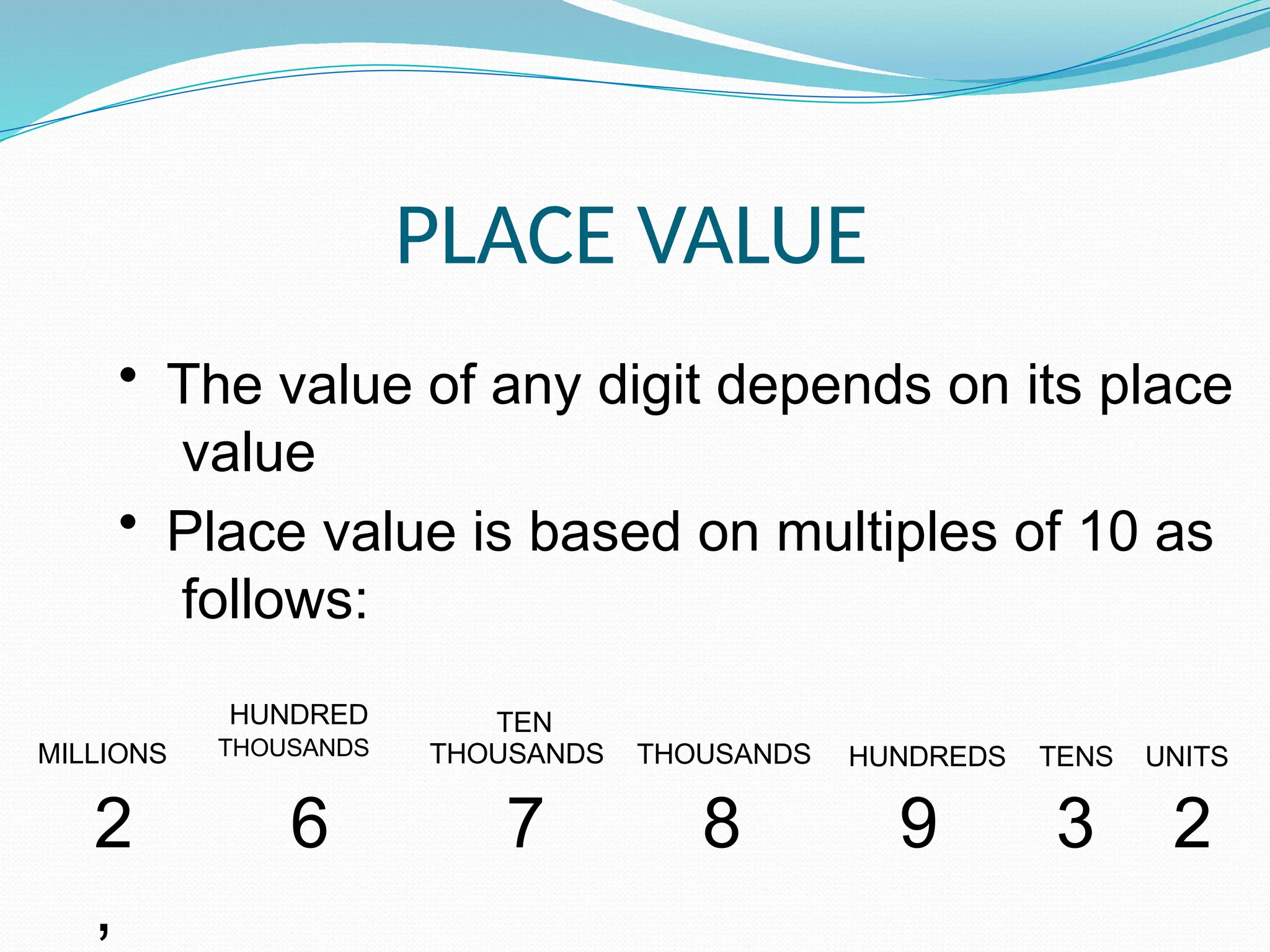
PLACE VALUE
• Thevalue of any digit depends on its place
value
• Place value is based on multiples of 10 as
follows:
TEN
HUNDRED
MILLIONS THOUSANDS THOUSANDS THOUSANDS HUNDREDS TENS UNITS
2
,
6 7 8 9 3 2
3.
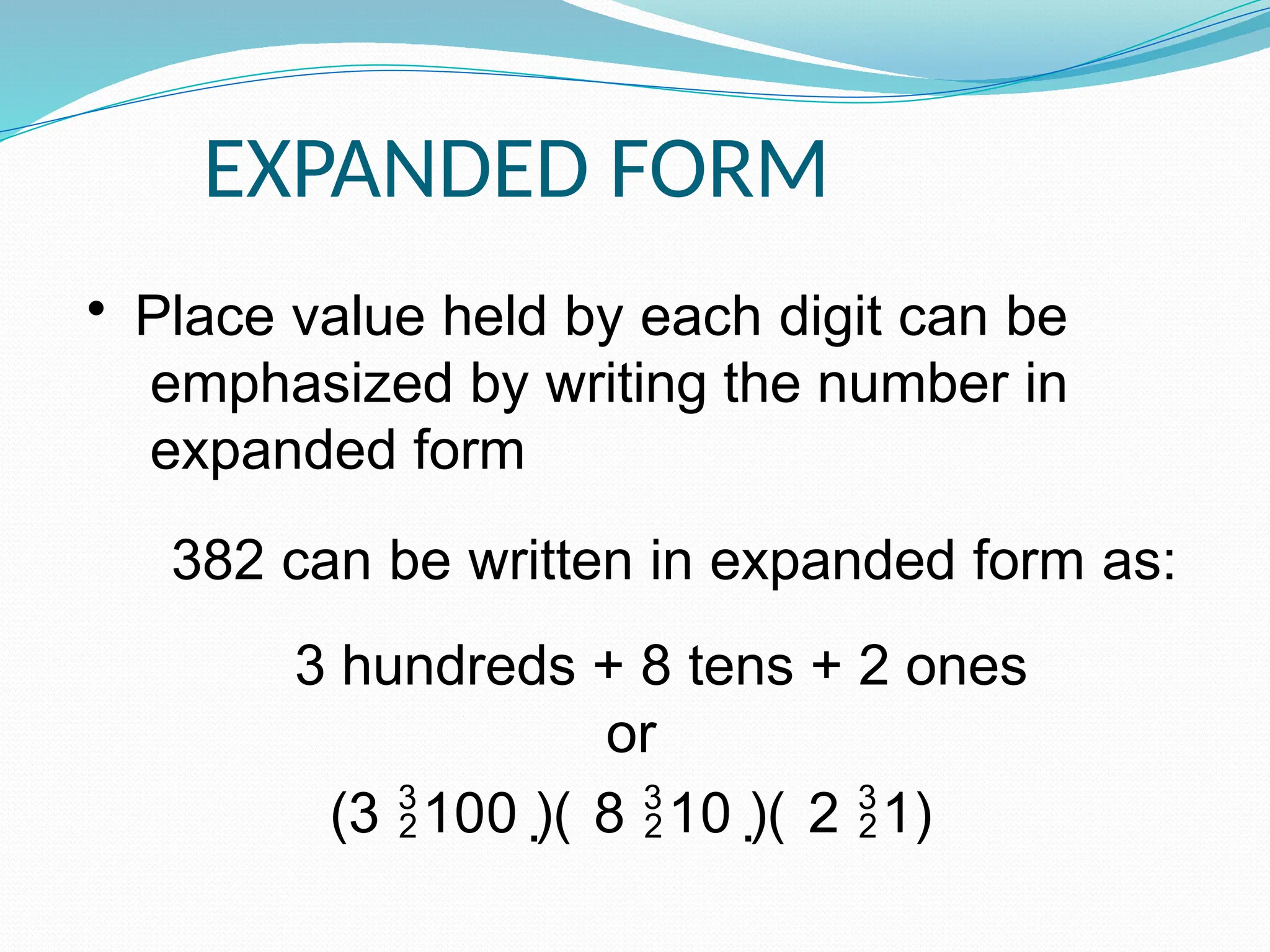
EXPANDED FORM
• Placevalue held by each digit can be
emphasized by writing the number in
expanded form
382 can be written in expanded form as:
3 hundreds + 8 tens + 2 ones
or
(3 100 )( 8 10 )( 2 1)
4.
ESTIMATING
• Used whenan exact mathematical answer
is not required
• A rough calculation is called estimating or
approximating
• Mistakes can often be avoided when
estimating is done before the actual
calculation
• When estimating, exact values are
rounded
5.
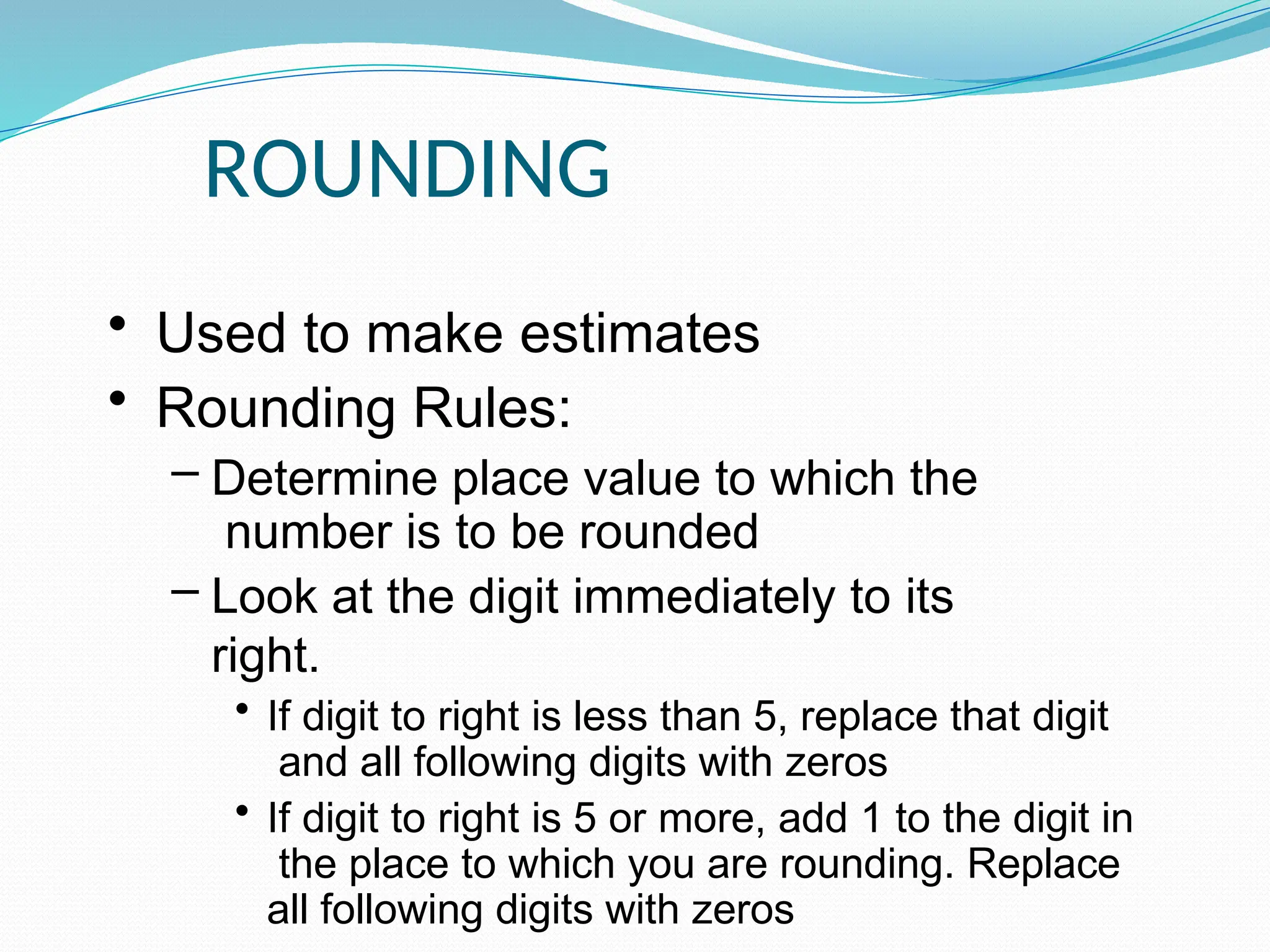
ROUNDING
• Used tomake estimates
• Rounding Rules:
– Determine place value to which the
number is to be rounded
– Look at the digit immediately to its
right.
• If digit to right is less than 5, replace that digit
and all following digits with zeros
• If digit to right is 5 or more, add 1 to the digit in
the place to which you are rounding. Replace
all following digits with zeros
6.
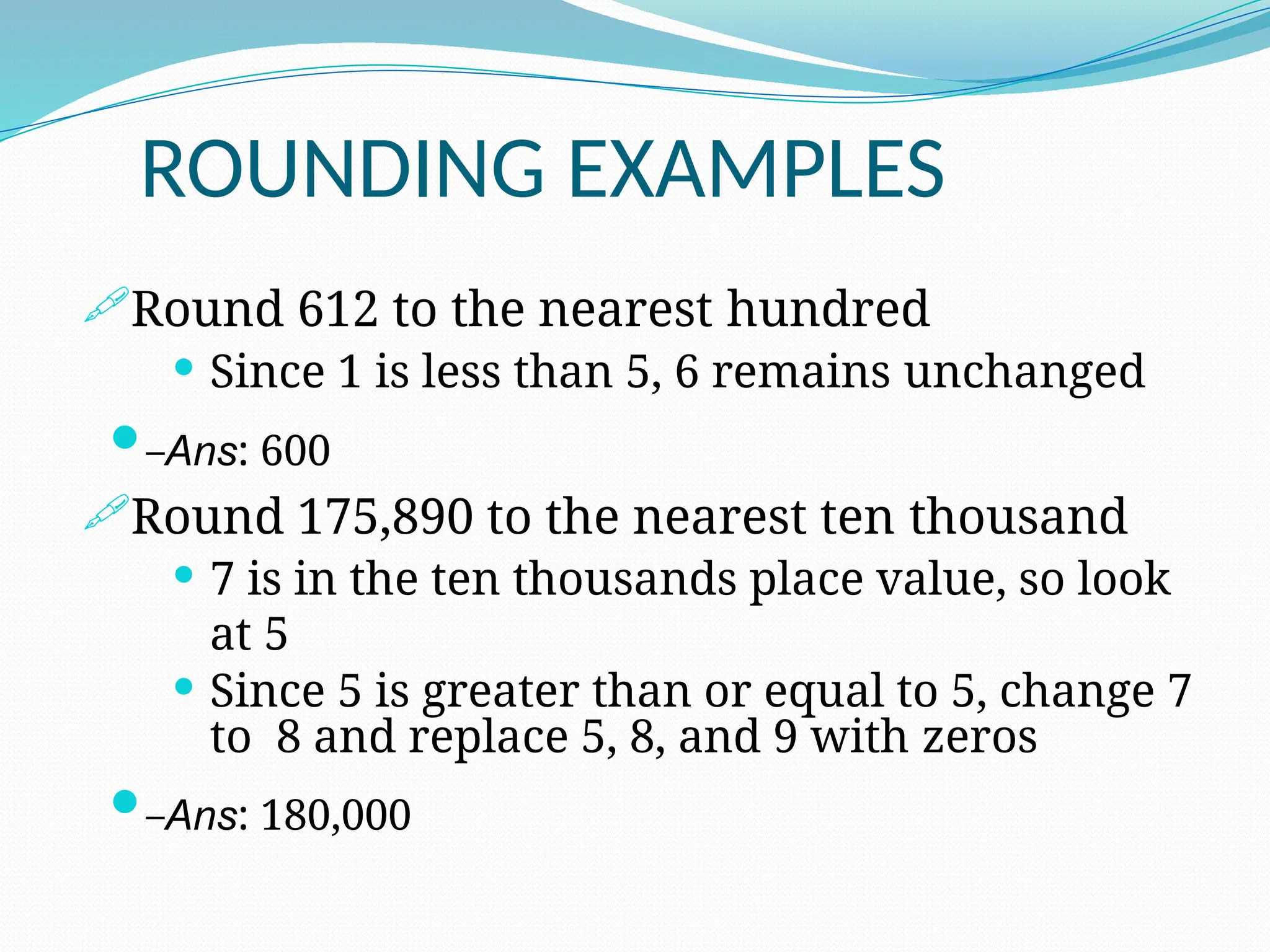
ROUNDING EXAMPLES
Round 612to the nearest hundred
Since 1 is less than 5, 6 remains unchanged
–Ans: 600
Round 175,890 to the nearest ten thousand
7 is in the ten thousands place value, so look
at 5
Since 5 is greater than or equal to 5, change 7
to 8 and replace 5, 8, and 9 with zeros
–Ans: 180,000
7.
ROUNDING TO THEEVEN
• Many technical trades use a process of
rounding to even
• Reduces bias when several numbers
are added
8.
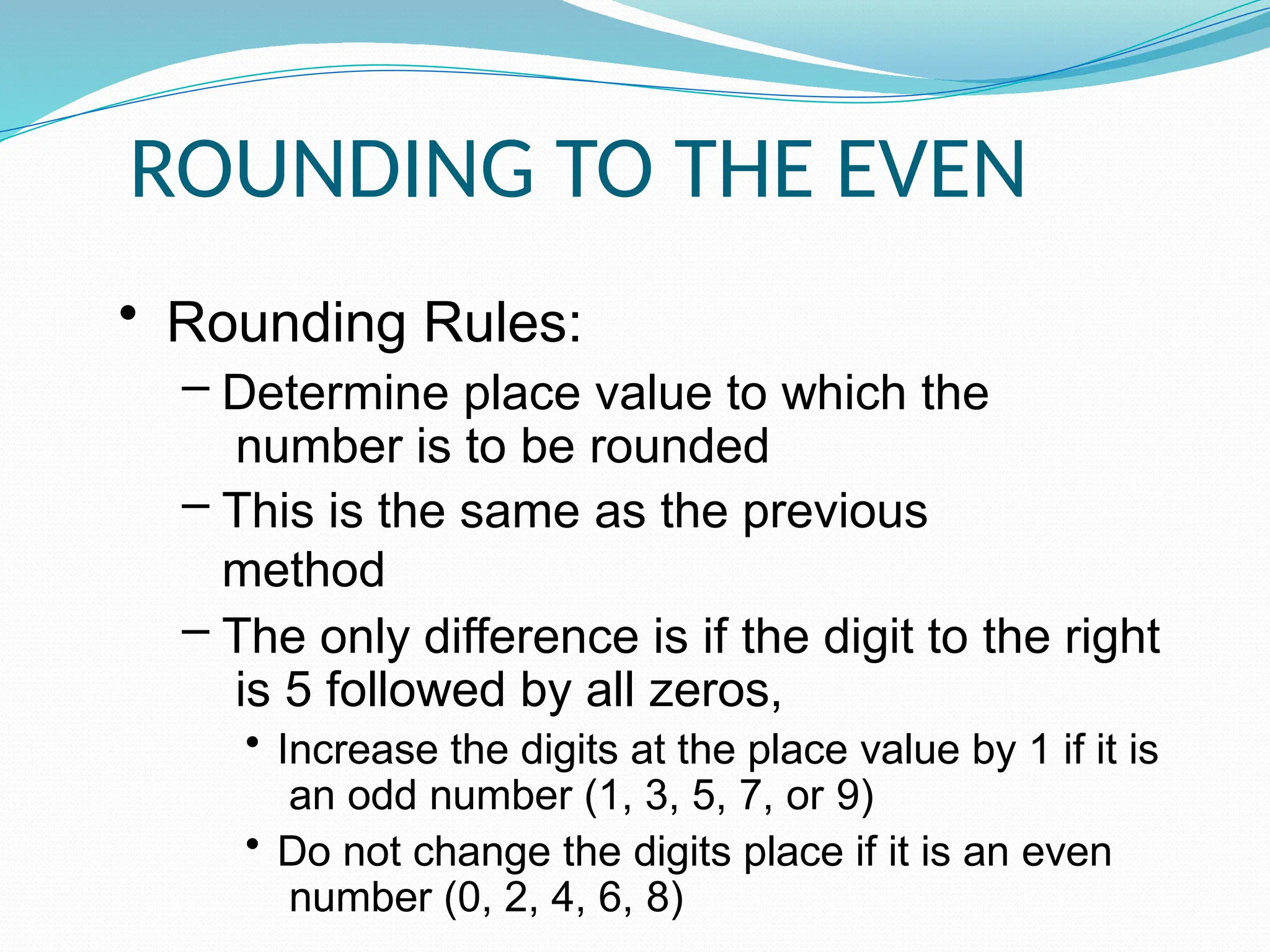
ROUNDING TO THEEVEN
• Rounding Rules:
– Determine place value to which the
number is to be rounded
– This is the same as the previous
method
– The only difference is if the digit to the right
is 5 followed by all zeros,
• Increase the digits at the place value by 1 if it is
an odd number (1, 3, 5, 7, or 9)
• Do not change the digits place if it is an even
number (0, 2, 4, 6, 8)
9.
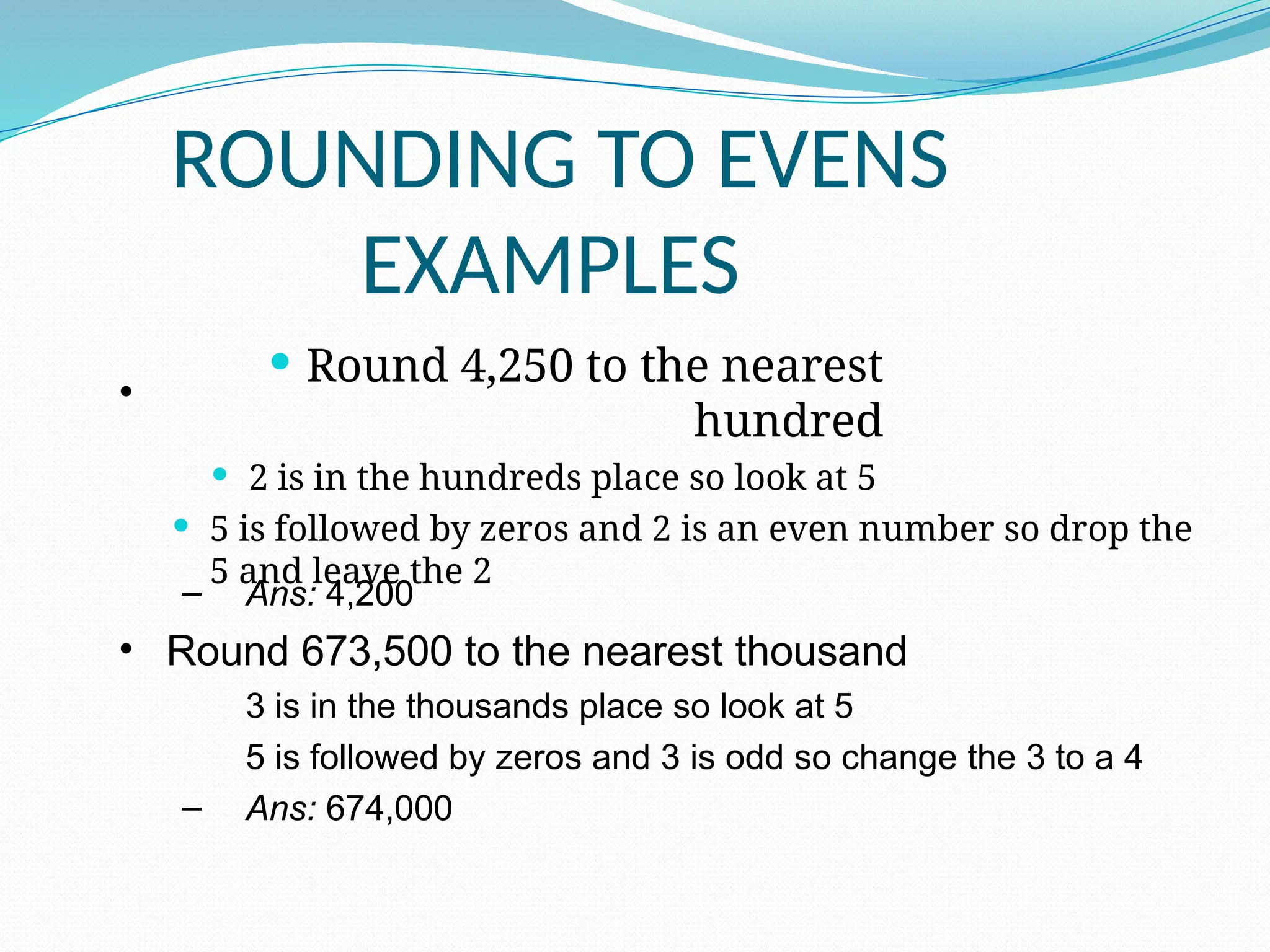
•
ROUNDING TO EVENS
EXAMPLES
Round 4,250 to the nearest
hundred
2 is in the hundreds place so look at 5
5 is followed by zeros and 2 is an even number so drop the
5 and leave the 2
– Ans: 4,200
• Round 673,500 to the nearest thousand
3 is in the thousands place so look at 5
5 is followed by zeros and 3 is odd so change the 3 to a 4
– Ans: 674,000
10.
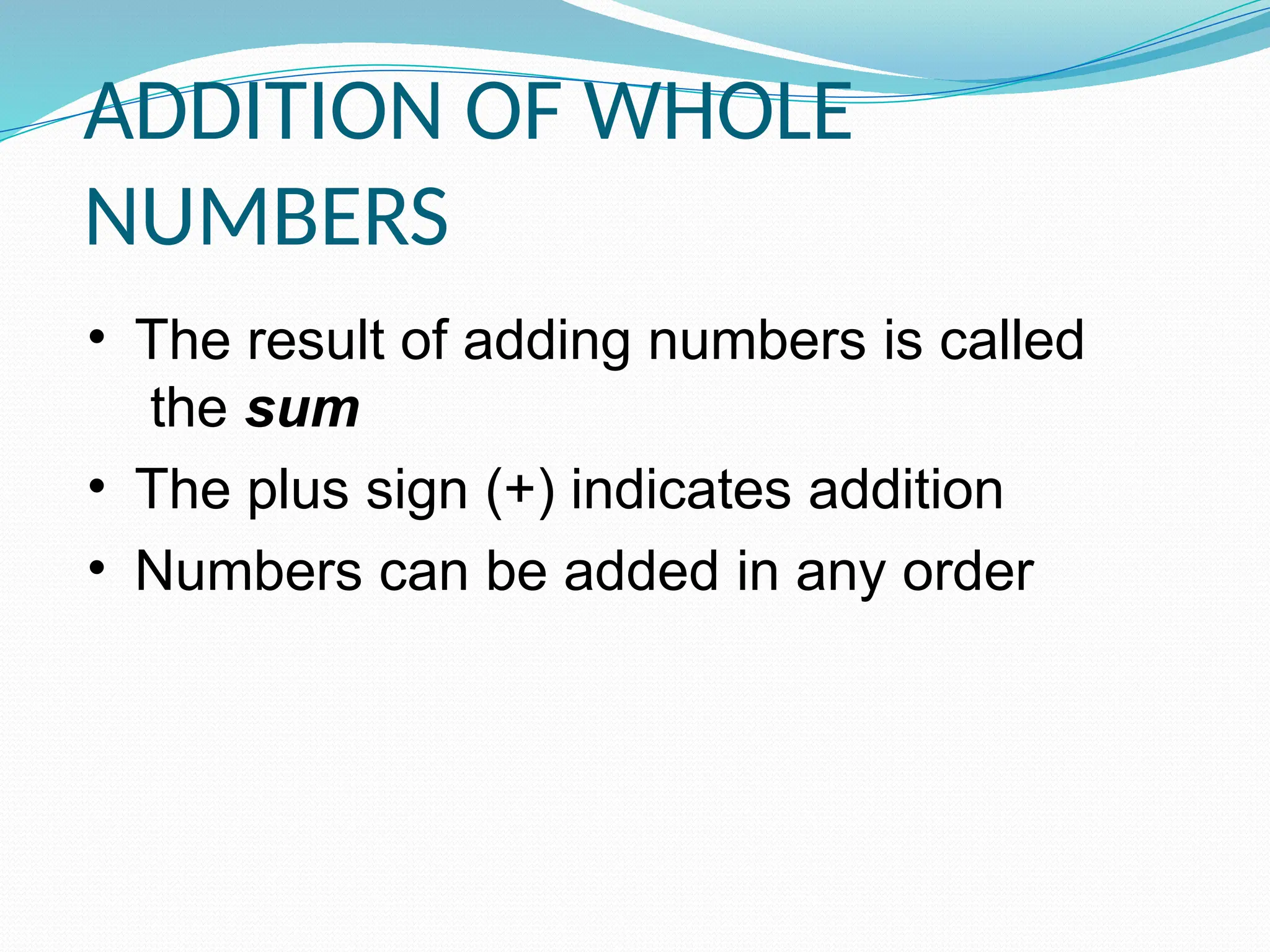
• The resultof adding numbers is called
the sum
• The plus sign (+) indicates addition
• Numbers can be added in any order
ADDITION OF WHOLE
NUMBERS
11.
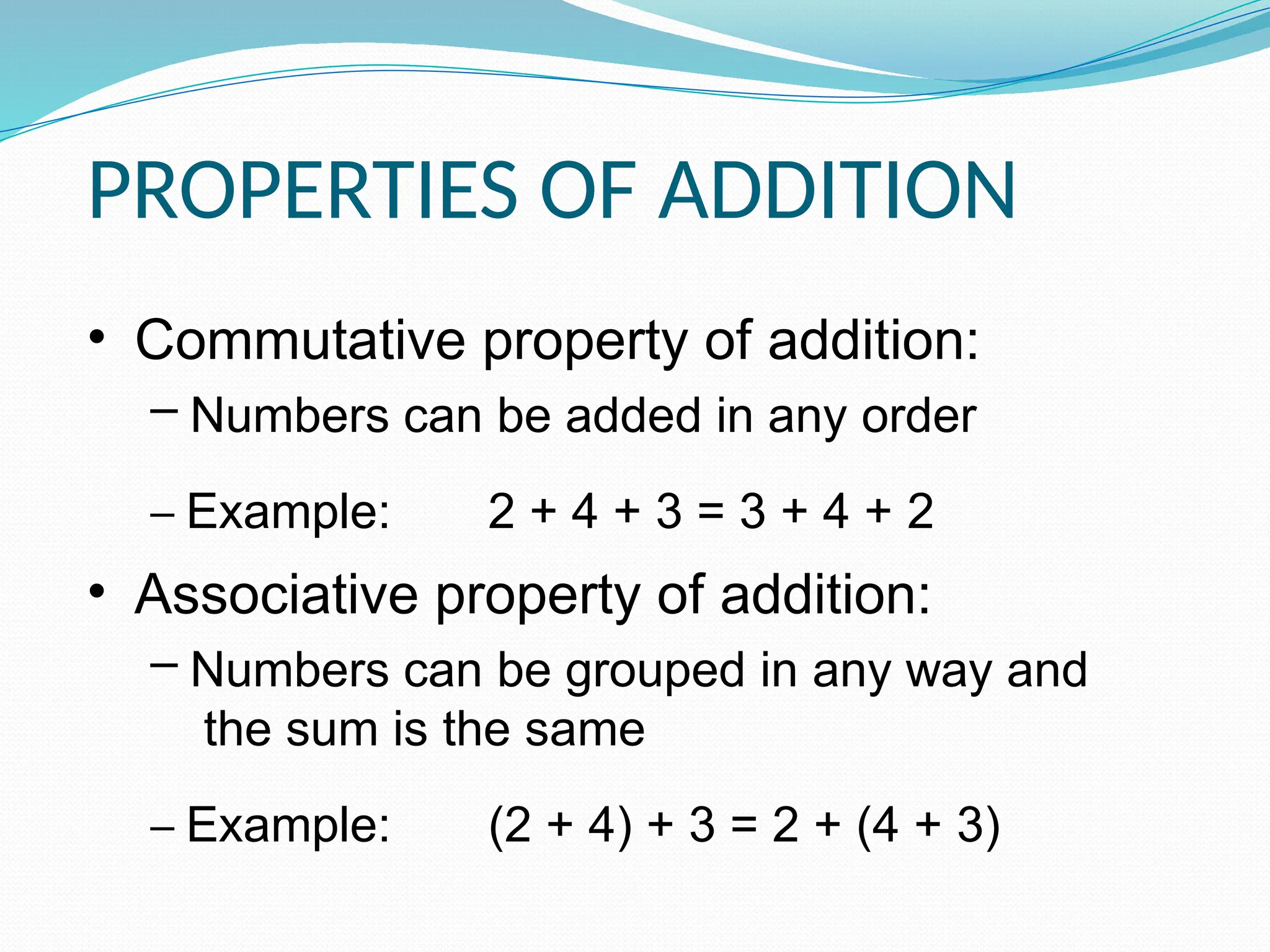
• Commutative propertyof addition:
– Numbers can be added in any order
– Example: 2 + 4 + 3 = 3 + 4 + 2
• Associative property of addition:
– Numbers can be grouped in any way and
the sum is the same
– Example: (2 + 4) + 3 = 2 + (4 + 3)
PROPERTIES OF ADDITION
12.
PROCEDURE FOR ADDING
WHOLENUMBERS
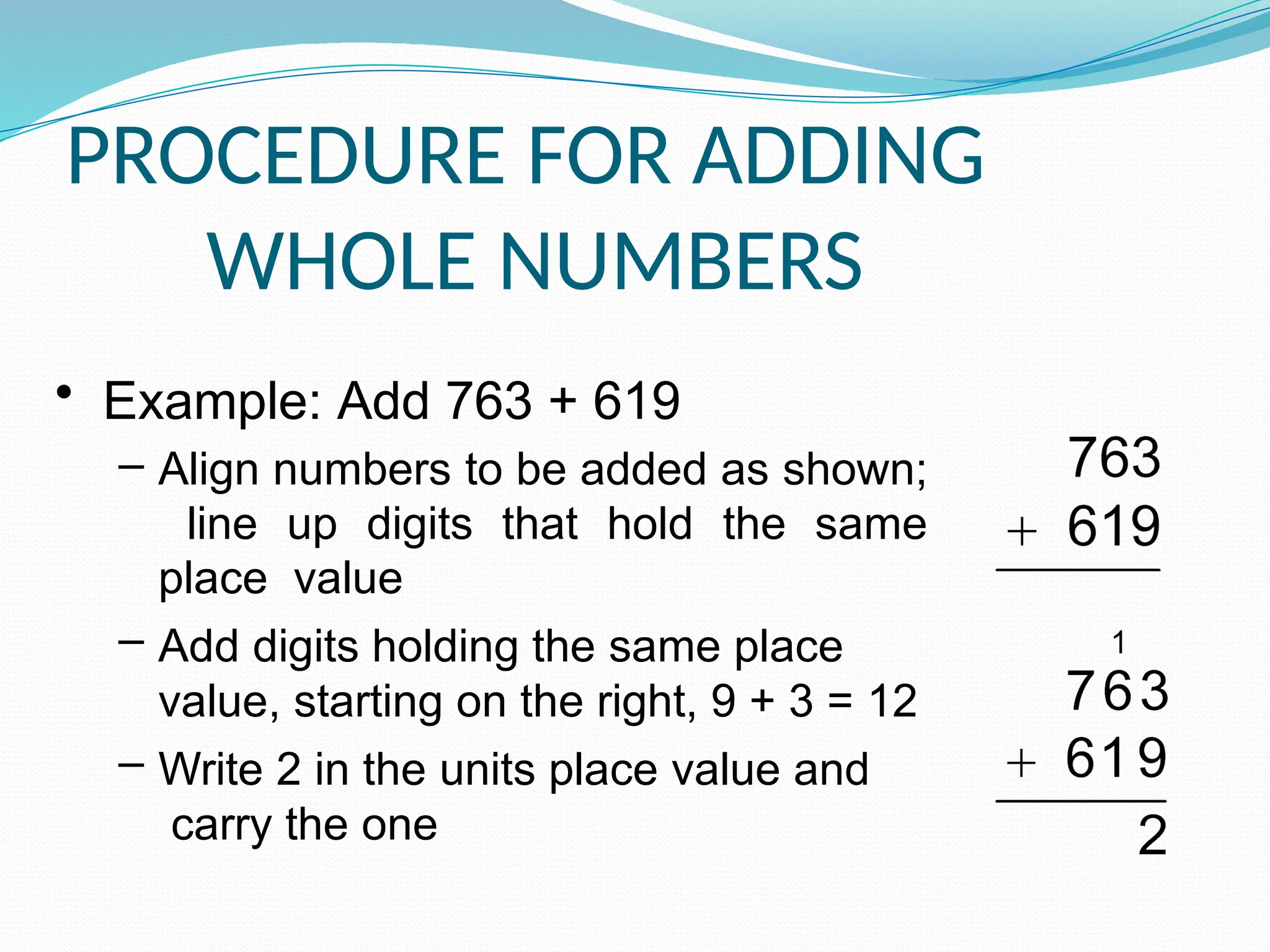
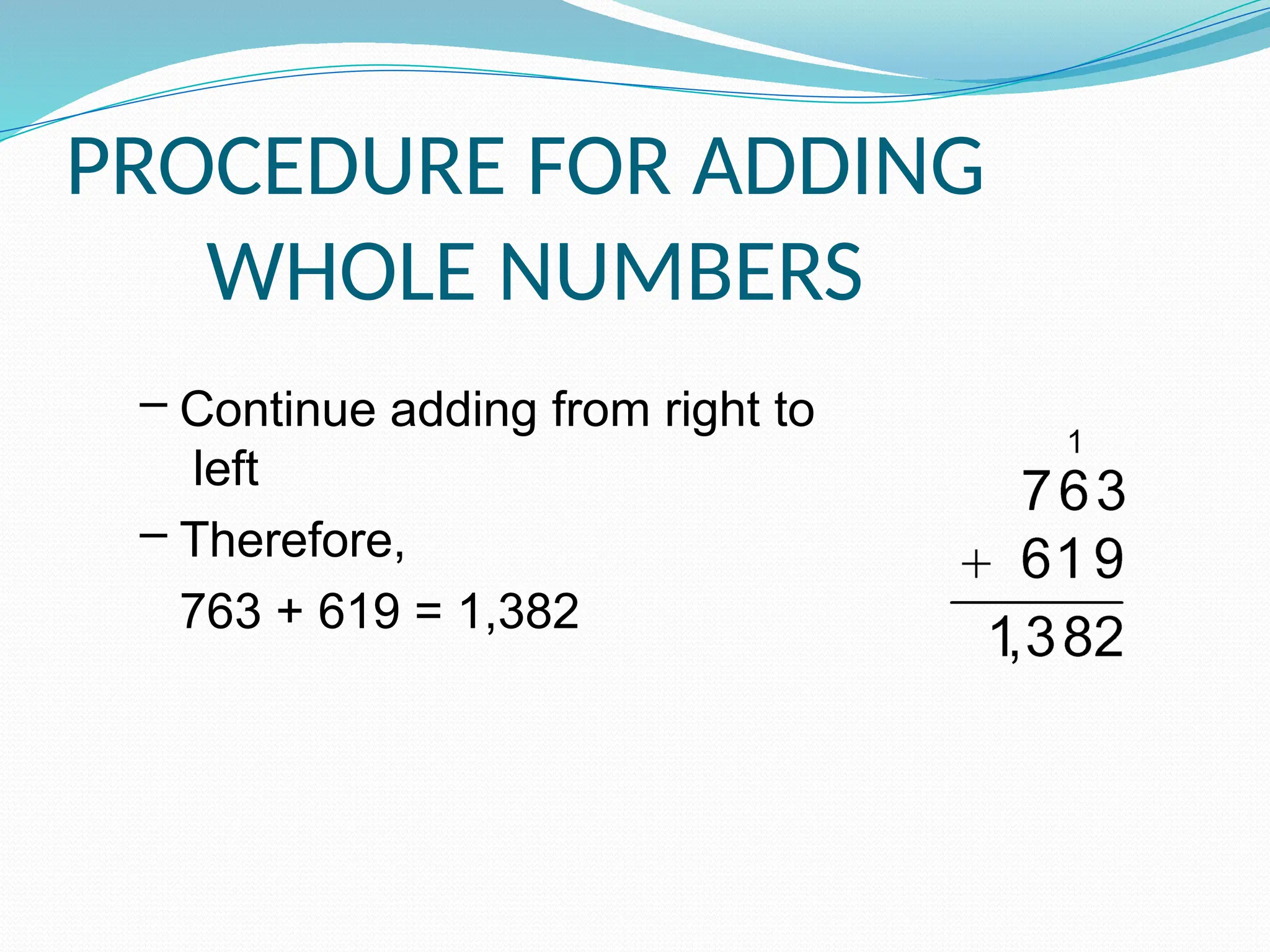
• Example: Add 763 + 619
– Align numbers to be added as shown;
line up digits that hold the same
place value
– Add digits holding the same place
value, starting on the right, 9 + 3 = 12
– Write 2 in the units place value and
carry the one
• Subtraction isthe operation which
determines the difference between two
quantities
• It is the inverse or opposite of addition
• The minus sign (–) indicates
subtraction
SUBTRACTION OF WHOLE
NUMBERS
15.
• The quantitysubtracted is called the
subtrahend
• The quantity from which the subtrahend
is subtracted is called the minuend
• The result is the difference
SUBTRACTION OF WHOLE
NUMBERS
16.
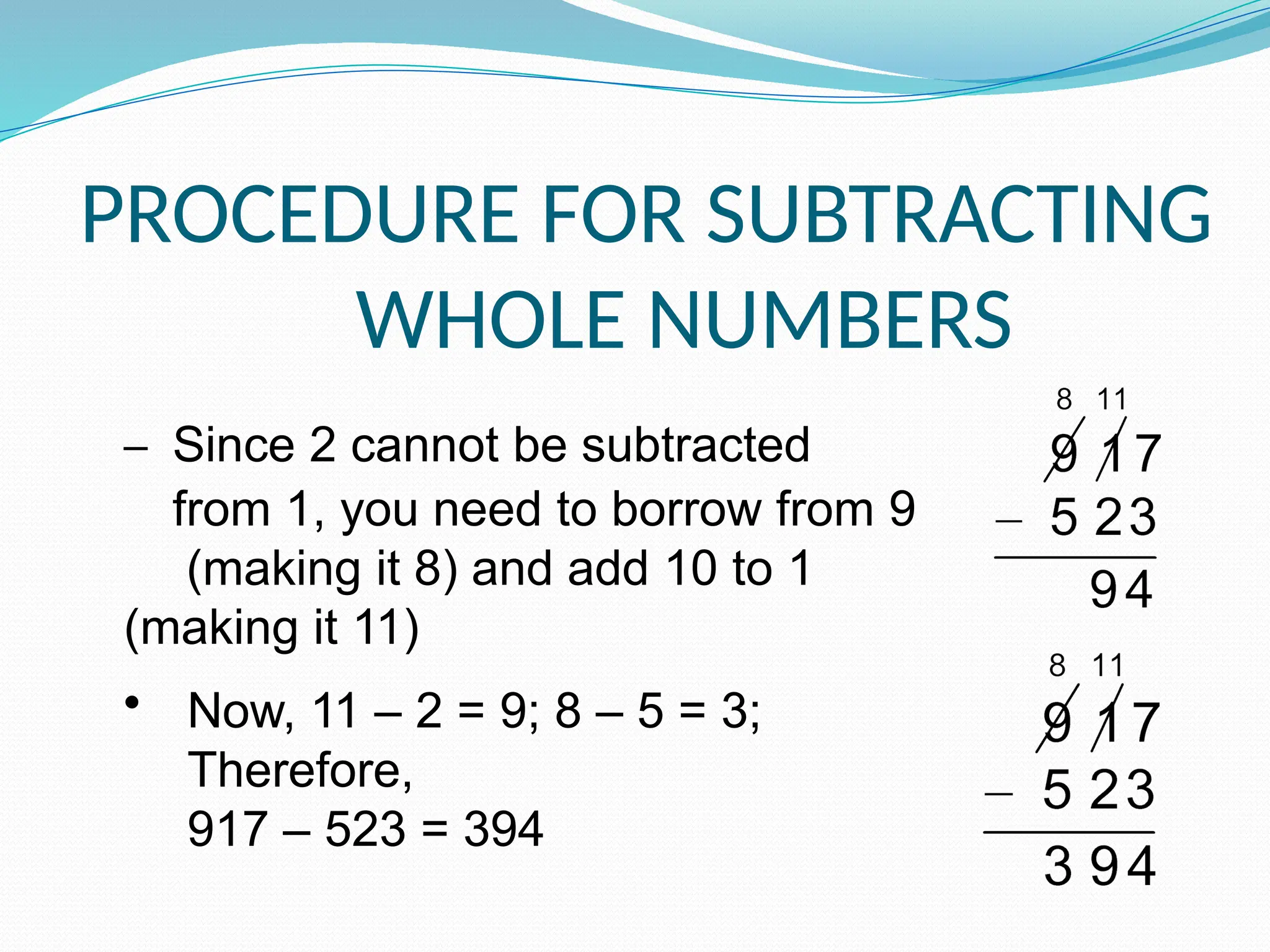
PROCEDURE FOR SUBTRACTING
WHOLENUMBERS
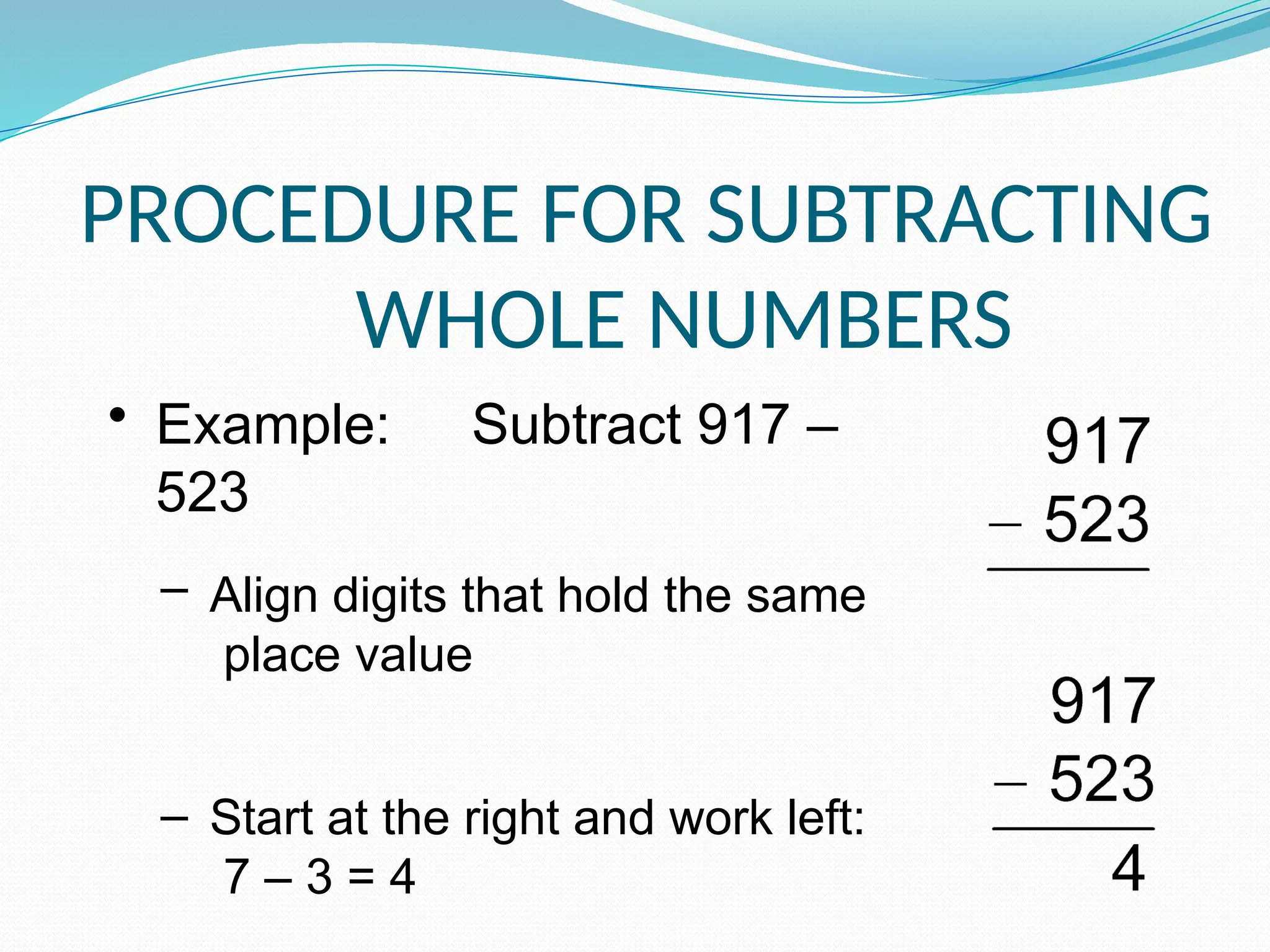
• Example: Subtract 917 –
523
– Align digits that hold the same
place value
– Start at the right and work left:
7 – 3 = 4
17.
PROCEDURE FOR SUBTRACTING
WHOLENUMBERS
– Since 2 cannot be subtracted
from 1, you need to borrow from 9
(making it 8) and add 10 to 1
(making it 11)
• Now, 11 – 2 = 9; 8 – 5 = 3;
Therefore,
917 – 523 = 394
18.
MULTIPLICATION OF WHOLE
NUMBERS
•Multiplication is a short method of
adding equal amounts
• There are many occupational uses of
multiplication
• The times sign (×) is used to indicate
multiplication
19.
MULTIPLICATION OF WHOLE
NUMBERS
•The number to be multiplied is called the
multiplicand
• The number by which the multiplicand is
multiplied is called the multiplier
• Factors are the numbers used in
multiplying
• The result of multiplying is called the
product
20.
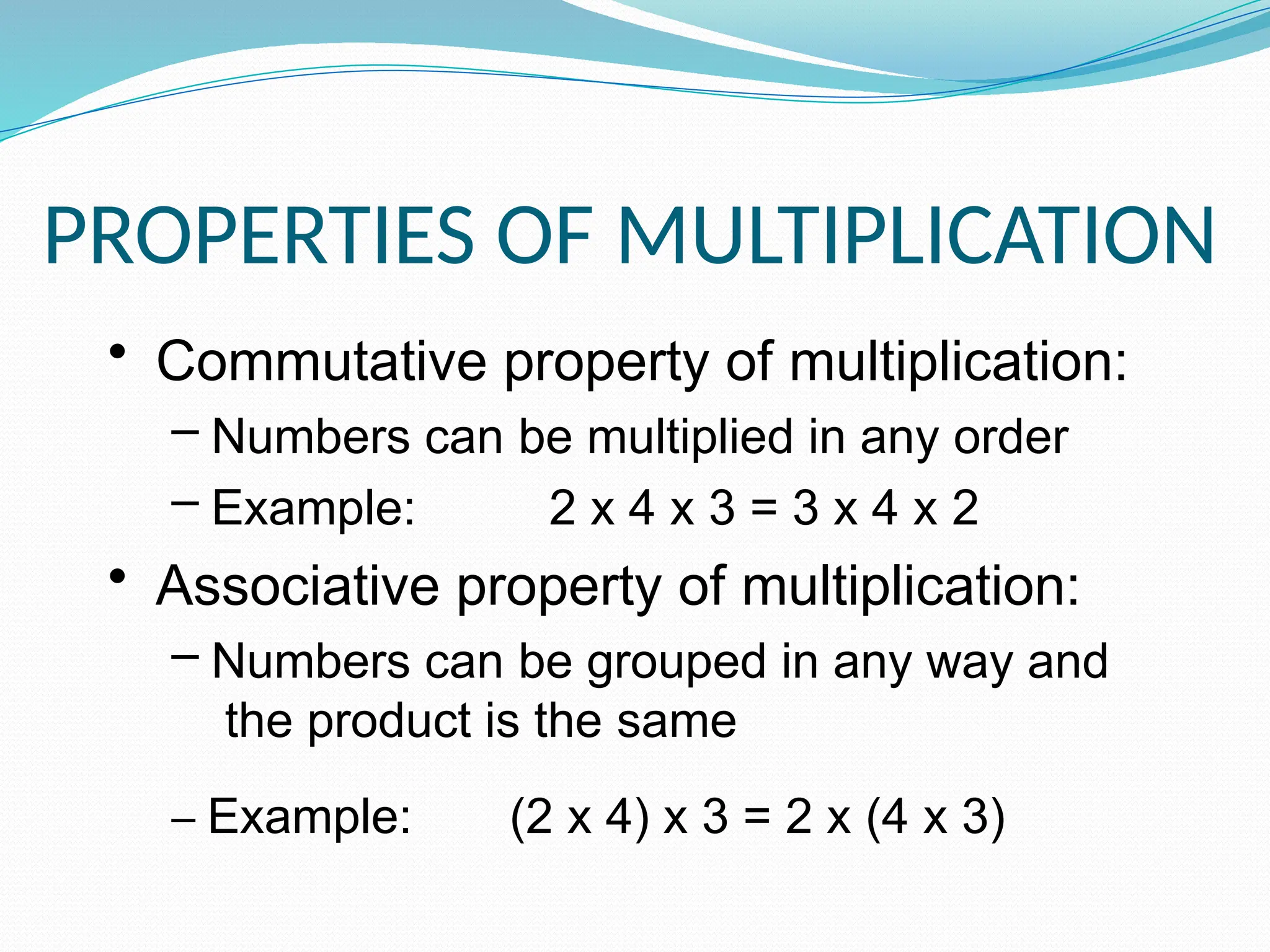
PROPERTIES OF MULTIPLICATION
•Commutative property of multiplication:
– Numbers can be multiplied in any order
– Example: 2 x 4 x 3 = 3 x 4 x 2
• Associative property of multiplication:
– Numbers can be grouped in any way and
the product is the same
– Example: (2 x 4) x 3 = 2 x (4 x 3)
21.
PROCEDURE FOR
MULTIPLICATION
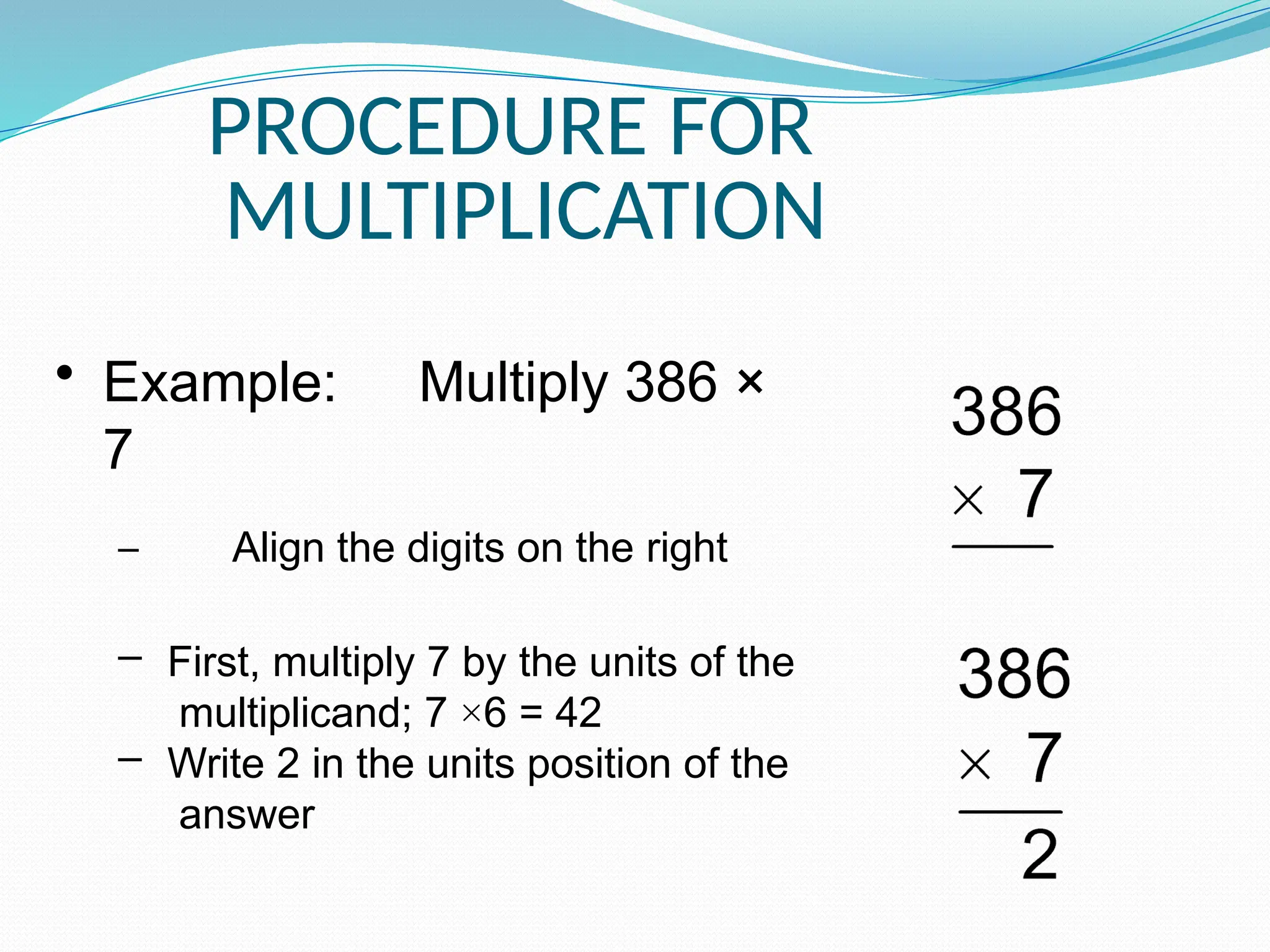
• Example:Multiply 386 ×
7
– Align the digits on the right
– First, multiply 7 by the units of the
multiplicand; 7 ×6 = 42
– Write 2 in the units position of the
answer
22.
PROCEDURE FOR
MULTIPLICATION
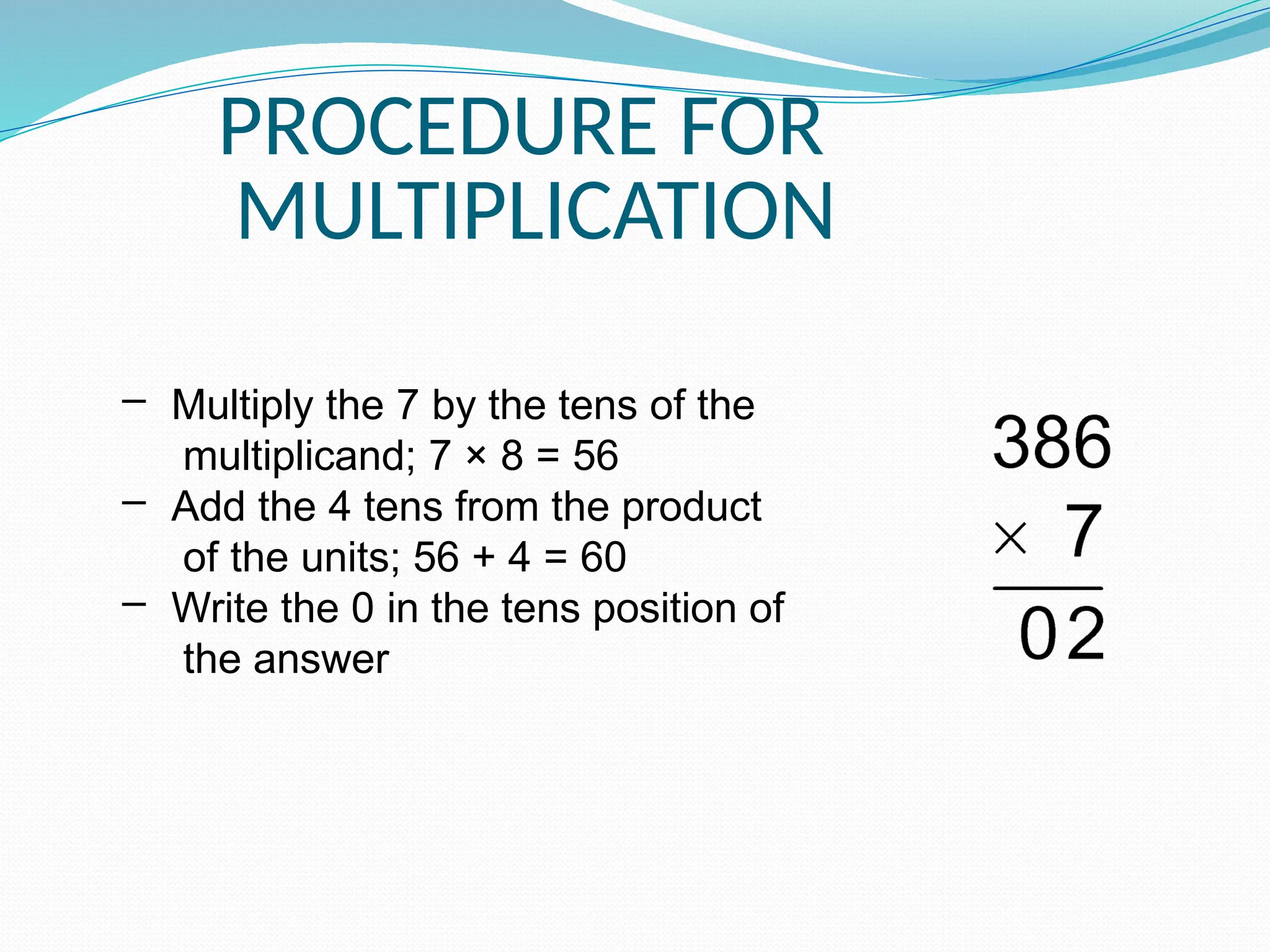
– Multiplythe 7 by the tens of the
multiplicand; 7 × 8 = 56
– Add the 4 tens from the product
of the units; 56 + 4 = 60
– Write the 0 in the tens position of
the answer
23.
PROCEDURE FOR
MULTIPLICATION
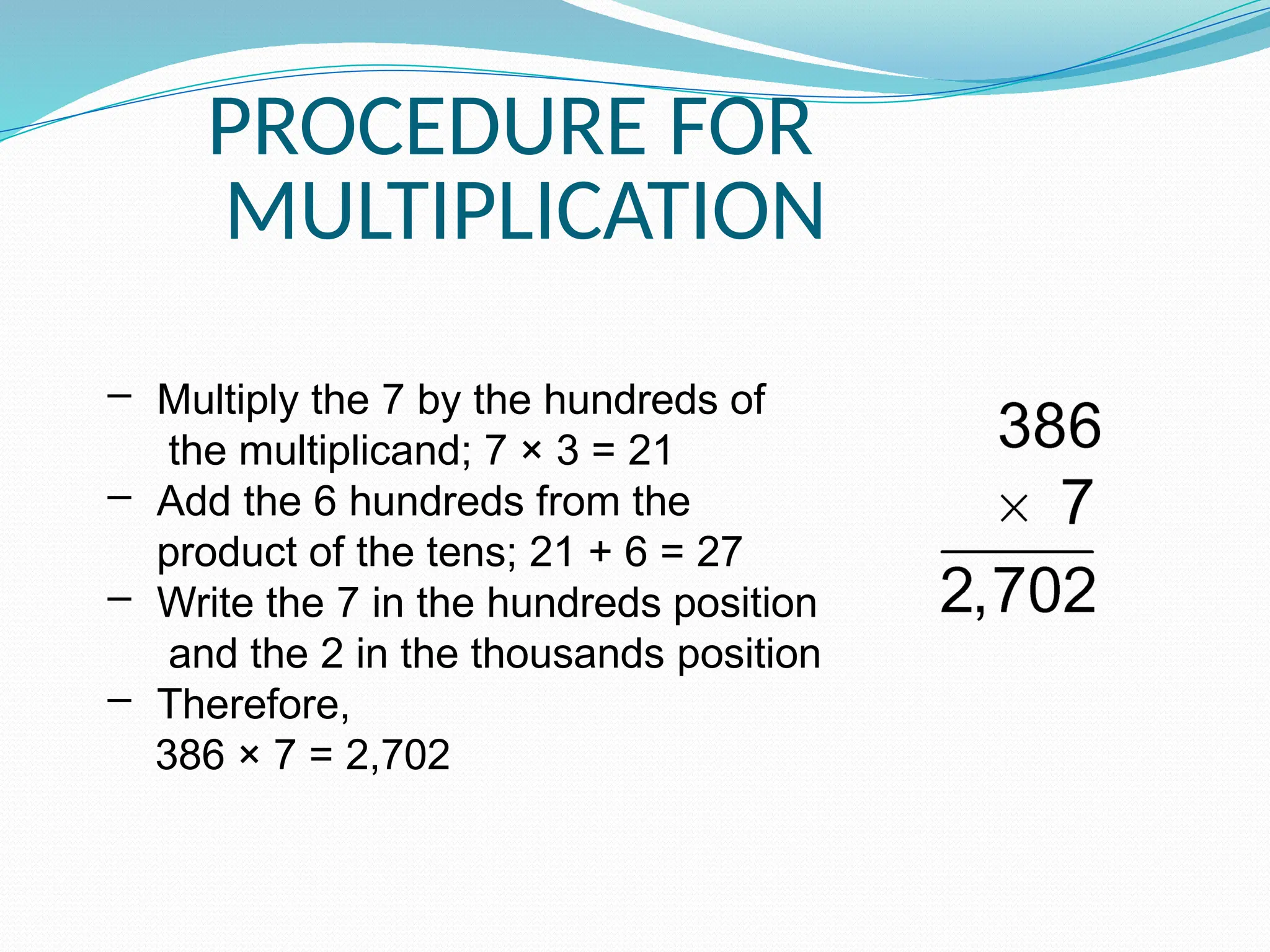
– Multiplythe 7 by the hundreds of
the multiplicand; 7 × 3 = 21
– Add the 6 hundreds from the
product of the tens; 21 + 6 = 27
– Write the 7 in the hundreds position
and the 2 in the thousands position
– Therefore,
386 × 7 = 2,702
24.
DIVISION OF WHOLE
NUMBERS
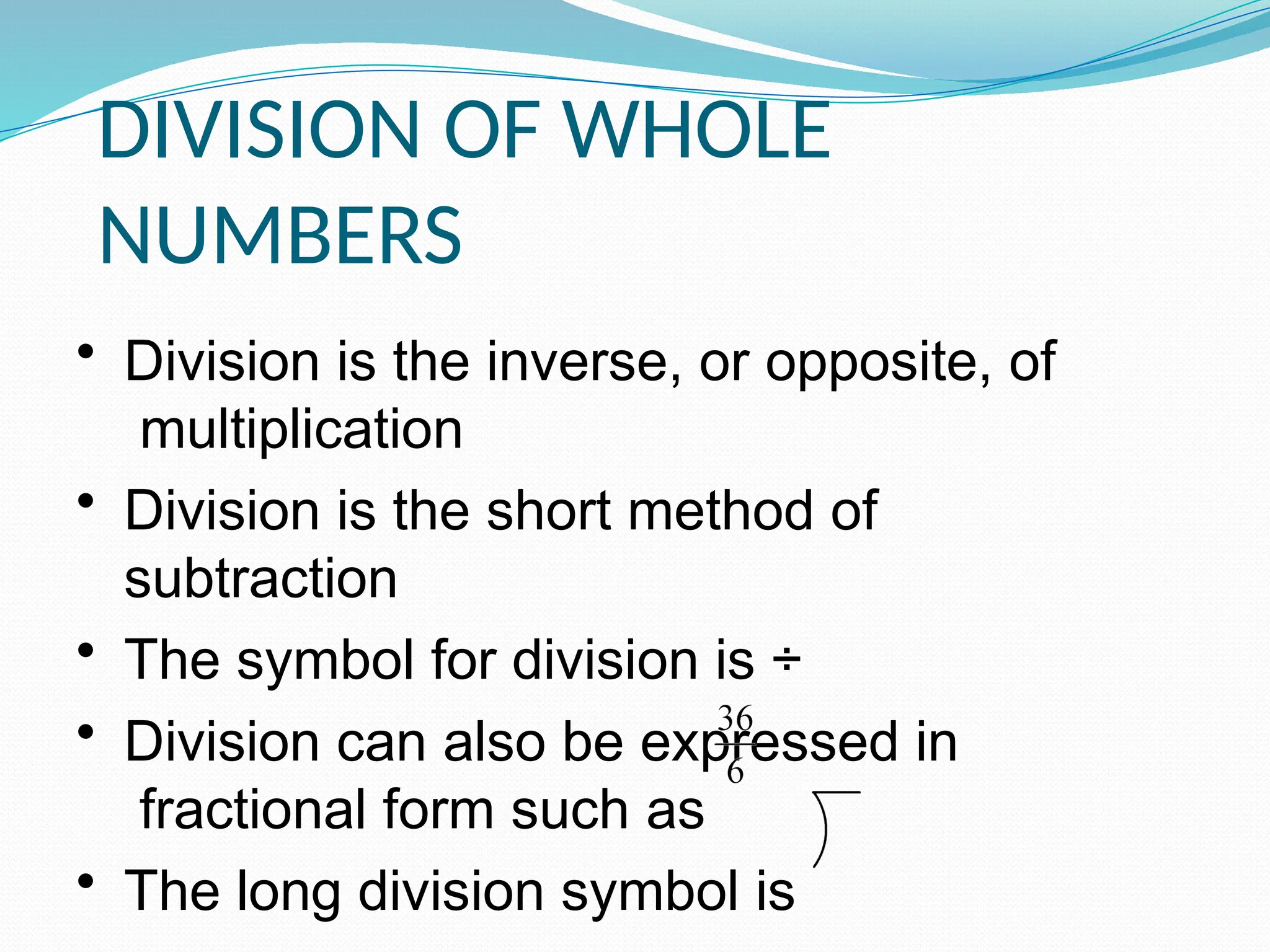
•In division, the number to be divided is
called the dividend
• The number by which the dividend is
divided is called the divisor
• The result is the quotient
• A difference left over is called the
remainder
25.
DIVISION OF WHOLE
NUMBERS
•Division is the inverse, or opposite, of
multiplication
• Division is the short method of
subtraction
• The symbol for division is ÷
• Division can also be expressed in
fractional form such as
• The long division symbol is
26.
DIVISION WITH ZERO
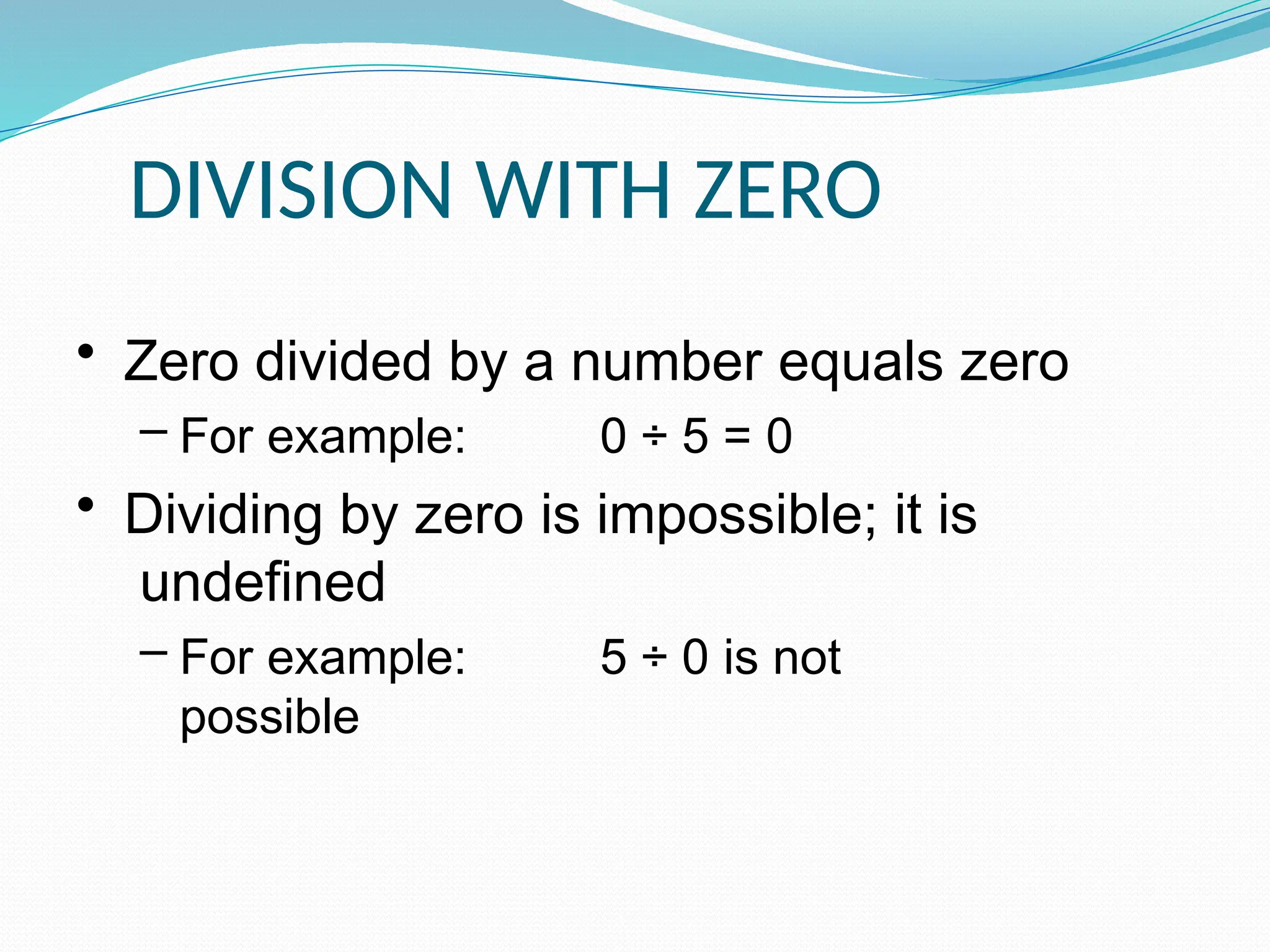
•Zero divided by a number equals zero
– For example: 0 ÷ 5 = 0
• Dividing by zero is impossible; it is
undefined
– For example: 5 ÷ 0 is not
possible
27.
PROCEDURE FOR DIVISION
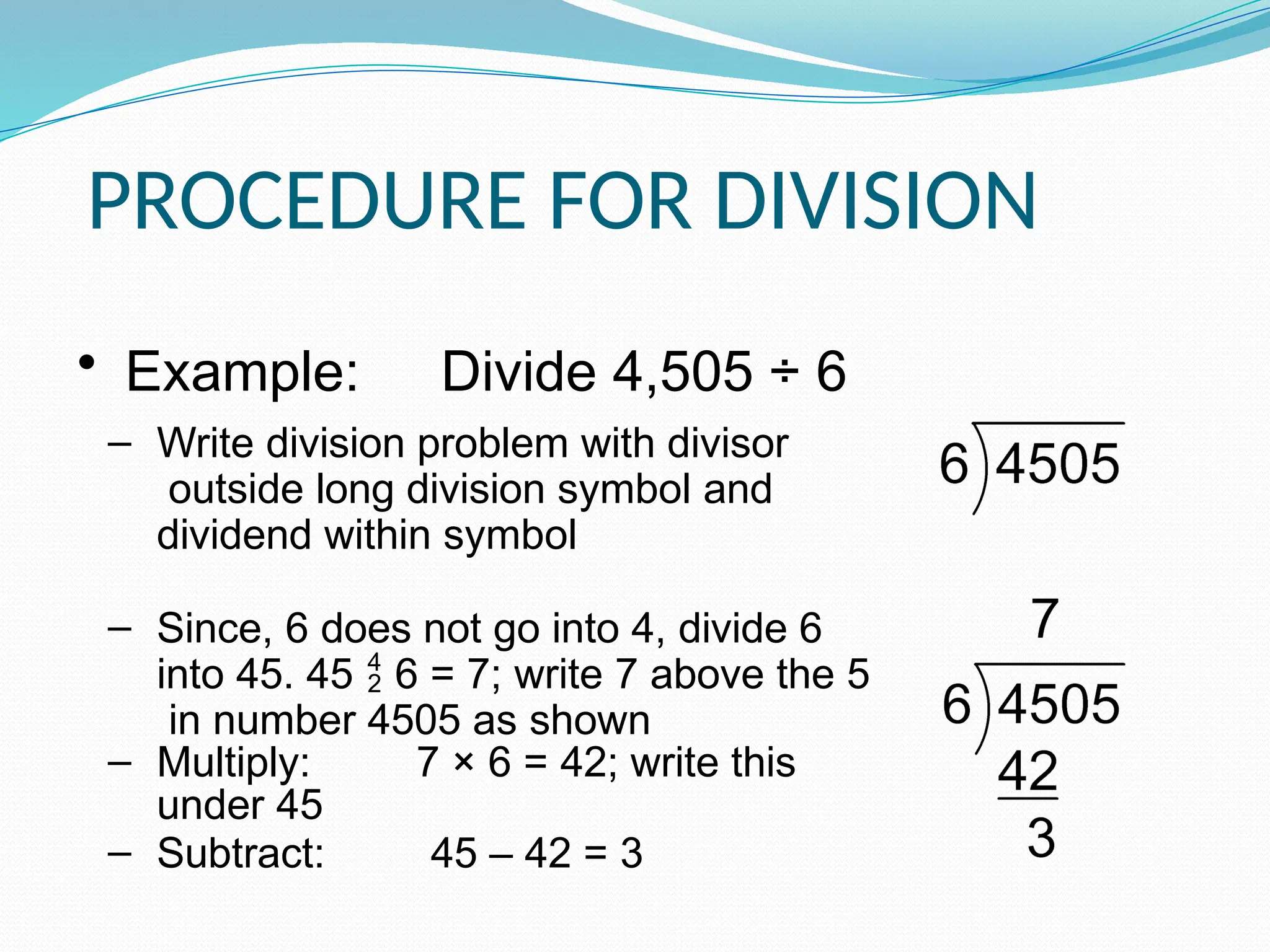
•Example: Divide 4,505 ÷ 6
‒ Write division problem with divisor
outside long division symbol and
dividend within symbol
‒ Since, 6 does not go into 4, divide 6
into 45. 45 6 = 7; write 7 above the 5
in number 4505 as shown
‒ Multiply: 7 × 6 = 42; write this
under 45
‒ Subtract: 45 – 42 = 3
28.
PROCEDURE FOR DIVISION
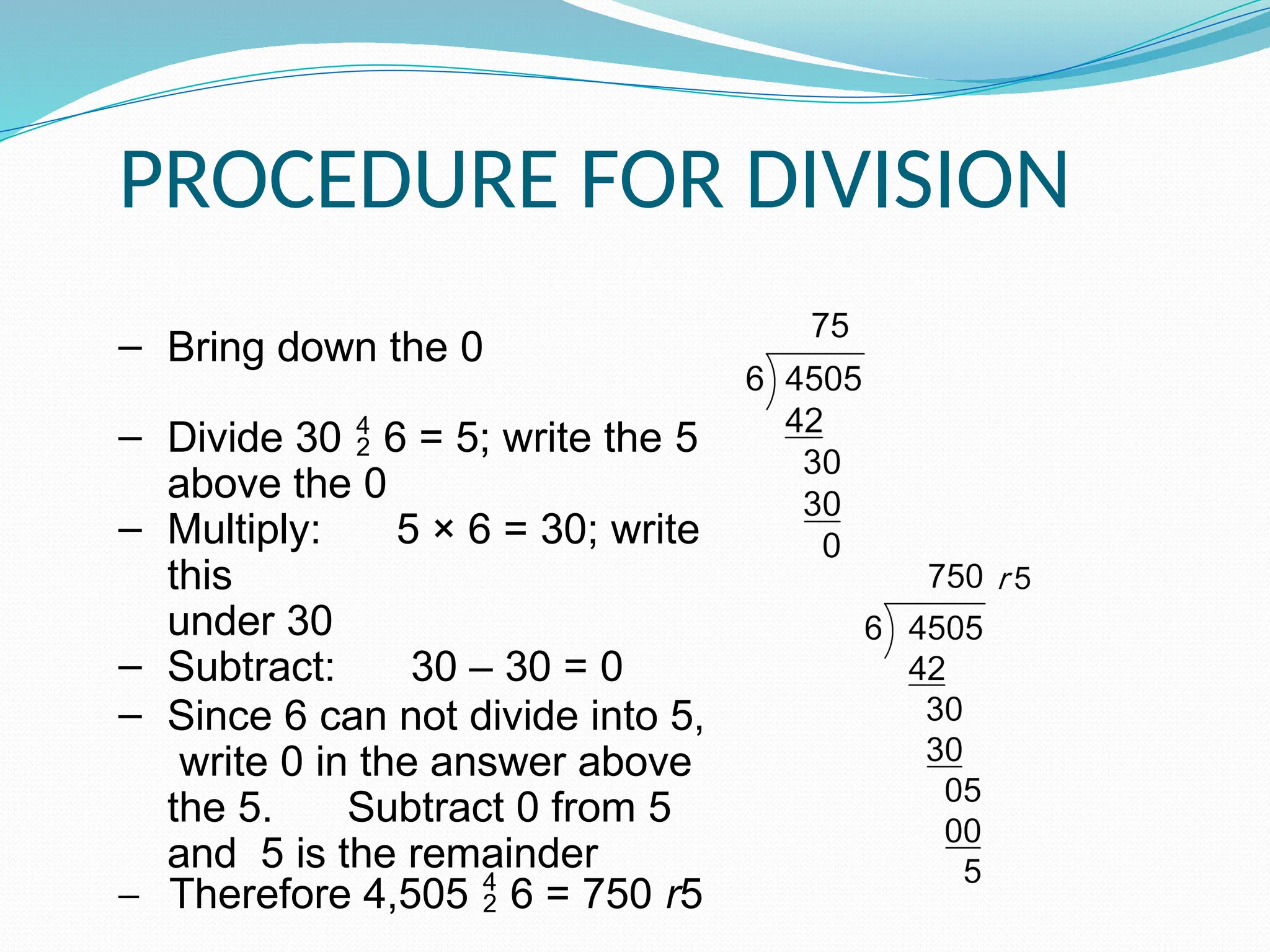
‒Bring down the 0
‒ Divide 30 6 = 5; write the 5
above the 0
‒ Multiply: 5 × 6 = 30; write
this
under 30
‒ Subtract: 30 – 30 = 0
‒ Since 6 can not divide into 5,
write 0 in the answer above
the 5. Subtract 0 from 5
and 5 is the remainder
‒ Therefore 4,505 6 = 750 r5
29.
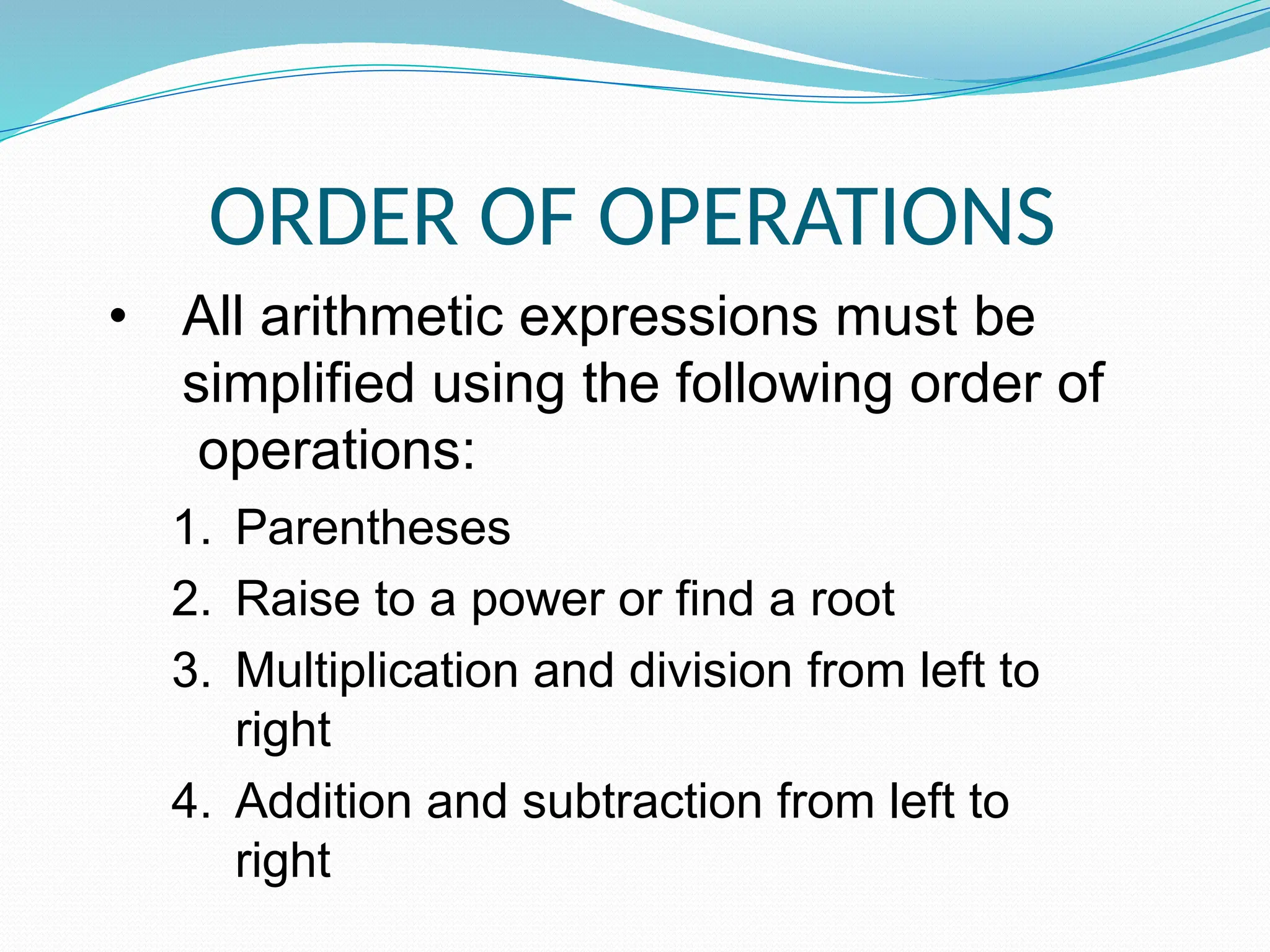
ORDER OF OPERATIONS
•All arithmetic expressions must be
simplified using the following order of
operations:
1. Parentheses
2. Raise to a power or find a root
3. Multiplication and division from left to
right
4. Addition and subtraction from left to
right
30.
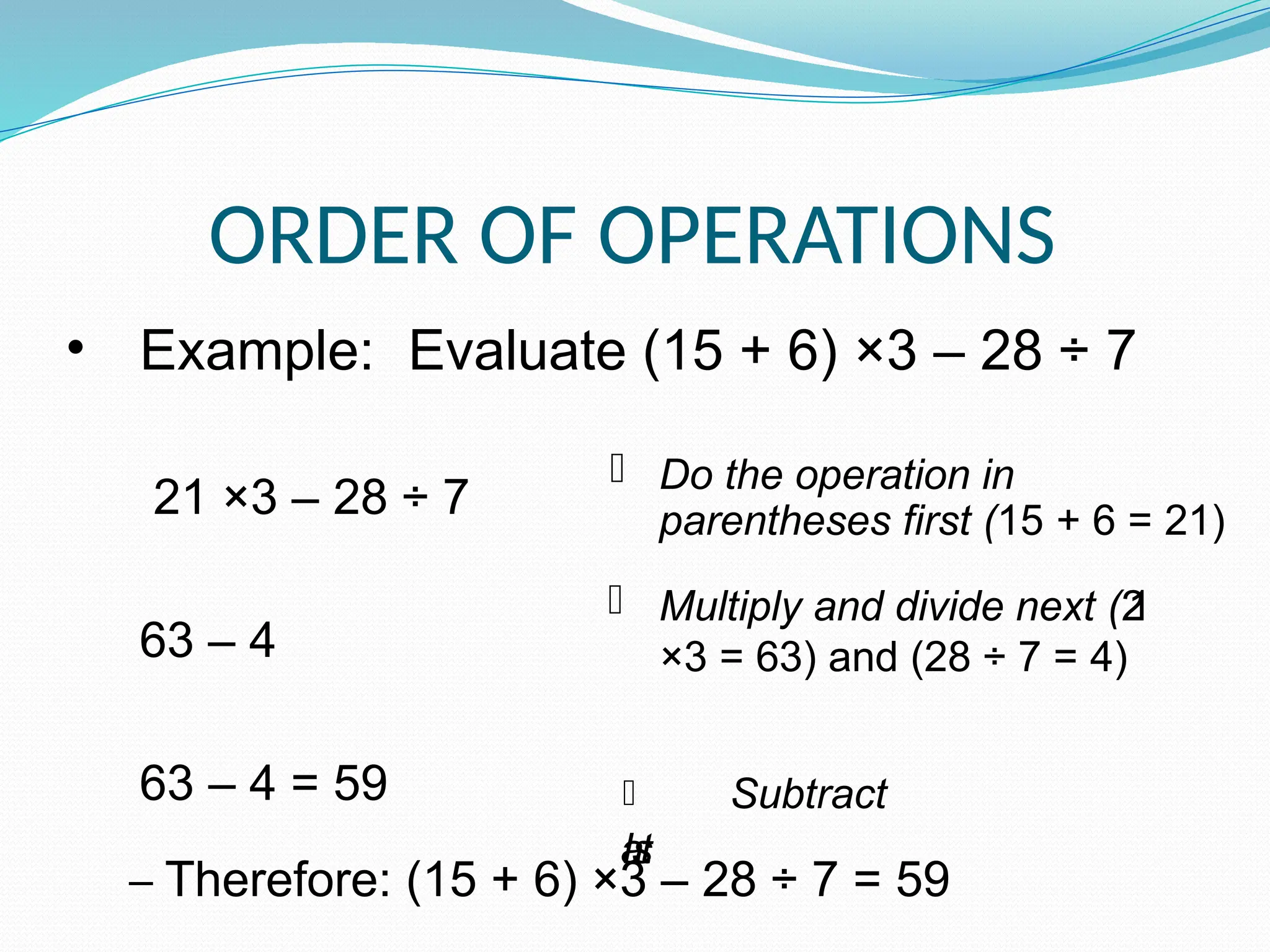
ORDER OF OPERATIONS
•Example: Evaluate (15 + 6) ×3 – 28 ÷ 7
21 ×3 – 28 ÷ 7
63 – 4
63 – 4 = 59
– Therefore: (15 + 6) ×3 – 28 ÷ 7 = 59
Do the operation in
parentheses first (15 + 6 = 21)
Multiply and divide next (2
1
×3 = 63) and (28 ÷ 7 = 4)
Subtract
l
a
s
t
31.
PRACTICAL PROBLEMS
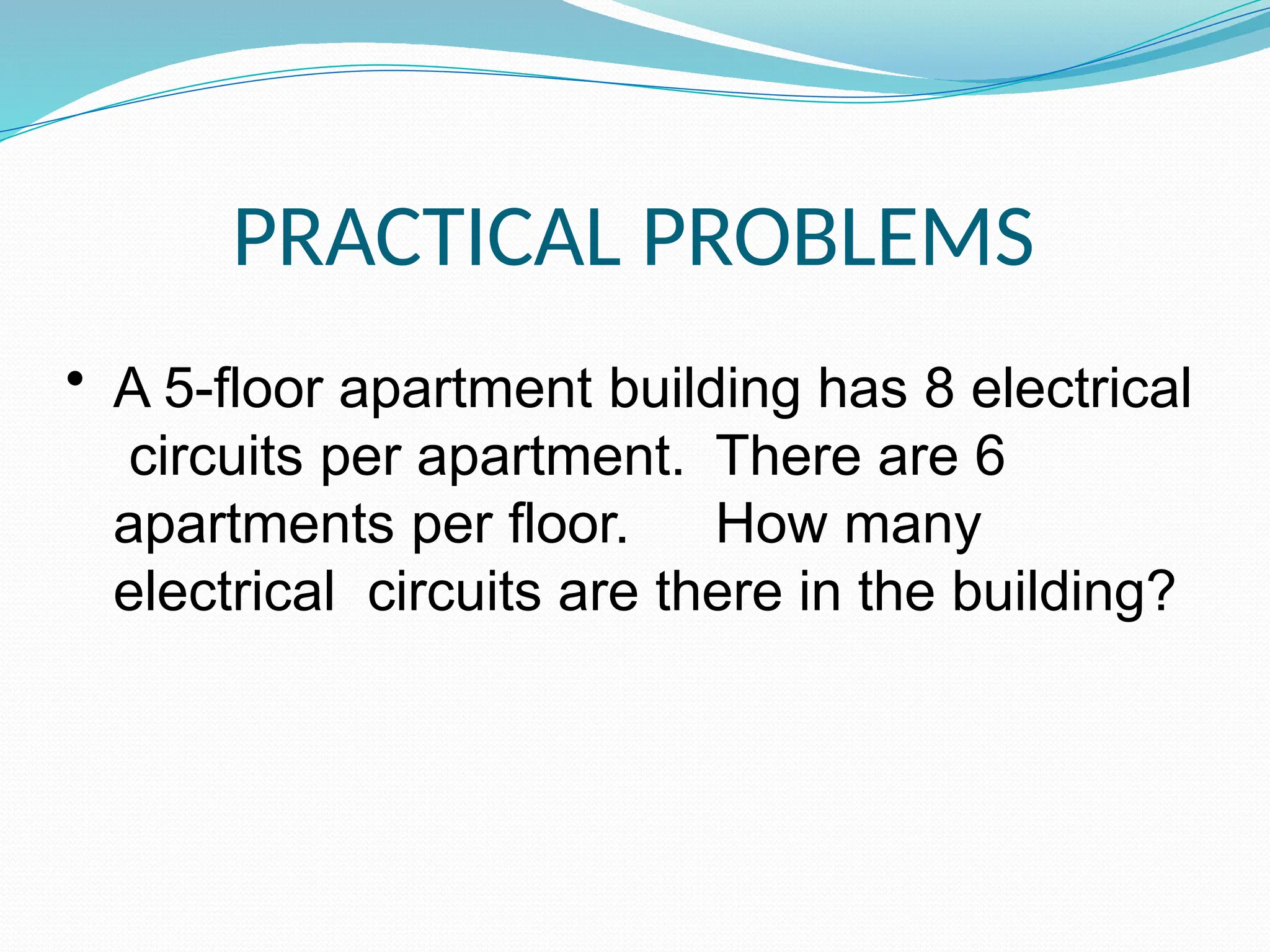
• A5-floor apartment building has 8 electrical
circuits per apartment. There are 6
apartments per floor. How many
electrical circuits are there in the building?
32.
PRACTICAL PROBLEMS
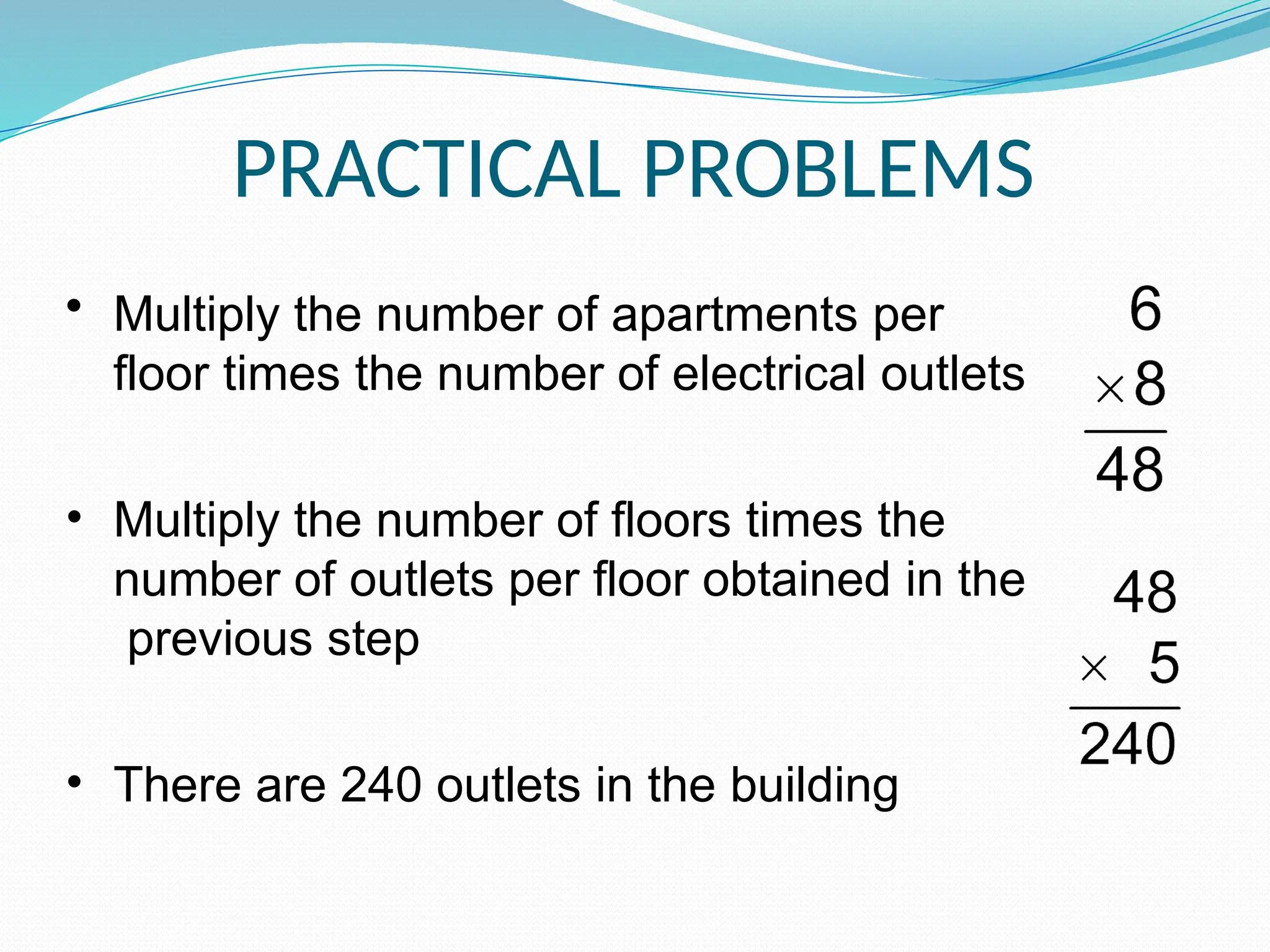
• Multiplythe number of apartments per
floor times the number of electrical outlets
• Multiply the number of floors times the
number of outlets per floor obtained in the
previous step
• There are 240 outlets in the building


![Basic_Math [Autosaved] [Autosaved].pptx](https://cdn.slidesharecdn.com/ss_thumbnails/basicmathautosavedautosaved-250224070305-7b90b787-thumbnail.jpg?width=640&height=640&fit=bounds)
![Basic_Math [Autosaved] [Autosaved] [Autosaved].pptx](https://cdn.slidesharecdn.com/ss_thumbnails/basicmathautosavedautosavedautosaved-250224070301-04538530-thumbnail.jpg?width=640&height=640&fit=bounds)


