FOR MNHS SHS
TheFirst Philippine
Republic
AGUINALDO ERA
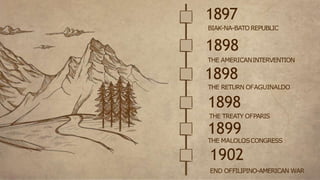
1897
BIAK-NA-BATO REPUBLIC
1898
THE AMERICANINTERVENTION
1898
THE RETURN OFAGUINALDO
1898
THE TREATY OFPARIS
1899
THE MALOLOSCONGRESS
1902
END OFFILIPINO-AMERICAN WAR
What is the main purpose?
• Signed on November 18, 1897. The Biak-na-Bato Constitution provided
for the creation of a Supreme Council to serve as the supreme body of
the Republic`s government. He also described some fundamental
human rights, such as freedom of religion, freedom of the press and the
right to education.
• The Republic of the Philippines, commonly known today as the Republic
of Biak-na-Bato, was the second revolutionary republican
government led by Emilio Aguinaldo during the Philippine Revolution,
replacing a government which also called itself the "Republic of the
Philippines".
BIAK-NA-BATO REPUBLIC
The Biak-na Bato Republic
Emilio Aguinaldo established his headquarters in
Biak-na-Bato in Bulacan province. The news
immediately spread throughout the country, and the
revolutionaries were once more in high spirits.
General llanera, who was in Nueva Ecija, declared his
support for Aguinaldo. In July 1897, Aguinaldo
established the Biak-na-Bato Republic and issued a
proclamation stating the following demands:
BIAK-NA-BATO REPUBLIC
• Expulsion of the friars and the return of the friar
lands to the Filipinos
• Representation of the Philippines in the Spanish
Cortes
• Freedom of the press and of religion
• Abolition of the government’s power to banish
Filipinos
• Equality for all before the law.
BIAK-NA-BATO REPUBLIC
Pedro Paterno, a Spaniard born in the
Philippines volunteered to act as negotiator
between Aguinaldo and Gov. Primo de
Rivera in order to end the clashes. The Leaders
are: Emilio Aguinaldo-President, Mariano Trias-
Vice President, Antonio Montenegro-Secretary,
Baldomero Aguinaldo-Treasurer, and Emilio
Riego de Dios
BIAK-NA-BATO REPUBLIC
• On December 23, 1897, Generals Celestino Tejero and
Ricardo Monet of the Spanish army arrived in Biak-na-
Bato and became hostages of the rebels.
• A ceasefire was declared by both camps and an
agreement between Aguinaldo and the Spanish forces
was made -that the Spanish government will grant self-
rule to the Philippines in 3 years if Aguinaldo went to exile
and surrender his arms. In exchange, Aguinaldo will
receive P800,000 (Mexican Pesos) as remuneration to the
revolutionaries and an amnesty.
BIAK-NA-BATO REPUBLIC
• After its defeat in the, Spain ceded its
longstanding colony of the Philippines to the
United States in the Treaty of Paris.
• On February 4, 1899, just two days before the
U.S. Senate ratified the treaty, fighting broke
out between American forces and Filipino
nationalists led by Emilio Aguinaldo who sought
independence rather than a change in colonial.
AMERICAN INTERVENTION
The ensuing Philippine-American War
lasted three years and resulted in the
death of over 4,200 American and over
20,000 Filipino combatants. As many
as 200,000 Filipino civilians died from
violence, famine, and disease.
AMERICAN INTERVENTION
The decision by U.S. was not without domestic
controversy. Americans who advocated annexation
evinced a
variety of motivations: desire for commercial
opportunities in Asia, concern that the Filipinos
were incapable of self-rule, and fear that if the
United States did not take control of the islands,
another power (such as Germany or Japan) might
do so.
THE AMERICAN INTERVENTION
• Meanwhile, American opposition to U.S.
colonial rule of the Philippines came in many
forms, ranging from those who thought it
morally wrong for the United States to be
engaged in colonialism, to those who feared
that annexation might eventually permit the
non-white Filipinos to have a role in
American national government.
THE AMERICAN INTERVENTION
• After the public and politicians debated the
annexation question, Filipino revolutionaries under
Aguinaldo seized control of most of the
Philippines’ main island of Luzon and proclaimed
the establishment of the independent Philippine
Republic. When it became clear that U.S. forces
were intent on imposing American colonial
control over the islands, the early clashes between
the two sides in 1899 swelled into an all-out war.
Americans tended to refer to the
ensuing conflict as an “insurrection”
rather than acknowledge the Filipinos’
contention that they were fighting to
ward off a foreign invader.
InApril 1898, the Spanish-American War broke out over Spain’s brutal
suppression of a rebellion in Cuba. The first in a series of decisive U.S.
victoriesoccurred on May 1,1898, when the U.S.Asiatic Squadronunder
Commodore George Dewey annihilated the Spanish Pacific fleet at the
Battle of Manila Bay inthe Philippines.
From his exile, Aguinaldo made arrangements with U.S.authorities to
returnto the Philippines and assist the United Statesinthe war against
Spain.He landed on May 19, rallied his revolutionaries, and began
liberating towns southof Manila. On June 12,he proclaimed Philippine
independence and established a provincial government, of which he
subsequently becamehead.
THE RETURN OF AGUINALDO AND THE
DECLARATION OF INDEPENDENCE
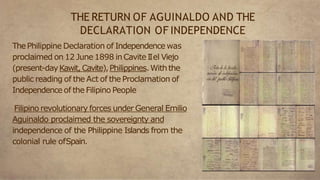
The Philippine Declaration of Independence was proclaimed on 12 June
1898 in Cavite IIel Viejo(present-dayKawit, Cavite),Philippines.With the
public reading of the Act of the Proclamation of Independence of the
Filipino People
Filipino revolutionary forces underGeneral Emilio Aguinaldo proclaimed
the sovereignty and independence of the Philippine Islands from the
colonial rule ofSpain.
THE RETURN OF AGUINALDO AND THE
DECLARATION OF INDEPENDENCE
ThePhilippine Declaration of Independence was
proclaimed on 12 June 1898 inCavite IIel Viejo
(present-dayKawit, Cavite),Philippines.Withthe
public reading of the Act of the Proclamation of
Independence of the Filipino People
Filipino revolutionary forces under General Emilio
Aguinaldo proclaimed the sovereignty and
independence of the Philippine Islands from the
colonial rule ofSpain.
THE RETURN OF AGUINALDO AND THE
DECLARATION OF INDEPENDENCE
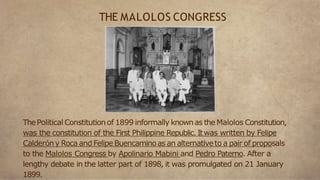
ThePolitical Constitutionof 1899 informally knownas the Malolos Constitution,
was the constitution of the First Philippine Republic. Itwas written by Felipe
Calderóny Roca and FelipeBuencaminoas an alternativeto a pair of proposals
to the Malolos Congress by Apolinario Mabini and Pedro Paterno. After a
lengthy debate in the latter part of 1898, it was promulgated on 21 January
1899.
THE MALOLOS CONGRESS
Theconstitutionplaced limitations on unsupervisedfreedomof action by the
chief executivewhichwould havehamperedrapid decisionmaking.As it was
createdduring thefight for Philippine independencefrom Spain,however
,its
Article 99 allowed unhamperedexecutivefreedomof action duringwartime.
Unsupervised executive governance continued throughout the Philippine–
American War which eruptedsoonafter proclamation.
After the Malolos Congress was convened on 15 September 1898, a
committee was selected to draft a constitution for the republic.[5]The
committee was composed of Hipólito Magsalin, Basilio Teodoro, José Albert,
Joaquín González, Gregorio Araneta, Pablo Ocampo, Aguedo Velarde, Higinio
Benitez, Tomás del Rosario, José Alejandrino, Alberto Barretto, José Ma. de la
Viña,José Luna, Antonio Luna, Mariano Abella, Juan Manday, Felipe Calderón,
ArsenioCruz and FelipeBuencamino.Theywereall wealthyand well educated.
THE MALOLOS CONGRESS
TheTreaty of Paris of 1898 (Filipino: Kasunduansa Paris ng1898;Spanish:
Tratado de París de 1898) was a treaty signed by Spain and the United
Stateson December 10,1898, that ended the Spanish–AmericanWar
.
Under it,Spain relinquishedall claim of sovereigntyover and title to Cuba
and also ceded Puerto Rico,Guam,and the Philippines to the United States.
Thecessionof the Philippines involveda compensation of $20 million from
the United Statesto Spain.
The treaty came into effect on April 11, 1899, when the documents of
ratification were exchanged.[2] Itwas the first treaty negotiated between
the two governmentssincethe 1819 Adams-Onís Treaty.
THE TREATY OF PARIS AND FILIPINO-
AMERICAN WAR
The Treaty of Paris marked the end of the Spanish Empire, apart from
some small holdings inNorthern Africa and several islands and territories
around the Gulf of Guinea, also in Africa. Itmarked the beginning of the
United States as a world power
. Many supportersof the war opposed the
treaty,which became one of the majorissuesin the election of 1900 when
it was opposed by Democrat William Jennings Bryan, who opposed
imperialism. Republican President William McKinley supported the treaty
and waseasily reelected.
THE TREATY OF PARIS AND FILIPINO-
AMERICAN WAR
The Philippine–American War
,also referred to as the Filipino–American
War
,the Philippine War
,the Philippine Insurrection or the Tagalog
Insurgency (Filipino: Digmaang Pilipino–Amerikano; Spanish:Guerra
filipino–estadounidense), was an armed conflict between the First
Philippine Republic and the United States that lasted from February 4,
1899, to July 2,1902. While Filipino nationalists viewed the conflict as a
continuation of the strugglefor independence that began in1896 with the
Philippine Revolution,the U.S.government regarded it as an insurrection.
The conflict arose when the First Philippine Republic objected to the terms
of the Treaty of Paris underwhich the United Statestookpossession of the
Philippines from Spain,endingthe Spanish–AmericanWar
.
THE TREATY OF PARIS AND FILIPINO-
AMERICAN WAR
Fighting erupted between forces of the United States and those of the
Philippine Republic on February 4,1899, in what became known as the 1899
Battle of Manila. On June 2,1899, the First Philippine Republic officially
declared war against the United States. The war officially ended on July 2,
1902,with a victoryfor the United States.However
,somePhilippinegroups—
led by veteransof the Katipunan,a Philippinerevolutionarysociety—continued
to battle the American forcesfor severalmore years.Among those leaders was
General Macario Sakay, a veteran Katipunan member who assumed the
presidency of the proclaimed Tagalog Republic, formed in 1902 after the
capture of President Emilio Aguinaldo. Other groups, including the Moro, Bicol
and Pulahan peoples, continued hostilities in remote areas and islands, until
their final defeat at the Battle of BudBagsakon June15,1913.
THE TREATY OF PARIS AND FILIPINO-
AMERICAN WAR
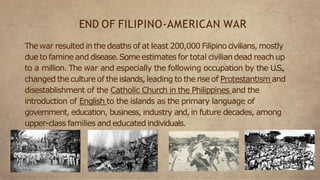
Thewar resulted inthe deaths of at least 200,000 Filipino civilians,mostly
due to famine and disease.Someestimates for total civilian dead reach up
to a million. The war and especially the following occupation by the U.S.
,
changed the culture of the islands, leading to the rise of Protestantism and
disestablishment of the Catholic Church in the Philippines and the
introduction of English to the islands as the primary language of
government, education, business, industry and, in future decades, among
upper-class families and educated individuals.
END OF FILIPINO-AMERICAN WAR
In1902, the United States Congress passed the Philippine Organic Act, which
providedfor the creation of the Philippine Assembly,with membersto be elected
by Filipino males (women did not have the vote until after the 1937 suffrage
plebiscite).Thisact was superseded by the 1916 JonesAct (Philippine Autonomy
Act),which contained the first formal and official declarationof the United States
government's commitment to eventuallygrant independenceto the Philippines.
The 1934 Tydings–McDuffie Act (Philippine Independence Act) created the
Commonwealthof the Philippinesthe following year
,increasing self-governancein
advance of independence, and established a process towards full Philippine
independence (originally scheduled for 1944, but interrupted and delayed by
World War II)
.The United States granted independence in 1946, following World
War IIand the Japanese occupation of the Philippines,through the Treaty of
END OF FILIPINO-AMERICAN WAR

1st republic-summary.pptx

  • 1.
    FOR MNHS SHS TheFirstPhilippine Republic
  • 2.
  • 3.
    1897 BIAK-NA-BATO REPUBLIC 1898 THE AMERICANINTERVENTION 1898 THERETURN OFAGUINALDO 1898 THE TREATY OFPARIS 1899 THE MALOLOSCONGRESS 1902 END OFFILIPINO-AMERICAN WAR
  • 4.
    What is themain purpose? • Signed on November 18, 1897. The Biak-na-Bato Constitution provided for the creation of a Supreme Council to serve as the supreme body of the Republic`s government. He also described some fundamental human rights, such as freedom of religion, freedom of the press and the right to education. • The Republic of the Philippines, commonly known today as the Republic of Biak-na-Bato, was the second revolutionary republican government led by Emilio Aguinaldo during the Philippine Revolution, replacing a government which also called itself the "Republic of the Philippines". BIAK-NA-BATO REPUBLIC
  • 5.
    The Biak-na BatoRepublic Emilio Aguinaldo established his headquarters in Biak-na-Bato in Bulacan province. The news immediately spread throughout the country, and the revolutionaries were once more in high spirits. General llanera, who was in Nueva Ecija, declared his support for Aguinaldo. In July 1897, Aguinaldo established the Biak-na-Bato Republic and issued a proclamation stating the following demands: BIAK-NA-BATO REPUBLIC
  • 6.
    • Expulsion ofthe friars and the return of the friar lands to the Filipinos • Representation of the Philippines in the Spanish Cortes • Freedom of the press and of religion • Abolition of the government’s power to banish Filipinos • Equality for all before the law. BIAK-NA-BATO REPUBLIC
  • 7.
    Pedro Paterno, aSpaniard born in the Philippines volunteered to act as negotiator between Aguinaldo and Gov. Primo de Rivera in order to end the clashes. The Leaders are: Emilio Aguinaldo-President, Mariano Trias- Vice President, Antonio Montenegro-Secretary, Baldomero Aguinaldo-Treasurer, and Emilio Riego de Dios BIAK-NA-BATO REPUBLIC
  • 8.
    • On December23, 1897, Generals Celestino Tejero and Ricardo Monet of the Spanish army arrived in Biak-na- Bato and became hostages of the rebels. • A ceasefire was declared by both camps and an agreement between Aguinaldo and the Spanish forces was made -that the Spanish government will grant self- rule to the Philippines in 3 years if Aguinaldo went to exile and surrender his arms. In exchange, Aguinaldo will receive P800,000 (Mexican Pesos) as remuneration to the revolutionaries and an amnesty. BIAK-NA-BATO REPUBLIC
  • 9.
    • After itsdefeat in the, Spain ceded its longstanding colony of the Philippines to the United States in the Treaty of Paris. • On February 4, 1899, just two days before the U.S. Senate ratified the treaty, fighting broke out between American forces and Filipino nationalists led by Emilio Aguinaldo who sought independence rather than a change in colonial. AMERICAN INTERVENTION
  • 10.
    The ensuing Philippine-AmericanWar lasted three years and resulted in the death of over 4,200 American and over 20,000 Filipino combatants. As many as 200,000 Filipino civilians died from violence, famine, and disease. AMERICAN INTERVENTION
  • 11.
    The decision byU.S. was not without domestic controversy. Americans who advocated annexation evinced a variety of motivations: desire for commercial opportunities in Asia, concern that the Filipinos were incapable of self-rule, and fear that if the United States did not take control of the islands, another power (such as Germany or Japan) might do so. THE AMERICAN INTERVENTION
  • 12.
    • Meanwhile, Americanopposition to U.S. colonial rule of the Philippines came in many forms, ranging from those who thought it morally wrong for the United States to be engaged in colonialism, to those who feared that annexation might eventually permit the non-white Filipinos to have a role in American national government. THE AMERICAN INTERVENTION
  • 13.
    • After thepublic and politicians debated the annexation question, Filipino revolutionaries under Aguinaldo seized control of most of the Philippines’ main island of Luzon and proclaimed the establishment of the independent Philippine Republic. When it became clear that U.S. forces were intent on imposing American colonial control over the islands, the early clashes between the two sides in 1899 swelled into an all-out war.
  • 14.
    Americans tended torefer to the ensuing conflict as an “insurrection” rather than acknowledge the Filipinos’ contention that they were fighting to ward off a foreign invader.
  • 15.
    InApril 1898, theSpanish-American War broke out over Spain’s brutal suppression of a rebellion in Cuba. The first in a series of decisive U.S. victoriesoccurred on May 1,1898, when the U.S.Asiatic Squadronunder Commodore George Dewey annihilated the Spanish Pacific fleet at the Battle of Manila Bay inthe Philippines. From his exile, Aguinaldo made arrangements with U.S.authorities to returnto the Philippines and assist the United Statesinthe war against Spain.He landed on May 19, rallied his revolutionaries, and began liberating towns southof Manila. On June 12,he proclaimed Philippine independence and established a provincial government, of which he subsequently becamehead. THE RETURN OF AGUINALDO AND THE DECLARATION OF INDEPENDENCE
  • 16.
    The Philippine Declarationof Independence was proclaimed on 12 June 1898 in Cavite IIel Viejo(present-dayKawit, Cavite),Philippines.With the public reading of the Act of the Proclamation of Independence of the Filipino People Filipino revolutionary forces underGeneral Emilio Aguinaldo proclaimed the sovereignty and independence of the Philippine Islands from the colonial rule ofSpain. THE RETURN OF AGUINALDO AND THE DECLARATION OF INDEPENDENCE
  • 17.
    ThePhilippine Declaration ofIndependence was proclaimed on 12 June 1898 inCavite IIel Viejo (present-dayKawit, Cavite),Philippines.Withthe public reading of the Act of the Proclamation of Independence of the Filipino People Filipino revolutionary forces under General Emilio Aguinaldo proclaimed the sovereignty and independence of the Philippine Islands from the colonial rule ofSpain. THE RETURN OF AGUINALDO AND THE DECLARATION OF INDEPENDENCE
  • 18.
    ThePolitical Constitutionof 1899informally knownas the Malolos Constitution, was the constitution of the First Philippine Republic. Itwas written by Felipe Calderóny Roca and FelipeBuencaminoas an alternativeto a pair of proposals to the Malolos Congress by Apolinario Mabini and Pedro Paterno. After a lengthy debate in the latter part of 1898, it was promulgated on 21 January 1899. THE MALOLOS CONGRESS
  • 19.
    Theconstitutionplaced limitations onunsupervisedfreedomof action by the chief executivewhichwould havehamperedrapid decisionmaking.As it was createdduring thefight for Philippine independencefrom Spain,however ,its Article 99 allowed unhamperedexecutivefreedomof action duringwartime. Unsupervised executive governance continued throughout the Philippine– American War which eruptedsoonafter proclamation. After the Malolos Congress was convened on 15 September 1898, a committee was selected to draft a constitution for the republic.[5]The committee was composed of Hipólito Magsalin, Basilio Teodoro, José Albert, Joaquín González, Gregorio Araneta, Pablo Ocampo, Aguedo Velarde, Higinio Benitez, Tomás del Rosario, José Alejandrino, Alberto Barretto, José Ma. de la Viña,José Luna, Antonio Luna, Mariano Abella, Juan Manday, Felipe Calderón, ArsenioCruz and FelipeBuencamino.Theywereall wealthyand well educated. THE MALOLOS CONGRESS
  • 20.
    TheTreaty of Parisof 1898 (Filipino: Kasunduansa Paris ng1898;Spanish: Tratado de París de 1898) was a treaty signed by Spain and the United Stateson December 10,1898, that ended the Spanish–AmericanWar . Under it,Spain relinquishedall claim of sovereigntyover and title to Cuba and also ceded Puerto Rico,Guam,and the Philippines to the United States. Thecessionof the Philippines involveda compensation of $20 million from the United Statesto Spain. The treaty came into effect on April 11, 1899, when the documents of ratification were exchanged.[2] Itwas the first treaty negotiated between the two governmentssincethe 1819 Adams-Onís Treaty. THE TREATY OF PARIS AND FILIPINO- AMERICAN WAR
  • 21.
    The Treaty ofParis marked the end of the Spanish Empire, apart from some small holdings inNorthern Africa and several islands and territories around the Gulf of Guinea, also in Africa. Itmarked the beginning of the United States as a world power . Many supportersof the war opposed the treaty,which became one of the majorissuesin the election of 1900 when it was opposed by Democrat William Jennings Bryan, who opposed imperialism. Republican President William McKinley supported the treaty and waseasily reelected. THE TREATY OF PARIS AND FILIPINO- AMERICAN WAR
  • 22.
    The Philippine–American War ,alsoreferred to as the Filipino–American War ,the Philippine War ,the Philippine Insurrection or the Tagalog Insurgency (Filipino: Digmaang Pilipino–Amerikano; Spanish:Guerra filipino–estadounidense), was an armed conflict between the First Philippine Republic and the United States that lasted from February 4, 1899, to July 2,1902. While Filipino nationalists viewed the conflict as a continuation of the strugglefor independence that began in1896 with the Philippine Revolution,the U.S.government regarded it as an insurrection. The conflict arose when the First Philippine Republic objected to the terms of the Treaty of Paris underwhich the United Statestookpossession of the Philippines from Spain,endingthe Spanish–AmericanWar . THE TREATY OF PARIS AND FILIPINO- AMERICAN WAR
  • 23.
    Fighting erupted betweenforces of the United States and those of the Philippine Republic on February 4,1899, in what became known as the 1899 Battle of Manila. On June 2,1899, the First Philippine Republic officially declared war against the United States. The war officially ended on July 2, 1902,with a victoryfor the United States.However ,somePhilippinegroups— led by veteransof the Katipunan,a Philippinerevolutionarysociety—continued to battle the American forcesfor severalmore years.Among those leaders was General Macario Sakay, a veteran Katipunan member who assumed the presidency of the proclaimed Tagalog Republic, formed in 1902 after the capture of President Emilio Aguinaldo. Other groups, including the Moro, Bicol and Pulahan peoples, continued hostilities in remote areas and islands, until their final defeat at the Battle of BudBagsakon June15,1913. THE TREATY OF PARIS AND FILIPINO- AMERICAN WAR
  • 24.
    Thewar resulted inthedeaths of at least 200,000 Filipino civilians,mostly due to famine and disease.Someestimates for total civilian dead reach up to a million. The war and especially the following occupation by the U.S. , changed the culture of the islands, leading to the rise of Protestantism and disestablishment of the Catholic Church in the Philippines and the introduction of English to the islands as the primary language of government, education, business, industry and, in future decades, among upper-class families and educated individuals. END OF FILIPINO-AMERICAN WAR
  • 25.
    In1902, the UnitedStates Congress passed the Philippine Organic Act, which providedfor the creation of the Philippine Assembly,with membersto be elected by Filipino males (women did not have the vote until after the 1937 suffrage plebiscite).Thisact was superseded by the 1916 JonesAct (Philippine Autonomy Act),which contained the first formal and official declarationof the United States government's commitment to eventuallygrant independenceto the Philippines. The 1934 Tydings–McDuffie Act (Philippine Independence Act) created the Commonwealthof the Philippinesthe following year ,increasing self-governancein advance of independence, and established a process towards full Philippine independence (originally scheduled for 1944, but interrupted and delayed by World War II) .The United States granted independence in 1946, following World War IIand the Japanese occupation of the Philippines,through the Treaty of END OF FILIPINO-AMERICAN WAR