U2 Sunday Bloody Sunday You are listening to the U2 song, “Sunday Bloody Sunday”.  The song describes an incident in Northern Ireland, in 1972 in which 26 civil rights protesters were shot by members of a British Regiment during a Northern Ireland Civil Rights Association march. Thirteen people, six of whom were minors, died immediately.
The United Kingdom: Politics By the late 1970s, England’s economy was in bad  shape  partly because of the costliness of running a welfare state with nationalized industries. 1979:  Conservative Party leader Margaret Thatcher becomes the first female Prime Minister in the history of England… more on “Thatcherism” later.
The United Kingdom: The “Troubles” in Northern Ireland Background The British had oppressed the people  of Ireland since the rule of Oliver Cromwell in the 1640s. The Irish Potato Famine from 1845 – 1849 intensified Irish anger against the British (even though it wasn’t really England’s fault). 1916:  Easter Uprising:  Small group  of Irish nationalists launches a revolt against British rule… 15 rebel leaders were executed by the British.
The United Kingdom: The “Troubles” in Northern Ireland Background 1919:  The new Irish Republican Army (people who wanted Irish independence) start a revolution against the British. 1922:  England agrees to grant independence to the majority of Ireland. The northern counties (Ulster) remain under British rule (Northern Ireland).
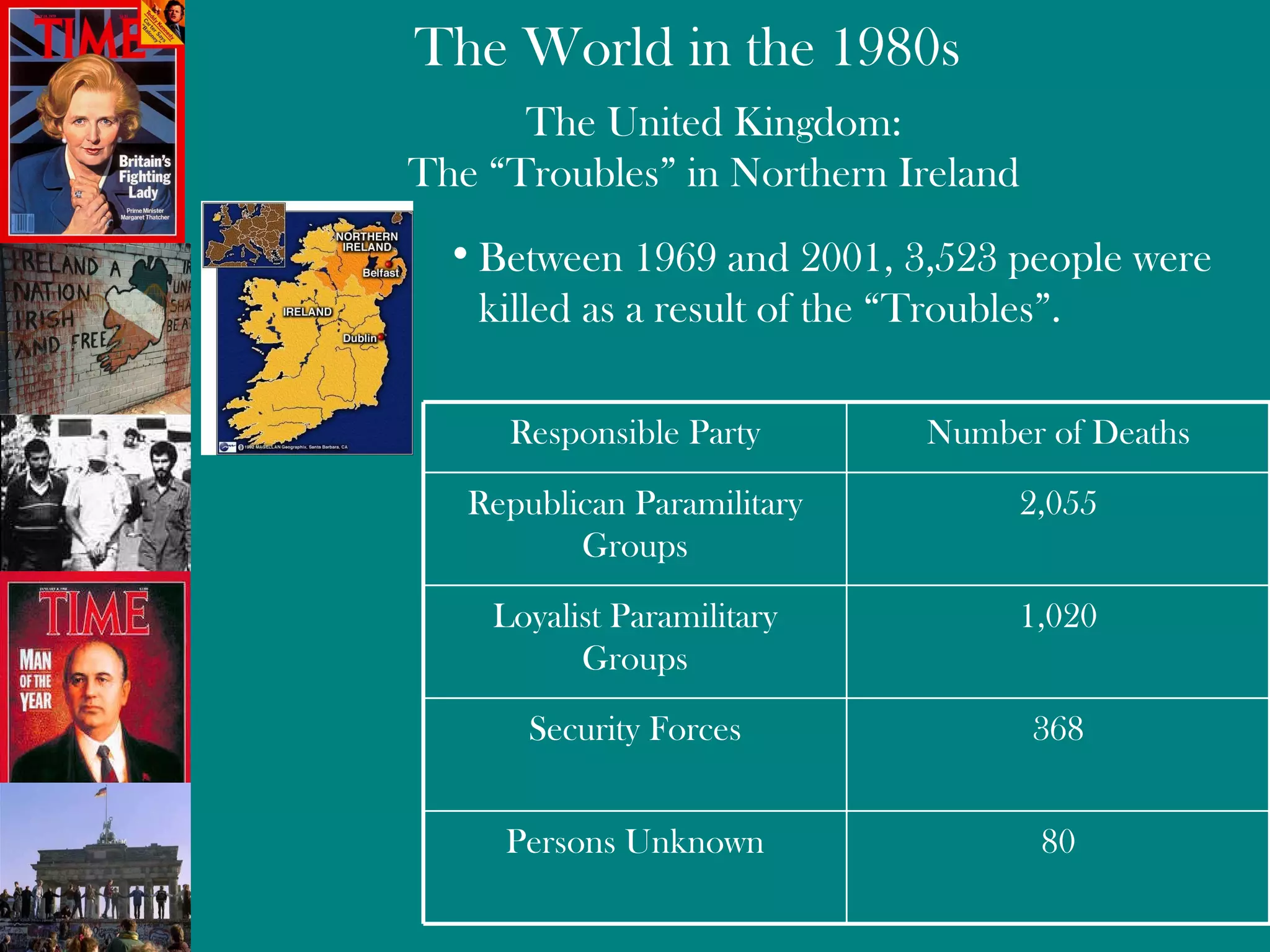
The United Kingdom: The “Troubles” in Northern Ireland Background Leads to a prolonged conflict in Northern Ireland between Catholics who want  to join the Republic of Ireland and  Protestants who want to remain part of the United Kingdom. Sinn Fein – Political division of the  IRA .  Para-military groups: Republican - Provisional IRA (Catholic). Loyalist – Ulster Freedom Fighters  (UFF), Ulster Volunteer Force (UVF),  Ulster Defence Association (UDA)  (all Protestant). clip
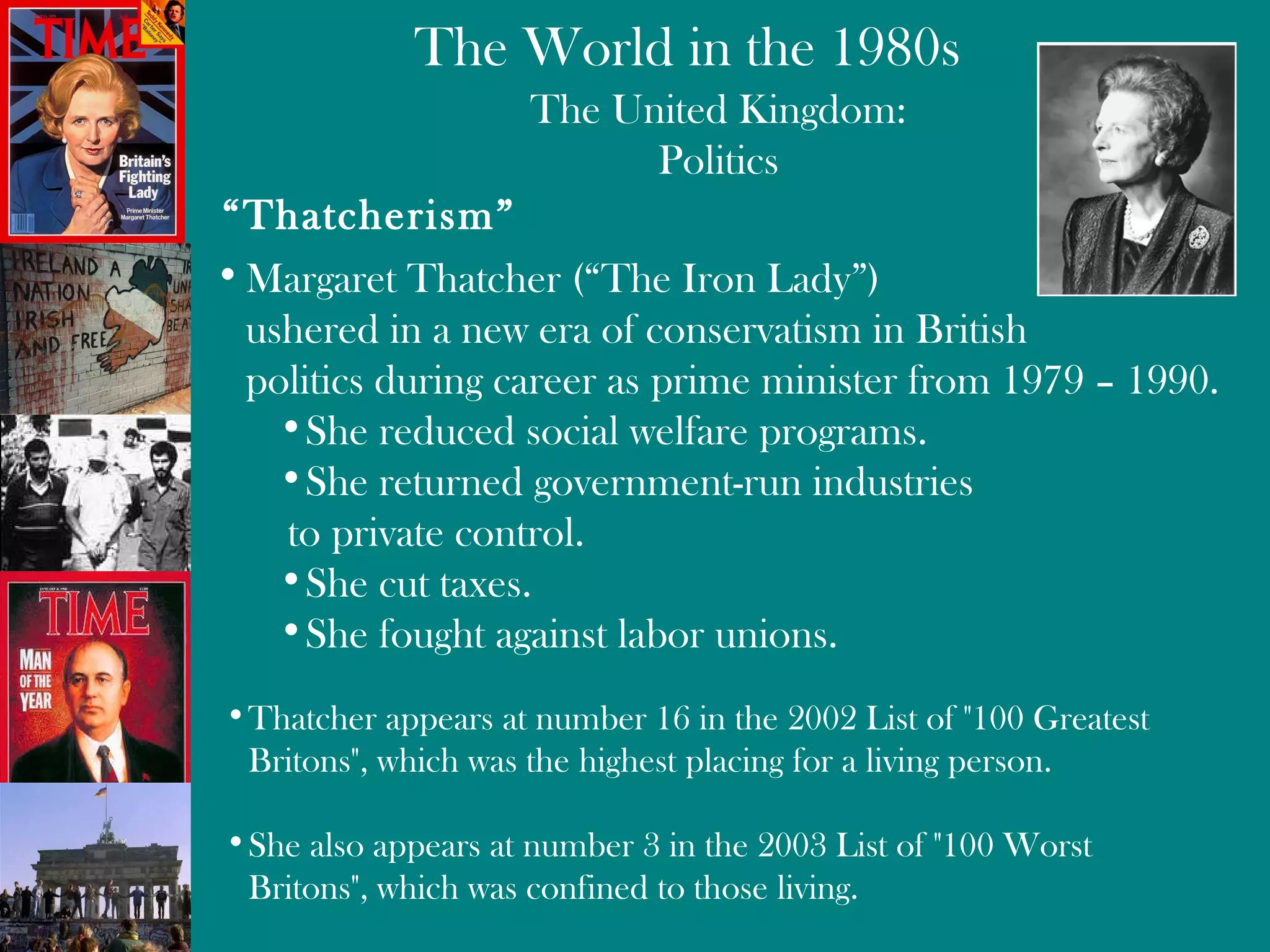
The United Kingdom: The “Troubles” in Northern Ireland Between 1969 and 2001, 3,523 people were killed as a result of the “Troubles”. 80 Persons Unknown 368 Security Forces 1,020 Loyalist Paramilitary Groups 2,055 Republican Paramilitary Groups Number of Deaths Responsible Party
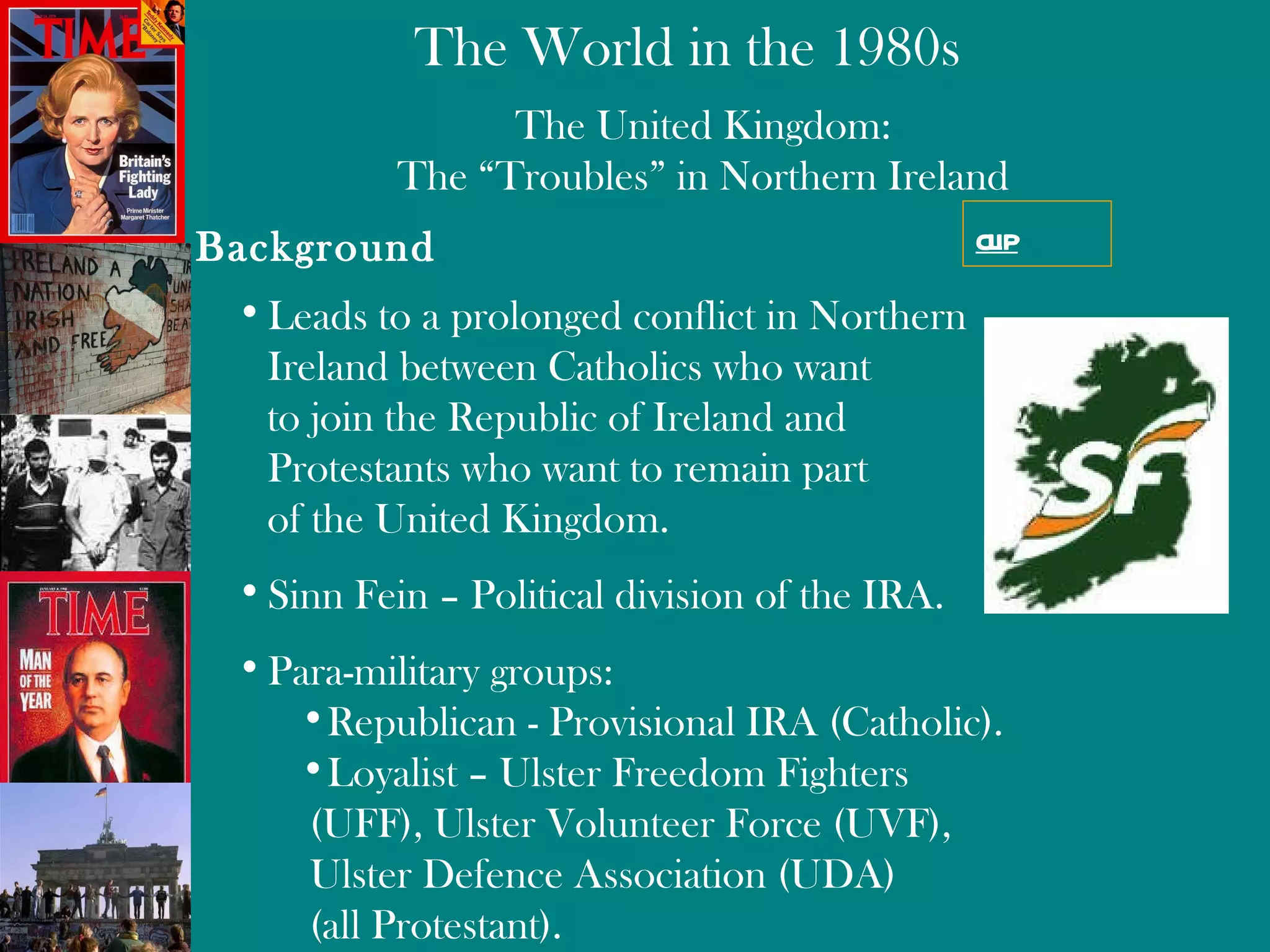
The United Kingdom: Politics “ Thatcherism” Margaret Thatcher (“The Iron Lady”) ushered in a new era of conservatism in British  politics during career as prime minister from 1979 – 1990. She reduced social welfare programs. She returned government-run industries to private control. She cut taxes. She fought against labor unions. Thatcher appears at number 16 in the 2002 List of "100 Greatest Britons", which was the highest placing for a living person.  She also appears at number 3 in the 2003 List of "100 Worst Britons", which was confined to those living.
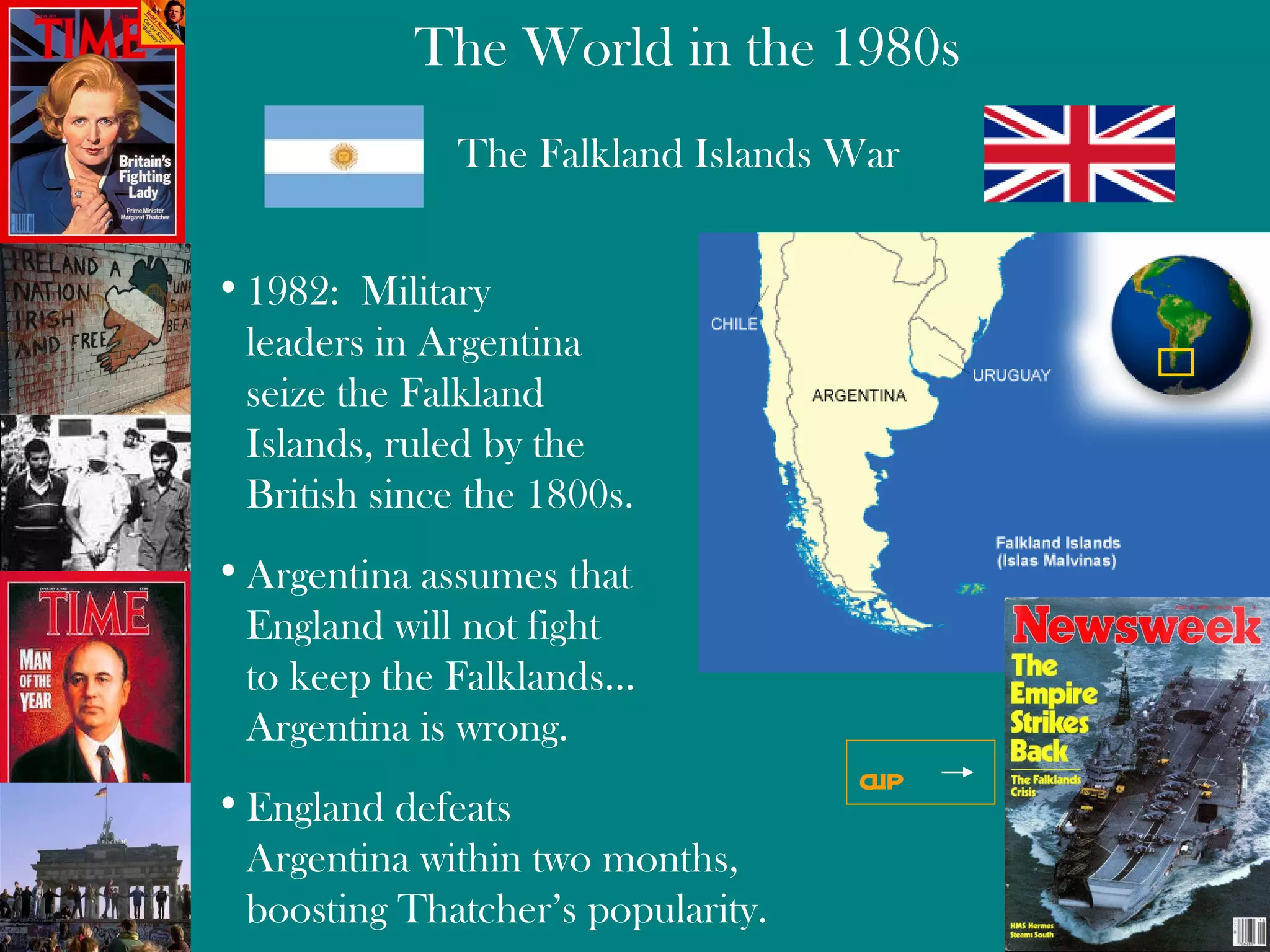
The Falkland Islands War 1982:  Military  leaders in Argentina  seize the Falkland  Islands, ruled by the  British since the 1800s. Argentina assumes that England will not fight to keep the Falklands… Argentina is wrong . England defeats  Argentina within two months,  boosting Thatcher’s popularity. clip
France 1981:  Francois Mitterand is elected  president, the first socialist president of the French Fifth Republic. Mitterand abolishes the death penalty  and imposes a wealth tax. Mitterand, unlike de Gaulle, establishes closer ties with the West and does not attempt to ease relations with the  Soviet Union.  Eventually world learns Mitterand has two completely  separate families – c’est la vie!
France The “Great Projects” of Francois Mitterand: The Channel Tunnel between  England and France The Pyramid at the Louvre The  Grande Arche
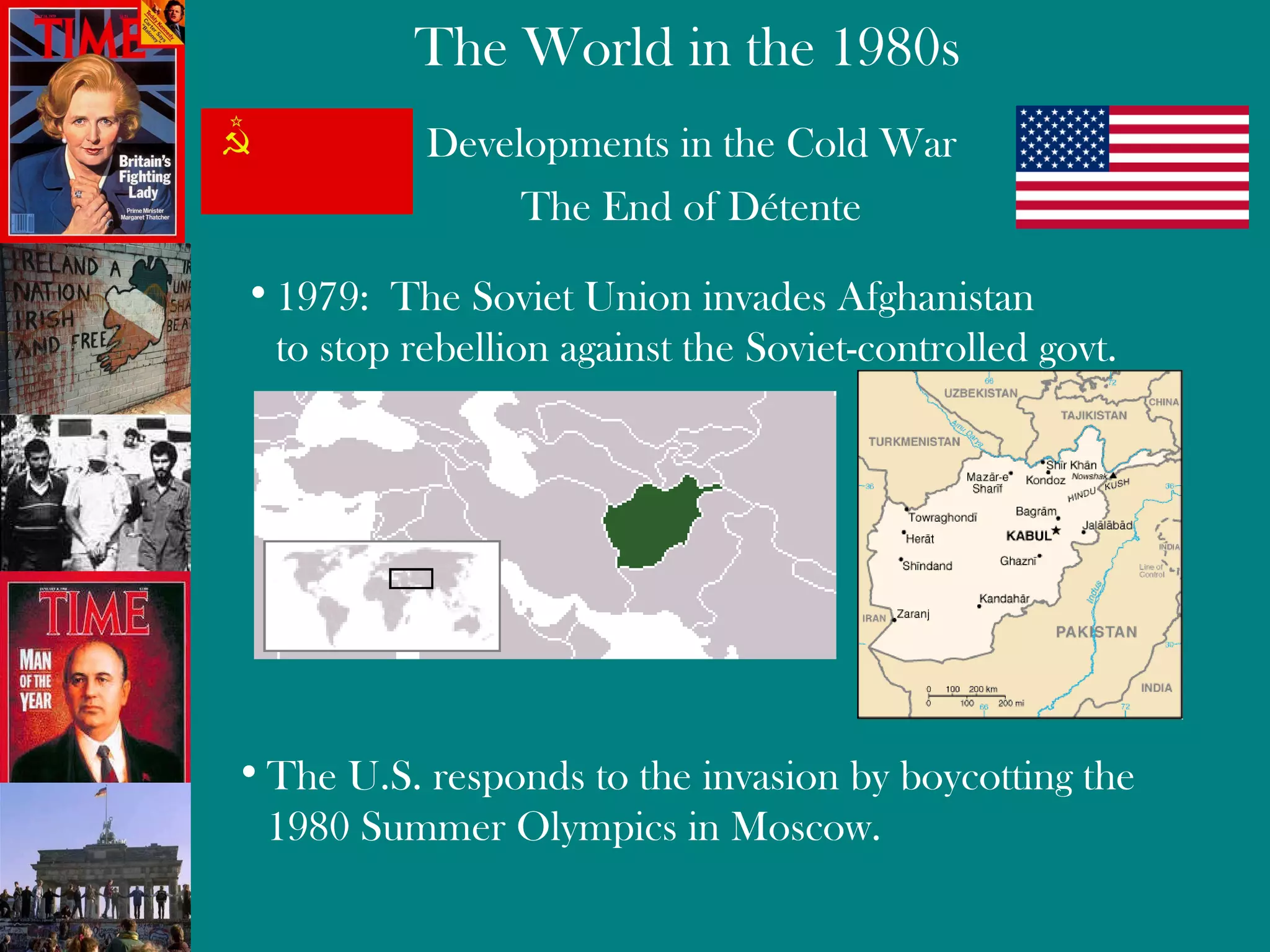
Developments in the Cold War The End of Détente  1979:  The Soviet Union invades Afghanistan to stop rebellion against the Soviet-controlled govt. The U.S. responds to the invasion by boycotting the 1980 Summer Olympics in Moscow.
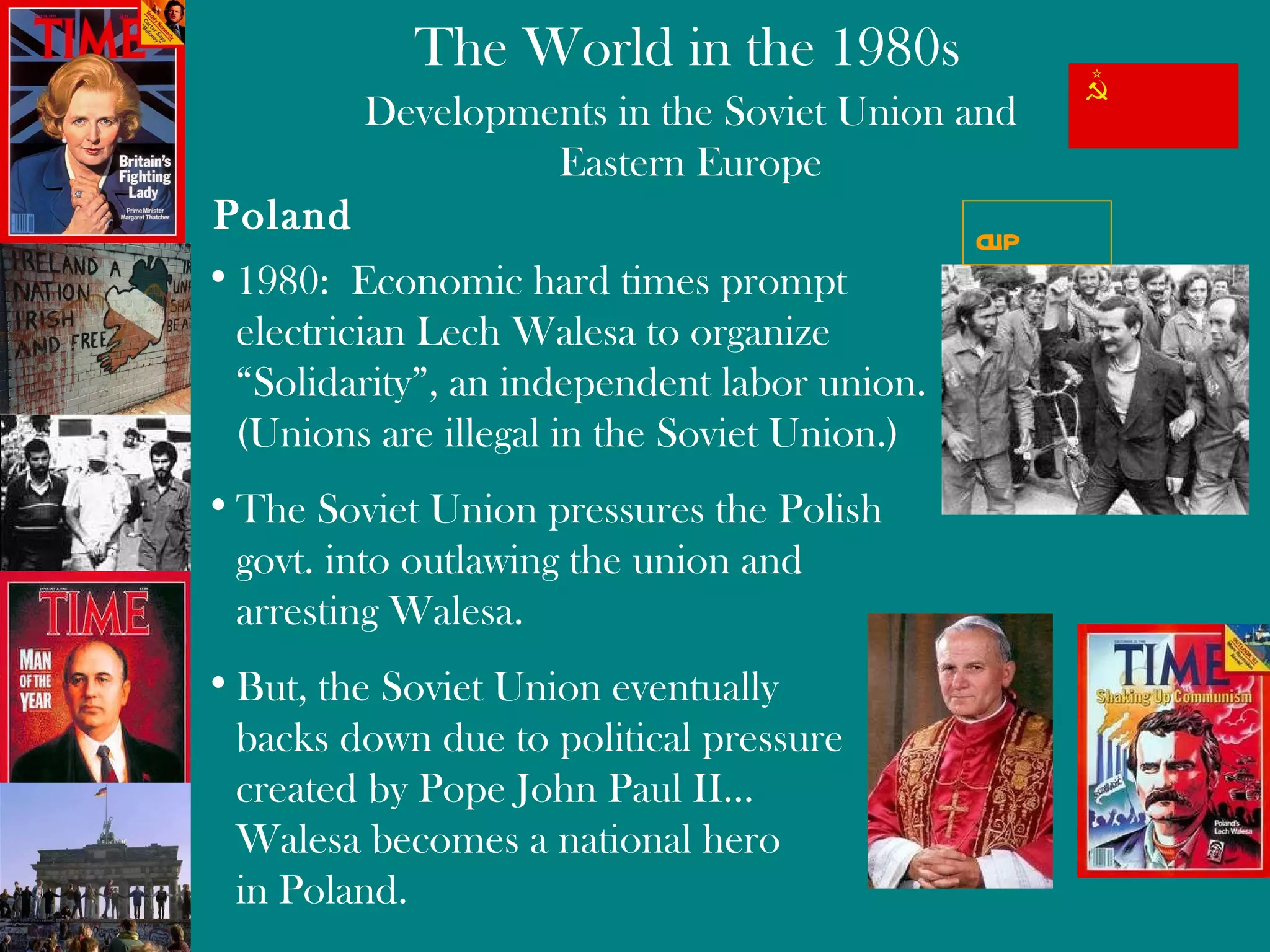
Developments in the Soviet Union and Eastern Europe 1980:  Economic hard times prompt  electrician Lech Walesa to organize  “Solidarity ”,  an independent labor union.  (Unions are illegal in the Soviet Union.) The Soviet Union pressures the Polish govt. into outlawing the union and  arresting Walesa. But, the Soviet Union eventually  backs down due to political pressure created by Pope John Paul II…  Walesa becomes a national hero  in Poland. Poland clip
Developments in the Soviet Union and Eastern Europe 1985:  A new energetic leader comes to  power in the Soviet Union,  Mikhail Gorbachev . Gorbachev launches a two-pronged reform effort: 1)  Glasnost – “openness”, the ending of  censorship. 2)  Perestroika – “restructuring” An attempt re-shape the dismal Soviet economy. To produce more and higher-quality goods, Gorbachev gives factory managers, instead of govt. officials, the ability to make business decisions. Farmers are allowed to sell food on the free market.
Developments in the Soviet Union and Eastern Europe 1986:  Meltdown at the nuclear power plant in  Chernobyl,  Ukraine. The disaster released as much as 300 times more radioactive fallout than the atomic bomb of Hiroshima. Soviet-era cover-up makes it difficult to know how many people have been affected.. A 2005 report attributed 56 direct deaths and estimated that as many as 9,000 people will die from some form of cancer.
Developments in the Soviet Union and Eastern Europe East Germany 1989:  Mass protests against East German govt. force  Erich Honecker to resign. November 9, 1989:  New East German govt. announces that East Berliners would be allowed to cross the border with proper permission (???). Tens of thousands of East Berliners heard the announcement and flooded the checkpoints.  The guards don’t know what to do… so they let them all pass into West Berlin.  In the next few days, people showed up with sledgehammers to destroy the Berlin Wall.
A portion of the wall is on display outside the EU Parliament in Brussels, Belgium.  clip
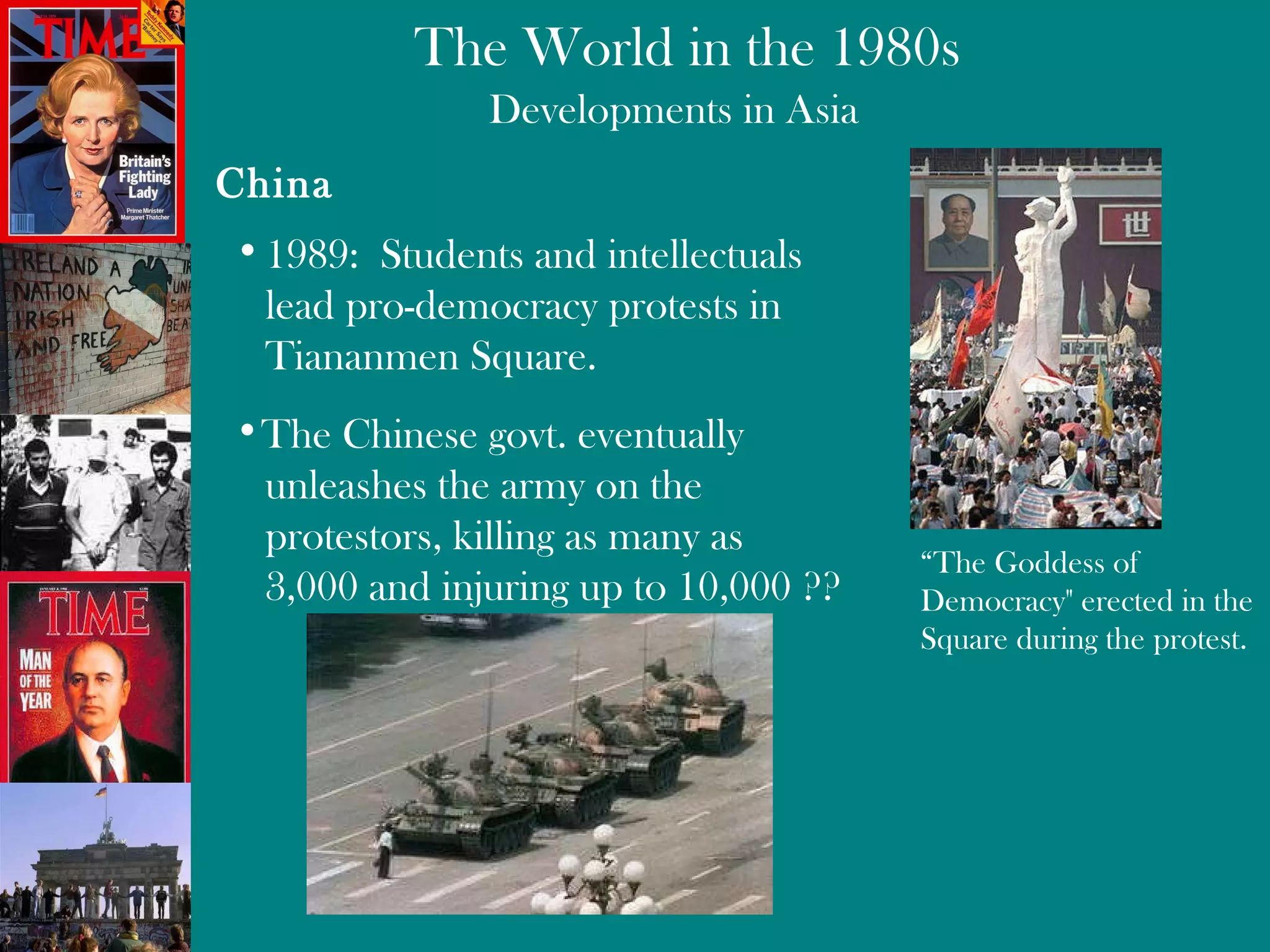
Developments in Asia China 1989:  Students and intellectuals  lead pro-democracy protests in  Tiananmen Square. “ The Goddess of Democracy" erected in the Square during the protest.  The Chinese govt. eventually unleashes the army on the  protestors, killing as many as  3,000 and injuring up to 10,000 ??
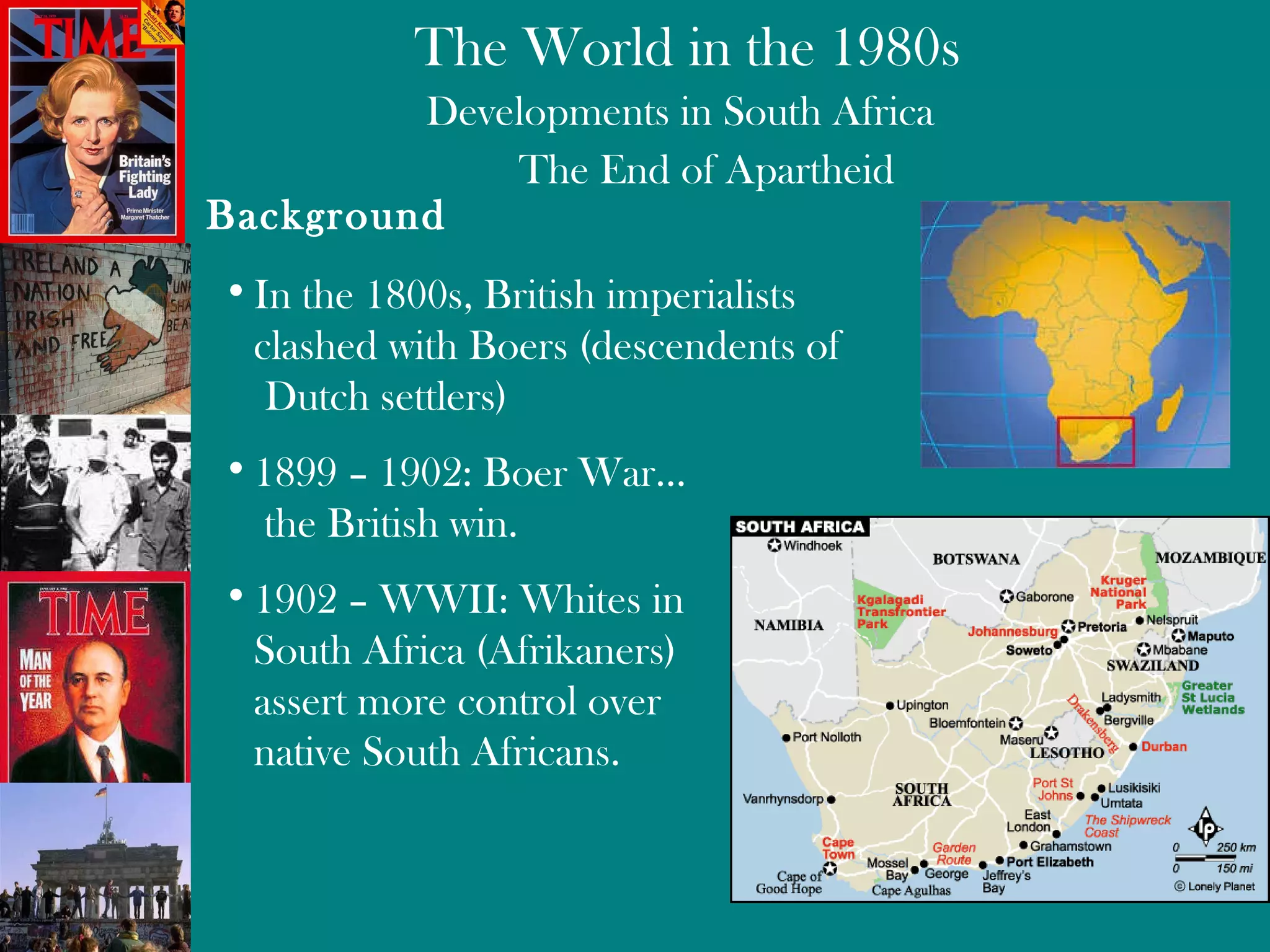
Developments in South Africa The End of Apartheid Background In the 1800s, British imperialists  clashed with Boers (descendents of  Dutch settlers) 1899 – 1902: Boer War…  the British win. 1902 – WWII: Whites in  South Africa (Afrikaners)  assert more control over  native South Africans.
Developments in South Africa The End of Apartheid Background 1948:  Afrikaners impose apartheid  – a system of complete    segregation based on race. -- More than 80% of South   Africa, including cities,    mines and the richest   farmland was reserved   for whites. 1962:  anti-apartheid  activist Nelson Mandela is arrested and sentenced to life in prison.
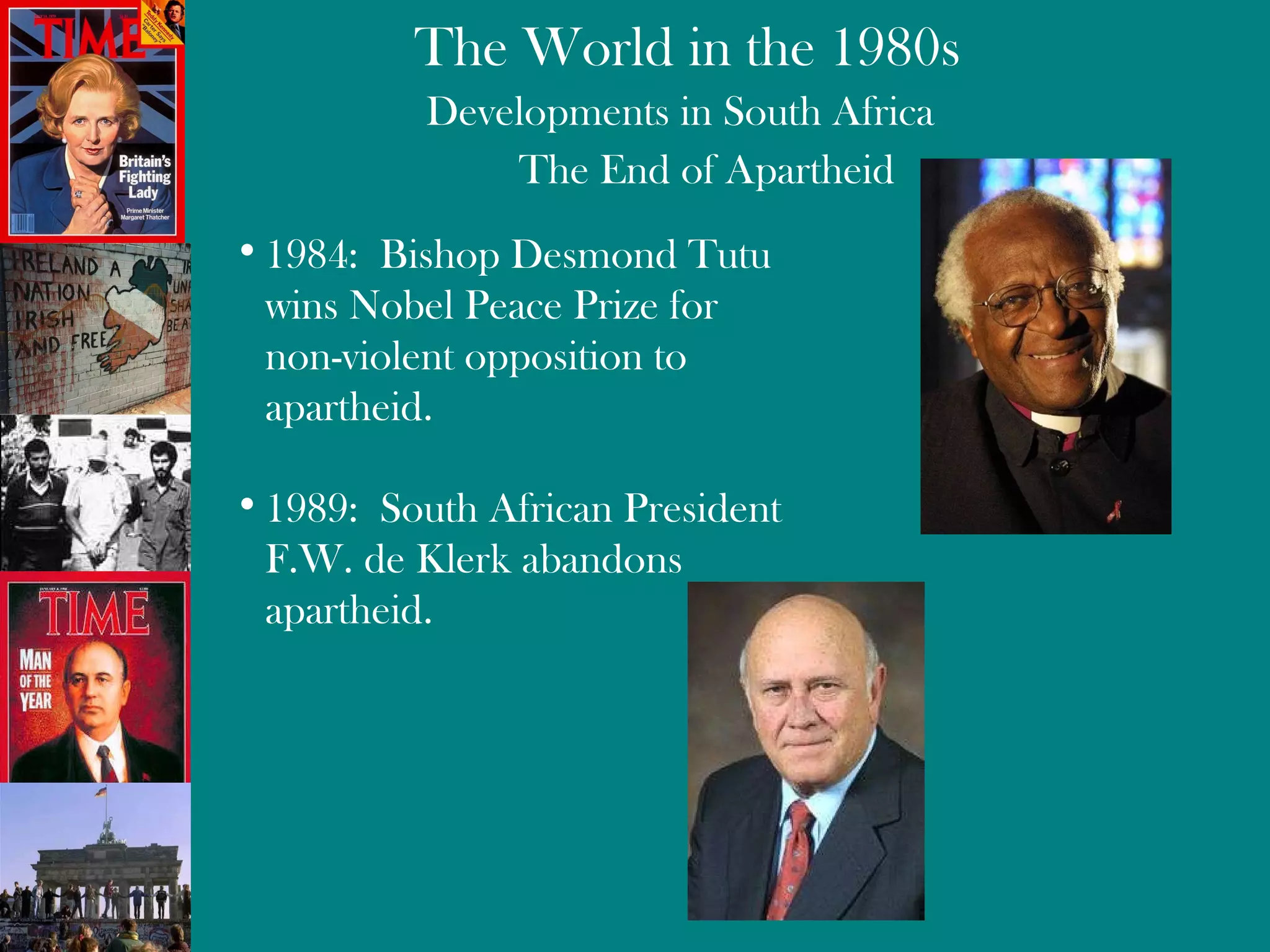
Developments in South Africa The End of Apartheid 1984:  Bishop Desmond Tutu wins Nobel Peace Prize for  non-violent opposition to  apartheid. 1989:  South African President F.W. de Klerk abandons  apartheid.
Meanwhile….back in the States…. Breedlove at his Freshman Homecoming Dance…. 1981
Breedlove at his Senior Prom, 1985… with the “love of my life”….
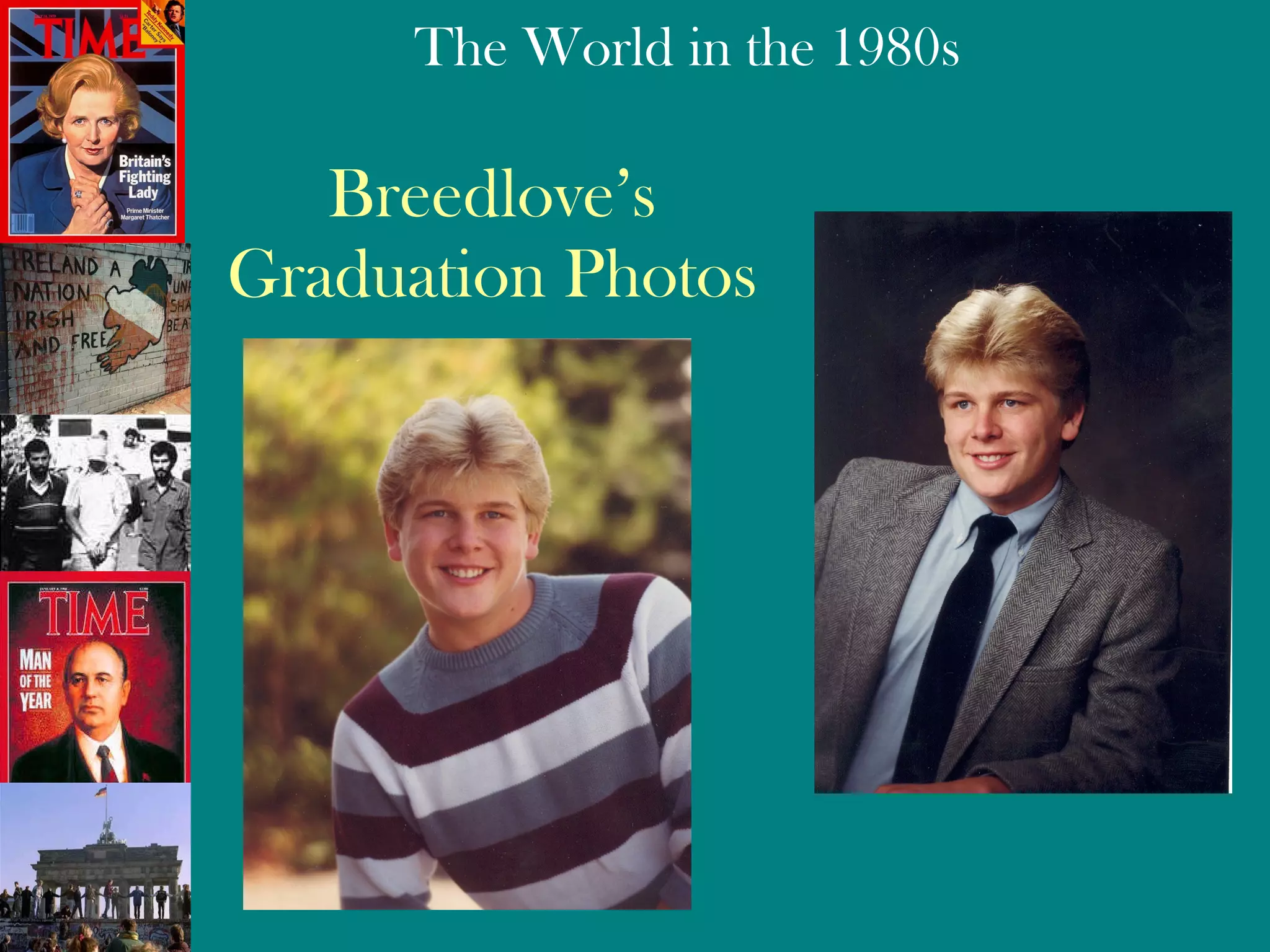
Breedlove’s Graduation Photos

1980s world(1)

  • 1.
    U2 Sunday BloodySunday You are listening to the U2 song, “Sunday Bloody Sunday”. The song describes an incident in Northern Ireland, in 1972 in which 26 civil rights protesters were shot by members of a British Regiment during a Northern Ireland Civil Rights Association march. Thirteen people, six of whom were minors, died immediately.
  • 2.
    The United Kingdom:Politics By the late 1970s, England’s economy was in bad shape partly because of the costliness of running a welfare state with nationalized industries. 1979: Conservative Party leader Margaret Thatcher becomes the first female Prime Minister in the history of England… more on “Thatcherism” later.
  • 3.
    The United Kingdom:The “Troubles” in Northern Ireland Background The British had oppressed the people of Ireland since the rule of Oliver Cromwell in the 1640s. The Irish Potato Famine from 1845 – 1849 intensified Irish anger against the British (even though it wasn’t really England’s fault). 1916: Easter Uprising: Small group of Irish nationalists launches a revolt against British rule… 15 rebel leaders were executed by the British.
  • 4.
    The United Kingdom:The “Troubles” in Northern Ireland Background 1919: The new Irish Republican Army (people who wanted Irish independence) start a revolution against the British. 1922: England agrees to grant independence to the majority of Ireland. The northern counties (Ulster) remain under British rule (Northern Ireland).
  • 5.
    The United Kingdom:The “Troubles” in Northern Ireland Background Leads to a prolonged conflict in Northern Ireland between Catholics who want to join the Republic of Ireland and Protestants who want to remain part of the United Kingdom. Sinn Fein – Political division of the IRA . Para-military groups: Republican - Provisional IRA (Catholic). Loyalist – Ulster Freedom Fighters (UFF), Ulster Volunteer Force (UVF), Ulster Defence Association (UDA) (all Protestant). clip
  • 6.
    The United Kingdom:The “Troubles” in Northern Ireland Between 1969 and 2001, 3,523 people were killed as a result of the “Troubles”. 80 Persons Unknown 368 Security Forces 1,020 Loyalist Paramilitary Groups 2,055 Republican Paramilitary Groups Number of Deaths Responsible Party
  • 7.
    The United Kingdom:Politics “ Thatcherism” Margaret Thatcher (“The Iron Lady”) ushered in a new era of conservatism in British politics during career as prime minister from 1979 – 1990. She reduced social welfare programs. She returned government-run industries to private control. She cut taxes. She fought against labor unions. Thatcher appears at number 16 in the 2002 List of "100 Greatest Britons", which was the highest placing for a living person. She also appears at number 3 in the 2003 List of "100 Worst Britons", which was confined to those living.
  • 8.
    The Falkland IslandsWar 1982: Military leaders in Argentina seize the Falkland Islands, ruled by the British since the 1800s. Argentina assumes that England will not fight to keep the Falklands… Argentina is wrong . England defeats Argentina within two months, boosting Thatcher’s popularity. clip
  • 9.
    France 1981: Francois Mitterand is elected president, the first socialist president of the French Fifth Republic. Mitterand abolishes the death penalty and imposes a wealth tax. Mitterand, unlike de Gaulle, establishes closer ties with the West and does not attempt to ease relations with the Soviet Union. Eventually world learns Mitterand has two completely separate families – c’est la vie!
  • 10.
    France The “GreatProjects” of Francois Mitterand: The Channel Tunnel between England and France The Pyramid at the Louvre The Grande Arche
  • 11.
    Developments in theCold War The End of Détente 1979: The Soviet Union invades Afghanistan to stop rebellion against the Soviet-controlled govt. The U.S. responds to the invasion by boycotting the 1980 Summer Olympics in Moscow.
  • 12.
    Developments in theSoviet Union and Eastern Europe 1980: Economic hard times prompt electrician Lech Walesa to organize “Solidarity ”, an independent labor union. (Unions are illegal in the Soviet Union.) The Soviet Union pressures the Polish govt. into outlawing the union and arresting Walesa. But, the Soviet Union eventually backs down due to political pressure created by Pope John Paul II… Walesa becomes a national hero in Poland. Poland clip
  • 13.
    Developments in theSoviet Union and Eastern Europe 1985: A new energetic leader comes to power in the Soviet Union, Mikhail Gorbachev . Gorbachev launches a two-pronged reform effort: 1) Glasnost – “openness”, the ending of censorship. 2) Perestroika – “restructuring” An attempt re-shape the dismal Soviet economy. To produce more and higher-quality goods, Gorbachev gives factory managers, instead of govt. officials, the ability to make business decisions. Farmers are allowed to sell food on the free market.
  • 14.
    Developments in theSoviet Union and Eastern Europe 1986: Meltdown at the nuclear power plant in Chernobyl, Ukraine. The disaster released as much as 300 times more radioactive fallout than the atomic bomb of Hiroshima. Soviet-era cover-up makes it difficult to know how many people have been affected.. A 2005 report attributed 56 direct deaths and estimated that as many as 9,000 people will die from some form of cancer.
  • 15.
    Developments in theSoviet Union and Eastern Europe East Germany 1989: Mass protests against East German govt. force Erich Honecker to resign. November 9, 1989: New East German govt. announces that East Berliners would be allowed to cross the border with proper permission (???). Tens of thousands of East Berliners heard the announcement and flooded the checkpoints. The guards don’t know what to do… so they let them all pass into West Berlin. In the next few days, people showed up with sledgehammers to destroy the Berlin Wall.
  • 16.
    A portion ofthe wall is on display outside the EU Parliament in Brussels, Belgium. clip
  • 17.
    Developments in AsiaChina 1989: Students and intellectuals lead pro-democracy protests in Tiananmen Square. “ The Goddess of Democracy" erected in the Square during the protest. The Chinese govt. eventually unleashes the army on the protestors, killing as many as 3,000 and injuring up to 10,000 ??
  • 18.
    Developments in SouthAfrica The End of Apartheid Background In the 1800s, British imperialists clashed with Boers (descendents of Dutch settlers) 1899 – 1902: Boer War… the British win. 1902 – WWII: Whites in South Africa (Afrikaners) assert more control over native South Africans.
  • 19.
    Developments in SouthAfrica The End of Apartheid Background 1948: Afrikaners impose apartheid – a system of complete segregation based on race. -- More than 80% of South Africa, including cities, mines and the richest farmland was reserved for whites. 1962: anti-apartheid activist Nelson Mandela is arrested and sentenced to life in prison.
  • 20.
    Developments in SouthAfrica The End of Apartheid 1984: Bishop Desmond Tutu wins Nobel Peace Prize for non-violent opposition to apartheid. 1989: South African President F.W. de Klerk abandons apartheid.
  • 21.
    Meanwhile….back in theStates…. Breedlove at his Freshman Homecoming Dance…. 1981
  • 22.
    Breedlove at hisSenior Prom, 1985… with the “love of my life”….
  • 23.