





“The Most
Extraordinary Country”*
Doing Business in India
When You Think INTERNATIONAL,
Think Fulbright.TM
Tuesday, February 20, 2007
7:15 - 9:00 a.m.
The Houstonian Hotel
111 North Post Oak Lane
Houston, Texas 77024
*Mark Twain
Foreign Investment in India:
An Overview
Presented by: Julie B. Hunt
Email: jhunt@fulbright.com
Phone: (214) 855-8046
Recent Growth & Opportunities in the
Indian Market
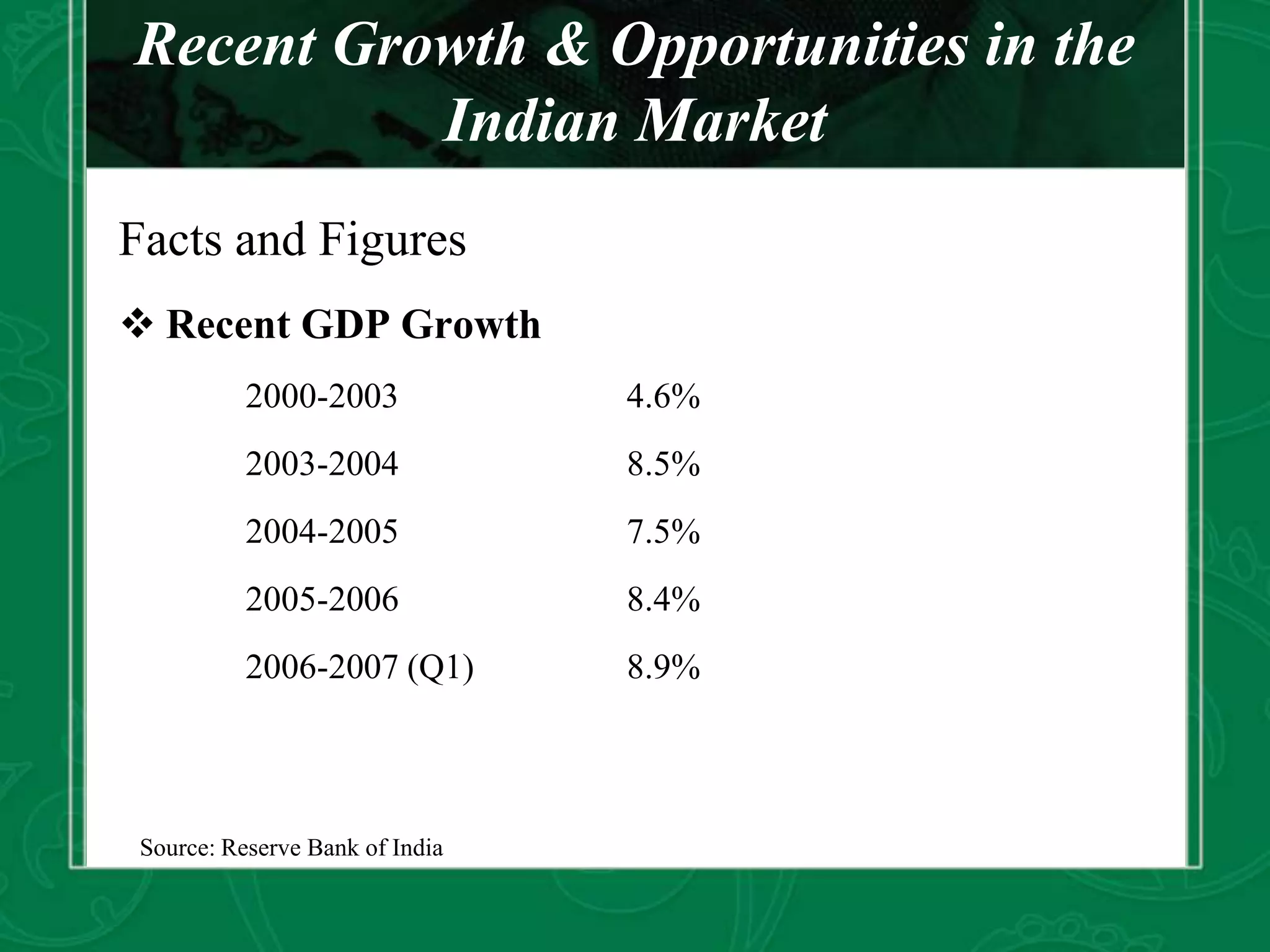
Facts and Figures
 Recent GDP Growth
2000-2003 4.6%
2003-2004 8.5%
2004-2005 7.5%
2005-2006 8.4%
2006-2007 (Q1) 8.9%
Source: Reserve Bank of India
Recent Growth & Opportunities in the
Indian Market (cont’d)
Facts and Figures
 Foreign Investment Growth
Source: Ministry of Finance, Government of India
Recent Growth & Opportunities in the
Indian Market (cont’d)
Facts and Figures
 Population of more than 1 billion
 Middle class of 300 million
 Stable democracy with a common law legal system
 Large English-speaking, highly educated workforce
 Vibrant capital markets – 23 stock exchanges with
9000 listed companies
 New Industrial Policy (1991) and continuing
liberalization of foreign investment
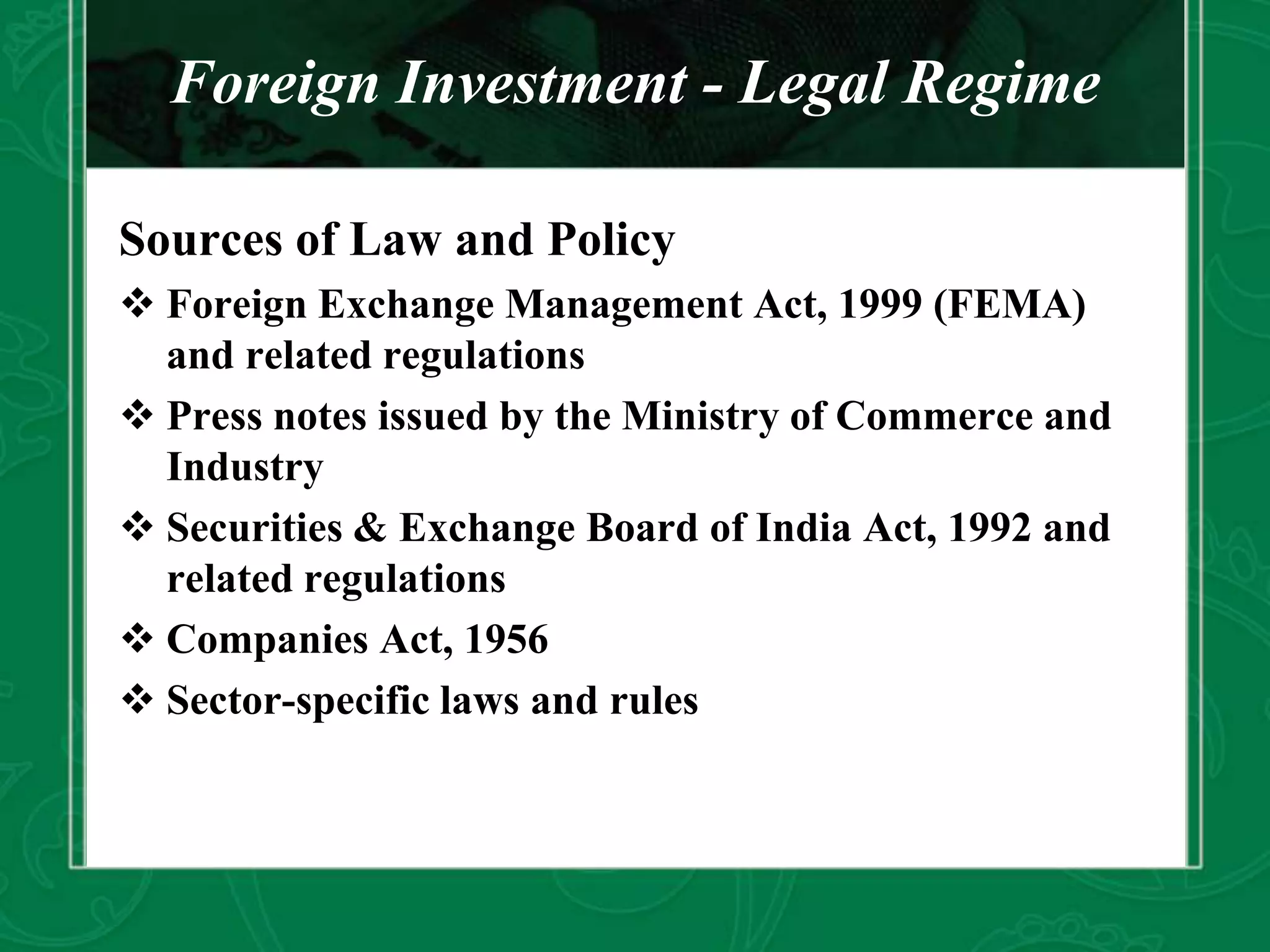
Foreign Investment - Legal Regime
Sources of Law and Policy
 Foreign Exchange Management Act, 1999 (FEMA)
and related regulations
 Press notes issued by the Ministry of Commerce and
Industry
 Securities & Exchange Board of India Act, 1992 and
related regulations
 Companies Act, 1956
 Sector-specific laws and rules
Foreign Investment - Legal Regime
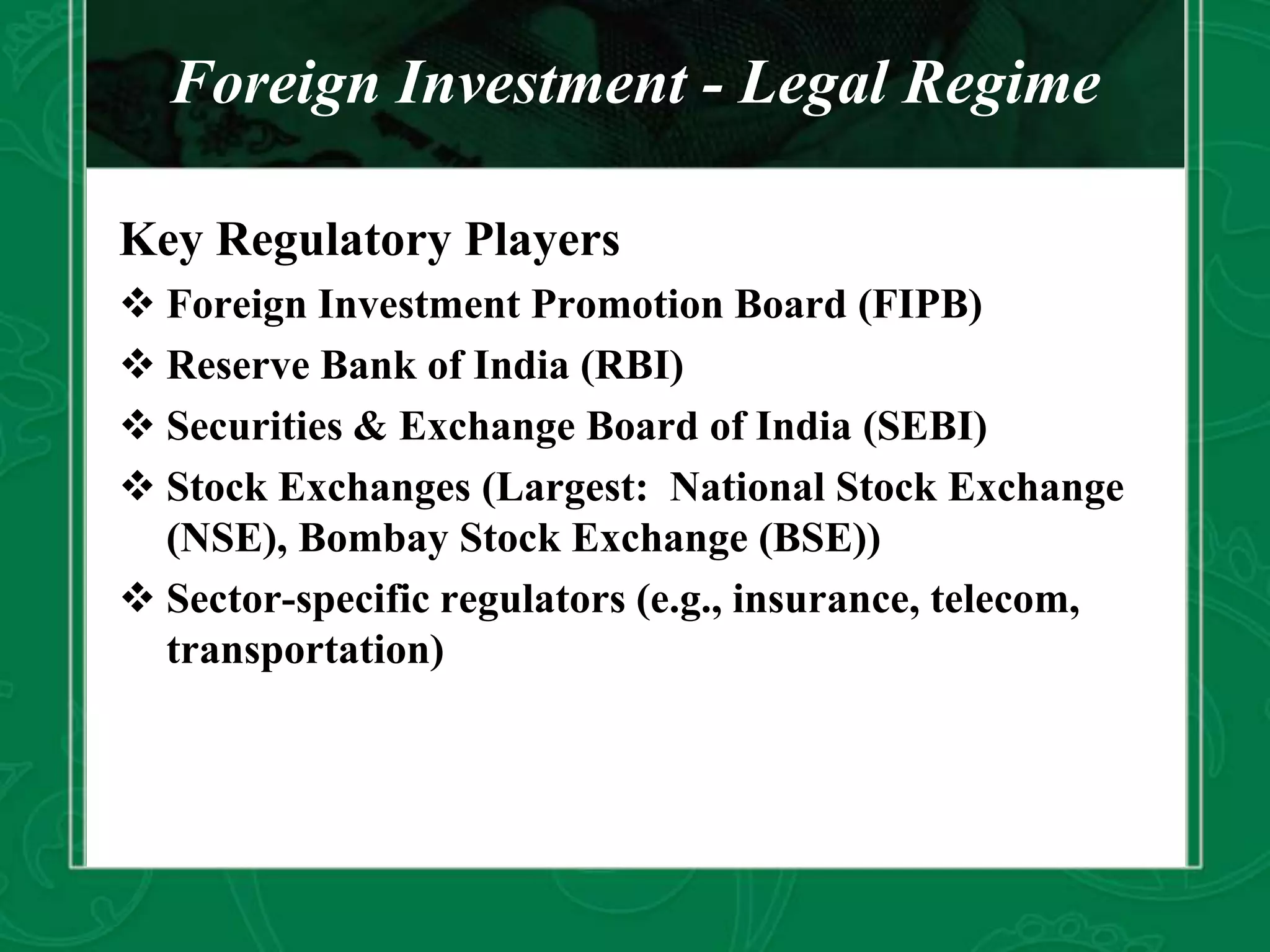
Key Regulatory Players
 Foreign Investment Promotion Board (FIPB)
 Reserve Bank of India (RBI)
 Securities & Exchange Board of India (SEBI)
 Stock Exchanges (Largest: National Stock Exchange
(NSE), Bombay Stock Exchange (BSE))
 Sector-specific regulators (e.g., insurance, telecom,
transportation)
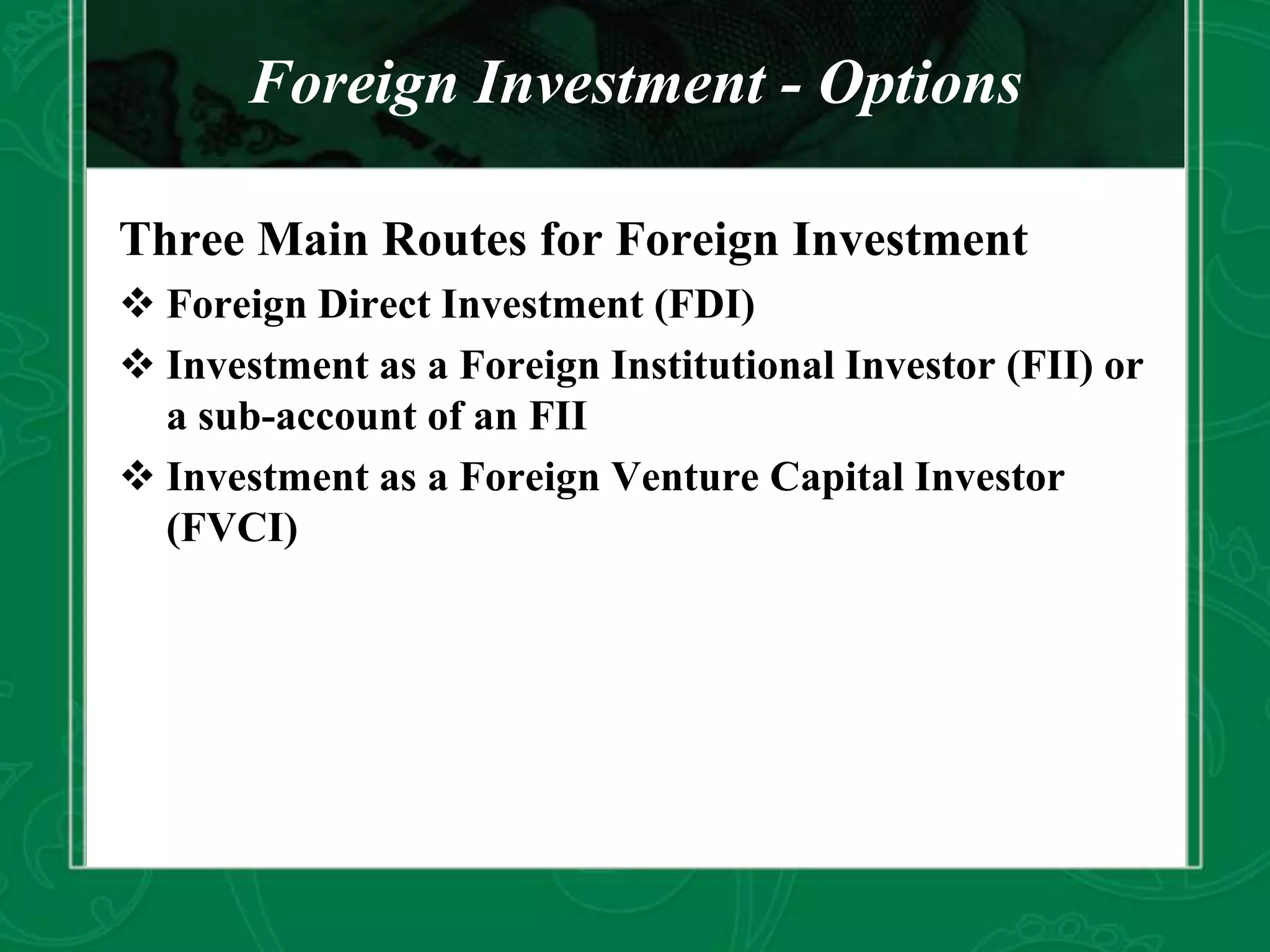
Foreign Investment - Options
Three Main Routes for Foreign Investment
 Foreign Direct Investment (FDI)
 Investment as a Foreign Institutional Investor (FII) or
a sub-account of an FII
 Investment as a Foreign Venture Capital Investor
(FVCI)
Foreign Investment - Options
Foreign Direct Investment (FDI)
 Subscription to new shares
 Transfer of existing interests
Foreign Investment - Options
Foreign Direct Investment (FDI)
 Automatic Route
 No approval needed from FIPB or the RBI
 Widely available, subject to certain percentage
caps and non-compete restrictions
 Requires certain after-the-fact filings and
declarations with the RBI (within 30 days after
payment for investment)
Foreign Investment - Options (cont’d)
Foreign Direct Investment – Approval Route
 Automatic Route not available (i.e., prior FIPB
approval is required) if the investment is:
 in an area where foreign investment is prohibited; for
example: retail trading (except single brand retail),
gambling, atomic energy, defense
 above the equity cap applicable to certain sectors; for
example: 74% in telecom, mining or banking.
Foreign Investment - Options (cont’d)
Foreign Direct Investment – Approval Route
 Automatic Route not available if the investment is:
 in the same field where the foreign investor has an
existing (pre-Jan 15, 2005) collaboration/joint venture in
India
 a more than 24% equity investment in companies which
manufacture for the small-scale sector.
Foreign Investment - Options (cont’d)
Foreign Direct Investment – Approval Route
 Approval Route
 Any investment not qualifying for the Automatic Route
 Requires prior approval from the Foreign Investment
Promotion Board (FIPB)
Foreign Investment - Options (cont’d)
Foreign Direct Investment – Approval Route
 Approvals take approximately 30 days to obtain,
decided on a case-by-case basis
 Relevant criteria:
 the amount of investment
 jobs creation
 other benefits to India such as export creation or
technology development
Foreign Investment - Options (cont’d)
Foreign Direct Investment (FDI)
Pricing Restrictions
 If listed on a stock exchange, price cannot be lower than
the average weekly high and low of closing prices
during the preceding (a) 6 months, or (b) 2 weeks,
whichever average is higher
 If unlisted, determined by a formula prescribed by the
Controller of Capital Issues
Foreign Investment - Options (cont’d)
Foreign Direct Investment (FDI)
 Transfers of Existing Shares – requires FIPB
approval if:
 activities are not under the Automatic Route
 non-resident shareholding would exceed sectoral limits
 price does not comply with the pricing restrictions
 Transfers of Existing Shares – requires RBI approval
if:
 company is involved in the financial services sector
 price does not comply with the pricing restrictions
Foreign Investment - Options (cont’d)
Foreign Institutional Investors (FII)
 What is an FII?
 An institution established outside India, which invests
in securities traded on the primary and secondary
markets in India
 Examples: pension funds, mutual funds, investment
trusts, university endowment funds
Foreign Investment - Options (cont’d)
Foreign Institutional Investors (FII)
 Foreign investment banks are not permitted to
directly invest in shares on the Indian stock exchange
 Makes investments on behalf of foreign investors,
referred to as “sub-accounts”
Foreign Investment - Options (cont’d)
Foreign Institutional Investors (FII)
 Qualifying as an FII
 Requires a certificate from the Securities and exchange
Board of India (SEBI)
 Strict qualification standards including professional
experience requirements and reputational
considerations (“Fit and proper person”
determination)
Foreign Investment - Options (cont’d)
Foreign Institutional Investors (FII)
 SEBI “Fit and proper person” criteria include:
 financial integrity
 absence of convictions or civil liabilities
 competence
 good reputation and character
 efficiency and honesty
 no violation of securities regulations in home
jurisdiction
Foreign Investment - Options (cont’d)
Foreign Institutional Investors (FII)
 Qualifying as a Sub-Account
 Also requires a fit and proper person analysis
Foreign Investment - Options (cont’d)
Foreign Institutional Investors (FII)
 FIIs may invest in:
 securities in the primary and secondary markets
(shares, debentures, warrants of listed and unlisted
companies)
 units issued by domestic mutual funds
 dated Government securities
 derivatives traded on a recognized stock exchange
 commercial paper
 debt instruments – provided a 70/30 equity/debt ratio is
maintained
Foreign Investment - Options (cont’d)
Foreign Institutional Investors (FII)
 Limits on the type and amount of investments apply
to FIIs
 no more than 10% of the equity in any one company
 no more than 10% in the equity in any one company on
behalf of a fund sub-account
 no more than 5% in the equity in any one company on
behalf of a corporate/individual sub-account
 no more than 24% in the aggregate of the total issued
capital of a company to be held by FIIs
Foreign Investment - Options (cont’d)
Foreign Venture Capital Investors (FVCI)
 What is an FVCI?
 An investor established outside of India, who proposes
to make venture capital investments in India
Foreign Investment - Options (cont’d)
Foreign Venture Capital Investors (FVCI)
 Qualifying as an FVCI
 Requires registration with SEBI; a copy of the
application is forwarded to the RBI for approval as well
 Involves a “fit and proper person” determination as for
FIIs
Foreign Investment - Options (cont’d)
Foreign Venture Capital Investors (FVCI)
 Benefits of registering as an FVCI
 one-time approval of the RBI for investments in Indian
companies
 ability to purchase or sell securities at a price that is
mutually acceptable to buyer and seller
 shares held by FVCI in an unlisted company are not
subject to the one-year lock-in generally applicable to
the shares of a company undergoing an IPO
Foreign Investment - Options (cont’d)
Foreign Venture Capital Investor (FVCI)
 Investment Requirements and Restrictions
 At least 66.67% of its funds must be invested in
unlisted equity shares (or equity-linked instruments of
unlisted entities)
 Up to 33.33% of its funds may be invested in an IPO
subscription for a venture capital undertaking, or
through a preferential allotment of equity shares of a
listed company
Foreign Investment - Options (cont’d)
Foreign Venture Capital Investor (FVCI)
 Investment Requirements and Restrictions
 Subject to certain sectoral percentage caps, limitations
on foreign investment
 No more than 25% of its funds may be invested in any
one venture capital undertaking
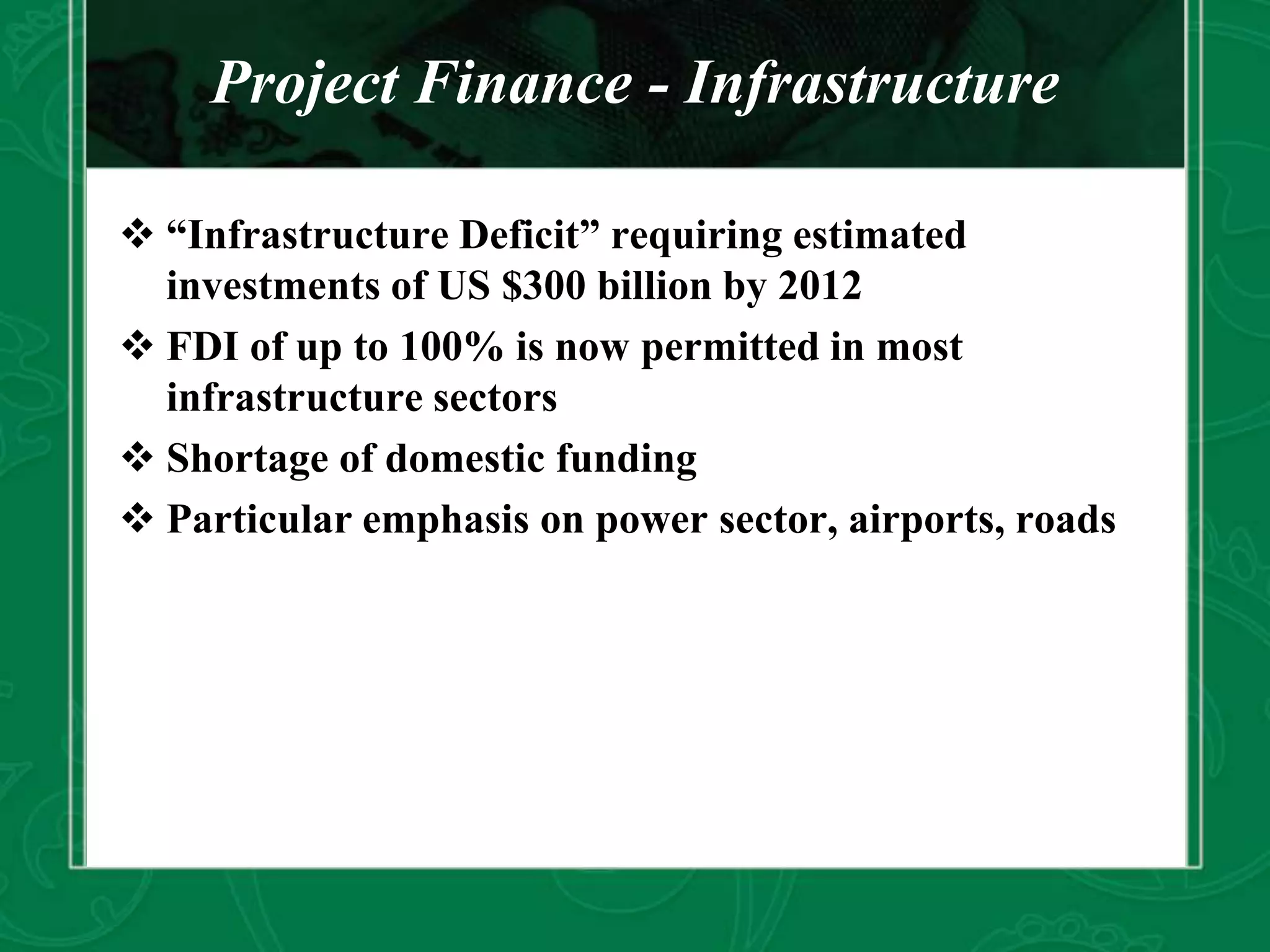
Project Finance - Infrastructure
 “Infrastructure Deficit” requiring estimated
investments of US $300 billion by 2012
 FDI of up to 100% is now permitted in most
infrastructure sectors
 Shortage of domestic funding
 Particular emphasis on power sector, airports, roads
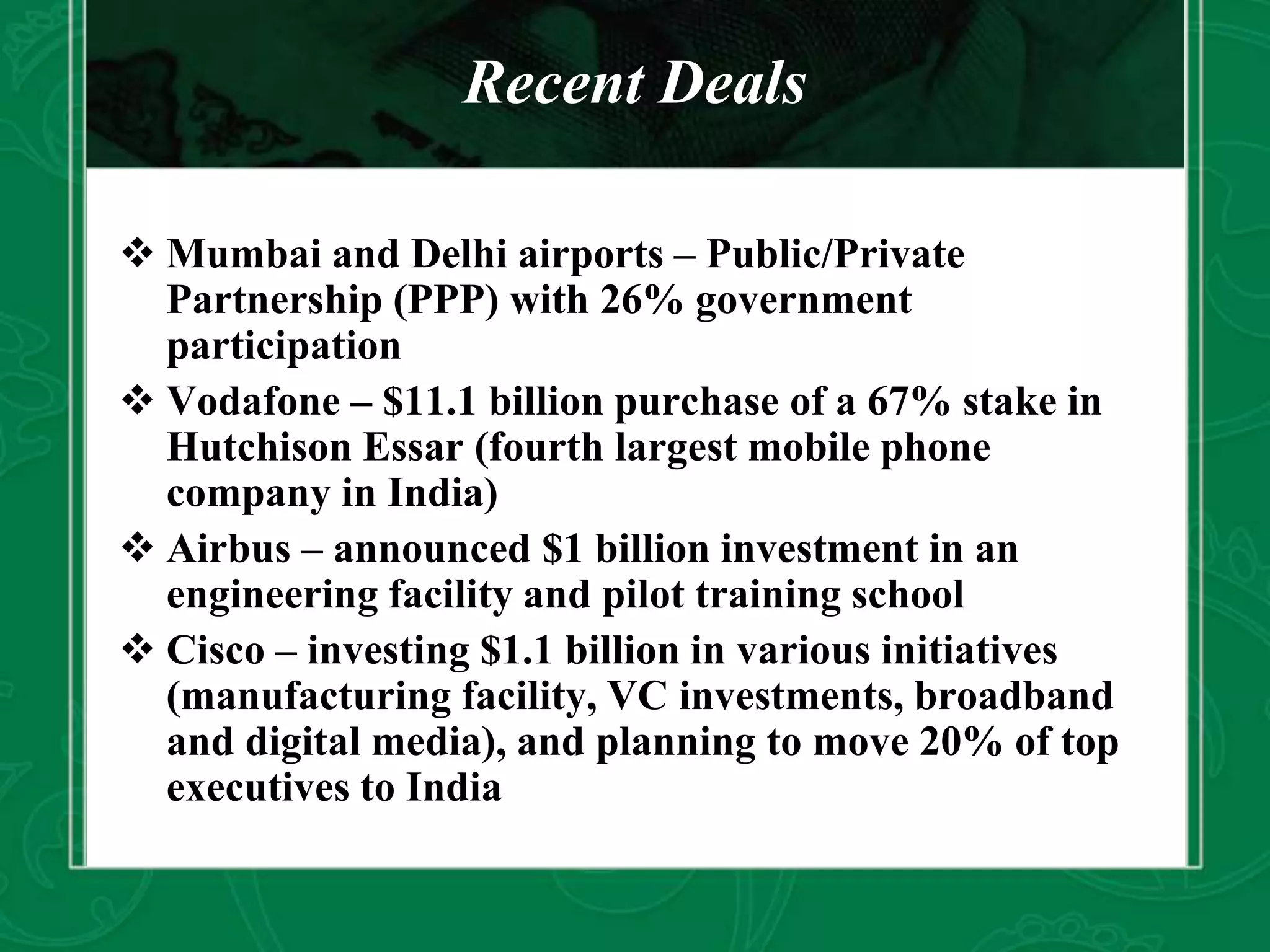
Recent Deals
 Mumbai and Delhi airports – Public/Private
Partnership (PPP) with 26% government
participation
 Vodafone – $11.1 billion purchase of a 67% stake in
Hutchison Essar (fourth largest mobile phone
company in India)
 Airbus – announced $1 billion investment in an
engineering facility and pilot training school
 Cisco – investing $1.1 billion in various initiatives
(manufacturing facility, VC investments, broadband
and digital media), and planning to move 20% of top
executives to India
Future Prospects
Projections for future growth
 Continued annual GDP growth of 8%
 GDP of US $11 trillion by 2011, US $27 trillion by
2050 (making India the third-largest economy in the
world)
 Trend of increasing liberalization of foreign
investment
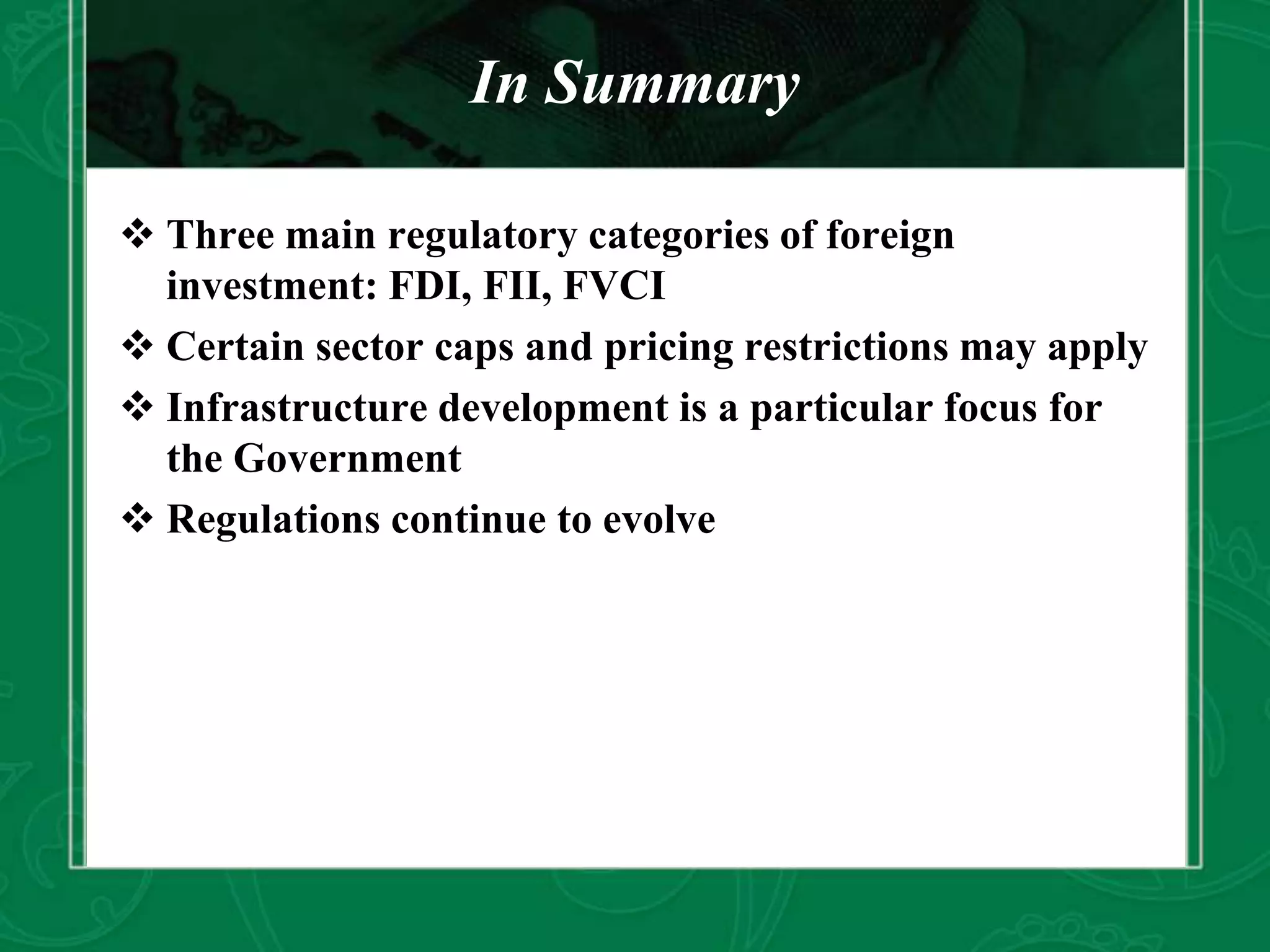
In Summary
 Three main regulatory categories of foreign
investment: FDI, FII, FVCI
 Certain sector caps and pricing restrictions may apply
 Infrastructure development is a particular focus for
the Government
 Regulations continue to evolve
When You Think INTERNATIONAL,
Think Fulbright.
TM

FIIs in India

  • 1.
    “The Most Extraordinary Country”* DoingBusiness in India When You Think INTERNATIONAL, Think Fulbright.TM Tuesday, February 20, 2007 7:15 - 9:00 a.m. The Houstonian Hotel 111 North Post Oak Lane Houston, Texas 77024 *Mark Twain
  • 2.
    Foreign Investment inIndia: An Overview Presented by: Julie B. Hunt Email: jhunt@fulbright.com Phone: (214) 855-8046
  • 3.
    Recent Growth &Opportunities in the Indian Market Facts and Figures  Recent GDP Growth 2000-2003 4.6% 2003-2004 8.5% 2004-2005 7.5% 2005-2006 8.4% 2006-2007 (Q1) 8.9% Source: Reserve Bank of India
  • 4.
    Recent Growth &Opportunities in the Indian Market (cont’d) Facts and Figures  Foreign Investment Growth Source: Ministry of Finance, Government of India
  • 5.
    Recent Growth &Opportunities in the Indian Market (cont’d) Facts and Figures  Population of more than 1 billion  Middle class of 300 million  Stable democracy with a common law legal system  Large English-speaking, highly educated workforce  Vibrant capital markets – 23 stock exchanges with 9000 listed companies  New Industrial Policy (1991) and continuing liberalization of foreign investment
  • 6.
    Foreign Investment -Legal Regime Sources of Law and Policy  Foreign Exchange Management Act, 1999 (FEMA) and related regulations  Press notes issued by the Ministry of Commerce and Industry  Securities & Exchange Board of India Act, 1992 and related regulations  Companies Act, 1956  Sector-specific laws and rules
  • 7.
    Foreign Investment -Legal Regime Key Regulatory Players  Foreign Investment Promotion Board (FIPB)  Reserve Bank of India (RBI)  Securities & Exchange Board of India (SEBI)  Stock Exchanges (Largest: National Stock Exchange (NSE), Bombay Stock Exchange (BSE))  Sector-specific regulators (e.g., insurance, telecom, transportation)
  • 8.
    Foreign Investment -Options Three Main Routes for Foreign Investment  Foreign Direct Investment (FDI)  Investment as a Foreign Institutional Investor (FII) or a sub-account of an FII  Investment as a Foreign Venture Capital Investor (FVCI)
  • 9.
    Foreign Investment -Options Foreign Direct Investment (FDI)  Subscription to new shares  Transfer of existing interests
  • 10.
    Foreign Investment -Options Foreign Direct Investment (FDI)  Automatic Route  No approval needed from FIPB or the RBI  Widely available, subject to certain percentage caps and non-compete restrictions  Requires certain after-the-fact filings and declarations with the RBI (within 30 days after payment for investment)
  • 11.
    Foreign Investment -Options (cont’d) Foreign Direct Investment – Approval Route  Automatic Route not available (i.e., prior FIPB approval is required) if the investment is:  in an area where foreign investment is prohibited; for example: retail trading (except single brand retail), gambling, atomic energy, defense  above the equity cap applicable to certain sectors; for example: 74% in telecom, mining or banking.
  • 12.
    Foreign Investment -Options (cont’d) Foreign Direct Investment – Approval Route  Automatic Route not available if the investment is:  in the same field where the foreign investor has an existing (pre-Jan 15, 2005) collaboration/joint venture in India  a more than 24% equity investment in companies which manufacture for the small-scale sector.
  • 13.
    Foreign Investment -Options (cont’d) Foreign Direct Investment – Approval Route  Approval Route  Any investment not qualifying for the Automatic Route  Requires prior approval from the Foreign Investment Promotion Board (FIPB)
  • 14.
    Foreign Investment -Options (cont’d) Foreign Direct Investment – Approval Route  Approvals take approximately 30 days to obtain, decided on a case-by-case basis  Relevant criteria:  the amount of investment  jobs creation  other benefits to India such as export creation or technology development
  • 15.
    Foreign Investment -Options (cont’d) Foreign Direct Investment (FDI) Pricing Restrictions  If listed on a stock exchange, price cannot be lower than the average weekly high and low of closing prices during the preceding (a) 6 months, or (b) 2 weeks, whichever average is higher  If unlisted, determined by a formula prescribed by the Controller of Capital Issues
  • 16.
    Foreign Investment -Options (cont’d) Foreign Direct Investment (FDI)  Transfers of Existing Shares – requires FIPB approval if:  activities are not under the Automatic Route  non-resident shareholding would exceed sectoral limits  price does not comply with the pricing restrictions  Transfers of Existing Shares – requires RBI approval if:  company is involved in the financial services sector  price does not comply with the pricing restrictions
  • 17.
    Foreign Investment -Options (cont’d) Foreign Institutional Investors (FII)  What is an FII?  An institution established outside India, which invests in securities traded on the primary and secondary markets in India  Examples: pension funds, mutual funds, investment trusts, university endowment funds
  • 18.
    Foreign Investment -Options (cont’d) Foreign Institutional Investors (FII)  Foreign investment banks are not permitted to directly invest in shares on the Indian stock exchange  Makes investments on behalf of foreign investors, referred to as “sub-accounts”
  • 19.
    Foreign Investment -Options (cont’d) Foreign Institutional Investors (FII)  Qualifying as an FII  Requires a certificate from the Securities and exchange Board of India (SEBI)  Strict qualification standards including professional experience requirements and reputational considerations (“Fit and proper person” determination)
  • 20.
    Foreign Investment -Options (cont’d) Foreign Institutional Investors (FII)  SEBI “Fit and proper person” criteria include:  financial integrity  absence of convictions or civil liabilities  competence  good reputation and character  efficiency and honesty  no violation of securities regulations in home jurisdiction
  • 21.
    Foreign Investment -Options (cont’d) Foreign Institutional Investors (FII)  Qualifying as a Sub-Account  Also requires a fit and proper person analysis
  • 22.
    Foreign Investment -Options (cont’d) Foreign Institutional Investors (FII)  FIIs may invest in:  securities in the primary and secondary markets (shares, debentures, warrants of listed and unlisted companies)  units issued by domestic mutual funds  dated Government securities  derivatives traded on a recognized stock exchange  commercial paper  debt instruments – provided a 70/30 equity/debt ratio is maintained
  • 23.
    Foreign Investment -Options (cont’d) Foreign Institutional Investors (FII)  Limits on the type and amount of investments apply to FIIs  no more than 10% of the equity in any one company  no more than 10% in the equity in any one company on behalf of a fund sub-account  no more than 5% in the equity in any one company on behalf of a corporate/individual sub-account  no more than 24% in the aggregate of the total issued capital of a company to be held by FIIs
  • 24.
    Foreign Investment -Options (cont’d) Foreign Venture Capital Investors (FVCI)  What is an FVCI?  An investor established outside of India, who proposes to make venture capital investments in India
  • 25.
    Foreign Investment -Options (cont’d) Foreign Venture Capital Investors (FVCI)  Qualifying as an FVCI  Requires registration with SEBI; a copy of the application is forwarded to the RBI for approval as well  Involves a “fit and proper person” determination as for FIIs
  • 26.
    Foreign Investment -Options (cont’d) Foreign Venture Capital Investors (FVCI)  Benefits of registering as an FVCI  one-time approval of the RBI for investments in Indian companies  ability to purchase or sell securities at a price that is mutually acceptable to buyer and seller  shares held by FVCI in an unlisted company are not subject to the one-year lock-in generally applicable to the shares of a company undergoing an IPO
  • 27.
    Foreign Investment -Options (cont’d) Foreign Venture Capital Investor (FVCI)  Investment Requirements and Restrictions  At least 66.67% of its funds must be invested in unlisted equity shares (or equity-linked instruments of unlisted entities)  Up to 33.33% of its funds may be invested in an IPO subscription for a venture capital undertaking, or through a preferential allotment of equity shares of a listed company
  • 28.
    Foreign Investment -Options (cont’d) Foreign Venture Capital Investor (FVCI)  Investment Requirements and Restrictions  Subject to certain sectoral percentage caps, limitations on foreign investment  No more than 25% of its funds may be invested in any one venture capital undertaking
  • 29.
    Project Finance -Infrastructure  “Infrastructure Deficit” requiring estimated investments of US $300 billion by 2012  FDI of up to 100% is now permitted in most infrastructure sectors  Shortage of domestic funding  Particular emphasis on power sector, airports, roads
  • 30.
    Recent Deals  Mumbaiand Delhi airports – Public/Private Partnership (PPP) with 26% government participation  Vodafone – $11.1 billion purchase of a 67% stake in Hutchison Essar (fourth largest mobile phone company in India)  Airbus – announced $1 billion investment in an engineering facility and pilot training school  Cisco – investing $1.1 billion in various initiatives (manufacturing facility, VC investments, broadband and digital media), and planning to move 20% of top executives to India
  • 31.
    Future Prospects Projections forfuture growth  Continued annual GDP growth of 8%  GDP of US $11 trillion by 2011, US $27 trillion by 2050 (making India the third-largest economy in the world)  Trend of increasing liberalization of foreign investment
  • 32.
    In Summary  Threemain regulatory categories of foreign investment: FDI, FII, FVCI  Certain sector caps and pricing restrictions may apply  Infrastructure development is a particular focus for the Government  Regulations continue to evolve
  • 33.
    When You ThinkINTERNATIONAL, Think Fulbright. TM