Great War Remembrance Cycle trail
The following article attempts to take you and your bicycle on a round trip
of a few days’ duration in order to discover the major sites of the Western
Front involving British troops. It is also a great opportunity to get a taste
of France so close to home.
You will be taken to Saint-Omer, Arras, Montreuil, Etaples and Wimereux,
a round trip of just under 400 kilometres, or 240 miles.
You’re in France from the moment you board the Berlioz or the Rodin.
French ships with that certain flair and style, a french crew, and, of
course, typically french meals and snacks.
This article is written by Alain Lenain, born and bred in this part of France.
He has himself travelled widely on his bicycle and he is a greeter. To find
out more about greeters and Alain, go to http://www.greeters62.com/visite-pas-de-
calais/portraits-greeters/Alain-Lenain.asp
It does not matter whether you’re a confirmed cyclist, whether you just
ride occasionally, even not at all, this is an opportunity to discover this
region so close to Britain, yet totally different, and, at the same time, to
visit some of those places where the first world war left its mark for ever.
As said earlier, you’re in France from the moment you are on board one of
the MyFerryLink ships, so here are a few tips about cycling in France
which will contribute to your having the best possible break:
* ride on the right, pretty obvious, but many forget.
* the rule is that traffic from the right has right of way, unless otherwise
stated.
* Lunch is the main meal of the day in France. It is when you will find the
best deals in restaurants and brasseries.
* Most shops, especially in rural areas close between 12:00 and 14:00
* If you just want to eat a sandwich for your lunch, many boulangeries
and cafés will prepare for you a baguette sandwich. In this part of France,
you will not escape from the friteries, although I personally recommend
chips for lunch when cycling
* Cyclists need to drink water. If you need supplies, just pop in to any
cemetery. The water at the tap is always potable. It is stated by law when
it’s not.
* There are several warmshowers members in the area, so do take
advantage of this facility.
* Do make use of the local Office de tourisme. You will always get a
welcome and relevant information.
Day 1
So, you are now in Calais. This trip can be done in the order given or back
to front. All of it can be done on two wheels, count about five days, more
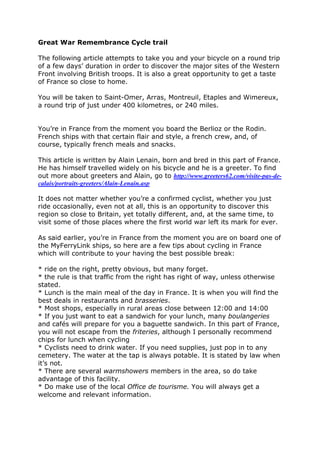
if you want. You can combine bike and train. All local french trains take
bicycles, up to twelve, at no extra charge. You can also do the trip by car
with the bikes on board and just use the bikes on a localised basis.
Although the trip is centred on the first world war, you will also have the
opportunity to discover other features…
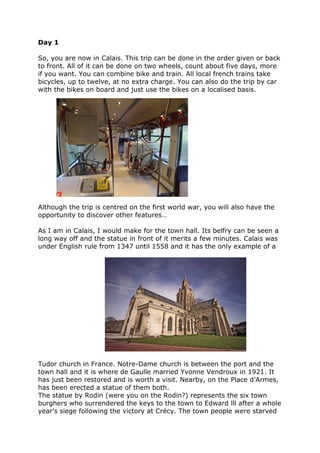
As I am in Calais, I would make for the town hall. Its belfry can be seen a
long way off and the statue in front of it merits a few minutes. Calais was
under English rule from 1347 until 1558 and it has the only example of a
Tudor church in France. Notre-Dame church is between the port and the
town hall and it is where de Gaulle married Yvonne Vendroux in 1921. It
has just been restored and is worth a visit. Nearby, on the Place d’Armes,
has been erected a statue of them both.
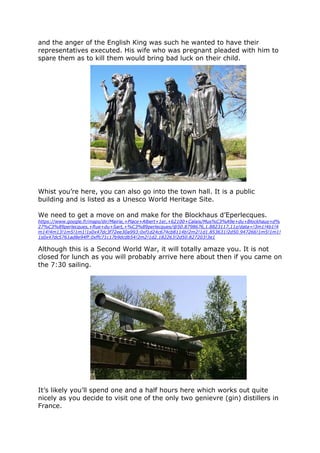
The statue by Rodin (were you on the Rodin?) represents the six town
burghers who surrendered the keys to the town to Edward lll after a whole
year’s siege following the victory at Crécy. The town people were starved
Day 1
So, you are now in Calais. This trip can be done in the order given or back
to front. All of it can be done on two wheels, count about five days, more
if you want. You can combine bike and train. All local french trains take
bicycles, up to twelve, at no extra charge. You can also do the trip by car
with the bikes on board and just use the bikes on a localised basis.
Although the trip is centred on the first world war, you will also have the
opportunity to discover other features…
As I am in Calais, I would make for the town hall. Its belfry can be seen a
long way off and the statue in front of it merits a few minutes. Calais was
under English rule from 1347 until 1558 and it has the only example of a
Tudor church in France. Notre-Dame church is between the port and the
town hall and it is where de Gaulle married Yvonne Vendroux in 1921. It
has just been restored and is worth a visit. Nearby, on the Place d’Armes,
has been erected a statue of them both.
The statue by Rodin (were you on the Rodin?) represents the six town
burghers who surrendered the keys to the town to Edward lll after a whole
year’s siege following the victory at Crécy. The town people were starved
Day 1
So, you are now in Calais. This trip can be done in the order given or back
to front. All of it can be done on two wheels, count about five days, more
if you want. You can combine bike and train. All local french trains take
bicycles, up to twelve, at no extra charge. You can also do the trip by car
with the bikes on board and just use the bikes on a localised basis.
Although the trip is centred on the first world war, you will also have the
opportunity to discover other features…
As I am in Calais, I would make for the town hall. Its belfry can be seen a
long way off and the statue in front of it merits a few minutes. Calais was
under English rule from 1347 until 1558 and it has the only example of a
Tudor church in France. Notre-Dame church is between the port and the
town hall and it is where de Gaulle married Yvonne Vendroux in 1921. It
has just been restored and is worth a visit. Nearby, on the Place d’Armes,
has been erected a statue of them both.
The statue by Rodin (were you on the Rodin?) represents the six town
burghers who surrendered the keys to the town to Edward lll after a whole
year’s siege following the victory at Crécy. The town people were starved
the old coalfield, a little hilly, but with more to please the eye along the
way.
https://www.google.fr/maps/dir/Saint-
Omer/A%C3%A9rodrome+de+Saint+Omer,+Chemin+du+Plateau+des+Bruy%C3%A8res,+Longuenesse/Olhai
n,+Fresnicourt-le-Dolmen/Aix-
Noulette/@50.5543859,2.2651335,11z/data=!4m26!4m25!1m5!1m1!1s0x47dcf893912760af:0x40af13e8163d
5e0!2m2!1d2.252208!2d50.750115!1m5!1m1!1s0x47dc55f06ffd906f:0xc22d50349c8bed33!2m2!1d2.232059!
2d50.730098!1m5!1m1!1s0x47dd1622cdd951c9:0xa0af141326a2950!2m2!1d2.5857!2d50.424929!1m5!1m1!
1s0x47dd3b945da800b9:0x40af13e816403d0!2m2!1d2.710604!2d50.426721!3e1
The flatter route involves following the canal out of St. Omer to Aire-sur-
la-Lys, then on to Béthune, where you leave the canal for Aix-Noulette.
https://www.google.fr/maps/dir/Saint-Omer/Aire-sur-la-Lys/B%C3%A9thune/Aix-
Noulette/@50.5899736,2.1859275,10z/data=!3m1!4b1!4m26!4m25!1m5!1m1!1s0x47dcf893912760af:0x40af
13e8163d5e0!2m2!1d2.252208!2d50.750115!1m5!1m1!1s0x47dd02969f929c99:0x2bcdbbc3588841bd!2m2!1
d2.396187!2d50.638757!1m5!1m1!1s0x47dd2259039319ff:0xc2f9dc5f81c67d18!2m2!1d2.63926!2d50.531036
!1m5!1m1!1s0x47dd3b945da800b9:0x40af13e816403d0!2m2!1d2.710604!2d50.426721!3e1
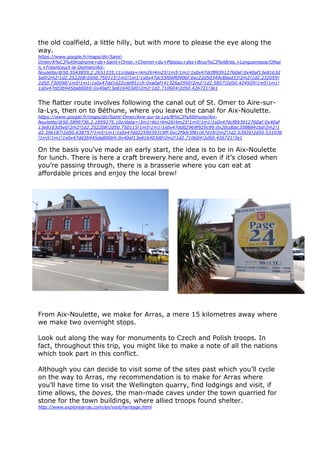
On the basis you’ve made an early start, the idea is to be in Aix-Noulette
for lunch. There is here a craft brewery here and, even if it’s closed when
you’re passing through, there is a brasserie where you can eat at
affordable prices and enjoy the local brew!
From Aix-Noulette, we make for Arras, a mere 15 kilometres away where
we make two overnight stops.
Look out along the way for monuments to Czech and Polish troops. In
fact, throughout this trip, you might like to make a note of all the nations
which took part in this conflict.
Although you can decide to visit some of the sites past which you’ll cycle
on the way to Arras, my recommendation is to make for Arras where
you’ll have time to visit the Wellington quarry, find lodgings and visit, if
time allows, the boves, the man-made caves under the town quarried for
stone for the town buildings, where allied troops found shelter.
http://www.explorearras.com/en/visit/heritage.html
A visit to the Wellington quarry is a must.
http://www.greatwar.co.uk/french-flanders-artois/museum-wellington-quarry.htm
Take away with you a poppy or two! The British Legion has a presence
here. More about that later…
http://www.britishlegion.org.uk/get-involved/how-to-give/?gclid=CjwKEAjwwN-rBRD-
oMzT6aO_wGwSJABwEIkJrPuKwOYC_sFrPHiGrG4nw3Q0TVXkaxmbRolD3ASQfRoCPZ7w_wcB
http://www.cwgc.org/
Option day 2
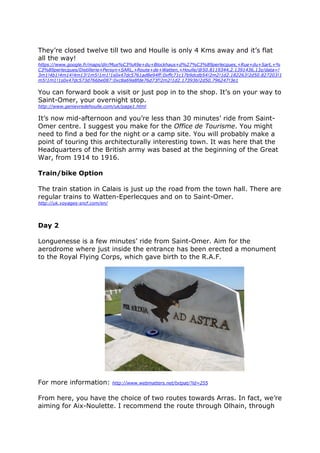
After visiting the Royal Air Corps memorial, back to Saint-Omer train
station from where you can catch a train to Hazebrouck and change there
for a train to Arras, many of which stop at stations close to Vimy and
Notre-Dame de Lorette.
Day 3
Head out of Arras along the road which you took yesterday and make for
Neuville Saint-Vaast and the Maison Blanche German cemetery. It is the
largest German cemetery in France. You will be struck by the harmony
with which the graves are laid out in relation to the landscape and the
Jewish graves won’t escape your notice either.
The regional tourism authority has produced a very good guide which I
recommend you download. This cemetery is n°9.
http://www.remembrancetrails-northernfrance.com/uploads/media/CRT-Livret-cyclotourisme-GB_02.pdf
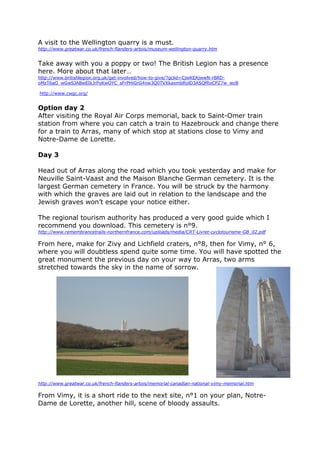
From here, make for Zivy and Lichfield craters, n°8, then for Vimy, n° 6,
where you will doubtless spend quite some time. You will have spotted the
great monument the previous day on your way to Arras, two arms
stretched towards the sky in the name of sorrow.
http://www.greatwar.co.uk/french-flanders-artois/memorial-canadian-national-vimy-memorial.htm
From Vimy, it is a short ride to the next site, n°1 on your plan, Notre-
Dame de Lorette, another hill, scene of bloody assaults.
On the main road at the foot of the hill, a new interpretation centre is
opening on the 9th
of June. If it’s lunch-time, you could try the café A
l’Potée d’Léandre across the road. There is also a cafeteria at the top of
the hill.
You visited the largest Germary this morning. Notre-Dame de Lorette is
the largest French cemetery. It is watched over by over 4000 volunteers
throughout the year, all in uniform.
The feature here is the Ring of Remembrance, officially opened on the 11th
of November last. This ring, which dominates the local countryside, is
engraved with the names of the 580 000 dead in alphabetical order
regardless of nationality, rank or creed. How many nationalities will you
spot here other than German, British and French? I can think of several…
You might want to visit Cabaret Rouge, n° 4 or follow the circuit on the
plan through Carency and Mont Saint-Eloi, back to Arras.
Day 4
An early start is needed for to-day’s stage to Montreuil-sur-Mer, with a
number of places to stop at along the way.
You will be travelling through the Artois. It was near Lillers that, in 1124,
monks discovered the phenomenon of what is known worldwide as the
artesian well. You will be crossing an area which undulates, punctuated by
water towers on the high points, feeding small, sleepy villages. Agriculture
is prominent here, as you will see from the incessant successions of
cultivated fields.
Do avoid the main road, D939!
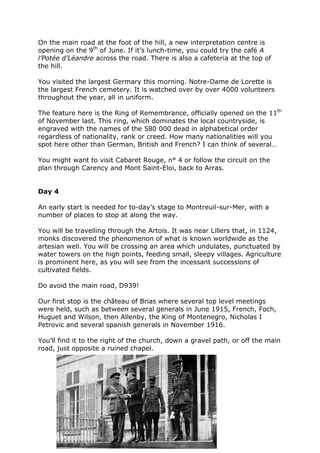
Our first stop is the château of Brias where several top level meetings
were held, such as between several generals in June 1915, French, Foch,
Huguet and Wilson, then Allenby, the King of Montenegro, Nicholas I
Petrovic and several spanish generals in November 1916.
You’ll find it to the right of the church, down a gravel path, or off the main
road, just opposite a ruined chapel.
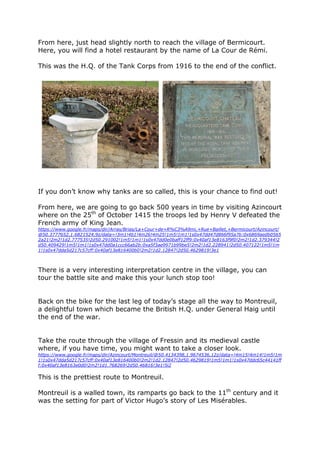
From here, just head slightly north to reach the village of Bermicourt.
Here, you will find a hotel restaurant by the name of La Cour de Rémi.
This was the H.Q. of the Tank Corps from 1916 to the end of the conflict.
If you don’t know why tanks are so called, this is your chance to find out!
From here, we are going to go back 500 years in time by visiting Azincourt
where on the 25th
of October 1415 the troops led by Henry V defeated the
French army of King Jean.
https://www.google.fr/maps/dir/Arras/Brias/La+Cour+de+R%C3%A9mi,+Rue+Baillet,+Bermicourt/Azincourt/
@50.3777652,1.6821524,9z/data=!3m1!4b1!4m26!4m25!1m5!1m1!1s0x47dd47d866f95a7b:0x6869aedb0565
2a21!2m2!1d2.777535!2d50.291002!1m5!1m1!1s0x47dd0e0baff12ff9:0x40af13e8163f9f0!2m2!1d2.379344!2
d50.409429!1m5!1m1!1s0x47dd0a1ccc66ab2b:0xa5f3ae9971b99be5!2m2!1d2.228941!2d50.407122!1m5!1m
1!1s0x47dda5d217c57cff:0x40af13e816400b0!2m2!1d2.12847!2d50.4629819!3e1
There is a very interesting interpretation centre in the village, you can
tour the battle site and make this your lunch stop too!
Back on the bike for the last leg of today’s stage all the way to Montreuil,
a delightful town which became the British H.Q. under General Haig until
the end of the war.
Take the route through the village of Fressin and its medieval castle
where, if you have time, you might want to take a closer look.
https://www.google.fr/maps/dir/Azincourt/Montreuil/@50.4134398,1.9674536,12z/data=!4m15!4m14!1m5!1m
1!1s0x47dda5d217c57cff:0x40af13e816400b0!2m2!1d2.12847!2d50.4629819!1m5!1m1!1s0x47ddc65c44141ff
f:0x40af13e8163e0d0!2m2!1d1.768269!2d50.46816!3e1!5i2
This is the prettiest route to Montreuil.
Montreuil is a walled town, its ramparts go back to the 11th
century and it
was the setting for part of Victor Hugo’s story of Les Misérables.
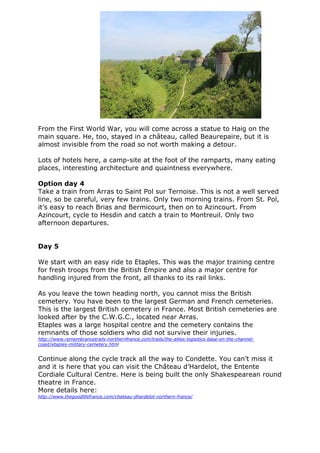
From the First World War, you will come across a statue to Haig on the
main square. He, too, stayed in a château, called Beaurepaire, but it is
almost invisible from the road so not worth making a detour.
Lots of hotels here, a camp-site at the foot of the ramparts, many eating
places, interesting architecture and quaintness everywhere.
Option day 4
Take a train from Arras to Saint Pol sur Ternoise. This is not a well served
line, so be careful, very few trains. Only two morning trains. From St. Pol,
it’s easy to reach Brias and Bermicourt, then on to Azincourt. From
Azincourt, cycle to Hesdin and catch a train to Montreuil. Only two
afternoon departures.
Day 5
We start with an easy ride to Etaples. This was the major training centre
for fresh troops from the British Empire and also a major centre for
handling injured from the front, all thanks to its rail links.
As you leave the town heading north, you cannot miss the British
cemetery. You have been to the largest German and French cemeteries.
This is the largest British cemetery in France. Most British cemeteries are
looked after by the C.W.G.C., located near Arras.
Etaples was a large hospital centre and the cemetery contains the
remnants of those soldiers who did not survive their injuries.
http://www.remembrancetrails-northernfrance.com/trails/the-allies-logisitics-base-on-the-channel-
coast/etaples-military-cemetery.html
Continue along the cycle track all the way to Condette. You can’t miss it
and it is here that you can visit the Château d’Hardelot, the Entente
Cordiale Cultural Centre. Here is being built the only Shakespearean round
theatre in France.
More details here:
http://www.thegoodlifefrance.com/chateau-dhardelot-northern-france/
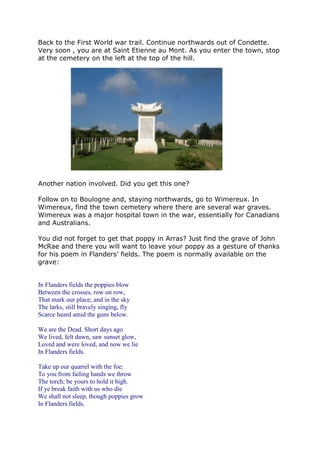
Back to the First World war trail. Continue northwards out of Condette.
Very soon , you are at Saint Etienne au Mont. As you enter the town, stop
at the cemetery on the left at the top of the hill.
Another nation involved. Did you get this one?
Follow on to Boulogne and, staying northwards, go to Wimereux. In
Wimereux, find the town cemetery where there are several war graves.
Wimereux was a major hospital town in the war, essentially for Canadians
and Australians.
You did not forget to get that poppy in Arras? Just find the grave of John
McRae and there you will want to leave your poppy as a gesture of thanks
for his poem in Flanders’ fields. The poem is normally available on the
grave:
In Flanders fields the poppies blow
Between the crosses, row on row,
That mark our place; and in the sky
The larks, still bravely singing, fly
Scarce heard amid the guns below.
We are the Dead. Short days ago
We lived, felt dawn, saw sunset glow,
Loved and were loved, and now we lie
In Flanders fields.
Take up our quarrel with the foe:
To you from failing hands we throw
The torch; be yours to hold it high.
If ye break faith with us who die
We shall not sleep, though poppies grow
In Flanders fields.
From Wimereux where there are many places where you can eat,
especially along the promenade and the main street, just follow the
beautiful Côte d’Opale, through several pretty fishing villages, past a
Portuguese monument and several reminders of the Second World War.
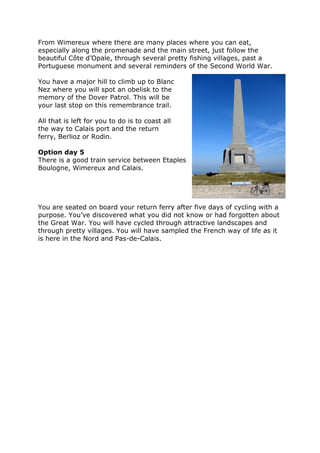
You have a major hill to climb up to Blanc
Nez where you will spot an obelisk to the
memory of the Dover Patrol. This will be
your last stop on this remembrance trail.
All that is left for you to do is to coast all
the way to Calais port and the return
ferry, Berlioz or Rodin.
Option day 5
There is a good train service between Etaples
Boulogne, Wimereux and Calais.
You are seated on board your return ferry after five days of cycling with a
purpose. You’ve discovered what you did not know or had forgotten about
the Great War. You will have cycled through attractive landscapes and
through pretty villages. You will have sampled the French way of life as it
is here in the Nord and Pas-de-Calais.

150602 remembrance cycle trail

  • 1.
    Great War RemembranceCycle trail The following article attempts to take you and your bicycle on a round trip of a few days’ duration in order to discover the major sites of the Western Front involving British troops. It is also a great opportunity to get a taste of France so close to home. You will be taken to Saint-Omer, Arras, Montreuil, Etaples and Wimereux, a round trip of just under 400 kilometres, or 240 miles. You’re in France from the moment you board the Berlioz or the Rodin. French ships with that certain flair and style, a french crew, and, of course, typically french meals and snacks. This article is written by Alain Lenain, born and bred in this part of France. He has himself travelled widely on his bicycle and he is a greeter. To find out more about greeters and Alain, go to http://www.greeters62.com/visite-pas-de- calais/portraits-greeters/Alain-Lenain.asp It does not matter whether you’re a confirmed cyclist, whether you just ride occasionally, even not at all, this is an opportunity to discover this region so close to Britain, yet totally different, and, at the same time, to visit some of those places where the first world war left its mark for ever. As said earlier, you’re in France from the moment you are on board one of the MyFerryLink ships, so here are a few tips about cycling in France which will contribute to your having the best possible break: * ride on the right, pretty obvious, but many forget. * the rule is that traffic from the right has right of way, unless otherwise stated. * Lunch is the main meal of the day in France. It is when you will find the best deals in restaurants and brasseries. * Most shops, especially in rural areas close between 12:00 and 14:00 * If you just want to eat a sandwich for your lunch, many boulangeries and cafés will prepare for you a baguette sandwich. In this part of France, you will not escape from the friteries, although I personally recommend chips for lunch when cycling * Cyclists need to drink water. If you need supplies, just pop in to any cemetery. The water at the tap is always potable. It is stated by law when it’s not. * There are several warmshowers members in the area, so do take advantage of this facility. * Do make use of the local Office de tourisme. You will always get a welcome and relevant information.
  • 2.
    Day 1 So, youare now in Calais. This trip can be done in the order given or back to front. All of it can be done on two wheels, count about five days, more if you want. You can combine bike and train. All local french trains take bicycles, up to twelve, at no extra charge. You can also do the trip by car with the bikes on board and just use the bikes on a localised basis. Although the trip is centred on the first world war, you will also have the opportunity to discover other features… As I am in Calais, I would make for the town hall. Its belfry can be seen a long way off and the statue in front of it merits a few minutes. Calais was under English rule from 1347 until 1558 and it has the only example of a Tudor church in France. Notre-Dame church is between the port and the town hall and it is where de Gaulle married Yvonne Vendroux in 1921. It has just been restored and is worth a visit. Nearby, on the Place d’Armes, has been erected a statue of them both. The statue by Rodin (were you on the Rodin?) represents the six town burghers who surrendered the keys to the town to Edward lll after a whole year’s siege following the victory at Crécy. The town people were starved
  • 3.
    Day 1 So, youare now in Calais. This trip can be done in the order given or back to front. All of it can be done on two wheels, count about five days, more if you want. You can combine bike and train. All local french trains take bicycles, up to twelve, at no extra charge. You can also do the trip by car with the bikes on board and just use the bikes on a localised basis. Although the trip is centred on the first world war, you will also have the opportunity to discover other features… As I am in Calais, I would make for the town hall. Its belfry can be seen a long way off and the statue in front of it merits a few minutes. Calais was under English rule from 1347 until 1558 and it has the only example of a Tudor church in France. Notre-Dame church is between the port and the town hall and it is where de Gaulle married Yvonne Vendroux in 1921. It has just been restored and is worth a visit. Nearby, on the Place d’Armes, has been erected a statue of them both. The statue by Rodin (were you on the Rodin?) represents the six town burghers who surrendered the keys to the town to Edward lll after a whole year’s siege following the victory at Crécy. The town people were starved
  • 4.
    Day 1 So, youare now in Calais. This trip can be done in the order given or back to front. All of it can be done on two wheels, count about five days, more if you want. You can combine bike and train. All local french trains take bicycles, up to twelve, at no extra charge. You can also do the trip by car with the bikes on board and just use the bikes on a localised basis. Although the trip is centred on the first world war, you will also have the opportunity to discover other features… As I am in Calais, I would make for the town hall. Its belfry can be seen a long way off and the statue in front of it merits a few minutes. Calais was under English rule from 1347 until 1558 and it has the only example of a Tudor church in France. Notre-Dame church is between the port and the town hall and it is where de Gaulle married Yvonne Vendroux in 1921. It has just been restored and is worth a visit. Nearby, on the Place d’Armes, has been erected a statue of them both. The statue by Rodin (were you on the Rodin?) represents the six town burghers who surrendered the keys to the town to Edward lll after a whole year’s siege following the victory at Crécy. The town people were starved
  • 5.
    the old coalfield,a little hilly, but with more to please the eye along the way. https://www.google.fr/maps/dir/Saint- Omer/A%C3%A9rodrome+de+Saint+Omer,+Chemin+du+Plateau+des+Bruy%C3%A8res,+Longuenesse/Olhai n,+Fresnicourt-le-Dolmen/Aix- Noulette/@50.5543859,2.2651335,11z/data=!4m26!4m25!1m5!1m1!1s0x47dcf893912760af:0x40af13e8163d 5e0!2m2!1d2.252208!2d50.750115!1m5!1m1!1s0x47dc55f06ffd906f:0xc22d50349c8bed33!2m2!1d2.232059! 2d50.730098!1m5!1m1!1s0x47dd1622cdd951c9:0xa0af141326a2950!2m2!1d2.5857!2d50.424929!1m5!1m1! 1s0x47dd3b945da800b9:0x40af13e816403d0!2m2!1d2.710604!2d50.426721!3e1 The flatter route involves following the canal out of St. Omer to Aire-sur- la-Lys, then on to Béthune, where you leave the canal for Aix-Noulette. https://www.google.fr/maps/dir/Saint-Omer/Aire-sur-la-Lys/B%C3%A9thune/Aix- Noulette/@50.5899736,2.1859275,10z/data=!3m1!4b1!4m26!4m25!1m5!1m1!1s0x47dcf893912760af:0x40af 13e8163d5e0!2m2!1d2.252208!2d50.750115!1m5!1m1!1s0x47dd02969f929c99:0x2bcdbbc3588841bd!2m2!1 d2.396187!2d50.638757!1m5!1m1!1s0x47dd2259039319ff:0xc2f9dc5f81c67d18!2m2!1d2.63926!2d50.531036 !1m5!1m1!1s0x47dd3b945da800b9:0x40af13e816403d0!2m2!1d2.710604!2d50.426721!3e1 On the basis you’ve made an early start, the idea is to be in Aix-Noulette for lunch. There is here a craft brewery here and, even if it’s closed when you’re passing through, there is a brasserie where you can eat at affordable prices and enjoy the local brew! From Aix-Noulette, we make for Arras, a mere 15 kilometres away where we make two overnight stops. Look out along the way for monuments to Czech and Polish troops. In fact, throughout this trip, you might like to make a note of all the nations which took part in this conflict. Although you can decide to visit some of the sites past which you’ll cycle on the way to Arras, my recommendation is to make for Arras where you’ll have time to visit the Wellington quarry, find lodgings and visit, if time allows, the boves, the man-made caves under the town quarried for stone for the town buildings, where allied troops found shelter. http://www.explorearras.com/en/visit/heritage.html
  • 6.
    A visit tothe Wellington quarry is a must. http://www.greatwar.co.uk/french-flanders-artois/museum-wellington-quarry.htm Take away with you a poppy or two! The British Legion has a presence here. More about that later… http://www.britishlegion.org.uk/get-involved/how-to-give/?gclid=CjwKEAjwwN-rBRD- oMzT6aO_wGwSJABwEIkJrPuKwOYC_sFrPHiGrG4nw3Q0TVXkaxmbRolD3ASQfRoCPZ7w_wcB http://www.cwgc.org/ Option day 2 After visiting the Royal Air Corps memorial, back to Saint-Omer train station from where you can catch a train to Hazebrouck and change there for a train to Arras, many of which stop at stations close to Vimy and Notre-Dame de Lorette. Day 3 Head out of Arras along the road which you took yesterday and make for Neuville Saint-Vaast and the Maison Blanche German cemetery. It is the largest German cemetery in France. You will be struck by the harmony with which the graves are laid out in relation to the landscape and the Jewish graves won’t escape your notice either. The regional tourism authority has produced a very good guide which I recommend you download. This cemetery is n°9. http://www.remembrancetrails-northernfrance.com/uploads/media/CRT-Livret-cyclotourisme-GB_02.pdf From here, make for Zivy and Lichfield craters, n°8, then for Vimy, n° 6, where you will doubtless spend quite some time. You will have spotted the great monument the previous day on your way to Arras, two arms stretched towards the sky in the name of sorrow. http://www.greatwar.co.uk/french-flanders-artois/memorial-canadian-national-vimy-memorial.htm From Vimy, it is a short ride to the next site, n°1 on your plan, Notre- Dame de Lorette, another hill, scene of bloody assaults.
  • 7.
    On the mainroad at the foot of the hill, a new interpretation centre is opening on the 9th of June. If it’s lunch-time, you could try the café A l’Potée d’Léandre across the road. There is also a cafeteria at the top of the hill. You visited the largest Germary this morning. Notre-Dame de Lorette is the largest French cemetery. It is watched over by over 4000 volunteers throughout the year, all in uniform. The feature here is the Ring of Remembrance, officially opened on the 11th of November last. This ring, which dominates the local countryside, is engraved with the names of the 580 000 dead in alphabetical order regardless of nationality, rank or creed. How many nationalities will you spot here other than German, British and French? I can think of several… You might want to visit Cabaret Rouge, n° 4 or follow the circuit on the plan through Carency and Mont Saint-Eloi, back to Arras. Day 4 An early start is needed for to-day’s stage to Montreuil-sur-Mer, with a number of places to stop at along the way. You will be travelling through the Artois. It was near Lillers that, in 1124, monks discovered the phenomenon of what is known worldwide as the artesian well. You will be crossing an area which undulates, punctuated by water towers on the high points, feeding small, sleepy villages. Agriculture is prominent here, as you will see from the incessant successions of cultivated fields. Do avoid the main road, D939! Our first stop is the château of Brias where several top level meetings were held, such as between several generals in June 1915, French, Foch, Huguet and Wilson, then Allenby, the King of Montenegro, Nicholas I Petrovic and several spanish generals in November 1916. You’ll find it to the right of the church, down a gravel path, or off the main road, just opposite a ruined chapel.
  • 8.
    From here, justhead slightly north to reach the village of Bermicourt. Here, you will find a hotel restaurant by the name of La Cour de Rémi. This was the H.Q. of the Tank Corps from 1916 to the end of the conflict. If you don’t know why tanks are so called, this is your chance to find out! From here, we are going to go back 500 years in time by visiting Azincourt where on the 25th of October 1415 the troops led by Henry V defeated the French army of King Jean. https://www.google.fr/maps/dir/Arras/Brias/La+Cour+de+R%C3%A9mi,+Rue+Baillet,+Bermicourt/Azincourt/ @50.3777652,1.6821524,9z/data=!3m1!4b1!4m26!4m25!1m5!1m1!1s0x47dd47d866f95a7b:0x6869aedb0565 2a21!2m2!1d2.777535!2d50.291002!1m5!1m1!1s0x47dd0e0baff12ff9:0x40af13e8163f9f0!2m2!1d2.379344!2 d50.409429!1m5!1m1!1s0x47dd0a1ccc66ab2b:0xa5f3ae9971b99be5!2m2!1d2.228941!2d50.407122!1m5!1m 1!1s0x47dda5d217c57cff:0x40af13e816400b0!2m2!1d2.12847!2d50.4629819!3e1 There is a very interesting interpretation centre in the village, you can tour the battle site and make this your lunch stop too! Back on the bike for the last leg of today’s stage all the way to Montreuil, a delightful town which became the British H.Q. under General Haig until the end of the war. Take the route through the village of Fressin and its medieval castle where, if you have time, you might want to take a closer look. https://www.google.fr/maps/dir/Azincourt/Montreuil/@50.4134398,1.9674536,12z/data=!4m15!4m14!1m5!1m 1!1s0x47dda5d217c57cff:0x40af13e816400b0!2m2!1d2.12847!2d50.4629819!1m5!1m1!1s0x47ddc65c44141ff f:0x40af13e8163e0d0!2m2!1d1.768269!2d50.46816!3e1!5i2 This is the prettiest route to Montreuil. Montreuil is a walled town, its ramparts go back to the 11th century and it was the setting for part of Victor Hugo’s story of Les Misérables.
  • 9.
    From the FirstWorld War, you will come across a statue to Haig on the main square. He, too, stayed in a château, called Beaurepaire, but it is almost invisible from the road so not worth making a detour. Lots of hotels here, a camp-site at the foot of the ramparts, many eating places, interesting architecture and quaintness everywhere. Option day 4 Take a train from Arras to Saint Pol sur Ternoise. This is not a well served line, so be careful, very few trains. Only two morning trains. From St. Pol, it’s easy to reach Brias and Bermicourt, then on to Azincourt. From Azincourt, cycle to Hesdin and catch a train to Montreuil. Only two afternoon departures. Day 5 We start with an easy ride to Etaples. This was the major training centre for fresh troops from the British Empire and also a major centre for handling injured from the front, all thanks to its rail links. As you leave the town heading north, you cannot miss the British cemetery. You have been to the largest German and French cemeteries. This is the largest British cemetery in France. Most British cemeteries are looked after by the C.W.G.C., located near Arras. Etaples was a large hospital centre and the cemetery contains the remnants of those soldiers who did not survive their injuries. http://www.remembrancetrails-northernfrance.com/trails/the-allies-logisitics-base-on-the-channel- coast/etaples-military-cemetery.html Continue along the cycle track all the way to Condette. You can’t miss it and it is here that you can visit the Château d’Hardelot, the Entente Cordiale Cultural Centre. Here is being built the only Shakespearean round theatre in France. More details here: http://www.thegoodlifefrance.com/chateau-dhardelot-northern-france/
  • 10.
    Back to theFirst World war trail. Continue northwards out of Condette. Very soon , you are at Saint Etienne au Mont. As you enter the town, stop at the cemetery on the left at the top of the hill. Another nation involved. Did you get this one? Follow on to Boulogne and, staying northwards, go to Wimereux. In Wimereux, find the town cemetery where there are several war graves. Wimereux was a major hospital town in the war, essentially for Canadians and Australians. You did not forget to get that poppy in Arras? Just find the grave of John McRae and there you will want to leave your poppy as a gesture of thanks for his poem in Flanders’ fields. The poem is normally available on the grave: In Flanders fields the poppies blow Between the crosses, row on row, That mark our place; and in the sky The larks, still bravely singing, fly Scarce heard amid the guns below. We are the Dead. Short days ago We lived, felt dawn, saw sunset glow, Loved and were loved, and now we lie In Flanders fields. Take up our quarrel with the foe: To you from failing hands we throw The torch; be yours to hold it high. If ye break faith with us who die We shall not sleep, though poppies grow In Flanders fields.
  • 11.
    From Wimereux wherethere are many places where you can eat, especially along the promenade and the main street, just follow the beautiful Côte d’Opale, through several pretty fishing villages, past a Portuguese monument and several reminders of the Second World War. You have a major hill to climb up to Blanc Nez where you will spot an obelisk to the memory of the Dover Patrol. This will be your last stop on this remembrance trail. All that is left for you to do is to coast all the way to Calais port and the return ferry, Berlioz or Rodin. Option day 5 There is a good train service between Etaples Boulogne, Wimereux and Calais. You are seated on board your return ferry after five days of cycling with a purpose. You’ve discovered what you did not know or had forgotten about the Great War. You will have cycled through attractive landscapes and through pretty villages. You will have sampled the French way of life as it is here in the Nord and Pas-de-Calais.