15 Benefits of Data Analytics in Business Growth.pdf
Explore how data analytics boosts business growth with insights that improve decision-making, customer targeting, operations, and long-term profitability.
15 Benefits of Data Analytics in Business Growth.pdf
1.
Back To Blogs
May,2025
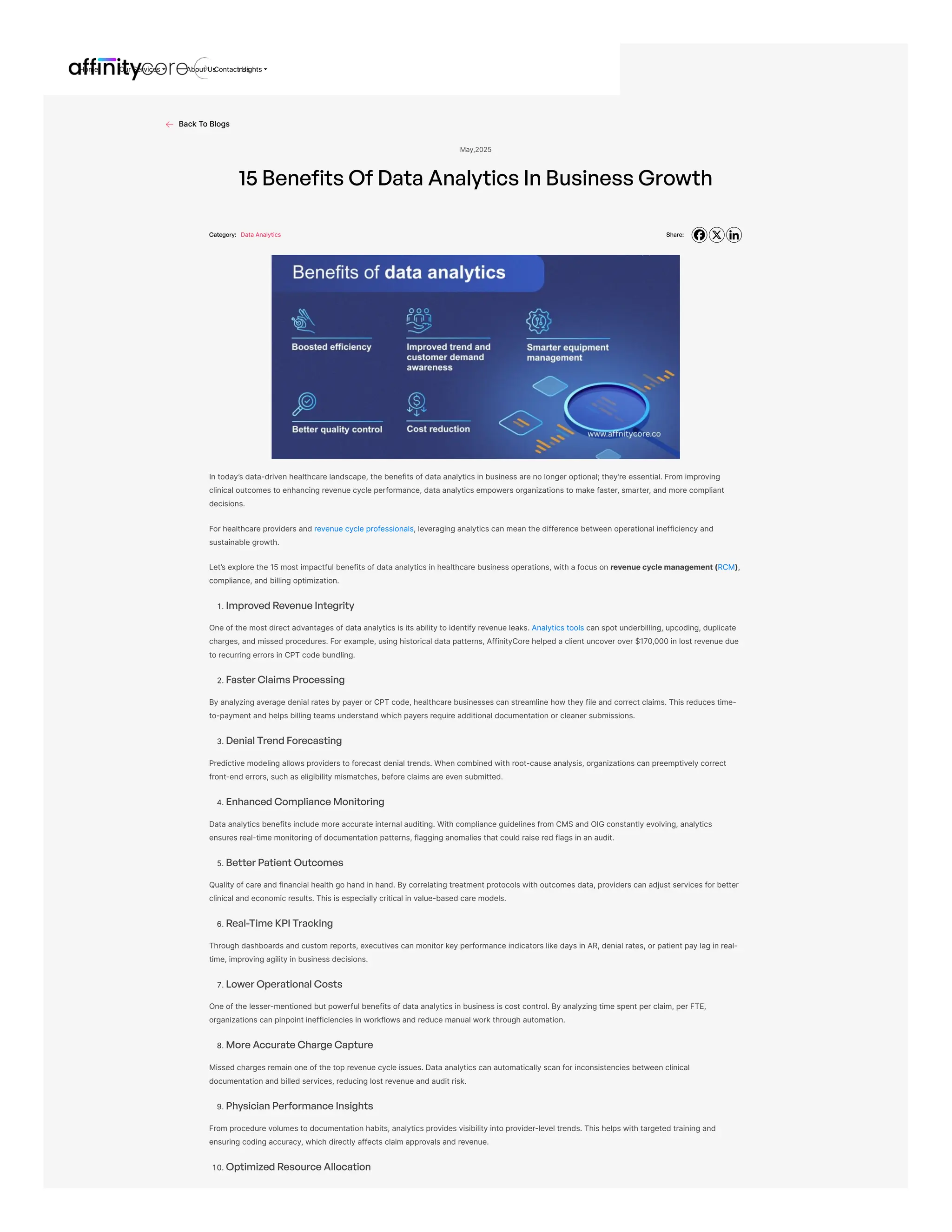
15Benefits Of Data Analytics In Business Growth
Category: Data Analytics Share:
In today’s data-driven healthcare landscape, the benefits of data analytics in business are no longer optional; they’re essential. From improving
clinical outcomes to enhancing revenue cycle performance, data analytics empowers organizations to make faster, smarter, and more compliant
decisions.
For healthcare providers and revenue cycle professionals, leveraging analytics can mean the difference between operational inefficiency and
sustainable growth.
Let’s explore the 15 most impactful benefits of data analytics in healthcare business operations, with a focus on revenue cycle management (RCM),
compliance, and billing optimization.
1. Improved Revenue Integrity
One of the most direct advantages of data analytics is its ability to identify revenue leaks. Analytics tools can spot underbilling, upcoding, duplicate
charges, and missed procedures. For example, using historical data patterns, AffinityCore helped a client uncover over $170,000 in lost revenue due
to recurring errors in CPT code bundling.
2. Faster Claims Processing
By analyzing average denial rates by payer or CPT code, healthcare businesses can streamline how they file and correct claims. This reduces time-
to-payment and helps billing teams understand which payers require additional documentation or cleaner submissions.
3. Denial Trend Forecasting
Predictive modeling allows providers to forecast denial trends. When combined with root-cause analysis, organizations can preemptively correct
front-end errors, such as eligibility mismatches, before claims are even submitted.
4. Enhanced Compliance Monitoring
Data analytics benefits include more accurate internal auditing. With compliance guidelines from CMS and OIG constantly evolving, analytics
ensures real-time monitoring of documentation patterns, flagging anomalies that could raise red flags in an audit.
5. Better Patient Outcomes
Quality of care and financial health go hand in hand. By correlating treatment protocols with outcomes data, providers can adjust services for better
clinical and economic results. This is especially critical in value-based care models.
6. Real-Time KPI Tracking
Through dashboards and custom reports, executives can monitor key performance indicators like days in AR, denial rates, or patient pay lag in real-
time, improving agility in business decisions.
7. Lower Operational Costs
One of the lesser-mentioned but powerful benefits of data analytics in business is cost control. By analyzing time spent per claim, per FTE,
organizations can pinpoint inefficiencies in workflows and reduce manual work through automation.
8. More Accurate Charge Capture
Missed charges remain one of the top revenue cycle issues. Data analytics can automatically scan for inconsistencies between clinical
documentation and billed services, reducing lost revenue and audit risk.
9. Physician Performance Insights
From procedure volumes to documentation habits, analytics provides visibility into provider-level trends. This helps with targeted training and
ensuring coding accuracy, which directly affects claim approvals and revenue.
10. Optimized Resource Allocation
Home Our Services About Us Insights
Contact Us
2.
By understanding historicalpatient volume, payer mix, and treatment cycles, clinics can better staff departments, reducing overtime costs and
improving patient satisfaction.
11. Enhanced Payer Contract Negotiation
Armed with detailed analytics on payer reimbursements and denial rates, healthcare organizations gain leverage in contract renewals. They can
identify which payers are underperforming and make data-backed adjustments.
12. Early Identification of Fraud or Abuse
Using anomaly detection, practices can spot irregular billing behavior that might suggest fraud, such as uncharacteristically high volumes of certain
high-reimbursing procedures or sudden documentation shifts.
13. Patient Payment Propensity Models
With rising patient responsibility, understanding which patients are likely to pay, and when, is vital. Analytics can guide decisions on payment plan
offerings or third-party collections strategies.
14. Revenue Code Accuracy
A common issue in RCM is mismatched revenue codes, often due to human error or outdated fee schedules. With data audits in place, such
mismatches were identified and corrected, boosting reimbursement and reducing recoupments.
15. Strategic Growth Planning
Finally, data analytics benefits extend to long-term planning. Whether it’s identifying high-performing service lines, expanding into new
geographies, or analyzing patient demographics, analytics gives leadership clarity to scale strategically.
Why Healthcare Must Embrace Data Analytics Now
According to HFMA, organizations that adopt robust analytics capabilities see a 15–20% improvement in cash collections and up to 30% fewer
denials. CMS and AMA also emphasize data transparency and performance tracking as part of their drive toward value-based care.
In a space where margins are tight and regulations are strict, the advantages of data analytics are far too significant to ignore.
Best Practices and Compliance Considerations
As you adopt more advanced analytics tools, remember to align with HIPAA and data security standards. Ensure access control, encrypted data
storage, and audit trails. Work with vendors or partners who fix data quality issues and have both the technology and the regulatory landscape of
healthcare.
How AffinityCore Can Support Your Analytics-Driven Growth
At AffinityCore, we don’t just provide medical billing, we provide custom medical billing solutions. Our team combines experienced coders, billing
professionals, and analytics consultants who help clients decode complex trends, prevent revenue leakage, and maximize compliance.
From tailored dashboards to predictive modeling of your denial rates, our end-to-end approach empowers you with the data clarity you need to
grow confidently and compliantly.
Ready to transform your revenue cycle with smarter decisions?
Let AffinityCore show you what the power of data analytics in business can do for your organization.
Contact us to learn how we can help.
TAGS: ← PREVIOUS
Never Miss An Update
Stay updated about Our news as it happens
Enter Your Email Address
What to read next
15 Benefits of Data Analytics in
Business Growth
DATA ANALYTICS
Read More
Business Process Optimization Guide:
Tools and Examples
BUSINESS PROCESS MANAGEMENT
Read More
12 Top Medical Billing Software for
Revenue Cycle Management
MEDICAL BILLING
Read More



![[DSC Europe 25] Sara Polak - The Ancient Operating System: What Archaeology T...](https://cdn.slidesharecdn.com/ss_thumbnails/3vch2p6tttdnwhsgazoz-3-sara-polak-smart-cities-251208152532-64404202-thumbnail.jpg?width=640&height=640&fit=bounds)
![[DSC Europe 25] Sara Polak - The Archaeology of Innovation: AI as the Next Cr...](https://cdn.slidesharecdn.com/ss_thumbnails/7ecbscdnt8mlcuqbd2ln-2-sara-polak-ai-creative-industries-251208152533-aa1fcf54-thumbnail.jpg?width=640&height=640&fit=bounds)
![[DSC Europe 25] Hans Kleinsman - The Compliance Gearbox: How Tax Tech Mediate...](https://cdn.slidesharecdn.com/ss_thumbnails/dxdytie1toel0hr90bjs-2-251212103250-174fdbe7-thumbnail.jpg?width=640&height=640&fit=bounds)

![[DSC Europe 25] Debmalya Biswas - Agentification: the art of transforming man...](https://cdn.slidesharecdn.com/ss_thumbnails/r5azlggvtqiaiiusrqdr-4-251212103249-5a12c89b-thumbnail.jpg?width=640&height=640&fit=bounds)
![[DSC Europe 25] Branko Dzakula - From Defense to Attack: How AI Redefines Cyb...](https://cdn.slidesharecdn.com/ss_thumbnails/80bdzdxpr3ky2g0qvyk9-8-251211083048-ce5fc1ee-thumbnail.jpg?width=640&height=640&fit=bounds)

![[DSC Europe 25] Milan Zdravkovic - The road less traveled in District Heating...](https://cdn.slidesharecdn.com/ss_thumbnails/nfaboniqwsz4ucyctnmy-2-milan-zdravkovic-dsc2025-the-road-less-traveled-in-district-heating-operation-251208151905-f56388a5-thumbnail.jpg?width=640&height=640&fit=bounds)
![[DSC Europe 25] Marija Vlajkovic & Andrea Radonjanin - Integration of AI tool...](https://cdn.slidesharecdn.com/ss_thumbnails/qf1jrglttoc3bm8s3aop-final-integration-of-ai-tools-251208151905-394f3a6a-thumbnail.jpg?width=640&height=640&fit=bounds)
![[DSC Europe 25] Kaja Kandare - LLM as a judge.pptx](https://cdn.slidesharecdn.com/ss_thumbnails/arxyccaxsdsd1ba99wjw-7-251212104007-2b4e3f64-thumbnail.jpg?width=640&height=640&fit=bounds)
![[DSC Europe 25] Bassam Maharmeh - Artificial Intelligence: Opportunities and ...](https://cdn.slidesharecdn.com/ss_thumbnails/thhfmr2fqpawzj7hsjpg-5-251211083048-2c23204f-thumbnail.jpg?width=640&height=640&fit=bounds)
![[DSC Europe 25] Jovan Bogicevic - Legacy to AI-Driven Defense: Transforming D...](https://cdn.slidesharecdn.com/ss_thumbnails/rsarluadt563hntyfc8q-3-251211083849-3e7bc4c0-thumbnail.jpg?width=640&height=640&fit=bounds)


![[DSC Europe 25] Milan Sekuloski - Data, Defence, and Development: Cybersecuri...](https://cdn.slidesharecdn.com/ss_thumbnails/dfrkwwx4qly6atqpbl4z-4-251209104645-c3d4b0ca-thumbnail.jpg?width=640&height=640&fit=bounds)
![[DSC Europe 25] Katherine Forrest - AI NOW: Understanding the Velocity of Cha...](https://cdn.slidesharecdn.com/ss_thumbnails/wvvbruqfrci0sfq9xwgb-4-251212104007-e5ad1987-thumbnail.jpg?width=640&height=640&fit=bounds)
![[DSC Europe 25] Miodrag Pesovic & Vladislav Radonjic - Federated Data Archite...](https://cdn.slidesharecdn.com/ss_thumbnails/gsbe3y5it5uhndi4e08e-1-251212103249-f1008e0c-thumbnail.jpg?width=640&height=640&fit=bounds)
![[DSC Europe 25] Imai Jen-La Plante - The New Generation: AI and the Future of...](https://cdn.slidesharecdn.com/ss_thumbnails/kxi8t2l5rggivgcenyba-1-jenlaplante-dsc-251208152532-d1e076c2-thumbnail.jpg?width=640&height=640&fit=bounds)
