1.4 Polynomials
Chapter 1 Prerequisites
Concepts & Objectives
⚫ Objectives of this section:
⚫ Identify the degree and leading coefficient of
polynomials.
⚫ Add and subtract polynomials.
⚫ Multiply polynomials.
⚫ Identify special product patterns.
⚫ Perform operations with polynomials of several
variables.
Polynomials
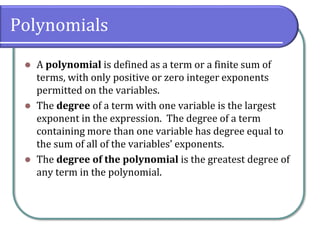
⚫ A polynomial is defined as a term or a finite sum of
terms, with only positive or zero integer exponents
permitted on the variables.
⚫ The degree of a term with one variable is the largest
exponent in the expression. The degree of a term
containing more than one variable has degree equal to
the sum of all of the variables’ exponents.
⚫ The degree of the polynomial is the greatest degree of
any term in the polynomial.
Polynomials (cont.)
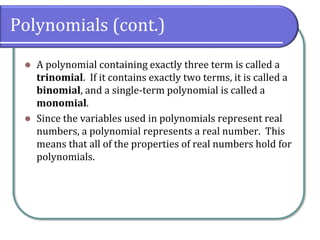
⚫ A polynomial containing exactly three term is called a
trinomial. If it contains exactly two terms, it is called a
binomial, and a single-term polynomial is called a
monomial.
⚫ Since the variables used in polynomials represent real
numbers, a polynomial represents a real number. This
means that all of the properties of real numbers hold for
polynomials.
Polynomials (cont.)
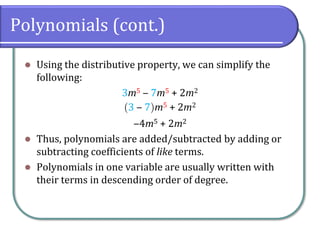
⚫ Using the distributive property, we can simplify the
following:
3m5 ‒ 7m5 + 2m2
3 ‒ 7m5 + 2m2
‒4m5 + 2m2
⚫ Thus, polynomials are added/subtracted by adding or
subtracting coefficients of like terms.
⚫ Polynomials in one variable are usually written with
their terms in descending order of degree.
Multiplying Polynomials
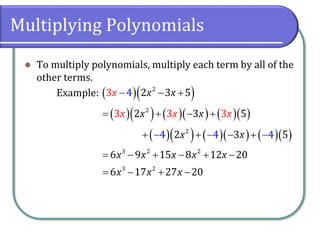
⚫ To multiply polynomials, multiply each term by all of the
other terms.
Example: ( )( )
( )( ) ( )( ) ( )( )
( )( ) ( )( ) ( )( )
2
2
2
3 2 2
3 2
2 3 5
2 3 5
2 3 5
6 9 15 8 12 20
6 17 27 20
3
3 3
4
4 4 4
3
x x
x x
x x
x x x x x
x x
x
x
x
x x
− +
= + − +
+ + − +
= − + − + −
−
− +
−
−
−
−
=
Multiplying Polynomials
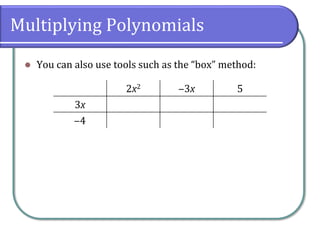
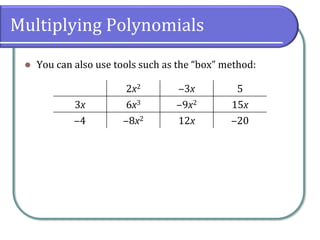
⚫ You can also use tools such as the “box” method:
2x2 ‒3x 5
3x
‒4
Multiplying Polynomials
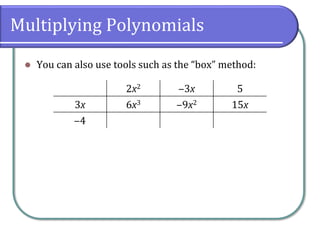
⚫ You can also use tools such as the “box” method:
2x2 ‒3x 5
3x 6x3 ‒9x2 15x
‒4
Multiplying Polynomials
⚫ You can also use tools such as the “box” method:
2x2 ‒3x 5
3x 6x3 ‒9x2 15x
‒4 ‒8x2 12x ‒20
Multiplying Polynomials
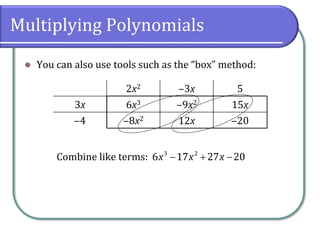
⚫ You can also use tools such as the “box” method:
Combine like terms:
2x2 ‒3x 5
3x 6x3 ‒9x2 15x
‒4 ‒8x2 12x ‒20
3 2
6 17 27 20
x x x
− + −
Multiplying Polynomials
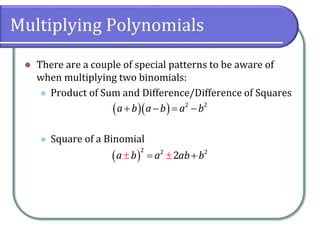
⚫ There are a couple of special patterns to be aware of
when multiplying two binomials:
⚫ Product of Sum and Difference/Difference of Squares
⚫ Square of a Binomial
( )( ) 2 2
a b a b a b
+ − = −
( )
 
= +
2 2 2
2
a b a ab b
Multiplying Polynomials
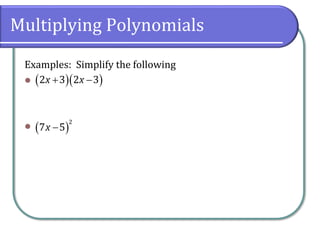
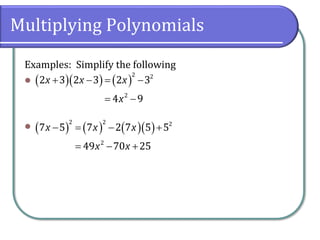
Examples: Simplify the following
⚫
⚫
( )( )
2 3 2 3
x x
+ −
( )
2
7 5
x −
Multiplying Polynomials
Examples: Simplify the following
⚫
⚫
( )( ) ( )
+ − = −
= −
2 2
2
2 3 2 3 2 3
4 9
x x x
x
( ) ( ) ( )( )
− = − +
= − +
2 2 2
2
7 5 7 2 7 5 5
49 70 25
x x x
x x
Multiplying Polynomials
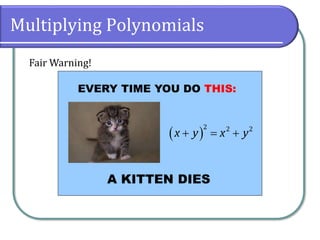
EVERY TIME YOU DO THIS:
A KITTEN DIES
( )
2 2 2
x y x y
+ = +
Fair Warning!
Polynomials of Several Variables
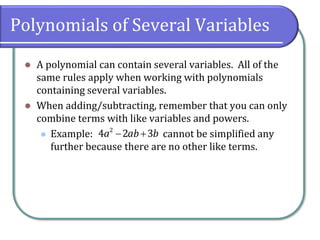
⚫ A polynomial can contain several variables. All of the
same rules apply when working with polynomials
containing several variables.
⚫ When adding/subtracting, remember that you can only
combine terms with like variables and powers.
⚫ Example: cannot be simplified any
further because there are no other like terms.
2
4 2 3
a ab b
− +
Polynomials of Several Variables
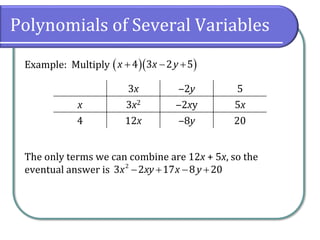
Example: Multiply
The only terms we can combine are 12x + 5x, so the
eventual answer is
( )( )
4 3 2 5
x x y
+ − +
3x ‒2y 5
x 3x2 ‒2xy 5x
4 12x ‒8y 20
2
3 2 17 8 20
x xy x y
− + − +
Classwork
⚫ College Algebra 2e
⚫ 1.4: 6-16 (even); 1.3: 36-50 (even); 1.2: 44-58 (even)
(omit 52)
⚫ 1.4 Classwork Check
⚫ Quiz 1.3

1.4 Polynomials

  • 1.
  • 2.
    Concepts & Objectives ⚫Objectives of this section: ⚫ Identify the degree and leading coefficient of polynomials. ⚫ Add and subtract polynomials. ⚫ Multiply polynomials. ⚫ Identify special product patterns. ⚫ Perform operations with polynomials of several variables.
  • 3.
    Polynomials ⚫ A polynomialis defined as a term or a finite sum of terms, with only positive or zero integer exponents permitted on the variables. ⚫ The degree of a term with one variable is the largest exponent in the expression. The degree of a term containing more than one variable has degree equal to the sum of all of the variables’ exponents. ⚫ The degree of the polynomial is the greatest degree of any term in the polynomial.
  • 4.
    Polynomials (cont.) ⚫ Apolynomial containing exactly three term is called a trinomial. If it contains exactly two terms, it is called a binomial, and a single-term polynomial is called a monomial. ⚫ Since the variables used in polynomials represent real numbers, a polynomial represents a real number. This means that all of the properties of real numbers hold for polynomials.
  • 5.
    Polynomials (cont.) ⚫ Usingthe distributive property, we can simplify the following: 3m5 ‒ 7m5 + 2m2 3 ‒ 7m5 + 2m2 ‒4m5 + 2m2 ⚫ Thus, polynomials are added/subtracted by adding or subtracting coefficients of like terms. ⚫ Polynomials in one variable are usually written with their terms in descending order of degree.
  • 6.
    Multiplying Polynomials ⚫ Tomultiply polynomials, multiply each term by all of the other terms. Example: ( )( ) ( )( ) ( )( ) ( )( ) ( )( ) ( )( ) ( )( ) 2 2 2 3 2 2 3 2 2 3 5 2 3 5 2 3 5 6 9 15 8 12 20 6 17 27 20 3 3 3 4 4 4 4 3 x x x x x x x x x x x x x x x x x x − + = + − + + + − + = − + − + − − − + − − − − =
  • 7.
    Multiplying Polynomials ⚫ Youcan also use tools such as the “box” method: 2x2 ‒3x 5 3x ‒4
  • 8.
    Multiplying Polynomials ⚫ Youcan also use tools such as the “box” method: 2x2 ‒3x 5 3x 6x3 ‒9x2 15x ‒4
  • 9.
    Multiplying Polynomials ⚫ Youcan also use tools such as the “box” method: 2x2 ‒3x 5 3x 6x3 ‒9x2 15x ‒4 ‒8x2 12x ‒20
  • 10.
    Multiplying Polynomials ⚫ Youcan also use tools such as the “box” method: Combine like terms: 2x2 ‒3x 5 3x 6x3 ‒9x2 15x ‒4 ‒8x2 12x ‒20 3 2 6 17 27 20 x x x − + −
  • 11.
    Multiplying Polynomials ⚫ Thereare a couple of special patterns to be aware of when multiplying two binomials: ⚫ Product of Sum and Difference/Difference of Squares ⚫ Square of a Binomial ( )( ) 2 2 a b a b a b + − = − ( )   = + 2 2 2 2 a b a ab b
  • 12.
    Multiplying Polynomials Examples: Simplifythe following ⚫ ⚫ ( )( ) 2 3 2 3 x x + − ( ) 2 7 5 x −
  • 13.
    Multiplying Polynomials Examples: Simplifythe following ⚫ ⚫ ( )( ) ( ) + − = − = − 2 2 2 2 3 2 3 2 3 4 9 x x x x ( ) ( ) ( )( ) − = − + = − + 2 2 2 2 7 5 7 2 7 5 5 49 70 25 x x x x x
  • 14.
    Multiplying Polynomials EVERY TIMEYOU DO THIS: A KITTEN DIES ( ) 2 2 2 x y x y + = + Fair Warning!
  • 15.
    Polynomials of SeveralVariables ⚫ A polynomial can contain several variables. All of the same rules apply when working with polynomials containing several variables. ⚫ When adding/subtracting, remember that you can only combine terms with like variables and powers. ⚫ Example: cannot be simplified any further because there are no other like terms. 2 4 2 3 a ab b − +
  • 16.
    Polynomials of SeveralVariables Example: Multiply The only terms we can combine are 12x + 5x, so the eventual answer is ( )( ) 4 3 2 5 x x y + − + 3x ‒2y 5 x 3x2 ‒2xy 5x 4 12x ‒8y 20 2 3 2 17 8 20 x xy x y − + − +
  • 17.
    Classwork ⚫ College Algebra2e ⚫ 1.4: 6-16 (even); 1.3: 36-50 (even); 1.2: 44-58 (even) (omit 52) ⚫ 1.4 Classwork Check ⚫ Quiz 1.3