Generation of FM signal
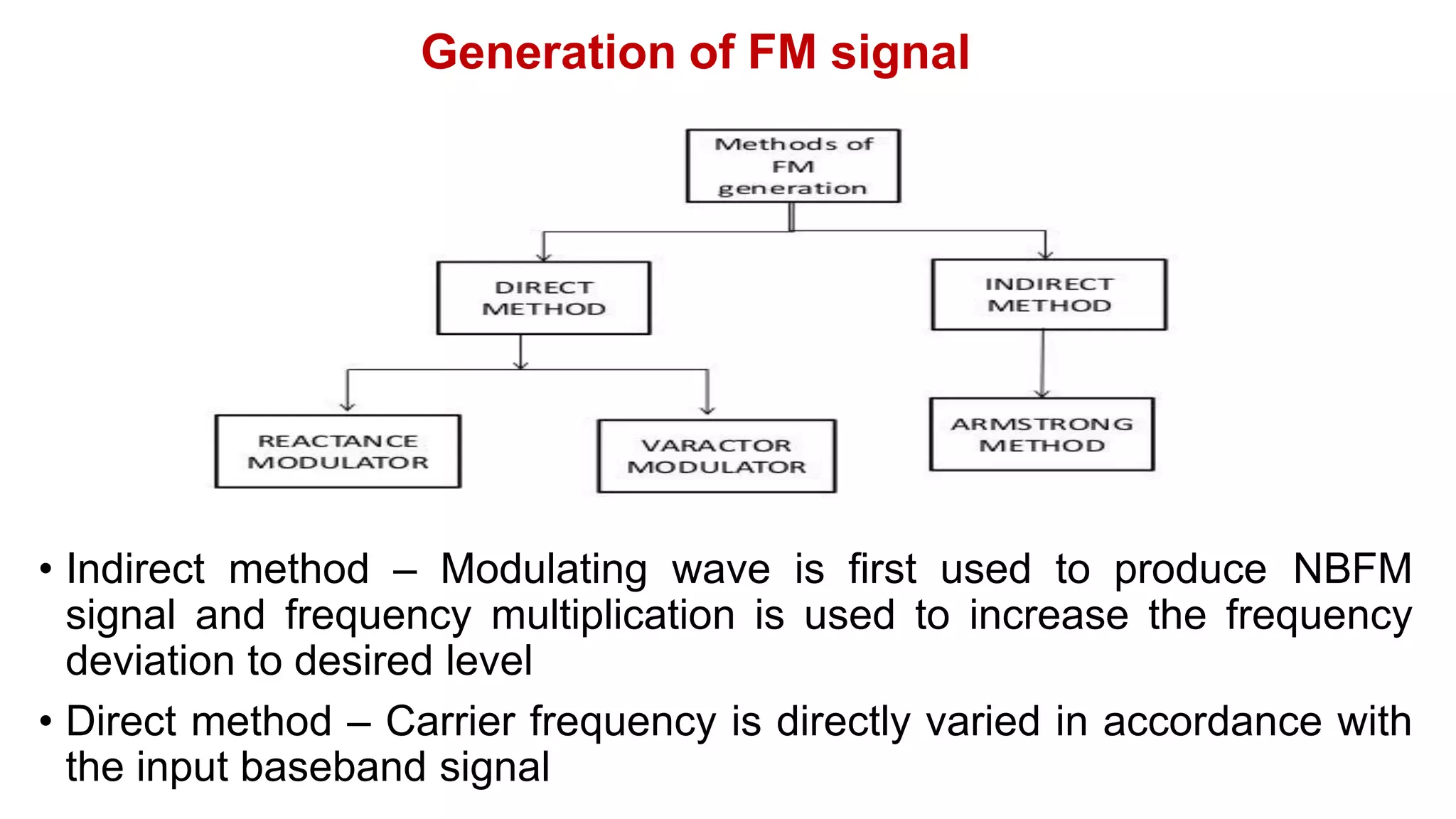
• Indirect method – Modulating wave is first used to produce NBFM
signal and frequency multiplication is used to increase the frequency
deviation to desired level
• Direct method – Carrier frequency is directly varied in accordance with
the input baseband signal
Armstrong method
Armstrong method
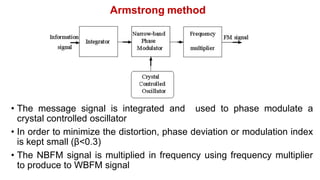
• The message signal is integrated and used to phase modulate a
crystal controlled oscillator
• In order to minimize the distortion, phase deviation or modulation index
is kept small (β<0.3)
• The NBFM signal is multiplied in frequency using frequency multiplier
to produce to WBFM signal
Armstrong method
• Let s1(t) denotes the output of the phase modulator
Armstrong method
• Let s1(t) denotes the output of the phase modulator
t
s1(t)  Ac cos[2f1t  2kf m(t)dt]     (1)
0
Armstrong method
• Let s1(t) denotes the output of the phase modulator
t
s1(t)  Ac cos[2f1t  2kf m(t)dt]     (1)
0
• f1 – Frequency of the crystal controlled oscillator
• kf – Frequency sensitivity (constant)
• For a sinusoidal modulating wave, the output s1(t) is given as
Armstrong method
• Let s1(t) denotes the output of the phase modulator
t
s1(t)  Ac cos[2f1t  2kf m(t)dt]     (1)
0
• f1 – Frequency of the crystal controlled oscillator
• kf – Frequency sensitivity (constant)
• For a sinusoidal modulating wave, the output s1(t) is given as
s1(t)  Accos[2f1t  1 sin 2fmt]    (2)
• The phase modulator output is multiplied ‘n’ times in frequency by
using frequency multiplier to produce the desired WBFM wave
Armstrong method
• Let s1(t) denotes the output of the phase modulator
t
s1(t)  Ac cos[2f1t  2kf m(t)dt]     (1)
0
• f1 – Frequency of the crystal controlled oscillator
• kf – Frequency sensitivity (constant)
• For a sinusoidal modulating wave, the output s1(t) is given as
s1(t)  Accos[2f1t  1 sin 2fmt]    (2)
• The phase modulator output is multiplied ‘n’ times in frequency by
using frequency multiplier to produce the desired WBFM wave
s(t)  Ac cos[2nf1t  n1 sin 2fmt]    (3)
Armstrong method
• In case of sinusoidal modulating wave
Armstrong method
• In case of sinusoidal modulating wave
s(t)  Ac cos[2fct   sin 2fmt]    (4)
• Frequency multiplier n1 shifts the NBFM to WBFM
• Frequency translator will not change the frequency deviation, it only
shifts the FM signal to either upwards and downwards in the spectrum
• Frequency multiplier n2 is used to increase the Δf and fc
  n1
fc  nf1
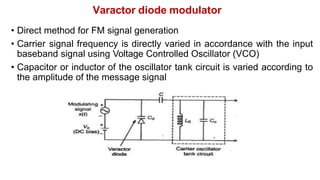
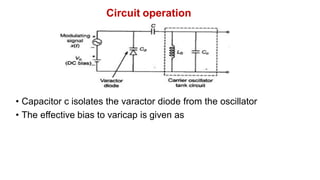
Varactor diode modulator
• Direct method for FM signal generation
• Carrier signal frequency is directly varied in accordance with the input
baseband signal using Voltage Controlled Oscillator (VCO)
• Capacitor or inductor of the oscillator tank circuit is varied according to
the amplitude of the message signal
Varactor diode modulator
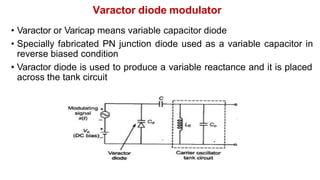
• Varactor or Varicap means variable capacitor diode
• Specially fabricated PN junction diode used as a variable capacitor in
reverse biased condition
• Varactor diode is used to produce a variable reactance and it is placed
across the tank circuit
Circuit operation
• Capacitor c isolates the varactor diode from the oscillator
• The effective bias to varicap is given as
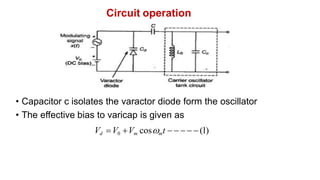
Circuit operation
• Capacitor c isolates the varactor diode form the oscillator
• The effective bias to varicap is given as
Vd V0 Vm cosmt     (1)
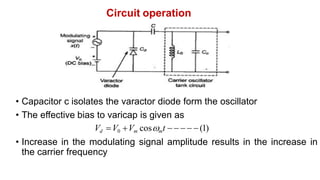
Circuit operation
• Capacitor c isolates the varactor diode form the oscillator
• The effective bias to varicap is given as
Vd V0 Vm cosmt     (1)
• Increase in the modulating signal amplitude results in the increase in
the carrier frequency
Circuit operation
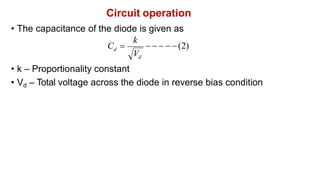
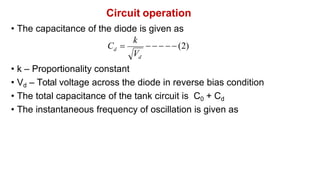
• The capacitance of the diode is given as
• k – Proportionality constant
• Vd – Total voltage across the diode in reverse bias condition
    (2)
d
d
C 
V
k
Circuit operation
• The capacitance of the diode is given as
• k – Proportionality constant
• Vd – Total voltage across the diode in reverse bias condition
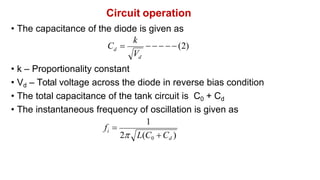
• The total capacitance of the tank circuit is C0 + Cd
• The instantaneous frequency of oscillation is given as
    (2)
d
d
C 
V
k
Circuit operation
• The capacitance of the diode is given as
• k – Proportionality constant
• Vd – Total voltage across the diode in reverse bias condition
• The total capacitance of the tank circuit is C0 + Cd
• The instantaneous frequency of oscillation is given as
    (2)
d
d
C 
V
k
2 L(C0 Cd )
1
i
f 
Circuit operation
• The capacitance of the diode is given as
• k – Proportionality constant
• Vd – Total voltage across the diode in reverse bias condition
• The total capacitance of the tank circuit is C0 + Cd
• The instantaneous frequency of oscillation is given as
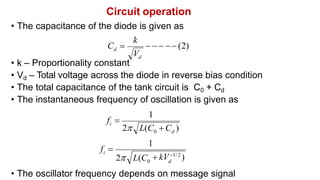
• The oscillator frequency depends on message signal
    (2)
d
d
C 
V
k
1
0 d
i
f 
2 L(C C )
1
0 d
 kV 1/2
)
2 L(C
i
f 
Reactance tube modulator
Ib  Id
Xc  R
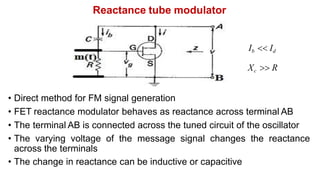
• Direct method for FM signal generation
• FET reactance modulator behaves as reactance across terminal AB
• The terminal AB is connected across the tuned circuit of the oscillator
• The varying voltage of the message signal changes the reactance
across the terminals
• The change in reactance can be inductive or capacitive
Expression for equivalent capacitance
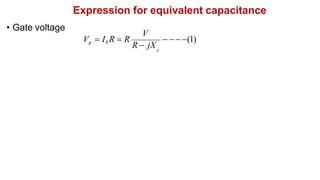
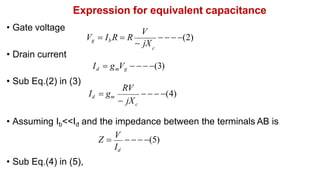
• Gate voltage
   (1)
c
V
Vg  Ib R  R
R  jX
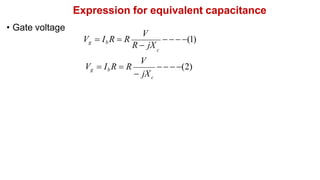
Expression for equivalent capacitance
• Gate voltage
   (1)
c
V
Vg  Ib R  R
R  jX
   (2)
 jX
Vg  Ib R  R
c
V
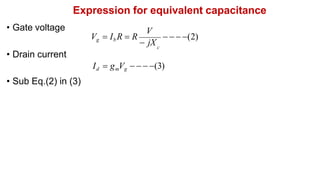
Expression for equivalent capacitance
• Gate voltage
• Drain current
Id  gmVg    (3)
• Sub Eq.(2) in (3)
c
V
Vg  Ib R  R
 jX
   (2)
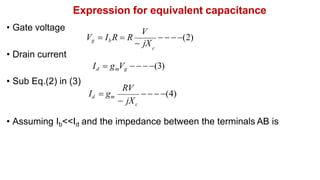
Expression for equivalent capacitance
• Gate voltage
• Sub Eq.(2) in (3)
• Assuming Ib<<Id and the impedance between the terminals AB is
c
• Drain current
Id  gmVg    (3)
V
Vg  Ib R  R
 jX
   (2)
   (4)
 jX
Id  gm
c
RV
Expression for equivalent capacitance
• Gate voltage
• Sub Eq.(2) in (3)
• Sub Eq.(4) in (5),
c
• Drain current
Id  gmVg    (3)
V
Vg  Ib R  R
 jX
   (2)
   (4)
 jX
Id  gm
c
RV
Id
• Assuming Ib<<Id and the impedance between the terminals AB is
Z 
V
   (5)
Expression for equivalent capacitance
gmR
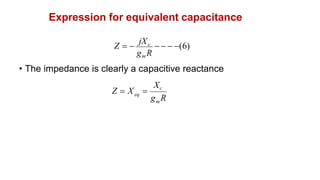
• The impedance is clearly a capacitive reactance
Z  
jXc
   (6)
g R
Xc
m
eq
Z  X 
Expression for equivalent capacitance
gmR
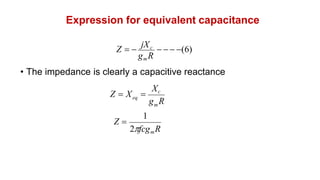
• The impedance is clearly a capacitive reactance
Z  
jXc
   (6)
1
2fcgmR
Z 
g R
Xc
m
eq
Z  X 
Expression for equivalent capacitance
gmR
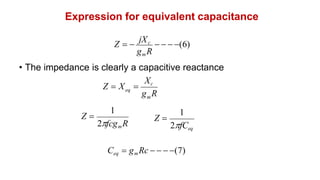
• The impedance is clearly a capacitive reactance
Z  
jXc
   (6)
1
2fcgmR
Z  1
2fCeq
Z 
Ceq  gmRc    (7)
g R
Xc
m
eq
Z  X 
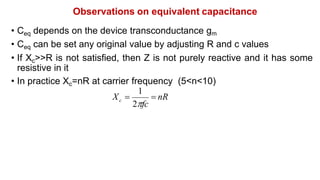
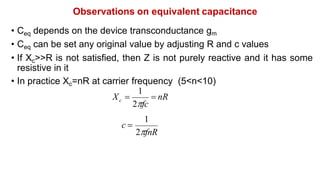
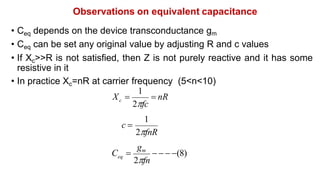
Observations on equivalent capacitance
• Ceq depends on the device transconductance gm
• Ceq can be set any original value by adjusting R and c values
• If Xc>>R is not satisfied, then Z is not purely reactive and it has some
resistive in it
• In practice Xc=nR at carrier frequency (5<n<10)
 nR
1
2fc
c
X 
Observations on equivalent capacitance
• Ceq depends on the device transconductance gm
• Ceq can be set any original value by adjusting R and c values
• If Xc>>R is not satisfied, then Z is not purely reactive and it has some
resistive in it
• In practice Xc=nR at carrier frequency (5<n<10)
 nR
1
2fc
c
X 
1
2fnR
c 
Observations on equivalent capacitance
• Ceq depends on the device transconductance gm
• Ceq can be set any original value by adjusting R and c values
• If Xc>>R is not satisfied, then Z is not purely reactive and it has some
resistive in it
• In practice Xc=nR at carrier frequency (5<n<10)
 nR
1
2fc
c
X 
1
2fnR
c 
   (8)
gm
2fn
C 
eq
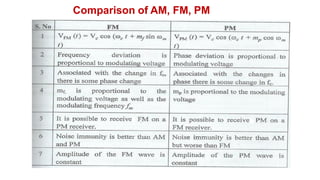
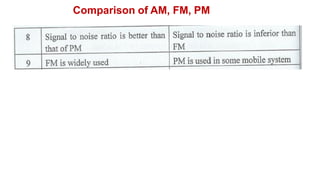
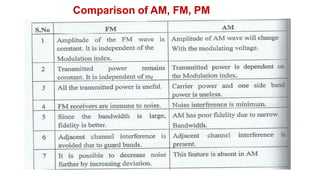
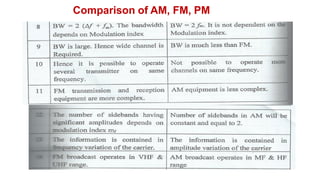
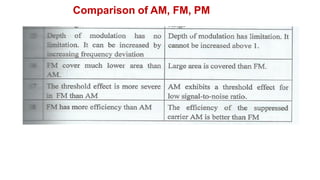
Comparison of AM, FM, PM
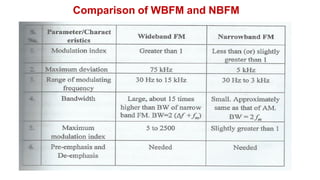
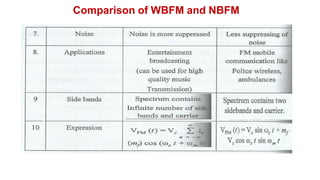
Comparison of WBFM and NBFM

14 FM_Generation.pdf

  • 1.
    Generation of FMsignal • Indirect method – Modulating wave is first used to produce NBFM signal and frequency multiplication is used to increase the frequency deviation to desired level • Direct method – Carrier frequency is directly varied in accordance with the input baseband signal
  • 2.
  • 3.
    Armstrong method • Themessage signal is integrated and used to phase modulate a crystal controlled oscillator • In order to minimize the distortion, phase deviation or modulation index is kept small (β<0.3) • The NBFM signal is multiplied in frequency using frequency multiplier to produce to WBFM signal
  • 4.
    Armstrong method • Lets1(t) denotes the output of the phase modulator
  • 5.
    Armstrong method • Lets1(t) denotes the output of the phase modulator t s1(t)  Ac cos[2f1t  2kf m(t)dt]     (1) 0
  • 6.
    Armstrong method • Lets1(t) denotes the output of the phase modulator t s1(t)  Ac cos[2f1t  2kf m(t)dt]     (1) 0 • f1 – Frequency of the crystal controlled oscillator • kf – Frequency sensitivity (constant) • For a sinusoidal modulating wave, the output s1(t) is given as
  • 7.
    Armstrong method • Lets1(t) denotes the output of the phase modulator t s1(t)  Ac cos[2f1t  2kf m(t)dt]     (1) 0 • f1 – Frequency of the crystal controlled oscillator • kf – Frequency sensitivity (constant) • For a sinusoidal modulating wave, the output s1(t) is given as s1(t)  Accos[2f1t  1 sin 2fmt]    (2) • The phase modulator output is multiplied ‘n’ times in frequency by using frequency multiplier to produce the desired WBFM wave
  • 8.
    Armstrong method • Lets1(t) denotes the output of the phase modulator t s1(t)  Ac cos[2f1t  2kf m(t)dt]     (1) 0 • f1 – Frequency of the crystal controlled oscillator • kf – Frequency sensitivity (constant) • For a sinusoidal modulating wave, the output s1(t) is given as s1(t)  Accos[2f1t  1 sin 2fmt]    (2) • The phase modulator output is multiplied ‘n’ times in frequency by using frequency multiplier to produce the desired WBFM wave s(t)  Ac cos[2nf1t  n1 sin 2fmt]    (3)
  • 9.
    Armstrong method • Incase of sinusoidal modulating wave
  • 10.
    Armstrong method • Incase of sinusoidal modulating wave s(t)  Ac cos[2fct   sin 2fmt]    (4) • Frequency multiplier n1 shifts the NBFM to WBFM • Frequency translator will not change the frequency deviation, it only shifts the FM signal to either upwards and downwards in the spectrum • Frequency multiplier n2 is used to increase the Δf and fc   n1 fc  nf1
  • 11.
    Varactor diode modulator •Direct method for FM signal generation • Carrier signal frequency is directly varied in accordance with the input baseband signal using Voltage Controlled Oscillator (VCO) • Capacitor or inductor of the oscillator tank circuit is varied according to the amplitude of the message signal
  • 12.
    Varactor diode modulator •Varactor or Varicap means variable capacitor diode • Specially fabricated PN junction diode used as a variable capacitor in reverse biased condition • Varactor diode is used to produce a variable reactance and it is placed across the tank circuit
  • 13.
    Circuit operation • Capacitorc isolates the varactor diode from the oscillator • The effective bias to varicap is given as
  • 14.
    Circuit operation • Capacitorc isolates the varactor diode form the oscillator • The effective bias to varicap is given as Vd V0 Vm cosmt     (1)
  • 15.
    Circuit operation • Capacitorc isolates the varactor diode form the oscillator • The effective bias to varicap is given as Vd V0 Vm cosmt     (1) • Increase in the modulating signal amplitude results in the increase in the carrier frequency
  • 16.
    Circuit operation • Thecapacitance of the diode is given as • k – Proportionality constant • Vd – Total voltage across the diode in reverse bias condition     (2) d d C  V k
  • 17.
    Circuit operation • Thecapacitance of the diode is given as • k – Proportionality constant • Vd – Total voltage across the diode in reverse bias condition • The total capacitance of the tank circuit is C0 + Cd • The instantaneous frequency of oscillation is given as     (2) d d C  V k
  • 18.
    Circuit operation • Thecapacitance of the diode is given as • k – Proportionality constant • Vd – Total voltage across the diode in reverse bias condition • The total capacitance of the tank circuit is C0 + Cd • The instantaneous frequency of oscillation is given as     (2) d d C  V k 2 L(C0 Cd ) 1 i f 
  • 19.
    Circuit operation • Thecapacitance of the diode is given as • k – Proportionality constant • Vd – Total voltage across the diode in reverse bias condition • The total capacitance of the tank circuit is C0 + Cd • The instantaneous frequency of oscillation is given as • The oscillator frequency depends on message signal     (2) d d C  V k 1 0 d i f  2 L(C C ) 1 0 d  kV 1/2 ) 2 L(C i f 
  • 20.
    Reactance tube modulator Ib Id Xc  R • Direct method for FM signal generation • FET reactance modulator behaves as reactance across terminal AB • The terminal AB is connected across the tuned circuit of the oscillator • The varying voltage of the message signal changes the reactance across the terminals • The change in reactance can be inductive or capacitive
  • 21.
    Expression for equivalentcapacitance • Gate voltage    (1) c V Vg  Ib R  R R  jX
  • 22.
    Expression for equivalentcapacitance • Gate voltage    (1) c V Vg  Ib R  R R  jX    (2)  jX Vg  Ib R  R c V
  • 23.
    Expression for equivalentcapacitance • Gate voltage • Drain current Id  gmVg    (3) • Sub Eq.(2) in (3) c V Vg  Ib R  R  jX    (2)
  • 24.
    Expression for equivalentcapacitance • Gate voltage • Sub Eq.(2) in (3) • Assuming Ib<<Id and the impedance between the terminals AB is c • Drain current Id  gmVg    (3) V Vg  Ib R  R  jX    (2)    (4)  jX Id  gm c RV
  • 25.
    Expression for equivalentcapacitance • Gate voltage • Sub Eq.(2) in (3) • Sub Eq.(4) in (5), c • Drain current Id  gmVg    (3) V Vg  Ib R  R  jX    (2)    (4)  jX Id  gm c RV Id • Assuming Ib<<Id and the impedance between the terminals AB is Z  V    (5)
  • 26.
    Expression for equivalentcapacitance gmR • The impedance is clearly a capacitive reactance Z   jXc    (6) g R Xc m eq Z  X 
  • 27.
    Expression for equivalentcapacitance gmR • The impedance is clearly a capacitive reactance Z   jXc    (6) 1 2fcgmR Z  g R Xc m eq Z  X 
  • 28.
    Expression for equivalentcapacitance gmR • The impedance is clearly a capacitive reactance Z   jXc    (6) 1 2fcgmR Z  1 2fCeq Z  Ceq  gmRc    (7) g R Xc m eq Z  X 
  • 29.
    Observations on equivalentcapacitance • Ceq depends on the device transconductance gm • Ceq can be set any original value by adjusting R and c values • If Xc>>R is not satisfied, then Z is not purely reactive and it has some resistive in it • In practice Xc=nR at carrier frequency (5<n<10)  nR 1 2fc c X 
  • 30.
    Observations on equivalentcapacitance • Ceq depends on the device transconductance gm • Ceq can be set any original value by adjusting R and c values • If Xc>>R is not satisfied, then Z is not purely reactive and it has some resistive in it • In practice Xc=nR at carrier frequency (5<n<10)  nR 1 2fc c X  1 2fnR c 
  • 31.
    Observations on equivalentcapacitance • Ceq depends on the device transconductance gm • Ceq can be set any original value by adjusting R and c values • If Xc>>R is not satisfied, then Z is not purely reactive and it has some resistive in it • In practice Xc=nR at carrier frequency (5<n<10)  nR 1 2fc c X  1 2fnR c     (8) gm 2fn C  eq
  • 32.
  • 33.
  • 34.
  • 35.
  • 36.
  • 37.
  • 38.