Post-Earthquake Site Reconnaissance
Geotechnical Engineering and Lifelines
2015 Gorkha (Nepal) Earthquake
Presented By:
Dr. Upul Atukorala, P, Eng.
Principal, Golder Associates Ltd., Vancouver, British Columbia, Canada
July 23, 2015
Presentation Outline
1. Geology of Kathmandu Valley
2. Earthquake Epicenter and Recorded
Shaking Intensity
3. Observations
 Airport and Oil Storage Tanks
 Sewage Treatment Plant (near airport)
 Road Slump (Lokanthali)
 Bishnumathi Bridge (Gongabu)
 Guest Houses (Gongabu aka Bus Park)
 Landslides (Dolakha)
4. Summary
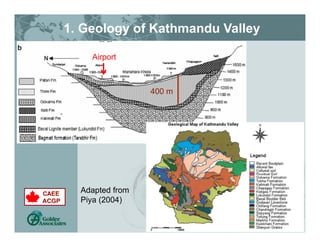
1. Geology of Kathmandu Valley
Adapted from
Piya (2004)
Airport
400 m
1. Geology of Kathmandu Valley, Contd.
 Underlain by thick deposits of lacustrine
sediments (locally known as black clay) some
400 to 500 m depth
 Lacustrine sediments are overlying sand and
gravel beds, overlying bedrock
 250 drill holes to > 100 m depth, 100 drill
holes to 45-100 m depth
 Soil stratigraphy and descriptions only – likely
water wells
2. EQ Epicenters and Shaking Intensity
[ref. Aydan & Ulusay, Goda et al, 2015]
• Shallow Earthquakes (<15 km)
• Epicenters of aftershocks West -> East
• Mw 7.9 Main Shock 77 km NW of Kathmandu,
7.3 Aftershock east of Kathmandu
Kathmandu
80 km
2. EQ Epicenters and Shaking Intensity,
Contd. [KATNP Stn]
After Goda et al (2015)
• PGA ~0.15 g
• 2 – 3 cycles of
strong shaking
lasting for ~10s
• Long period
cycles
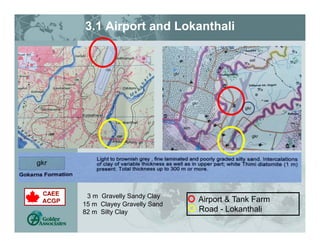
3.1 Airport and Lokanthali
Airport & Tank Farm
Road - Lokanthali
3 m Gravelly Sandy Clay
15 m Clayey Gravelly Sand
82 m Silty Clay
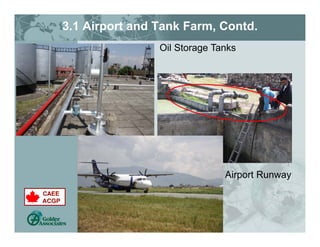
3.1 Airport and Tank Farm, Contd.
Oil Storage Tanks
Airport Runway
3.1 Airport and Tank Farm, Contd.
 There is some cracking on the runway;
 There is a substantial layer of rubber on the
runway, due to the intense use for the
emergency relief operations;
 The Taxiway is overstressed due to the
emergency relief operations, compounded by:
Heavy loads
Repetitions
 TIA has identified the need for a hardened
Emergency Response Center and a new Air
Traffic Control Tower.
[Slide by Pablo Riofrio Ando]
3.2 Sewerage Treatment Plant
Bagmati Area Sewerage
Treatment Plant
[Near the Airport]
Oxidation Secondary
Treatment Tanks
Secondary
Clarifiers
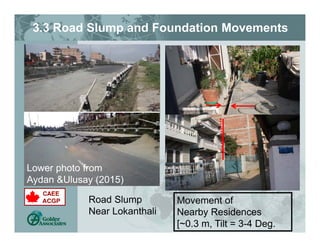
3.3 Road Slump and Foundation Movements
Road Slump
Near Lokanthali
Movement of
Nearby Residences
[~0.3 m, Tilt = 3-4 Deg.
Lower photo from
Aydan &Ulusay (2015)
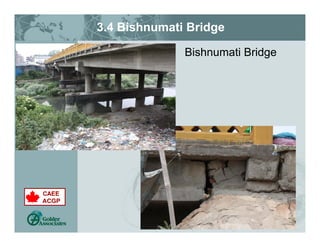
3.4 Bishnumati Bridge
Bishnumati Bridge
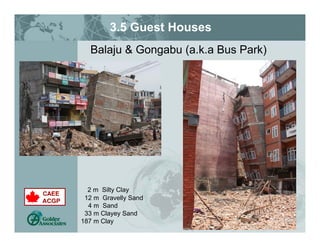
3.5 Guest Houses
Balaju & Gongabu (a.k.a Bus Park)
2 m Silty Clay
12 m Gravelly Sand
4 m Sand
33 m Clayey Sand
187 m Clay
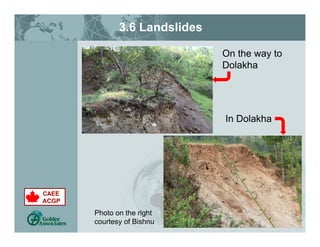
3.6 Landslides
In Dolakha
Photo on the right
courtesy of Bishnu
On the way to
Dolakha
4. Summary
1. CAEE Team visited several areas in Kathmandu
and Dolakha from June 10-16, 2015.
2. Geotechnical damage observed was
limited/minimal and localized for an earthquake of
this magnitude and soils in Kathmandu.
3. Design ground shaking for Kathmandu = 0.42 g,
but peak shaking felt ~ 0.15 g ~ 1/3rd of design
PGA
4. Duration of strong shaking ~ 10 seconds with 2-3
cycles of strong shaking [low for M7.9].
5. Earthquake occurred during the dry months of the
year; ground water table may have been deep
6. 3., 4. and 5. above are possible reasons why the
observed geotechnical damage was low/localized.
11CCEE_Nepal_Presentation_July23_Geotechnical_Final

11CCEE_Nepal_Presentation_July23_Geotechnical_Final

  • 1.
    Post-Earthquake Site Reconnaissance GeotechnicalEngineering and Lifelines 2015 Gorkha (Nepal) Earthquake Presented By: Dr. Upul Atukorala, P, Eng. Principal, Golder Associates Ltd., Vancouver, British Columbia, Canada July 23, 2015
  • 2.
    Presentation Outline 1. Geologyof Kathmandu Valley 2. Earthquake Epicenter and Recorded Shaking Intensity 3. Observations  Airport and Oil Storage Tanks  Sewage Treatment Plant (near airport)  Road Slump (Lokanthali)  Bishnumathi Bridge (Gongabu)  Guest Houses (Gongabu aka Bus Park)  Landslides (Dolakha) 4. Summary
  • 3.
    1. Geology ofKathmandu Valley Adapted from Piya (2004) Airport 400 m
  • 4.
    1. Geology ofKathmandu Valley, Contd.  Underlain by thick deposits of lacustrine sediments (locally known as black clay) some 400 to 500 m depth  Lacustrine sediments are overlying sand and gravel beds, overlying bedrock  250 drill holes to > 100 m depth, 100 drill holes to 45-100 m depth  Soil stratigraphy and descriptions only – likely water wells
  • 5.
    2. EQ Epicentersand Shaking Intensity [ref. Aydan & Ulusay, Goda et al, 2015] • Shallow Earthquakes (<15 km) • Epicenters of aftershocks West -> East • Mw 7.9 Main Shock 77 km NW of Kathmandu, 7.3 Aftershock east of Kathmandu Kathmandu 80 km
  • 6.
    2. EQ Epicentersand Shaking Intensity, Contd. [KATNP Stn] After Goda et al (2015) • PGA ~0.15 g • 2 – 3 cycles of strong shaking lasting for ~10s • Long period cycles
  • 7.
    3.1 Airport andLokanthali Airport & Tank Farm Road - Lokanthali 3 m Gravelly Sandy Clay 15 m Clayey Gravelly Sand 82 m Silty Clay
  • 8.
    3.1 Airport andTank Farm, Contd. Oil Storage Tanks Airport Runway
  • 9.
    3.1 Airport andTank Farm, Contd.  There is some cracking on the runway;  There is a substantial layer of rubber on the runway, due to the intense use for the emergency relief operations;  The Taxiway is overstressed due to the emergency relief operations, compounded by: Heavy loads Repetitions  TIA has identified the need for a hardened Emergency Response Center and a new Air Traffic Control Tower. [Slide by Pablo Riofrio Ando]
  • 10.
    3.2 Sewerage TreatmentPlant Bagmati Area Sewerage Treatment Plant [Near the Airport] Oxidation Secondary Treatment Tanks Secondary Clarifiers
  • 11.
    3.3 Road Slumpand Foundation Movements Road Slump Near Lokanthali Movement of Nearby Residences [~0.3 m, Tilt = 3-4 Deg. Lower photo from Aydan &Ulusay (2015)
  • 12.
  • 13.
    3.5 Guest Houses Balaju& Gongabu (a.k.a Bus Park) 2 m Silty Clay 12 m Gravelly Sand 4 m Sand 33 m Clayey Sand 187 m Clay
  • 14.
    3.6 Landslides In Dolakha Photoon the right courtesy of Bishnu On the way to Dolakha
  • 15.
    4. Summary 1. CAEETeam visited several areas in Kathmandu and Dolakha from June 10-16, 2015. 2. Geotechnical damage observed was limited/minimal and localized for an earthquake of this magnitude and soils in Kathmandu. 3. Design ground shaking for Kathmandu = 0.42 g, but peak shaking felt ~ 0.15 g ~ 1/3rd of design PGA 4. Duration of strong shaking ~ 10 seconds with 2-3 cycles of strong shaking [low for M7.9]. 5. Earthquake occurred during the dry months of the year; ground water table may have been deep 6. 3., 4. and 5. above are possible reasons why the observed geotechnical damage was low/localized.