
MATERIALS OF CONSTRUCTION
PHARMACEUTICAL MANUFACTURING
PLANT EQUIPMENTS
V.JAGAN MOHAN RAO M.S.Pharm., MED.CHEM
NIPER-KOLKATA
Asst.Professor, MIPER-KURNOOL
EMAIL- jaganvana6@gmail.com
Factors affecting selection of an
engineering material
• Physical
• Chemical
• Economy
Physical
• Strength
• Mass
• Wear and tear
• Thermal conductivity
• Thermal Expansion
• Cleansing
• Sterilization
• Transparency
Chemical
• Contamination
• Reactivity with chemicals
Classification of material
•Metal
–Ferrous
•Cast Iron
•Steel Carbon
•Stainless steel
– Non ferrous
•Aluminium
•Nickel
•Lead
•Non metal
–InOrganic
•Glass
•Asbestos
–Organic
•Rubber
•Timber
FERROUS METALS
Iron metal is one of the used materials
for the construction of plants because
of its mechanical strength, abundent
availability and lower cost. Some
varieties of iron are discussed.
1. Cast iron:
It consists of iron with a proportion of carbon(beyond 1.5%). The
properties of iron depend on the amount carbon present in it.
Cast iron is abundently available, inexpensive and therefore
widely used. A number of types of cast iron are available.
Advantages:
1. cast iron is cheap. Therefore, it is used in place of expensive
plant material for coating
2. Since cast iron has low thermal conductivity, it is used for the
construction of outer surface of jackets of steam pans.
3. low melting temperatures 1140/ 1200 C
Disadvantages:
1. Cast iron is very hard and brittle. Therfore, it is difficult to
machine. This disadvantage can be over come by the addition of
different materials to improve his performance.
2. Cast iron is attacked by dil.H2SO4, dil. Nitric acid and dilute as
well as conHCl.
3. It is resistant to conc. H2SO4, nitric acid and alkalis.
4. Since cast iron has low thermal conductivity, it cannot be used
for heat transfer insteels.
Uses:
It is commonly used for the construction of :
1 supports for plant
2 jackets of steam pans
3 linings with enamel, plastic or suitable protective material.
Modification of cast iron: Cast iron is not considered corrosion
resistant. The characteristics of cast iron can be altered by
alloying with other elements such as silicon, nickel and
chromium
Commercial types: duriron anddurichlor.
2. Carbon steel
Carbon steel is an iron alloy, which contains only a small %of
carbon.
Advantages:
1. carbon steel is cheapest. Therefore, it is preferred.
2. it is easily weldable and is freqently used in fabrication
Dissadvantages:
1. carbonsteel has limited resistance to corrosion. This
property can be improved by preparing alloys.
2. it reacts with caustic soda, brine and sea water. Alloying it
can reduce thisreactivity.
Uses:
 carbon steel is used for the construction of bars, pipes and
plates. it is used to fabricate large storage tanks for water,
sulphuric acid, organic solvents etc.
 It is used for supporting structures such as grinders and bases
for plant vessels.
VARIENTS OF CARBON STEEL
The properties of carbon steel can be altered by
alloying it with other metals. Some of the metals
and their properties are:
Nickel(Ni)- improves toughness, corrosion
resistance and low temperatureproperties.
Chromium(Cr)- increase hardness, more
abrassive resistant and resistance to oxidation.
Silicon (Si)- increase hardness, more abrasive
resistant and resistance to oxidation.
Molybdenum(Mb)/ provides strength at
elevated temperatures.
3. Stainless steel
It is an alloy of iron. Usually, it contains chromium
and nickel, which make the steel corrosion resistant.
Stainless steel is stabilised by the addition of
titanium, niobium, tantalum. Minor amount of other
elements such as copper, molybdenum and
selenium are added. Stainless steel also has the
advantage of ease infabrication.
The abundent use of stainless steel is due to the
properties such as
Heat resistance
Corrosion resistance
Ease of fabrication
Cleaning and sterilisation
Tensile strength
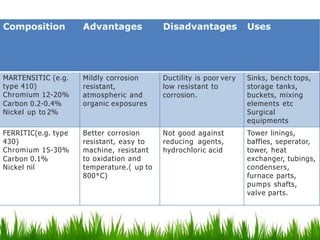
Depending on the composition, stainless steel alloys
are available in 3 groups viz., martensitic, ferritic
and austenitic.
Composition Advantages Disadvantages Uses
MARTENSITIC (e.g.
type 410)
Chromium 12-20%
Carbon 0.2-0.4%
Nickel up to 2%
Mildly corrosion
resistant,
atmospheric and
organic exposures
Ductility is poor very
low resistant to
corrosion.
Sinks, bench tops,
storage tanks,
buckets, mixing
elements etc
Surgical
equipments
FERRITIC(e.g. type
430)
Chromium 15-30%
Carbon 0.1%
Nickel nil
Better corrosion
resistant, easy to
machine, resistant
to oxidation and
temperature.( up to
800*C)
Not good against
reducing agents,
hydrochloric acid
Tower linings,
baffles, seperator,
tower, heat
exchanger, tubings,
condensers,
furnace parts,
pumps shafts,
valve parts.
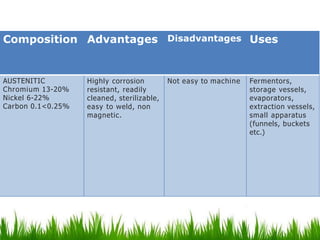
Composition Advantages Disadvantages Uses
AUSTENITIC
Chromium 13-20%
Nickel 6-22%
Carbon 0.1<0.25%
Highly corrosion
resistant, readily
cleaned, sterilizable,
easy to weld, non
magnetic.
Not easy to machine Fermentors,
storage vessels,
evaporators,
extraction vessels,
small apparatus
(funnels, buckets
etc.)
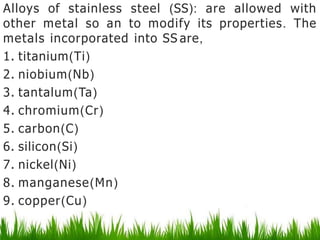
Alloys of stainless steel (SS): are allowed with
other metal so an to modify its properties. The
metals incorporated into SS are,
1. titanium(Ti)
2. niobium(Nb)
3. tantalum(Ta)
4. chromium(Cr)
5. carbon(C)
6. silicon(Si)
7. nickel(Ni)
8. manganese(Mn)
9. copper(Cu)
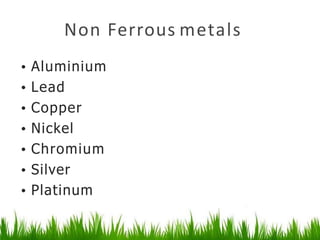
Non Ferrous metals
• Aluminium
• Lead
• Copper
• Nickel
• Chromium
• Silver
• Platinum
ALUMINIUM
A number of aluminium items are used in regular day to day life.
Aluminium is cheap, light in weight and offers adequate
mechanical strength. In addition, aluminium equipment can be
easily fabricated. Further, aluminium can be strengthened by
cold working. Their maintenance and cleaning is also easy.
Hence, its utility is mostly recommended. However the use of
aluminium in the construction of plant and equipment is limited.
Advantages:
1. high resistance to atmospheric conditions, industrial fumes,
vapour and fresh or salt waters. Aluminium can be used with
conc. Nitric acid (above 82%) and acetic acid.
2.Thermal conductivity of aluminium is 60% that of pure copper.
Dissadvantages:
3. The mechanical strength decreases greatly above 150*C.
4. aluminium cannot be used with strong caustic solution.
5. many mineral acids attack aluminium.
6. oxide and hydro/ oxide films are formed rapidly, when its surface
is exposed. Normally this film is thickened by chemical and
electrolytic means. This provides so called anodised finishes.
• The serious disadvantage is that trace
amounts of Cu in solution are harmful
to microorganisms and enzyme
systems when used in biological
industries and act as degradation
catalysts for a number of important
food constituents and pharmaceuticals.
• Important alloys are brasses, bronzes and
cupronickels. Gun metal contains Cu88%,
Sn10%, and Zn2%. Cupronickels (10 to 30%
Ni) are very important copper alloys.
• They have the highest corrosion resistance of
all copper alloys and are much used as heat
exchanger tubing.
SILVER
Because of its high cost, silver is used only as a material of plant
construction in special cases and usually silver coated material is
used rather than solid silver.
It is not resistant to concentrated HCl or H2SO4, any strength of
nitric acid, and sulphur and sulphur compounds.
It is resistant to organic acids and their salts. It is even more
malleable and ductile than copper and, therefore, capable of
being readily worked. It has a higher thermal conductivity than
all other metals.
A few e.g. of its special uses are – plant for the manufacture of
salicylates and acetic acid; a silver/ plated basket for a
hydroextracter used in vitamin crystallisation; a solid silver
vessel in a cast/ iron jacket for bromination.
TITANIUM
q Titanium has become increasingly important as a
construction material. It is strong and of medium
weight.
q Corrosion resistance is very superior in oxidizing and
mild reducing media (Ti/ Pd alloys Grade 7 and 11
have superior resistance in reducing environments, as
does the Ti/ Mo/ Ni alloy grade 12).
q Titanium is usually not bothered by impingement
attack, crevice corrosion, and pitting attack in
seawater. Its general resistance to seawater is
excellent.
Contd...
q Titanium is resistant to nitric acid at all
concentrations except with red fuming nitric.
q The metal also resists ferric chloride, cupric
chloride, and other hot chloride solutions.
However there are a number of disadvantages to
titanium which have limited its use.
q Titanium is not easy to form, it has a high spring
back and tends to gall, and welding must be
carried out in an inert atmosphere.
NICKEL
• Nickel is resistant to oxidation and
alkalis but is attacked slowly by dilute
mineral acids and rapidly by
concentrated acids.
•It is resistant to the weak organic acids
occuring in pharmaceutical preparations,
q
r
e.g. citiric, tartaric and stearic. It is also
t
esistant to phenols. Its salts are non
oxic. It is useful for such plant as pans,
vats, tanks, mixers, valves, and pumps,
nickel wire may be woven to form filter
cloths.
CHROMIUM
Although hard and resistant to
corrosion, chromium is not normally
used as material of plant
construction.
It forms resistant alloy with nickel and,
probably, its most important use is in
the manufacture of stainless steel.
It is also, of course, used as a plating
to protect steel.
Non Metals
• Glass
• Rubber
• Plastic
– Thermosetting Plastic
– Thermoplastic
General properties
• Resistant to chemicals
• Resistant to contamination
• Corrosion resistant
• Easy to fabricate
Application
• Flooring
• Roofing
• Windows & doors
• Piping
• Storage tanks
• Insulation materials
Thermosetting Plastic
• Permanently shaped to rigid
structure during manufacturing.
• Phenol formaldehyde
•Bakelite (cookwear handle)
• Melamine (iron)
Thermoplastic
• Soften under the influence of heat
– Poly vinyl Chloride (PVC)
– Polyethylene/Polypropylene
– Polystyrene
– Acrylonitrile Butadiene Styrene (ABS)
– Cellulose Acetate Butyrate (CAB)
• Poor resistance to organics
Polyvinyl chloride
• Clear, tough, inert
• Stabilizer or colorant
can be incorporated
• Resistant to acids
• Resistant to alkali
• Crack readily
(plasticizer added
to reduce this)
• Turn yellow when
exposed to UV
Polyethylene
• Economical
• Density (0.91-0.96)
determine stiffness,
transluscency, vapour
transmission
• More density-> more
stiffness, less permiable,
less, resistant to cracking
• Pipe of Polyethylene
must be fully
supported
• stable upto 1200F
Polyporopylene
• Good resistance to
chemical, acids,
alkali
• tough and flexible
• resistance to fatigue
(weakening of a
material caused by
repeatedly applied
loads)
• Stable upto 2500F
• Brittle at low
temperature
• Used for
manufacturing
piping systems
Polystyrene
• High mechanical
strength
• Chemical resistant
• Rigid
• Clear
• Easy to scratch
• Brittle (rubber or
acrylic compounds
can be mixed to
improve properties)
• Stable upto 1900F
Acrylonitrile Butadiene
Styrene (ABS)
• Acid resistant
• Resistant to
organic solvents
• Not resistant to
alkali
Phenolic and epoxyplastics
• Fiber glass have
high strength
• Heat resistant
• Excellent in weak
alkali solutions
• Use for gears,
fitting, pump
• Applications
include - coatings,
adhesives and as
composite
materials
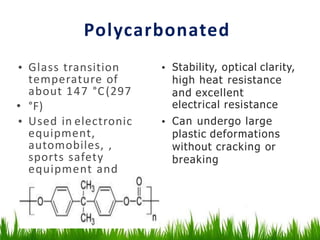
Polycarbonated
• Glass transition
temperature of
about 147 °C(297
• °F)
• Used in electronic
equipment,
automobiles, ,
sports safety
equipment and
medical devices
• Stability, optical clarity,
high heat resistance
and excellent
electrical resistance
• Can undergo large
plastic deformations
without cracking or
breaking
Fluorocarbon plastics
• Non-stick
• Friction Resistant
• CMF, obtained from the fluorination of
graphite, is the most thermally stable
polymeric fluorocarbon known
Chlorinated polyvinyl chloride
• CPVC is ideally suited for self-
supporting constructions where
temperatures up to 200 °F (90 °C)
• very difficult to ignite
• More ductile, allowing greater
flexure and crush resistance
• temperatures greater than PVC,
typically 40 °C to 50 °C (104 °F to
122 °F)
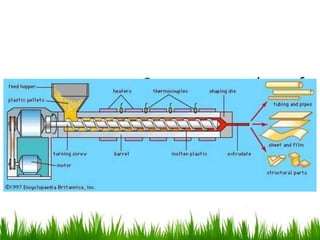
Screw extruder of
thermoplastic polymers
11. materialsof construction

11. materialsof construction

  • 1.
    MATERIALS OF CONSTRUCTION PHARMACEUTICALMANUFACTURING PLANT EQUIPMENTS V.JAGAN MOHAN RAO M.S.Pharm., MED.CHEM NIPER-KOLKATA Asst.Professor, MIPER-KURNOOL EMAIL- jaganvana6@gmail.com
  • 2.
    Factors affecting selectionof an engineering material • Physical • Chemical • Economy
  • 3.
    Physical • Strength • Mass •Wear and tear • Thermal conductivity • Thermal Expansion • Cleansing • Sterilization • Transparency
  • 4.
  • 5.
    Classification of material •Metal –Ferrous •CastIron •Steel Carbon •Stainless steel – Non ferrous •Aluminium •Nickel •Lead •Non metal –InOrganic •Glass •Asbestos –Organic •Rubber •Timber
  • 6.
    FERROUS METALS Iron metalis one of the used materials for the construction of plants because of its mechanical strength, abundent availability and lower cost. Some varieties of iron are discussed.
  • 7.
    1. Cast iron: Itconsists of iron with a proportion of carbon(beyond 1.5%). The properties of iron depend on the amount carbon present in it. Cast iron is abundently available, inexpensive and therefore widely used. A number of types of cast iron are available. Advantages: 1. cast iron is cheap. Therefore, it is used in place of expensive plant material for coating 2. Since cast iron has low thermal conductivity, it is used for the construction of outer surface of jackets of steam pans. 3. low melting temperatures 1140/ 1200 C
  • 8.
    Disadvantages: 1. Cast ironis very hard and brittle. Therfore, it is difficult to machine. This disadvantage can be over come by the addition of different materials to improve his performance. 2. Cast iron is attacked by dil.H2SO4, dil. Nitric acid and dilute as well as conHCl. 3. It is resistant to conc. H2SO4, nitric acid and alkalis. 4. Since cast iron has low thermal conductivity, it cannot be used for heat transfer insteels. Uses: It is commonly used for the construction of : 1 supports for plant 2 jackets of steam pans 3 linings with enamel, plastic or suitable protective material. Modification of cast iron: Cast iron is not considered corrosion resistant. The characteristics of cast iron can be altered by alloying with other elements such as silicon, nickel and chromium Commercial types: duriron anddurichlor.
  • 9.
    2. Carbon steel Carbonsteel is an iron alloy, which contains only a small %of carbon. Advantages: 1. carbon steel is cheapest. Therefore, it is preferred. 2. it is easily weldable and is freqently used in fabrication Dissadvantages: 1. carbonsteel has limited resistance to corrosion. This property can be improved by preparing alloys. 2. it reacts with caustic soda, brine and sea water. Alloying it can reduce thisreactivity. Uses:  carbon steel is used for the construction of bars, pipes and plates. it is used to fabricate large storage tanks for water, sulphuric acid, organic solvents etc.  It is used for supporting structures such as grinders and bases for plant vessels.
  • 10.
    VARIENTS OF CARBONSTEEL The properties of carbon steel can be altered by alloying it with other metals. Some of the metals and their properties are: Nickel(Ni)- improves toughness, corrosion resistance and low temperatureproperties. Chromium(Cr)- increase hardness, more abrassive resistant and resistance to oxidation. Silicon (Si)- increase hardness, more abrasive resistant and resistance to oxidation. Molybdenum(Mb)/ provides strength at elevated temperatures.
  • 11.
    3. Stainless steel Itis an alloy of iron. Usually, it contains chromium and nickel, which make the steel corrosion resistant. Stainless steel is stabilised by the addition of titanium, niobium, tantalum. Minor amount of other elements such as copper, molybdenum and selenium are added. Stainless steel also has the advantage of ease infabrication. The abundent use of stainless steel is due to the properties such as Heat resistance Corrosion resistance Ease of fabrication Cleaning and sterilisation Tensile strength Depending on the composition, stainless steel alloys are available in 3 groups viz., martensitic, ferritic and austenitic.
  • 12.
    Composition Advantages DisadvantagesUses MARTENSITIC (e.g. type 410) Chromium 12-20% Carbon 0.2-0.4% Nickel up to 2% Mildly corrosion resistant, atmospheric and organic exposures Ductility is poor very low resistant to corrosion. Sinks, bench tops, storage tanks, buckets, mixing elements etc Surgical equipments FERRITIC(e.g. type 430) Chromium 15-30% Carbon 0.1% Nickel nil Better corrosion resistant, easy to machine, resistant to oxidation and temperature.( up to 800*C) Not good against reducing agents, hydrochloric acid Tower linings, baffles, seperator, tower, heat exchanger, tubings, condensers, furnace parts, pumps shafts, valve parts.
  • 13.
    Composition Advantages DisadvantagesUses AUSTENITIC Chromium 13-20% Nickel 6-22% Carbon 0.1<0.25% Highly corrosion resistant, readily cleaned, sterilizable, easy to weld, non magnetic. Not easy to machine Fermentors, storage vessels, evaporators, extraction vessels, small apparatus (funnels, buckets etc.)
  • 14.
    Alloys of stainlesssteel (SS): are allowed with other metal so an to modify its properties. The metals incorporated into SS are, 1. titanium(Ti) 2. niobium(Nb) 3. tantalum(Ta) 4. chromium(Cr) 5. carbon(C) 6. silicon(Si) 7. nickel(Ni) 8. manganese(Mn) 9. copper(Cu)
  • 15.
    Non Ferrous metals •Aluminium • Lead • Copper • Nickel • Chromium • Silver • Platinum
  • 16.
    ALUMINIUM A number ofaluminium items are used in regular day to day life. Aluminium is cheap, light in weight and offers adequate mechanical strength. In addition, aluminium equipment can be easily fabricated. Further, aluminium can be strengthened by cold working. Their maintenance and cleaning is also easy. Hence, its utility is mostly recommended. However the use of aluminium in the construction of plant and equipment is limited. Advantages: 1. high resistance to atmospheric conditions, industrial fumes, vapour and fresh or salt waters. Aluminium can be used with conc. Nitric acid (above 82%) and acetic acid. 2.Thermal conductivity of aluminium is 60% that of pure copper. Dissadvantages: 3. The mechanical strength decreases greatly above 150*C. 4. aluminium cannot be used with strong caustic solution. 5. many mineral acids attack aluminium. 6. oxide and hydro/ oxide films are formed rapidly, when its surface is exposed. Normally this film is thickened by chemical and electrolytic means. This provides so called anodised finishes.
  • 17.
    • The seriousdisadvantage is that trace amounts of Cu in solution are harmful to microorganisms and enzyme systems when used in biological industries and act as degradation catalysts for a number of important food constituents and pharmaceuticals. • Important alloys are brasses, bronzes and cupronickels. Gun metal contains Cu88%, Sn10%, and Zn2%. Cupronickels (10 to 30% Ni) are very important copper alloys. • They have the highest corrosion resistance of all copper alloys and are much used as heat exchanger tubing.
  • 18.
    SILVER Because of itshigh cost, silver is used only as a material of plant construction in special cases and usually silver coated material is used rather than solid silver. It is not resistant to concentrated HCl or H2SO4, any strength of nitric acid, and sulphur and sulphur compounds. It is resistant to organic acids and their salts. It is even more malleable and ductile than copper and, therefore, capable of being readily worked. It has a higher thermal conductivity than all other metals. A few e.g. of its special uses are – plant for the manufacture of salicylates and acetic acid; a silver/ plated basket for a hydroextracter used in vitamin crystallisation; a solid silver vessel in a cast/ iron jacket for bromination.
  • 19.
    TITANIUM q Titanium hasbecome increasingly important as a construction material. It is strong and of medium weight. q Corrosion resistance is very superior in oxidizing and mild reducing media (Ti/ Pd alloys Grade 7 and 11 have superior resistance in reducing environments, as does the Ti/ Mo/ Ni alloy grade 12). q Titanium is usually not bothered by impingement attack, crevice corrosion, and pitting attack in seawater. Its general resistance to seawater is excellent.
  • 20.
    Contd... q Titanium isresistant to nitric acid at all concentrations except with red fuming nitric. q The metal also resists ferric chloride, cupric chloride, and other hot chloride solutions. However there are a number of disadvantages to titanium which have limited its use. q Titanium is not easy to form, it has a high spring back and tends to gall, and welding must be carried out in an inert atmosphere.
  • 21.
    NICKEL • Nickel isresistant to oxidation and alkalis but is attacked slowly by dilute mineral acids and rapidly by concentrated acids. •It is resistant to the weak organic acids occuring in pharmaceutical preparations, q r e.g. citiric, tartaric and stearic. It is also t esistant to phenols. Its salts are non oxic. It is useful for such plant as pans, vats, tanks, mixers, valves, and pumps, nickel wire may be woven to form filter cloths.
  • 22.
    CHROMIUM Although hard andresistant to corrosion, chromium is not normally used as material of plant construction. It forms resistant alloy with nickel and, probably, its most important use is in the manufacture of stainless steel. It is also, of course, used as a plating to protect steel.
  • 23.
    Non Metals • Glass •Rubber • Plastic – Thermosetting Plastic – Thermoplastic
  • 24.
    General properties • Resistantto chemicals • Resistant to contamination • Corrosion resistant • Easy to fabricate
  • 25.
    Application • Flooring • Roofing •Windows & doors • Piping • Storage tanks • Insulation materials
  • 26.
    Thermosetting Plastic • Permanentlyshaped to rigid structure during manufacturing. • Phenol formaldehyde •Bakelite (cookwear handle) • Melamine (iron)
  • 27.
    Thermoplastic • Soften underthe influence of heat – Poly vinyl Chloride (PVC) – Polyethylene/Polypropylene – Polystyrene – Acrylonitrile Butadiene Styrene (ABS) – Cellulose Acetate Butyrate (CAB) • Poor resistance to organics
  • 28.
    Polyvinyl chloride • Clear,tough, inert • Stabilizer or colorant can be incorporated • Resistant to acids • Resistant to alkali • Crack readily (plasticizer added to reduce this) • Turn yellow when exposed to UV
  • 29.
    Polyethylene • Economical • Density(0.91-0.96) determine stiffness, transluscency, vapour transmission • More density-> more stiffness, less permiable, less, resistant to cracking • Pipe of Polyethylene must be fully supported • stable upto 1200F
  • 30.
    Polyporopylene • Good resistanceto chemical, acids, alkali • tough and flexible • resistance to fatigue (weakening of a material caused by repeatedly applied loads) • Stable upto 2500F • Brittle at low temperature • Used for manufacturing piping systems
  • 31.
    Polystyrene • High mechanical strength •Chemical resistant • Rigid • Clear • Easy to scratch • Brittle (rubber or acrylic compounds can be mixed to improve properties) • Stable upto 1900F
  • 32.
    Acrylonitrile Butadiene Styrene (ABS) •Acid resistant • Resistant to organic solvents • Not resistant to alkali
  • 33.
    Phenolic and epoxyplastics •Fiber glass have high strength • Heat resistant • Excellent in weak alkali solutions • Use for gears, fitting, pump • Applications include - coatings, adhesives and as composite materials
  • 34.
    Polycarbonated • Glass transition temperatureof about 147 °C(297 • °F) • Used in electronic equipment, automobiles, , sports safety equipment and medical devices • Stability, optical clarity, high heat resistance and excellent electrical resistance • Can undergo large plastic deformations without cracking or breaking
  • 35.
    Fluorocarbon plastics • Non-stick •Friction Resistant • CMF, obtained from the fluorination of graphite, is the most thermally stable polymeric fluorocarbon known
  • 36.
    Chlorinated polyvinyl chloride •CPVC is ideally suited for self- supporting constructions where temperatures up to 200 °F (90 °C) • very difficult to ignite • More ductile, allowing greater flexure and crush resistance • temperatures greater than PVC, typically 40 °C to 50 °C (104 °F to 122 °F)
  • 37.