Data Structure and
Algorithm (CS-102)
Ashok K Turuk
Graph
• A graph is a collection of nodes (or
vertices, singular is vertex) and edges (or
arcs)
– Each node contains an element
– Each edge connects two nodes together (or
possibly the same node to itself) and may
contain an edge attribute
• A directed graph is one in which the edges
have a direction
• An undirected graph is one in which the
edges do not have a direction
2
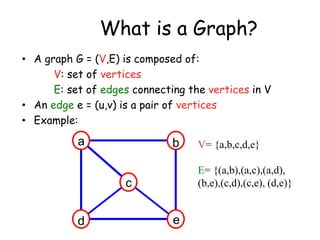
What is a Graph?
• A graph G = (V,E) is composed of:
V: set of vertices
E: set of edges connecting the vertices in V
• An edge e = (u,v) is a pair of vertices
• Example:
a b
c
d e
V= {a,b,c,d,e}
E= {(a,b),(a,c),(a,d),
(b,e),(c,d),(c,e), (d,e)}
some problems that can be
represented by a graph
• computer networks
• airline flights
• road map
• course prerequisite structure
• tasks for completing a job
• flow of control through a
program
• many more
a digraph
A
B
C D
E
V = [A, B, C, D, E]
E = [<A,B>, <B,C>, <C,B>, <A,C>, <A,E>, <C,D>]
Graph terminology
• The size of a graph is the number of nodes in it
• The empty graph has size zero (no nodes)
• If two nodes are connected by an edge, they are
neighbors (and the nodes are adjacent to each other)
• The degree of a node is the number of edges it has
• For directed graphs,
– If a directed edge goes from node S to node D, we call S the
source and D the destination of the edge
• The edge is an out-edge of S and an in-edge of D
• S is a predecessor of D, and D is a successor of S
– The in-degree of a node is the number of in-edges it has
– The out-degree of a node is the number of out-edges it has
6
7
Terminology:
Path
• path: sequence of
vertices v1,v2,. . .vk
such that consecutive
vertices vi and vi+1 are
adjacent.
3
3 3
3
2
a b
c
d e
a b
c
d e
a b e d c b e d c
More Terminology
• simple path: no repeated vertices
• cycle: simple path, except that the last vertex is the same
as the first vertex
a b
c
d e
b e c
a c d a
a b
c
d e
Even More Terminology
• subgraph: subset of vertices and edges forming a graph
• connected component: maximal connected subgraph. E.g.,
the graph below has 3 connected components.
connected not connected
•connected graph: any two vertices are connected
by some path
0 0
1 2 3
1 2 0
1 2
3
(i) (ii) (iii) (iv)
(a) Some of the subgraph of G1
0 0
1
0
1
2
0
1
2
(i) (ii) (iii) (iv)
(b) Some of the subgraph of G3
0
1 2
3
G1
0
1
2
G3
Subgraphs Examples
More…
• tree - connected graph without cycles
• forest - collection of trees
tree
forest
tree
tree
tree
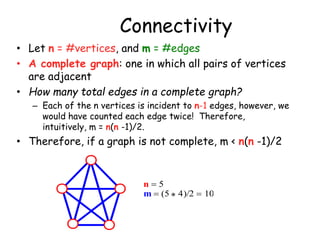
Connectivity
• Let n = #vertices, and m = #edges
• A complete graph: one in which all pairs of vertices
are adjacent
• How many total edges in a complete graph?
– Each of the n vertices is incident to n-1 edges, however, we
would have counted each edge twice! Therefore,
intuitively, m = n(n -1)/2.
• Therefore, if a graph is not complete, m < n(n -1)/2
n 5
m  (5 
More Connectivity
n = #vertices
m = #edges
• For a tree m = n - 1
n  5
m  4
n  5
m  3
If m < n - 1, G is not
connected
Oriented (Directed) Graph
• A graph where edges are directed
Directed vs. Undirected Graph
• An undirected graph is one in which the
pair of vertices in a edge is unordered,
(v0, v1) = (v1,v0)
• A directed graph is one in which each
edge is a directed pair of vertices, <v0,
v1> != <v1,v0> tail head
Graph terminology
• An undirected graph is connected if there is a
path from every node to every other node
• A directed graph is strongly connected if there is
a path from every node to every other node
• A directed graph is weakly connected if the
underlying undirected graph is connected
• Node X is reachable from node Y if there is a path
from Y to X
• A subset of the nodes of the graph is a connected
component (or just a component) if there is a path
from every node in the subset to every other node
in the subset
16
graph data structures
• storing the vertices
– each vertex has a unique identifier and,
maybe, other information
– for efficiency, associate each vertex with a
number that can be used as an index
• storing the edges
– adjacency matrix – represent all possible
edges
– adjacency lists – represent only the
existing edges
storing the vertices
• when a vertex is added to the graph,
assign it a number
– vertices are numbered between 0 and n-1
• graph operations start by looking up
the number associated with a vertex
• many data structures to use
– any of the associative data structures
– for small graphs a vector can be used
• search will be O(n)
the vertex vector
A
B
C D
E
0
1
2 3
4
0
1
2
3
4
A
B
C
D
E
adjacency matrix
A
B
C D
E
0
1
2 3
4
0
1
2
3
4
A
B
C
D
E
0 1 1 0 1
0 0 1 0 0
0 1 0 1 0
0 0 0 0 0
0 0 0 0 0
0
1
2
3
4
0 1 2 3 4
Examples for Adjacency Matrix
0
1
1
1
1
0
1
1
1
1
0
1
1
1
1
0












0
1
0
1
0
0
0
1
0










G1
G2
0
1 2
3
0
1
2
symmetric
Asymmetric
maximum # edges?
a V2 matrix is needed for
a graph with V vertices
many graphs are “sparse”
• degree of “sparseness” key factor in
choosing a data structure for edges
– adjacency matrix requires space for all
possible edges
– adjacency list requires space for existing
edges only
• affects amount of memory space
needed
• affects efficiency of graph operations
adjacency lists
A
B
C D
E
0
1
2 3
4
0
1
2
3
4
1 2 4
2
1 3
0
1
2
3
4
A
B
C
D
E
0
1
2
3
0
1
2
1 2 3
0 2 3
0 1 3
0 1 2
G1
1
0 2
G3
0
1 2
3
0
1
2
Least-Cost Algorithms
Dijkstra’s Algorithm
Find the least cost path from a given node to all
other nodes in the network
N = Set of nodes in the network
s = Source node
M = Set of nodes so far incorporated by the
algorithm
dij = link cost from node i to node j, dii = 0
dij = ∞ if two nodes are not directly connected
dij >= 0 of two nodes are directly connected
Dn = cost of the least-cost path from node s to
node n that is currently known to the algorithm
1. Initialize
M = {s} [ set of nodes so far
incorporated consists of only the
source node]
Dn = dsn for n != s (initial path costs to
the neighbor nodes are simply the link
cost)
2. Find the neighbor node not in M that
has the least-cost path from node s
and incorporate that node into M.
Find w !Є M such that Dw = min { Dj } for j
!Є M
3. Update the least-cost path:
Dn = min[ Dn , Dw + dwn ] for all n !Є M
If the latter term is minimum, path from
s to n is now the path from s to w,
concatenated with the link from w to n
2 3
4 5
61
6
2
7
1
3 1
8
4
8
2
5
3
2
1
3
5
It M D2 Path D3 Path D4 Path D5 Path D6 Path
1 {1} 2 1 -2 5 1-3 1 1-4 ∞ - ∞ -
2 {1, 4} 2 1-2 4 1-4-3 1 1-4 2 1-4-5 ∞ -
3 {1,2,4} 2 1-2 4 1-4-3 1 1-4 2 1-4-5 ∞ -
It = Iteration

10.graph

  • 1.
    Data Structure and Algorithm(CS-102) Ashok K Turuk
  • 2.
    Graph • A graphis a collection of nodes (or vertices, singular is vertex) and edges (or arcs) – Each node contains an element – Each edge connects two nodes together (or possibly the same node to itself) and may contain an edge attribute • A directed graph is one in which the edges have a direction • An undirected graph is one in which the edges do not have a direction 2
  • 3.
    What is aGraph? • A graph G = (V,E) is composed of: V: set of vertices E: set of edges connecting the vertices in V • An edge e = (u,v) is a pair of vertices • Example: a b c d e V= {a,b,c,d,e} E= {(a,b),(a,c),(a,d), (b,e),(c,d),(c,e), (d,e)}
  • 4.
    some problems thatcan be represented by a graph • computer networks • airline flights • road map • course prerequisite structure • tasks for completing a job • flow of control through a program • many more
  • 5.
    a digraph A B C D E V= [A, B, C, D, E] E = [<A,B>, <B,C>, <C,B>, <A,C>, <A,E>, <C,D>]
  • 6.
    Graph terminology • Thesize of a graph is the number of nodes in it • The empty graph has size zero (no nodes) • If two nodes are connected by an edge, they are neighbors (and the nodes are adjacent to each other) • The degree of a node is the number of edges it has • For directed graphs, – If a directed edge goes from node S to node D, we call S the source and D the destination of the edge • The edge is an out-edge of S and an in-edge of D • S is a predecessor of D, and D is a successor of S – The in-degree of a node is the number of in-edges it has – The out-degree of a node is the number of out-edges it has 6
  • 7.
    7 Terminology: Path • path: sequenceof vertices v1,v2,. . .vk such that consecutive vertices vi and vi+1 are adjacent. 3 3 3 3 2 a b c d e a b c d e a b e d c b e d c
  • 8.
    More Terminology • simplepath: no repeated vertices • cycle: simple path, except that the last vertex is the same as the first vertex a b c d e b e c a c d a a b c d e
  • 9.
    Even More Terminology •subgraph: subset of vertices and edges forming a graph • connected component: maximal connected subgraph. E.g., the graph below has 3 connected components. connected not connected •connected graph: any two vertices are connected by some path
  • 10.
    0 0 1 23 1 2 0 1 2 3 (i) (ii) (iii) (iv) (a) Some of the subgraph of G1 0 0 1 0 1 2 0 1 2 (i) (ii) (iii) (iv) (b) Some of the subgraph of G3 0 1 2 3 G1 0 1 2 G3 Subgraphs Examples
  • 11.
    More… • tree -connected graph without cycles • forest - collection of trees tree forest tree tree tree
  • 12.
    Connectivity • Let n= #vertices, and m = #edges • A complete graph: one in which all pairs of vertices are adjacent • How many total edges in a complete graph? – Each of the n vertices is incident to n-1 edges, however, we would have counted each edge twice! Therefore, intuitively, m = n(n -1)/2. • Therefore, if a graph is not complete, m < n(n -1)/2 n 5 m  (5 
  • 13.
    More Connectivity n =#vertices m = #edges • For a tree m = n - 1 n  5 m  4 n  5 m  3 If m < n - 1, G is not connected
  • 14.
    Oriented (Directed) Graph •A graph where edges are directed
  • 15.
    Directed vs. UndirectedGraph • An undirected graph is one in which the pair of vertices in a edge is unordered, (v0, v1) = (v1,v0) • A directed graph is one in which each edge is a directed pair of vertices, <v0, v1> != <v1,v0> tail head
  • 16.
    Graph terminology • Anundirected graph is connected if there is a path from every node to every other node • A directed graph is strongly connected if there is a path from every node to every other node • A directed graph is weakly connected if the underlying undirected graph is connected • Node X is reachable from node Y if there is a path from Y to X • A subset of the nodes of the graph is a connected component (or just a component) if there is a path from every node in the subset to every other node in the subset 16
  • 17.
    graph data structures •storing the vertices – each vertex has a unique identifier and, maybe, other information – for efficiency, associate each vertex with a number that can be used as an index • storing the edges – adjacency matrix – represent all possible edges – adjacency lists – represent only the existing edges
  • 18.
    storing the vertices •when a vertex is added to the graph, assign it a number – vertices are numbered between 0 and n-1 • graph operations start by looking up the number associated with a vertex • many data structures to use – any of the associative data structures – for small graphs a vector can be used • search will be O(n)
  • 19.
    the vertex vector A B CD E 0 1 2 3 4 0 1 2 3 4 A B C D E
  • 20.
    adjacency matrix A B C D E 0 1 23 4 0 1 2 3 4 A B C D E 0 1 1 0 1 0 0 1 0 0 0 1 0 1 0 0 0 0 0 0 0 0 0 0 0 0 1 2 3 4 0 1 2 3 4
  • 21.
    Examples for AdjacencyMatrix 0 1 1 1 1 0 1 1 1 1 0 1 1 1 1 0             0 1 0 1 0 0 0 1 0           G1 G2 0 1 2 3 0 1 2 symmetric Asymmetric
  • 22.
    maximum # edges? aV2 matrix is needed for a graph with V vertices
  • 23.
    many graphs are“sparse” • degree of “sparseness” key factor in choosing a data structure for edges – adjacency matrix requires space for all possible edges – adjacency list requires space for existing edges only • affects amount of memory space needed • affects efficiency of graph operations
  • 24.
    adjacency lists A B C D E 0 1 23 4 0 1 2 3 4 1 2 4 2 1 3 0 1 2 3 4 A B C D E
  • 25.
    0 1 2 3 0 1 2 1 2 3 02 3 0 1 3 0 1 2 G1 1 0 2 G3 0 1 2 3 0 1 2
  • 26.
    Least-Cost Algorithms Dijkstra’s Algorithm Findthe least cost path from a given node to all other nodes in the network N = Set of nodes in the network s = Source node M = Set of nodes so far incorporated by the algorithm dij = link cost from node i to node j, dii = 0 dij = ∞ if two nodes are not directly connected dij >= 0 of two nodes are directly connected Dn = cost of the least-cost path from node s to node n that is currently known to the algorithm
  • 27.
    1. Initialize M ={s} [ set of nodes so far incorporated consists of only the source node] Dn = dsn for n != s (initial path costs to the neighbor nodes are simply the link cost) 2. Find the neighbor node not in M that has the least-cost path from node s and incorporate that node into M.
  • 28.
    Find w !ЄM such that Dw = min { Dj } for j !Є M 3. Update the least-cost path: Dn = min[ Dn , Dw + dwn ] for all n !Є M If the latter term is minimum, path from s to n is now the path from s to w, concatenated with the link from w to n
  • 29.
    2 3 4 5 61 6 2 7 1 31 8 4 8 2 5 3 2 1 3 5
  • 30.
    It M D2Path D3 Path D4 Path D5 Path D6 Path 1 {1} 2 1 -2 5 1-3 1 1-4 ∞ - ∞ - 2 {1, 4} 2 1-2 4 1-4-3 1 1-4 2 1-4-5 ∞ - 3 {1,2,4} 2 1-2 4 1-4-3 1 1-4 2 1-4-5 ∞ - It = Iteration