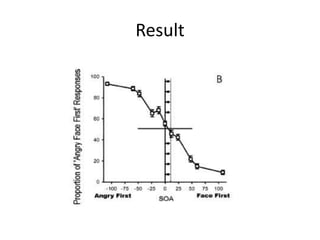
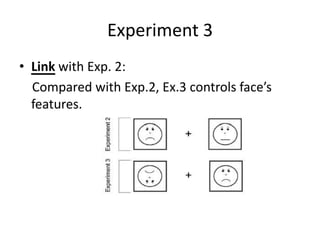
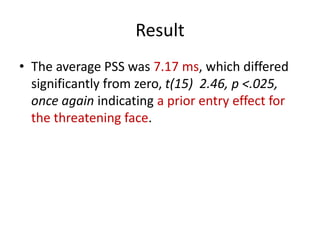
The study used temporal order judgment (TOJ) tasks to directly measure how motivationally significant stimuli like faces capture attention. In Experiment 1, upright faces showed prior entry over inverted faces. Experiment 2 found emotional faces had greater prior entry than neutral faces. Experiment 3 ruled out low-level feature differences by finding prior entry for inverted emotional faces. Experiment 4 eliminated prior entry for inverted faces, supporting the role of holistic processing. Experiment 5 extended these effects to realistic faces. Experiment 6 addressed response biases. Across experiments, the study provides evidence that faces and emotional expressions capture attention through visual prior entry.




![(Posner, Walker, Friedrich, & Rafal, 1984)Their studies assess a global attentional measure created by gauging a combination of different attentional processes. [(1),(2),(3)]](https://image.slidesharecdn.com/1019yijung-091020083502-phpapp01/85/1019-Yijung-7-320.jpg)