| XPLANE 1OUR THINKING
10 TIPS FOR RUNNING A SUCCESSFUL WORKSHOP
JULY 2014
| XPLANE 2OUR THINKING 2
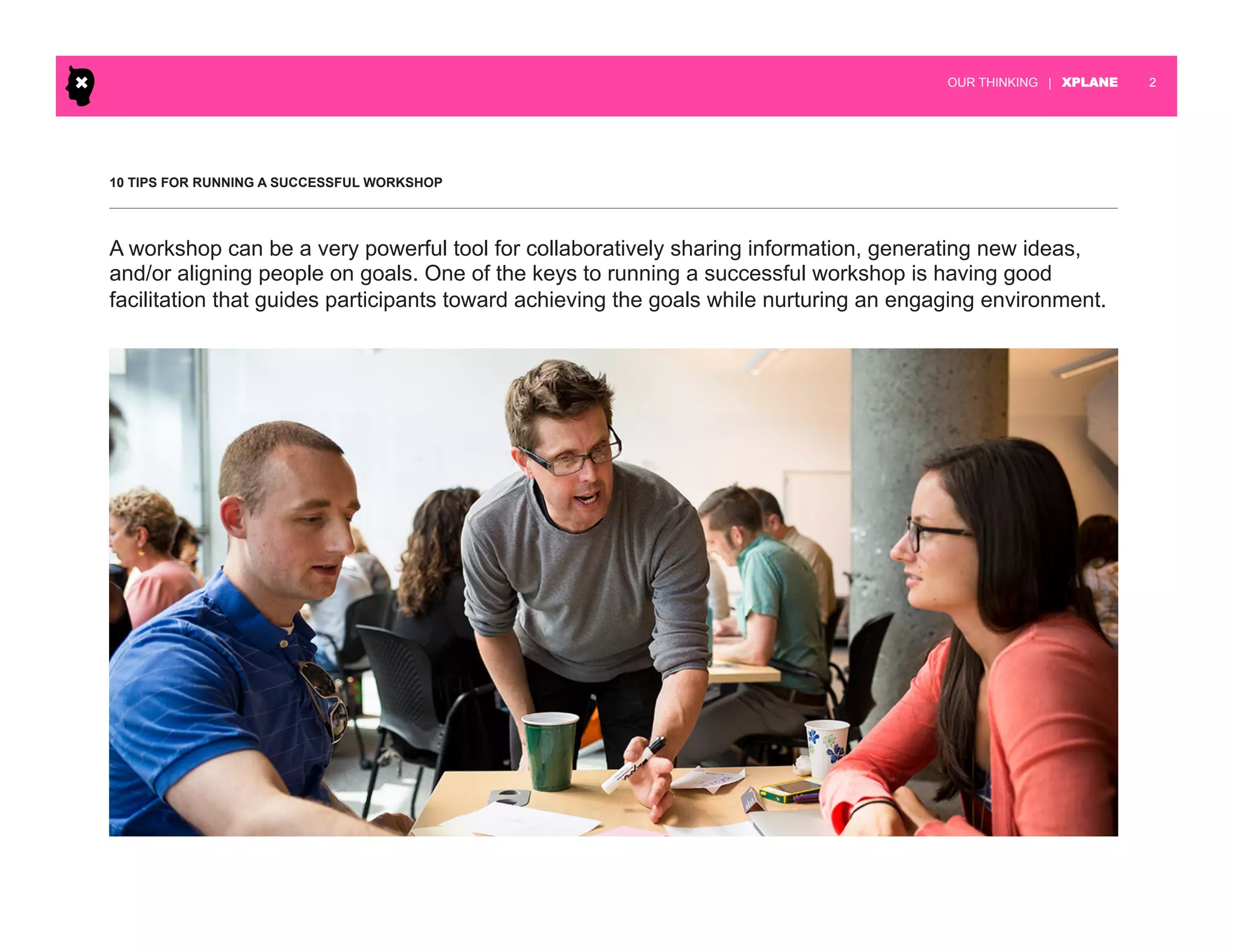
A workshop can be a very powerful tool for collaboratively sharing information, generating new ideas,
and/or aligning people on goals. One of the keys to running a successful workshop is having good
facilitation that guides participants toward achieving the goals while nurturing an engaging environment.
10 TIPS FOR RUNNING A SUCCESSFUL WORKSHOP
| XPLANE 3OUR THINKING
10 TIPS FOR RUNNING A SUCCESSFUL WORKSHOP
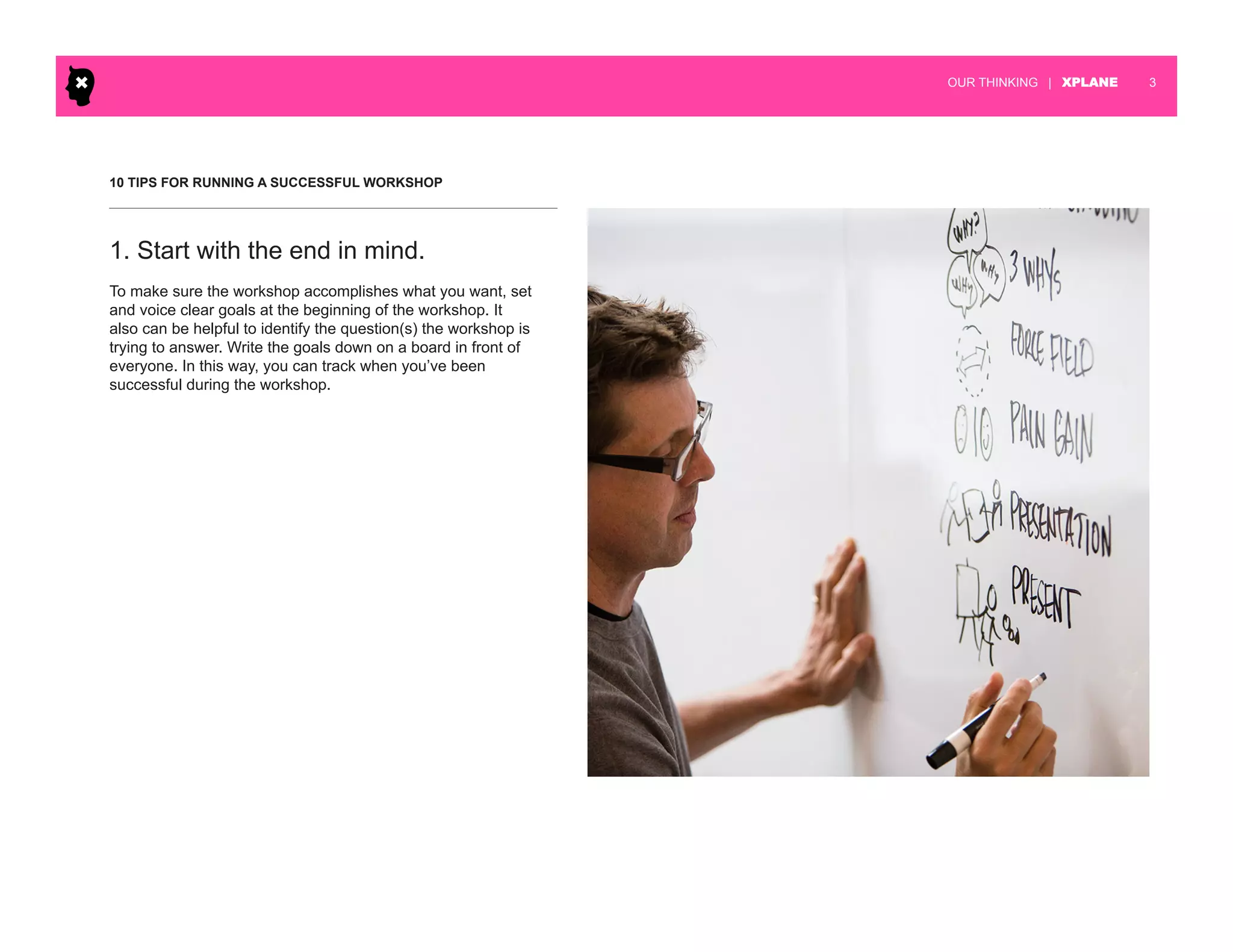
To make sure the workshop accomplishes what you want, set
and voice clear goals at the beginning of the workshop. It
also can be helpful to identify the question(s) the workshop is
trying to answer. Write the goals down on a board in front of
everyone. In this way, you can track when you’ve been
successful during the workshop.
1. Start with the end in mind.
| XPLANE 4OUR THINKING
10 TIPS FOR RUNNING A SUCCESSFUL WORKSHOP
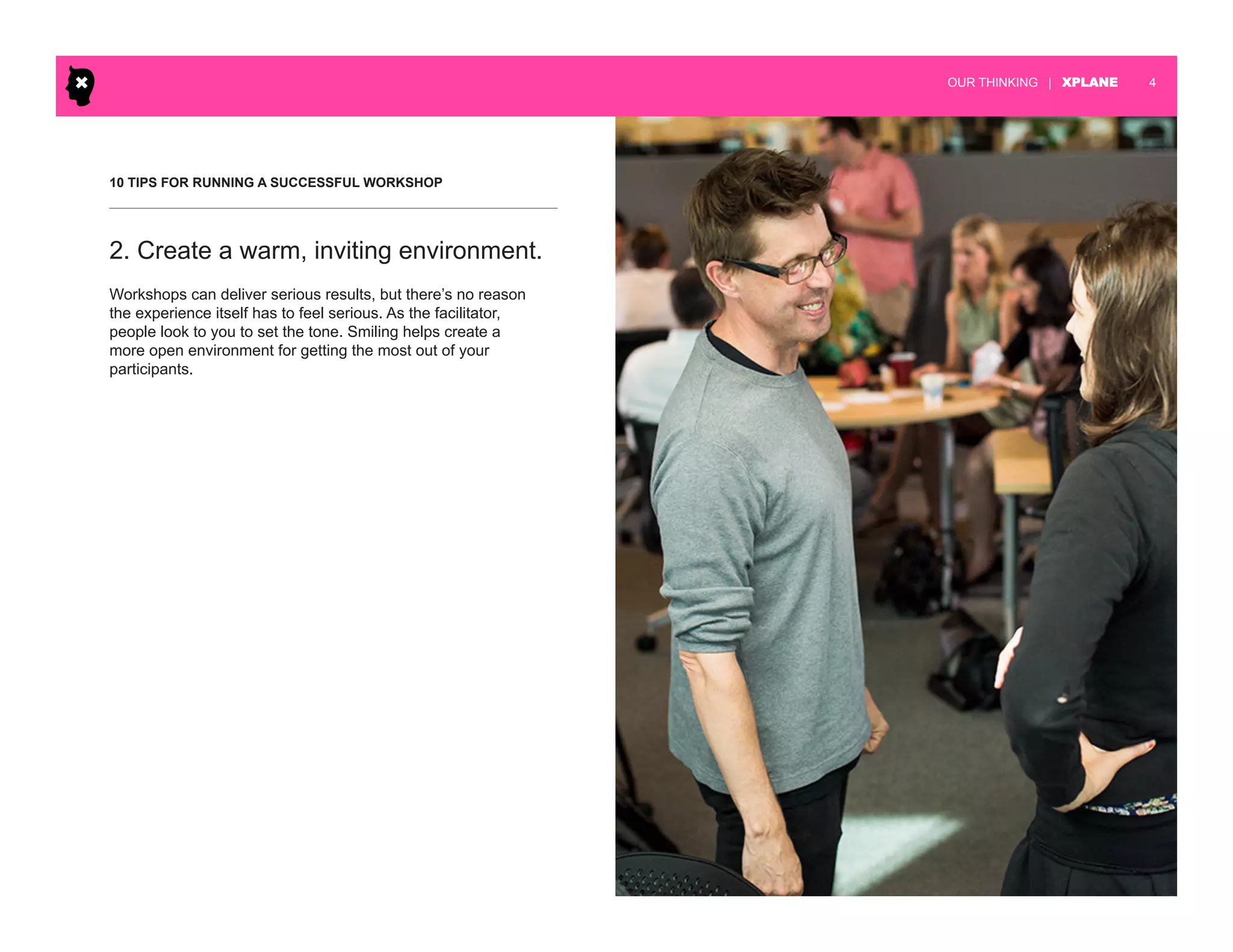
Workshops can deliver serious results, but there’s no reason
the experience itself has to feel serious. As the facilitator,
people look to you to set the tone. Smiling helps create a
more open environment for getting the most out of your
participants.
2. Create a warm, inviting environment.
| XPLANE 5OUR THINKING
10 TIPS FOR RUNNING A SUCCESSFUL WORKSHOP
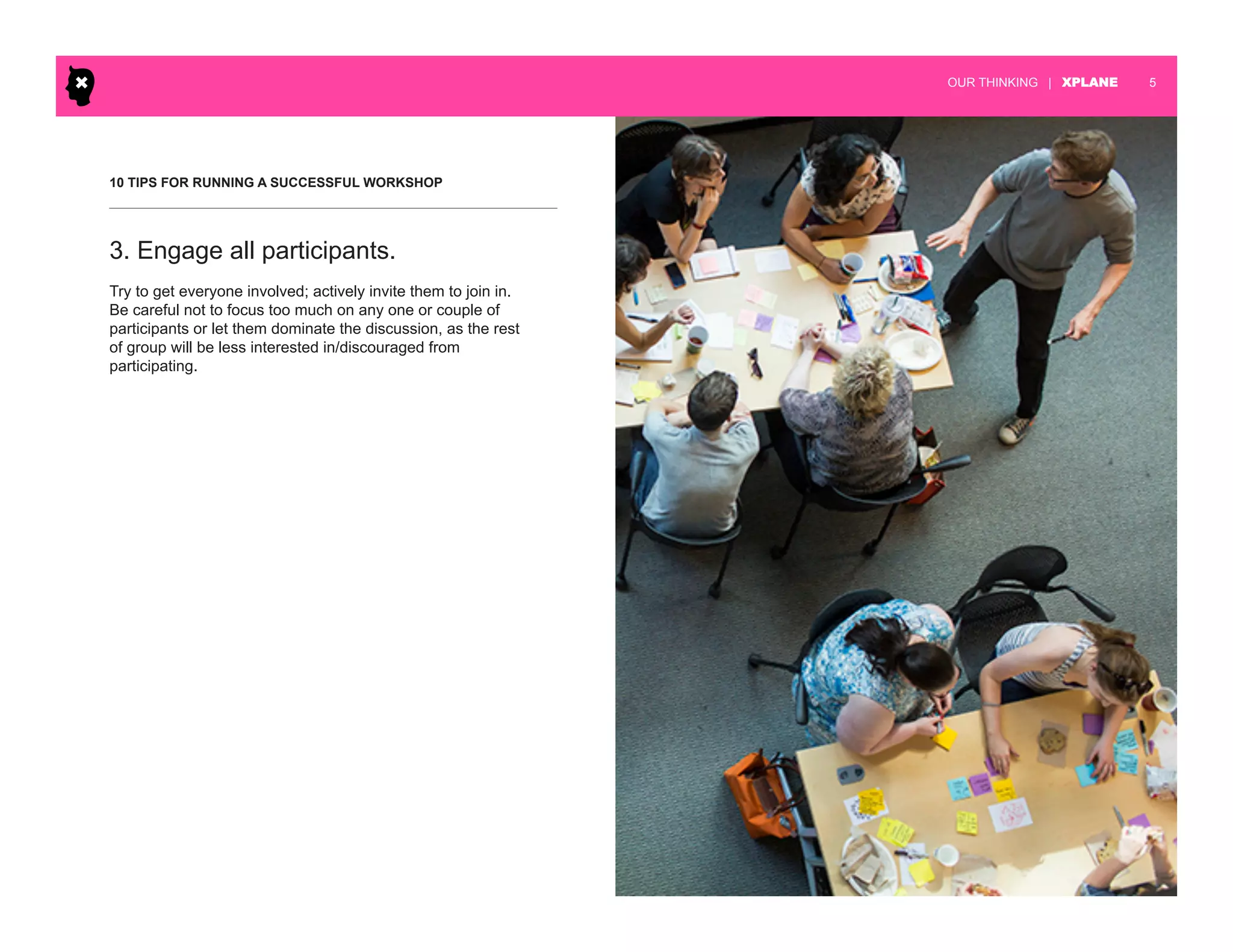
Try to get everyone involved; actively invite them to join in.
Be careful not to focus too much on any one or couple of
participants or let them dominate the discussion, as the rest
of group will be less interested in/discouraged from
participating.
3. Engage all participants.
| XPLANE 6OUR THINKING
10 TIPS FOR RUNNING A SUCCESSFUL WORKSHOP
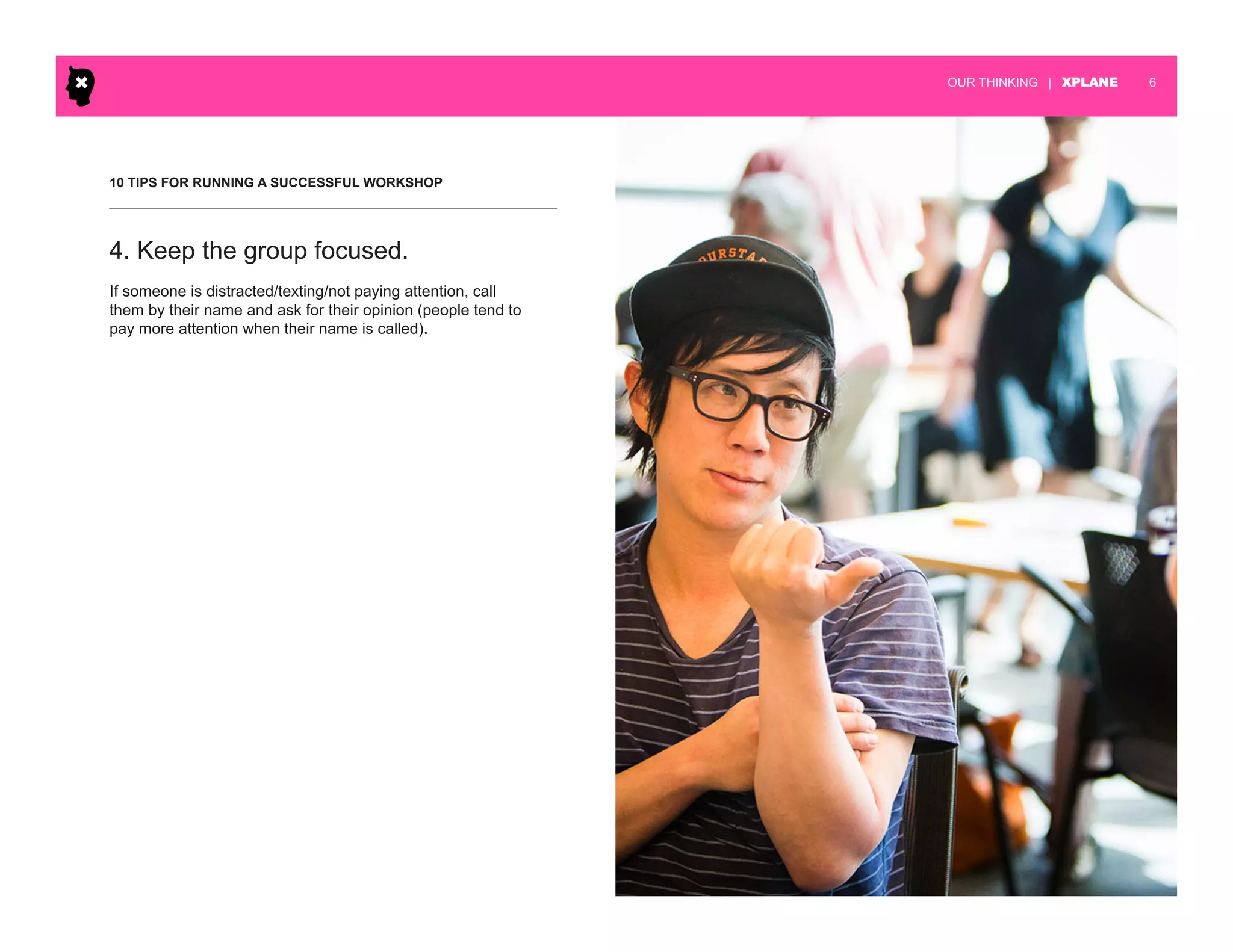
If someone is distracted/texting/not paying attention, call
them by their name and ask for their opinion (people tend to
pay more attention when their name is called).
4. Keep the group focused.
| XPLANE 7OUR THINKING
10 TIPS FOR RUNNING A SUCCESSFUL WORKSHOP
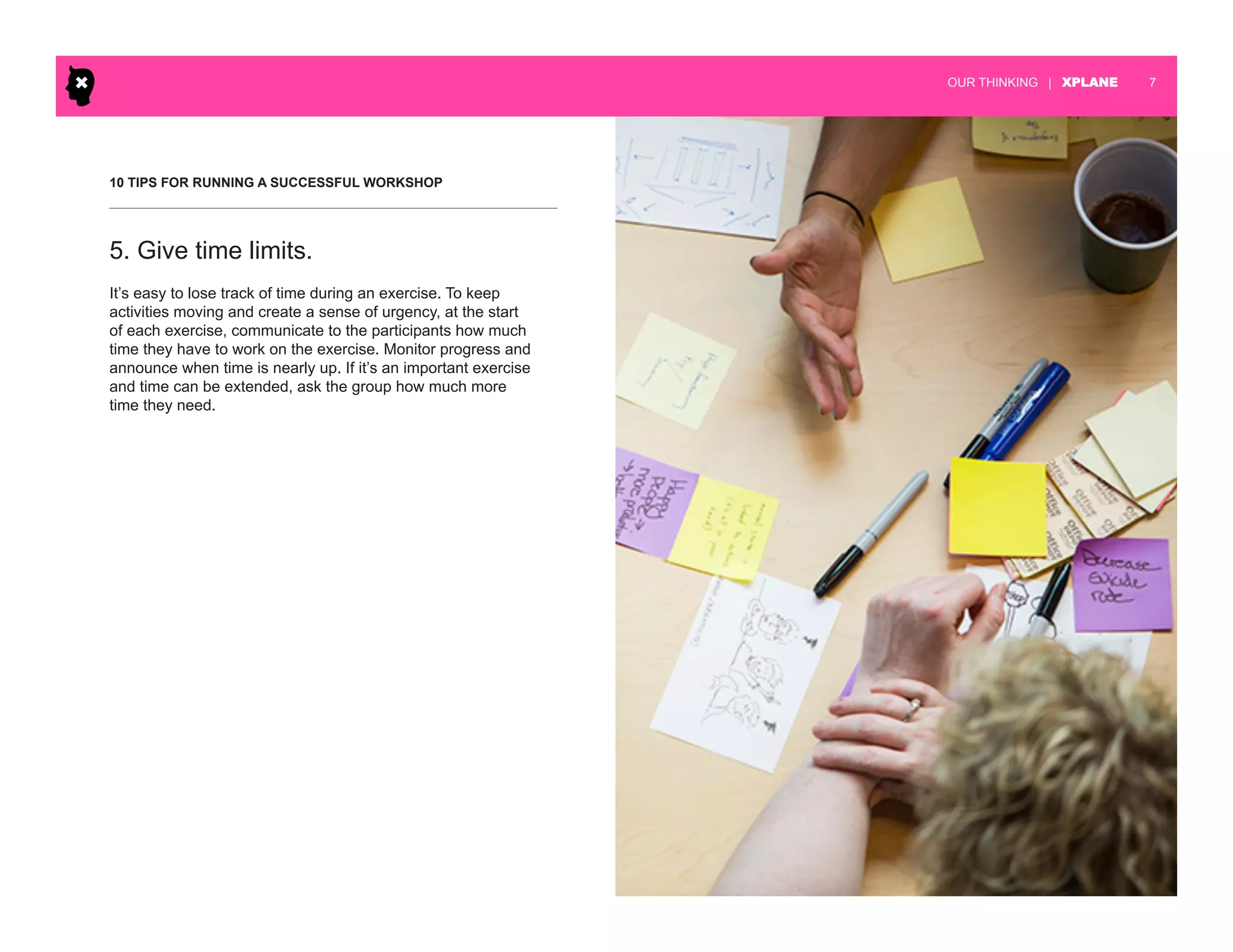
It’s easy to lose track of time during an exercise. To keep
activities moving and create a sense of urgency, at the start
of each exercise, communicate to the participants how much
time they have to work on the exercise. Monitor progress and
announce when time is nearly up. If it’s an important exercise
and time can be extended, ask the group how much more
time they need.
5. Give time limits.
| XPLANE 8OUR THINKING
10 TIPS FOR RUNNING A SUCCESSFUL WORKSHOP
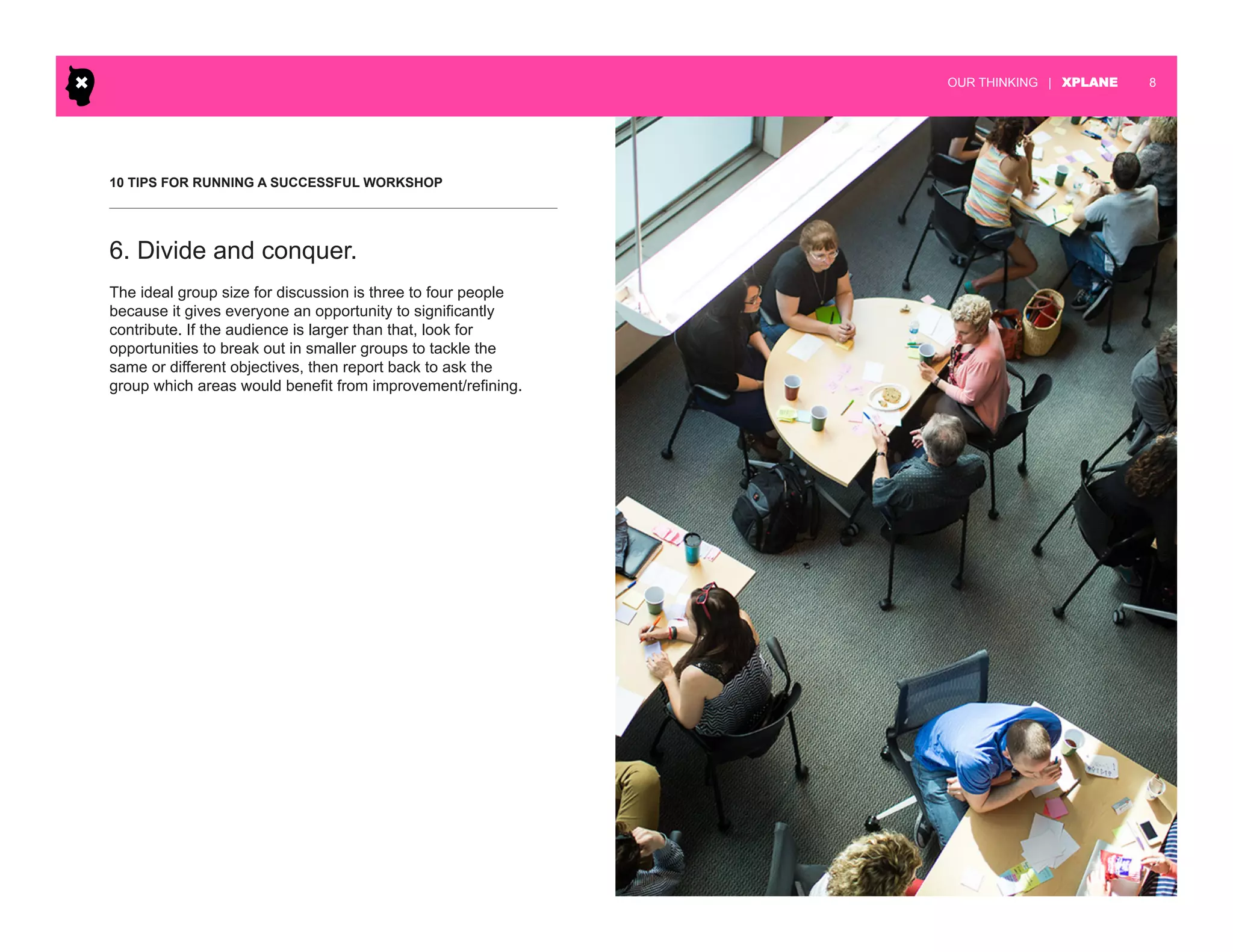
The ideal group size for discussion is three to four people
because it gives everyone an opportunity to significantly
contribute. If the audience is larger than that, look for
opportunities to break out in smaller groups to tackle the
same or different objectives, then report back to ask the
group which areas would benefit from improvement/refining.
6. Divide and conquer.
| XPLANE 9OUR THINKING
10 TIPS FOR RUNNING A SUCCESSFUL WORKSHOP
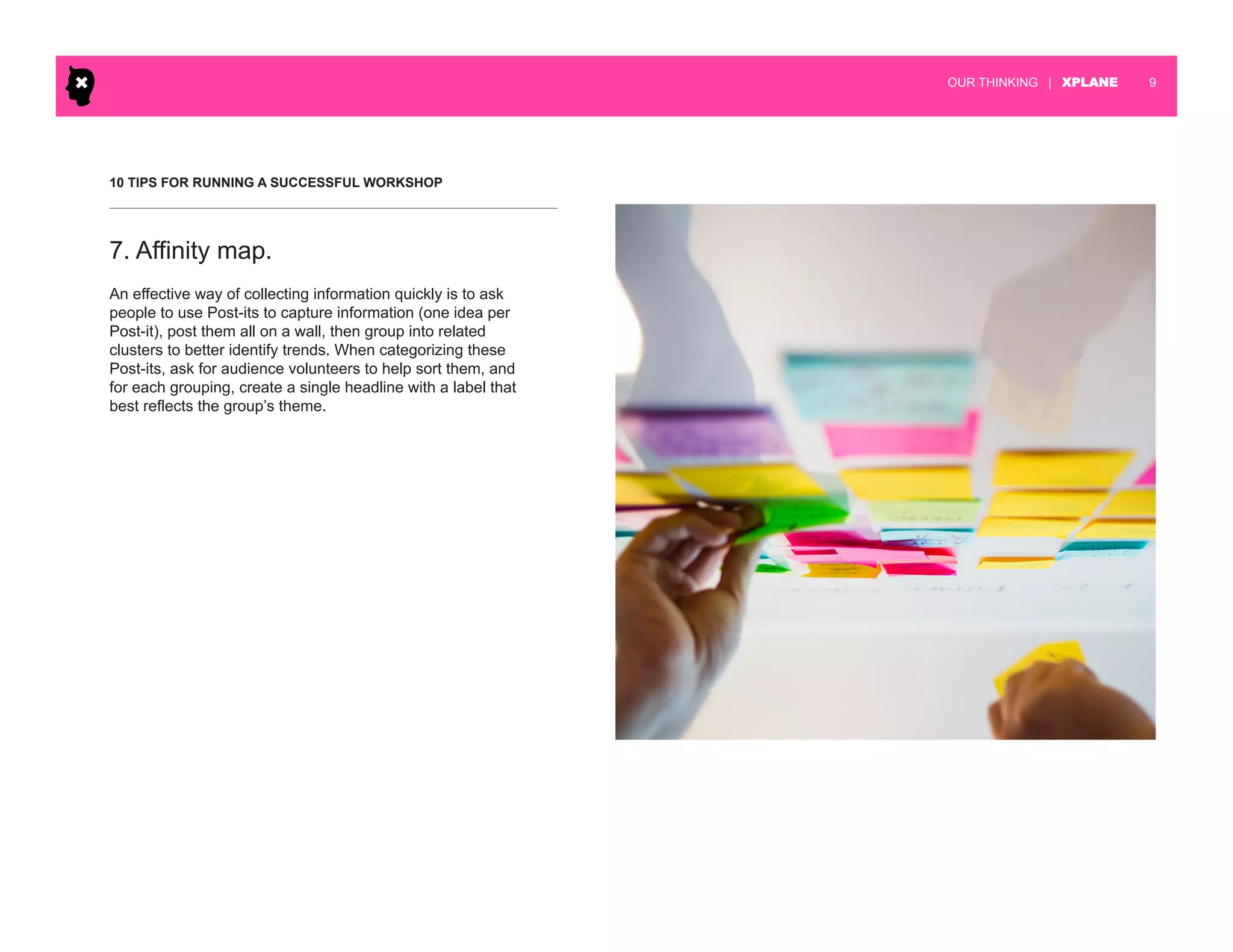
An effective way of collecting information quickly is to ask
people to use Post-its to capture information (one idea per
Post-it), post them all on a wall, then group into related
clusters to better identify trends. When categorizing these
Post-its, ask for audience volunteers to help sort them, and
for each grouping, create a single headline with a label that
best reflects the group’s theme.
7. Affinity map.
| XPLANE 10OUR THINKING
10 TIPS FOR RUNNING A SUCCESSFUL WORKSHOP
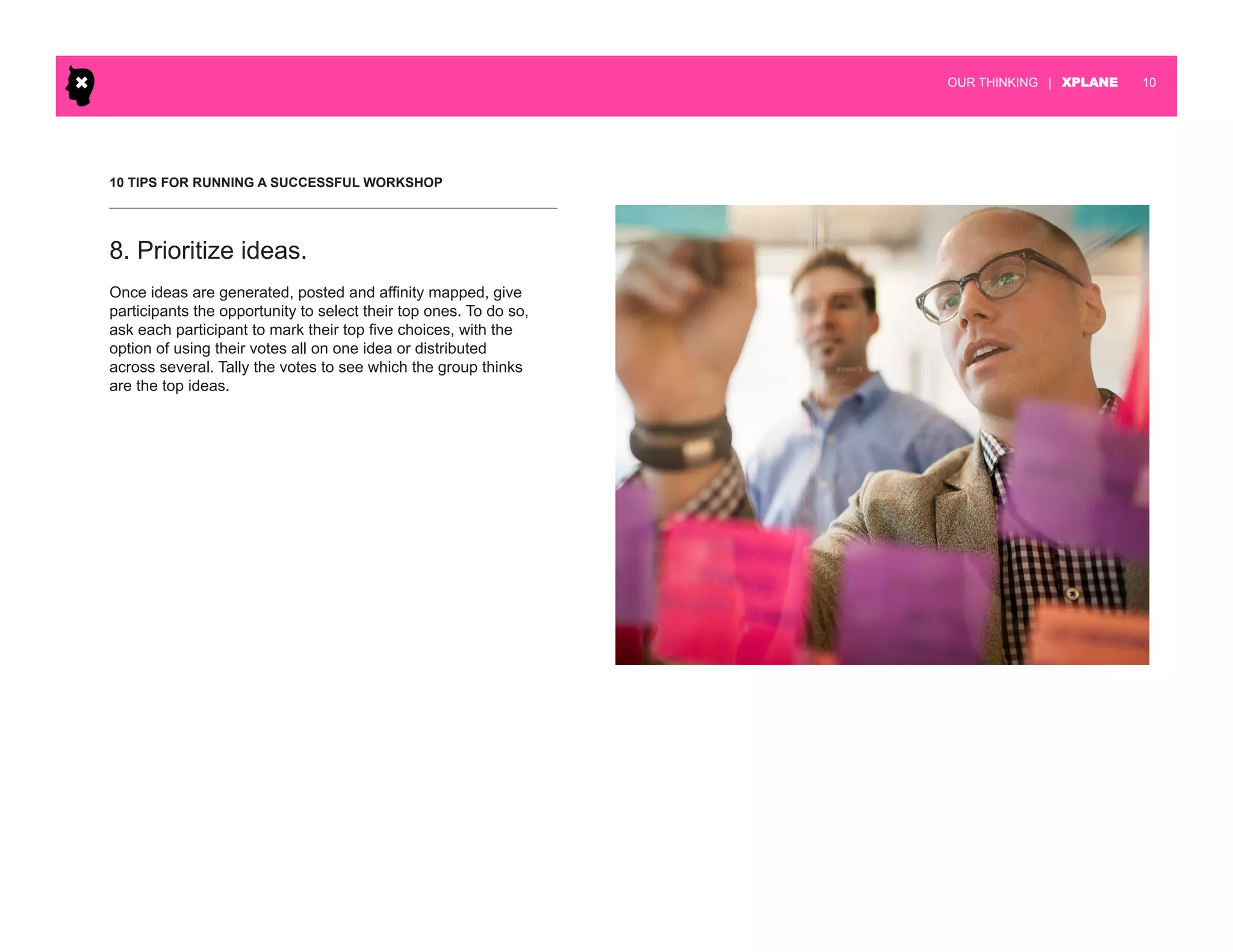
Once ideas are generated, posted and affinity mapped, give
participants the opportunity to select their top ones. To do so,
ask each participant to mark their top five choices, with the
option of using their votes all on one idea or distributed
across several. Tally the votes to see which the group thinks
are the top ideas.
8. Prioritize ideas.
| XPLANE 11OUR THINKING
10 TIPS FOR RUNNING A SUCCESSFUL WORKSHOP
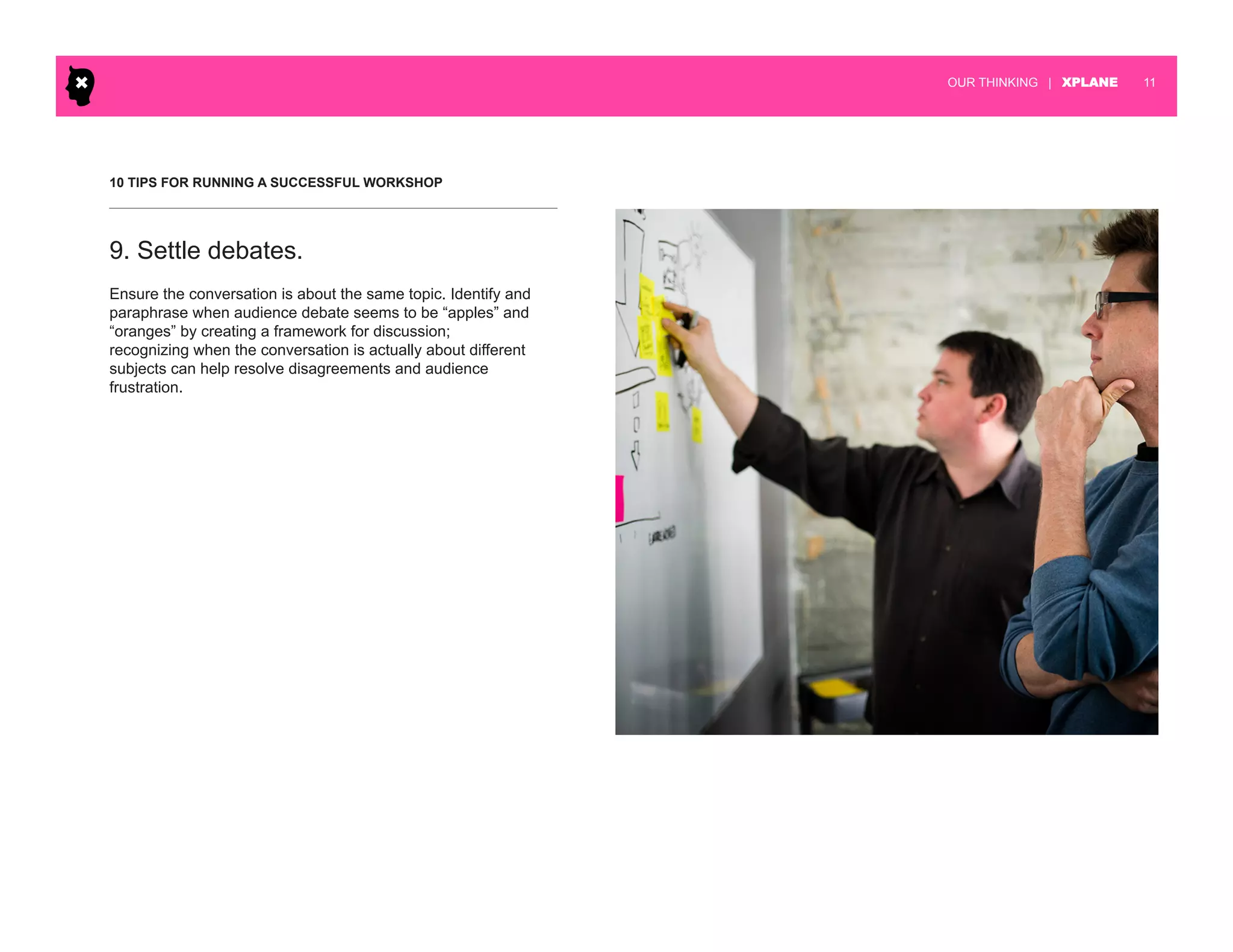
Ensure the conversation is about the same topic. Identify and
paraphrase when audience debate seems to be “apples” and
“oranges” by creating a framework for discussion;
recognizing when the conversation is actually about different
subjects can help resolve disagreements and audience
frustration.
9. Settle debates.
| XPLANE 12OUR THINKING
10 TIPS FOR RUNNING A SUCCESSFUL WORKSHOP
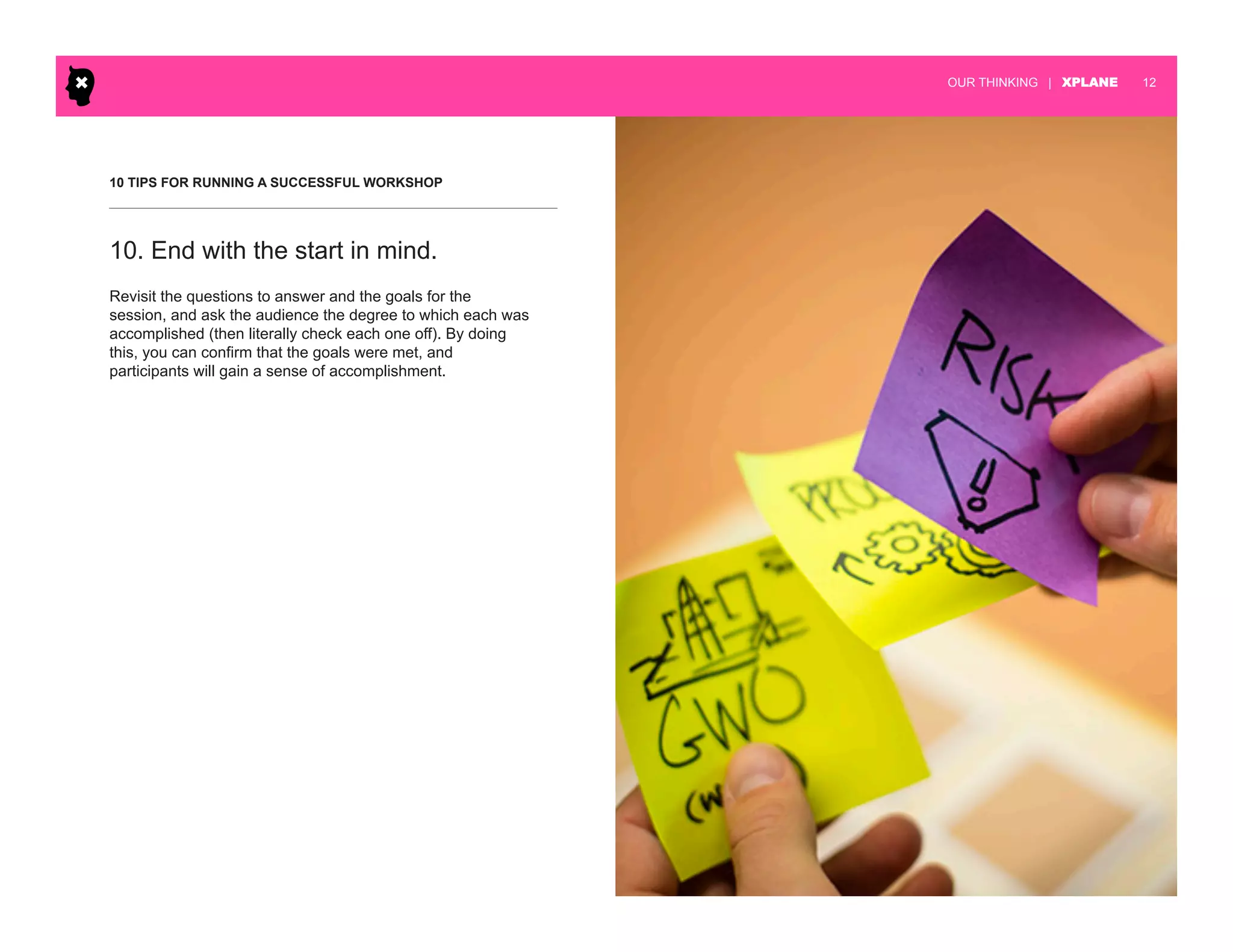
Revisit the questions to answer and the goals for the
session, and ask the audience the degree to which each was
accomplished (then literally check each one off). By doing
this, you can confirm that the goals were met, and
participants will gain a sense of accomplishment.
10. End with the start in mind.
| XPLANE 13OUR THINKING
www.xplane.com

10 Tips for Runnning a Successful Workshop

  • 1.
    | XPLANE 1OURTHINKING 10 TIPS FOR RUNNING A SUCCESSFUL WORKSHOP JULY 2014
  • 2.
    | XPLANE 2OURTHINKING 2 A workshop can be a very powerful tool for collaboratively sharing information, generating new ideas, and/or aligning people on goals. One of the keys to running a successful workshop is having good facilitation that guides participants toward achieving the goals while nurturing an engaging environment. 10 TIPS FOR RUNNING A SUCCESSFUL WORKSHOP
  • 3.
    | XPLANE 3OURTHINKING 10 TIPS FOR RUNNING A SUCCESSFUL WORKSHOP To make sure the workshop accomplishes what you want, set and voice clear goals at the beginning of the workshop. It also can be helpful to identify the question(s) the workshop is trying to answer. Write the goals down on a board in front of everyone. In this way, you can track when you’ve been successful during the workshop. 1. Start with the end in mind.
  • 4.
    | XPLANE 4OURTHINKING 10 TIPS FOR RUNNING A SUCCESSFUL WORKSHOP Workshops can deliver serious results, but there’s no reason the experience itself has to feel serious. As the facilitator, people look to you to set the tone. Smiling helps create a more open environment for getting the most out of your participants. 2. Create a warm, inviting environment.
  • 5.
    | XPLANE 5OURTHINKING 10 TIPS FOR RUNNING A SUCCESSFUL WORKSHOP Try to get everyone involved; actively invite them to join in. Be careful not to focus too much on any one or couple of participants or let them dominate the discussion, as the rest of group will be less interested in/discouraged from participating. 3. Engage all participants.
  • 6.
    | XPLANE 6OURTHINKING 10 TIPS FOR RUNNING A SUCCESSFUL WORKSHOP If someone is distracted/texting/not paying attention, call them by their name and ask for their opinion (people tend to pay more attention when their name is called). 4. Keep the group focused.
  • 7.
    | XPLANE 7OURTHINKING 10 TIPS FOR RUNNING A SUCCESSFUL WORKSHOP It’s easy to lose track of time during an exercise. To keep activities moving and create a sense of urgency, at the start of each exercise, communicate to the participants how much time they have to work on the exercise. Monitor progress and announce when time is nearly up. If it’s an important exercise and time can be extended, ask the group how much more time they need. 5. Give time limits.
  • 8.
    | XPLANE 8OURTHINKING 10 TIPS FOR RUNNING A SUCCESSFUL WORKSHOP The ideal group size for discussion is three to four people because it gives everyone an opportunity to significantly contribute. If the audience is larger than that, look for opportunities to break out in smaller groups to tackle the same or different objectives, then report back to ask the group which areas would benefit from improvement/refining. 6. Divide and conquer.
  • 9.
    | XPLANE 9OURTHINKING 10 TIPS FOR RUNNING A SUCCESSFUL WORKSHOP An effective way of collecting information quickly is to ask people to use Post-its to capture information (one idea per Post-it), post them all on a wall, then group into related clusters to better identify trends. When categorizing these Post-its, ask for audience volunteers to help sort them, and for each grouping, create a single headline with a label that best reflects the group’s theme. 7. Affinity map.
  • 10.
    | XPLANE 10OURTHINKING 10 TIPS FOR RUNNING A SUCCESSFUL WORKSHOP Once ideas are generated, posted and affinity mapped, give participants the opportunity to select their top ones. To do so, ask each participant to mark their top five choices, with the option of using their votes all on one idea or distributed across several. Tally the votes to see which the group thinks are the top ideas. 8. Prioritize ideas.
  • 11.
    | XPLANE 11OURTHINKING 10 TIPS FOR RUNNING A SUCCESSFUL WORKSHOP Ensure the conversation is about the same topic. Identify and paraphrase when audience debate seems to be “apples” and “oranges” by creating a framework for discussion; recognizing when the conversation is actually about different subjects can help resolve disagreements and audience frustration. 9. Settle debates.
  • 12.
    | XPLANE 12OURTHINKING 10 TIPS FOR RUNNING A SUCCESSFUL WORKSHOP Revisit the questions to answer and the goals for the session, and ask the audience the degree to which each was accomplished (then literally check each one off). By doing this, you can confirm that the goals were met, and participants will gain a sense of accomplishment. 10. End with the start in mind.
  • 13.
    | XPLANE 13OURTHINKING www.xplane.com