10 Research-Based Tips
for Enhancing Literacy
Instruction for Students
With Intellectual
Disability
Christopher J. Lemons, Jill H. Allor, Stephanie Al Otaiba,
and Lauren M. LeJeune
Literacy
T
E
A
C
H
IN
G
E
xc
ep
ti
on
al
C
h
il
d
re
n
,
V
ol
.
49
,
N
o.
1
,
p
p
.
18
–3
0.
C
op
yr
ig
h
t
20
16
T
h
e
A
u
th
or
(s
).
D
O
I:
1
0.
11
77
/0
04
00
59
91
66
62
20
2
by guest on October 20, 2016tcx.sagepub.comDownloaded from
http://tcx.sagepub.com/
TEACHING EXCEPTIONAL CHILDREN |
SEPTEMBER/OCTOBER 2016 19
In the past 2 decades, researchers
(often working closely with parents,
teachers, and other school staff
members) have conducted studies that
have substantially increased
understanding how to effectively teach
children and adolescents with
intellectual disability (ID) to read. This
research focus has been fueled by
increased societal expectations for
individuals with ID, advocacy efforts,
and legislative priorities (e.g.,
strengthened accountability standards).
Findings from this body of work
indicate that children and adolescents
with ID can obtain higher levels of
reading achievement than previously
anticipated (Allor, Mathes, Roberts,
Cheatham, & Al Otaiba, 2014). Recent
research also suggests that the historic
focus on functional reading (e.g., signs,
restaurant words) for this population of
learners is likely too limited of a focus
for many (Browder et al., 2009).
Research outcomes suggest that
integrating components of traditional
reading instruction (e.g., phonics,
phonemic awareness) into programs
for students with ID will lead to
increases in independent reading skills
for many (Allor, Al Otaiba, Ortiz, &
Folsom, 2014). These increased reading
abilities are likely to lead to greater
postsecondary outcomes, including
employment, independence, and
quality of life. Unfortunately, many
teachers remain unsure of how to best
design and deliver reading intervention
for students with ID.
We offer a set of 10 research-based
tips for special education teachers,
general education teachers, and other
members of IEP teams to consider when
planning literacy instruction for students
with ID in order to maximize student
outcomes. For each tip, we describe our
rationale for the recommendation and
provide implementation guidance. Our
Literacy Instruction and Support
Planning Tool can be used by team
members to organize information to
guide planning. Our aim is to provide
educators and IEP team members with a
framework for reflecting on current
reading practices in order to make
research-based adjustments that are
likely to improve student outcomes.
The Conceptual Model of Literacy
Browder and colleagues (2009) proposed
a conceptual model for early literacy
instruction for students with severe
developmental disabilities. We believe
their framework provides guidance for
designing and delivering literacy
instruction for all students with ID. We
used Browder et al.’s model to develop the
Literacy Instruction and Support Planning
Tool that IEP teams can use to guide
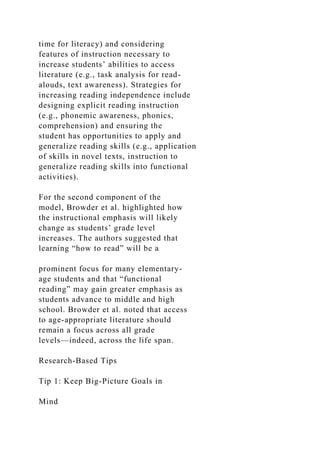
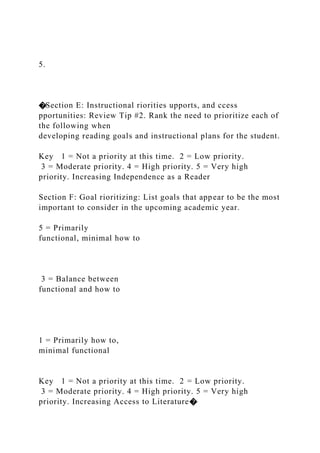
decision making (see Figure 1). We
encourage readers to obtain Browder et
al.’s original article, however, for
additional detail on the conceptual model.
Browder et al.’s (2009) model includes
two primary components. The first
component offers guidance on
considering instructional priorities,
supports, and access opportunities; the
second provides direction for considering
the instructional emphasis. For the first
component, Browder et al. outlined two
primary literacy goals: increasing access
to literature and increasing students’
independence as readers. Within the
initial goal, the emphasis is on ensuring
opportunities are provided for students
to access literature (e.g., adapted books,
time for literacy) and considering
features of instruction necessary to
increase students’ abilities to access
literature (e.g., task analysis for read-
alouds, text awareness). Strategies for
increasing reading independence include
designing explicit reading instruction
(e.g., phonemic awareness, phonics,
comprehension) and ensuring the
student has opportunities to apply and
generalize reading skills (e.g., application
of skills in novel texts, instruction to
generalize reading skills into functional
activities).
For the second component of the
model, Browder et al. highlighted how
the instructional emphasis will likely
change as students’ grade level
increases. The authors suggested that
learning “how to read” will be a
prominent focus for many elementary-
age students and that “functional
reading” may gain greater emphasis as
students advance to middle and high
school. Browder et al. noted that access
to age-appropriate literature should
remain a focus across all grade
levels—indeed, across the life span.
Research-Based Tips
Tip 1: Keep Big-Picture Goals in
Mind
When thinking about literacy
instruction, it may be tempting for
many teachers and parents to focus on
goals for the next calendar year and
subsequently to devote limited time to
looking at the bigger picture. We think
big-picture visioning is important even
in the early elementary school years. It
can be helpful to pause and have team
members spend a little time thinking
about longer-term outcomes and the
amount of time in which these
outcomes are to be achieved.
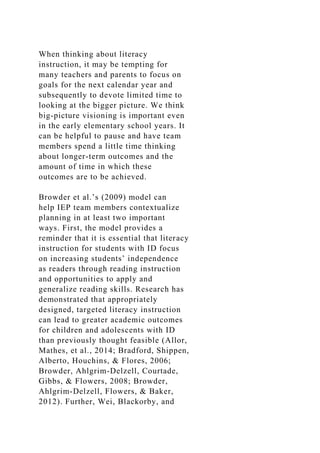
Browder et al.’s (2009) model can
help IEP team members contextualize
planning in at least two important
ways. First, the model provides a
reminder that it is essential that literacy
instruction for students with ID focus
on increasing students’ independence
as readers through reading instruction
and opportunities to apply and
generalize reading skills. Research has
demonstrated that appropriately
designed, targeted literacy instruction
can lead to greater academic outcomes
for children and adolescents with ID
than previously thought feasible (Allor,
Mathes, et al., 2014; Bradford, Shippen,
Alberto, Houchins, & Flores, 2006;
Browder, Ahlgrim-Delzell, Courtade,
Gibbs, & Flowers, 2008; Browder,
Ahlgrim-Delzell, Flowers, & Baker,
2012). Further, Wei, Blackorby, and
Schiller (2011) demonstrated that
adolescents with ID continue to show
gains in reading skill across the high
Children and adolescents with ID can obtain
higher levels of reading achievement than
previously anticipated.
by guest on October 20, 2016tcx.sagepub.comDownloaded from
http://tcx.sagepub.com/
20 COUNCIL FOR EXCEPTIONAL CHILDREN
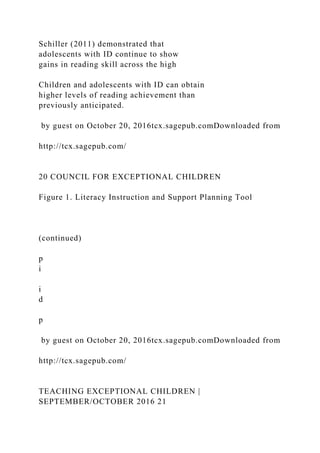
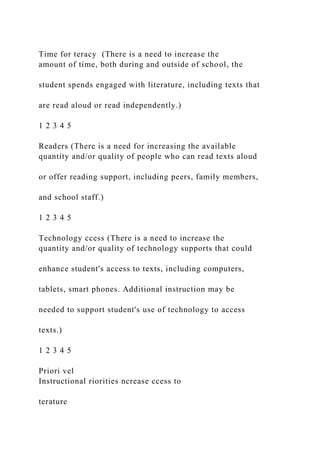
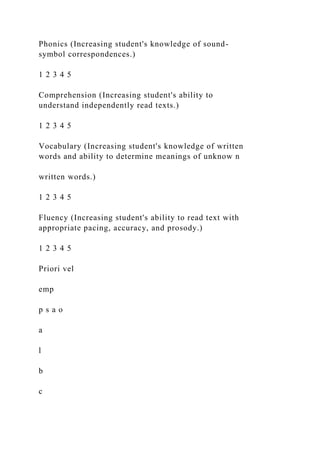
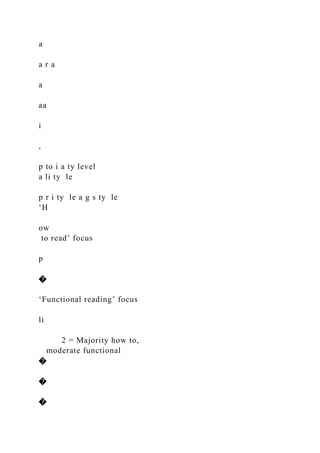
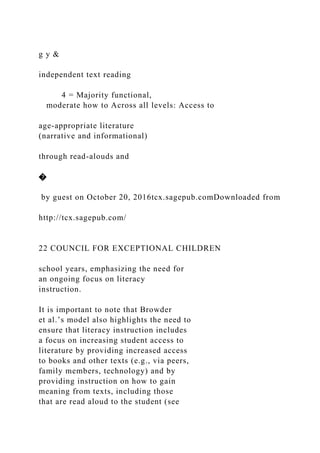
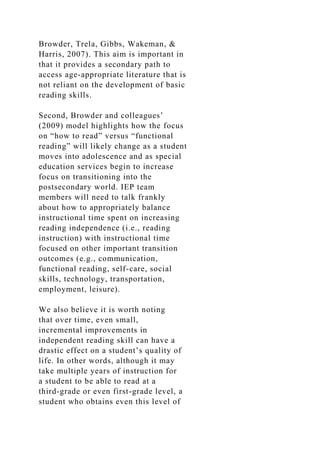
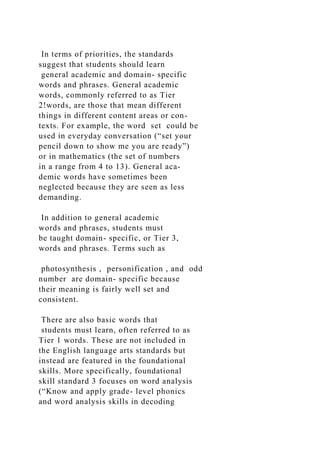
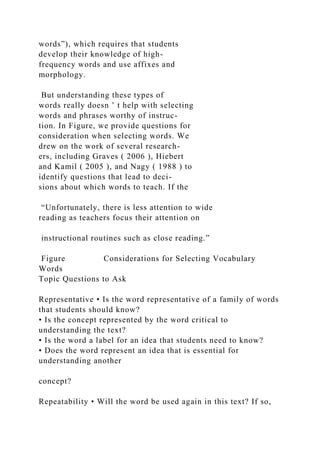
Figure 1. Literacy Instruction and Support Planning Tool
(continued)
p
i
i
d
p
by guest on October 20, 2016tcx.sagepub.comDownloaded from
http://tcx.sagepub.com/
TEACHING EXCEPTIONAL CHILDREN |
SEPTEMBER/OCTOBER 2016 21
22 COUNCIL FOR EXCEPTIONAL CHILDREN
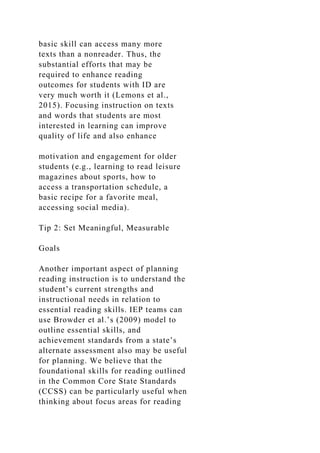
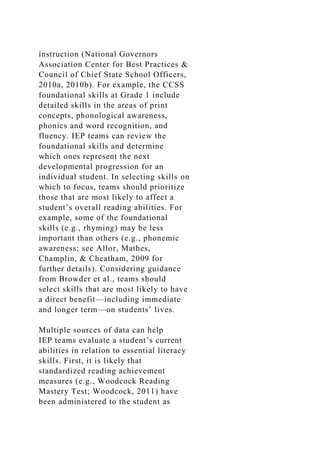
Figure 1 (continued)
1.
2.
3.
4.
5.
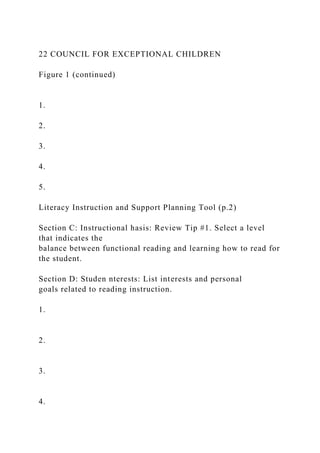
Literacy Instruction and Support Planning Tool (p.2)
Section C: Instructional hasis: Review Tip #1. Select a level
that indicates the
balance between functional reading and learning how to read for
the student.
Section D: Studen nterests: List interests and personal
goals related to reading instruction.
1.
2.
3.
4.
5.
�Section E: Instructional riorities upports, and ccess
pportunities: Review Tip #2. Rank the need to prioritize each of
the following when
developing reading goals and instructional plans for the student.
Key 1 = Not a priority at this time. 2 = Low priority.
3 = Moderate priority. 4 = High priority. 5 = Very high
priority. Increasing Independence as a Reader
Section F: Goal rioritizing: List goals that appear to be the most
important to consider in the upcoming academic year.
5 = Primarily
functional, minimal how to
3 = Balance between
functional and how to
1 = Primarily how to,
minimal functional
Key 1 = Not a priority at this time. 2 = Low priority.
3 = Moderate priority. 4 = High priority. 5 = Very high
priority. Increasing Access to Literature�
Opportunities to ppl eneralize kills
Text pplications (Instruction and support is needed
for generalization of reading skills to novel texts.)
1 2 3 4 5
Functional ctivities (Instruction and support is
needed for generalization of reading skills into functional
activities [e.g., menus, newspapers, weather reports,
directions].)
1 2 3 4 5
Writing (Instruction and support is needed to extend
generalization of reading skills into writing, including
options to select pictures, phrases, etc. for students who
are not yet writing.)
1 2 3 4 5
Priori vel
Opportunities to ccess terature
Adapted s (There is a need to increase the
quantity and/or quality of adapted texts to support
learning. Additionally, instruction may be needed to
support student's use of adapted texts.)
1 2 3 4 5
Time for teracy (There is a need to increase the
amount of time, both during and outside of school, the
student spends engaged with literature, including texts that
are read aloud or read independently.)
1 2 3 4 5
Readers (There is a need for increasing the available
quantity and/or quality of people who can read texts aloud
or offer reading support, including peers, family members,
and school staff.)
1 2 3 4 5
Technology ccess (There is a need to increase the
quantity and/or quality of technology supports that could
enhance student's access to texts, including computers,
tablets, smart phones. Additional instruction may be
needed to support student's use of technology to access
texts.)
1 2 3 4 5
Priori vel
Instructional riorities ncrease ccess to
terature
Task nalysis for ead louds (Instructors need to
systematically plan instruction to support the student's
ability to benefit from texts that are read aloud.)
1 2 3 4 5
Text wareness (Instruction is needed to increase
student's awareness of text features during read alouds
[e.g., student points to key words during read aloud.)
1 2 3 4 5
Vocabulary (Instruction is needed to increase student's
understanding of words during read alouds.)
1 2 3 4 5
Listenin omprehension (Instruction is needed to
increase student's ability to apply grade-level aligned
reading comprehension skills to texts that are read aloud
[e.g., sequencing events, identifying main idea].)
1 2 3 4 5
Priori
Instructional riorities for eadin nstruction
Phonemic wareness (Increasing student's ability to
hear and manipulate sounds in spoken language.)
1 2 3 4 5
Phonics (Increasing student's knowledge of sound-
symbol correspondences.)
1 2 3 4 5
Comprehension (Increasing student's ability to
understand independently read texts.)
1 2 3 4 5
Vocabulary (Increasing student's knowledge of written
words and ability to determine meanings of unknow n
written words.)
1 2 3 4 5
Fluency (Increasing student's ability to read text with
appropriate pacing, accuracy, and prosody.)
1 2 3 4 5
Priori vel
emp
p s a o
a
l
b
c
a
a r a
a
aa
i
,
p to i a ty level
a li ty le
p r i ty le a g s ty le
‘H
ow
to read’ focus
p
�
‘Functional reading’ focus
li
2 = Majority how to,
moderate functional
�
�
�
g y &
independent text reading
4 = Majority functional,
moderate how to Across all levels: Access to
age-appropriate literature
(narrative and informational)
through read-alouds and
�
by guest on October 20, 2016tcx.sagepub.comDownloaded from
http://tcx.sagepub.com/
22 COUNCIL FOR EXCEPTIONAL CHILDREN
school years, emphasizing the need for
an ongoing focus on literacy
instruction.
It is important to note that Browder
et al.’s model also highlights the need to
ensure that literacy instruction includes
a focus on increasing student access to
literature by providing increased access
to books and other texts (e.g., via peers,
family members, technology) and by
providing instruction on how to gain
meaning from texts, including those
that are read aloud to the student (see
Browder, Trela, Gibbs, Wakeman, &
Harris, 2007). This aim is important in
that it provides a secondary path to
access age-appropriate literature that is
not reliant on the development of basic
reading skills.
Second, Browder and colleagues’
(2009) model highlights how the focus
on “how to read” versus “functional
reading” will likely change as a student
moves into adolescence and as special
education services begin to increase
focus on transitioning into the
postsecondary world. IEP team
members will need to talk frankly
about how to appropriately balance
instructional time spent on increasing
reading independence (i.e., reading
instruction) with instructional time
focused on other important transition
outcomes (e.g., communication,
functional reading, self-care, social
skills, technology, transportation,
employment, leisure).
We also believe it is worth noting
that over time, even small,
incremental improvements in
independent reading skill can have a
drastic effect on a student’s quality of
life. In other words, although it may
take multiple years of instruction for
a student to be able to read at a
third-grade or even first-grade level, a
student who obtains even this level of
basic skill can access many more
texts than a nonreader. Thus, the
substantial efforts that may be
required to enhance reading
outcomes for students with ID are
very much worth it (Lemons et al.,
2015). Focusing instruction on texts
and words that students are most
interested in learning can improve
quality of life and also enhance
motivation and engagement for older
students (e.g., learning to read leisure
magazines about sports, how to
access a transportation schedule, a
basic recipe for a favorite meal,
accessing social media).
Tip 2: Set Meaningful, Measurable
Goals
Another important aspect of planning
reading instruction is to understand the
student’s current strengths and
instructional needs in relation to
essential reading skills. IEP teams can
use Browder et al.’s (2009) model to
outline essential skills, and
achievement standards from a state’s
alternate assessment also may be useful
for planning. We believe that the
foundational skills for reading outlined
in the Common Core State Standards
(CCSS) can be particularly useful when
thinking about focus areas for reading
instruction (National Governors
Association Center for Best Practices &
Council of Chief State School Officers,
2010a, 2010b). For example, the CCSS
foundational skills at Grade 1 include
detailed skills in the areas of print
concepts, phonological awareness,
phonics and word recognition, and
fluency. IEP teams can review the
foundational skills and determine
which ones represent the next
developmental progression for an
individual student. In selecting skills on
which to focus, teams should prioritize
those that are most likely to affect a
student’s overall reading abilities. For
example, some of the foundational
skills (e.g., rhyming) may be less
important than others (e.g., phonemic
awareness; see Allor, Mathes,
Champlin, & Cheatham, 2009 for
further details). Considering guidance
from Browder et al., teams should
select skills that are most likely to have
a direct benefit—including immediate
and longer term—on students’ lives.
Multiple sources of data can help
IEP teams evaluate a student’s current
abilities in relation to essential literacy
skills. First, it is likely that
standardized reading achievement
measures (e.g., Woodcock Reading
Mastery Test; Woodcock, 2011) have
been administered to the student as
part of the formal evaluation process.
Other criterion-referenced assessments
may also indicate which reading skills
students have mastered. Data from
these measures can highlight areas of
relative strength and weakness.
Second, teams may also administer
early-grade measures of curriculum-
based measurement (CBM) to evaluate
students’ performance in phonological
awareness, letter knowledge, and word
and passage reading. Several studies
(Allor, Mathes, et al., 2014; Lemons
et al., 2013) have demonstrated that
early-grade CBM can be used to
monitor response to reading instruction
for children with ID across grade levels.
Third, the IEP team may develop
informal (or mastery) assessments
based on the CCSS Foundational Skills
or other standards to evaluate a
student’s current abilities on key skills.
For example, at Grade 1, students
are expected to “decode two-syllable
words following basic patterns by
breaking words into syllables”
(RF.1.3.4). A teacher could generate a
list of 10 two-syllable words and
observe the student reading these
words to evaluate whether the student
was able to perform the skill.
Alternatively, teachers could create
similar informal assessments using
content they are teaching in their daily
lessons. For example, teachers might
conduct a brief assessment to
determine whether a student is able to
correctly produce taught letter sounds
and words. This data can guide
decisions on whether the student is
ready to move forward in the scope and
The model provides a reminder that it is
essential that literacy instruction for students
with ID focus on increasing students’
independence as readers.
by guest on October 20, 2016tcx.sagepub.comDownloaded from
http://tcx.sagepub.com/
TEACHING EXCEPTIONAL CHILDREN |
SEPTEMBER/OCTOBER 2016 23
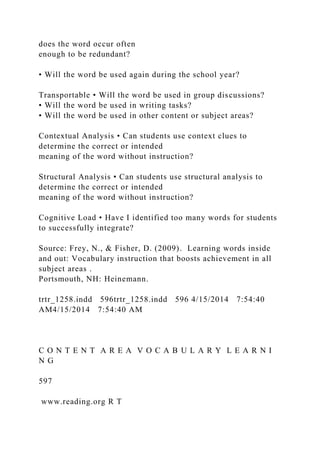
Table 1. Resources to Enhance Literacy Instruction
CBM resources • IRIS module
http://iris.peabody.vanderbilt.edu/module/gpm/cresource/q1/p02
/#content
• The ABCs of CBM: A Practical Guide to Curriculum-Based
Measurement, 2nd ed. (Hosp, Hosp,
& Howell, 2016)
• Potential measures:
http://www.intensiveintervention.org/chart/progress-monitoring
Promising intervention programs • Early Interventions in
Reading https://www.mheonline.com/program/view/4/1/2542/
SRAEIRLV11/
• Early Literacy Skill Builder
http://www.attainmentcompany.com/elsb
• Mondo Bookshop Phonics http://www.mondopub.com
• Road to Reading http://products.brookespublishing.com/
Reading-related web resources • Project Intensity (A federally
funded research project) http://www
.projectintensity.com/
• Reading Rockets (resource for teaching reading)
http://www.readingrockets.org/
• Reading A-Z (resource for findings texts)
https://www.readinga-z.com/
• TextProject (resource for vocabulary instruction)
http://textproject.org/
Reading-related text resources • Direct Instruction Reading, 5th
ed. (Carnine, Silbert, Kame'enui, & Tarver, 2009)
• Fundamentals of Literacy Instruction & Assessment, Pre-K–6
(Hougen & Smart, 2012) and
Fundamentals of Literacy Instruction & Assessment, 6–12
(Hougen, 2014)
• More Language Arts, Math, and Science for Students with
Severe Disabilities (Browder &
Spooner, 2014)
• Teaching Students with Moderate and Severe Disabilities
(Browder & Spooner, 2011)
Note. CBM = curriculum-based measurement.
sequence. It is also useful to conduct
frequent assessments of previously
learned material to determine if the
student has retained prior learning and
to reteach when needed.
Once the team has a solid
understanding of the student’s current
abilities, it should generate a set of IEP
goals that are focused on essential
reading skills. IEP goals can be
generated based on Browder et al.’s
(2009) model, performance on early-
grade CBM, the CCSS Foundational
Skills in reading, and informal
assessment. Following guidance
provided by Yell and Stecker (2003), an
example of an IEP goal based on oral
reading fluency CBM would be “By the
end of the school year, when presented
with a second-grade oral reading
fluency probe, Je’Sean will correctly
read aloud 90 words per minute with at
least 95% accuracy.” Teachers can
learn more about using CBM to
monitor progress through resources
provided in Table 1.
Tip 3: Provide Explicit, Systematic
Reading Instruction
In our experiences working in schools,
too often we find that reading
instruction provided to students with
ID is disconnected and disorganized.
This is often because teachers are not
provided with an appropriate
instructional program but are instead
pulling resources from various
sources, including the Internet. We
believe that using one reading
program as a base will help teachers
deliver instruction in a more
systematic way. Additional resources
can then be aligned to this program.
We strongly recommend that teachers
select an evidence-based program that
provides explicit models, corrective
feedback, scaffolding, reinforcement,
and cumulative review as well as a
focus on systematic instruction in
phonological awareness and phonics
skills (Bradford et al., 2006; Browder
et al., 2012; Browder et al., 2009;
Conners, Rosenquist, Sligh, Atwell, &
Kiser, 2006). See Table 1 for
recommendations of appropriate
programs that have been demonstrated
to be effective in research studies
involving students with ID. It is likely
that the base program will need some
adaptations as teachers work to
individualize instruction and that
supplemental content may be
necessary to meet the instructional
and access needs of the student.
However, using the base program as a
foundation will increase the
connectedness and organization of
instruction. This is because a
structured scope and sequence is key
to keeping instruction organized and
unified.
Another element of systematic
teaching is providing instruction that
enables students to apply skills across
contexts and make connections among
related skills (Browder et al., 2007).
Students with ID benefit from routine
language that is repeated across
lessons and contexts (e.g., reading and
by guest on October 20, 2016tcx.sagepub.comDownloaded from
https://www.mheonline.com/program/view/4/1/2542/SRAEIRLV
11/
https://www.mheonline.com/program/view/4/1/2542/SRAEIRLV
11/
http://www.projectintensity.com/
http://tcx.sagepub.com/
24 COUNCIL FOR EXCEPTIONAL CHILDREN
writing; general education classroom,
resource room) so instructions are
quickly understood. A student with ID
may not make the necessary
connection if one teacher refers to
sight words as “outlaw words” while
another refers to them as “look-and-
say words.” Teachers should also
explicitly teach connections among
related skills (e.g., phonological
awareness to decoding to spelling,
decoding to meaning to writing). For
example, when students are decoding
a word, they first say the sounds of
individual letters and then blend those
sounds to say the word. These two
subskills can be practiced separately
(i.e., in separate letter-sound practice
and oral phonemic awareness
blending practice) and then explicitly
applied to decoding and spelling.
Systematic review, ongoing cumulative
practice, and integration of skills in
this manner will increase the
likelihood that students will maintain
and generalize skills.
We realize that some students’
initial response to instruction focused
on phonological awareness and
phonics skills may be minimal. For
these students, teachers should
consider devoting a period of
instruction to increasing sight word
reading ability (Browder & Xin, 1998).
Teachers could do this as we did in a
recent study (Lemons et al., in press)
by teaching important, highly
imageable, decodable words (e.g.,
mom, dad, dog) paired with pictures.
Alternatively, teachers could use a
more traditional sight word program
(e.g., Edmark [ProEd, 2011], PCI
[Haugen-McLane, Hohlt, & Haney,
2008]). We believe it is important to
integrate phonological awareness and
letter-sound instruction into these sight
word programs as early as possible to
ensure students have the ability to
decode words that are not directly
taught to them.
Tip 4: Provide Instruction With
Sufficient Intensity to Accomplish
Goals
Inclusion and the amount of time
spent with same-age peers without
disabilities in general education
settings are important to consider
when planning for children and
adolescents with ID. However, IEP
teams should consider whether
receiving all instruction in the general
education classroom will allow for a
sufficient level of intensive
intervention to support the student in
meeting reading goals (Zigmond &
Kloo, 2011). There are at least two
important points regarding intensity.
First, in informal discussions with
teachers who have participated in our
recent studies, many have reported
that a substantial number of their
students with ID spend a majority of
time in the general education
classroom receiving one-on-one
support from a paraprofessional to
participate in instructional routines;
however, this most often does not
involve direct instruction of academic
skills. In many cases, teachers
reported that pullout instruction
would have allowed an instructor to
provide more intensive reading
instruction that better targeted
students’ academic needs.
Second, even when intensive
instruction is provided, many students
with ID will need multiple years of
intervention to achieve reading goals.
For example, Allor, Mathes, and
colleagues (2014) provided daily
phonics-based reading instruction to
children with below-average IQ,
including many with ID. Instruction
was provided for 40 to 50 minutes per
day in groups of one to three students.
Although students receiving the
researcher-delivered reading
intervention made statistically
significantly better gains on average
that students in the business-as-usual
control classrooms, many students
made only 1 year’s worth of progress in
the curriculum after participating in the
study for between 2 and 4 years.
However, given the stable, relatively
flat growth demonstrated by the
students in the control condition, it is
unlikely that students in the treatment
condition would have made the
progress they did with less intensive
instruction.
To meet learning goals, the IEP team
should ensure that the student receives
a sufficient amount of time
participating in direct instruction in
reading provided by a highly qualified,
trained interventionist (Fuchs, Fuchs, &
Compton, 2012). This instruction
should be closely aligned to the
student’s academic needs. In other
words, instruction should target the
student’s zone of proximal
development, or as we like to say, it
should be in the student’s
“instructional sweet spot.” Beyond this,
instruction should be engaging, and a
plan should be in place to closely
monitor the student’s response to
instruction. In our collective experience
as teachers and researchers, it is
challenging to provide this level of
intensity within the general education
classroom.
Tip 5: Seek Out Professional
Development Opportunities
Many special educators who teach
students with ID have received limited
preservice training on how children
learn to read. In-service professional
development to increase knowledge in
this area can help teachers
individualize and intensify reading
instruction for their students. We
believe that there are at least two
important aspects of this on which
professional development could focus.
First, teachers should understand
what skilled readers do and understand
how this skill develops. A fully
developed reader recognizes letters and
words quickly, uses the meanings of
individual words, and makes
immediate connections to the meaning
of what they are reading. Skilled
readers also use and apply general
knowledge of the world to help them
Instruction should be engaging, and a plan
should be in place to closely monitor the
student’s response to instruction.
by guest on October 20, 2016tcx.sagepub.comDownloaded from
http://tcx.sagepub.com/
TEACHING EXCEPTIONAL CHILDREN |
SEPTEMBER/OCTOBER 2016 25
understand what they are reading.
“Skilled reading happens too fast and
is too automatic to detect its underlying
processes through simple introspection.
We read, but we cannot watch how our
minds make sense out of print” (Moats,
1999, p. 12). Skilled reading involves
many different processes happening
simultaneously so that students can
recognize words effortlessly and focus
deeply on comprehension.
Second, teachers should understand
theoretical models of reading
development. Scarborough’s (2001)
woven-strand model demonstrates how
initial skills in language comprehension
(i.e., knowledge of background,
vocabulary, language structures,
literacy, and verbal reasoning) and
word recognition skills (i.e.,
phonological awareness, decoding,
spelling, and sight recognition)
gradually become integrated. With
instruction and practice, readers
increase both automaticity and strategy
to eventually demonstrate fluent
coordination of word reading and
comprehension processes. (For
additional information on how learning
to read occurs, see Perfetti, 2003;
Perfetti & Marron, 1998.)
We understand that resources are
often stretched in schools and that
funds to provide for additional
professional development (PD)
opportunities are frequently limited.
We have three recommendations that
may help teachers access additional
PD. First, local universities often offer
courses on reading development and
reading instruction. Although these are
available to teachers through tuition or
scholarship opportunities, there may be
additional ways to access the content.
For example, university instructors will
often allow a teacher to audit a course
in exchange for involving the teacher’s
class in practicum or research
activities. Second, as researchers, we
often offer school districts
complimentary PD for supporting our
research efforts. Teachers can reach out
to researchers at local universities to
see if these types of opportunities are
available. Our third recommendation is
for teachers with common interests to
form professional learning
communities (PLCs; Helman &
Rosheim, 2016) in which they can work
together to deepen knowledge and
improve practice. The PLC could
devote time to learning about reading
instruction from several high-quality,
free websites (e.g., Table 1) and
sharing brief videos of instruction or
assessment to assist one another in
planning and problem solving.
Alternatively, the PLC could dedicate
time to reading books and peer-
reviewed journal articles, discussing
the content, and then applying
instructional techniques. Suggestions
of books to consider are included in
Table 1. Finally, members of the PLC
could opt to purchase a new
curriculum and agree to support one
another in initial implementation and
problem solving.
Tip 6: Remember That Language
Abilities Are the Underlying
Foundation for Reading Skills
The theory of reading development
known as the “simple view of reading”
(Hoover & Gough, 1990) stresses that
the act of reading combines word
recognition and language
comprehension. In other words,
reading is simply the process of
translating print into language.
Planning for reading instruction should
take into consideration a student’s
language abilities. Learning to read
does not occur decontextualized from
language development. Good readers
make immediate links between print
and meaning; therefore, instruction
should support students with ID in
making these connections as much as
possible. For example, isolated skills
should be combined as soon as
possible to create words and sentences
in contexts that are familiar to students
and likely to be understood.
With their expertise in language
development, speech language
pathologists (SLPs) are in the unique
position of being able to identify and
intervene upon language roots of
reading problems (Ehren & Whitmire,
2009). For example, SLPs may provide
key information about how speech
perception, speech sound production,
and vocabulary are interfering with
reading progress (Squires, Gillam, &
Reutzel, 2013). Many SLPs are trained
to take a diagnostic-prescriptive
approach to intervention (Ehren &
Whitmire, 2009). In this approach, a
student’s current abilities and areas of
instructional need are evaluated, and
an intervention is designed to target
areas of need. IEP team members can
find additional guidance on enhancing
the role of the SLP in literacy
instruction through the American
Speech-Language-Hearing Association
(2001). It is also important to
remember that expert guidance from
teachers of English as a second
language or bilingual education
programs will be necessary for students
whose first language is not English.
Tip 7: Scaffold Working Memory
Many students with ID have deficits in
working memory that can limit
response to reading instruction.
Consider, for example, the cognitive
demands that are required for a student
to sound out the word sat. The student
says the sound for each letter, /s/ /a/
/t/, and then must blend those sounds
together to say the whole word.
Students who are not skilled at
blending spoken sounds into words
and who experience deficits in working
memory often will forget the first
sound by the time they begin to blend
the sounds together and respond with
the word at instead of sat. They simply
forgot the /s/ sound. Other tasks—
such as identifying the middle sound in
a spoken word or manipulating
phonemes—are even more difficult.
With their expertise in language development,
speech language pathologists are in the unique
position of being able to identify and intervene
upon language roots of reading problems.
by guest on October 20, 2016tcx.sagepub.comDownloaded from
http://tcx.sagepub.com/
26 COUNCIL FOR EXCEPTIONAL CHILDREN
Teachers can provide various forms of
scaffolding to assist students in
manipulating phonemes even if a
student’s working memory limitations
make the task difficult. For example, in a
recent study focused on improving
reading outcomes for children with
Down syndrome (Lemons et al., in
press), we provided two levels of
scaffolding for early reading activities.
First, we taught a limited number of
highly imageable, decodable words (e.g.,
dog) by having students match the words
to pictures. When students were able to
identify the words automatically, we
were then able to use the printed word
or picture to support early phonological
awareness and alphabetic principle
activities. For example, if we asked a
student to provide the first sound in the
word dog and the student needed
additional scaffolding, we showed the
student the picture or printed word.
Second, we quickly integrated letters into
phonological awareness activities to
provide additional support. Often,
phonemic awareness is taught without
letters, which is appropriate for very
young students who are typically
developing; however, in our experience,
students with working memory
limitations find that the addition of
letters makes the task much easier. This
is especially true for students who know
many letter sounds but are still unable to
blend sounds into words. For example, if
a student was unable to segment the
word dog using Elkonin boxes (i.e., a
figure where small connected squares
represent a series of phonemes) with
three plastic chips, we replaced the chips
with plastic letters (e.g., d, o, g).
Conversely, if a student was unable to
blend the sounds /d/ /o/ /g/ into the
word dog, simply adding the letters to
the task serves as a mnemonic clue so
the student can hold the sounds in
memory long enough to blend them into
the word. This type of flexible scaffolding
ensures that students are able to be
successful with early reading activities.
Tip 8: Target Specific Parts of a
Scope and Sequence to Focus
Instruction
When planning reading instruction for
students with ID, teachers need to
consider not only what content to
teach but also how to proceed through
that content. Using a systematic
approach to moving through a
curriculum’s scope and sequence can
assist a teacher in ensuring that
instruction is focused and consistent so
that students master the content.
Further, planning instruction so that an
appropriate amount of content is
targeted at a time will allow teachers to
focus planning efforts. When the
amount of content from the scope and
sequence to be included in a lesson is
matched to a student’s instructional
level, this can enhance student
learning.
Teachers must decide when to
repeat individual lessons or groups of
lessons. Sometimes students may
master some skills within a lesson
(e.g., letter sounds) but still have
difficulty with other skills in the same
lesson or groups of lessons (e.g.,
blending letter sounds into words). In
one research study, we found that
some students were able to learn sight
words and individual letter sounds at a
faster pace than decoding regular
words (see Allor, Gifford, Al Otaiba,
Miller, & Cheatham, 2013). In this case,
a teacher may introduce additional
sight words and letter sounds while
providing extra practice in blending
and spelling. It is also helpful for
teachers to group students with similar
skills into homogenous small groups
for teacher or paraprofessional
instruction or to pair a student who
lacks a skill with a student who has
mastered it for peer-pair practice.
One way that we have targeted
specific parts of a scope and sequence
in our work is to select a limited
number of new words or sounds to be
taught at a time. For example, in
Lemons, Mrachko, Kostewicz, and
Paterra (2012), we used the scope and
sequence of an evidence-based reading
program (i.e., Road to Reading;
Blachman & Tangel, 2008) to generate
a preassessment of letter sounds,
decodable words, and high-frequency
words. We used data from this
assessment to determine, individually,
where students would be placed in the
program. For each student, we selected
five target letter sounds, decodable
words, and high-frequency words to
target in upcoming lessons.
Intervention was delivered and
learning of this content was assessed
daily. When students provided the
correct letter sound or word for 3
consecutive days, we deemed that item
“mastered” and replaced it with the
next letter or word on the scope and
sequence. We also did frequent
assessments of mastered items to check
for maintenance and incorporated
missed items back into instruction.
This systematic approach to moving
through a scope and sequence allowed
us to match the intervention to each
student’s instructional level. For some
students, we likely could have targeted
a larger number of items. Teachers
should use data they are collecting to
determine an appropriate pacing for
their students.
Tip 9: Use Data to Guide
Instruction and Adaptation
One of the most important things
teachers can do to increase the
likelihood that students with ID obtain
reading goals is to use data to monitor
progress and guide ongoing adaptations.
In multiple studies (Allor, Mathes, et al.,
2014; Lemons et al., 2012), we have used
early-grade CBM to track students’
response to reading instruction, to pace
their progress through a curriculum, and
to inform us when instructional changes
or even modifications were necessary.
We encourage teachers to learn more
about CBM and to consider whether this
form of progress monitoring may be
One of the most important things teachers can
do to increase the likelihood that students with
ID obtain reading goals is to use data to monitor
progress and guide ongoing adaptations.
by guest on October 20, 2016tcx.sagepub.comDownloaded from
http://tcx.sagepub.com/
TEACHING EXCEPTIONAL CHILDREN |
SEPTEMBER/OCTOBER 2016 27
useful for their students. The data
collected from CBM can also be used to
guide ongoing adaptation of reading
instruction. Teachers can use a process
called data-based individualization (DBI)
to determine when and how to make
instructional changes (Fuchs
et al., 2012). Teachers can learn more
about DBI through the National Center
on Intensive Intervention (www.
intensiveintervention.org). Although
most of the materials on the site are
focused on students without ID, the
guidance provided on using data to
evaluate student progress and modify
instruction when students are not
responding sufficiently remains relevant.
The approach provides teachers a
framework to serve as a clinical expert
who provides targeted, individualized
instruction.
Tip 10: Involve Service Providers
and Family Members
Although we acknowledge that less
research support is available for this
tip, the Individuals With Disabilities
Education Act (2006) does emphasize
that IEP meetings should involve
service providers and family members.
During the IEP team meeting, members
should discuss how they can
coordinate and provide support for
reading instruction. We briefly
highlighted the important role that
SLPs may play (Ehren & Whitmire,
2009; Squires et al., 2013), but other
support staff, including assistive
technology specialists, behavior
specialists, and school psychologists,
may offer expertise that can support
reading instruction (Ayres, Mechling, &
Sansosti, 2013; Smith, DeMarco, &
Worley, 2009). It is important that team
members consider how they can
provide support for the agreed-upon
reading goals and to ensure that there
is consistency across support. For
example, if a student receives
instruction from a general education
teacher, a special education teacher,
and an SLP, the three professionals
should plan to use common
instructional language, to target similar
skills, and to review data frequently.
Involving family members is also
crucial. However, too often the role of
family members is poorly defined.
Some families may be unaware of
research showing that students with
ID can learn to read. We believe there
are at least two important points to
consider here. First, family members
should prioritize features of literacy
that are included as aspects of
increased access to literature in
Browder at al.’s (2009) model. Family
members should be encouraged to
provide children with multiple
opportunities to access literature
through read-alouds, adapted text,
and repeated reading when
appropriate. Families can provide
definitions of new vocabulary words
and can encourage discussions of
stories—both those read aloud and
ones a student may read
independently. It is vital that school
personnel encourage parental
participation and important that
necessary supports are provided for
families of culturally and linguistically
diverse backgrounds and for those of
lower socioeconomic status.
Second, family members should not
be responsible for initial instruction of
skills. Instead, family members’ roles
are to provide supported opportunities
for practice that are fun and engaging.
Teachers can provide family members
with simple, gamelike activities that
focus on reviewing skills the student
can do independently or with minimal
support. For example, if a student is
able to appropriately segment three
phoneme words about 80% of the
time, a teacher could create a sheet
that includes pictures and Elkonin
boxes for four three-phoneme words.
Family members could hang the sheet
on the refrigerator and encourage the
student to segment one or two words
multiple times throughout the day
when the child is in the kitchen. This
provides additional opportunities for
practice, requires little time or effort
on the family members’ part, and
could be integrated into a family’s
schedule in a quick and fun way.
Students can practice reading a set of
words and sentences to family
members; as students advance, they
can read books recommended or
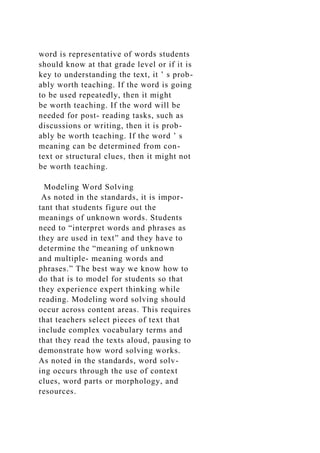
provided by the teacher. See Figure 2
for a set of tips that families may find
useful as they prepare for an IEP
meeting.
Literacy Instruction and Support
Planning Tool
We designed the planning tool (Figure
1) based on Browder et al.’s (2009)
model of literacy instruction for
students with ID. IEP team members
can use the tool as a guide for
discussing the literacy needs of
individual students and when planning
related instruction and supports.
Various school professionals and
parents could use this tool in multiple
ways. It may be used as part of the IEP
process or in other planning
discussions. We suggest the following
guidance as one way to use the tool.
1. Individual team members (including
parents) can independently review
the 10 tips presented in this article.
While reading, team members may
pause after each tip and review the
related discussion points presented
on the tool (Sections A and B).
Individuals are encouraged to take
notes that may be useful during
team discussions.
2. Team members can then meet and
review instructional priorities. The
discussion points for Tips 1 and 2
(Figure 1 Section A, Focus on
Instructional Planning) may be used
to facilitate this discussion.
3. The team can discuss the
appropriate instructional emphasis
for the student (Section C). Team
by guest on October 20, 2016tcx.sagepub.comDownloaded from
http://tcx.sagepub.com/
28 COUNCIL FOR EXCEPTIONAL CHILDREN
members may consider the student’s
current skills, goals for the student,
and number of years remaining
before the transition to
postsecondary opportunities. Team
members then select a level of focus
(e.g., 1 = primary instructional
emphasis on teaching the student
how to read, minimal instructional
focus on functional reading). Recall
Browder et al.’s (2009) priority of
ensuring access to age-appropriate
literature across all levels.
4. Section D can be completed as team
members discuss interests the student
has that are relevant to planning
literacy instruction. This may assist
with selecting high-interest texts, and
it may help ensure that the student’s
personal goals for improving reading
skills are considered.
5. Team members then reflect on
instructional priorities, supports,
and access opportunities (Section
E). This section of the tool has been
designed to align closely with
Browder et al.’s (2009) model. For
each item, the team discusses the
current priority level. For example,
under Instructional Priorities for
Reading Instruction, the team may
evaluate whether there is a need to
provide instruction related to
phonemic awareness by rating the
item on the Likert-type scale (e.g., 1
= not a priority at this time, 2 =
low priority).
6. Section F provides a space for team
members to list goals that appear to
be the most important to consider in
the upcoming academic year.
7. The team then reviews the
discussion points for Tips 3 through
10 (Section B, Focus on Instructional
Delivery) to plan the specially
designed instruction and supports to
increase the student’s reading
abilities and access to literature.
Conclusion
One of the most important roles an
educator plays is teaching students to
read. Enhancing reading and other
literacy-related outcomes for students
with ID will likely increase the success
these students will experience in
postsecondary employment,
education, and independence (Hosp,
Hensley, Huddle, & Ford, 2014).
Ensuring that IEP goals and services
are aligned with guidance from
current research holds promise for
increasing the effectiveness of
educators in teaching a greater
number of students to read. Our hope
is that IEP teams who consider the 10
tips we have highlighted will be more
reflective, will plan more intensive
Figure 2. Tips for Families
Review data from the school to understand your child’s current
strengths and areas of need.
¾ Consider your goals for next steps of progress. Share these
with your child’s teachers and members of the IEP
team.
¾ Remember that reading is very important, but it is one of
many aspects of your child’s education.
As students get older, consider postsecondary needs and target
independence, employment, and social aspects
(friends, leisure).
Work with school personnel to plan specific goals, services to
meet these goals, data that will be shared to
monitor progress toward goals, and the location of services that
will ensure goals can be appropriately targeted.
¾ Remember that, sometimes, inclusive settings are less
intensive than other options.
¾ Ask how other service providers (e.g., SLP, behavior
specialist) can support reading.
If you don’t understand, ask questions!
¾ You are a critical member of the IEP team and understanding
goals and services is necessary for you to be
involved.
¾ Ask for information to be explained in simpler language if
IEP members are using terms that you do not
understand.
¾ Scheduling a meeting or phone call with your child’s special
education teacher to review information to be
discussed prior to the IEP meeting may be helpful.
Request for guidance from teachers on how you can support
instruction at home.
¾ Don’t overdo it.
¾ Keep reading time with you fun!
¾ Spend more time on increased access to literature (reading
aloud, language support, discussion of stories).
¾ For more basic skills (e.g., letter sounds, word reading,
fluency), your role should be more practice than primary
instruction.
by guest on October 20, 2016tcx.sagepub.comDownloaded from
http://tcx.sagepub.com/
TEACHING EXCEPTIONAL CHILDREN |
SEPTEMBER/OCTOBER 2016 29
and effective instruction, and will see
increasingly positive student
outcomes.
References
Allor, J. H., Al Otaiba, S., Ortiz, M., &
Folsom, J. (2014). Comprehensive
beginning reading. In D. M. Browder
& F. Spooner (Eds.), More language
arts, math, and science for students
with severe disabilities (pp. 109–126).
Baltimore, MD: Brookes.
Allor, J. H., Gifford, D. B., Al Otaiba, S.,
Miller, S. J., & Cheatham, J. P. (2013).
Teaching students with intellectual
disability to integrate reading skills:
Effects of text and text-based lessons.
Remedial and Special Education, 34,
346–356. doi:10.1177/0741932513494020
Allor, J. H., Mathes, P. G., Champlin, T., &
Cheatham, J. P. (2009). Research-based
techniques for teaching early reading
skills to students with intellectual
disabilities. Education and Training
in Developmental Disabilities, 44,
356–366.
Allor, J. H., Mathes, P. G., Roberts, J. K.,
Cheatham, J. P., & Al Otaiba, S. (2014).
Is scientifically based reading instruction
effective for students with below-average
IQs? Exceptional Children, 80, 287–306.
doi:10.1177/0014402914522208
American Speech-Language-Hearing
Association. (2001). Roles and
responsibilities of speech-language
pathologists with respect to reading and
writing in children and adolescents.
Retrieved from http://www.asha.org/policy
Ayres, K. M., Mechling, L., & Sansosti, F. J.
(2013). The use of mobile technologies
to assist with life skills/independence
of students with moderate/severe
intellectual disability and/or autism
spectrum disorders: Considerations
for the future of school psychology.
Psychology in the Schools, 50, 259–271.
doi:10.1002/pits.21673
Blachman, B. A., & Tangel, D. M. (2008).
Road to reading: A program for
preventing and remediating reading
difficulties. Baltimore, MD: Brookes.
Bradford, S., Shippen, M. E., Alberto, P.,
Houchins, D. E., & Flores, M. (2006).
Using systematic instruction to teach
decoding skills to middle school
students with moderate intellectual
disabilities. Education and Training in
Developmental Disabilities, 41, 333–343.
Browder, D. M., Ahlgrim-Delzell, L.,
Courtade, G., Gibbs, S. L., & Flowers, C.
(2008). Evaluation of the effectiveness
of an early literacy program for
students with significant developmental
disabilties. Exceptional Children, 75, 33–
52. doi:10.1177/001440290807500102
Browder, D. M., Ahlgrim-Delzell, L.,
Flowers, C., & Baker, J. (2012). An
evaluation of a multicomponent early
literacy program for students with severe
developmental disabilities. Remedial
and Special Education, 33, 237–246.
doi:10.1177/0741932510387305
Browder, D. M., Gibbs, S., Ahlgrim-Delzell,
L., Courtade, G. R., Mraz, M., &
Flowers, C. (2009). Literacy for students
with severe developmental disabilities:
What should we teach and what
should we hope to achieve? Remedial
and Special Education, 30, 269–282.
doi:10.1177/0741932508315054
Browder, D. M., Trela, K., Gibbs,
S. L., Wakeman, S., & Harris, A. A.
(2007). Academic skills: Reading and
mathematics. In S. L. Odom, R. H.
Horner, M. E. Snell, & J. Blacher (Eds.),
Handbook of developmental disabilities
(pp. 292–309). New York, NY: Guilford.
Browder, D. M., & Xin, Y. P. (1998). A
meta-analysis and review of sight
word research and its implications
for teaching functional reading
to individuals with moderate and
severe disabilities. The Journal of
Special Education, 32, 130–153.
doi:10.1177/002246699803200301
Conners, F. A., Rosenquist, C. J., Sligh,
A. C., Atwell, J. A., & Kiser, T. (2006).
Phonological reading skills acquisition by
children with mental retardation. Research
in Developmental Disabilities, 27, 121–137.
doi:10.1016/j.ridd.2004.11.015
Ehren, B. J., & Whitmire, K. (2009).
Speech-language pathologists as primary
contributors to response to intervention
at the secondary level. Seminars in
Speech and Language, 30, 90–104.
doi:10.1055/s-0029-1215717
Fuchs, D., Fuchs, L. S., & Compton, D. L.
(2012). Smart RTI: A next-generation
approach to multilevel prevention.
Exceptional Children, 78, 263–279.
doi:10.1177/001440291207800301
Haugen-McLane, J., Hohlt, J., & Haney, J.
L. (2008). PCI Reading Program. San
Antonio, TX: PCI Education.
Helman, L., & Rosheim, K. (2016). The role
of professional learning communities
in successful response to intervention
implementation. In S. R. Jimerson, M. K.
Burns, & A. M. VanDerHeyden (Eds.),
Handbook of response to intervention
(pp. 89–101). New York, NY: Springer.
Hoover, W. A., & Gough, P. B. (1990).
The simple view of reading. Reading
and Writing, 2, 127–160. doi:10.1007/
BF00401799
Hosp, J. L., Hensley, K., Huddle, S. M., &
Ford, J. W. (2014). Using curriculum-
based measures with postsecondary
students with intellectual and
developmental disabilities. Remedial
and Special Education, 35, 247–257.
doi:10.1177/0741932514530572
Individuals With Disabilities Education Act,
20 U.S.C.§ 1400 et seq. (2006).
Lemons, C. J., King, S. A., Davidson, K. A.,
Puranik, C. S., Al Otaiba, S., Fulmer, D.,
. . . Fidler, D. J. (in press). Developing
an early reading intervention aligned
with the Down syndrome behavioral
phenotype. Focus on Autism and Other
Developmental Disabilities.
Lemons, C. J., King, S. A., Davidson, K. A.,
Puranik, C. S., Fulmer, D., Mrachko,
A. A., . . . Fidler, D. J. (2015). Adapting
phonological awareness interventions
for children with Down syndrome
based on the behavioral phenotype: A
promising approach? Intellectual and
Developmental Disabilities, 53, 271–288.
doi:10.1352/1934-9556-53.4.271
Lemons, C. J., Mrachko, A. A.,
Kostewicz, D. E., & Paterra, M. F.
(2012). Effectiveness of phonological
awareness and decoding interventions
for children with Down syndrome:
Three single-subject studies.
Exceptional Children, 79, 67–90.
doi:10.1177/001440291207900104
Lemons, C. J., Zigmond, N., Kloo, A., Hill,
D. R., Mrachko, A. A., Paterra, M. F., .
. . Davis, S. M. (2013). Performance of
students with significant disabilities on
early grade curriculum-based measures
of word and passage reading fluency.
Exceptional Children, 79, 408–426.
doi:10.1177/001440291307900402
Moats, L. C. (1999). Teaching reading
is rocket science. Washington, DC:
Federation of Teachers.
National Governors Association Center for
Best Practices & Chief Council of State
School Officers. (2010a). Common Core
State Standards. Washington, DC: Author.
National Governors Association Center
for Best Practices & Chief Council of
State School Officers. (2010b). English
language arts standards: Reading.
Foundational skills: Introduction for K–5.
Washington, DC: Author. Retrieved from
http://www.corestandards.org/ELA-
Literacy/RF/introduction/
Perfetti, C. A. (2003). The universal
grammar of reading. Scientific Studies
of Reading, 7, 3–24. doi:10.1207/
S1532799XSSR0701_02
by guest on October 20, 2016tcx.sagepub.comDownloaded from
http://tcx.sagepub.com/
30 COUNCIL FOR EXCEPTIONAL CHILDREN
Perfetti, C. A., & Marron, M. A. (1998).
Learning to read: Literacy acquisition
by children and adults. In D. A. Wagner
(Ed.), Advances in adult literacy
research and development (pp. 89–138).
Philadelphia: National Center for Adult
Literacy.
ProEd (2011). Edmark Reading Program,
Second Edition. Austin, TX: ProEd.
Scarborough, H. S. (2001). Connecting
early language and literacy to later
reading (dis)abilities. In S. Neuman & D.
Dickinson (Eds.), Handbook of research
in early literacy (pp. 97–110). New York,
NY: Guilford.
Smith, D. D., DeMarco, J. F., & Worley, M.
(2009). Literacy beyond picture books:
Teaching secondary students with
moderate to severe disabilities. Thousand
Oaks, CA: Corwin Press.
Squires, K. E., Gillam, S. L., & Reutzel,
D. R. (2013). Characteristics of children
who struggle with reading: Teachers
and speech-language pathologists
collaborate to suppor young learners.
Early Childhood Education Journal, 41,
401–411. doi:10.1007/s10643-013-0577-6
Wei, X., Blackorby, J., & Schiller, E. (2011).
Growth in reading achievement of
students with disabilities, ages 7 to
17. Exceptional Children, 78, 89–106.
doi:10.1177/001440291107800106
Woodcock, R. W. (2011). Woodcock
Reading Mastery Tests, Third Edition.
San Antonio: Pearson.
Yell, M. L., & Stecker, P. M. (2003).
Developing legally correct and
educationally meaningful IEPs using
cirriculum-based measurement.
Assessment for Effective Intervention, 28,
73–88. doi:10.1177/073724770302800308
Zigmond, N., & Kloo, A. (2011). General
and special education are (and should
be) different. In J. M. Kauffman & D. P.
Hallahan (Eds.), Handbook of special
education (pp. 160–172). New York, NY:
Routledge.
Christopher J. Lemons, Assistant Professor,
Department of Special Education Peabody
College of Vanderbilt University, Nashville,
Tennessee. Jill H. Allor, Professor,
Department of Teaching and Learning,
Southern Methodist University, Dallas,
Texas. Stephanie Al Otaiba, Professor and
Patsy and Ray Caldwell Centennial Chair in
Teaching and Learning, Department of
Teaching and Learning Southern Methodist
University, Dallas, Texas. Lauren M.
LeJeune, Doctoral student, Department of
Special Education, Peabody College of
Vanderbilt University, Nashville, Tennessee.
Address correspondence regarding this article
to Chris Lemons, Vanderbilt University, 228
Peabody, Nashville, TN 37212 (e-mail: chris.
[email protected]).
Authors’ Note
The research described in this article was
supported in part by Grants R324A110162,
R324A130102, and R324A160132 from the
Institute of Education Sciences and Grant
H325D140073 from the Office of Special
Education Programs, both within the U.S.
Department of Education. Nothing in the
article necessarily reflects the positions or
policies of the federal government, and no
official endorsement by it should be
inferred. The Team William Discovery
Grant provided additional support. We also
appreciate guidance from numerous
parents, teachers, and other educational
professionals on the content of this
manuscript.
TEACHING Exceptional Children,
Vol. 49, No. 1, pp. 18–30.
Copyright 2016 The Author(s).
CEC’s online catalog has the very latest resources for teachers,
administrators,
and teacher educators—take a minute and take a gander. Browse
by topic,
keyword, or format to find the latest evidence-based practices
and strategies,
reference and training materials, and more.
Webinars ■ Books ■ Quick-reference guides
Peruse the table of contents from a book,
post product reviews, or check out the
featured author, product, and eBook!
New content is added every week,
so don’t miss out—stop by today!
www.pubs.cec.sped.org
by guest on October 20, 2016tcx.sagepub.comDownloaded from
http://tcx.sagepub.com/
PRINCIPLES OF INVESTMENT
Level 5
Coursework Assignment
2018/19
Due date: 29th April 2019
Principles of Investment Individual Assignment 2019
LACE AND HOSIERY WORKERS PROVIDENT CHARITY
(LHWPC)
This charity was set up by a very wealthy Victorian industrialist
in 1896 who made a fortune from lace-making and hosiery in
the East Midlands area. It is dedicated to giving charitable
financial support to widows and orphans living within a specific
geographical area located around the City of Nottingham. It is
run by a group of elected trustees and has investments and cash
approaching £4.5million.
The Trustees donate the Charity's income to deserving cases
who are invited to apply following referral by social services
and charitable organisations. These applications are then
assessed by a panel, and in qualifying cases, financial assistance
is offered to help with living costs, particularly in relation to
education.
The Charity has approached you, as an independent financial
advisor, to see if you can advise and assist them going forward.
Specifically and in confidence, the Trustees have asked for their
investment portfolio to be reviewed and redesigned as they have
concerns about its present structure. They feel that it should be
more balanced; less exposed to investment risks and are seeking
your advice in this respect.
In addition to the securities shown in the table, the Charity
owned, until recently, a small portfolio of commercial retail
units. These have now been sold and theproceeds (£960,000) are
being held in a bank money market account, on one month's
notice of withdrawal. This cash balance is also available for
new investment.
As there is an adequate cash balance in the Charity's current
account to cover everyday expenditure, you are reliably
informed that there is no requirement for the Trustees to retain
any further money in cash as an "emergency reserve".
The chairman of the Trustees has also mentioned that, following
the appointment of some new members, there has been some
heated debate about the progress of the funds under their
control. He says that the following views have been expressed
at a recent meeting:
"The current investment prices and values are out of date by at
least six months. Also they look very unbalanced. Look at all
those damned bank shares. We've lost a fortune thanks to those
bankers".
"Financial advisors are just a bunch of rogues and charlatans
and are only in it for the commission they make by churning
investments around. The one thing that they cannot control is
risk and, as a charity, security is clearly important to us."
"The stock market is just a casino and is no place for a well
respected charity such as ours. You might as well stick all the
money on the National Lottery".
"Our share investments seem to be concentrated in similar
companies and not very well spread about. A friend of mine,
who does a bit of investing in the stock market, tells me this can
potentially be very dangerous, and quite risky, if anything goes
wrong."
Details of the Charity's investments are shown in the following
table. The Chairman of the Trustees apologises for the fact that
the prices are a little out of date, they were last valued about six
months ago. So the first request, from the Chairman is for you
to calculate exactly what the total value of the investments is at
the time of your review. The Trustee's chairman has also
expressed the following concerns to you:
- the possible exposure to risk that is inherent in such a
relatively large portfolio of investments spread across various
asset classes.
- the relatively high management fees which are payable for the
Investment Trust shares. They are not happy about this.
Some of the new trustees have even proposed that they should
become more active in investment decisions themselves and not
be reliant on professional advice with all the associated costs.
- a more transparent investment policy whereby it is clear
exactly what shares are in the portfolio. The Investment Trusts
appear to be very shadowy enterprises and the charity has over
£1.2m invested in them.
- to ensure their investments can be justified from an ethical
point of view. The chairman has indicated to you that this is a
very important consideration from the perspective of the
Charity.
- to address their fears about the level of inflation in the future
and how they could mitigate any possible rises in the level of
inflation. They have fears that both interest rates and inflation
may rise during 2019.
The chairman and the treasurer of the Trustees have requested
that you review the existing portfolio by updating the valuations
and commenting on the range of investments held, initially, in
terms of asset allocation and risk. And then to recommend, with
reasons:
- how you would respond to the concerns of the Chairman,
given above, and the views of the five new Trustee members.
- the changes you would make to their current portfolio in terms
of asset allocation and diversification with your reasons in
terms of investment theory and risk management.
- the construction of a new balanced investment portfolio for
the Charity including your recommendations for the investment
of the additional £960,000 currently held in cash.
ASSIGNMENT TASK:
Therefore; in summary, you are to write a 3,000 word report
which:
1) Updates the investment totals and reviews the suitability of
the present investment portfolio, with an analysis of the main
risks.
2) Discuss briefly the theory behind portfolio planning and risk
management.
You should also make reference to the relevance of the Trustee
Act and the responsibilities of Trustees in this type of situation.
*See note below.
3) Make recommendations for appropriate changes to create a
new investment portfolio by applying relevant risk and return
measures and showing how they have been used to evaluate the
assets.
The new portfolio should meet the needs of the Charity and
should include the investment of the additional cash holding. In
creating the new portfolio you should address the concerns
expressed by the Trustees.
Please refer to the attached marking grid for guidance as to the
structure and mark weighting for the various learning outcomes.
* You should note that as a Charity, the LHWPC is governed by
the Trustee Act 2000, and this should be taken into account in
relation to any recommendations that you make to the Trustees.
CURRENT INVESTMENT PORTFOLIO
THE LACE AND HOSIERY WORKERS PROVIDENT
CHARITY (LHWPC)
GILTS
Nominal Stock Description Price Value
£200,000 5.00% Treasury 2018 £117.61
£235,220
£150,000 1.50% Treasury 2021 £106.21
£159,315
£250,000 5.00% Treasury 2025 £121.00
£302,500
£175,000 3.50% Treasury 2068 £168.58
£295,015
Sub Total for Gilts
£ 992,050
Investment Trusts
Shares Price (p)
Value
50,000 Alliance Trust 454
£227,000
70,000 Monks Investment Trust 380
£266,000
120,000 Fidelity China Special Situations 98
£117,600
Sub Total for Investment Trusts
£610,600
Ordinary Shares Price (p)
Value
25,000 Tesco 302
£75,500
32,000 Sainsbury 346
£110,720
22,100 Morrisons 201
£44,421
18,500 RBS 345
£63,825
36,400 Barclays 248
£90,272
28,000 HSBC 630
£176,400
35,000 Lloyds Bank 78
£27,300
2,500 BAT 3325
£83,125
10,000 Imperial Tobacco 3616
£361,600
10,000 Diageo 1914
£191,400
10,000 BAE Systems 424
£42,400
19,800 Meggitt 486
£96,228
9,750 A.B.Foods 3028
£295,230
350,000 Premier Foods 60
£210,000
Sub Total for Ordinary Shares:
£1,868,421
Total Investment assets held (excluding cash) :
£3,471,071
PLUS £960,000 CASH HELD IN A LLOYDS MONEY
MARKET ACCOUNT
Total Investment assets held (including cash) : £4,431,071
FURTHER IMPORTANT INFORMATION
Prices of the securities within the portfolio.
Choose a date on which you will do your research; use the date
for updating asset prices in the portfolio and the same date for
selling / buying new assets as a result of your recommended
changes.
Derivatives:
The Fund is prohibited from entering into any derivative
transactions.
Bibliography
You are reminded that you must include a full reference section
at the end of the assignment and also include appropriate
acknowledgements in the text of the assignment. You should
follow normal academic conventions e.g. the APA system.
Please obtain a leaflet on 'Bibliography and Referencing' from
Adsetts to ensure you are familiar with the methods of
referencing.
The WORD LIMIT for the assignment 3,000 words (+10% max).
The word count (excluding bibliography and appendices) must
be stated on the front sheet of the assignment. If the word count
is exceeded the rules shown below will apply.
ASSIGNMENT WORD LIMIT PENALTY
If the word limit is exceeded. Your module learning scheme
and assignment specifications set a word limit of 3,000 words,
excluding appendices. Where the words exceed this by a 10%
margin, work will be penalised for exceeding the word limit.
The penalty for exceeding the word limit is that 5 marks are
deducted from the final tutor mark. So, if your word count
exceeds 3,300, the penalty will be 5 marks deducted.
Note: it is anticipated that the Appendix will contain items such
as tables / graphs / charts / articles etc. which support and help
to evidence your work.
Note: Large sections of “free text” in the appendix will be
treated as part of your main report and will be added to your
word count.
The coursework deadline is 29th April 2019. Assignments
should be submitted through the portal on the Module
Blackboard site and via the turnitin link on the BB site.
Late submission of course work will be dealt with under
standard University regulations which are available on the
Registry part of the Student Intranet. Marks and feedback will
be available via grade book.TURNITIN
Overview of the system and rationale for using it.
Turnitin is a text-matching online service that can be used to
teach about, detect, and deter plagiarism. Students and staff can
submit work to the service through Blackboard sites.
Turnitin then generates an originality report based on how much
text matches sources in Turnitin's database.
The Turnitin database consists of the following sources:
· Many websites (several billion)
· Online journals
· All previously submitted papers in the UK
A report is generated which highlights all matches and strength
of matches to other sources. Please note that Turnitin does not
discriminate between properly referenced text and plagiarised
text. It just highlights text that staff (or students) should look
at further and evaluate.
One main benefit of Turnitin is as a learning tool for students,
because they can view the reports themselves. Students can put
their own work through the system and receive a report which
can help point out to them areas where they may have
referenced improperly.
It is strongly recommended that students submit a draft of their
assignment to the system prior to the formal assignment hand-in
deadline so they can see for themselves whether there is any
evidence of plagiarism.
Students must submit their final version of the assignment into
the Turnitin system by the published deadline date and time.
PRINCIPLES OF INVESTMENT - COURSEWORK
ASSESSMENT CRITERIA 2018/19
STUDENT NAME /
NUMBER……………………………………………………………
………
Below 40%
40 - 49%
50 - 59%
60 - 69%
70% and above
Max Mark
Actual Mark
Outcome 1
Evaluation of the suitability of the current portfolio with an
analysis of the main risks
Little attempt to analyse the suitability of the existing portfolio
or to evaluate risks
Some attempt at analysis of the suitability of the existing
portfolio and risk evaluation.
Reasonable attempt at analysis of the suitability of the existing
portfolio and risk evaluation.
Good attempt at analysis of the suitability of the existing
portfolio and risk evaluation.
An in depth analysis of the of the suitability of the existing
portfolio and risk evaluation.
30
Outcome 2
Analysis of the theoretical background to portfolio planning and
risk management and appreciation of the Trustee Act 2000 on
the investment strategy of the Trust
Little or no attempt at this task
A basic description of theory and the key points
Reasonable description of theory, the key points and their
implications
Good description of theory, the key points and their
implications
A very clear understanding of theory and description of the key
points and their implications
20
Outcome 3
Draw up a new portfolio to meet the requirements of the charity
giving suitable reasons for the recommendations and addressing
the concerns of the trustees.
Little or no attempt at a balanced portfolio. No reasons for
choice of investments; trustees concerns not addressed.
An attempt at a balanced portfolio. Reasons for choice of
investments weak; some attempt to address trustees concerns.
Reasonable attempt at a balanced portfolio. Incomplete reasons
for choice of investments and some trustees concerns addressed.
Good attempt at a balanced portfolio. Good reasons for choice
of investments and trustees concerns substantially addressed.
Work shows a very good attempt at a balanced portfolio.
Reasons for choice of investments strongly argued and backed
up; trustees concerns addressed.
35
Outcome 4
Usage and critique of relevant literature, accuracy and quality
of referencing in the text and bibliography.
Written communication and cogency of arguments
Little or no critical evaluation of the set literature. Referencing
and bibliography very weak or non- existent.
Poorly written, hard to follow, spelling and grammatical errors.
Some usage of relevant literature, but weak on the critical
evaluation. Referencing poor and inaccurate.
Able to follow points made, some spelling and grammatical
errors.
Reasonable use of relevant literature, showing reading around
the subject, but some weaknesses in evaluation. Referencing
good.
Reader friendly and few spelling and grammatical errors.
Good review of available literature with good evidence of
reading around the subject. Critical evaluation of literature
good. Referencing and bibliography very good.
Very reader friendly, few or no spelling and grammatical errors.
Work shows strong evidence of depth of reading and in depth
critical analysis. Referencing and bibliography excellent.
Very reader friendly, few or no spelling and grammatical errors,
imaginative / innovative approach to communication ,
15
Cheating regulations
Introduction
Cheating happens when a student tries to obtain, or obtains, an
unfair advantage. The University will not condone any act of
cheating because the act undermines the mutual trust which is
essential in an academic community. The procedures below
define different forms of cheating and explain the processes that
the University will follow if cheating is suspected.
In addition to these procedures students on professional courses
may also be subject to Professional Statutory Body regulations
and procedures, these procedures will be specified in individual
course documentation.
Principles Underpinning Actions Against Cheating
• The University wants everyone to value the quality and
standards of its awards; this is undermined by cheating
• Plagiarism and collusion are forms of cheating or 'academic
misconduct' and all cases will be dealt with as such
• Regulations and procedures for dealing with cheating should
be as fair, transparent and consistent as possible
• If plagiarism, collusion or other forms of cheating are alleged
there must be sufficient evidence to substantiate the allegations
on a balance of probability
• Investigating and dealing with plagiarism and collusion
mainly involves academic judgements
• The University reserves the right to use any reasonable and
fair means of identifying plagiarism and collusion
• The investigation and consideration of all forms of cheating,
and the consequences arising, should not be considered within
the Assessment Board structure but by a separate panel
• Decisions made under the University's School Academic
Conduct Panel procedure may not be changed by Assessment
Boards
• Information should be recorded to facilitate monitoring and
review of the procedures
• The length of time information is kept on individual student
files should be determined by the severity of the cheating.
Different Forms of Cheating
1 The following gives examples of some forms of cheating:
Plagiarism: this is where someone tries to pass off another's
work, thoughts or ideas as their own, whether deliberately or
unintentionally, without appropriate acknowledgement.
Plagiarism can take a number of forms, including:
complete plagiarism: the substantial and unauthorised use of the
work or ideas of another person without acknowledgement of
the source, including copying the work of another student, eg
writing, computer programmes, designs, experiment results,
music or copying of text directly from a website without
acknowledgement.
partial plagiarism: the inclusion of several sentences or more
from another person’s work which has not been referenced in
accordance with SHU conventions on academic referencing and
citation; the summarising of another person’s work by simply
changing a few words or altering the order of presentation,
without acknowledgement. This may be intentional with the aim
being to deceive the marker, and unintentional as a result, for
example, of poor study skills.
self plagiarism or duplication: copying work that was originally
completed and submitted by the student and resubmitted for
another purpose, without acknowledgement of this, unless
resubmission is allowed.
collusion: this is where a student undertakes work with others,
without acknowledgement, e.g.
• submits as entirely his/her own work, work done in
collaboration with another person, with the intention to gain an
unfair advantage, or
• colludes with another student to complete work which is
intended to be submitted as that other student's own unaided
work or
• knowingly permits another student to copy all or part of
his/her own work and to submit it as that student's own unaided
work
If collusion is suspected and if after investigation it cannot be
established which individual(s) is/are responsible, all students
involved will be deemed responsible, provided there is
sufficient evidence to substantiate the allegations on the balance
of probability.
2 Falsifying data: this is where a student presents data in
laboratory reports, projects, dissertations, etc based on
experimental/ experiential work which the student claims to
have carried out but which he/she has invented or obtained by
unfair means.
3 Impersonation: this is the assumption by one person of the
identity of another person with the intent to deceive or to gain
unfair advantage.
4 Dishonest practice: this covers any form of dishonest practice
not specifically identified by the above definitions, eg actual or
attempted bribery, making false declarations to receive special
consideration
Sheet1Gilts and Fixed InterestNominal valueGilt
NamePriceCoupon %Market ValueAnnual
IncomeTotalExamples of other data which you could include are
- Years until maturity / Issuer / GRYINVESTMENT TRUSTS
AND ORDINARY SHARESTRUSTS AND SHARESNumber of
sharesCompany / Collective namePriceDiv YieldMarket
ValueAnnual IncomeTotalExamples of other data which you
could include are - market listed upon / PE / EPS / Beta /
Country listed / Risk grade / NAVTotal Portfolio ValuePortfolio
YieldAnnual income divided by market value
Sheet2
Sheet3
594
R T The Reading Teacher Vol. 67 Issue 8 pp. 594–599
DOI: 10.1002/trtr.1258 © 2014 International Reading
Association
C O N T E N T A R E A
V O C A B U L A R Y
L E A R N I N G
Douglas Fisher ! Nancy Frey
V
ocabulary is a significant predic-
tor of overall reading comprehension
(Baumann, Kame ’ enui, & Ash, 2003 ) and
student performance (Stahl & Fairbanks,
1986 ). When readers know a lot of words, they can
read more complex texts. When writers know a lot
of words, they can compose more sophisticated
documents. For decades, the value of vocabulary was
evident in content standards, and most states or prov-
inces typically had a standard related to vocabulary.
This has changed with the Common Core State
Standards for English Language Arts. Keep in mind
that in elementary school, these standards speak to
expectations in all content areas, not only the read-
ing and language arts block. There are a total of 32
English language arts standards, and four of the
standards (12.5%) focus explicitly on vocabulary.
These include:
! Reading Standard 4 : Interpret words and phrases
as they are used in a text, including determining
technical, connotative, and figurative meanings,
and analyze how specific word choices shape
meaning or tone.
! Language Standard 4 : Determine or clarify the
meaning of unknown and multiple-meaning
words and phrases by using context clues, ana-
lyzing meaningful word parts, and consulting
general and specialized reference materials, as
appropriate.
! Language Standard 5 : Demonstrate understand-
ing of figurative language, word relationships,
and nuances in word meanings.
! Language Standard 6 : Acquire and use accurately
a range of general academic and domain-spe-
cific words and phrases sufficient for reading,
writing, speaking, and listening at the college
and career readiness level; demonstrate inde-
pendence in gathering vocabulary knowledge
when considering a word or phrase important to
comprehension or expression.
Vocabulary appears implicitly in other standards.
For instance, the reading foundational skills con-
tain expectations about acquisition of skills related to
prefixes and morphology, both of which are driven
by meaning. Even the fluency standard ’ s empha-
sis in grades 3–5 on prosody, expression, and the
use of context to confirm or self- correct serves as a
reminder of the role of vocabulary in comprehension.
And it comes as no surprise that the writing stan-
dards call for students to use transitional phrases,
linking words, and definitions of terms in their
compositions.
The department editors welcome reader comments. Douglas
Fisher is a
professor at San Diego State University, California, USA; e-
mail [email protected]
mail.sdsu.edu . Nancy Frey is a professor at San Diego State
University,
California, USA; e- mail [email protected] .
C O N T E N T A R E A L I T E R A C Y
trtr_1258.indd 594trtr_1258.indd 594 4/15/2014 7:54:40
AM4/15/2014 7:54:40 AM
C O N T E N T A R E A V O C A B U L A R Y L E A R N I
N G
595
www.reading.org R T
The value of vocabulary is not limited
to the English language arts standards.
Content area standards also emphasize
the importance of learning words. For
example, the math standards require the
following:
! Kindergarten students must “iden-
tify and describe shapes (squares,
circles, triangles, rectangles, hexa-
gons, cubes, cones, cylinders, and
spheres),” and they must “correctly
name shapes regardless of their
orientations or overall size.”
! Sixth grade students must “identify
parts of an expression using math-
ematical terms ( sum , term , product ,
factor , quotient , coefficient ).”
To accomplish these standards and
a host of others, students will need
significant practice with words. In
fact, academic language, of which aca-
demic vocabulary is a part, has been
identified as one of the major shifts
with the Common Core State Standards
(see! http://www.achievethecore
.org/content/upload/Shifts%202%20
pager_091313.pdf ). Clearly, the archi-
tects of the standards wanted to ensure
that students learn a lot of words and
phrases and know how to mobilize this
knowledge as they read and write. There
is good reason for this—vocabulary is
an essential gateway for achieving the
ELA standards.
Vocabulary is at the Core of
Literacy
Reading, writing, speaking, and listen-
ing are grounded in the formulation and
understanding of written and verbal
messages. Without meaning, words
and phrases are nothing more than
a nonsensical string of sounds or let-
ters. Vocabulary is not an isolated skill;
readers, writers, speakers, and listen-
ers marshal what they know about
words and phrases to understand and
convey coherent messages in what
Thorndike termed “a cooperation of
many forces” (1917, p. 232). Vocabulary
researchers have long advocated for
instructional approaches that capital-
ize on these “many forces,” especially
through teaching structural, contex-
tual, and morphemic analysis skills
(Baumann, Edwards, & Boland, 2003 ;
Brusnighan & Folk, 2012 ), using oral
language channels (Beck & McKeown,
2007 ), leveraging texts to facilitate dis-
cussion and interaction (Lennox, 2013 ),
and teaching for word appreciation and
word consciousness (Graves & Watts-
Taffe, 2008 ).
The demand on vocabulary knowl-
edge intensifies throughout the
elementary and middle school years,
especially in regard to print. Nagy and
Anderson ( 1984 ) estimated that stu-
dents entering ninth grade needed to
know and understand 88,500 word
families, stating that “even the most
ruthlessly systematic direct vocabulary
instruction could neither account for a
significant proportion of all the words
children actually learn, nor cover more
than a modest proportion of the words
they will encounter in school reading
materials” (p. 304).
Yet in too many cases, vocabu-
lary instruction is isolated from other
aspects of the instructional day, partic-
ularly in content area learning. It is far
too common to assign students a list
of words (usually technical terms) that
will be used in a social studies or sci-
ence unit and then ask them to look
up words and write definitions so that
they can then compose solitary sen-
tences. This limited exposure to words
and phrases in decontextualized situ-
ations has not proven to be effective,
nor is it of a sufficient intensity. In
an observational study of Canadian
upper elementary classrooms, Scott,
Jamieson- Noel, and Asselin ( 2003 )
found that 39% of vocabulary instruc-
tional time was dedicated to definitions,
mostly through dictionary and work-
sheet use. Vocabulary instruction in
elementary content area classes was
even more limited. The same research-
ers found that an average of only 1.4%
of social studies, mathematics, science,
and arts instructional time was devoted
to vocabulary development. Whether
your goal is to meet the demands of the
Common Core State Standards, or for
locations not impacted directly by these
standards but where vocabulary is a sig-
nificant concern, we recommend that
teachers attend to four significant com-
ponents of word learning: wide reading,
selecting words to teach, modeling
word solving, and providing students
opportunities through collabora-
tive conversations to actually use their
growing vocabularies.
Wide Reading
One of the ways that students build their
vocabularies is through reading. If stu-
dents read 60!minutes per day, five days a
week, they will read more than 2,250,000
words per year. Mason, Stahl, Au, and
Herman ( 2003 ) estimate that this level of
reading will result in students learning
2,250 words per year, far more than could
ever be taught through direct instruction
“Content area standards also
emphasize!the! importance of
learning words.”
trtr_1258.indd 595trtr_1258.indd 595 4/15/2014 7:54:40
AM4/15/2014 7:54:40 AM
C O N T E N T A R E A V O C A B U L A R Y L E A R N I
N G
596
The Reading Teacher Vol. 67 Issue 8 May 2014R T
alone. Unfortunately, there is less atten-
tion to wide reading as teachers focus
their attention on instructional routines
such as close reading. But expert teach-
ers, as noted by Sanden ( 2012 ), continue
to provide students opportunities to read
independently and combine this with
“assistance in areas such as monitoring
student choices, teaching independent
reading behaviors, and maintaining a
focus on student growth” (p. 224). In the
rush to raise the rigor of students’ read-
ing, teachers should remember that
practice does not make perfect, but rather
permanent. Students need practice with
a lot of texts so that they build their back-
ground knowledge and vocabulary.
They also need instruction with specific
words that will unlock increasingly com-
plex texts. And that starts with selecting
the right words for instruction; words
that students are not likely to learn while
reading.
Selecting Words and
Phrases to Teach
As we have noted, students need to
learn thousands of words per year,
depending on their grade level. Teachers
simply cannot directly teach all of the
words students need to learn. As we
will discuss later in this article, thank-
fully students learn a lot of words
while reading. Those words reserved
for instruction should be worthy of
the attention. That is to say, for stu-
dents to develop a depth of knowledge
about words and phrases, teachers need
to carefully select the words they will
teach.
In terms of priorities, the standards
suggest that students should learn
general academic and domain- specific
words and phrases. General academic
words, commonly referred to as Tier
2!words, are those that mean different
things in different content areas or con-
texts. For example, the word set could be
used in everyday conversation (“set your
pencil down to show me you are ready”)
or in mathematics (the set of numbers
in a range from 4 to 13). General aca-
demic words have sometimes been
neglected because they are seen as less
demanding.
In addition to general academic
words and phrases, students must
be taught domain- specific, or Tier 3,
words and phrases. Terms such as
photosynthesis , personification , and odd
number are domain- specific because
their meaning is fairly well set and
consistent.
There are also basic words that
students must learn, often referred to as
Tier 1 words. These are not included in
the English language arts standards but
instead are featured in the foundational
skills. More specifically, foundational
skill standard 3 focuses on word analysis
(“Know and apply grade- level phonics
and word analysis skills in decoding
words”), which requires that students
develop their knowledge of high-
frequency words and use affixes and
morphology.
But understanding these types of
words really doesn ’ t help with selecting
words and phrases worthy of instruc-
tion. In Figure, we provide questions for
consideration when selecting words. We
drew on the work of several research-
ers, including Graves ( 2006 ), Hiebert
and Kamil ( 2005 ), and Nagy ( 1988 ) to
identify questions that lead to deci-
sions about which words to teach. If the
“Unfortunately, there is less attention to wide
reading as teachers focus their attention on
instructional routines such as close reading.”
Figure Considerations for Selecting Vocabulary
Words
Topic Questions to Ask
Representative • Is the word representative of a family of words
that students should know?
• Is the concept represented by the word critical to
understanding the text?
• Is the word a label for an idea that students need to know?
• Does the word represent an idea that is essential for
understanding another
concept?
Repeatability • Will the word be used again in this text? If so,
does the word occur often
enough to be redundant?
• Will the word be used again during the school year?
Transportable • Will the word be used in group discussions?
• Will the word be used in writing tasks?
• Will the word be used in other content or subject areas?
Contextual Analysis • Can students use context clues to
determine the correct or intended
meaning of the word without instruction?
Structural Analysis • Can students use structural analysis to
determine the correct or intended
meaning of the word without instruction?
Cognitive Load • Have I identified too many words for students
to successfully integrate?
Source: Frey, N., & Fisher, D. (2009). Learning words inside
and out: Vocabulary instruction that boosts achievement in all
subject areas .
Portsmouth, NH: Heinemann.
trtr_1258.indd 596trtr_1258.indd 596 4/15/2014 7:54:40
AM4/15/2014 7:54:40 AM
C O N T E N T A R E A V O C A B U L A R Y L E A R N I
N G
597
www.reading.org R T
word is representative of words students
should know at that grade level or if it is
key to understanding the text, it ’ s prob-
ably worth teaching. If the word is going
to be used repeatedly, then it might
be worth teaching. If the word will be
needed for post- reading tasks, such as
discussions or writing, then it is prob-
ably be worth teaching. If the word ’ s
meaning can be determined from con-
text or structural clues, then it might not
be worth teaching.
Modeling Word Solving
As noted in the standards, it is impor-
tant that students figure out the
meanings of unknown words. Students
need to “interpret words and phrases as
they are used in text” and they have to
determine the “meaning of unknown
and multiple- meaning words and
phrases.” The best way we know how to
do that is to model for students so that
they experience expert thinking while
reading. Modeling word solving should
occur across content areas. This requires
that teachers select pieces of text that
include complex vocabulary terms and
that they read the texts aloud, pausing to
demonstrate how word solving works.
As noted in the standards, word solv-
ing occurs through the use of context
clues, word parts or morphology, and
resources.
! Context clues are those that are
included around the unknown
word, whether in the same sentence
or not, that help the reader under-
stand the target word. These clues
do not always work and sometimes
are actually distracting. Part of the
teacher modeling of word solving
should include examples of non-
directive or mis-directive clues.
! Word parts or morphology focuses
on prefixes, suffixes, roots, bases,
word families, cognates—basically
anything inside the word that can
help the reader figure out the word.
Like context clues, word parts don ’ t
always work, and teachers should
include non-examples in their
modeling.
! Resources are things outside of the
text that help a reader determine
meaning, such as dictionaries, the-
sauri, and even asking other people.
Teachers can also model these word-
solving strategies using technology
such as smartphones or computers.
By way of example, consider the
modeling David Samson provided for
his students. The class was learning
about the night sky, and Mr. Samson
was modeling with the text Moon Power
(Evans, 2011 ), projecting the text on his
document camera. Early in the text, they
encounter the word orbit . Mr. Samson
reads the text: “The moon does not stay
still. It travels around, or orbits, Earth”
(n.p.). In response, he says, “I ’ m not
really sure what the word orbit means.
The author says that the moon does
not stay still and that it travels. So I
think that orbit has to do with the moon
moving, but I don ’ t really know if I can
explain it any further. But look, I see that
the word is bolded and highlighted. I
know, when that happens, the word is
probably in the glossary. I ’ m going to
check. [pause] Yep, there it is. It ’ s a path
that the moon takes as it travels around.
I think I will look at the figure again to
see if that works. [returning to original
page] Much better. There ’ s an illus-
tration that shows me the orbit of the
moon around the Earth. That ’ s the path
it takes as it travels around. I think I can
explain that a lot better now, so I think
I ’ ll continue reading.”
Using Words in Discussion
Selecting the right words to teach and
modeling word solving approaches
are important aspects of instruction
necessary to meet the increased expec-
tations in the Common Core State
Standards, but they are insufficient
in and of themselves. Students need
to have time to use the words they
are learning with their teacher and
with their peers (Wasik & Iannone-
Campbell, 2012 ). Importantly, there
is another standard that focuses
on student- to- student interac-
tions. In the area of Speaking and
Listening, standard 1 indicates that
students must “prepare for and par-
ticipate effectively in a range of
conversations and collaborations
with diverse partners, building on
others’ ideas and expressing their own
clearly and persuasively” (National
Governors Association Center for
Best Practices &!Council of Chief
State School Officers, 2010 , p. 22). At
first glance, this does not appear to
be a vocabulary- focused standard.
When the details of this standard are
explored, however, the role of words
becomes more obvious.
At the kindergarten level, students
are expected to “continue the conver-
sation through multiple exchanges”
(p.!23), whereas fourth grade students
are expected to “pose and respond to
specific questions to clarify or follow up
on information, and make comments
that contribute to the discussion and
link to the remarks of others” (p.!24).
In all cases, students are expected to
“It is important
that!students figure
out!the!meanings
of!unknown
words.”
trtr_1258.indd 597trtr_1258.indd 597 4/15/2014 7:54:40
AM4/15/2014 7:54:40 AM
C O N T E N T A R E A V O C A B U L A R Y L E A R N I
N G
598
The Reading Teacher Vol. 67 Issue 8 May 2014R T
engage in discussions focused on grade-
level texts and topics. To do so, to have
these types of conversations, students
need to know a lot of words. There are
a number of ways to facilitate students’
use of vocabulary in the classroom.
We ’ ll just provide a few examples here
that allow students to engage with
words that they are learning.
! Interactive read-alouds and shared
readings provide the teacher with
an opportunity to foster discussion
about content area texts (Fisher,
Flood, Lapp, & Frey, 2004 ; Fisher,
Frey, & Lapp, 2008 ). Using ques-
tions that bring students back to
the text, the teacher poses ques-
tions about the main ideas and key
details, text structure and vocab-
ulary, as well as questions that
focus on the author ’ s purpose and
inferential and interpretive levels
of meaning. Importantly, these
discussions should not be con-
stricted by a question-and-answer
approach, but instead should incor-
porate conversational moves that
keep the discussion going, such
as “Why do you think that?” and
“Did everyone hear that important
point? Could you say that again,
please?” (Michaels, O ’ Connor,
Hall, & Resnick, 2010 ).
! Collaborative text-based discussions
encourage students to apply aca-
demic vocabulary within the
context of co-constructed knowl-
edge while using many of the
discussion techniques they have
gained through interactive read-
alouds and shared readings.
The reciprocal teaching protocol
(Palincsar & Brown, 1984 ) provides
students with a frame for discuss-
ing informational text in small
groups. The discussion focuses on
summarizing a passage, question-
ing the text, asking other group
members for clarification, and
making predictions about what the
author will discuss next, given the
information students have read so
far.
! Games allow academic vocabulary
to bubble up naturally in conver-
sation. Place a number of paper
plates marked with a number on
the floor of a kindergarten class-
room and ask students to place
a foot on the correct announced
number. These small groups (no
more than three) can then answer
a discussion question you pose to
them, such as “What number do
you get when you add 3 more? Tell
your partners the math sentence.”
Older students can construct game
questions and answers to be used
with the entire class, such as those
modeled on Jeopardy! , Who Wants
to Be a Millionaire? and The $25,000
Pyramid.
! Opinion stations ready students
for the instruction and discus-
sion that will follow and are ideal
for topics in social studies, sci-
ence, and the arts that do not have
a clear answer. Label each corner
of your classroom with one of
four signs (Strongly Agree, Agree,
Disagree, or Strongly Disagree)
and post a thought-provoking
statement related to your content
teaching, such as “The gorillas
were the most fun animal to watch
on our field trip to the zoo yester-
day” or “The best artist we studied
was Vincent van Gogh.” Students
choose the corner that best reflects
their opinion, and they discuss
it with like-minded classmates.
Importantly, groups then intermin-
gle with those who do not agree
with them, which provides them
with a reason to use academic
language while supporting their
opinions with evidence.
Conclusion
Vocabulary lies at the heart of con-
tent learning, as it serves as a proxy
for students’ understanding of con-
cepts. In other words, it is part of a
complex network of knowledge that
draws on students’ understanding of
the alphabetics, syntax, and semantics
of language. But teaching vocabu-
lary as!an isolated skill undermines
the!ways students use language as a
tool for learning about the world. All
learning is social; vocabulary instruc-
tion should leverage interactions
between teacher, student, and text such
that students are continually growing
in their ability to describe, explain, and
query.
R E F E R E N C E S
Baumann , J.F. , Edwards , E. , & Boland , E.M.
( 2003 ). Vocabulary Tricks: Effects of
Instruction in Morphology and Context on
Fifth- Grade Students’ Ability to Derive and
Infer Word Meanings . American Educational
Research Journal , 40 ( 2 ), 447 – 494 .
Baumann , J.F. , Kame ’ enui , E.J. , & Ash , G.E.
( 2003 ). Research on vocabulary instruc-
tion: Voltaire redux . In J. Flood , D. Lapp ,
J.R. ! Squire , & J.M. Jensen (Eds.), Handbook
of Research on Teaching the English Language
Arts ( 2nd ed. , pp. 752 – 785 ). Mahwah, NJ :
Erlbaum .
“Vocabulary lies at the heart of content
learning, as it serves as a proxy for students’
understanding of concepts.”
trtr_1258.indd 598trtr_1258.indd 598 4/15/2014 7:54:40
AM4/15/2014 7:54:40 AM
C O N T E N T A R E A V O C A B U L A R Y L E A R N I
N G
599
www.reading.org R T
Beck , I.L. , & McKeown , M.G. ( 2007 ). Increasing
Young Low- Income Children ’ s Oral
Vocabulary Repertoires through Rich and
Focused Instruction . Elementary School
Journal , 107 ( 3 ), 251 – 271 .
Brusnighan , S. , & Folk , J. ( 2012 ). Combining
Contextual and Morphemic Cues Is
Beneficial During Incidental Vocabulary
Acquisition: Semantic Transparency in
Novel Compound Word Processing . Reading
Research Quarterly , 47 ( 2 ), 172 – 190 .
Evans , L. ( 2011 ). Moon power . New York :
Scholastic .
Fisher , D. , Flood , J. , Lapp , D. , & Frey , N. (
2004 ).
Interactive read- alouds: Is there a common
set of implementation practices? The
Reading Teacher , 58 ( 1 ), 8 – 17 .
Fisher , D. , Frey , N. , & Lapp , D. ( 2008 ). Shared
readings, modeling comprehension, vocab-
ulary, text structures, and text features for
older readers . The Reading Teacher , 61 ( 7 ),
548 – 556 .
Graves , M.F. ( 2006 ). The vocabulary book:
Learning & instruction . New York : Teachers
College .
Graves , M.F. , & Watts-Taffe , S. ( 2008 ). For
the Love of Words: Fostering Word
Consciousness in Young Readers . The
Reading Teacher , 62 ( 3 ), 185 – 193 .
Hiebert , E. H. , & Kamil , M. L. (Eds.). ( 2005 ).
Teaching and learning vocabulary: Bringing
research to practice . Mahwah, NJ : Erlbaum .
Lennox , S. ( 2013 ). Interactive Read- Alouds—An
Avenue for Enhancing Children ’ s Language
for Thinking and Understanding: A
Review of Recent Research . Early Childhood
Education Journal , 41 ( 5 ), 381 – 389 .
Mason , J.M. , Stahl , S.A. , Au , K.H. , & Herman ,
P.A. ( 2003 ). Reading: Children ’ s develop-
ing knowledge of words . In J. Flood , D. Lapp ,
J.R. Squire , & J.M. Jensen (Eds.), Handbook
of research on teaching the English language
arts ( 2nd ed. , pp. 914 – 930 ). Mahwah, NJ :
Lawrence Erlbaum Associates .
Michaels , S. , O ’ Connor , M. C. , Hall , M. W. ,
& Resnick , L. B. ( 2010 ). Accountable Talk ®
Sourcebook: For Classroom Conversation
That Works (v.3.1) . University of Pittsburgh
Institute for Learning. Retrieved from http://
ifl.lrdc.pitt.edu
Nagy , W.E. ( 1988 ). Teaching vocabulary to
improve reading comprehension . Urbana, IL :
National Council of Teachers of English .
Nagy , W. E. , & Anderson , R. ( 1984 ). How many
words are there in printed school English?
Reading Research Quarterly , 19 ( 3 ), 304 – 330 .
National Governors Association Center for
Best Practices & Council of Chief State
School Officers . ( 2010 ). Common Core State
Standards for English language arts and liter-
acy in history/social studies, science, and tech-
nical subjects . Washington, DC : Authors .
Palincsar , A.S. , & Brown , A.L. ( 1984 ). Reciprocal
teaching of comprehension- fostering and
comprehension- monitoring activities .
Cognition and Instruction , 1 ( 2 ), 117 – 175 .
Sanden , S. ( 2012 ). Independent reading:
Perspectives and practices of highly effec-
tive teachers . The Reading Teacher , 66 ( 3 ),
222 – 231 .
Scott , J.A. , Jamieson-Noel , D. , & Asselin , M.
( 2003 ). Vocabulary Instruction throughout
the Day in Twenty- Three Canadian Upper-
Elementary Classrooms . Elementary School
Journal , 103 ( 3 ), 269 – 286 .
Stahl , S. , & Fairbanks , M. ( 1986 ). The effects
of vocabulary instruction: A model- based
meta- analysis . Review of Educational
Research , 56 ( 1 ), 72 – 110 .
Thorndike , E.L. ( 1917 ). Reading as reason-
ing: A study of mistakes in paragraph read-
ing . Journal of Educational Psychology , 8 ( 6 ),
323 – 332 .
Wasik , B. , & Iannone-Campbell , C. ( 2012 ).
Developing vocabulary through purposeful,
strategic conversations . The Reading Teacher ,
66 ( 4 ), 321 – 332 .
trtr_1258.indd 599trtr_1258.indd 599 4/15/2014 7:54:41
AM4/15/2014 7:54:41 AM
Guiding Principles for Adolescent Literacy
by International Reading Association
In recognition of the unique psychology and neurology of
adolescence, distinct from the literacy development of younger
readers or adults, the International Reading Association (IRA)
has
outlined seven guiding principles of literacy development for
this
population. According to these principles, adolescents require
the
following to become motivated, lifelong readers:
• Access to a wide variety of reading material that appeal to
adolescent interests
• Instruction that builds the skill and desire to read increasingly
complex materials
• Assessment that shows both strengths and needs
• Expert teachers who model and provide explicit instruction
across
the curriculum
• Reading specialists (for students having difficulty learning
how to
read)
• Teachers who understand the complexities of individual
adolescent
readers
• Homes, communities, and a nation that support the needs of
adolescent learners

10 Research-Based Tips for Enhancing Literacy Instruct.docx

  • 1.
    10 Research-Based Tips forEnhancing Literacy Instruction for Students With Intellectual Disability Christopher J. Lemons, Jill H. Allor, Stephanie Al Otaiba, and Lauren M. LeJeune Literacy T E A C H IN G E xc ep ti on
  • 2.
  • 3.
  • 4.
    91 66 62 20 2 by guest onOctober 20, 2016tcx.sagepub.comDownloaded from http://tcx.sagepub.com/ TEACHING EXCEPTIONAL CHILDREN | SEPTEMBER/OCTOBER 2016 19 In the past 2 decades, researchers (often working closely with parents, teachers, and other school staff members) have conducted studies that have substantially increased understanding how to effectively teach children and adolescents with intellectual disability (ID) to read. This research focus has been fueled by increased societal expectations for individuals with ID, advocacy efforts, and legislative priorities (e.g., strengthened accountability standards). Findings from this body of work indicate that children and adolescents with ID can obtain higher levels of reading achievement than previously anticipated (Allor, Mathes, Roberts, Cheatham, & Al Otaiba, 2014). Recent
  • 5.
    research also suggeststhat the historic focus on functional reading (e.g., signs, restaurant words) for this population of learners is likely too limited of a focus for many (Browder et al., 2009). Research outcomes suggest that integrating components of traditional reading instruction (e.g., phonics, phonemic awareness) into programs for students with ID will lead to increases in independent reading skills for many (Allor, Al Otaiba, Ortiz, & Folsom, 2014). These increased reading abilities are likely to lead to greater postsecondary outcomes, including employment, independence, and quality of life. Unfortunately, many teachers remain unsure of how to best design and deliver reading intervention for students with ID. We offer a set of 10 research-based tips for special education teachers, general education teachers, and other members of IEP teams to consider when planning literacy instruction for students with ID in order to maximize student outcomes. For each tip, we describe our rationale for the recommendation and provide implementation guidance. Our Literacy Instruction and Support Planning Tool can be used by team members to organize information to guide planning. Our aim is to provide educators and IEP team members with a framework for reflecting on current
  • 6.
    reading practices inorder to make research-based adjustments that are likely to improve student outcomes. The Conceptual Model of Literacy Browder and colleagues (2009) proposed a conceptual model for early literacy instruction for students with severe developmental disabilities. We believe their framework provides guidance for designing and delivering literacy instruction for all students with ID. We used Browder et al.’s model to develop the Literacy Instruction and Support Planning Tool that IEP teams can use to guide decision making (see Figure 1). We encourage readers to obtain Browder et al.’s original article, however, for additional detail on the conceptual model. Browder et al.’s (2009) model includes two primary components. The first component offers guidance on considering instructional priorities, supports, and access opportunities; the second provides direction for considering the instructional emphasis. For the first component, Browder et al. outlined two primary literacy goals: increasing access to literature and increasing students’ independence as readers. Within the initial goal, the emphasis is on ensuring opportunities are provided for students to access literature (e.g., adapted books,
  • 7.
    time for literacy)and considering features of instruction necessary to increase students’ abilities to access literature (e.g., task analysis for read- alouds, text awareness). Strategies for increasing reading independence include designing explicit reading instruction (e.g., phonemic awareness, phonics, comprehension) and ensuring the student has opportunities to apply and generalize reading skills (e.g., application of skills in novel texts, instruction to generalize reading skills into functional activities). For the second component of the model, Browder et al. highlighted how the instructional emphasis will likely change as students’ grade level increases. The authors suggested that learning “how to read” will be a prominent focus for many elementary- age students and that “functional reading” may gain greater emphasis as students advance to middle and high school. Browder et al. noted that access to age-appropriate literature should remain a focus across all grade levels—indeed, across the life span. Research-Based Tips Tip 1: Keep Big-Picture Goals in Mind
  • 8.
    When thinking aboutliteracy instruction, it may be tempting for many teachers and parents to focus on goals for the next calendar year and subsequently to devote limited time to looking at the bigger picture. We think big-picture visioning is important even in the early elementary school years. It can be helpful to pause and have team members spend a little time thinking about longer-term outcomes and the amount of time in which these outcomes are to be achieved. Browder et al.’s (2009) model can help IEP team members contextualize planning in at least two important ways. First, the model provides a reminder that it is essential that literacy instruction for students with ID focus on increasing students’ independence as readers through reading instruction and opportunities to apply and generalize reading skills. Research has demonstrated that appropriately designed, targeted literacy instruction can lead to greater academic outcomes for children and adolescents with ID than previously thought feasible (Allor, Mathes, et al., 2014; Bradford, Shippen, Alberto, Houchins, & Flores, 2006; Browder, Ahlgrim-Delzell, Courtade, Gibbs, & Flowers, 2008; Browder, Ahlgrim-Delzell, Flowers, & Baker, 2012). Further, Wei, Blackorby, and
  • 9.
    Schiller (2011) demonstratedthat adolescents with ID continue to show gains in reading skill across the high Children and adolescents with ID can obtain higher levels of reading achievement than previously anticipated. by guest on October 20, 2016tcx.sagepub.comDownloaded from http://tcx.sagepub.com/ 20 COUNCIL FOR EXCEPTIONAL CHILDREN Figure 1. Literacy Instruction and Support Planning Tool (continued) p i i d p by guest on October 20, 2016tcx.sagepub.comDownloaded from http://tcx.sagepub.com/ TEACHING EXCEPTIONAL CHILDREN | SEPTEMBER/OCTOBER 2016 21
  • 10.
    22 COUNCIL FOREXCEPTIONAL CHILDREN Figure 1 (continued) 1. 2. 3. 4. 5. Literacy Instruction and Support Planning Tool (p.2) Section C: Instructional hasis: Review Tip #1. Select a level that indicates the balance between functional reading and learning how to read for the student. Section D: Studen nterests: List interests and personal goals related to reading instruction. 1. 2. 3. 4.
  • 11.
    5. �Section E: Instructionalriorities upports, and ccess pportunities: Review Tip #2. Rank the need to prioritize each of the following when developing reading goals and instructional plans for the student. Key 1 = Not a priority at this time. 2 = Low priority. 3 = Moderate priority. 4 = High priority. 5 = Very high priority. Increasing Independence as a Reader Section F: Goal rioritizing: List goals that appear to be the most important to consider in the upcoming academic year. 5 = Primarily functional, minimal how to 3 = Balance between functional and how to 1 = Primarily how to, minimal functional Key 1 = Not a priority at this time. 2 = Low priority. 3 = Moderate priority. 4 = High priority. 5 = Very high priority. Increasing Access to Literature�
  • 12.
    Opportunities to ppleneralize kills Text pplications (Instruction and support is needed for generalization of reading skills to novel texts.) 1 2 3 4 5 Functional ctivities (Instruction and support is needed for generalization of reading skills into functional activities [e.g., menus, newspapers, weather reports, directions].) 1 2 3 4 5 Writing (Instruction and support is needed to extend generalization of reading skills into writing, including options to select pictures, phrases, etc. for students who are not yet writing.) 1 2 3 4 5 Priori vel Opportunities to ccess terature Adapted s (There is a need to increase the quantity and/or quality of adapted texts to support learning. Additionally, instruction may be needed to support student's use of adapted texts.) 1 2 3 4 5
  • 13.
    Time for teracy(There is a need to increase the amount of time, both during and outside of school, the student spends engaged with literature, including texts that are read aloud or read independently.) 1 2 3 4 5 Readers (There is a need for increasing the available quantity and/or quality of people who can read texts aloud or offer reading support, including peers, family members, and school staff.) 1 2 3 4 5 Technology ccess (There is a need to increase the quantity and/or quality of technology supports that could enhance student's access to texts, including computers, tablets, smart phones. Additional instruction may be needed to support student's use of technology to access texts.) 1 2 3 4 5 Priori vel Instructional riorities ncrease ccess to terature
  • 14.
    Task nalysis foread louds (Instructors need to systematically plan instruction to support the student's ability to benefit from texts that are read aloud.) 1 2 3 4 5 Text wareness (Instruction is needed to increase student's awareness of text features during read alouds [e.g., student points to key words during read aloud.) 1 2 3 4 5 Vocabulary (Instruction is needed to increase student's understanding of words during read alouds.) 1 2 3 4 5 Listenin omprehension (Instruction is needed to increase student's ability to apply grade-level aligned reading comprehension skills to texts that are read aloud [e.g., sequencing events, identifying main idea].) 1 2 3 4 5 Priori Instructional riorities for eadin nstruction Phonemic wareness (Increasing student's ability to hear and manipulate sounds in spoken language.) 1 2 3 4 5
  • 15.
    Phonics (Increasing student'sknowledge of sound- symbol correspondences.) 1 2 3 4 5 Comprehension (Increasing student's ability to understand independently read texts.) 1 2 3 4 5 Vocabulary (Increasing student's knowledge of written words and ability to determine meanings of unknow n written words.) 1 2 3 4 5 Fluency (Increasing student's ability to read text with appropriate pacing, accuracy, and prosody.) 1 2 3 4 5 Priori vel emp p s a o a l b c
  • 16.
    a a r a a aa i , pto i a ty level a li ty le p r i ty le a g s ty le ‘H ow to read’ focus p � ‘Functional reading’ focus li 2 = Majority how to, moderate functional � � �
  • 17.
    g y & independenttext reading 4 = Majority functional, moderate how to Across all levels: Access to age-appropriate literature (narrative and informational) through read-alouds and � by guest on October 20, 2016tcx.sagepub.comDownloaded from http://tcx.sagepub.com/ 22 COUNCIL FOR EXCEPTIONAL CHILDREN school years, emphasizing the need for an ongoing focus on literacy instruction. It is important to note that Browder et al.’s model also highlights the need to ensure that literacy instruction includes a focus on increasing student access to literature by providing increased access to books and other texts (e.g., via peers, family members, technology) and by providing instruction on how to gain meaning from texts, including those that are read aloud to the student (see
  • 18.
    Browder, Trela, Gibbs,Wakeman, & Harris, 2007). This aim is important in that it provides a secondary path to access age-appropriate literature that is not reliant on the development of basic reading skills. Second, Browder and colleagues’ (2009) model highlights how the focus on “how to read” versus “functional reading” will likely change as a student moves into adolescence and as special education services begin to increase focus on transitioning into the postsecondary world. IEP team members will need to talk frankly about how to appropriately balance instructional time spent on increasing reading independence (i.e., reading instruction) with instructional time focused on other important transition outcomes (e.g., communication, functional reading, self-care, social skills, technology, transportation, employment, leisure). We also believe it is worth noting that over time, even small, incremental improvements in independent reading skill can have a drastic effect on a student’s quality of life. In other words, although it may take multiple years of instruction for a student to be able to read at a third-grade or even first-grade level, a student who obtains even this level of
  • 19.
    basic skill canaccess many more texts than a nonreader. Thus, the substantial efforts that may be required to enhance reading outcomes for students with ID are very much worth it (Lemons et al., 2015). Focusing instruction on texts and words that students are most interested in learning can improve quality of life and also enhance motivation and engagement for older students (e.g., learning to read leisure magazines about sports, how to access a transportation schedule, a basic recipe for a favorite meal, accessing social media). Tip 2: Set Meaningful, Measurable Goals Another important aspect of planning reading instruction is to understand the student’s current strengths and instructional needs in relation to essential reading skills. IEP teams can use Browder et al.’s (2009) model to outline essential skills, and achievement standards from a state’s alternate assessment also may be useful for planning. We believe that the foundational skills for reading outlined in the Common Core State Standards (CCSS) can be particularly useful when thinking about focus areas for reading
  • 20.
    instruction (National Governors AssociationCenter for Best Practices & Council of Chief State School Officers, 2010a, 2010b). For example, the CCSS foundational skills at Grade 1 include detailed skills in the areas of print concepts, phonological awareness, phonics and word recognition, and fluency. IEP teams can review the foundational skills and determine which ones represent the next developmental progression for an individual student. In selecting skills on which to focus, teams should prioritize those that are most likely to affect a student’s overall reading abilities. For example, some of the foundational skills (e.g., rhyming) may be less important than others (e.g., phonemic awareness; see Allor, Mathes, Champlin, & Cheatham, 2009 for further details). Considering guidance from Browder et al., teams should select skills that are most likely to have a direct benefit—including immediate and longer term—on students’ lives. Multiple sources of data can help IEP teams evaluate a student’s current abilities in relation to essential literacy skills. First, it is likely that standardized reading achievement measures (e.g., Woodcock Reading Mastery Test; Woodcock, 2011) have been administered to the student as
  • 21.
    part of theformal evaluation process. Other criterion-referenced assessments may also indicate which reading skills students have mastered. Data from these measures can highlight areas of relative strength and weakness. Second, teams may also administer early-grade measures of curriculum- based measurement (CBM) to evaluate students’ performance in phonological awareness, letter knowledge, and word and passage reading. Several studies (Allor, Mathes, et al., 2014; Lemons et al., 2013) have demonstrated that early-grade CBM can be used to monitor response to reading instruction for children with ID across grade levels. Third, the IEP team may develop informal (or mastery) assessments based on the CCSS Foundational Skills or other standards to evaluate a student’s current abilities on key skills. For example, at Grade 1, students are expected to “decode two-syllable words following basic patterns by breaking words into syllables” (RF.1.3.4). A teacher could generate a list of 10 two-syllable words and observe the student reading these words to evaluate whether the student was able to perform the skill. Alternatively, teachers could create similar informal assessments using content they are teaching in their daily
  • 22.
    lessons. For example,teachers might conduct a brief assessment to determine whether a student is able to correctly produce taught letter sounds and words. This data can guide decisions on whether the student is ready to move forward in the scope and The model provides a reminder that it is essential that literacy instruction for students with ID focus on increasing students’ independence as readers. by guest on October 20, 2016tcx.sagepub.comDownloaded from http://tcx.sagepub.com/ TEACHING EXCEPTIONAL CHILDREN | SEPTEMBER/OCTOBER 2016 23 Table 1. Resources to Enhance Literacy Instruction CBM resources • IRIS module http://iris.peabody.vanderbilt.edu/module/gpm/cresource/q1/p02 /#content • The ABCs of CBM: A Practical Guide to Curriculum-Based Measurement, 2nd ed. (Hosp, Hosp, & Howell, 2016) • Potential measures: http://www.intensiveintervention.org/chart/progress-monitoring Promising intervention programs • Early Interventions in Reading https://www.mheonline.com/program/view/4/1/2542/
  • 23.
    SRAEIRLV11/ • Early LiteracySkill Builder http://www.attainmentcompany.com/elsb • Mondo Bookshop Phonics http://www.mondopub.com • Road to Reading http://products.brookespublishing.com/ Reading-related web resources • Project Intensity (A federally funded research project) http://www .projectintensity.com/ • Reading Rockets (resource for teaching reading) http://www.readingrockets.org/ • Reading A-Z (resource for findings texts) https://www.readinga-z.com/ • TextProject (resource for vocabulary instruction) http://textproject.org/ Reading-related text resources • Direct Instruction Reading, 5th ed. (Carnine, Silbert, Kame'enui, & Tarver, 2009) • Fundamentals of Literacy Instruction & Assessment, Pre-K–6 (Hougen & Smart, 2012) and Fundamentals of Literacy Instruction & Assessment, 6–12 (Hougen, 2014) • More Language Arts, Math, and Science for Students with Severe Disabilities (Browder & Spooner, 2014) • Teaching Students with Moderate and Severe Disabilities (Browder & Spooner, 2011)
  • 24.
    Note. CBM =curriculum-based measurement. sequence. It is also useful to conduct frequent assessments of previously learned material to determine if the student has retained prior learning and to reteach when needed. Once the team has a solid understanding of the student’s current abilities, it should generate a set of IEP goals that are focused on essential reading skills. IEP goals can be generated based on Browder et al.’s (2009) model, performance on early- grade CBM, the CCSS Foundational Skills in reading, and informal assessment. Following guidance provided by Yell and Stecker (2003), an example of an IEP goal based on oral reading fluency CBM would be “By the end of the school year, when presented with a second-grade oral reading fluency probe, Je’Sean will correctly read aloud 90 words per minute with at least 95% accuracy.” Teachers can learn more about using CBM to monitor progress through resources provided in Table 1. Tip 3: Provide Explicit, Systematic Reading Instruction In our experiences working in schools,
  • 25.
    too often wefind that reading instruction provided to students with ID is disconnected and disorganized. This is often because teachers are not provided with an appropriate instructional program but are instead pulling resources from various sources, including the Internet. We believe that using one reading program as a base will help teachers deliver instruction in a more systematic way. Additional resources can then be aligned to this program. We strongly recommend that teachers select an evidence-based program that provides explicit models, corrective feedback, scaffolding, reinforcement, and cumulative review as well as a focus on systematic instruction in phonological awareness and phonics skills (Bradford et al., 2006; Browder et al., 2012; Browder et al., 2009; Conners, Rosenquist, Sligh, Atwell, & Kiser, 2006). See Table 1 for recommendations of appropriate programs that have been demonstrated to be effective in research studies involving students with ID. It is likely that the base program will need some adaptations as teachers work to individualize instruction and that supplemental content may be necessary to meet the instructional and access needs of the student. However, using the base program as a
  • 26.
    foundation will increasethe connectedness and organization of instruction. This is because a structured scope and sequence is key to keeping instruction organized and unified. Another element of systematic teaching is providing instruction that enables students to apply skills across contexts and make connections among related skills (Browder et al., 2007). Students with ID benefit from routine language that is repeated across lessons and contexts (e.g., reading and by guest on October 20, 2016tcx.sagepub.comDownloaded from https://www.mheonline.com/program/view/4/1/2542/SRAEIRLV 11/ https://www.mheonline.com/program/view/4/1/2542/SRAEIRLV 11/ http://www.projectintensity.com/ http://www.projectintensity.com/ http://tcx.sagepub.com/ 24 COUNCIL FOR EXCEPTIONAL CHILDREN writing; general education classroom, resource room) so instructions are quickly understood. A student with ID may not make the necessary connection if one teacher refers to sight words as “outlaw words” while another refers to them as “look-and-
  • 27.
    say words.” Teachersshould also explicitly teach connections among related skills (e.g., phonological awareness to decoding to spelling, decoding to meaning to writing). For example, when students are decoding a word, they first say the sounds of individual letters and then blend those sounds to say the word. These two subskills can be practiced separately (i.e., in separate letter-sound practice and oral phonemic awareness blending practice) and then explicitly applied to decoding and spelling. Systematic review, ongoing cumulative practice, and integration of skills in this manner will increase the likelihood that students will maintain and generalize skills. We realize that some students’ initial response to instruction focused on phonological awareness and phonics skills may be minimal. For these students, teachers should consider devoting a period of instruction to increasing sight word reading ability (Browder & Xin, 1998). Teachers could do this as we did in a recent study (Lemons et al., in press) by teaching important, highly imageable, decodable words (e.g., mom, dad, dog) paired with pictures. Alternatively, teachers could use a more traditional sight word program
  • 28.
    (e.g., Edmark [ProEd,2011], PCI [Haugen-McLane, Hohlt, & Haney, 2008]). We believe it is important to integrate phonological awareness and letter-sound instruction into these sight word programs as early as possible to ensure students have the ability to decode words that are not directly taught to them. Tip 4: Provide Instruction With Sufficient Intensity to Accomplish Goals Inclusion and the amount of time spent with same-age peers without disabilities in general education settings are important to consider when planning for children and adolescents with ID. However, IEP teams should consider whether receiving all instruction in the general education classroom will allow for a sufficient level of intensive intervention to support the student in meeting reading goals (Zigmond & Kloo, 2011). There are at least two important points regarding intensity. First, in informal discussions with teachers who have participated in our recent studies, many have reported that a substantial number of their students with ID spend a majority of
  • 29.
    time in thegeneral education classroom receiving one-on-one support from a paraprofessional to participate in instructional routines; however, this most often does not involve direct instruction of academic skills. In many cases, teachers reported that pullout instruction would have allowed an instructor to provide more intensive reading instruction that better targeted students’ academic needs. Second, even when intensive instruction is provided, many students with ID will need multiple years of intervention to achieve reading goals. For example, Allor, Mathes, and colleagues (2014) provided daily phonics-based reading instruction to children with below-average IQ, including many with ID. Instruction was provided for 40 to 50 minutes per day in groups of one to three students. Although students receiving the researcher-delivered reading intervention made statistically significantly better gains on average that students in the business-as-usual control classrooms, many students made only 1 year’s worth of progress in the curriculum after participating in the study for between 2 and 4 years. However, given the stable, relatively flat growth demonstrated by the
  • 30.
    students in thecontrol condition, it is unlikely that students in the treatment condition would have made the progress they did with less intensive instruction. To meet learning goals, the IEP team should ensure that the student receives a sufficient amount of time participating in direct instruction in reading provided by a highly qualified, trained interventionist (Fuchs, Fuchs, & Compton, 2012). This instruction should be closely aligned to the student’s academic needs. In other words, instruction should target the student’s zone of proximal development, or as we like to say, it should be in the student’s “instructional sweet spot.” Beyond this, instruction should be engaging, and a plan should be in place to closely monitor the student’s response to instruction. In our collective experience as teachers and researchers, it is challenging to provide this level of intensity within the general education classroom. Tip 5: Seek Out Professional Development Opportunities Many special educators who teach students with ID have received limited preservice training on how children
  • 31.
    learn to read.In-service professional development to increase knowledge in this area can help teachers individualize and intensify reading instruction for their students. We believe that there are at least two important aspects of this on which professional development could focus. First, teachers should understand what skilled readers do and understand how this skill develops. A fully developed reader recognizes letters and words quickly, uses the meanings of individual words, and makes immediate connections to the meaning of what they are reading. Skilled readers also use and apply general knowledge of the world to help them Instruction should be engaging, and a plan should be in place to closely monitor the student’s response to instruction. by guest on October 20, 2016tcx.sagepub.comDownloaded from http://tcx.sagepub.com/ TEACHING EXCEPTIONAL CHILDREN | SEPTEMBER/OCTOBER 2016 25 understand what they are reading. “Skilled reading happens too fast and is too automatic to detect its underlying processes through simple introspection.
  • 32.
    We read, butwe cannot watch how our minds make sense out of print” (Moats, 1999, p. 12). Skilled reading involves many different processes happening simultaneously so that students can recognize words effortlessly and focus deeply on comprehension. Second, teachers should understand theoretical models of reading development. Scarborough’s (2001) woven-strand model demonstrates how initial skills in language comprehension (i.e., knowledge of background, vocabulary, language structures, literacy, and verbal reasoning) and word recognition skills (i.e., phonological awareness, decoding, spelling, and sight recognition) gradually become integrated. With instruction and practice, readers increase both automaticity and strategy to eventually demonstrate fluent coordination of word reading and comprehension processes. (For additional information on how learning to read occurs, see Perfetti, 2003; Perfetti & Marron, 1998.) We understand that resources are often stretched in schools and that funds to provide for additional professional development (PD) opportunities are frequently limited. We have three recommendations that
  • 33.
    may help teachersaccess additional PD. First, local universities often offer courses on reading development and reading instruction. Although these are available to teachers through tuition or scholarship opportunities, there may be additional ways to access the content. For example, university instructors will often allow a teacher to audit a course in exchange for involving the teacher’s class in practicum or research activities. Second, as researchers, we often offer school districts complimentary PD for supporting our research efforts. Teachers can reach out to researchers at local universities to see if these types of opportunities are available. Our third recommendation is for teachers with common interests to form professional learning communities (PLCs; Helman & Rosheim, 2016) in which they can work together to deepen knowledge and improve practice. The PLC could devote time to learning about reading instruction from several high-quality, free websites (e.g., Table 1) and sharing brief videos of instruction or assessment to assist one another in planning and problem solving. Alternatively, the PLC could dedicate time to reading books and peer- reviewed journal articles, discussing the content, and then applying instructional techniques. Suggestions
  • 34.
    of books toconsider are included in Table 1. Finally, members of the PLC could opt to purchase a new curriculum and agree to support one another in initial implementation and problem solving. Tip 6: Remember That Language Abilities Are the Underlying Foundation for Reading Skills The theory of reading development known as the “simple view of reading” (Hoover & Gough, 1990) stresses that the act of reading combines word recognition and language comprehension. In other words, reading is simply the process of translating print into language. Planning for reading instruction should take into consideration a student’s language abilities. Learning to read does not occur decontextualized from language development. Good readers make immediate links between print and meaning; therefore, instruction should support students with ID in making these connections as much as possible. For example, isolated skills should be combined as soon as possible to create words and sentences in contexts that are familiar to students and likely to be understood.
  • 35.
    With their expertisein language development, speech language pathologists (SLPs) are in the unique position of being able to identify and intervene upon language roots of reading problems (Ehren & Whitmire, 2009). For example, SLPs may provide key information about how speech perception, speech sound production, and vocabulary are interfering with reading progress (Squires, Gillam, & Reutzel, 2013). Many SLPs are trained to take a diagnostic-prescriptive approach to intervention (Ehren & Whitmire, 2009). In this approach, a student’s current abilities and areas of instructional need are evaluated, and an intervention is designed to target areas of need. IEP team members can find additional guidance on enhancing the role of the SLP in literacy instruction through the American Speech-Language-Hearing Association (2001). It is also important to remember that expert guidance from teachers of English as a second language or bilingual education programs will be necessary for students whose first language is not English. Tip 7: Scaffold Working Memory Many students with ID have deficits in working memory that can limit response to reading instruction.
  • 36.
    Consider, for example,the cognitive demands that are required for a student to sound out the word sat. The student says the sound for each letter, /s/ /a/ /t/, and then must blend those sounds together to say the whole word. Students who are not skilled at blending spoken sounds into words and who experience deficits in working memory often will forget the first sound by the time they begin to blend the sounds together and respond with the word at instead of sat. They simply forgot the /s/ sound. Other tasks— such as identifying the middle sound in a spoken word or manipulating phonemes—are even more difficult. With their expertise in language development, speech language pathologists are in the unique position of being able to identify and intervene upon language roots of reading problems. by guest on October 20, 2016tcx.sagepub.comDownloaded from http://tcx.sagepub.com/ 26 COUNCIL FOR EXCEPTIONAL CHILDREN Teachers can provide various forms of scaffolding to assist students in manipulating phonemes even if a student’s working memory limitations make the task difficult. For example, in a recent study focused on improving
  • 37.
    reading outcomes forchildren with Down syndrome (Lemons et al., in press), we provided two levels of scaffolding for early reading activities. First, we taught a limited number of highly imageable, decodable words (e.g., dog) by having students match the words to pictures. When students were able to identify the words automatically, we were then able to use the printed word or picture to support early phonological awareness and alphabetic principle activities. For example, if we asked a student to provide the first sound in the word dog and the student needed additional scaffolding, we showed the student the picture or printed word. Second, we quickly integrated letters into phonological awareness activities to provide additional support. Often, phonemic awareness is taught without letters, which is appropriate for very young students who are typically developing; however, in our experience, students with working memory limitations find that the addition of letters makes the task much easier. This is especially true for students who know many letter sounds but are still unable to blend sounds into words. For example, if a student was unable to segment the word dog using Elkonin boxes (i.e., a figure where small connected squares represent a series of phonemes) with three plastic chips, we replaced the chips with plastic letters (e.g., d, o, g).
  • 38.
    Conversely, if astudent was unable to blend the sounds /d/ /o/ /g/ into the word dog, simply adding the letters to the task serves as a mnemonic clue so the student can hold the sounds in memory long enough to blend them into the word. This type of flexible scaffolding ensures that students are able to be successful with early reading activities. Tip 8: Target Specific Parts of a Scope and Sequence to Focus Instruction When planning reading instruction for students with ID, teachers need to consider not only what content to teach but also how to proceed through that content. Using a systematic approach to moving through a curriculum’s scope and sequence can assist a teacher in ensuring that instruction is focused and consistent so that students master the content. Further, planning instruction so that an appropriate amount of content is targeted at a time will allow teachers to focus planning efforts. When the amount of content from the scope and sequence to be included in a lesson is matched to a student’s instructional level, this can enhance student learning.
  • 39.
    Teachers must decidewhen to repeat individual lessons or groups of lessons. Sometimes students may master some skills within a lesson (e.g., letter sounds) but still have difficulty with other skills in the same lesson or groups of lessons (e.g., blending letter sounds into words). In one research study, we found that some students were able to learn sight words and individual letter sounds at a faster pace than decoding regular words (see Allor, Gifford, Al Otaiba, Miller, & Cheatham, 2013). In this case, a teacher may introduce additional sight words and letter sounds while providing extra practice in blending and spelling. It is also helpful for teachers to group students with similar skills into homogenous small groups for teacher or paraprofessional instruction or to pair a student who lacks a skill with a student who has mastered it for peer-pair practice. One way that we have targeted specific parts of a scope and sequence in our work is to select a limited number of new words or sounds to be taught at a time. For example, in Lemons, Mrachko, Kostewicz, and Paterra (2012), we used the scope and sequence of an evidence-based reading
  • 40.
    program (i.e., Roadto Reading; Blachman & Tangel, 2008) to generate a preassessment of letter sounds, decodable words, and high-frequency words. We used data from this assessment to determine, individually, where students would be placed in the program. For each student, we selected five target letter sounds, decodable words, and high-frequency words to target in upcoming lessons. Intervention was delivered and learning of this content was assessed daily. When students provided the correct letter sound or word for 3 consecutive days, we deemed that item “mastered” and replaced it with the next letter or word on the scope and sequence. We also did frequent assessments of mastered items to check for maintenance and incorporated missed items back into instruction. This systematic approach to moving through a scope and sequence allowed us to match the intervention to each student’s instructional level. For some students, we likely could have targeted a larger number of items. Teachers should use data they are collecting to determine an appropriate pacing for their students. Tip 9: Use Data to Guide Instruction and Adaptation
  • 41.
    One of themost important things teachers can do to increase the likelihood that students with ID obtain reading goals is to use data to monitor progress and guide ongoing adaptations. In multiple studies (Allor, Mathes, et al., 2014; Lemons et al., 2012), we have used early-grade CBM to track students’ response to reading instruction, to pace their progress through a curriculum, and to inform us when instructional changes or even modifications were necessary. We encourage teachers to learn more about CBM and to consider whether this form of progress monitoring may be One of the most important things teachers can do to increase the likelihood that students with ID obtain reading goals is to use data to monitor progress and guide ongoing adaptations. by guest on October 20, 2016tcx.sagepub.comDownloaded from http://tcx.sagepub.com/ TEACHING EXCEPTIONAL CHILDREN | SEPTEMBER/OCTOBER 2016 27 useful for their students. The data collected from CBM can also be used to guide ongoing adaptation of reading instruction. Teachers can use a process called data-based individualization (DBI) to determine when and how to make
  • 42.
    instructional changes (Fuchs etal., 2012). Teachers can learn more about DBI through the National Center on Intensive Intervention (www. intensiveintervention.org). Although most of the materials on the site are focused on students without ID, the guidance provided on using data to evaluate student progress and modify instruction when students are not responding sufficiently remains relevant. The approach provides teachers a framework to serve as a clinical expert who provides targeted, individualized instruction. Tip 10: Involve Service Providers and Family Members Although we acknowledge that less research support is available for this tip, the Individuals With Disabilities Education Act (2006) does emphasize that IEP meetings should involve service providers and family members. During the IEP team meeting, members should discuss how they can coordinate and provide support for reading instruction. We briefly highlighted the important role that SLPs may play (Ehren & Whitmire, 2009; Squires et al., 2013), but other support staff, including assistive technology specialists, behavior specialists, and school psychologists,
  • 43.
    may offer expertisethat can support reading instruction (Ayres, Mechling, & Sansosti, 2013; Smith, DeMarco, & Worley, 2009). It is important that team members consider how they can provide support for the agreed-upon reading goals and to ensure that there is consistency across support. For example, if a student receives instruction from a general education teacher, a special education teacher, and an SLP, the three professionals should plan to use common instructional language, to target similar skills, and to review data frequently. Involving family members is also crucial. However, too often the role of family members is poorly defined. Some families may be unaware of research showing that students with ID can learn to read. We believe there are at least two important points to consider here. First, family members should prioritize features of literacy that are included as aspects of increased access to literature in Browder at al.’s (2009) model. Family members should be encouraged to provide children with multiple opportunities to access literature through read-alouds, adapted text, and repeated reading when appropriate. Families can provide definitions of new vocabulary words
  • 44.
    and can encouragediscussions of stories—both those read aloud and ones a student may read independently. It is vital that school personnel encourage parental participation and important that necessary supports are provided for families of culturally and linguistically diverse backgrounds and for those of lower socioeconomic status. Second, family members should not be responsible for initial instruction of skills. Instead, family members’ roles are to provide supported opportunities for practice that are fun and engaging. Teachers can provide family members with simple, gamelike activities that focus on reviewing skills the student can do independently or with minimal support. For example, if a student is able to appropriately segment three phoneme words about 80% of the time, a teacher could create a sheet that includes pictures and Elkonin boxes for four three-phoneme words. Family members could hang the sheet on the refrigerator and encourage the student to segment one or two words multiple times throughout the day when the child is in the kitchen. This provides additional opportunities for practice, requires little time or effort on the family members’ part, and could be integrated into a family’s
  • 45.
    schedule in aquick and fun way. Students can practice reading a set of words and sentences to family members; as students advance, they can read books recommended or provided by the teacher. See Figure 2 for a set of tips that families may find useful as they prepare for an IEP meeting. Literacy Instruction and Support Planning Tool We designed the planning tool (Figure 1) based on Browder et al.’s (2009) model of literacy instruction for students with ID. IEP team members can use the tool as a guide for discussing the literacy needs of individual students and when planning related instruction and supports. Various school professionals and parents could use this tool in multiple ways. It may be used as part of the IEP process or in other planning discussions. We suggest the following guidance as one way to use the tool. 1. Individual team members (including parents) can independently review the 10 tips presented in this article. While reading, team members may pause after each tip and review the related discussion points presented on the tool (Sections A and B).
  • 46.
    Individuals are encouragedto take notes that may be useful during team discussions. 2. Team members can then meet and review instructional priorities. The discussion points for Tips 1 and 2 (Figure 1 Section A, Focus on Instructional Planning) may be used to facilitate this discussion. 3. The team can discuss the appropriate instructional emphasis for the student (Section C). Team by guest on October 20, 2016tcx.sagepub.comDownloaded from http://tcx.sagepub.com/ 28 COUNCIL FOR EXCEPTIONAL CHILDREN members may consider the student’s current skills, goals for the student, and number of years remaining before the transition to postsecondary opportunities. Team members then select a level of focus (e.g., 1 = primary instructional emphasis on teaching the student how to read, minimal instructional focus on functional reading). Recall Browder et al.’s (2009) priority of ensuring access to age-appropriate literature across all levels.
  • 47.
    4. Section Dcan be completed as team members discuss interests the student has that are relevant to planning literacy instruction. This may assist with selecting high-interest texts, and it may help ensure that the student’s personal goals for improving reading skills are considered. 5. Team members then reflect on instructional priorities, supports, and access opportunities (Section E). This section of the tool has been designed to align closely with Browder et al.’s (2009) model. For each item, the team discusses the current priority level. For example, under Instructional Priorities for Reading Instruction, the team may evaluate whether there is a need to provide instruction related to phonemic awareness by rating the item on the Likert-type scale (e.g., 1 = not a priority at this time, 2 = low priority). 6. Section F provides a space for team members to list goals that appear to be the most important to consider in the upcoming academic year. 7. The team then reviews the discussion points for Tips 3 through 10 (Section B, Focus on Instructional Delivery) to plan the specially
  • 48.
    designed instruction andsupports to increase the student’s reading abilities and access to literature. Conclusion One of the most important roles an educator plays is teaching students to read. Enhancing reading and other literacy-related outcomes for students with ID will likely increase the success these students will experience in postsecondary employment, education, and independence (Hosp, Hensley, Huddle, & Ford, 2014). Ensuring that IEP goals and services are aligned with guidance from current research holds promise for increasing the effectiveness of educators in teaching a greater number of students to read. Our hope is that IEP teams who consider the 10 tips we have highlighted will be more reflective, will plan more intensive Figure 2. Tips for Families Review data from the school to understand your child’s current strengths and areas of need. ¾ Consider your goals for next steps of progress. Share these with your child’s teachers and members of the IEP team. ¾ Remember that reading is very important, but it is one of
  • 49.
    many aspects ofyour child’s education. As students get older, consider postsecondary needs and target independence, employment, and social aspects (friends, leisure). Work with school personnel to plan specific goals, services to meet these goals, data that will be shared to monitor progress toward goals, and the location of services that will ensure goals can be appropriately targeted. ¾ Remember that, sometimes, inclusive settings are less intensive than other options. ¾ Ask how other service providers (e.g., SLP, behavior specialist) can support reading. If you don’t understand, ask questions! ¾ You are a critical member of the IEP team and understanding goals and services is necessary for you to be involved. ¾ Ask for information to be explained in simpler language if IEP members are using terms that you do not understand. ¾ Scheduling a meeting or phone call with your child’s special education teacher to review information to be discussed prior to the IEP meeting may be helpful. Request for guidance from teachers on how you can support instruction at home. ¾ Don’t overdo it.
  • 50.
    ¾ Keep readingtime with you fun! ¾ Spend more time on increased access to literature (reading aloud, language support, discussion of stories). ¾ For more basic skills (e.g., letter sounds, word reading, fluency), your role should be more practice than primary instruction. by guest on October 20, 2016tcx.sagepub.comDownloaded from http://tcx.sagepub.com/ TEACHING EXCEPTIONAL CHILDREN | SEPTEMBER/OCTOBER 2016 29 and effective instruction, and will see increasingly positive student outcomes. References Allor, J. H., Al Otaiba, S., Ortiz, M., & Folsom, J. (2014). Comprehensive beginning reading. In D. M. Browder & F. Spooner (Eds.), More language arts, math, and science for students with severe disabilities (pp. 109–126). Baltimore, MD: Brookes. Allor, J. H., Gifford, D. B., Al Otaiba, S., Miller, S. J., & Cheatham, J. P. (2013). Teaching students with intellectual disability to integrate reading skills: Effects of text and text-based lessons.
  • 51.
    Remedial and SpecialEducation, 34, 346–356. doi:10.1177/0741932513494020 Allor, J. H., Mathes, P. G., Champlin, T., & Cheatham, J. P. (2009). Research-based techniques for teaching early reading skills to students with intellectual disabilities. Education and Training in Developmental Disabilities, 44, 356–366. Allor, J. H., Mathes, P. G., Roberts, J. K., Cheatham, J. P., & Al Otaiba, S. (2014). Is scientifically based reading instruction effective for students with below-average IQs? Exceptional Children, 80, 287–306. doi:10.1177/0014402914522208 American Speech-Language-Hearing Association. (2001). Roles and responsibilities of speech-language pathologists with respect to reading and writing in children and adolescents. Retrieved from http://www.asha.org/policy Ayres, K. M., Mechling, L., & Sansosti, F. J. (2013). The use of mobile technologies to assist with life skills/independence of students with moderate/severe intellectual disability and/or autism spectrum disorders: Considerations for the future of school psychology. Psychology in the Schools, 50, 259–271. doi:10.1002/pits.21673 Blachman, B. A., & Tangel, D. M. (2008).
  • 52.
    Road to reading:A program for preventing and remediating reading difficulties. Baltimore, MD: Brookes. Bradford, S., Shippen, M. E., Alberto, P., Houchins, D. E., & Flores, M. (2006). Using systematic instruction to teach decoding skills to middle school students with moderate intellectual disabilities. Education and Training in Developmental Disabilities, 41, 333–343. Browder, D. M., Ahlgrim-Delzell, L., Courtade, G., Gibbs, S. L., & Flowers, C. (2008). Evaluation of the effectiveness of an early literacy program for students with significant developmental disabilties. Exceptional Children, 75, 33– 52. doi:10.1177/001440290807500102 Browder, D. M., Ahlgrim-Delzell, L., Flowers, C., & Baker, J. (2012). An evaluation of a multicomponent early literacy program for students with severe developmental disabilities. Remedial and Special Education, 33, 237–246. doi:10.1177/0741932510387305 Browder, D. M., Gibbs, S., Ahlgrim-Delzell, L., Courtade, G. R., Mraz, M., & Flowers, C. (2009). Literacy for students with severe developmental disabilities: What should we teach and what should we hope to achieve? Remedial and Special Education, 30, 269–282.
  • 53.
    doi:10.1177/0741932508315054 Browder, D. M.,Trela, K., Gibbs, S. L., Wakeman, S., & Harris, A. A. (2007). Academic skills: Reading and mathematics. In S. L. Odom, R. H. Horner, M. E. Snell, & J. Blacher (Eds.), Handbook of developmental disabilities (pp. 292–309). New York, NY: Guilford. Browder, D. M., & Xin, Y. P. (1998). A meta-analysis and review of sight word research and its implications for teaching functional reading to individuals with moderate and severe disabilities. The Journal of Special Education, 32, 130–153. doi:10.1177/002246699803200301 Conners, F. A., Rosenquist, C. J., Sligh, A. C., Atwell, J. A., & Kiser, T. (2006). Phonological reading skills acquisition by children with mental retardation. Research in Developmental Disabilities, 27, 121–137. doi:10.1016/j.ridd.2004.11.015 Ehren, B. J., & Whitmire, K. (2009). Speech-language pathologists as primary contributors to response to intervention at the secondary level. Seminars in Speech and Language, 30, 90–104. doi:10.1055/s-0029-1215717 Fuchs, D., Fuchs, L. S., & Compton, D. L. (2012). Smart RTI: A next-generation approach to multilevel prevention.
  • 54.
    Exceptional Children, 78,263–279. doi:10.1177/001440291207800301 Haugen-McLane, J., Hohlt, J., & Haney, J. L. (2008). PCI Reading Program. San Antonio, TX: PCI Education. Helman, L., & Rosheim, K. (2016). The role of professional learning communities in successful response to intervention implementation. In S. R. Jimerson, M. K. Burns, & A. M. VanDerHeyden (Eds.), Handbook of response to intervention (pp. 89–101). New York, NY: Springer. Hoover, W. A., & Gough, P. B. (1990). The simple view of reading. Reading and Writing, 2, 127–160. doi:10.1007/ BF00401799 Hosp, J. L., Hensley, K., Huddle, S. M., & Ford, J. W. (2014). Using curriculum- based measures with postsecondary students with intellectual and developmental disabilities. Remedial and Special Education, 35, 247–257. doi:10.1177/0741932514530572 Individuals With Disabilities Education Act, 20 U.S.C.§ 1400 et seq. (2006). Lemons, C. J., King, S. A., Davidson, K. A., Puranik, C. S., Al Otaiba, S., Fulmer, D., . . . Fidler, D. J. (in press). Developing an early reading intervention aligned
  • 55.
    with the Downsyndrome behavioral phenotype. Focus on Autism and Other Developmental Disabilities. Lemons, C. J., King, S. A., Davidson, K. A., Puranik, C. S., Fulmer, D., Mrachko, A. A., . . . Fidler, D. J. (2015). Adapting phonological awareness interventions for children with Down syndrome based on the behavioral phenotype: A promising approach? Intellectual and Developmental Disabilities, 53, 271–288. doi:10.1352/1934-9556-53.4.271 Lemons, C. J., Mrachko, A. A., Kostewicz, D. E., & Paterra, M. F. (2012). Effectiveness of phonological awareness and decoding interventions for children with Down syndrome: Three single-subject studies. Exceptional Children, 79, 67–90. doi:10.1177/001440291207900104 Lemons, C. J., Zigmond, N., Kloo, A., Hill, D. R., Mrachko, A. A., Paterra, M. F., . . . Davis, S. M. (2013). Performance of students with significant disabilities on early grade curriculum-based measures of word and passage reading fluency. Exceptional Children, 79, 408–426. doi:10.1177/001440291307900402 Moats, L. C. (1999). Teaching reading is rocket science. Washington, DC: Federation of Teachers.
  • 56.
    National Governors AssociationCenter for Best Practices & Chief Council of State School Officers. (2010a). Common Core State Standards. Washington, DC: Author. National Governors Association Center for Best Practices & Chief Council of State School Officers. (2010b). English language arts standards: Reading. Foundational skills: Introduction for K–5. Washington, DC: Author. Retrieved from http://www.corestandards.org/ELA- Literacy/RF/introduction/ Perfetti, C. A. (2003). The universal grammar of reading. Scientific Studies of Reading, 7, 3–24. doi:10.1207/ S1532799XSSR0701_02 by guest on October 20, 2016tcx.sagepub.comDownloaded from http://tcx.sagepub.com/ 30 COUNCIL FOR EXCEPTIONAL CHILDREN Perfetti, C. A., & Marron, M. A. (1998). Learning to read: Literacy acquisition by children and adults. In D. A. Wagner (Ed.), Advances in adult literacy research and development (pp. 89–138). Philadelphia: National Center for Adult Literacy. ProEd (2011). Edmark Reading Program, Second Edition. Austin, TX: ProEd.
  • 57.
    Scarborough, H. S.(2001). Connecting early language and literacy to later reading (dis)abilities. In S. Neuman & D. Dickinson (Eds.), Handbook of research in early literacy (pp. 97–110). New York, NY: Guilford. Smith, D. D., DeMarco, J. F., & Worley, M. (2009). Literacy beyond picture books: Teaching secondary students with moderate to severe disabilities. Thousand Oaks, CA: Corwin Press. Squires, K. E., Gillam, S. L., & Reutzel, D. R. (2013). Characteristics of children who struggle with reading: Teachers and speech-language pathologists collaborate to suppor young learners. Early Childhood Education Journal, 41, 401–411. doi:10.1007/s10643-013-0577-6 Wei, X., Blackorby, J., & Schiller, E. (2011). Growth in reading achievement of students with disabilities, ages 7 to 17. Exceptional Children, 78, 89–106. doi:10.1177/001440291107800106 Woodcock, R. W. (2011). Woodcock Reading Mastery Tests, Third Edition. San Antonio: Pearson. Yell, M. L., & Stecker, P. M. (2003). Developing legally correct and educationally meaningful IEPs using
  • 58.
    cirriculum-based measurement. Assessment forEffective Intervention, 28, 73–88. doi:10.1177/073724770302800308 Zigmond, N., & Kloo, A. (2011). General and special education are (and should be) different. In J. M. Kauffman & D. P. Hallahan (Eds.), Handbook of special education (pp. 160–172). New York, NY: Routledge. Christopher J. Lemons, Assistant Professor, Department of Special Education Peabody College of Vanderbilt University, Nashville, Tennessee. Jill H. Allor, Professor, Department of Teaching and Learning, Southern Methodist University, Dallas, Texas. Stephanie Al Otaiba, Professor and Patsy and Ray Caldwell Centennial Chair in Teaching and Learning, Department of Teaching and Learning Southern Methodist University, Dallas, Texas. Lauren M. LeJeune, Doctoral student, Department of Special Education, Peabody College of Vanderbilt University, Nashville, Tennessee. Address correspondence regarding this article to Chris Lemons, Vanderbilt University, 228 Peabody, Nashville, TN 37212 (e-mail: chris. [email protected]). Authors’ Note The research described in this article was supported in part by Grants R324A110162,
  • 59.
    R324A130102, and R324A160132from the Institute of Education Sciences and Grant H325D140073 from the Office of Special Education Programs, both within the U.S. Department of Education. Nothing in the article necessarily reflects the positions or policies of the federal government, and no official endorsement by it should be inferred. The Team William Discovery Grant provided additional support. We also appreciate guidance from numerous parents, teachers, and other educational professionals on the content of this manuscript. TEACHING Exceptional Children, Vol. 49, No. 1, pp. 18–30. Copyright 2016 The Author(s). CEC’s online catalog has the very latest resources for teachers, administrators, and teacher educators—take a minute and take a gander. Browse by topic, keyword, or format to find the latest evidence-based practices and strategies, reference and training materials, and more. Webinars ■ Books ■ Quick-reference guides Peruse the table of contents from a book, post product reviews, or check out the featured author, product, and eBook! New content is added every week, so don’t miss out—stop by today!
  • 60.
    www.pubs.cec.sped.org by guest onOctober 20, 2016tcx.sagepub.comDownloaded from http://tcx.sagepub.com/ PRINCIPLES OF INVESTMENT Level 5 Coursework Assignment 2018/19 Due date: 29th April 2019 Principles of Investment Individual Assignment 2019 LACE AND HOSIERY WORKERS PROVIDENT CHARITY (LHWPC)
  • 61.
    This charity wasset up by a very wealthy Victorian industrialist in 1896 who made a fortune from lace-making and hosiery in the East Midlands area. It is dedicated to giving charitable financial support to widows and orphans living within a specific geographical area located around the City of Nottingham. It is run by a group of elected trustees and has investments and cash approaching £4.5million. The Trustees donate the Charity's income to deserving cases who are invited to apply following referral by social services and charitable organisations. These applications are then assessed by a panel, and in qualifying cases, financial assistance is offered to help with living costs, particularly in relation to education. The Charity has approached you, as an independent financial advisor, to see if you can advise and assist them going forward. Specifically and in confidence, the Trustees have asked for their investment portfolio to be reviewed and redesigned as they have concerns about its present structure. They feel that it should be more balanced; less exposed to investment risks and are seeking your advice in this respect. In addition to the securities shown in the table, the Charity owned, until recently, a small portfolio of commercial retail units. These have now been sold and theproceeds (£960,000) are being held in a bank money market account, on one month's notice of withdrawal. This cash balance is also available for new investment. As there is an adequate cash balance in the Charity's current account to cover everyday expenditure, you are reliably informed that there is no requirement for the Trustees to retain any further money in cash as an "emergency reserve".
  • 62.
    The chairman ofthe Trustees has also mentioned that, following the appointment of some new members, there has been some heated debate about the progress of the funds under their control. He says that the following views have been expressed at a recent meeting: "The current investment prices and values are out of date by at least six months. Also they look very unbalanced. Look at all those damned bank shares. We've lost a fortune thanks to those bankers". "Financial advisors are just a bunch of rogues and charlatans and are only in it for the commission they make by churning investments around. The one thing that they cannot control is risk and, as a charity, security is clearly important to us." "The stock market is just a casino and is no place for a well respected charity such as ours. You might as well stick all the money on the National Lottery". "Our share investments seem to be concentrated in similar companies and not very well spread about. A friend of mine, who does a bit of investing in the stock market, tells me this can potentially be very dangerous, and quite risky, if anything goes wrong." Details of the Charity's investments are shown in the following table. The Chairman of the Trustees apologises for the fact that the prices are a little out of date, they were last valued about six months ago. So the first request, from the Chairman is for you to calculate exactly what the total value of the investments is at
  • 63.
    the time ofyour review. The Trustee's chairman has also expressed the following concerns to you: - the possible exposure to risk that is inherent in such a relatively large portfolio of investments spread across various asset classes. - the relatively high management fees which are payable for the Investment Trust shares. They are not happy about this. Some of the new trustees have even proposed that they should become more active in investment decisions themselves and not be reliant on professional advice with all the associated costs. - a more transparent investment policy whereby it is clear exactly what shares are in the portfolio. The Investment Trusts appear to be very shadowy enterprises and the charity has over £1.2m invested in them. - to ensure their investments can be justified from an ethical point of view. The chairman has indicated to you that this is a very important consideration from the perspective of the Charity. - to address their fears about the level of inflation in the future and how they could mitigate any possible rises in the level of inflation. They have fears that both interest rates and inflation may rise during 2019. The chairman and the treasurer of the Trustees have requested that you review the existing portfolio by updating the valuations and commenting on the range of investments held, initially, in terms of asset allocation and risk. And then to recommend, with reasons: - how you would respond to the concerns of the Chairman, given above, and the views of the five new Trustee members.
  • 64.
    - the changesyou would make to their current portfolio in terms of asset allocation and diversification with your reasons in terms of investment theory and risk management. - the construction of a new balanced investment portfolio for the Charity including your recommendations for the investment of the additional £960,000 currently held in cash. ASSIGNMENT TASK: Therefore; in summary, you are to write a 3,000 word report which: 1) Updates the investment totals and reviews the suitability of the present investment portfolio, with an analysis of the main risks. 2) Discuss briefly the theory behind portfolio planning and risk management. You should also make reference to the relevance of the Trustee Act and the responsibilities of Trustees in this type of situation. *See note below. 3) Make recommendations for appropriate changes to create a new investment portfolio by applying relevant risk and return measures and showing how they have been used to evaluate the assets.
  • 65.
    The new portfolioshould meet the needs of the Charity and should include the investment of the additional cash holding. In creating the new portfolio you should address the concerns expressed by the Trustees. Please refer to the attached marking grid for guidance as to the structure and mark weighting for the various learning outcomes. * You should note that as a Charity, the LHWPC is governed by the Trustee Act 2000, and this should be taken into account in relation to any recommendations that you make to the Trustees. CURRENT INVESTMENT PORTFOLIO THE LACE AND HOSIERY WORKERS PROVIDENT CHARITY (LHWPC)
  • 66.
    GILTS Nominal Stock DescriptionPrice Value £200,000 5.00% Treasury 2018 £117.61 £235,220 £150,000 1.50% Treasury 2021 £106.21 £159,315 £250,000 5.00% Treasury 2025 £121.00 £302,500 £175,000 3.50% Treasury 2068 £168.58 £295,015 Sub Total for Gilts £ 992,050 Investment Trusts Shares Price (p) Value 50,000 Alliance Trust 454 £227,000 70,000 Monks Investment Trust 380 £266,000 120,000 Fidelity China Special Situations 98 £117,600 Sub Total for Investment Trusts £610,600 Ordinary Shares Price (p) Value 25,000 Tesco 302 £75,500 32,000 Sainsbury 346 £110,720 22,100 Morrisons 201 £44,421
  • 67.
    18,500 RBS 345 £63,825 36,400Barclays 248 £90,272 28,000 HSBC 630 £176,400 35,000 Lloyds Bank 78 £27,300 2,500 BAT 3325 £83,125 10,000 Imperial Tobacco 3616 £361,600 10,000 Diageo 1914 £191,400 10,000 BAE Systems 424 £42,400 19,800 Meggitt 486 £96,228 9,750 A.B.Foods 3028 £295,230 350,000 Premier Foods 60 £210,000 Sub Total for Ordinary Shares: £1,868,421 Total Investment assets held (excluding cash) : £3,471,071 PLUS £960,000 CASH HELD IN A LLOYDS MONEY MARKET ACCOUNT Total Investment assets held (including cash) : £4,431,071
  • 68.
    FURTHER IMPORTANT INFORMATION Pricesof the securities within the portfolio. Choose a date on which you will do your research; use the date for updating asset prices in the portfolio and the same date for selling / buying new assets as a result of your recommended changes. Derivatives: The Fund is prohibited from entering into any derivative transactions. Bibliography You are reminded that you must include a full reference section at the end of the assignment and also include appropriate acknowledgements in the text of the assignment. You should follow normal academic conventions e.g. the APA system. Please obtain a leaflet on 'Bibliography and Referencing' from Adsetts to ensure you are familiar with the methods of referencing. The WORD LIMIT for the assignment 3,000 words (+10% max). The word count (excluding bibliography and appendices) must be stated on the front sheet of the assignment. If the word count is exceeded the rules shown below will apply. ASSIGNMENT WORD LIMIT PENALTY If the word limit is exceeded. Your module learning scheme and assignment specifications set a word limit of 3,000 words,
  • 69.
    excluding appendices. Wherethe words exceed this by a 10% margin, work will be penalised for exceeding the word limit. The penalty for exceeding the word limit is that 5 marks are deducted from the final tutor mark. So, if your word count exceeds 3,300, the penalty will be 5 marks deducted. Note: it is anticipated that the Appendix will contain items such as tables / graphs / charts / articles etc. which support and help to evidence your work. Note: Large sections of “free text” in the appendix will be treated as part of your main report and will be added to your word count. The coursework deadline is 29th April 2019. Assignments should be submitted through the portal on the Module Blackboard site and via the turnitin link on the BB site. Late submission of course work will be dealt with under standard University regulations which are available on the Registry part of the Student Intranet. Marks and feedback will be available via grade book.TURNITIN Overview of the system and rationale for using it. Turnitin is a text-matching online service that can be used to teach about, detect, and deter plagiarism. Students and staff can submit work to the service through Blackboard sites. Turnitin then generates an originality report based on how much text matches sources in Turnitin's database. The Turnitin database consists of the following sources:
  • 70.
    · Many websites(several billion) · Online journals · All previously submitted papers in the UK A report is generated which highlights all matches and strength of matches to other sources. Please note that Turnitin does not discriminate between properly referenced text and plagiarised text. It just highlights text that staff (or students) should look at further and evaluate. One main benefit of Turnitin is as a learning tool for students, because they can view the reports themselves. Students can put their own work through the system and receive a report which can help point out to them areas where they may have referenced improperly. It is strongly recommended that students submit a draft of their assignment to the system prior to the formal assignment hand-in deadline so they can see for themselves whether there is any evidence of plagiarism. Students must submit their final version of the assignment into the Turnitin system by the published deadline date and time. PRINCIPLES OF INVESTMENT - COURSEWORK ASSESSMENT CRITERIA 2018/19 STUDENT NAME / NUMBER…………………………………………………………… ……… Below 40% 40 - 49% 50 - 59% 60 - 69% 70% and above Max Mark
  • 71.
    Actual Mark Outcome 1 Evaluationof the suitability of the current portfolio with an analysis of the main risks Little attempt to analyse the suitability of the existing portfolio or to evaluate risks Some attempt at analysis of the suitability of the existing portfolio and risk evaluation. Reasonable attempt at analysis of the suitability of the existing portfolio and risk evaluation. Good attempt at analysis of the suitability of the existing portfolio and risk evaluation. An in depth analysis of the of the suitability of the existing portfolio and risk evaluation. 30 Outcome 2 Analysis of the theoretical background to portfolio planning and risk management and appreciation of the Trustee Act 2000 on the investment strategy of the Trust Little or no attempt at this task A basic description of theory and the key points Reasonable description of theory, the key points and their implications
  • 72.
    Good description oftheory, the key points and their implications A very clear understanding of theory and description of the key points and their implications 20 Outcome 3 Draw up a new portfolio to meet the requirements of the charity giving suitable reasons for the recommendations and addressing the concerns of the trustees. Little or no attempt at a balanced portfolio. No reasons for choice of investments; trustees concerns not addressed. An attempt at a balanced portfolio. Reasons for choice of investments weak; some attempt to address trustees concerns. Reasonable attempt at a balanced portfolio. Incomplete reasons for choice of investments and some trustees concerns addressed. Good attempt at a balanced portfolio. Good reasons for choice of investments and trustees concerns substantially addressed. Work shows a very good attempt at a balanced portfolio. Reasons for choice of investments strongly argued and backed up; trustees concerns addressed. 35 Outcome 4
  • 73.
    Usage and critiqueof relevant literature, accuracy and quality of referencing in the text and bibliography. Written communication and cogency of arguments Little or no critical evaluation of the set literature. Referencing and bibliography very weak or non- existent. Poorly written, hard to follow, spelling and grammatical errors. Some usage of relevant literature, but weak on the critical evaluation. Referencing poor and inaccurate. Able to follow points made, some spelling and grammatical errors. Reasonable use of relevant literature, showing reading around the subject, but some weaknesses in evaluation. Referencing good. Reader friendly and few spelling and grammatical errors. Good review of available literature with good evidence of reading around the subject. Critical evaluation of literature good. Referencing and bibliography very good. Very reader friendly, few or no spelling and grammatical errors.
  • 74.
    Work shows strongevidence of depth of reading and in depth critical analysis. Referencing and bibliography excellent. Very reader friendly, few or no spelling and grammatical errors, imaginative / innovative approach to communication , 15 Cheating regulations Introduction Cheating happens when a student tries to obtain, or obtains, an unfair advantage. The University will not condone any act of cheating because the act undermines the mutual trust which is essential in an academic community. The procedures below define different forms of cheating and explain the processes that the University will follow if cheating is suspected. In addition to these procedures students on professional courses may also be subject to Professional Statutory Body regulations and procedures, these procedures will be specified in individual course documentation. Principles Underpinning Actions Against Cheating
  • 75.
    • The Universitywants everyone to value the quality and standards of its awards; this is undermined by cheating • Plagiarism and collusion are forms of cheating or 'academic misconduct' and all cases will be dealt with as such • Regulations and procedures for dealing with cheating should be as fair, transparent and consistent as possible • If plagiarism, collusion or other forms of cheating are alleged there must be sufficient evidence to substantiate the allegations on a balance of probability • Investigating and dealing with plagiarism and collusion mainly involves academic judgements • The University reserves the right to use any reasonable and fair means of identifying plagiarism and collusion • The investigation and consideration of all forms of cheating, and the consequences arising, should not be considered within the Assessment Board structure but by a separate panel • Decisions made under the University's School Academic Conduct Panel procedure may not be changed by Assessment Boards • Information should be recorded to facilitate monitoring and review of the procedures • The length of time information is kept on individual student files should be determined by the severity of the cheating. Different Forms of Cheating
  • 76.
    1 The followinggives examples of some forms of cheating: Plagiarism: this is where someone tries to pass off another's work, thoughts or ideas as their own, whether deliberately or unintentionally, without appropriate acknowledgement. Plagiarism can take a number of forms, including: complete plagiarism: the substantial and unauthorised use of the work or ideas of another person without acknowledgement of the source, including copying the work of another student, eg writing, computer programmes, designs, experiment results, music or copying of text directly from a website without acknowledgement. partial plagiarism: the inclusion of several sentences or more from another person’s work which has not been referenced in accordance with SHU conventions on academic referencing and citation; the summarising of another person’s work by simply changing a few words or altering the order of presentation, without acknowledgement. This may be intentional with the aim being to deceive the marker, and unintentional as a result, for example, of poor study skills. self plagiarism or duplication: copying work that was originally completed and submitted by the student and resubmitted for another purpose, without acknowledgement of this, unless resubmission is allowed. collusion: this is where a student undertakes work with others, without acknowledgement, e.g. • submits as entirely his/her own work, work done in collaboration with another person, with the intention to gain an unfair advantage, or • colludes with another student to complete work which is intended to be submitted as that other student's own unaided work or • knowingly permits another student to copy all or part of his/her own work and to submit it as that student's own unaided work
  • 77.
    If collusion issuspected and if after investigation it cannot be established which individual(s) is/are responsible, all students involved will be deemed responsible, provided there is sufficient evidence to substantiate the allegations on the balance of probability. 2 Falsifying data: this is where a student presents data in laboratory reports, projects, dissertations, etc based on experimental/ experiential work which the student claims to have carried out but which he/she has invented or obtained by unfair means. 3 Impersonation: this is the assumption by one person of the identity of another person with the intent to deceive or to gain unfair advantage. 4 Dishonest practice: this covers any form of dishonest practice not specifically identified by the above definitions, eg actual or attempted bribery, making false declarations to receive special consideration Sheet1Gilts and Fixed InterestNominal valueGilt NamePriceCoupon %Market ValueAnnual IncomeTotalExamples of other data which you could include are - Years until maturity / Issuer / GRYINVESTMENT TRUSTS AND ORDINARY SHARESTRUSTS AND SHARESNumber of sharesCompany / Collective namePriceDiv YieldMarket ValueAnnual IncomeTotalExamples of other data which you could include are - market listed upon / PE / EPS / Beta / Country listed / Risk grade / NAVTotal Portfolio ValuePortfolio YieldAnnual income divided by market value Sheet2 Sheet3
  • 78.
    594 R T TheReading Teacher Vol. 67 Issue 8 pp. 594–599 DOI: 10.1002/trtr.1258 © 2014 International Reading Association C O N T E N T A R E A V O C A B U L A R Y L E A R N I N G Douglas Fisher ! Nancy Frey V ocabulary is a significant predic- tor of overall reading comprehension (Baumann, Kame ’ enui, & Ash, 2003 ) and student performance (Stahl & Fairbanks, 1986 ). When readers know a lot of words, they can read more complex texts. When writers know a lot of words, they can compose more sophisticated documents. For decades, the value of vocabulary was evident in content standards, and most states or prov- inces typically had a standard related to vocabulary. This has changed with the Common Core State Standards for English Language Arts. Keep in mind that in elementary school, these standards speak to expectations in all content areas, not only the read- ing and language arts block. There are a total of 32 English language arts standards, and four of the standards (12.5%) focus explicitly on vocabulary. These include: ! Reading Standard 4 : Interpret words and phrases as they are used in a text, including determining
  • 79.
    technical, connotative, andfigurative meanings, and analyze how specific word choices shape meaning or tone. ! Language Standard 4 : Determine or clarify the meaning of unknown and multiple-meaning words and phrases by using context clues, ana- lyzing meaningful word parts, and consulting general and specialized reference materials, as appropriate. ! Language Standard 5 : Demonstrate understand- ing of figurative language, word relationships, and nuances in word meanings. ! Language Standard 6 : Acquire and use accurately a range of general academic and domain-spe- cific words and phrases sufficient for reading, writing, speaking, and listening at the college and career readiness level; demonstrate inde- pendence in gathering vocabulary knowledge when considering a word or phrase important to comprehension or expression. Vocabulary appears implicitly in other standards. For instance, the reading foundational skills con- tain expectations about acquisition of skills related to prefixes and morphology, both of which are driven by meaning. Even the fluency standard ’ s empha- sis in grades 3–5 on prosody, expression, and the use of context to confirm or self- correct serves as a reminder of the role of vocabulary in comprehension. And it comes as no surprise that the writing stan- dards call for students to use transitional phrases, linking words, and definitions of terms in their compositions.
  • 80.
    The department editorswelcome reader comments. Douglas Fisher is a professor at San Diego State University, California, USA; e- mail [email protected] mail.sdsu.edu . Nancy Frey is a professor at San Diego State University, California, USA; e- mail [email protected] . C O N T E N T A R E A L I T E R A C Y trtr_1258.indd 594trtr_1258.indd 594 4/15/2014 7:54:40 AM4/15/2014 7:54:40 AM C O N T E N T A R E A V O C A B U L A R Y L E A R N I N G 595 www.reading.org R T The value of vocabulary is not limited to the English language arts standards. Content area standards also emphasize the importance of learning words. For example, the math standards require the following: ! Kindergarten students must “iden- tify and describe shapes (squares, circles, triangles, rectangles, hexa- gons, cubes, cones, cylinders, and spheres),” and they must “correctly name shapes regardless of their
  • 81.
    orientations or overallsize.” ! Sixth grade students must “identify parts of an expression using math- ematical terms ( sum , term , product , factor , quotient , coefficient ).” To accomplish these standards and a host of others, students will need significant practice with words. In fact, academic language, of which aca- demic vocabulary is a part, has been identified as one of the major shifts with the Common Core State Standards (see! http://www.achievethecore .org/content/upload/Shifts%202%20 pager_091313.pdf ). Clearly, the archi- tects of the standards wanted to ensure that students learn a lot of words and phrases and know how to mobilize this knowledge as they read and write. There is good reason for this—vocabulary is an essential gateway for achieving the ELA standards. Vocabulary is at the Core of Literacy Reading, writing, speaking, and listen- ing are grounded in the formulation and understanding of written and verbal messages. Without meaning, words and phrases are nothing more than a nonsensical string of sounds or let- ters. Vocabulary is not an isolated skill; readers, writers, speakers, and listen- ers marshal what they know about
  • 82.
    words and phrasesto understand and convey coherent messages in what Thorndike termed “a cooperation of many forces” (1917, p. 232). Vocabulary researchers have long advocated for instructional approaches that capital- ize on these “many forces,” especially through teaching structural, contex- tual, and morphemic analysis skills (Baumann, Edwards, & Boland, 2003 ; Brusnighan & Folk, 2012 ), using oral language channels (Beck & McKeown, 2007 ), leveraging texts to facilitate dis- cussion and interaction (Lennox, 2013 ), and teaching for word appreciation and word consciousness (Graves & Watts- Taffe, 2008 ). The demand on vocabulary knowl- edge intensifies throughout the elementary and middle school years, especially in regard to print. Nagy and Anderson ( 1984 ) estimated that stu- dents entering ninth grade needed to know and understand 88,500 word families, stating that “even the most ruthlessly systematic direct vocabulary instruction could neither account for a significant proportion of all the words children actually learn, nor cover more than a modest proportion of the words they will encounter in school reading materials” (p. 304). Yet in too many cases, vocabu-
  • 83.
    lary instruction isisolated from other aspects of the instructional day, partic- ularly in content area learning. It is far too common to assign students a list of words (usually technical terms) that will be used in a social studies or sci- ence unit and then ask them to look up words and write definitions so that they can then compose solitary sen- tences. This limited exposure to words and phrases in decontextualized situ- ations has not proven to be effective, nor is it of a sufficient intensity. In an observational study of Canadian upper elementary classrooms, Scott, Jamieson- Noel, and Asselin ( 2003 ) found that 39% of vocabulary instruc- tional time was dedicated to definitions, mostly through dictionary and work- sheet use. Vocabulary instruction in elementary content area classes was even more limited. The same research- ers found that an average of only 1.4% of social studies, mathematics, science, and arts instructional time was devoted to vocabulary development. Whether your goal is to meet the demands of the Common Core State Standards, or for locations not impacted directly by these standards but where vocabulary is a sig- nificant concern, we recommend that teachers attend to four significant com- ponents of word learning: wide reading, selecting words to teach, modeling word solving, and providing students
  • 84.
    opportunities through collabora- tiveconversations to actually use their growing vocabularies. Wide Reading One of the ways that students build their vocabularies is through reading. If stu- dents read 60!minutes per day, five days a week, they will read more than 2,250,000 words per year. Mason, Stahl, Au, and Herman ( 2003 ) estimate that this level of reading will result in students learning 2,250 words per year, far more than could ever be taught through direct instruction “Content area standards also emphasize!the! importance of learning words.” trtr_1258.indd 595trtr_1258.indd 595 4/15/2014 7:54:40 AM4/15/2014 7:54:40 AM C O N T E N T A R E A V O C A B U L A R Y L E A R N I N G 596 The Reading Teacher Vol. 67 Issue 8 May 2014R T alone. Unfortunately, there is less atten- tion to wide reading as teachers focus their attention on instructional routines such as close reading. But expert teach-
  • 85.
    ers, as notedby Sanden ( 2012 ), continue to provide students opportunities to read independently and combine this with “assistance in areas such as monitoring student choices, teaching independent reading behaviors, and maintaining a focus on student growth” (p. 224). In the rush to raise the rigor of students’ read- ing, teachers should remember that practice does not make perfect, but rather permanent. Students need practice with a lot of texts so that they build their back- ground knowledge and vocabulary. They also need instruction with specific words that will unlock increasingly com- plex texts. And that starts with selecting the right words for instruction; words that students are not likely to learn while reading. Selecting Words and Phrases to Teach As we have noted, students need to learn thousands of words per year, depending on their grade level. Teachers simply cannot directly teach all of the words students need to learn. As we will discuss later in this article, thank- fully students learn a lot of words while reading. Those words reserved for instruction should be worthy of the attention. That is to say, for stu- dents to develop a depth of knowledge about words and phrases, teachers need to carefully select the words they will teach.
  • 86.
    In terms ofpriorities, the standards suggest that students should learn general academic and domain- specific words and phrases. General academic words, commonly referred to as Tier 2!words, are those that mean different things in different content areas or con- texts. For example, the word set could be used in everyday conversation (“set your pencil down to show me you are ready”) or in mathematics (the set of numbers in a range from 4 to 13). General aca- demic words have sometimes been neglected because they are seen as less demanding. In addition to general academic words and phrases, students must be taught domain- specific, or Tier 3, words and phrases. Terms such as photosynthesis , personification , and odd number are domain- specific because their meaning is fairly well set and consistent. There are also basic words that students must learn, often referred to as Tier 1 words. These are not included in the English language arts standards but instead are featured in the foundational skills. More specifically, foundational skill standard 3 focuses on word analysis (“Know and apply grade- level phonics and word analysis skills in decoding
  • 87.
    words”), which requiresthat students develop their knowledge of high- frequency words and use affixes and morphology. But understanding these types of words really doesn ’ t help with selecting words and phrases worthy of instruc- tion. In Figure, we provide questions for consideration when selecting words. We drew on the work of several research- ers, including Graves ( 2006 ), Hiebert and Kamil ( 2005 ), and Nagy ( 1988 ) to identify questions that lead to deci- sions about which words to teach. If the “Unfortunately, there is less attention to wide reading as teachers focus their attention on instructional routines such as close reading.” Figure Considerations for Selecting Vocabulary Words Topic Questions to Ask Representative • Is the word representative of a family of words that students should know? • Is the concept represented by the word critical to understanding the text? • Is the word a label for an idea that students need to know? • Does the word represent an idea that is essential for understanding another concept? Repeatability • Will the word be used again in this text? If so,
  • 88.
    does the wordoccur often enough to be redundant? • Will the word be used again during the school year? Transportable • Will the word be used in group discussions? • Will the word be used in writing tasks? • Will the word be used in other content or subject areas? Contextual Analysis • Can students use context clues to determine the correct or intended meaning of the word without instruction? Structural Analysis • Can students use structural analysis to determine the correct or intended meaning of the word without instruction? Cognitive Load • Have I identified too many words for students to successfully integrate? Source: Frey, N., & Fisher, D. (2009). Learning words inside and out: Vocabulary instruction that boosts achievement in all subject areas . Portsmouth, NH: Heinemann. trtr_1258.indd 596trtr_1258.indd 596 4/15/2014 7:54:40 AM4/15/2014 7:54:40 AM C O N T E N T A R E A V O C A B U L A R Y L E A R N I N G 597 www.reading.org R T
  • 89.
    word is representativeof words students should know at that grade level or if it is key to understanding the text, it ’ s prob- ably worth teaching. If the word is going to be used repeatedly, then it might be worth teaching. If the word will be needed for post- reading tasks, such as discussions or writing, then it is prob- ably be worth teaching. If the word ’ s meaning can be determined from con- text or structural clues, then it might not be worth teaching. Modeling Word Solving As noted in the standards, it is impor- tant that students figure out the meanings of unknown words. Students need to “interpret words and phrases as they are used in text” and they have to determine the “meaning of unknown and multiple- meaning words and phrases.” The best way we know how to do that is to model for students so that they experience expert thinking while reading. Modeling word solving should occur across content areas. This requires that teachers select pieces of text that include complex vocabulary terms and that they read the texts aloud, pausing to demonstrate how word solving works. As noted in the standards, word solv- ing occurs through the use of context clues, word parts or morphology, and resources.
  • 90.
    ! Context cluesare those that are included around the unknown word, whether in the same sentence or not, that help the reader under- stand the target word. These clues do not always work and sometimes are actually distracting. Part of the teacher modeling of word solving should include examples of non- directive or mis-directive clues. ! Word parts or morphology focuses on prefixes, suffixes, roots, bases, word families, cognates—basically anything inside the word that can help the reader figure out the word. Like context clues, word parts don ’ t always work, and teachers should include non-examples in their modeling. ! Resources are things outside of the text that help a reader determine meaning, such as dictionaries, the- sauri, and even asking other people. Teachers can also model these word- solving strategies using technology such as smartphones or computers. By way of example, consider the modeling David Samson provided for his students. The class was learning about the night sky, and Mr. Samson was modeling with the text Moon Power (Evans, 2011 ), projecting the text on his
  • 91.
    document camera. Earlyin the text, they encounter the word orbit . Mr. Samson reads the text: “The moon does not stay still. It travels around, or orbits, Earth” (n.p.). In response, he says, “I ’ m not really sure what the word orbit means. The author says that the moon does not stay still and that it travels. So I think that orbit has to do with the moon moving, but I don ’ t really know if I can explain it any further. But look, I see that the word is bolded and highlighted. I know, when that happens, the word is probably in the glossary. I ’ m going to check. [pause] Yep, there it is. It ’ s a path that the moon takes as it travels around. I think I will look at the figure again to see if that works. [returning to original page] Much better. There ’ s an illus- tration that shows me the orbit of the moon around the Earth. That ’ s the path it takes as it travels around. I think I can explain that a lot better now, so I think I ’ ll continue reading.” Using Words in Discussion Selecting the right words to teach and modeling word solving approaches are important aspects of instruction necessary to meet the increased expec- tations in the Common Core State Standards, but they are insufficient in and of themselves. Students need to have time to use the words they are learning with their teacher and
  • 92.
    with their peers(Wasik & Iannone- Campbell, 2012 ). Importantly, there is another standard that focuses on student- to- student interac- tions. In the area of Speaking and Listening, standard 1 indicates that students must “prepare for and par- ticipate effectively in a range of conversations and collaborations with diverse partners, building on others’ ideas and expressing their own clearly and persuasively” (National Governors Association Center for Best Practices &!Council of Chief State School Officers, 2010 , p. 22). At first glance, this does not appear to be a vocabulary- focused standard. When the details of this standard are explored, however, the role of words becomes more obvious. At the kindergarten level, students are expected to “continue the conver- sation through multiple exchanges” (p.!23), whereas fourth grade students are expected to “pose and respond to specific questions to clarify or follow up on information, and make comments that contribute to the discussion and link to the remarks of others” (p.!24). In all cases, students are expected to “It is important that!students figure out!the!meanings
  • 93.
    of!unknown words.” trtr_1258.indd 597trtr_1258.indd 5974/15/2014 7:54:40 AM4/15/2014 7:54:40 AM C O N T E N T A R E A V O C A B U L A R Y L E A R N I N G 598 The Reading Teacher Vol. 67 Issue 8 May 2014R T engage in discussions focused on grade- level texts and topics. To do so, to have these types of conversations, students need to know a lot of words. There are a number of ways to facilitate students’ use of vocabulary in the classroom. We ’ ll just provide a few examples here that allow students to engage with words that they are learning. ! Interactive read-alouds and shared readings provide the teacher with an opportunity to foster discussion about content area texts (Fisher, Flood, Lapp, & Frey, 2004 ; Fisher, Frey, & Lapp, 2008 ). Using ques- tions that bring students back to the text, the teacher poses ques- tions about the main ideas and key details, text structure and vocab- ulary, as well as questions that
  • 94.
    focus on theauthor ’ s purpose and inferential and interpretive levels of meaning. Importantly, these discussions should not be con- stricted by a question-and-answer approach, but instead should incor- porate conversational moves that keep the discussion going, such as “Why do you think that?” and “Did everyone hear that important point? Could you say that again, please?” (Michaels, O ’ Connor, Hall, & Resnick, 2010 ). ! Collaborative text-based discussions encourage students to apply aca- demic vocabulary within the context of co-constructed knowl- edge while using many of the discussion techniques they have gained through interactive read- alouds and shared readings. The reciprocal teaching protocol (Palincsar & Brown, 1984 ) provides students with a frame for discuss- ing informational text in small groups. The discussion focuses on summarizing a passage, question- ing the text, asking other group members for clarification, and making predictions about what the author will discuss next, given the information students have read so far.
  • 95.
    ! Games allowacademic vocabulary to bubble up naturally in conver- sation. Place a number of paper plates marked with a number on the floor of a kindergarten class- room and ask students to place a foot on the correct announced number. These small groups (no more than three) can then answer a discussion question you pose to them, such as “What number do you get when you add 3 more? Tell your partners the math sentence.” Older students can construct game questions and answers to be used with the entire class, such as those modeled on Jeopardy! , Who Wants to Be a Millionaire? and The $25,000 Pyramid. ! Opinion stations ready students for the instruction and discus- sion that will follow and are ideal for topics in social studies, sci- ence, and the arts that do not have a clear answer. Label each corner of your classroom with one of four signs (Strongly Agree, Agree, Disagree, or Strongly Disagree) and post a thought-provoking statement related to your content teaching, such as “The gorillas were the most fun animal to watch on our field trip to the zoo yester- day” or “The best artist we studied
  • 96.
    was Vincent vanGogh.” Students choose the corner that best reflects their opinion, and they discuss it with like-minded classmates. Importantly, groups then intermin- gle with those who do not agree with them, which provides them with a reason to use academic language while supporting their opinions with evidence. Conclusion Vocabulary lies at the heart of con- tent learning, as it serves as a proxy for students’ understanding of con- cepts. In other words, it is part of a complex network of knowledge that draws on students’ understanding of the alphabetics, syntax, and semantics of language. But teaching vocabu- lary as!an isolated skill undermines the!ways students use language as a tool for learning about the world. All learning is social; vocabulary instruc- tion should leverage interactions between teacher, student, and text such that students are continually growing in their ability to describe, explain, and query. R E F E R E N C E S Baumann , J.F. , Edwards , E. , & Boland , E.M. ( 2003 ). Vocabulary Tricks: Effects of Instruction in Morphology and Context on Fifth- Grade Students’ Ability to Derive and
  • 97.
    Infer Word Meanings. American Educational Research Journal , 40 ( 2 ), 447 – 494 . Baumann , J.F. , Kame ’ enui , E.J. , & Ash , G.E. ( 2003 ). Research on vocabulary instruc- tion: Voltaire redux . In J. Flood , D. Lapp , J.R. ! Squire , & J.M. Jensen (Eds.), Handbook of Research on Teaching the English Language Arts ( 2nd ed. , pp. 752 – 785 ). Mahwah, NJ : Erlbaum . “Vocabulary lies at the heart of content learning, as it serves as a proxy for students’ understanding of concepts.” trtr_1258.indd 598trtr_1258.indd 598 4/15/2014 7:54:40 AM4/15/2014 7:54:40 AM C O N T E N T A R E A V O C A B U L A R Y L E A R N I N G 599 www.reading.org R T Beck , I.L. , & McKeown , M.G. ( 2007 ). Increasing Young Low- Income Children ’ s Oral Vocabulary Repertoires through Rich and Focused Instruction . Elementary School Journal , 107 ( 3 ), 251 – 271 . Brusnighan , S. , & Folk , J. ( 2012 ). Combining Contextual and Morphemic Cues Is
  • 98.
    Beneficial During IncidentalVocabulary Acquisition: Semantic Transparency in Novel Compound Word Processing . Reading Research Quarterly , 47 ( 2 ), 172 – 190 . Evans , L. ( 2011 ). Moon power . New York : Scholastic . Fisher , D. , Flood , J. , Lapp , D. , & Frey , N. ( 2004 ). Interactive read- alouds: Is there a common set of implementation practices? The Reading Teacher , 58 ( 1 ), 8 – 17 . Fisher , D. , Frey , N. , & Lapp , D. ( 2008 ). Shared readings, modeling comprehension, vocab- ulary, text structures, and text features for older readers . The Reading Teacher , 61 ( 7 ), 548 – 556 . Graves , M.F. ( 2006 ). The vocabulary book: Learning & instruction . New York : Teachers College . Graves , M.F. , & Watts-Taffe , S. ( 2008 ). For the Love of Words: Fostering Word Consciousness in Young Readers . The Reading Teacher , 62 ( 3 ), 185 – 193 . Hiebert , E. H. , & Kamil , M. L. (Eds.). ( 2005 ). Teaching and learning vocabulary: Bringing research to practice . Mahwah, NJ : Erlbaum . Lennox , S. ( 2013 ). Interactive Read- Alouds—An Avenue for Enhancing Children ’ s Language for Thinking and Understanding: A
  • 99.
    Review of RecentResearch . Early Childhood Education Journal , 41 ( 5 ), 381 – 389 . Mason , J.M. , Stahl , S.A. , Au , K.H. , & Herman , P.A. ( 2003 ). Reading: Children ’ s develop- ing knowledge of words . In J. Flood , D. Lapp , J.R. Squire , & J.M. Jensen (Eds.), Handbook of research on teaching the English language arts ( 2nd ed. , pp. 914 – 930 ). Mahwah, NJ : Lawrence Erlbaum Associates . Michaels , S. , O ’ Connor , M. C. , Hall , M. W. , & Resnick , L. B. ( 2010 ). Accountable Talk ® Sourcebook: For Classroom Conversation That Works (v.3.1) . University of Pittsburgh Institute for Learning. Retrieved from http:// ifl.lrdc.pitt.edu Nagy , W.E. ( 1988 ). Teaching vocabulary to improve reading comprehension . Urbana, IL : National Council of Teachers of English . Nagy , W. E. , & Anderson , R. ( 1984 ). How many words are there in printed school English? Reading Research Quarterly , 19 ( 3 ), 304 – 330 . National Governors Association Center for Best Practices & Council of Chief State School Officers . ( 2010 ). Common Core State Standards for English language arts and liter- acy in history/social studies, science, and tech- nical subjects . Washington, DC : Authors . Palincsar , A.S. , & Brown , A.L. ( 1984 ). Reciprocal teaching of comprehension- fostering and
  • 100.
    comprehension- monitoring activities. Cognition and Instruction , 1 ( 2 ), 117 – 175 . Sanden , S. ( 2012 ). Independent reading: Perspectives and practices of highly effec- tive teachers . The Reading Teacher , 66 ( 3 ), 222 – 231 . Scott , J.A. , Jamieson-Noel , D. , & Asselin , M. ( 2003 ). Vocabulary Instruction throughout the Day in Twenty- Three Canadian Upper- Elementary Classrooms . Elementary School Journal , 103 ( 3 ), 269 – 286 . Stahl , S. , & Fairbanks , M. ( 1986 ). The effects of vocabulary instruction: A model- based meta- analysis . Review of Educational Research , 56 ( 1 ), 72 – 110 . Thorndike , E.L. ( 1917 ). Reading as reason- ing: A study of mistakes in paragraph read- ing . Journal of Educational Psychology , 8 ( 6 ), 323 – 332 . Wasik , B. , & Iannone-Campbell , C. ( 2012 ). Developing vocabulary through purposeful, strategic conversations . The Reading Teacher , 66 ( 4 ), 321 – 332 . trtr_1258.indd 599trtr_1258.indd 599 4/15/2014 7:54:41 AM4/15/2014 7:54:41 AM Guiding Principles for Adolescent Literacy
  • 101.
    by International ReadingAssociation In recognition of the unique psychology and neurology of adolescence, distinct from the literacy development of younger readers or adults, the International Reading Association (IRA) has outlined seven guiding principles of literacy development for this population. According to these principles, adolescents require the following to become motivated, lifelong readers: • Access to a wide variety of reading material that appeal to adolescent interests • Instruction that builds the skill and desire to read increasingly complex materials • Assessment that shows both strengths and needs • Expert teachers who model and provide explicit instruction across the curriculum • Reading specialists (for students having difficulty learning how to read) • Teachers who understand the complexities of individual adolescent
  • 102.
    readers • Homes, communities,and a nation that support the needs of adolescent learners