Academic and professional legal writing
requires development of an argument and
demonstration of the relationships between
the ideas expressed.
1
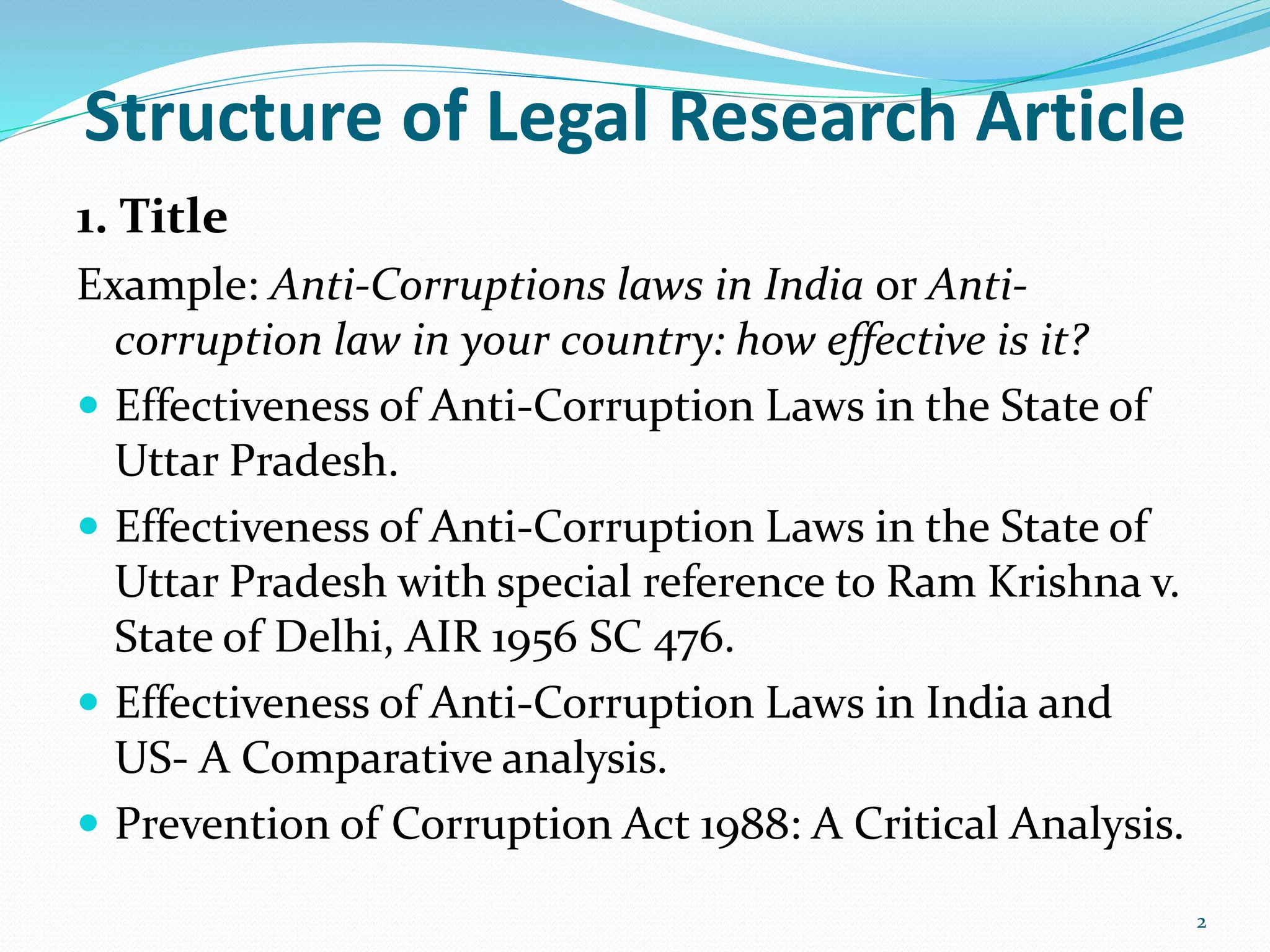
Structure of Legal Research Article
1. Title
Example: Anti-Corruptions laws in India or Anti-
corruption law in your country: how effective is it?
 Effectiveness of Anti-Corruption Laws in the State of
Uttar Pradesh.
 Effectiveness of Anti-Corruption Laws in the State of
Uttar Pradesh with special reference to Ram Krishna v.
State of Delhi, AIR 1956 SC 476.
 Effectiveness of Anti-Corruption Laws in India and
US- A Comparative analysis.
 Prevention of Corruption Act 1988: A Critical Analysis.
2
2. Name of the author/authors
(footnote: Complete designation, address of the
author/authors)
Example: ** Dr. Ruchi Lal
Footnote:
** Associate Professor, Amity Law School, Amity University
Noida (UP) Email:…
3
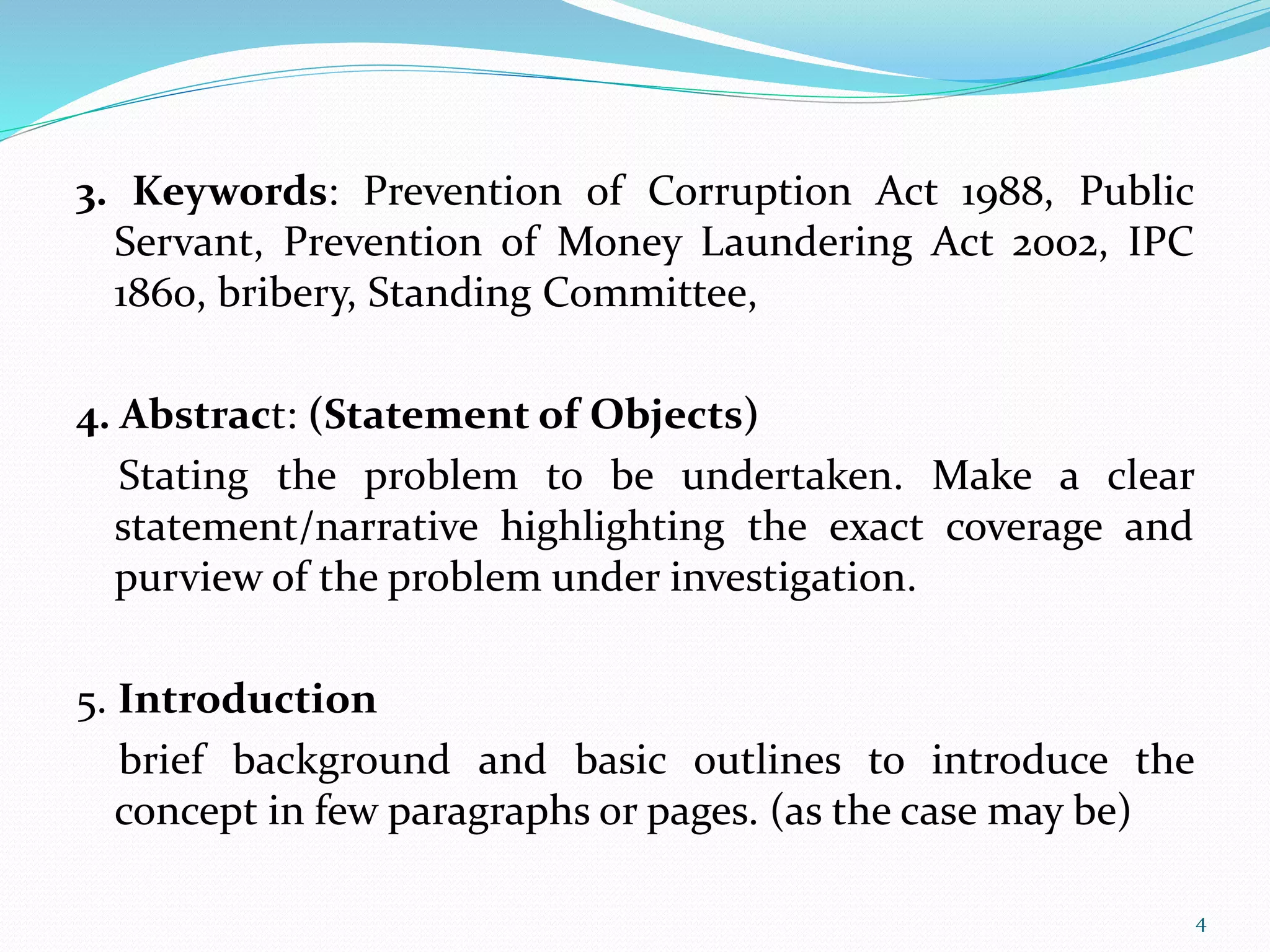
3. Keywords: Prevention of Corruption Act 1988, Public
Servant, Prevention of Money Laundering Act 2002, IPC
1860, bribery, Standing Committee,
4. Abstract: (Statement of Objects)
Stating the problem to be undertaken. Make a clear
statement/narrative highlighting the exact coverage and
purview of the problem under investigation.
5. Introduction
brief background and basic outlines to introduce the
concept in few paragraphs or pages. (as the case may be)
4
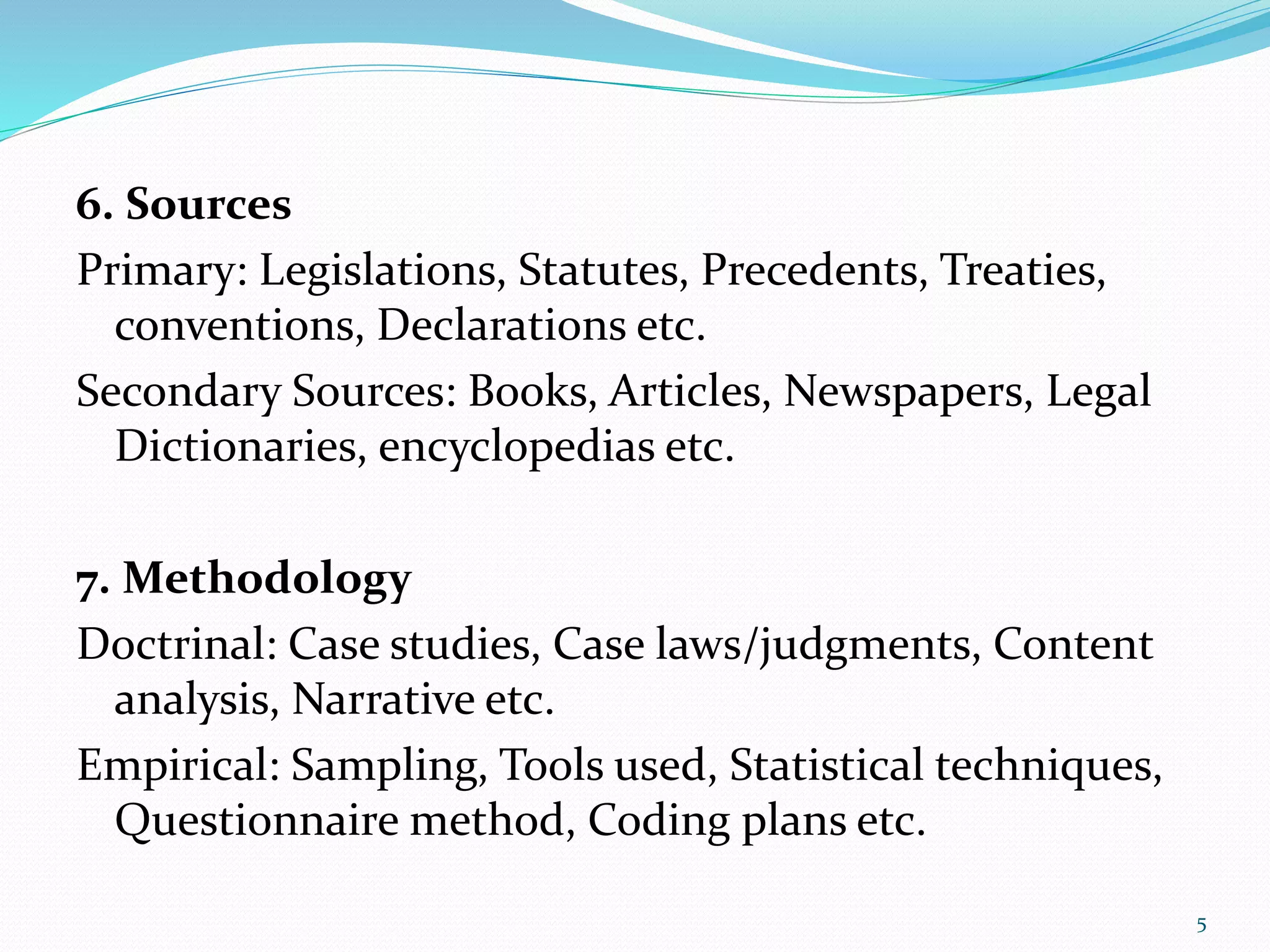
6. Sources
Primary: Legislations, Statutes, Precedents, Treaties,
conventions, Declarations etc.
Secondary Sources: Books, Articles, Newspapers, Legal
Dictionaries, encyclopedias etc.
7. Methodology
Doctrinal: Case studies, Case laws/judgments, Content
analysis, Narrative etc.
Empirical: Sampling, Tools used, Statistical techniques,
Questionnaire method, Coding plans etc.
5
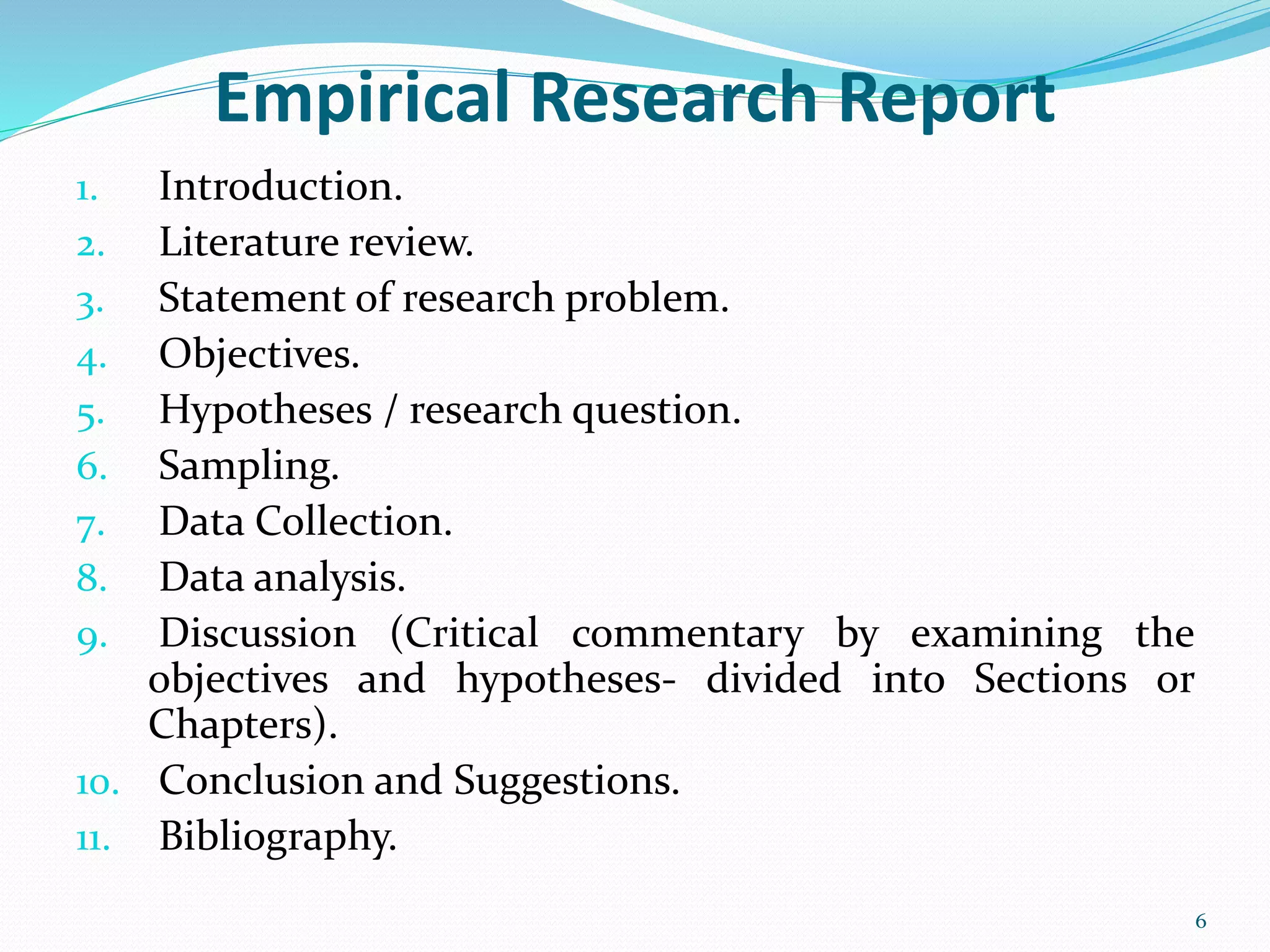
Empirical Research Report
1. Introduction.
2. Literature review.
3. Statement of research problem.
4. Objectives.
5. Hypotheses / research question.
6. Sampling.
7. Data Collection.
8. Data analysis.
9. Discussion (Critical commentary by examining the
objectives and hypotheses- divided into Sections or
Chapters).
10. Conclusion and Suggestions.
11. Bibliography.
6
Doctrinal Research Report
1. Introduction.
2. Literature Review.
3. Statement of Research Problem.
4. Objectives.
5. Hypotheses/Research Question.
6. Data Collection.
7. Data analysis.
8. Discussion (Critical commentary by examining the
objectives and hypotheses and deriving inferences)
9. Conclusion & Suggestions.
10. Bibliography.
7
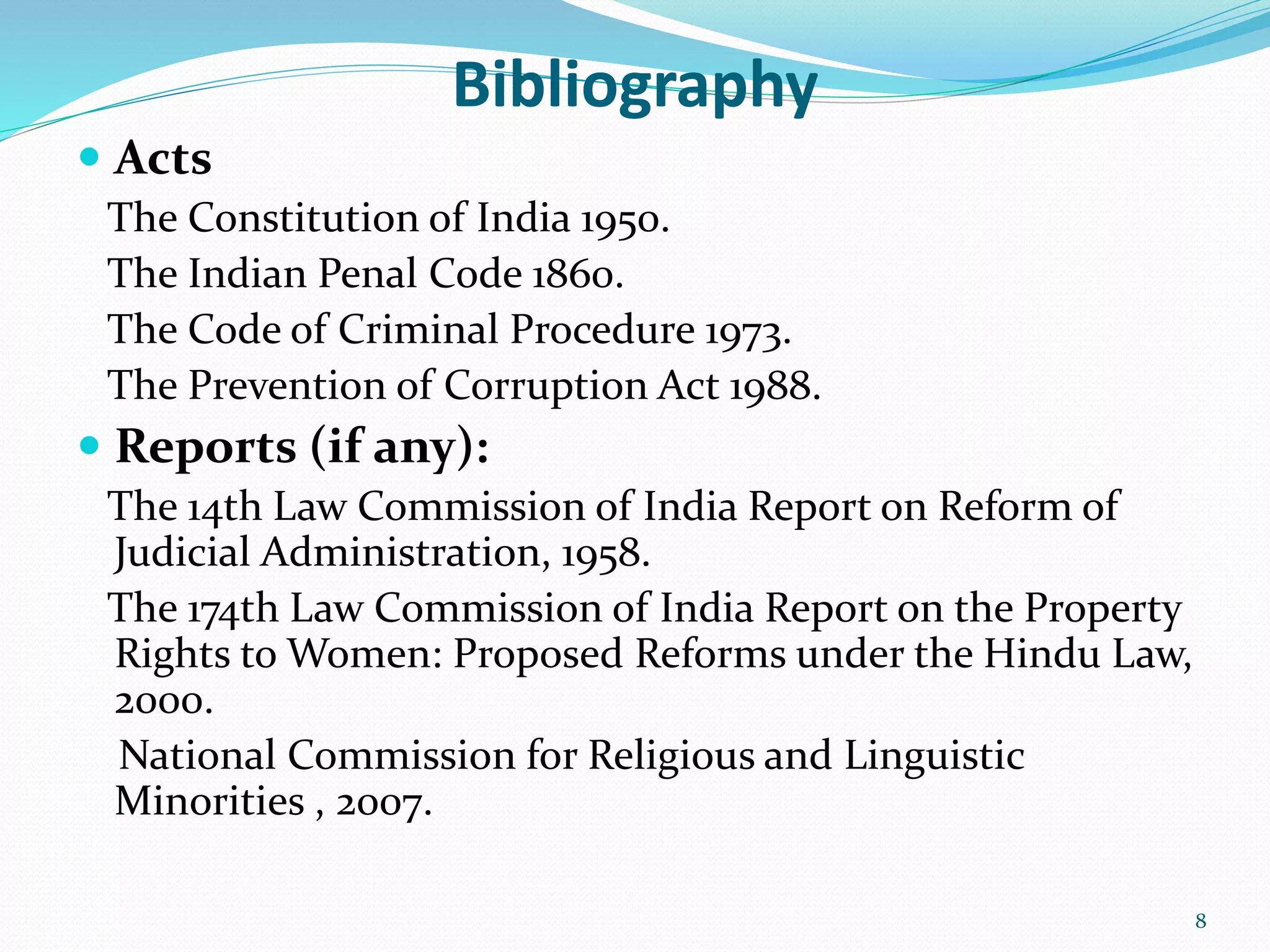
Bibliography
 Acts
The Constitution of India 1950.
The Indian Penal Code 1860.
The Code of Criminal Procedure 1973.
The Prevention of Corruption Act 1988.
 Reports (if any):
The 14th Law Commission of India Report on Reform of
Judicial Administration, 1958.
The 174th Law Commission of India Report on the Property
Rights to Women: Proposed Reforms under the Hindu Law,
2000.
National Commission for Religious and Linguistic
Minorities , 2007.
8
 Books
 Articles/Journals
 Newspapers
 Other Sources (Internet Sources)
 Kesavananda Bharati v. State of Kerala, AIR 1973 SC 146.
 PM Bakshi, The Constitution of India, Universal Law
Publishing (15th Edition) 2018.
 “SC: EC can’t take away star campaigner status”, The Times
of India,3 November 2020, p. 7 (Delhi edition).
 Basu, NK (1968). Tribes of India, New Delhi: National Book
Trust.
FOR CITATION: 19th Blue Book Edition. (ILI Format)
9

10. legal research paper

  • 1.
    Academic and professionallegal writing requires development of an argument and demonstration of the relationships between the ideas expressed. 1
  • 2.
    Structure of LegalResearch Article 1. Title Example: Anti-Corruptions laws in India or Anti- corruption law in your country: how effective is it?  Effectiveness of Anti-Corruption Laws in the State of Uttar Pradesh.  Effectiveness of Anti-Corruption Laws in the State of Uttar Pradesh with special reference to Ram Krishna v. State of Delhi, AIR 1956 SC 476.  Effectiveness of Anti-Corruption Laws in India and US- A Comparative analysis.  Prevention of Corruption Act 1988: A Critical Analysis. 2
  • 3.
    2. Name ofthe author/authors (footnote: Complete designation, address of the author/authors) Example: ** Dr. Ruchi Lal Footnote: ** Associate Professor, Amity Law School, Amity University Noida (UP) Email:… 3
  • 4.
    3. Keywords: Preventionof Corruption Act 1988, Public Servant, Prevention of Money Laundering Act 2002, IPC 1860, bribery, Standing Committee, 4. Abstract: (Statement of Objects) Stating the problem to be undertaken. Make a clear statement/narrative highlighting the exact coverage and purview of the problem under investigation. 5. Introduction brief background and basic outlines to introduce the concept in few paragraphs or pages. (as the case may be) 4
  • 5.
    6. Sources Primary: Legislations,Statutes, Precedents, Treaties, conventions, Declarations etc. Secondary Sources: Books, Articles, Newspapers, Legal Dictionaries, encyclopedias etc. 7. Methodology Doctrinal: Case studies, Case laws/judgments, Content analysis, Narrative etc. Empirical: Sampling, Tools used, Statistical techniques, Questionnaire method, Coding plans etc. 5
  • 6.
    Empirical Research Report 1.Introduction. 2. Literature review. 3. Statement of research problem. 4. Objectives. 5. Hypotheses / research question. 6. Sampling. 7. Data Collection. 8. Data analysis. 9. Discussion (Critical commentary by examining the objectives and hypotheses- divided into Sections or Chapters). 10. Conclusion and Suggestions. 11. Bibliography. 6
  • 7.
    Doctrinal Research Report 1.Introduction. 2. Literature Review. 3. Statement of Research Problem. 4. Objectives. 5. Hypotheses/Research Question. 6. Data Collection. 7. Data analysis. 8. Discussion (Critical commentary by examining the objectives and hypotheses and deriving inferences) 9. Conclusion & Suggestions. 10. Bibliography. 7
  • 8.
    Bibliography  Acts The Constitutionof India 1950. The Indian Penal Code 1860. The Code of Criminal Procedure 1973. The Prevention of Corruption Act 1988.  Reports (if any): The 14th Law Commission of India Report on Reform of Judicial Administration, 1958. The 174th Law Commission of India Report on the Property Rights to Women: Proposed Reforms under the Hindu Law, 2000. National Commission for Religious and Linguistic Minorities , 2007. 8
  • 9.
     Books  Articles/Journals Newspapers  Other Sources (Internet Sources)  Kesavananda Bharati v. State of Kerala, AIR 1973 SC 146.  PM Bakshi, The Constitution of India, Universal Law Publishing (15th Edition) 2018.  “SC: EC can’t take away star campaigner status”, The Times of India,3 November 2020, p. 7 (Delhi edition).  Basu, NK (1968). Tribes of India, New Delhi: National Book Trust. FOR CITATION: 19th Blue Book Edition. (ILI Format) 9