CODE-N-PLAY:

      DEPLOYABLE PROTOCOL STACKS


      PouzinSociety@FutureNet 2010


                           Waterford Institute of Technology (WIT)              www: www.tssg.org          e-mail: pphelan@tssg.org
Patrick Phelan             Telecommunications Software & Systems Group (TSSG)   Tel : +353 (0)51 30-2945   mobile: +353 (0)860724364
Senior Research Engineer   Cork Road, Waterford, Ireland                        Fax: +353 (0)51 30-2901    IN: www.linkedin.com/in/1pphelan
Agenda

 • Background
    TSSG / WIT
    EU FP7 –ICT 4WARD
 • The Fun Stuff
    Prelude
    Fetching the pieces
    Network Medium
 • Roadmap
    Today
    Tomorrow
 • Demo / Backup Slides
Background


                           Waterford Institute of Technology (WIT)              www: www.tssg.org          e-mail: pphelan@tssg.org
Patrick Phelan             Telecommunications Software & Systems Group (TSSG)   Tel : +353 (0)51 30-2945   mobile: +353 (0)860724364
Senior Research Engineer   Cork Road, Waterford, Ireland                        Fax: +353 (0)51 30-2901    IN: www.linkedin.com/in/1pphelan
TSSG

 • The Telecommunications Software & Systems Group
   (TSSG) is one of the largest integrated information
   communication technology (ICT) research centres in
   Ireland.
 • TSSG is part of Waterford Institute of Technology
   (WIT), and is based at WIT’s West Campus in
   Carriganore, Co. Waterford, Ireland.
 • More Information:
    http://www.wit.ie
    http://www.tssg.org
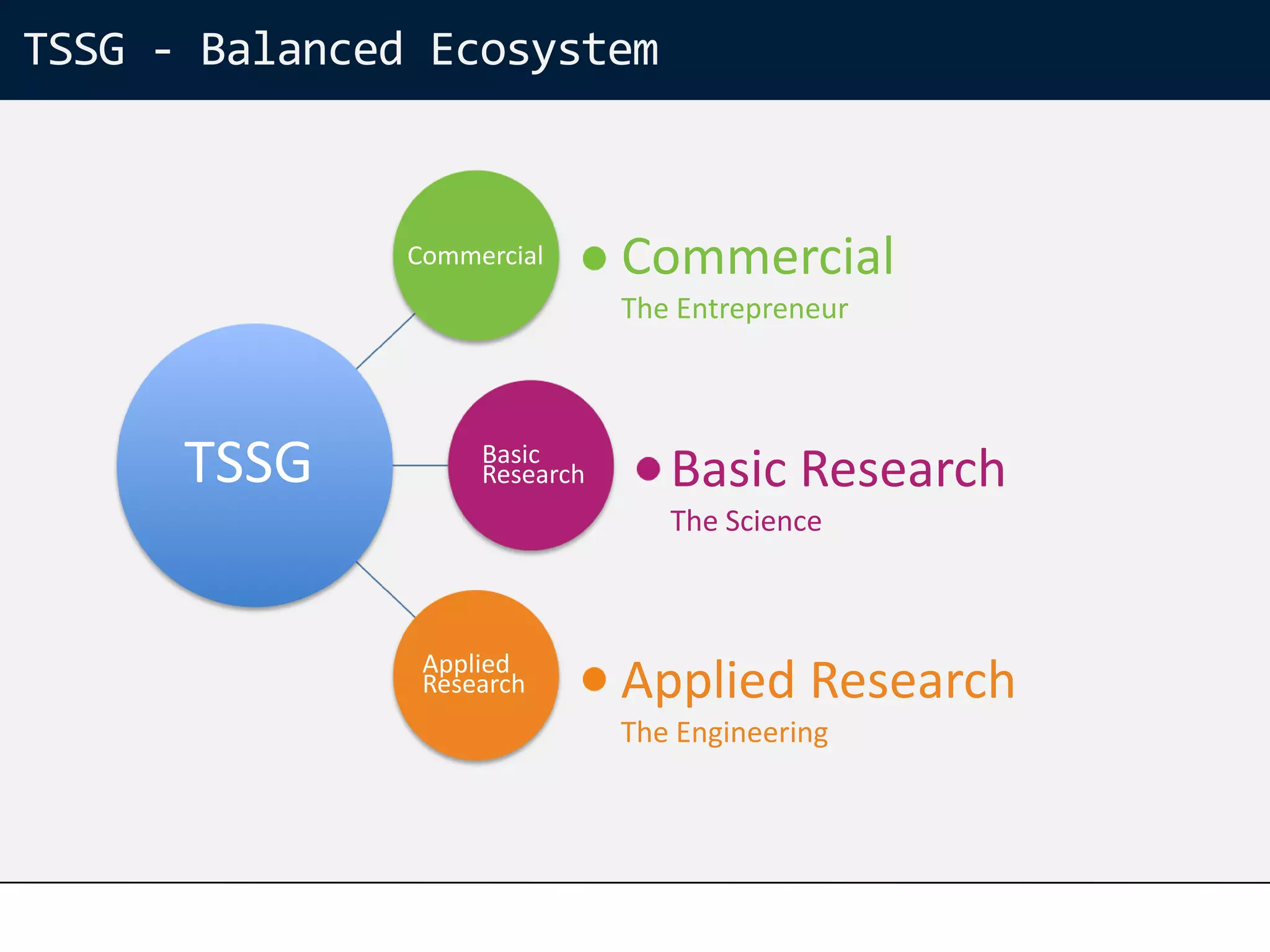
TSSG - Balanced Ecosystem


               Commercial      Commercial
                               The Entrepreneur


      TSSG          Basic
                    Research      Basic Research
                                  The Science


                Applied
                Research       Applied Research
                               The Engineering
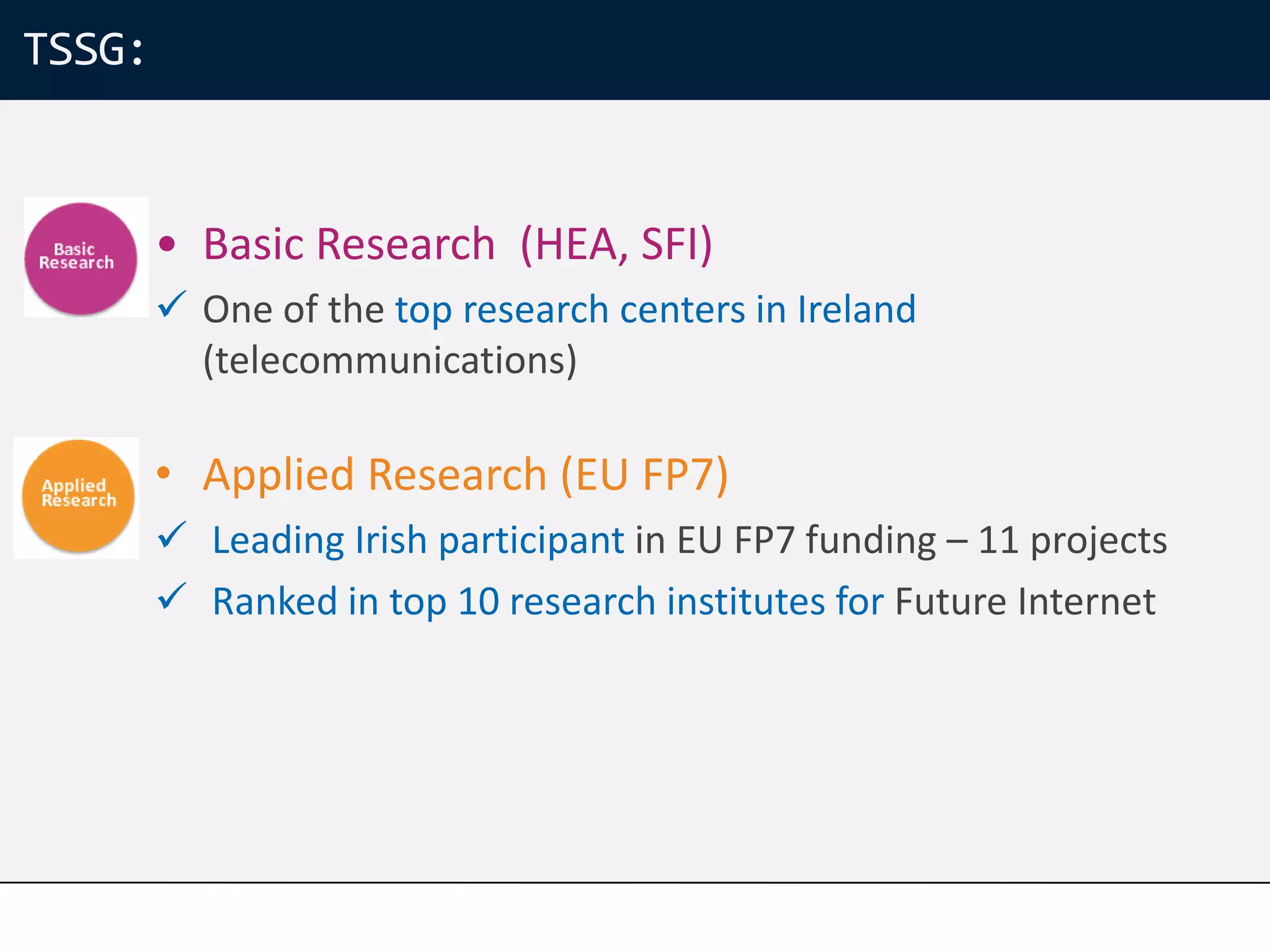
TSSG:


        • Basic Research (HEA, SFI)
         One of the top research centers in Ireland
          (telecommunications)

        • Applied Research (EU FP7)
         Leading Irish participant in EU FP7 funding – 11 projects
         Ranked in top 10 research institutes for Future Internet
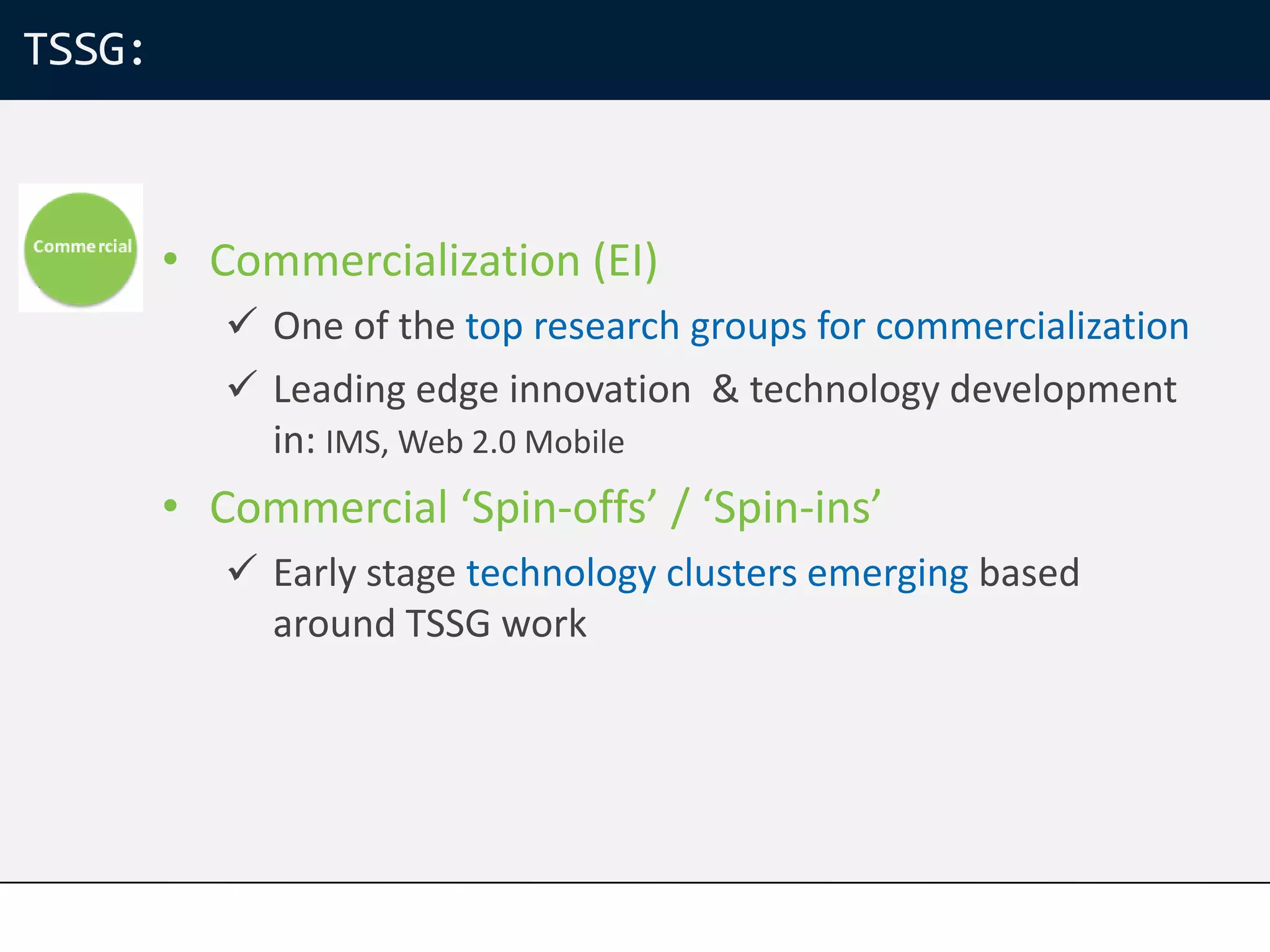
TSSG:


        • Commercialization (EI)
            One of the top research groups for commercialization
            Leading edge innovation & technology development
             in: IMS, Web 2.0 Mobile
        • Commercial ‘Spin-offs’ / ‘Spin-ins’
            Early stage technology clusters emerging based
             around TSSG work
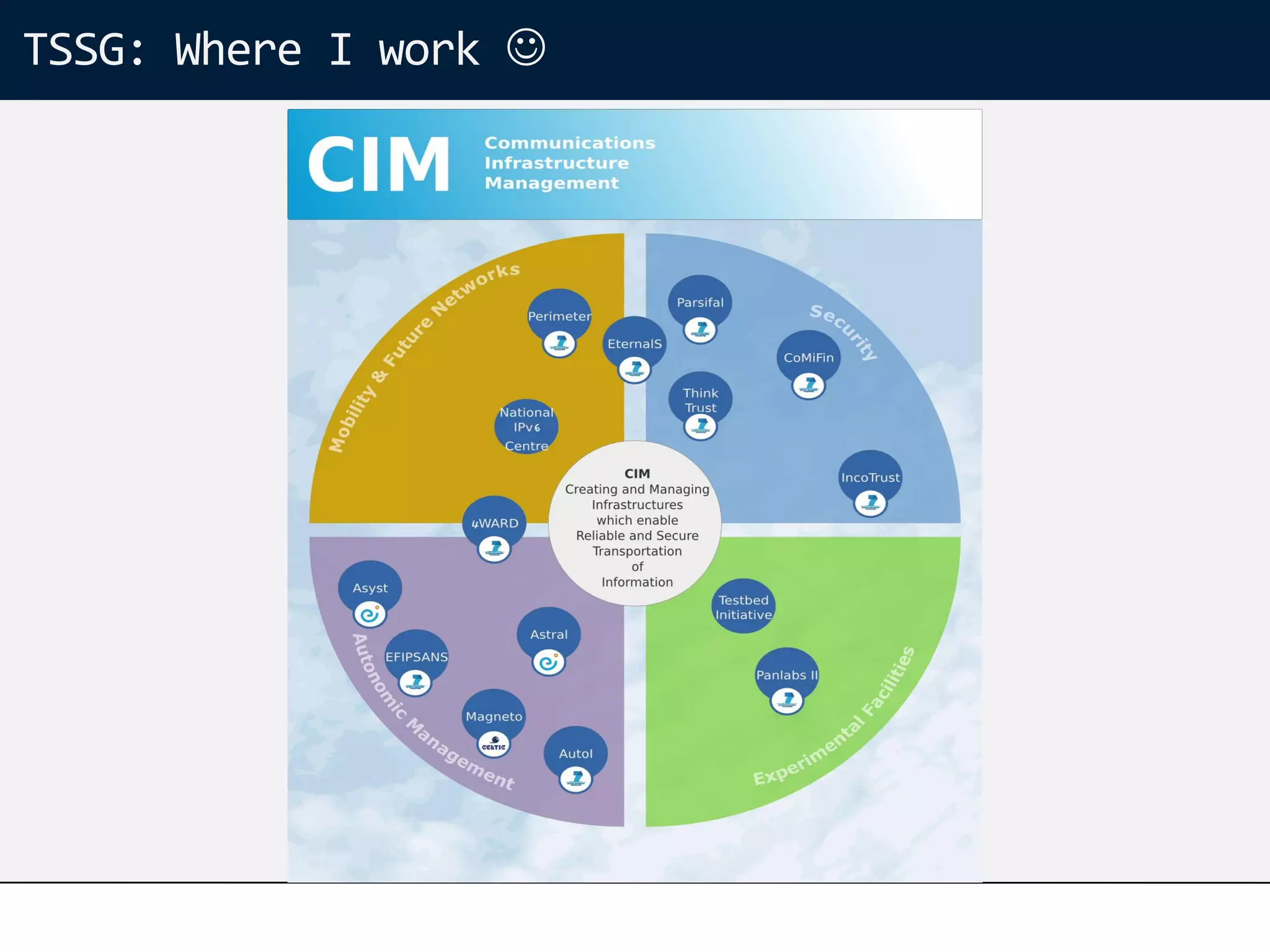
TSSG: Where I work 
4WARD [IP EU FP7 ICT]

 • The 4WARD project is looking to the new architecture
   and design of the Future Internet and has set itself the
   task of creating a new approach to networking
   architecture that is more flexible and better adapted to
   present and future requirements.
 • Co-Ordinator : Ericsson
    37 Partners including Nokia, Alcatel-Lucent, NEC,
     Telefonica, Deutsche Telekom, France Telecom, Telecom
     Italia…
 • More Information
    http://www.4ward-project.eu
Finally the interesting stuff…


                           Waterford Institute of Technology (WIT)              www: www.tssg.org          e-mail: pphelan@tssg.org
Patrick Phelan             Telecommunications Software & Systems Group (TSSG)   Tel : +353 (0)51 30-2945   mobile: +353 (0)860724364
Senior Research Engineer   Cork Road, Waterford, Ireland                        Fax: +353 (0)51 30-2901    IN: www.linkedin.com/in/1pphelan
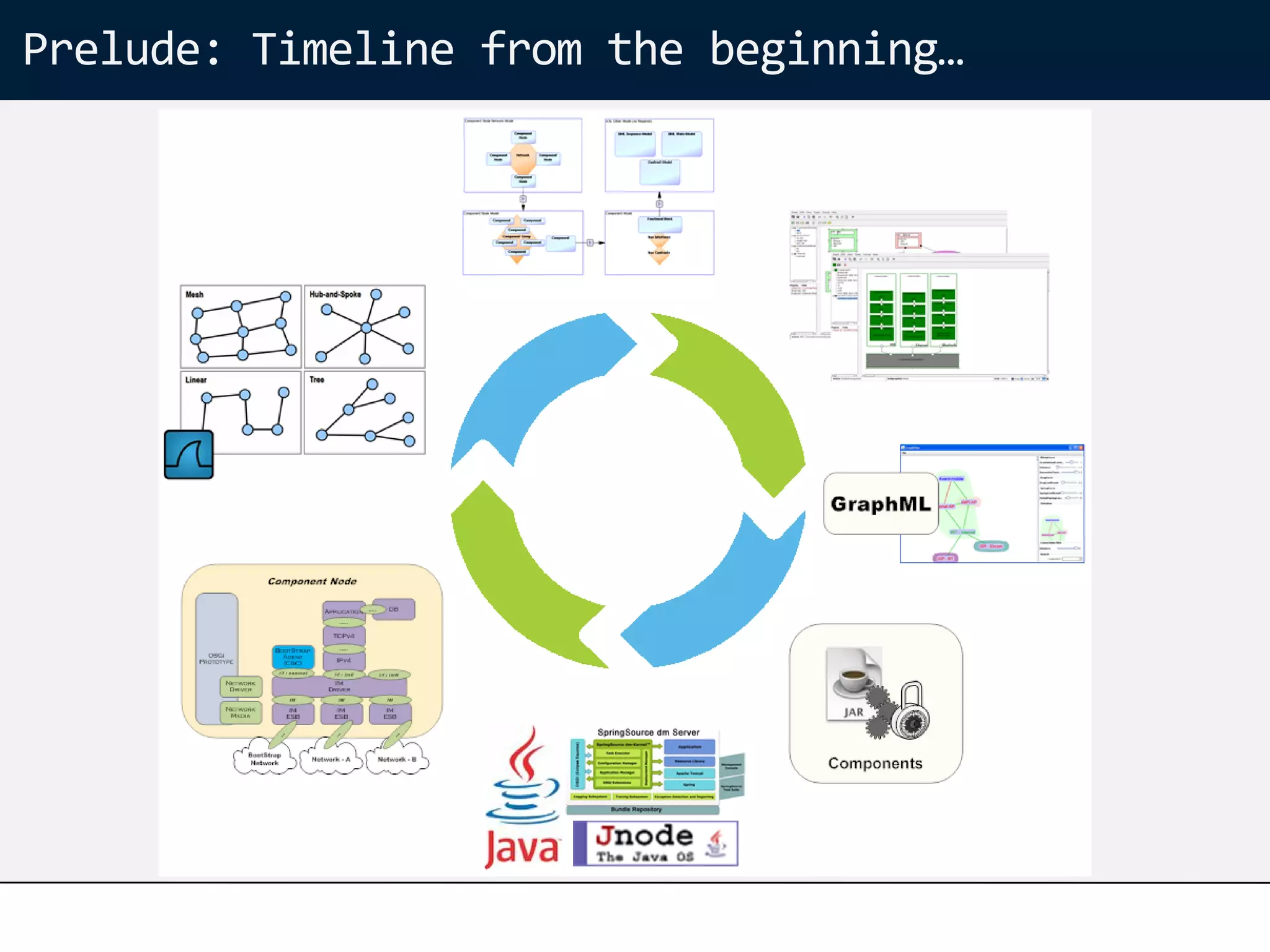
Prelude: Timeline from the beginning…
Prelude: Guiding Principles
 • KISS Principle
      Light weight, Modular, Flexible, Best Practises
      Agility + Flexibility + Ease-Of-Use = Productivity
      Java (Popular, low barrier to entry)
      OSGi (Industry Standard)

 • Software Development Practices
    Convention, Configuration, Code
      In that order for higher productivity
    Service based through & through
      Looser coupling, easier maintenance
    Grows with the Scenarios
      Pick-and-choose only the features required
Executive Summary: In a nutshell

 • Java based development, deployment and execution
      No C/C++, No OS Kernel (User space), No pain
      Removal of barrier to entry
      Cross platform – OS independent.
      Off the shelf (free/community tools / platform)
      Applying Industry practises / tooling
 • Design – Develop – Deploy
 • Its Software - Nothing is impossible!

 • Network Protocol(s) / Stack implementation / testing
 • Network & Node configuration & deployment
 • Complete Programmatic Control – Repeat Scenarios
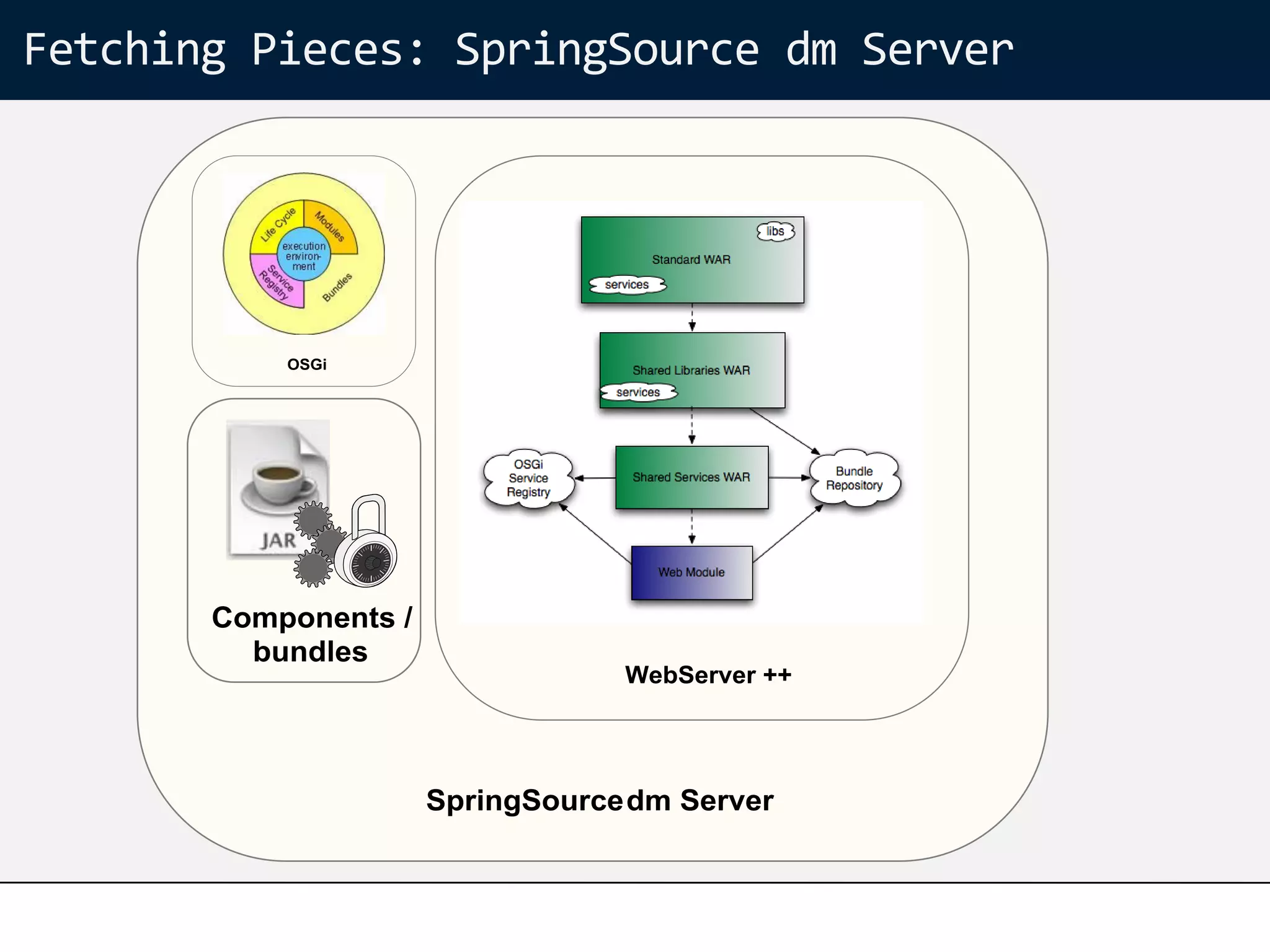
Fetching Pieces: SpringSource dm Server

 • SpringSource dm Server™ is a completely modular,
   OSGi-based Java server designed to run enterprise Java
   applications and Spring-powered applications with a
   new degree of flexibility and reliability. The
   SpringSource dm Server is based on the new
   SpringSource Dynamic Module Kernel™ (dm Kernel).
    http://www.springsource.org/dmserver
 • OSGi™ - The Dynamic Module System for Java™
    http://www.osgi.org/Main/HomePage
 • SpringSource dm Server™ moves to Eclipse
    Project Virgo (EPL Licensing)
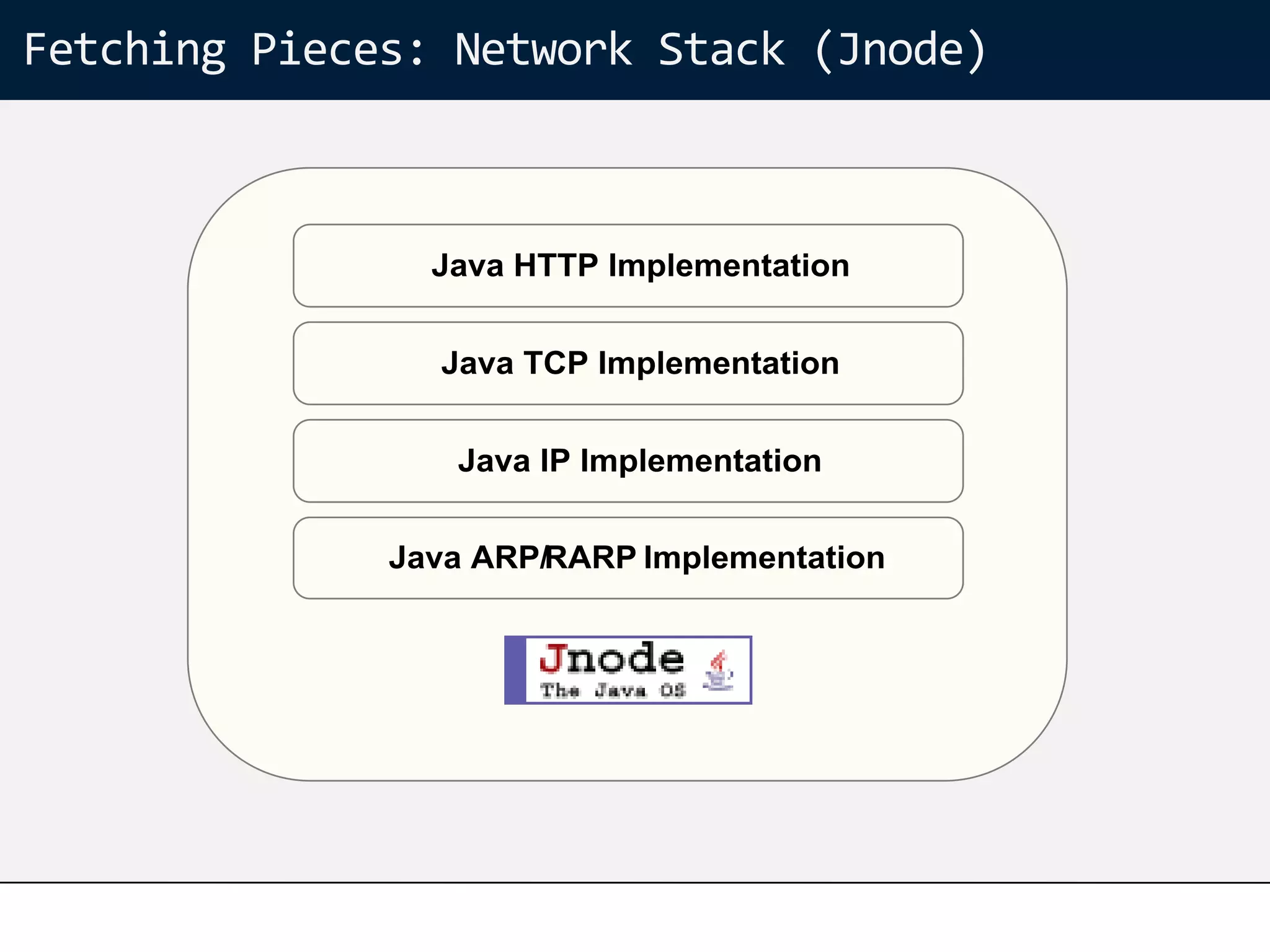
Fetching Pieces: Network Stack (Jnode)

 • JNode (Java New Operating System Design Effort) is an
   open-source project to create a Java platform operating
   system. The project has taken the unique direction of
   creating all the software in Java itself, with the
   exception of some assembly language to boot and load
   the system.
    http://www.jnode.org


 • Extracted/Componentised the Network Sub-System of
   the Operating System.
    Protocols, Device & Network Infrastructure.
Fetching Pieces: Transport (XMPP)

 • XMPP – http://www.xmpp.org
    Open Standards – RFC 3920, 3921
    Underlying protocol for most IM applications.
      Jabber, Google Talk…
    Widespread use, various implementations.
    Open Source Clients / Servers / Libraries.
      Ignite Realtime – Openfire (Server) / Smack (Client Library)
      http://www.igniterealtime.org/projects/openfire/
    Interesting side effect : XMPP is a reliable transport.
      Programmatic control of “unreliability”
      Reproducible failure / congestion scenarios.
Assembly: From Models to Implementation

 •   OSGi - bundles are components.
 •   OSGi - network protocols are exposed as OSGi services
 •   OSGi - “network stack” is SOA assembled
 •   OSGi – “Application” is a component node
 •   dm Server - “Application”(s) isolated from each other
 •   dm Server – Deployment platform.
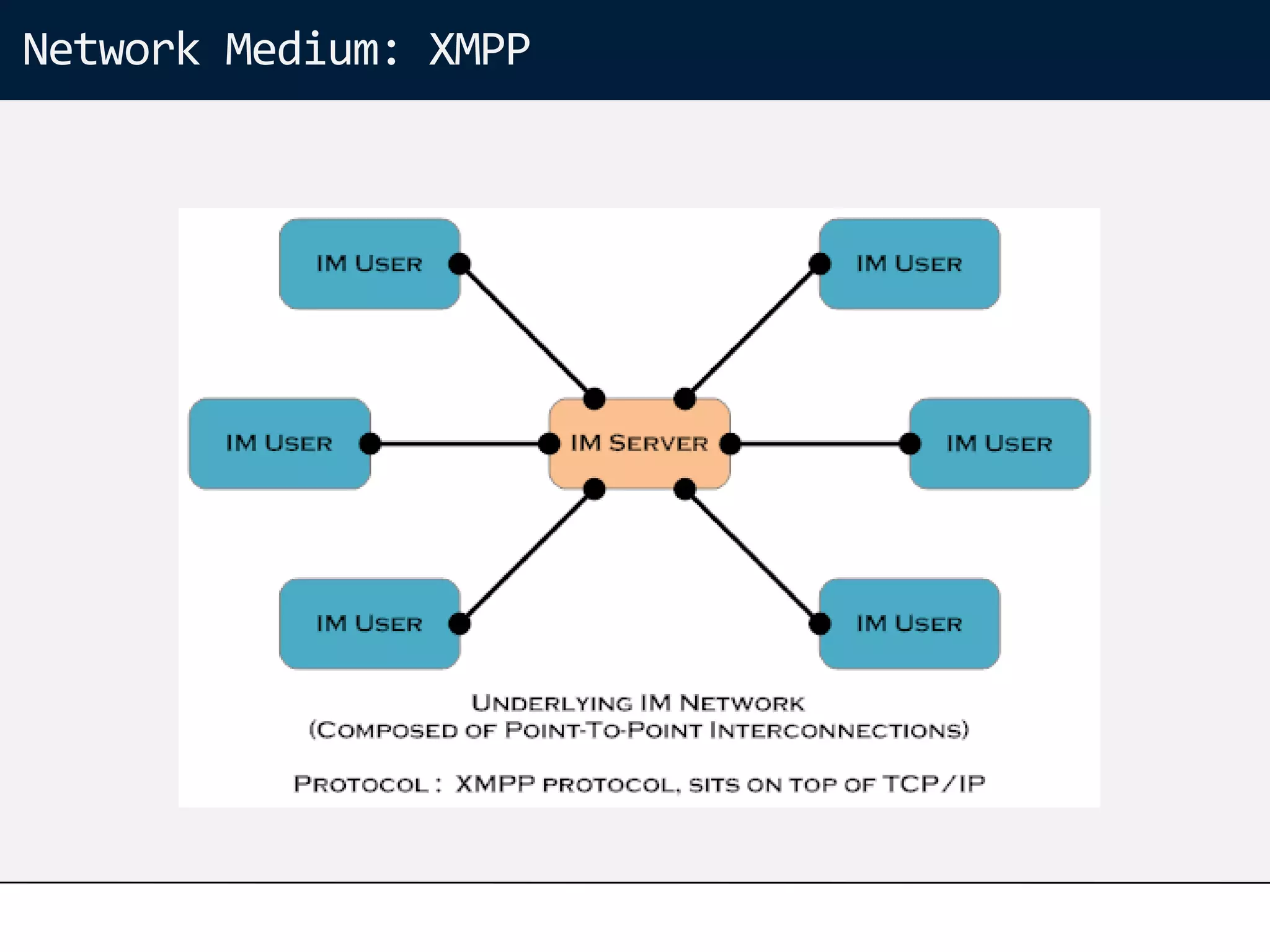
 •   The underlying network medium is XMPP – virtual
     network (overlay).
      XMPP is the current flavour of overlay.
      Abstracted at the driver interface – can be implemented
       over “sockets” or magic pixie dust if required.
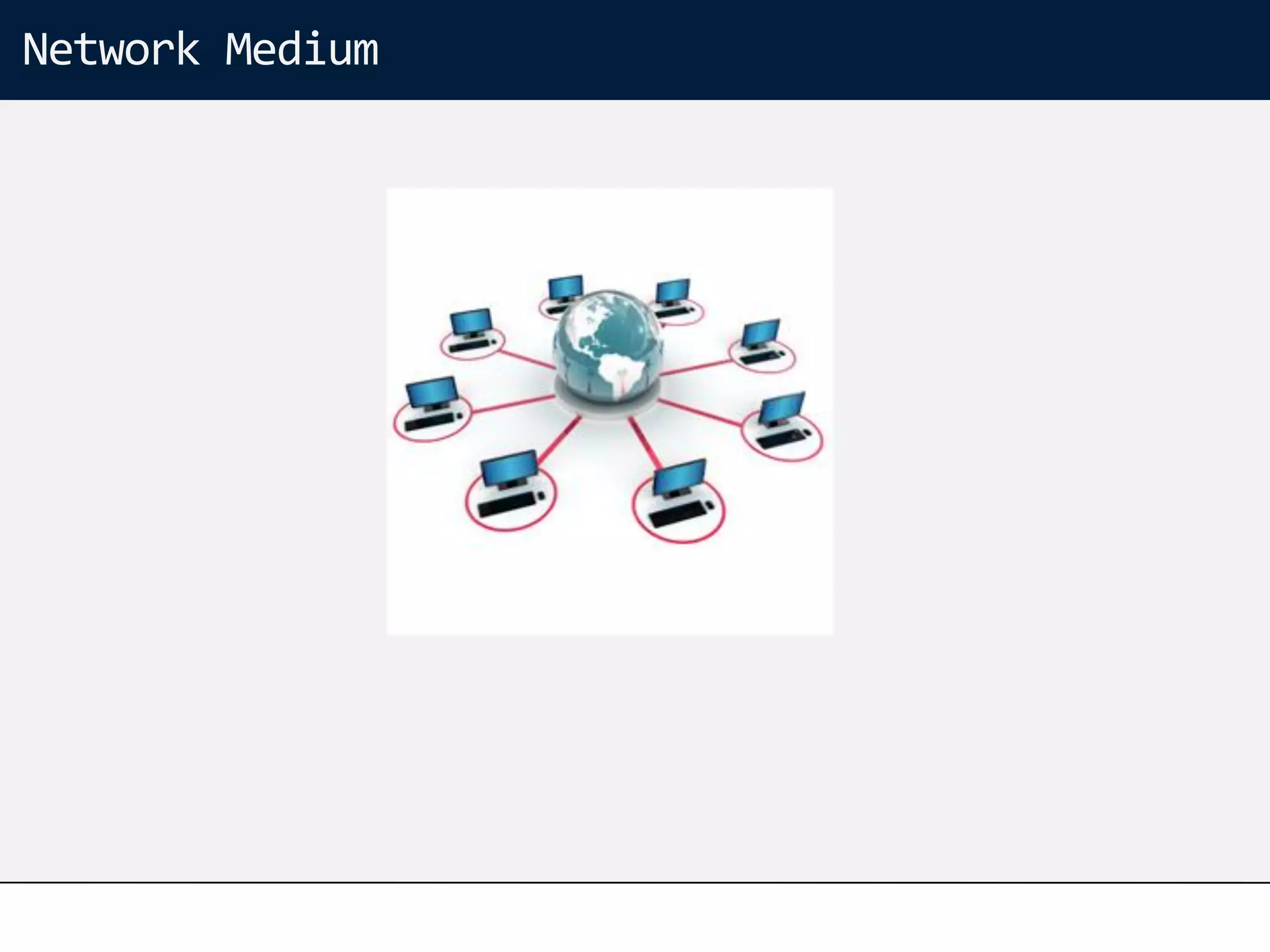
Network Medium
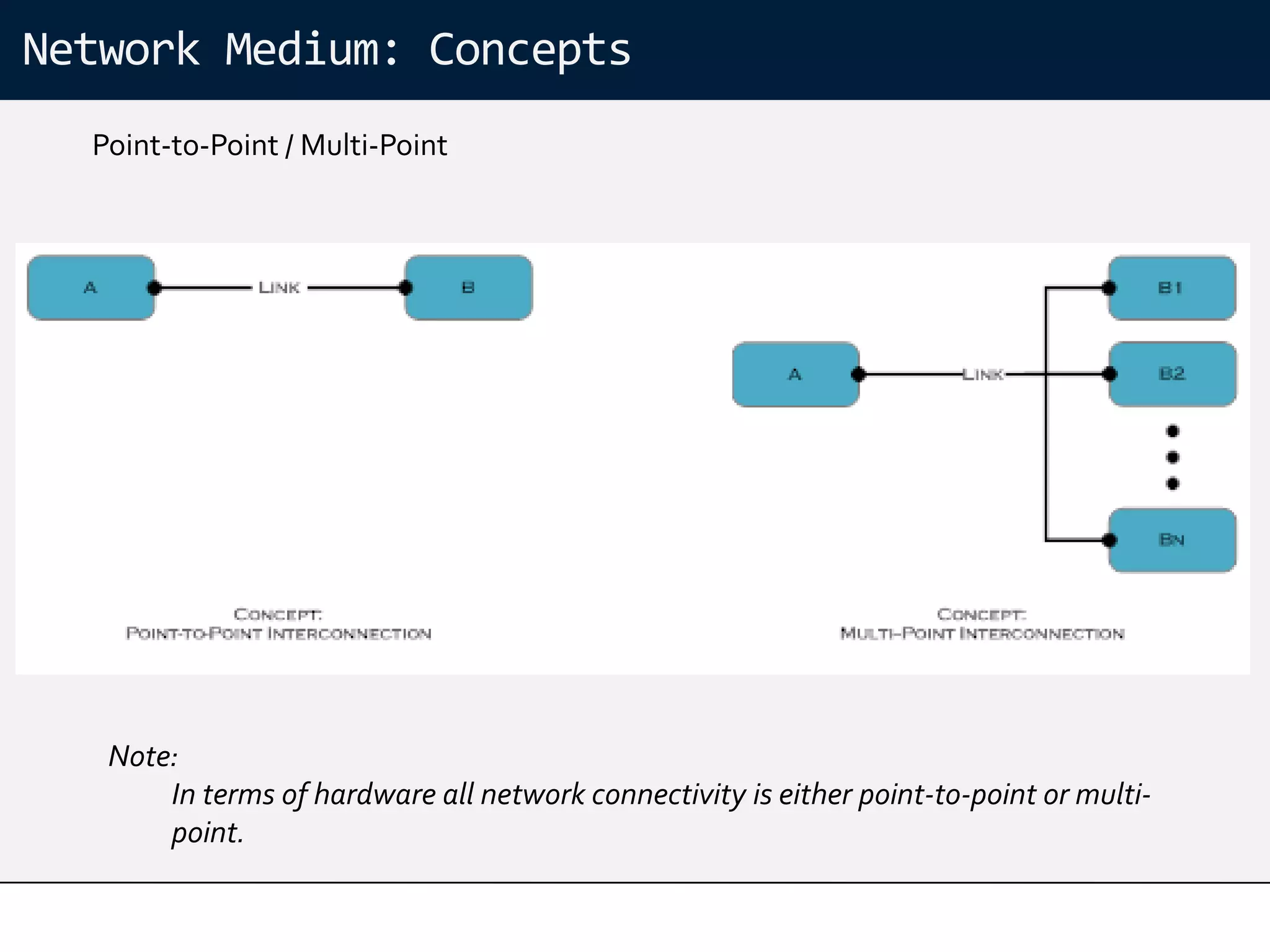
Network Medium: Concepts
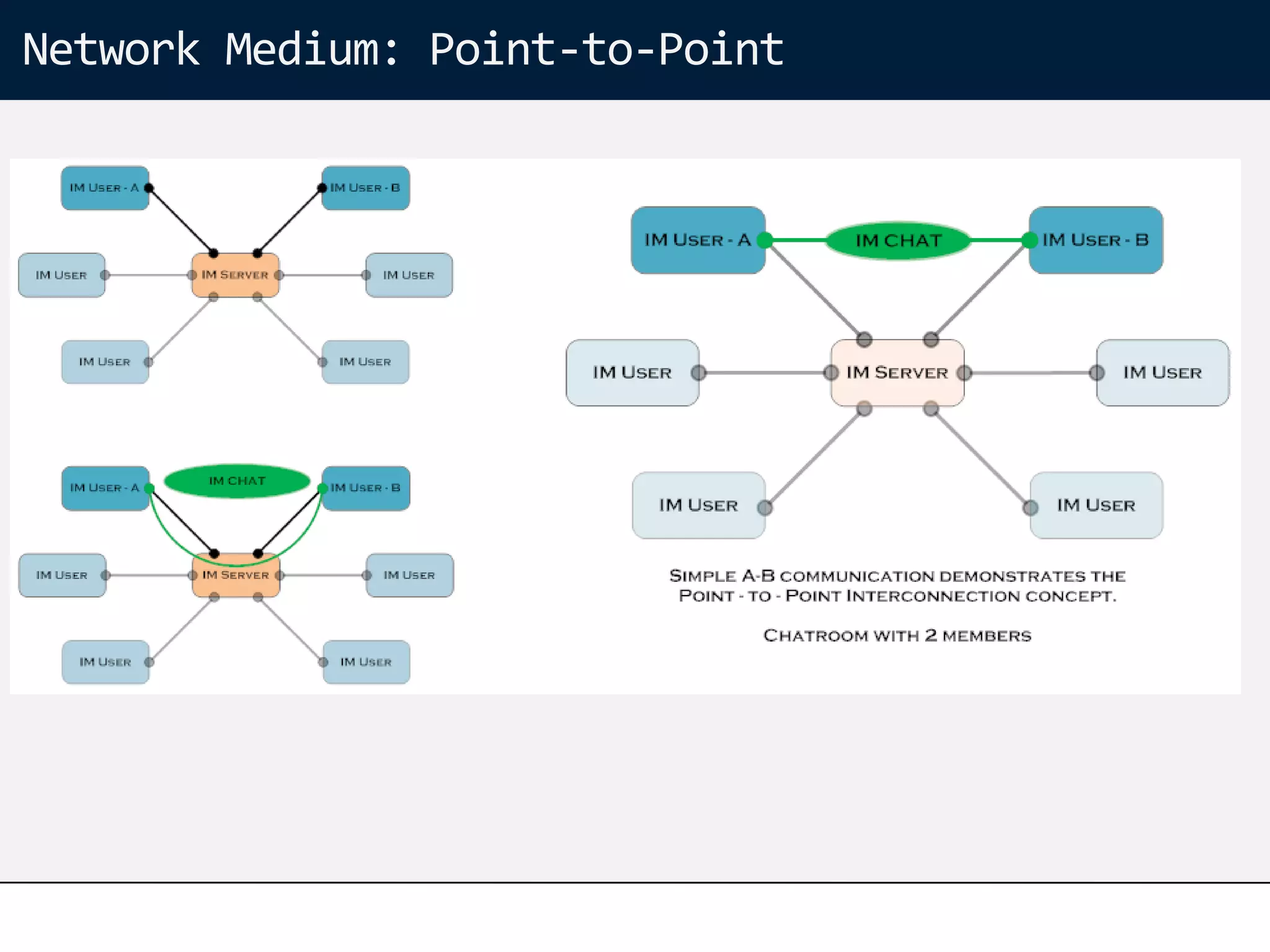
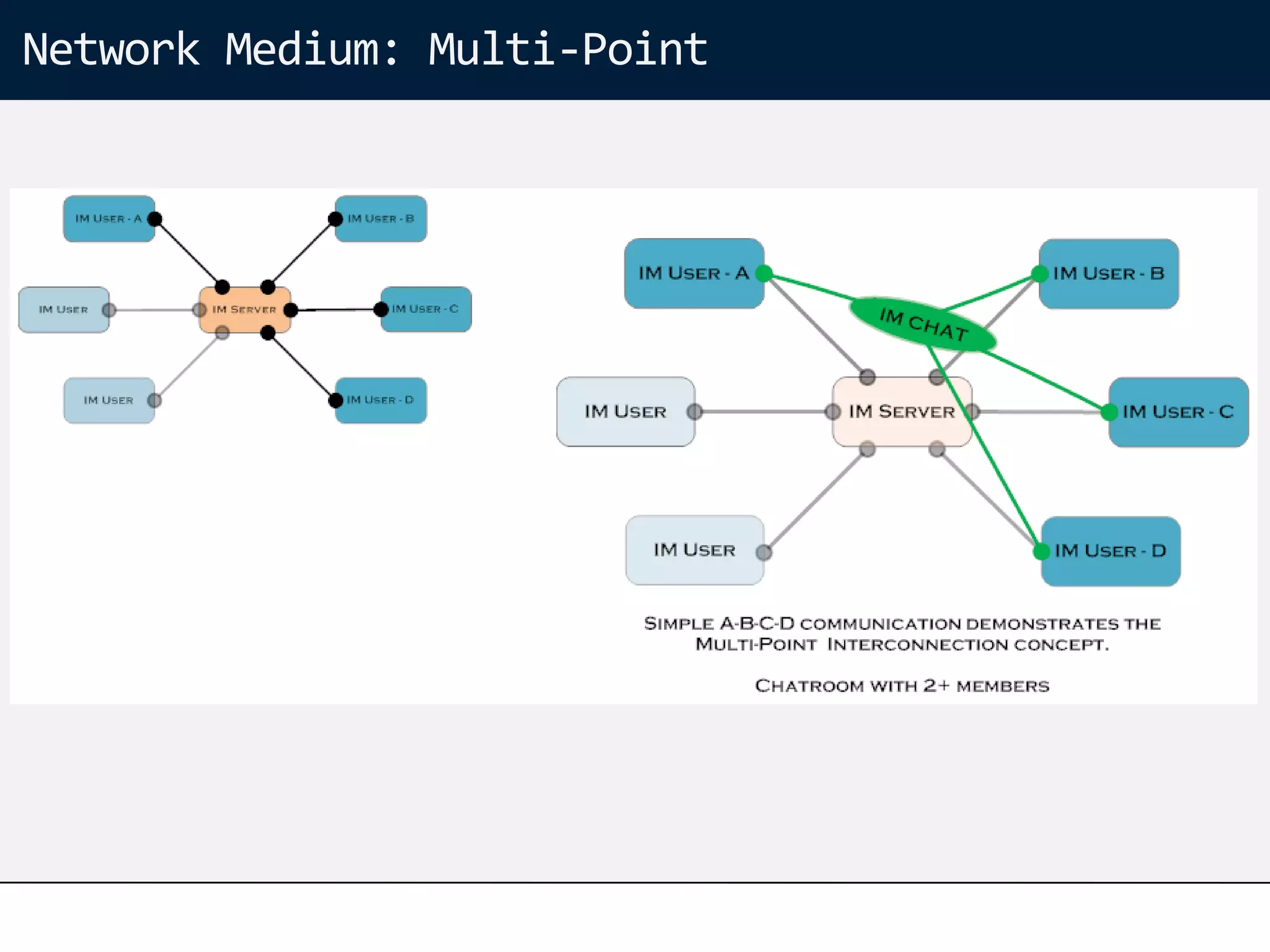
  Point-to-Point / Multi-Point


   Note:
       In terms of hardware all network connectivity is either point-to-point or multi-
       point.
Network Medium: XMPP
Network Medium: Point-to-Point
Network Medium: Multi-Point
Network Medium: Its All About The PDU


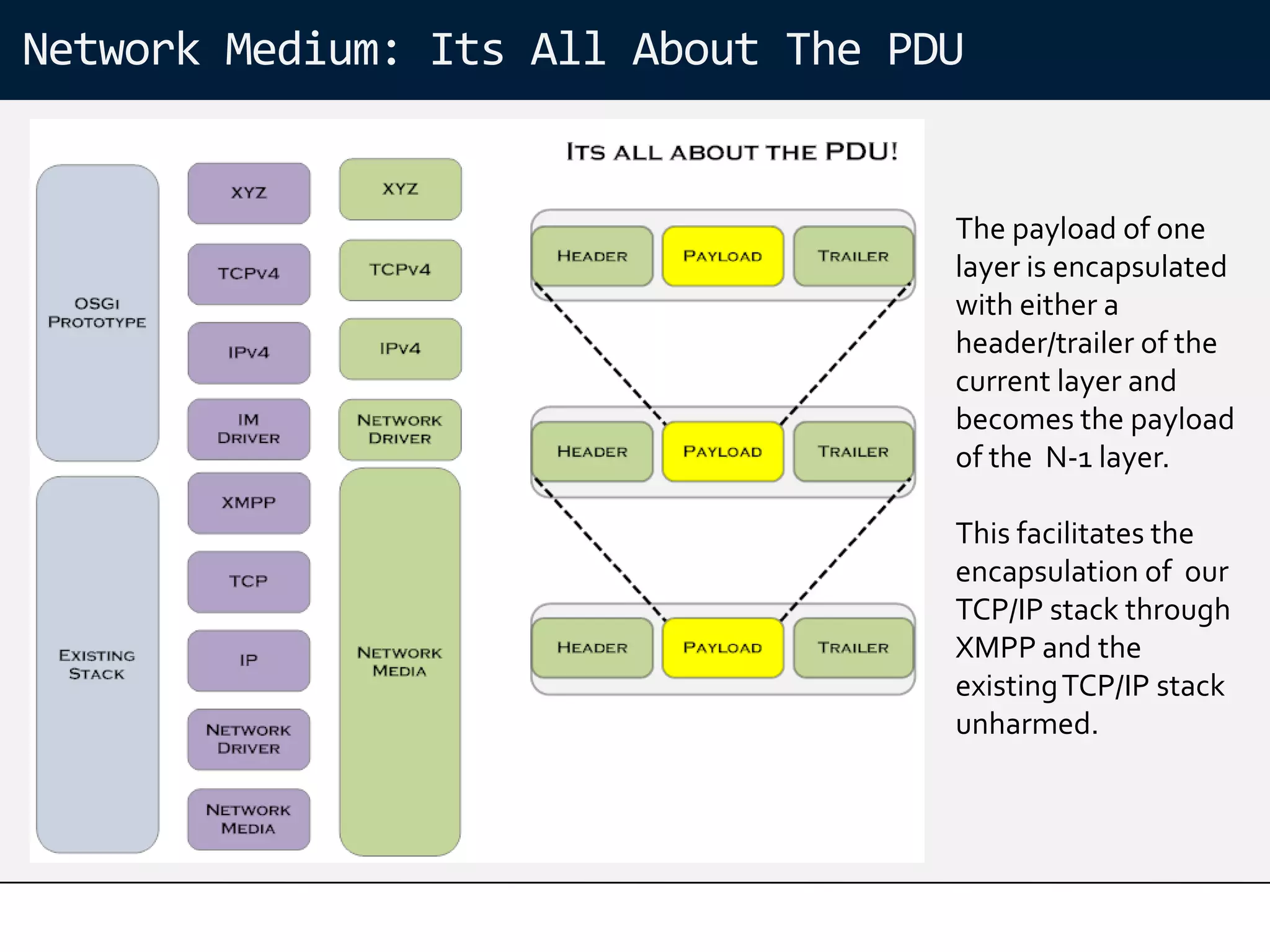
                                    The payload of one
                                    layer is encapsulated
                                    with either a
                                    header/trailer of the
                                    current layer and
                                    becomes the payload
                                    of the N-1 layer.

                                    This facilitates the
                                    encapsulation of our
                                    TCP/IP stack through
                                    XMPP and the
                                    existing TCP/IP stack
                                    unharmed.
Network Medium: Details

 • A chat room represents a hardware network.
 • A IM buddy represents a hardware Point-of-Attachment
   (POA) for our nodes.
 • A node with multiple POAs can be a member of
   multiple networks i.e. can be a router.
 • Any message sent by a node on the network can be
   seen by any other node with a POA to that network.
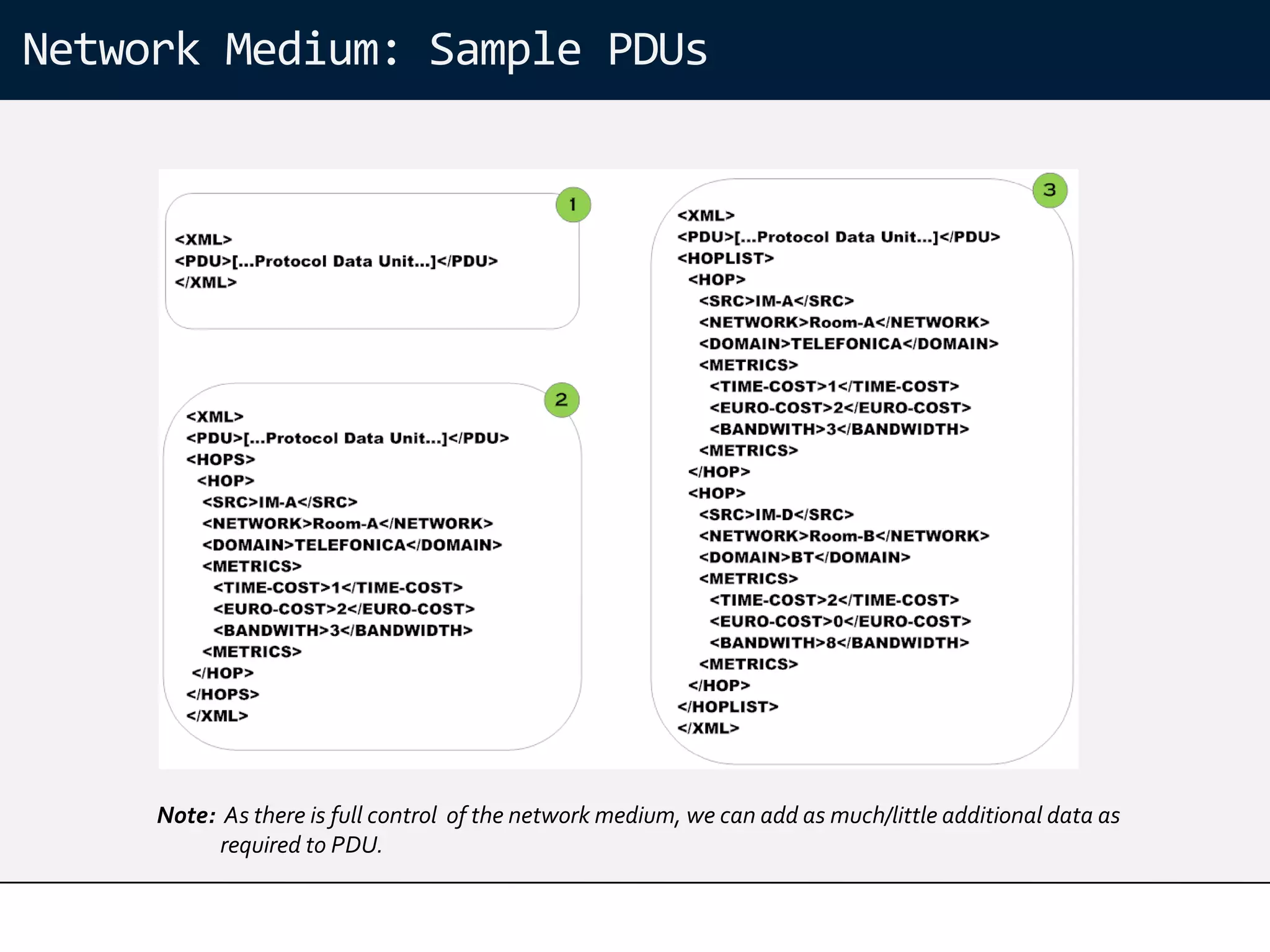
Network Medium: Sample PDUs


     Note: As there is full control of the network medium, we can add as much/little additional data as
           required to PDU.
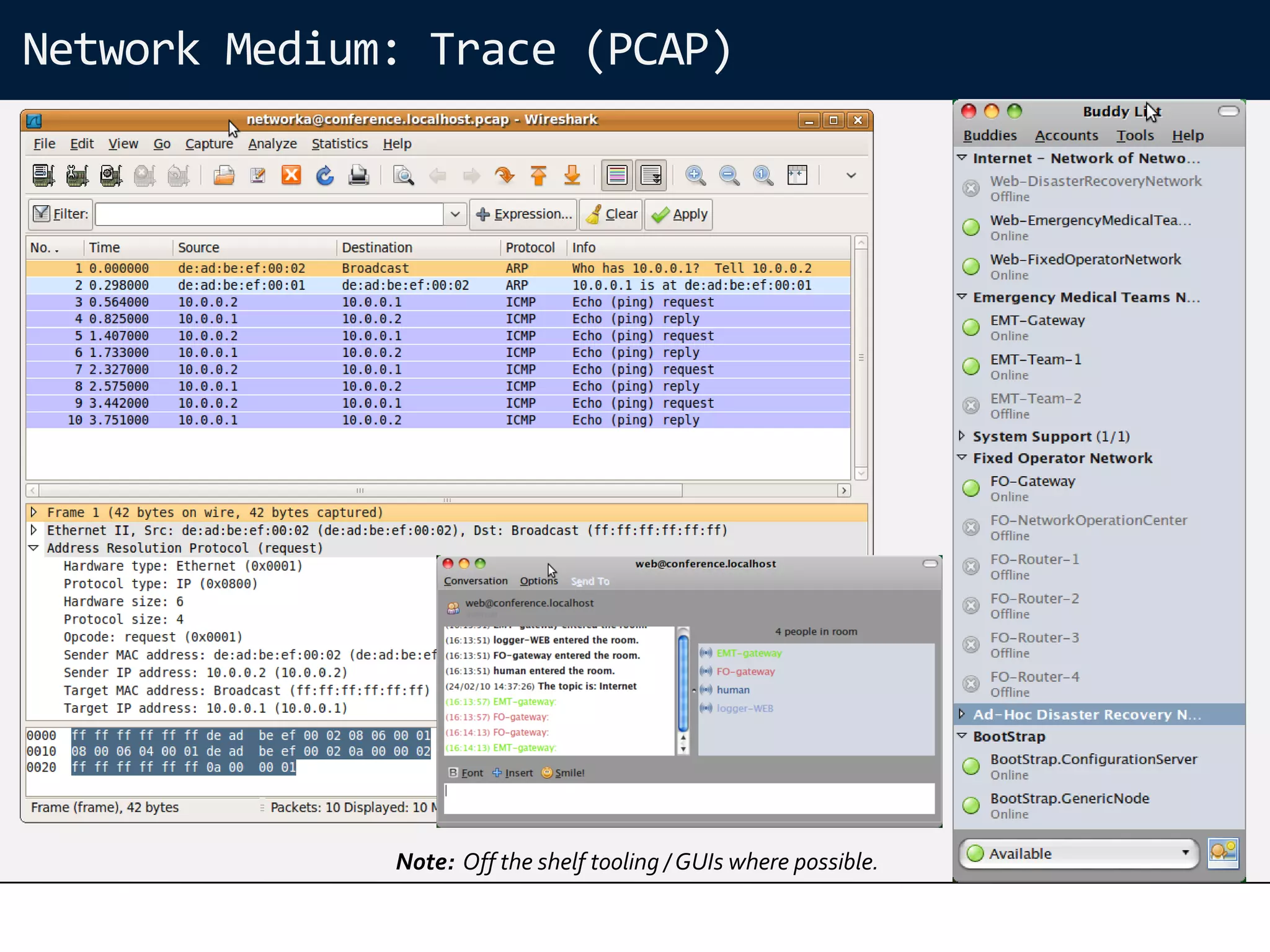
Network Medium: Trace (PCAP)


              Note: Off the shelf tooling / GUIs where possible.
Roadmap


                           Waterford Institute of Technology (WIT)              www: www.tssg.org          e-mail: pphelan@tssg.org
Patrick Phelan             Telecommunications Software & Systems Group (TSSG)   Tel : +353 (0)51 30-2945   mobile: +353 (0)860724364
Senior Research Engineer   Cork Road, Waterford, Ireland                        Fax: +353 (0)51 30-2901    IN: www.linkedin.com/in/1pphelan
Today: Toolbox

 • Documentation
    Developer Build System / Install Guides
    Various free resources (internet)
 • Tools / Frameworks
    Eclipse (with additional plugins)
    SpringSource dm Server
    Java 6
 • Up and Running quickly with templates
    Spring OSGi PLAN Template
    Spring OSGi Bundle Template (similar to a JAR)
    Templated examples – starting points
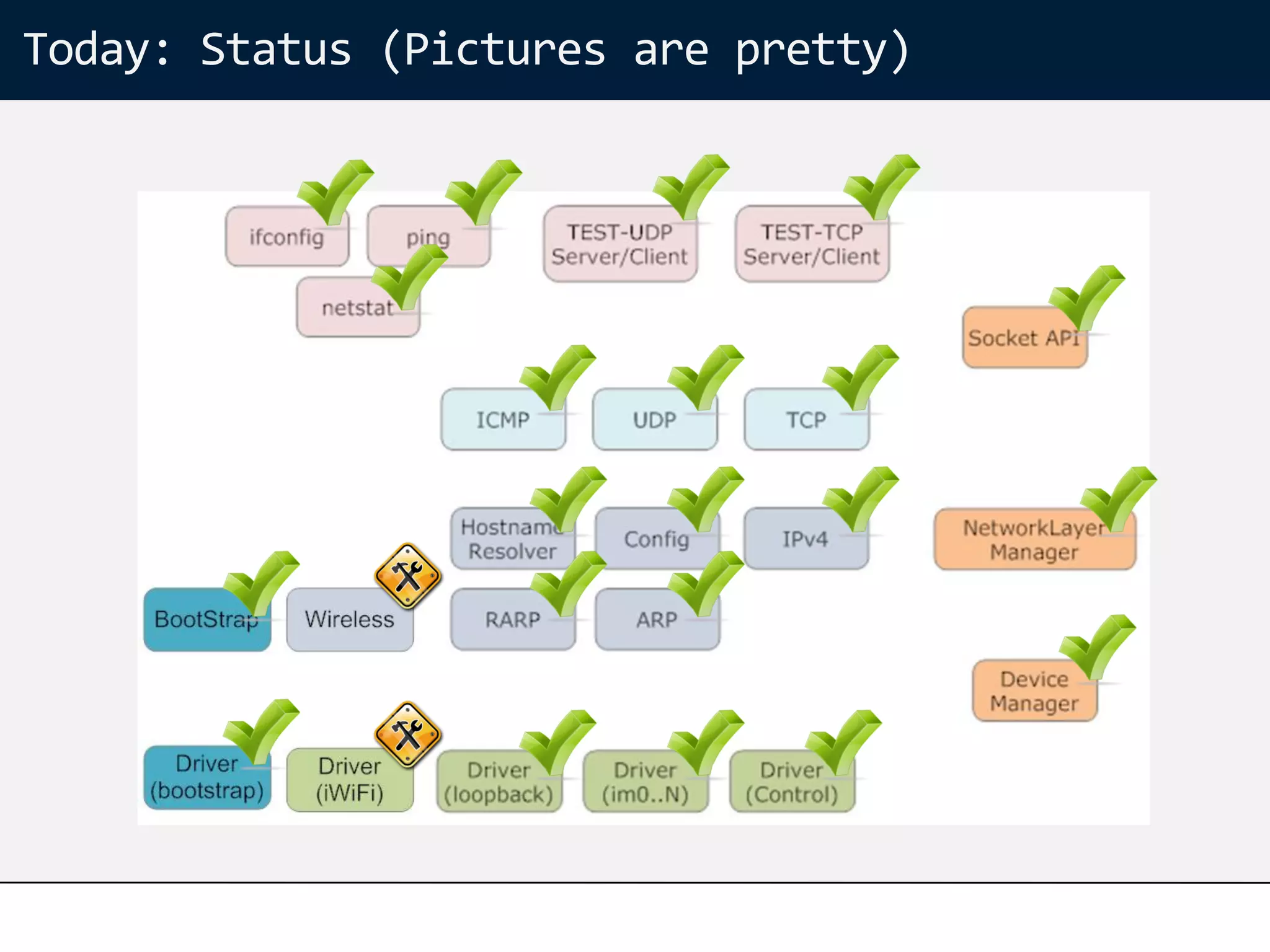
Today: Status (Pictures are pretty)
Today: Status

 • IPv4 Based Network Stack (verified operational)
    Faux Socket API
    TCP / UDP / ICMP/ IP/ ARP/ RARP
    Loopback Driver / Ethernet Driver
    Device Manager / NetworkLayer Manager / Name Service
    Dynamic Stack Configuration (IP addresses/ Routes/
     Interfaces / Hostname Resolution)
    Multi-Threaded Operation
      Bundles, Threadpools (send, packet processor, etc.), logging
    Service Orientated Interaction (Protocols)
    Logging – PCAP format traces from networks.
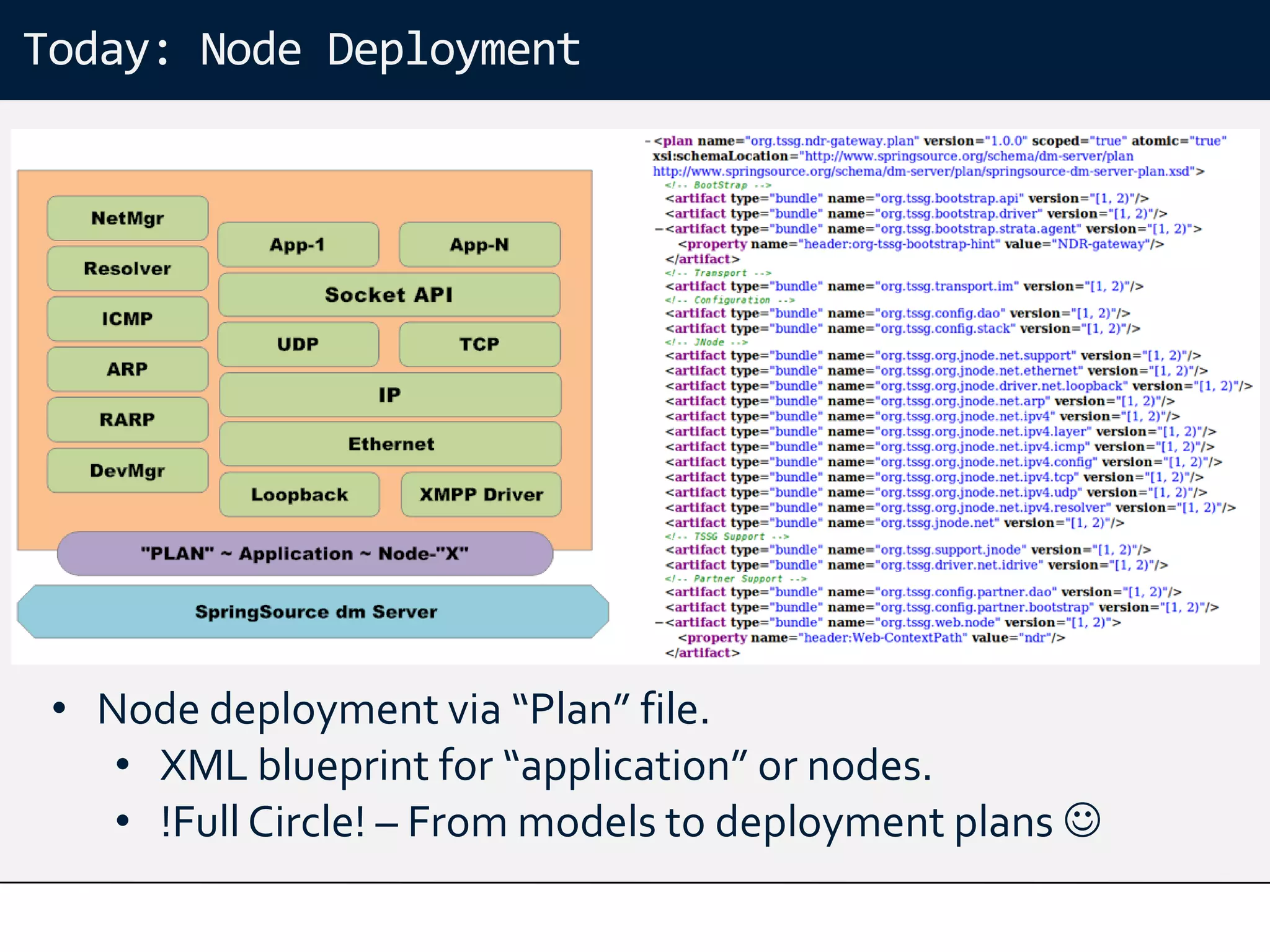
Today: Node Deployment


 • Node deployment via “Plan” file.
    • XML blueprint for “application” or nodes.
    • !Full Circle! – From models to deployment plans 
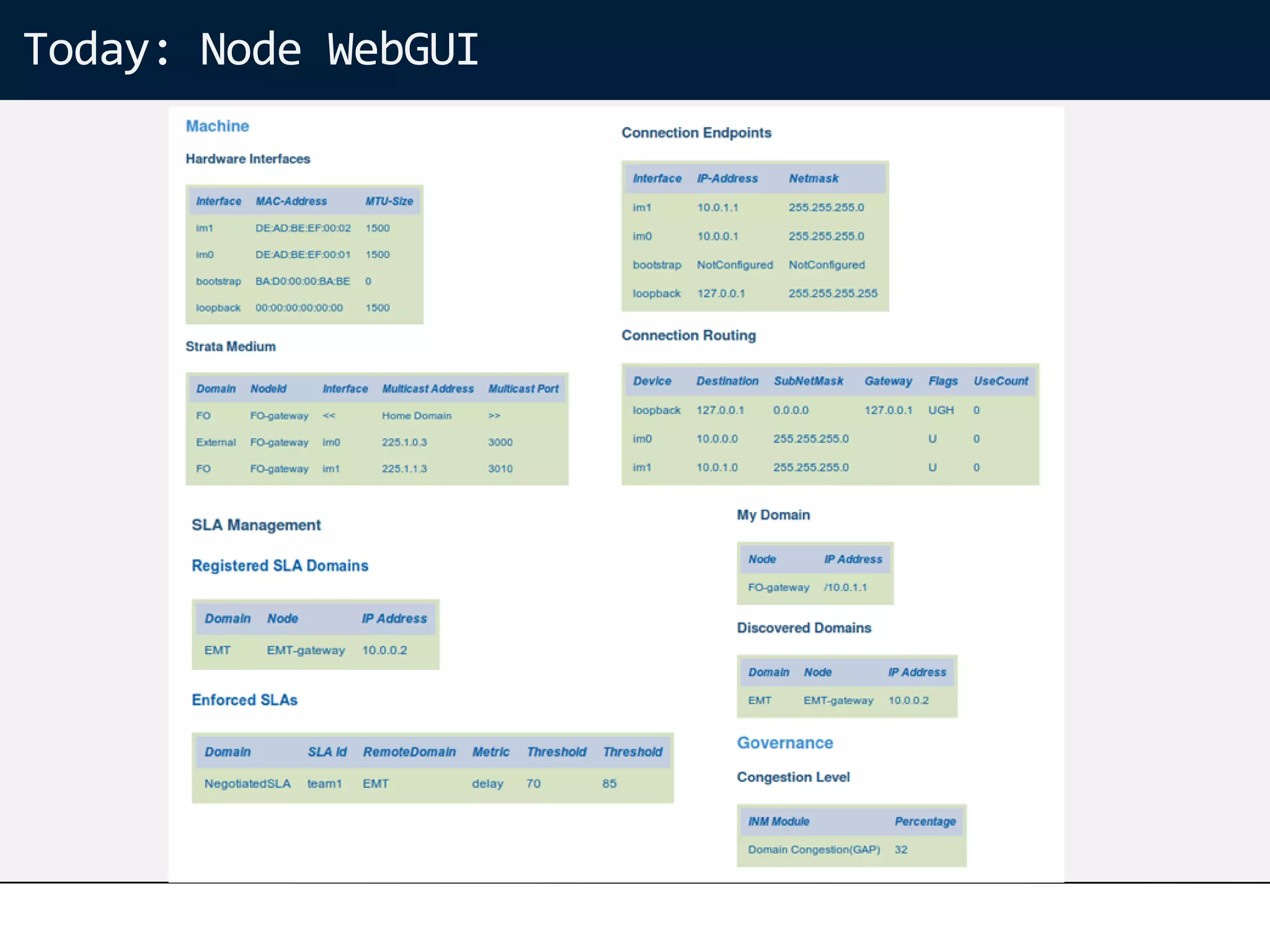
Today: Node WebGUI
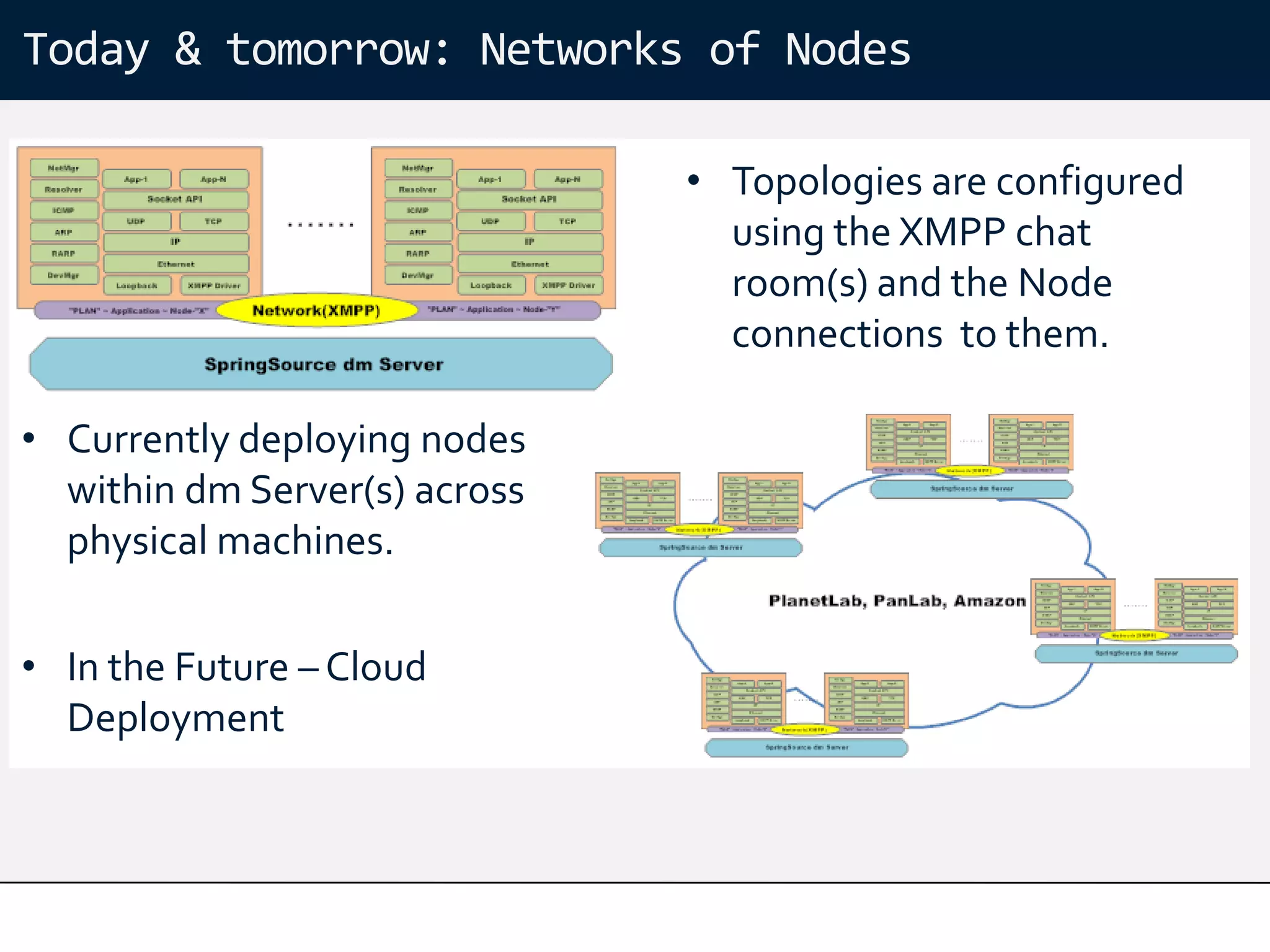
Today & tomorrow: Networks of Nodes

                               • Topologies are configured
                                 using the XMPP chat
                                 room(s) and the Node
                                 connections to them.

• Currently deploying nodes
  within dm Server(s) across
  physical machines.

• In the Future – Cloud
  Deployment
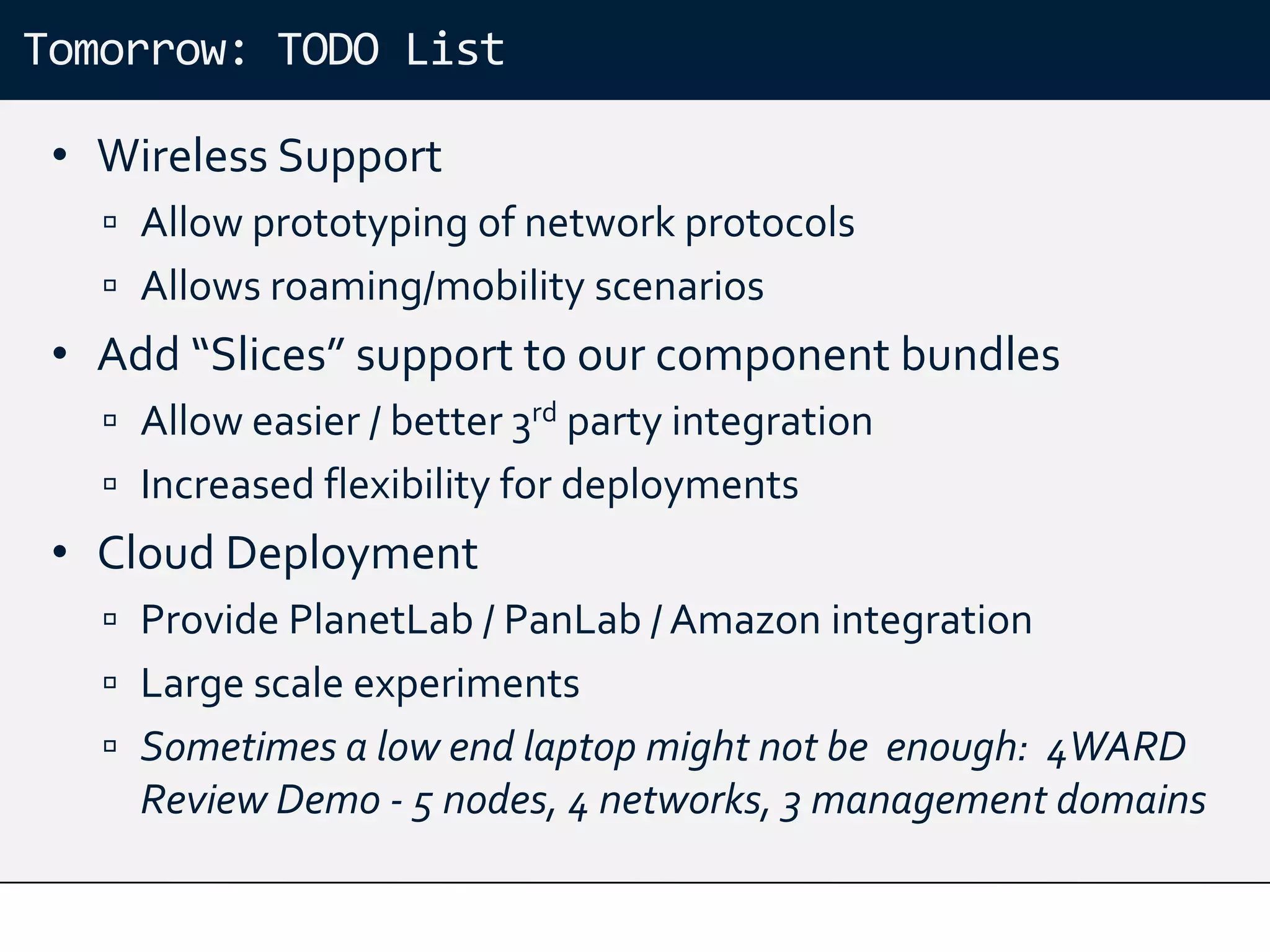
Tomorrow: TODO List

 • Wireless Support
    Allow prototyping of network protocols
    Allows roaming/mobility scenarios
 • Add “Slices” support to our component bundles
    Allow easier / better 3rd party integration
    Increased flexibility for deployments
 • Cloud Deployment
    Provide PlanetLab / PanLab / Amazon integration
    Large scale experiments
    Sometimes a low end laptop might not be enough: 4WARD
     Review Demo - 5 nodes, 4 networks, 3 management domains
Tomorrow: TODO List

 • TINOS (Going Open Source)
    Currently within the 4WARD IPR Process
    Currently LGPL for all components
    What’s in a name: TINOS
      A small island off the coast of Greece.
      Who knew – picking a project name was so difficult.
    Building a community
      Remove the barrier to entry to Network Protocols/Stacks
      Educate, Educate, Educate
      Developers, Developers, Developers
Tomorrow: TODO List

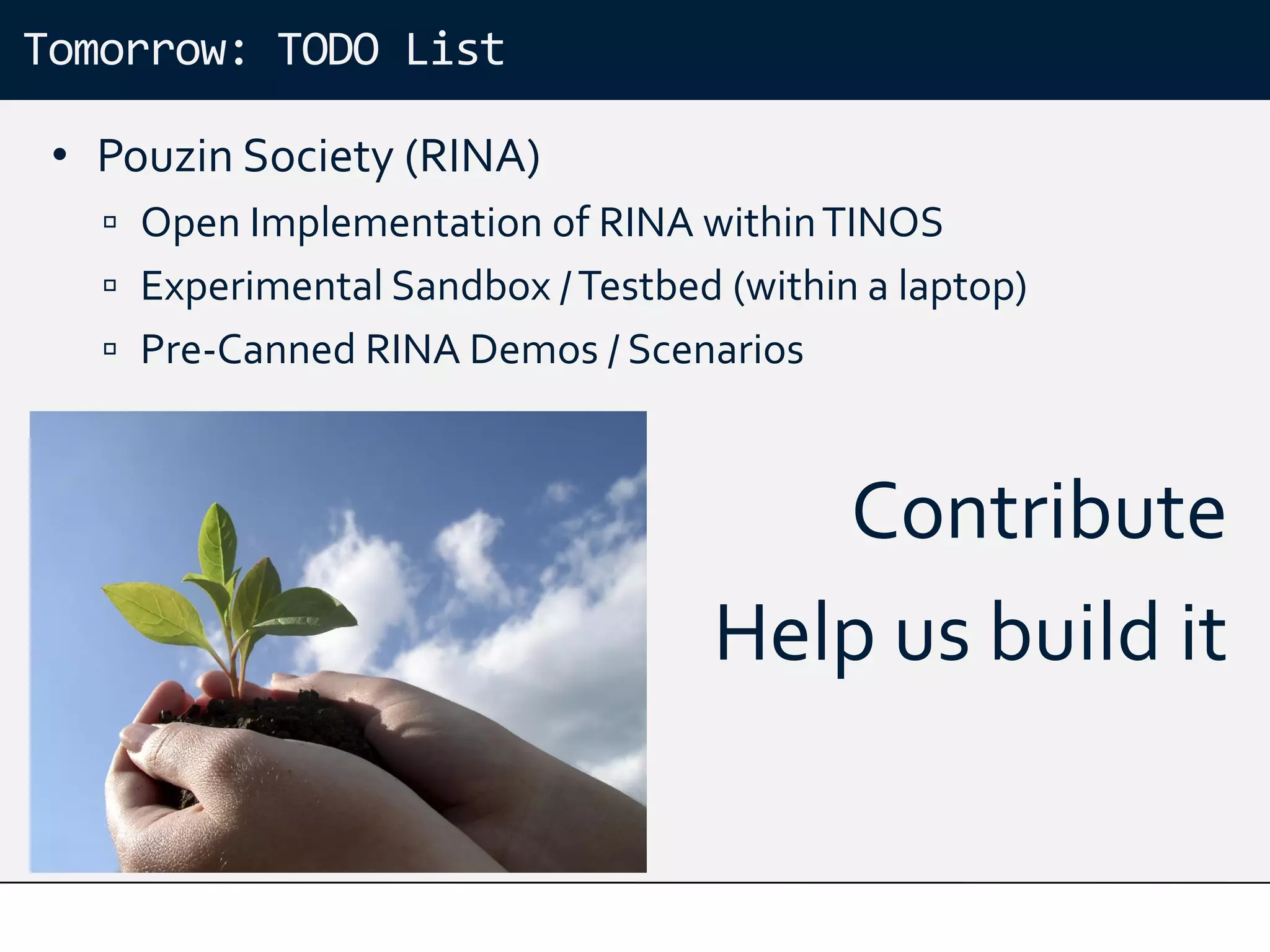
 • Pouzin Society (RINA)
    Open Implementation of RINA within TINOS
    Experimental Sandbox / Testbed (within a laptop)
    Pre-Canned RINA Demos / Scenarios


                                       Contribute
                                    Help us build it
Demo Shots / Backup Slides


                           Waterford Institute of Technology (WIT)              www: www.tssg.org          e-mail: pphelan@tssg.org
Patrick Phelan             Telecommunications Software & Systems Group (TSSG)   Tel : +353 (0)51 30-2945   mobile: +353 (0)860724364
Senior Research Engineer   Cork Road, Waterford, Ireland                        Fax: +353 (0)51 30-2901    IN: www.linkedin.com/in/1pphelan
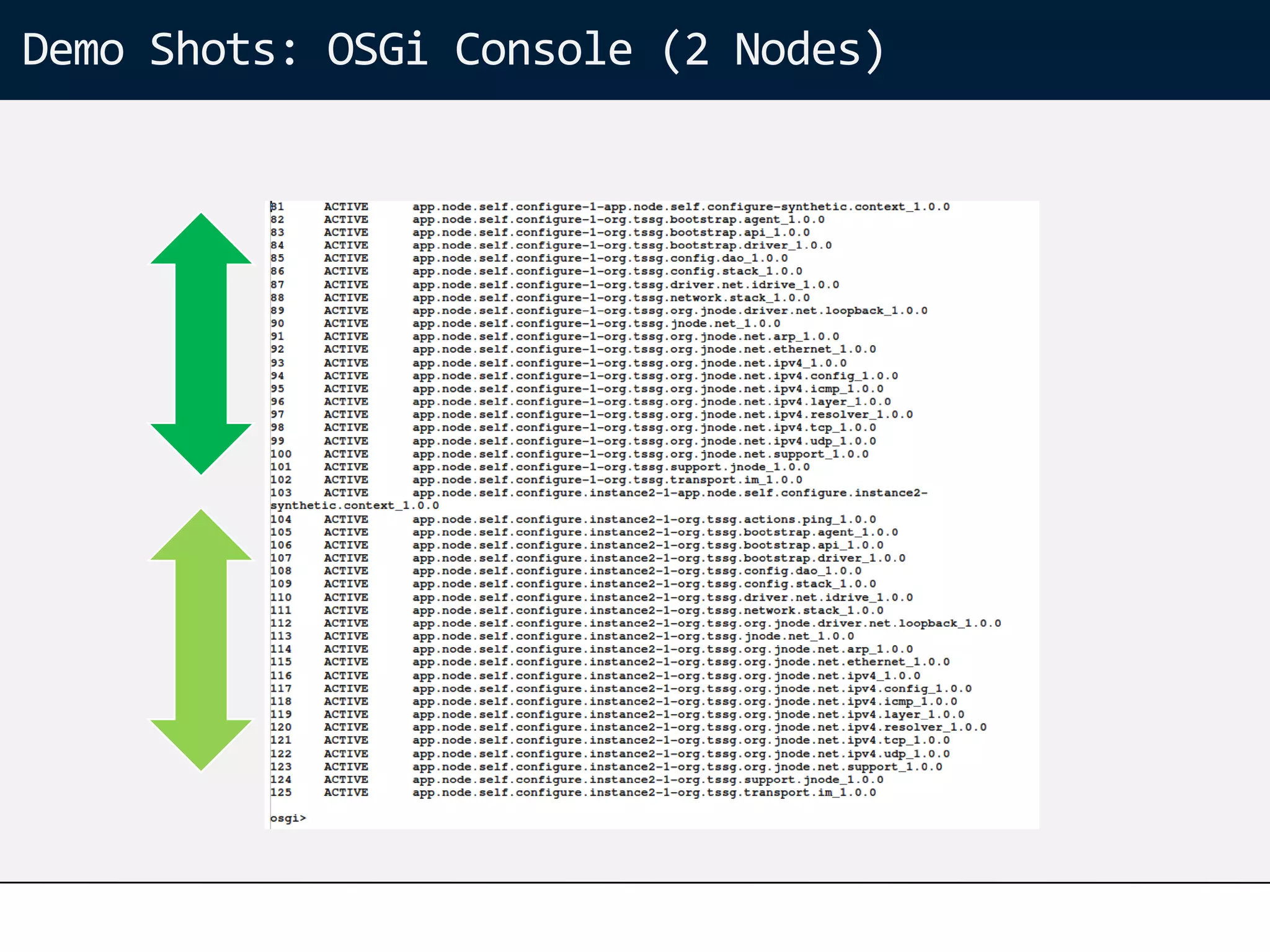
Demo Shots: OSGi Console (2 Nodes)
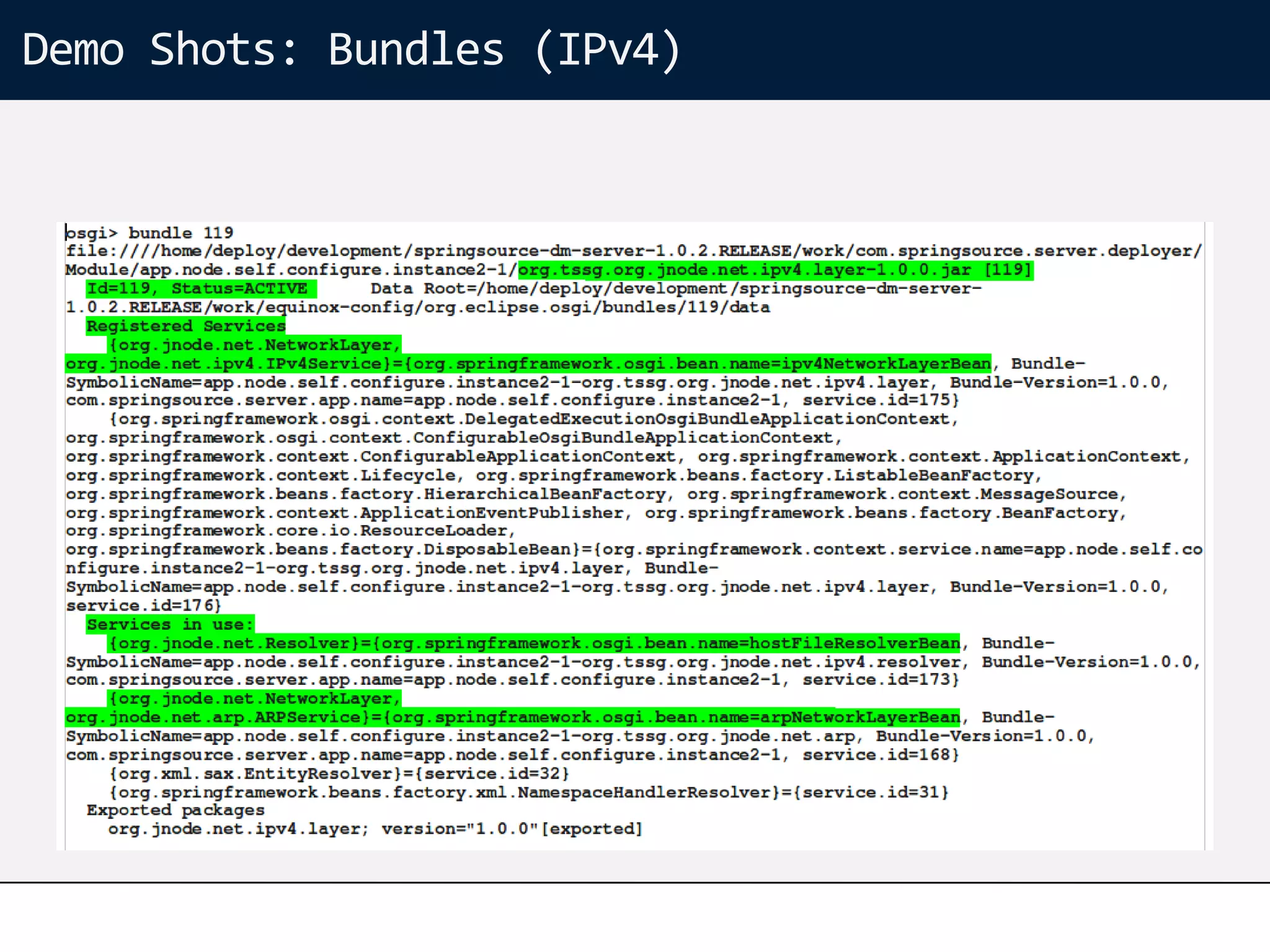
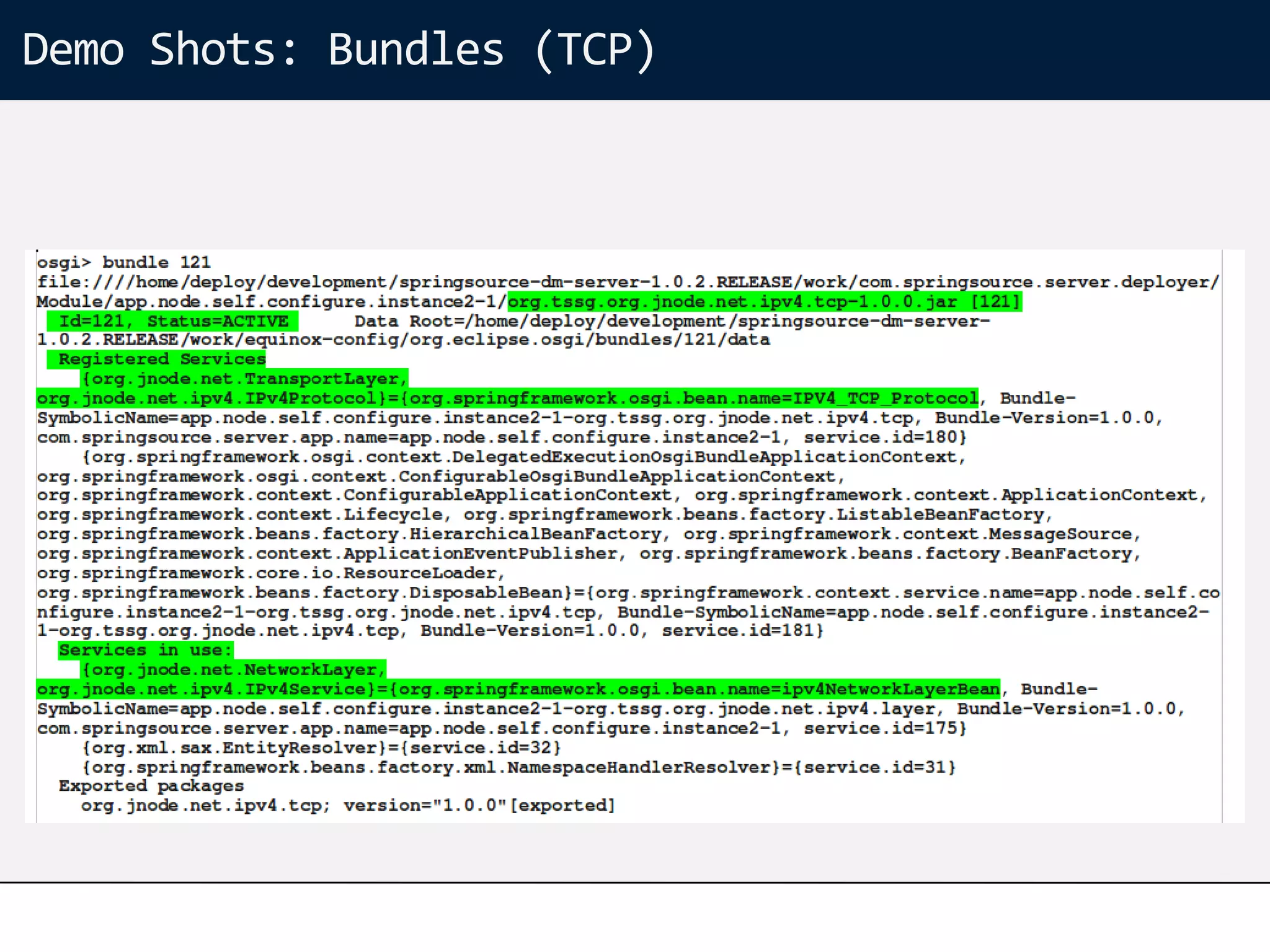
Demo Shots: Bundles (IPv4)
Demo Shots: Bundles (TCP)
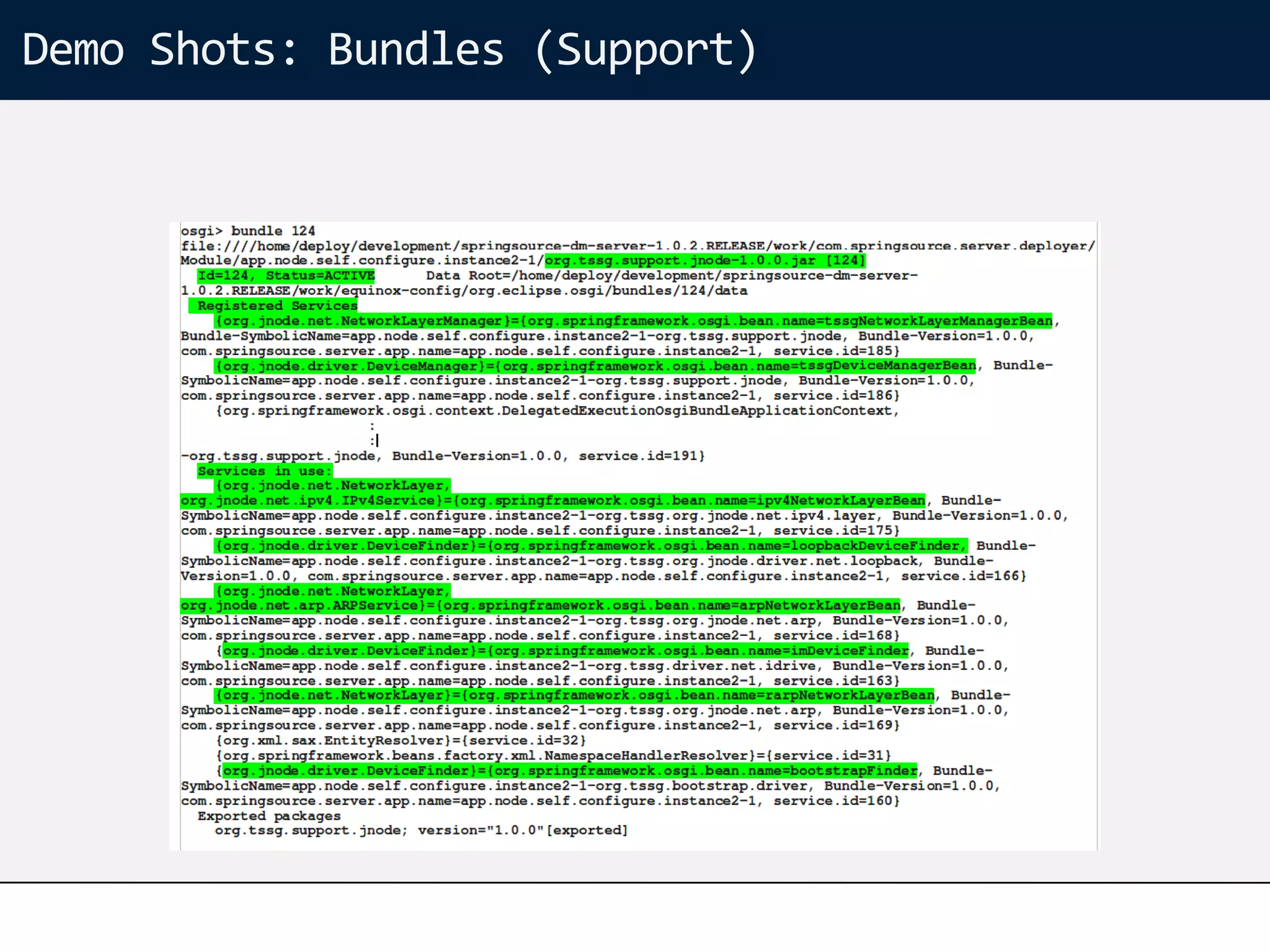
Demo Shots: Bundles (Support)
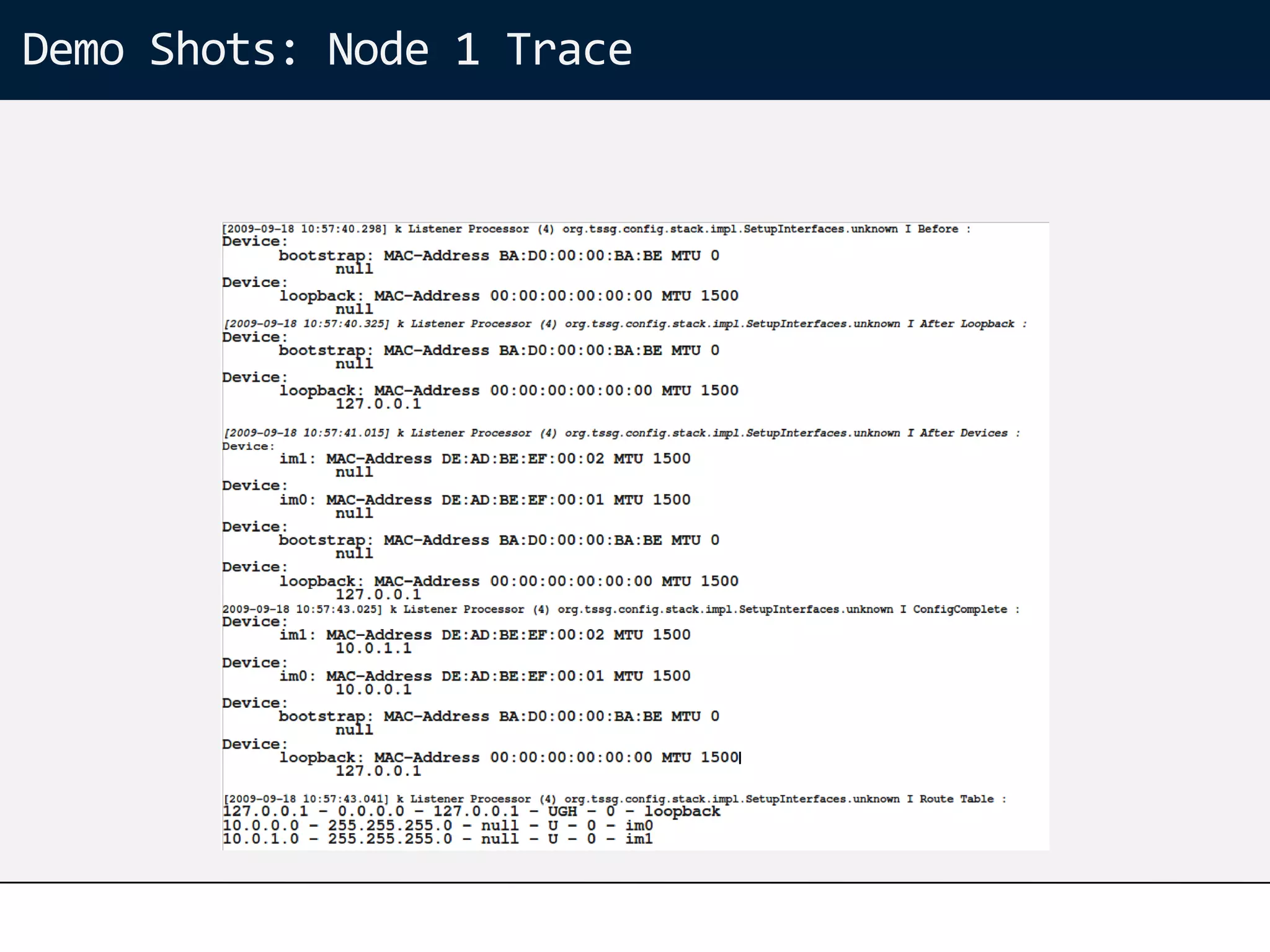
Demo Shots: Node 1 Trace
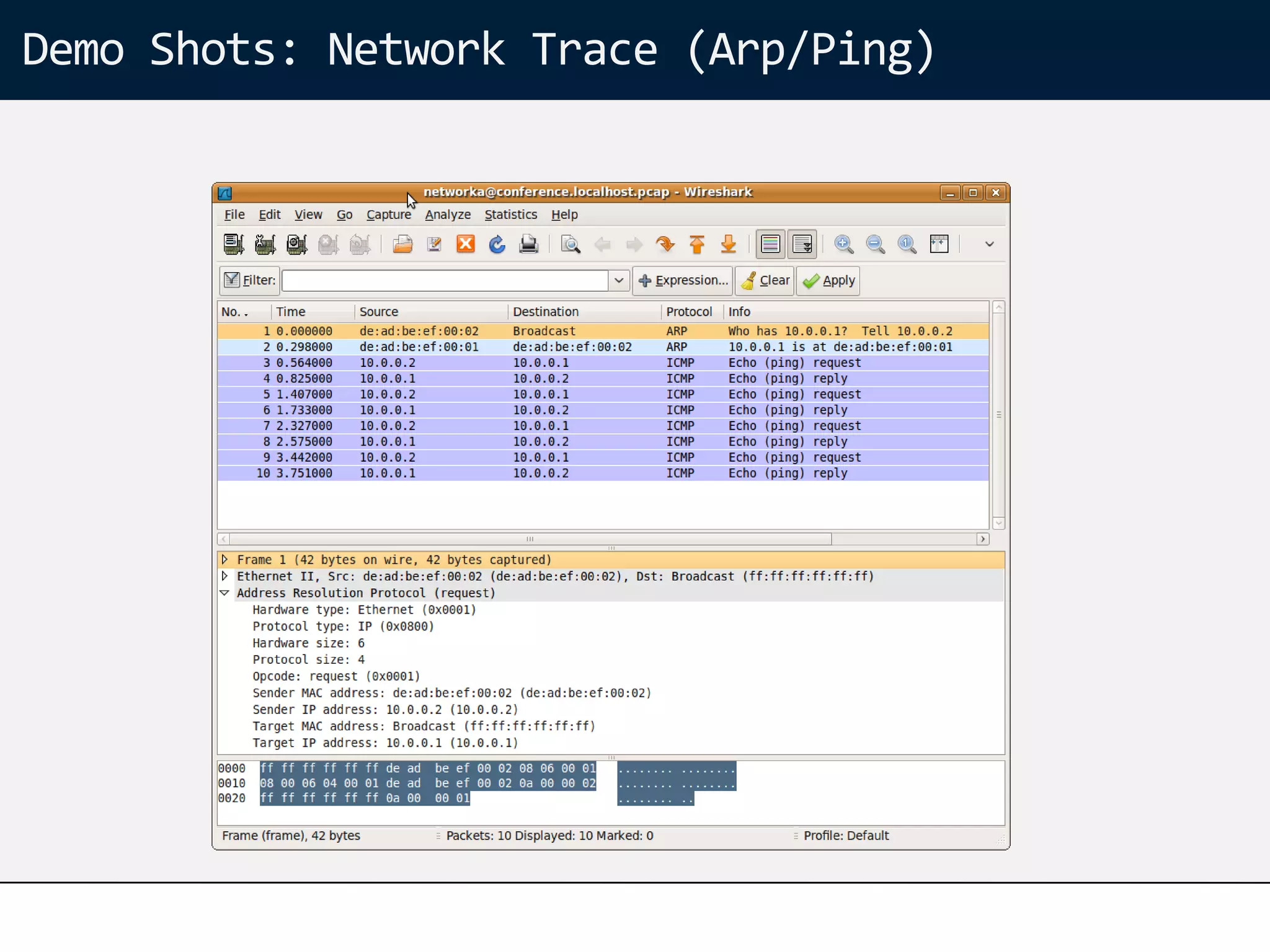
Demo Shots: Network Trace (Arp/Ping)
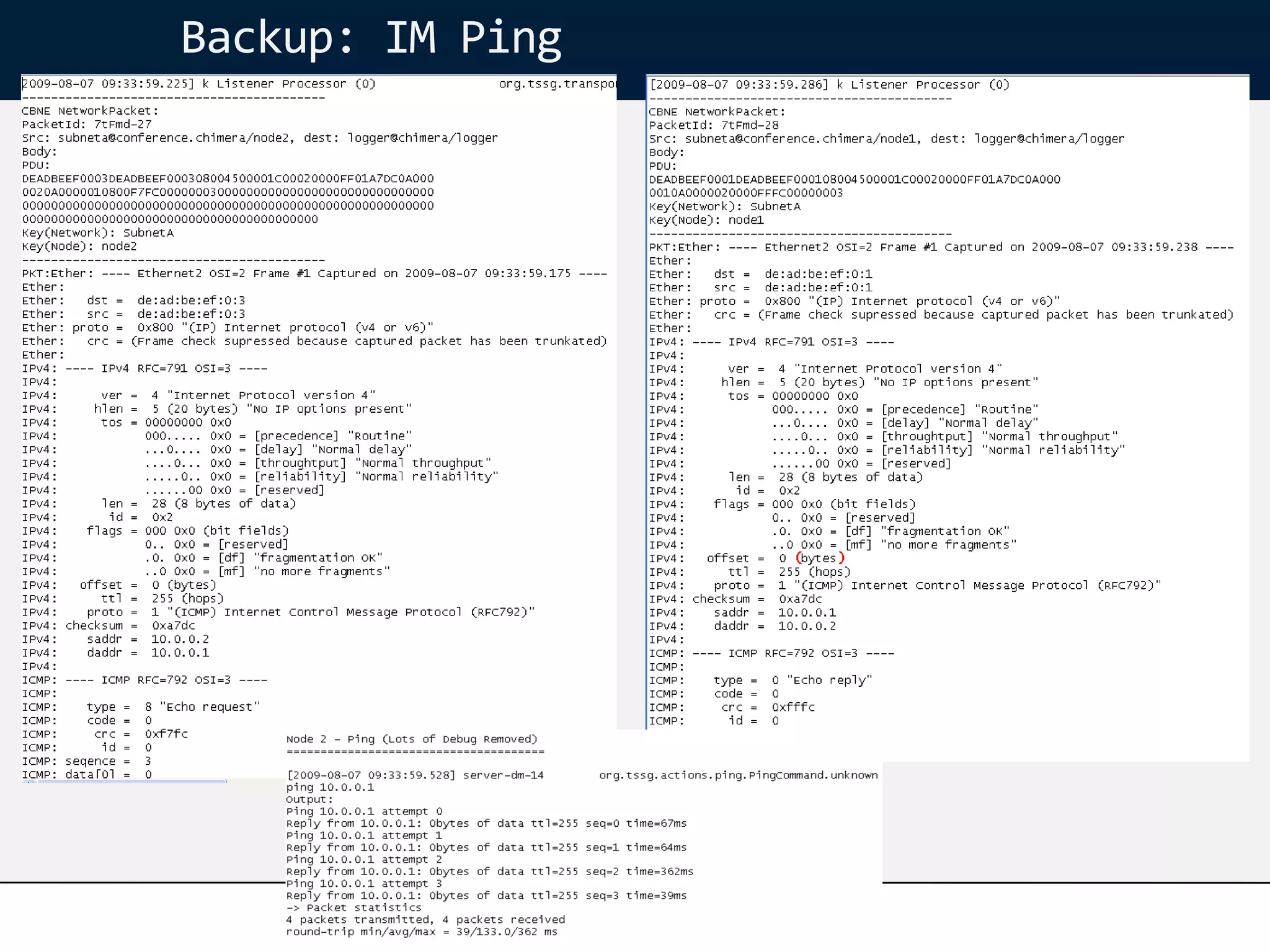
Backup: IM Ping
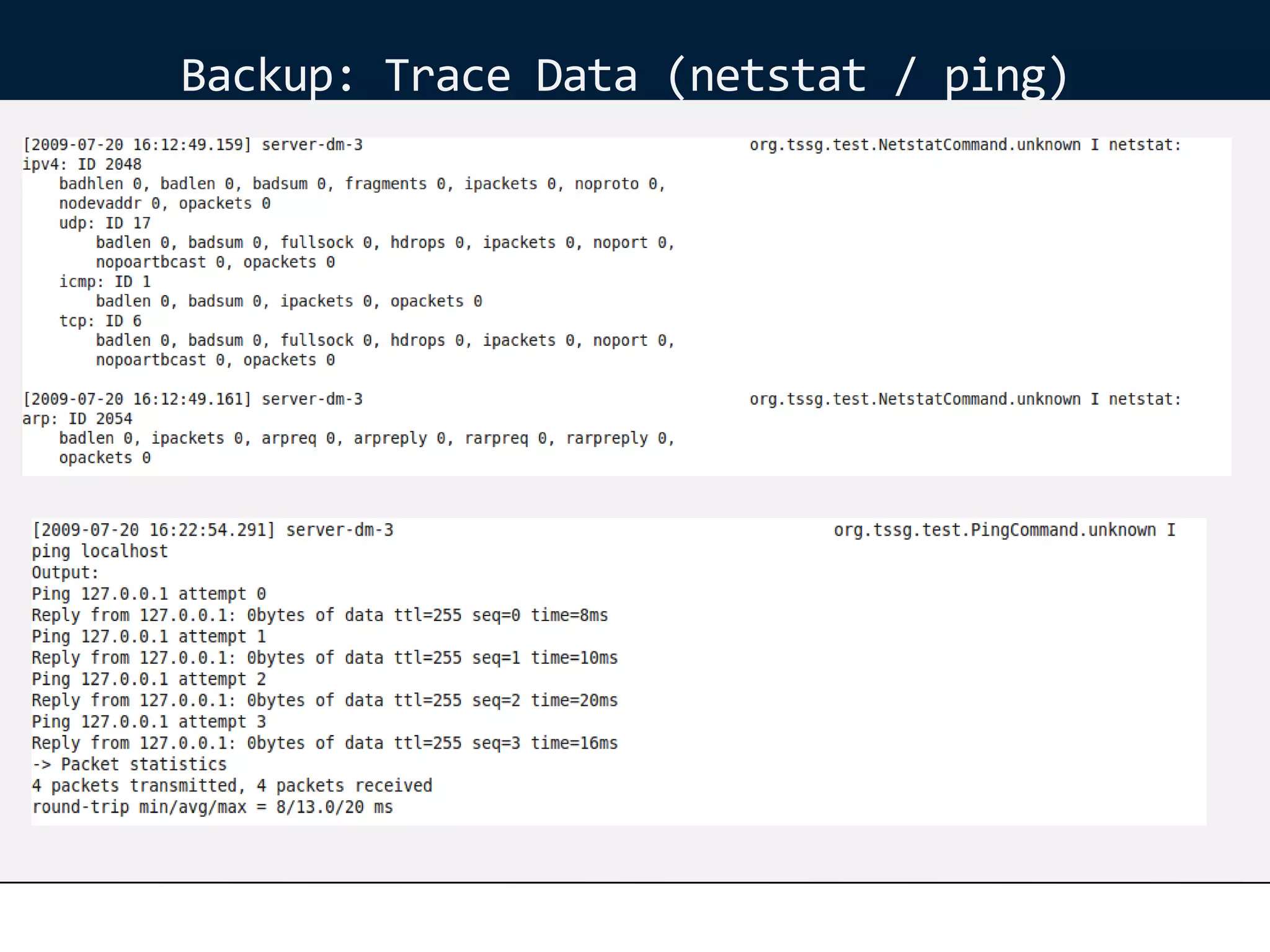
Backup: Trace Data (netstat / ping)
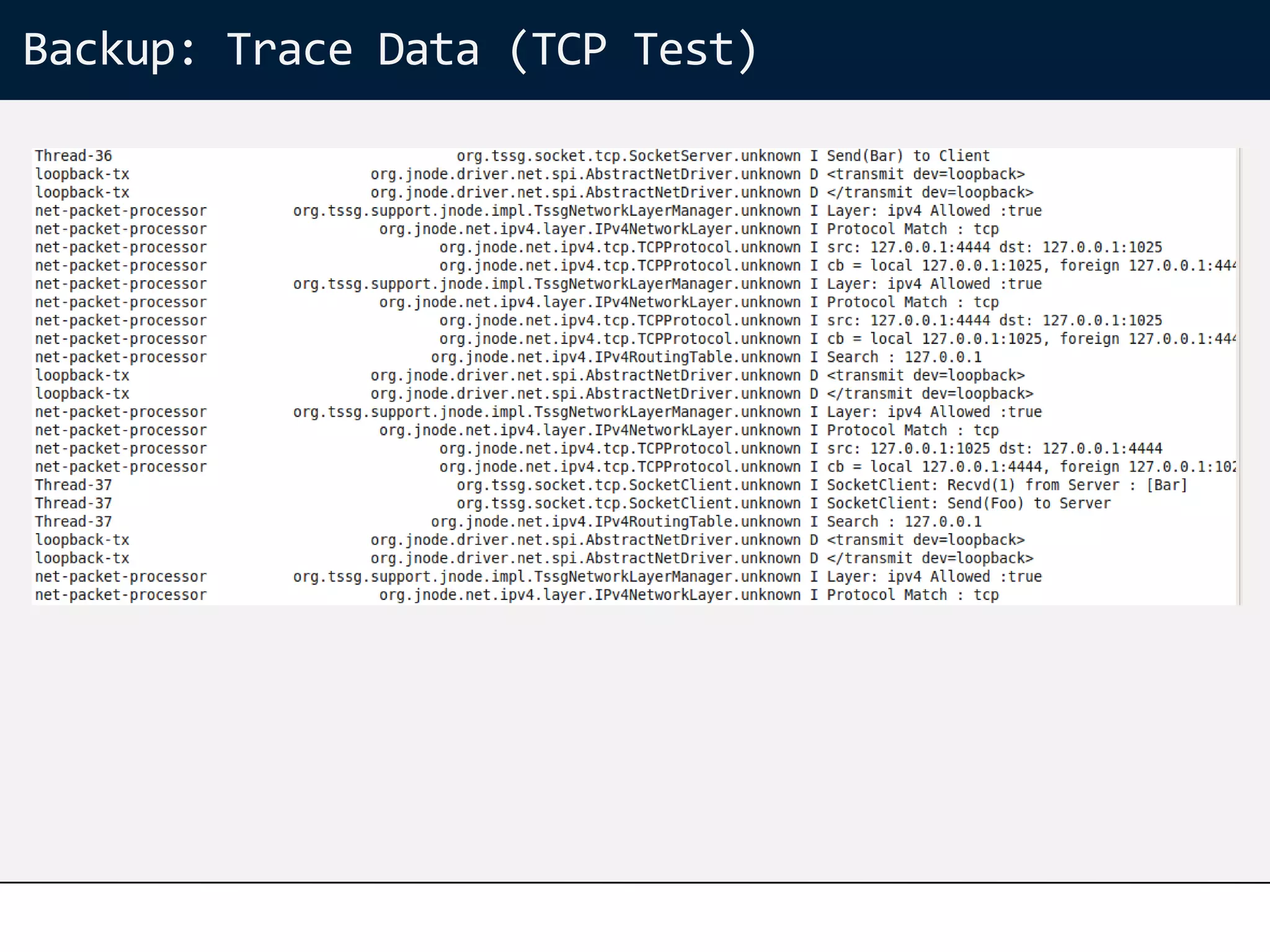
Backup: Trace Data (TCP Test)
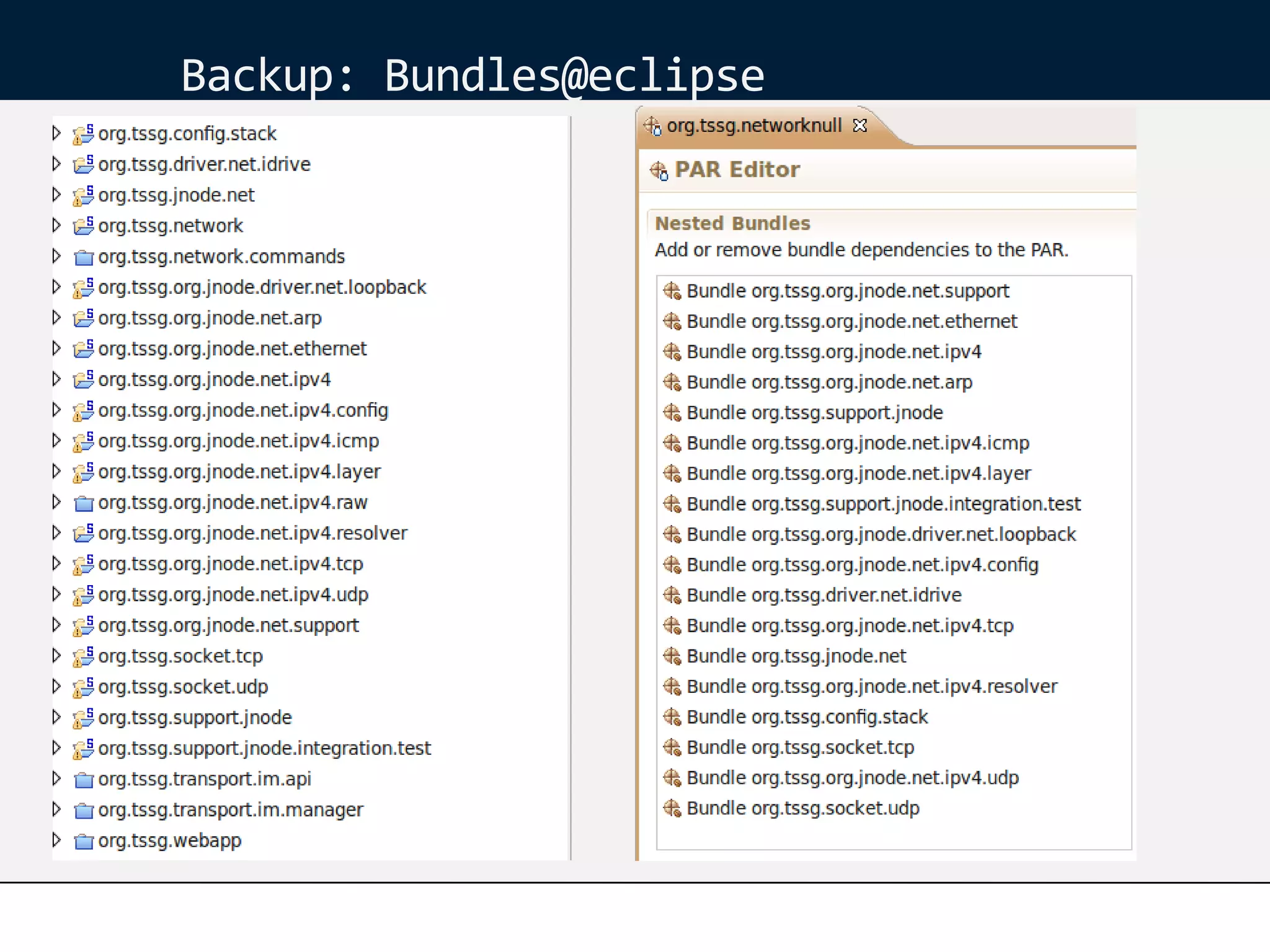
Backup: Bundles@eclipse
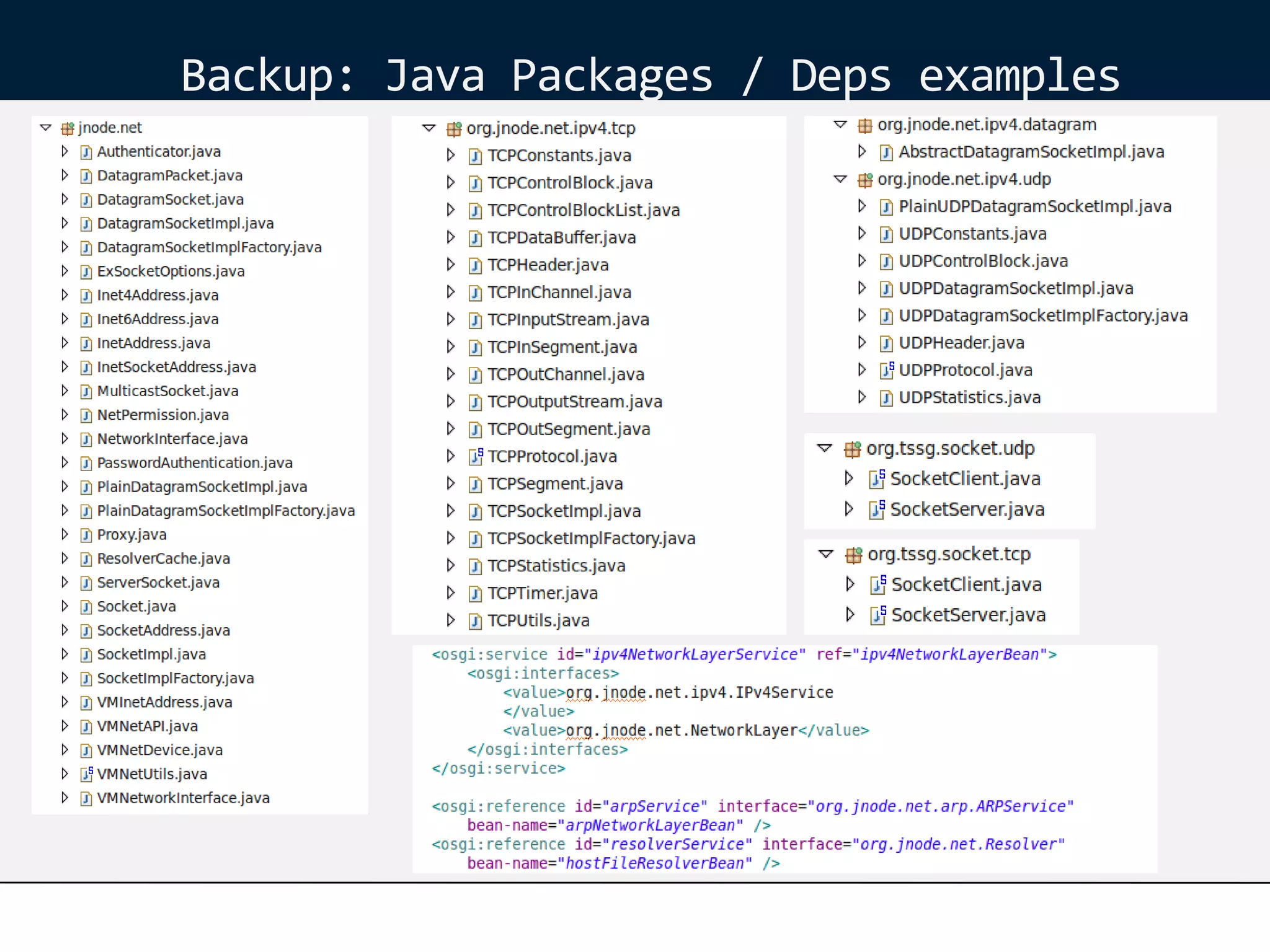
Backup: Java Packages / Deps examples

10 fn s03

  • 1.
    CODE-N-PLAY: DEPLOYABLE PROTOCOL STACKS PouzinSociety@FutureNet 2010 Waterford Institute of Technology (WIT) www: www.tssg.org e-mail: pphelan@tssg.org Patrick Phelan Telecommunications Software & Systems Group (TSSG) Tel : +353 (0)51 30-2945 mobile: +353 (0)860724364 Senior Research Engineer Cork Road, Waterford, Ireland Fax: +353 (0)51 30-2901 IN: www.linkedin.com/in/1pphelan
  • 2.
    Agenda • Background  TSSG / WIT  EU FP7 –ICT 4WARD • The Fun Stuff  Prelude  Fetching the pieces  Network Medium • Roadmap  Today  Tomorrow • Demo / Backup Slides
  • 3.
    Background Waterford Institute of Technology (WIT) www: www.tssg.org e-mail: pphelan@tssg.org Patrick Phelan Telecommunications Software & Systems Group (TSSG) Tel : +353 (0)51 30-2945 mobile: +353 (0)860724364 Senior Research Engineer Cork Road, Waterford, Ireland Fax: +353 (0)51 30-2901 IN: www.linkedin.com/in/1pphelan
  • 4.
    TSSG • TheTelecommunications Software & Systems Group (TSSG) is one of the largest integrated information communication technology (ICT) research centres in Ireland. • TSSG is part of Waterford Institute of Technology (WIT), and is based at WIT’s West Campus in Carriganore, Co. Waterford, Ireland. • More Information:  http://www.wit.ie  http://www.tssg.org
  • 5.
    TSSG - BalancedEcosystem Commercial Commercial The Entrepreneur TSSG Basic Research Basic Research The Science Applied Research Applied Research The Engineering
  • 6.
    TSSG: • Basic Research (HEA, SFI)  One of the top research centers in Ireland (telecommunications) • Applied Research (EU FP7)  Leading Irish participant in EU FP7 funding – 11 projects  Ranked in top 10 research institutes for Future Internet
  • 7.
    TSSG: • Commercialization (EI)  One of the top research groups for commercialization  Leading edge innovation & technology development in: IMS, Web 2.0 Mobile • Commercial ‘Spin-offs’ / ‘Spin-ins’  Early stage technology clusters emerging based around TSSG work
  • 8.
    TSSG: Where Iwork 
  • 9.
    4WARD [IP EUFP7 ICT] • The 4WARD project is looking to the new architecture and design of the Future Internet and has set itself the task of creating a new approach to networking architecture that is more flexible and better adapted to present and future requirements. • Co-Ordinator : Ericsson  37 Partners including Nokia, Alcatel-Lucent, NEC, Telefonica, Deutsche Telekom, France Telecom, Telecom Italia… • More Information  http://www.4ward-project.eu
  • 10.
    Finally the interestingstuff… Waterford Institute of Technology (WIT) www: www.tssg.org e-mail: pphelan@tssg.org Patrick Phelan Telecommunications Software & Systems Group (TSSG) Tel : +353 (0)51 30-2945 mobile: +353 (0)860724364 Senior Research Engineer Cork Road, Waterford, Ireland Fax: +353 (0)51 30-2901 IN: www.linkedin.com/in/1pphelan
  • 11.
    Prelude: Timeline fromthe beginning…
  • 12.
    Prelude: Guiding Principles • KISS Principle  Light weight, Modular, Flexible, Best Practises  Agility + Flexibility + Ease-Of-Use = Productivity  Java (Popular, low barrier to entry)  OSGi (Industry Standard) • Software Development Practices  Convention, Configuration, Code  In that order for higher productivity  Service based through & through  Looser coupling, easier maintenance  Grows with the Scenarios  Pick-and-choose only the features required
  • 13.
    Executive Summary: Ina nutshell • Java based development, deployment and execution  No C/C++, No OS Kernel (User space), No pain  Removal of barrier to entry  Cross platform – OS independent.  Off the shelf (free/community tools / platform)  Applying Industry practises / tooling • Design – Develop – Deploy • Its Software - Nothing is impossible! • Network Protocol(s) / Stack implementation / testing • Network & Node configuration & deployment • Complete Programmatic Control – Repeat Scenarios
  • 14.
  • 15.
    Fetching Pieces: SpringSourcedm Server • SpringSource dm Server™ is a completely modular, OSGi-based Java server designed to run enterprise Java applications and Spring-powered applications with a new degree of flexibility and reliability. The SpringSource dm Server is based on the new SpringSource Dynamic Module Kernel™ (dm Kernel).  http://www.springsource.org/dmserver • OSGi™ - The Dynamic Module System for Java™  http://www.osgi.org/Main/HomePage • SpringSource dm Server™ moves to Eclipse  Project Virgo (EPL Licensing)
  • 16.
  • 17.
    Fetching Pieces: NetworkStack (Jnode) • JNode (Java New Operating System Design Effort) is an open-source project to create a Java platform operating system. The project has taken the unique direction of creating all the software in Java itself, with the exception of some assembly language to boot and load the system.  http://www.jnode.org • Extracted/Componentised the Network Sub-System of the Operating System.  Protocols, Device & Network Infrastructure.
  • 18.
    Fetching Pieces: Transport(XMPP) • XMPP – http://www.xmpp.org  Open Standards – RFC 3920, 3921  Underlying protocol for most IM applications.  Jabber, Google Talk…  Widespread use, various implementations.  Open Source Clients / Servers / Libraries.  Ignite Realtime – Openfire (Server) / Smack (Client Library)  http://www.igniterealtime.org/projects/openfire/  Interesting side effect : XMPP is a reliable transport.  Programmatic control of “unreliability”  Reproducible failure / congestion scenarios.
  • 19.
    Assembly: From Modelsto Implementation • OSGi - bundles are components. • OSGi - network protocols are exposed as OSGi services • OSGi - “network stack” is SOA assembled • OSGi – “Application” is a component node • dm Server - “Application”(s) isolated from each other • dm Server – Deployment platform. • The underlying network medium is XMPP – virtual network (overlay).  XMPP is the current flavour of overlay.  Abstracted at the driver interface – can be implemented over “sockets” or magic pixie dust if required.
  • 20.
  • 21.
    Network Medium: Concepts Point-to-Point / Multi-Point Note: In terms of hardware all network connectivity is either point-to-point or multi- point.
  • 22.
  • 23.
  • 24.
  • 25.
    Network Medium: ItsAll About The PDU The payload of one layer is encapsulated with either a header/trailer of the current layer and becomes the payload of the N-1 layer. This facilitates the encapsulation of our TCP/IP stack through XMPP and the existing TCP/IP stack unharmed.
  • 26.
    Network Medium: Details • A chat room represents a hardware network. • A IM buddy represents a hardware Point-of-Attachment (POA) for our nodes. • A node with multiple POAs can be a member of multiple networks i.e. can be a router. • Any message sent by a node on the network can be seen by any other node with a POA to that network.
  • 27.
    Network Medium: SamplePDUs Note: As there is full control of the network medium, we can add as much/little additional data as required to PDU.
  • 28.
    Network Medium: Trace(PCAP) Note: Off the shelf tooling / GUIs where possible.
  • 29.
    Roadmap Waterford Institute of Technology (WIT) www: www.tssg.org e-mail: pphelan@tssg.org Patrick Phelan Telecommunications Software & Systems Group (TSSG) Tel : +353 (0)51 30-2945 mobile: +353 (0)860724364 Senior Research Engineer Cork Road, Waterford, Ireland Fax: +353 (0)51 30-2901 IN: www.linkedin.com/in/1pphelan
  • 30.
    Today: Toolbox •Documentation  Developer Build System / Install Guides  Various free resources (internet) • Tools / Frameworks  Eclipse (with additional plugins)  SpringSource dm Server  Java 6 • Up and Running quickly with templates  Spring OSGi PLAN Template  Spring OSGi Bundle Template (similar to a JAR)  Templated examples – starting points
  • 31.
  • 32.
    Today: Status •IPv4 Based Network Stack (verified operational)  Faux Socket API  TCP / UDP / ICMP/ IP/ ARP/ RARP  Loopback Driver / Ethernet Driver  Device Manager / NetworkLayer Manager / Name Service  Dynamic Stack Configuration (IP addresses/ Routes/ Interfaces / Hostname Resolution)  Multi-Threaded Operation  Bundles, Threadpools (send, packet processor, etc.), logging  Service Orientated Interaction (Protocols)  Logging – PCAP format traces from networks.
  • 33.
    Today: Node Deployment • Node deployment via “Plan” file. • XML blueprint for “application” or nodes. • !Full Circle! – From models to deployment plans 
  • 34.
  • 35.
    Today & tomorrow:Networks of Nodes • Topologies are configured using the XMPP chat room(s) and the Node connections to them. • Currently deploying nodes within dm Server(s) across physical machines. • In the Future – Cloud Deployment
  • 36.
    Tomorrow: TODO List • Wireless Support  Allow prototyping of network protocols  Allows roaming/mobility scenarios • Add “Slices” support to our component bundles  Allow easier / better 3rd party integration  Increased flexibility for deployments • Cloud Deployment  Provide PlanetLab / PanLab / Amazon integration  Large scale experiments  Sometimes a low end laptop might not be enough: 4WARD Review Demo - 5 nodes, 4 networks, 3 management domains
  • 37.
    Tomorrow: TODO List • TINOS (Going Open Source)  Currently within the 4WARD IPR Process  Currently LGPL for all components  What’s in a name: TINOS  A small island off the coast of Greece.  Who knew – picking a project name was so difficult.  Building a community  Remove the barrier to entry to Network Protocols/Stacks  Educate, Educate, Educate  Developers, Developers, Developers
  • 38.
    Tomorrow: TODO List • Pouzin Society (RINA)  Open Implementation of RINA within TINOS  Experimental Sandbox / Testbed (within a laptop)  Pre-Canned RINA Demos / Scenarios Contribute Help us build it
  • 39.
    Demo Shots /Backup Slides Waterford Institute of Technology (WIT) www: www.tssg.org e-mail: pphelan@tssg.org Patrick Phelan Telecommunications Software & Systems Group (TSSG) Tel : +353 (0)51 30-2945 mobile: +353 (0)860724364 Senior Research Engineer Cork Road, Waterford, Ireland Fax: +353 (0)51 30-2901 IN: www.linkedin.com/in/1pphelan
  • 40.
    Demo Shots: OSGiConsole (2 Nodes)
  • 41.
  • 42.
  • 43.
  • 44.
  • 45.
    Demo Shots: NetworkTrace (Arp/Ping)
  • 46.
  • 47.
    Backup: Trace Data(netstat / ping)
  • 48.
  • 49.
  • 50.
    Backup: Java Packages/ Deps examples