A Tutorial on the Zachman Enterprise Architecture1
A Tutorial on the
Zachman Framework for
Enterprise Architecture
A Tutorial on the Zachman Enterprise Architecture2
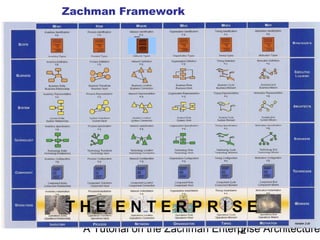
Zachman Framework
A Tutorial on the Zachman Enterprise Architecture3
VA EnterpriseVA Enterprise
Zachman Framework
A Tutorial on the Zachman Enterprise Architecture4
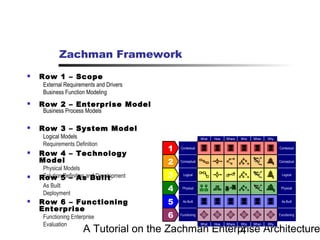
Zachman Framework
 Row 1 – Scope
External Requirements and Drivers
Business Function Modeling
 Row 2 – Enterprise Model
Business Process Models
 Row 3 – System Model
Logical Models
Requirements Definition
 Row 4 – Technology
Model
Physical Models
Solution Definition and Development Row 5 – As Built
As Built
Deployment
 Row 6 – Functioning
Enterprise
Functioning Enterprise
Evaluation
1
2
3
4
5
6
Contextual
Conceptual
Logical
Physical
As Built
Functioning
Contextual
Conceptual
Logical
Physical
As Built
Functioning
Why
Why
Who
Who
When
When
Where
Where
What
What
How
How
A Tutorial on the Zachman Enterprise Architecture5
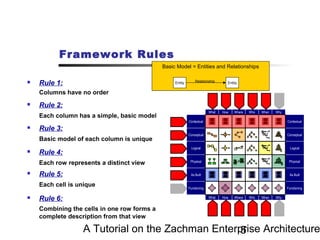
Framework Rules
 Rule 1:
Columns have no order
Contextual
Conceptual
Logical
Physical
As Built
Functioning
Contextual
Conceptual
Logical
Physical
As Built
Functioning
Why
Why
Who
Who
When
When
Where
Where
What
What
How
How
 Rule 2:
Each column has a simple, basic model
 Rule 3:
Basic model of each column is unique
 Rule 4:
Each row represents a distinct view
 Rule 5:
Each cell is unique
 Rule 6:
Combining the cells in one row forms a
complete description from that view
Basic Model = Entities and Relationships
EntityRelationshipEntity
A Tutorial on the Zachman Enterprise Architecture6
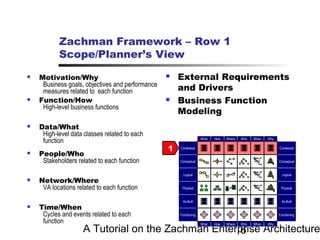
Zachman Framework – Row 1
Scope/Planner’s View
 External Requirements
and Drivers
 Business Function
Modeling
 Motivation/Why
Business goals, objectives and performance
measures related to each function
 Function/How
High-level business functions
 Data/What
High-level data classes related to each
function
 People/Who
Stakeholders related to each function
 Network/Where
VA locations related to each function
 Time/When
Cycles and events related to each
function
1 Contextual
Conceptual
Logical
Physical
As Built
Functioning
Contextual
Conceptual
Logical
Physical
As Built
Functioning
Why
Why
Who
Who
When
When
Where
Where
What
What
How
How
A Tutorial on the Zachman Enterprise Architecture7
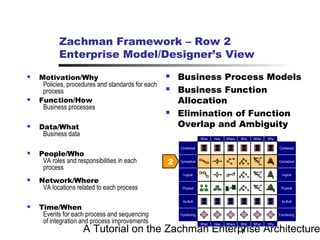
Zachman Framework – Row 2
Enterprise Model/Designer’s View
 Business Process Models
 Business Function
Allocation
 Elimination of Function
Overlap and Ambiguity
 Motivation/Why
Policies, procedures and standards for each
process
 Function/How
Business processes
 Data/What
Business data
 People/Who
VA roles and responsibilities in each
process
 Network/Where
VA locations related to each process
 Time/When
Events for each process and sequencing
of integration and process improvements
2
Contextual
Conceptual
Logical
Physical
As Built
Functioning
Contextual
Conceptual
Logical
Physical
As Built
Functioning
Why
Why
Who
Who
When
When
Where
Where
What
What
How
How
A Tutorial on the Zachman Enterprise Architecture8
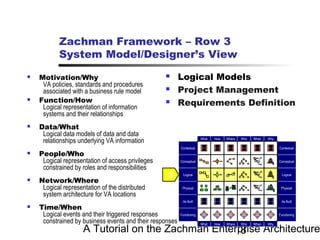
Zachman Framework – Row 3
System Model/Designer’s View
 Logical Models
 Project Management
 Requirements Definition
 Motivation/Why
VA policies, standards and procedures
associated with a business rule model
 Function/How
Logical representation of information
systems and their relationships
 Data/What
Logical data models of data and data
relationships underlying VA information
 People/Who
Logical representation of access privileges
constrained by roles and responsibilities
 Network/Where
Logical representation of the distributed
system architecture for VA locations
 Time/When
Logical events and their triggered responses
constrained by business events and their responses
3
Contextual
Conceptual
Logical
Physical
As Built
Functioning
Contextual
Conceptual
Logical
Physical
As Built
Functioning
Why
Why
Who
Who
When
When
Where
Where
What
What
How
How
A Tutorial on the Zachman Enterprise Architecture9
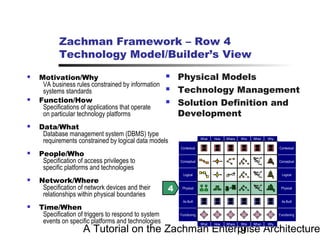
Zachman Framework – Row 4
Technology Model/Builder’s View
 Physical Models
 Technology Management
 Solution Definition and
Development
 Motivation/Why
VA business rules constrained by information
systems standards
 Function/How
Specifications of applications that operate
on particular technology platforms
 Data/What
Database management system (DBMS) type
requirements constrained by logical data models
 People/Who
Specification of access privileges to
specific platforms and technologies
 Network/Where
Specification of network devices and their
relationships within physical boundaries
 Time/When
Specification of triggers to respond to system
events on specific platforms and technologies
4
Contextual
Conceptual
Logical
Physical
As Built
Functioning
Contextual
Conceptual
Logical
Physical
As Built
Functioning
Why
Why
Who
Who
When
When
Where
Where
What
What
How
How
A Tutorial on the Zachman Enterprise Architecture10
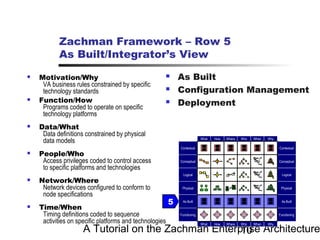
Zachman Framework – Row 5
As Built/Integrator’s View
 As Built
 Configuration Management
 Deployment
 Motivation/Why
VA business rules constrained by specific
technology standards
 Function/How
Programs coded to operate on specific
technology platforms
 Data/What
Data definitions constrained by physical
data models
 People/Who
Access privileges coded to control access
to specific platforms and technologies
 Network/Where
Network devices configured to conform to
node specifications
 Time/When
Timing definitions coded to sequence
activities on specific platforms and technologies
5
Contextual
Conceptual
Logical
Physical
As Built
Functioning
Contextual
Conceptual
Logical
Physical
As Built
Functioning
Why
Why
Who
Who
When
When
Where
Where
What
What
How
How
A Tutorial on the Zachman Enterprise Architecture11
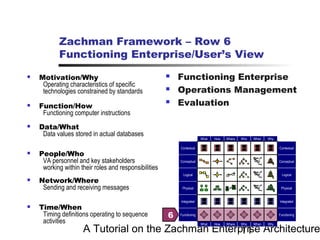
Zachman Framework – Row 6
Functioning Enterprise/User’s View
 Functioning Enterprise
 Operations Management
 Evaluation
 Motivation/Why
Operating characteristics of specific
technologies constrained by standards
 Function/How
Functioning computer instructions
 Data/What
Data values stored in actual databases
 People/Who
VA personnel and key stakeholders
working within their roles and responsibilities
 Network/Where
Sending and receiving messages
 Time/When
Timing definitions operating to sequence
activities
6
Contextual
Conceptual
Logical
Physical
Integrated
Functioning
Contextual
Conceptual
Logical
Physical
Integrated
Functioning
Why
Why
Who
Who
When
When
Where
Where
What
What
How
How
A Tutorial on the Zachman Enterprise Architecture12
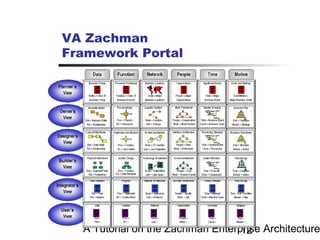
VA Zachman
Framework Portal

1 zachman eaf_tutorial

  • 1.
    A Tutorial onthe Zachman Enterprise Architecture1 A Tutorial on the Zachman Framework for Enterprise Architecture
  • 2.
    A Tutorial onthe Zachman Enterprise Architecture2 Zachman Framework
  • 3.
    A Tutorial onthe Zachman Enterprise Architecture3 VA EnterpriseVA Enterprise Zachman Framework
  • 4.
    A Tutorial onthe Zachman Enterprise Architecture4 Zachman Framework  Row 1 – Scope External Requirements and Drivers Business Function Modeling  Row 2 – Enterprise Model Business Process Models  Row 3 – System Model Logical Models Requirements Definition  Row 4 – Technology Model Physical Models Solution Definition and Development Row 5 – As Built As Built Deployment  Row 6 – Functioning Enterprise Functioning Enterprise Evaluation 1 2 3 4 5 6 Contextual Conceptual Logical Physical As Built Functioning Contextual Conceptual Logical Physical As Built Functioning Why Why Who Who When When Where Where What What How How
  • 5.
    A Tutorial onthe Zachman Enterprise Architecture5 Framework Rules  Rule 1: Columns have no order Contextual Conceptual Logical Physical As Built Functioning Contextual Conceptual Logical Physical As Built Functioning Why Why Who Who When When Where Where What What How How  Rule 2: Each column has a simple, basic model  Rule 3: Basic model of each column is unique  Rule 4: Each row represents a distinct view  Rule 5: Each cell is unique  Rule 6: Combining the cells in one row forms a complete description from that view Basic Model = Entities and Relationships EntityRelationshipEntity
  • 6.
    A Tutorial onthe Zachman Enterprise Architecture6 Zachman Framework – Row 1 Scope/Planner’s View  External Requirements and Drivers  Business Function Modeling  Motivation/Why Business goals, objectives and performance measures related to each function  Function/How High-level business functions  Data/What High-level data classes related to each function  People/Who Stakeholders related to each function  Network/Where VA locations related to each function  Time/When Cycles and events related to each function 1 Contextual Conceptual Logical Physical As Built Functioning Contextual Conceptual Logical Physical As Built Functioning Why Why Who Who When When Where Where What What How How
  • 7.
    A Tutorial onthe Zachman Enterprise Architecture7 Zachman Framework – Row 2 Enterprise Model/Designer’s View  Business Process Models  Business Function Allocation  Elimination of Function Overlap and Ambiguity  Motivation/Why Policies, procedures and standards for each process  Function/How Business processes  Data/What Business data  People/Who VA roles and responsibilities in each process  Network/Where VA locations related to each process  Time/When Events for each process and sequencing of integration and process improvements 2 Contextual Conceptual Logical Physical As Built Functioning Contextual Conceptual Logical Physical As Built Functioning Why Why Who Who When When Where Where What What How How
  • 8.
    A Tutorial onthe Zachman Enterprise Architecture8 Zachman Framework – Row 3 System Model/Designer’s View  Logical Models  Project Management  Requirements Definition  Motivation/Why VA policies, standards and procedures associated with a business rule model  Function/How Logical representation of information systems and their relationships  Data/What Logical data models of data and data relationships underlying VA information  People/Who Logical representation of access privileges constrained by roles and responsibilities  Network/Where Logical representation of the distributed system architecture for VA locations  Time/When Logical events and their triggered responses constrained by business events and their responses 3 Contextual Conceptual Logical Physical As Built Functioning Contextual Conceptual Logical Physical As Built Functioning Why Why Who Who When When Where Where What What How How
  • 9.
    A Tutorial onthe Zachman Enterprise Architecture9 Zachman Framework – Row 4 Technology Model/Builder’s View  Physical Models  Technology Management  Solution Definition and Development  Motivation/Why VA business rules constrained by information systems standards  Function/How Specifications of applications that operate on particular technology platforms  Data/What Database management system (DBMS) type requirements constrained by logical data models  People/Who Specification of access privileges to specific platforms and technologies  Network/Where Specification of network devices and their relationships within physical boundaries  Time/When Specification of triggers to respond to system events on specific platforms and technologies 4 Contextual Conceptual Logical Physical As Built Functioning Contextual Conceptual Logical Physical As Built Functioning Why Why Who Who When When Where Where What What How How
  • 10.
    A Tutorial onthe Zachman Enterprise Architecture10 Zachman Framework – Row 5 As Built/Integrator’s View  As Built  Configuration Management  Deployment  Motivation/Why VA business rules constrained by specific technology standards  Function/How Programs coded to operate on specific technology platforms  Data/What Data definitions constrained by physical data models  People/Who Access privileges coded to control access to specific platforms and technologies  Network/Where Network devices configured to conform to node specifications  Time/When Timing definitions coded to sequence activities on specific platforms and technologies 5 Contextual Conceptual Logical Physical As Built Functioning Contextual Conceptual Logical Physical As Built Functioning Why Why Who Who When When Where Where What What How How
  • 11.
    A Tutorial onthe Zachman Enterprise Architecture11 Zachman Framework – Row 6 Functioning Enterprise/User’s View  Functioning Enterprise  Operations Management  Evaluation  Motivation/Why Operating characteristics of specific technologies constrained by standards  Function/How Functioning computer instructions  Data/What Data values stored in actual databases  People/Who VA personnel and key stakeholders working within their roles and responsibilities  Network/Where Sending and receiving messages  Time/When Timing definitions operating to sequence activities 6 Contextual Conceptual Logical Physical Integrated Functioning Contextual Conceptual Logical Physical Integrated Functioning Why Why Who Who When When Where Where What What How How
  • 12.
    A Tutorial onthe Zachman Enterprise Architecture12 VA Zachman Framework Portal

Editor's Notes

  • #6 Framework Rules Zachman provided the following rules to assist the reader in understanding ISA and its application. Rule 1: The columns have no order. Order implies priorities and creates a bias toward one aspect at the expense of others. All columns are equally important because all are abstractions of the same enterprise. Rule 2: Each column has a simple, basic model. Each column represents an abstraction from the real world for convenience of description. These models include: ·          Data (what), Function (how), Network (where), People (who), Time (when), and Motivation (why) Rule 3: The basic model of each column must be unique. The individual models may be related to one another because they are all abstractions of the same real-world enterprise, but each model represents a separate and unique concept. Rule 4: Each row represents a distinct perspective This rule is most easily demonstrated by the Business Model, System Model, and Technology Model rows, which represent the owner’s, architect’s, and builder’s perspectives. Each perspective is different because it deals with a different set of constraints. For example, the owner deals with usability constraints, both aesthetic and functional, and the architect deals with design constraints, the laws of physics or nature, and the builder deals with construction constraints, the state of the art in methods and technologies. Rule 5: Each cell is unique. Since each column has a unique basic model that makes each column unique and each row has a different perspective, each cell in the framework is unique. Zachman likens ISA to a “periodic table” for information entities, providing a classification scheme for information entities, allowing different entities to be combined to provide different views of an information system. Because each cell is unique, different techniques and different graphic representations are appropriate for different cells. This also accounts for the large number of information systems design models and methodologies that have emerged over the years. Rule 6: Combining the cells in one row forms a complete model. The sum of all cells in a given row is the most complete depiction of reality from the perspective of that row. As new cells in a given row are defined each new cell description must be consistent with the perspective of that row. Each cell in a given row can be defined and is independent of any other cells in the row, yet each cell is but one abstraction of the same perspective of reality. Therefore, each cell is related to every other cell in the same row