Web Services
Khasim
History
 Structured programming
 Object-oriented programming
 Distributed computing
 Electronic data interchange
 World Wide Web
 Web services
Who Was First?
 What company first proposed the web
services concept?
 Hewlett-Packard's e-Speak in 1999
 was an enabler for e-services
 Microsoft introduced the name "web
services" in June 2000
 MS "bet the company" on its web services
strategy
 now every major vendor is a player
Open, Standard Technologies
 XML – tagging data such that it can be
exchanged between applications and
platforms
 SOAP – messaging protocol for
transporting information and
instructions between applications (uses
XML)
Open, Standard Technologies
 WSDL – a standard method of
describing web services and their
specific capabilities (XML)
 UDDI – defines XML-based rules for
building directories in which companies
advertise themselves and their web
services
Advantages
 Open, text-based standards
 Modular approach
 Inexpensive to implement (relatively)
 Reduce the cost of enterprise
application integration
 Incremental implementation
Real Web Services
 UC-Berkeley
 Unified Communications Technical Project
 unify email, voice, and fax into in-boxes
accessible from cell phones, PDAs, or e-
mail clients
 Eastman Chemical Company
 distributors access chemical catalog in
real-time and push info to customers
Real Web Services
 Accenture
 Live Information Models
 stock traders access real-time information
from a single terminal
 Dollar Rent-a-Car + Southwest Airlines
 Southwest runs Unix
 Dollar runs MS Windows
 Dollar turned its system into a web service
More Examples
 Web service broker sites
 www.xmethods.net
 www.salcentral.com
Online Resources
 www.deitel.com
 web services, C#
 www.w3.org
 World Wide Web Consortium (W3C)
 recommendations, news, mission, FAQs
 www.w3.org/History.html
 history of computing and internet from
1945 to now
Online Resources
 www.webservices.org
 news, standards, vendors, platforms,
products, applications, case studies,
security mechanisms
 www.webservicesarchitect.com
 online journal for web service developers;
tools, vendors, business models, additional
resources
Online Resources
 www.ws-i.org
 web service interoperability organization
(WS-I); promote interoperability among
services created in different languages and
platforms; white papers, news, FAQs
Online Resources
 www.xml.com/lpt/a/2002/02/06/
webservices.html
 "Web Service Pitfalls": limitations,
unresolved security issues
 www.webservices.org/print.php?
sid=201
 "Web Services—A Reality Check":
transactions, security, QoS
The Big Picture
Client
UDDI Registry
WSDL
Document
Web Service Code
Client queries registry to locate service
Registry refers client to WSDL document
Client accesses WSDL document
WSDL provides data to interact with web service
Client sends SOAP-message request
Web service returns SOAP-message response
XML
 Developed from Standard Generalized
Markup Method (SGML)
 XML widely supported by W3C
 Essential characteristic is the
separation of content from presentation
 XML describes only data
 Any application that understands XML
can exchange data
XML
 XML parser checks syntax
 If syntax is good the document is well-
formed
 XML document can optionally reference
a Document Type Definition (DTD), also
called a Schema
 If an XML document adheres to the
structure of the schema it is valid
SOAP
 SOAP enables between distributed
systems
 SOAP message has three parts
 envelope – wraps entire message and
contains header and body
 header – optional element with additional
info such as security or routing
 body – application-specific data being
commuicated
WSDL
 Web services are self-describing
 Description is written in WSDL, an XML-
based language through which a web
service conveys to applications the
methods that the service provides and
how those methods are accessed
 WSDL is meant to be read by
applications (not humans)
UDDI
 UDDI defines an XML-based format that
describes electronic capabilities and business
processes
 Entries are stored in a UDDI registry
 UDDI Business Registry (UBR)
 "white pages" – contact info, description
 "yellow pages" – classification info, details
 "green pages" – technical data
 uddi.microsoft.com
OASIS
 Not competition to W3C
 Ensure that businesses acquire e-
business tools that meet their needs
 United Nations Centre for Trade
Facilitation and Electronic Business
produced Electronic Business XML
(ebXML)
More Info
 www.w3.org/2002/ws
 web services activity
 www.uddi.org
 explanation; business benefits
 www.oasis-open.org
 technical work and standards
 www.ebxml.org
 technology and business benefits
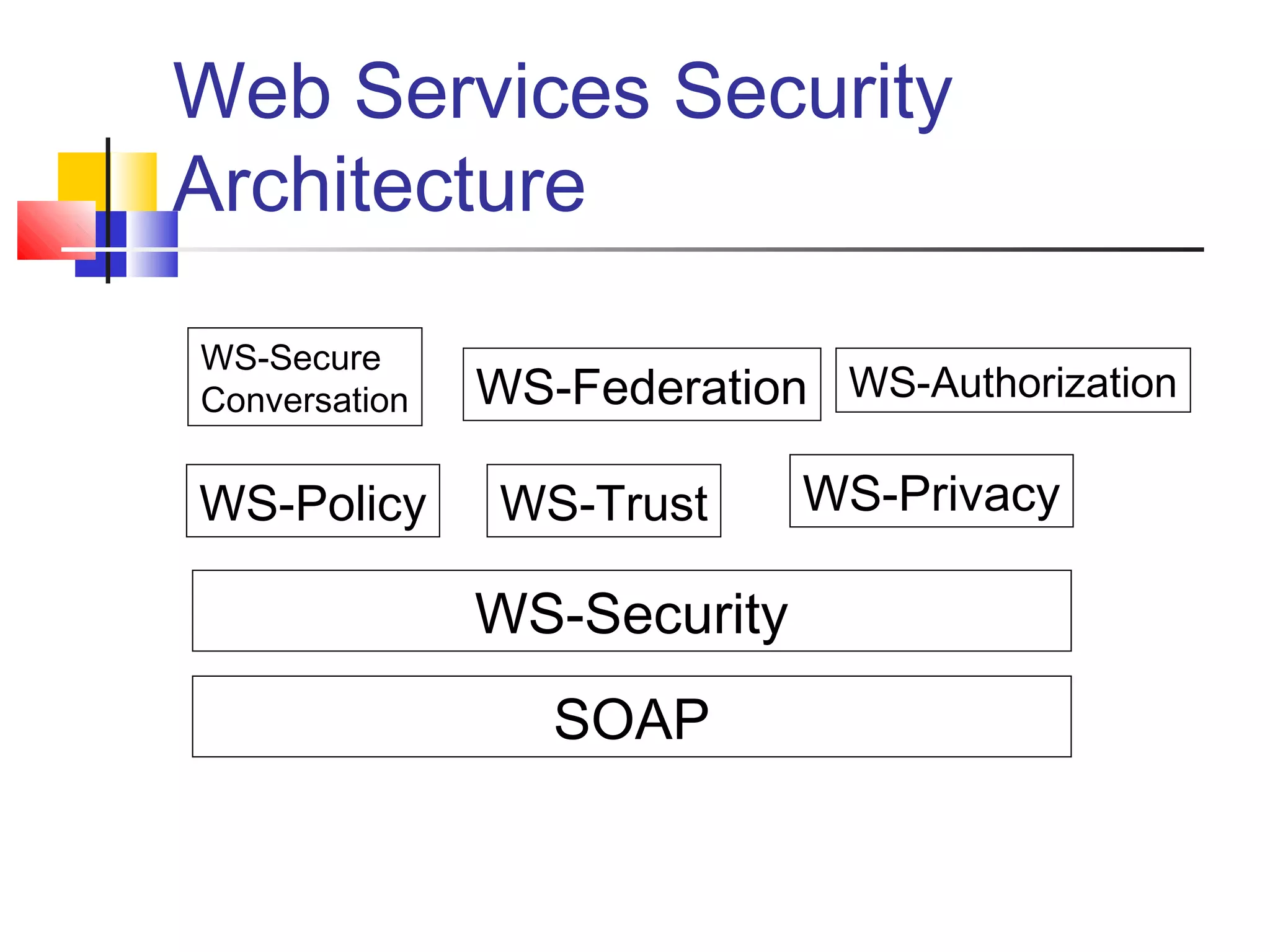
SOAP
WS-Security
WS-Policy WS-Trust WS-Privacy
WS-Secure
Conversation WS-Federation WS-Authorization
Web Services Security
Architecture
SOAP
WS-Security
WS-Policy WS-Trust WS-Privacy
WS-Secure
Conversation WS-Federation WS-Authorization
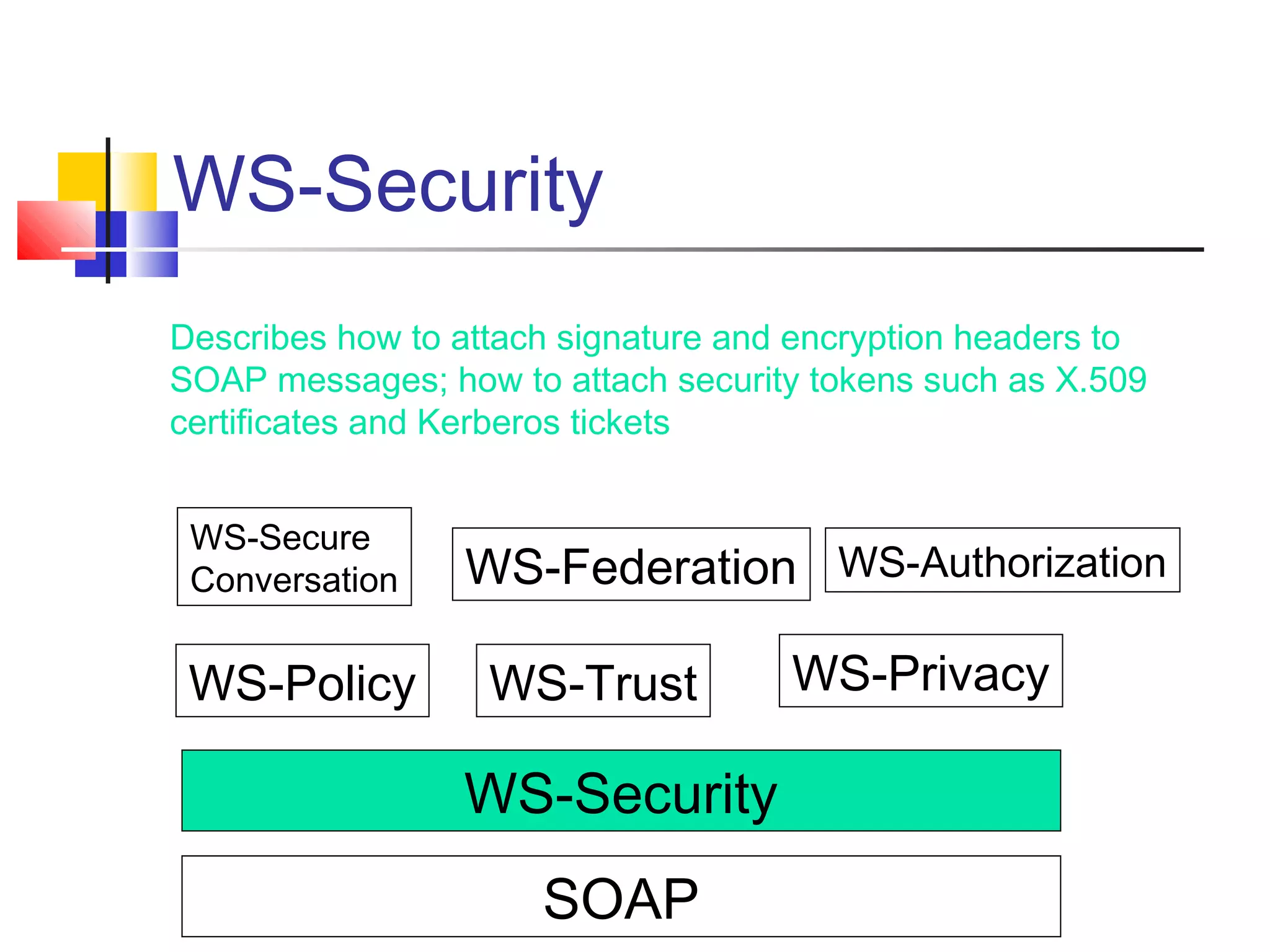
WS-Security
Describes how to attach signature and encryption headers to
SOAP messages; how to attach security tokens such as X.509
certificates and Kerberos tickets
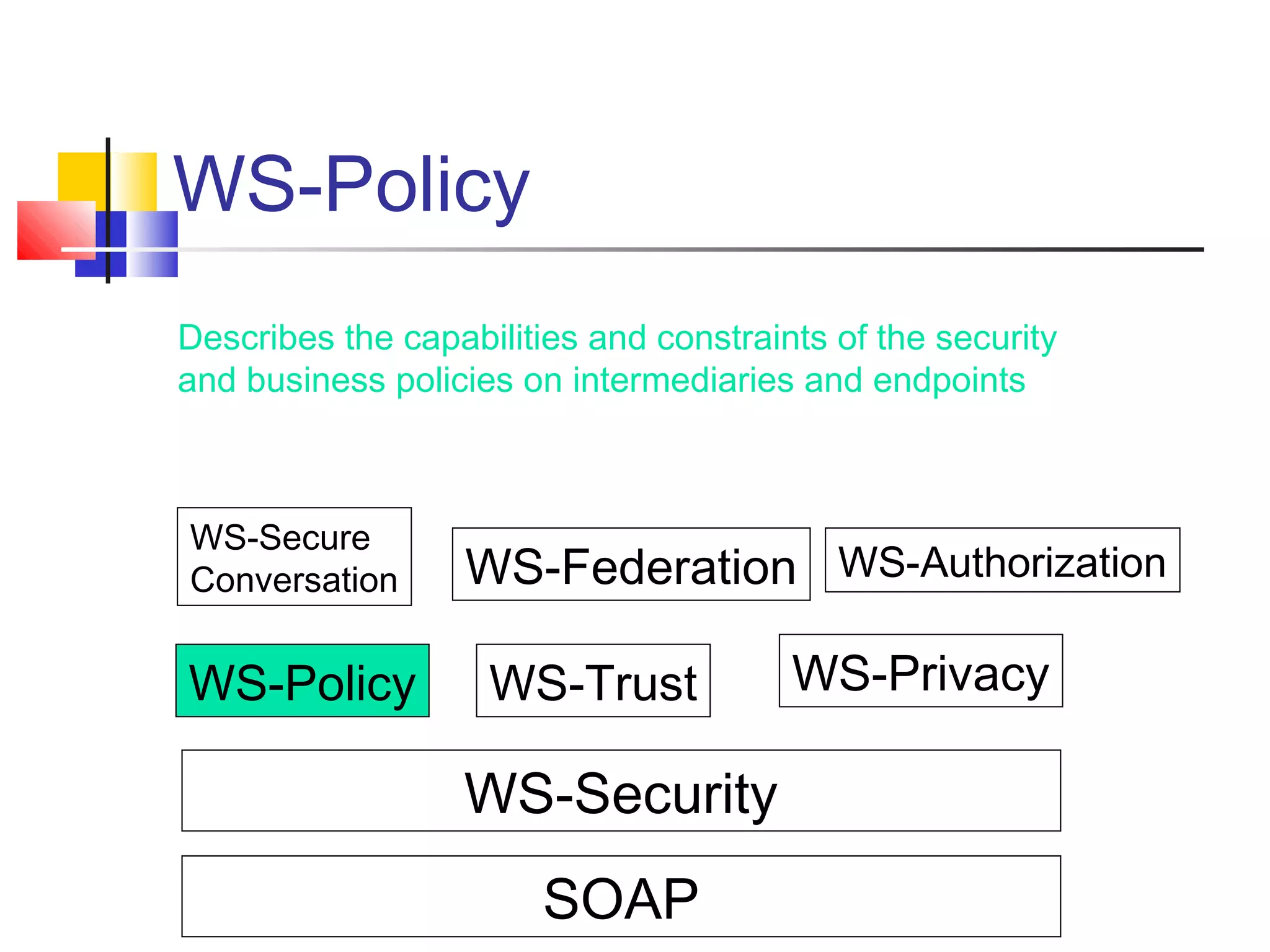
WS-Policy
SOAP
WS-Security
WS-Policy WS-Trust WS-Privacy
WS-Secure
Conversation WS-Federation WS-Authorization
Describes the capabilities and constraints of the security
and business policies on intermediaries and endpoints
WS-Trust
SOAP
WS-Security
WS-Policy WS-Trust WS-Privacy
WS-Secure
Conversation WS-Federation WS-Authorization
Framework for trust models that enables web services to
interoperate securely.
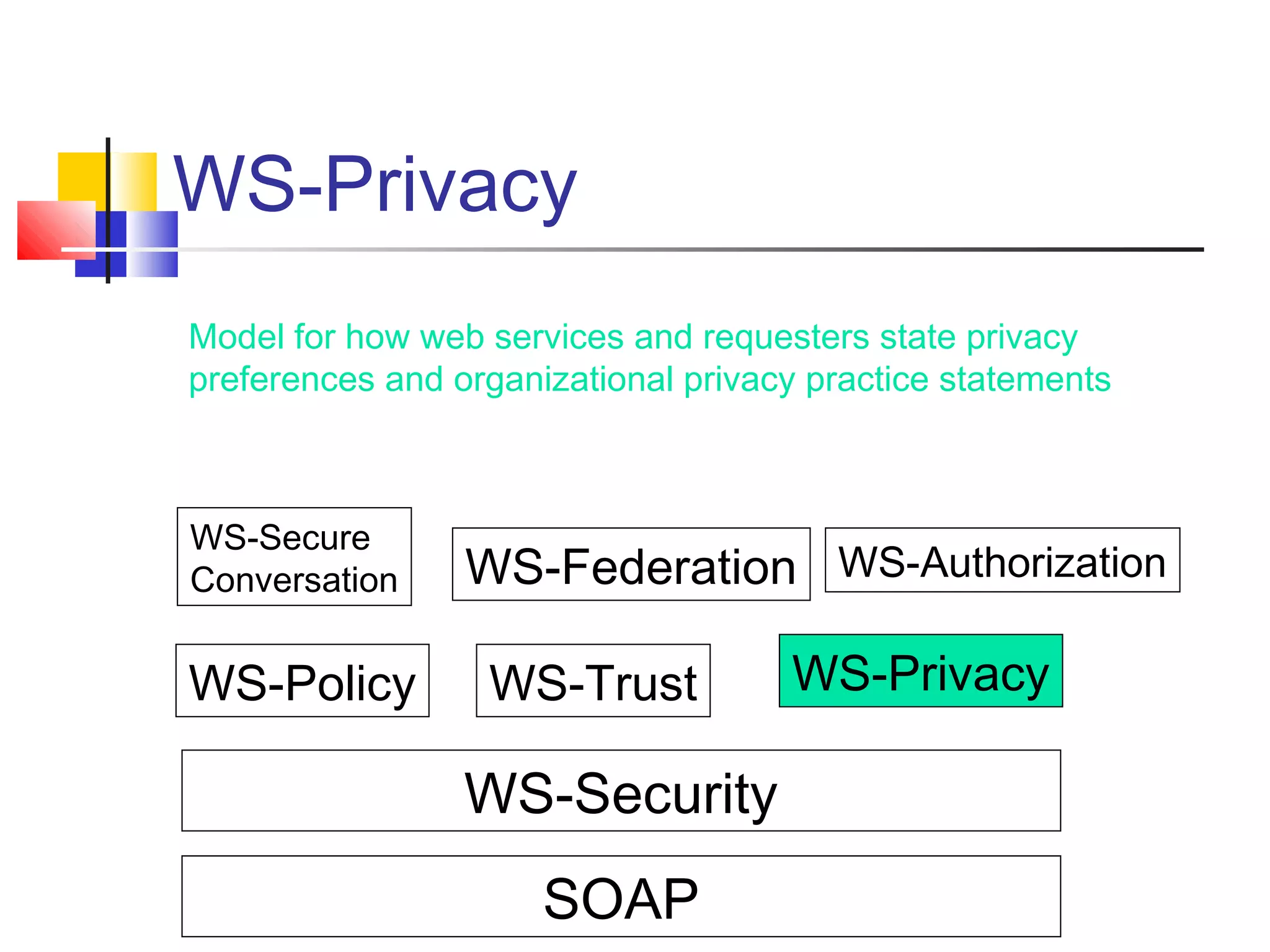
WS-Privacy
SOAP
WS-Security
WS-Policy WS-Trust WS-Privacy
WS-Secure
Conversation WS-Federation WS-Authorization
Model for how web services and requesters state privacy
preferences and organizational privacy practice statements
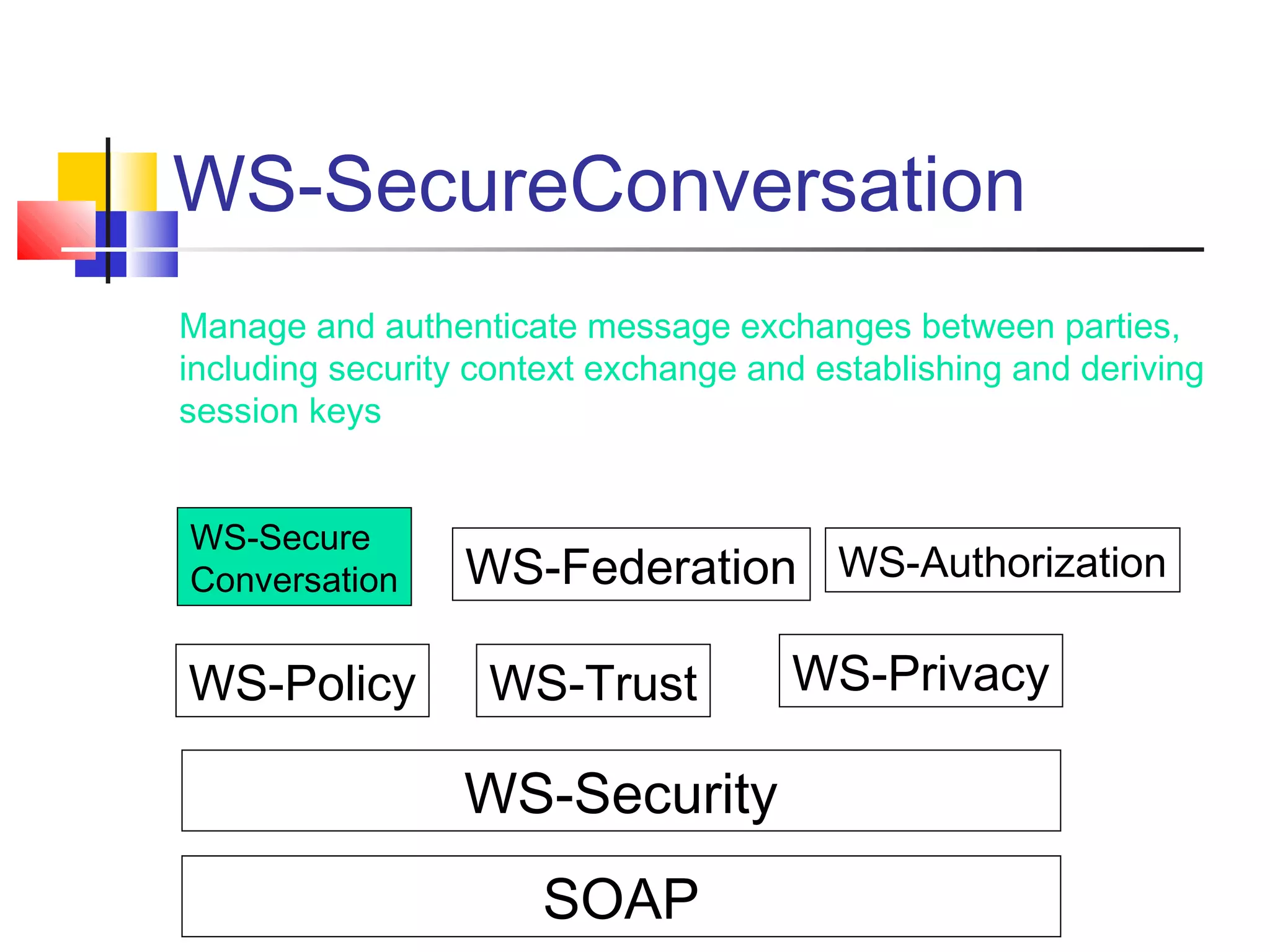
WS-SecureConversation
SOAP
WS-Security
WS-Policy WS-Trust WS-Privacy
WS-Secure
Conversation WS-Federation WS-Authorization
Manage and authenticate message exchanges between parties,
including security context exchange and establishing and deriving
session keys
WS-Federation
SOAP
WS-Security
WS-Policy WS-Trust WS-Privacy
WS-Secure
Conversation WS-Federation WS-Authorization
Manage and broker trust relationships in a heterogeneous
federated environment, including support for federated identities.
WS-Authorization
SOAP
WS-Security
WS-Policy WS-Trust WS-Privacy
WS-Secure
Conversation WS-Federation WS-Authorization
Manage authorization data and authorization policy.

1. web services

  • 1.
  • 2.
    History  Structured programming Object-oriented programming  Distributed computing  Electronic data interchange  World Wide Web  Web services
  • 3.
    Who Was First? What company first proposed the web services concept?  Hewlett-Packard's e-Speak in 1999  was an enabler for e-services  Microsoft introduced the name "web services" in June 2000  MS "bet the company" on its web services strategy  now every major vendor is a player
  • 4.
    Open, Standard Technologies XML – tagging data such that it can be exchanged between applications and platforms  SOAP – messaging protocol for transporting information and instructions between applications (uses XML)
  • 5.
    Open, Standard Technologies WSDL – a standard method of describing web services and their specific capabilities (XML)  UDDI – defines XML-based rules for building directories in which companies advertise themselves and their web services
  • 6.
    Advantages  Open, text-basedstandards  Modular approach  Inexpensive to implement (relatively)  Reduce the cost of enterprise application integration  Incremental implementation
  • 7.
    Real Web Services UC-Berkeley  Unified Communications Technical Project  unify email, voice, and fax into in-boxes accessible from cell phones, PDAs, or e- mail clients  Eastman Chemical Company  distributors access chemical catalog in real-time and push info to customers
  • 8.
    Real Web Services Accenture  Live Information Models  stock traders access real-time information from a single terminal  Dollar Rent-a-Car + Southwest Airlines  Southwest runs Unix  Dollar runs MS Windows  Dollar turned its system into a web service
  • 9.
    More Examples  Webservice broker sites  www.xmethods.net  www.salcentral.com
  • 10.
    Online Resources  www.deitel.com web services, C#  www.w3.org  World Wide Web Consortium (W3C)  recommendations, news, mission, FAQs  www.w3.org/History.html  history of computing and internet from 1945 to now
  • 11.
    Online Resources  www.webservices.org news, standards, vendors, platforms, products, applications, case studies, security mechanisms  www.webservicesarchitect.com  online journal for web service developers; tools, vendors, business models, additional resources
  • 12.
    Online Resources  www.ws-i.org web service interoperability organization (WS-I); promote interoperability among services created in different languages and platforms; white papers, news, FAQs
  • 13.
    Online Resources  www.xml.com/lpt/a/2002/02/06/ webservices.html "Web Service Pitfalls": limitations, unresolved security issues  www.webservices.org/print.php? sid=201  "Web Services—A Reality Check": transactions, security, QoS
  • 14.
    The Big Picture Client UDDIRegistry WSDL Document Web Service Code Client queries registry to locate service Registry refers client to WSDL document Client accesses WSDL document WSDL provides data to interact with web service Client sends SOAP-message request Web service returns SOAP-message response
  • 15.
    XML  Developed fromStandard Generalized Markup Method (SGML)  XML widely supported by W3C  Essential characteristic is the separation of content from presentation  XML describes only data  Any application that understands XML can exchange data
  • 16.
    XML  XML parserchecks syntax  If syntax is good the document is well- formed  XML document can optionally reference a Document Type Definition (DTD), also called a Schema  If an XML document adheres to the structure of the schema it is valid
  • 17.
    SOAP  SOAP enablesbetween distributed systems  SOAP message has three parts  envelope – wraps entire message and contains header and body  header – optional element with additional info such as security or routing  body – application-specific data being commuicated
  • 18.
    WSDL  Web servicesare self-describing  Description is written in WSDL, an XML- based language through which a web service conveys to applications the methods that the service provides and how those methods are accessed  WSDL is meant to be read by applications (not humans)
  • 19.
    UDDI  UDDI definesan XML-based format that describes electronic capabilities and business processes  Entries are stored in a UDDI registry  UDDI Business Registry (UBR)  "white pages" – contact info, description  "yellow pages" – classification info, details  "green pages" – technical data  uddi.microsoft.com
  • 20.
    OASIS  Not competitionto W3C  Ensure that businesses acquire e- business tools that meet their needs  United Nations Centre for Trade Facilitation and Electronic Business produced Electronic Business XML (ebXML)
  • 21.
    More Info  www.w3.org/2002/ws web services activity  www.uddi.org  explanation; business benefits  www.oasis-open.org  technical work and standards  www.ebxml.org  technology and business benefits
  • 22.
    SOAP WS-Security WS-Policy WS-Trust WS-Privacy WS-Secure ConversationWS-Federation WS-Authorization Web Services Security Architecture
  • 23.
    SOAP WS-Security WS-Policy WS-Trust WS-Privacy WS-Secure ConversationWS-Federation WS-Authorization WS-Security Describes how to attach signature and encryption headers to SOAP messages; how to attach security tokens such as X.509 certificates and Kerberos tickets
  • 24.
    WS-Policy SOAP WS-Security WS-Policy WS-Trust WS-Privacy WS-Secure ConversationWS-Federation WS-Authorization Describes the capabilities and constraints of the security and business policies on intermediaries and endpoints
  • 25.
    WS-Trust SOAP WS-Security WS-Policy WS-Trust WS-Privacy WS-Secure ConversationWS-Federation WS-Authorization Framework for trust models that enables web services to interoperate securely.
  • 26.
    WS-Privacy SOAP WS-Security WS-Policy WS-Trust WS-Privacy WS-Secure ConversationWS-Federation WS-Authorization Model for how web services and requesters state privacy preferences and organizational privacy practice statements
  • 27.
    WS-SecureConversation SOAP WS-Security WS-Policy WS-Trust WS-Privacy WS-Secure ConversationWS-Federation WS-Authorization Manage and authenticate message exchanges between parties, including security context exchange and establishing and deriving session keys
  • 28.
    WS-Federation SOAP WS-Security WS-Policy WS-Trust WS-Privacy WS-Secure ConversationWS-Federation WS-Authorization Manage and broker trust relationships in a heterogeneous federated environment, including support for federated identities.
  • 29.
    WS-Authorization SOAP WS-Security WS-Policy WS-Trust WS-Privacy WS-Secure ConversationWS-Federation WS-Authorization Manage authorization data and authorization policy.