Python
Programming
Introduction
At the end of this lesson…
Participants will be able to…
• Define what is Python Programming
• Appreciate the history of Python Programming
• List the uses and features of Python Programming
• Python is a general-purpose, interpreted high-level
programming language whose design philosophy
emphasizes code readability
• Its syntax are said to be clear and expressive
• Have a large and compressive standard library
• Python supports multiple programming paradigms,
including object-oriented, imperative and functional
programming styles
Introduction
• Python is a versatile or flexible language
• Interpreted
• Python allows easy debugging
• Python is a free and open-source software
• Python interactive mode
• Python is portable
• Python is platform-independent
• Python is user-friendly
• Python is a dynamic language
• and others…
Introduction
• Currently, it is maintained by the Python Software
Foundation (PSF). The PSF also host an annual Python
Conference (PyCon).
• Python.PH is a nonprofit organization based on the
Philippines that is recognized by the PSF. Python.PH holds
initiatives to promote Python such as workshop, user
meetups, a job board, and PyCon.PH.
Introduction
• One of the most popular programming languages in the
world, has created everything from Netflix’s
recommendation algorithm to the software that controls
self-driving cars.
• Python is a general-purpose language, which means it’s
designed to be used in a range of applications, including
data science, software and web development,
automation, and generally getting stuff done.
Introduction
• Python is used in GIS programming. It is used as a scripting
language for ArcGIS, and for Quantum GIS.
• It's used in everything from machine learning to building websites
and software testing. It can be used by developers and non-
developers alike.
• Python is commonly used for developing websites and software,
task automation, data analysis, and data visualization. Since it’s
relatively easy to learn, Python has been adopted by many non-
programmers such as accountants and scientists, for a variety of
everyday tasks, like organizing finances.
Uses of Python Programming
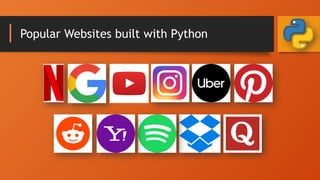
Popular Websites built with Python
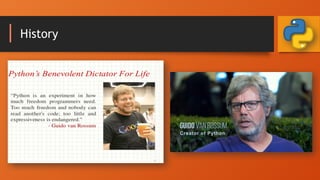
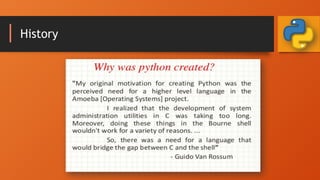
• Invented in the Netherlands, early 90s by Guido van
Rossum
• History of Python starts with ABC
• ABC is a general-purpose programming language and
programming environment, which had been developed in
the Netherlands, Amsterdam, at the CWI (Centrum
Wiskunde & Informatica).
• The greatest achievement of ABC was to influence the
design of Python
History
• Python was conceived in the late 1980s and its
implementation started in December 1989 was first
released to the public in 1991..
• Guido van Rossum is a fan of “Monty Pythons Flying
Circus”, this is a famous TV Show in Netherlands
• Named after the comedy group, Monty Python
• Open source from the beginning
History
History
History
Using the Python Shell
Think of the Python shell as a way to peer within
running Python code. It places you inside of a
running instance of Python, into which you can
feed programming code; at the same time, Python
will do what you have asked it to do and will show
you a little bit about how it responds to its
environment.
THANK YOU!

1 - Python Programming Introduction.pptx

  • 1.
  • 2.
    At the endof this lesson… Participants will be able to… • Define what is Python Programming • Appreciate the history of Python Programming • List the uses and features of Python Programming
  • 3.
    • Python isa general-purpose, interpreted high-level programming language whose design philosophy emphasizes code readability • Its syntax are said to be clear and expressive • Have a large and compressive standard library • Python supports multiple programming paradigms, including object-oriented, imperative and functional programming styles Introduction
  • 4.
    • Python isa versatile or flexible language • Interpreted • Python allows easy debugging • Python is a free and open-source software • Python interactive mode • Python is portable • Python is platform-independent • Python is user-friendly • Python is a dynamic language • and others… Introduction
  • 5.
    • Currently, itis maintained by the Python Software Foundation (PSF). The PSF also host an annual Python Conference (PyCon). • Python.PH is a nonprofit organization based on the Philippines that is recognized by the PSF. Python.PH holds initiatives to promote Python such as workshop, user meetups, a job board, and PyCon.PH. Introduction
  • 6.
    • One ofthe most popular programming languages in the world, has created everything from Netflix’s recommendation algorithm to the software that controls self-driving cars. • Python is a general-purpose language, which means it’s designed to be used in a range of applications, including data science, software and web development, automation, and generally getting stuff done. Introduction
  • 7.
    • Python isused in GIS programming. It is used as a scripting language for ArcGIS, and for Quantum GIS. • It's used in everything from machine learning to building websites and software testing. It can be used by developers and non- developers alike. • Python is commonly used for developing websites and software, task automation, data analysis, and data visualization. Since it’s relatively easy to learn, Python has been adopted by many non- programmers such as accountants and scientists, for a variety of everyday tasks, like organizing finances. Uses of Python Programming
  • 8.
  • 9.
    • Invented inthe Netherlands, early 90s by Guido van Rossum • History of Python starts with ABC • ABC is a general-purpose programming language and programming environment, which had been developed in the Netherlands, Amsterdam, at the CWI (Centrum Wiskunde & Informatica). • The greatest achievement of ABC was to influence the design of Python History
  • 10.
    • Python wasconceived in the late 1980s and its implementation started in December 1989 was first released to the public in 1991.. • Guido van Rossum is a fan of “Monty Pythons Flying Circus”, this is a famous TV Show in Netherlands • Named after the comedy group, Monty Python • Open source from the beginning History
  • 11.
  • 12.
  • 13.
    Using the PythonShell Think of the Python shell as a way to peer within running Python code. It places you inside of a running instance of Python, into which you can feed programming code; at the same time, Python will do what you have asked it to do and will show you a little bit about how it responds to its environment.
  • 14.

Editor's Notes

  • #3 Python is a simple language Python makes use of very simple English phrases. It is much simpler to use as compared to languages like C, C++, or JAVA. Python follows a very simple syntax structure. There is no need to explicitly declare variables. You can define complex operations in a single statement. Instead of opening and closing brackets, Python uses indentation for statement grouping. The syntax and programming structure followed while coding in Python is very simple. Python is very easy to learn.
  • #4 Python is a versatile or flexible language Python is a flexible and versatile language because it can be used for many purposes. Packages like NumPy , matplotlib , pandas , and so on make it a perfect programming language for data analysis , web development , artificial intelligence , data science , and much more. Presently it is in great demand for application development and system development programming. It is also a very suitable language for developing complex multi-protocol network applications. Interpreted: Python code does not require explicit compilation. It is an interpreted language where the code is converted to an intermediate code called bytecodes. The bytecode is converted to a machine code that can be understood and executed by the computer. Python allows easy debugging: Python is an interpreted language. It is executed line by line which makes it easier to debug. Python is a free and open-source software: Python can be downloaded for free from its official website. You can install Python on your system for free. Python is freely used and distributed, and anyone can attribute to it. Interactive Mode: The interactive mode of Python which is a Python prompt allows users to interact directly with the interpreter. It allows the user to test the code before finalizing it which greatly helps in reducing errors at the time of coding. Python is portable: Python code can be executed on any platform without making any alteration in the code. No initial setup of the software is required for executing a program. Python is platform-independent: The software coded in Python can run on different operating environments. This means that a Python program created UNIX for instance, and then can be executed on a Windows system that has Python. Python is user friendly Features like high-level data structures and extensive standard free libraries make Python user friendly. The code can be divided into modules. These modules can be used in other applications thereby saving a lot of effort and time. Python is a dynamic language Python is called a dynamic language because a coder need not declare the data type of any variable in the code. The data type of a variable is assigned dynamically when the value is stored in the variable.