PMP
Project Management Professional
Exam Preparation Course
Project Management
Frame Work
Welcome


Name

Organization
Role in organization
Who am I ?
• My name is Ahmed Hegazy
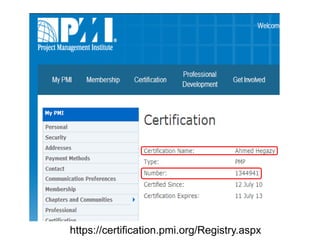
• Certified Project Management Professional PMP by PMI /
USA from July 2010.
• Certified ITIL Foundation
• Six Sigma Green Belt by Expert Rating
• BSC , Major Accounting, Faculty of Commerce 1999
• Business Administration Diploma (ongoing) Ain Shams
University
• Business Administration Consultant at Abshir for
knowledge (Owner).
Ground Rules To Enhance Performance
Start on time to End on time
Mobile Phone on Silent Please
What you will learn today ..
• What is PMP …
• What is PMI …
• What is PMPBOK …
• Why PMP …
• How to be certified …
• What is PMPBOK processes and knowledge
areas …
• What is the deferent between project and
operation …
• And more …
PMI > PMBOK> Exam> PMP
Project Management Institute (PMI) provide Project
Management Body Of Knowledge (PMBOK)
PMI : The Project Management Institute (PMI) offers a range of services
to the Project Management profession such as the development of
standards, research, education, hosting conferences and training
seminars.
PMBOK : Global Standard to manage projects
Good practice to manage projects
Provides common terminology
PMP : As of 31 July 2010, there were 393,413 active PMP certified
individuals worldwide.
Project Management Professional
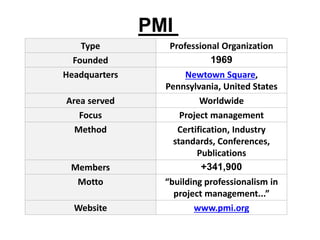
Type Professional Organization
Founded 1969
Headquarters Newtown Square,
Pennsylvania, United States
Area served Worldwide
Focus Project management
Method Certification, Industry
standards, Conferences,
Publications
Members 341,900+
Motto “building professionalism in
project management...”
Website www.pmi.org
PMI
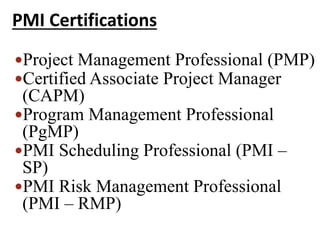
PMI Certifications
Project Management Professional (PMP)
Certified Associate Project Manager
(CAPM)
Program Management Professional
(PgMP)
PMI Scheduling Professional (PMI –
SP)
PMI Risk Management Professional
(PMI – RMP)
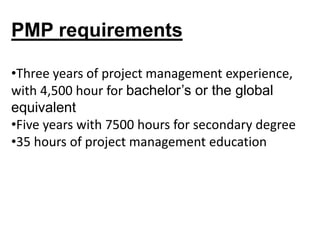
PMP requirements
•Three years of project management experience,
with 4,500 hour for bachelor’s or the global
equivalent
•Five years with 7500 hours for secondary degree
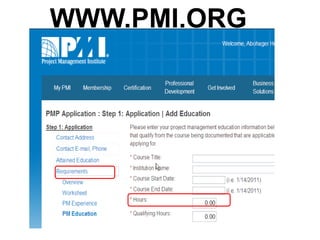
•35 hours of project management education
WWW.PMI.ORG
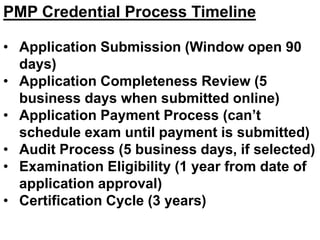
PMP Credential Process Timeline
• Application Submission (Window open 90
days)
• Application Completeness Review (5
business days when submitted online)
• Application Payment Process (can’t
schedule exam until payment is submitted)
• Audit Process (5 business days, if selected)
• Examination Eligibility (1 year from date of
application approval)
• Certification Cycle (3 years)
https://certification.pmi.org/Registry.aspx
Why PMI?.... Why PMP?
Are flexible.
PMI certifications are not based on one specific methodology
Keep you up-to-date.
PMI continually conducts in-depth studies to ensure that our
credentials actually reflect the current skills, knowledge and best
practices you need to succeed.
Encourage professional growth.
You never have to worry about a PMI certification becoming
obsolete. Our certification maintenance program requires you to
earn professional development units (PDUs).
Help you get ahead.
The Project Management Professional (PMP)® credential
increases your salary by up to 10%, according to the PMI Salary
Survey and helps you stand out and better market yourself to
prospective employers.
Are renowned throughout the world.
PMI has provided project management certifications for over 25
years, and our PMP® credential was the first one designed
specifically for project managers..
•The exam must be completed in four hours
•Includes 200 multiple-choice questions with four answer
choices per question
•The passing score on the exam is now 106 out of 175,
approximately 61 percent.
•Twenty-five of the 200 exam questions are "prerelease
questions;'. (they are not included in your score for the
exam)
•THE PMP EXAM IS NOT Only A TEST OF THE
INFORMATION IN THE PMBOK Guide!
•Do not expect the exam to have all straightforward,
definition-type questions.
•You cannot rely only on real-world experience.
About the PMP exam
Included:
• up to about 150 "What would you do in this
situation?" questions (situational questions).
• only 10 to 15 questions requiring you to
MEMORIZE the inputs or outputs from the PMBOK·
Guide.
• Expect 20 formula-related calculations on the
exam.
About the exam
PMPBOK
PMI Standard Contents
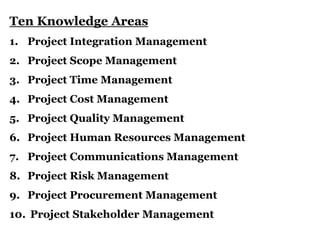
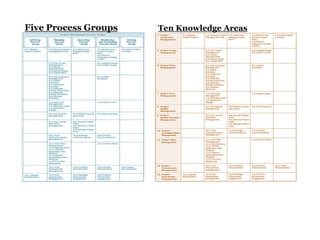
Ten Knowledge Areas
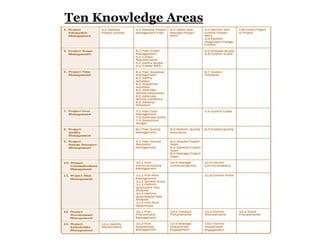
1. Project Integration Management
2. Project Scope Management
3. Project Time Management
4. Project Cost Management
5. Project Quality Management
6. Project Human Resources Management
7. Project Communications Management
8. Project Risk Management
9. Project Procurement Management
10. Project Stakeholder Management
Ten Knowledge Areas
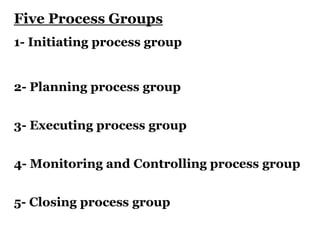
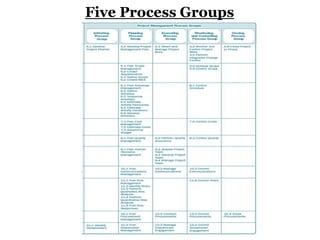
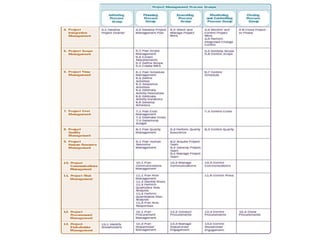
Five Process Groups
1- Initiating process group
2- Planning process group
3- Executing process group
4- Monitoring and Controlling process group
5- Closing process group
Five Process Groups
Ten Knowledge AreasFive Process Groups
What is a Project?
A project is a temporary endeavor undertaken to create a
unique product, service, or result (Deliverables).
Temporary
( definite beginning and definite end)
Unique
( different location, different design, different circumstances,
different contractors etc.)
Progressive Elaboration
Continuously improving and detailing a plan as more detailed
and specific information and more accurate estimates become
available.
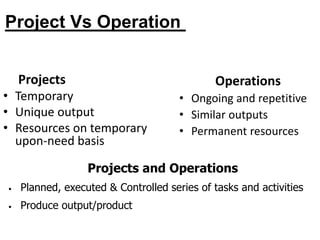
Projects
• Temporary
• Unique output
• Resources on temporary
upon-need basis
Operations
• Ongoing and repetitive
• Similar outputs
• Permanent resources
Projects and Operations
• Planned, executed & Controlled series of tasks and activities
• Produce output/product
Project Vs Operation
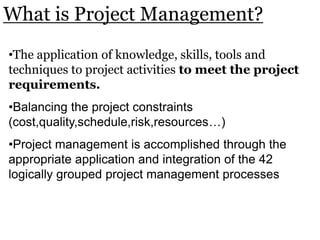
•The application of knowledge, skills, tools and
techniques to project activities to meet the project
requirements.
•Balancing the project constraints
(cost,quality,schedule,risk,resources…)
•Project management is accomplished through the
appropriate application and integration of the 42
logically grouped project management processes
What is Project Management?
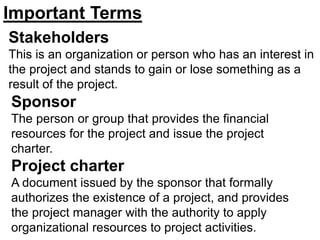
Stakeholders
This is an organization or person who has an interest in
the project and stands to gain or lose something as a
result of the project.
Sponsor
The person or group that provides the financial
resources for the project and issue the project
charter.
Project charter
A document issued by the sponsor that formally
authorizes the existence of a project, and provides
the project manager with the authority to apply
organizational resources to project activities.
Important Terms
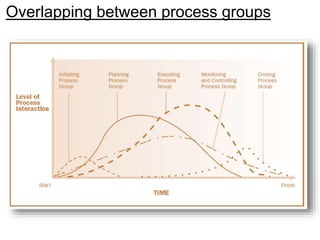
Overlapping between process groups
Project Life Cycle
A project life cycle is a collection of generally
sequential and sometimes overlapping project
phases whose name and number are determined
by the management and control needs of the
organization or organizations involved in the
project, the nature of the project itself, and its
area of application.
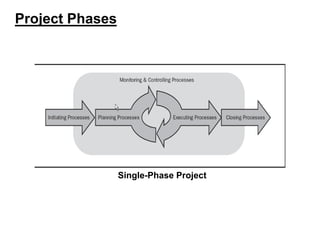
Project Phases
Single-Phase Project
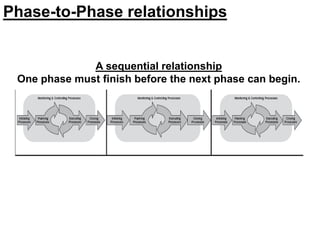
Phase-to-Phase relationships
A sequential relationship
One phase must finish before the next phase can begin.
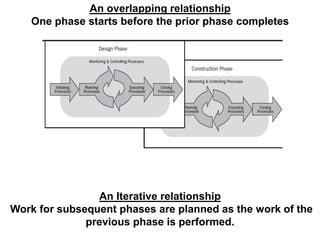
An overlapping relationship
One phase starts before the prior phase completes
An Iterative relationship
Work for subsequent phases are planned as the work of the
previous phase is performed.
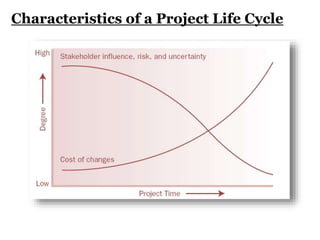
Characteristics of a Project Life Cycle
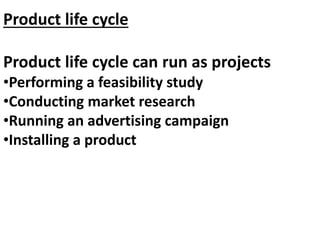
Product life cycle
Product life cycle can run as projects
•Performing a feasibility study
•Conducting market research
•Running an advertising campaign
•Installing a product
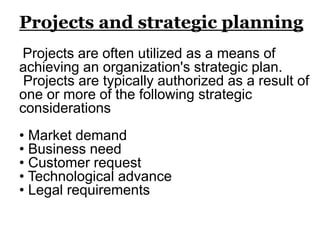
Projects and strategic planning
Projects are often utilized as a means of
achieving an organization's strategic plan.
Projects are typically authorized as a result of
one or more of the following strategic
considerations
• Market demand
• Business need
• Customer request
• Technological advance
• Legal requirements
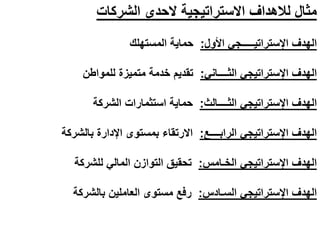
‫الشركات‬ ‫الحدى‬ ‫االستراتيجية‬ ‫لالهداف‬ ‫مثال‬
‫األول‬ ‫اإلستراتيـــــجي‬ ‫الهدف‬:‫المستهلك‬ ‫حماية‬
‫الثــــاني‬ ‫اإلستراتيجي‬ ‫الهدف‬:‫للمواطن‬ ‫متميزة‬ ‫خدمة‬ ‫تقديم‬
‫الثــــالث‬ ‫اإلستراتيجي‬ ‫الهدف‬:‫الشركة‬ ‫استثمارات‬ ‫حماية‬
‫الرابــــع‬ ‫اإلستراتيجي‬ ‫الهدف‬:‫بالشركة‬ ‫اإلدارة‬ ‫بمستوى‬ ‫االرتقاء‬
‫الخـامس‬ ‫اإلستراتيجي‬ ‫الهدف‬:‫للشركة‬ ‫المالي‬ ‫التوازن‬ ‫تحقيق‬
‫السـادس‬ ‫اإلستراتيجي‬ ‫الهدف‬:‫بالشركة‬ ‫العاملين‬ ‫مستوى‬ ‫رفع‬
Program management
A program is defined as a group of related
projects managed in a coordinated way to
obtain benefits and control not available
from managing them individually.
Portfolio management
A portfolio refers to a collection of projects or programs
and other work that are grouped together to facilitate
effective management of that work to meet strategic
business objectives. The projects or programs of the
portfolio may not necessarily be interdependent or
directly related.
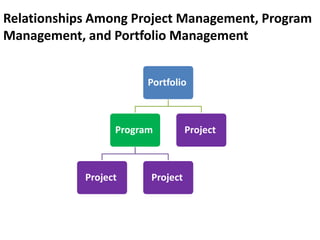
Relationships Among Project Management, Program
Management, and Portfolio Management
Portfolio
Program
Project Project
Project
PMO (Project Management Office)
•Their role can vary from an advisory capacity
to full authority over projects.
• Managing shared resources
• Identifying project management methodology,
best practices, and standards, policies, templates
• Coaching, mentoring
• Coordinating communication across projects
Role of a Project Manager
Project Manager The person assigned by the
performing organization to achieve the project
objectives.
Functional manager is focused on providing
management oversight for an administrative area.
Operation manager is responsible for the core
business.
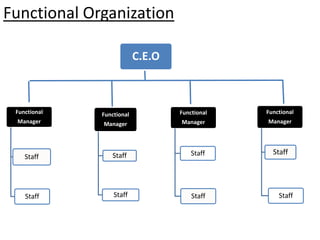
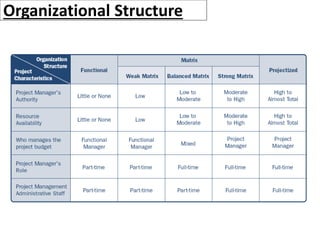
Functional
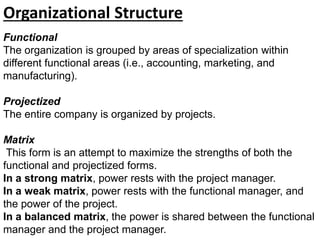
The organization is grouped by areas of specialization within
different functional areas (i.e., accounting, marketing, and
manufacturing).
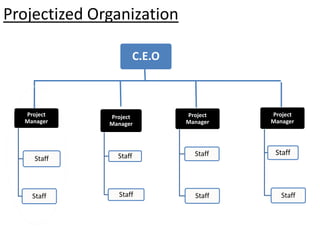
Projectized
The entire company is organized by projects.
Matrix
This form is an attempt to maximize the strengths of both the
functional and projectized forms.
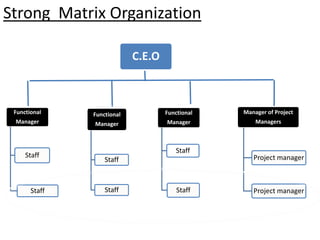
In a strong matrix, power rests with the project manager.
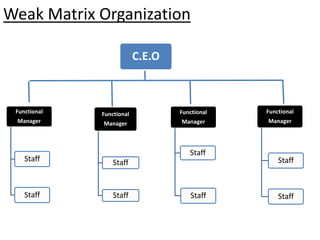
In a weak matrix, power rests with the functional manager, and
the power of the project.
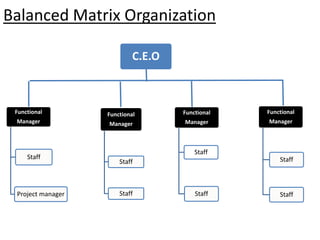
In a balanced matrix, the power is shared between the functional
manager and the project manager.
Organizational Structure
Functional Organization
Functional
Manager
Staff
Staff
Functional
Manager
Staff
Staff
Functional
Manager
Staff
Staff
Functional
Manager
Staff
Staff
C.E.O
Projectized Organization
Project
Manager
Staff
Staff
Project
Manager
Staff
Staff
Project
Manager
Staff
Staff
Project
Manager
Staff
Staff
C.E.O
Weak Matrix Organization
Functional
Manager
Staff
Staff
Functional
Manager
Staff
Staff
Functional
Manager
Staff
Staff
Functional
Manager
Staff
Staff
C.E.O
Balanced Matrix Organization
Functional
Manager
Staff
Project manager
Functional
Manager
Staff
Staff
Functional
Manager
Staff
Staff
Functional
Manager
Staff
Staff
C.E.O
Strong Matrix Organization
Functional
Manager
Staff
Staff
Functional
Manager
Staff
Staff
Functional
Manager
Staff
Staff
Manager of Project
Managers
Project manager
Project manager
C.E.O
Organizational Structure
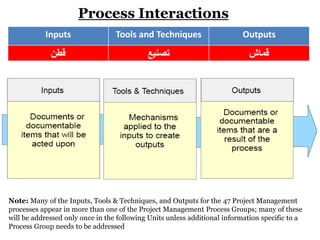
Process Interactions
Note: Many of the Inputs, Tools & Techniques, and Outputs for the 47 Project Management
processes appear in more than one of the Project Management Process Groups; many of these
will be addressed only once in the following Units unless additional information specific to a
Process Group needs to be addressed
Inputs Tools and Techniques Outputs
‫قطن‬ ‫تصنيع‬ ‫قماش‬
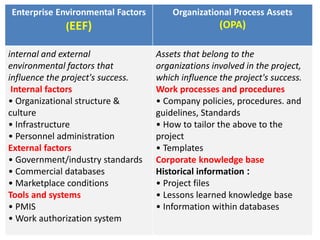
Organizational Process Assets
(OPA)
Enterprise Environmental Factors
(EEF)
Assets that belong to the
organizations involved in the project,
which influence the project's success.
Work processes and procedures
• Company policies, procedures. and
guidelines, Standards
• How to tailor the above to the
project
• Templates
Corporate knowledge base
Historical information :
• Project files
• Lessons learned knowledge base
• Information within databases
internal and external
environmental factors that
influence the project's success.
Internal factors
• Organizational structure &
culture
• Infrastructure
• Personnel administration
External factors
• Government/industry standards
• Commercial databases
• Marketplace conditions
Tools and systems
• PMIS
• Work authorization system
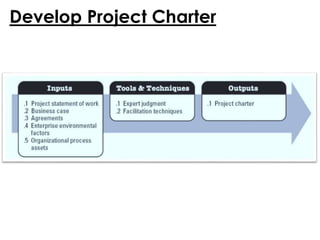
Develop Project Charter
The process of
developing the
project charter.
Expert judgment is
applied to
technical and
management
aspects by
individuals or
groups with
Thank you
Ahmed Hegazy
+201091991137
PMP, Six Sigma Green Belt , ITIL

1 project management framework - Fifth edition

  • 1.
    PMP Project Management Professional ExamPreparation Course Project Management Frame Work
  • 2.
  • 3.
    Who am I? • My name is Ahmed Hegazy • Certified Project Management Professional PMP by PMI / USA from July 2010. • Certified ITIL Foundation • Six Sigma Green Belt by Expert Rating • BSC , Major Accounting, Faculty of Commerce 1999 • Business Administration Diploma (ongoing) Ain Shams University • Business Administration Consultant at Abshir for knowledge (Owner).
  • 4.
    Ground Rules ToEnhance Performance Start on time to End on time Mobile Phone on Silent Please
  • 5.
    What you willlearn today .. • What is PMP … • What is PMI … • What is PMPBOK … • Why PMP … • How to be certified … • What is PMPBOK processes and knowledge areas … • What is the deferent between project and operation … • And more …
  • 6.
    PMI > PMBOK>Exam> PMP Project Management Institute (PMI) provide Project Management Body Of Knowledge (PMBOK) PMI : The Project Management Institute (PMI) offers a range of services to the Project Management profession such as the development of standards, research, education, hosting conferences and training seminars. PMBOK : Global Standard to manage projects Good practice to manage projects Provides common terminology PMP : As of 31 July 2010, there were 393,413 active PMP certified individuals worldwide. Project Management Professional
  • 7.
    Type Professional Organization Founded1969 Headquarters Newtown Square, Pennsylvania, United States Area served Worldwide Focus Project management Method Certification, Industry standards, Conferences, Publications Members 341,900+ Motto “building professionalism in project management...” Website www.pmi.org PMI
  • 8.
    PMI Certifications Project ManagementProfessional (PMP) Certified Associate Project Manager (CAPM) Program Management Professional (PgMP) PMI Scheduling Professional (PMI – SP) PMI Risk Management Professional (PMI – RMP)
  • 9.
    PMP requirements •Three yearsof project management experience, with 4,500 hour for bachelor’s or the global equivalent •Five years with 7500 hours for secondary degree •35 hours of project management education
  • 10.
  • 11.
    PMP Credential ProcessTimeline • Application Submission (Window open 90 days) • Application Completeness Review (5 business days when submitted online) • Application Payment Process (can’t schedule exam until payment is submitted) • Audit Process (5 business days, if selected) • Examination Eligibility (1 year from date of application approval) • Certification Cycle (3 years)
  • 12.
  • 13.
    Why PMI?.... WhyPMP? Are flexible. PMI certifications are not based on one specific methodology Keep you up-to-date. PMI continually conducts in-depth studies to ensure that our credentials actually reflect the current skills, knowledge and best practices you need to succeed. Encourage professional growth. You never have to worry about a PMI certification becoming obsolete. Our certification maintenance program requires you to earn professional development units (PDUs). Help you get ahead. The Project Management Professional (PMP)® credential increases your salary by up to 10%, according to the PMI Salary Survey and helps you stand out and better market yourself to prospective employers. Are renowned throughout the world. PMI has provided project management certifications for over 25 years, and our PMP® credential was the first one designed specifically for project managers..
  • 14.
    •The exam mustbe completed in four hours •Includes 200 multiple-choice questions with four answer choices per question •The passing score on the exam is now 106 out of 175, approximately 61 percent. •Twenty-five of the 200 exam questions are "prerelease questions;'. (they are not included in your score for the exam) •THE PMP EXAM IS NOT Only A TEST OF THE INFORMATION IN THE PMBOK Guide! •Do not expect the exam to have all straightforward, definition-type questions. •You cannot rely only on real-world experience. About the PMP exam
  • 15.
    Included: • up toabout 150 "What would you do in this situation?" questions (situational questions). • only 10 to 15 questions requiring you to MEMORIZE the inputs or outputs from the PMBOK· Guide. • Expect 20 formula-related calculations on the exam. About the exam
  • 16.
  • 17.
    Ten Knowledge Areas 1.Project Integration Management 2. Project Scope Management 3. Project Time Management 4. Project Cost Management 5. Project Quality Management 6. Project Human Resources Management 7. Project Communications Management 8. Project Risk Management 9. Project Procurement Management 10. Project Stakeholder Management
  • 18.
  • 19.
    Five Process Groups 1-Initiating process group 2- Planning process group 3- Executing process group 4- Monitoring and Controlling process group 5- Closing process group
  • 20.
  • 21.
  • 23.
    What is aProject? A project is a temporary endeavor undertaken to create a unique product, service, or result (Deliverables). Temporary ( definite beginning and definite end) Unique ( different location, different design, different circumstances, different contractors etc.) Progressive Elaboration Continuously improving and detailing a plan as more detailed and specific information and more accurate estimates become available.
  • 24.
    Projects • Temporary • Uniqueoutput • Resources on temporary upon-need basis Operations • Ongoing and repetitive • Similar outputs • Permanent resources Projects and Operations • Planned, executed & Controlled series of tasks and activities • Produce output/product Project Vs Operation
  • 25.
    •The application ofknowledge, skills, tools and techniques to project activities to meet the project requirements. •Balancing the project constraints (cost,quality,schedule,risk,resources…) •Project management is accomplished through the appropriate application and integration of the 42 logically grouped project management processes What is Project Management?
  • 26.
    Stakeholders This is anorganization or person who has an interest in the project and stands to gain or lose something as a result of the project. Sponsor The person or group that provides the financial resources for the project and issue the project charter. Project charter A document issued by the sponsor that formally authorizes the existence of a project, and provides the project manager with the authority to apply organizational resources to project activities. Important Terms
  • 27.
  • 28.
    Project Life Cycle Aproject life cycle is a collection of generally sequential and sometimes overlapping project phases whose name and number are determined by the management and control needs of the organization or organizations involved in the project, the nature of the project itself, and its area of application.
  • 29.
  • 30.
    Phase-to-Phase relationships A sequentialrelationship One phase must finish before the next phase can begin.
  • 31.
    An overlapping relationship Onephase starts before the prior phase completes An Iterative relationship Work for subsequent phases are planned as the work of the previous phase is performed.
  • 32.
    Characteristics of aProject Life Cycle
  • 33.
    Product life cycle Productlife cycle can run as projects •Performing a feasibility study •Conducting market research •Running an advertising campaign •Installing a product
  • 34.
    Projects and strategicplanning Projects are often utilized as a means of achieving an organization's strategic plan. Projects are typically authorized as a result of one or more of the following strategic considerations • Market demand • Business need • Customer request • Technological advance • Legal requirements
  • 35.
    ‫الشركات‬ ‫الحدى‬ ‫االستراتيجية‬‫لالهداف‬ ‫مثال‬ ‫األول‬ ‫اإلستراتيـــــجي‬ ‫الهدف‬:‫المستهلك‬ ‫حماية‬ ‫الثــــاني‬ ‫اإلستراتيجي‬ ‫الهدف‬:‫للمواطن‬ ‫متميزة‬ ‫خدمة‬ ‫تقديم‬ ‫الثــــالث‬ ‫اإلستراتيجي‬ ‫الهدف‬:‫الشركة‬ ‫استثمارات‬ ‫حماية‬ ‫الرابــــع‬ ‫اإلستراتيجي‬ ‫الهدف‬:‫بالشركة‬ ‫اإلدارة‬ ‫بمستوى‬ ‫االرتقاء‬ ‫الخـامس‬ ‫اإلستراتيجي‬ ‫الهدف‬:‫للشركة‬ ‫المالي‬ ‫التوازن‬ ‫تحقيق‬ ‫السـادس‬ ‫اإلستراتيجي‬ ‫الهدف‬:‫بالشركة‬ ‫العاملين‬ ‫مستوى‬ ‫رفع‬
  • 36.
    Program management A programis defined as a group of related projects managed in a coordinated way to obtain benefits and control not available from managing them individually. Portfolio management A portfolio refers to a collection of projects or programs and other work that are grouped together to facilitate effective management of that work to meet strategic business objectives. The projects or programs of the portfolio may not necessarily be interdependent or directly related.
  • 37.
    Relationships Among ProjectManagement, Program Management, and Portfolio Management Portfolio Program Project Project Project
  • 38.
    PMO (Project ManagementOffice) •Their role can vary from an advisory capacity to full authority over projects. • Managing shared resources • Identifying project management methodology, best practices, and standards, policies, templates • Coaching, mentoring • Coordinating communication across projects
  • 39.
    Role of aProject Manager Project Manager The person assigned by the performing organization to achieve the project objectives. Functional manager is focused on providing management oversight for an administrative area. Operation manager is responsible for the core business.
  • 40.
    Functional The organization isgrouped by areas of specialization within different functional areas (i.e., accounting, marketing, and manufacturing). Projectized The entire company is organized by projects. Matrix This form is an attempt to maximize the strengths of both the functional and projectized forms. In a strong matrix, power rests with the project manager. In a weak matrix, power rests with the functional manager, and the power of the project. In a balanced matrix, the power is shared between the functional manager and the project manager. Organizational Structure
  • 41.
  • 42.
  • 43.
  • 44.
    Balanced Matrix Organization Functional Manager Staff Projectmanager Functional Manager Staff Staff Functional Manager Staff Staff Functional Manager Staff Staff C.E.O
  • 45.
  • 46.
  • 47.
    Process Interactions Note: Manyof the Inputs, Tools & Techniques, and Outputs for the 47 Project Management processes appear in more than one of the Project Management Process Groups; many of these will be addressed only once in the following Units unless additional information specific to a Process Group needs to be addressed Inputs Tools and Techniques Outputs ‫قطن‬ ‫تصنيع‬ ‫قماش‬
  • 48.
    Organizational Process Assets (OPA) EnterpriseEnvironmental Factors (EEF) Assets that belong to the organizations involved in the project, which influence the project's success. Work processes and procedures • Company policies, procedures. and guidelines, Standards • How to tailor the above to the project • Templates Corporate knowledge base Historical information : • Project files • Lessons learned knowledge base • Information within databases internal and external environmental factors that influence the project's success. Internal factors • Organizational structure & culture • Infrastructure • Personnel administration External factors • Government/industry standards • Commercial databases • Marketplace conditions Tools and systems • PMIS • Work authorization system
  • 49.
    Develop Project Charter Theprocess of developing the project charter. Expert judgment is applied to technical and management aspects by individuals or groups with
  • 50.
    Thank you Ahmed Hegazy +201091991137 PMP,Six Sigma Green Belt , ITIL