E-Commerce(CS802E)
INTRODUCTION TO E-COMMERCE
2
Introduction to the course
 Instructor for E-Commerce(CS802E): Kuntal Bhowmick
 E-Commerce(CS802E)gives a survey of the key
technological elements of e-commerce and provides insight
into e-commerce infrastructures. It also covers some
business strategies essential to e-commerce.The web
authoring tool FrontPage will be used.
3
A quick survey
 Which of the following have you done?
• Used e-mail
• Browsed the Web
• Bought a product on the Web
• Created a web page using an authoring tool
• Written some HTML
4
Electronic commerce
• To many people the term electronic commerce,
often shortened to e-commerce, is equivalent
to shopping on the web.
• The term electronic business is sometimes used
to capture the broader notion of e-commerce.
• In this course, we will use e-commerce in its
broadest sense. It encompasses both web
shopping and other business conducted
electronically.
5
E-commerce is not new
• Banks have used electronic funds transfers
(EFTs), also called wire transfers, for decades.
• Businesses have been engaging in electronic
data interchange for years. EDI occurs when
one business transmits computer readable data
in a standard format to another business.
6
Electronic data interchange
• In the 1960s businesses realized that many of
the documents they exchanged related to the
shipping of goods and contained the same set
of information for each transaction.
• By sending the information electronically in a
standard format, the businesses could save
money on printing, mailing, and re-entry of
data.
• Electronic transfer of data also introduces fewer
errors than manual transfer.
7
Technology and commerce
• In order to understand how technology can aid
commerce we need to understand traditional
commerce.
• Once we have identified what activities are
involved in traditional commerce, we can
consider how technology can improve them.
• Note that technology does not always improve
commerce. Knowing when technology will
NOT help is also useful.
8
Origins of commerce
• The origins of traditional commerce predate
recorded history.
• Commerce is based on the specialization of
skills. Instead of performing all services
and producing all goods independently,
people rely on each other for the goods and
services they need.
• Example: My mother trades eggs to one of
her neighbors in exchange for repairs to the
fences on her ranch.
9
Traditional commerce
• Although money has replaced bartering, the basic
mechanics of commerce remain the same: one
member of society creates something of value
that another member of society desires.
• Commerce is a negotiated exchange of valuable
objects or services between at least two parties
and includes all activities that each of the parties
undertakes the complete the transaction.
10
Views of commerce
Commerce can be viewed from at least two
different perspectives:
1. The buyer’s viewpoint
2. The seller’s viewpoint
Both perspectives will illustrate that commerce
involves a number of distinct activities, called
business processes.
11
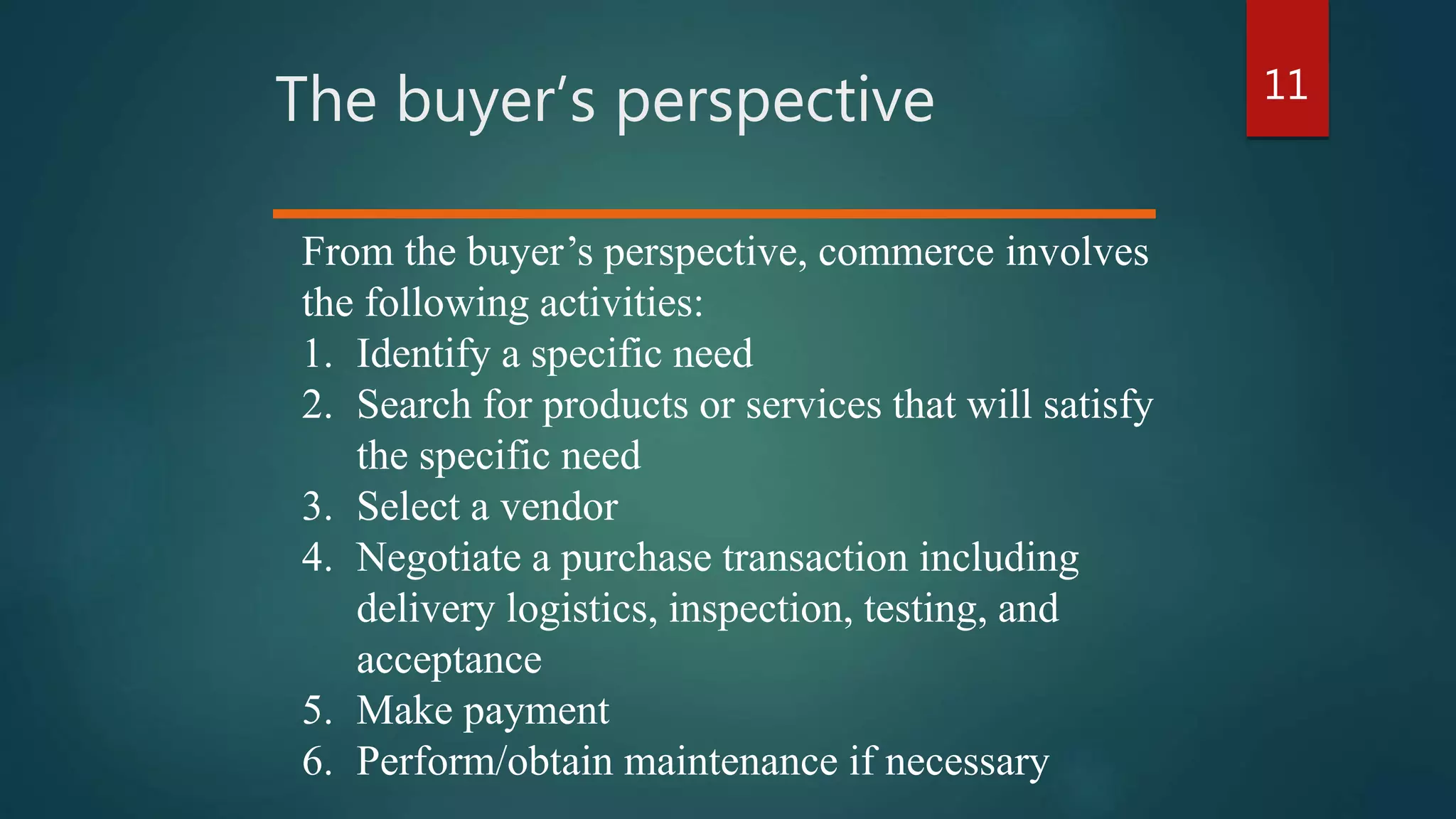
The buyer’s perspective
From the buyer’s perspective, commerce involves
the following activities:
1. Identify a specific need
2. Search for products or services that will satisfy
the specific need
3. Select a vendor
4. Negotiate a purchase transaction including
delivery logistics, inspection, testing, and
acceptance
5. Make payment
6. Perform/obtain maintenance if necessary
12
The seller’s perspective
From the sellers’ perspective, commerce involves
the following activities:
1. Conduct market research to identify customer
needs
2. Create a product or service to meet those needs
3. Advertise and promote the product or service
4. Negotiate a sales transaction including delivery
logistics, inspection, testing, and acceptance
5. Ship goods and invoice the customer
6. Receive and process customer payments
7. Provide after sales support and maintenance
13
Business processes
Business processes are the activities involved in
conducting commerce.
Examples include:
• Transferring funds
• Placing orders
• Sending invoices
• Shipping goods to customers
14
E-commerce
We will define e-commerce as the use of electronic
data transmission to implement or enhance any
business activity.
Example : A buyer sends an electronic
purchase order to a seller. The seller then sends an
electronic invoice back to the buyer.
When used appropriately, electronic transmission
can save both time and money.
15
Impact of e-commerce
E-commerce is changing the way traditional
commerce is conducted:
• Technology can help throughout the process
including promotion, searching, selecting,
negotiating, delivery, and support.
• The value chain is being reconfigured.
16
Value chain analysis
A way of looking at the activities of an industry
or organization.
• Primary activities
Costs are directly allocated to a product
• Support activities
Costs are associated with the overall operation
of the organization
17
Example: Figure 1
18
Origin of the name
An organization is a ā€œchainā€ of activities, each
providing a value:
• R&D develops the products
• Sales promotes the products
• Production manufactures the products
• Final inspection assures quality
• Logistics delivers the products
• Technical support maintains the products
19
A typical company value chain
Outbound
Logistics
Operations
Inbound
Logistics
Sales and
Marketing
Service
Profit
Margin
Product R&D, Technology, Systems Development
Human Resources Management
General Administration
Primary Activities and Costs
Support
Activities
and Costs
20
Reconfiguring the value chain
1. Vertical
 Forward integration: Gaining ownership
or increased control over distributors
or retailers.
Example: United Airlines buys Priceline
 Backward integration: Gaining ownership
or increased control over suppliers.
Example: Amazon buys RCA records
2. Horizontal: Seeking increased control over
competitors.
Example: Amazon buys BestBooksBuys.com
21
Appropriateness
It is important to identify which business processes
can be streamlined using e-commerce technologies.
It is equally important to realize that some processes
make effective use of traditional commerce and can’t
be improved upon using technology.
Technology is not a panacea. Using it when it is
not necessary or helpful can be a costly mistake.
22
Well-suited for e-commerce
Business processes that are well-suited for electronic
commerce:
• Sale/purchase of new books and CDs
• Online delivery of software
• Advertising and promotion of travel services
• Online tracking of shipments
The business processes that are especially well-suited
to e-commerce include commodity items, that is, a
product or service that has become standardized.
23
Best for traditional commerce
Business processes that are well-suited to traditional
commerce:
• Sale/purchase of high fashion clothing
(Any possible exceptions?)
• Sale/purchase of perishable food products
• Small-denomination transactions (Future?)
• Sale of expensive jewelry and antiques
In general, products that buyers prefer to touch, smell,
or otherwise closely examine are difficult to sell using
e-commerce.
24
Questionable cases
Would e-commerce or traditional commerce work
best for the following activities?
• Sale/purchase of rare books
• Browsing through new books
• Sale/purchase of shoes
• Sale/purchase of collectibles (trading cards,
plates, etc.)
25
Combinations of both
Some business processes can be handled well using
a combination of electronic and traditional methods:
• Sale/purchase of automobiles
• Online banking
• Roommate-matching services
• Sale/purchase of investment/insurance products
In this course we will discuss the issue of evaluating
the advantages and disadvantages of e-commerce.
Let’s consider a few examples now.
26
Advantages of e-commerce
For the seller:
• Increases sales/decreases cost
• Makes promotion easier for smaller firms
• Can be used to reach narrow market segments
For the buyer:
• Makes it easier to obtain competitive bids
• Provides a wider range of choices
• Provides an easy way to customize the level of
detail in the information obtained
27
Advantages of e-commerce II
In general:
• Increases the speed and accuracy with which
businesses can exchange information
• Electronic payments (tax refunds, paychecks,
etc.) cost less to issue and are more secure
• Can make products and services available in
remote areas
• Enables people to work from home, providing
scheduling flexibility
28
Disadvantages of e-commerce
• Some business processes are not suited to e-commerce,
even with improvements in technology
• Many products and services require a critical mass of
potential buyers (e.g. online grocers)
• Costs and returns on e-commerce can be difficult to
quantify and estimate
• Cultural impediments: People are reluctant to change in
order to integrate new technology
• The legal environment is uncertain: Courts and legislators
are trying to catch up

1. introduction to E-commerce

  • 1.
  • 2.
    2 Introduction to thecourse  Instructor for E-Commerce(CS802E): Kuntal Bhowmick  E-Commerce(CS802E)gives a survey of the key technological elements of e-commerce and provides insight into e-commerce infrastructures. It also covers some business strategies essential to e-commerce.The web authoring tool FrontPage will be used.
  • 3.
    3 A quick survey Which of the following have you done? • Used e-mail • Browsed the Web • Bought a product on the Web • Created a web page using an authoring tool • Written some HTML
  • 4.
    4 Electronic commerce • Tomany people the term electronic commerce, often shortened to e-commerce, is equivalent to shopping on the web. • The term electronic business is sometimes used to capture the broader notion of e-commerce. • In this course, we will use e-commerce in its broadest sense. It encompasses both web shopping and other business conducted electronically.
  • 5.
    5 E-commerce is notnew • Banks have used electronic funds transfers (EFTs), also called wire transfers, for decades. • Businesses have been engaging in electronic data interchange for years. EDI occurs when one business transmits computer readable data in a standard format to another business.
  • 6.
    6 Electronic data interchange •In the 1960s businesses realized that many of the documents they exchanged related to the shipping of goods and contained the same set of information for each transaction. • By sending the information electronically in a standard format, the businesses could save money on printing, mailing, and re-entry of data. • Electronic transfer of data also introduces fewer errors than manual transfer.
  • 7.
    7 Technology and commerce •In order to understand how technology can aid commerce we need to understand traditional commerce. • Once we have identified what activities are involved in traditional commerce, we can consider how technology can improve them. • Note that technology does not always improve commerce. Knowing when technology will NOT help is also useful.
  • 8.
    8 Origins of commerce •The origins of traditional commerce predate recorded history. • Commerce is based on the specialization of skills. Instead of performing all services and producing all goods independently, people rely on each other for the goods and services they need. • Example: My mother trades eggs to one of her neighbors in exchange for repairs to the fences on her ranch.
  • 9.
    9 Traditional commerce • Althoughmoney has replaced bartering, the basic mechanics of commerce remain the same: one member of society creates something of value that another member of society desires. • Commerce is a negotiated exchange of valuable objects or services between at least two parties and includes all activities that each of the parties undertakes the complete the transaction.
  • 10.
    10 Views of commerce Commercecan be viewed from at least two different perspectives: 1. The buyer’s viewpoint 2. The seller’s viewpoint Both perspectives will illustrate that commerce involves a number of distinct activities, called business processes.
  • 11.
    11 The buyer’s perspective Fromthe buyer’s perspective, commerce involves the following activities: 1. Identify a specific need 2. Search for products or services that will satisfy the specific need 3. Select a vendor 4. Negotiate a purchase transaction including delivery logistics, inspection, testing, and acceptance 5. Make payment 6. Perform/obtain maintenance if necessary
  • 12.
    12 The seller’s perspective Fromthe sellers’ perspective, commerce involves the following activities: 1. Conduct market research to identify customer needs 2. Create a product or service to meet those needs 3. Advertise and promote the product or service 4. Negotiate a sales transaction including delivery logistics, inspection, testing, and acceptance 5. Ship goods and invoice the customer 6. Receive and process customer payments 7. Provide after sales support and maintenance
  • 13.
    13 Business processes Business processesare the activities involved in conducting commerce. Examples include: • Transferring funds • Placing orders • Sending invoices • Shipping goods to customers
  • 14.
    14 E-commerce We will definee-commerce as the use of electronic data transmission to implement or enhance any business activity. Example : A buyer sends an electronic purchase order to a seller. The seller then sends an electronic invoice back to the buyer. When used appropriately, electronic transmission can save both time and money.
  • 15.
    15 Impact of e-commerce E-commerceis changing the way traditional commerce is conducted: • Technology can help throughout the process including promotion, searching, selecting, negotiating, delivery, and support. • The value chain is being reconfigured.
  • 16.
    16 Value chain analysis Away of looking at the activities of an industry or organization. • Primary activities Costs are directly allocated to a product • Support activities Costs are associated with the overall operation of the organization
  • 17.
  • 18.
    18 Origin of thename An organization is a ā€œchainā€ of activities, each providing a value: • R&D develops the products • Sales promotes the products • Production manufactures the products • Final inspection assures quality • Logistics delivers the products • Technical support maintains the products
  • 19.
    19 A typical companyvalue chain Outbound Logistics Operations Inbound Logistics Sales and Marketing Service Profit Margin Product R&D, Technology, Systems Development Human Resources Management General Administration Primary Activities and Costs Support Activities and Costs
  • 20.
    20 Reconfiguring the valuechain 1. Vertical  Forward integration: Gaining ownership or increased control over distributors or retailers. Example: United Airlines buys Priceline  Backward integration: Gaining ownership or increased control over suppliers. Example: Amazon buys RCA records 2. Horizontal: Seeking increased control over competitors. Example: Amazon buys BestBooksBuys.com
  • 21.
    21 Appropriateness It is importantto identify which business processes can be streamlined using e-commerce technologies. It is equally important to realize that some processes make effective use of traditional commerce and can’t be improved upon using technology. Technology is not a panacea. Using it when it is not necessary or helpful can be a costly mistake.
  • 22.
    22 Well-suited for e-commerce Businessprocesses that are well-suited for electronic commerce: • Sale/purchase of new books and CDs • Online delivery of software • Advertising and promotion of travel services • Online tracking of shipments The business processes that are especially well-suited to e-commerce include commodity items, that is, a product or service that has become standardized.
  • 23.
    23 Best for traditionalcommerce Business processes that are well-suited to traditional commerce: • Sale/purchase of high fashion clothing (Any possible exceptions?) • Sale/purchase of perishable food products • Small-denomination transactions (Future?) • Sale of expensive jewelry and antiques In general, products that buyers prefer to touch, smell, or otherwise closely examine are difficult to sell using e-commerce.
  • 24.
    24 Questionable cases Would e-commerceor traditional commerce work best for the following activities? • Sale/purchase of rare books • Browsing through new books • Sale/purchase of shoes • Sale/purchase of collectibles (trading cards, plates, etc.)
  • 25.
    25 Combinations of both Somebusiness processes can be handled well using a combination of electronic and traditional methods: • Sale/purchase of automobiles • Online banking • Roommate-matching services • Sale/purchase of investment/insurance products In this course we will discuss the issue of evaluating the advantages and disadvantages of e-commerce. Let’s consider a few examples now.
  • 26.
    26 Advantages of e-commerce Forthe seller: • Increases sales/decreases cost • Makes promotion easier for smaller firms • Can be used to reach narrow market segments For the buyer: • Makes it easier to obtain competitive bids • Provides a wider range of choices • Provides an easy way to customize the level of detail in the information obtained
  • 27.
    27 Advantages of e-commerceII In general: • Increases the speed and accuracy with which businesses can exchange information • Electronic payments (tax refunds, paychecks, etc.) cost less to issue and are more secure • Can make products and services available in remote areas • Enables people to work from home, providing scheduling flexibility
  • 28.
    28 Disadvantages of e-commerce •Some business processes are not suited to e-commerce, even with improvements in technology • Many products and services require a critical mass of potential buyers (e.g. online grocers) • Costs and returns on e-commerce can be difficult to quantify and estimate • Cultural impediments: People are reluctant to change in order to integrate new technology • The legal environment is uncertain: Courts and legislators are trying to catch up