Introduction to Cloud Computing Bonnie Durkin Business Lead, Cloud Partner Program February 3, 2010
Agenda Why cloud computing How partners make money What is cloud computing Layers of cloud computing
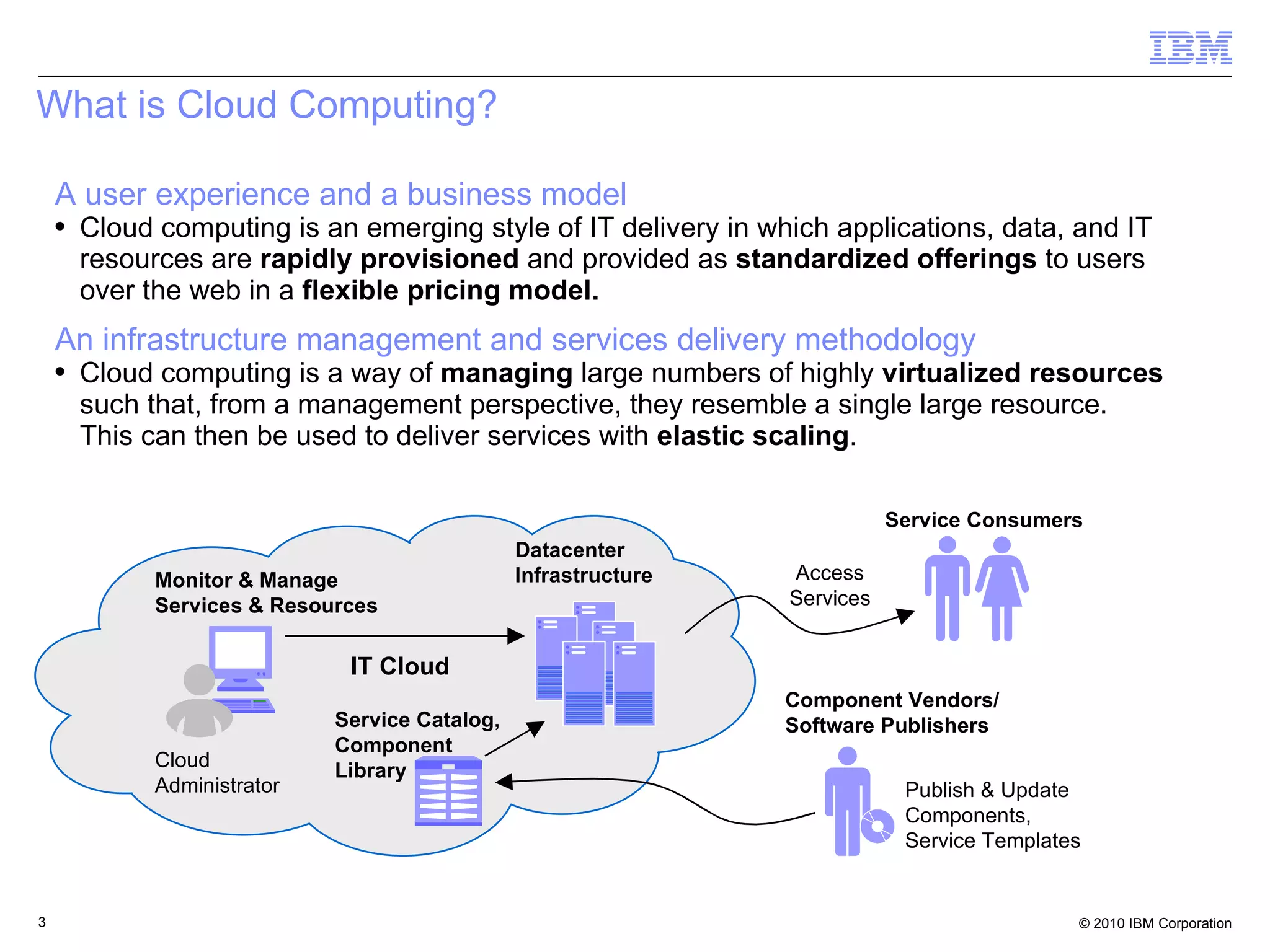
What is Cloud Computing? A user experience and a business model Cloud computing is an emerging style of IT delivery in which applications, data, and IT resources are  rapidly provisioned  and provided as  standardized offerings  to users over the web in a  flexible pricing model. An infrastructure management and services delivery methodology Cloud computing is a way of  managing  large numbers of highly  virtualized resources  such that, from a management perspective, they resemble a single large resource.  This can then be used to deliver services with  elastic scaling . Monitor & Manage Services & Resources Cloud Administrator Datacenter Infrastructure Service Catalog, Component Library Service Consumers Component Vendors/ Software Publishers Publish & Update Components, Service Templates  IT Cloud Access Services
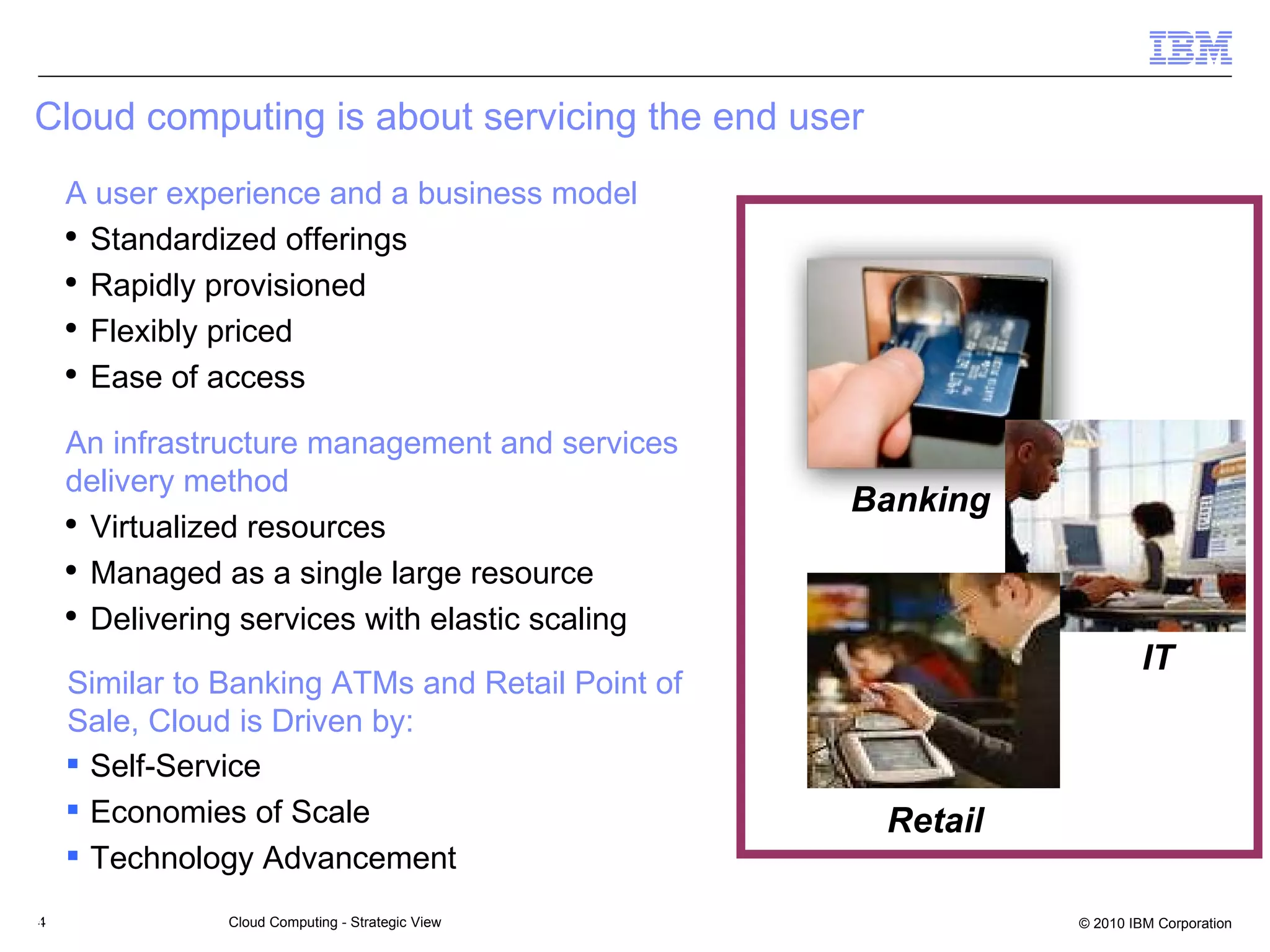
Cloud computing is about servicing the end user IBM Confidential Banking  Retail IT  Self-Service Economies of Scale Technology Advancement  A user experience and a business model Standardized offerings Rapidly provisioned Flexibly priced Ease of access An infrastructure management and services delivery method Virtualized resources Managed as a single large resource Delivering services with elastic scaling Similar to Banking ATMs and Retail Point of Sale, Cloud is Driven by:
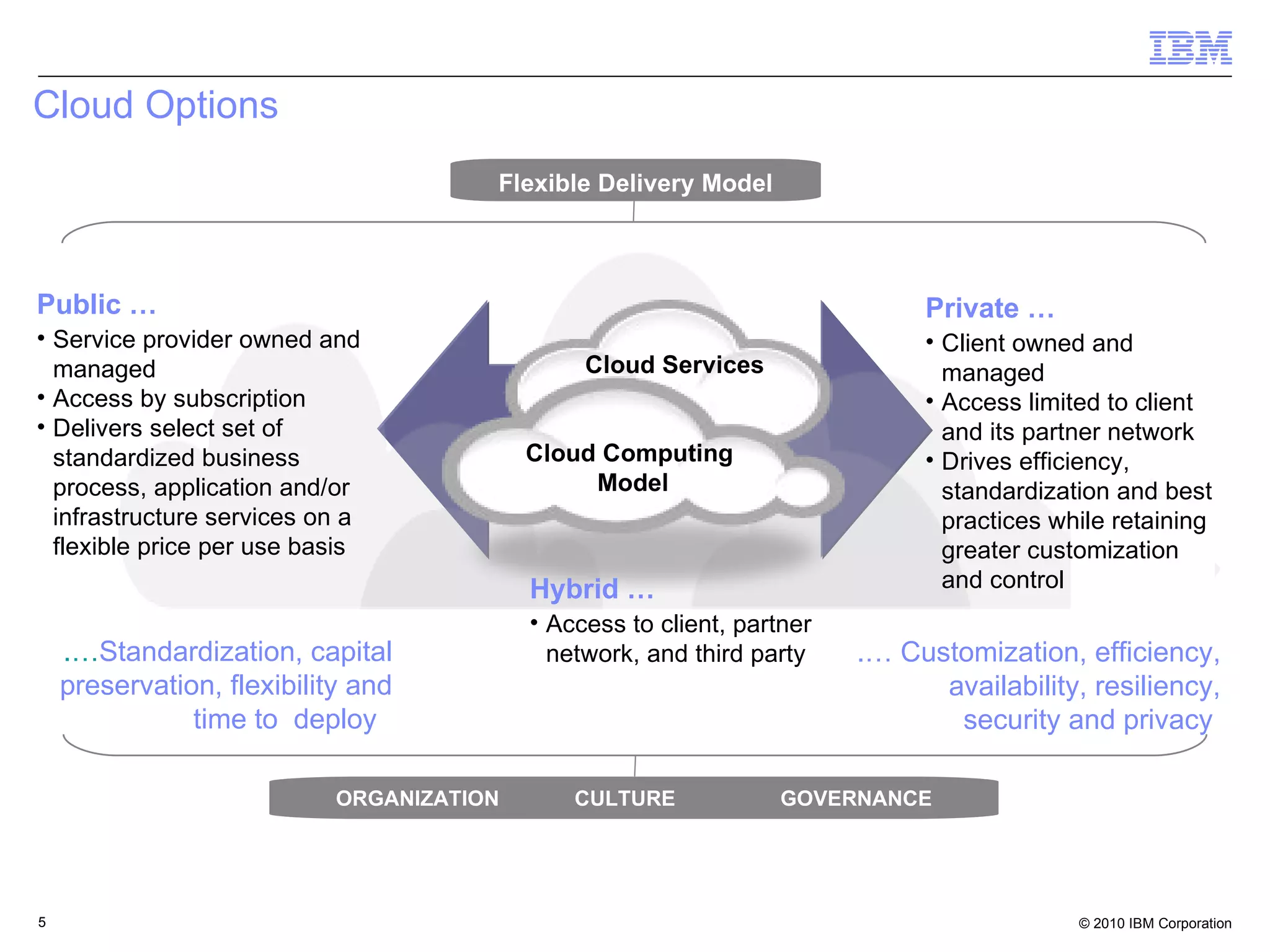
Cloud Options ORGANIZATION CULTURE GOVERNANCE Flexible Delivery Model Public … Service provider owned and managed Access by subscription Delivers select set of standardized business process, application and/or infrastructure services on a flexible price per use basis Private … Client owned and managed Access limited to client and its partner network Drives efficiency, standardization and best practices while retaining greater customization and control Cloud Services  Cloud Computing  Model .… Customization, efficiency, availability, resiliency, security and privacy  .… Standardization, capital preservation, flexibility and time to  deploy   Hybrid … Access to client, partner network, and third party  resources
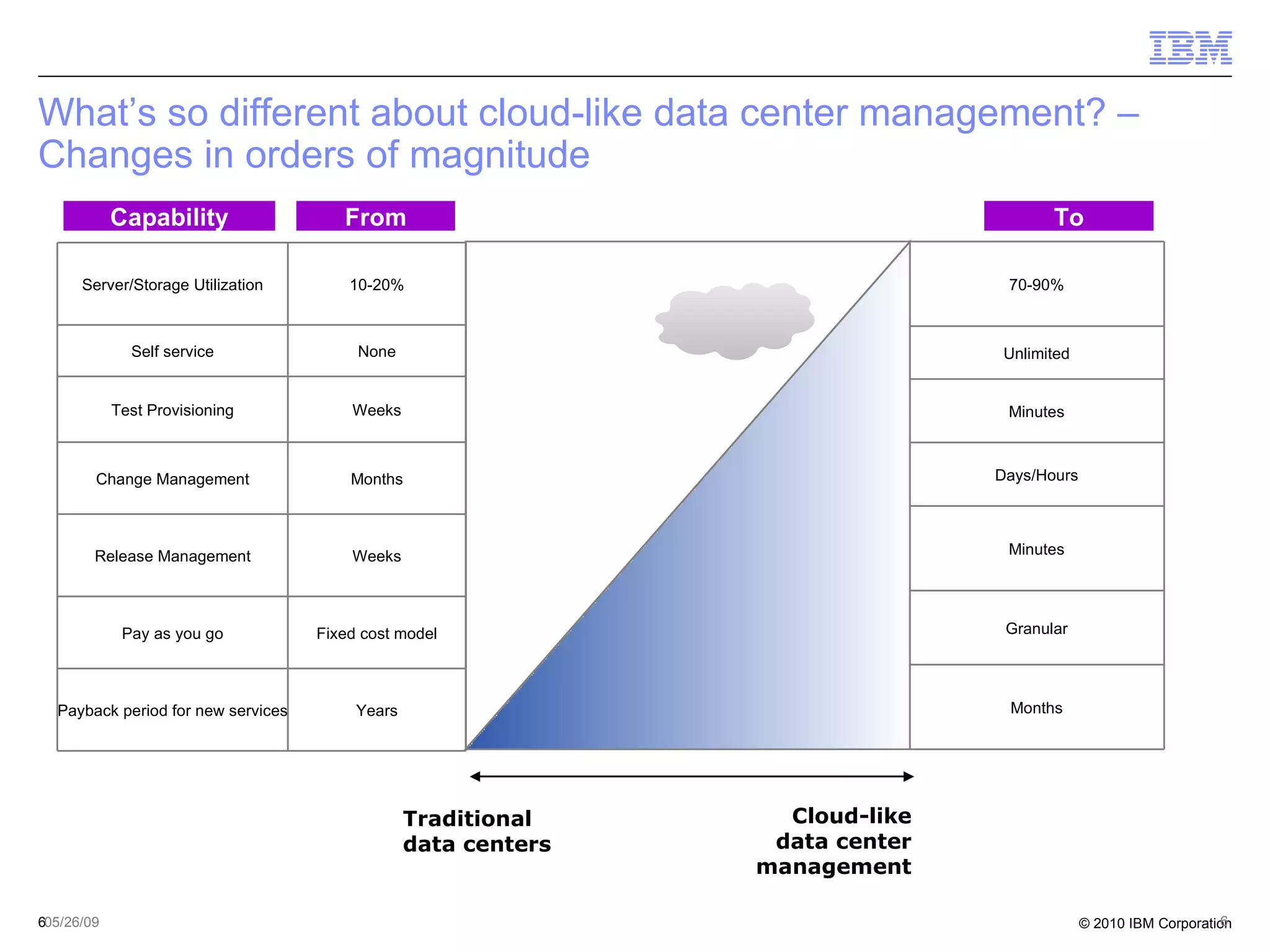
Traditional data centers Cloud-like data center management Capability From To 05/26/09 What’s so different about cloud-like data center management? – Changes in orders of magnitude Server/Storage Utilization 10-20% Self service None Test Provisioning Weeks Change Management Months Release Management Weeks Pay as you go Fixed cost model Payback period for new services Years 70-90% Unlimited Minutes Days/Hours Minutes Granular Months
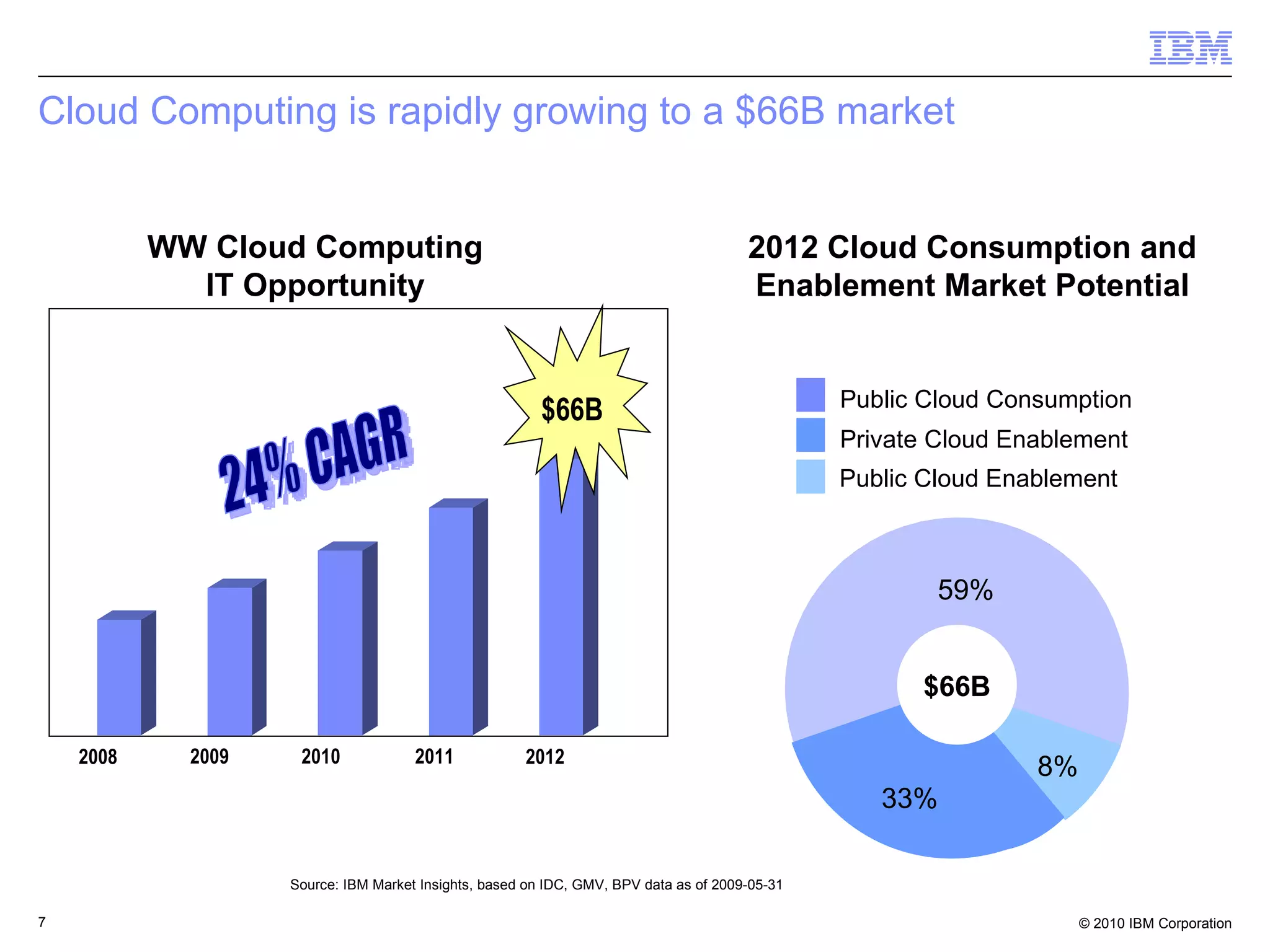
Cloud Computing is rapidly growing to a $66B market May 20th, 2009 May 20th, 2009 2012 Cloud Consumption and Enablement Market Potential Source: IBM Market Insights, based on IDC, GMV, BPV data as of 2009-05-31 $66B 33% 8% 59% Private Cloud Enablement Public Cloud Enablement Public Cloud Consumption 2008 2009 2011 2012 2010 24% CAGR WW Cloud Computing IT Opportunity $66B
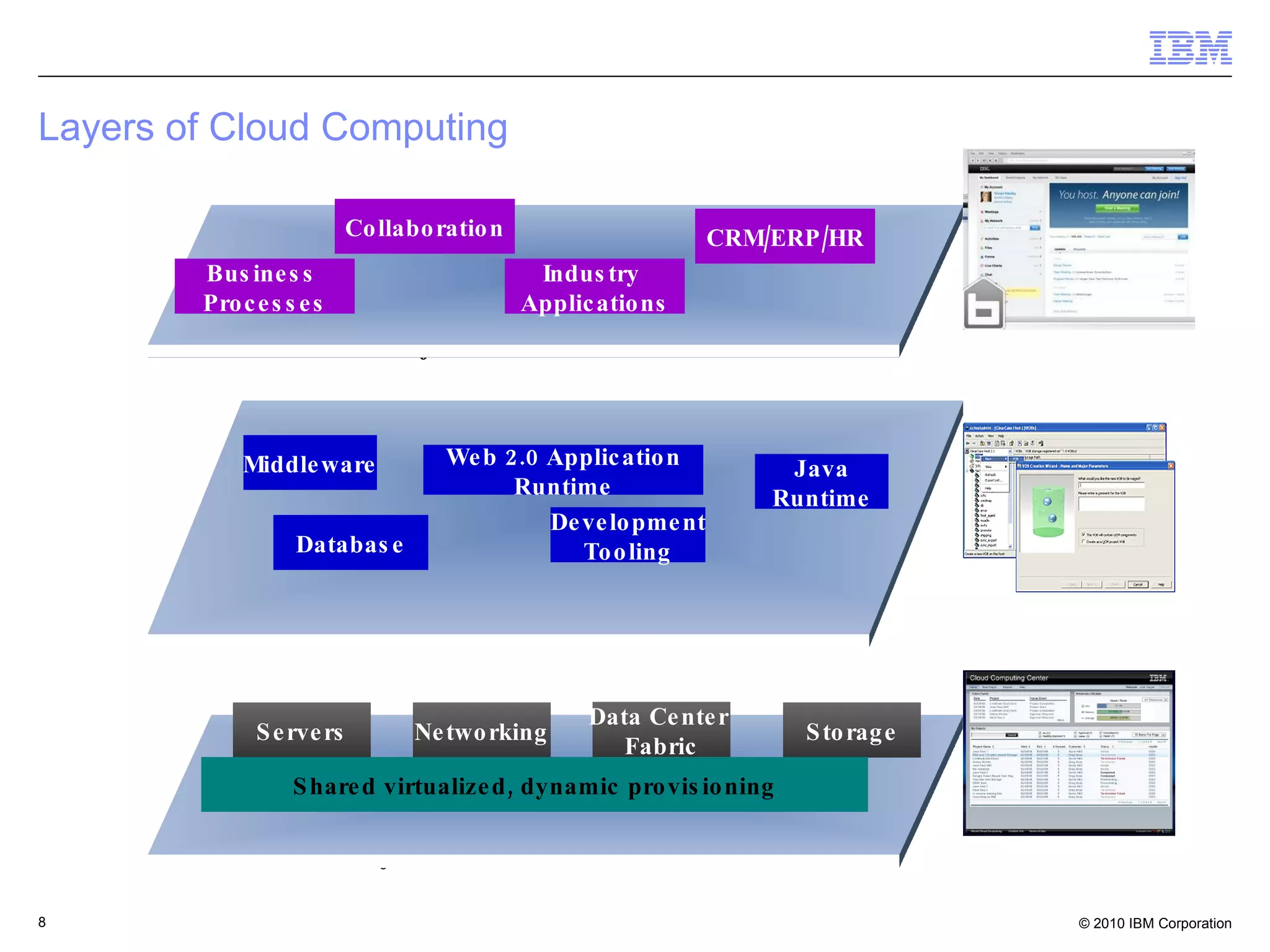
Layers of Cloud Computing  Infrastructure as a Service Platform as a Service High Volume Transactions Software as a Service Servers Networking Storage Middleware Collaboration Business  Processes CRM/ERP/HR Industry  Applications Data Center  Fabric Shared virtualized, dynamic provisioning Database Web 2.0 Application Runtime Java Runtime Development Tooling
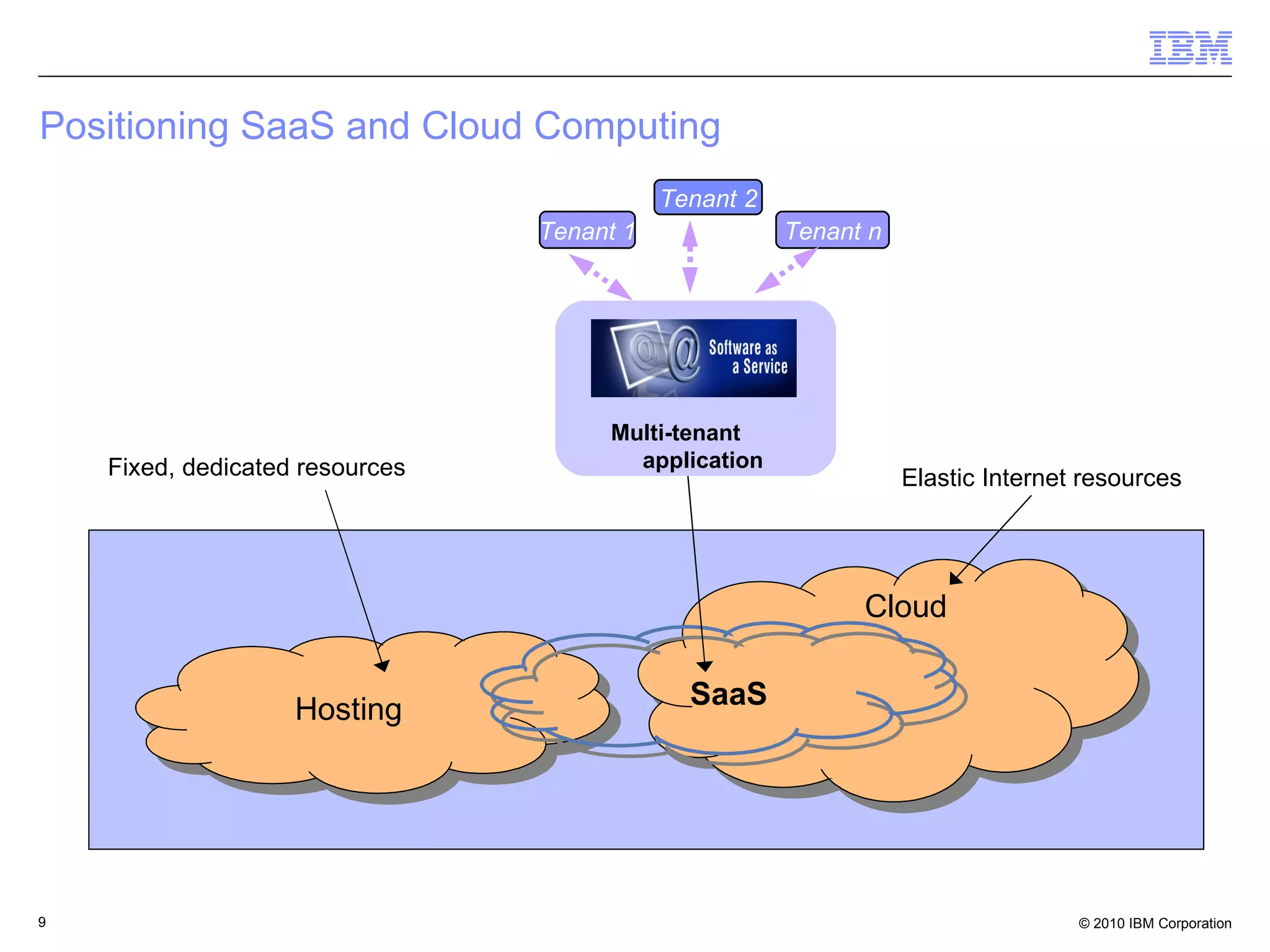
Positioning SaaS and Cloud Computing  Hosting Cloud SaaS Fixed, dedicated resources Elastic Internet resources Multi-tenant application Tenant 1 Tenant 2 Tenant n
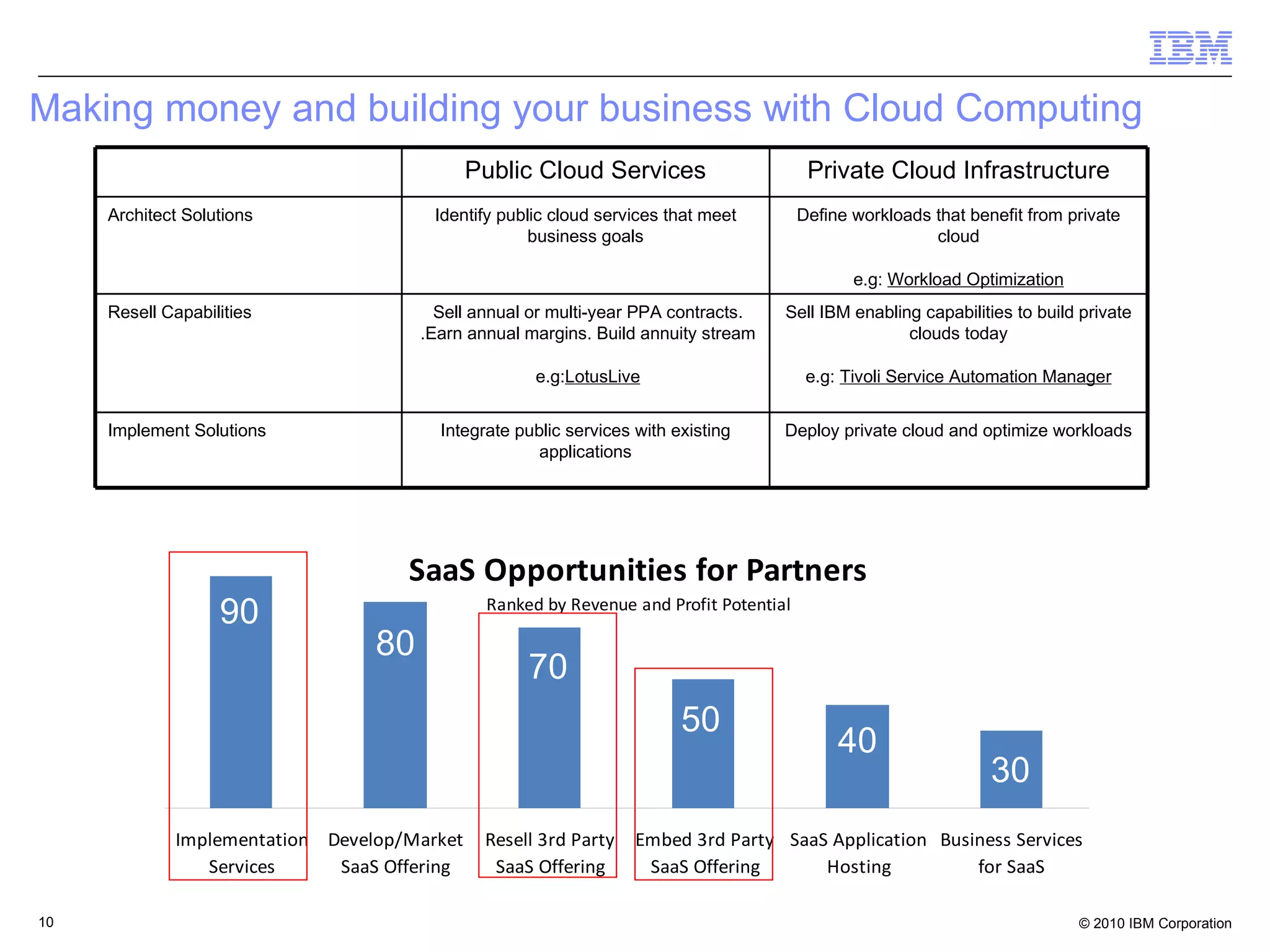
Making money and building your business with Cloud Computing 90 80 70 50 40 30 Source: Blended 'attractiveness' rating scale, combining both Revenue and Profit opportunity factors, developed by IBM based on an IDC study Define workloads that benefit from private cloud e.g:  Workload Optimization Identify public cloud services that meet business goals Architect Solutions Deploy private cloud and optimize workloads Integrate public services with existing applications Implement Solutions Sell IBM enabling capabilities to build private clouds today e.g:  Tivoli Service Automation Manager Sell annual or multi-year PPA contracts.  Earn annual margins. Build annuity stream.  e.g:  LotusLive Resell Capabilities Private Cloud Infrastructure Public Cloud Services
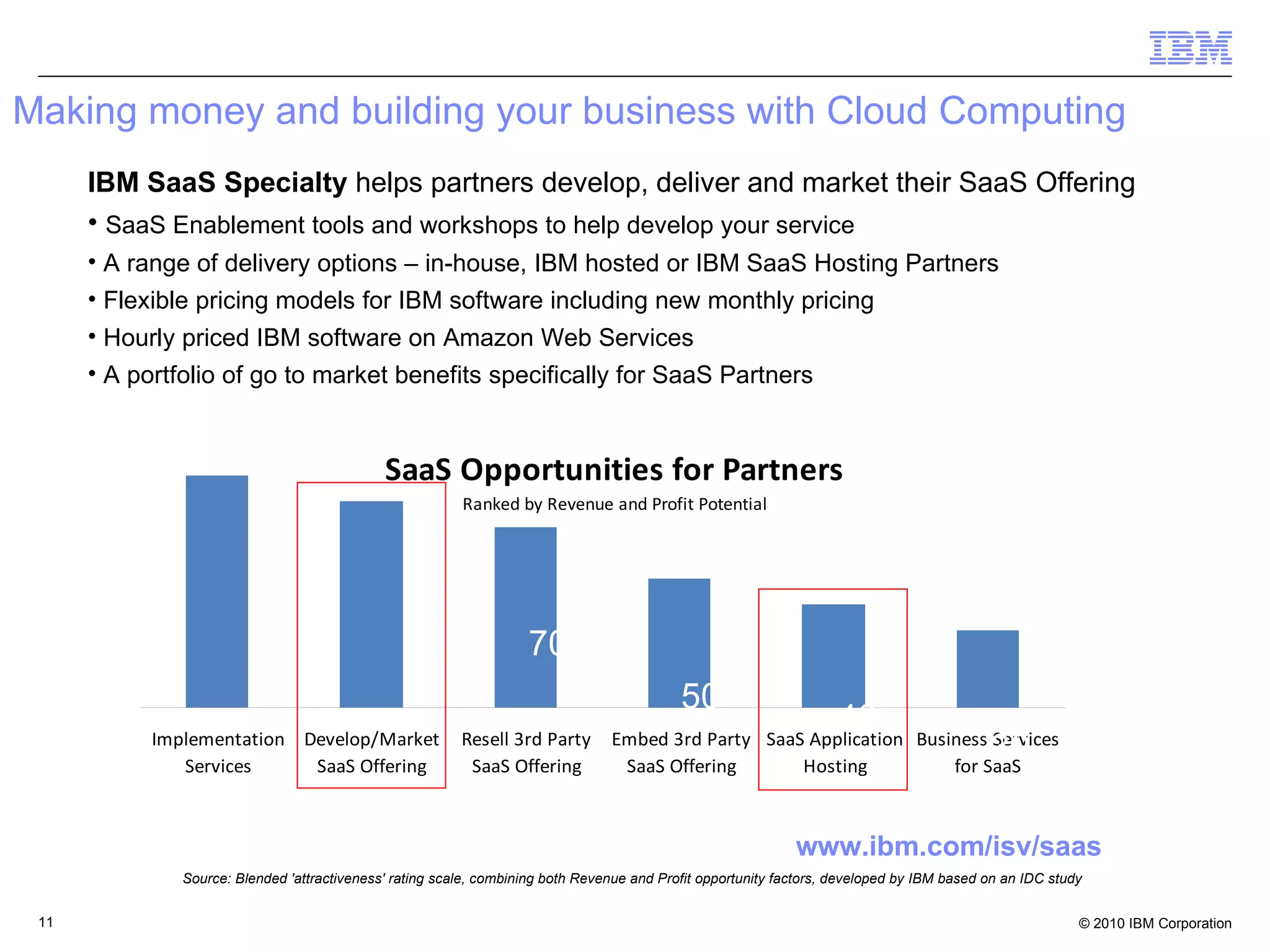
Making money and building your business with Cloud Computing 90 80 70 50 40 30 Source: Blended 'attractiveness' rating scale, combining both Revenue and Profit opportunity factors, developed by IBM based on an IDC study IBM SaaS Specialty  helps partners develop, deliver and market their SaaS Offering SaaS Enablement tools and workshops to help develop your service A range of delivery options – in-house, IBM hosted or IBM SaaS Hosting Partners Flexible pricing models for IBM software including new monthly pricing Hourly priced IBM software on Amazon Web Services A portfolio of go to market benefits specifically for SaaS Partners www.ibm.com/isv/saas
SaaS and Cloud Computing Module 201
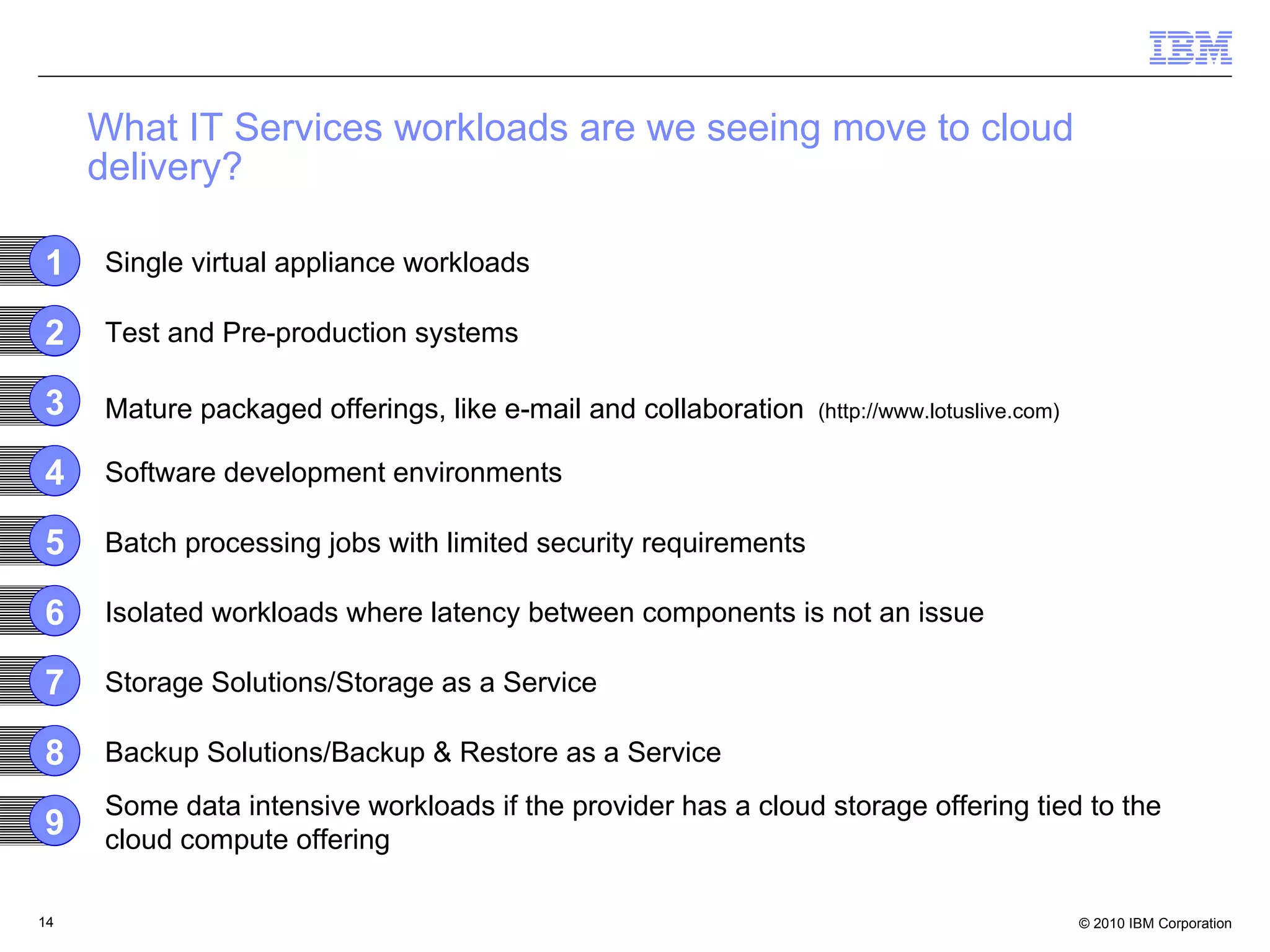
Agenda What workloads are suitable for the cloud? IBM’s growing portfolio of cloud offerings  IBM’s SaaS Partner Program Getting started with SaaS and cloud computing with IBM
What IT Services workloads are we seeing move to cloud delivery? Single virtual appliance workloads Test and Pre-production systems Mature packaged offerings, like e-mail and collaboration  (http://www.lotuslive.com) Software development environments Batch processing jobs with limited security requirements Isolated workloads where latency between components is not an issue Storage Solutions/Storage as a Service Backup Solutions/Backup & Restore as a Service Some data intensive workloads if the provider has a cloud storage offering tied to the cloud compute offering 1 2 3 4 5 6 7 8 9
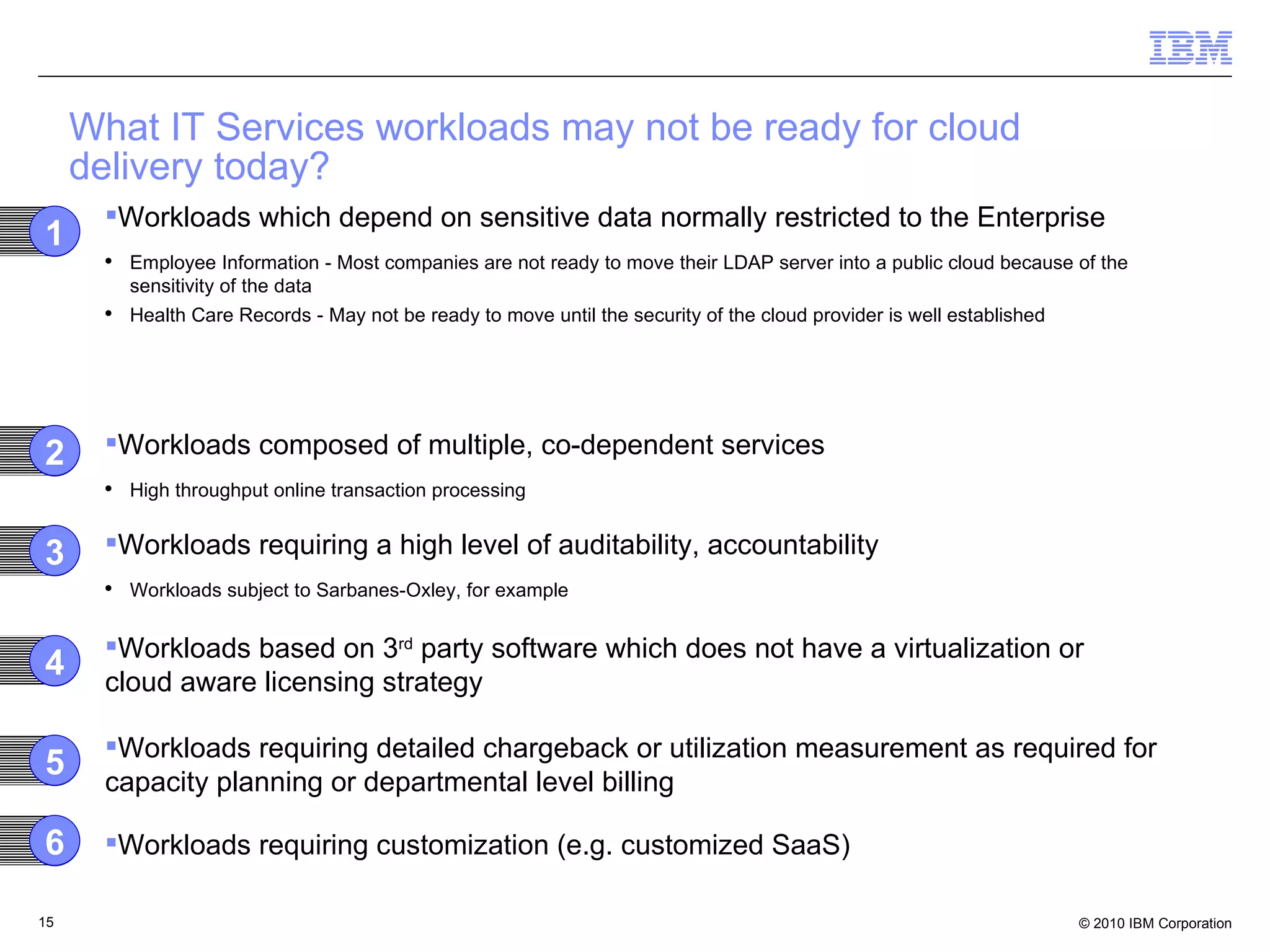
What IT Services workloads may not be ready for cloud delivery today? Workloads which depend on sensitive data normally restricted to the Enterprise Employee Information - Most companies are not ready to move their LDAP server into a public cloud because of the sensitivity of the data Health Care Records - May not be ready to move until the security of the cloud provider is well established Workloads composed of multiple, co-dependent services High throughput online transaction processing Workloads requiring a high level of auditability, accountability Workloads subject to Sarbanes-Oxley, for example Workloads based on 3 rd  party software which does not have a virtualization or cloud aware licensing strategy Workloads requiring detailed chargeback or utilization measurement as required for capacity planning or departmental level billing Workloads requiring customization (e.g. customized SaaS)‏ 1 2 3 4 5 6
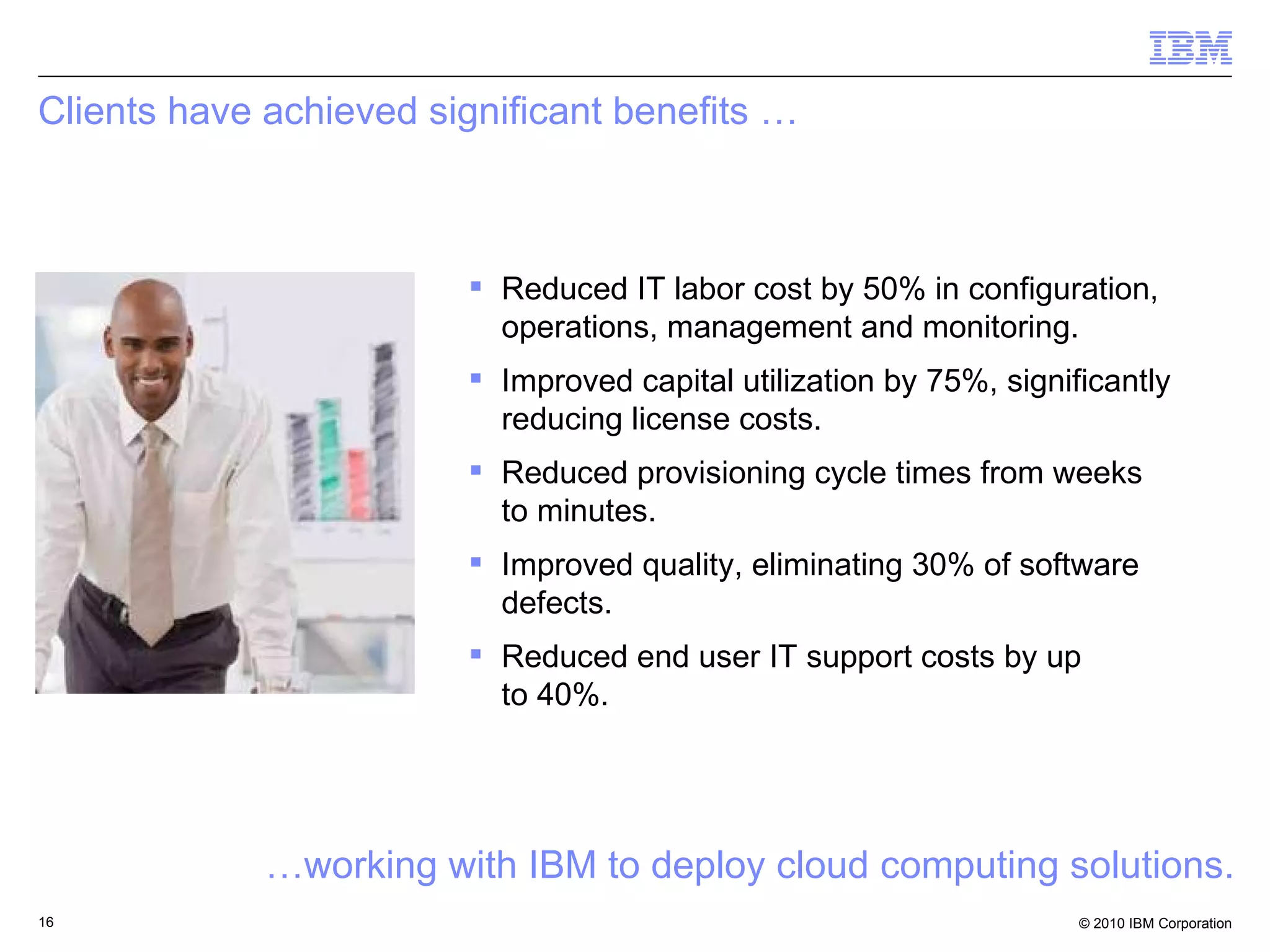
Clients have achieved significant benefits … Reduced IT labor cost by 50% in configuration, operations, management and monitoring. Improved capital utilization by 75%, significantly reducing license costs. Reduced provisioning cycle times from weeks to minutes. Improved quality, eliminating 30% of software defects. Reduced end user IT support costs by up  to 40%. … working with IBM to deploy cloud computing solutions.
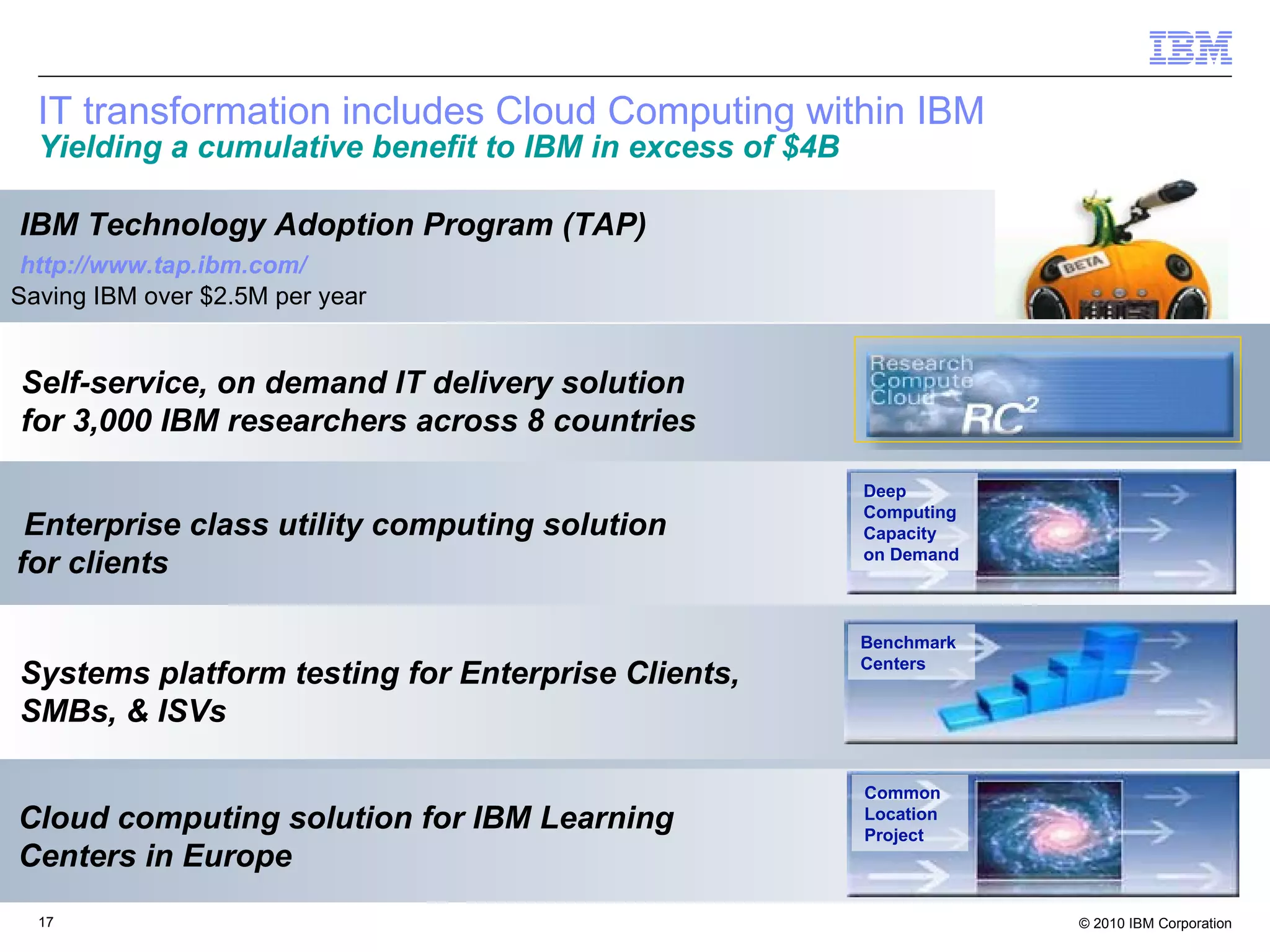
IT transformation includes Cloud Computing within IBM  Yielding a cumulative benefit to IBM in excess of $4B Self-service, on demand IT delivery solution for 3,000 IBM researchers across 8 countries IBM Technology Adoption Program (TAP)   http://www.tap.ibm.com/ Saving IBM over $2.5M per year Enterprise class utility computing solution  for clients Systems platform testing for Enterprise Clients, SMBs, & ISVs Cloud computing solution for IBM Learning Centers in Europe Deep Computing Capacity  on Demand Benchmark Centers Common Location Project
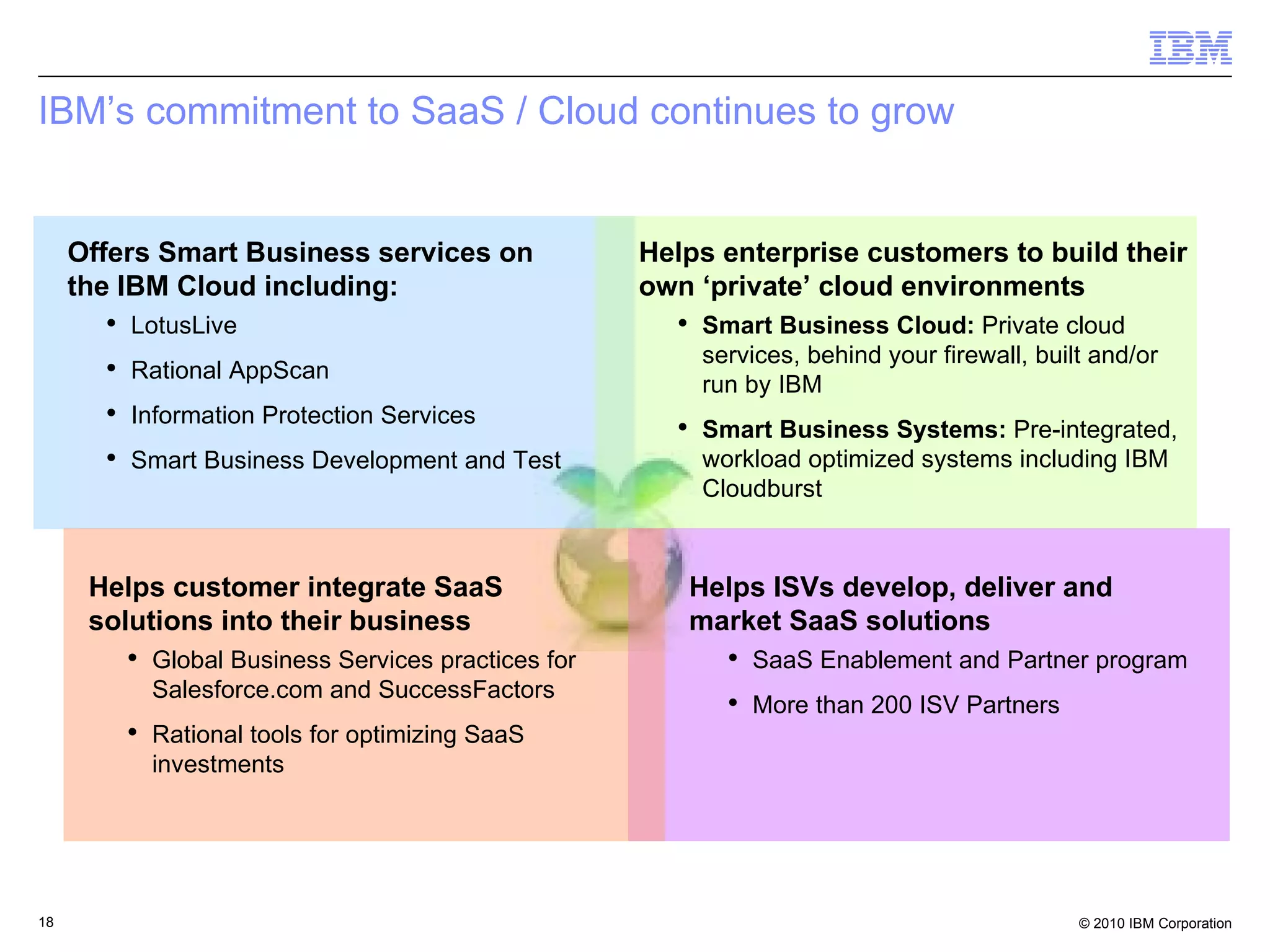
IBM’s commitment to SaaS / Cloud continues to grow Offers Smart Business services on the IBM Cloud including: LotusLive Rational AppScan Information Protection Services Smart Business Development and Test Helps ISVs develop, deliver and market SaaS solutions SaaS Enablement and Partner program More than 200 ISV Partners Helps customer integrate SaaS solutions into their business Global Business Services practices for Salesforce.com and SuccessFactors Rational tools for optimizing SaaS investments Helps enterprise customers to build their own ‘private’ cloud environments Smart Business Cloud:  Private cloud services, behind your firewall, built and/or run by IBM  Smart Business Systems:  Pre-integrated, workload optimized systems including IBM Cloudburst
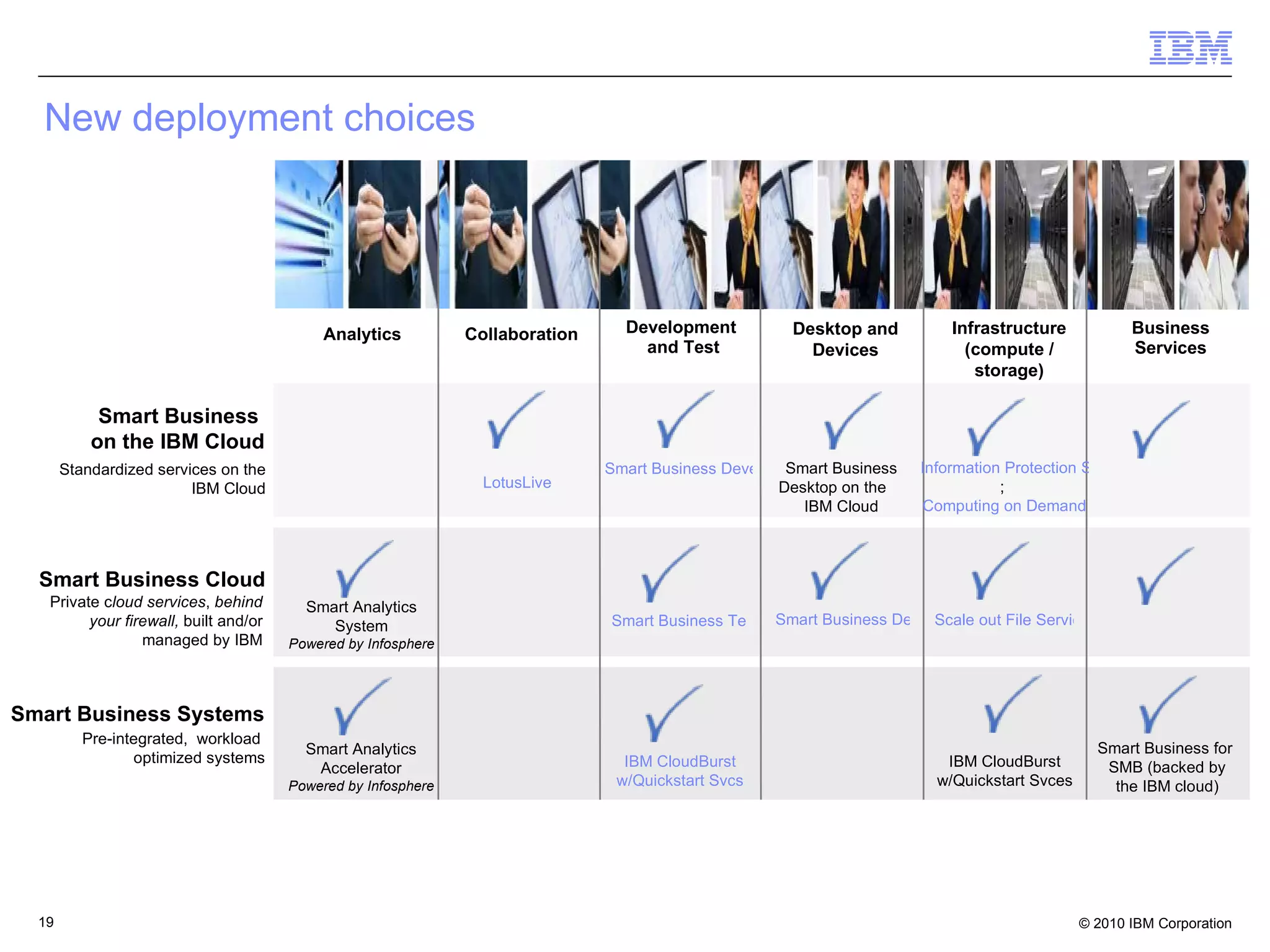
New deployment choices Smart Business  on the IBM Cloud Smart Business Cloud Smart Business Systems Standardized services on the IBM Cloud Pre-integrated,  workload  optimized systems Private c loud services ,  behind your firewall,  built and/or managed by IBM LotusLive IBM  CloudBurst w/Quickstart   Svcs Smart Business Test Cloud Smart Business Development & Test on the IBM Cloud Smart Business Desktop Cloud Smart Business Desktop on the  IBM Cloud Information Protection Services ;  Computing on Demand Smart Business for  SMB (backed by the IBM cloud) IBM CloudBurst w/Quickstart Svces Scale out File Services Analytics Collaboration Development  and Test Desktop and Devices Infrastructure (compute / storage) Business Services Smart Analytics System Powered by Infosphere Smart Analytics Accelerator Powered by Infosphere
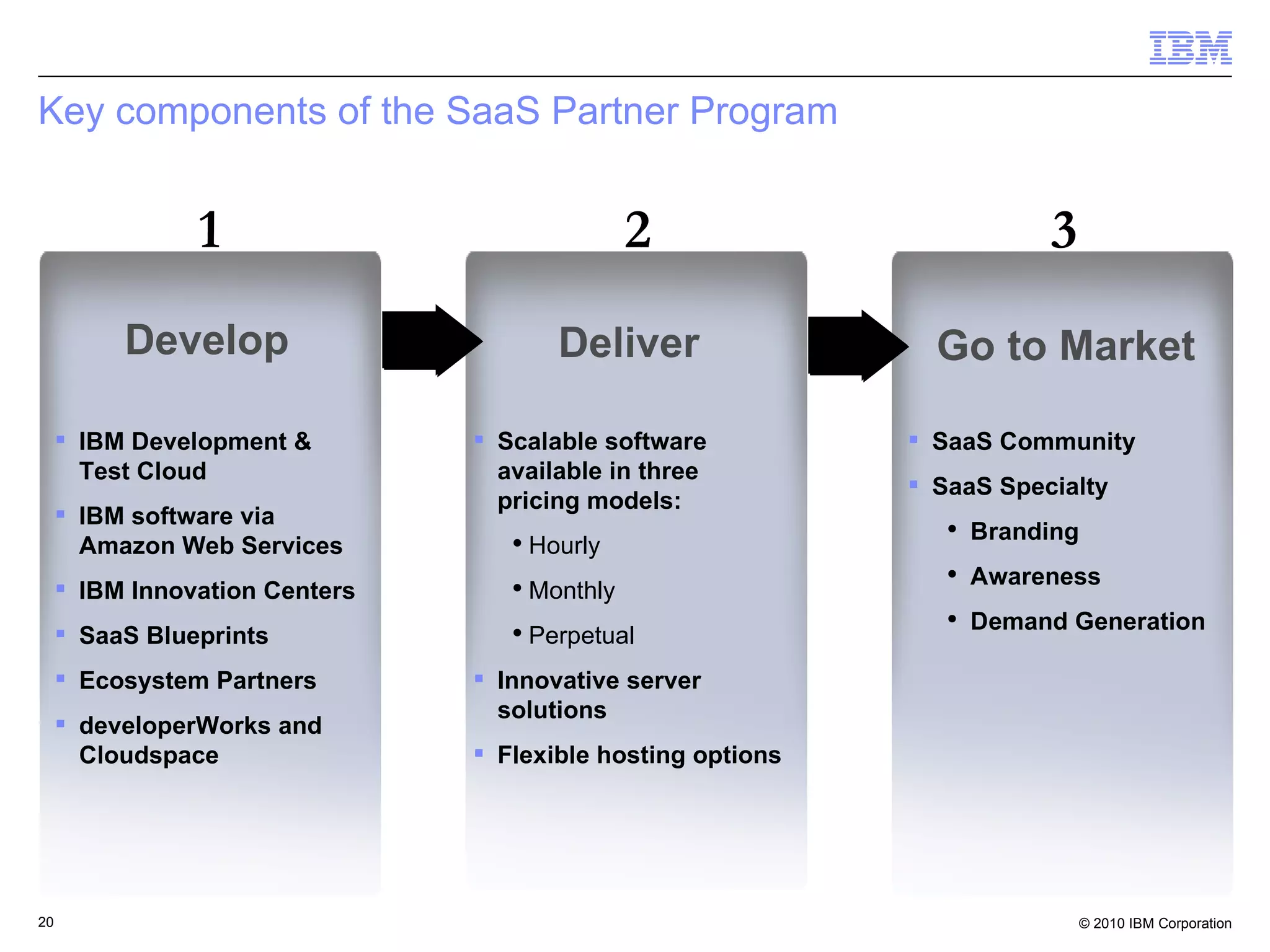
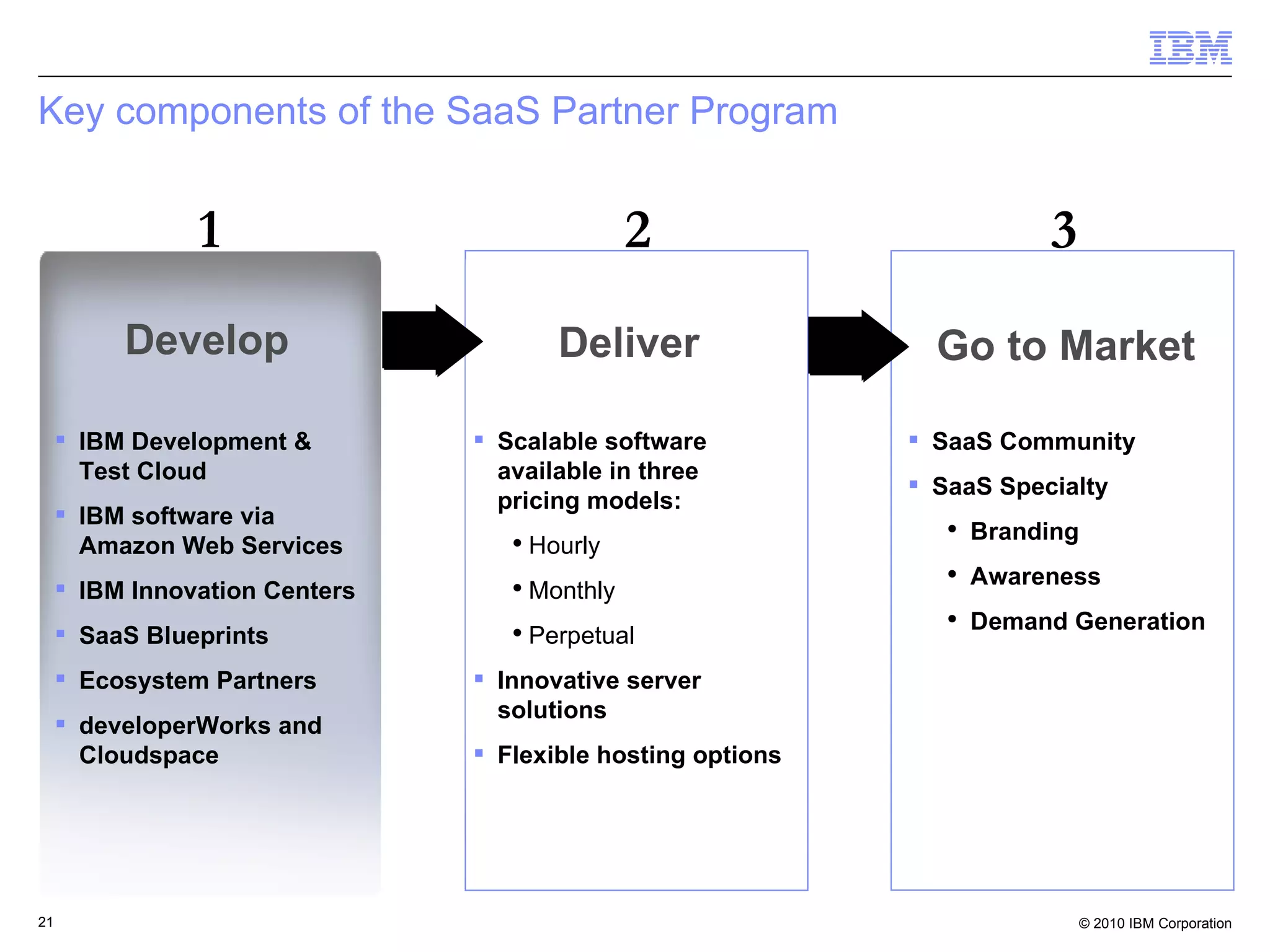
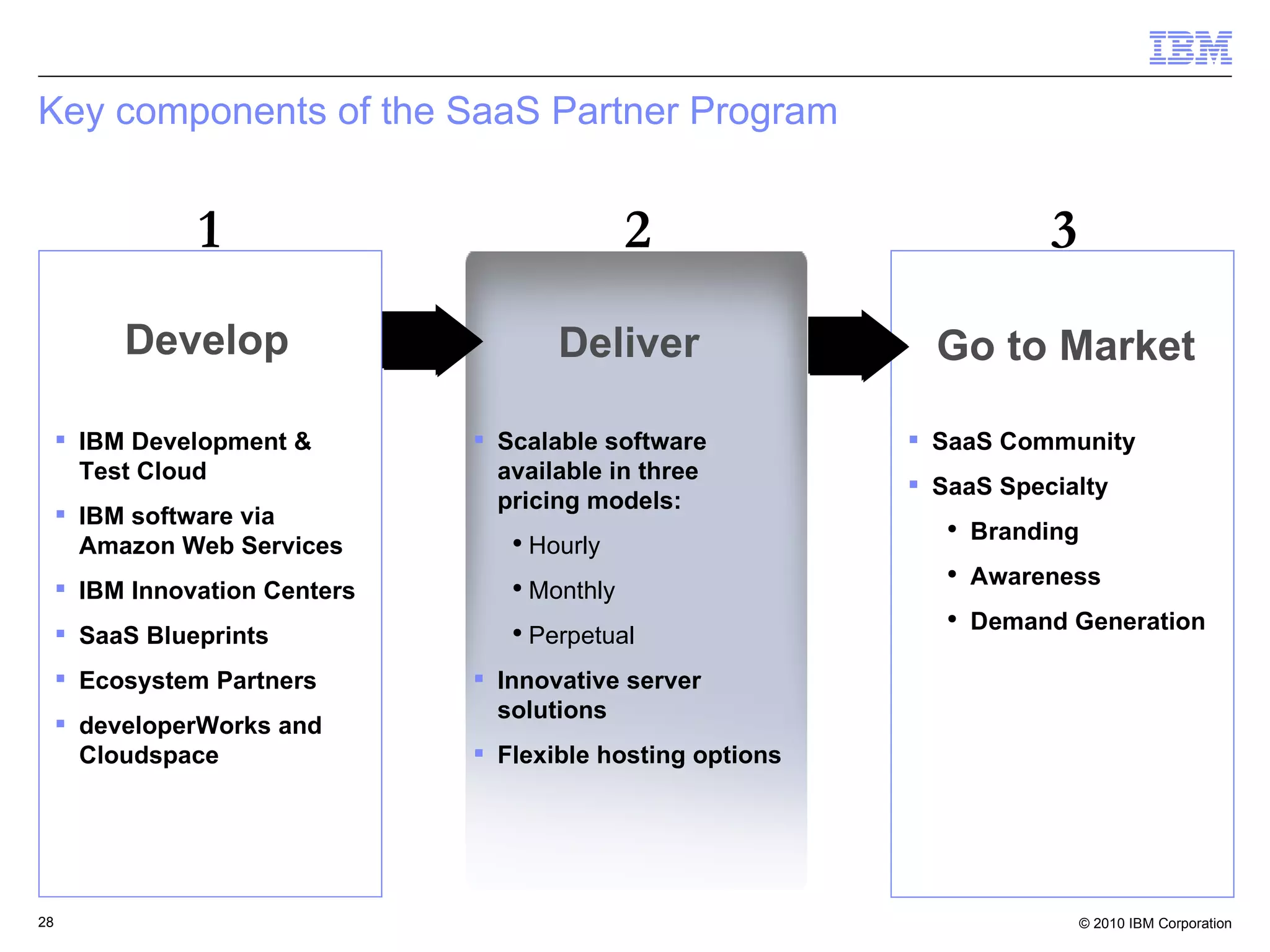
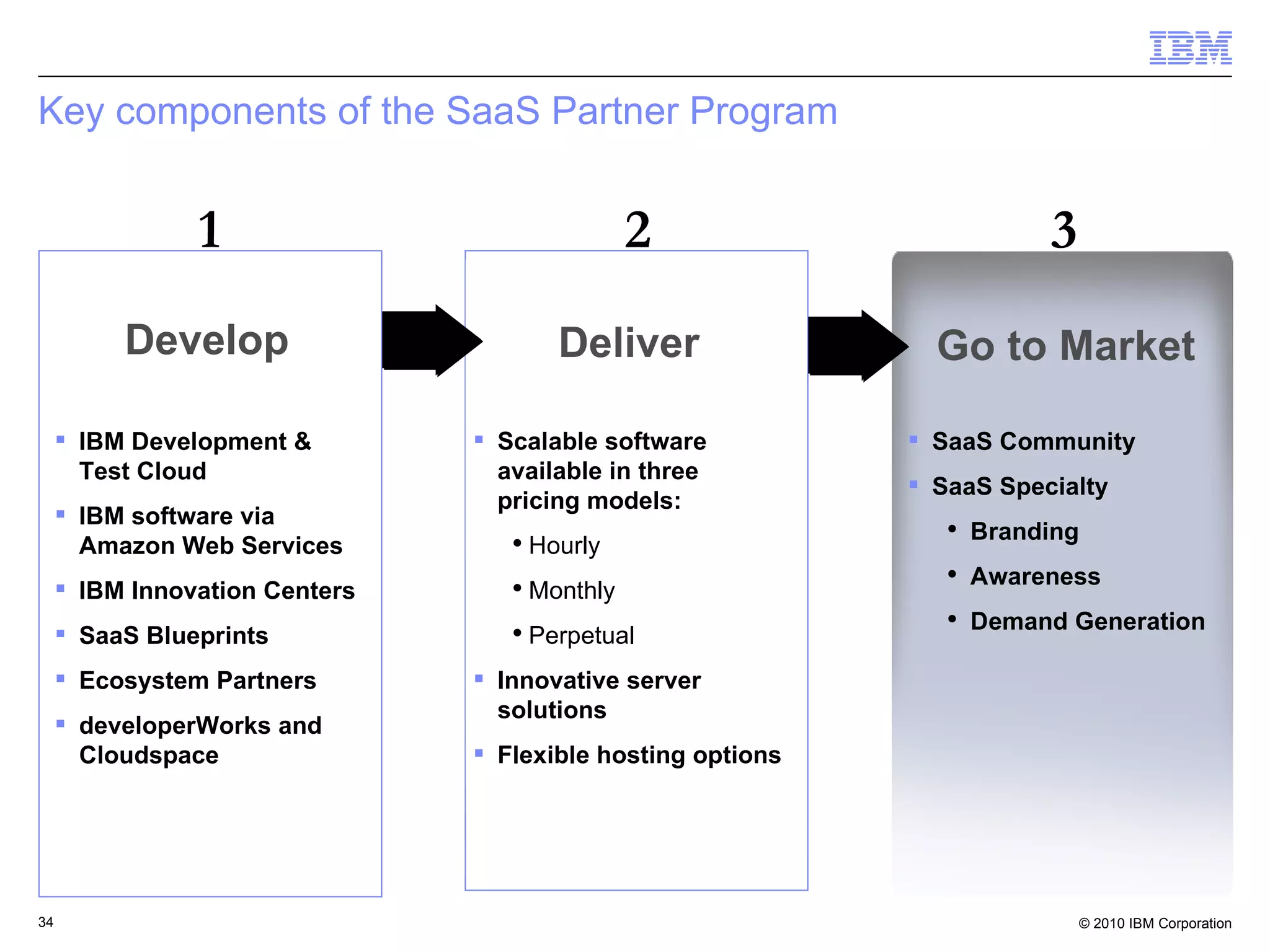
Key components of the SaaS Partner Program SaaS Community SaaS Specialty Branding Awareness Demand Generation  Scalable software available in three pricing models: Hourly Monthly Perpetual Innovative server solutions Flexible hosting options Develop Go to Market Deliver 1 2 3 IBM Development & Test Cloud IBM software via Amazon Web Services IBM Innovation Centers SaaS Blueprints Ecosystem Partners developerWorks and Cloudspace
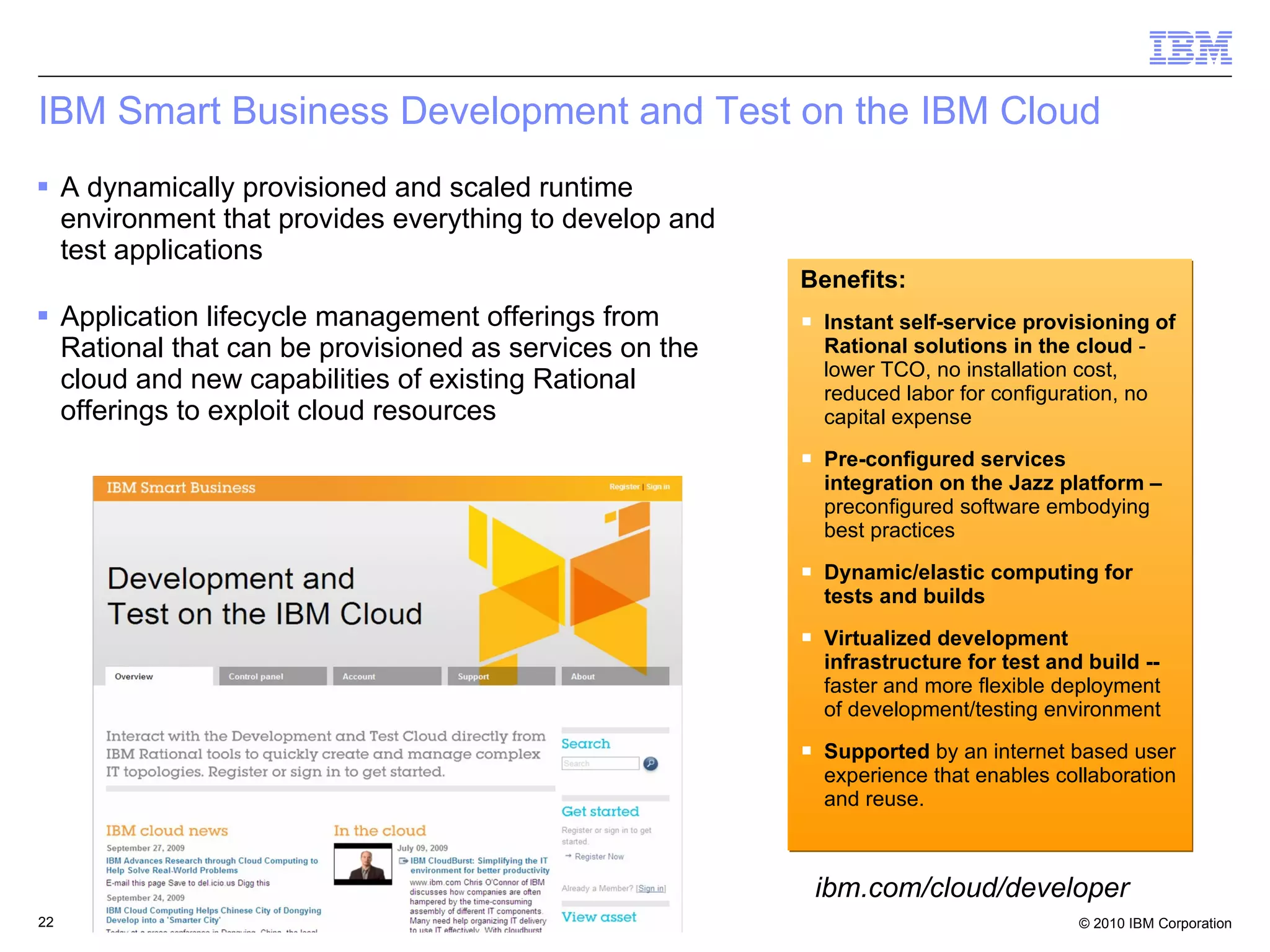
IBM Smart Business Development and Test on the IBM Cloud A dynamically provisioned and scaled runtime environment that provides everything to develop and test applications Application lifecycle management offerings from Rational that can be provisioned as services on the cloud and new capabilities of existing Rational offerings to exploit cloud resources Benefits: Instant self-service provisioning of Rational solutions in the cloud  - lower TCO, no installation cost, reduced labor for configuration, no capital expense Pre-configured services integration on the Jazz platform –  preconfigured software embodying best practices Dynamic/elastic computing for tests and builds  Virtualized development infrastructure for test and build --  faster and more flexible deployment of development/testing environment Supported  by an internet based user experience that enables collaboration and reuse . ibm.com/cloud/developer
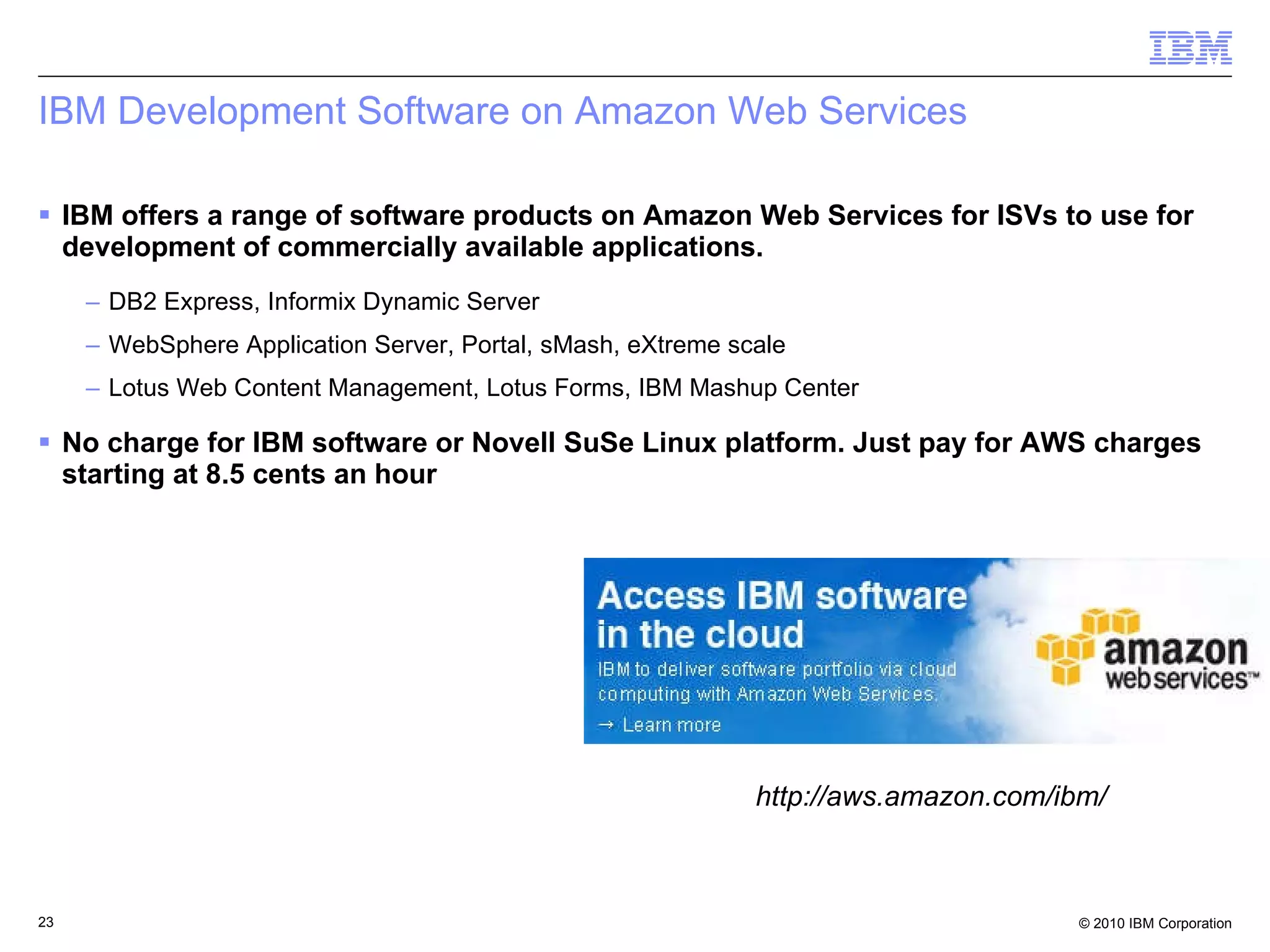
IBM Development Software on Amazon Web Services IBM offers a range of software products on Amazon Web Services for ISVs to use for development of commercially available applications. DB2 Express, Informix Dynamic Server WebSphere Application Server, Portal, sMash, eXtreme scale Lotus Web Content Management, Lotus Forms, IBM Mashup Center No charge for IBM software or Novell SuSe Linux platform. Just pay for AWS charges starting at 8.5 cents an hour http://aws.amazon.com/ibm/
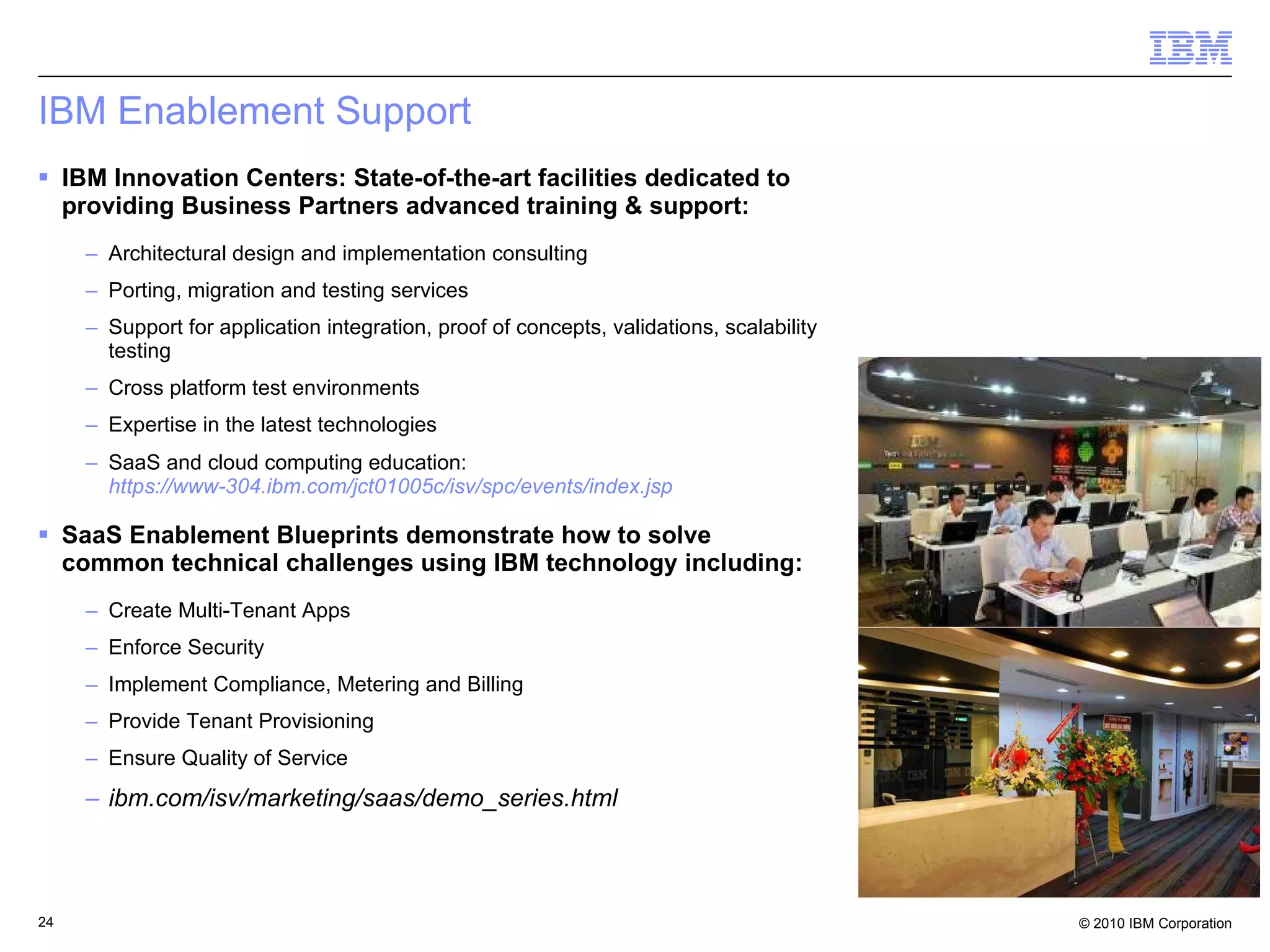
IBM Enablement Support IBM Innovation Centers: State-of-the-art facilities dedicated to providing Business Partners advanced training & support: Architectural design and implementation consulting Porting, migration and testing services Support for application integration, proof of concepts, validations, scalability testing Cross platform test environments Expertise in the latest technologies SaaS and cloud computing education: https://www-304.ibm.com/jct01005c/isv/spc/events/index.jsp SaaS Enablement Blueprints demonstrate how to solve common technical challenges using IBM technology including: Create Multi-Tenant Apps Enforce Security Implement Compliance, Metering and Billing Provide Tenant Provisioning  Ensure Quality of Service  ibm.com/isv/marketing/saas/demo_series.html
SaaS Ecosystem Partners IBM has a growing network of SaaS Enablement Partners who bring resources and experience to help you enable your SaaS solution on IBM technology including: Persistent Software  – Transform, Develop, and Integration Offer a 2-week assessment to define an individualized SaaS Implementation Plan, complete with cost estimates and timeline WaveMaker  – Deploy Existing Applications on the Cloud Offer a Proof of concept at IBM Innovation Center Corent  – Rapid App- Development Tools SaaS-Suite™ is a set of software products for rapid development of  sophisticated turnkey (SaaS) applications LongJump  – Rapid Development Platform Complete PaaS stack and tools to develop and deliver applications
Case Study: Wavemaker and KANA Business Challenge: KANA wanted to give its customers a way to quickly and easily tailor WebSphere based KANA applications to fit their particular business processes  Solution: WaveMaker Studio is a drag and drop development tool that runs in a browser WaveMaker enables anyone to build Web applications without complex coding Benefit: WaveMaker is expected to achieve these benefits for KANA customers: Reduce the cost to configure the UI for a typical customer service solution by 75% Make it possible to respond to changing business situations in minutes or hours  Enable business managers to customize the software themselves  Allow IT to focus on other business innovation Reduce the Total Cost of Ownership (TCO) of the product  Ensure a stable, flexible, standards-based dynamic platform for the software product KANA Software is a leading customer service ISV with over 600 companies worldwide deploying its product, including half of the Fortune 50. "WaveMaker turbocharged our development effort for KANA 10, cutting at least 50 percent of our development time.”  –  Mark Angel, CTO, KANA
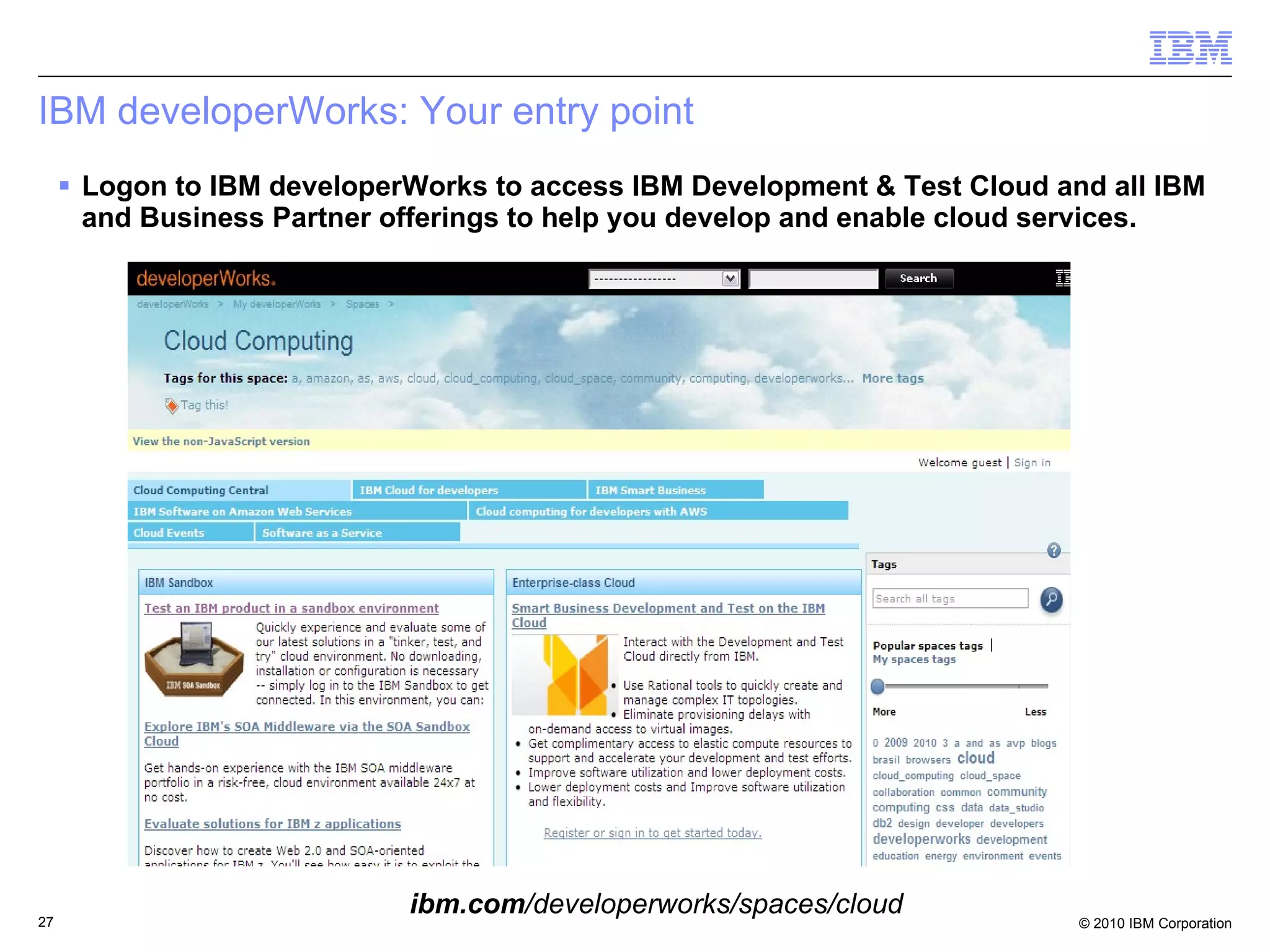
IBM developerWorks: Your entry point Logon to IBM developerWorks to access IBM Development & Test Cloud and all IBM and Business Partner offerings to help you develop and enable cloud services. ibm.com /developerworks/spaces/cloud
Key components of the SaaS Partner Program SaaS Community SaaS Specialty Branding Awareness Demand Generation  Scalable software available in three pricing models: Hourly Monthly Perpetual Innovative server solutions Flexible hosting options Develop Go to Market Deliver 1 2 3 IBM Development & Test Cloud IBM software via Amazon Web Services IBM Innovation Centers SaaS Blueprints Ecosystem Partners developerWorks and Cloudspace
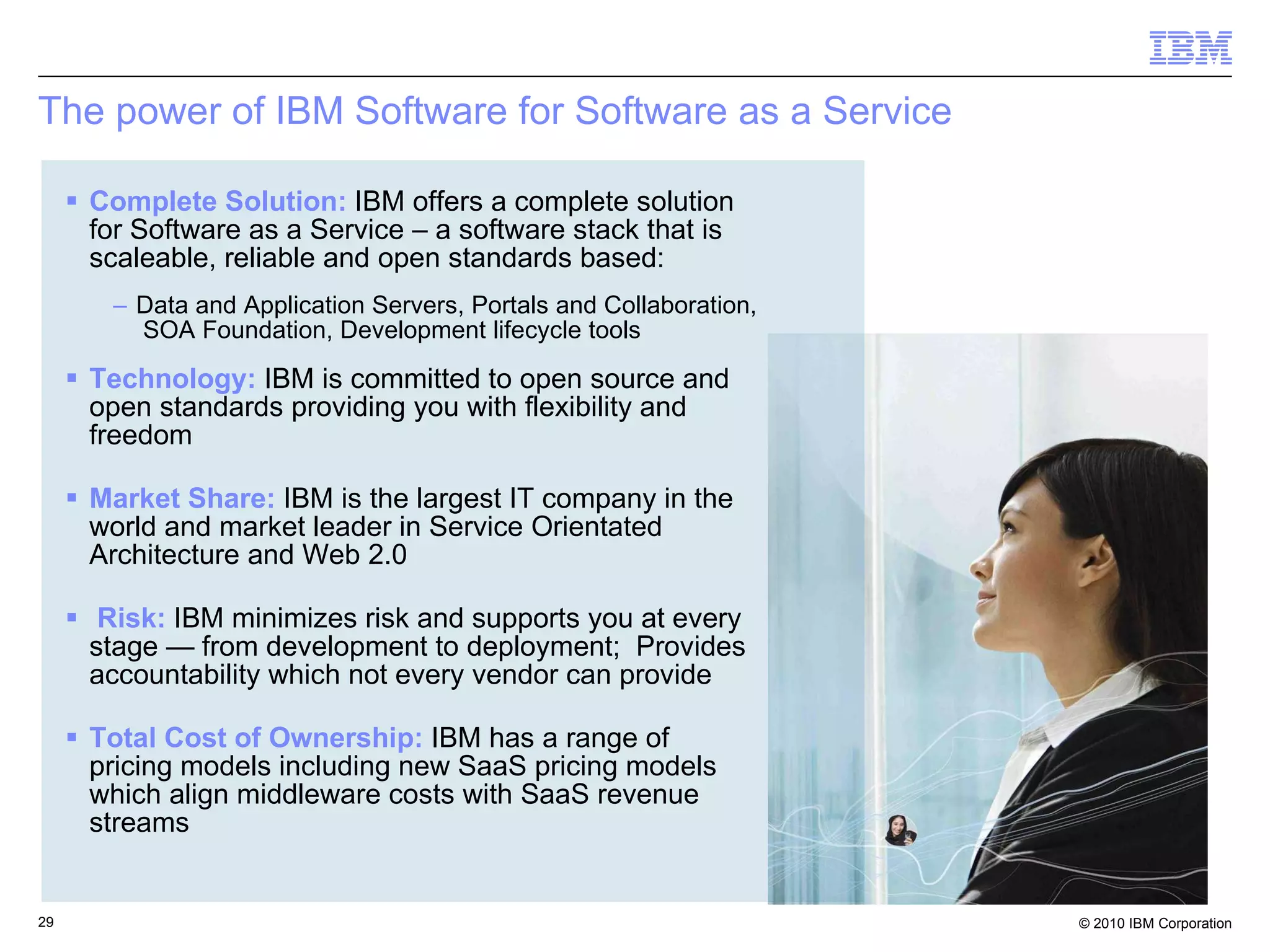
The power of IBM Software for Software as a Service Complete Solution:   IBM offers a complete solution for Software as a Service – a software stack that is scaleable, reliable and open standards based:  Data and Application Servers, Portals and Collaboration,  SOA Foundation, Development lifecycle tools  Technology:   IBM is committed to open source and open standards providing you with flexibility and freedom Market Share:   IBM is the largest IT company in the world and market leader in Service Orientated Architecture and Web 2.0 Risk:   IBM minimizes risk and supports you at every stage — from development to deployment;  Provides accountability which not every vendor can provide Total Cost of Ownership:   IBM has a range of pricing models including new SaaS pricing models which align middleware costs with SaaS revenue streams
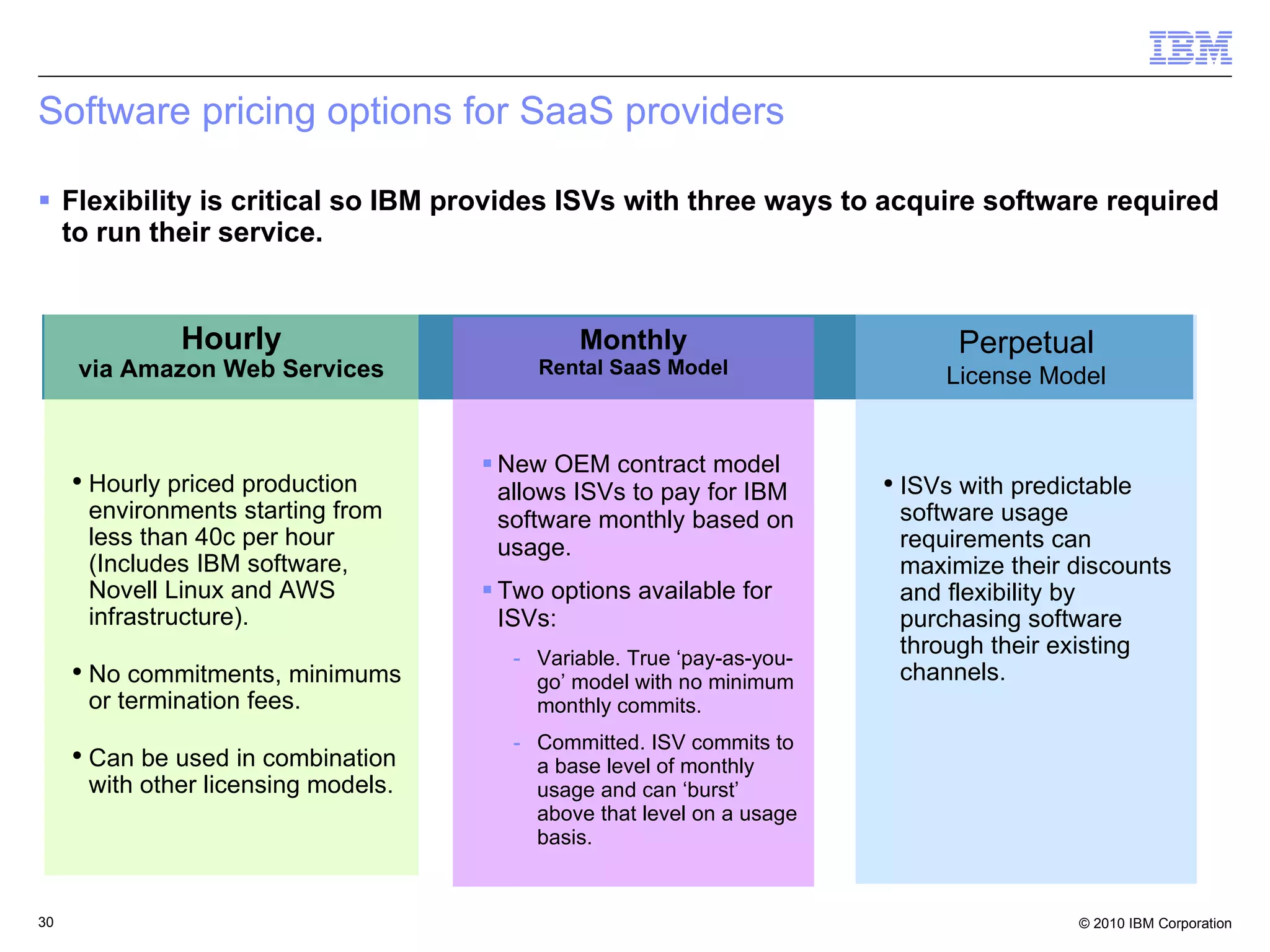
Software pricing options for SaaS providers Flexibility is critical so IBM provides ISVs with three ways to acquire software required to run their service. Monthly Rental SaaS Model New OEM contract model allows ISVs to pay for IBM software monthly based on usage.  Two options available for ISVs: Variable. True ‘pay-as-you-go’ model with no minimum monthly commits. Committed. ISV commits to a base level of monthly usage and can ‘burst’ above that level on a usage basis. Perpetual License Model ISVs with predictable software usage requirements can maximize their discounts and flexibility by purchasing software through their existing channels.   Hourly via Amazon Web Services Hourly priced production environments starting from less than 40c per hour (Includes IBM software, Novell Linux and AWS infrastructure). No commitments, minimums or termination fees. Can be used in combination with other licensing models.
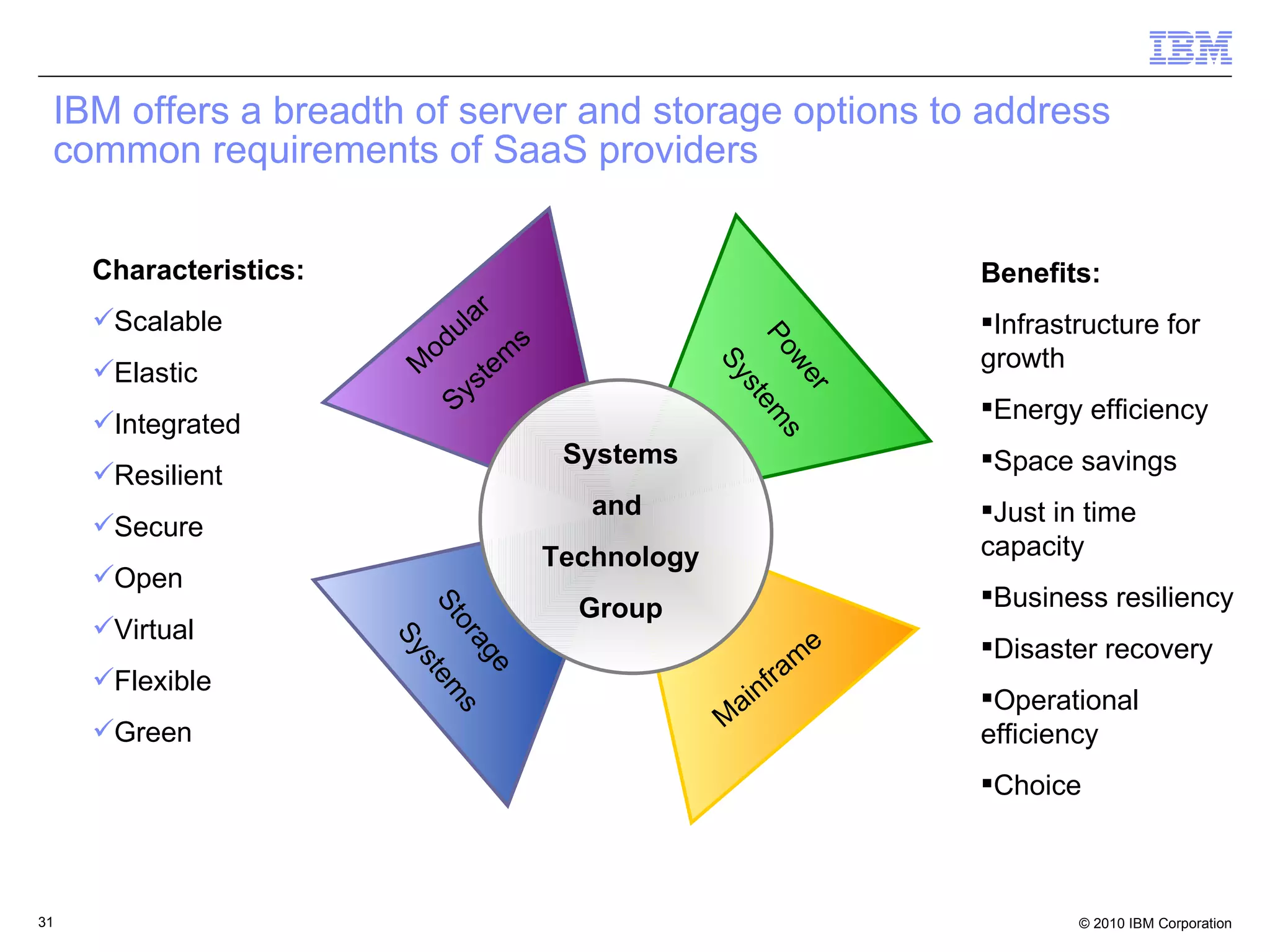
IBM offers a breadth of server and storage options to address common requirements of SaaS providers Benefits: Infrastructure for growth Energy efficiency Space savings Just in time capacity Business resiliency Disaster recovery Operational efficiency Choice Characteristics: Scalable Elastic Integrated Resilient Secure Open Virtual Flexible Green Mainframe Modular  Systems Power Systems Storage Systems Systems and  Technology Group
Smart Business Systems: IBM Cloudburst and WebSphere Cloudburst Appliance Integrated service delivery platforms that include hardware, storage, networking, virtualization and service management software.  Workload-optimized systems create a cloud environment and build dynamic infrastructure to deliver new levels of service at reduced costs. “ Built for Performance” based on architectures required by specific workloads Optimized for test/dev workloads or production implementations Available with several attractive financing options
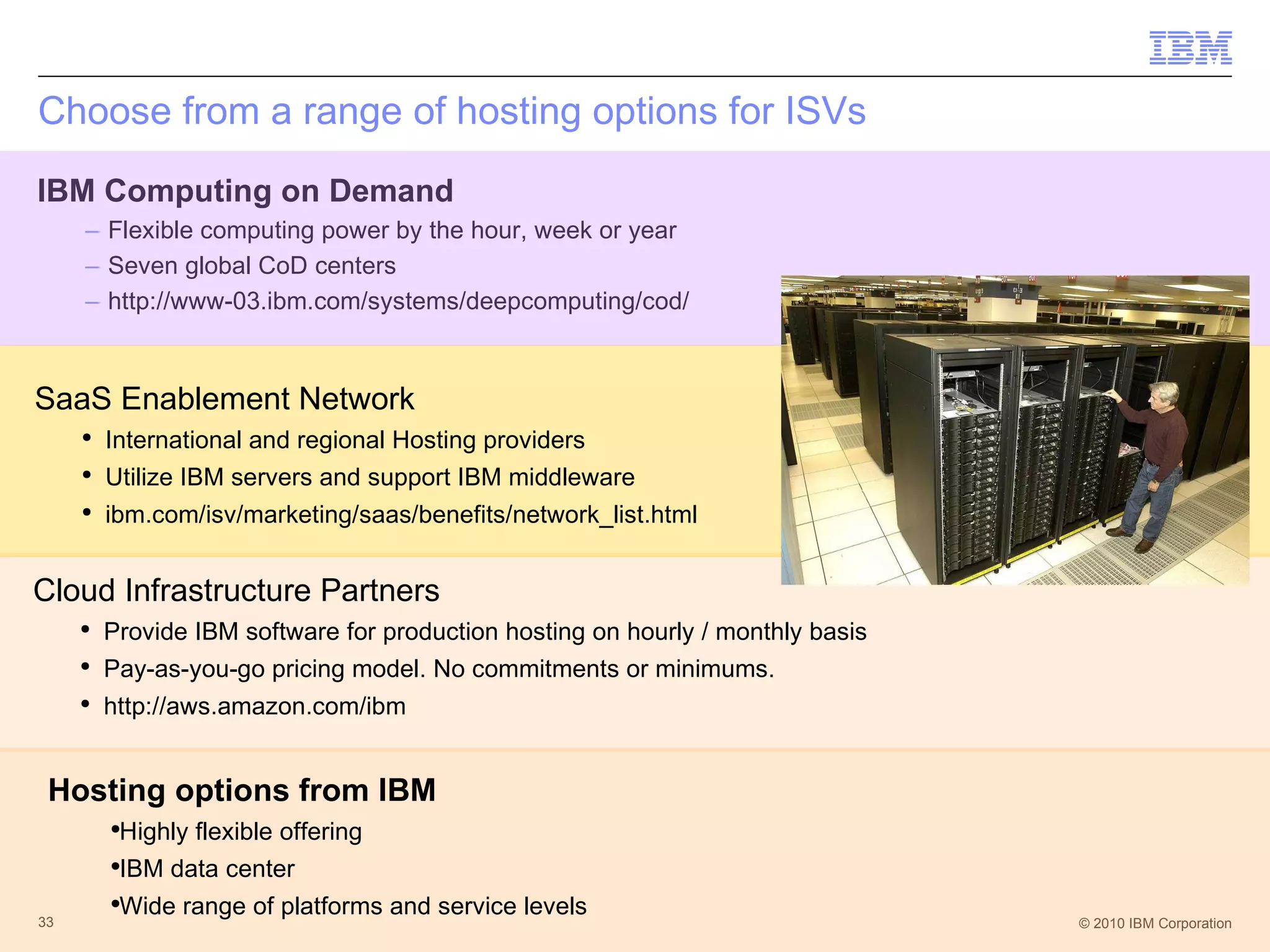
Choose from a range of hosting options for ISVs IBM Computing on Demand Flexible computing power by the hour, week or year Seven global CoD centers http://www-03.ibm.com/systems/deepcomputing/cod/ SaaS Enablement Network International and regional Hosting providers Utilize IBM servers and support IBM middleware ibm.com/isv/marketing/saas/benefits/network_list.html Cloud Infrastructure Partners Provide IBM software for production hosting on hourly / monthly basis Pay-as-you-go pricing model. No commitments or minimums. http://aws.amazon.com/ibm Hosting options from IBM  Highly flexible offering  IBM data center Wide range of platforms and service levels
Key components of the SaaS Partner Program SaaS Community SaaS Specialty Branding Awareness Demand Generation  Scalable software available in three pricing models: Hourly Monthly Perpetual Innovative server solutions Flexible hosting options Develop Go to Market Deliver 1 2 3 IBM Development & Test Cloud IBM software via Amazon Web Services IBM Innovation Centers SaaS Blueprints Ecosystem Partners developerWorks and Cloudspace
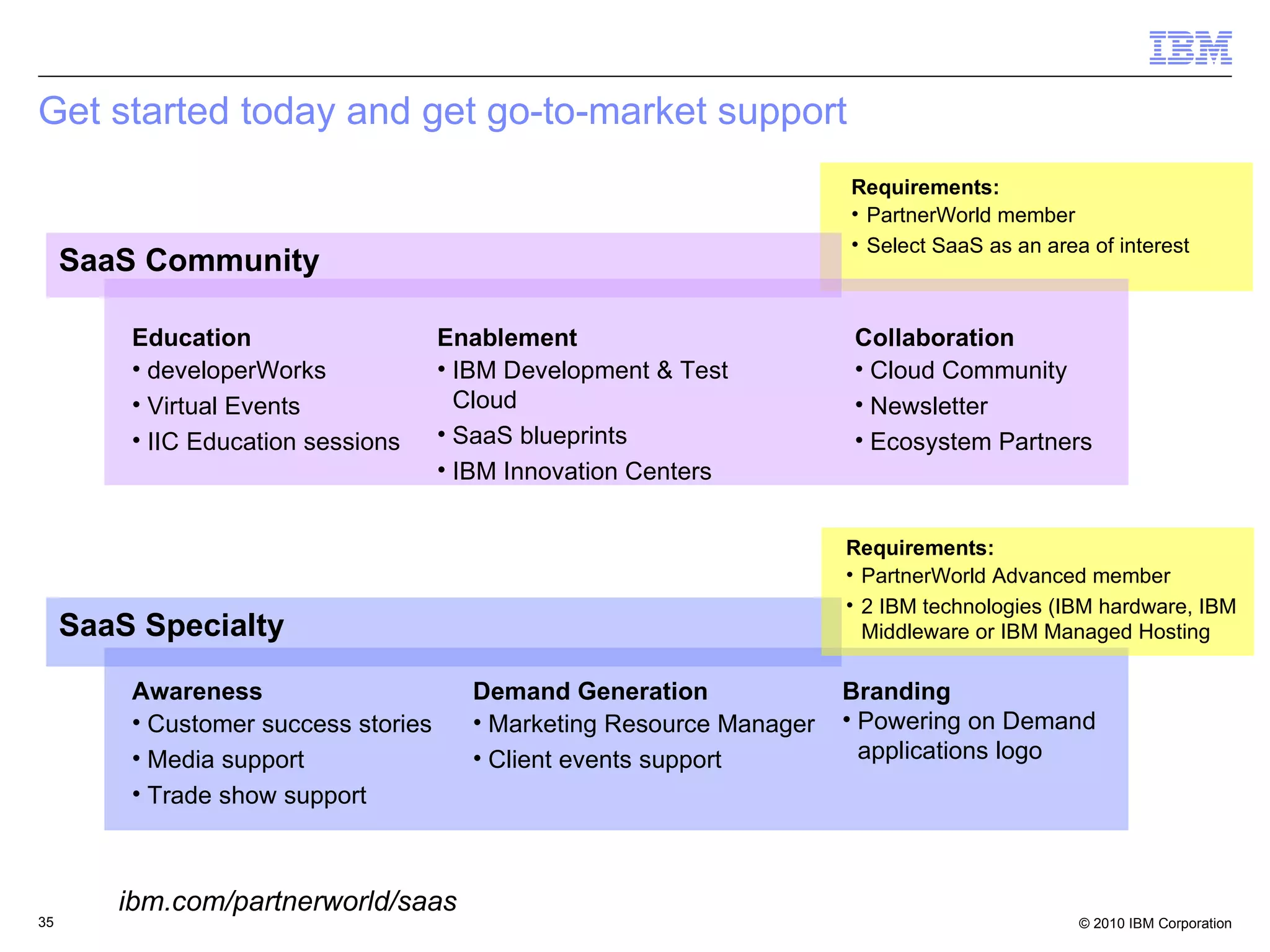
Get started today and get go-to-market support SaaS Community Education developerWorks Virtual Events IIC Education sessions Enablement IBM Development & Test Cloud SaaS blueprints IBM Innovation Centers Collaboration Cloud Community Newsletter Ecosystem Partners Requirements: PartnerWorld member Select SaaS as an area of interest SaaS Specialty Awareness Customer success stories Media support Trade show support Demand Generation Marketing Resource Manager Client events support Branding Powering on Demand applications logo Requirements: PartnerWorld Advanced member 2 IBM technologies (IBM hardware, IBM Middleware or IBM Managed Hosting ibm.com/partnerworld/saas
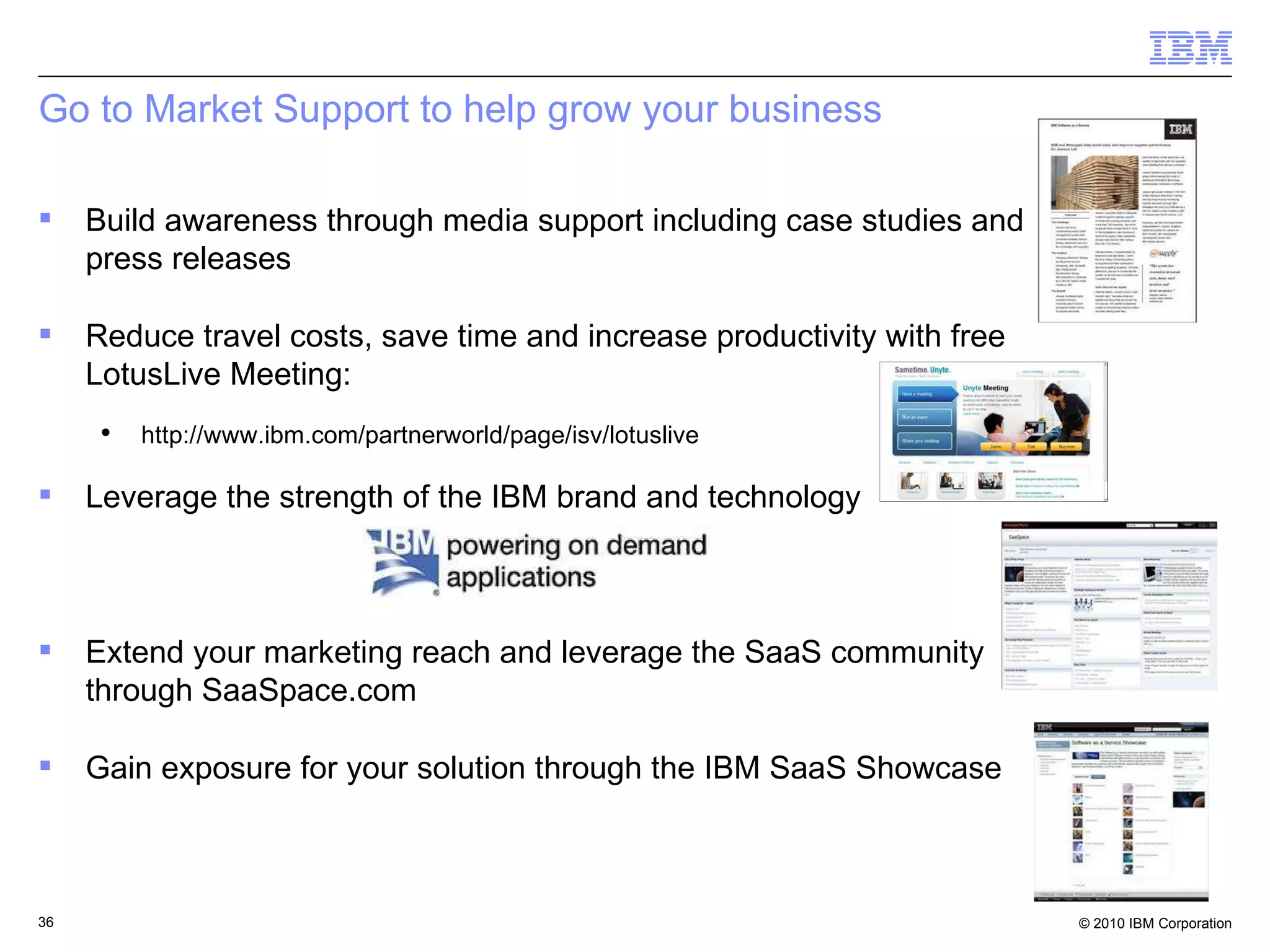
Go to Market Support to help grow your business Build awareness through media support including case studies and press releases  Reduce travel costs, save time and increase productivity with free LotusLive Meeting:  http://www.ibm.com/partnerworld/page/isv/lotuslive Leverage the strength of the IBM brand and technology Extend your marketing reach and leverage the SaaS community through SaaSpace.com Gain exposure for your solution through the IBM SaaS Showcase
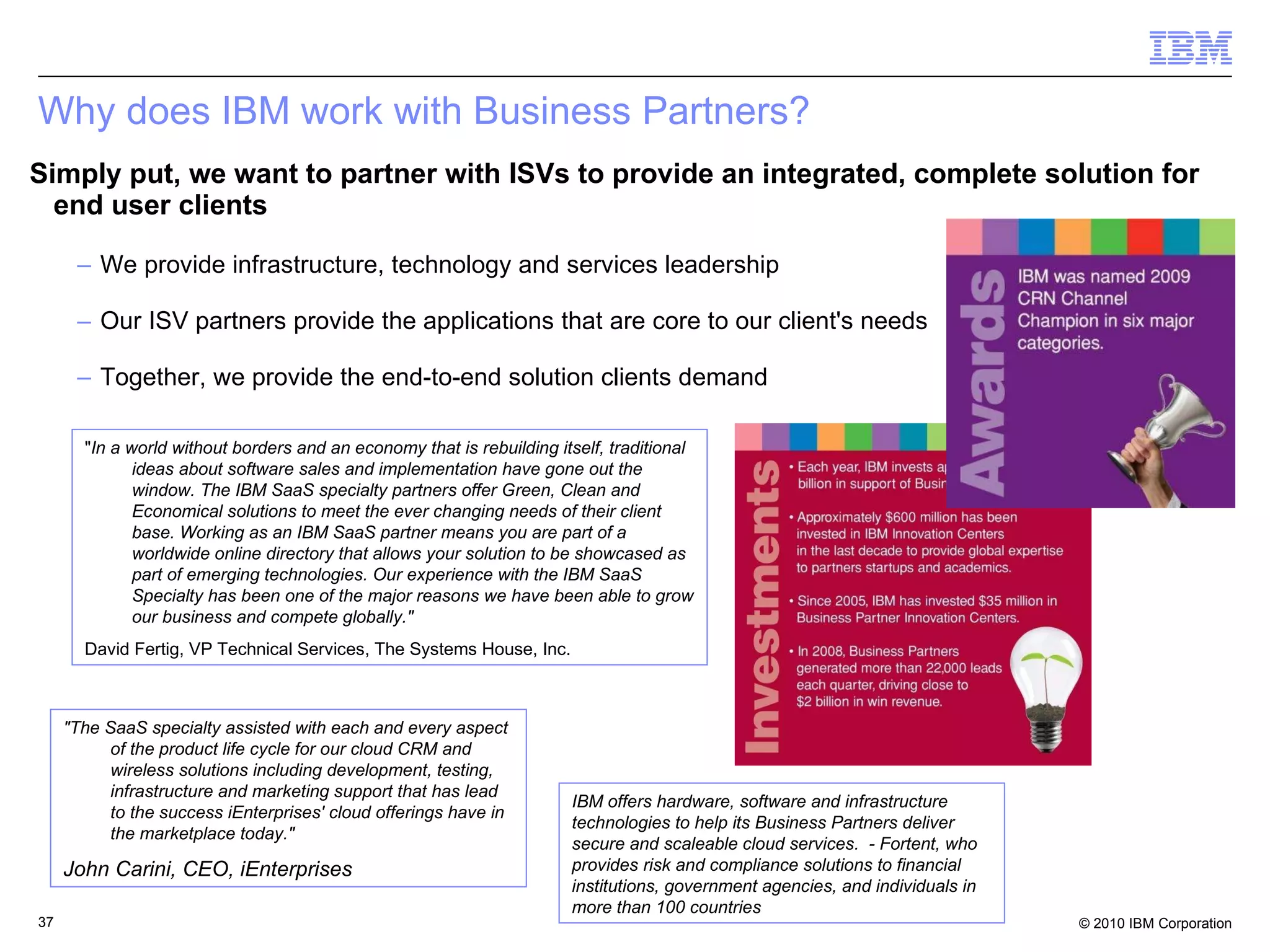
Why does IBM work with Business Partners? Simply put, we want to partner with ISVs to provide an integrated, complete solution for end user clients We provide infrastructure, technology and services leadership Our ISV partners provide the applications that are core to our client's needs Together, we provide the end-to-end solution clients demand " In a world without borders and an economy that is rebuilding itself, traditional ideas about software sales and implementation have gone out the window. The IBM SaaS specialty partners offer Green, Clean and Economical solutions to meet the ever changing needs of their client base. Working as an IBM SaaS partner means you are part of a worldwide online directory that allows your solution to be showcased as part of emerging technologies. Our experience with the IBM SaaS Specialty has been one of the major reasons we have been able to grow our business and compete globally." David Fertig, VP Technical Services, The Systems House, Inc.  "The SaaS specialty assisted with each and every aspect of the product life cycle for our cloud CRM and wireless solutions including development, testing, infrastructure and marketing support that has lead to the success iEnterprises' cloud offerings have in the marketplace today." John Carini, CEO, iEnterprises  IBM offers hardware, software and infrastructure technologies to help its Business Partners deliver secure and scaleable cloud services.  - Fortent, who provides  risk and compliance solutions to financial institutions, government agencies, and individuals in more than 100 countries
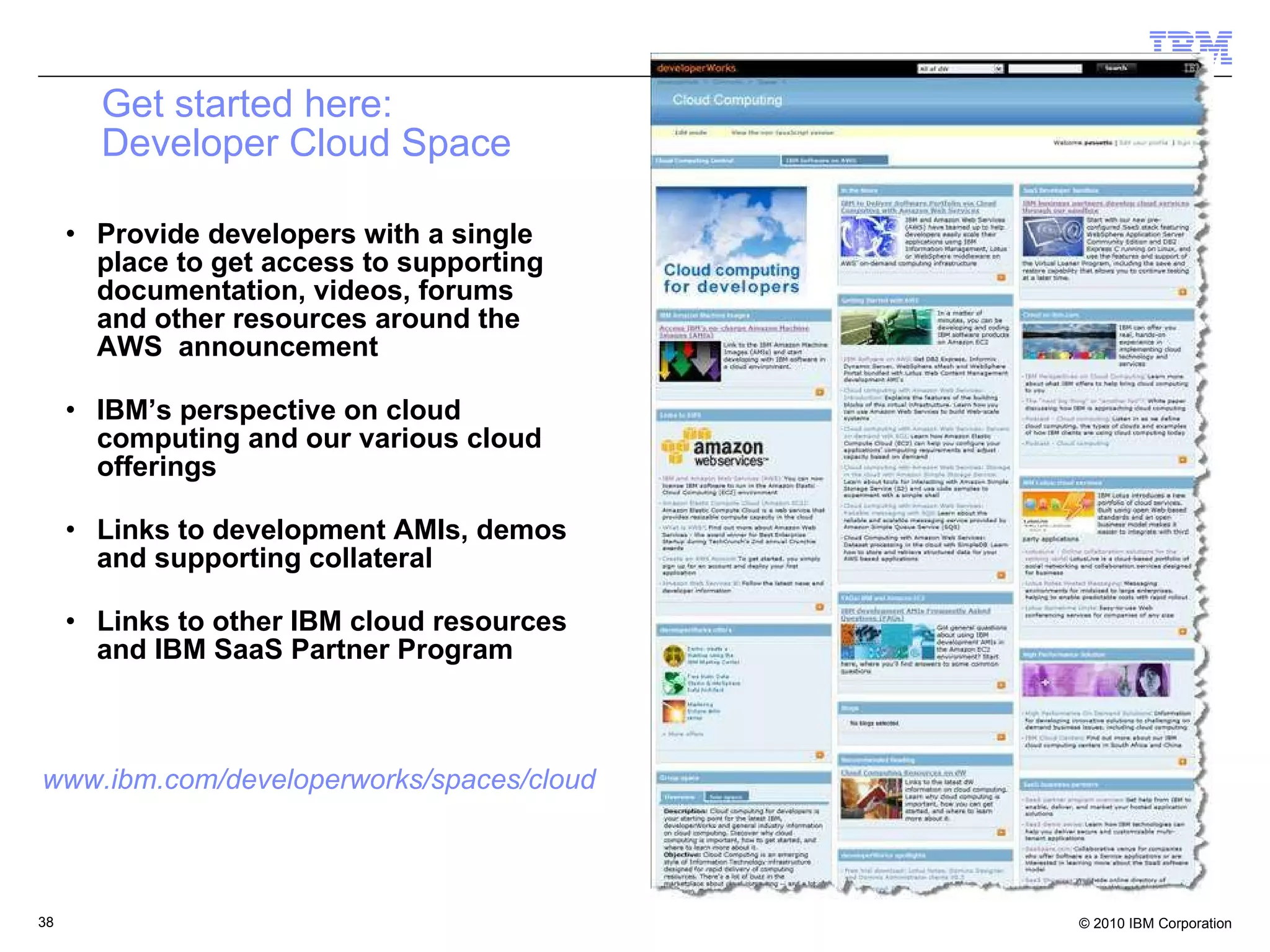
Get started here: Developer Cloud Space Provide developers with a single place to get access to supporting documentation, videos, forums and other resources around the AWS  announcement IBM’s perspective on cloud computing and our various cloud offerings Links to development AMIs, demos and supporting collateral Links to other IBM cloud resources and IBM SaaS Partner Program www.ibm.com/developerworks/spaces/cloud
Key links for SaaS and Cloud Computing ibm.com /cloud ibm.com /developerworks/spaces/cloud ibm.com /developerworks/downloads/cloud.html ibm.com /developerworks/downloads/faq-ec2/faq-ec2.html ibm.com /isv/marketing/saas/demo_series.html ibm.com /partnerworld/saas https ://www-304.ibm.com/jct01005c/isv/spc/events/index.jsp http:// aws.amazon.com/ibm

1 Intro To Cloud Computing (External)

  • 1.
    Introduction to CloudComputing Bonnie Durkin Business Lead, Cloud Partner Program February 3, 2010
  • 2.
    Agenda Why cloudcomputing How partners make money What is cloud computing Layers of cloud computing
  • 3.
    What is CloudComputing? A user experience and a business model Cloud computing is an emerging style of IT delivery in which applications, data, and IT resources are rapidly provisioned and provided as standardized offerings to users over the web in a flexible pricing model. An infrastructure management and services delivery methodology Cloud computing is a way of managing large numbers of highly virtualized resources such that, from a management perspective, they resemble a single large resource. This can then be used to deliver services with elastic scaling . Monitor & Manage Services & Resources Cloud Administrator Datacenter Infrastructure Service Catalog, Component Library Service Consumers Component Vendors/ Software Publishers Publish & Update Components, Service Templates IT Cloud Access Services
  • 4.
    Cloud computing isabout servicing the end user IBM Confidential Banking Retail IT Self-Service Economies of Scale Technology Advancement A user experience and a business model Standardized offerings Rapidly provisioned Flexibly priced Ease of access An infrastructure management and services delivery method Virtualized resources Managed as a single large resource Delivering services with elastic scaling Similar to Banking ATMs and Retail Point of Sale, Cloud is Driven by:
  • 5.
    Cloud Options ORGANIZATIONCULTURE GOVERNANCE Flexible Delivery Model Public … Service provider owned and managed Access by subscription Delivers select set of standardized business process, application and/or infrastructure services on a flexible price per use basis Private … Client owned and managed Access limited to client and its partner network Drives efficiency, standardization and best practices while retaining greater customization and control Cloud Services Cloud Computing Model .… Customization, efficiency, availability, resiliency, security and privacy .… Standardization, capital preservation, flexibility and time to deploy Hybrid … Access to client, partner network, and third party resources
  • 6.
    Traditional data centersCloud-like data center management Capability From To 05/26/09 What’s so different about cloud-like data center management? – Changes in orders of magnitude Server/Storage Utilization 10-20% Self service None Test Provisioning Weeks Change Management Months Release Management Weeks Pay as you go Fixed cost model Payback period for new services Years 70-90% Unlimited Minutes Days/Hours Minutes Granular Months
  • 7.
    Cloud Computing israpidly growing to a $66B market May 20th, 2009 May 20th, 2009 2012 Cloud Consumption and Enablement Market Potential Source: IBM Market Insights, based on IDC, GMV, BPV data as of 2009-05-31 $66B 33% 8% 59% Private Cloud Enablement Public Cloud Enablement Public Cloud Consumption 2008 2009 2011 2012 2010 24% CAGR WW Cloud Computing IT Opportunity $66B
  • 8.
    Layers of CloudComputing Infrastructure as a Service Platform as a Service High Volume Transactions Software as a Service Servers Networking Storage Middleware Collaboration Business Processes CRM/ERP/HR Industry Applications Data Center Fabric Shared virtualized, dynamic provisioning Database Web 2.0 Application Runtime Java Runtime Development Tooling
  • 9.
    Positioning SaaS andCloud Computing Hosting Cloud SaaS Fixed, dedicated resources Elastic Internet resources Multi-tenant application Tenant 1 Tenant 2 Tenant n
  • 10.
    Making money andbuilding your business with Cloud Computing 90 80 70 50 40 30 Source: Blended 'attractiveness' rating scale, combining both Revenue and Profit opportunity factors, developed by IBM based on an IDC study Define workloads that benefit from private cloud e.g: Workload Optimization Identify public cloud services that meet business goals Architect Solutions Deploy private cloud and optimize workloads Integrate public services with existing applications Implement Solutions Sell IBM enabling capabilities to build private clouds today e.g: Tivoli Service Automation Manager Sell annual or multi-year PPA contracts. Earn annual margins. Build annuity stream. e.g: LotusLive Resell Capabilities Private Cloud Infrastructure Public Cloud Services
  • 11.
    Making money andbuilding your business with Cloud Computing 90 80 70 50 40 30 Source: Blended 'attractiveness' rating scale, combining both Revenue and Profit opportunity factors, developed by IBM based on an IDC study IBM SaaS Specialty helps partners develop, deliver and market their SaaS Offering SaaS Enablement tools and workshops to help develop your service A range of delivery options – in-house, IBM hosted or IBM SaaS Hosting Partners Flexible pricing models for IBM software including new monthly pricing Hourly priced IBM software on Amazon Web Services A portfolio of go to market benefits specifically for SaaS Partners www.ibm.com/isv/saas
  • 12.
    SaaS and CloudComputing Module 201
  • 13.
    Agenda What workloadsare suitable for the cloud? IBM’s growing portfolio of cloud offerings IBM’s SaaS Partner Program Getting started with SaaS and cloud computing with IBM
  • 14.
    What IT Servicesworkloads are we seeing move to cloud delivery? Single virtual appliance workloads Test and Pre-production systems Mature packaged offerings, like e-mail and collaboration (http://www.lotuslive.com) Software development environments Batch processing jobs with limited security requirements Isolated workloads where latency between components is not an issue Storage Solutions/Storage as a Service Backup Solutions/Backup & Restore as a Service Some data intensive workloads if the provider has a cloud storage offering tied to the cloud compute offering 1 2 3 4 5 6 7 8 9
  • 15.
    What IT Servicesworkloads may not be ready for cloud delivery today? Workloads which depend on sensitive data normally restricted to the Enterprise Employee Information - Most companies are not ready to move their LDAP server into a public cloud because of the sensitivity of the data Health Care Records - May not be ready to move until the security of the cloud provider is well established Workloads composed of multiple, co-dependent services High throughput online transaction processing Workloads requiring a high level of auditability, accountability Workloads subject to Sarbanes-Oxley, for example Workloads based on 3 rd party software which does not have a virtualization or cloud aware licensing strategy Workloads requiring detailed chargeback or utilization measurement as required for capacity planning or departmental level billing Workloads requiring customization (e.g. customized SaaS)‏ 1 2 3 4 5 6
  • 16.
    Clients have achievedsignificant benefits … Reduced IT labor cost by 50% in configuration, operations, management and monitoring. Improved capital utilization by 75%, significantly reducing license costs. Reduced provisioning cycle times from weeks to minutes. Improved quality, eliminating 30% of software defects. Reduced end user IT support costs by up to 40%. … working with IBM to deploy cloud computing solutions.
  • 17.
    IT transformation includesCloud Computing within IBM Yielding a cumulative benefit to IBM in excess of $4B Self-service, on demand IT delivery solution for 3,000 IBM researchers across 8 countries IBM Technology Adoption Program (TAP) http://www.tap.ibm.com/ Saving IBM over $2.5M per year Enterprise class utility computing solution for clients Systems platform testing for Enterprise Clients, SMBs, & ISVs Cloud computing solution for IBM Learning Centers in Europe Deep Computing Capacity on Demand Benchmark Centers Common Location Project
  • 18.
    IBM’s commitment toSaaS / Cloud continues to grow Offers Smart Business services on the IBM Cloud including: LotusLive Rational AppScan Information Protection Services Smart Business Development and Test Helps ISVs develop, deliver and market SaaS solutions SaaS Enablement and Partner program More than 200 ISV Partners Helps customer integrate SaaS solutions into their business Global Business Services practices for Salesforce.com and SuccessFactors Rational tools for optimizing SaaS investments Helps enterprise customers to build their own ‘private’ cloud environments Smart Business Cloud: Private cloud services, behind your firewall, built and/or run by IBM Smart Business Systems: Pre-integrated, workload optimized systems including IBM Cloudburst
  • 19.
    New deployment choicesSmart Business on the IBM Cloud Smart Business Cloud Smart Business Systems Standardized services on the IBM Cloud Pre-integrated, workload optimized systems Private c loud services , behind your firewall, built and/or managed by IBM LotusLive IBM CloudBurst w/Quickstart Svcs Smart Business Test Cloud Smart Business Development & Test on the IBM Cloud Smart Business Desktop Cloud Smart Business Desktop on the IBM Cloud Information Protection Services ; Computing on Demand Smart Business for SMB (backed by the IBM cloud) IBM CloudBurst w/Quickstart Svces Scale out File Services Analytics Collaboration Development and Test Desktop and Devices Infrastructure (compute / storage) Business Services Smart Analytics System Powered by Infosphere Smart Analytics Accelerator Powered by Infosphere
  • 20.
    Key components ofthe SaaS Partner Program SaaS Community SaaS Specialty Branding Awareness Demand Generation Scalable software available in three pricing models: Hourly Monthly Perpetual Innovative server solutions Flexible hosting options Develop Go to Market Deliver 1 2 3 IBM Development & Test Cloud IBM software via Amazon Web Services IBM Innovation Centers SaaS Blueprints Ecosystem Partners developerWorks and Cloudspace
  • 21.
    Key components ofthe SaaS Partner Program SaaS Community SaaS Specialty Branding Awareness Demand Generation Scalable software available in three pricing models: Hourly Monthly Perpetual Innovative server solutions Flexible hosting options Develop Go to Market Deliver 1 2 3 IBM Development & Test Cloud IBM software via Amazon Web Services IBM Innovation Centers SaaS Blueprints Ecosystem Partners developerWorks and Cloudspace
  • 22.
    IBM Smart BusinessDevelopment and Test on the IBM Cloud A dynamically provisioned and scaled runtime environment that provides everything to develop and test applications Application lifecycle management offerings from Rational that can be provisioned as services on the cloud and new capabilities of existing Rational offerings to exploit cloud resources Benefits: Instant self-service provisioning of Rational solutions in the cloud - lower TCO, no installation cost, reduced labor for configuration, no capital expense Pre-configured services integration on the Jazz platform – preconfigured software embodying best practices Dynamic/elastic computing for tests and builds Virtualized development infrastructure for test and build -- faster and more flexible deployment of development/testing environment Supported by an internet based user experience that enables collaboration and reuse . ibm.com/cloud/developer
  • 23.
    IBM Development Softwareon Amazon Web Services IBM offers a range of software products on Amazon Web Services for ISVs to use for development of commercially available applications. DB2 Express, Informix Dynamic Server WebSphere Application Server, Portal, sMash, eXtreme scale Lotus Web Content Management, Lotus Forms, IBM Mashup Center No charge for IBM software or Novell SuSe Linux platform. Just pay for AWS charges starting at 8.5 cents an hour http://aws.amazon.com/ibm/
  • 24.
    IBM Enablement SupportIBM Innovation Centers: State-of-the-art facilities dedicated to providing Business Partners advanced training & support: Architectural design and implementation consulting Porting, migration and testing services Support for application integration, proof of concepts, validations, scalability testing Cross platform test environments Expertise in the latest technologies SaaS and cloud computing education: https://www-304.ibm.com/jct01005c/isv/spc/events/index.jsp SaaS Enablement Blueprints demonstrate how to solve common technical challenges using IBM technology including: Create Multi-Tenant Apps Enforce Security Implement Compliance, Metering and Billing Provide Tenant Provisioning Ensure Quality of Service ibm.com/isv/marketing/saas/demo_series.html
  • 25.
    SaaS Ecosystem PartnersIBM has a growing network of SaaS Enablement Partners who bring resources and experience to help you enable your SaaS solution on IBM technology including: Persistent Software – Transform, Develop, and Integration Offer a 2-week assessment to define an individualized SaaS Implementation Plan, complete with cost estimates and timeline WaveMaker – Deploy Existing Applications on the Cloud Offer a Proof of concept at IBM Innovation Center Corent – Rapid App- Development Tools SaaS-Suite™ is a set of software products for rapid development of sophisticated turnkey (SaaS) applications LongJump – Rapid Development Platform Complete PaaS stack and tools to develop and deliver applications
  • 26.
    Case Study: Wavemakerand KANA Business Challenge: KANA wanted to give its customers a way to quickly and easily tailor WebSphere based KANA applications to fit their particular business processes Solution: WaveMaker Studio is a drag and drop development tool that runs in a browser WaveMaker enables anyone to build Web applications without complex coding Benefit: WaveMaker is expected to achieve these benefits for KANA customers: Reduce the cost to configure the UI for a typical customer service solution by 75% Make it possible to respond to changing business situations in minutes or hours Enable business managers to customize the software themselves Allow IT to focus on other business innovation Reduce the Total Cost of Ownership (TCO) of the product Ensure a stable, flexible, standards-based dynamic platform for the software product KANA Software is a leading customer service ISV with over 600 companies worldwide deploying its product, including half of the Fortune 50. "WaveMaker turbocharged our development effort for KANA 10, cutting at least 50 percent of our development time.” – Mark Angel, CTO, KANA
  • 27.
    IBM developerWorks: Yourentry point Logon to IBM developerWorks to access IBM Development & Test Cloud and all IBM and Business Partner offerings to help you develop and enable cloud services. ibm.com /developerworks/spaces/cloud
  • 28.
    Key components ofthe SaaS Partner Program SaaS Community SaaS Specialty Branding Awareness Demand Generation Scalable software available in three pricing models: Hourly Monthly Perpetual Innovative server solutions Flexible hosting options Develop Go to Market Deliver 1 2 3 IBM Development & Test Cloud IBM software via Amazon Web Services IBM Innovation Centers SaaS Blueprints Ecosystem Partners developerWorks and Cloudspace
  • 29.
    The power ofIBM Software for Software as a Service Complete Solution: IBM offers a complete solution for Software as a Service – a software stack that is scaleable, reliable and open standards based: Data and Application Servers, Portals and Collaboration, SOA Foundation, Development lifecycle tools Technology: IBM is committed to open source and open standards providing you with flexibility and freedom Market Share: IBM is the largest IT company in the world and market leader in Service Orientated Architecture and Web 2.0 Risk: IBM minimizes risk and supports you at every stage — from development to deployment; Provides accountability which not every vendor can provide Total Cost of Ownership: IBM has a range of pricing models including new SaaS pricing models which align middleware costs with SaaS revenue streams
  • 30.
    Software pricing optionsfor SaaS providers Flexibility is critical so IBM provides ISVs with three ways to acquire software required to run their service. Monthly Rental SaaS Model New OEM contract model allows ISVs to pay for IBM software monthly based on usage. Two options available for ISVs: Variable. True ‘pay-as-you-go’ model with no minimum monthly commits. Committed. ISV commits to a base level of monthly usage and can ‘burst’ above that level on a usage basis. Perpetual License Model ISVs with predictable software usage requirements can maximize their discounts and flexibility by purchasing software through their existing channels. Hourly via Amazon Web Services Hourly priced production environments starting from less than 40c per hour (Includes IBM software, Novell Linux and AWS infrastructure). No commitments, minimums or termination fees. Can be used in combination with other licensing models.
  • 31.
    IBM offers abreadth of server and storage options to address common requirements of SaaS providers Benefits: Infrastructure for growth Energy efficiency Space savings Just in time capacity Business resiliency Disaster recovery Operational efficiency Choice Characteristics: Scalable Elastic Integrated Resilient Secure Open Virtual Flexible Green Mainframe Modular Systems Power Systems Storage Systems Systems and Technology Group
  • 32.
    Smart Business Systems:IBM Cloudburst and WebSphere Cloudburst Appliance Integrated service delivery platforms that include hardware, storage, networking, virtualization and service management software. Workload-optimized systems create a cloud environment and build dynamic infrastructure to deliver new levels of service at reduced costs. “ Built for Performance” based on architectures required by specific workloads Optimized for test/dev workloads or production implementations Available with several attractive financing options
  • 33.
    Choose from arange of hosting options for ISVs IBM Computing on Demand Flexible computing power by the hour, week or year Seven global CoD centers http://www-03.ibm.com/systems/deepcomputing/cod/ SaaS Enablement Network International and regional Hosting providers Utilize IBM servers and support IBM middleware ibm.com/isv/marketing/saas/benefits/network_list.html Cloud Infrastructure Partners Provide IBM software for production hosting on hourly / monthly basis Pay-as-you-go pricing model. No commitments or minimums. http://aws.amazon.com/ibm Hosting options from IBM Highly flexible offering IBM data center Wide range of platforms and service levels
  • 34.
    Key components ofthe SaaS Partner Program SaaS Community SaaS Specialty Branding Awareness Demand Generation Scalable software available in three pricing models: Hourly Monthly Perpetual Innovative server solutions Flexible hosting options Develop Go to Market Deliver 1 2 3 IBM Development & Test Cloud IBM software via Amazon Web Services IBM Innovation Centers SaaS Blueprints Ecosystem Partners developerWorks and Cloudspace
  • 35.
    Get started todayand get go-to-market support SaaS Community Education developerWorks Virtual Events IIC Education sessions Enablement IBM Development & Test Cloud SaaS blueprints IBM Innovation Centers Collaboration Cloud Community Newsletter Ecosystem Partners Requirements: PartnerWorld member Select SaaS as an area of interest SaaS Specialty Awareness Customer success stories Media support Trade show support Demand Generation Marketing Resource Manager Client events support Branding Powering on Demand applications logo Requirements: PartnerWorld Advanced member 2 IBM technologies (IBM hardware, IBM Middleware or IBM Managed Hosting ibm.com/partnerworld/saas
  • 36.
    Go to MarketSupport to help grow your business Build awareness through media support including case studies and press releases Reduce travel costs, save time and increase productivity with free LotusLive Meeting: http://www.ibm.com/partnerworld/page/isv/lotuslive Leverage the strength of the IBM brand and technology Extend your marketing reach and leverage the SaaS community through SaaSpace.com Gain exposure for your solution through the IBM SaaS Showcase
  • 37.
    Why does IBMwork with Business Partners? Simply put, we want to partner with ISVs to provide an integrated, complete solution for end user clients We provide infrastructure, technology and services leadership Our ISV partners provide the applications that are core to our client's needs Together, we provide the end-to-end solution clients demand " In a world without borders and an economy that is rebuilding itself, traditional ideas about software sales and implementation have gone out the window. The IBM SaaS specialty partners offer Green, Clean and Economical solutions to meet the ever changing needs of their client base. Working as an IBM SaaS partner means you are part of a worldwide online directory that allows your solution to be showcased as part of emerging technologies. Our experience with the IBM SaaS Specialty has been one of the major reasons we have been able to grow our business and compete globally." David Fertig, VP Technical Services, The Systems House, Inc. "The SaaS specialty assisted with each and every aspect of the product life cycle for our cloud CRM and wireless solutions including development, testing, infrastructure and marketing support that has lead to the success iEnterprises' cloud offerings have in the marketplace today." John Carini, CEO, iEnterprises IBM offers hardware, software and infrastructure technologies to help its Business Partners deliver secure and scaleable cloud services. - Fortent, who provides risk and compliance solutions to financial institutions, government agencies, and individuals in more than 100 countries
  • 38.
    Get started here:Developer Cloud Space Provide developers with a single place to get access to supporting documentation, videos, forums and other resources around the AWS announcement IBM’s perspective on cloud computing and our various cloud offerings Links to development AMIs, demos and supporting collateral Links to other IBM cloud resources and IBM SaaS Partner Program www.ibm.com/developerworks/spaces/cloud
  • 39.
    Key links forSaaS and Cloud Computing ibm.com /cloud ibm.com /developerworks/spaces/cloud ibm.com /developerworks/downloads/cloud.html ibm.com /developerworks/downloads/faq-ec2/faq-ec2.html ibm.com /isv/marketing/saas/demo_series.html ibm.com /partnerworld/saas https ://www-304.ibm.com/jct01005c/isv/spc/events/index.jsp http:// aws.amazon.com/ibm

Editor's Notes

  • #4 Everyone is talking about cloud these days Some view it as something to think about in the future Others believe that many aspects of cloud have been around for a long time For users – it is a new way to consume services From a users POV, A cloud service has three distinct characteristics that differentiate it from traditional hosting. - It is sold on demand, typically by the minute or the hour; - it is elastic -- a user can have as much or as little of a service as they want at any given time; - and the service is fully managed by the provider (the consumer needs nothing but a personal computer and Internet access). Key point: Lowers cost. For providers – it is a new way to deliver services For “cloud” builders (service provider), it is defined in terms of infrastructure and the management of that infrastructures. It must address operation support functions to manage virtualized resources and provide consumers with elasticity and transparency to underlying technology. They need business support functions that keep track of the cloud resources and who is using them. The main Point: Cloud Computing dramatically improves IT resource utilization, thus reducing the over-all cost of computing. This savings is passed on to the subscriber of the service. The growth is being driven by the consumer internet experience
  • #5 Cloud computing will change the way IT operates, very similar to the way ATMs have changed the banking experience. As mentioned earlier, much of the growth is being driven by the consumer and their internet experiences.
  • #6 Public = “external sourcing” – a third party provider offers public cloud services via the internet Private = “internal sourcing” – the data and processes are managed within the company’s data center There is also the notion of a “hybrid cloud” … with some apps in the private cloud and others in a public cloud. Adoption of the cloud will be shaped by the workload characteristics and where they best fit Apps where risk and migration may be too high will stay private: ex: database, transaction processing, ERP workloads, highly regulated workloads Workloads that may be standardized for cloud include: web infrastructure apps, collaborative infrastructure, development and test, high performance computing Workloads that are very suited to the cloud: high volume/low cost analytics, collaborative business networks, industry scale “smart” applications More detail: The traditional hosting environment is not elastic. The IT environment is usually dedicated to packaged applications, or applications that are mission critical and are subject to high-compliance regulations. You will typically see this model in large enterprises who need dedicated compute power. This can be local or remote. ASP’s, for example, provide remote web-delivered applications on behalf of companies, but they give each tenant a dedicated environment. Very secure, but inefficient and cost prohibitive if you want to scale to a multi-tenant model. From traditional hosting environments, “Cloud Computing” has introduced 2 new delivery models for applications that are web delivered. a public cloud is a shared cloud computing infrastructure that anyone can access and that is connected to the public Internet a private cloud is a cloud computing infrastructure owned by a single party (usually a large enterprise) and that may or may not be connected to the public Internet. a hybrid cloud is the union of private and public clouds that are used together to be able to leverage the benefits of both. =================================================================================== Public clouds: • no capital expenditures — pay per use • ability to pass headaches of expansion to someone else • reduction of IT staff and sys-admin staff Private clouds: • ability to control details of hardware provisioning and of hardware characteristics • fully owned infrastructure which reduces security concerns, gives the ability to satisfy regulatory requirements without requiring cooperation of cloud provider • may leverage existing resources (sunk costs)
  • #8 According to leading analysts and IBM market insights, the core cloud market potential should grow to over $63B in 2012 Note that the assessment of market potential is still preliminary and will change as: Definition of cloud gets more precise New offerings shape the market Survey based analyses are published
  • #9 Now let’s switch to the layers of cloud computing, and focus in on one particular area – Software as a Service – where we have had a strong partner program for the last 5 years. First the layers: IaaS – this is the raw compute environment – ex: Amazon Web Services, Rackspace PaaS – middleware + business support services – someone can build on this platform and use the services as needed ex: Force.com, Google App Engine SaaS – the application and there are thousands of them; most notably: Salesforce.com, Success Factors Cloud computing is a general term for anything that involves delivering hosted services over the Internet. These services are broadly divided into three categories: Infrastructure-as-a-Service (IaaS), Platform-as-a-Service (PaaS) and Software-as-a-Service (SaaS). The name “cloud computing” was inspired by the cloud symbol that was often used to represent the Internet in flow charts and diagrams. Lets examine these 3 layers: Infrastructure-as-a-Service provides virtual server instances with unique IP addresses and blocks of storage on demand. Customers use the provider's application program interface (API) to start, stop, access and configure their virtual servers and storage. In the enterprise, cloud computing allows a company to pay for only as much capacity as is needed, and bring more online as soon as required. Because this pay-for-what-you-use model resembles the way electricity and water are consumed, it's sometimes referred to as utility computing. Platform-as-a-service in the cloud is defined as a set of software and product development tools hosted on the infrastructure. Developers create applications on the VENDOR’s platform over the Internet. Force.com and GoogleApps are examples of PaaS. Software-as-a-Service is the web delivered application. These applications can be anything from Web-based email to inventory control and database processing. Because the applications and the data are “hosted” in the cloud, the end user is free to use the service from anywhere over the internet. Just like IaaS, SaaS applications are sold based on usage. Summary: In all cases, the “as-a-Service” implies utility computing. These attributes contribute to the elasticity of cloud-computing, and what ultimately defines cloud-computing.
  • #10 SaaS is clearly viewed as part of cloud Not everyone who is doing SaaS today are using a cloud environment Many are offering as a hosted service with some degree of multi-tenancy
  • #11 This slide helps to identify the ways our partners can make money with cloud computing. The top half are some areas where customers are seeking help and leadership. The very first thing you have to do is identify the workloads that cloud makes sense, which are candidates to apply cloud computing. This means defining the workloads that should be put on the cloud, whether public or private. The next step to make money is reselling. Once you know a workload is suited for cloud, you can sell them corresponding software. A good example of a public cloud offering is LotusLive for collaboration. In a private cloud from a management perspective is the enabling capabilities such as Tivoli Service Automation Manager. And then there is the implementation services to help the customer integrate the cloud into their existing environment so it still feels seamless to them.
  • #12 On this slide are additional opportunities to develop your own SaaS offerings in a new way, possibly going into a new market. This about offering applications in a new way. Cloud is a consumption and delivery model. Using cloud customers can consume your software in a new way.
  • #18 IBM is also using Cloud Computing in many of our own data centers and facilities – to support our own work as well as improving how we provide services to your customers. IBM's IT transformation continues: our own IT investments over the past 5 years have delivered a cumulative benefit yield of $4.1B Technology Incubation: IBM’s technology Adoption Program (TAP) supports innovators in IBM to make collaborative innovation faster, easier and more cost-effectively. With more than 92,000 early adopters in just the last 12 months- there are now more than 70 active ‘incubations’ and 10 new formalized technology projected developed. The IBM Research Compute Cloud (RC 2 ) is a self service, on demand IT delivery solution established in 2H07 in the U.S. and currently being deployed across the Research team worldwide. It was created to improve resource utilization and speed time-to-test of new technologies. It serves as a virtualized service environment, integrating existing assets and products based on SOA. RC 2 supports the full life cycle of a service delivery from offering creation through order placement, contract fulfillment, monitoring, reporting and billing, allowing a “zero touch” option requiring no involvement from administrators to execute selected business processes. The Deep Computing Capacity on Demand facility is leveraging a cloud design to provide an enterprise class utility computing solution for clients – who can tap into the IBM DCCoD centers at any time- by the hour, week, or multi-year. This center was able to improve access and reduce setup time from two weeks to two hours Cloud computing solution for STG platform testing for Enterprise Clients, SMBs, & ISVs increased benchmark testing capacity 50%,with no staffing increase. And the Cloud computing solution for IBM Learning Centers in Europe improved infrastructure utilization by 80%, and reduced staff by 30%. Transition Line: Clearly, innovation is in our DNA – and Cloud Computing is just one more example of how we are harvesting new technologies to change the way we do business – and to help you change the way you can do yours. We have a strong track record of bringing about structure to what some might consider ‘disruptive technologies’ – but they often bring about a whole new view for IT Delivery.
  • #39 Good starting point to learn about IBM AMIs