HUMAN RESOURCE
MANAGEMENT
INTRODUCTION
CONCEPTS
 MANAGEMENT – Accomplishment of
organisational objectives by utilizing
physical, & financial resources through the
efforts of human resources.
 RESOURCES - factors of production
results in conversion of raw materials into
useful goods/services.
Evolution of concept of HR
 1. Labour / Manpower – denotes physical
abilities & capacities of employees –
commodity-wages based on demand &
supply
 2. Personnel – persons employed in
service – employees as a whole
 3. HR- denotes resources of all the people
who contribute their services to the
attainment of organisational goals
 Human Resources –
 Acc to Leon C. Megission, “HR is the total
knowledge, skills, creative abilities, talents and
aptitudes of an organisation’s workforce as
well as the values, attitudes and beliefs of the
individuals involved.”
 HRM is a process for making efficient and
effective use of Human Resources, so that the
set goals are achieved.
Human Resource Management
 Defined as the art of procuring, developing
and maintaining competent workforce to
achieve goals of an organisation in an
effective and efficient manner. ( Robbins)
PM Vs HRM
Dimensions PM HRM
Nature of Relations Pluralist Unitarian
Contract Emphasis on
compliance
Beyond contract
Commitment
Conflict Old thought New thought
Role of procedures Roles dominated Culture and values
dominated
Planning Ad-hoc and Reactive Integrated, Proactive
PERSONNEL MGT HRM
Mgmt of people employed Mgmt of KSA, attititudes..
Man is an economic resource/service
exchanged for wage / salary Man is an economic, social & psychological
Commodity that can be purchased &
used
Treated as a valuable resource
Employees are cost centers, mgmt
controls cost
Profit Centre- invest capital for
development & future use
Used only for organisational benefit Used for organization, individual & family
benefit
Auxiliary function Strategic mgmt function
HUMAN CAPITAL
 “Our employees are our greatest assets, and the
ability to attract and retain them is the key driver
of our future success.”
 The human capital can be defined as "the
embodiment of productive capacity within people.
It is the sum of people’s skills, knowledge,
attributes, motivations, and fortitude. It can be
given or rented to others, but only on a
temporary basis; its ownership is non-
transferable.”
Importance of HRM
 HR – most important resource
 Put other resources to proper use
 Help transform lifeless factors of
production into useful products
 Capable of enlargement – produce
extraordinary things when inspired
 Can help organisation achieve results
quickly, efficiently & effectively.
Importance Cont….
 Attract and retain talent
 Train people for changing roles
 Develop skills and competencies
 Promote team sprit
 Develop loyalty
 Increase productivity
 Improve job satisfaction
 Generate employment opportunities
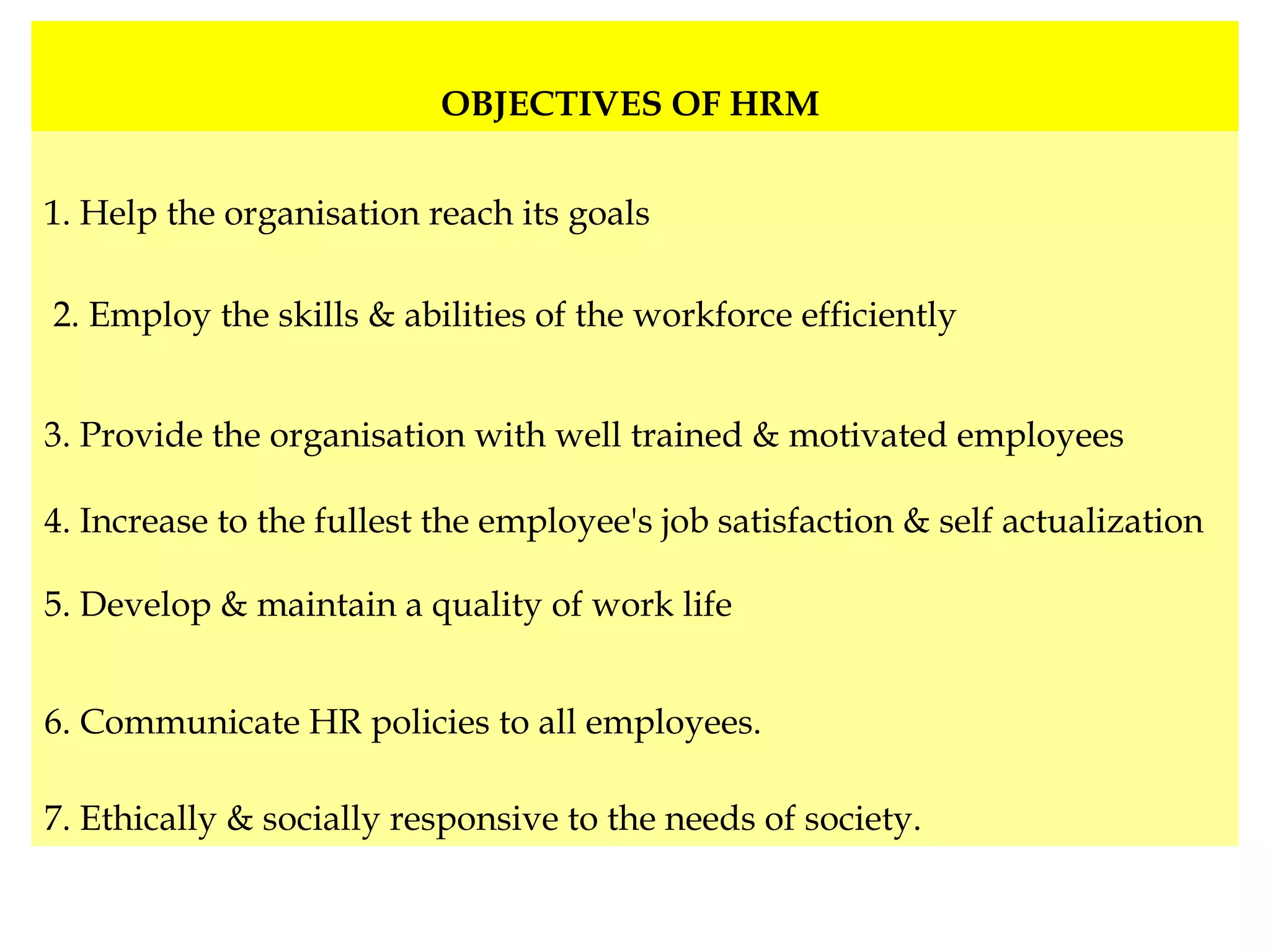
OBJECTIVES OF HRM
1. Help the organisation reach its goals
2. Employ the skills & abilities of the workforce efficiently
3. Provide the organisation with well trained & motivated employees
4. Increase to the fullest the employee's job satisfaction & self actualization
5. Develop & maintain a quality of work life
6. Communicate HR policies to all employees.
7. Ethically & socially responsive to the needs of society.
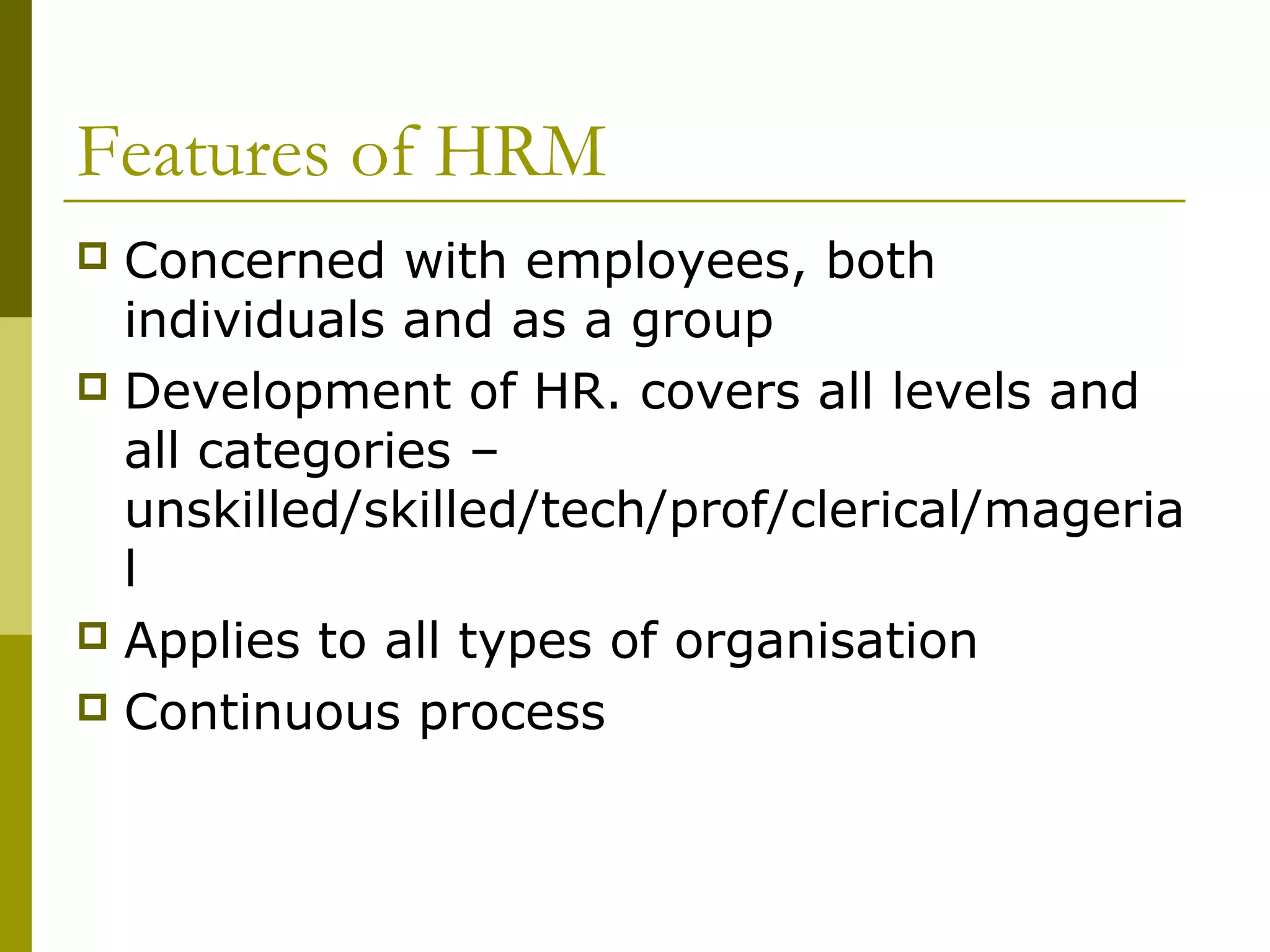
Features of HRM
 Concerned with employees, both
individuals and as a group
 Development of HR. covers all levels and
all categories –
unskilled/skilled/tech/prof/clerical/mageria
l
 Applies to all types of organisation
 Continuous process
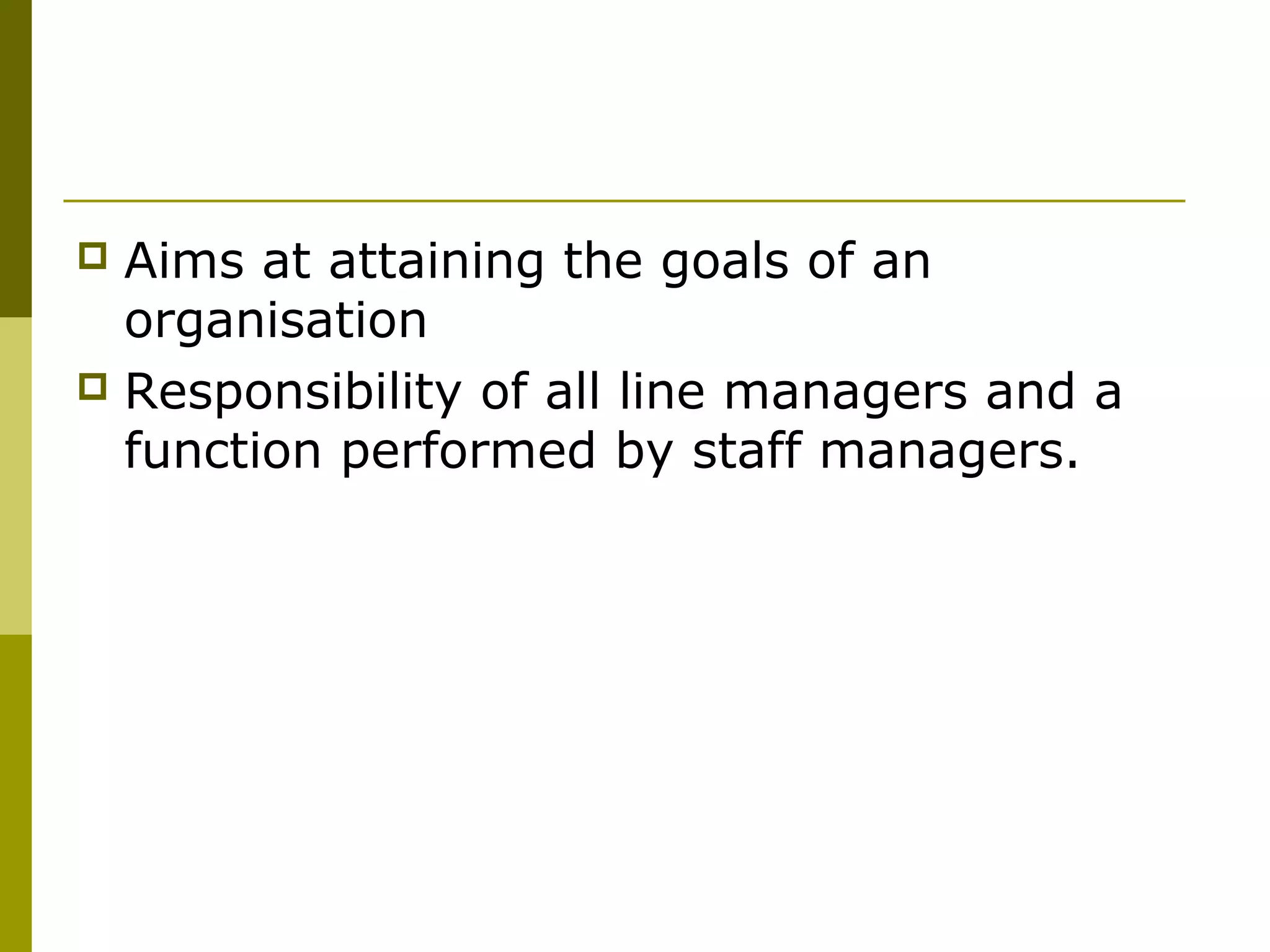
 Aims at attaining the goals of an
organisation
 Responsibility of all line managers and a
function performed by staff managers.
Functions of HRM
A. Managerial Functions:
Planning, Organizing, Directing , Controlling
B. Operative Functions:
Procurement functions, Development
functions, Motivation & compensation,
Maintenance, Integration, & Separation.
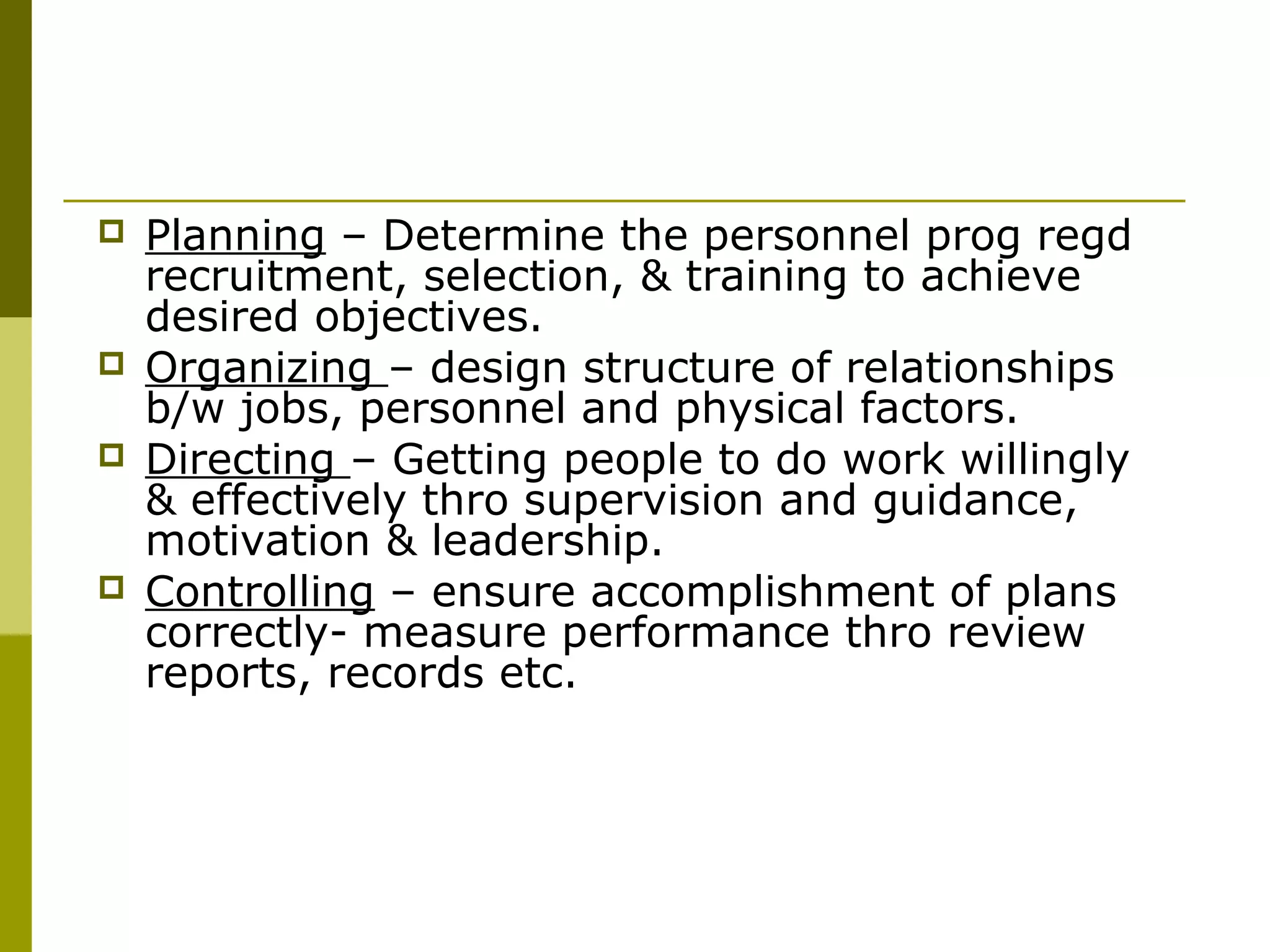
 Planning – Determine the personnel prog regd
recruitment, selection, & training to achieve
desired objectives.
 Organizing – design structure of relationships
b/w jobs, personnel and physical factors.
 Directing – Getting people to do work willingly
& effectively thro supervision and guidance,
motivation & leadership.
 Controlling – ensure accomplishment of plans
correctly- measure performance thro review
reports, records etc.
Managerial Functions
Operative Functions
1. Procurement Function – concerned with
procuring & employing people with required
knowledge, skill and aptitude.
2. Development – Increase of skills, knowledge
abilities etc
3. Motivation & compensation – inspire people to
give best-through incentives & rewards
4. Integration – of goals thro progs, redressal,
negotiations.
5. Maintenance – protecting & preserving
physical and psychological health of
employees
6. Separation
Procurement Development Motivation &
Compensati
on
Integration Maintenance Separation
Job Analysis Training Job design Grievance redressal Health & safety Retirement
HR Planning Executive
development
Work scheduling Discipline Employee welfare Layoff
Recruitment Career planning &
development
Motivation Teams & teamwork Social security
measures
Outsourcing
Selection Human Resource
development
Job evaluation Collective
bargaining
Discharge
Placement Performance
appraisal
Employee
participation
&
empowerment
Induction &
orientation
Compensation
administration
Trade unions &
associations
Internal Mobility Incentives &
benefits.
Industrial relations
ROLE OF PERSONNEL MANAGER
1. Administrative Roles
Policy maker - develop personnel policies
Administrative expert - record keeping, databases, processing benefits/claims, leave,
medical facilities.
Advisor - to line managers , grievance redressal, conflict resolution, selection & training
Housekeeper - recruiting, testing, ref check, employee surveys, salary & wage admin
Counselor - on various personal and professional problems
Welfare officer - provides & maintains canteens, hospitals, clubs, libraries,
transportation, coop societies.
Legal consultant - settling disputes, handling disciplinary cases, collective bargaining.
2. Operational Roles
Recruiter
Trainer, developer, motivator
Coordinator
mediator
3. Strategic Roles
Change Agent - translate vision statements into meaningful format.
Strategic partner - training centre, design centre..
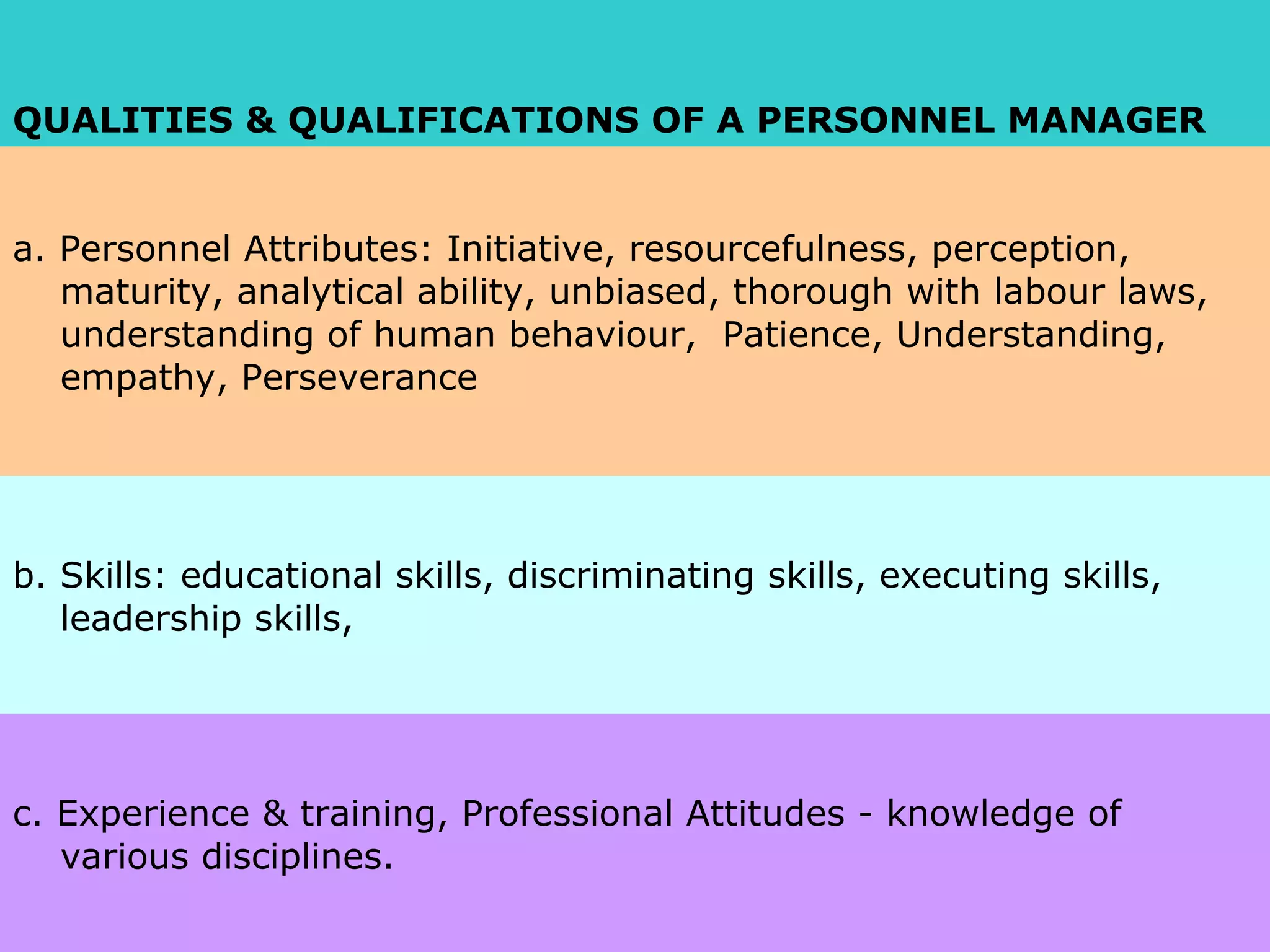
QUALITIES & QUALIFICATIONS OF A PERSONNEL MANAGER
a. Personnel Attributes: Initiative, resourcefulness, perception,
maturity, analytical ability, unbiased, thorough with labour laws,
understanding of human behaviour, Patience, Understanding,
empathy, Perseverance
b. Skills: educational skills, discriminating skills, executing skills,
leadership skills,
c. Experience & training, Professional Attitudes - knowledge of
various disciplines.

1. hrm intro (1)

  • 1.
  • 2.
    CONCEPTS  MANAGEMENT –Accomplishment of organisational objectives by utilizing physical, & financial resources through the efforts of human resources.  RESOURCES - factors of production results in conversion of raw materials into useful goods/services.
  • 3.
    Evolution of conceptof HR  1. Labour / Manpower – denotes physical abilities & capacities of employees – commodity-wages based on demand & supply  2. Personnel – persons employed in service – employees as a whole  3. HR- denotes resources of all the people who contribute their services to the attainment of organisational goals
  • 4.
     Human Resources–  Acc to Leon C. Megission, “HR is the total knowledge, skills, creative abilities, talents and aptitudes of an organisation’s workforce as well as the values, attitudes and beliefs of the individuals involved.”  HRM is a process for making efficient and effective use of Human Resources, so that the set goals are achieved.
  • 5.
    Human Resource Management Defined as the art of procuring, developing and maintaining competent workforce to achieve goals of an organisation in an effective and efficient manner. ( Robbins)
  • 6.
    PM Vs HRM DimensionsPM HRM Nature of Relations Pluralist Unitarian Contract Emphasis on compliance Beyond contract Commitment Conflict Old thought New thought Role of procedures Roles dominated Culture and values dominated Planning Ad-hoc and Reactive Integrated, Proactive
  • 7.
    PERSONNEL MGT HRM Mgmtof people employed Mgmt of KSA, attititudes.. Man is an economic resource/service exchanged for wage / salary Man is an economic, social & psychological Commodity that can be purchased & used Treated as a valuable resource Employees are cost centers, mgmt controls cost Profit Centre- invest capital for development & future use Used only for organisational benefit Used for organization, individual & family benefit Auxiliary function Strategic mgmt function
  • 8.
    HUMAN CAPITAL  “Ouremployees are our greatest assets, and the ability to attract and retain them is the key driver of our future success.”  The human capital can be defined as "the embodiment of productive capacity within people. It is the sum of people’s skills, knowledge, attributes, motivations, and fortitude. It can be given or rented to others, but only on a temporary basis; its ownership is non- transferable.”
  • 9.
    Importance of HRM HR – most important resource  Put other resources to proper use  Help transform lifeless factors of production into useful products  Capable of enlargement – produce extraordinary things when inspired  Can help organisation achieve results quickly, efficiently & effectively.
  • 10.
    Importance Cont….  Attractand retain talent  Train people for changing roles  Develop skills and competencies  Promote team sprit  Develop loyalty  Increase productivity  Improve job satisfaction  Generate employment opportunities
  • 11.
    OBJECTIVES OF HRM 1.Help the organisation reach its goals 2. Employ the skills & abilities of the workforce efficiently 3. Provide the organisation with well trained & motivated employees 4. Increase to the fullest the employee's job satisfaction & self actualization 5. Develop & maintain a quality of work life 6. Communicate HR policies to all employees. 7. Ethically & socially responsive to the needs of society.
  • 12.
    Features of HRM Concerned with employees, both individuals and as a group  Development of HR. covers all levels and all categories – unskilled/skilled/tech/prof/clerical/mageria l  Applies to all types of organisation  Continuous process
  • 13.
     Aims atattaining the goals of an organisation  Responsibility of all line managers and a function performed by staff managers.
  • 14.
    Functions of HRM A.Managerial Functions: Planning, Organizing, Directing , Controlling B. Operative Functions: Procurement functions, Development functions, Motivation & compensation, Maintenance, Integration, & Separation.
  • 15.
     Planning –Determine the personnel prog regd recruitment, selection, & training to achieve desired objectives.  Organizing – design structure of relationships b/w jobs, personnel and physical factors.  Directing – Getting people to do work willingly & effectively thro supervision and guidance, motivation & leadership.  Controlling – ensure accomplishment of plans correctly- measure performance thro review reports, records etc. Managerial Functions
  • 16.
    Operative Functions 1. ProcurementFunction – concerned with procuring & employing people with required knowledge, skill and aptitude. 2. Development – Increase of skills, knowledge abilities etc 3. Motivation & compensation – inspire people to give best-through incentives & rewards 4. Integration – of goals thro progs, redressal, negotiations. 5. Maintenance – protecting & preserving physical and psychological health of employees 6. Separation
  • 17.
    Procurement Development Motivation& Compensati on Integration Maintenance Separation Job Analysis Training Job design Grievance redressal Health & safety Retirement HR Planning Executive development Work scheduling Discipline Employee welfare Layoff Recruitment Career planning & development Motivation Teams & teamwork Social security measures Outsourcing Selection Human Resource development Job evaluation Collective bargaining Discharge Placement Performance appraisal Employee participation & empowerment Induction & orientation Compensation administration Trade unions & associations Internal Mobility Incentives & benefits. Industrial relations
  • 18.
    ROLE OF PERSONNELMANAGER 1. Administrative Roles Policy maker - develop personnel policies Administrative expert - record keeping, databases, processing benefits/claims, leave, medical facilities. Advisor - to line managers , grievance redressal, conflict resolution, selection & training Housekeeper - recruiting, testing, ref check, employee surveys, salary & wage admin Counselor - on various personal and professional problems Welfare officer - provides & maintains canteens, hospitals, clubs, libraries, transportation, coop societies. Legal consultant - settling disputes, handling disciplinary cases, collective bargaining. 2. Operational Roles Recruiter Trainer, developer, motivator Coordinator mediator 3. Strategic Roles Change Agent - translate vision statements into meaningful format. Strategic partner - training centre, design centre..
  • 19.
    QUALITIES & QUALIFICATIONSOF A PERSONNEL MANAGER a. Personnel Attributes: Initiative, resourcefulness, perception, maturity, analytical ability, unbiased, thorough with labour laws, understanding of human behaviour, Patience, Understanding, empathy, Perseverance b. Skills: educational skills, discriminating skills, executing skills, leadership skills, c. Experience & training, Professional Attitudes - knowledge of various disciplines.