TOPS Technologies
http://www.tops-int.com
+91-99747 55006
ANDROID OPERATING
SYSTEM
CONTENTS
• Introduction
• Mobile OS
• Android History
• Android Versions
• Models
• Architecture
• Challenges
• Merits and Demerits
• Limitations
Conclusion and future
Scope
INTRODUCTION
Android is a software
stack for mobile
devices that includes
an operating system,
middleware and key
applications.
4
The Android™ was built upon the open Linux kernel, and
developed by Android, Inc., which is owned by Google.
History
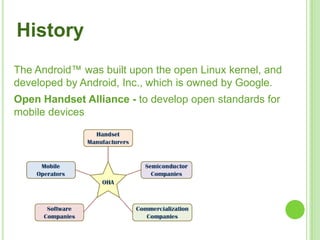
Open Handset Alliance - to develop open standards for
mobile devices
5
A mobile operating system (OS) is a software that
allows smart phones, tablet PCs and other devices to run
applications and programs.
Examples
• Symbian OS
• BlackBerry OS
• Apple’s iOS
• Windows Phone OS
• Android OS
Mobile Operating System
Android Versions
 First Version of Android.
 The focus of Android beta is testing incorporating usability.
 Android beta will generally have many more problems on speed
and performance.
 First full version of android.
 Released on September 23, 2008.
 Wi-Fi and Bluetooth support.
 Quite slow in operating.
 copy and paste feature in the web browser
is not present.
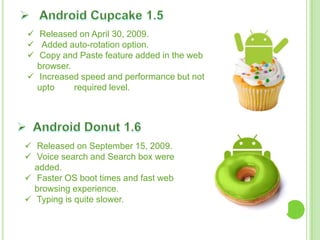
 Released on April 30, 2009.
 Added auto-rotation option.
 Copy and Paste feature added in the web
browser.
 Increased speed and performance but not
upto required level.
 Released on September 15, 2009.
 Voice search and Search box were
added.
 Faster OS boot times and fast web
browsing experience.
 Typing is quite slower.
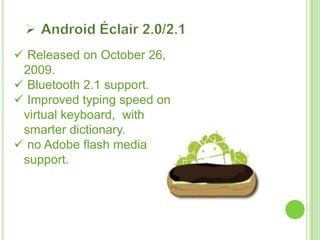
 Released on October 26,
2009.
 Bluetooth 2.1 support.
 Improved typing speed on
virtual keyboard, with
smarter dictionary.
 no Adobe flash media
support.
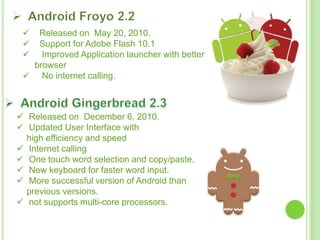
 Released on May 20, 2010.
 Support for Adobe Flash 10.1
 Improved Application launcher with better
browser
 No internet calling.
 Released on December 6, 2010.
 Updated User Interface with
high efficiency and speed
 Internet calling
 One touch word selection and copy/paste.
 New keyboard for faster word input.
 More successful version of Android than
previous versions.
 not supports multi-core processors.
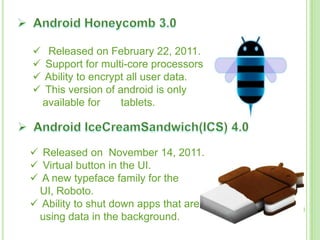
 Released on February 22, 2011.
 Support for multi-core processors
 Ability to encrypt all user data.
 This version of android is only
available for tablets.
 Released on November 14, 2011.
 Virtual button in the UI.
 A new typeface family for the
UI, Roboto.
 Ability to shut down apps that are
using data in the background.
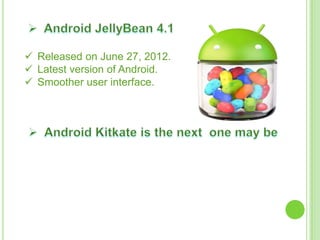
 Released on June 27, 2012.
 Latest version of Android.
 Smoother user interface.
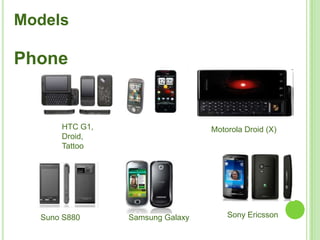
Models
12
HTC G1,
Droid,
Tattoo
Motorola Droid (X)
Suno S880 Samsung Galaxy Sony Ericsson
Phone
13
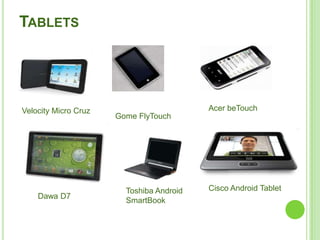
TABLETS
Velocity Micro Cruz
Gome FlyTouch
Acer beTouch
Dawa D7
Toshiba Android
SmartBook
Cisco Android Tablet
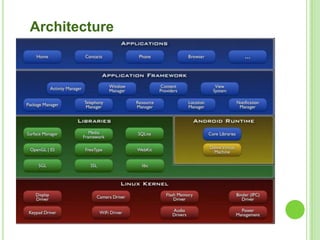
Architecture
15
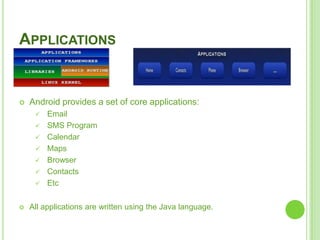
APPLICATIONS
 Android provides a set of core applications:
 Email
 SMS Program
 Calendar
 Maps
 Browser
 Contacts
 Etc
 All applications are written using the Java language.
16
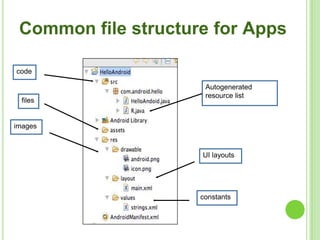
code
images
files
UI layouts
constants
Autogenerated
resource list
Common file structure for Apps
17
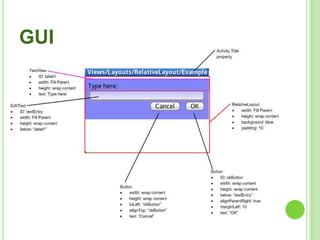
GUI
18
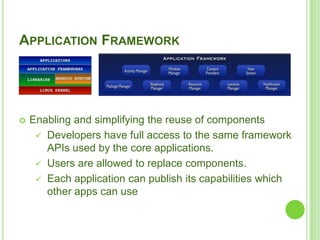
APPLICATION FRAMEWORK
 Enabling and simplifying the reuse of components
 Developers have full access to the same framework
APIs used by the core applications.
 Users are allowed to replace components.
 Each application can publish its capabilities which
other apps can use
19
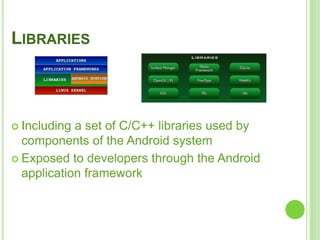
LIBRARIES
 Including a set of C/C++ libraries used by
components of the Android system
 Exposed to developers through the Android
application framework
20
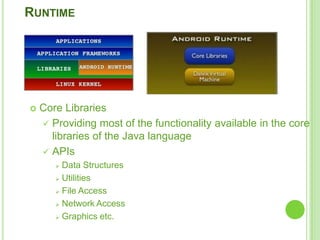
RUNTIME
 Core Libraries
 Providing most of the functionality available in the core
libraries of the Java language
 APIs
 Data Structures
 Utilities
 File Access
 Network Access
 Graphics etc.
21
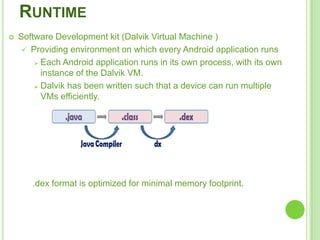
RUNTIME
 Software Development kit (Dalvik Virtual Machine )
 Providing environment on which every Android application runs
 Each Android application runs in its own process, with its own
instance of the Dalvik VM.
 Dalvik has been written such that a device can run multiple
VMs efficiently.
.dex format is optimized for minimal memory footprint.
Challenges
 CPU typically runs 500-600 Mhz
 RAM available to an App may only be a few
megabytes
 Disk (flash) access is very slow
 Lifecycle - apps must pause/quit often, and restore to
give the illusion that they are always running
 UI design
 typical screen may be HVGA (320x480)
 may be in portrait or landscape
 very high DPI - small text may not be readable
 touch resolution is very low (~25 pixel)
 Network access may be slow and (very) intermittent
23
 Highly customizable
 Services can run in the background
 Notifications let you know of background events
 Multitasking
 Widget
 Can install a modified ROM
 Easy access to thousands of applications via the Google
Android Android App Market
 Google Maniac
 Advertising
 Continuous Internet connection
Merits
Demerits
• Making source code available to everyone
inevitably invites the attention of hackers.
• Android operating system uses more amount
of battery as compared to normal mobile
phones.
• As there are so many user sometimes it
becomes difficult to connect all the users.
• As we call Android is world of applications we
continuously need to connected with the
internet which is not possible for all the users.
• Android is now stepping up in next level of
mobile internet.
• There are chances of Android Mobile sales
becomes more then iPhone in next two years.
• Google may launch another version of android
that starts K because Google is launching all the
android versions in the alphabetical order.
• There are chances of Android may become the
widely used operating system in world.

09 09-2013 android-introduction p_pt

  • 1.
  • 2.
    CONTENTS • Introduction • MobileOS • Android History • Android Versions • Models • Architecture • Challenges • Merits and Demerits • Limitations Conclusion and future Scope
  • 3.
    INTRODUCTION Android is asoftware stack for mobile devices that includes an operating system, middleware and key applications.
  • 4.
    4 The Android™ wasbuilt upon the open Linux kernel, and developed by Android, Inc., which is owned by Google. History Open Handset Alliance - to develop open standards for mobile devices
  • 5.
    5 A mobile operatingsystem (OS) is a software that allows smart phones, tablet PCs and other devices to run applications and programs. Examples • Symbian OS • BlackBerry OS • Apple’s iOS • Windows Phone OS • Android OS Mobile Operating System
  • 6.
    Android Versions  FirstVersion of Android.  The focus of Android beta is testing incorporating usability.  Android beta will generally have many more problems on speed and performance.  First full version of android.  Released on September 23, 2008.  Wi-Fi and Bluetooth support.  Quite slow in operating.  copy and paste feature in the web browser is not present.
  • 7.
     Released onApril 30, 2009.  Added auto-rotation option.  Copy and Paste feature added in the web browser.  Increased speed and performance but not upto required level.  Released on September 15, 2009.  Voice search and Search box were added.  Faster OS boot times and fast web browsing experience.  Typing is quite slower.
  • 8.
     Released onOctober 26, 2009.  Bluetooth 2.1 support.  Improved typing speed on virtual keyboard, with smarter dictionary.  no Adobe flash media support.
  • 9.
     Released onMay 20, 2010.  Support for Adobe Flash 10.1  Improved Application launcher with better browser  No internet calling.  Released on December 6, 2010.  Updated User Interface with high efficiency and speed  Internet calling  One touch word selection and copy/paste.  New keyboard for faster word input.  More successful version of Android than previous versions.  not supports multi-core processors.
  • 10.
     Released onFebruary 22, 2011.  Support for multi-core processors  Ability to encrypt all user data.  This version of android is only available for tablets.  Released on November 14, 2011.  Virtual button in the UI.  A new typeface family for the UI, Roboto.  Ability to shut down apps that are using data in the background.
  • 11.
     Released onJune 27, 2012.  Latest version of Android.  Smoother user interface.
  • 12.
    Models 12 HTC G1, Droid, Tattoo Motorola Droid(X) Suno S880 Samsung Galaxy Sony Ericsson Phone
  • 13.
    13 TABLETS Velocity Micro Cruz GomeFlyTouch Acer beTouch Dawa D7 Toshiba Android SmartBook Cisco Android Tablet
  • 14.
  • 15.
    15 APPLICATIONS  Android providesa set of core applications:  Email  SMS Program  Calendar  Maps  Browser  Contacts  Etc  All applications are written using the Java language.
  • 16.
  • 17.
  • 18.
    18 APPLICATION FRAMEWORK  Enablingand simplifying the reuse of components  Developers have full access to the same framework APIs used by the core applications.  Users are allowed to replace components.  Each application can publish its capabilities which other apps can use
  • 19.
    19 LIBRARIES  Including aset of C/C++ libraries used by components of the Android system  Exposed to developers through the Android application framework
  • 20.
    20 RUNTIME  Core Libraries Providing most of the functionality available in the core libraries of the Java language  APIs  Data Structures  Utilities  File Access  Network Access  Graphics etc.
  • 21.
    21 RUNTIME  Software Developmentkit (Dalvik Virtual Machine )  Providing environment on which every Android application runs  Each Android application runs in its own process, with its own instance of the Dalvik VM.  Dalvik has been written such that a device can run multiple VMs efficiently. .dex format is optimized for minimal memory footprint.
  • 22.
    Challenges  CPU typicallyruns 500-600 Mhz  RAM available to an App may only be a few megabytes  Disk (flash) access is very slow  Lifecycle - apps must pause/quit often, and restore to give the illusion that they are always running  UI design  typical screen may be HVGA (320x480)  may be in portrait or landscape  very high DPI - small text may not be readable  touch resolution is very low (~25 pixel)  Network access may be slow and (very) intermittent
  • 23.
    23  Highly customizable Services can run in the background  Notifications let you know of background events  Multitasking  Widget  Can install a modified ROM  Easy access to thousands of applications via the Google Android Android App Market  Google Maniac  Advertising  Continuous Internet connection Merits Demerits
  • 24.
    • Making sourcecode available to everyone inevitably invites the attention of hackers. • Android operating system uses more amount of battery as compared to normal mobile phones. • As there are so many user sometimes it becomes difficult to connect all the users. • As we call Android is world of applications we continuously need to connected with the internet which is not possible for all the users.
  • 25.
    • Android isnow stepping up in next level of mobile internet. • There are chances of Android Mobile sales becomes more then iPhone in next two years. • Google may launch another version of android that starts K because Google is launching all the android versions in the alphabetical order. • There are chances of Android may become the widely used operating system in world.

Editor's Notes

  • #4 Android is a complete operating environment based upon the Linux® V2.6 kernel. Initially, the deployment target for Android was the mobile-phone arena, including smart phones and lower-cost flip-phone devices. However, Android's full range of computing services and rich functional support have the potential to extend beyond the mobile-phone market. Android can be useful for other platforms and applications. In this article, get an introduction to the Android platform and learn how to code a basic Android application.
  • #5 • 2001 search service for wireless device• 2005– Acquire Android(Andy Rubin: Danger CEO, Development Sidekick of T-Mobile)– Acquire Skia (2D Graphics for mobile device)– Acquire RegWireless (Browser and Email for mobile device)– Move Engineers from PlamSource (Dianne Hackborn, etc…)• 2007 Nov 5: Android announced • 2007 Nov 12: Android SDK released by OHA• 2007 Dec 14: Bug-fix SDK released• 2008 Jan 3: Android Developer Challenge I starts accepting submissions• 2008 Feb 13: m5-rc15 SDK released• 2008 Apr 14: 1788 total submissions for Challenge I• 2008 May 12: Top 50 Applications in Challenge I announced• 2008 Nov: Android Phone(G1 Phone by HTC/T-mobile)• 2008 Nov: Full Source Open• 2009 Apr: HTC Magic• 2009 July: HTC Hero, Samsung i7500, Android Netbook, Set-top……• 2009 Aug: Android Developer Challenge II