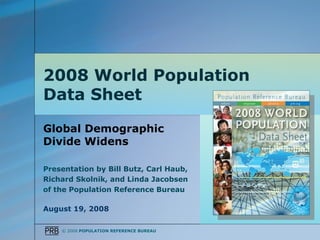
2008 World Population
Data Sheet

Global Demographic
Divide Widens

Presentation by Bill Butz, Carl Haub,
Richard Skolnik, and Linda Jacobsen
of the Population Reference Bureau

August 19, 2008

    © 2008 POPULATION REFERENCE BUREAU
Developing Regions Make Up an
 Increasing Share of World Population.

World Population (in Billions): 1950-2050


Source: United Nations Population Division, World Population Prospects: The 2006 Revision.

        © 2008 POPULATION REFERENCE BUREAU
More Developed Countries Have Fewer
 Young People Relative to Elderly.

Population by Age and Sex, More Developed Countries: 2008


Source: United Nations Population Division, World Population Prospects: The 2006 Revision.

        © 2008 POPULATION REFERENCE BUREAU
Less Developed Countries Have More
 Young People Relative to Elderly.

Population by Age and Sex, Less Developed Countries: 2008


Source: United Nations Population Division, World Population Prospects: The 2006 Revision.

        © 2008 POPULATION REFERENCE BUREAU
Italy and the Democratic Republic of the
 Congo (formerly Zaire) Illustrate the
 Demographic Divide in 2008.


                                                                                DEM. REP. OF
                                                                  ITALY
                                                                                 THE CONGO
  2008 Population                                               59.9 million       66.5 million
  2025 Population                                               62.0 million      109.7 million
  Population below Age 15                                        8.4 million       31.3 million
  Population Age 65 and Older                                   11.9 million        1.7 million
  Annual Births                                                     568,000         2.9 million
  Annual Deaths                                                     575,000            843,000
  Annual Natural Increase (births minus deaths)                       - 7,000       2.1 million
  Annual Infant Deaths                                                 2,300           270,000
  Life Expectancy at Birth                                          81 years          53 years
  Percent of Population Undernourished                                < 2.5%              74%


Source: Carl Haub and Mary Mederios Kent, 2008 World Population Data Sheet.

       © 2008 POPULATION REFERENCE BUREAU
Every Country Has a Different
 Pattern of Fertility Decline.

Fertility Patterns for Selected Countries: 1950-2010


Sources: United Nations Population Division, World Population Prospects: The 2006 Revision;
Population Reference Bureau; and Korea National Statistics Office.

        © 2008 POPULATION REFERENCE BUREAU
What Do Global Population
Projections Assume?


“Realization of the medium variant projections
contained in the 2006 Revision is also contingent
on ensuring that fertility continues to decline in
developing countries…To achieve such
reductions, it is essential that access to family
planning expands in the poorest countries of the
world.”

Source: United Nations Population Division, World
Population Prospects: The 2006 Revision.


   © 2008 POPULATION REFERENCE BUREAU
Just as Fertility Patterns Differ, So
 Do Those of Contraceptive Use.

Percent of Married Women Using Contraception, Selected Countries


N.A. – Data not available.
Sources: Demographic and Health Surveys and United Nations Population Division.

        © 2008 POPULATION REFERENCE BUREAU
Few Statistics Show Cross-Regional Gaps
    in Health Care as Does Maternal Mortality.


A Woman’s Lifetime Risk of Dying from a Pregnancy-Related
Cause: 2005

            Developed Countries 1                                      1 in 7,300
            Eastern Asia                                               1 in 1,200
            Latin America and the Caribbean                              1 in 290
            North Africa 2                                               1 in 210
            WORLD TOTAL                                                    1 in 92
            South Asia                                                     1 in 61
            Sub-Saharan Africa                                             1 in 22

1
    Excludes non-Baltic republics of the former Soviet Union.
2
    Excludes Sudan.
Source: WHO, UNICEF, UNFPA, and the World Bank, Maternal Mortality in 2005: Estimates
Developed by WHO, UNICEF, UNFPA, and the World Bank.


           © 2008 POPULATION REFERENCE BUREAU
Many People Lack Required Calories.

Percent of Population Consuming Less Than Required Number of Calories, 2002-2004


Source: United Nations Food and Agriculture Organization, Statistics Division.

        © 2008 POPULATION REFERENCE BUREAU
Mother’s Education Is A Key to
Children’s Nutritional Status.

Percent of Children Under Age 3 Who Are Stunted, by Mother’s Education


Source: Demographic and Health Surveys.

       © 2008 POPULATION REFERENCE BUREAU
Stunting Can Be Addressed.


 Focus on children from conception to 2 years of age.
 Promote exclusive breastfeeding and appropriate
  complementary foods.
 Encourage community-based approaches to better
  feeding and caring.
 Reduce infection.
 Ready-to-use foods are promising in some settings.
 Conditional cash transfers also show promise.


   © 2008 POPULATION REFERENCE BUREAU
The Countries With the Least Access to an
 Improved Water Source Have Among the
 World’s Fastest-Growing Populations.


                                                                       Population (millions)
                                      Percent of Population
                                         With Improved
                                         Drinking Water                Mid-2008      Mid-2025
                                          Source, 2006

 Afghanistan                                        22                        32.7     50.3
 Ethiopia                                           42                        79.1    110.5
 Niger                                              42                        14.7     26.3
 Dem. Rep. of the Congo                             46                        66.5    109.7
 Nigeria                                            47                   148.1        205.4


Source: Carl Haub and Mary Mederios Kent, 2008 World Population Data Sheet.


       © 2008 POPULATION REFERENCE BUREAU
The United States Has Been Growing
 Faster Than Expected.

United States Population (in Millions): 1970-2050


Source: Population Reference Bureau, analysis of data from U.S. Census Bureau.

        © 2008 POPULATION REFERENCE BUREAU
Continued Population Growth Sets the
 United States Apart From Other Developed
 Countries Around the World.

Percent Change in Population, Selected Countries: 2008-2050


Source: Carl Haub and Mary Mederios Kent, 2008 World Population Data Sheet.

       © 2008 POPULATION REFERENCE BUREAU
By 2050, One in Every Five
 Americans Will Be Age 65 or Older.

Percent of U.S. Population in Selected Age Groups: 1970-2050


Source: Population Reference Bureau, analysis of data from U.S. Census Bureau.

        © 2008 POPULATION REFERENCE BUREAU
The United States Will Continue to Become
 More Racially and Ethnically Diverse.

Percent of U.S. Population by Race and Ethnicity:
At 300 Million and 400 Million


                                                          AT 300 MILLION         AT 400 MILLION
                                                              (2007)                 (2039)
  White Alone*                                                             66                51
  Black or African American Alone*                                         12                12
  Asian, Native Hawaiian, and Other Pacific
                                                                            5                 7
  Islander Alone*
  American Indian and Alaska Native Alone*                                  1                 1
  Two or More Races*                                                        1                 3
  Hispanic (of any race)                                                   15                26
  TOTAL                                                                   100               100


* Excludes Hispanics.
Source: Population Reference Bureau, analysis of data from U.S. Census Bureau.

        © 2008 POPULATION REFERENCE BUREAU
Ten Percent of U.S. Counties Have Already
 Reached Majority-Minority Status.

Counties at or Nearing Majority-Minority Status (Total Population), United States: 2007


Source: Population Reference Bureau, analysis of data from U.S. Census Bureau.

        © 2008 POPULATION REFERENCE BUREAU
Minorities Make Up at Least 50 Percent of
 the Youth Population in One in Seven
 Counties Nationwide.

Counties at or Nearing Majority-Minority Status (Under-20 Population), United States: 2007


Source: Population Reference Bureau, analysis of data from U.S. Census Bureau.

        © 2008 POPULATION REFERENCE BUREAU
The Current Generation Gap in Racial-
 Ethnic Diversity Will Gradually Decrease
 by 2050.

Percent of the U.S. Population That Is Minority, by Age Group: 2007-2050


Source: Population Reference Bureau, analysis of data from U.S. Census Bureau.

        © 2008 POPULATION REFERENCE BUREAU
2008 World Population
Data Sheet

Global Demographic
Divide Widens

Presentation by Bill Butz, Carl Haub,
Richard Skolnik, and Linda Jacobsen
of the Population Reference Bureau

August 19, 2008

    © 2008 POPULATION REFERENCE BUREAU

08worlddatasheet presentation

  • 1.
    2008 World Population DataSheet Global Demographic Divide Widens Presentation by Bill Butz, Carl Haub, Richard Skolnik, and Linda Jacobsen of the Population Reference Bureau August 19, 2008 © 2008 POPULATION REFERENCE BUREAU
  • 2.
    Developing Regions MakeUp an Increasing Share of World Population. World Population (in Billions): 1950-2050 Source: United Nations Population Division, World Population Prospects: The 2006 Revision. © 2008 POPULATION REFERENCE BUREAU
  • 3.
    More Developed CountriesHave Fewer Young People Relative to Elderly. Population by Age and Sex, More Developed Countries: 2008 Source: United Nations Population Division, World Population Prospects: The 2006 Revision. © 2008 POPULATION REFERENCE BUREAU
  • 4.
    Less Developed CountriesHave More Young People Relative to Elderly. Population by Age and Sex, Less Developed Countries: 2008 Source: United Nations Population Division, World Population Prospects: The 2006 Revision. © 2008 POPULATION REFERENCE BUREAU
  • 5.
    Italy and theDemocratic Republic of the Congo (formerly Zaire) Illustrate the Demographic Divide in 2008. DEM. REP. OF ITALY THE CONGO 2008 Population 59.9 million 66.5 million 2025 Population 62.0 million 109.7 million Population below Age 15 8.4 million 31.3 million Population Age 65 and Older 11.9 million 1.7 million Annual Births 568,000 2.9 million Annual Deaths 575,000 843,000 Annual Natural Increase (births minus deaths) - 7,000 2.1 million Annual Infant Deaths 2,300 270,000 Life Expectancy at Birth 81 years 53 years Percent of Population Undernourished < 2.5% 74% Source: Carl Haub and Mary Mederios Kent, 2008 World Population Data Sheet. © 2008 POPULATION REFERENCE BUREAU
  • 6.
    Every Country Hasa Different Pattern of Fertility Decline. Fertility Patterns for Selected Countries: 1950-2010 Sources: United Nations Population Division, World Population Prospects: The 2006 Revision; Population Reference Bureau; and Korea National Statistics Office. © 2008 POPULATION REFERENCE BUREAU
  • 7.
    What Do GlobalPopulation Projections Assume? “Realization of the medium variant projections contained in the 2006 Revision is also contingent on ensuring that fertility continues to decline in developing countries…To achieve such reductions, it is essential that access to family planning expands in the poorest countries of the world.” Source: United Nations Population Division, World Population Prospects: The 2006 Revision. © 2008 POPULATION REFERENCE BUREAU
  • 8.
    Just as FertilityPatterns Differ, So Do Those of Contraceptive Use. Percent of Married Women Using Contraception, Selected Countries N.A. – Data not available. Sources: Demographic and Health Surveys and United Nations Population Division. © 2008 POPULATION REFERENCE BUREAU
  • 9.
    Few Statistics ShowCross-Regional Gaps in Health Care as Does Maternal Mortality. A Woman’s Lifetime Risk of Dying from a Pregnancy-Related Cause: 2005 Developed Countries 1 1 in 7,300 Eastern Asia 1 in 1,200 Latin America and the Caribbean 1 in 290 North Africa 2 1 in 210 WORLD TOTAL 1 in 92 South Asia 1 in 61 Sub-Saharan Africa 1 in 22 1 Excludes non-Baltic republics of the former Soviet Union. 2 Excludes Sudan. Source: WHO, UNICEF, UNFPA, and the World Bank, Maternal Mortality in 2005: Estimates Developed by WHO, UNICEF, UNFPA, and the World Bank. © 2008 POPULATION REFERENCE BUREAU
  • 10.
    Many People LackRequired Calories. Percent of Population Consuming Less Than Required Number of Calories, 2002-2004 Source: United Nations Food and Agriculture Organization, Statistics Division. © 2008 POPULATION REFERENCE BUREAU
  • 11.
    Mother’s Education IsA Key to Children’s Nutritional Status. Percent of Children Under Age 3 Who Are Stunted, by Mother’s Education Source: Demographic and Health Surveys. © 2008 POPULATION REFERENCE BUREAU
  • 12.
    Stunting Can BeAddressed.  Focus on children from conception to 2 years of age.  Promote exclusive breastfeeding and appropriate complementary foods.  Encourage community-based approaches to better feeding and caring.  Reduce infection.  Ready-to-use foods are promising in some settings.  Conditional cash transfers also show promise. © 2008 POPULATION REFERENCE BUREAU
  • 13.
    The Countries Withthe Least Access to an Improved Water Source Have Among the World’s Fastest-Growing Populations. Population (millions) Percent of Population With Improved Drinking Water Mid-2008 Mid-2025 Source, 2006 Afghanistan 22 32.7 50.3 Ethiopia 42 79.1 110.5 Niger 42 14.7 26.3 Dem. Rep. of the Congo 46 66.5 109.7 Nigeria 47 148.1 205.4 Source: Carl Haub and Mary Mederios Kent, 2008 World Population Data Sheet. © 2008 POPULATION REFERENCE BUREAU
  • 14.
    The United StatesHas Been Growing Faster Than Expected. United States Population (in Millions): 1970-2050 Source: Population Reference Bureau, analysis of data from U.S. Census Bureau. © 2008 POPULATION REFERENCE BUREAU
  • 15.
    Continued Population GrowthSets the United States Apart From Other Developed Countries Around the World. Percent Change in Population, Selected Countries: 2008-2050 Source: Carl Haub and Mary Mederios Kent, 2008 World Population Data Sheet. © 2008 POPULATION REFERENCE BUREAU
  • 16.
    By 2050, Onein Every Five Americans Will Be Age 65 or Older. Percent of U.S. Population in Selected Age Groups: 1970-2050 Source: Population Reference Bureau, analysis of data from U.S. Census Bureau. © 2008 POPULATION REFERENCE BUREAU
  • 17.
    The United StatesWill Continue to Become More Racially and Ethnically Diverse. Percent of U.S. Population by Race and Ethnicity: At 300 Million and 400 Million AT 300 MILLION AT 400 MILLION (2007) (2039) White Alone* 66 51 Black or African American Alone* 12 12 Asian, Native Hawaiian, and Other Pacific 5 7 Islander Alone* American Indian and Alaska Native Alone* 1 1 Two or More Races* 1 3 Hispanic (of any race) 15 26 TOTAL 100 100 * Excludes Hispanics. Source: Population Reference Bureau, analysis of data from U.S. Census Bureau. © 2008 POPULATION REFERENCE BUREAU
  • 18.
    Ten Percent ofU.S. Counties Have Already Reached Majority-Minority Status. Counties at or Nearing Majority-Minority Status (Total Population), United States: 2007 Source: Population Reference Bureau, analysis of data from U.S. Census Bureau. © 2008 POPULATION REFERENCE BUREAU
  • 19.
    Minorities Make Upat Least 50 Percent of the Youth Population in One in Seven Counties Nationwide. Counties at or Nearing Majority-Minority Status (Under-20 Population), United States: 2007 Source: Population Reference Bureau, analysis of data from U.S. Census Bureau. © 2008 POPULATION REFERENCE BUREAU
  • 20.
    The Current GenerationGap in Racial- Ethnic Diversity Will Gradually Decrease by 2050. Percent of the U.S. Population That Is Minority, by Age Group: 2007-2050 Source: Population Reference Bureau, analysis of data from U.S. Census Bureau. © 2008 POPULATION REFERENCE BUREAU
  • 21.
    2008 World Population DataSheet Global Demographic Divide Widens Presentation by Bill Butz, Carl Haub, Richard Skolnik, and Linda Jacobsen of the Population Reference Bureau August 19, 2008 © 2008 POPULATION REFERENCE BUREAU