What is discourse?

Module 2
2008-9

Lesson 4
Why analyse discourse?
Some (many?) things happen primarily (only?) in language
From (say)
To (say)

promising to come to dinner
telling someone you love them

(Or indeed: talking to the dog)
Definitions of Discourse (1)
A particular unit of language (above the
sentence), or discourse in structure;
A particular focus on language use,
discourse as function.
Discourse as structure ?
Problem:you can have a unit which looks like a sentence
but doesn’t mean anything
e.g. Colourless green ideas sleep furiously
… but on the other hand the units in which people speak
do not always look like sentences.
e.g. You can run a hou- whatcha- now whatcha you can
run a house-you can run a house a- and do the job,
which is important, y’ can’t y- a man can’t do it
himself, and a woman can’t do it himself w- if y’ want
it to be successful. In most cases.
How do you analyse something which is not a
sentence?
Discourse as a System of
functions ?
e.g. “what’s the time?”
Phatic function (opens a contact)
Emotive function (conveys the need of the speaker)
Conative function (asks something of the addressee)
Referential function (makes reference to the world
outside the language)
PROBLEM:
Discourse analysis may turn into a more general and
broader analysis of language functions.
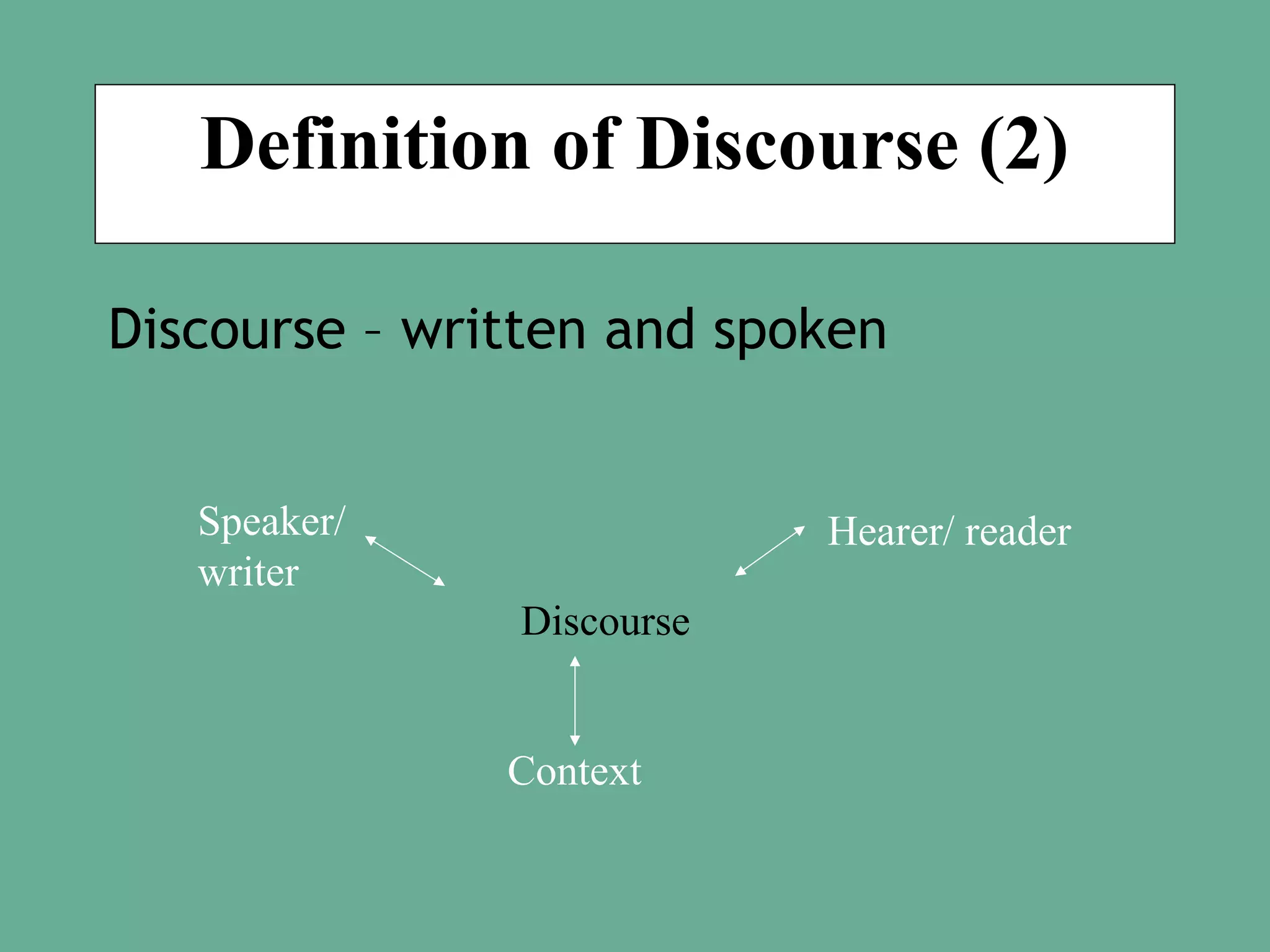
Definition of Discourse (2)
Discourse – written and spoken
Speaker/
writer

Hearer/ reader
Discourse
Context
Objects of discourse
‘Discourse’ refers to any utterance which is
meaningful. These texts can be:
- written texts
- oral texts (‘speech’/’talk’)
- mixed written/oral texts (e.g. Internet chat)
Discourse does not depend on the size of a text
(“P” and “Ladies” can both be analysed as
discourse)
Definitions of ‘discourse’ (3)
(a)

A set of terms, metaphors, allusions, ways of talking, references and
so on, which constitute an object

(b)

A to-and-fro of exchanges in talk (or text) that performs social
actions
Doing discourse analysis

Scope
Influences
Approaches
The scope of discourse analysis
Discourse analysis is not a discipline which exists on its
own. It is influenced by other disciplines and
influences them as well. It is a two-way process …
For this reason discourse analysis examines spoken and
written texts from all sorts of different areas
(medical, legal, advertising) and from all sorts of
perspectives (race, gender, power)
Discourse analysis has a number of practical
applications - for example in analysing
communication problems in medicine,
psychotherapy, education, in analysing written style
etc.
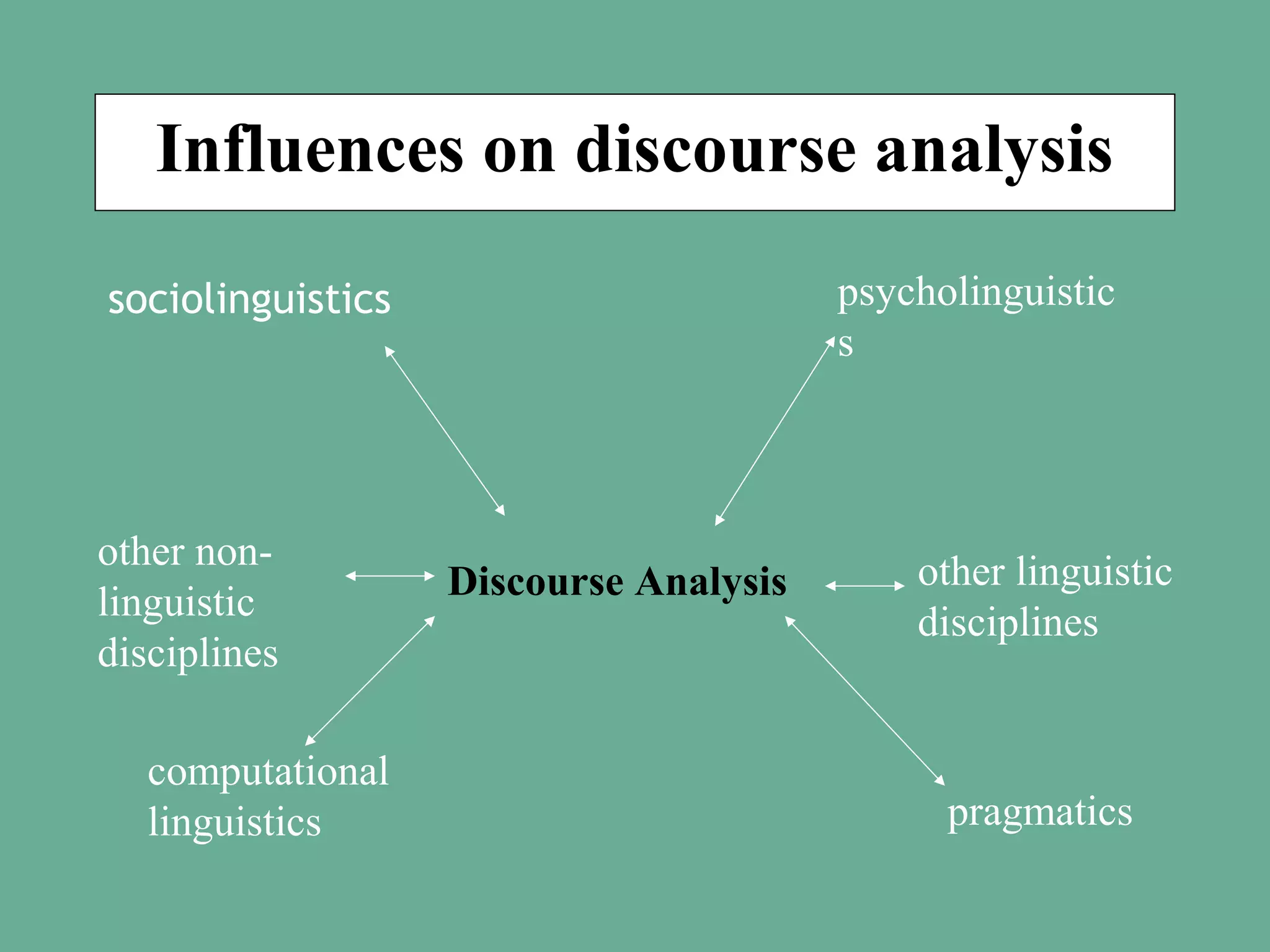
Influences on discourse analysis
psycholinguistic
s

sociolinguistics

other nonlinguistic
disciplines
computational
linguistics

Discourse Analysis

other linguistic
disciplines

pragmatics
Approaches to Discourse
Deborah Schiffrin “Approaches to Discourse”
(1994) singles out 6 major approaches to
discourse:
the speech act approach;
interactional sociolinguistics;
the ethnography of communication;
pragmatic approach;
conversation analysis;
variationist approach.
Approaches to Discourse (1)

The Speech Act Approach
Founders of the speech act theory: John Austin & John
Searle.
There are different types of speech acts:
e.g. “speak louder” (directive)
“Oxford Street is a shopper’s paradise“ (assertive)
Although speech act theory was not first developed as a
means of analyzing discourse, particular issues in speech
act theory (indirect speech acts, multiple functions of
utterances) led to discourse analysis
Approaches to Discourse (2)

Interactional sociolinguistics
Represents the combination of three disciplines:
anthropology, sociology, and linguistics.
Focuses on how people from different cultures may share
grammatical knowledge of a language but
contextualize what is said differently to produce
different messages.
e.g. “yeah, bring them down here. I’ll flog them for you”
(Australian English)
Approaches to Discourse (3)

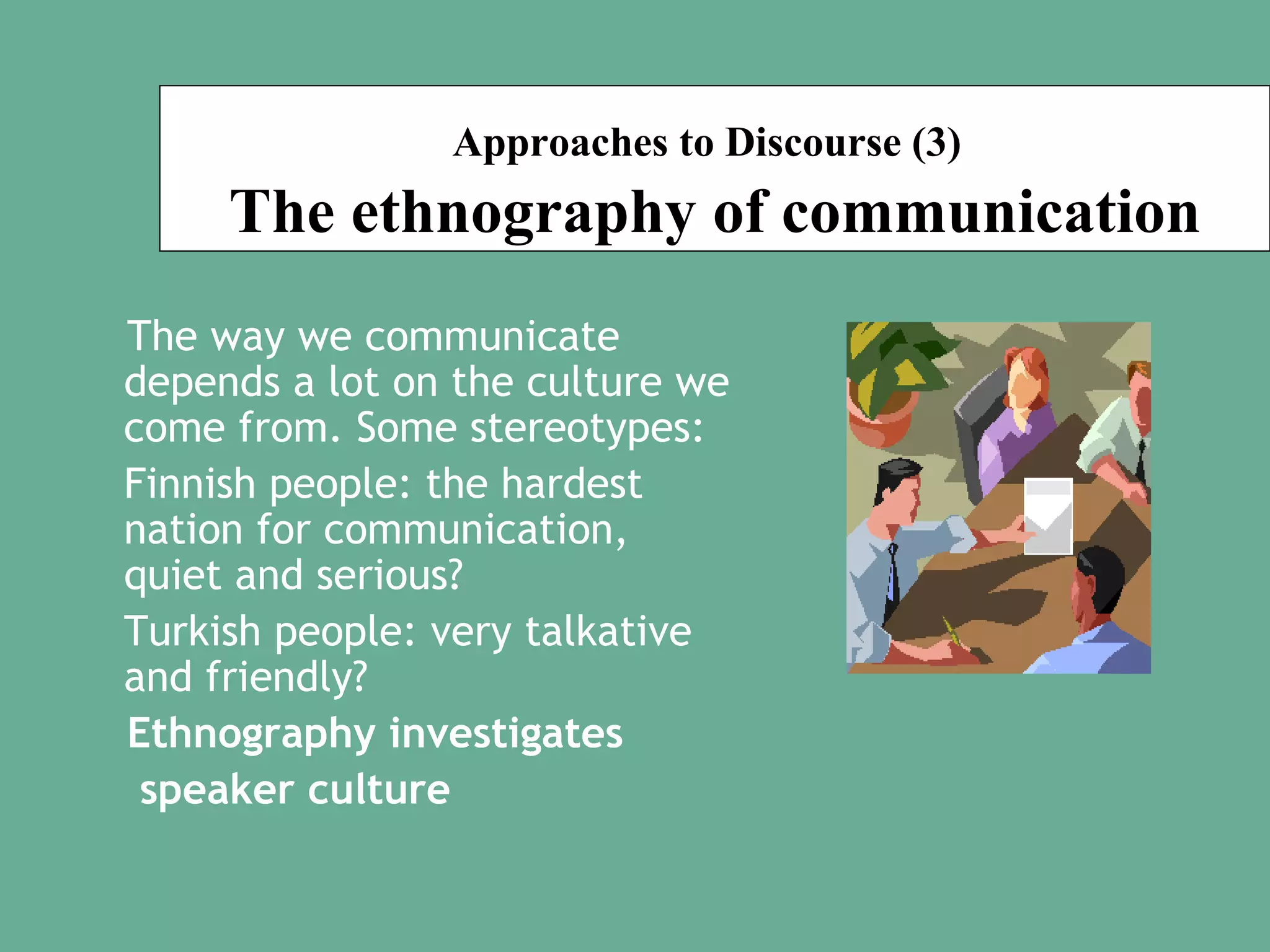
The ethnography of communication
The way we communicate
depends a lot on the culture we
come from. Some stereotypes:
Finnish people: the hardest
nation for communication,
quiet and serious?
Turkish people: very talkative
and friendly?
Ethnography investigates
speaker culture
Approaches to Discourse (4)

Pragmatics
H. P. Grice: the cooperative principle
and conversational maxims.
People interact by using minimal
assumptions about one another.
Approaches to Discourse (5)

Conversation analysis
e.g. A: This is Mr. Smith may I help you
B: I can’t hear you
A: This is Mr. Smith
B: Smith.

Conversational analysis is particularly
interested in the sequencing of utterances,
i.e. not in what people say but in how they
say it
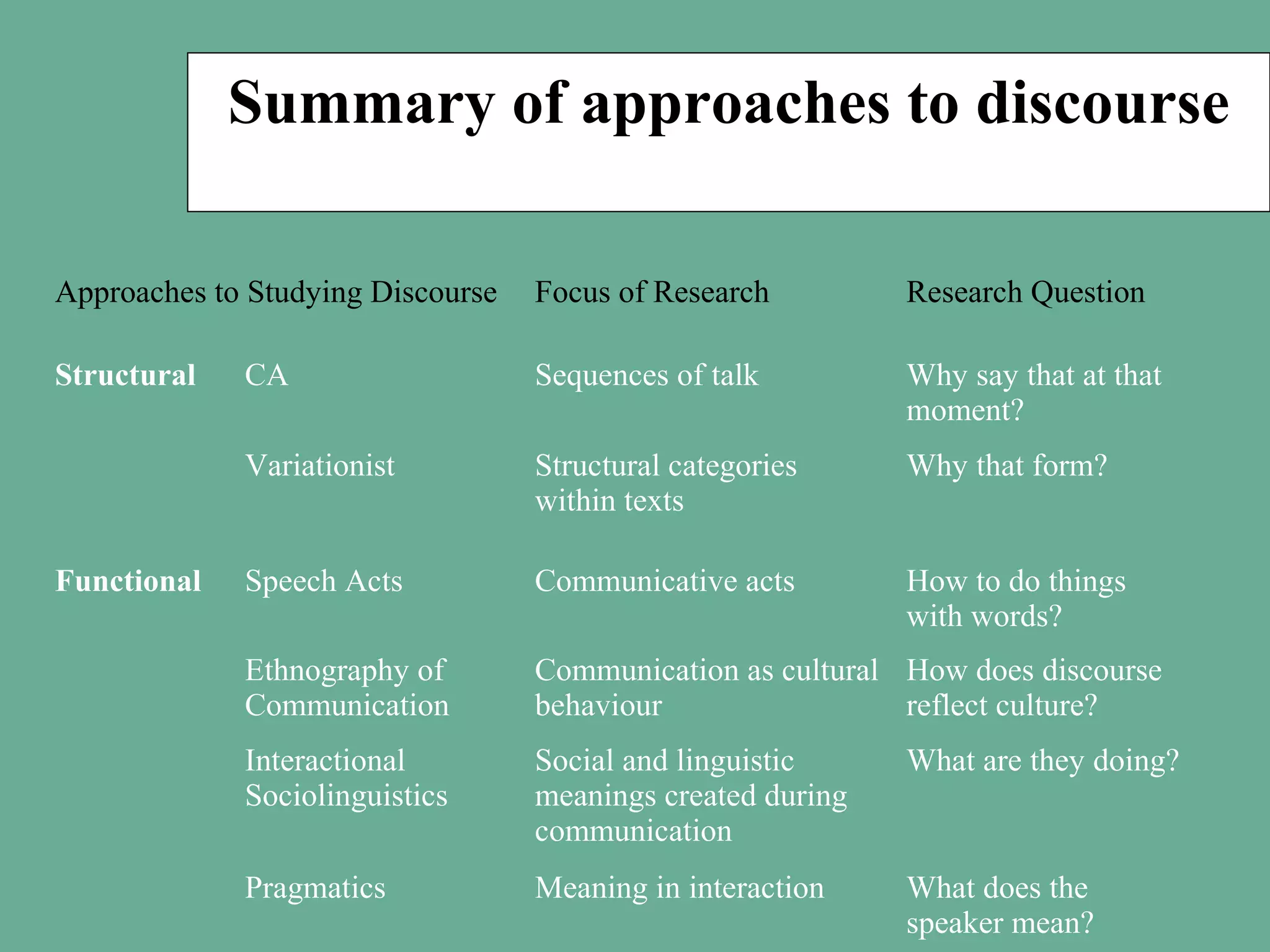
Summary of approaches to discourse
Approaches to Studying Discourse

Focus of Research

Research Question

Structural

CA

Sequences of talk

Why say that at that
moment?

Variationist

Structural categories
within texts

Why that form?

Speech Acts

Communicative acts

How to do things
with words?

Ethnography of
Communication

Communication as cultural How does discourse
behaviour
reflect culture?

Interactional
Sociolinguistics

Social and linguistic
meanings created during
communication

What are they doing?

Pragmatics

Meaning in interaction

What does the
speaker mean?

Functional
How do you analyse discourse?
Various ways. Depends on what sort of discourse you’re interested in.

Constituting an object vs realising a social action
Constituting an object
Usually some cultural object (marriage, crime, obesity etc)
Data:
Media texts (eg news reports, magazine articles, newspaper features)
Personal accounts (eg in interviews, diaries)
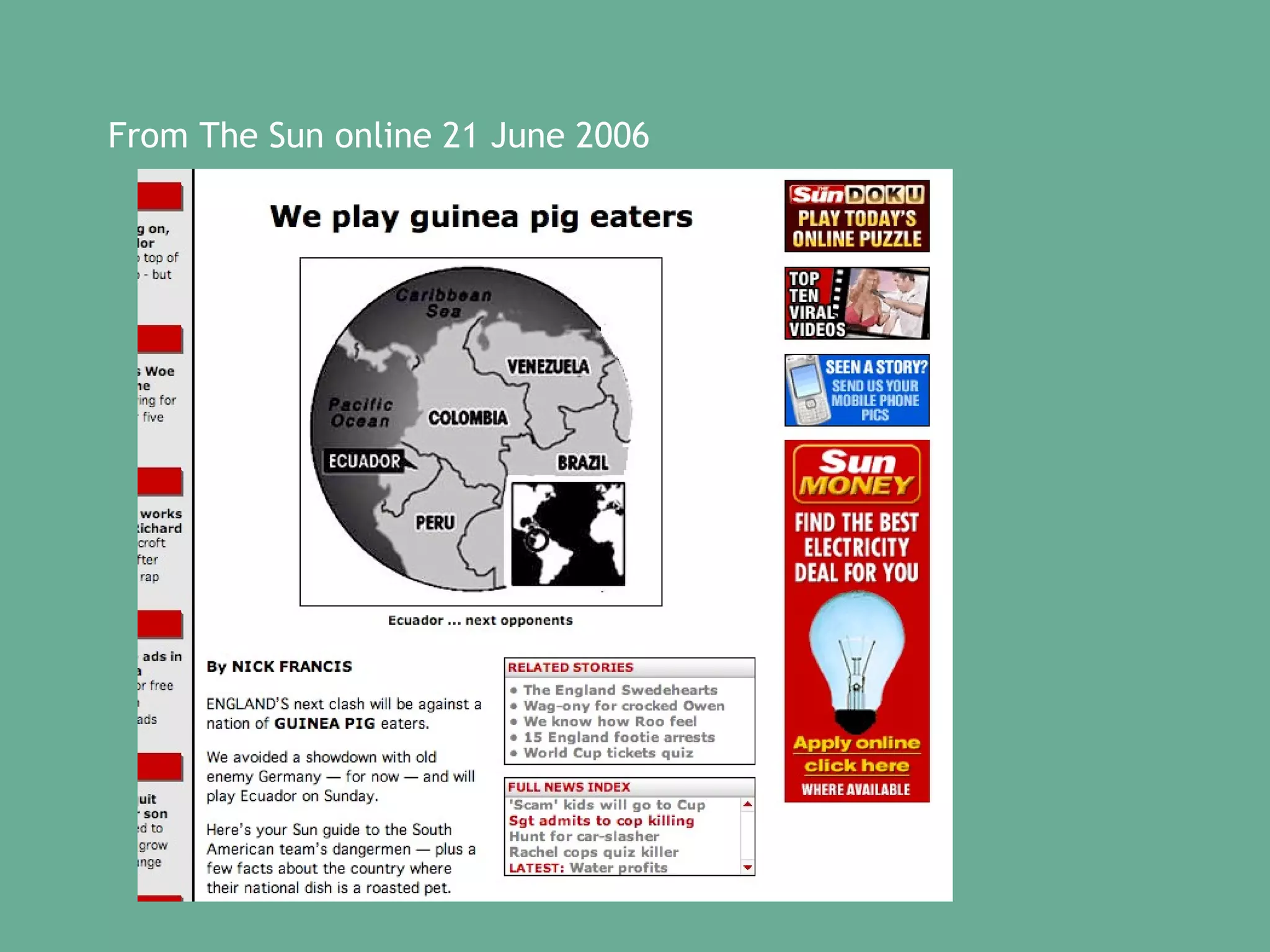
From The Sun online 21 June 2006
ENGLAND’S next clash will be against a nation of
GUINEA PIG eaters.We avoided a showdown with
old enemy Germany — for now — and will play
Ecuador on Sunday.
Here’s your Sun guide to the South American team’s
dangermen — plus a few facts about the country
where their national dish is a roasted pet.
It would be easy to underestimate them. But Ecuador
beat mighty Brazil and Argentina in the South
American qualifying rounds.
[continues]
ENGLAND’S next clash will be against a
nation of GUINEA PIG eaters.We
avoided a showdown with old enemy
Germany — for now — and will play
Ecuador on Sunday.
Here’s your Sun guide to the South
American team’s dangermen — plus a
few facts about the country where their
national dish is a roasted pet.

The whole nation?
Nothing else?
Why old enemy?

Facts?
Whose pet?
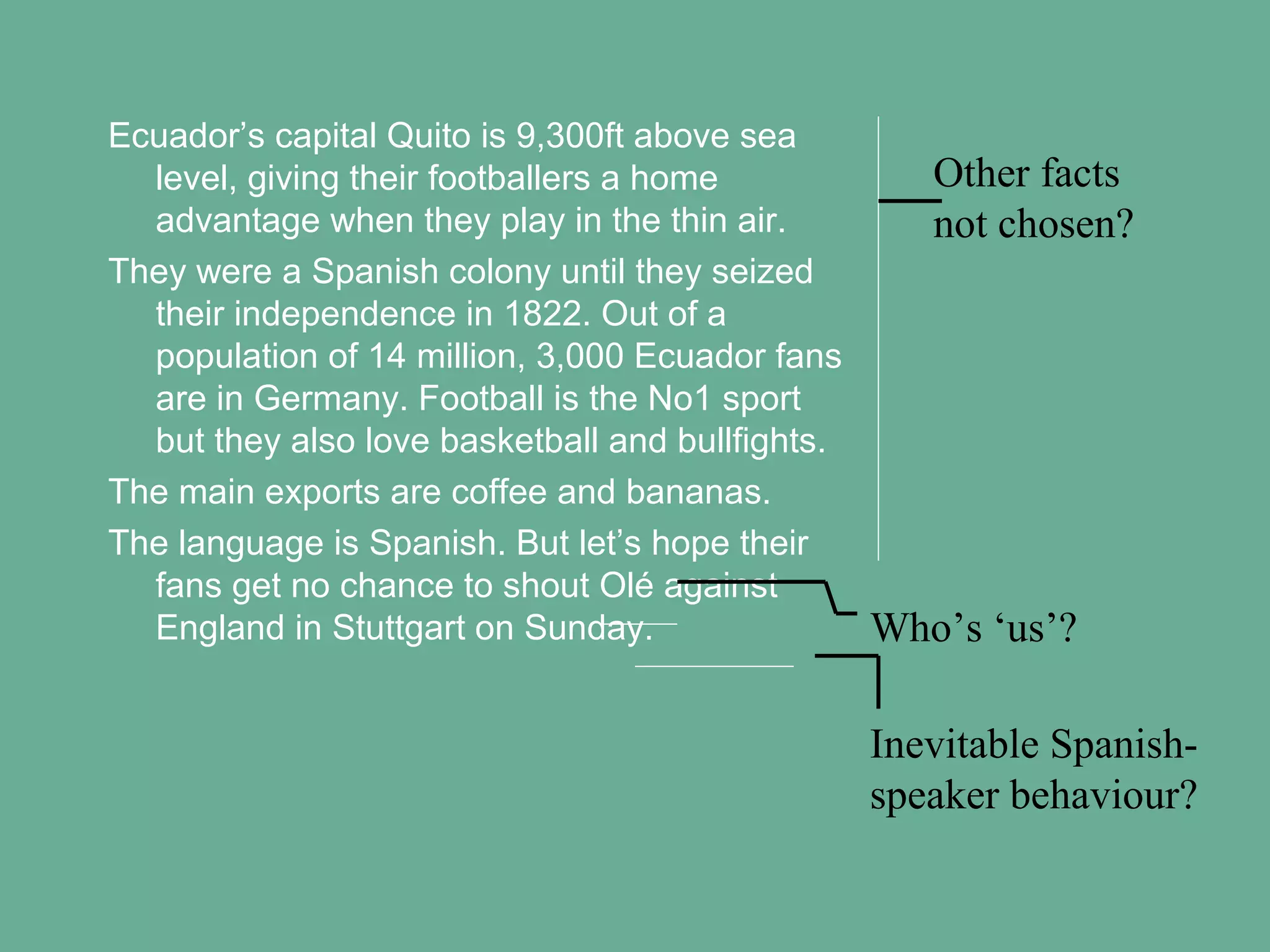
Ecuador’s capital Quito is 9,300ft above sea
level, giving their footballers a home
advantage when they play in the thin air.
They were a Spanish colony until they seized
their independence in 1822. Out of a
population of 14 million, 3,000 Ecuador fans
are in Germany. Football is the No1 sport
but they also love basketball and bullfights.
The main exports are coffee and bananas.
The language is Spanish. But let’s hope their
fans get no chance to shout Olé against
England in Stuttgart on Sunday.

Other facts
not chosen?

Who’s ‘us’?
Inevitable Spanishspeaker behaviour?
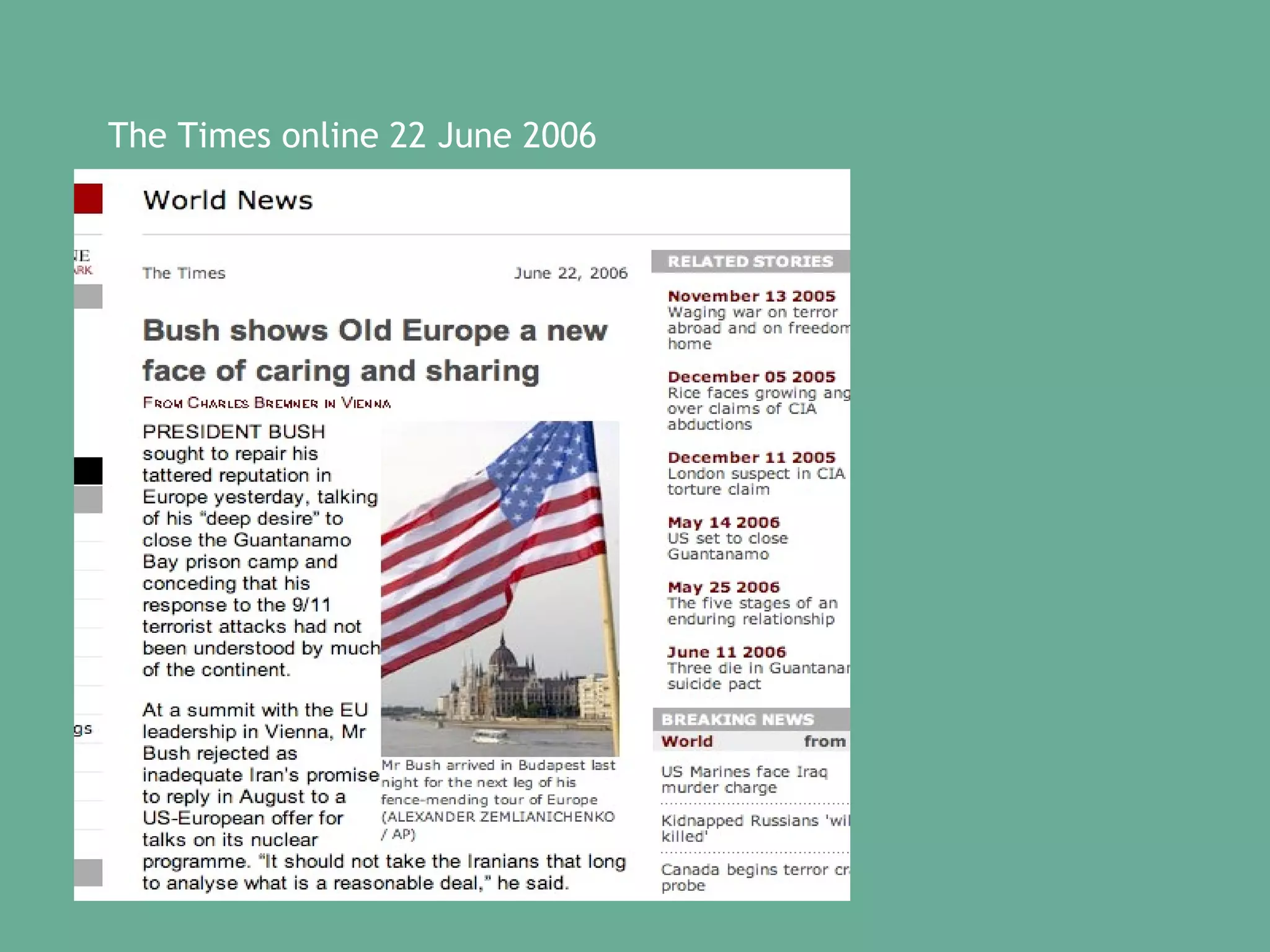
The Times online 22 June 2006
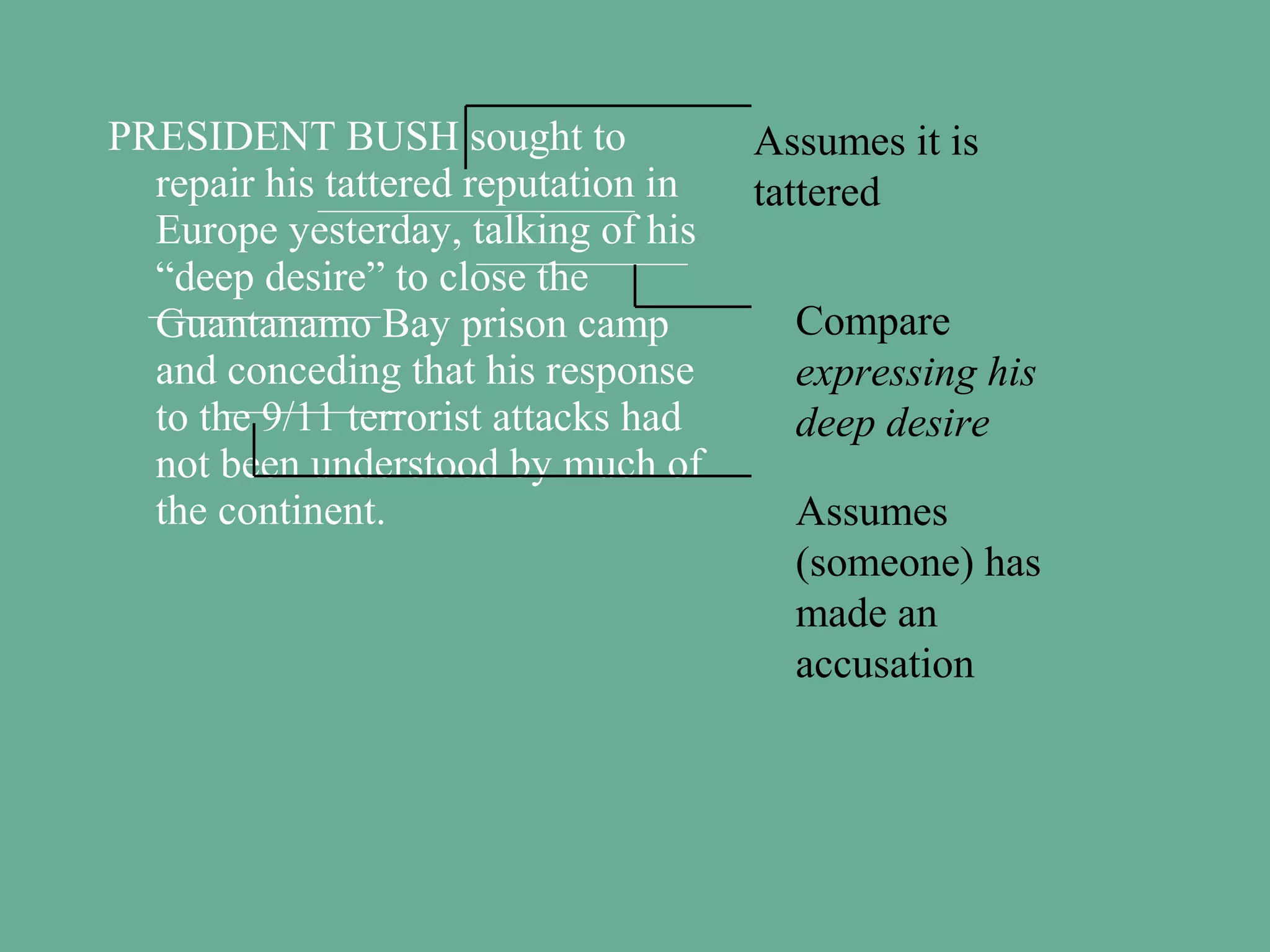
PRESIDENT BUSH sought to
repair his tattered reputation in
Europe yesterday, talking of his
“deep desire” to close the
Guantanamo Bay prison camp
and conceding that his response
to the 9/11 terrorist attacks had
not been understood by much of
the continent.

Assumes it is
tattered
Compare
expressing his
deep desire
Assumes
(someone) has
made an
accusation
Discourse as language-in-interaction

Language in interaction comes through in a sequence,
in turns. Each turn has an implication for the next.
An example analysis: doctors delivering diagnoses.
Do they tell the patient immediately?
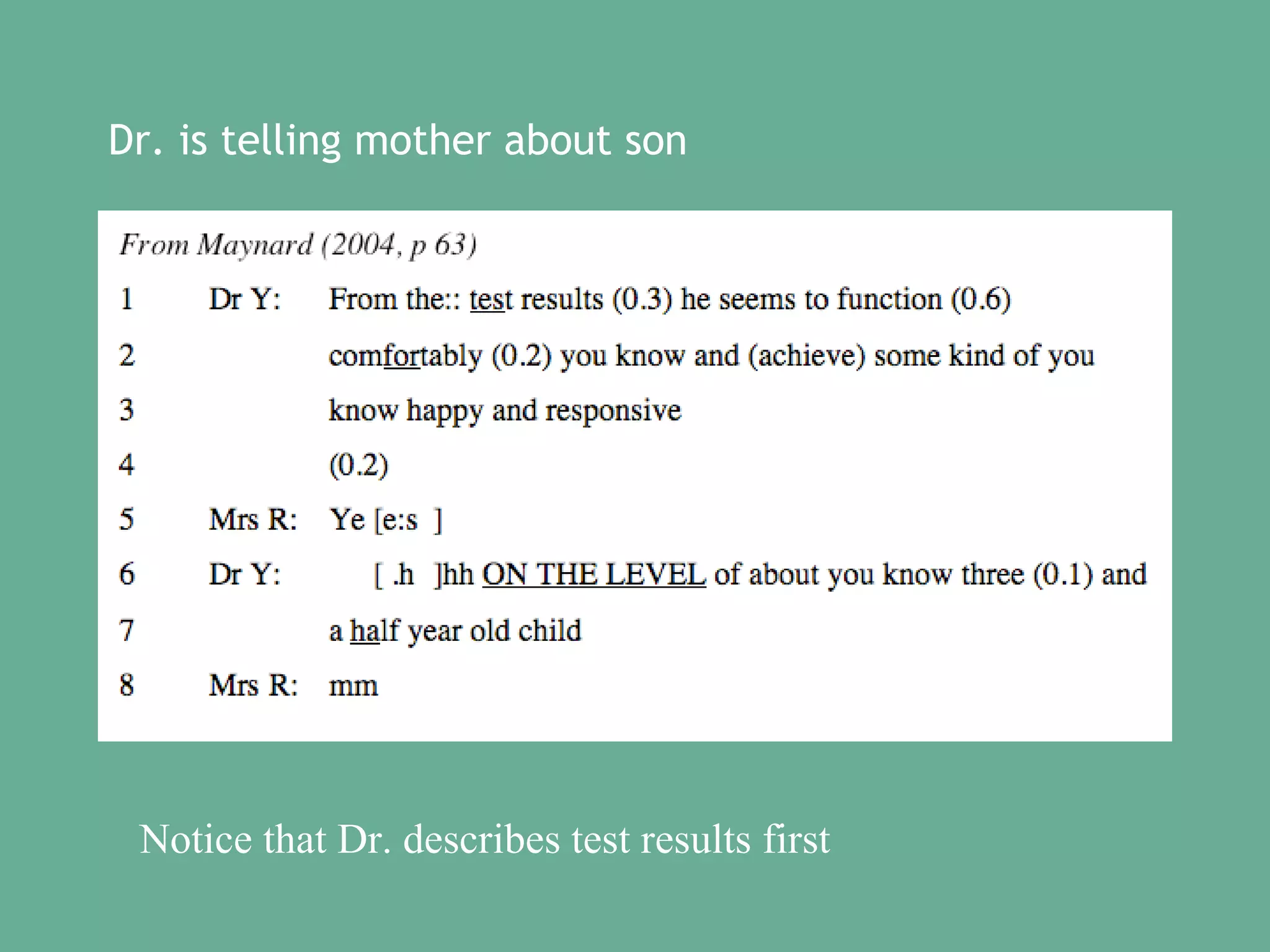
Dr. is telling mother about son

Notice that Dr. describes test results first
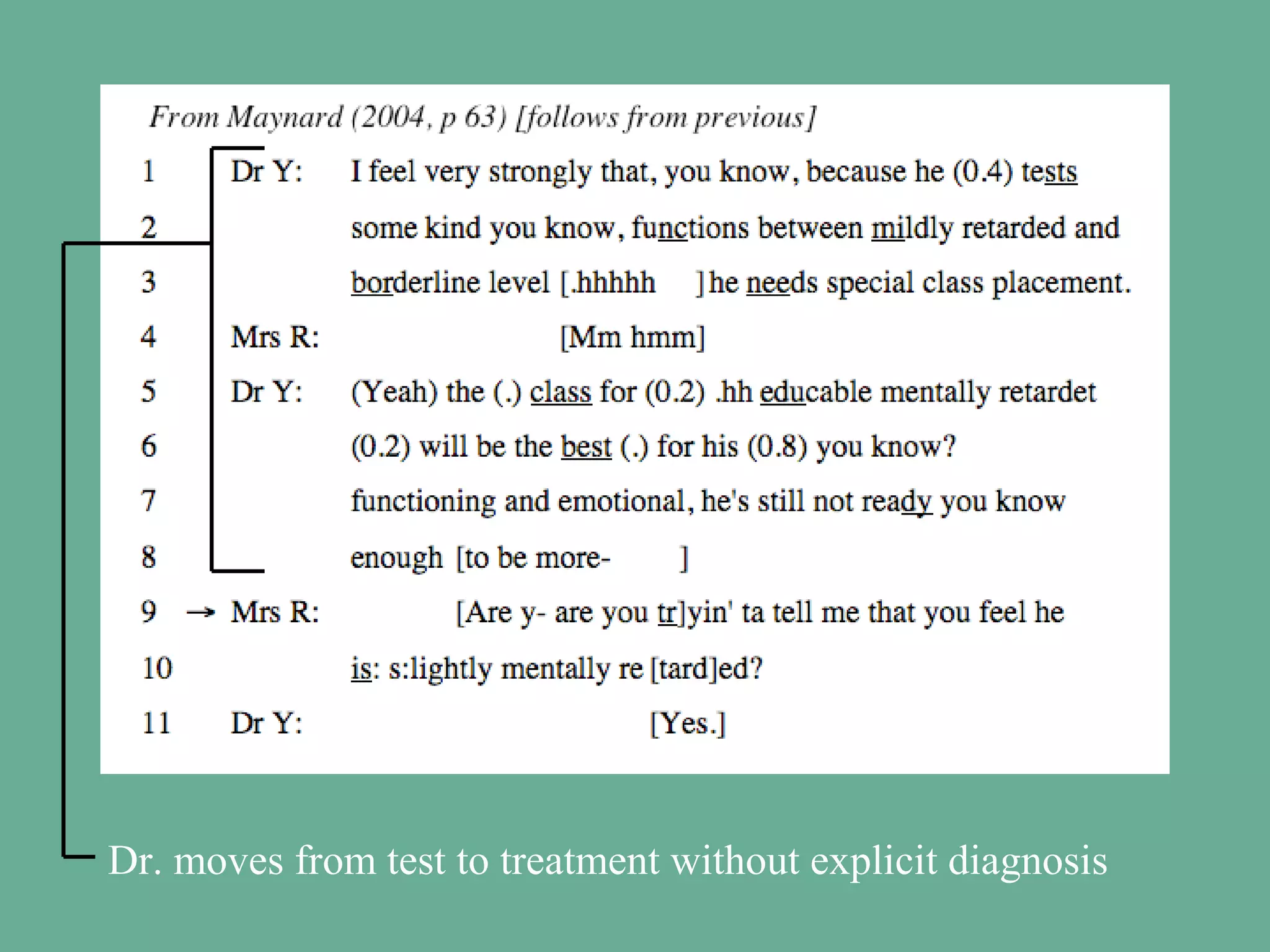
Dr. moves from test to treatment without explicit diagnosis
What does this results-first practice achieve?
(a)
(b)
(c)
(d)

Gives patient the sight of the evidence first
Shows that the diagnosis when given is well-founded
Allows the patient to guess or predict what is to come
Allows them to voice it themselves
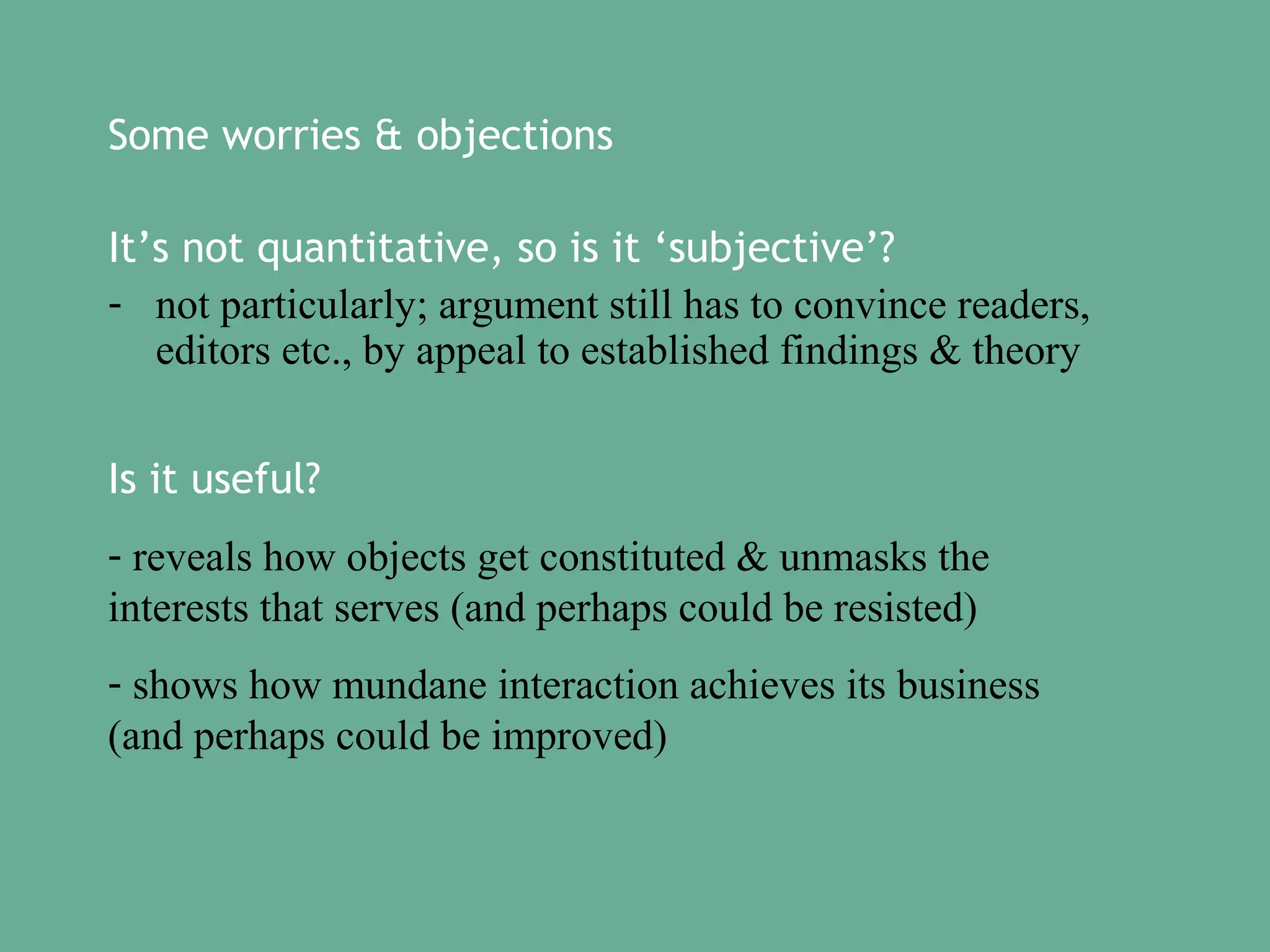
Some worries & objections
It’s not quantitative, so is it ‘subjective’?
- not particularly; argument still has to convince readers,
editors etc., by appeal to established findings & theory
Is it useful?
- reveals how objects get constituted & unmasks the
interests that serves (and perhaps could be resisted)
- shows how mundane interaction achieves its business
(and perhaps could be improved)
Why you shouldn’t do Discourse Analysis
-

-

recording the data (other than media texts) isn’t always
easy
transcribing the data is laborious
mastering the craft of explicating what’s going on, without
overinterpreting it or merely describing it, is hard
you won’t come away with a demonstration that X caused
Y
or a survey of the incidence of A is X in Y population
etcetera
Why you might do Discourse Analysis
- you get close to the data

- the data (eg video recordings) are of life as it’s
lived
- you uncover the subtle organisation of language,
the prime medium of our social lives (and selves)
- You plug in to social practices that - at the
grandest - constitute reality and our place in it
Other reasons why discourse analysis might
interest you
- it might be connected to your life (job, family,
friends and so on)
- it can go on your cv
- if you get interested in the subject you might want
to take it further (tesi, specialistica)
so it’s worth starting to think about what you
are interested in (linguistically)

08 09.4.what is-discourse-2

  • 1.
    What is discourse? Module2 2008-9 Lesson 4
  • 2.
    Why analyse discourse? Some(many?) things happen primarily (only?) in language From (say) To (say) promising to come to dinner telling someone you love them (Or indeed: talking to the dog)
  • 3.
    Definitions of Discourse(1) A particular unit of language (above the sentence), or discourse in structure; A particular focus on language use, discourse as function.
  • 4.
    Discourse as structure? Problem:you can have a unit which looks like a sentence but doesn’t mean anything e.g. Colourless green ideas sleep furiously … but on the other hand the units in which people speak do not always look like sentences. e.g. You can run a hou- whatcha- now whatcha you can run a house-you can run a house a- and do the job, which is important, y’ can’t y- a man can’t do it himself, and a woman can’t do it himself w- if y’ want it to be successful. In most cases. How do you analyse something which is not a sentence?
  • 5.
    Discourse as aSystem of functions ? e.g. “what’s the time?” Phatic function (opens a contact) Emotive function (conveys the need of the speaker) Conative function (asks something of the addressee) Referential function (makes reference to the world outside the language) PROBLEM: Discourse analysis may turn into a more general and broader analysis of language functions.
  • 6.
    Definition of Discourse(2) Discourse – written and spoken Speaker/ writer Hearer/ reader Discourse Context
  • 7.
    Objects of discourse ‘Discourse’refers to any utterance which is meaningful. These texts can be: - written texts - oral texts (‘speech’/’talk’) - mixed written/oral texts (e.g. Internet chat) Discourse does not depend on the size of a text (“P” and “Ladies” can both be analysed as discourse)
  • 8.
    Definitions of ‘discourse’(3) (a) A set of terms, metaphors, allusions, ways of talking, references and so on, which constitute an object (b) A to-and-fro of exchanges in talk (or text) that performs social actions
  • 9.
  • 10.
    The scope ofdiscourse analysis Discourse analysis is not a discipline which exists on its own. It is influenced by other disciplines and influences them as well. It is a two-way process … For this reason discourse analysis examines spoken and written texts from all sorts of different areas (medical, legal, advertising) and from all sorts of perspectives (race, gender, power) Discourse analysis has a number of practical applications - for example in analysing communication problems in medicine, psychotherapy, education, in analysing written style etc.
  • 11.
    Influences on discourseanalysis psycholinguistic s sociolinguistics other nonlinguistic disciplines computational linguistics Discourse Analysis other linguistic disciplines pragmatics
  • 12.
    Approaches to Discourse DeborahSchiffrin “Approaches to Discourse” (1994) singles out 6 major approaches to discourse: the speech act approach; interactional sociolinguistics; the ethnography of communication; pragmatic approach; conversation analysis; variationist approach.
  • 13.
    Approaches to Discourse(1) The Speech Act Approach Founders of the speech act theory: John Austin & John Searle. There are different types of speech acts: e.g. “speak louder” (directive) “Oxford Street is a shopper’s paradise“ (assertive) Although speech act theory was not first developed as a means of analyzing discourse, particular issues in speech act theory (indirect speech acts, multiple functions of utterances) led to discourse analysis
  • 14.
    Approaches to Discourse(2) Interactional sociolinguistics Represents the combination of three disciplines: anthropology, sociology, and linguistics. Focuses on how people from different cultures may share grammatical knowledge of a language but contextualize what is said differently to produce different messages. e.g. “yeah, bring them down here. I’ll flog them for you” (Australian English)
  • 15.
    Approaches to Discourse(3) The ethnography of communication The way we communicate depends a lot on the culture we come from. Some stereotypes: Finnish people: the hardest nation for communication, quiet and serious? Turkish people: very talkative and friendly? Ethnography investigates speaker culture
  • 16.
    Approaches to Discourse(4) Pragmatics H. P. Grice: the cooperative principle and conversational maxims. People interact by using minimal assumptions about one another.
  • 17.
    Approaches to Discourse(5) Conversation analysis e.g. A: This is Mr. Smith may I help you B: I can’t hear you A: This is Mr. Smith B: Smith. Conversational analysis is particularly interested in the sequencing of utterances, i.e. not in what people say but in how they say it
  • 18.
    Summary of approachesto discourse Approaches to Studying Discourse Focus of Research Research Question Structural CA Sequences of talk Why say that at that moment? Variationist Structural categories within texts Why that form? Speech Acts Communicative acts How to do things with words? Ethnography of Communication Communication as cultural How does discourse behaviour reflect culture? Interactional Sociolinguistics Social and linguistic meanings created during communication What are they doing? Pragmatics Meaning in interaction What does the speaker mean? Functional
  • 19.
    How do youanalyse discourse? Various ways. Depends on what sort of discourse you’re interested in. Constituting an object vs realising a social action
  • 20.
    Constituting an object Usuallysome cultural object (marriage, crime, obesity etc) Data: Media texts (eg news reports, magazine articles, newspaper features) Personal accounts (eg in interviews, diaries)
  • 21.
    From The Sunonline 21 June 2006
  • 22.
    ENGLAND’S next clashwill be against a nation of GUINEA PIG eaters.We avoided a showdown with old enemy Germany — for now — and will play Ecuador on Sunday. Here’s your Sun guide to the South American team’s dangermen — plus a few facts about the country where their national dish is a roasted pet. It would be easy to underestimate them. But Ecuador beat mighty Brazil and Argentina in the South American qualifying rounds. [continues]
  • 23.
    ENGLAND’S next clashwill be against a nation of GUINEA PIG eaters.We avoided a showdown with old enemy Germany — for now — and will play Ecuador on Sunday. Here’s your Sun guide to the South American team’s dangermen — plus a few facts about the country where their national dish is a roasted pet. The whole nation? Nothing else? Why old enemy? Facts? Whose pet?
  • 24.
    Ecuador’s capital Quitois 9,300ft above sea level, giving their footballers a home advantage when they play in the thin air. They were a Spanish colony until they seized their independence in 1822. Out of a population of 14 million, 3,000 Ecuador fans are in Germany. Football is the No1 sport but they also love basketball and bullfights. The main exports are coffee and bananas. The language is Spanish. But let’s hope their fans get no chance to shout Olé against England in Stuttgart on Sunday. Other facts not chosen? Who’s ‘us’? Inevitable Spanishspeaker behaviour?
  • 25.
    The Times online22 June 2006
  • 26.
    PRESIDENT BUSH soughtto repair his tattered reputation in Europe yesterday, talking of his “deep desire” to close the Guantanamo Bay prison camp and conceding that his response to the 9/11 terrorist attacks had not been understood by much of the continent. Assumes it is tattered Compare expressing his deep desire Assumes (someone) has made an accusation
  • 27.
    Discourse as language-in-interaction Languagein interaction comes through in a sequence, in turns. Each turn has an implication for the next. An example analysis: doctors delivering diagnoses. Do they tell the patient immediately?
  • 28.
    Dr. is tellingmother about son Notice that Dr. describes test results first
  • 29.
    Dr. moves fromtest to treatment without explicit diagnosis
  • 30.
    What does thisresults-first practice achieve? (a) (b) (c) (d) Gives patient the sight of the evidence first Shows that the diagnosis when given is well-founded Allows the patient to guess or predict what is to come Allows them to voice it themselves
  • 31.
    Some worries &objections It’s not quantitative, so is it ‘subjective’? - not particularly; argument still has to convince readers, editors etc., by appeal to established findings & theory Is it useful? - reveals how objects get constituted & unmasks the interests that serves (and perhaps could be resisted) - shows how mundane interaction achieves its business (and perhaps could be improved)
  • 33.
    Why you shouldn’tdo Discourse Analysis - - recording the data (other than media texts) isn’t always easy transcribing the data is laborious mastering the craft of explicating what’s going on, without overinterpreting it or merely describing it, is hard you won’t come away with a demonstration that X caused Y or a survey of the incidence of A is X in Y population etcetera
  • 34.
    Why you mightdo Discourse Analysis - you get close to the data - the data (eg video recordings) are of life as it’s lived - you uncover the subtle organisation of language, the prime medium of our social lives (and selves) - You plug in to social practices that - at the grandest - constitute reality and our place in it
  • 35.
    Other reasons whydiscourse analysis might interest you - it might be connected to your life (job, family, friends and so on) - it can go on your cv - if you get interested in the subject you might want to take it further (tesi, specialistica) so it’s worth starting to think about what you are interested in (linguistically)