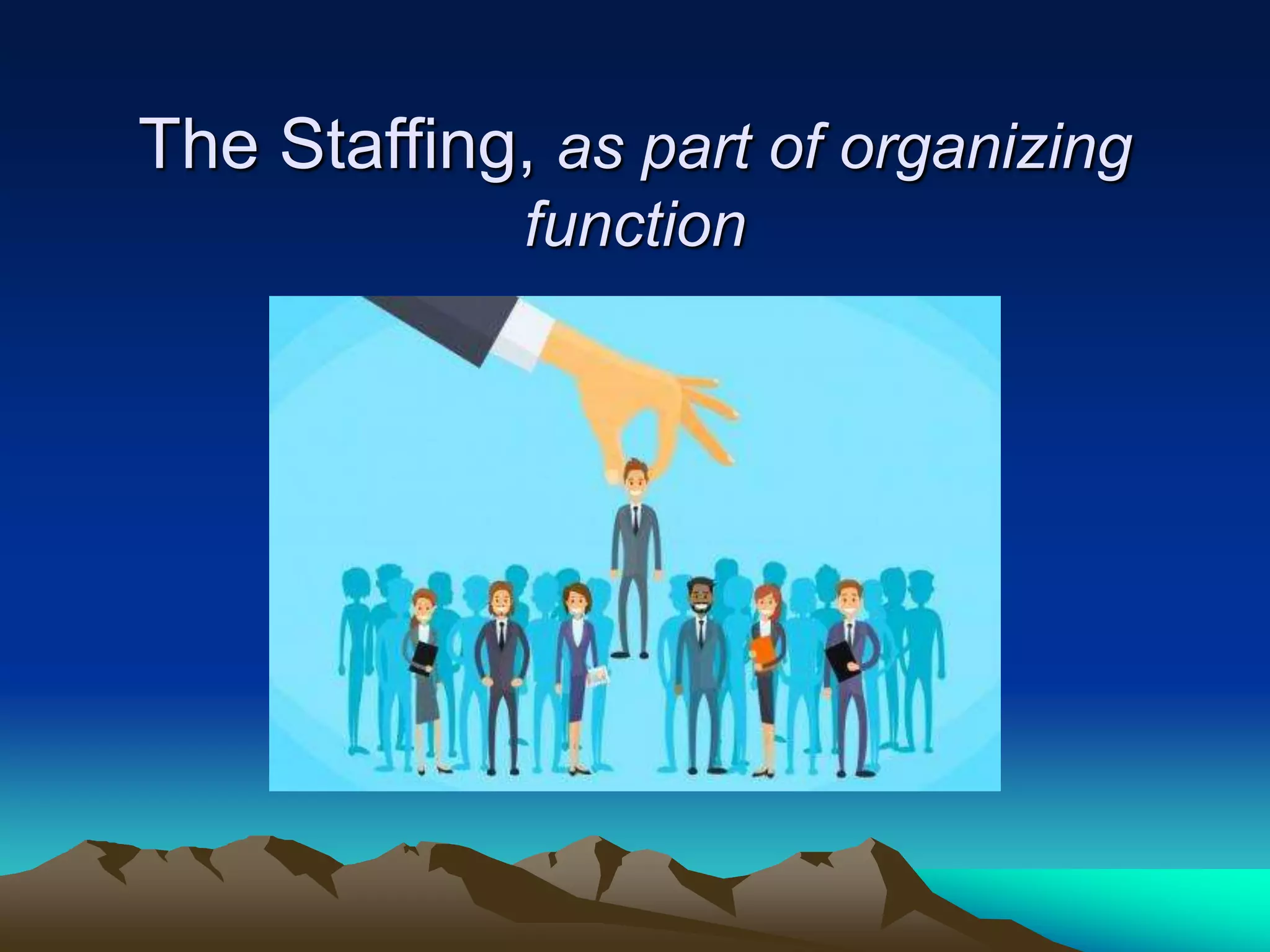
The Staffing, as part of organizing
function
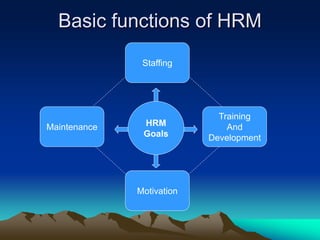
Basic functions of HRM
HRM
Goals
Staffing
Training
And
Development
Motivation
Maintenance
The Staffing Function
• Activities in HRM
related with seeking,
attracting and hiring
qualified people
• It is made of several
factors like:
– Strategic HR planning
– Recruiting
– selection
1. Strategic HR planning
• Strategic HR planning is forecasting the
future work force needs of an organization
• It is a process by which an organization
ensures that it has the right number and kind
of people, capable of effectively and
efficiently completing the organizational tasks
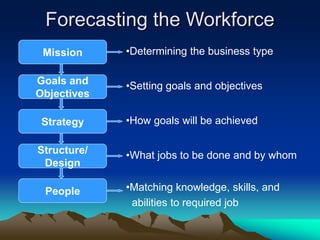
Forecasting the Workforce
Goals and
Objectives
Mission
Strategy
Structure/
Design
People
•Determining the business type
•Setting goals and objectives
•How goals will be achieved
•What jobs to be done and by whom
•Matching knowledge, skills, and
abilities to required job
1. Strategic HR planning
• The number of managers required in any
organization depends upon its:
– Size : how big or small the organization is
• more people needed in big organizations and
comparatively less people in small
organizations
– Nature: simple or complex
• more people in complex and less people in
simple organization
1. Strategic HR planning
–Plans for expansion
• more people are needed to run new units and
branches
–Turnover rate of managerial employees
• more people needed if turnover rate is high
–Number of managers retiring in near future
• People needed in their replacement
–Technological changes in the organization
requiring new hiring
Job Analysis
• Job analysis is a systematic way of finding
activities within a job
• Similar activities are placed in one group
• Also, the necessary knowledge and skills
are identified required for the job
• The purpose of job analysis is to find and
make job description, job specifications
and job evaluation
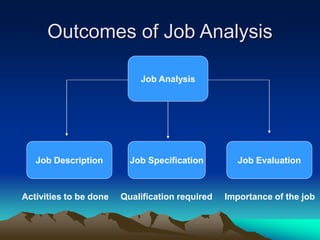
Outcomes of Job Analysis
Job Description Job Specification Job Evaluation
Job Analysis
Activities to be done Importance of the job
Qualification required
Job Description
• Also called as the Term of Reference
• A job description is a written statement of what the job
holder is expected to do, how it is done, under what
condition and why
• It includes the job title, duties to be performed, and the
authority and responsibilities of the jobholder
• Example
Job title: Benefits Manager
Reports to: Director, Human Resource
Functions: Manages employee benefits program
Duties and Responsibilities: Details of the tasks
Job Specification
• Job specification refers to the minimum qualification a
candidate must possess to perform the job successfully
• May include information on education, skills, experience,
abilities, and some personal characteristics like weight and
height (as in Army)
• It is also in written form
• The purpose of this is to encourage potential job candidates
to apply
• Also, to discourage non-qualifying candidates
Job Evaluation
• Job evaluation specifies the relative value of
each job in the organization
• Provides basis for comparison for having an
equal compensation program i.e. jobs requiring
similar level of skills, knowledge, and abilities
should be equally paid
• The information is for the use of HR Department
only
2. Recruiting (1)
• It is the process of seeking sources for job candidates
• Its objectives are to inform the job candidates about the
vacancy and to receive as many applications as possible
• The more applications received, the better the chances for
finding a suitable candidate.
Recruitment sources are:
• Internal Search:
– The Internal data base of the company
– Employees referral and recommendations
• External Sources:
– Advertisement in the newspaper, company website and internet
• Colleges and Universities:
• Professional Organizations in HR services
• Previous applications, lay-offs, part time workers
2. Recruiting (2)
Where to look for potential job candidates?
– From inside the organization :
• The development function enables an organization to have
the right number of people when they are needed
• Job positions are advertised through inter office memos,
internal communication and on the company notice board
• Some organizations maintain a Human Resource
Information System [HRIS]
– From outside the organization:
• Attracting potential job candidates through job
advertisement in the newspaper, company website and on
the internet
3. Selection (1)
Once we have short listed the candidates, the selection
process starts, that consists of:
1. The initial screening interview: to eliminate the unmatched
candidates
2. Completing the application form: company specific
application form to get specific information
3. Employment tests: assignments to test the skills and
abilities of the potential candidates
4. Comprehensive interview: to get in-depth information
about the candidate
3. Selection (2)
5. Background investigation: the process of verifying
information candidate has provided
6. Conditional job offer: a job offer with some conditions
7. Medical or physical examination: a check-up to
determine an applicant’s physical fitness for job
performance
8. Permanent job offer: a formal letter offering job to the
finalized candidate

06- The Organizing function -Staffing.ppt

  • 1.
    The Staffing, aspart of organizing function
  • 2.
    Basic functions ofHRM HRM Goals Staffing Training And Development Motivation Maintenance
  • 3.
    The Staffing Function •Activities in HRM related with seeking, attracting and hiring qualified people • It is made of several factors like: – Strategic HR planning – Recruiting – selection
  • 4.
    1. Strategic HRplanning • Strategic HR planning is forecasting the future work force needs of an organization • It is a process by which an organization ensures that it has the right number and kind of people, capable of effectively and efficiently completing the organizational tasks
  • 5.
    Forecasting the Workforce Goalsand Objectives Mission Strategy Structure/ Design People •Determining the business type •Setting goals and objectives •How goals will be achieved •What jobs to be done and by whom •Matching knowledge, skills, and abilities to required job
  • 6.
    1. Strategic HRplanning • The number of managers required in any organization depends upon its: – Size : how big or small the organization is • more people needed in big organizations and comparatively less people in small organizations – Nature: simple or complex • more people in complex and less people in simple organization
  • 7.
    1. Strategic HRplanning –Plans for expansion • more people are needed to run new units and branches –Turnover rate of managerial employees • more people needed if turnover rate is high –Number of managers retiring in near future • People needed in their replacement –Technological changes in the organization requiring new hiring
  • 8.
    Job Analysis • Jobanalysis is a systematic way of finding activities within a job • Similar activities are placed in one group • Also, the necessary knowledge and skills are identified required for the job • The purpose of job analysis is to find and make job description, job specifications and job evaluation
  • 9.
    Outcomes of JobAnalysis Job Description Job Specification Job Evaluation Job Analysis Activities to be done Importance of the job Qualification required
  • 10.
    Job Description • Alsocalled as the Term of Reference • A job description is a written statement of what the job holder is expected to do, how it is done, under what condition and why • It includes the job title, duties to be performed, and the authority and responsibilities of the jobholder • Example Job title: Benefits Manager Reports to: Director, Human Resource Functions: Manages employee benefits program Duties and Responsibilities: Details of the tasks
  • 11.
    Job Specification • Jobspecification refers to the minimum qualification a candidate must possess to perform the job successfully • May include information on education, skills, experience, abilities, and some personal characteristics like weight and height (as in Army) • It is also in written form • The purpose of this is to encourage potential job candidates to apply • Also, to discourage non-qualifying candidates
  • 12.
    Job Evaluation • Jobevaluation specifies the relative value of each job in the organization • Provides basis for comparison for having an equal compensation program i.e. jobs requiring similar level of skills, knowledge, and abilities should be equally paid • The information is for the use of HR Department only
  • 13.
    2. Recruiting (1) •It is the process of seeking sources for job candidates • Its objectives are to inform the job candidates about the vacancy and to receive as many applications as possible • The more applications received, the better the chances for finding a suitable candidate. Recruitment sources are: • Internal Search: – The Internal data base of the company – Employees referral and recommendations • External Sources: – Advertisement in the newspaper, company website and internet • Colleges and Universities: • Professional Organizations in HR services • Previous applications, lay-offs, part time workers
  • 14.
    2. Recruiting (2) Whereto look for potential job candidates? – From inside the organization : • The development function enables an organization to have the right number of people when they are needed • Job positions are advertised through inter office memos, internal communication and on the company notice board • Some organizations maintain a Human Resource Information System [HRIS] – From outside the organization: • Attracting potential job candidates through job advertisement in the newspaper, company website and on the internet
  • 15.
    3. Selection (1) Oncewe have short listed the candidates, the selection process starts, that consists of: 1. The initial screening interview: to eliminate the unmatched candidates 2. Completing the application form: company specific application form to get specific information 3. Employment tests: assignments to test the skills and abilities of the potential candidates 4. Comprehensive interview: to get in-depth information about the candidate
  • 16.
    3. Selection (2) 5.Background investigation: the process of verifying information candidate has provided 6. Conditional job offer: a job offer with some conditions 7. Medical or physical examination: a check-up to determine an applicant’s physical fitness for job performance 8. Permanent job offer: a formal letter offering job to the finalized candidate