
INDUSTRIAL AND MUNICIPAL
WASTE MANAGEMENT
INDUSTRIAL WASTE
TREATMENT
C.E.8.3.1
UNIT II
TREATMENT OF WASTE
ASST. PROF. PRACHI DESSAI, DON BOSCO COLLEGE OF ENGINEERING 1
STEP 3: NEUTRALISATION
ASST. PROF. PRACHI DESSAI, DON BOSCO COLLEGE OF ENGINEERING 2
NEUTRALISATION
i. Treatment of industrial waste so that it is neither too acidic nor too alkaline for safe
discharge.
ii. To render it compatible with the treatment of municipal sewage when joint treatment is
practiced & to make certain that its pH does not kill or otherwise inactivate the
microorganisms that are being used to biologically oxidize the organic matter content.
iii. To prevent corrosion of pipelines and equipment leading from the industry to its ultimate
destination
iv. To comply with municipal or other governmental ordinances of excessive acid or alkaline
conditions in sewers or receiving waters
ASST. PROF. PRACHI DESSAI, DON BOSCO COLLEGE OF ENGINEERING 3
NEUTRALISATION
Acceptable Methods of Neutralization:
i. Mixing wastes so that the net effect is a neutral pH.
ii. Passing acid wastes through beds of limestone.
iii. Mixing acid wastes with lime slurries.
iv. Adding the proper proportions of concentrated solutions of caustic soda(NaOH) or soda ash
(Na2CO3)to acid wastes.
v. Adding compressed CO2 to alkaline wastes.
vi. Adding sulfuric acid to alkaline wastes.
ASST. PROF. PRACHI DESSAI, DON BOSCO COLLEGE OF ENGINEERING 4
NEUTRALISATION
Mixing Wastes: Mixing of wastes can be accomplished within a single plant operation or
between neighboring industrial plants.
i. If one plant produces an alkaline waste that can be pumped conveniently to an area adjacent
to a plant discharging an acid waste, an economical and feasible system of neutralization
results for each plant.
a. For example, a building-materials plant producing an alkaline (lime and magnesia) waste pumps the
slurry, after some equalization, about one-half mile to mix with the effluent from a chemical plant,
producing an acid waste. The neutralized waste resulting from this combination is more readily
treatable for final disposal, and both plants thereby solve problems in economics, politics, and
engineering.
b. Hyde (1965) reports the use of a 500,000-gallon reservoir ahead of an anaerobic digestion pond to
mix various types of plant wastes before treatment. The resulting pH of the reservoir effluent ranged
from 6.5 to 8.5.
ASST. PROF. PRACHI DESSAI, DON BOSCO COLLEGE OF ENGINEERING 5
NEUTRALISATION
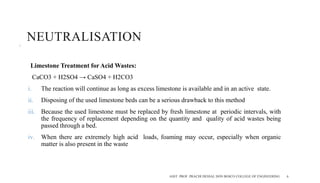
Limestone Treatment for Acid Wastes:
CaCO3 + H2SO4 → CaSO4 + H2CO3
i. The reaction will continue as long as excess limestone is available and in an active state.
ii. Disposing of the used limestone beds can be a serious drawback to this method
iii. Because the used limestone must be replaced by fresh limestone at periodic intervals, with
the frequency of replacement depending on the quantity and quality of acid wastes being
passed through a bed.
iv. When there are extremely high acid loads, foaming may occur, especially when organic
matter is also present in the waste
ASST. PROF. PRACHI DESSAI, DON BOSCO COLLEGE OF ENGINEERING 6
NEUTRALISATION
Lime-Slurry Treatment :
i. Lime is used up continuously because it is converted to calcium sulfate and carried out in
the waste.
ii. Though slow acting, lime possesses a high neutralizing power and its action can be hastened
by heating or oxygenating the mixture.
iii. It is relatively inexpensive, but in large quantities, cost can be an important factor.
ASST. PROF. PRACHI DESSAI, DON BOSCO COLLEGE OF ENGINEERING 7
NEUTRALISATION
Caustic-Soda Treatment for Acid Waste:
i. Adding concentrated solutions of caustic soda or sodium carbonate to acid wastes in the
proper proportions results in faster, but more costly, neutralization.
ii. Smaller volumes of the agent are required, because these neutralizers are more powerful
than lime or limestone.
iii. Another advantage is that the reaction products are soluble and do not increase the hardness
of receiving waters.
iv. Caustic soda is normally bled into the suction side of a pump discharging acid wastes.
ASST. PROF. PRACHI DESSAI, DON BOSCO COLLEGE OF ENGINEERING 8
NEUTRALISATION
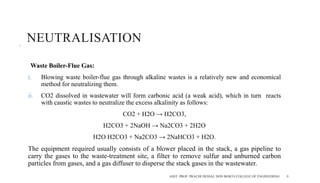
Waste Boiler-Flue Gas:
i. Blowing waste boiler-flue gas through alkaline wastes is a relatively new and economical
method for neutralizing them.
ii. CO2 dissolved in wastewater will form carbonic acid (a weak acid), which in turn reacts
with caustic wastes to neutralize the excess alkalinity as follows:
CO2 + H2O → H2CO3,
H2CO3 + 2NaOH → Na2CO3 + 2H2O
H2O H2CO3 + Na2CO3 → 2NaHCO3 + H2O.
The equipment required usually consists of a blower placed in the stack, a gas pipeline to
carry the gases to the waste-treatment site, a filter to remove sulfur and unburned carbon
particles from gases, and a gas diffuser to disperse the stack gases in the wastewater.
ASST. PROF. PRACHI DESSAI, DON BOSCO COLLEGE OF ENGINEERING 9
NEUTRALISATION
Carbon Dioxide Treatment:
i. Bottled CO2 is applied to wastewater in much the same way as compressed air is applied to
activated-sludge basins.
ii. It neutralizes alkaline wastes on the same principle as boiler-feed gases (i.e., it forms a weak
acid [carbonic acid] when dissolved in water) but with much less operating difficulty.
iii. Producing Carbon Dioxide in Alkaline Wastes Another way to produce carbon dioxide is to
burn gas underwater.
i. Submerged combustion on a continuous basis, using an evaporation vessel, a burner with flame jets
submerged below the waste surface in the vessel, a bustle in which air and natural gas were mixed to
form a combustible mixture, and other equipment to measure air, gas, and waste flows and the
weight of waste volatilized during each run
ASST. PROF. PRACHI DESSAI, DON BOSCO COLLEGE OF ENGINEERING 10
NEUTRALISATION
Sulfuric Acid Treatment for Alkaline Wastes:
i. Addition of sulfuric acid to alkaline wastes
ii. Common, but expensive
iii. Storage and feeding equipment requirements are low as result of its great acidity, but it is
difficult to handle because of its corrosiveness.
iv. The neutralization reaction that occurs when it is added to wastewater is as follows:
2NaOH + H2SO4→ Na2SO4 + 2H2O
ASST. PROF. PRACHI DESSAI, DON BOSCO COLLEGE OF ENGINEERING 11
STEP 4:
EQUILIZATION AND
PROPORTIONING
ASST. PROF. PRACHI DESSAI, DON BOSCO COLLEGE OF ENGINEERING 12
EQUILIZATION
i. Equalization is a method of retaining waste in a basin so that the effluent discharged is
fairly uniform in its water quality characteristics
ii. pH, color, turbidity, alkalinity, biochemical oxygen demand [BOD]
iii. Air is sometimes injected into these basins to provide
a. better mixing
b. chemical oxidation of reduced compounds
c. some degree of biological oxidation
d. agitation to prevent suspended solids from settling.
This mixing may be brought about in the following ways:
a. proper distribution and baffling
b. Mechanical agitation
c. Aeration
d. combinations of all three.
ASST. PROF. PRACHI DESSAI, DON BOSCO COLLEGE OF ENGINEERING 13
EQUILIZATION
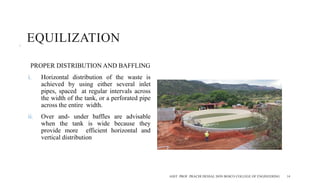
PROPER DISTRIBUTION AND BAFFLING
i. Horizontal distribution of the waste is
achieved by using either several inlet
pipes, spaced at regular intervals across
the width of the tank, or a perforated pipe
across the entire width.
ii. Over and- under baffles are advisable
when the tank is wide because they
provide more efficient horizontal and
vertical distribution
ASST. PROF. PRACHI DESSAI, DON BOSCO COLLEGE OF ENGINEERING 14
EQUILIZATION
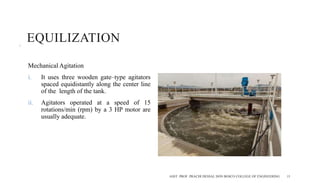
Mechanical Agitation
i. It uses three wooden gate–type agitators
spaced equidistantly along the center line
of the length of the tank.
ii. Agitators operated at a speed of 15
rotations/min (rpm) by a 3 HP motor are
usually adequate.
ASST. PROF. PRACHI DESSAI, DON BOSCO COLLEGE OF ENGINEERING 15
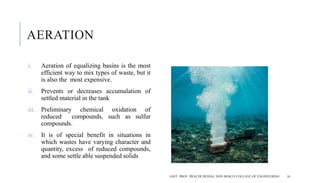
AERATION
i. Aeration of equalizing basins is the most
efficient way to mix types of waste, but it
is also the most expensive.
ii. Prevents or decreases accumulation of
settled material in the tank
iii. Preliminary chemical oxidation of
reduced compounds, such as sulfur
compounds.
iv. It is of special benefit in situations in
which wastes have varying character and
quantity, excess of reduced compounds,
and some settle able suspended solids
ASST. PROF. PRACHI DESSAI, DON BOSCO COLLEGE OF ENGINEERING 16
PROPORTIONING
i. Proportioning means the discharge of industrial wastes in proportion to the flow of
municipal sewage in the sewers or to the stream flow in the receiving river.
ii. To facilitate proportioning, a holding tank should be constructed with a variable-speed
pump to control the effluent discharge.
iii. This procedure has several purposes:
a. Protect municipal sewage treatment using chemicals from being impaired by a sudden overdose of chemicals
contained in the industrial waste
b. Protect biological-treatment devices from shock loads of industrial wastes that may inactivate the bacteria
c. Minimize fluctuations of sanitary standards in the treated effluent.
ASST. PROF. PRACHI DESSAI, DON BOSCO COLLEGE OF ENGINEERING 17

06 - Neutralisation, Equalisation & Proportioning.pptx

  • 1.
    INDUSTRIAL AND MUNICIPAL WASTEMANAGEMENT INDUSTRIAL WASTE TREATMENT C.E.8.3.1 UNIT II TREATMENT OF WASTE ASST. PROF. PRACHI DESSAI, DON BOSCO COLLEGE OF ENGINEERING 1
  • 2.
    STEP 3: NEUTRALISATION ASST.PROF. PRACHI DESSAI, DON BOSCO COLLEGE OF ENGINEERING 2
  • 3.
    NEUTRALISATION i. Treatment ofindustrial waste so that it is neither too acidic nor too alkaline for safe discharge. ii. To render it compatible with the treatment of municipal sewage when joint treatment is practiced & to make certain that its pH does not kill or otherwise inactivate the microorganisms that are being used to biologically oxidize the organic matter content. iii. To prevent corrosion of pipelines and equipment leading from the industry to its ultimate destination iv. To comply with municipal or other governmental ordinances of excessive acid or alkaline conditions in sewers or receiving waters ASST. PROF. PRACHI DESSAI, DON BOSCO COLLEGE OF ENGINEERING 3
  • 4.
    NEUTRALISATION Acceptable Methods ofNeutralization: i. Mixing wastes so that the net effect is a neutral pH. ii. Passing acid wastes through beds of limestone. iii. Mixing acid wastes with lime slurries. iv. Adding the proper proportions of concentrated solutions of caustic soda(NaOH) or soda ash (Na2CO3)to acid wastes. v. Adding compressed CO2 to alkaline wastes. vi. Adding sulfuric acid to alkaline wastes. ASST. PROF. PRACHI DESSAI, DON BOSCO COLLEGE OF ENGINEERING 4
  • 5.
    NEUTRALISATION Mixing Wastes: Mixingof wastes can be accomplished within a single plant operation or between neighboring industrial plants. i. If one plant produces an alkaline waste that can be pumped conveniently to an area adjacent to a plant discharging an acid waste, an economical and feasible system of neutralization results for each plant. a. For example, a building-materials plant producing an alkaline (lime and magnesia) waste pumps the slurry, after some equalization, about one-half mile to mix with the effluent from a chemical plant, producing an acid waste. The neutralized waste resulting from this combination is more readily treatable for final disposal, and both plants thereby solve problems in economics, politics, and engineering. b. Hyde (1965) reports the use of a 500,000-gallon reservoir ahead of an anaerobic digestion pond to mix various types of plant wastes before treatment. The resulting pH of the reservoir effluent ranged from 6.5 to 8.5. ASST. PROF. PRACHI DESSAI, DON BOSCO COLLEGE OF ENGINEERING 5
  • 6.
    NEUTRALISATION Limestone Treatment forAcid Wastes: CaCO3 + H2SO4 → CaSO4 + H2CO3 i. The reaction will continue as long as excess limestone is available and in an active state. ii. Disposing of the used limestone beds can be a serious drawback to this method iii. Because the used limestone must be replaced by fresh limestone at periodic intervals, with the frequency of replacement depending on the quantity and quality of acid wastes being passed through a bed. iv. When there are extremely high acid loads, foaming may occur, especially when organic matter is also present in the waste ASST. PROF. PRACHI DESSAI, DON BOSCO COLLEGE OF ENGINEERING 6
  • 7.
    NEUTRALISATION Lime-Slurry Treatment : i.Lime is used up continuously because it is converted to calcium sulfate and carried out in the waste. ii. Though slow acting, lime possesses a high neutralizing power and its action can be hastened by heating or oxygenating the mixture. iii. It is relatively inexpensive, but in large quantities, cost can be an important factor. ASST. PROF. PRACHI DESSAI, DON BOSCO COLLEGE OF ENGINEERING 7
  • 8.
    NEUTRALISATION Caustic-Soda Treatment forAcid Waste: i. Adding concentrated solutions of caustic soda or sodium carbonate to acid wastes in the proper proportions results in faster, but more costly, neutralization. ii. Smaller volumes of the agent are required, because these neutralizers are more powerful than lime or limestone. iii. Another advantage is that the reaction products are soluble and do not increase the hardness of receiving waters. iv. Caustic soda is normally bled into the suction side of a pump discharging acid wastes. ASST. PROF. PRACHI DESSAI, DON BOSCO COLLEGE OF ENGINEERING 8
  • 9.
    NEUTRALISATION Waste Boiler-Flue Gas: i.Blowing waste boiler-flue gas through alkaline wastes is a relatively new and economical method for neutralizing them. ii. CO2 dissolved in wastewater will form carbonic acid (a weak acid), which in turn reacts with caustic wastes to neutralize the excess alkalinity as follows: CO2 + H2O → H2CO3, H2CO3 + 2NaOH → Na2CO3 + 2H2O H2O H2CO3 + Na2CO3 → 2NaHCO3 + H2O. The equipment required usually consists of a blower placed in the stack, a gas pipeline to carry the gases to the waste-treatment site, a filter to remove sulfur and unburned carbon particles from gases, and a gas diffuser to disperse the stack gases in the wastewater. ASST. PROF. PRACHI DESSAI, DON BOSCO COLLEGE OF ENGINEERING 9
  • 10.
    NEUTRALISATION Carbon Dioxide Treatment: i.Bottled CO2 is applied to wastewater in much the same way as compressed air is applied to activated-sludge basins. ii. It neutralizes alkaline wastes on the same principle as boiler-feed gases (i.e., it forms a weak acid [carbonic acid] when dissolved in water) but with much less operating difficulty. iii. Producing Carbon Dioxide in Alkaline Wastes Another way to produce carbon dioxide is to burn gas underwater. i. Submerged combustion on a continuous basis, using an evaporation vessel, a burner with flame jets submerged below the waste surface in the vessel, a bustle in which air and natural gas were mixed to form a combustible mixture, and other equipment to measure air, gas, and waste flows and the weight of waste volatilized during each run ASST. PROF. PRACHI DESSAI, DON BOSCO COLLEGE OF ENGINEERING 10
  • 11.
    NEUTRALISATION Sulfuric Acid Treatmentfor Alkaline Wastes: i. Addition of sulfuric acid to alkaline wastes ii. Common, but expensive iii. Storage and feeding equipment requirements are low as result of its great acidity, but it is difficult to handle because of its corrosiveness. iv. The neutralization reaction that occurs when it is added to wastewater is as follows: 2NaOH + H2SO4→ Na2SO4 + 2H2O ASST. PROF. PRACHI DESSAI, DON BOSCO COLLEGE OF ENGINEERING 11
  • 12.
    STEP 4: EQUILIZATION AND PROPORTIONING ASST.PROF. PRACHI DESSAI, DON BOSCO COLLEGE OF ENGINEERING 12
  • 13.
    EQUILIZATION i. Equalization isa method of retaining waste in a basin so that the effluent discharged is fairly uniform in its water quality characteristics ii. pH, color, turbidity, alkalinity, biochemical oxygen demand [BOD] iii. Air is sometimes injected into these basins to provide a. better mixing b. chemical oxidation of reduced compounds c. some degree of biological oxidation d. agitation to prevent suspended solids from settling. This mixing may be brought about in the following ways: a. proper distribution and baffling b. Mechanical agitation c. Aeration d. combinations of all three. ASST. PROF. PRACHI DESSAI, DON BOSCO COLLEGE OF ENGINEERING 13
  • 14.
    EQUILIZATION PROPER DISTRIBUTION ANDBAFFLING i. Horizontal distribution of the waste is achieved by using either several inlet pipes, spaced at regular intervals across the width of the tank, or a perforated pipe across the entire width. ii. Over and- under baffles are advisable when the tank is wide because they provide more efficient horizontal and vertical distribution ASST. PROF. PRACHI DESSAI, DON BOSCO COLLEGE OF ENGINEERING 14
  • 15.
    EQUILIZATION Mechanical Agitation i. Ituses three wooden gate–type agitators spaced equidistantly along the center line of the length of the tank. ii. Agitators operated at a speed of 15 rotations/min (rpm) by a 3 HP motor are usually adequate. ASST. PROF. PRACHI DESSAI, DON BOSCO COLLEGE OF ENGINEERING 15
  • 16.
    AERATION i. Aeration ofequalizing basins is the most efficient way to mix types of waste, but it is also the most expensive. ii. Prevents or decreases accumulation of settled material in the tank iii. Preliminary chemical oxidation of reduced compounds, such as sulfur compounds. iv. It is of special benefit in situations in which wastes have varying character and quantity, excess of reduced compounds, and some settle able suspended solids ASST. PROF. PRACHI DESSAI, DON BOSCO COLLEGE OF ENGINEERING 16
  • 17.
    PROPORTIONING i. Proportioning meansthe discharge of industrial wastes in proportion to the flow of municipal sewage in the sewers or to the stream flow in the receiving river. ii. To facilitate proportioning, a holding tank should be constructed with a variable-speed pump to control the effluent discharge. iii. This procedure has several purposes: a. Protect municipal sewage treatment using chemicals from being impaired by a sudden overdose of chemicals contained in the industrial waste b. Protect biological-treatment devices from shock loads of industrial wastes that may inactivate the bacteria c. Minimize fluctuations of sanitary standards in the treated effluent. ASST. PROF. PRACHI DESSAI, DON BOSCO COLLEGE OF ENGINEERING 17