L E S S O N 2 
65 
Lesson 2: Initial Steps 
Performance Checklist 
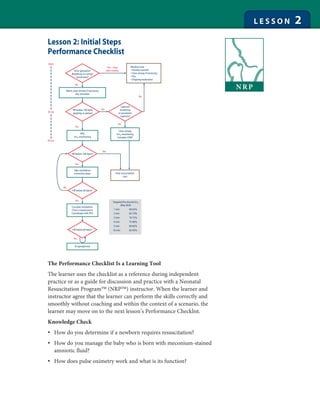
Term gestation? 
Breathing or crying? 
Good tone? 
No 
Warm, clear airway if necessary, 
dry, stimulate 
Yes—stay 
with mother 
HR below 100 bpm, 
gasping, or apnea? 
Routine Care 
• Provide warmth 
• Clear airway if necessary 
• Dry 
• Ongoing evaluation 
Labored 
breathing 
or persistent 
cyanosis? 
No 
No 
PPV, 
Yes 
SPO2 monitoring 
Yes 
Clear airway 
SPO2 monitoring 
Consider CPAP 
Post-resuscitation 
care 
Targeted Pre-ductal SPO2 
After Birth 
1 min 
2 min 
3 min 
4 min 
5 min 
10 min 
60-65% 
65-70% 
70-75% 
75-80% 
80-85% 
85-95% 
HR below 100 bpm? 
Yes 
Take ventilation 
corrective steps 
HR below 60 bpm? 
Yes 
Consider intubation 
Chest compressions 
Coordinate with PPV 
HR below 60 bpm? 
Yes 
IV epinephrine 
No 
Birth 
30 sec 
60 sec 
No 
The Performance Checklist Is a Learning Tool 
The learner uses the checklist as a reference during independent 
practice or as a guide for discussion and practice with a Neonatal 
Resuscitation Program™ (NRP™) instructor. When the learner and 
instructor agree that the learner can perform the skills correctly and 
smoothly without coaching and within the context of a scenario, the 
learner may move on to the next lesson’s Performance Checklist. 
Knowledge Check 
• How do you determine if a newborn requires resuscitation? 
• How do you manage the baby who is born with meconium-stained 
amniotic fluid? 
• How does pulse oximetry work and what is its function? 
NRP
Initial Steps of Resuscitation 
66 
Learning Objectives 
Identify the newborn who requires initial steps of resuscitation. 
Demonstrate correct technique for performing initial steps, 
including decision making for a baby born with meconium-stained 
amniotic fluid. 
Demonstrate correct placement of oximeter probe and 
interpretation of pulse oximetry. 
“You are called to attend a cesarean birth due to breech presentation. 
How would you prepare for the birth of this baby? As you work, say 
your thoughts and actions aloud so your assistant and I will know 
what you are thinking and doing.” 
Instructor should check boxes as the learner responds correctly. 
Participant Name: 
 Obtains relevant perinatal 
history 
Gestational age? Fluid clear? How many babies? Other 
risk factors? 
Performs equipment check 
 If obstetric provider indicates 
that meconium is present in 
amniotic fluid, prepares for 
intubation and meconium 
aspiration 
Warmer on and towels to dry, Clear airway (bulb 
syringe, wall suction set at 80-100 mm Hg, meconium 
aspirator), Auscultate (stethoscope), Oxygenate (checks 
oxygen, blender, pulse oximeter and probe), Ventilate 
(checks positive-pressure ventilation [PPV] device), 
Intubate (laryngoscope and blades, endotracheal tubes, 
stylets, end-tidal CO2 detector), Medicate (code cart 
accessible), Thermoregulate 
Option 1: Meconium-stained amniotic fluid, vigorous newborn. 
“The baby has been born.” 
Sample Vital 
Signs Performance Steps Details 
Appears term 
Respiratory rate 
(RR)-crying 
Tone-flexed 
Completes initial assessment 
when baby is born. 
 Learner asks 3 questions: 
• Term? 
• Breathing or crying? 
• Good tone? 
Initial assessment determines whether or not baby will 
receive initial steps of resuscitation at the radiant warmer. 
 Allows baby to stay with his 
mother for routine care: 
Warm, clear airway if 
necessary, dry, stimulate if 
necessary, continue 
evaluation 
“Vigorous” meconium-stained baby is defined by 
• Strong respiratory efforts 
• Good muscle tone 
• Heart rate (HR) 100 beats per minute (bpm) 
Assume that a crying baby with good tone has 
HR 100 bpm.
L E S S O N 2 
67 
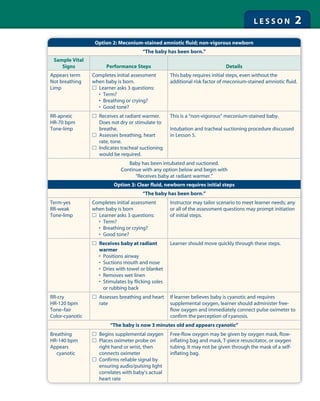
Option 2: Meconium-stained amniotic fluid; non-vigorous newborn 
“The baby has been born.” 
Sample Vital 
Signs Performance Steps Details 
Appears term 
Not breathing 
Limp 
Completes initial assessment 
when baby is born. 
 Learner asks 3 questions: 
• Term? 
• Breathing or crying? 
• Good tone? 
This baby requires initial steps, even without the 
additional risk factor of meconium-stained amniotic fluid. 
RR-apneic 
HR-70 bpm 
Tone-limp 
 Receives at radiant warmer. 
Does not dry or stimulate to 
breathe. 
 Assesses breathing, heart 
rate, tone. 
 Indicates tracheal suctioning 
would be required. 
This is a “non-vigorous” meconium-stained baby. 
Intubation and tracheal suctioning procedure discussed 
in Lesson 5. 
Baby has been intubated and suctioned. 
Continue with any option below and begin with 
“Receives baby at radiant warmer.” 
Option 3: Clear fluid, newborn requires initial steps 
“The baby has been born.” 
Term-yes 
RR-weak 
Tone-limp 
Completes initial assessment 
when baby is born 
 Learner asks 3 questions: 
• Term? 
• Breathing or crying? 
• Good tone? 
Instructor may tailor scenario to meet learner needs; any 
or all of the assessment questions may prompt initiation 
of initial steps. 
 Receives baby at radiant 
warmer 
• Positions airway 
• Suctions mouth and nose 
• Dries with towel or blanket 
• Removes wet linen 
• Stimulates by flicking soles 
or rubbing back 
Learner should move quickly through these steps. 
RR-cry 
HR-120 bpm 
Tone–fair 
Color-cyanotic 
 Assesses breathing and heart 
rate 
If learner believes baby is cyanotic and requires 
supplemental oxygen, learner should administer free-flow 
oxygen and immediately connect pulse oximeter to 
confirm the perception of cyanosis. 
“The baby is now 3 minutes old and appears cyanotic” 
Breathing 
HR-140 bpm 
Appears 
cyanotic 
 Begins supplemental oxygen 
 Places oximeter probe on 
right hand or wrist, then 
connects oximeter 
 Confirms reliable signal by 
ensuring audio/pulsing light 
correlates with baby’s actual 
heart rate 
Free-flow oxygen may be given by oxygen mask, flow-inflating 
bag and mask, T-piece resuscitator, or oxygen 
tubing. It may not be given through the mask of a self-inflating 
bag.
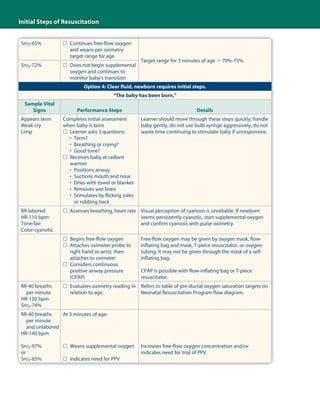
Initial Steps of Resuscitation 
SPO2-65%  Continues free-flow oxygen 
68 
and weans per oximetry 
target range for age 
Target range for 3 minutes of age  70%-75%. 
SPO2-72%  Does not begin supplemental 
oxygen and continues to 
monitor baby’s transition 
Option 4: Clear fluid, newborn requires initial steps. 
“The baby has been born.” 
Sample Vital 
Signs Performance Steps Details 
Appears term 
Weak cry 
Limp 
Completes initial assessment 
when baby is born 
 Learner asks 3 questions: 
• Term? 
• Breathing or crying? 
• Good tone? 
 Receives baby at radiant 
warmer 
• Positions airway 
• Suctions mouth and nose 
• Dries with towel or blanket 
• Removes wet linen 
• Stimulates by flicking soles 
or rubbing back 
Learner should move through these steps quickly; handle 
baby gently, do not use bulb syringe aggressively, do not 
waste time continuing to stimulate baby if unresponsive. 
RR-labored 
HR-110 bpm 
Tone-fair 
Color-cyanotic 
 Assesses breathing, heart rate Visual perception of cyanosis is unreliable. If newborn 
seems persistently cyanotic, start supplemental oxygen 
and confirm cyanosis with pulse oximetry. 
 Begins free-flow oxygen 
 Attaches oximeter probe to 
right hand or wrist; then 
attaches to oximeter 
 Considers continuous 
positive airway pressure 
(CPAP) 
Free-flow oxygen may be given by oxygen mask, flow-inflating 
bag and mask, T-piece resuscitator, or oxygen 
tubing. It may not be given through the mask of a self-inflating 
bag. 
CPAP is possible with flow-inflating bag or T-piece 
resuscitator. 
RR-40 breaths 
per minute 
HR-120 bpm 
SPO2-74% 
 Evaluates oximetry reading in 
relation to age. 
Refers to table of pre-ductal oxygen saturation targets on 
Neonatal Resuscitation Program flow diagram. 
RR-40 breaths 
per minute 
and unlabored 
HR-140 bpm 
SPO2-97% 
or 
SPO2-65% 
At 3 minutes of age: 
 Weans supplemental oxygen 
 Indicates need for PPV 
Increases free-flow oxygen concentration and/or 
indicates need for trial of PPV.
L E S S O N 2 
69 
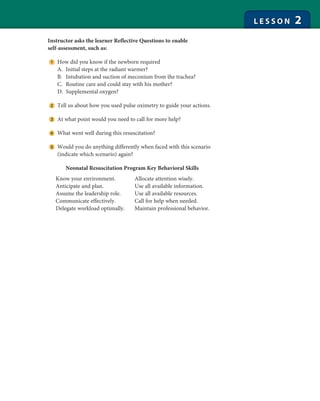
Instructor asks the learner Reflective Questions to enable 
self-assessment, such as: 
How did you know if the newborn required 
A. Initial steps at the radiant warmer? 
B. Intubation and suction of meconium from the trachea? 
C. Routine care and could stay with his mother? 
D. Supplemental oxygen? 
Tell us about how you used pulse oximetry to guide your actions. 
At what point would you need to call for more help? 
What went well during this resuscitation? 
Would you do anything differently when faced with this scenario 
(indicate which scenario) again? 
Neonatal Resuscitation Program Key Behavioral Skills 
Know your environment. Allocate attention wisely. 
Anticipate and plan. Use all available information. 
Assume the leadership role. Use all available resources. 
Communicate effectively. Call for help when needed. 
Delegate workload optimally. Maintain professional behavior.

NRP: Lesson 2

  • 1.
    L E SS O N 2 65 Lesson 2: Initial Steps Performance Checklist Term gestation? Breathing or crying? Good tone? No Warm, clear airway if necessary, dry, stimulate Yes—stay with mother HR below 100 bpm, gasping, or apnea? Routine Care • Provide warmth • Clear airway if necessary • Dry • Ongoing evaluation Labored breathing or persistent cyanosis? No No PPV, Yes SPO2 monitoring Yes Clear airway SPO2 monitoring Consider CPAP Post-resuscitation care Targeted Pre-ductal SPO2 After Birth 1 min 2 min 3 min 4 min 5 min 10 min 60-65% 65-70% 70-75% 75-80% 80-85% 85-95% HR below 100 bpm? Yes Take ventilation corrective steps HR below 60 bpm? Yes Consider intubation Chest compressions Coordinate with PPV HR below 60 bpm? Yes IV epinephrine No Birth 30 sec 60 sec No The Performance Checklist Is a Learning Tool The learner uses the checklist as a reference during independent practice or as a guide for discussion and practice with a Neonatal Resuscitation Program™ (NRP™) instructor. When the learner and instructor agree that the learner can perform the skills correctly and smoothly without coaching and within the context of a scenario, the learner may move on to the next lesson’s Performance Checklist. Knowledge Check • How do you determine if a newborn requires resuscitation? • How do you manage the baby who is born with meconium-stained amniotic fluid? • How does pulse oximetry work and what is its function? NRP
  • 2.
    Initial Steps ofResuscitation 66 Learning Objectives Identify the newborn who requires initial steps of resuscitation. Demonstrate correct technique for performing initial steps, including decision making for a baby born with meconium-stained amniotic fluid. Demonstrate correct placement of oximeter probe and interpretation of pulse oximetry. “You are called to attend a cesarean birth due to breech presentation. How would you prepare for the birth of this baby? As you work, say your thoughts and actions aloud so your assistant and I will know what you are thinking and doing.” Instructor should check boxes as the learner responds correctly. Participant Name: Obtains relevant perinatal history Gestational age? Fluid clear? How many babies? Other risk factors? Performs equipment check If obstetric provider indicates that meconium is present in amniotic fluid, prepares for intubation and meconium aspiration Warmer on and towels to dry, Clear airway (bulb syringe, wall suction set at 80-100 mm Hg, meconium aspirator), Auscultate (stethoscope), Oxygenate (checks oxygen, blender, pulse oximeter and probe), Ventilate (checks positive-pressure ventilation [PPV] device), Intubate (laryngoscope and blades, endotracheal tubes, stylets, end-tidal CO2 detector), Medicate (code cart accessible), Thermoregulate Option 1: Meconium-stained amniotic fluid, vigorous newborn. “The baby has been born.” Sample Vital Signs Performance Steps Details Appears term Respiratory rate (RR)-crying Tone-flexed Completes initial assessment when baby is born. Learner asks 3 questions: • Term? • Breathing or crying? • Good tone? Initial assessment determines whether or not baby will receive initial steps of resuscitation at the radiant warmer. Allows baby to stay with his mother for routine care: Warm, clear airway if necessary, dry, stimulate if necessary, continue evaluation “Vigorous” meconium-stained baby is defined by • Strong respiratory efforts • Good muscle tone • Heart rate (HR) 100 beats per minute (bpm) Assume that a crying baby with good tone has HR 100 bpm.
  • 3.
    L E SS O N 2 67 Option 2: Meconium-stained amniotic fluid; non-vigorous newborn “The baby has been born.” Sample Vital Signs Performance Steps Details Appears term Not breathing Limp Completes initial assessment when baby is born. Learner asks 3 questions: • Term? • Breathing or crying? • Good tone? This baby requires initial steps, even without the additional risk factor of meconium-stained amniotic fluid. RR-apneic HR-70 bpm Tone-limp Receives at radiant warmer. Does not dry or stimulate to breathe. Assesses breathing, heart rate, tone. Indicates tracheal suctioning would be required. This is a “non-vigorous” meconium-stained baby. Intubation and tracheal suctioning procedure discussed in Lesson 5. Baby has been intubated and suctioned. Continue with any option below and begin with “Receives baby at radiant warmer.” Option 3: Clear fluid, newborn requires initial steps “The baby has been born.” Term-yes RR-weak Tone-limp Completes initial assessment when baby is born Learner asks 3 questions: • Term? • Breathing or crying? • Good tone? Instructor may tailor scenario to meet learner needs; any or all of the assessment questions may prompt initiation of initial steps. Receives baby at radiant warmer • Positions airway • Suctions mouth and nose • Dries with towel or blanket • Removes wet linen • Stimulates by flicking soles or rubbing back Learner should move quickly through these steps. RR-cry HR-120 bpm Tone–fair Color-cyanotic Assesses breathing and heart rate If learner believes baby is cyanotic and requires supplemental oxygen, learner should administer free-flow oxygen and immediately connect pulse oximeter to confirm the perception of cyanosis. “The baby is now 3 minutes old and appears cyanotic” Breathing HR-140 bpm Appears cyanotic Begins supplemental oxygen Places oximeter probe on right hand or wrist, then connects oximeter Confirms reliable signal by ensuring audio/pulsing light correlates with baby’s actual heart rate Free-flow oxygen may be given by oxygen mask, flow-inflating bag and mask, T-piece resuscitator, or oxygen tubing. It may not be given through the mask of a self-inflating bag.
  • 4.
    Initial Steps ofResuscitation SPO2-65% Continues free-flow oxygen 68 and weans per oximetry target range for age Target range for 3 minutes of age 70%-75%. SPO2-72% Does not begin supplemental oxygen and continues to monitor baby’s transition Option 4: Clear fluid, newborn requires initial steps. “The baby has been born.” Sample Vital Signs Performance Steps Details Appears term Weak cry Limp Completes initial assessment when baby is born Learner asks 3 questions: • Term? • Breathing or crying? • Good tone? Receives baby at radiant warmer • Positions airway • Suctions mouth and nose • Dries with towel or blanket • Removes wet linen • Stimulates by flicking soles or rubbing back Learner should move through these steps quickly; handle baby gently, do not use bulb syringe aggressively, do not waste time continuing to stimulate baby if unresponsive. RR-labored HR-110 bpm Tone-fair Color-cyanotic Assesses breathing, heart rate Visual perception of cyanosis is unreliable. If newborn seems persistently cyanotic, start supplemental oxygen and confirm cyanosis with pulse oximetry. Begins free-flow oxygen Attaches oximeter probe to right hand or wrist; then attaches to oximeter Considers continuous positive airway pressure (CPAP) Free-flow oxygen may be given by oxygen mask, flow-inflating bag and mask, T-piece resuscitator, or oxygen tubing. It may not be given through the mask of a self-inflating bag. CPAP is possible with flow-inflating bag or T-piece resuscitator. RR-40 breaths per minute HR-120 bpm SPO2-74% Evaluates oximetry reading in relation to age. Refers to table of pre-ductal oxygen saturation targets on Neonatal Resuscitation Program flow diagram. RR-40 breaths per minute and unlabored HR-140 bpm SPO2-97% or SPO2-65% At 3 minutes of age: Weans supplemental oxygen Indicates need for PPV Increases free-flow oxygen concentration and/or indicates need for trial of PPV.
  • 5.
    L E SS O N 2 69 Instructor asks the learner Reflective Questions to enable self-assessment, such as: How did you know if the newborn required A. Initial steps at the radiant warmer? B. Intubation and suction of meconium from the trachea? C. Routine care and could stay with his mother? D. Supplemental oxygen? Tell us about how you used pulse oximetry to guide your actions. At what point would you need to call for more help? What went well during this resuscitation? Would you do anything differently when faced with this scenario (indicate which scenario) again? Neonatal Resuscitation Program Key Behavioral Skills Know your environment. Allocate attention wisely. Anticipate and plan. Use all available information. Assume the leadership role. Use all available resources. Communicate effectively. Call for help when needed. Delegate workload optimally. Maintain professional behavior.