Evolution of Microprocessor
Development of Microprocessor
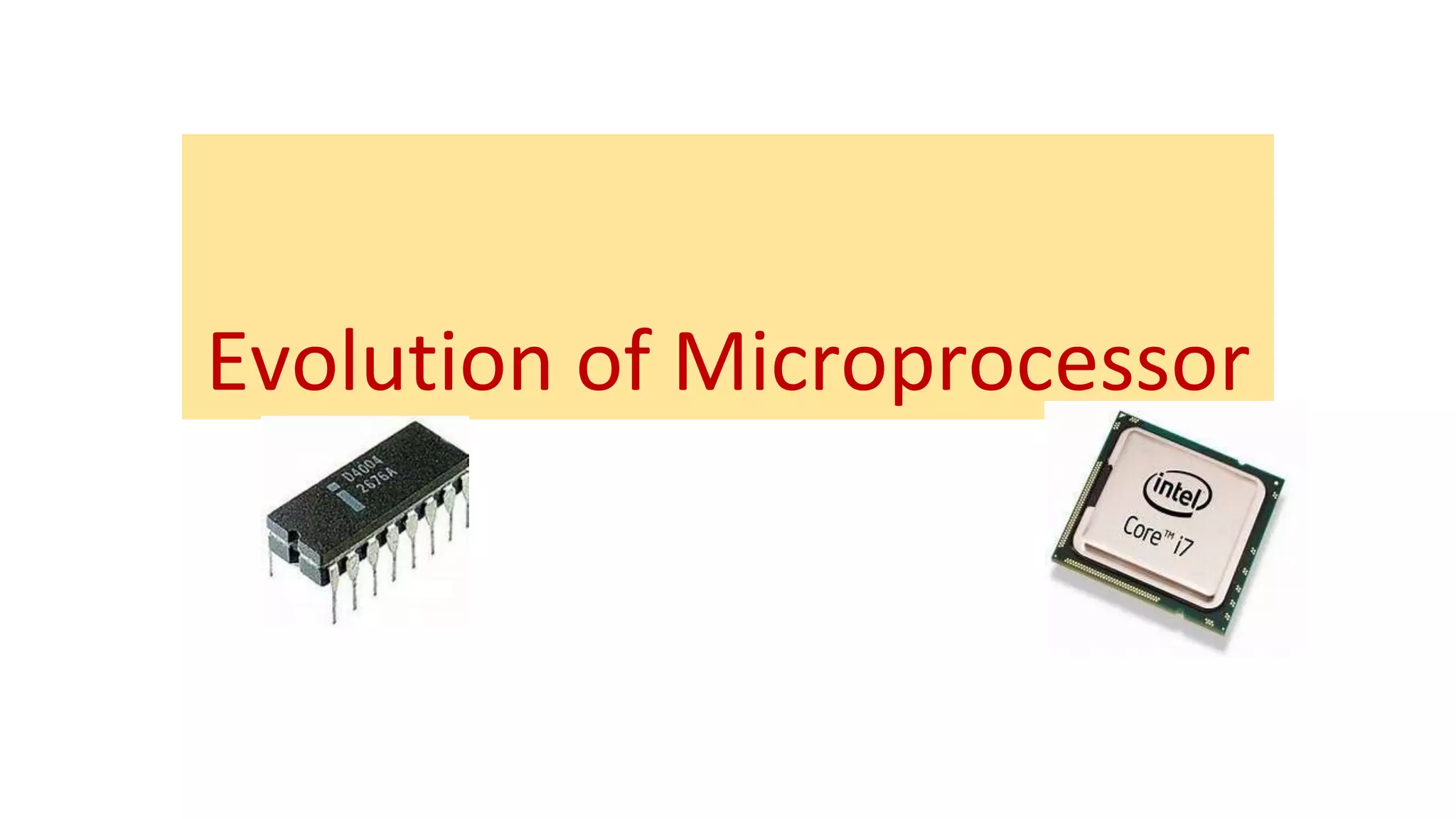
• The first microprocessor was introduced by INTEL in 1971.
• INTEL 4004 : Single chip microprocessor
• The developments in μP since 1971 have been in the direction of
• improving architecture
• improving instruction set,
• increasing speeds,
• simplifying power requirements and
• incorporating more and more memory space and I/O facilities in the same
chip
4-bit Processor
1971 First single-chip Microprocessor “INTEL 4004” was introduced by Intel. .
Originally developed in partnership with Busicom calculator.
With 12-bit address bus it can address 640 bytes of Memory.
4-bit Data bus.
46 instruction set.
Designed with PMOS (10 µm)technology with 2250 transistors.
1974 4040 :Enhanced version of INTEL 4004 by Intel with PMOS technology.
Faster than 4004.
Support Interrupts.
60 instruction set.
12-bit address bus and 4-bit data bus.
PMOS (10 µm) technology with 3000 Transistors.
4-bit Processor
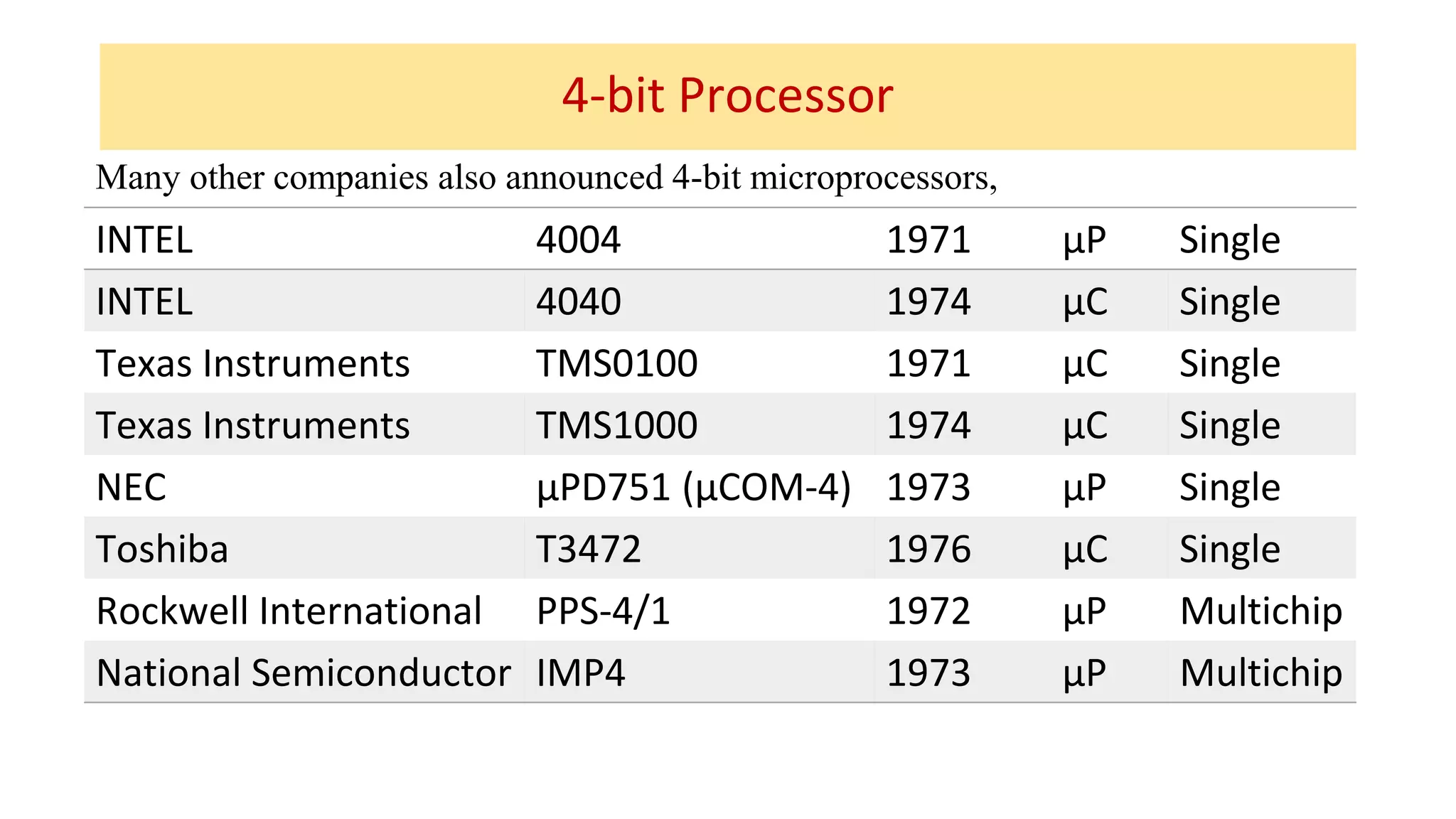
INTEL 4004 1971 µP Single
INTEL 4040 1974 µC Single
Texas Instruments TMS0100 1971 µC Single
Texas Instruments TMS1000 1974 µC Single
NEC μPD751 (μCOM-4) 1973 µP Single
Toshiba T3472 1976 µC Single
Rockwell International PPS-4/1 1972 µP Multichip
National Semiconductor IMP4 1973 µP Multichip
Many other companies also announced 4-bit microprocessors,
8-bit Processor
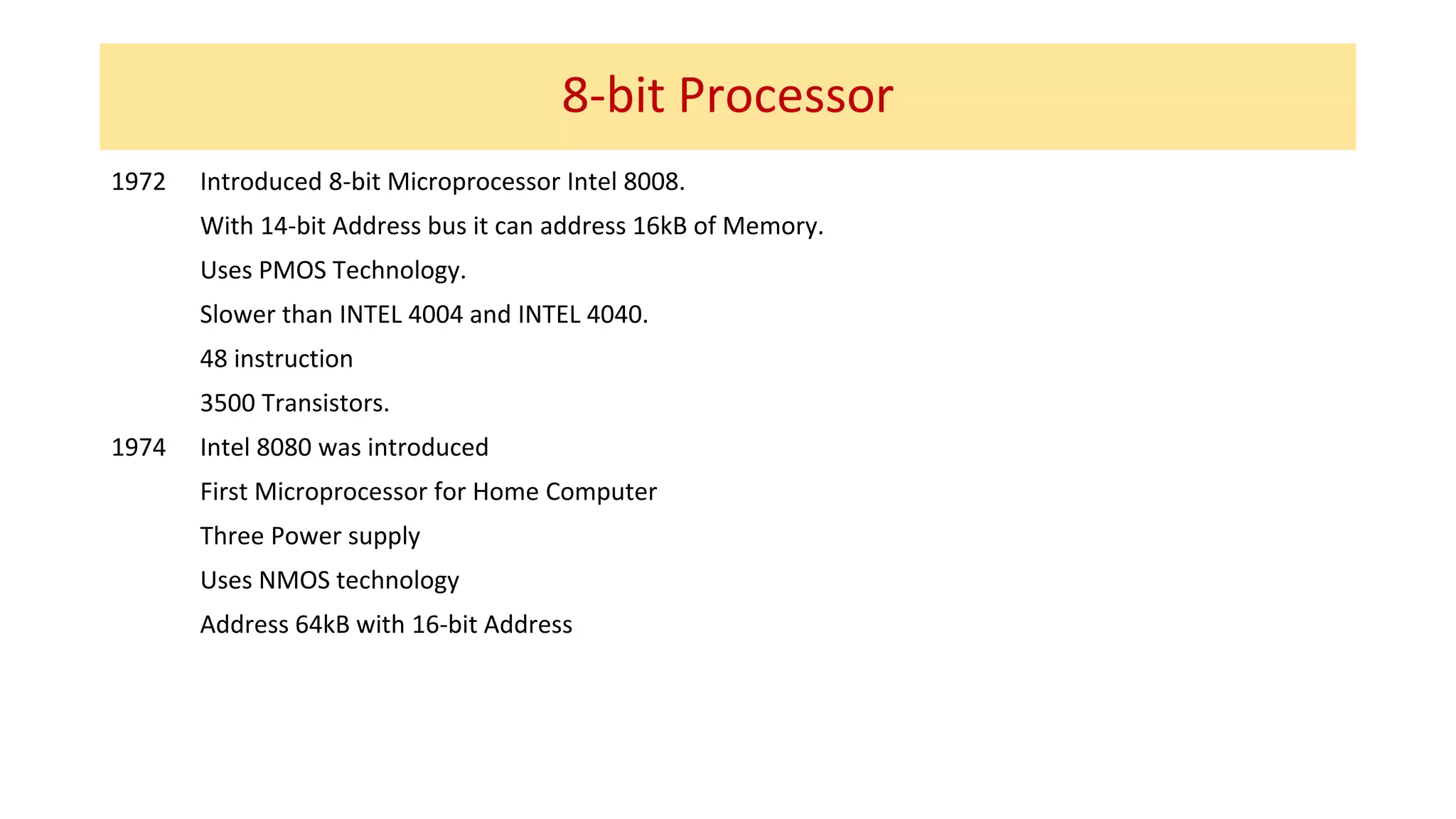
1972 Introduced 8-bit Microprocessor Intel 8008.
With 14-bit Address bus it can address 16kB of Memory.
Uses PMOS Technology.
Slower than INTEL 4004 and INTEL 4040.
48 instruction
3500 Transistors.
1974 Intel 8080 was introduced
First Microprocessor for Home Computer
Three Power supply
Uses NMOS technology
Address 64kB with 16-bit Address
8-bit Processor
1976 Intel introduces 8085, improved version of 8080
NMOS Technology
Requires Single Power Supply of +5V
Inbuilt Clock Generator
1st commercially successful Microprocessor.
Address data multiplexing
Added 4- more interrupts
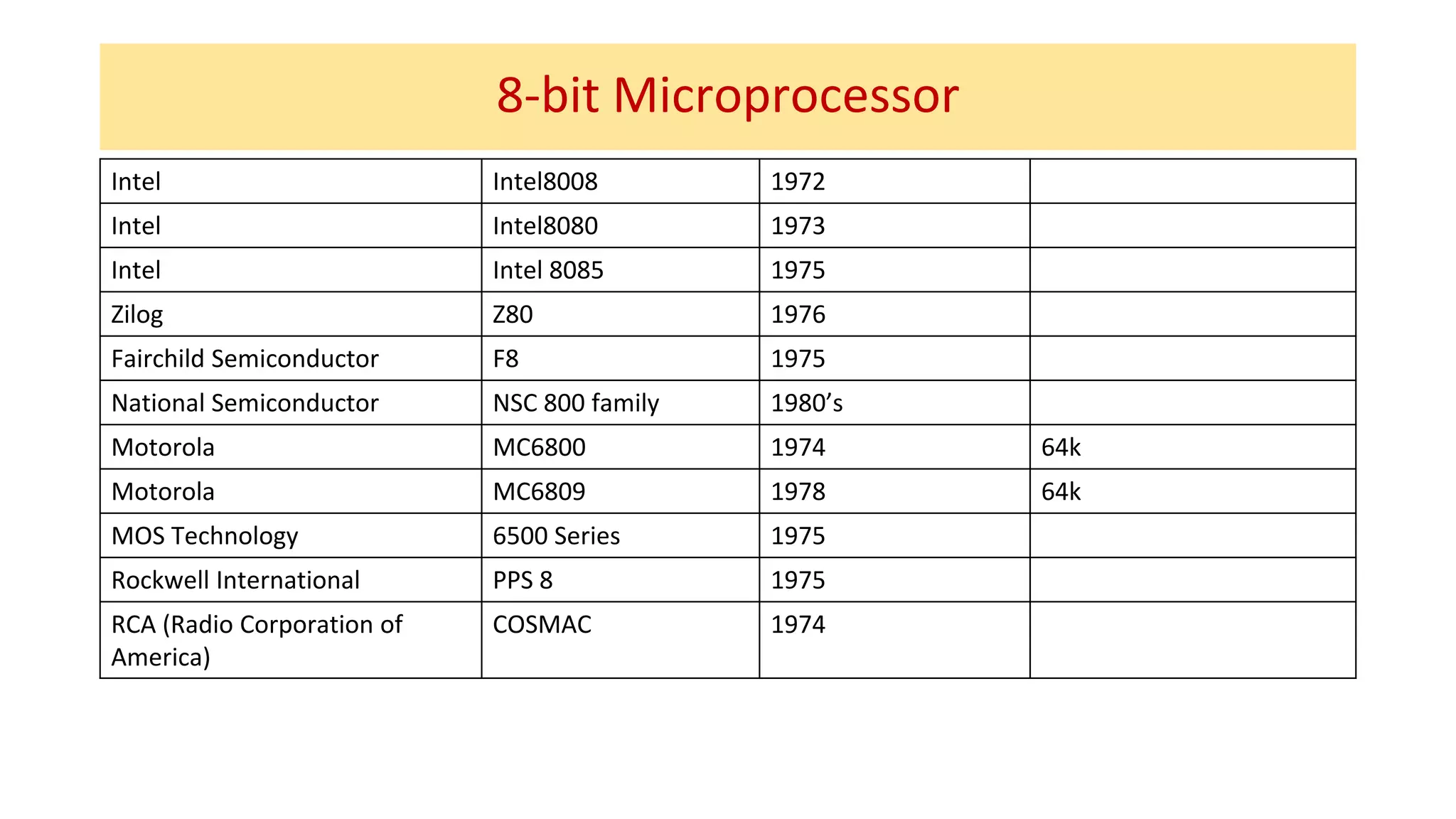
8-bit Microprocessor
Intel Intel8008 1972
Intel Intel8080 1973
Intel Intel 8085 1975
Zilog Z80 1976
Fairchild Semiconductor F8 1975
National Semiconductor NSC 800 family 1980’s
Motorola MC6800 1974 64k
Motorola MC6809 1978 64k
MOS Technology 6500 Series 1975
Rockwell International PPS 8 1975
RCA (Radio Corporation of
America)
COSMAC 1974
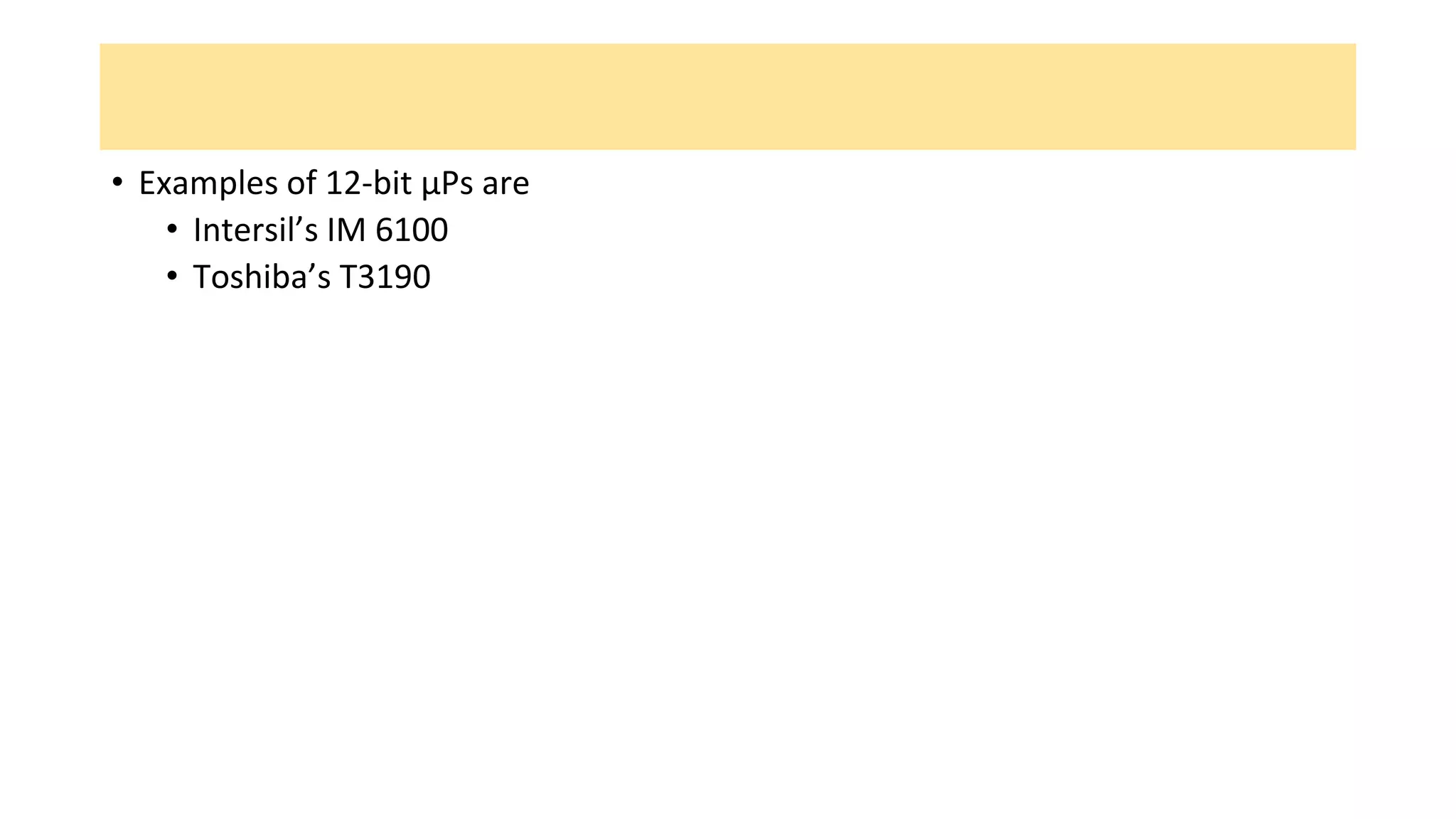
• Examples of 12-bit μPs are
• Intersil’s IM 6100
• Toshiba’s T3190
16-bit Processor
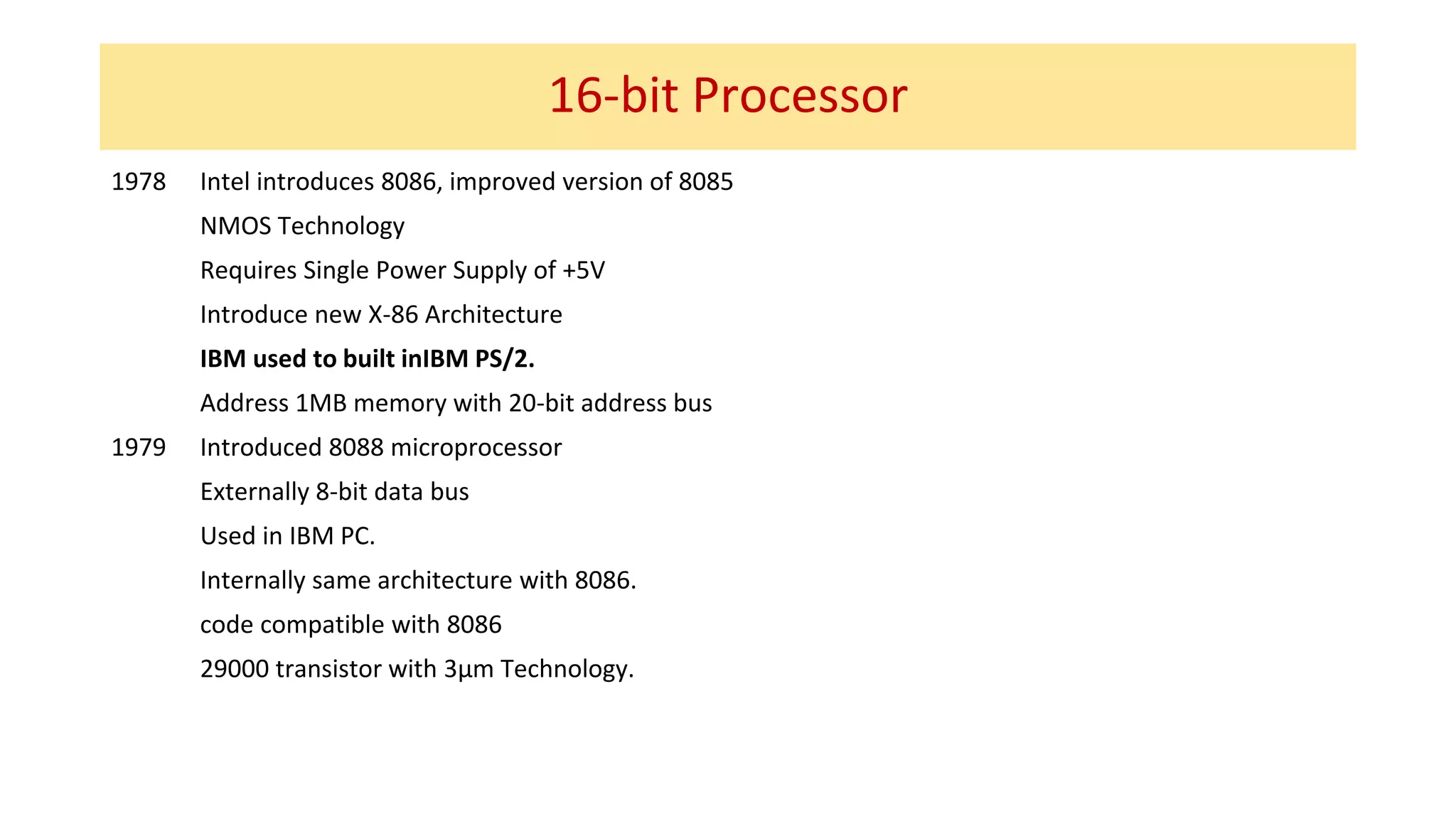
1978 Intel introduces 8086, improved version of 8085
NMOS Technology
Requires Single Power Supply of +5V
Introduce new X-86 Architecture
IBM used to built inIBM PS/2.
Address 1MB memory with 20-bit address bus
1979 Introduced 8088 microprocessor
Externally 8-bit data bus
Used in IBM PC.
Internally same architecture with 8086.
code compatible with 8086
29000 transistor with 3µm Technology.
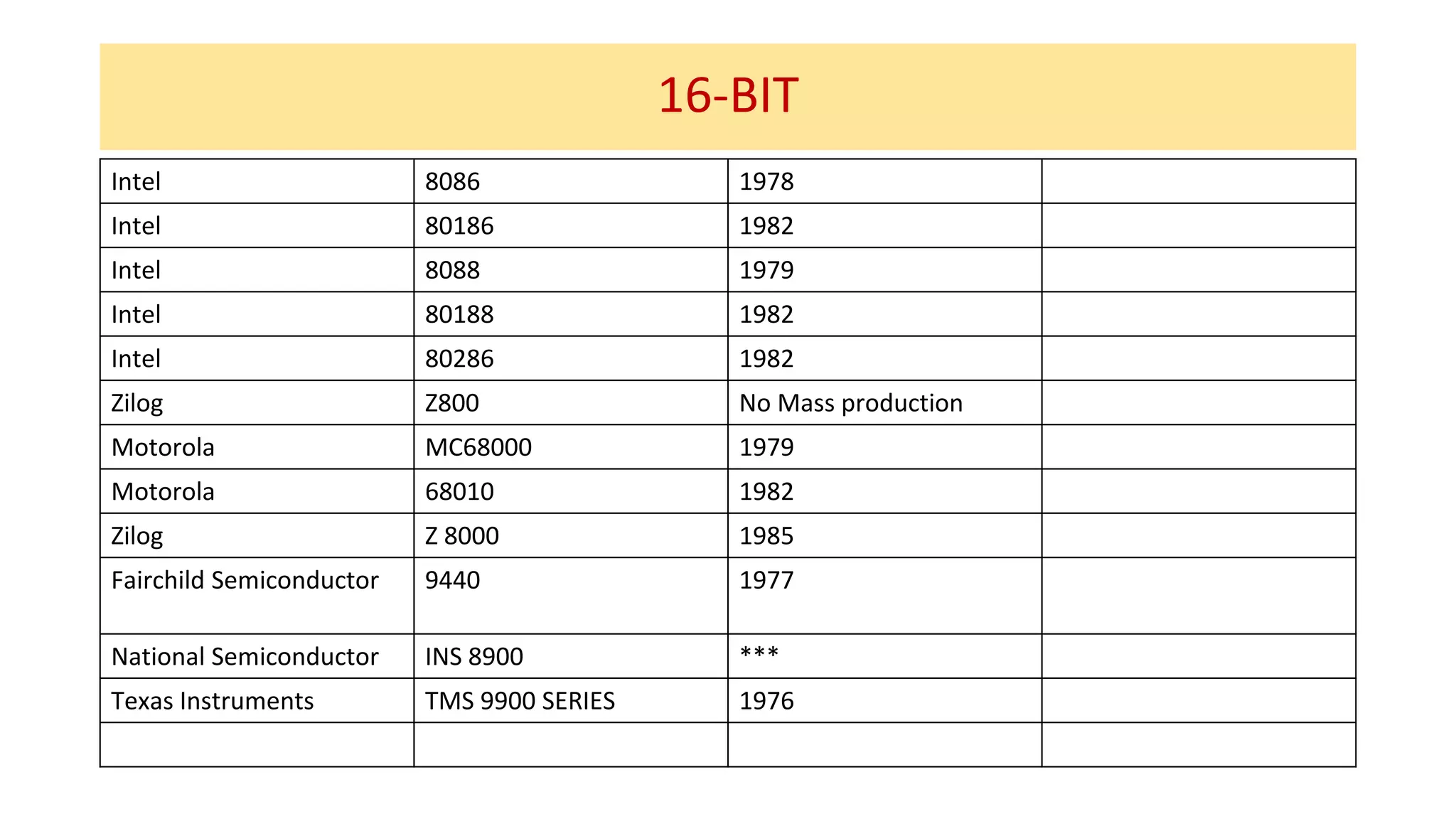
16-BIT
Intel 8086 1978
Intel 80186 1982
Intel 8088 1979
Intel 80188 1982
Intel 80286 1982
Zilog Z800 No Mass production
Motorola MC68000 1979
Motorola 68010 1982
Zilog Z 8000 1985
Fairchild Semiconductor 9440 1977
National Semiconductor INS 8900 ***
Texas Instruments TMS 9900 SERIES 1976
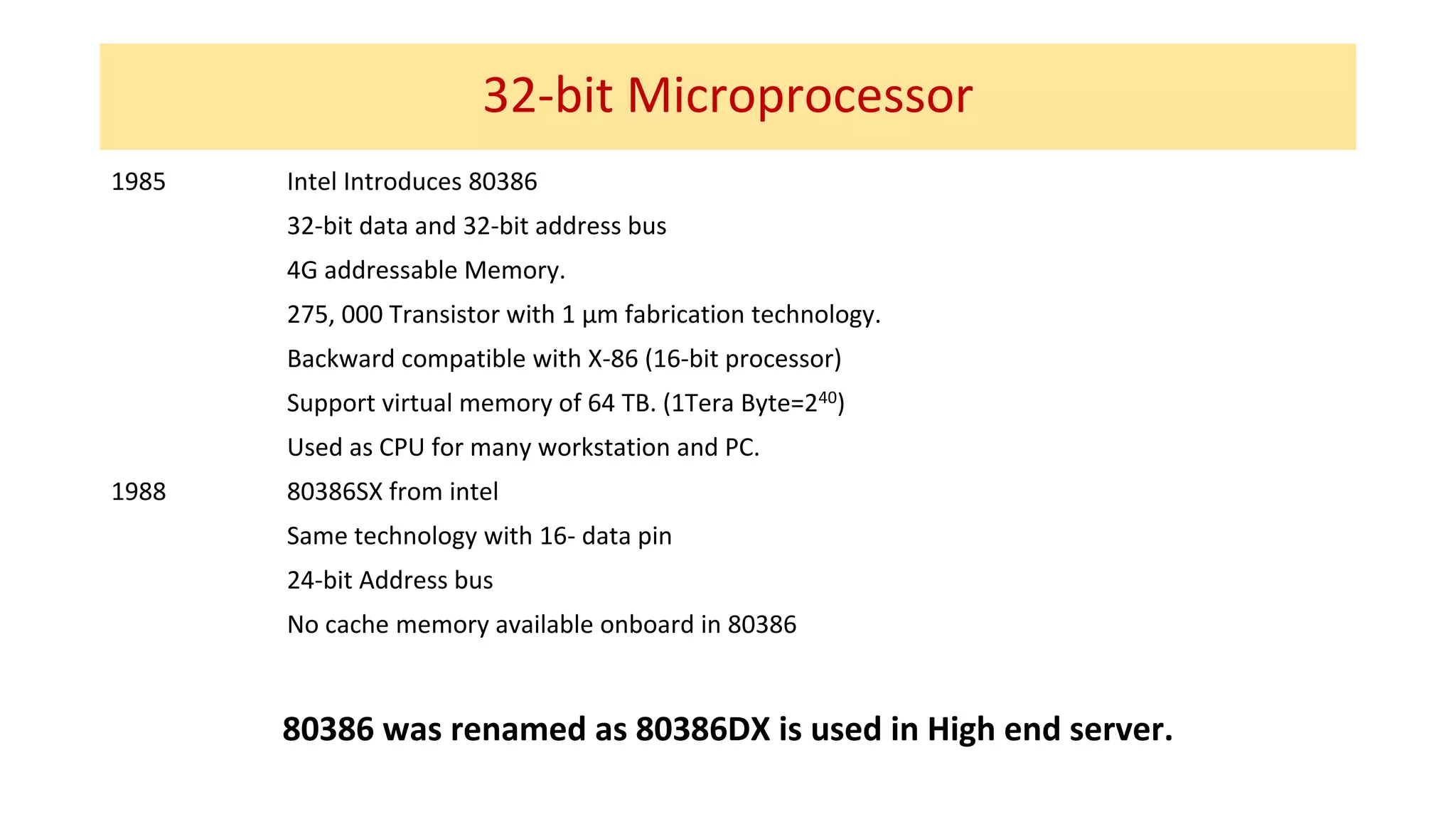
32-bit Microprocessor
1985 Intel Introduces 80386
32-bit data and 32-bit address bus
4G addressable Memory.
275, 000 Transistor with 1 µm fabrication technology.
Backward compatible with X-86 (16-bit processor)
Support virtual memory of 64 TB. (1Tera Byte=240)
Used as CPU for many workstation and PC.
1988 80386SX from intel
Same technology with 16- data pin
24-bit Address bus
No cache memory available onboard in 80386
80386 was renamed as 80386DX is used in High end server.
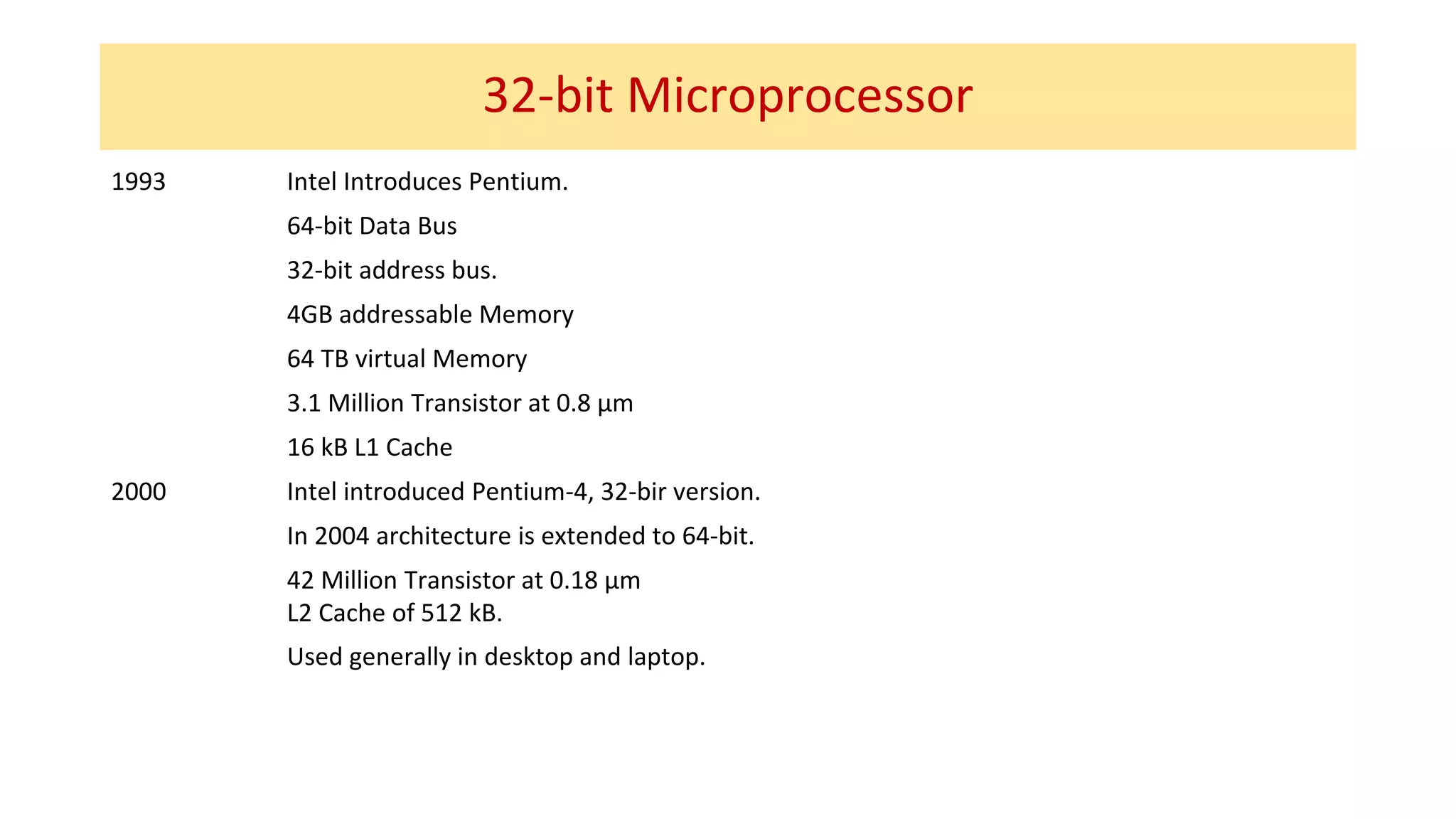
32-bit Microprocessor
1993 Intel Introduces Pentium.
64-bit Data Bus
32-bit address bus.
4GB addressable Memory
64 TB virtual Memory
3.1 Million Transistor at 0.8 µm
16 kB L1 Cache
2000 Intel introduced Pentium-4, 32-bir version.
In 2004 architecture is extended to 64-bit.
42 Million Transistor at 0.18 µm
L2 Cache of 512 kB.
Used generally in desktop and laptop.
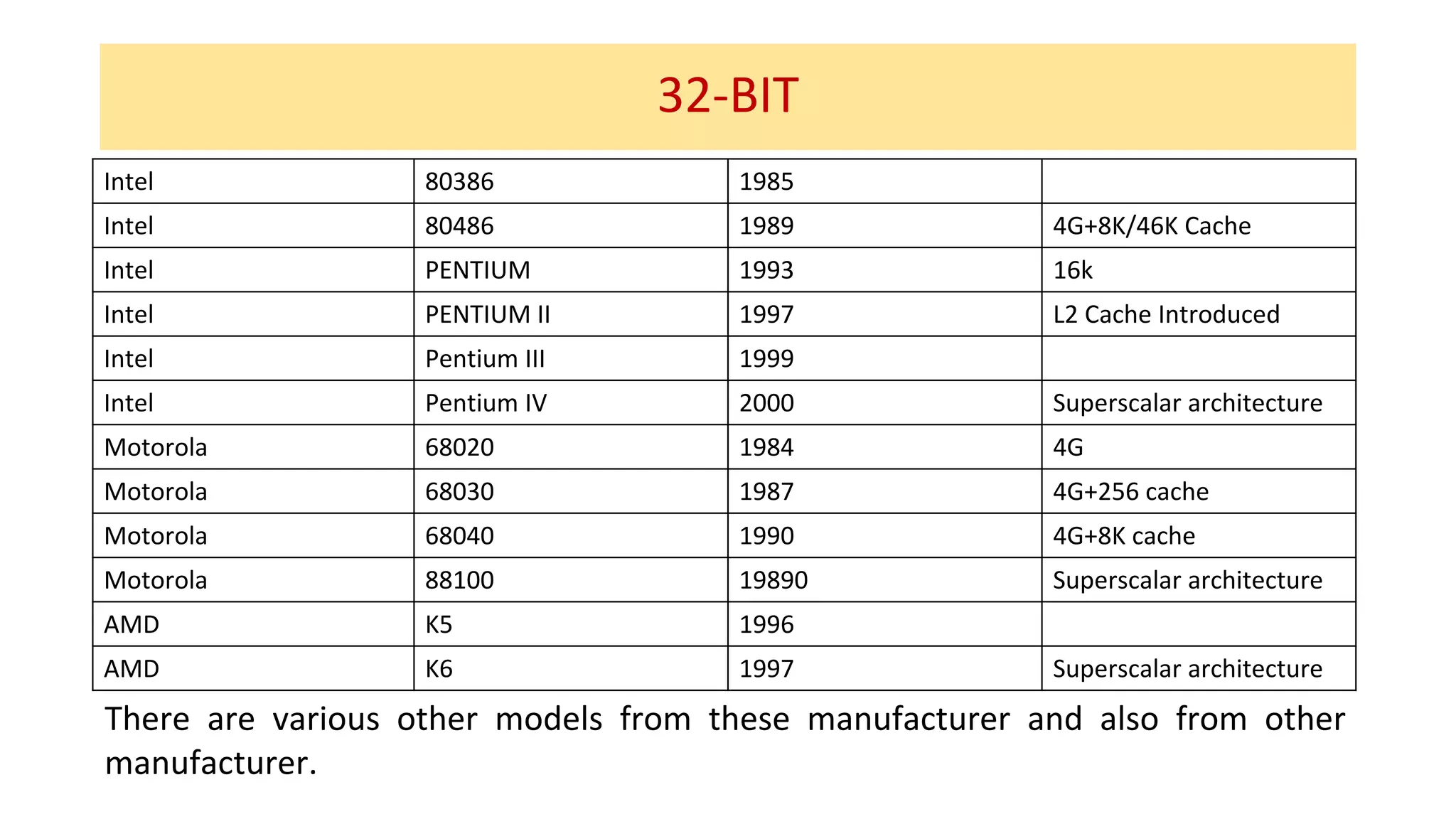
32-BIT
Intel 80386 1985
Intel 80486 1989 4G+8K/46K Cache
Intel PENTIUM 1993 16k
Intel PENTIUM II 1997 L2 Cache Introduced
Intel Pentium III 1999
Intel Pentium IV 2000 Superscalar architecture
Motorola 68020 1984 4G
Motorola 68030 1987 4G+256 cache
Motorola 68040 1990 4G+8K cache
Motorola 88100 19890 Superscalar architecture
AMD K5 1996
AMD K6 1997 Superscalar architecture
There are various other models from these manufacturer and also from other
manufacturer.
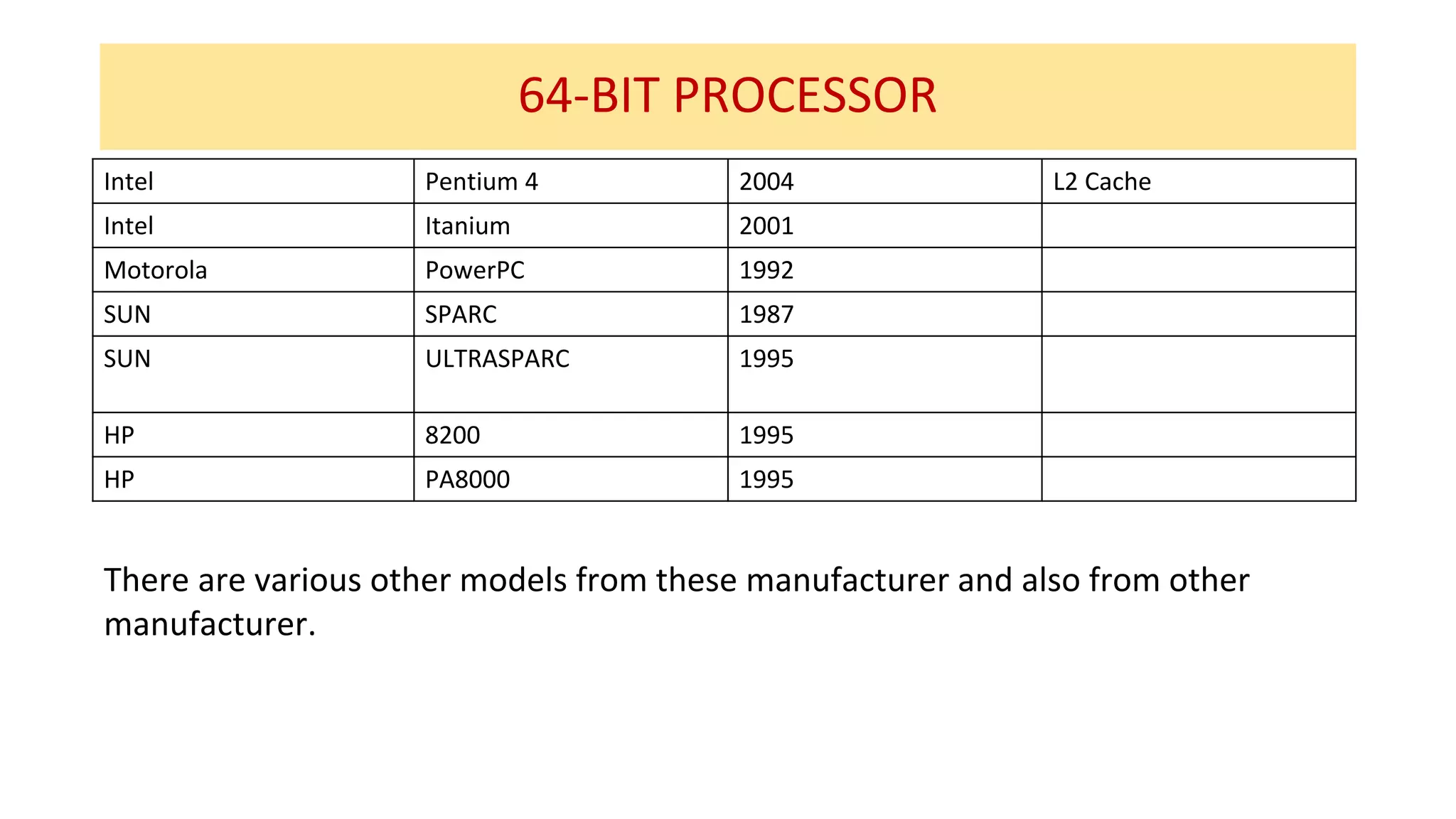
64-BIT PROCESSOR
Intel Pentium 4 2004 L2 Cache
Intel Itanium 2001
Motorola PowerPC 1992
SUN SPARC 1987
SUN ULTRASPARC 1995
HP 8200 1995
HP PA8000 1995
There are various other models from these manufacturer and also from other
manufacturer.
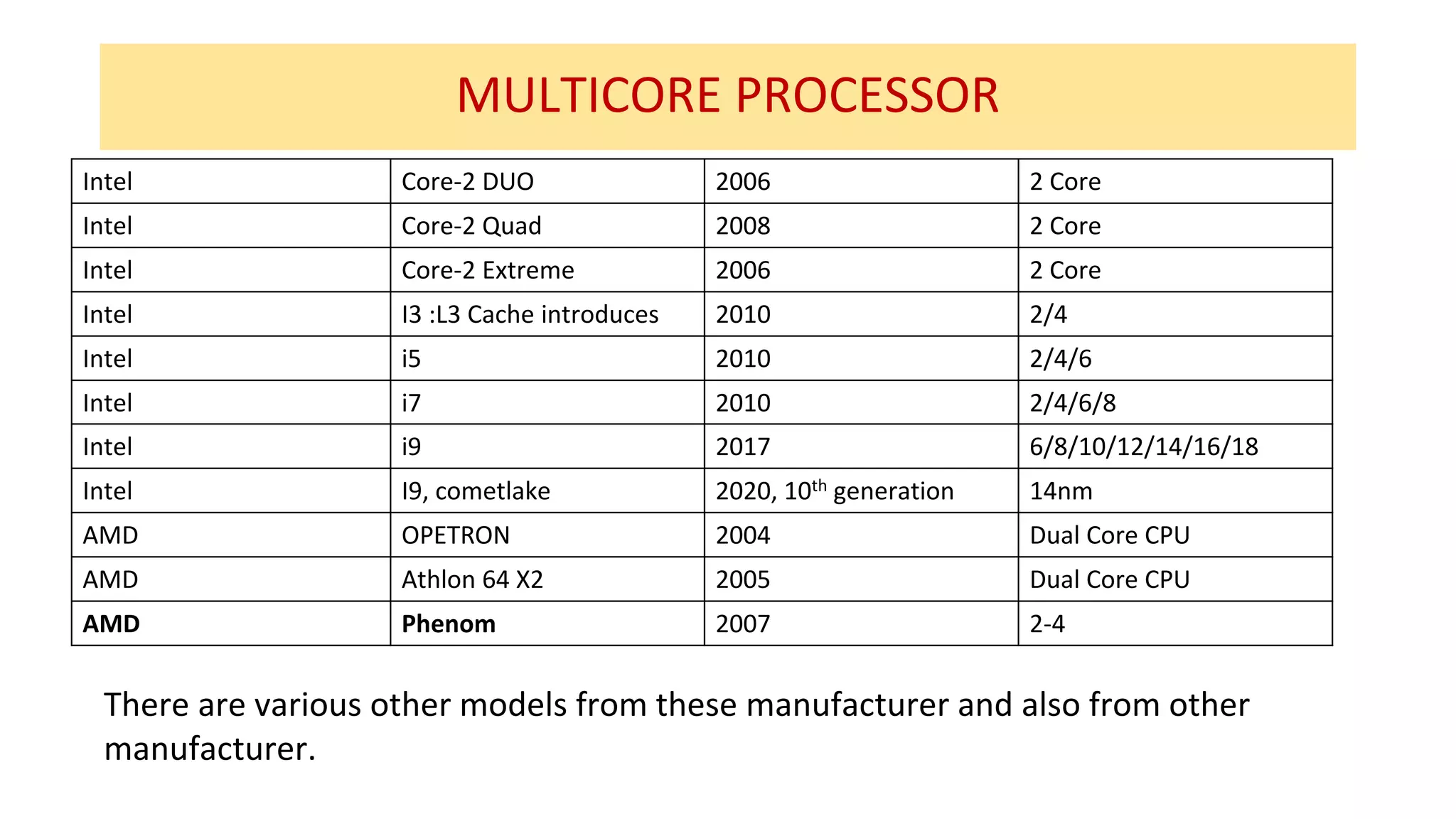
MULTICORE PROCESSOR
Intel Core-2 DUO 2006 2 Core
Intel Core-2 Quad 2008 2 Core
Intel Core-2 Extreme 2006 2 Core
Intel I3 :L3 Cache introduces 2010 2/4
Intel i5 2010 2/4/6
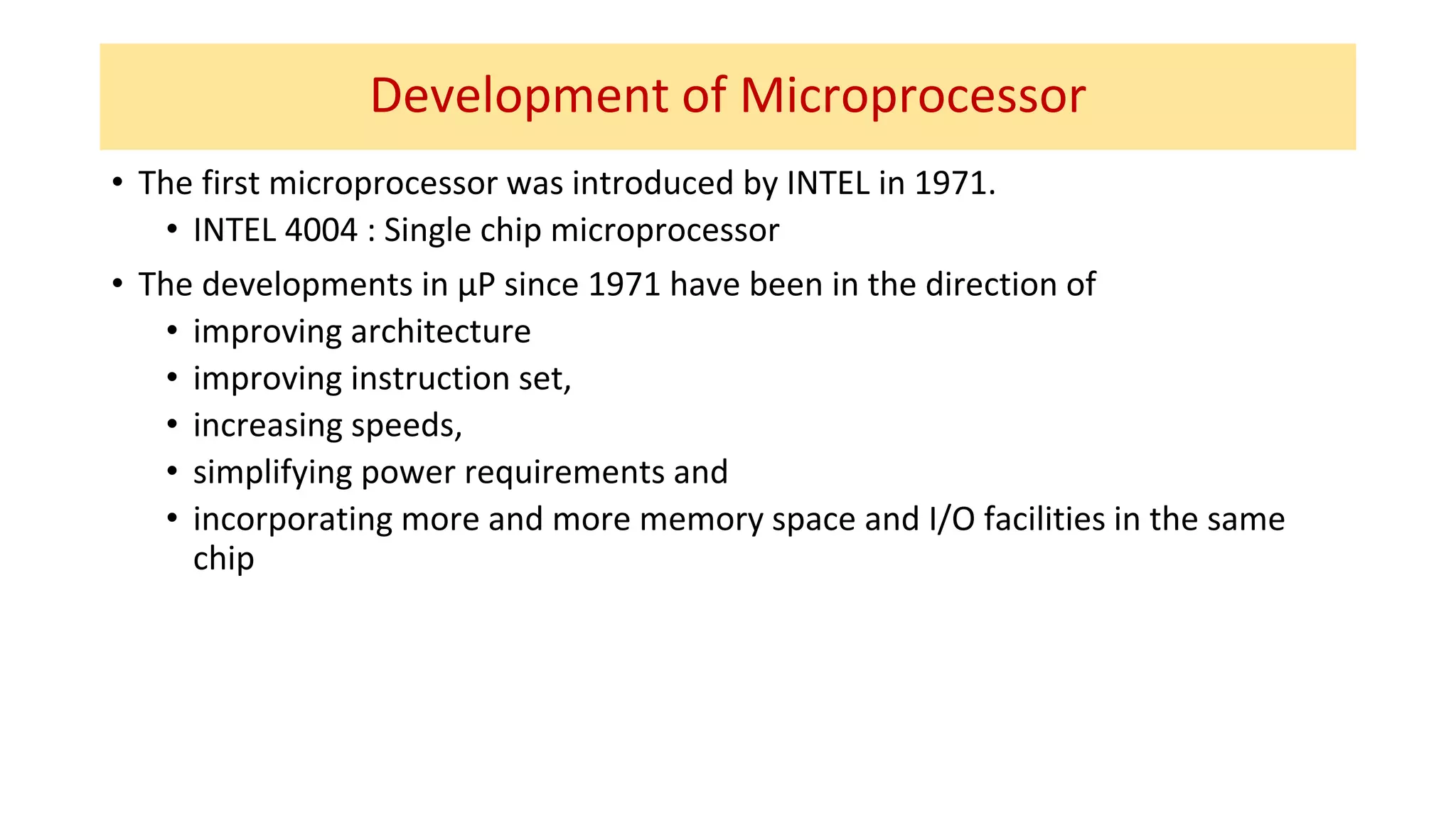
Intel i7 2010 2/4/6/8
Intel i9 2017 6/8/10/12/14/16/18
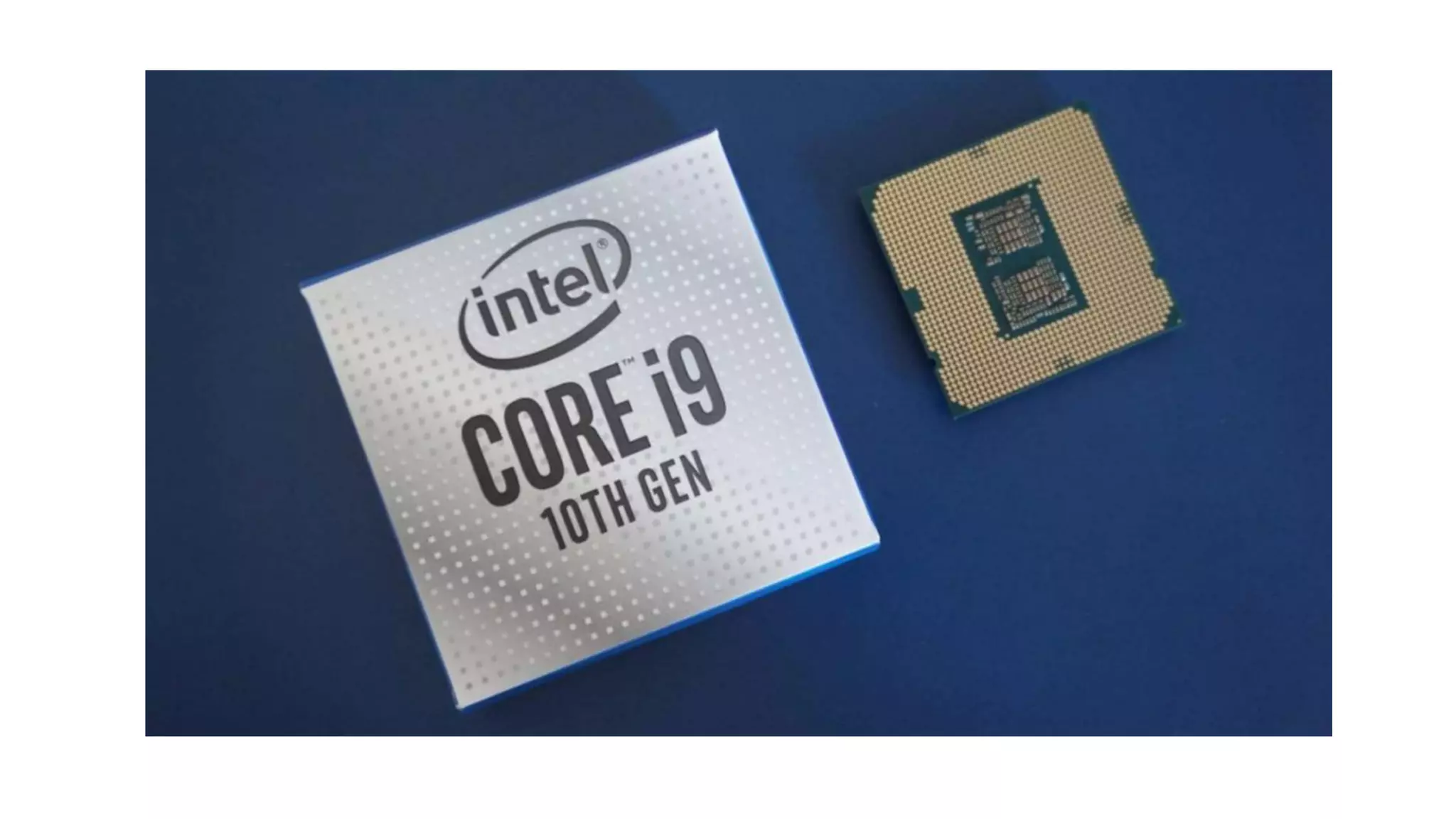
Intel I9, cometlake 2020, 10th generation 14nm
AMD OPETRON 2004 Dual Core CPU
AMD Athlon 64 X2 2005 Dual Core CPU
AMD Phenom 2007 2-4
There are various other models from these manufacturer and also from other
manufacturer.
0.2 evolution of microprocessor

0.2 evolution of microprocessor

  • 1.
  • 2.
    Development of Microprocessor •The first microprocessor was introduced by INTEL in 1971. • INTEL 4004 : Single chip microprocessor • The developments in μP since 1971 have been in the direction of • improving architecture • improving instruction set, • increasing speeds, • simplifying power requirements and • incorporating more and more memory space and I/O facilities in the same chip
  • 3.
    4-bit Processor 1971 Firstsingle-chip Microprocessor “INTEL 4004” was introduced by Intel. . Originally developed in partnership with Busicom calculator. With 12-bit address bus it can address 640 bytes of Memory. 4-bit Data bus. 46 instruction set. Designed with PMOS (10 µm)technology with 2250 transistors. 1974 4040 :Enhanced version of INTEL 4004 by Intel with PMOS technology. Faster than 4004. Support Interrupts. 60 instruction set. 12-bit address bus and 4-bit data bus. PMOS (10 µm) technology with 3000 Transistors.
  • 4.
    4-bit Processor INTEL 40041971 µP Single INTEL 4040 1974 µC Single Texas Instruments TMS0100 1971 µC Single Texas Instruments TMS1000 1974 µC Single NEC μPD751 (μCOM-4) 1973 µP Single Toshiba T3472 1976 µC Single Rockwell International PPS-4/1 1972 µP Multichip National Semiconductor IMP4 1973 µP Multichip Many other companies also announced 4-bit microprocessors,
  • 5.
    8-bit Processor 1972 Introduced8-bit Microprocessor Intel 8008. With 14-bit Address bus it can address 16kB of Memory. Uses PMOS Technology. Slower than INTEL 4004 and INTEL 4040. 48 instruction 3500 Transistors. 1974 Intel 8080 was introduced First Microprocessor for Home Computer Three Power supply Uses NMOS technology Address 64kB with 16-bit Address
  • 6.
    8-bit Processor 1976 Intelintroduces 8085, improved version of 8080 NMOS Technology Requires Single Power Supply of +5V Inbuilt Clock Generator 1st commercially successful Microprocessor. Address data multiplexing Added 4- more interrupts
  • 7.
    8-bit Microprocessor Intel Intel80081972 Intel Intel8080 1973 Intel Intel 8085 1975 Zilog Z80 1976 Fairchild Semiconductor F8 1975 National Semiconductor NSC 800 family 1980’s Motorola MC6800 1974 64k Motorola MC6809 1978 64k MOS Technology 6500 Series 1975 Rockwell International PPS 8 1975 RCA (Radio Corporation of America) COSMAC 1974
  • 8.
    • Examples of12-bit μPs are • Intersil’s IM 6100 • Toshiba’s T3190
  • 9.
    16-bit Processor 1978 Intelintroduces 8086, improved version of 8085 NMOS Technology Requires Single Power Supply of +5V Introduce new X-86 Architecture IBM used to built inIBM PS/2. Address 1MB memory with 20-bit address bus 1979 Introduced 8088 microprocessor Externally 8-bit data bus Used in IBM PC. Internally same architecture with 8086. code compatible with 8086 29000 transistor with 3µm Technology.
  • 10.
    16-BIT Intel 8086 1978 Intel80186 1982 Intel 8088 1979 Intel 80188 1982 Intel 80286 1982 Zilog Z800 No Mass production Motorola MC68000 1979 Motorola 68010 1982 Zilog Z 8000 1985 Fairchild Semiconductor 9440 1977 National Semiconductor INS 8900 *** Texas Instruments TMS 9900 SERIES 1976
  • 11.
    32-bit Microprocessor 1985 IntelIntroduces 80386 32-bit data and 32-bit address bus 4G addressable Memory. 275, 000 Transistor with 1 µm fabrication technology. Backward compatible with X-86 (16-bit processor) Support virtual memory of 64 TB. (1Tera Byte=240) Used as CPU for many workstation and PC. 1988 80386SX from intel Same technology with 16- data pin 24-bit Address bus No cache memory available onboard in 80386 80386 was renamed as 80386DX is used in High end server.
  • 12.
    32-bit Microprocessor 1993 IntelIntroduces Pentium. 64-bit Data Bus 32-bit address bus. 4GB addressable Memory 64 TB virtual Memory 3.1 Million Transistor at 0.8 µm 16 kB L1 Cache 2000 Intel introduced Pentium-4, 32-bir version. In 2004 architecture is extended to 64-bit. 42 Million Transistor at 0.18 µm L2 Cache of 512 kB. Used generally in desktop and laptop.
  • 13.
    32-BIT Intel 80386 1985 Intel80486 1989 4G+8K/46K Cache Intel PENTIUM 1993 16k Intel PENTIUM II 1997 L2 Cache Introduced Intel Pentium III 1999 Intel Pentium IV 2000 Superscalar architecture Motorola 68020 1984 4G Motorola 68030 1987 4G+256 cache Motorola 68040 1990 4G+8K cache Motorola 88100 19890 Superscalar architecture AMD K5 1996 AMD K6 1997 Superscalar architecture There are various other models from these manufacturer and also from other manufacturer.
  • 14.
    64-BIT PROCESSOR Intel Pentium4 2004 L2 Cache Intel Itanium 2001 Motorola PowerPC 1992 SUN SPARC 1987 SUN ULTRASPARC 1995 HP 8200 1995 HP PA8000 1995 There are various other models from these manufacturer and also from other manufacturer.
  • 15.
    MULTICORE PROCESSOR Intel Core-2DUO 2006 2 Core Intel Core-2 Quad 2008 2 Core Intel Core-2 Extreme 2006 2 Core Intel I3 :L3 Cache introduces 2010 2/4 Intel i5 2010 2/4/6 Intel i7 2010 2/4/6/8 Intel i9 2017 6/8/10/12/14/16/18 Intel I9, cometlake 2020, 10th generation 14nm AMD OPETRON 2004 Dual Core CPU AMD Athlon 64 X2 2005 Dual Core CPU AMD Phenom 2007 2-4 There are various other models from these manufacturer and also from other manufacturer.