Blockchains 101
@blockstrap
#StartingBlock2015
Introduction & Primer
First, some context
These slides are from the #StartingBlock2015 tour by @blockstrap.
6 European countries in 8 days – (Istanbul, Amsterdam, Barcelona, Prague, Berlin
& London). We met lots of great people, answered lots of great questions and had
a great time. We look forward to meeting many of them again in the near future.
These slides might only make perfect sense if you were at the talks and can
remember all the additional points we made whilst discussing the tech.
This deck is 2nd
of 6.
Questions? Comments? @MrAdamGiles adam@neuroware.io
Blockchains 101
Refresher
➔ We know that the blockchain records Transactions
➔ Transactions are time dependent, happen in an order
➔ Once you’ve spent coins, you can’t go back in time and spend again
➔ Blockchains record transactions in a time domain
Blockchains 101
Blockchain Rules
➔ Once something has happened, and we create a record of that, the
fact that it happened never changes
➔ Data written into a blockchain is a historical record and is immutable
➔ Blockchains have to prove that they haven’t been tampered with
➔ Everyone running that blockchain has to agree on the data stored in it
Blockchains from First Principles
Blockchains 101
Blockchains
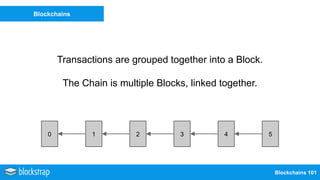
Transactions are grouped together into a Block.
The Chain is multiple Blocks, linked together.
0 21 43 5
Blockchains 101
Blockchains
0 21 43 5
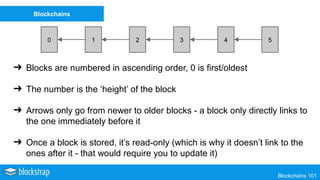
➔ Blocks are numbered in ascending order, 0 is first/oldest
➔ The number is the ‘height’ of the block
➔ Arrows only go from newer to older blocks - a block only directly links to
the one immediately before it
➔ Once a block is stored, it’s read-only (which is why it doesn’t link to the
ones after it - that would require you to update it)
Blockchains 101
Blockchains
0 21 43 5
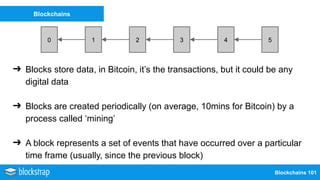
➔ Blocks store data, in Bitcoin, it’s the transactions, but it could be any
digital data
➔ Blocks are created periodically (on average, 10mins for Bitcoin) by a
process called ‘mining’
➔ A block represents a set of events that have occurred over a particular
time frame (usually, since the previous block)
Blockchains 101
Blockchains
0 21 43 5
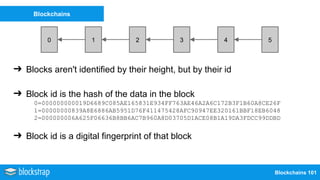
➔ Blocks aren't identified by their height, but by their id
➔ Block id is the hash of the data in the block
0=000000000019D6689C085AE165831E934FF763AE46A2A6C172B3F1B60A8CE26F
1=00000000839A8E6886AB5951D76F411475428AFC90947EE320161BBF18EB6048
2=000000006A625F06636B8BB6AC7B960A8D03705D1ACE08B1A19DA3FDCC99DDBD
➔ Block id is a digital fingerprint of that block
Blockchains 101
What’s in a block?
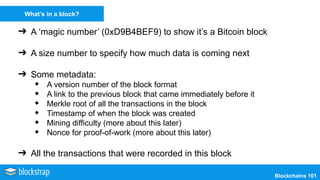
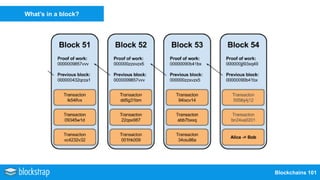
➔ A ‘magic number’ (0xD9B4BEF9) to show it’s a Bitcoin block
➔ A size number to specify how much data is coming next
➔ Some metadata:
◆ A version number of the block format
◆ A link to the previous block that came immediately before it
◆ Merkle root of all the transactions in the block
◆ Timestamp of when the block was created
◆ Mining difficulty (more about this later)
◆ Nonce for proof-of-work (more about this later)
➔ All the transactions that were recorded in this block
Blockchains 101
What’s in a block?
Blockchains 101
Tamper Evident
➔ Blocks are identified by their id (hash of the metadata)
➔ Metadata in turn, contains Merkel Root of Transaction data
➔ Change the metadata, block id will change - broken chain
➔ Change the details of a transaction, the merkle root will change, which
in turn changes the metadata hash, which will change the block id
➔ Hashing data once is really quick, so easy to check the validity of each
block as you go along
Blockchains 101
Why not a database?
Blockchains solve specific problems:
➔ Fully distributed - highly fault tolerant
➔ No centralised authority
➔ 3rd party trust without trust
➔ Low barrier to entry - computer + internet = win
➔ Instant, Global transactional capability
➔ No double spending
➔ Very low transaction costs
Databases can’t do this yet
Blockchains 101
Blockchains as Distributed Databases
In Bitcoin, everyone has a copy of the Blockchain
➔ Everyone running the Bitcoin client is part of the network
➔ New blocks are broadcast to the network
➔ Everyone updates their local copy of the blockchain
➔ If you’re behind the current height of the chain, you can ask other
nodes for copies of the Blocks needed to catch-up
➔ If everyone has a copy of the blockchain, when queried, everyone
gets the same answer
➔ Blockchains are a bit like read-only distributed databases
Blockchains 101
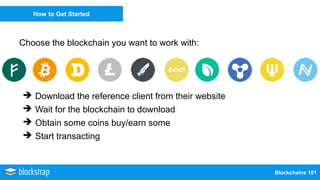
How to Get Started
Choose the blockchain you want to work with:
➔ Download the reference client from their website
➔ Wait for the blockchain to download
➔ Obtain some coins buy/earn some
➔ Start transacting
Blockchains 101
How to Get Started
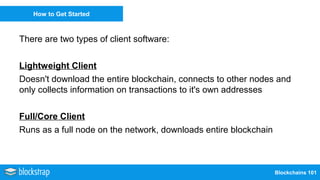
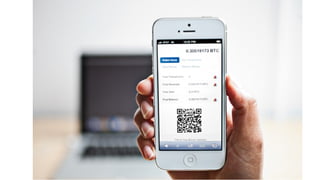
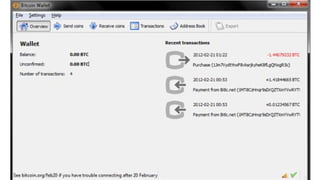
There are two types of client software:
Lightweight Client
Doesn't download the entire blockchain, connects to other nodes and
only collects information on transactions to it's own addresses
Full/Core Client
Runs as a full node on the network, downloads entire blockchain
Any Questions?

CBGTBT - Part 2 - Blockchains 101

  • 1.
  • 2.
    Introduction & Primer First,some context These slides are from the #StartingBlock2015 tour by @blockstrap. 6 European countries in 8 days – (Istanbul, Amsterdam, Barcelona, Prague, Berlin & London). We met lots of great people, answered lots of great questions and had a great time. We look forward to meeting many of them again in the near future. These slides might only make perfect sense if you were at the talks and can remember all the additional points we made whilst discussing the tech. This deck is 2nd of 6. Questions? Comments? @MrAdamGiles adam@neuroware.io
  • 3.
    Blockchains 101 Refresher ➔ Weknow that the blockchain records Transactions ➔ Transactions are time dependent, happen in an order ➔ Once you’ve spent coins, you can’t go back in time and spend again ➔ Blockchains record transactions in a time domain
  • 4.
    Blockchains 101 Blockchain Rules ➔Once something has happened, and we create a record of that, the fact that it happened never changes ➔ Data written into a blockchain is a historical record and is immutable ➔ Blockchains have to prove that they haven’t been tampered with ➔ Everyone running that blockchain has to agree on the data stored in it
  • 5.
  • 6.
    Blockchains 101 Blockchains Transactions aregrouped together into a Block. The Chain is multiple Blocks, linked together. 0 21 43 5
  • 7.
    Blockchains 101 Blockchains 0 2143 5 ➔ Blocks are numbered in ascending order, 0 is first/oldest ➔ The number is the ‘height’ of the block ➔ Arrows only go from newer to older blocks - a block only directly links to the one immediately before it ➔ Once a block is stored, it’s read-only (which is why it doesn’t link to the ones after it - that would require you to update it)
  • 8.
    Blockchains 101 Blockchains 0 2143 5 ➔ Blocks store data, in Bitcoin, it’s the transactions, but it could be any digital data ➔ Blocks are created periodically (on average, 10mins for Bitcoin) by a process called ‘mining’ ➔ A block represents a set of events that have occurred over a particular time frame (usually, since the previous block)
  • 9.
    Blockchains 101 Blockchains 0 2143 5 ➔ Blocks aren't identified by their height, but by their id ➔ Block id is the hash of the data in the block 0=000000000019D6689C085AE165831E934FF763AE46A2A6C172B3F1B60A8CE26F 1=00000000839A8E6886AB5951D76F411475428AFC90947EE320161BBF18EB6048 2=000000006A625F06636B8BB6AC7B960A8D03705D1ACE08B1A19DA3FDCC99DDBD ➔ Block id is a digital fingerprint of that block
  • 10.
    Blockchains 101 What’s ina block? ➔ A ‘magic number’ (0xD9B4BEF9) to show it’s a Bitcoin block ➔ A size number to specify how much data is coming next ➔ Some metadata: ◆ A version number of the block format ◆ A link to the previous block that came immediately before it ◆ Merkle root of all the transactions in the block ◆ Timestamp of when the block was created ◆ Mining difficulty (more about this later) ◆ Nonce for proof-of-work (more about this later) ➔ All the transactions that were recorded in this block
  • 11.
  • 12.
    Blockchains 101 Tamper Evident ➔Blocks are identified by their id (hash of the metadata) ➔ Metadata in turn, contains Merkel Root of Transaction data ➔ Change the metadata, block id will change - broken chain ➔ Change the details of a transaction, the merkle root will change, which in turn changes the metadata hash, which will change the block id ➔ Hashing data once is really quick, so easy to check the validity of each block as you go along
  • 13.
    Blockchains 101 Why nota database? Blockchains solve specific problems: ➔ Fully distributed - highly fault tolerant ➔ No centralised authority ➔ 3rd party trust without trust ➔ Low barrier to entry - computer + internet = win ➔ Instant, Global transactional capability ➔ No double spending ➔ Very low transaction costs Databases can’t do this yet
  • 14.
    Blockchains 101 Blockchains asDistributed Databases In Bitcoin, everyone has a copy of the Blockchain ➔ Everyone running the Bitcoin client is part of the network ➔ New blocks are broadcast to the network ➔ Everyone updates their local copy of the blockchain ➔ If you’re behind the current height of the chain, you can ask other nodes for copies of the Blocks needed to catch-up ➔ If everyone has a copy of the blockchain, when queried, everyone gets the same answer ➔ Blockchains are a bit like read-only distributed databases
  • 15.
    Blockchains 101 How toGet Started Choose the blockchain you want to work with: ➔ Download the reference client from their website ➔ Wait for the blockchain to download ➔ Obtain some coins buy/earn some ➔ Start transacting
  • 16.
    Blockchains 101 How toGet Started There are two types of client software: Lightweight Client Doesn't download the entire blockchain, connects to other nodes and only collects information on transactions to it's own addresses Full/Core Client Runs as a full node on the network, downloads entire blockchain
  • 19.

Editor's Notes

  • #3 Assume familiar with software, just not blockchains Bitcoin can be polizing, quickly decends into conversations/arguments about politics, But as software is eating the workd, that's what we'll be focusing on Simplified first , then circle back round and dive deeper Simplifications can be missleading Tell meif too fast/slow