Creating a Foundation
for Proactive Incident
Response
Introduction
As a Boy Scout, you’re trained to be prepared - always in a state of readiness
in mind and body to do your duty. And for many of us in cybersecurity, a
sense of duty is what drew us to the industry in the first place. What happens
when the mind and body are at the ready, but you don't have the right
approach or tools to carry out your duty as you know you can and should?
Quarterly
Incident
Response
Threat
Report
Effective Incident Detection
Before your SOC can set its incident response process into motion, there
needs to be an effective method to accurately identify real threats. The
average SOC gets thousands of alerts per day, and weeding out false positives
to focus on actual threats can be challenging. With a security orchestration
platform in place, your ecosystem of security technologies can work together
to deliver vital context that lets your team know where their focus is most
needed.
Decisive Incident Detection
With security orchestration and automation, these crucial details are
automatically gathered and presented to your security team, enabling them
to assess the priority of an alert, quickly close false positives and clearly
identify which security events would trigger applying your incident response
process. This ultimately helps drive down mean time to detect (MTTD)
which, when combined with a proactive incident response plan will also lead
to a faster mean time to respond (MTTR).
Security Orchestration for Proactive IR
The QIRTR identifies six steps for taking a more proactive approach to
incident response. Of those security orchestration has a significant impact
on the first four:
● Have an incident response plan in place
● Communicate and notify
● Know your legal requirements
● Visibility is key
● Hunt quietly
● Regular checkups + multi-factor authentication
For effective incident response - your entire security team needs to know
what steps to take A and when. This means having a clear, documented plan
that is periodically tested through simulations to assess effectiveness and
continuously improve.
One of the key benefits offered by security orchestration platforms is the
ability to codify your incident response plans into consistent, repeatable
playbooks.
Effective Incident Response
Because security orchestration gives your team a complete picture of an
incident, it can also help your team do the necessary postmortem and
reporting to satisfy legal requirements. Some security orchestration and
automation platforms offer automated reporting that provides a snapshot of
the security incident as well as a summary of the playbooks applied and
remediation steps taken.
Leverage Security Orchestration
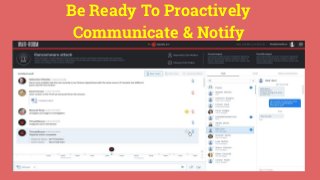
Be Ready To Proactively
Communicate & Notify
Utilizing all available information and having it presented to analysts in a
clear, usable way ensures that the security team has all the data needed to
perform deep analysis and determine the best incident response approach
rapidly.
By channeling our inner Boy Scouts and taking a more proactive approach to
incident response enabled by security orchestration, we can help our security
operations teams more quickly, effectively and consistently identify and
respond to threats.
Conclusion

Creating a Foundation for Proactive Incident Response

  • 1.
    Creating a Foundation forProactive Incident Response
  • 2.
    Introduction As a BoyScout, you’re trained to be prepared - always in a state of readiness in mind and body to do your duty. And for many of us in cybersecurity, a sense of duty is what drew us to the industry in the first place. What happens when the mind and body are at the ready, but you don't have the right approach or tools to carry out your duty as you know you can and should?
  • 3.
  • 4.
    Effective Incident Detection Beforeyour SOC can set its incident response process into motion, there needs to be an effective method to accurately identify real threats. The average SOC gets thousands of alerts per day, and weeding out false positives to focus on actual threats can be challenging. With a security orchestration platform in place, your ecosystem of security technologies can work together to deliver vital context that lets your team know where their focus is most needed.
  • 5.
    Decisive Incident Detection Withsecurity orchestration and automation, these crucial details are automatically gathered and presented to your security team, enabling them to assess the priority of an alert, quickly close false positives and clearly identify which security events would trigger applying your incident response process. This ultimately helps drive down mean time to detect (MTTD) which, when combined with a proactive incident response plan will also lead to a faster mean time to respond (MTTR).
  • 6.
    Security Orchestration forProactive IR The QIRTR identifies six steps for taking a more proactive approach to incident response. Of those security orchestration has a significant impact on the first four: ● Have an incident response plan in place ● Communicate and notify ● Know your legal requirements ● Visibility is key ● Hunt quietly ● Regular checkups + multi-factor authentication
  • 7.
    For effective incidentresponse - your entire security team needs to know what steps to take A and when. This means having a clear, documented plan that is periodically tested through simulations to assess effectiveness and continuously improve. One of the key benefits offered by security orchestration platforms is the ability to codify your incident response plans into consistent, repeatable playbooks. Effective Incident Response
  • 8.
    Because security orchestrationgives your team a complete picture of an incident, it can also help your team do the necessary postmortem and reporting to satisfy legal requirements. Some security orchestration and automation platforms offer automated reporting that provides a snapshot of the security incident as well as a summary of the playbooks applied and remediation steps taken. Leverage Security Orchestration
  • 9.
    Be Ready ToProactively Communicate & Notify
  • 10.
    Utilizing all availableinformation and having it presented to analysts in a clear, usable way ensures that the security team has all the data needed to perform deep analysis and determine the best incident response approach rapidly. By channeling our inner Boy Scouts and taking a more proactive approach to incident response enabled by security orchestration, we can help our security operations teams more quickly, effectively and consistently identify and respond to threats. Conclusion