Ceramic Biomaterials
   (Bioceramics)
arunraj(kudiyan)
                   jabir kv
                   ijaz(annan)
                   binaz(thavala)
                   shiju vp
• The class of ceramics used for repair and replacement
  of diseased and damaged parts of the musculoskeletal
  system are referred to as bioceramics.
• Ceramics are refractory polycrystalline compounds
   –   Usually inorganic
   –   Highly inert
   –   Hard and brittle
   –   High compressive strength
   –   Generally good electric and thermal insulators
   –   Good aesthetic appearance
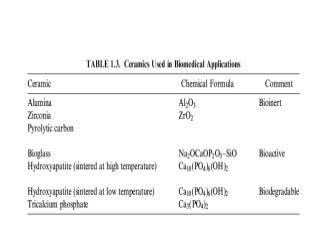
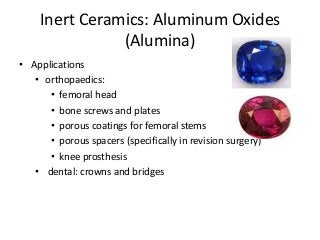
Inert Ceramics: Aluminum Oxides
               (Alumina)
• Applications
   • orthopaedics:
      • femoral head
      • bone screws and plates
      • porous coatings for femoral stems
      • porous spacers (specifically in revision surgery)
      • knee prosthesis
   • dental: crowns and bridges
Alumina
• Inertness:
   – advantage is that it makes material more biocompatible

   – disadvantage:
      • nonadherent fibrous membrane at the interface.
      • interfacial failure can occur, leading to implant
        loosening
Inert Ceramics: Zirconia, ZrO2
• Fabrication:
  • Obtained from the mineral zircon
  • Addition of MgO, CaO, CeO, or Y2O3 stabilize
    tetragonal crystal structure (e.g. 97 mol%ZrO2 and 3
    mol%Y2O3)
  • Usually hot-pressed or hot isostatically pressed

• Applications:
  • orthopaedics: femoral head, artificial knee, bone
    screws and plates, favored over UHMWPE due to
    superior wear resistance
  • dental: crowns and bridges
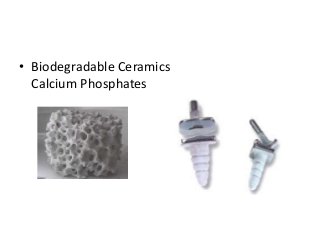
• Biodegradable Ceramics
  Calcium Phosphates
• Uses
  • repair material for bone damaged trauma or
    disease
  • void filling after resection of bone tumours
  • repair and fusion of vertebrae
  • repair of herniated disks
  • repair of maxillofacial and dental defects
  • ocular implants
  • drug-delivery
• Bioactive Ceramics: Glass Ceramics
• Bioactive: capable of direct chemical bonding
  with the host biological tissue
• Glass:
  • an inorganic melt cooled to solid form without
    crystallization
  • an amorphous solid
  • possesses short range atomic order  BRITTLE!
Ceramic biomaterials (bioceramics)

Ceramic biomaterials (bioceramics)

  • 1.
    Ceramic Biomaterials (Bioceramics)
  • 2.
    arunraj(kudiyan) jabir kv ijaz(annan) binaz(thavala) shiju vp
  • 3.
    • The classof ceramics used for repair and replacement of diseased and damaged parts of the musculoskeletal system are referred to as bioceramics. • Ceramics are refractory polycrystalline compounds – Usually inorganic – Highly inert – Hard and brittle – High compressive strength – Generally good electric and thermal insulators – Good aesthetic appearance
  • 6.
    Inert Ceramics: AluminumOxides (Alumina) • Applications • orthopaedics: • femoral head • bone screws and plates • porous coatings for femoral stems • porous spacers (specifically in revision surgery) • knee prosthesis • dental: crowns and bridges
  • 7.
    Alumina • Inertness: – advantage is that it makes material more biocompatible – disadvantage: • nonadherent fibrous membrane at the interface. • interfacial failure can occur, leading to implant loosening
  • 8.
    Inert Ceramics: Zirconia,ZrO2 • Fabrication: • Obtained from the mineral zircon • Addition of MgO, CaO, CeO, or Y2O3 stabilize tetragonal crystal structure (e.g. 97 mol%ZrO2 and 3 mol%Y2O3) • Usually hot-pressed or hot isostatically pressed • Applications: • orthopaedics: femoral head, artificial knee, bone screws and plates, favored over UHMWPE due to superior wear resistance • dental: crowns and bridges
  • 9.
    • Biodegradable Ceramics Calcium Phosphates
  • 10.
    • Uses • repair material for bone damaged trauma or disease • void filling after resection of bone tumours • repair and fusion of vertebrae • repair of herniated disks • repair of maxillofacial and dental defects • ocular implants • drug-delivery
  • 11.
    • Bioactive Ceramics:Glass Ceramics • Bioactive: capable of direct chemical bonding with the host biological tissue • Glass: • an inorganic melt cooled to solid form without crystallization • an amorphous solid • possesses short range atomic order  BRITTLE!