A quick look at
gRPC, GraphQL, REST APIs
which way to go?Phil Wilkins
Phil.Wilkins@capgemini.com
uk.linkedin.com/in/philWilkins
@PhilAtCapgemini /
@MP3Monster
Oracle-integration.cloud /
APIPlatform.cloud /
Blog.mp3monster.org
‹#›© 2018 Capgemini. All rights reserved.
1
2
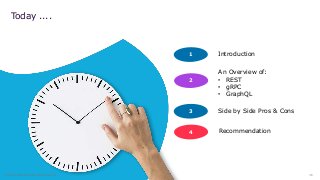
Introduction
Today ....
An Overview of:
• REST
• gRPC
• GraphQL
3 Side by Side Pros & Cons
4 Recommendation
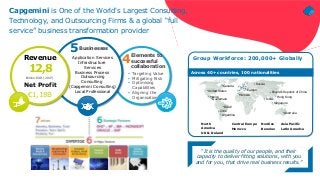
Capgemini is One of the World's Largest Consulting,
Technology, and Outsourcing Firms & a global “full
service” business transformation provider
Group Workforce: 200,000+ Globally
Asia Pacific
Latin America
Canada
United States
Mexico
Brazil
Argentina
Europe
Morocco
Australia
People’s Republic of China
India
Chile
Guatemala
Russia
Singapore
Hong Kong
North
America
UK & Ireland
Nordics
Benelux
“It is the quality of our people, and their
capacity to deliver fitting solutions, with you
and for you, that drive real business results.”
Across 40+ countries, 100 nationalities
5Businesses
Revenue
12,8
Billion EUR (2017)
Central Europe
Morocco
Net Profit
€1,18B
 Targeting Value
 Mitigating Risk
 Optimising
Capabilities
 Aligning the
Organisation
Elements to
successful
collaboration
Application Services
Infrastructure
Services
Business Process
Outsourcing
Consulting
(Capgemini Consulting)
Local Professional
4
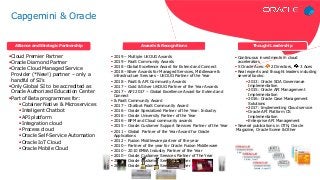
Cloud Premier Partner
Oracle Diamond Partner
Oracle Cloud Managed Service
Provider (*New!) partner – only a
handful of SI’s
Only Global SI to be accredited as
Oracle Authorized Education Center
Part of Beta programmes for:
Cotainer Native & Microservices
Inteligent Chatbot
API platform
Integration cloud
Process cloud
Oracle Self-Service Automation
Oracle IoT Cloud
Oracle Mobile Cloud
 Continuous investments in cloud
accelerators
 5 Oracle Aces: 2 Directors, 3 Aces
 Real experts and thought leaders including
several books:
 2013: Oracle SOA Governance
Implementation
 2015: Oracle API Management
Implementation
 2016: Oracle Case Management
Solutions
 2017: Implementing Cloud service
 Oracle API Platform CS
Implementation
 Enterprise API Management
 Several publications in OTN, Oracle
Magazine, Oracle Scene & Other
 2019 – Multiple UKOUG Awards
 2019 – PaaS Community Awards
 2018 –Global Excellence Award for Extend and Connect
 2018 –Silver Awards for Managed Services, Middleware &
infrastructure Services - UKOUG Partner of the Year
 2018 – PaaS & API Community Awards
 2017 – Gold & Silver UKOUG Partner of the Year Awards
 2017 – API 2017 – Global Excellence Award for Extend and
Connect
 & PaaS Community Award
 2017 – Chatbot PaaS Community Award
 2016 – Oracle Specialized Partner of the Year: Industry
 2016 – Oracle University Partner of the Year
 2016 – BPM and Cloud community awards
 2015 – Oracle Customer Support Services Partner of the Year
 2011 – Global Partner of the Year Award for Oracle
Applications
 2012 – Fusion Middleware partner of the year
 2010 – Partner of the year for Oracle Fusion Middleware
 2010 – 2010 EMEA Industry Partner of the Year
 2010 – Oracle Customer Services Partner of The Year
 2009 – Oracle Customer Services Partner of The Year
 2008 – Oracle Customer Services Partner of The Year
Alliance and Strategic Partnership Awards & Recognitions Thought Leadership
Article – June 17
Article – June 17
Podcast – August 17
Capgemini & Oracle
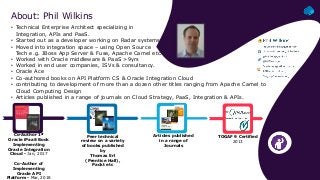
• Technical Enterprise Architect specializing in
Integration, APIs and PaaS.
• Started out as a developer working on Radar systems
• Moved into integration space – using Open Source
Tech e.g. JBoss App Server & Fuse, Apache Camel etc.
• Worked with Oracle middleware & PaaS >9yrs
• Worked in end user companies, ISVs & consultancy.
• Oracle Ace
About: Phil Wilkins
Peer technical
review on a variety
of books published
by
Thomas Erl
(Prentice Hall),
Packt etc
Articles published
in a range of
Journals
Co-Author 1st
Oracle iPaaS Book
Implementing
Oracle Integration
Cloud - Jan, 2017
Co-Author of
Implementing
Oracle API
Platform - Mar, 2018
TOGAF 9 Certified
2013
• Co-authored books on API Platform CS & Oracle Integration Cloud
• contributing to development of more than a dozen other titles ranging from Apache Camel to
Cloud Computing Design
• Articles published in a range of journals on Cloud Strategy, PaaS, Integration & APIs.
{ developer }
LONDON
#OracleDeveloperMeetup
https://www.meetup.com/Oracle-Developer-Meetup-London/
http://bit.ly/OracleDevMeetupPhil Wilkins
Phil.Wilkins@capgemini.com
uk.linkedin.com/in/philWilkins
@PhilAtCapgemini /
@MP3Monster
Oracle-integration.cloud /
APIPlatform.cloud /
Blog.mp3monster.org
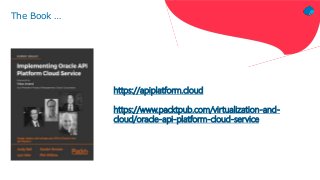
The Book …
https://apiplatform.cloud
https://www.packtpub.com/virtualization-and-
cloud/oracle-api-platform-cloud-service
RESTful Introduction
Useful Resources:
• restfulapi.net/
• docs.oracle.com/javaee/6/tut
orial/doc/gijqy.html
• roy.gbiv.com/talks/webarch_
9805/index.htm
‹#›© 2018 Capgemini. All rights reserved.
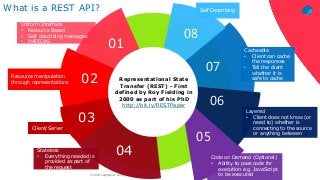
What is a REST API?
01
03
05
06
02
07
Representational State
Transfer (REST) - First
defined by Roy Fielding in
2000 as part of his PhD
http://bit.ly/RESTPaper
08
Code on Demand (Optional)
• Ability to pass code for
execution e.g. JavaScript
to be executed
Layered
• Client does not know (or
need to) whether is
connecting to the source
or anything between
Cacheable
• Client can cache
the responses
• Tell the client
whether it is
safe to cache
Self Describing
Resource manipulation
through representations
Client/Server
Stateless
• Everything needed is
provided as part of
the request
04
Uniform Interface
• Resource Based
• Self describing messages
• HATEOAS
‹#›© 2018 Capgemini. All rights reserved.
REST – Pros
Established, well understood, well supported
Doesn’t have any requirements of the application server (e.g. HTTP/1 rather than
HTTP/2)
Use of URIs makes it easy to cache and ease workloads across different levels in the
network (browser, CDN, reverse proxy)
Self describing…
Makes easy for payload to be used by middleware
Easy Query content – so tolerant of content make up
‹#›© 2018 Capgemini. All rights reserved.
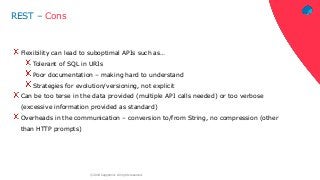
REST – Cons
Flexibility can lead to suboptimal APIs such as…
Tolerant of SQL in URIs
Poor documentation – making hard to understand
Strategies for evolution/versioning, not explicit
Can be too terse in the data provided (multiple API calls needed) or too verbose
(excessive information provided as standard)
Overheads in the communication – conversion to/from String, no compression (other
than HTTP prompts)
GraphQL
Useful Resources:
• Graphql.org
• www.graphqlbin.com
• www.apollographql.com/
‹#›© 2018 Capgemini. All rights reserved.
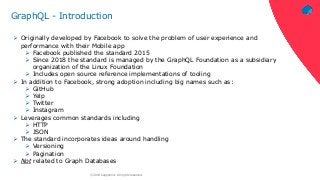
GraphQL - Introduction
 Originally developed by Facebook to solve the problem of user experience and
performance with their Mobile app
 Facebook published the standard 2015
 Since 2018 the standard is managed by the GraphQL Foundation as a subsidiary
organization of the Linux Foundation
 Includes open source reference implementations of tooling
 In addition to Facebook, strong adoption including big names such as:
 GitHub
 Yelp
 Twitter
 Instagram
 Leverages common standards including
 HTTP
 JSON
 The standard incorporates ideas around handling
 Versioning
 Pagination
 Not related to Graph Databases
‹#›© 2018 Capgemini. All rights reserved.
GraphQL – Basic Query
• Schemas with strong typing
• Schemas can define multiple entities
• Schemas support the idea of
abstraction through interfaces
• Different entities can be linked via
common attributes
• Operations can then be used
• Operations can define the attributes to
use/retrieve
Droid implements Character
{ id: ID!
name: String!
friends: [Character]
appearsIn: [Episode]!
primaryFunction: String
}
interface Character
{ id: ID!
name: String!
friends: [Character]
appearsIn: [String]!
}
{
"data":
{
"droid":
{
"name": "C-3PO“
“primaryFunction”:
“Interpreter”
}
}
}
Query
{
droid(id: "2000")
{
name,
primaryFunction
}
}
type Query {droid(id: ID!): Droid }
type Mutation {deleteDroid(id: ID!)
type Mutation (addDroid(newDroid: Droid!}
• Schemas can define different types of
operations
• Query  get
• Mutations  insert / update / delete
Based on:https://github.com/graphql/swapi-graphql
‹#›© 2018 Capgemini. All rights reserved.
GraphQL – Query with Sub-Selections
• Types can be referenced by other
types
• Define arrays of values,
• null & not null
• Default values and operations
• Can go further …
• Expressions can define ‘join’ style
operations
• Arguments for each subtype, so could
ask for droids
• Typically use a client framework to make
the query and traverse the response
Droid implements Character
{ id: ID!
name: String!
friends: [Character]
appearsIn: [Episode]!
primaryFunction: String
hasFriends: Boolean =>
@computed(value:friends != null)
}
type Episode
{ id: ID!
title: String!
openCrawl: String
director: String!
}
{
"data":
{
"droid":
{
"name": "C-3PO“
“appearsIn”:
[
{“title”:”A New Hope”},
{“title”:”Revenge of the
Sith”},
}
}
}
Query
{
droid(id: "2000")
{
name,
appearsIn
{
title
}
}
}
Based on:https://github.com/graphql/swapi-graphql
‹#›© 2018 Capgemini. All rights reserved.
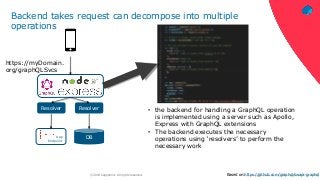
Backend takes request can decompose into multiple
operations
• the backend for handling a GraphQL operation
is implemented using a server such as Apollo,
Express with GraphQL extensions
• The backend executes the necessary
operations using ‘resolvers’ to perform the
necessary work
ResolverResolver
DBApp
Endpoint
Based on:https://github.com/graphql/swapi-graphql
https://myDomain.
org/graphQLSvcs
‹#›© 2018 Capgemini. All rights reserved.
GraphQL – Pros
Can define the data wanted – making API calls very efficient
Ability to put workload into the backend blending data together
Reduced round tripping of successive API calls
Strongly structured & typed
JSON based meaning…
Easy to work with
Human readable
Easy to formulate queries and responses (although libraries further simplify)
Version managed greatly simplified (API enhancement unlikely to be disruptive)
‹#›© 2018 Capgemini. All rights reserved.
GraphQL – Cons
Doesn’t leverage HTTP to its maximum benefit
Can’t exploit web based caching to reduce backend workload (URLs are always the same –
differences are in the body)
Simple requests do require more effort
As notation and mechanics are closer to relational and object persistence, risk of reflecting
underlying data models & being vulnerable to change
Useful Resources:
• grpc.io/
• developers.google.com/protocol-
buffers/docs/javatutorial
• github.com/grpc
‹#›© 2018 Capgemini. All rights reserved.
gRPC - Introduction
 Developed by Google (the original meaning of ‘g’ in gRPC (Google have played with
the meaning of the g in different releases)
 Is open-source
 In addition to Google, big adopters include…
 Netflix
 Cisco
 Is technical RPC style with concepts including…
 Services & messages rather than objects & references
 Simplicity & lightweight – work with small devices
 Interoperability over internet infrastructure
 Layering to allow evolution
 Payload & implementation agnostic
 Standardized error codes
 10/11 Programming Languages officially supported (C/C++/C#, Objective C, Dart,
Go, Node, PHP, Java, Ruby, Dart, Python)
 Leverages …
 HTTP/2 (based on Google’s SPEDY) – not HTTP. Common verb semantics but
differences at the wire level. Impact on server support
 Supports ideas of …
 Versioning & compatibility
 Some common concepts to Apache Avro
‹#›© 2018 Capgemini. All rights reserved.
gRPC
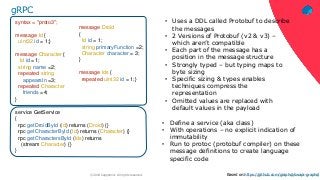
• Uses a DDL called Protobuf to describe
the messages
• 2 Versions of Protobuf (v2 & v3) –
which aren’t compatible
• Each part of the message has a
position in the message structure
• Strongly typed – but typing maps to
byte sizing
• Specific sizing & types enables
techniques compress the
representation
• Omitted values are replaced with
default values in the payload
• Define a service (aka class)
• With operations – no explicit indication of
immutability
• Run to protoc (protobuf compiler) on these
message definitions to create language
specific code
message Droid
{
Id id = 1;
string primaryFunction =2;
Character character = 3;
}
message Ids {
repeated uint32 id = 1;}
syntax = "proto3";
message Id {
uint32 id = 1;}
message Character {
Id id =1;
string name =2;
repeated string
appearsIn =3;
repeated Character
friends =4;
}
service GetService
{
rpc getDroidById (Id) returns (Droid) {}
rpc getCharacterById (Id) returns (Character) {}
rpc getCharactersById (Ids) returns
(stream Character) {}
}
Based on:https://github.com/graphql/swapi-graphql
‹#›© 2018 Capgemini. All rights reserved.
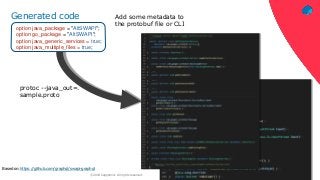
Generated code Add some metadata to
the protobuf file or CLI
option java_package = "AltSWAPI";
option go_package = "AltSWAPI";
option java_generic_services = true;
option java_multiple_files = true;
Based on:https://github.com/graphql/swapi-graphql
protoc --java_out=.
sample.proto
‹#›© 2018 Capgemini. All rights reserved.
gRPC – Pros
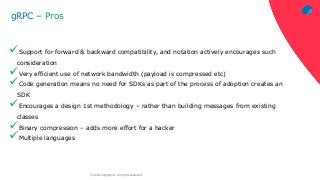
Support for forward & backward compatibility, and notation actively encourages such
consideration
Very efficient use of network bandwidth (payload is compressed etc)
Code generation means no need for SDKs as part of the process of adoption creates an
SDK
Encourages a design 1st methodology – rather than building messages from existing
classes
Binary compression – adds more effort for a hacker
Multiple languages
‹#›© 2018 Capgemini. All rights reserved.
gRPC – Cons
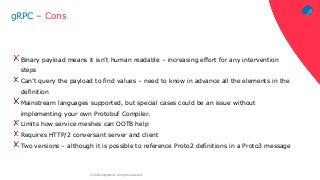
Binary payload means it isn’t human readable – increasing effort for any intervention
steps
Can’t query the payload to find values – need to know in advance all the elements in the
definition
Mainstream languages supported, but special cases could be an issue without
implementing your own Protobuf Compiler.
Limits how service meshes can OOTB help
Requires HTTP/2 conversant server and client
Two versions – although it is possible to reference Proto2 definitions in a Proto3 message
25© 2018 Capgemini. All rights reserved.
Recommendations
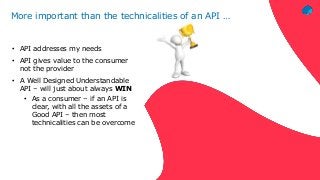
More important than the technicalities of an API …
• API addresses my needs
• API gives value to the consumer
not the provider
• A Well Designed Understandable
API – will just about always WIN
• As a consumer – if an API is
clear, with all the assets of a
Good API – then most
technicalities can be overcome
‹#›© 2018 Capgemini. All rights reserved.
Legalese
Authentication&
Authorization
SDK
TestFramework
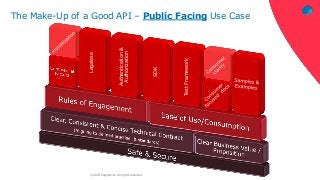
The Make-Up of a Good API – Public Facing Use Case
‹#›© 2018 Capgemini. All rights reserved.
Legalese
Authentication&
Authorization
SDK
TestFramework
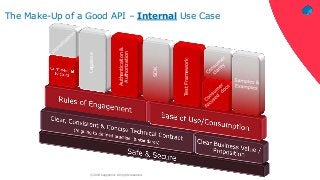
The Make-Up of a Good API – Internal Use Case
29© 2018 Capgemini. All rights reserved.29
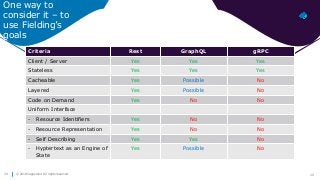
One way to
consider it – to
use Fielding’s
goals
Criteria Rest GraphQL gRPC
Client / Server Yes Yes Yes
Stateless Yes Yes Yes
Cacheable Yes Possible No
Layered Yes Possible No
Code on Demand Yes No No
Uniform Interface
- Resource Identifiers Yes No No
- Resource Representation Yes No No
- Self Describing Yes Yes No
- Hyptertext as an Engine of
State
Yes Possible No
30© 2018 Capgemini. All rights reserved.30
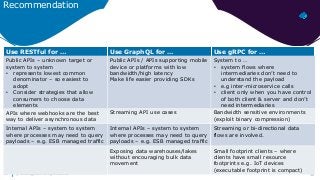
Recommendation
Use RESTful for … Use GraphQL for … Use gRPC for …
Public APIs – unknown target or
system to system
• represents lowest common
denominator – so easiest to
adopt
• Consider strategies that allow
consumers to choose data
elements
Internal APIs – system to system
where processes may need to query
payloads – e.g. ESB managed traffic
APIs where webhooks are the best
way to deliver asynchronous data
Public APIs / APIs supporting mobile
device or platforms with low
bandwidth/high latency
Make life easier providing SDKs
Streaming API use cases
Internal APIs – system to system
where processes may need to query
payloads – e.g. ESB managed traffic
System to …
• system flows where
intermediaries don’t need to
understand the payload
• e.g inter-microservice calls
• client only when you have control
of both client & server and don’t
need intermediaries
Streaming or bi-directional data
flows are involved.
Bandwidth sensitive environments
(exploit binary compression)
Exposing data warehouses/lakes
without encouraging bulk data
movement
Small footprint clients – where
clients have small resource
footprints e.g. IoT devices
(executable footprint is compact)
Conclusion
• Right tool for the right job
• There is no single silver bullet
• Have a kit bag, not 1 hammer
With more than 190,000 people, Capgemini is present in over 40 countries and
celebrates its 50th Anniversary year in 2018. A global leader in consulting, technology
and outsourcing services, the Group reported 2016 global revenues of EUR 12.5 billion.
Together with its clients, Capgemini creates and delivers business, technology and
digital solutions that fit their needs, enabling them to achieve innovation and
competitiveness. A deeply multicultural organization, Capgemini has developed its own
way of working, the Collaborative Business Experience™, and draws on Rightshore®, its
worldwide delivery model.
About Capgemini
Learn more about us at
www.capgemini.com
This message contains information that may be privileged or confidential and is
the property of the Capgemini Group.
Copyright © 2018 Capgemini. All rights reserved.
Rightshore® is a trademark belonging to Capgemini.
This message is intended only for the person to whom it is addressed. If you are not the intended recipient, you are not authorized to
read, print, retain, copy, disseminate, distribute, or use this message or any part thereof. If you receive this message in error, please
notify the sender immediately and delete all copies of this message.

A quick look at gRPC, GraphQL, REST APIs - Which way to go?

  • 1.
    A quick lookat gRPC, GraphQL, REST APIs which way to go?Phil Wilkins Phil.Wilkins@capgemini.com uk.linkedin.com/in/philWilkins @PhilAtCapgemini / @MP3Monster Oracle-integration.cloud / APIPlatform.cloud / Blog.mp3monster.org
  • 2.
    ‹#›© 2018 Capgemini.All rights reserved. 1 2 Introduction Today .... An Overview of: • REST • gRPC • GraphQL 3 Side by Side Pros & Cons 4 Recommendation
  • 3.
    Capgemini is Oneof the World's Largest Consulting, Technology, and Outsourcing Firms & a global “full service” business transformation provider Group Workforce: 200,000+ Globally Asia Pacific Latin America Canada United States Mexico Brazil Argentina Europe Morocco Australia People’s Republic of China India Chile Guatemala Russia Singapore Hong Kong North America UK & Ireland Nordics Benelux “It is the quality of our people, and their capacity to deliver fitting solutions, with you and for you, that drive real business results.” Across 40+ countries, 100 nationalities 5Businesses Revenue 12,8 Billion EUR (2017) Central Europe Morocco Net Profit €1,18B  Targeting Value  Mitigating Risk  Optimising Capabilities  Aligning the Organisation Elements to successful collaboration Application Services Infrastructure Services Business Process Outsourcing Consulting (Capgemini Consulting) Local Professional 4
  • 4.
    Cloud Premier Partner OracleDiamond Partner Oracle Cloud Managed Service Provider (*New!) partner – only a handful of SI’s Only Global SI to be accredited as Oracle Authorized Education Center Part of Beta programmes for: Cotainer Native & Microservices Inteligent Chatbot API platform Integration cloud Process cloud Oracle Self-Service Automation Oracle IoT Cloud Oracle Mobile Cloud  Continuous investments in cloud accelerators  5 Oracle Aces: 2 Directors, 3 Aces  Real experts and thought leaders including several books:  2013: Oracle SOA Governance Implementation  2015: Oracle API Management Implementation  2016: Oracle Case Management Solutions  2017: Implementing Cloud service  Oracle API Platform CS Implementation  Enterprise API Management  Several publications in OTN, Oracle Magazine, Oracle Scene & Other  2019 – Multiple UKOUG Awards  2019 – PaaS Community Awards  2018 –Global Excellence Award for Extend and Connect  2018 –Silver Awards for Managed Services, Middleware & infrastructure Services - UKOUG Partner of the Year  2018 – PaaS & API Community Awards  2017 – Gold & Silver UKOUG Partner of the Year Awards  2017 – API 2017 – Global Excellence Award for Extend and Connect  & PaaS Community Award  2017 – Chatbot PaaS Community Award  2016 – Oracle Specialized Partner of the Year: Industry  2016 – Oracle University Partner of the Year  2016 – BPM and Cloud community awards  2015 – Oracle Customer Support Services Partner of the Year  2011 – Global Partner of the Year Award for Oracle Applications  2012 – Fusion Middleware partner of the year  2010 – Partner of the year for Oracle Fusion Middleware  2010 – 2010 EMEA Industry Partner of the Year  2010 – Oracle Customer Services Partner of The Year  2009 – Oracle Customer Services Partner of The Year  2008 – Oracle Customer Services Partner of The Year Alliance and Strategic Partnership Awards & Recognitions Thought Leadership Article – June 17 Article – June 17 Podcast – August 17 Capgemini & Oracle
  • 5.
    • Technical EnterpriseArchitect specializing in Integration, APIs and PaaS. • Started out as a developer working on Radar systems • Moved into integration space – using Open Source Tech e.g. JBoss App Server & Fuse, Apache Camel etc. • Worked with Oracle middleware & PaaS >9yrs • Worked in end user companies, ISVs & consultancy. • Oracle Ace About: Phil Wilkins Peer technical review on a variety of books published by Thomas Erl (Prentice Hall), Packt etc Articles published in a range of Journals Co-Author 1st Oracle iPaaS Book Implementing Oracle Integration Cloud - Jan, 2017 Co-Author of Implementing Oracle API Platform - Mar, 2018 TOGAF 9 Certified 2013 • Co-authored books on API Platform CS & Oracle Integration Cloud • contributing to development of more than a dozen other titles ranging from Apache Camel to Cloud Computing Design • Articles published in a range of journals on Cloud Strategy, PaaS, Integration & APIs.
  • 6.
    { developer } LONDON #OracleDeveloperMeetup https://www.meetup.com/Oracle-Developer-Meetup-London/ http://bit.ly/OracleDevMeetupPhilWilkins Phil.Wilkins@capgemini.com uk.linkedin.com/in/philWilkins @PhilAtCapgemini / @MP3Monster Oracle-integration.cloud / APIPlatform.cloud / Blog.mp3monster.org
  • 7.
  • 8.
    RESTful Introduction Useful Resources: •restfulapi.net/ • docs.oracle.com/javaee/6/tut orial/doc/gijqy.html • roy.gbiv.com/talks/webarch_ 9805/index.htm
  • 9.
    ‹#›© 2018 Capgemini.All rights reserved. What is a REST API? 01 03 05 06 02 07 Representational State Transfer (REST) - First defined by Roy Fielding in 2000 as part of his PhD http://bit.ly/RESTPaper 08 Code on Demand (Optional) • Ability to pass code for execution e.g. JavaScript to be executed Layered • Client does not know (or need to) whether is connecting to the source or anything between Cacheable • Client can cache the responses • Tell the client whether it is safe to cache Self Describing Resource manipulation through representations Client/Server Stateless • Everything needed is provided as part of the request 04 Uniform Interface • Resource Based • Self describing messages • HATEOAS
  • 10.
    ‹#›© 2018 Capgemini.All rights reserved. REST – Pros Established, well understood, well supported Doesn’t have any requirements of the application server (e.g. HTTP/1 rather than HTTP/2) Use of URIs makes it easy to cache and ease workloads across different levels in the network (browser, CDN, reverse proxy) Self describing… Makes easy for payload to be used by middleware Easy Query content – so tolerant of content make up
  • 11.
    ‹#›© 2018 Capgemini.All rights reserved. REST – Cons Flexibility can lead to suboptimal APIs such as… Tolerant of SQL in URIs Poor documentation – making hard to understand Strategies for evolution/versioning, not explicit Can be too terse in the data provided (multiple API calls needed) or too verbose (excessive information provided as standard) Overheads in the communication – conversion to/from String, no compression (other than HTTP prompts)
  • 12.
    GraphQL Useful Resources: • Graphql.org •www.graphqlbin.com • www.apollographql.com/
  • 13.
    ‹#›© 2018 Capgemini.All rights reserved. GraphQL - Introduction  Originally developed by Facebook to solve the problem of user experience and performance with their Mobile app  Facebook published the standard 2015  Since 2018 the standard is managed by the GraphQL Foundation as a subsidiary organization of the Linux Foundation  Includes open source reference implementations of tooling  In addition to Facebook, strong adoption including big names such as:  GitHub  Yelp  Twitter  Instagram  Leverages common standards including  HTTP  JSON  The standard incorporates ideas around handling  Versioning  Pagination  Not related to Graph Databases
  • 14.
    ‹#›© 2018 Capgemini.All rights reserved. GraphQL – Basic Query • Schemas with strong typing • Schemas can define multiple entities • Schemas support the idea of abstraction through interfaces • Different entities can be linked via common attributes • Operations can then be used • Operations can define the attributes to use/retrieve Droid implements Character { id: ID! name: String! friends: [Character] appearsIn: [Episode]! primaryFunction: String } interface Character { id: ID! name: String! friends: [Character] appearsIn: [String]! } { "data": { "droid": { "name": "C-3PO“ “primaryFunction”: “Interpreter” } } } Query { droid(id: "2000") { name, primaryFunction } } type Query {droid(id: ID!): Droid } type Mutation {deleteDroid(id: ID!) type Mutation (addDroid(newDroid: Droid!} • Schemas can define different types of operations • Query  get • Mutations  insert / update / delete Based on:https://github.com/graphql/swapi-graphql
  • 15.
    ‹#›© 2018 Capgemini.All rights reserved. GraphQL – Query with Sub-Selections • Types can be referenced by other types • Define arrays of values, • null & not null • Default values and operations • Can go further … • Expressions can define ‘join’ style operations • Arguments for each subtype, so could ask for droids • Typically use a client framework to make the query and traverse the response Droid implements Character { id: ID! name: String! friends: [Character] appearsIn: [Episode]! primaryFunction: String hasFriends: Boolean => @computed(value:friends != null) } type Episode { id: ID! title: String! openCrawl: String director: String! } { "data": { "droid": { "name": "C-3PO“ “appearsIn”: [ {“title”:”A New Hope”}, {“title”:”Revenge of the Sith”}, } } } Query { droid(id: "2000") { name, appearsIn { title } } } Based on:https://github.com/graphql/swapi-graphql
  • 16.
    ‹#›© 2018 Capgemini.All rights reserved. Backend takes request can decompose into multiple operations • the backend for handling a GraphQL operation is implemented using a server such as Apollo, Express with GraphQL extensions • The backend executes the necessary operations using ‘resolvers’ to perform the necessary work ResolverResolver DBApp Endpoint Based on:https://github.com/graphql/swapi-graphql https://myDomain. org/graphQLSvcs
  • 17.
    ‹#›© 2018 Capgemini.All rights reserved. GraphQL – Pros Can define the data wanted – making API calls very efficient Ability to put workload into the backend blending data together Reduced round tripping of successive API calls Strongly structured & typed JSON based meaning… Easy to work with Human readable Easy to formulate queries and responses (although libraries further simplify) Version managed greatly simplified (API enhancement unlikely to be disruptive)
  • 18.
    ‹#›© 2018 Capgemini.All rights reserved. GraphQL – Cons Doesn’t leverage HTTP to its maximum benefit Can’t exploit web based caching to reduce backend workload (URLs are always the same – differences are in the body) Simple requests do require more effort As notation and mechanics are closer to relational and object persistence, risk of reflecting underlying data models & being vulnerable to change
  • 19.
    Useful Resources: • grpc.io/ •developers.google.com/protocol- buffers/docs/javatutorial • github.com/grpc
  • 20.
    ‹#›© 2018 Capgemini.All rights reserved. gRPC - Introduction  Developed by Google (the original meaning of ‘g’ in gRPC (Google have played with the meaning of the g in different releases)  Is open-source  In addition to Google, big adopters include…  Netflix  Cisco  Is technical RPC style with concepts including…  Services & messages rather than objects & references  Simplicity & lightweight – work with small devices  Interoperability over internet infrastructure  Layering to allow evolution  Payload & implementation agnostic  Standardized error codes  10/11 Programming Languages officially supported (C/C++/C#, Objective C, Dart, Go, Node, PHP, Java, Ruby, Dart, Python)  Leverages …  HTTP/2 (based on Google’s SPEDY) – not HTTP. Common verb semantics but differences at the wire level. Impact on server support  Supports ideas of …  Versioning & compatibility  Some common concepts to Apache Avro
  • 21.
    ‹#›© 2018 Capgemini.All rights reserved. gRPC • Uses a DDL called Protobuf to describe the messages • 2 Versions of Protobuf (v2 & v3) – which aren’t compatible • Each part of the message has a position in the message structure • Strongly typed – but typing maps to byte sizing • Specific sizing & types enables techniques compress the representation • Omitted values are replaced with default values in the payload • Define a service (aka class) • With operations – no explicit indication of immutability • Run to protoc (protobuf compiler) on these message definitions to create language specific code message Droid { Id id = 1; string primaryFunction =2; Character character = 3; } message Ids { repeated uint32 id = 1;} syntax = "proto3"; message Id { uint32 id = 1;} message Character { Id id =1; string name =2; repeated string appearsIn =3; repeated Character friends =4; } service GetService { rpc getDroidById (Id) returns (Droid) {} rpc getCharacterById (Id) returns (Character) {} rpc getCharactersById (Ids) returns (stream Character) {} } Based on:https://github.com/graphql/swapi-graphql
  • 22.
    ‹#›© 2018 Capgemini.All rights reserved. Generated code Add some metadata to the protobuf file or CLI option java_package = "AltSWAPI"; option go_package = "AltSWAPI"; option java_generic_services = true; option java_multiple_files = true; Based on:https://github.com/graphql/swapi-graphql protoc --java_out=. sample.proto
  • 23.
    ‹#›© 2018 Capgemini.All rights reserved. gRPC – Pros Support for forward & backward compatibility, and notation actively encourages such consideration Very efficient use of network bandwidth (payload is compressed etc) Code generation means no need for SDKs as part of the process of adoption creates an SDK Encourages a design 1st methodology – rather than building messages from existing classes Binary compression – adds more effort for a hacker Multiple languages
  • 24.
    ‹#›© 2018 Capgemini.All rights reserved. gRPC – Cons Binary payload means it isn’t human readable – increasing effort for any intervention steps Can’t query the payload to find values – need to know in advance all the elements in the definition Mainstream languages supported, but special cases could be an issue without implementing your own Protobuf Compiler. Limits how service meshes can OOTB help Requires HTTP/2 conversant server and client Two versions – although it is possible to reference Proto2 definitions in a Proto3 message
  • 25.
    25© 2018 Capgemini.All rights reserved. Recommendations
  • 26.
    More important thanthe technicalities of an API … • API addresses my needs • API gives value to the consumer not the provider • A Well Designed Understandable API – will just about always WIN • As a consumer – if an API is clear, with all the assets of a Good API – then most technicalities can be overcome
  • 27.
    ‹#›© 2018 Capgemini.All rights reserved. Legalese Authentication& Authorization SDK TestFramework The Make-Up of a Good API – Public Facing Use Case
  • 28.
    ‹#›© 2018 Capgemini.All rights reserved. Legalese Authentication& Authorization SDK TestFramework The Make-Up of a Good API – Internal Use Case
  • 29.
    29© 2018 Capgemini.All rights reserved.29 One way to consider it – to use Fielding’s goals Criteria Rest GraphQL gRPC Client / Server Yes Yes Yes Stateless Yes Yes Yes Cacheable Yes Possible No Layered Yes Possible No Code on Demand Yes No No Uniform Interface - Resource Identifiers Yes No No - Resource Representation Yes No No - Self Describing Yes Yes No - Hyptertext as an Engine of State Yes Possible No
  • 30.
    30© 2018 Capgemini.All rights reserved.30 Recommendation Use RESTful for … Use GraphQL for … Use gRPC for … Public APIs – unknown target or system to system • represents lowest common denominator – so easiest to adopt • Consider strategies that allow consumers to choose data elements Internal APIs – system to system where processes may need to query payloads – e.g. ESB managed traffic APIs where webhooks are the best way to deliver asynchronous data Public APIs / APIs supporting mobile device or platforms with low bandwidth/high latency Make life easier providing SDKs Streaming API use cases Internal APIs – system to system where processes may need to query payloads – e.g. ESB managed traffic System to … • system flows where intermediaries don’t need to understand the payload • e.g inter-microservice calls • client only when you have control of both client & server and don’t need intermediaries Streaming or bi-directional data flows are involved. Bandwidth sensitive environments (exploit binary compression) Exposing data warehouses/lakes without encouraging bulk data movement Small footprint clients – where clients have small resource footprints e.g. IoT devices (executable footprint is compact)
  • 31.
    Conclusion • Right toolfor the right job • There is no single silver bullet • Have a kit bag, not 1 hammer
  • 33.
    With more than190,000 people, Capgemini is present in over 40 countries and celebrates its 50th Anniversary year in 2018. A global leader in consulting, technology and outsourcing services, the Group reported 2016 global revenues of EUR 12.5 billion. Together with its clients, Capgemini creates and delivers business, technology and digital solutions that fit their needs, enabling them to achieve innovation and competitiveness. A deeply multicultural organization, Capgemini has developed its own way of working, the Collaborative Business Experience™, and draws on Rightshore®, its worldwide delivery model. About Capgemini Learn more about us at www.capgemini.com This message contains information that may be privileged or confidential and is the property of the Capgemini Group. Copyright © 2018 Capgemini. All rights reserved. Rightshore® is a trademark belonging to Capgemini. This message is intended only for the person to whom it is addressed. If you are not the intended recipient, you are not authorized to read, print, retain, copy, disseminate, distribute, or use this message or any part thereof. If you receive this message in error, please notify the sender immediately and delete all copies of this message.