The Freedom Seder, Feminist
Seders, & Transformation
Rabbi Rachel Barenblat
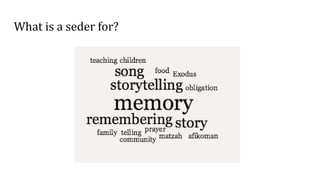
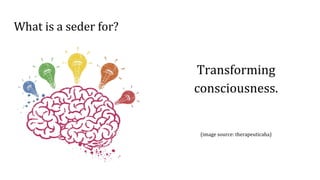
What is a seder for?
Transforming
consciousness.
(image source: therapeuticaha)
I know this...
...thanks to Rabbi Arthur Waskow
and the Freedom Seder
and everything which followed from it.
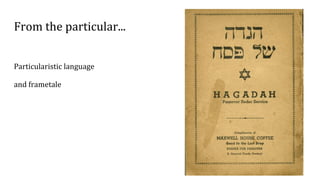
From the particular...
Particularistic language
and frametale
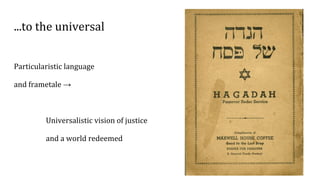
...to the universal
Particularistic language
and frametale →
Universalistic vision of justice
and a world redeemed
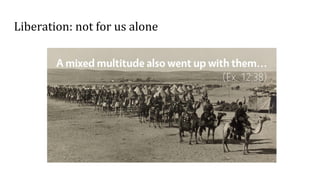
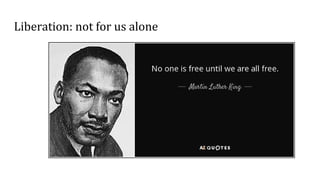
Liberation: not for us alone
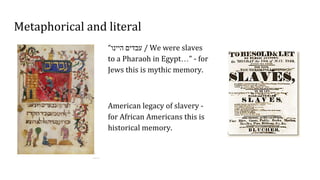
Metaphorical and literal
“‫היינו‬ ‫עבדים‬ / We were slaves
to a Pharaoh in Egypt…” - for
Jews this is mythic memory.
American legacy of slavery -
for African Americans this is
historical memory.
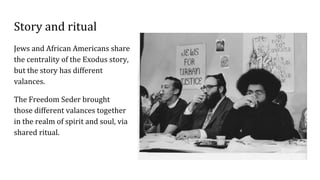
Story and ritual
Jews and African Americans share
the centrality of the Exodus story,
but the story has different
valances.
The Freedom Seder brought
those different valances together
in the realm of spirit and soul, via
shared ritual.
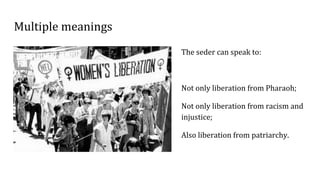
Multiple meanings
The seder can speak to:
Not only liberation from Pharaoh;
Not only liberation from racism and
injustice;
Also liberation from patriarchy.
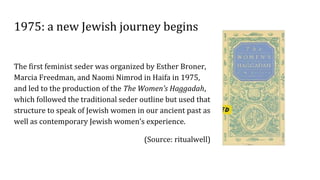
1975: a new Jewish journey begins
The first feminist seder was organized by Esther Broner,
Marcia Freedman, and Naomi Nimrod in Haifa in 1975,
and led to the production of the The Women’s Haggadah,
which followed the traditional seder outline but used that
structure to speak of Jewish women in our ancient past as
well as contemporary Jewish women’s experience.
(Source: ritualwell)
From innovation to tradition
1) First something is an innovation.
2) Then it starts to become familiar.
3) Then it becomes increasingly commonplace
4) Eventually it becomes assimilated into the tradition.
I didn’t grow up with Miriam’s Cup, but I could have.
(And my own son certainly has.)
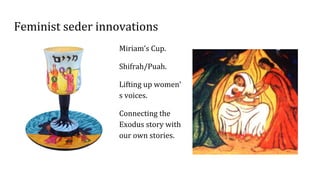
Feminist seder innovations
Miriam’s Cup.
Shifrah/Puah.
Lifting up women’
s voices.
Connecting the
Exodus story with
our own stories.
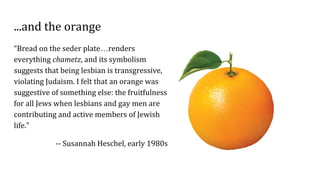
...and the orange
“Bread on the seder plate…renders
everything chametz, and its symbolism
suggests that being lesbian is transgressive,
violating Judaism. I felt that an orange was
suggestive of something else: the fruitfulness
for all Jews when lesbians and gay men are
contributing and active members of Jewish
life.”
-- Susannah Heschel, early 1980s
Already
The seder as a frame for speaking about African American liberation
→ the seder as a frame for speaking about women’s liberation
→ the seder as a frame for speaking about GLBT liberation
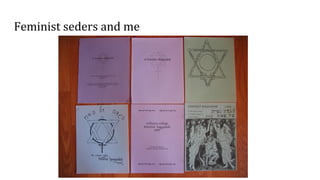
Feminist seders and me
The Williams College Feminist Seder Project
First feminist seder at Williams: 1992.
Wrestling with God-language: King, to Queen, to Wellspring or Source.
(Masculine to feminine; then power-over to power-from-within,
sidestepping the gender binary altogether.)
Using Judaism to tell a feminist story? Using feminism to inform our Jewish story?
Process vs. product, destination vs. journey.
We knew we stood on the shoulders of women who came before us.
We never doubted our right to take our story into our own hands.
In other places
Ma’yan: The Jewish Women's Project
Founded 1993.
Held their first feminist seder in 1994 for 150 women.
Within a few years they were holding feminist seders
for 500 on four consecutive nights.
“In Richardson, Texas, they call it ‘Miriam’s seder.’ ‘Hers Seder’ is the term of art in
Pennsylvania, at the American Jewish Congress gatherings. And in a diverse cross-
section of neighborhoods, towns and cities, from the semi-suburbia of Hollis Hills,
Queens, to the flatlands of Canton, Ohio, to the East Bay of San Francisco, to the deep
South of Birmingham, Ala., the event is known simply as a women’s seder.”
-- The Jewish Week, “Evolution of the Feminist Seder,” 2000
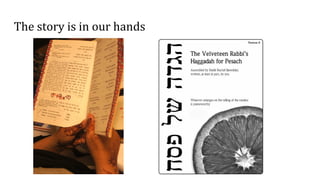
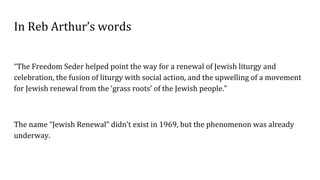
The story is in our hands
In Reb Arthur’s words
“The Freedom Seder helped point the way for a renewal of Jewish liturgy and
celebration, the fusion of liturgy with social action, and the upwelling of a movement
for Jewish renewal from the ‘grass roots’ of the Jewish people.”
The name “Jewish Renewal” didn’t exist in 1969, but the phenomenon was already
underway.
Jewish Renewal
Jewish Renewal is a transdenominational approach to revitalizing Judaism.
We combine the socially progressive values of egalitarianism, the joy of Hasidism, the informed do-it-
yourself spirit of the havurah movement, and the accumulated wisdom of centuries of tradition.
We value deep ecumenism; in Hillel's words, we learn from every person and spiritual tradition.
We create innovative, accessible, and welcoming prayer experiences.
We shape halacha (Jewish law) into a living way of walking in the world.
And we seek to deepen the ongoing, joyful, and fundamental connection, with a God Who connects us
all, which is at the heart of Jewish practice.
(source: aleph.org/what-is-jewish-renewal)
‫שעה‬ ‫הוראת‬ - Question of the Hour
What expressions of Judaism are called-for
in this moment in time?
Making this question central, and continuing
to answer it anew, is core to Jewish Renewal.
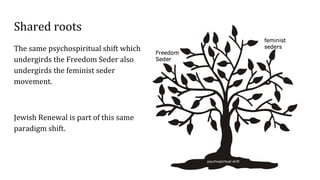
Shared roots
The same psychospiritual shift which
undergirds the Freedom Seder also
undergirds the feminist seder
movement.
Jewish Renewal is part of this same
paradigm shift.
And grassroots
No one gives “permission” for this kind of ritual re-creation.
It arises from the ground up, part of the cultural zeitgeist.
It reflects the yearning to find, mirrored in our people’s core story, a message which
speaks to today’s awareness that the work of liberation is not complete.
This renewal of Judaism empowers us to take the tradition into our own hands.
The seder and intersectionality
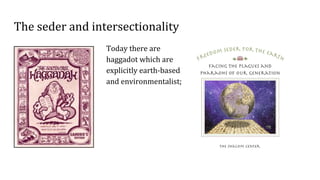
Today there are
haggadot which are
explicitly earth-based
and environmentalist;
The seder and intersectionality
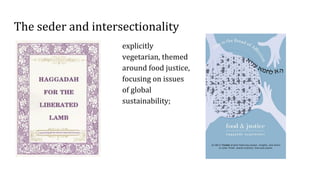
explicitly
vegetarian, themed
around food justice,
focusing on issues
of global
sustainability;
The seder and intersectionality
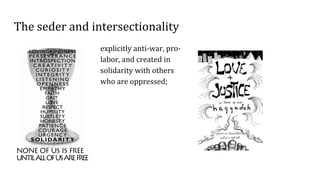
explicitly anti-war, pro-
labor, and created in
solidarity with others
who are oppressed;
The seder and intersectionality
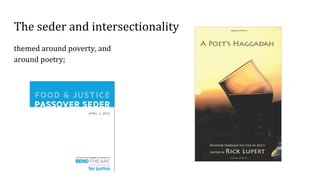
themed around poverty, and
around poetry;
The seder and intersectionality
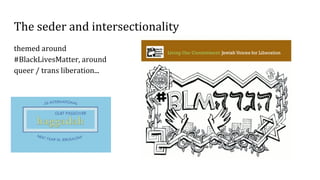
themed around
#BlackLivesMatter, around
queer / trans liberation...
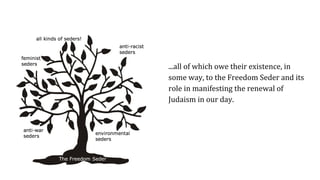
...all of which owe their existence, in
some way, to the Freedom Seder and its
role in manifesting the renewal of
Judaism in our day.
What is a seder for?
Transforming consciousness.
Changing us from within, so we can go forth and change the world.
If you emerge entirely unchanged, you’re doing it wrong.
Thanks, Reb Arthur.
Three seder poems of liberation
Thanks for having me.
Rabbi Rachel Barenblat
velveteenrabbi.com | aleph.org
@velveteenrabbi | @ALEPHAlliance
rbarenblat@gmail.com

The freedom seder, feminist seders, and transformation

  • 1.
    The Freedom Seder,Feminist Seders, & Transformation Rabbi Rachel Barenblat
  • 2.
    What is aseder for?
  • 3.
    What is aseder for? Transforming consciousness. (image source: therapeuticaha)
  • 4.
    I know this... ...thanksto Rabbi Arthur Waskow and the Freedom Seder and everything which followed from it.
  • 5.
  • 6.
    ...to the universal Particularisticlanguage and frametale → Universalistic vision of justice and a world redeemed
  • 7.
  • 8.
  • 9.
    Metaphorical and literal “‫היינו‬‫עבדים‬ / We were slaves to a Pharaoh in Egypt…” - for Jews this is mythic memory. American legacy of slavery - for African Americans this is historical memory.
  • 10.
    Story and ritual Jewsand African Americans share the centrality of the Exodus story, but the story has different valances. The Freedom Seder brought those different valances together in the realm of spirit and soul, via shared ritual.
  • 11.
    Multiple meanings The sedercan speak to: Not only liberation from Pharaoh; Not only liberation from racism and injustice; Also liberation from patriarchy.
  • 12.
    1975: a newJewish journey begins The first feminist seder was organized by Esther Broner, Marcia Freedman, and Naomi Nimrod in Haifa in 1975, and led to the production of the The Women’s Haggadah, which followed the traditional seder outline but used that structure to speak of Jewish women in our ancient past as well as contemporary Jewish women’s experience. (Source: ritualwell)
  • 13.
    From innovation totradition 1) First something is an innovation. 2) Then it starts to become familiar. 3) Then it becomes increasingly commonplace 4) Eventually it becomes assimilated into the tradition. I didn’t grow up with Miriam’s Cup, but I could have. (And my own son certainly has.)
  • 14.
    Feminist seder innovations Miriam’sCup. Shifrah/Puah. Lifting up women’ s voices. Connecting the Exodus story with our own stories.
  • 15.
    ...and the orange “Breadon the seder plate…renders everything chametz, and its symbolism suggests that being lesbian is transgressive, violating Judaism. I felt that an orange was suggestive of something else: the fruitfulness for all Jews when lesbians and gay men are contributing and active members of Jewish life.” -- Susannah Heschel, early 1980s
  • 16.
    Already The seder asa frame for speaking about African American liberation → the seder as a frame for speaking about women’s liberation → the seder as a frame for speaking about GLBT liberation
  • 17.
  • 18.
    The Williams CollegeFeminist Seder Project First feminist seder at Williams: 1992. Wrestling with God-language: King, to Queen, to Wellspring or Source. (Masculine to feminine; then power-over to power-from-within, sidestepping the gender binary altogether.) Using Judaism to tell a feminist story? Using feminism to inform our Jewish story? Process vs. product, destination vs. journey. We knew we stood on the shoulders of women who came before us. We never doubted our right to take our story into our own hands.
  • 19.
    In other places Ma’yan:The Jewish Women's Project Founded 1993. Held their first feminist seder in 1994 for 150 women. Within a few years they were holding feminist seders for 500 on four consecutive nights.
  • 20.
    “In Richardson, Texas,they call it ‘Miriam’s seder.’ ‘Hers Seder’ is the term of art in Pennsylvania, at the American Jewish Congress gatherings. And in a diverse cross- section of neighborhoods, towns and cities, from the semi-suburbia of Hollis Hills, Queens, to the flatlands of Canton, Ohio, to the East Bay of San Francisco, to the deep South of Birmingham, Ala., the event is known simply as a women’s seder.” -- The Jewish Week, “Evolution of the Feminist Seder,” 2000
  • 21.
    The story isin our hands
  • 22.
    In Reb Arthur’swords “The Freedom Seder helped point the way for a renewal of Jewish liturgy and celebration, the fusion of liturgy with social action, and the upwelling of a movement for Jewish renewal from the ‘grass roots’ of the Jewish people.” The name “Jewish Renewal” didn’t exist in 1969, but the phenomenon was already underway.
  • 23.
    Jewish Renewal Jewish Renewalis a transdenominational approach to revitalizing Judaism. We combine the socially progressive values of egalitarianism, the joy of Hasidism, the informed do-it- yourself spirit of the havurah movement, and the accumulated wisdom of centuries of tradition. We value deep ecumenism; in Hillel's words, we learn from every person and spiritual tradition. We create innovative, accessible, and welcoming prayer experiences. We shape halacha (Jewish law) into a living way of walking in the world. And we seek to deepen the ongoing, joyful, and fundamental connection, with a God Who connects us all, which is at the heart of Jewish practice. (source: aleph.org/what-is-jewish-renewal)
  • 24.
    ‫שעה‬ ‫הוראת‬ -Question of the Hour What expressions of Judaism are called-for in this moment in time? Making this question central, and continuing to answer it anew, is core to Jewish Renewal.
  • 25.
    Shared roots The samepsychospiritual shift which undergirds the Freedom Seder also undergirds the feminist seder movement. Jewish Renewal is part of this same paradigm shift.
  • 26.
    And grassroots No onegives “permission” for this kind of ritual re-creation. It arises from the ground up, part of the cultural zeitgeist. It reflects the yearning to find, mirrored in our people’s core story, a message which speaks to today’s awareness that the work of liberation is not complete. This renewal of Judaism empowers us to take the tradition into our own hands.
  • 27.
    The seder andintersectionality Today there are haggadot which are explicitly earth-based and environmentalist;
  • 28.
    The seder andintersectionality explicitly vegetarian, themed around food justice, focusing on issues of global sustainability;
  • 29.
    The seder andintersectionality explicitly anti-war, pro- labor, and created in solidarity with others who are oppressed;
  • 30.
    The seder andintersectionality themed around poverty, and around poetry;
  • 31.
    The seder andintersectionality themed around #BlackLivesMatter, around queer / trans liberation...
  • 32.
    ...all of whichowe their existence, in some way, to the Freedom Seder and its role in manifesting the renewal of Judaism in our day.
  • 33.
    What is aseder for? Transforming consciousness. Changing us from within, so we can go forth and change the world. If you emerge entirely unchanged, you’re doing it wrong. Thanks, Reb Arthur.
  • 34.
    Three seder poemsof liberation
  • 35.
    Thanks for havingme. Rabbi Rachel Barenblat velveteenrabbi.com | aleph.org @velveteenrabbi | @ALEPHAlliance rbarenblat@gmail.com