Mentors
● Craig Seidel
● LtCol Richard Lawson
● CDR Jack Souders
Sponsor
● Maj Richard Barnes (DIU)
● Mark Breier (In-Q-Tel)
TA: Sally Egan
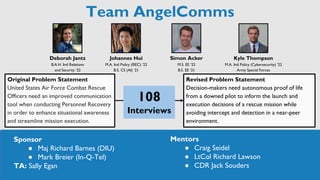
Original Problem Statement
United States Air Force Combat Rescue
Officers need an improved communication
tool when conducting Personnel Recovery
in order to enhance situational awareness
and streamline mission execution.
Revised Problem Statement
Decision-makers need autonomous proof of life
from a downed pilot to inform the launch and
execution decisions of a rescue mission while
avoiding intercept and detection in a near-peer
environment.
Simon Acker
M.S. EE ‘22
B.S. EE ‘21
Johannes Hui
M.A. Intl Policy (ISEC) ‘22
B.S. CS (AI) ‘21
Deborah Jantz
B.A.H. Intl Relations
and Security ‘22
Kyle Thompson
M.A. Intl Policy (Cybersecurity) ‘22
Army Special Forces
108
Interviews
Team AngelComms
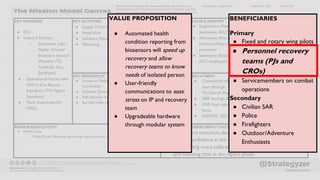
BENEFICIARIES
Primary
● Fixed and rotary wing pilots
● Personnel recovery
teams (PJs and
CROs)
● Servicemembers on combat
operations
Secondary
● Civilian SAR
● Police
● Firefighters
● Outdoor/Adventure
Enthusiasts
VALUE PROPOSITION
● Automated health
condition reporting from
biosensors will speed up
recovery and allow
recovery teams to know
needs of isolated person
● User-friendly
communications to ease
stress on IP and recovery
team
● Upgradeable hardware
through modular system
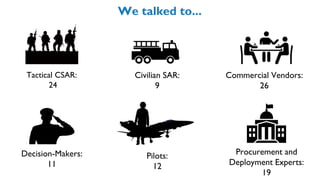
We talked to...
Tactical CSAR:
24
Civilian SAR:
9
Commercial Vendors:
26
Decision-Makers:
11
Pilots:
12
Procurement and
Deployment Experts:
19
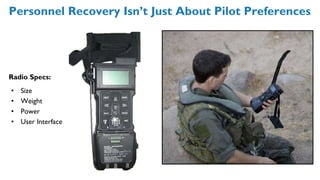
Radio Specs:
• Size
• Weight
• Power
• User Interface
Personnel Recovery Isn’t Just About Pilot Preferences
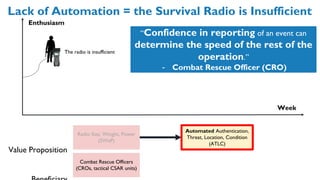
Value Proposition
The radio is insufficient
Radio Size, Weight, Power
(SWaP)
Week
Enthusiasm
Lack of Automation = the Survival Radio is Insufficient
Combat Rescue Officers
(CROs, tactical CSAR units)
Automated Authentication,
Threat, Location, Condition
(ATLC)
“Confidence in reporting of an event can
determine the speed of the rest of the
operation.”
- Combat Rescue Officer (CRO)
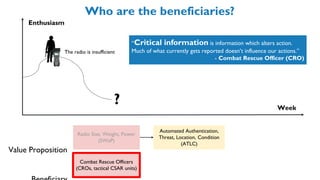
Value Proposition
Automated Authentication,
Threat, Location, Condition
(ATLC)
Radio Size, Weight, Power
(SWaP)
Combat Rescue Officers
(CROs, tactical CSAR units)
Week
Enthusiasm
Who are the beneficiaries?
“Critical information is information which alters action.
Much of what currently gets reported doesn’t influence our actions.”
- Combat Rescue Officer (CRO)
The radio is insufficient
?
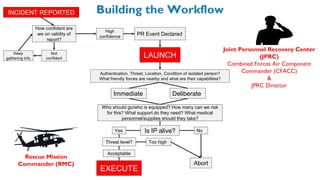
Building the Workflow
INCIDENT REPORTED
Is IP alive?
Yes No
Threat level?
Acceptable
EXECUTE
Too high
Abort
Rescue Mission
Commander (RMC)
How confident are
we on validity of
report?
Not
confident
Keep
gathering info
Authentication, Threat, Location, Condition of isolated person?
What friendly forces are nearby and what are their capabilities?
Immediate Deliberate
LAUNCH
Who should go/who is equipped? How many can we risk
for this? What support do they need? What medical
personnel/supplies should they take?
PR Event Declared
High
confidence
Joint Personnel Recovery Center
(JPRC)
Combined Forces Air Component
Commander (CFACC)
&
JPRC Director
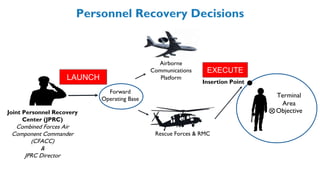
Personnel Recovery Decisions
Joint Personnel Recovery
Center (JPRC)
Combined Forces Air
Component Commander
(CFACC)
&
JPRC Director
Terminal
Area
Objective
Insertion Point
Forward
Operating Base
Rescue Forces & RMC
Airborne
Communications
Platform
LAUNCH
EXECUTE
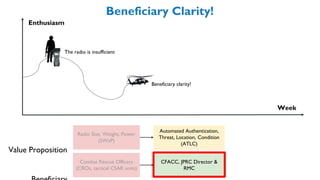
Value Proposition
Radio Size, Weight, Power
(SWaP)
Combat Rescue Officers
(CROs, tactical CSAR units)
Week
Enthusiasm
Beneficiary Clarity!
Beneficiary clarity!
The radio is insufficient
Automated Authentication,
Threat, Location, Condition
(ATLC)
CFACC, JPRC Director &
RMC
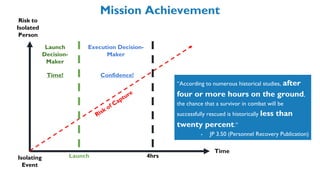
Mission Achievement
Risk to
Isolated
Person
4hrs
Isolating
Event
Time
“According to numerous historical studies, after
four or more hours on the ground,
the chance that a survivor in combat will be
successfully rescued is historically less than
twenty percent.”
- JP 3.50 (Personnel Recovery Publication)
Launch
Launch
Decision-
Maker
Execution Decision-
Maker
Time! Confidence!
Execution Decision by Rescue Mission Commander (RMC)
Joint Personnel Recovery
Center (JPRC)
Combined Forces Air
Component Commander
(CFACC)
&
JPRC Director
Terminal
Area
Objective
Forward
Operating Base
Rescue Forces & RMC
Airborne
Communications
Platform
When you don't know [proof of life]...it makes it extremely difficult
to decide to risk anyone, much less a helicopter full of five member
rescue team.
- Air Force Brig Gen
Report Needed
Updated Report
Needed
Automation
Needed
LAUNCH
EXECUTE
Value Proposition
Radio Size, Weight, Power
(SWaP)
Combat Rescue Officers
(CROs, tactical CSAR units)
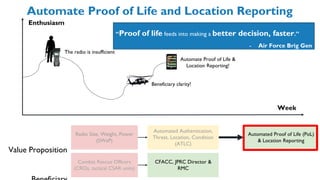
Automate Proof of Life and Location Reporting
Automated Proof of Life (PoL)
& Location Reporting
“Proof of life feeds into making a better decision, faster.”
- Air Force Brig Gen
Week
Enthusiasm
Automate Proof of Life &
Location Reporting!
The radio is insufficient
Automated Authentication,
Threat, Location, Condition
(ATLC)
Beneficiary clarity!
CFACC, JPRC Director &
RMC
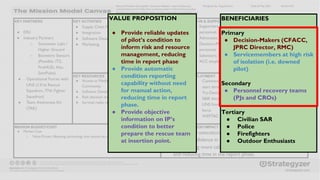
BENEFICIARIES
Primary
● Decision-Makers (CFACC,
JPRC Director, RMC)
● Servicemembers at high risk
of isolation (i.e. downed
pilot)
Secondary
● Personnel recovery teams
(PJs and CROs)
Tertiary
● Civilian SAR
● Police
● Firefighters
● Outdoor Enthusiasts
VALUE PROPOSITION
● Provide reliable updates
of pilot’s condition to
inform risk and resource
management, reducing
time in report phase
● Provide automatic
condition reporting
capability without need
for manual action,
reducing time in report
phase.
● Provide objective
information on IP’s
condition to better
prepare the rescue team
at insertion point.
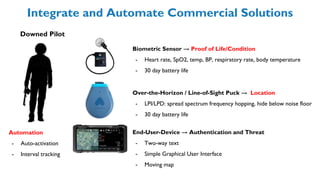
Biometric Sensor → Proof of Life/Condition
- Heart rate, SpO2, temp, BP, respiratory rate, body temperature
- 30 day battery life
Downed Pilot
End-User-Device → Authentication and Threat
- Two-way text
- Simple Graphical User Interface
- Moving map
Over-the-Horizon / Line-of-Sight Puck → Location
- LPI/LPD: spread spectrum frequency hopping, hide below noise floor
- 30 day battery life
Automation
- Auto-activation
- Interval tracking
Integrate and Automate Commercial Solutions
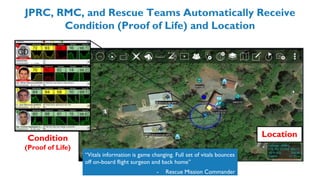
JPRC, RMC, and Rescue Teams Automatically Receive
Condition (Proof of Life) and Location
Condition
(Proof of Life)
Location
“Vitals information is game changing. Full set of vitals bounces
off on-board flight surgeon and back home”
- Rescue Mission Commander
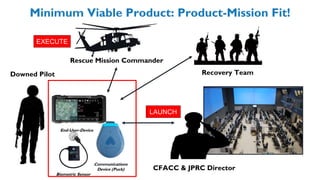
Minimum Viable Product: Product-Mission Fit!
Downed Pilot
CFACC & JPRC Director
Rescue Mission Commander
End-User-Device
Biometric Sensor
Communications
Device (Puck)
Recovery Team
EXECUTE
LAUNCH
Week
Enthusiasm
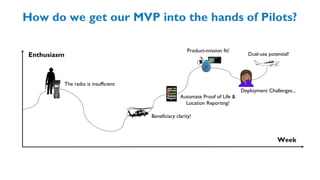
How do we get our MVP into the hands of Pilots?
Product-mission fit!
Dual-use potential!
The radio is insufficient
Automate Proof of Life &
Location Reporting!
Beneficiary clarity!
Deployment Challenges...
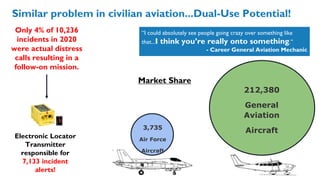
Similar problem in civilian aviation...Dual-Use Potential!
Only 4% of 10,236
incidents in 2020
were actual distress
calls resulting in a
follow-on mission.
212,380
General
Aviation
Aircraft
3,735
Air Force
Aircraft
“I could absolutely see people going crazy over something like
that...I think you’re really onto something.”
- Career General Aviation Mechanic
Electronic Locator
Transmitter
responsible for
7,133 incident
alerts!
Market Share
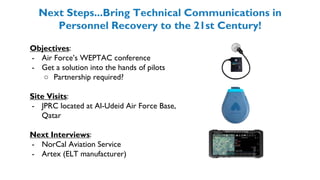
Next Steps...Bring Technical Communications in
Personnel Recovery to the 21st Century!
Objectives:
- Air Force’s WEPTAC conference
- Get a solution into the hands of pilots
○ Partnership required?
Site Visits:
- JPRC located at Al-Udeid Air Force Base,
Qatar
Next Interviews:
- NorCal Aviation Service
- Artex (ELT manufacturer)
Mentors
● Craig Seidel
● LtCol Richard Lawson
● CDR Jack Souders
Sponsor
● Maj Richard Barnes (DIU)
● Mark Breier (In-Q-Tel)
TA: Sally Egan
AngelComms: angelcomms@lists.stanford.edu
Simon Acker
M.S. EE ‘22
B.S. EE ‘21
Johannes Hui
M.A. Intl Policy (ISEC) ‘22
B.S. CS (AI) ‘21
Deborah Jantz
B.A.H. Intl Relations
and Security ‘22
Kyle Thompson
M.A. Intl Policy (Cybersecurity) ‘22
Army Special Forces
Thank you to our interviewees, sponsors,
mentors, and TA!

AngelComms H4D 2021 Lessons Learned

  • 1.
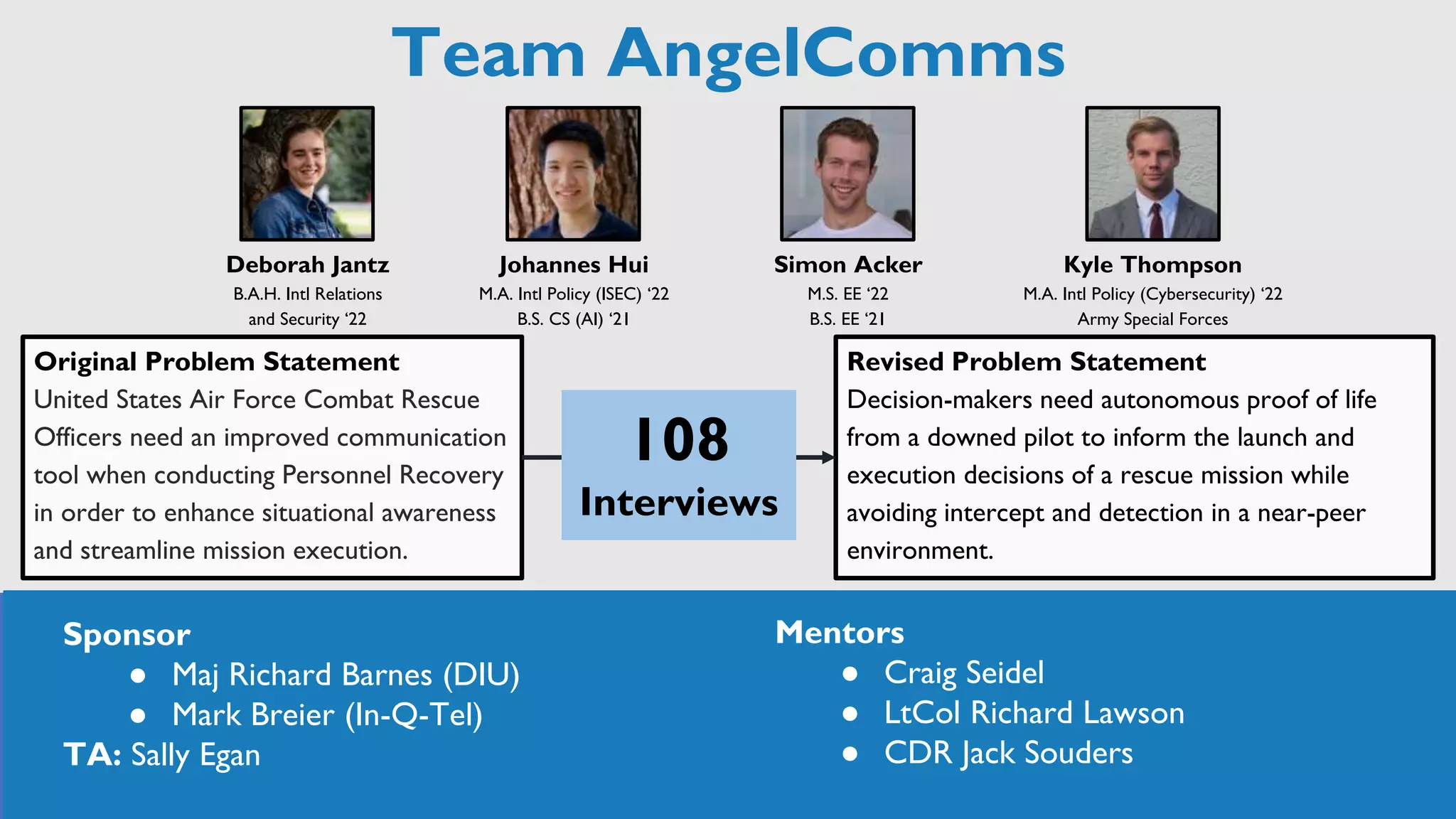
    Mentors ● Craig Seidel ●LtCol Richard Lawson ● CDR Jack Souders Sponsor ● Maj Richard Barnes (DIU) ● Mark Breier (In-Q-Tel) TA: Sally Egan Original Problem Statement United States Air Force Combat Rescue Officers need an improved communication tool when conducting Personnel Recovery in order to enhance situational awareness and streamline mission execution. Revised Problem Statement Decision-makers need autonomous proof of life from a downed pilot to inform the launch and execution decisions of a rescue mission while avoiding intercept and detection in a near-peer environment. Simon Acker M.S. EE ‘22 B.S. EE ‘21 Johannes Hui M.A. Intl Policy (ISEC) ‘22 B.S. CS (AI) ‘21 Deborah Jantz B.A.H. Intl Relations and Security ‘22 Kyle Thompson M.A. Intl Policy (Cybersecurity) ‘22 Army Special Forces 108 Interviews Team AngelComms
  • 2.
    BENEFICIARIES Primary ● Fixed androtary wing pilots ● Personnel recovery teams (PJs and CROs) ● Servicemembers on combat operations Secondary ● Civilian SAR ● Police ● Firefighters ● Outdoor/Adventure Enthusiasts VALUE PROPOSITION ● Automated health condition reporting from biosensors will speed up recovery and allow recovery teams to know needs of isolated person ● User-friendly communications to ease stress on IP and recovery team ● Upgradeable hardware through modular system
  • 3.
    We talked to... TacticalCSAR: 24 Civilian SAR: 9 Commercial Vendors: 26 Decision-Makers: 11 Pilots: 12 Procurement and Deployment Experts: 19
  • 4.
    Radio Specs: • Size •Weight • Power • User Interface Personnel Recovery Isn’t Just About Pilot Preferences
  • 5.
    Value Proposition The radiois insufficient Radio Size, Weight, Power (SWaP) Week Enthusiasm Lack of Automation = the Survival Radio is Insufficient Combat Rescue Officers (CROs, tactical CSAR units) Automated Authentication, Threat, Location, Condition (ATLC) “Confidence in reporting of an event can determine the speed of the rest of the operation.” - Combat Rescue Officer (CRO)
  • 6.
    Value Proposition Automated Authentication, Threat,Location, Condition (ATLC) Radio Size, Weight, Power (SWaP) Combat Rescue Officers (CROs, tactical CSAR units) Week Enthusiasm Who are the beneficiaries? “Critical information is information which alters action. Much of what currently gets reported doesn’t influence our actions.” - Combat Rescue Officer (CRO) The radio is insufficient ?
  • 7.
    Building the Workflow INCIDENTREPORTED Is IP alive? Yes No Threat level? Acceptable EXECUTE Too high Abort Rescue Mission Commander (RMC) How confident are we on validity of report? Not confident Keep gathering info Authentication, Threat, Location, Condition of isolated person? What friendly forces are nearby and what are their capabilities? Immediate Deliberate LAUNCH Who should go/who is equipped? How many can we risk for this? What support do they need? What medical personnel/supplies should they take? PR Event Declared High confidence Joint Personnel Recovery Center (JPRC) Combined Forces Air Component Commander (CFACC) & JPRC Director
  • 8.
    Personnel Recovery Decisions JointPersonnel Recovery Center (JPRC) Combined Forces Air Component Commander (CFACC) & JPRC Director Terminal Area Objective Insertion Point Forward Operating Base Rescue Forces & RMC Airborne Communications Platform LAUNCH EXECUTE
  • 9.
    Value Proposition Radio Size,Weight, Power (SWaP) Combat Rescue Officers (CROs, tactical CSAR units) Week Enthusiasm Beneficiary Clarity! Beneficiary clarity! The radio is insufficient Automated Authentication, Threat, Location, Condition (ATLC) CFACC, JPRC Director & RMC
  • 10.
    Mission Achievement Risk to Isolated Person 4hrs Isolating Event Time “Accordingto numerous historical studies, after four or more hours on the ground, the chance that a survivor in combat will be successfully rescued is historically less than twenty percent.” - JP 3.50 (Personnel Recovery Publication) Launch Launch Decision- Maker Execution Decision- Maker Time! Confidence!
  • 11.
    Execution Decision byRescue Mission Commander (RMC) Joint Personnel Recovery Center (JPRC) Combined Forces Air Component Commander (CFACC) & JPRC Director Terminal Area Objective Forward Operating Base Rescue Forces & RMC Airborne Communications Platform When you don't know [proof of life]...it makes it extremely difficult to decide to risk anyone, much less a helicopter full of five member rescue team. - Air Force Brig Gen Report Needed Updated Report Needed Automation Needed LAUNCH EXECUTE
  • 12.
    Value Proposition Radio Size,Weight, Power (SWaP) Combat Rescue Officers (CROs, tactical CSAR units) Automate Proof of Life and Location Reporting Automated Proof of Life (PoL) & Location Reporting “Proof of life feeds into making a better decision, faster.” - Air Force Brig Gen Week Enthusiasm Automate Proof of Life & Location Reporting! The radio is insufficient Automated Authentication, Threat, Location, Condition (ATLC) Beneficiary clarity! CFACC, JPRC Director & RMC
  • 13.
    BENEFICIARIES Primary ● Decision-Makers (CFACC, JPRCDirector, RMC) ● Servicemembers at high risk of isolation (i.e. downed pilot) Secondary ● Personnel recovery teams (PJs and CROs) Tertiary ● Civilian SAR ● Police ● Firefighters ● Outdoor Enthusiasts VALUE PROPOSITION ● Provide reliable updates of pilot’s condition to inform risk and resource management, reducing time in report phase ● Provide automatic condition reporting capability without need for manual action, reducing time in report phase. ● Provide objective information on IP’s condition to better prepare the rescue team at insertion point.
  • 14.
    Biometric Sensor →Proof of Life/Condition - Heart rate, SpO2, temp, BP, respiratory rate, body temperature - 30 day battery life Downed Pilot End-User-Device → Authentication and Threat - Two-way text - Simple Graphical User Interface - Moving map Over-the-Horizon / Line-of-Sight Puck → Location - LPI/LPD: spread spectrum frequency hopping, hide below noise floor - 30 day battery life Automation - Auto-activation - Interval tracking Integrate and Automate Commercial Solutions
  • 15.
    JPRC, RMC, andRescue Teams Automatically Receive Condition (Proof of Life) and Location Condition (Proof of Life) Location “Vitals information is game changing. Full set of vitals bounces off on-board flight surgeon and back home” - Rescue Mission Commander
  • 16.
    Minimum Viable Product:Product-Mission Fit! Downed Pilot CFACC & JPRC Director Rescue Mission Commander End-User-Device Biometric Sensor Communications Device (Puck) Recovery Team EXECUTE LAUNCH
  • 17.
    Week Enthusiasm How do weget our MVP into the hands of Pilots? Product-mission fit! Dual-use potential! The radio is insufficient Automate Proof of Life & Location Reporting! Beneficiary clarity! Deployment Challenges...
  • 18.
    Similar problem incivilian aviation...Dual-Use Potential! Only 4% of 10,236 incidents in 2020 were actual distress calls resulting in a follow-on mission. 212,380 General Aviation Aircraft 3,735 Air Force Aircraft “I could absolutely see people going crazy over something like that...I think you’re really onto something.” - Career General Aviation Mechanic Electronic Locator Transmitter responsible for 7,133 incident alerts! Market Share
  • 19.
    Next Steps...Bring TechnicalCommunications in Personnel Recovery to the 21st Century! Objectives: - Air Force’s WEPTAC conference - Get a solution into the hands of pilots ○ Partnership required? Site Visits: - JPRC located at Al-Udeid Air Force Base, Qatar Next Interviews: - NorCal Aviation Service - Artex (ELT manufacturer)
  • 20.
    Mentors ● Craig Seidel ●LtCol Richard Lawson ● CDR Jack Souders Sponsor ● Maj Richard Barnes (DIU) ● Mark Breier (In-Q-Tel) TA: Sally Egan AngelComms: angelcomms@lists.stanford.edu Simon Acker M.S. EE ‘22 B.S. EE ‘21 Johannes Hui M.A. Intl Policy (ISEC) ‘22 B.S. CS (AI) ‘21 Deborah Jantz B.A.H. Intl Relations and Security ‘22 Kyle Thompson M.A. Intl Policy (Cybersecurity) ‘22 Army Special Forces Thank you to our interviewees, sponsors, mentors, and TA!